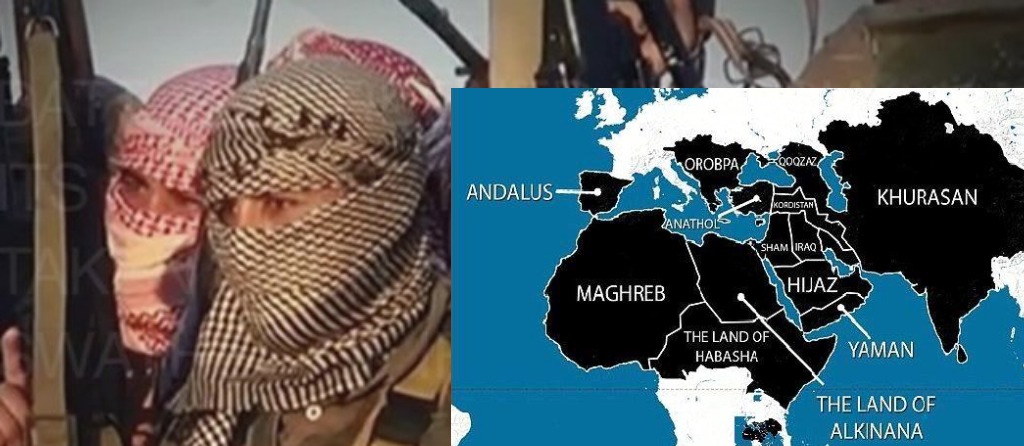
Posted tagged ‘Iran’

On moral blindness

February 27, 2015

On moral blindness, Israel Hayom, Dror Eydar, February 27, 2015

1. Scholars who study our civilization a hundred years in the future will be able to point out the key geopolitical shifts in the Middle East, the collapse of the geographical nations and the return to the ancient social borders, and the rise of radical Islam. They will describe how the Islamic Republic of Iran took over countries like Yemen, Iraq, Syria and Lebanon, its tentacles of terrorism reaching every corner, including Gaza, Judea and Samaria.

They will study the Iranian nuclear issue and be able to quote hundreds of instances in which Iranian leaders vowed to destroy the Jewish state. But when they begin studying the Israeli society of our time, they will encounter a failure of logic. Amid a virtual consensus on preventing an Iranian nuclear bomb, they will not be able to understand the Israeli focus on bottles recycled by the prime minister’s wife, the electrician the prime minister hired and the frivolous reports that grabbed massive headlines while world powers were busy leaving Iran with the ability to manufacture a bomb. They will have trouble understanding what the Jews were arguing about while facing such an obvious threat.

In an effort to solve this mystery, the scholars will turn to historians who studied the 1930s in Europe: Western leaders’ willful blindness to Hitler’s explicit threats; Europe’s desperate longing for reconciliation with the fuhrer. They will review the history of France, which was warned in those years but failed to prepare an army. They will review Neville Chamberlain’s declaration of “peace for our time” while waving a worthless piece of paper. They will examine the history of European Jewry, which failed to accurately read the political map. Among other things, they will look at U.S. Jewry in the 1940s. They may read the memoirs of Rebecca Kook, the daughter of Hillel Kook, a prominent member of the Irgun.

2. In 1940, the members of the Irgun arrived in the U.S. at the behest of Ze’ev Jabotinsky, to recruit a Hebrew army to fight the Nazis alongside the allied forces. In 1942, when the extermination of Europe’s Jewry began to emerge, the delegation changed course and devoted themselves to saving Jewish lives. They had the nerve to challenge the official stance adopted by the Roosevelt administration — accepted with little opposition by the Jewish leaders of the United States — that the only way to save the Jews was to win the war.

The Irgun members pressured the leaders of the free world to make saving Jewish lives a goal of equal importance to winning the war, and to dedicate special resources to making it happen. They focused their efforts on campaigning in the media, among intellectuals, in the U.S. Congress and to the administration. They convinced then-President Franklin D. Roosevelt to establish the War Refugee Board — an executive agency created to save Jews. It is estimated that the board was responsible for saving 200,000 Jewish lives.

The future scholars will delve deep into the battle waged by the Jewish leadership in America against the Irgun’s delegation. The mudslinging campaign against them was not led by the administration. It was spearheaded by House Foreign Affairs Committee Chairman Sol Bloom — a New York Jew, Rabbi Stephen Samuel Wise and Nahum Goldmann of the American Jewish Congress and other Jewish leaders.

Every effort made by the Irgun delegation was met with criticism and active sabotage efforts. They claimed that their activity was too political, too vocal, too aggressive, and that in fact they did not represent anyone. Hundreds of letters were sent to senators and representatives and Jewish leaders. The letters said that the Irgun members were part of a fascist terrorist outfit from Palestine. Jewish activists handed out pamphlets warning that the delegation would bring catastrophe and destruction on the Jewish people.

Several explanations were provided for this hostile behavior. The main explanation was that Jewish leadership’s fear of tarnishing the image of the Jewish community. In a secret British Foreign Office document, Nahum Goldmann was quoted as saying that just as Hitler brought anti-Semitism to Europe, Hillel Kook would bring anti-Semitism to the U.S.

At the end of the 19th century, Germany’s Jews were also fearful of Zionism. It made them susceptible to accusations of dual loyalty, and labeled them as belonging in Palestine. That is why they resisted the Zionist movement and made extra efforts to be even more German than the rest of the Germans.

3. For the last 20 years, Prime Minister Benjamin Netanyahu has been warning anyone who would listen of Iran’s perilous ambitions. Much like Nazi Germany, Iran and radical Islam do not threaten only Israel but the entire free world. But the left-wing liberal mindset, inspired by U.S. President Barack Obama, complacently dismisses these warnings, often with a side of disrespect.

Over the last month, the White House and a long line of cultural figures and politicians have been confronting a far greater threat: Netanyahu’s upcoming speech at the U.S. Congress. The future historians will note the American Jews who disrespected the Israeli prime minister for fighting for the safety of his people. They will add to that list a number of Israelis who took pains to undermine Netanyahu’s legitimacy and sabotage his address.

One of these critics, Peter Beinart, recently slammed Nobel Peace Prize laureate Elie Wiesel for urging Obama to join him at Netanyahu’s address.

“Wiesel is acutely, and understandably, sensitive to the harm Jews suffer. Yet he is largely blind to the harm Jews cause,” Beinart wrote. Cause to whom? To the Palestinians, of course. The American Left is stuck in its 1980s elitist morality that refused to see that the reality has changed.

There is no occupation anymore, Mr. Beinart. Certainly not in the way that you and your friends make it out. The Arabs of Judea and Samaria enjoy expanded autonomy — a de facto state with a national anthem, a flag, a government and enormous budgets. It is true that the IDF is present on the outskirts, because we do not trust our neighbors. But incidentally, they, too, do not trust themselves to ward off Hamas and the radical Islamists. Israel in fact protects the lives of the Palestinian leadership and population from the perils of the Islamic caliphate, which has the ability to turn the lives of these Arabs into a hell devoid of human rights, and heads.

4. This blindness is not just geopolitical, but it is also moral. We are students of the great teacher Rabbi Akiva, who in the second century classified the commandment to “love your neighbor as you love yourself” (Leviticus 19:18) as a great principle of the Torah (Genesis Rabbah 24:7). In this he built on the work of Hillel the Elder who in the first century B.C.E. placed the entire Torah upon the foundation of this dictum (Babylonian Talmud: Tractate Shabbat 31a).

But the same Rabbi Akiva taught us that in the event of a conflict between your life and your neighbor’s life, “your brother shall live with you.” Namely, your own life comes first (Babylonian Talmud: Tractate Baba Mezi’a, 62a). That is the proper way to approach altruistic love. If you do not love your own life, or the lives of your own people, more than the lives of others, especially those who are hostile toward you, then you do not truly possess a moral understanding, but rather a nihilistic intellectualism that plays pretend in living rooms across the east and west coasts of the U.S.

Next Tuesday, truth seekers will be called upon to support Netanyahu when he addresses a joint session of Congress. The State of Israel needs your courageous support.

Special Report: How Iran’s military chiefs operate in Iraq

February 25, 2015

Special Report: How Iran’s military chiefs operate in Iraq, Reuters, February 24, 2015

File photo of a tank belonging to the Shi'ite Badr Brigade militia taking position in front of a gas station in Suleiman Beg, northern IraqA tank belonging to the Shi’ite Badr Brigade militia takes position in front of a gas station in Suleiman Beg, northern Iraq in this September 9, 2014 file photo. CREDIT: REUTERS/AHMED JADALLAH/FILES

The face stares out from multiple billboards in central Baghdad, a grey-haired general casting a watchful eye across the Iraqi capital. This military commander is not Iraqi, though. He’s Iranian.

*********************

(Reuters) – The face stares out from multiple billboards in central Baghdad, a grey-haired general casting a watchful eye across the Iraqi capital. This military commander is not Iraqi, though. He’s Iranian.

The posters are a recent arrival, reflecting the influence Iran now wields in Baghdad.

Iraq is a mainly Arab country. Its citizens, Shi’ite and Sunni Muslims alike, have long mistrusted Iran, the Persian nation to the east. But as Baghdad struggles to fight the Sunni extremist group Islamic State, many Shi’ite Iraqis now look to Iran, a Shi’ite theocracy, as their main ally.

In particular, Iraqi Shi’ites have grown to trust the powerful Iranian-backed militias that have taken charge since the Iraqi army deserted en masse last summer. Dozens of paramilitary groups have united under a secretive branch of the Iraqi government called the Popular Mobilisation Committee, or Hashid Shaabi. Created by Prime Minister Haider al-Abadi’s predecessor Nuri al-Maliki, the official body now takes the lead role in many of Iraq’s security operations. From its position at the nexus between Tehran, the Iraqi government, and the militias, it is increasingly influential in determining the country’s future.

Until now, little has been known about the body. But in a series of interviews with Reuters, key Iraqi figures inside Hashid Shaabi have detailed the ways the paramilitary groups, Baghdad and Iran collaborate, and the role Iranian advisers play both inside the group and on the frontlines.

Those who spoke to Reuters include two senior figures in the Badr Organisation, perhaps the single most powerful Shi’ite paramilitary group, and the commander of a relatively new militia called Saraya al-Khorasani.

In all, Hashid Shaabi oversees and coordinates several dozen factions. The insiders say most of the groups followed a call to arms by Iraq’s leading Shi’ite cleric Grand Ayatollah Ali al-Sistani. But they also cite the religious guidance of Ayatollah Ali Khamenei, the supreme leader of Iran, as a key factor in their decision to fight and – as they see it – defend Iraq.

Hadi al-Amiri, the leader of the Badr Organisation, told Reuters: “The majority of us believe that … Khamenei has all the qualifications as an Islamic leader. He is the leader not only for Iranians but the Islamic nation. I believe so and I take pride in it.”

He insisted there was no conflict between his role as an Iraqi political and military leader and his fealty to Khamenei.

“Khamenei would place the interests of the Iraqi people above all else,” Amiri said.

FROM BATTLEFIELD TO HOSPITAL

Hashid Shaabi is headed by Jamal Jaafar Mohammed, better known by his nom de guerre Abu Mahdi al-Mohandis, a former Badr commander who once plotted against Saddam Hussein and whom American officials have accused of bombing the U.S. embassy in Kuwait in 1983.

Iraqi officials say Mohandis is the right-hand man of Qassem Soleimani, head of the Quds Force, part of Iran’s Revolutionary Guard. Mohandis is praised by some militia fighters as “the commander of all troops” whose “word is like a sword above all groups.”

The body he heads helps coordinate everything from logistics to military operations against Islamic State. Its members say Mohandis’ close friendships with both Soleimani and Amiri helps anchor the collaboration.

The men have known each other for more than 20 years, according to Muen al-Kadhimi, a Badr Organisation leader in western Baghdad. “If we look at this history,” Kadhimi said, “it helped significantly in organizing the Hashid Shaabi and creating a force that achieved a victory that 250,000 (Iraqi) soldiers and 600,000 interior ministry police failed to do.”

Kadhimi said the main leadership team usually consulted for three to four weeks before major military campaigns. “We look at the battle from all directions, from first determining the field … how to distribute assignments within the Hashid Shaabi battalions, consult battalion commanders and the logistics,” he said.

Soleimani, he said, “participates in the operation command center from the start of the battle to the end, and the last thing (he) does is visit the battle’s wounded in the hospital.”

Iraqi and Kurdish officials put the number of Iranian advisers in Iraq between 100 and several hundred – fewer than the nearly 3,000 American officers training Iraqi forces. In many ways, though, the Iranians are a far more influential force.

Iraqi officials say Tehran’s involvement is driven by its belief that Islamic State is an immediate danger to Shi’ite religious shrines not just in Iraq but also in Iran. Shrines in both nations, but especially in Iraq, rank among the sect’s most sacred.

The Iranians, the Iraqi officials say, helped organize the Shi’ite volunteers and militia forces after Grand Ayatollah Sistani called on Iraqis to defend their country days after Islamic State seized control of the northern city of Mosul last June.

Prime Minister Abadi has said Iran has provided Iraqi forces and militia volunteers with weapons and ammunition from the first days of the war with Islamic State.

They have also provided troops. Several Kurdish officials said that when Islamic State fighters pushed close to the Iraq-Iran border in late summer, Iran dispatched artillery units to Iraq to fight them. Farid Asarsad, a senior official from the semi-autonomous Iraqi region of Kurdistan, said Iranian troops often work with Iraqi forces. In northern Iraq, Kurdish peshmerga soldiers “dealt with the technical issues like identifying targets in battle, but the launching of rockets and artillery – the Iranians were the ones who did that.”

Kadhimi, the senior Badr official, said Iranian advisers in Iraq have helped with everything from tactics to providing paramilitary groups with drone and signals capabilities, including electronic surveillance and radio communications.

“The U.S. stayed all these years with the Iraqi army and never taught them to use drones or how to operate a very sophisticated communication network, or how to intercept the enemy’s communication,” he said. “The Hashid Shaabi, with the help of (Iranian) advisers, now knows how to operate and manufacture drones.”

A MAGICAL FIGHTER

One of the Shi’ite militia groups that best shows Iran’s influence in Iraq is Saraya al-Khorasani. It was formed in 2013 in response to Khamenei’s call to fight Sunni jihadists, initially in Syria and later Iraq.

The group is responsible for the Baghdad billboards that feature Iranian General Hamid Taghavi, a member of the Iranian Revolutionary Guard. Known to militia members as Abu Mariam, Taghavi was killed in northern Iraq in December. He has become a hero for many of Iraq’s Shi’ite fighters.

Taghavi “was an expert at guerrilla war,” said Ali al-Yasiri, the commander of Saraya al-Khorasani. “People looked at him as magical.”

In a video posted online by the Khorasani group soon after Taghavi’s death, the Iranian general squats on the battlefield, giving orders as bullets snap overhead. Around him, young Iraqi fighters with AK-47s press themselves tightly against the ground. The general wears rumpled fatigues and has a calm, grandfatherly demeanor. Later in the video, he rallies his fighters, encouraging them to run forward to attack positions.

Within two days of Mosul’s fall on June 10 last year, Taghavi, a member of Iran’s minority Arab population, traveled to Iraq with members of Iran’s regular military and the Revolutionary Guard. Soon, he was helping map out a way to outflank Islamic State outside Balad, 50 miles (80 km) north of Baghdad.

Taghavi’s time with Saraya al-Khorasani proved a boon for the group. Its numbers swelled from 1,500 to 3,000. It now boasts artillery, heavy machine guns, and 23 military Humvees, many of them captured from Islamic State.

“Of course, they are good,” Yasiri said with a grin. “They are American made.”

In November, Taghavi was back in Iraq for a Shi’ite militia offensive near the Iranian border. Yasiri said Taghavi formulated a plan to “encircle and besiege” Islamic State in the towns of Jalawala and Saadiya. After success with that, he began to plot the next battle. Yasiri urged him to be more cautious, but Taghavi was killed by a sniper in December.

At Taghavi’s funeral, the head of Iran’s Supreme National Security Council, Ali Shamkhani, eulogized the slain commander. He was, said Shamkhani, one of those Iranians in Iraq”defending Samarra and giving their blood so we don’t have to give our blood in Tehran.” Both Soleimani and the Badr Organisation’s Amiri were among the mourners.

A NEW IRAQI SOUL

Saraya al-Khorasani’s headquarters sit in eastern Baghdad, inside an exclusive government complex that houses ministers and members of parliament. Giant pictures of Taghavi and other slain al-Khorasani fighters hang from the exterior walls of the group’s villa.

Commander Yasiri walks with a cane after he was wounded in his left leg during a battle in eastern Diyala in November. On his desk sits a small framed drawing of Iran’s Khamenei.

He describes Saraya al-Khorasani, along with Badr and several other groups, as “the soul” of Iraq’s Hashid Shaabi committee.

Not everyone agrees. A senior Shi’ite official in the Iraqi government took a more critical view, saying Saraya al-Khorasani and the other militias were tools of Tehran. “They are an Iranian-made group that was established by Taghavi. Because of their close ties with Iranians for weapons and ammunition, they are so effective,” the official said.

Asarsad, the senior Kurdish official, predicts Iraq’s Shi’ite militias will evolve into a permanent force that resembles the Iranian Revolutionary Guard. That sectarian force, he believes, will one day operate in tandem with Iraq’s regular military.

“There will be two armies in Iraq,” he said.

That could have big implications for the country’s future. Human rights groups have accused the Shi’ite militias of displacing and killing Sunnis in areas they liberate — a charge the paramilitary commanders vigorously deny. The militias blame any excesses on locals and accuse Sunni politicians of spreading rumors to sully the name of Hashid Shaabi.

The senior Shi’ite official critical of Saraya al-Khorasani said the militia groups, which have the freedom to operate without directly consulting the army or the prime minister, could yet undermine Iraq’s stability. The official described Badr as by far the most powerful force in the country, even stronger than Prime Minister Abadi.

Amiri, the Badr leader, rejected such claims. He said he presents his military plans directly to Abadi for approval.

His deputy Kadhimi was in no doubt, though, that the Hashid Shaabi was more powerful than the Iraqi military.

“A Hashid Shaabi (soldier) sees his commander … or Haji Hadi Amiri or Haji Mohandis or even Haji Qassem Soleimani in the battle, eating with them, sitting with them on the ground, joking with them. This is why they are ready to fight,” said Kadhimi. “This is why it is an invincible force.”

From The Mediterranean to the Golan, Iran Builds Active Front And Direct Military Presence

February 23, 2015

From The Mediterranean to the Golan, Iran Builds Active Front And Direct Military Presence On Israel’s Border To Deter Israel And Further Ideology Of Eliminating The Zionist Regime

By: Y. Carmon and Y. Yehoshua*

February 16, 2015

via From The Mediterranean to the Golan, Iran Builds Active Front And Direct Military Presence On Israel’s Border To Deter Israel And Further Ideology Of Eliminating The Zionist Regime.


Israel faces a fateful crisis. As much as it feared the Iranian nuclear program, it never imagined that Iran would be standing on its border even before its nuclear agreement with the Americans was complete. The Iranian threat to Israel is no longer theoretical, nor does it have anything to do with Israel’s deterrent of using its nuclear weapons, which cannot be used considering the international power balance. The threat has become direct, practical and conventional.”[1]

Introduction

In recent years, Iran has based its deployment in Syria on the establishment of a new Hizbullah Syria organization along the lines of Hizbullah Lebanon, as well as on the direct presence of Iranian forces in Syria, particularly in the Golan Heights.

Iran’s deployment in Syria, and particularly the presence of its forces in the Golan Heights, at first only as command posts and a limited number of special forces, reveals a trend of Iranian activity in the region that is direct, not only by proxy as it has been to date. According to the Iranian plan, the command posts are meant to operate “130,000 trained Iranian Basij fighters waiting to enter Syria,” as is evident from May 2014 statements by Islamic Revolutionary Guards Corps (IRGC) senior official Hossein Hamedani, that were censored and removed immediately after publication in Iran.[2]

Statements expressing intent to establish a front of anti-Israel activity in the Golan were heard from Iranian and Syrian officials as early as 2013, and have been implemented openly and in practice  in the past two years (see MEMRI Special Dispatch No. 5307, Assad And His Allies Threaten To Open A Front In Golan Heights, May 21, 2013). During this time, there were also a few terror operations as well as operations to collect intelligence information in the Golan, which Israel claims were carried out by Hizbullah and Iranian elements; for example, there have been rocket fire, roadside bombs, drones launched, and weapons transferred to Hizbullah. Israel for its part has carried out pinpoint counter-operations inside Syrian territory, such as bombing missile deliveries and attacking senior Iranian officials in Syria, for example, the January 2015 assassination of Gen. Mohammad Ali Allahdadi and other IRGC soldiers who have not been publicly identified, alongside several Hizbullah operatives, and the February 2013 assassination of top IRGC official Hassan Shateri, which Iran claims was carried out by Israel.[3]

Iran’s direct deployment in the Golan creates a single battle front against Israel from Rosh HaNikra to Quneitra.[4] It also constitutes a violation of the status quo of the Golan Heights front, which has been quiet since the Separation of Forces Agreement of 1974,[5] and comes on top of Hizbullah’s violations of U.N. Security Council Resolution 1701.[6] Syrian Foreign Minister Walid Al-Mu’allem said in an interview on Iran’s Al-Alam TV channel that “there is resistance in the Golan that is acting against Jabhat Al-Nusra and against the Israeli plans.”[7] Lebanese analyst Anis Naqash, who is close to Hizbullah, also said that “there is indeed resistance in the Golan.” According to him, there have been several actions against Israel by the Golan resistance, which he called popular Syrian resistance, and Israel has not acknowledged this so as to not reveal its helplessness. Regarding the violation of Resolution 1701 he said: “From the onset there was confusion about it. We – the resistance camp – violated Resolution 1701 from the moment they began implementing it.”[8]

Furthermore, Iran’s deployment on the border has implications for the chances of a war breaking out in the region and for the character of such a war. This, because it increases the possibility that any local eruption could quickly develop into a regional conflict, since Iran now commands the theater that stretches from Iran and Iraq through Syria and Lebanon and the Mediterranean.[9] It should be noted that Hizbullah’s January 28, 2015 retaliatory attack against Israel’s January 18 attack in itself did not develop into a broader conflict only because Israel refrained from responding to it. A senior Iranian spokesman assessed that this was due to Israel’s “intense fear of the outbreak of an all-out war.”[10]

Iran’s aim in deploying in the Golan Heights is not only to deter Israel from acting against its nuclear program, defend Syria as part of the resistance axis, and establish an active front for anti-Israel terror attacks in the Golan and even liberate the Israeli Golan. It also meshes with the Iranian regime’s ideological perception of Israel as an entity that must be eliminated, as is evident in statements by Iranian Supreme Leader Ali Khamenei. According to this perception, the West Bank must be armed, as the Gaza Strip was, in advance of eliminating the state of Israel.

It should be noted that in addition to its deployment for the purpose of eliminating the state of Israel, Iran is building capabilities and ways of operating against Israel and against Jewish/Israeli targets worldwide; these are occasionally put into action.[11]

Iran’s front on Israel’s northern border, in addition to its involvement in other arenas in the region, creates tremendous pressure on its dwindling resources and exhausts it, intensifying its dependence on regional forces. But the export of Iran’s Islamic Revolution always contributes directly to the survival of the Iranian regime. This is because the mobilization of Iranian national forces and Iranian youth in the ideological framework of struggle outside Iran inoculates Iran’s dictatorial regime against internal uprising and rebellion against it.

I. Regional Background: Under Guise Of Fighting Sunni Jihadi Organizations, Iran Deploys On Israel’s Border

In recent years Iran has taken advantage of the fact that the theater between Iraq and the Mediterranean – that is, Iraq, Syria, and Lebanon – has become a veritable no man’s land like Afghanistan, and has tightened its grip there and built up its deployment vis-a-vis Israel. Following the abandonment of the Syrian theater by the West, primarily the U.S., and the absence of any operation to decide the conflict following the Syrian uprising, Syria has become an arena of regional and global conflict. Participating in this conflict are fighters in the global jihad, such as Jabhat Al-Nusra and the Islamic State (ISIS), which have the support of Sunni elements, and on the other side Iran and its satellites, such as Hizbullah Lebanon and Hizbullah Syria, as well as the Iraqi militia Asa’ib ‘Ahl Al-Haqq and “the Fatimiyyoun Brigade” of Afghan Shi’ites.[12]

The West’s nonintervention in Syria has spawned not only Iran’s infiltration into that country but also its infiltration into two additional theaters where it has tightened its grip. First, the non-intervention has brought about the undermining of the situation in Lebanon, where in addition to the influx of millions of refugees and the collapse of the political system, the country has become an arena of conflict between Iran and the Sunni jihadis. Likewise, it has brought about the complete undermining of the situation in Iraq, where ISIS – which first established itself in Syria – has invaded the Sunni region and has consolidated its status there. The Iraqi army has collapsed, leading to the emergence on the ground of pro-Iran militias and of troops of the IRGC’s Qods Force, which is headed by Qassem Soleimani.[13]

Thus, Iran has created for itself a single theater of operation stretching from Iran to the Mediterranean, as Iranian officials describe it. For example, Yahya Rahim Safavi, former IRGC commander and security affairs advisor to Supreme Leader Ali Khamenei, boasted in May 2014: “Our strategic depth reaches to the Mediterranean, and above Israel’s head.”[14] In recent similar statements, Ali Saeedi, Khamenei’s representative in the IRGC, said: “The borders of Islamic Iran have expanded [all the way] to the shores of the Mediterranean, and the countries of the region are supported by Iran.” He said further that “we must prepare the ground for the globalization of the Islamic Revolution.”[15] In another speech, he said: “In the past, our borders were Haji Omran [on the Iran-Iraq border], while today our borders are the shore of the Mediterranean and Bab El-Mandeb [in Yemen].”[16] IRGC commander Mohammad Ali Jafari said: “Today, the borders of Islamic Iran and [its Islamic] Revolution have expanded, and we are not defending our country from its own borders but are standing fast and fighting together with our Shi’ite and Sunni brothers against the front of the arrogance [i.e. the West, headed by the U.S.] many kilometers from Iran’s borders.”[17]

In deploying directly on Israel’s border, Iran has effectively become a country neighboring Israel, despite being geographically distant, while Syria and Lebanon have become components in a broader Iran-led regional resistance entity bordering Israel.

II. Building A Single Conflict Front With Israel From Rosh HaNikra To Quneitra

Implementing the statements it has made over the past two years, Iran has created a single conflict front with Israel stretching from Rosh HaNikra to Quneitra, where it and its satellites, Hizbullah Lebanon and Hizbullah Syria, operate freely against Israel in violation of UN Resolution 1701 and while changing the status quo that has existed between Israel and Syria since the Separation of Forces Agreement of 1974.

As part of this implementation, the Syrian Golan has become an Iranian theater of operation as well. This strategic Iranian presence in the Golan was at first clandestine, under the auspices of “defending the resistance axis” and in the name of “the war on Sunni terrorism,” but later became public, and was accompanied by open threats to target Israel from the Syrian border. Thus, for example, in response to a May 2013 Israeli airstrike in the Damascus area targeting Fateh-110 long-range missiles being transferred from Iran to Hizbullah, spokesmen in Iran, Syria, and Hizbullah issued statements regarding the need for resistance in the Golan.[18] At a May 7, 2013 meeting with Iranian foreign minister Ali Akbar Salehi, Syrian President Bashar Al-Assad announced, “The Golan will become a front of resistance.”[19] Iranian Army chief of staff Hassan Firouzabadi also revealed that “according to Assad’s strategic decision, a popular resistance based on the Hizbullah template is being established across Syria.”[20]

In their statements, the top leaders of the resistance axis stress that, in addition to forming an active front in the Syrian Golan vis-a-vis Israel, the axis means to actually “liberate the Syrian Golan” from Israeli control. The deputy of the Iranian chief of staff, Mas’oud Jazeyeri, promised that the region would see many changes, “some of which will pass through the Golan,” and added that “the liberation of the Golan is not impossible.”[21] Hizbullah secretary-general Hassan Nasrallah announced, for his part, that his organization would aid the Syrian resistance “in order to liberate the Syrian Golan.”[22] Nahed Hattar wrote in the Lebanese Al-Akhbar  that “ending the Syria war [i.e., expelling the jihad organizations from it] is meaningless without wresting the Golan from Israeli hands.”[23]

In the framework of this plan for creating a single front from Rosh HaNikra to Quneitra, Hizbullah Lebanon is ignoring the Lebanon-Syria border and is operating freely in Syria, particularly in the Golan, despite criticism in Lebanon.[24] Nasrallah’s January 30, 2015 speech, delivered two days after Hizbullah’s counterattack following Israel’s January 18 attack in Quneitra, amounted to an acknowledgement of a reality in which “there is no recognition of division into arenas” and the resistance is entitled to confront the enemy “wherever it wants and however it wants.” Moreover, in this speech Nasrallah described the death of Hizbullah and IRGC operatives in Israel’s operation as “the mingling of Lebanese blood with Iranian blood on Syrian soil” and stated that this reflected the fact that there is “one cause, one destiny, and one battle.”[25] He also declared in his speech that “the rules of engagement” with Israel had now changed, referring to the rules set out in UN Resolution 1701; as a matter of fact, Hizbullah is indeed violating this resolution in various ways, including with its presence south of Lebanon’s Litani River, alongside the presence of IRGC forces.

III. Elements Of The New Iranian Deployment In Syria: Hizbullah Syria And A Direct Iranian Presence On Israel’s Border

The building of the new Iranian front has two elements: a) establishing a Hizbullah Syria based on the Hizbullah Lebanon model, and b) Iranian forces’ direct involvement in the Golan.

A. Hizbullah Syria – Another Resistance Arm Against Israel

The new Hizbullah Syria is also being established as part of an extensive strategic view and in preparation for the coming conflict with Israel. Senior IRGC official Hossein Hamedani said in a May 2014 speech that “Syria has become a decisive geopolitical region in the regional power balance” and that Iran has established “a second Hizbullah – popular militias in 14 Syrian governorates with 70,000 members, from Syria’s Shi’ites, Sunnis, and Alawites.”[26]

Likewise, an April 21, 2014 analysis published by the moderate conservative Iranian website Farda stated, “The establishment of a Hizbullah Syria, as a bud of resistance, will not only impact the Syrian crisis but will also serve as a mighty arm of the resistance that will give the Zionists nightmares. The Zionist regime, which was previously concerned with the threats along the Lebanese border, must now prepare itself for the new situation. As ongoing events show, the resistance front is uniting from day to day, and the situation for the Zionists and their supporters is worsening.”[27]

Also, Mohammad Reza Naqdi, commander of the Basij paramilitary force, explained: “Hizbullah emerged after the 1982 war in Lebanon. The Palestinian resistance was born after the attacks against Palestine. And today in Syria we are witnessing the establishment of a military force, following the aggression and plots against Syria.” He added, “The resistance force will liberate Jerusalem.”[28]

B. Direct Iranian Activity In The Golan And Lebanon

In the past, Iran preferred to manage the conflict with Israel exclusively through its proxies and allies – Assad and Hizbullah. However, there has recently been open physical presence of IRGC and Qods Force soldiers in Syria, specifically in the Syrian Golan. As mentioned above, Hossein Hamedani, former IRGC commander in the Tehran province, even stated in a speech that “there are 130,000 trained Iranian Basij fighters waiting to enter Syria.”[29]

Arab media also published reports that Iranian forces have been present in the Golan since May 2013. The reports included details provided by Syrian oppositionist circles regarding important bases in the Golan where IRGC forces were present: bases in the Tal Al-Sha’ar area and Tal Al-Ahmar, the Division 90 headquarters, an espionage base near Mazari’ Al-Amal, and a camp in Al-Shuhada.[30]

Testimony also appeared regarding significant IRGC presence on the Israeli-Lebanese border, including on a Twitter account close to the IRGC which posted photos indicating that “the IRGC soldiers of the Islamic revolution are on the border of [Lebanon and] occupied Palestine.”[31] In this context it should be mentioned that, back in January 2012, there was outrage in Lebanon following statements by the commander of the IRGC’s Qods Force, General Qassem Soleimani, who said that “Iran has a presence in South Lebanon and Iraq” and that “these regions are under the influence of the activity and philosophy of the Islamic Republic of Iran.”[32]

The physical presence of senior IRGC generals in the Golan and South Lebanon also indicates the importance of this arena in Iran’s eyes. Examples are presence of Iranian General Mohammad Ali Allahdadi in the Golan, which was exposed after he was killed in an Israeli airstrike in January 2015, and of Iranian General and IRGC commander in Lebanon Hassan Shateri, who was killed in February 2014 in an attack on a military convoy from Damascus to Beirut.[33] This, alongside reports that General Qassem Soleimani was present in Syria in general and in the Quneitra and Dar’a areas in particular.[34]

IV. Calls In Palestinian Resistance Movements To Join Northern Front

Palestinian resistance movements such as Hamas also expressed willingness to join the northern front against Israel by activating Palestinians living in refugee camps there.

Hamas official Mahmoud Al-Zahar called to enable the establishment of military groups belonging to the Al-Qassam Brigades – Hamas’s military wing – in Lebanese and Syrian refugee camps in order “to resist the enemy from northern Palestine.”[35] At the same time, there have been increasing reports recently on renewed Hamas contacts with Iran and Hizbullah, after a period of tension between them due to Hamas’s support for the Syrian revolution.[36]

Abu Ahmad Fouad, deputy secretary-general of the Popular Front for the Liberation of Palestine (PFLP), supported Al-Zahar’s call and said that the establishment of these militias “should take place as part of a general framework of resistance movements, including the Lebanese Hizbullah.” He told the Al-Mayadeen TV channel: “We believe what Hizbullah Secretary-General Hassan Nasrallah said regarding uniting the fronts against the Israeli occupation, and there are ongoing meetings to develop the Palestinian resistance operation and coordinate it with the Lebanese resistance.”[37]

‘Imad Zaqout, news director for Hamas’s Al-Aqsa TV, even admitted for the first time that the ‘Izz Al-Din Al-Qassam Brigades have already operated groups in neighboring countries, and that the rocket fire from Lebanon into Israel during the 2014 conflict in Gaza had been ordered by the Brigades. He added: “Hamas thought and planned for every future war with the Zionist enemy to be a total one. Meaning that it would include every inch of land in Palestine and inflict large-scale damage on the enemy.”[38]

V. The Iranian Front In The Golan – Implementing Iranian Ideological Perception Regarding Need To Eliminate Israel

Constructing a united front from Rosh HaNikra to Quneitra meshes with Iran’s comprehensive strategy to eliminate Israel. Iranian regime heads have repeatedly stated their commitment to this goal over the years, from Supreme Leader Ali Khamenei to other regime and military leaders.[39]

To bring only a handful of examples, in a July 23, 2014 speech, Khamenei said that “the only solution is to destroy the Zionist regime.”[40] Furthermore, Mehdi Taeb, head of Khamenei’s “Ammar Headquarters” think tank and the brother of IRGC intelligence chief Hossein Taeb, said in a November 12, 2014 speech in Qom that “Iran’s sword is currently stuck in the throat of the accursed Israeli regime, and according to the instructions of the founder of the Islamic Republic [Ayatollah Ruhollah] Khomeini, we must remove this oppressive regime from the world map… The Imam Khomeini saw the Basij [as a force] that would destroy the Zionist regime, and today, thanks to divine grace, Iran has besieged Israel with those same popular forces.”[41] Similar statements were repeatedly made by IRGC officials as well. On August 27, 2014, IRGC Deputy Commander Hossein Salami said: “Destroying the Zionist regime is a very simple matter… [It] will take place gradually. It is a matter of divine faith, [it is] more than a mere wish for us.”[42] On November 26, 2014, Basij Commander Mohammad Reza Naqdi said: “The Iranian nation and Basij members are determined to hold victory prayers led by their Imam [Khamenei] at the Al-Aqsa Mosque.”[43] The next day, IRGC navy official Ali Razmjou said that the Zionist regime “will be eliminated from the world map in the near future thanks to the resistance of Basij and Hizbullah members throughout the world.”[44]

VI. Developing The Palestinian Front By Arming West Bank, Israeli Arabs

To comprehensively implement this Iranian strategy to eliminate Israel, in addition to its activity in Syria and the Golan, the Iranian regime has increasingly expressed its intent to arm the West Bank, and even the Israeli Arabs, as it has armed the Gaza Strip.[45] Khamenei called on several occasions to arm the West Bank. In a July 23, 2014 speech, he said: “Allah willing, the day will come when this regime is destroyed. [But] so long as this false regime is on its feet – what is the solution? The solution is total armed resistance against this regime. This is the solution… Therefore, it is my belief that the West Bank should be armed just like Gaza.”[46]  A July 26, 2015 post on Khamenei’s Facebook page said: “The West Bank should be armed like Gaza.”[47]

Other officials also referred to the arming of the West Bank as part of a strategic policy of the Iranian regime. The deputy chair of the Majlis National Security Committee, Mansour Haghighatpour, said: “One of our goals is to arm the West Bank, because it is the best measure for fighting the Zionist regime.”[48] Ahmad Vahidi, who was defense minister under Ahmadinejad and commander of the IRGC Qods Force, said that “arming the West Bank is a strategic policy of the Leader [Khamenei], whose implementation will transform the Palestine arena,” and even called to arm the territories that were conquered in 1948, in addition to the West Bank. [49] Iranian Defense Minister Hossein Dehghan said in a rally honoring the Hizbullah members killed in the Quneitra attack, held on January 27, 2015 at the Hizbullah representation in Tehran: “We will utilize every available capability in order to arm the West Bank… The policy of the Islamic Republic regime is to arm the West Bank and strengthen the resistance axis and the forces of Hizbullah in order to fight the usurping and occupying Zionist regime.”[50]

In an August 29, 2014 message of congratulations to the Palestinian people at the close of the 2014 Gaza conflict, IRGC commander Jafari expressed Iran’s support of the Gaza resistance, while mentioning the hope for the elimination of the Zionist regime. He said: “We shall stand fast with you to the end. Continue to raise the banner of jihad in the path of God, for your honor and the honor of all Muslims is linked to this holy jihad. And know that, with Allah’s help, eliminating this crumbling and bloodthirsty Zionist regime will be the greatest achievement on this divine path, and the final victory is not so far away.”[51]

VII. The Battle In The Dar’a Region – Completing The Siege Around Israel

It should be mentioned that the Syrian army, Hizbullah and Iranian forces recently launched a large-scale joint attack on the southern front to expel the rebels from the Dar’a region. During this campaign, titled “The Quneitra Martyrs Battle,” the Syrian regime admitted openly for the first time that Iranian forces were fighting in Syria alongside Assad’s forces. In addition, Gen. Qassem Soleimani visited the region, and Hizbullah and IRGC flags were flown there.[52]

This joint effort to wrest control of the southern Syria front from the hands of the rebels is regarded by Syria, Iran and Hizbullah as part of their struggle against Israel and its allies. A victory in this region will bring the Iranian forces closer to the Jordanian border in the south and the Israeli border in the west, will prepare the ground for defeating the opposition forces in the Quneitra area, and will enable the creation of a territorial continuum of resistance axis forces stretching from Dar’a through Damascus and Quneitra to Lebanon.

A Syrian army commander admitted on Syrian TV that the operation in the Dar’a region was being carried out “in collaboration with the resistance axis – Hizbullah and Iran.” He added that the goal of the army’s actions in the Dar’a and Quneitra area was “to ensure calm on the borders with the neighboring countries [Israel and Jordan] and disrupt the security zone they are attempting to establish.”[53]

The Al-Hadath News website, which is close to the Syrian regime, also exposed Iran’s involvement  in the fighting, and even posted a photo of Gen. Qassem Soleimani in the area. It reported: “Iran, which had been taking part in the fighting in Syria by means of military advisors within the Syrian army, recently decided to join the military conflict officially and openly.” According to the site, Soleimani arrived in the area “to supervise and follow the campaign in southern Syria, and take part in directing it,” and his presence there lends the campaign “a clear geopolitical military character” that means that “the resistance is calling the shots in southern Syria.” The site added that the first goal of this attack was to defeat the armed opposition forces in Dar’a in advance of defeating them in Quneitra, which would be “a blow to the Zionist enemy.” This, in addition to preventing them from advancing towards Damascus. The site stated further that “southern Syria is clearly no longer involved in an inter-Syrian conflict, or a conflict between Syrians and takfiri forces [i.e., the jihad groups], but rather in a conflict between the resistance axis [comprising] Iran, Syria and Hizbullah on the one hand and the Israel-Jordan-U.S. alliance on the other.”[54]

Ibrahim Al-Amin, board chairman of the Lebanese Al-Akhbar daily, which is close to Hizbullah, wrote on this matter on February 11 that the top leadership of the resistance axis has decided “to create new political, military and security facts [on the ground] along the border between Jordan and occupied Palestine.”[55]

VIII. The Implications Of Iran And Its Proxies Surrounding Israel

Iran’s presence in the Golan, as well as in Lebanon and on the Mediterranean, creates a situation where any local conflict can rapidly escalate into a comprehensive regional war with direct Iranian involvement. Though Nasrallah stressed in his speech in late January 2015 that Hizbullah had completed its punitive measures for the killing of its six operatives in Quneitra, and that it is not interested in war, Iran continues to threaten further attacks, and may arrange further eruptions in the region or outside it by employing Hizbullah cells in various parts of the world.[56] In addition, articles in the Lebanese press spoke of the possible outbreak of a regional war.[57]

As long as Hizbullah operates from Lebanon, Israel is able to deter it, since Israel’s response to an attack from Lebanon employing the full force of Hizbullah’s missile arsenal (comprising over 100,000 missiles) will be the destruction of Lebanon’s infrastructures, a scenario that deters Hizbullah. However, if Hizbullah is activated from outside Lebanon, Israel will not be able to respond in the same manner.

As for Iran, it does not regard itself as deterred by Israel, now that it has built a single, comprehensive front against Israel stretching from the Mediterranean to southern Syria. It also has the capability of activating Hizbullah, despite the heavy price this organization will pay.

In fact, the Syrian front in general, and especially in the Golan, has become Iran’s favored theatre of operations, since acting there diminishes the chance of a war within its own borders. In this context, Khamenei’s advisor Ali Ahmad Velayati said on February 8, 2013 that “Iran has planned its defensive positions outside its own borders, and has linked its fate to the fate of the Islamic countries; this is why it will support those such as [Syrian President] Bashar Al-Assad to the end…”[58] Mehdi Taeb, the head of Khamenei’s “Ammar Headquarters” think tank, said in one of his speeches: “The loss of Syria will lead to the loss of Tehran itself.”[59]

Moreover, Iran’s presence on the Israeli border limits Israel’s ability to use military measures against Iran’s nuclear program. This, since Iran is building up its response capabilities in the region, to complement its long-range missiles. In the past, it was Hizbullah Lebanon that deterred Israel, to some extent, from acting militarily against Iran’s nuclear program. Today this deterrence is significantly strengthened by the advent of Hizbullah Syria and the direct presence of Iranian forces in the Golan.

According to Mehdi Taeb, the centrality of Hizbullah to Iran’s deterrence vis-a-vis Israel was already demonstrated in the 2006 Lebanon war. In a 2013 speech, he said that Iran never had to attack Israel’s nuclear warheads because “we completely locked up [Israel] with Hizbullah. During the 2006 Lebanon war, the Zionist regime tried to break this lock [i.e. Hizbullah], but after 33 days [of fighting], it gave up, and left [Lebanon].”[60]

Al-Akhbar columnist Nahed Al-Hattar also addressed the implications of Iran’s deployment on Israel’s border. He said that, while Israel is unable to use its nuclear capabilities due to international considerations, Iran has created a “practical, direct and conventional” threat against it: “Israel faces a fateful crisis. As much as it feared the Iranian nuclear program, it never imagined that Iran would be standing on its border even before its nuclear agreement with the Americans was complete. The Iranian threat to Israel is no longer theoretical, nor does it have anything to do with Israel’s deterrent of using its nuclear weapons, which cannot be used considering the international power balance. The threat has become direct, practical and conventional.”[61]

*Y. Carmon is President and Founder of MEMRI; Y. Yehoshua is Vice President for Research and Director of MEMRI Israel.

Endnotes:

[1] From a February 13, 2015 article by columnist Nahed Al-Hattar in the Lebanese daily Al-Akhbar.

[2] Fars (Iran), April 5, 2014. See also MEMRI Special Dispatch No. 5848, Iranian Media Reports Deleted Following Publication (1): Senior IRGC Official Speaking On Iran’s Military Involvement In Syria Says Iran Has Established ‘Second Hizbullah’ There, September 25, 2014.

[3] In the last two years, numerous security incidents have occurred on Israel’s northern border. The incidents include the launch of a drone from South Lebanon in April 2013, which, according to Israeli estimates, was carried out by IRGC members; rocket fire towards the Hermon outpost in May 2013; a roadside bomb near the Israeli-Lebanese border in August 2013; roadside bombs on the Israeli-Syrian border in March and October 2014; anti-tank missile fire from Syria towards an Israeli vehicle in June 2014; a drone infiltrating Israel from Quneitra in August 2014; and  rocket fire on the Golan in January 2015. This, alongside Israeli attacks on weapons shipments such as a shipment of SA-17 anti-aircraft missiles to Hizbullah in Syria in January 2013, an attack on a truck convoy carrying missiles and a launcher in February 2014, and an attack on a warehouse storing Russian-made missiles that were on their way from Syria to Lebanon in December 2014.

[4] The notion of a single front from the Rosh HaNikra to Quneitra (i.e., from the Mediterranean to the Golan) was expressed  repeatedly in the Lebanese press. See for example a January 19, 2015 article in the daily Al-Safir, an article by Firas Al-Shoufi from the same date in Al-Akhbar, and Nahed Hattar’s January 21, 2015 article in Al-Akhbar. The head of Al-Akhbar‘s board of directors, Ibrahim Al-Amin, expressed a similar notion in the daily as early as May 27, 2013.

[5] This violation of a decades-long status quo is so grave that, in a late January 2015 interview with Foreign Affairs magazine, Bashar Al-Assad persisted in denying that it was happening, claiming, “Never has an operation against Israel happened through the Golan Heights since the cease-fire in 1974. It has never happened. So for Israel to allege that there was a plan for an operation—that’s a far cry from reality, just an excuse, because they wanted to assassinate somebody from Hizbullah.” Foreign Affairs (U.S.), January 25, 2015.

[6] On Hizbullah’s violations of  Resolution 1701, see MEMRI Special Dispatch No. 5857, “Daily Close To Hizbullah: In Violation Of UNSCR 1701, Hizbullah Has Resumed Operations South Of The Litani River,” October 13, 2014.

[7] Al-Alam TV (Iran), February 2, 2015.

[8] LDC (Lebanon), January 29, 2015.

[9] Many columnists close to Hizbullah and Iran addressed the scenario of an imminent all-out war with Israel. For example, columnist Wafiq Qanso described Hizbullah’s considerations prior to reacting to the Israeli attack as follows: “The time, place, and manner of a reaction  is subject  to the examination of  the leadership of the resistance.” He said that such an examination takes into account several elements, including “the reality in the region and the possibility of a counter-reaction [by Israel] and a slide into extensive war.” Al-Akhbar (Lebanon), January 21, 2015. Lebanese analyst ‘Ali Haidar  wrote: “It is now clear that direct Israeli military intervention will trigger a parallel regional intervention on an [even] larger and more dangerous scale, leading to a scenario of  regional escalation.” Al-Akhbar (Lebanon), February 13, 2015. Iranian analyst Hassan Hanizadeh, who is close to Iranian  regime circles, wrote: “The current confrontation is a prelude to a comprehensive war that will not be confined to South Lebanon, and may even spread  south of Quneitra.” Fars, Iran, January 28, 2015. Al-Akhbar’s Ibrahim Al-Amin wrote, “The possibility of an all-out conflict breaking out that will leave no border between Lebanon and Syria is valid and in effect.” Al-Akhbar, Lebanon, May 27, 2013.

[10]  Brigadier Yadollah Javani, an advisor to Khamenei’s representative in the IRGC, said in a February 15, 2015 interview on Iran’s Al-Alam TV: “Nasrallah announced they [Hizbullah]  would respond to the [January 18] attack, and we saw how this response was carried out. The beauty of it is that the Zionists, for their part, did not respond at all. The reason is their intense fear of the outbreak of an all-out war.”

[11] Recently, many Iran and Hizbullah cells across the world planning attacks against Israeli and Jewish targets were discovered. For example, Uruguay in early January 2015 expelled a top diplomat at the Iranian Embassy in Montevideo on suspicion of his involvement in placing a bomb near the Israeli Embassy in the city; see: English.alarabiya.net, February 6, 2015. Likewise, in April 2014, two Hizbullah operatives planning an attack against Israeli tourists were arrested in Thailand; see: English.alarabiya.net, April 18, 2014. In May 2013, Nigerian security forces uncovered a Hizbullah terror cell that planned to carry out attacks against Israeli targets in the country and in other parts of West Africa. In February 2013, Nigerian security forces uncovered a terror squad operated by the IRGC’s Qods Force that was planning attacks against Chabad House and against offices of the Israeli Zim shipping lines in the city of Lagos. See: Haaretz, IBA, May 30, 2013.

[12] Reports on Iranian forces participating in the fighting in Syria appeared in Iran as early as 2013. See MEMRI Inquiry & Analysis No. 1040, “Despite Denials By Iranian Regime, Statements By Majlis Member And Reports In Iran Indicate Involvement Of Iranian Troops In Syria Fighting,” December 4, 2013.

Recently, Al-Sharq Al-Awsat reported, citing Ahmad Ramadan, a member of the National Coalition for Syrian Revolution and Opposition Forces, that Iran  was airlifting Shi’ite warriors, especially Iraqis and Afghans, to Latakia, Syria, where they are trained by the IRGC before being dispatched to Dar’a. Al-Sharq Al-Awsat, London, February 13, 2015.

[13] See MEMRI Special Dispatch No. 5877, Iranian Campaign Touts IRGC Qods Force Commander Qassem Soleimani As ‘Savior Of Iraq’; Soleimani: Iran Has Thousands Of Organizations Like Hizbullah; I Pray To Die A Martyr, November 10, 2014.

[14] Mehr (Iran), February 5, 2015.

[15] Tasnim (Iran), February 11, 2015.

[16] Tasnim (Iran), February 4, 2015.

[17] Mehr (Iran), January 30, 2015.

[18] See MEMRI Special Dispatch No. 5848, Iranian Media Reports Deleted Following Publication (1): Senior IRGC Official Speaking On Iran’s Military Involvement In Syria Says Iran Has Established ‘Second Hizbullah’ There, September 25, 2014.

[19] Al-Quds Al-Arabi (London), Almayadeen.net, May 7, 2013.

[20] ISNA (Iran), May 11, 2013.

[21] The statements were made in an interview on Hizbullah’s Al-Manar TV. Irinn.ir, May 17, 2013.

[22] Al-Safir (Lebanon), May 10, 2013.

[23] Al-Akhbar (Lebanon), February 13, 2015.

[24] Recently, former Lebanese prime minister Sa’d Al-Hariri, chairman of the Al-Mustaqbal faction, expressed harsh criticism of Hizbullah’s involvement in Syria. In a speech marking the 10th anniversary of the assassination of his father, Rafiq Al-Hariri, he said: “[In the past] we said to Hizbullah: entering the Syrian war is lunacy in itself. It has brought the terrorist insanity into our country. Today we say to it that connecting the Golan with the South [of Lebanon] is also lunacy, and another reason for us to say to it: Get out of Syria. Stop importing Syrian conflagrations into our country, first a terrorist conflagration, then a conflagration from the Golan, and tomorrow who knows where [the conflagration] will come from.” See Youtube.com/watch?v=G90oHQpD-AU#t=174, February 14, 2015.

On earlier criticism inside Lebanon on Hizbullah’s involvement in Syria, see MEMRI Inquiry & Analysis No. 980, Lebanon Openly Enters Fighting In Syria, June 13, 2013. The Lebanese press close to Hizbullah  has since May 2013 mentioned numerous times the notion of abolishing the Lebanon-Syria border and the expansion of the resistance front from Lebanon to Syria in the framework of all-out conflict with Israel. For example, Ibrahim Al-Amin wrote in Al-Akhbar: “Everyone must act based on the expansion in practice of [Israel’s] northern front, [which now stretches from  Lebanon to Syria]. In the near future, we may see the border with Lebanon remaining calm, while the most active front will be on the Palestine-Syria border [in the Golan]… We are simply facing a new level of unity between the resistance in Lebanon and [that in] Syria… such that the possibility of an all-out conflict breaking out that will leave no border between Lebanon and Syria is valid and in effect.” Al-Akhbar, Lebanon, May 27, 2013. Columnist Nahed Hattar wrote in Al-Akhbar recently that the Golan was “a pan-Arab arena shared by the Lebanese, the Syrian, the Jordanian, and the Iraqi [people]. From today onwards, there is no longer room for partial resistance and for partial national plans.” Al-Akhbar, Lebanon, January 23, 2015. See also  MEMRI Inquiry & Analysis No. 1138, Following Killing Of Hizbullah Operative Jihad Mughniyah, New Information Comes To Light Regarding Hizbullah, Iranian Activity In Syrian Golan On Israeli Border, January 28, 2015.

[25] Al-Safir (Lebanon), January 31, 2015. The previous day, similar statements were made by IRGC commander Jafari: “Iran and Hizbullah are one, and everywhere the blood of our martyrs on the front is spilled together, and our response will be the same.” Fars, Iran, January 30, 2015.

[26] Fars (Iran), May 4, 2014. See MEMRI Special Dispatch No. 5848, Iranian Media Reports Deleted Following Publication (1): Senior IRGC Official Speaking On Iran’s Military Involvement In Syria Says Iran Has Established ‘Second Hizbullah’ There, September 25, 2014.

[27] Farda (Iran), April 21, 2014.

[28] Al-Manar TV (Lebanon), May 10, 2013.

[29] Fars (Iran), May 4, 2014.

[30] See MEMRI Inquiry & Analysis Series Report No. 1138, Following Killing Of Hizbullah Operative Jihad Mughniyah, New Information Comes To Light Regarding Hizbullah, Iranian Activity In Syrian Golan On Israeli Border, January 28, 2015.

[31] See MEMRI Special Dispatch No. 5915, Iranian Army Twitter Account, Iranian Army-Affiliated Blog Report: IRGC Troops At Lebanon-Israel Border, December 26, 2014.

[32] ISNA (Iran), January 18, 2012. The Lebanese government requested clarifications on these statements, which resulted in denials by the Iranian foreign ministry. See Fars (Iran), January 25, 2012.

[33] Al-Gumhouriyya (Egypt), Alarabiya.net, February 15, 2014.

[34] The Syrian opposition reported  that  Soleimani was spotted in Quneitra. Al-Nahar (Lebanon), January 19, 2015. Another report indicated that, on January 11, 2015, “Qassem Soleimani visited Damascus on his way to Beirut, where he met with the resistance leadership.” Al-Akhbar (Lebanon), January 21, 2015. There were also reports, accompanied with photos, that Soleimani recently visited the Dar’a region. Alhadathnews.net, February 10, 2015.

[35] Almanar.com, February 4, 2015.

[36] Al-Akhbar (Lebanon), January 10, 2015, October 23, 2014.

[37] Alwatanvoice.com, February 6, 2015.

[38] Alwatanvoice.com, February 6, 2015.

[39] See MEMRI Special Dispatch No. 5906, Iranian Regime Escalates Threats To Annihilate Israel, December 17, 2014.

[40] See MEMRI TV Clip 4366, Iran’s Leader Khamenei: Armed Struggle Should Continue until Israel Is Destroyed by a Referendum, July 23, 2014.

[41] Snn.ir, November 12, 2014.

[42] Fars (Iran), August 27, 2014.

[43] Fars (Iran), November 26, 2014.

[44] IRNA (Iran), November 27, 2014.

[45] See MEMRI Special Dispatch No. 5906, Iranian Regime Escalates Threats To Annihilate Israel, December 17, 2014.

[46] See MEMRI TV Clip No. 4366, “Iran’s Leader Khamenei: Armed Struggle Should Continue until Israel Is Destroyed by a Referendum,” July 23, 2014.

[47] See Special Dispatch No. 5808, “Iranian Supreme Leader Khamenei Calls For The Annihilation Of Israel,” July 28, 2014.

[48] Fars (Iran), November 27, 2014.

[49] Tasnim (Iran), July 26, 2014.

[50] ISNA (Iran), January 27, 2015.

[51] Tasnim (Iran), August 29, 2014.

[52] On Soleimani’s presence in Dar’a, including photos, see Alhadathnews.net, February 11, 2015. There have recently been many other reports in the Arab press on the involvement of Iranian troops in the fighting in Dar’a. See a February 13, 2015 report in the Lebanese  Al-Akhbar, as well as reports in Al-Sharq Al-Awsat  from February 12 and February 13. The February 12 article in Al-Sharq Al-Awsat stated that Hizbullah’s leadership in the area was stationed in a special war room in the 9th Division base in Sanamin, north of Dar’a.

[53] Lbcgrouop.tv; Al-Riyadh (Saudi Arabia), February 12, 2015.

[54] Alhadathnews.net, February 11, 2015.

[55] Al-Akhbar (Lebanon), February 11, 2015.

[56] Iran has made numerous threats to this effect.  IRGC Qods Force deputy commander Esmail Qaani said after the Quneitra attack: “We will not rest until Israel is eliminated,” Mehr (Iran), January 22, 2015. IRGC commander ‘Ali Jafari threatened a response by means of Hizbullah’s cells across the world: “They [Israel] are surely familiar with the capabilities of the Hizbullah cells that have been established  around the  world [to fight] the enemies of Islam, and they fear them. If  they expect Hizbullah to respond to their action, they must expect a firm and crushing response not only in the region of their border but in any part of the world where there are Zionist Israelis or their supporters” Fars (Iran), January 30, 2015.

[57] On this, see note 9.

[58]  Yjc.ir, February 8, 2013.

[59] See MEMRI Inquiry & Analysis No. 946, “Iranian Official: The Loss Of Syria Will Lead To The Loss Of Tehran Itself; Syria Is An Iranian Province; Iran Has Formed A 60,000-Strong Syrian Basij; Israel Is Our Only Threat,” March 11, 2013.

[60] See reference in note 59.

[61] Al-Akhbar (Lebanon), February 13, 2015.

Hero of the Middle East: Abdel Fattah el-Sisi

February 23, 2015

Hero of the Middle East: Abdel Fattah el-Sisi, The Gatestone InstituteBassam Tawil, February 23, 2015

(Please see also Obama kept reform Muslims out of summit on extremism. — DM)

The courageous, historic speech yesterday by the Grand Imam of al-Azhar University, the seat of Sunni Islam, calling for the reform of Islam, was the result of the even more courageous, historic speech delivered a few weeks ago by Egypt’s devoutly Muslim President, Abdel Fattah El-Sisi.

The Muslim Brotherhood, the current American administration’s great friend, is the poison tree whose fruit is the Islamist terrorism embodied by the ISIS, Al-Qaeda, Hamas, Palestinian Islamic Jihad, Al-Nusra Front, Boko Haram and others.

Apparently some of the Sunni Arab States have not yet realized that their own national security, and ability to withstand Iran, depend on how strong Egypt is.

It is possible, in fact, that U.S. policy is to weaken the Sunni world seeking to unite under el-Sisi’s flag of modernity. With European complicity, the U.S. Administration is trying to defraud the Arabs and turn the Israel-Palestine conflict into a center of Middle Eastern chaos, in order to hide the nuclear deal they are concocting with Iran.

The treachery of the U.S. Administration is the reason why Egypt’s faith in the United States, which is supposed to defend the Arabs against a nuclear Iran, has effectively evaporated.

And now the greatest American insanity of all time: America and Turkey are arming and training Islamist terrorist operatives in Turkey, on the ground that they are “moderates” opposed to Bashar Assad’s regime in Syria. They either ignore or are unaware that there is no such thing as a moderate Islamist terrorist. The other name of the “moderates” opposing Assad is ISIS.

The Muslim Brotherhood, in effect, runs Turkey. According to recent rumors, Turkey is also planning to build a nuclear reactor, “for research and peaceful purposes.”

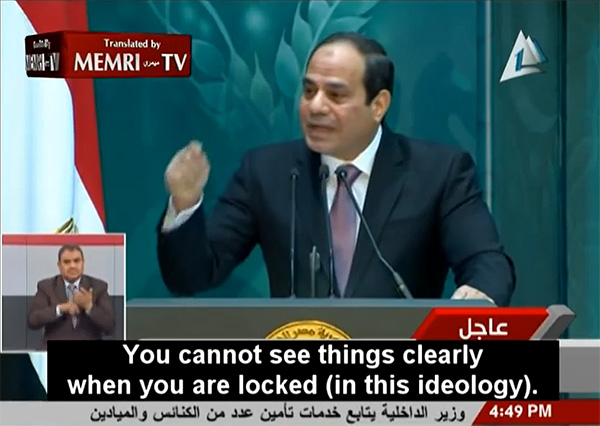
Sheikh Dr. Ahmed al-Tayyeb, the Grand Imam of Cairo’s Al-Azhar University, the seat of Sunni Islam, yesterday delivered a courageous, historic speech in Mecca, Saudi Arabia, urging reform in religious education to curb extremism in Islam. Al-Tayyeb’s address was the result of an even more courageous and historic speech, delivered a few weeks ago by Egypt’s devoutly Muslim President, Abdel Fattah el-Sisi, at Al-Azhar University.

El-Sisi’s monumental statement, truly worthy of a Nobel Prize, is having a seismic result. Al-Sisi directed his remarks, about the ills of Islam to Islamic clerics in Egypt and around the world. It was enormously brave of him. He did not single out radical Islam, but he did call on all Muslims to examine themselves, carry out a religious revolution and renew their faith.

El-Sisi, a man of monumental courage, urged Muslims not to behave according to the ancient, destructive interpretations of the Qur’an and Islam that make the rest of the world hate them, destroy Islam’s reputation and put Muslim immigrants to Western countries in the position of having to fight their hosts. He claimed that it is illogical for over a billion Muslims to aspire to conquer and subdue six billion non-Muslims.

949 (1)Egypt’s President, Abdel Fattah el-Sisi, delivered a historic speech to top Islamic scholars and clergy at Al-Azhar University in Cairo, December 28, 2014. (Image source: MEMRI)

Islam deals in depth with uniting the Muslim nation (umma) and mutual responsibility among Muslims, as though they were one entity. The Prophet Muhammad (S.A.A.W.) said that every drop of Muslim blood is more precious than the entire Kaaba. Thus the liberty ISIS took upon itself to burn alive a Jordanian pilot and 45 Egyptians, to spread terrorism throughout Syria, Iraq and Egypt and to kill other Muslims in various locations around the globe, claiming they were “infidels,” is heresy in and of itself.

The calls for the deaths of “a million shaheeds” and the killing of Jews for the sake of Al-Aqsa mosque in Jerusalem, as was done by Arafat in the past, and is being done now by his heirs in the Palestinian Authority and Hamas, are a crime; they are extremist incitement that is opposed to the forgiving and compromising spirit of Islam. The murder and terrorism carried out by terrorist organizations such as ISIS, Hamas, Palestinian Islamic Jihad [PIJ] and other Islamist organizations against Jews, Christians and other non-Muslims is contrary to the modern Islam needed in the contemporary era.

El-Sisi was correct that the Muslim Brotherhood’s Sunni ideology, which drives most of the extremist Islamist organizations around the world, preaches forced conversion of “infidels” to Islam at any price, or death. Some of the “infidels” are supposed to join Islam of their own accord(targ’ib), out of self-serving interest, and some not of their own accord (tarhib), out of fear and death threats. Such conversions are also contrary to the original Islam, which states that no one is to be forced to convert to Islam and that a calm religious dialogue should be held.

However, a few days after President el-Sisi’s speech, which attempted to unify Muslims and Christian Copts, the Muslim Brotherhood and their affiliated terrorist organizations increased their attacks on Egyptian civilians and security forces throughout Egypt and the Sinai Peninsula, as well as murdering 21 Egyptian Christian Copts in Libya. The Muslim Brotherhood knows that behind the scenes, U.S. President Obama supports the movement, especially the branch in Egypt seeking to overthrow President Sisi. This approval from the U.S. encourages the Muslim Brotherhood to be even more determined to subvert and undermine Egypt’s stability, sabotage its economic rehabilitation and destroy the el-Sisi regime.

In this atmosphere of American support, the Ansar Bayt al-Maqdis terrorist group in the Sinai Peninsula operates under Muslim Brotherhood protection. It recently changed its name to the “Sinai Province” of the Islamic State and swore allegiance to the “Caliph,” Abu Bakr al-Baghdadi. It is currently working hand-in-hand with Hamas in the Gaza Strip to weaken el-Sisi’s Egyptian forces in the Sinai Peninsula.

Other Islamist terrorist organizations also kill Egyptian civilians and security forces with bombs and assault rifles. In the name of the Muslim Brotherhood’s ideology, they indiscriminately attack people on public transport, in airports and in public places, with the intent of retaking control of Egypt.

For this reason, an Egyptian court recently designated Hamas a terrorist organization, along with its military wing, the Izz al-Din al-Qassam Brigades, and outlawed both of them. In response, Qatar, a slippery agent in the service of America but also, treacherously, in the service of Iran, allowed armed Izz al-Din al-Qassam Brigades operatives to be interviewed by its Al-Jazeera TV. The operatives called the Egyptian president a traitor to the Islamic-Arab cause and to those seeking to “liberate Palestine.”

At the same time, Qatar continues to use its Al-Jazeera TV to broadcast hate propaganda targeting the el-Sisi regime, to disseminate videos and to fabricate insulting quotes intended to cause friction between el-Sisi on one side and the leaders of the Arab world and the Gulf States on the other — and to keep them from giving hungry Egyptians economic aid.

As the date for the economic conference in Sharm el-Sheikh (in the Sinai Peninsula) nears, Al-Jazeera’s propaganda machine has moved into ever-higher gear. Apparently, some of the Sunni Arabs states have not yet realized that their own national security and ability to withstand Iran depend on how strong Egypt is.

The U.S. Administration could easily halt the subversion of Egypt, but not only does it turn a blind eye, it suffers from a peculiar form of ignorance that makes it fight ISIS while at the same time supporting the Muslim Brotherhood, the hothouse of most Islamic terrorist organizations, including ISIS. The damage done to Egypt and the cracks in the weak Sunni Muslim ranks in the Middle East will eventually harm American interests and expose the Gulf States to the increasing Iranian threat.

The Muslim Brotherhood, the current American administration’s great friend, is the poison tree whose fruit is the Islamist terrorism embodied by ISIS, Al-Qaeda, Hamas, Palestinian Islamic Jihad, Al-Nusra Front, Boko Haram and others. This linkage has become obvious to all the Arab states, while the U.S. and Europe steadfastly ignore the danger to their own survival, and refuse to outlaw them.

It is possible, in fact, that U.S. policy is to weaken the Sunni world that is seeking to unite under el-Sisi’s flag of modernity. With European complicity, the U.S. Administration is trying to defraud the Arabs and turn the Israeli-Palestinian conflict into a center of Middle Eastern chaos, in order to hide the nuclear deal they are concocting with Iran. That is why the West does not really want to rehabilitate the Palestinian refugees by settling them in the Arab states, and why the West continues to nourish false Palestinian hopes that perpetuate this conflict.

The treachery of the U.S. Administration is the reason why Egyptians’ faith in America, which is supposed to defend the Arabs against a nuclear Iran, has effectively evaporated.

In the meantime, Iran’s Houthi proxies have taken over Yemen, threatening the entire Persian Gulf from the south. The el-Sisi regime is currently in the market for new allies, such as Russian President Vladimir Putin. Putin recently paid a visit to Egypt to examine the possibilities of building a nuclear reactor, sounding the first chord of a regional nuclear arms race.

The problems of the Middle East begin in the United States: that was the claim of participants in the Al-Jazeera TV show, “From Washington.” They described American policy towards Egypt as hesitant, indecisive and undemocratic. They claimed that the U.S. Administration had not yet decided whether or not to support el-Sisi, who heralded change and the willingness to fight radical Islam (a fight America used to participate in) or to remain neutral and waffle, in view of Egypt’s presumed instability. The Americans seem to be putting their all money on the extreme Islamists, who they seem to think will eventually win the bloody conflict currently being waged in Egypt.

The Americans have forgotten that under Mubarak, the regime turned a blind eye to attacks against Israel that were carried out by the Muslim Brotherhood and their carefully fostered agents. Unfortunately, since el-Sisi was elected, Egypt itself has become a victim of radical Islamic terrorism. The U.S. Administration, however, appears clearly to hate el-Sisi, and seems to be doing its utmost to undermine him and see him thrown out.

Under ousted President Mohamed Morsi, Egypt was tolerant and patient toward the U.S. Administration’s best friends, the Muslim Brotherhood, as well as Islamist and Palestinian terrorist organizations such as Hamas, Ansar Bayt al-Maqdis, Al-Qaeda, and Palestinian Islamic Jihad, all of which set up camp in the Sinai Peninsula. These terrorist groups smuggled weapons in from Iran, Sudan, Libya and Lebanon; dug smuggling and attack tunnels; developed missiles and carried out terrorist attacks “only” against Israel, the current U.S. Administration’s other apparent enemy, even though so many American Jews foolishly voted for them.

Now those same Islamist and Palestinian terrorist organizations are striking a mortal blow to the security or Egypt, and killing its civilians and security personnel.

The Muslim Brotherhood, mindful of America’s pro-Islamist policy toward it, is deliberately indulging in a wave of terrorism in Egypt and the Sinai Peninsula. Muslim Brotherhood operatives there are targeting civilians, public transport, airports and natural gas pipelines, all to undermine Egypt’s internal security and bring down el-Sisi’s regime in favor of extremist Islamists and a nuclear-threshold Iran.

In the current international situation, the U.S. Administration has apparently finally cut a deal with Turkey — which will be flimsy and ethereal — that allows Turkey to do the only thing it really cares about: to bring down the regime of Syria’s President, Bashar al-Assad.

The U.S. is also trying to cut a deal with Qatar, which along with Turkey openly supports the Muslim Brotherhood and its terrorist proxies in Egypt, Gaza, Syria and Iraq, who in general work against Western interests.

The ironic result is that Turkey plays host to both NATO and senior Hamas figures, while it deliberately ignores the slaughter by ISIS of Kurds and other ethnic minorities in Iraq and Syria. The Muslim Brotherhood, in effect, actually rules Turkey. Turkey’s President Recep Tayyip Erdogan and his AKP party make it easy for foreign fighters to cross the Turkish border into Syria and join the ranks of ISIS. Meanwhile, the Turkish government wages a diversionary propaganda war against Israel. According to recent rumors, Turkey is also planning to build a nuclear reactor, “for research and peaceful purposes.”

Another surreal result is that Qatar hosts the U.S. military bases, while it finances and encourages terrorist organizations operating against Israel and the Egypt. It also panders to Sheikh Yusuf al-Qaradawi, the spiritual mentor of the Muslim Brotherhood, an Islamist terrorist who issues fatwas permitting the murder of civilians and approves death sentences for apostasy.

And now the greatest American insanity of all time: the U.S. and Turkey are arming and training Islamist terrorist operatives in Turkey, on the grounds that they are “moderates” opposed to Bashar Assad’s regime in Syria. They either ignore or are not aware that there is no such thing as a moderate Islamist terrorist.

The other name of the “moderates” opposing Bashar Assad is ISIS; Iran’s Supreme Leader, Ali Khamenei and Hezbollah’s Hassan Nasrallah are now even saying that the U.S. is arming ISIS.

In the meantime, the Egyptian army continues its struggle against Islamist terrorist targets in the Sinai Peninsula and Libya, unaided, and even undermined, by the U.S.

In view of the U.S. Administration’s collaboration with the Muslim Brotherhood and terrorist organizations in the Gaza Strip, I am persuaded that in the near future it will be possible to find a joint Egyptian-Israeli-Palestinian formula for eradicating the Hamas-PIJ enclave of terrorism, this time by Arabs.

Most ironically of all, in the shadow of American zigzagging, a joint Arab-Israeli front is developing against Sunni and Shi’ite radicalism, and the Palestinians can only profit from it. Thus el-Sisi, who, with towering vision and courage, dares to speak openly about the poison tree of radical Islam and its fruit, when others are afraid, is a truly great Islamic hero.

Armageddon in Syria?

February 20, 2015

Armageddon in Syria?

By Jonathan Keiler

via Articles: Armageddon in Syria?.


The Syrian city and province of Da’ara lie hard on the border between Jordan and Syria near the picturesque Yarmouk river gorge. It is an area of dramatic beauty and rugged terrain, difficult for both merchants and armies to cross. Da’ara no doubt emerged, like many ancient sites of importance (such as Megiddo, putative site of Armageddon), because its location allowed the inhabitants to control access into rich lands, making it a profitable and strategically valuable position. Indeed, the British-Arab General John Glubb  Pasha called Da’ara the Therompylae of Syria. It still is today, which is why an Iranian-led army is now trying to bash its way through Da’ara, and from there, into Jordan and Israel.

When it comes to Iran much international diplomacy focuses on that country’s nuclear ambitions. Those concerns are very real, and for Israel, potentially existential. But Iran is not just after securing a nuclear arsenal. It is assiduously seeking to extend its conventional power throughout the region, from Yemen to Iraq. If Iranian-supported forces get through Da’ara, the mullahs will have advanced their ambitions one more step.

Today Da’ara is held by elements of what is left of the so-called Free Syrian Army. Presumably, these are the very people United States supports in the Syrian civil war, except that President Obama is busy forging a strategic alliance with Iran, which very much wants to see Da’ara fall.

The revolt against the regime of Syrian President Bashir Assad began in Da’ara. This gives the area even more importance, since its fall would give a psychological boost to Assad and his masters in Tehran. President Obama set a “red line” for Assad, then he didn’t, then he decided Assad had to go, and now he evidently doesn’t because he’s decided to ally the United States with Assad and Iran against ISIS. So now the rebels in Da’ara are being left to fend for themselves against a combined force of Assad’s Army, Hizb’allah, other Shia mercenaries, and their Iranian advisors. So far, the rebels are holding, though it is unlikely that they can do so for much longer.

While Assad’s goal may be to smash the Da’ara rebels, Iranian aims are much broader. In seizing Da’ara, Iran would control access into southern Syria, thus limiting the ability of American special forces, such as they are, to operate there, and effectively limit Jordanian involvement in the campaign against ISIS. Iran might not be opposed to Jordanian strikes on ISIS, which is in theory a common enemy, but would no doubt relish the ability to gain further leverage over American-led allied operations. And ultimately, Iranian/Syrian forces in Da’ara will threaten the moderate Sunni regime in Amman, which is almost certainly a long-term Iranian objective.

Even more critical to the Iranians is access to the Golan Heights. Iran has sought to install a Hizb’allah presence on the Golan Heights for some time now. Hizb’allah already poses a significant threat to Israel from Lebanon, but its political position in that country creates problems, as combat with Israel inevitably costs Lebanon dearly, a price which the Lebanese people are increasingly unwilling to pay. On the other hand, the Syrian Golan, which is a sparsely populated, heavily-fortified military zone, would be a near perfect launching point for Hizb’allah attacks into Israel.

Free Syrian forces in the northern Golan have clashed repeatedly with Assad’s forces around the mostly destroyed regional capital of Quneitra, which was the focus of fierce fighting in the 1973 Yom Kippur War. Israel has maintained a strong presence in the northern Golan since that time, making this area a tough one for Iranian/Hizb’allah encroachment. Israel annihilated a small joint Hizb’allah-Iranian foray into the northern Golan in January with an airstrike. Hizb’allah responded shortly afterward with a limited attack into Israel from Lebanon. The offensive into Da’ara is an Iranian move against the southern Golan following the check in the north.

The southern Golan offers opportunities to the Iranians that the northern Golan does not. It would give Iran a presence at the meeting point of Syria, Israel, and Jordan.  It would also place the Iranians astride the Yarmouk River, which is the largest tributary of the Jordan, the vital water resource for Israel, Jordan, and the Palestinian-administered areas of the West Bank.  Plus, the rugged terrain would provide opportunities for Iranian/Hizb’allah mischief.

In the early 1980s, I was a kibbutz volunteer on the southern Golan at Afik, before it was a vacation spot. Afik is only a few miles from the Ruqqad wadi (itself a tributary of the Yarmouk) and the Syrian border. Militarily, this area has been a backwater compared to the rest of the Golan, the gorge providing a natural anti-tank barrier. If anything, the area resembles southern Lebanon, where Hizb’allah has demonstrated it excels at a quasi-conventional warfare of anti-tank missile attacks, commando strikes and indirect rocket fire. The area still harbors gazelle and wild boar, which makes identifying intrusions all the more difficult. During my time there, an IDF field intelligence unit (which a cousin at one point commanded) used then state-of-the-art ground surveillance radars (mounted in typical make-do Israeli fashion on World War II era M3 half-tracks) to identify threats. Today, surveillance technology has much improved, but so has the threat. Iran would like nothing better than to turn the southern Golan and its thriving nearby towns and kibbutzim into a new Lebanon-like front against Israel.

Iran’s moves to control the Syrian Golan are sometimes presented as an attempt to deter Israeli action against its nuclear program by providing additional launching points for Hizb’allah missiles. While to some extent this is probably true, it is also way too exculpatory. So far, despite more than a decade of intense speculation, Israel has not attacked Iran. Iranian deterrence (though Hizb’allah in Lebanon, the threat of terrorism, its own long-range missile forces, and diplomatic maneuvering) has so far worked adequately. The idea that a few more Hizb’allah rockets on the Golan would make a great deal of difference is quite a stretch.  But why should Iran mind when its goals are described, even by its critics, in such a passive manner?

In reality, Iran is building a conventional threat against Israel that is immediate and real.  An Israeli air campaign against the joint Syrian/Iranian/Hizb’allah offensive at Da’ara would likely frustrate the effort. That would also likely necessitate air strikes against Syrian anti-aircraft missiles, and perhaps dogfights against Syrian aircraft, all of which are under the effective command/control of Iran, if not manned by Iranian crews. But President Obama has effectively allied the United States with Syria and Iran in the campaign (such as it is) against ISIS. As part of that devil’s bargain, Syrian antiaircraft positions and aircraft cannot be molested by American flyers.

Were Israel to attack at Da’ara, Obama would no doubt see it as a direct assault on his own objectives in the area, thus making Israel a direct adversary of the United States, which is probably something he would relish.  Thus, at the Da’ara gap is Israel presented with a true Hobson’s choice, to either attack with all the attendant risks, or to do nothing and let Iran into the Golan. Perhaps Armageddon begins at Da’ara, not Megiddo.

Aiding Islamic Terrorists Is Our Foreign Policy

February 20, 2015

Aiding Islamic Terrorists Is Our Foreign Policy, Front Page Magazine, Daniel Greenfield, February 20, 2015

s3tttf7n-14138040081-370x350

In the White House, Obama has tried to shape an Islamist future for the Middle East, favoring Islamist governments in Turkey and Islamist movements such as the Muslim Brotherhood. He saw his role as paving the way for the next generation of regional regimes that would be explicitly Islamist.Obama’s foreign policy in the region has been an elaborate exercise in trying to draw up new maps for a caliphate. The inclusion of terrorist groups in this program isn’t a mistake. It’s not naiveté or blindness. It’s the whole point of the exercise which was to transform terrorist groups into governments.

Obama’s foreign policy in the region has been an elaborate exercise in trying to draw up new maps for a caliphate. The inclusion of terrorist groups in this program isn’t a mistake. It’s not naiveté or blindness. It’s the whole point of the exercise which was to transform terrorist groups into governments.

******************

Obama says that we are not fighting a war on Islam. What he leaves out is that under his administration the United States is fighting in a civil war that is taking place within Islam.

It’s not a conflict between the proverbial moderate Muslim and the raging fanatic. That was an outdated Bush era notion. Instead Obama has brought us into a fight between Muslim governments and Muslim terrorists, not on the side of the governments we were allied with, but on the side of the terrorists.

It’s why Egypt is shopping for French planes and Russian nukes. Yemen’s government was run out of town by Obama’s new Iranian friends in a proxy war with Saudi Arabia. And the Saudis are dumping oil.

Iran and Qatar are the regional powers Obama is closest to. What these two countries have in common, is that despite their mutual hostility, they are both international state sponsors of Islamic terrorism.

Obama’s diplomats will be negotiating with the Taliban in Qatar. Among the Taliban delegation will be the terrorist leaders that Obama freed from Gitmo. And Iran gets anything it wants, from Yemen to the bomb, by using the threat of walking away in a huff from the hoax nuclear negotiations as leverage.

In Syria and Iraq, Obama is fighting ISIS alongside Islamic terrorists linked to Al Qaeda and Iran. In Libya, he overthrew a government in support of Islamic terrorists. His administration has spoken out against Egyptian air strikes against the Islamic State Jihadists in Libya who had beheaded Coptic Christians.

At the prayer breakfast where he denounced Christianity for the Crusades was the foreign minister of the Muslim Brotherhood government of Sudan that has massacred Christians. Unlike Libya, where Obama used a false claim of genocide to justify an illegal war, Sudan actually has committed genocide. And yet Obama ruled out using force against Sudan’s genocide even while he was running for office.

The United States now has a strange two-tier relationship with the Middle East. On paper we retain a number of traditional alliances with old allies such as Egypt, Israel and Saudi Arabia, complete with arms sales, foreign aid and florid speeches. But when it comes to policy, our new friends are the terrorists.

American foreign policy is no longer guided by national interests. Our allies have no input in it. It is shaped around the whims of Qatar and Iran; it’s guided by the Muslim Brotherhood and defined by the interests of state sponsors of terror. Our foreign policy is a policy of aiding Islamic terrorists.

It’s only a question of which terrorists.

Obama’s familiar argument is that ISIS and Al Qaeda fighters shouldn’t be called Islamic terrorists. Not even the politically correct sop of “Radical Islam” is acceptable. The terrorists are perverting Islam, he claims. The claim was banal even before September 11, but it bears an entirely new significance from an administration that has put Muslim Brotherhood operatives into key positions.

The administration is asserting the power to decide who is a Muslim. It’s a theological position that means it is taking sides in a Muslim civil war between Islamists.

This position is passed off as a strategy for undermining the terrorists. Refusing to call the Islamic State by its name, using the more derogatory “Daesh,” denying that the Islamic terrorists are acting in the name of Islam, is supposed to inhibit recruitment. This claim is made despite the flood of Muslims leaving the West to join ISIS. If any group should be vulnerable to our propaganda, it should be them.

But that’s not what this is really about.

According recognition to a state is a powerful diplomatic tool for shaping world politics. We refuse to recognize ISIS, as we initially refused to recognize the USSR. Obama resumed diplomatic ties with Cuba. His people negotiate and appease the Taliban even though it was in its own time just as brutal as ISIS.

Obama is not willing to recognize ISIS as Islamic, but he does recognize the Muslim Brotherhood as Islamic. Both are violent and murderous Islamists. But only one of them is “legitimate” in his eyes.

Those choices are not about terrorist recruitment, but about building a particular map of the region. Obama refuses to concede that ISIS is Islamic, not because he worries that it will bring them more followers, this is a tertiary long shot at best, but because he is supporting some of their rivals.

The White House Summit on Countering Violent Extremism has brought a covert strategy out into the spotlight. Despite its name, it’s not countering violence or extremism.

The new director of the Center for Strategic Counterterrorism Communications, the axis of Obama’s CVE strategy, is Rashad Hussain who appeared at Muslim Brotherhood front group events and defended the head of Islamic Jihad. In attendance was Salam Al-Marayati of the Muslim Public Affairs Council, yet another Muslim Brotherhood linked group, who had urged Muslims not to cooperate with the FBI and defended Hamas and Hezbollah.

In Syria, the United States is coordinating with Assad and backing the Syrian rebels, who have their own extensive ties to the Muslim Brotherhood and even Al Qaeda. This could be viewed as an “enemy of my enemy” alliance, but this administration backed the Brotherhood before it viewed ISIS as a threat. Top Democrats, including Nancy Pelosi and John Kerry, had focused on outreach to Assad under Bush.

They’re not allying with Assad and the Brotherhood to beat ISIS. They’re fighting ISIS to protect the Brotherhood and their deal with Iran.

In the White House, Obama has tried to shape an Islamist future for the Middle East, favoring Islamist governments in Turkey and Islamist movements such as the Muslim Brotherhood. He saw his role as paving the way for the next generation of regional regimes that would be explicitly Islamist.

The Arab Spring was a deceptive code name for a clean sweep that would push out the old leaders like Mubarak and replace them with the Muslim Brotherhood and other likeminded Islamists. Islamic terrorism, at least against the United States, would end because their mission had been accomplished.

Stabilizing unrest by putting the destabilizers in charge wasn’t a new idea. Carter helped make it happen in Iran. And the more violent an Islamic terrorist group is, the more important it is to find a way to stop the violence by putting them in charge. The only two criteria that matter are violence and dialogue.

So why isn’t Obama talking to ISIS? Because ISIS won’t talk back. It’s impossible to support a terrorist group that won’t engage in dialogue. If ISIS were to indicate any willingness to negotiate, diplomats would be sitting around a table with headchoppers in less time than it takes a Jordanian pilot to burn.

And that still might happen.

Obama isn’t trying to finish off ISIS. He’s keeping them on the ropes the way that he did the Taliban. Over 2,000 Americans died on the off chance that the Taliban would agree to the negotiations in Qatar. Compared to that price in blood, the Bergdahl deal was small potatoes. And if Obama is negotiating with the Taliban after all that, is there any doubt that he would negotiate to integrate ISIS into Iraq and Syria?

Obama’s foreign policy in the region has been an elaborate exercise in trying to draw up new maps for a caliphate. The inclusion of terrorist groups in this program isn’t a mistake. It’s not naiveté or blindness. It’s the whole point of the exercise which was to transform terrorist groups into governments.

Stabilizing the region by turning terrorists into governments may sound like pouring oil on a fire, but to progressives who believe in root causes, rather than winning wars, violence is a symptom of discontent. The problem isn’t the suicide bomber. It’s our power structure. Tear that down, as Obama tried to do in Cairo, and the terrorists no longer have anything to fight against because we aren’t in their way.

Bush tried to build up civil society to choke off terrorism. Obama builds civil society around terrorists.

Obama does not believe that the terrorists are the problem. He believes that we are the problem. His foreign policy is not about fighting Islamic terrorists. It is about destroying our power to stop them.

He isn’t fighting terrorists. He’s fighting us.

Why is Obama fixated on Iran?

February 20, 2015

Why is Obama fixated on Iran? Israel Hayom, David M. Weinberg, February 20, 2015

America is ready to legitimize a seismic shift in the global balance of power through a grand civilizational bargain with the ayatollahs of Iran.

It is ardor for Islam and sympathy for Islamic ambitions of global leadership, not just distaste for American overreach, that apparently fuels Obama’s secretive dash toward a deal with Iran.

******************

Why does U.S. President Barack Obama so desperately want a deal with Iran? Why is he so fixated on a grand bargain with the Islamic republic, the world’s biggest killer of Americans? What explains the president’s passion to embrace the radical mullahs of Tehran, despite the fact that all America’s traditional allies in the region are calling for him to check Iran’s advances? Why the deferential approach that seeks Iran’s partnership, instead of its isolation?

The question becomes even sharper when you consider the fact that Iran is patently not seeking integration in the Middle East or reconciliation with the West, but rather obviously domination of the region and apocalyptic victory over the West.

After all, you don’t have to be an expert to discern the expansionist and threatening Iranian strategy. Tehran is seeking to create a land corridor under its domination from the Persian Gulf through Iraq and Syria to the Mediterranean. The only missing link in this land bridge of Shiite supremacy is Anbar province in western Iraq, now under Islamic State control. Now you understand why Iranian troops are leading the fight against ISIS in this zone.

What is harder to understand are American airstrikes against ISIS in Anbar, which seem to be tailored to match the movements of Iranian ground advances. The clear U.S.-Iranian military coordination in this theater of operations gives lie to Washington’s denials that it has already entered into a tacit alliance with Iran.

While the defeat of ISIS is a rational American policy goal, acquiescence to Iranian ascendancy in ISIS’s stead is not. Nor is American acceptance of the Iranian takeover of Yemen, through its Zaydi/Houthi Shiite allies — which gives Iran choke-off control of the vital Bab el-Mandeb waterway at the opening the Red Sea. Obama’s Washington hasn’t even whimpered in protest or concern about this.

We also have no indication that in its current negotiations with Tehran the administration has tackled Iranian adventurism in Syria and Lebanon, and along Israel’s northern and southern borders. Just the opposite: The administration says that the talks with Iran have been narrowly focused on centrifuges and uranium stockpile limits. Iran’s regional subversion (plus its long-range missile capabilities and its human rights record, etc.) has not been on the agenda.

I don’t believe for a second that Obama truly thinks he can bring about substantial moderation of Iranian diplomatic and military behavior; that by giving Supreme Leader Ayatollah Ali Khamenei the comprehensive sanctions relief and renewed international legitimacy that Iran seeks, the Islamic republic will stop being the expansionist and aggressive Islamic republic it is.

That’s just not believable. Iran has consistently cast its quest for regional power as a movement of “Islamic resistance” against the U.S. and its sidekick, Israel. There is no basis for the assumption that moving to a less polarized relationship with Iran will accelerate a transition toward a more democratic, less theocratic, and less expansionist regime within Iran. On the contrary: A nuclear deal that lifts sanctions without addressing Iran’s regional ambitions would have the effect of greatly strengthening Iran’s hand.

And indeed, an Iranian Islamic empire is emerging in vast swaths of territory, from Shiraz to Sanaa and from Tabriz to Tripoli, right under Obama’s nose.

So again, what could possibly explain Obama’s relentless pursuit of strategic partnership with Iran — a partnership that is so perceptibly detrimental and dangerous to the West and to Israel and other long-standing American allies in the region?

A spate of recent articles by American analysts (Anthony Cordesman, Bill Kristol, Colin Dueck, Eli Lake, Elliott Abrams, Eric Edelman, Jonathan Tobin, Josef Joffe, Michael Doran, Michael Ledeen, Raymond Ibrahim, Victor Davis Hanson, Walter Russell Mead) have sought to plumb the depths of Obama’s fervor for rapprochement with Iran.

They mostly conclude that the roots of Obama’s approach rest in the fairly widespread, basically liberal, and quintessentially leftist convictions that America has for decades been sinful and diplomatically domineering, and must atone for its arrogance through retrenchment and accommodation. Obama shares the progressive aversion to the use of American power. Hence his chronic need to apologize for it.

Thus, U.S. Cold War culpability — in Iraq, Iran, Afghanistan, Africa, South America and Cuba — is a burden on America that must be addressed by shrinking America’s global footprint, and allowing indigenous, revolutionary movements to legitimately emerge and stabilize.

As such, the rules of nuclear non-proliferation are an unfair Western construct and need not apply to Iran. China is an authentic power with vast continental rights. And Israel is an abnormality, a Western outpost of capitalism and privilege where it has never really belonged, an irritant that should be treated like any other country as much as politically possible — no more.

In short, Obama believes that he will be leaving the world a better place by cutting America down to size.

To me, this is an insufficient explanation of Obama’s symptoms. Nor does it help to call Obama messianic and self-absorbed — as in George Will’s delicious quip this week that “If narcissism were oil, this president would be Saudi Arabia.”

None of this explains the depth of commitment to a deal with Iran that Obama has evinced since his first day in office (and perhaps, even before taking office, as Michael Doran has sought to show in Mosaic magazine). Nor does it explain the administration’s commitment to keeping everybody in the dark about the extent of its apparent pact with Iran.

It seems to me that Obama’s fervor for Iran lies somewhere much more fundamental: In a deep-seated ideological belief that Islam has a rightful leadership place in the world.

Consider the fact that Obama’s inaugural address abroad was “A New Beginning,” delivered in Cairo in 2009 — a contrite appeal to the Muslim world for forgiveness and for partnership. Go back and listen to Obama wax eloquent about “hearing the call of the azaan” as a young man in Indonesia, and about the historical achievements of Islamic civilization in algebra and architecture. This is Obama speaking from the recesses of his soul.

Consider Obama’s refusal to acknowledge the Manichean and irreconcilable nature of the challenge posed to the West by radical Islam; his refusal to even mutter the words “Islamic extremism” or “jihadism”; and his absolute unwillingness to connect terrorism to Islam or even admit that Islamic terrorists deliberately target Jews (like those Jews in Paris’ Hyper Cacher grocery).

The terms radical Islam and Islamic terrorist aren’t in Obama’s lexicon because deep down Obama doesn’t believe that Western (or Judeo-Christian) civilization is any better than Islamic civilization.

No better, perhaps, than even the Islamic State group. Speaking to the National Prayer breakfast in Washington on February 5, Obama said: “Before we get on our high horse and think this [ISIS beheadings, sex slavery, crucifixion, roasting of humans, etc.] is unique to some other place, remember that during the Crusades and the Inquisition, people committed terrible deeds in the name of Christ.”

This is tantamount to saying that the West is rooted in immorality, and that it is time for other, no less moral, and possibly more moral, powers to emerge — specifically, Islamic powers. It is equivalent to saying that the denouement of America and rise of an Islamic superpower will elevate world politics to a better sphere.

It is like saying — actually this is exactly what Obama is saying! — that America is ready to legitimize a seismic shift in the global balance of power through a grand civilizational bargain with the ayatollahs of Iran.

It is ardor for Islam and sympathy for Islamic ambitions of global leadership, not just distaste for American overreach, that apparently fuels Obama’s secretive dash toward a deal with Iran.

ISIS Burns Iraqis Alive in Message to US – Government Remains Oblivious

February 18, 2015

ISIS Burns Iraqis Alive in Message to US – Government Remains Oblivious, ISIS Study Group, February 18, 2015

(The article states that “Ms. Harf and the rest of the Obama administration doesn’t understand this because they’ve never served a day in the lives in the military.” Obviously, the Dept. of Defense is part of the Obama administration. Unfortunately, it is micromanaged and otherwise generally ignored by others with neither military experience nor understanding. — DM)

photo3

Unfortunately, the Obama administration remains oblivious to the threat.

****************

The Islamic State (IS) burned alive 45 Iraqis in the town of Khan al-Baghdadi on Tuesday. It remains unclear who the victims were, but its likely they were a combination of IA personnel and pro-government tribal fighters who were cut off and isolated when the rest of the town’s garrison fled in panic. We also hear that some of the families of security personnel may be among the victims, although that remains unconfirmed at this time. The location of the executions isn’t a coincidence as Khan al-Baghdadi is only 5 miles from al-Asad Airbase. The message IS sent to the Obama administration is clear: “We’re doing this right in front of your American military and there’s nothing they can do about it. In fact, they’re too scared to do anything.” This act throws more fuel on the propaganda fire and it also fuels the whole “Flames of War” theme they’ve been going with these days.

ISIS militants reportedly burn to death 45 people in western Iraqi town
http://www.foxnews.com/world/2015/02/18/isis-reportedly-burns-alive-45-people-in-western-iraqi-town/

Islamic State militants ‘burn to death 45 in Iraq’
http://www.bbc.com/news/world-middle-east-31502863

ISIS Launches First Wave of Attacks Against al-Asad Airbase as Kirkuk Heats Up
http://isisstudygroup.com/?p=4779

Islamic state Seizes Town of Khan al-Baghdadi, Threaten US Marins at Ayn al-Asad
http://isisstudygroup.com/?p=4755

Pro-Government Tribal Forces in Anbar Running Out of Steam
http://isisstudygroup.com/?p=3626

flames-300x169

Source: al-Hayat Media Center

Every six months we’ve seen an exponential growth for IS. We have about two more years of President Obama’s weak responses and complete lack of understanding the problem that could allow IS to grow somewhere between 4-8 times larger than it is now by the time he leaves office. If one were to overlay the areas AQI/IS controlled during OIF the thing that would be noticed is they controlled very little areas in Iraq such as safe-houses and maybe some specific neighborhoods and desert areas in 2008. From late-2010 you’d begin to see the end of IS’ decline (ISI during this time), overlay that around OCT 12, OCT 13 through OCT 14 and you will see the startling growth pattern. In two more years of limited airstrikes it will control a sizable chunk of Libya, parts of Egypt, Most of Syria and the Kurds of Iraq will be hanging by a thread. By then we’ll probably see Western Pakistan and Eastern Afghanistan carved up between IS and the Taliban/AQ. In Nigeria, Mali, Morocco, Algeria and other Maghreb nations we may see open conflict by the later part of this time frame. Some of them are already in open conflict and others are seeing latent-incipient stages of conflict. What we do know is that Islamic State has been sending cadre of seasoned commanders to organize groups like Boko Haram, which if you look at their strength and growth you will see it gaining momentum in tandem with the Islamic State over the past 12 months. These cadre from Islamic State are likely natives of the lands they are sent to organize already existing movements. Islamic State has also attracted military professionals from some of the 90 plus countries it has been able to recruit from. Some people will look at this with great skepticism, but 5 years ago the Islamic State was a skeleton compared to what it is now. This is something that we here at the ISIS Study Group have been talking about since we started posting articles about the Islamic State in the summer of 2014. The US needs to begin an aggressive campaign to regain the initiative to include providing more material support to Arab allies such as Egypt and Jordan. The United States and indeed the rest of the world cannot afford to have a President Buchanan type in the White House right now which is exactly what Barack Obama is doing. He is doing the minimum hoping to run out the presidential clock without a major incident and pass this problem off to the next president where it could be exponentially worse as we’ve stated.

UAE Strikes ISIS in Iraq – Jordan Masses Troops to Prevent Retaliatory Attacks
http://isisstudygroup.com/?p=4721

Egypt Strikes ISIS Positions in Libya – Moderate Muslims Rise Up Against Terror
http://isisstudygroup.com/?p=4889

Jordan Steps Up Airstrikes Against ISIS, Egypt Launches New Sinai Offensive
http://isisstudygroup.com/?p=4669

ISIS: Still Going Strong Despite Coalition Efforts
http://isisstudygroup.com/?p=3154

Unfortunately, the Obama administration remains oblivious to the threat. Just recently DoS spokeswoman Marie Harf got on TV and said that “we can’t kill our way to victory” and then said that the root cause of the threat is all jihadists really want are “jobs” – just like what the delusional Danish government thinks. Ms. Harf is a reflection of the incompetence that’s endemic throughout the Obama administration’s DoS and National Security Council. Its highly unlikely that she even understands any of the things she gets told to say on TV. Meanwhile, other members of the administration are either downplaying the threat to our 300 Marines stationed at al-Asad Airbase or they’re puffing out their chests claiming how “easy” it will be to “kill more IS fighters because they’ll all be in one place.” However, IS has proven to be extremely resilient and are adapting to US airstrikes and our overly restrictive ROE – which they’re exploiting to the fullest. Yes, al-Asad is a large base and yes, it will take a sizable force – and time – to completely secure it. As the fall of the Syrian Army’s 17th Division and Taqba Airbase have demonstrated, IS has quickly applied lessons learned to refine their TTPs for follow-on operations. The current siege of al-Asad Airbase has already demonstrated several of these lessons. Unless aggressive action is taken now, our troops will be in even greater risk than they are now in the coming days. Ms. Harf and the rest of the Obama administration doesn’t understand this because they’ve never served a day in the lives in the military. If they did, they would know that this enemy can’t be reasoned with, they can’t be bargained with and they absolutely will not stop until they’ve eradicate the world of all “nonbelievers” or “Kufar.” This is how Baghdadi and his followers think – jobs or a free phone is nowhere on their list of priorities. They also only respect strength through instilling fear, which is a common theme with everything they do. Until the Obama administration – and its European counterparts – comes to terms with this, IS will continue to expand and threaten the civilized world.

Harf Truths and Whole Lies
http://www.wsj.com/articles/harf-truths-and-whole-lies-1424207249


marie-harf-271x300

State Department Spokeswoman Marie Harf has become the butt of jokes like this one and worse on a near daily basis. This is the only job DoS Spokeswoman Marie Harf is qualified to do
Source: @exjon (twitter)

Other Related Links:

The Main Act: ISIS Tightens its Grip on Anbar Province, Preps to Take al-Asad Airbase
http://isisstudygroup.com/?p=4916

Shia Militias Sent to Reinforce al-Asad Airbase: IA on Verge of Collapse
http://isisstudygroup.com/?p=2758

Obama’s ISIS Strategy: Failed Before it Started
http://isisstudygroup.com/?p=1730

Another Reason Obama’s ISIS Strategy Failed
http://isisstudygroup.com/?p=1757

Interview With Surviving Member of Syrian Army 17th Division
http://isisstudygroup.com/?p=537

Inside the Islamic State (2nd Installment From Vice News)
http://isisstudygroup.com/?p=733

Syrian Army 17th Division Barracks Overrun by Islamic State
http://isisstudygroup.com/?p=229

Thousands of Afghan, Pakistani Shiites in Hizballah’s advance on Golan

February 17, 2015

Thousands of Afghan, Pakistani Shiites in Hizballah’s advance on Golan, DEBKAfile, February 17, 2015

Afghan_Hazaras_fighters_South_Syria_2.15Afghan Hazara fighters in South Syria

The Iranian-backed “Operation Quneitra Martyrs named for Gen. Ali Allah Dadi” to capture the Golan brings Afghan and Pakistani Shiite fighters to an Israeli border for the first time, DEBKAfile‘s military and intelligence sources reveal that 2,000 of these fighters have joined an equal number of Hizballah troops, who are spearheading a march on the Golan from southern Syria, directly behind the Syrian tanks. They are acting on an order from the Iranian high command in Syria to integrate Shiite fighters from Afghanistan and Pakistan in combat for the Golan sector of the Syrian-Israeli border.

These fighters were recruited from two Shiite militias which the Revolutionary Guards Al Qods Brigades have established among Iran’s minority communities, notably the Hazara and Zaynubian Militias.

Hazara has been drawn from the two million Afghan Shiite refugees who escaped to Iran in flight from persecution by Taliban and al Qaeda. Zaynubian Militia is made up of Pakistani Shiites brought to Iran for military training.

From the Israeli viewpoint, the arrival of these fighters to boost Hizballah’s push in southern Syria attests to Iran’s intention to expanding the Hizballah war effort against Israel – both from Syria and from Lebanon. The injection of this new strength is designed to consolidate Israel’s besiegement from the east and the north by a strong, continuous Lebanese-Afghan-Shiite Shiite military belt under Iranian command, and teach them to fight Israel as an integrated force

Still, not everyone in top IDF and security top circles rates the combat capabilities of the Afghan-Pakistani contingents too highly. Some account for the slowdown of the Iranian-Syrian offensive at the beginning of this week by the disappointing performance of those Shiite forces and their failure to fully pull their weight as expected.

DEBKAfile’s military sources say that the truth of the matter is irrelevant, considering Tehran’s firm determination to win a foothold on the Golan willy-nilly – even if to attain this objective, it becomes necessary to import more manpower, be they Afghans or Pakistanis, as well as adding more heavy arms.

Interestingly, a small group of Hazaras had their first Syrian experience two years ago when they were thrown into the Syrian army’s battle for the town of Aleppo. They took a severe beating from Syrian rebel forces, against whom their unfamiliarity with urban guerrilla warfare and local conditions placed them at a serious disadvantage. They were pulled out and sent to Iran for extra training and reorganization and brought back to Syria at the beginning of the year.

Each of these Shiite militiamen is paid $500 per month, a sum which they may transfer to their needy families in Iran and Afghanistan.

Obama, Iran and the Late William Buckley

February 16, 2015

Obama, Iran and the Late William Buckley, Huffington Post, February 15, 2015

(This is from left-“leaning” Huffington Post. William Buckley, the CIA agent mentioned in the article, was not National Review’s William F. Buckley, Jr. The comments following the article are interesting.– DM)

President Obama seems determined to move forward on a nuclear agreement with the regime that tortured and murdered William Buckley. He should reflect on how this dedicated CIA agent must have felt, abandoned by his government and alone with his Iranian torturers, enduring a hellish nightmare in the basement of the Iranian foreign ministry. Is the nation William Buckley died for now about to be abandoned, for the sake of a presidential legacy?

***************

There are growing indications that the Obama administration will sign a nuclear agreement with Iran that will allow Tehran to become a nuclear-threshold state. It seems the only issue being contested at present is the extent of the cosmetic and temporary concessions the Iranians will grant so that Iran does not fully emerge as a nuclear weapons state until after the expiration of the Obama presidency. The disarming body language and genuine warmth that characterizes the public interaction between U.S. Secretary of State John Kerry and Iran’s Minster of Foreign Affairs Mohammad Javad Zarif seems to point in that direction, belying the fact that these two nations have not had diplomatic relations for 35 years because the government of one of those states ordered its armed thugs to attack and seize the embassy of the other nation, in the most flagrant violation of international law, holding its diplomats hostage for 444 days.

Of course, Barack Obama has promised on more than one occasion that he would never permit Iran to become a nuclear armed state. Then again, this is the same President Obama who warned Syria’s president not to use poison gas on his own people, or there would be consequences for crossing that red line. And let us not forget the President’s assurances that the war in Iraq was over and it was safe to withdraw all U.S. forces, or that the emerging Islamic State was nothing more than a “jayvee team” or that Yemen was a great success story for America’s anti-terrorism strategy — the same Yemen where Washington was recently forced to close its embassy after a coup in that country staged by anti-American rebels loyal to Iran.

The consequences involved in permitting Iran to become a nuclear weapons state are, obviously, far more consequential. Barack Obama is not the first president confronting a rogue regime about to acquire nuclear weapons capability. In the early 1990s, evidence mounted that North Korea was embarking on a nuclear weapons program. As with President Obama, then President Clinton pledged to the American people that the North Korean regime would never be permitted to obtain nuclear weapons. Then former President Jimmy Carter came to the rescue. He flew to North Korea, met with the reigning dictator and laid the groundwork for what became the 1994 Agreed Framework treaty, which supposedly froze North Korea’s attempt to develop atomic weapons through plutonium production in exchange for U.S. economic aid. However, the treaty collapsed after Clinton left office when U.S. intelligence learned that North Korea had cheated on the agreement by secretly developing a uranium enrichment program as an alternative path towards developing nuclear bombs. In 2006, North Korea conducted its first test detonation of a nuclear bomb.

It appears that the Obama administration is following in the path originally set by President Clinton. In addition to tolerating a vast nuclear enrichment facility, much of it underground, that can only have been established for the eventual mass production of nuclear bombs to mate with Tehran’s increasingly powerful and longer-range ballistic missiles, the current administration has been passive in the face of Iran’s growing hegemony in the Middle East, as witnessed by Tehran’s virtual occupation of Lebanon through its proxy militia, its massive intervention in the Syrian civil war on the side of Basher Assad, and increasing military involvement and control in Iraq and the recent pro-Iranian coup in Yemen. This passivity is inexplicable, considering the potential and dire strategic and economic consequences for the United States.

What about the character of the regime that President Obama and his national security team seem about to trust with the most destructive weapons on earth? Amid the long list of Iranian terrorist attacks against the U.S. and its interests aboard unleashed by Tehran since 1979, there is one which, more than any other, defines the essence of the regime of the Ayatollahs and its contempt for the United States.

In 1984, the CIA station chief in Beirut, William Buckley, was kidnapped by the Iranian controlled Hezbollah militia. The fate of William Buckley was disclosed byWashington Post columnist Jack Anderson in an article published the following year. According to Anderson, who based his account on confidential sources within the U.S. intelligence community, Buckley was smuggled into Iran, and subjected to numerous bouts of brutal interrogation under barbaric torture in the basement of the Iranian foreign ministry, the same building being presided over today by John Kerry’s Iranian counterpart, Zarif. The barbarous torture eventually induced a heart attack, leading to the death of Buckley. As Jack Anderson stated in his article, Iran was responsible for the horrific murder under torture of an American patriot.

President Obama seems determined to move forward on a nuclear agreement with the regime that tortured and murdered William Buckley. He should reflect on how this dedicated CIA agent must have felt, abandoned by his government and alone with his Iranian torturers, enduring a hellish nightmare in the basement of the Iranian foreign ministry. Is the nation William Buckley died for now about to be abandoned, for the sake of a presidential legacy?