Posted tagged ‘Iran’

Putting Iran on Notice

February 3, 2017

Putting Iran on Notice, Front Page MagazineKenneth R. Timmerman, February 3, 2017

zoobinmissile

What will the new Sheriff do? It’s easy to imagine Tehran’s leaders with their turbans in a twist, trying to read between General Flynn’s lines.

Strategic uncertainty, as long as it is followed up at some point with concrete action, is a huge advance in our policy toward the Islamo-fascist regime in Tehran. Keeping the Iranians guessing exactly what we will do, and how hard, potentially could even deter them from taking some aggressive actions.

******************************

The announcement from National Security Advisor Lieutenant General Michael Flynn on Wednesday that the Trump administration was “putting Iran on notice” after its latest ballistic missile test is bad news for the ruling clerical elite and its Revolutionary Guards, and potentially good news for Iranians who love freedom.

Pundits in the United States and Europe bemoaned a lack of specificity, although one snarky establishment commentator noted, it sounded like Flynn was saying, “do that again, and we’ll pop you.”

The Iranians responded with predictable chest-thumping. “Iran is the strongest power in the region and has a lot of political, economic and military power,” said former foreign minister Ali Akbar Velayati, now a top advisor to absolute ruler Ayatollah Khamenei.

He and other Iranian leaders warned that Iran would act in “self-defense” if the United States struck first, a scarcely-veiled threat to attack U.S. assets, U.S. friends and allies in the region, and possibly to carry out terrorist attacks on U.S. soil.

So what exactly did Flynn mean?

First, the obvious: there is a new Sheriff in town. Donald Trump is not Barack Obama. Nor is he George W. Bush, or Bill Clinton, or any of his predecessors who for the past 38-years have pretty much given the Islamic regime in Tehran a pass whenever it has attacked Americans.

What will the new Sheriff do? It’s easy to imagine Tehran’s leaders with their turbans in a twist, trying to read between General Flynn’s lines.

Did he mean the United States will blow Iranian patrol boats out of the water the next time they try to “swarm” a U.S. navy vessel in the Persian Gulf? The Islamic Revolutionary Guards Corps (IRGC) has been practicing such tactics for years, breaking off just hundreds of meters short of collision.

Those swarming attacks are a serious threat, since our naval gunners cannot know which of a dozen small boats may be intending to break off from the swarm in a suicide attack against our ship.

Or did he mean that the U.S. will respond if Iran test-fires another long-range ballistic missile? How so? Militarily? With new sanctions? Or with some form of technical sabotage such as Stuxnet?

That’s just it: they can’t know.

Perhaps General Flynn was referring to the “emergency” United Nations Security Council meeting on Tuesday, convened by the United States? But that’s where both Russia and France came to Iran’s aid, praising the nuclear deal and calling on the United States to maintain it.

Perhaps General Flynn was responding to the failure of the United Nations to respond, meaning that the U.S. is planning unilateral measures?

Oh, my: in Tehran, they just can’t know.

Strategic uncertainty, as long as it is followed up at some point with concrete action, is a huge advance in our policy toward the Islamo-fascist regime in Tehran. Keeping the Iranians guessing exactly what we will do, and how hard, potentially could even deter them from taking some aggressive actions.

A new, more muscular policy toward the Islamic state in Iran will have many moving parts. But first and foremost, it will identify the regime as an enemy of the United States of America. Because that is how they have behaved since their inception thirty-eight years ago next week.

America has never used the powerful tools at our disposal to punish – or heaven forbid, actually undermine – the Iranian regime. Here are just a few of the options that should be on the table:

• The U.S. could intensify Persian-language broadcasting from the Voice of America and Radio Free Europe/Radio Liberty, providing Iranians deprived of a free press with accurate information about the United States and about their own country. This will require major reforms at both services spearheaded by a dynamic new CEO at the Broadcasting Board of Governors.

• The U.S. could use the levers of power diplomacy to shun Iran at international organizations such as the United Nations Human Rights Council and UNESCO, and to prevent Iranian diplomats from international travel.

• The U.S. could use our permanent delegation to the IAEA in Vienna, Austria, to intensify intelligence sharing with UN inspectors to ensure they conduct rigorous inspections of Iran’s nuclear installations.

• The U.S. could take steps to curtail Iranian expansionism into Iraq, Syria, Yemen and Lebanon.

• The U.S. could actually punish the Iranian regime for its acts of international terrorism, including the 1983 Beirut bombings of our embassy and the U.S. Marine barracks, the 1996 attack on the Khobar Towers, the 1998 attacks on U.S. embassies in Africa, the 2000 attack on the U.S.S. Cole, the September 11, 2001 attacks, the ongoing supply of Explosively Formed Projectiles (EFPs) to militias in Iraq that have taken the lives of an estimated 1,500 U.S. servicemen, the bounty offered by the IRGC to Taliban terrorists for every American they kill, and the September 11, 2012 attacks in Benghazi.

Many of these attacks were carried out in conjunction with al Qaeda or al Qaeda affiliates, a relationship long pooh-poohed by the U.S. intelligence community but which in recent years has been well-documented.

Punishment could include identifying as war criminals the Iranian regime officials responsible for these acts, indicting them, and issuing Interpol Red Notices on them to prevent them from international travel. It could also include Treasury and intelligence community efforts to identify, block, and seize their overseas assets.

Finally, and most important of all, the U.S. could provide support for opponents of the Iranian regime to include open support for human rights and freedom advocates similar to what President Reagan did for Soviet refusniks, and covert support for active opposition groups inside Iran.

What will President Trump choose from this menu – and from the many other policy proposals that undoubtedly are being floated by his advisors?

Oh, my: in Tehran, they don’t know.

If it were my decision, I would say: let’s keep them guessing until the policies are ready for prime time. Then let’s roll them out and watch the Islamic State of Iran’s leaders squirm.
Making Sense of the Mess in Syria

December 6, 2016

Making Sense of the Mess in Syria, Front Page MagazineAri Lieberman, December 6, 2016

syriamess

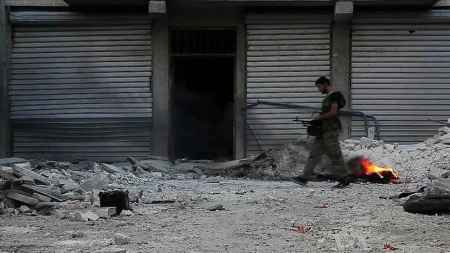
The vacillating and pusillanimous policies pursued by the Obama administration have enabled the Russians and Iranians to fill the void. Meanwhile, as Syria’s death toll nears 500,000 and its migrants – some with radical Islamic connections – continue to stream into Europe, it is clear that the nation state of Syria, Balkanized after five years of brutal conflict, is no more.

***********************

On July 30, 1970 a squadron of Israeli air force F-4E Phantoms and Mirages laden with bombs and missiles took off from their airbase in Sinai and flew westward toward Egypt. Their target was an Egyptian radar station.

The action occurred during the height of the War of Attrition between Israel and Egypt. The Egyptians were faring badly and their armed forces had suffered a series of public humiliations at the hands of the Israel Defense Forces. As a consequence, the Soviets stepped into the fray to save their client state and deployed 10,000 military personal and technical experts to the theater. The Soviets also assumed full control of Egypt’s air defenses. Surface-to-air missile batteries were manned by Soviet personnel and Soviet piloted MiG 21Js – the Soviet Union’s latest MiG-21 variant – patrolled Egyptian airspace. A direct clash between the Soviet Union and Israel was inevitable.

As the Israeli fighters zeroed in on their target, 16 Soviet MiGs moved in to intercept. In the melee that followed, five MiGs were shot down for no Israeli losses. The remaining 11 MiGs beat a hasty retreat. The Soviets were simply no match for the seasoned Israeli pilots.

The clash brought regional tensions – already heightened after one year of near constant border clashes – to a boiling point but neither side wanted an escalation. A ceasefire was eventually brokered by the superpowers and tensions deescalated.

Russia’s present military deployment in Syria is not dissimilar to its deployment in Egypt 46 years ago but the chances of an Israeli-Russian aerial clash today is virtually nil. There are some salient differences between the two circumstances. Israel and Russia are no longer bitter enemies and currently maintain cordial relations. Lines of communications between the two nations are good. Potential misunderstandings – to the extent that any exist – are channeled through liaisons to prevent accidental confrontations.

But war can best be summed up as organized chaos and given the clutter over the skies of Syria, with Russian, Israeli, Turkish and Coalition aircraft all operating within the confines of a limited space, mishaps are certainly possible. The Russians maintain formidable air defenses in Syria and Israel views them warily.

Underscoring this, last week IAF fighter jets launched two strikes in Syria, one targeting ISIS, in which four ISIS terrorists were killed and the second, targeting a Hezbollah weapons convoy and a Syrian military compound just outside Damascus. Though the Israelis have understandably remained moot on the specifics of the latter attack, according to published sources, Israeli fighters launched a number of Israeli made Popeye air-to-surface missiles from Lebanese airspace at a facility housing elements of Syria’s 4th Armored Division as well as a Hezbollah-bound weapons convoy traveling along the Beirut-Damascus highway.

Israel cognizant of Russia’s S-400 and S-300 air defense platforms in Syria opted to circumvent the possibility of an accidental confrontation by launching its attack from Lebanese airspace. It should be noted that the S-400s were deployed by the Russians last year following the downing of a Russian Su-24 by a Turkish F-16. The move was meant to serve as a deterrent to Turkey and no hostile intent was directed at Israel. Additionally, the term “Lebanese airspace” is a rather generous term that implies that Lebanon is a fully sovereign nation. In reality, Lebanon is sovereign in name only, having been swallowed whole by Hezbollah, Iran’s genocidal Shia proxy.

Israel’s interest in Syria is limited to ensuring that game-changing weapons of strategic import don’t fall into the hands of Hezbollah. Thus, on several occasions, Israeli fighter jets have launched successful interdicting operations aimed at destroying sophisticated weaponry – including SA-22 anti-aircraft missiles, Scud D ballistic missiles and Yakhont cruise missiles – clandestinely shipped from Iran via Syria.

A secondary goal is to ensure that border areas remain free of Hezbollah, Iranian and ISIS influence. In January 2015, an Israeli airstrike liquidated 12 senior Hezbollah and Iranian Revolutionary Guard Corps operatives, including an IRGC general, who were reconnoitering the border near Israel’s Golan Heights for future operations against the Jewish State.

Russia, which has a much broader interest in Syria, understands Israel’s concerns and has no interest in needlessly antagonizing the Israelis. Syria has been under Soviet and now Russia’s sphere of influence since the early 1950s and Russia is intent on maintaining its air and naval bases in Syria. To that end, it is keen on maintaining Assad’s hold on power, or for that matter, any Assad replacement that commits to friendly relations with Moscow and continued Russian military presence.

Russia is also looking to project military power and reassert its role as a superpower. The high profile deployment of a sizable Russian fleet in the Eastern Mediterranean, which includes the Russian aircraft carrier and Cold War relic, Admiral Kuznetsov, represents part of this strategy. However, it appears that the Kuznetsov has been a bit of an embarrassment for Putin.

On November 14, a carrier-based MiG-29K crashed while attempting a failed landing on the Kuznetsov. The carrier was encountering problems with its arrestor cables and the MiG crashed while circling and waiting for repairs. Just three weeks later, a Russian Navy Su-33 encountered a similar fate while attempting a landing on the Kuznetsov. Recent Satellite imagery taken of the Russian air base at Khmeimim, near Latakia, shows rows of Su-33 and MiG-29K carrier-based aircraft parked alongside Russian land-based fighter jets indicating that the Russians have given up on the notion of launching strikes from the Kuznetsov.

While the Israelis and Russians maintain clear strategies and objectives for Syria, under Obama, the U.S. strategy in Syria can best be described as befuddled and lacking any clear direction. The U.S. had initially called for Assad’s unconditional departure but seems to have backed away from that position and now calls for an orderly transition of power, seemingly giving Assad some wiggle room.

Obama had threatened to use military force if Assad employed poison gas against his own people but back peddled on that position as well. In late 2015 it was revealed that the Obama administration spent an astonishing $500 million to train four or five Free Syrian Army rebels, clearly demonstrating that Obama’s policy on Syria represents nothing short of a farcical tragic comedy.

The Obama administration had initially ignored the ISIS menace and its current pinprick military campaign against the terror group is utilizing but a fraction of America’s military strength. Finally, while the Obama administration has publicly sought to end Syria’s civil war peacefully, its transfer of billions in cash to the Islamic Republic has only served to fuel the fire. There is no doubt that this cash has been utilized to pay the salaries of Iran’s mercenary forces in Syria, Lebanon, Yemen and Iraq.

The vacillating and pusillanimous policies pursued by the Obama administration have enabled the Russians and Iranians to fill the void. Meanwhile, as Syria’s death toll nears 500,000 and its migrants – some with radical Islamic connections – continue to stream into Europe, it is clear that the nation state of Syria, Balkanized after five years of brutal conflict, is no more.

Our World: Michael Flynn and what he means for Trump’s foreign policy

December 5, 2016

Our World: Michael Flynn and what he means for Trump’s foreign policy, Jerusalem PostCaroline B. Glick, December 5, 2016

(Please see also, Mosul offensive folds, waiting now for Trump. — DM)

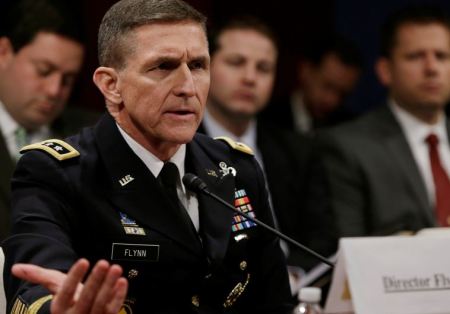
flynnRetired U.S. Army Lt. General Michael Flynn in 2014. (photo credit:REUTERS)

Mattis argued that Iran’s nuclear program was far from the only threat Iran constituted to the US and its allies. By empowering Iran through the nuclear deal, Obama was enabling Iran’s rise as a hegemonic power throughout the region.

With Mattis and Flynn at his side, Trump intends to bring down the Iranian regime as a first step toward securing an unconditional victory in the war against radical Islam.

**************************

In the US and around the world, people are anxiously awaiting US President-elect Donald Trump’s announcement of his choice to serve as secretary of state. There is no doubt that Trump’s choice for the position will tell us a great deal about the direction his foreign policy is likely to take.

But the fact is that we already have sufficient information to understand what his greatest focus will be.

Trump’s announcement last week that he has selected Marine General James Mattis to serve as his defense secretary is a key piece of the puzzle.

Mattis has a sterling reputation as a brilliant strategist and a sober-minded leader. His appointment has garnered plaudits across the ideological spectrum.

In 2013, US President Barack Obama summarily removed Mattis from his command as head of the US Military’s Central Command. According to media reports, Mattis was fired due to his opposition to Obama’s strategy of embracing Iran, first and foremost through his nuclear diplomacy. Mattis argued that Iran’s nuclear program was far from the only threat Iran constituted to the US and its allies. By empowering Iran through the nuclear deal, Obama was enabling Iran’s rise as a hegemonic power throughout the region.

Mattis’s dim view of Iran is shared by Trump’s choice to serve as his national security adviser. Lt. General Michael Flynn’s appointment has been met with far less enthusiasm among Washington’s foreign policy elites.

Tom Ricks of The New York Times, for instance, attacked Flynn as “erratic” in an article Saturday where he praised Mattis.

It is difficult to understand the basis for Ricks’ criticism. Flynn is considered the most talented intelligence officer of his generation. Like Mattis, Obama promoted Flynn only to fire him over disagreements regarding Obama’s strategy of embracing Iran and pretending away the war that radical Islamists are waging against the US and across the globe.

Flynn served under Obama as the director of the Defense Intelligence Agency. He was fired in 2014 for his refusal to toe the administration’s mendacious lines that radical Islam is not the doctrine informing and inspiring the enemy, and that al-Qaida and its fellows are losing their war.

What Obama and his advisers didn’t want to hear about the US’s enemies and about how best to defeat them Flynn shared with the public in his recently published book Field of Fight, which he coauthored with Michael Ledeen, who served in various national security positions during the Reagan administration.

Flynn’s book is a breath of fresh air in the acrid intellectual environment that Washington has become during the Obama administration. Writing it in this intellectually corrupt atmosphere was an act of intellectual courage.

In Field of Fight, Flynn disposes of the political correctness that has dictated the policy discourse in Washington throughout the Bush and Obama administrations. He forthrightly identifies the enemy that the US is facing as “radical Islam,” and provides a detailed, learned description of its totalitarian ideology and supremacist goals. Noting that no strategy based on denying the truth about the enemy can lead to victory, Flynn explains how his understanding of the enemy’s doctrine and modes of operation enabled him to formulate strategies for winning the ground wars in both Iraq and Afghanistan.

And win them he did. As he explains in his book, Flynn oversaw the transformation of the US’s strategies for fighting in both theaters from strategies based on top-down decapitation of the enemy’s leadership to a groundup destruction of the terrorist networks.

Flynn’s strategy, which worked in both countries, was based on the premise that it wasn’t enough to kill “high value” targets. The US needed to develop a granular understanding of the terrorist networks from the village level up the line. Only by taking out the local terrorist leaders would the US be able to destroy the ability of the likes of al-Qaida, the Iranian-controlled Shi’ite militias and the Taliban to quickly mobilize new forces and reignite fighting shortly after every successful US operation.

Flynn’s book contributes three essential insights to the discussion of the global jihad. First, he explains that the Bush and Obama administrations were both unable to translate military victories on the ground into strategic victories because they both refused to join their military war with a war of ideas.

The purpose of a war of ideas is to discredit the cause for which the enemy fights. Without such a war, on the one hand the American people sour on the war because they don’t understand why it is important to win. On the other hand, without a war of ideas directed specifically at the Islamic world, Muslims worldwide have continued to be susceptible to recruitment by the likes of ISIS and al-Qaida.

As Flynn notes, the popularity of radical Islam has skyrocketed during the Obama years. Whereas in 2011 there were 20,000 foreign recruits fighting for ISIS in Iraq and Syria, by 2015, the number had risen to 35,000.

Flynn’s second contribution is his forthright discussion of the central role the Iranian regime plays in the global jihad. Flynn chronicles not only Iran’s leadership of the war against the US in Iraq and Afghanistan. He shows that their cooperation is global and predates 9/11 by several years.

Flynn recalls for instance that in 1996 British troops confiscated an al-Qaida training manual written by Iranian intelligence in a terrorist training facility in Bosnia. Six Iranian “diplomats” were arrested at the scene.

Flynn is unflinching in his criticism of the Obama administration’s moves to develop an alliance with Iran. And he is almost equally critical of George W. Bush’s war against terror.

For instance, Flynn argues, “It was a huge strategic mistake for the United States to invade Iraq militarily.”

Iran, he said was the main culprit in 2001 and remains the main enemy today.

“If, as we claimed, our basic mission after 9/11 was the defeat of the terrorists and their state sponsors then our primary target should have been Tehran, not Baghdad, and that method should have been political – support of the internal Iranian opposition.”

Flynn’s final major contribution to the intellectual discourse regarding the war is his blunt identification of the members of the enemy axis. Flynn states that the radical Islamic terrorist armies operate in cooperation with and at the pleasure of a state alliance dominated by Russia and Iran and joined by North Korea, Venezuela and other rogue regimes. Flynn’s frank discussion of Russia’s pivotal role in the alliance exposes the widely touted claims that he is somehow pro-Russian as utter nonsense.

In Flynn’s view, while Russia is Iran’s primary partner in its war for global domination, it should not be the primary focus of US efforts. Iran should be the focus.

In his words, the best place to unravel the enemy alliance is at its “weakest point,” which, he argues, is Iran.

Flynn explains that the basic and endemic weakness of the Iranian regime owes to the fact that the Iranian people hate it. To defeat the regime, Flynn recommends a strategy of political war and subversion that empowers the Iranian people to overthrow the regime as they sought to do in the 2009 Green Revolution. Flynn makes the case that the Green Revolution failed in large part because the Obama administration refused to stand with the Iranian people.

Flynn is both an experienced commander and an innovative, critical, strategic thinker. As his book makes clear, while flamboyant and blunt he is not at all erratic. He is far-sighted and determined, and locked on his target: Iran.

Whoever Trump selects as secretary of state, his appointment of Mattis on the one hand and Flynn on the other exposes his hand. Trump is interested in ending the war that the forces of radical Islam started with the US not on September 11, 2001, but on November 4, 1979, with the seizure of the US embassy in Tehran.

With Mattis and Flynn at his side, Trump intends to bring down the Iranian regime as a first step toward securing an unconditional victory in the war against radical Islam.

Iran to Trump: Death to America Will Live On

December 5, 2016

Iran to Trump: Death to America Will Live On

by Majid Rafizadeh

December 5, 2016 at 4:00 am

Source: Iran to Trump: Death to America Will Live On

  • Ayatollah Ali Khamenei made it clear that Trump’s presidency causes “no difference” to Iran-US relationships. He called the Americans’ election “a spectacle for exposing their crimes and debacles.”
  • “Thank God, we are prepared to confront any possible incident.” — Iran’s Supreme Leader, Ayatollah Ali Khamenei.
  • From the perspective of Iranian moderates, reformists and hardliners, the US is not a superpower anymore; but a weak actor in the Middle East and on the global stage.
  • Iranian leaders also made it clear that Tehran will continue supporting Hezbollah and other groups that have been designated as terrorist groups by the US Department of State. These groups pursue anti-American and anti-Israeli agendas.

Ideologically speaking, Iran’s hardliners, primarily Supreme Leader Ayatollah Ali Khamenei and senior officials of the Islamic Revolutionary Guard Corps (IRGC) who enjoy the final say in Iran’s domestic and foreign policies, have made it clear that Iran will not change the core pillars of its religious and revolutionary establishment: Anti-Americanism and hatred towards the “Great Satan” and the “Little Satan”, Israel.

Supporters of Ayatollah Khamenei and the IRGC enthusiastically shouted “Death to America” in response to a recent speech that Khamenei gave, applauding the 1979 hostage-taking and takeover of the US Embassy in Tehran.

Iran’s major state newspapers carried anti-American headlines this week, quoting the Supreme Leader. In his latest public speech to thousands of people, which was televised via Iran’s state TV, Khamenei made it clear that Trump’s presidency will cause “no difference” to Iran-US relationships. Khamenei pointed out that, “We have no judgment on this election because America is the same America”. In his speech, Khamenei attacked President-elect Donald Trump and the American people. The Ayatollah called the US election “a spectacle for exposing their crimes and debacles.”

Other hardliners echoed the same message that there would be no change in Iran’s revolutionary principles and ideals against the US and its allies. The deputy commander of the Revolutionary Guards, Hossein Salami, told Iran’s Fars news agency: “When the Republicans were in power, they threatened us and showed their hostility… and when the Democrats were in power, the policies of the United States were the same.”

Khamenei also remarked that the US will remain the evil, or the “Great Satan,” saying:

“In the past 37 years, neither of the two parties who were in charge did us any good and their evil has always been directed toward us….We neither mourn nor celebrate, because it makes no difference to us… We have no concerns. Thank God, we are prepared to confront any possible incident.”

He added that the remarks made by Donald Trump “over the last few weeks on immoral issues — which are, for the most part, not baseless accusations — are enough to disgrace America.”

Militarily, strategically and geopolitically, Tehran’s core pillars of damaging US national interests, and scuttling US foreign policy objectives will remain intact.

Iran’s semi-official Fars news agency reported that Iran’s armed forces chief of staff, General Mohammad Hossein Bagheri, has heavily criticized Donald Trump for stating that the US will confront Iranian boats in the Gulf if they harass US Navy ships. In the last year, Iran has increasingly harassed and provoked US Navy ships, and detained 11 American sailors.

General Bagheri stated out that, “The person [Trump] who has recently achieved power, has talked off the top of his head! Threatening Iran in the Persian Gulf is just a joke.”

In 2016, the number of incidents of boats from Iran’s navy and Revolutionary Guards provoking and harassing the US Navy ships rose significantly to 31 incidents, highlighting that the IRGC evidently feels sufficiently emboldened to damage US national security publicly and on a regular basis. From the perspective of Iranian moderates, reformists and hardliners, the US is not a superpower anymore; but a weak actor in the Middle East and on the global stage.

In addition, Iran, with underlying anti-American objectives, is aggressively expanding its military presence and naval bases in foreign nations and international waters. Major General Mohammad Hossein Baqheri said, as cited by the Iranian Tasnim news agency, that the expanding presence in international waters and naval bases in foreign countries “could be ten times more efficient than nuclear power.” For the first time, the Iranian Navy’s 44th flotilla, comprised of a Bushehr logistic warship and an Alvand destroyer, has now sailed into the Atlantic Ocean as well.

Tehran is also considering having naval bases on the coasts of Yemen and Syria to support the Assad government and the Houthis. As Iran’s Chief of the General Staff told a gathering of senior naval commanders, “One day, we may need bases on the coasts of Yemen and Syria, and we need the necessary infrastructures for them under international maritime law.”

Iran’s naval commander, Rear Admiral Habibollah Sayyari, also told the gathering of senior naval commanders that boosting military presence in international waters reflects Iran’s power.

According to the Tasnim news agency, Iran’s navy has already deployed 49 flotillas to various maritime zones. Sayyari added that the flotillas showcased Iran’s symbol of power.”

Iranian leaders also made it clear that Tehran will continue supporting Hezbollah and other groups that are designated as terrorist groups by the US Department of State.

These groups pursue anti-American and anti-Israel agendas.

Khamenei and IRGC are sending a strong message that Iran will neither alter its core religious and revolutionary pillar of anti-Americanism, nor change its foreign policy and military objectives of damaging US interests. Iran’s policy towards the “Great Satan” will remain as it has been since the establishment of the Islamic Republic of Iran in 1979.

Dr. Majid Rafizadeh, political scientist and Harvard University scholar is president of the International American Council on the Middle East. He can be reached at Dr.rafizadeh@post.harvard.edu.

Prime Minister Trudeau’s affection for despots, autocrats and Islamists

December 4, 2016

Prime Minister Trudeau’s affection for despots, autocrats and Islamists, CIJ NewsDiane Weber Bederman, December 4, 2016

justin-trudeau-7-cijnewsJustin Trudeau. Photo: CIJnews

Canadian Prime Minister Justin Trudeau displayed his affection for fascism on the death of Fidel Castro. “We join the people of Cuba today in mourning the loss of this remarkable leader.” He seems to be following in the footsteps of his father Pierre. Members of Parliament, media outlets in Canada, and around the world expressed their shock at his comments.

Trudeau has also shared his affection for Chinese Communists. “Justin’s 2013 tribute to the role of big government in forcing people into living more environmentally might explain his flirtation with dictators and despots. ‘There is a level of admiration I actually have for China because their basic dictatorship is allowing them to actually turn their economy around on a dime…”’

Trudeau is in the process of cozying up to the Iranians. Iran; a country run by an autocratic, theocratic despot. Trudeau has opened the doors to warmer relations with Russia.

According to Canadian journalist Terence Corcoran “The Trudeaus have been at this for six decades, flirting with the murderous icons of communist oppression since the 1950s when Trudeau the First expressed his admiration for elements of Stalin’s Soviet Communism.

In the 1960s, a 41-year-old Pierre Trudeau visited Communist China during the great famine and co-wrote a book hailing Maoism and denying the existence of a national food policy that killed 38 million people. He never retracted his China views. But, in the 1970s, he cozied up to Fidel Castro, who until his death Friday has held the Caribbean island in a form of political slavery.”

Paul Wells from the Toronto Star did not parse his words of condemnation. “Trudeau lauded Castro’s ‘tremendous dedication and love for the Cuban people,’ whose speech and dietary protein Castro rationed, by law, for decades. I guess it was tough love.”

Margaret Wente from the Globe and Mail wrote “Mr. Trudeau’s affection for the old dictator puts him in the company of Vladimir Putin and Bashar al-Assad.” She found his comments oddly timed. “He was just winding up a far-flung trip whose theme was human rights, during which he lectured various African nations on the need to improve their treatment of women and sexual minorities. Unfortunately, Mr. Castro wasn’t all that progressive either. “

The Globe Editorial Board wrote their concerns about Justin Trudeau; that his comments leave the disturbing impression that he actually believes what he said about Castro including “I know my father was very proud to call him a friend and I had the opportunity to meet Fidel when my father passed away. It was also a real honour to meet his three sons and his brother President Raúl Castro during my recent visit to Cuba.”

Gerald Caplan wrote “Scarcity became the overriding characteristic of Fidelismo, scarcity in both the quantity and quality of the life he provided. Dissent was not tolerated, political dissidents imprisoned, human rights a foreign intrusion, free speech counterrevolutionary, trade unions government servants, gays an insult to the revolution.”

Kelly McParland of the National Post wrote: “Given a choice between saying something nice about his Dad’s Cuban pal, and defending the values of democracy and human rights, Justin Trudeau picked the wrong one.”

He went with “el Comandante” – the captain, the commander – one of the appellations accorded Cuba’s Fidel Castro during the 50+ years in which treated his country like a personal political project, impoverishing millions while pursuing a self-defeating confrontation with Washington.”

Mark Bonokoski, Toronto Sun wrote “Blind to Cuban history, and blinkered by his fathers’ fairy tales about Fidel Castro, Prime Minister Justin Trudeau’s statement about the death of the Cuban dictator was an embarrassment of international proportions. He ignored the brutal truth about the man, dancing around like a clown in a parade dodging horse droppings.”

Members of parliament shared their outrage; from Lisa Raitt, to Rona Ambrose, Maxime Bernier, Kellie Leitch, to Stephen Harper’s son. And then there was world-wide condemnation of Trudeau’s affection for this despot.

So I ask all of these people, journalists, columnists, and Canadian Members of Parliament, where is your outrage at Trudeau’s attempts to mimic these despots? First, by allowing him to pass a petition that attacks free speech without a word from any of you.

The Parliament passed petition 411 that could attack free speech.

We, the undersigned, Citizens and residents of Canada, call upon the House of Commons to join us in recognizing that extremist individuals do not represent the religion of Islam, and in condemning all forms of Islamophobia” (dislike of or prejudice against Islam or Muslims, especially as a political force).

In English this means that we will not be able to criticize Islam as a political force. This is denying us of our right to criticize an ideology that is diametrically opposed to the ideology of democracy.

This leads me to the next question. Where is your outrage with Trudeau’s statement that Islam is compatible with the west while the leading Muslim organization in Canada, ICNA, posted a publication on its official site saying this is not true?

The political system of Islam is totally incompatible with western democracy.

The concept of government party and the opposition is alien to Islam.

All belong to one Ummah with only one goal and pursue the same aims and objects of Islamic guidelines!”[Online publication of ICNA Canada’s site]

ICNA (Islamic Circle of North America) Canada is an Islamic nation-wide organization striving “to build an Exemplary Canadian Muslim Community” by “total submission to Him [Allah] and through the propagation of true and universal message of Islam.” Dr. Iqbal Massod Al-Nadvi is the Amir (President) of Islamic Circle of ICNA Canada and is also serving as Chairperson of Canadian Council of Imams.

Whom should we believe? Non-Muslims or respected Muslim leaders?

Trudeau’s stance is a breach of our Constitution and free speech. Islam, based on Sharia Law as is being interpreted by major Islamic groups, is innately homophobic, misogynistic, xenophobic and viciously anti-semitic. Saudi Arabia just announced they aren’t ready for female drivers!

Islam, as being reflected in Islamic literature in Canada, does not treat all people as equal; does not believe in free will; does not accept gay rights or women as equal to men. Islam the ideology does not separate itself from Islam the religion so it is not tolerant of other religions (there are no synagogues or churches in many Muslim countries) and it makes demands on democracy to accommodate religious beliefs in the secular world.

Where is Main Stream media when it comes to “outing” Trudeau and his comments about Islam? Where are these people who are shocked by Trudeau’s comments about Castro and his love of autocrats, despots and theocrats? Why are they not holding him to account for his declaration that Islam is compatible with the West?

Trump Sec of Defense Pick: Enemy of Islamism and Iran

December 4, 2016

Trump Sec of Defense Pick: Enemy of Islamism and Iran, Clarion ProjectRyan Mauro, December 4, 2016

united-states-general-james-mattis-640-320-getty-drew-angerer_0General James Mattis with President-elect Trump (Photo: Drew Angerer/Getty Images)

General Mattis completely and utterly rejects the romanticized interpretation of the Iranian regime as “moderate” or part of the solution to Sunni terrorism. In April, he described the Iranian regime as the “single most enduring threat to stability and peace in the Middle East;” one greater than Al-Qaeda or ISIS.

***************************

President-Elect Trump has chosen Marine Corps General James “Mad Dog” Mattis for secretary of defense, eliciting widespread enthusiasm focusing on his status as the “most revered Marine in a generation” and factory of quotable quotes.

Deserving of more positive attention is his emphasis on confronting Political Islam and the Iranian regime.

General Mattis has advocated for significant changes in both the military fight against the specific Islamist terrorist groups like ISIS and Al-Qaeda, as well as the fight against the Islamist ideology that births them. Although ISIS’ caliphate is on the decline, General Mattis doesn’t settle for an encouraging positive trend. He wants to win quickly and decisively, yet humanely with care for civilians.

In August, he said the strategy still is “unguided by a sustained policy or sound strategy [and is] replete with half measures.”

Mattis was one of the chief architects of the counter-insurgency campaign that turned Iraq around so rapidly that it even surprises many of its supporters.

In testimony to the Senate in 2015, he said, “The fundamental question I believe is, ‘Is political Islam in our best interest?’ If not, what is our policy to authoritatively support the countervailing forces?”

In another speech, General Mattis said that the fundamental flaw in our strategy has been a failure to define Political Islam as the enemy of U.S. interests. He made the correct observation that such a delineation between friend and foe would allow us to identify supportable Muslim allies.

“If we won’t even ask the question [if Political Islam is in U.S. interests], then how do we ever get to the point of recognizing which is our side in the fight? And if we don’t take our own side in this fight, we are leaving others adrift,” he said.

He then referenced his recent trip to Egypt and the widespread perception that the U.S. actually intends to empower the Muslim Brotherhood. The failure to base policy around a rejection of Political Islam inevitably leads to a tolerance or even an embrace of Islamists who surpass the low bar of condemning Al-Qaeda and ISIS.

The Muslims who oppose Islamists are, as Mattis put it, left adrift.

Countless articles have been written claiming that a policy based on fighting “radical Islam,” “Political Islam,” “Islamism” and similar terms will inflame the Muslim world. Islamists and allied institutions will undoubtedly cry foul, as they always have at every minor slight, but the delineation will separate the wheat from the chaff.

Overlooked allies amongst Muslims and non-Muslim minorities will surface as U.S. policy forces the Muslim world to take stances on Islamism and its adhering organizations. New allies will be born as the discussion of Islamism leads to rejections of it. If messaged correctly, the U.S. will end up with more Muslim allies of better quality.

This view of Islamism as the adversary, rather than just specific terrorist groups targeting the U.S. homeland, is why General Mattis rejects the notion of a “moderate” Iranian regime. He was fired by the Obama Administration for his tough questions about the ramifications of current U.S. policy towards Iran.

General Mattis completely and utterly rejects the romanticized interpretation of the Iranian regime as “moderate” or part of the solution to Sunni terrorism. In April, he described the Iranian regime as the “single most enduring threat to stability and peace in the Middle East;” one greater than Al-Qaeda or ISIS.

We recently pointed out that four of Trump’s picks want to designate the Muslim Brotherhood as a Foreign Terrorist Organization and wage a long overdue ideological offensive against Islamism, also known as Political Islam.

Trump then chose K.T. McFarland as deputy national security adviser and Katharine Gorka as part of his Department of Homeland security “landing team” to manage the transition between administrations. Both are strong advocates of an ideological war against Islamism and Gorka has advocated for the Muslim Brotherhood Terrorist Designation Act.

The U.S. war against Islamist extremism now enters a new, decisive phase, but let not our enthusiasm for this strategy blind us from the risks.

The successful implementation of the anti-Islamism strategy is not solely dependent upon Trump’s national security team. It’s dependent upon him.

If his decisions prevent demonstrable success, the ideological strategy will be considered a failed concept. Its advocates will have their credibility tarnished, perhaps unfairly, and the Western response to Islamism will be put on an indefinite hold as the ideology marches on.

Krauthammer’s Take: It’s Good to Have a Defense Secretary Called ‘Mad Dog’

December 2, 2016

Krauthammer’s Take: It’s Good to Have a Defense Secretary Called ‘Mad Dog’, Fox News via YouTube, December 1, 2016

https://www.youtube.com/watch?v=PbAT92oDLDU

Iranian Radioactive Iridium-292 Device Stolen from Bushehr Transport Car

November 27, 2016

Iranian Radioactive Iridium-292 Device Stolen from Bushehr Transport Car, Jewish Press, November 27, 2016

rouhani_and_salehi_in_bushehr_nuclear_plant_1-1Iranian President Hassan Rouhani and Head of the Atomic Energy Organization of Iran (AEOI) Ali Akbar Salehi in Bushehr Nuclear Plant. January 13, 2015
Photo Credit: Hossein Heidarpour / Tasnim News Agency / Wikipedia Commons CC 4.0

A device loaded with Iridium-292 has gone missing in Iran, according to a report in the Saudi owned newspaper Asharq Al-Aawsaat.

A car transporting the radioactive material from Iran’s Bushehr Nuclear Power Plant was stolen. The car was later found, but the radioactive material was gone.

On November 18, the International Atomic Energy Agency warned the Gulf Cooperation Council of the missing radioactive isotope, after being informed of the loss by Atomic Energy Organization of Iran (AEOI). It is not clear when the device was actually stolen.

There is fear that the material can be converted into a dirty bomb by attaching the material to a conventional bomb.

Local Iranian hospitals have been told to look out for cases of radiation sickness or burns.

Iridium-292 in an unstable isotope that releases gamma rays. It’s used to find structural flaws in metals.

Close proximity to the exposed isotope will cause injury within minutes to hours, and death within hours to days.

In November of 2015, Iridium being used for industrial testing was stolen from a US company near Basra, Iraq, but it was later found in Zubair, Iraq, in February 2016.

Obama Admin Covering Up Key Iran Deal Details in Final Days

November 22, 2016

Obama Admin Covering Up Key Iran Deal Details in Final Days Rubio spox: Senator looks forward to helping Trump shred Iran deal

BY:
November 22, 2016 5:00 am

Source: Obama Admin Covering Up Key Iran Deal Details in Final Days

Secretary of State John Kerry talks with Iranian Foreign Minister Mohammad Javad Zarif in Vienna / AP

Senior Obama administration officials in their final days in office are seeking to cover up key details of the Iran nuclear deal from Congress, according to documents and sources who spoke to the Washington Free Beacon about continued efforts by the White House to block formal investigations into secret diplomacy with Tehran that resulted in a $1.7 billion cash payment by the United States.

As leading members of Congress petition the Obama administration for answers about what many describe as a $1.7 billion “ransom” payment to Iran, Obama administration officials are doubling down on their refusal to answer questions about the secret negotiations with Iran that led to this payment.

Sen. Marco Rubio (R., Fla.), a vocal opponent of last year’s nuclear deal with Iran, has been seeking answers from senior Obama administration officials since at least late September. However, officials continue to stonewall the senator’s inquiries, according to senior congressional sources and formal communications between Rubio and the State Department obtained by the Free Beacon.

Rubio and several other lawmakers have petitioned the Obama administration for documents and information about the secret negotiations that resulted in Tehran receiving $1.7 billion in cash and a promise from the United States to further roll back sanctions on an Iranian financial institution that helped finance the country’s illicit ballistic missile program.

A spokesman for Rubio told the Free Beacon that the administration’s continued obfuscation has motivated the senator to take steps to help President-elect Donald Trump kill the nuclear agreement once he enters office next year.

“Senator Rubio looks forward to working with President-elect Trump and his team to scrap this fundamentally flawed deal and hold Iran accountable for its cheating and regional aggression,” the spokesman said.

Rubio submitted a list of questions about the deal to Deputy Secretary of State Antony Blinken on Sept. 29 during a hearing aimed at examining these payments to Iran.

Blinken finally provided answers to these questions last week, but declined to address all specific questions Rubio posed about the secret negotiations over the $1.7 billion payment.

While the Obama administration has maintained for months that the payment was not part of a ransom package, the Free Beacon and other publications have disclosed in recent weeks that the United States did engage in secret diplomacy with Iran on a range of issues, including the release of American hostages and the $1.7 billion payment.

These issues were addressed in three separate agreements that were only finalized once the United States agreed to provide Tehran with the $1.7 billion payment. Secret documents stored on Capitol Hill and treated in a classified manner show that each of the agreements hinged on the cash payment, the Free Beacon first disclosed in October.

Rubio and other lawmakers have also sought answers from Attorney General Loretta Lynch, who would have played a role in signing off on the agreements. Lynch has declined to answer questions, prompting Rubio and Rep. Mike Pompeo (R., Kan.), the incoming CIA director, to accuse her of “pleading the fifth” before Congress.

The White House has not responded to similar questions submitted by Rubio on Sept. 10, and Treasury Secretary Jack Lew has not answered a series of queries posed on Oct. 25, according to sources who accused the administration of intentionally dodging congressional oversight.

Rubio asked Blinken to provide information on any U.S. official who signed off on the secret deals, and to specify if the agreements were part of the formal nuclear agreement or were inked separately. He also asked whether the deals were tied to the release of U.S. hostages.

Rubio hopes to obtain the name of the Iranian official or officials who signed these documents. Sources familiar with the deals and secret documents stored on Capitol Hill told the Free Beacon it is likely the United States inked these deals with a representative of Iran’s intelligence apparatus.

Blinken did not provide firm answers to any of these questions, according to a copy of his formal communication to Rubio viewed by the Free Beacon. He maintained that the cash payment was part of a decades-old legal dispute with Tehran before the international claims tribunal at the Hague.

“The timing of the Hague settlement was a consequence of the United States taking advantage of the opening of diplomatic opportunities with Iran on several fronts simultaneously, including the opportunity to minimize litigation risk with respect to Iran’s contract claims arising under the U.S.-Iran Foreign Military Sales (‘FMS’) Program,” Blinken wrote, repeating a talking point issued by several Obama administration officials.

The payment was not a ransom, Blinken said.

“Regarding the allegations that this settlement constituted ransom to free American citizens who were released from prison in Iran on January 17, the Administration has repeatedly made it clear since January, and President Obama recently reiterated, that this settlement did not constitute ransom and that the United States has not and will not pay ransom,” he wrote. “Upon Iran’s release of several unjustly detained Americans, the United States provided relief to certain Iranian citizens charged with primarily sanctions-related crimes, several of whom are dual U.S.-Iranian nationals, as a one-time reciprocal humanitarian gesture.”

Islam’s “Human Rights”

November 5, 2016

Islam’s “Human Rights”, Gatestone InstituteJanet Tavakoli, November 5, 2016

No intelligent government should impair the right of free speech to placate people who falsely claim they are victims when often they are, in fact, aggressors.

To the 57 members of the Organization of Islamic Cooperation, however, all human rights must first be based on Islamic religious law, Sharia: whatever is inside Sharia is a human right, whatever is outside Sharia is not a human right.

Therefore, slavery or having sex with children or beating one’s wife, or calling rapes that do not have four witnesses adultery the punishment for which is death, or a woman officially having half the worth of a man, are all “human rights.”

Soft jihad includes rewriting history as with the UNESCO vote claiming that ancient Biblical monuments such as Rachel’s Tomb or the Cave of the Patriarchs are Islamic, when historically Islam did not even exist until the seventh century; migration to widen Islam (hijrah), as we are seeing now in Europe and Turkish threats to flood Germany with migrants; cultural penetration such as promoting Islam in school textbooks or tailoring curricula for “political correctness”; political and educational infiltration, as well as intimidation (soft jihad with the threat of hard jihad just underneath it).

More regrettable is that these are so often done, as at UNESCO, with the help and complicity of the West.

Both hard and soft jihad are how Islam historically has been able to overrun Persia, Turkey, Greece, Southern Spain, Portugal, all of North Africa, and all of Eastern Europe. It is up to us not to let this be done to us again.


After witnessing the Islamic Republic of Iran violate human rights, adopt sharia law, persecute other religions, murder dissenters, and compel the judiciary to serve the Ministry of Intelligence, it seems clear that the worst thing that can happen to a free Western country is to allow Islamic fundamentalists to take over a government.

Most of the world’s 1.6 billion Muslims pray in Arabic, even if it is not their mother tongue. The problem, however, is not in the translation; it is in the ideology.

Fifteen of the nineteen 9/11 hijackers were Saudi Arabian; two more were from the United Arab Emirates; one was from Egypt, and one from Lebanon. All were from Arabic-speaking countries.

Muslim scholars did not unite to protest the act of terrorism on 9/11. Instead, many celebrated a victory; the Quran includes passages that permit violence to expand Islam.

Most so-called Muslims are peace-loving, but if there are 164 verses of the Koran prescribing jihad, and many Muslims might feel it would be heretical or disloyal to condemn it.

Arabic-speaking Muslim countries are not alone in supporting terrorism. According to the U.S. Department of State, the Islamic Republic of Iran is still the leading state sponsor of terrorism. Iran also recently announced that it will continue to support terrorism, including the terrorist groups Hizballah [“The Party of Allah”] and Hamas.

Iran still supports the death fatwa issued against a European, the British novelist Salman Rushdie, for The Satanic Verses — a novel — issued by the long-dead Ayatollah Khomeini in 1989. Last year the bounty on his head was raised another $600,000 to almost $4 million.

Until his death earlier this year, Ayatollah Vaez-Tabasi, a leading Shia cleric in Iran, who presided over the Imam Reza shrine that draws as many annual visitors as Mecca, called for “perpetual holy war.”

Muhammad’s Practices Clash with the Humanistic Values of Western Civilization

Fundamentalists view Muhammad as the perfect man. Yet Muhammad led violent followers who raped, enslaved war captives, and murdered unbelievers as part of Islam’s program to expand. Today that behavior is emulated by Islamic terrorists in Iraq, Syria, Sudan, Pakistan, Bangladesh, Mauritania, Nigeria, to name just a few.

Muhammad had several wives, including a slave given to him as a gift. When he was in his fifties, he asked for a friend’s six-year-old daughter and consummated the so-called marriage when the child was nine. Although Muhammad criticized corrupt customs of his Arab contemporaries, he had sex with a girl who was too young to be capable of consent; in the West we call this statutory rape. (Sahih Bukhari volume 5, book 58, number 234)

Referring to Muhammad’s life, fundamentalists allow forced marriages of female children in countries including Saudi Arabia, Afghanistan, some Gulf States, and Iran.

If fundamentalist Muslim leaders do not understand how flawed this ideology appears to the West, their incomprehension may spring from a fundamentally different view of human rights: To the West, these values are embodied in the Enlightenment — such as individual freedoms, freedom of thought, disinterested enquiry — and in the Universal Declaration of Human Rights – that all people, regardless of race religion or gender, have the right to life, liberty personal security, and freedom from slavery torture, and degrading treatment.

To the 57 members of the Organization of Islamic Cooperation (OIC), however, all human rights must first be based on Islamic religious law, Sharia: whatever is inside Sharia is a human right, whatever is outside Sharia is not a human right.

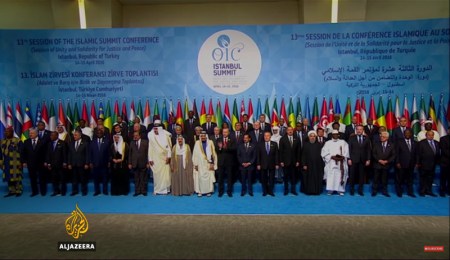
2022To the 57 members of the Organization of Islamic Cooperation, all human rights must first be based on Islamic religious law, Sharia: whatever is inside Sharia is a human right, whatever is outside Sharia is not a human right. Pictured above: The 2016 OIC Summit in Istanbul, Turkey. (Image source: Al Jazeera video screenshot)

Therefore, slavery or having sex with children or beating one’s wife, or calling rapes that do not have four witnesses adultery the punishment for which is death, or a woman officially having half the worth of a man, are all “human rights.”

In 2005, after the Danish cartoonist Kurt Westergaard drew a cartoon mildly satirizing Muhammad as an assignment for a newspaper, many Muslim clerics cried blasphemy and called for his death. These included a Pakistani cleric who offered a one million dollar reward to anyone who would murder the Dane. Thousands of Muslims protested. In 2010, an axe-wielding Muslim assailant attacked Westergaard in his home; fortunately, Westergaard was able to escape to a secure room.

Western governments should stand resolute against those who would blackmail us into giving up our freedoms. No intelligent government should impair the right of free speech to placate people who falsely claim they are victims when often they are, in fact, aggressors.

Reformist Muslims and the Credibility Crisis

Most of the world’s 1.6 billion Muslims may not countenance violence and human rights violations, but the fact remains that fundamentalists are not a fringe group; they occupy senior positions in the Muslim clerical hierarchy. There are tens of millions (or more) of them, and each seems to believe that his interpretation of Islam is the only correct one. Of this group, it is estimated that hundreds of thousands are jihadis willing to engage in active violence.

Many Reformist Muslims claim they are being unfairly lumped into this extremist crew, but if they are claiming a schism, many they often have not been clear about it.

When Martin Luther, a Catholic priest and a theology professor, repudiated two core teachings of the Catholic Church, he acknowledged that, by definition, he was no longer Catholic. He was part of the Protestant Reformation, and his followers are called Lutherans.

Reformist Muslims still call themselves Muslims, but there can never be a Quran 2.0. Every word in the Quran is believed to be the word of Allah, similar to the Ten Commandments as the direct word of God; no one is able to say that Allah did not mean what Allah reportedly said. Interpretations, however do differ and since 1948 have apparently caused the deaths of 11,000,000 Muslims at the hands of other Muslims.

So one can imagine what might be in store for non-Muslims.

Islam, moreover, seems to have been has been set up to spread it both by violence, “hard jihad,” and “soft jihad. ” Hard jihad includes terrorism, murder and attempted murder. Soft jihad includes rewriting history as with the UNESCO vote claiming that ancient Biblical monuments such as Rachel’s Tomb or the Cave of the Patriarchs are Islamic, when historically Islam did not even exist until the seventh century; migration to widen Islam (hijrah), as we are seeing now in Europe and Turkish threats to flood Germany with migrants; cultural penetration such as promoting Islamin school textbooks or tailoring curricula for “political correctness“; political and educational infiltration, as well as intimidation (soft jihad with the threat of hard jihad just underneath it).

More regrettable is that these are so often done, as at UNESCO, with the help and complicity of the West.

Both hard and soft jihad are how Islam historically has been able to overrun Persia, Turkey, Greece, Southern Spain, Portugal, all of North Africa, and all of Eastern Europe. It is up to us not to let this be done to us again.