Posted tagged ‘Iran’

Iranian Defector: ‘U.S. Negotiating Team Mainly There to Speak on Iran’s Behalf’

March 29, 2015

Iranian Defector: ‘U.S. Negotiating Team Mainly There to Speak on Iran’s Behalf’, Weekly StandardDaniel Halper, March 28, 2015

(If the report is accurate, it explains quite a lot about the direction in which the “negotiations” have been going. — DM)

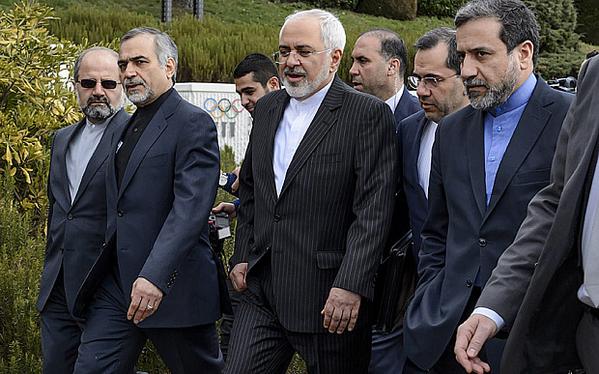
An Iranian journalist writing about the nuclear negotiations between the United States and Iran has defected. In an interview Amir Hossein Motaghi, has some harsh words for his native Iran. He also has a damning indictment of America’s role in the nuclear negotiations.

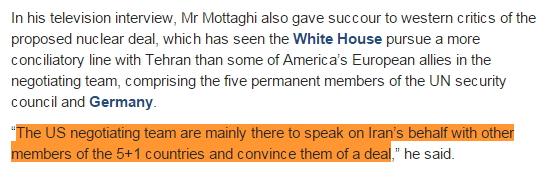
“The U.S. negotiating team are mainly there to speak on Iran’s behalf with other members of the 5+1 countries and convince them of a deal,” Motaghi told a TV station after just defecting from the Iranian delegation while abroad for the nuclear talks. The P 5 + 1 is made up of United States, United Kingdom, Russia, China, France, plus Germany.

CBNkmdFVIAADMpl
CBNk6T0WsAAEI1T

NBC’s Engel: Officials Say Allies: Simply Don’t Trust” U.S. Under Obama Admin – The Five

March 28, 2015

NBC’s Engel: Officials Say Allies: Simply Don’t Trust” U.S. Under Obama Admin – The Five, Fox News via You Tube, March 27, 2015

(In other breaking news, today is Saturday, unexpectedly. Please see also, Iranian general in Sanaa to organize Yemen rebel counter-offensive for Saudi-led attacks.  — DM)


Column One: Managing Obama’s war against Israel

March 27, 2015

Column One: Managing Obama’s war against Israel, Jerusalem Post, Caroline Glick, March 26, 2015

ShowImageUS President Barack Obama meets with Prime Minister Benjamin Netanyahu at the White House, October 1, 2014. (photo credit:REUTERS)

As Max Boot explained Wednesday in The Wall Street Journal, the administration’s animosity toward Israel is a function of Obama’s twin strategic aims, both evident since he entered office: realigning US policy in the Middle East toward Iran and away from its traditional allies Israel and the Sunni Arab states, and ending the US’s strategic alliance with Israel.

Obama has reached a point in his presidency where he is prepared to give full expression to his plan to end the US’s strategic alliance with Israel.

He thinks that doing so is both an end to itself and a means of succeeding in his bid to achieve a rapprochement with Iran.

*********************

On Wednesday the Jerusalem Municipality announced it is shelving plans to build 1,500 apartments in the Har Homa neighborhood. Officials gave no explanation for its sudden move. But none was needed.

Obviously the construction of apartments for Jews in Jerusalem was blocked in the hopes of appeasing US President Barack Obama.

But is there any reason to believe he can be appeased? Today the White House is issuing condemnations of Israel faster than the UN.

To determine how to handle what is happening, we need to understand the nature of what is happening.

First we need to understand that the administration’s hostility has little to do with Israel’s actions.

As Max Boot explained Wednesday in The Wall Street Journal, the administration’s animosity toward Israel is a function of Obama’s twin strategic aims, both evident since he entered office: realigning US policy in the Middle East toward Iran and away from its traditional allies Israel and the Sunni Arab states, and ending the US’s strategic alliance with Israel.

Over the past six years we have seen how Obama has consistently, but gradually, taken steps to advance these two goals. Toward Iran, he has demonstrated an unflappable determination to accommodate the terrorism supporting, nuclear proliferating, human rights repressing and empire building mullahs.

Beginning last November, as the deadline for nuclear talks between the US and its partners and Tehran approached, Obama’s attempts to accommodate Tehran escalated steeply.

Obama has thrown caution to the winds in a last-ditch effort to convince Iranian dictator Ali Khamenei to sign a deal with him. Last month the administration published a top secret report on Israel’s nuclear installations. Last week, Obama’s director of national intelligence James Clapper published an annual terrorism threat assessment that failed to mention either Iran or Hezbollah as threats.

And this week, the administration accused Israel of spying on its talks with Iran in order to tell members of Congress the details of the nuclear deal that Obama and his advisers have been trying to hide from them.

In the regional context, the administration has had nothing to say in the face of Iran’s takeover of the Bab el-Mandeb Strait and the Gulf of Aden this week. With its Houthi-proxy now in charge of the strategic waterway, and with its own control over the Straits of Hormuz, Iran is poised to exercise naval control over the two choke points of access to Arab oil.

The administration is assisting Iranian Shi’ite proxies in their battle to defeat Islamic State forces in the Iraqi city of Tikrit. It has said nothing about the Shi’ite massacres of Sunnis that come under their control.

Parallel to its endless patience for Tehran, the Obama administration has been treating Israel with bristling and ever-escalating hostility. This hostility has been manifested among other things through strategic leaks of highly classified information, implementing an arms embargo on weapons exports to Israel in time of war, ending a 40-year agreement to provide Israel with fuel in times of emergency, blaming Israel for the absence of peace, expressing tolerance and understanding for Palestinian terrorism, providing indirect support for Europe’s economic war against Israel, and providing indirect support for the BDS movement by constantly accusing Israel of ill intentions and dishonesty.

Then there is the UN. Since he first entered office, Obama has been threatening to withhold support for Israel at the UN. To date, the administration has vetoed one anti-Israel resolution at the UN Security Council and convinced the Palestinians not to submit another one for a vote.

In the months that preceded these actions, the administration exploited Israel’s vulnerability to extort massive concessions to the Palestinians.

Obama forced Benjamin Netanyahu to announce his support for Palestinian statehood in September 2009. He used the UN threat to coerce Netanyahu to agree to negotiations based on the 1949 armistice lines, to deny Jews their property rights in Jerusalem, Judea and Samaria, and to release scores of terrorist murderers from prison.

Following the nationalist camp’s victory in last week’s election, Obama brought to a head the crisis in relations he instigated. He has done so for two reasons.

First, next week is the deadline for signing a nuclear agreement with Iran. Obama views Netanyahu as the prospective deal’s most articulate and effective opponent.

As Obama sees it, Netanyahu threatens his nuclear diplomacy with Iran because he has a unique ability to communicate his concerns about the deal to US lawmakers and the American people, and mobilize them to join him in opposing Obama’s actions. The letters sent by 47 senators to the Iranian regime explaining the constitutional limitations on presidential power to conclude treaties without Senate approval, like the letter to Obama from 367 House members expressing grave and urgent concerns about the substance of the deal he seeks to conclude, are evidence of Netanyahu’s success.

The second reason Obama has gone to war against Israel is because he views the results of last week’s election as an opportunity to market his anti-Israel and pro-Iranian positions to the American public.

If Netanyahu can convince Americans to oppose Obama on Iran, Obama believes that by accusing Netanyahu of destroying chances for peace and calling him a racist, Obama will be able to win sufficient public support for his anti-Israel policies to intimidate pro-Israel Democratic lawmakers into accepting his pro-Iranian policies.

To this end, Obama has announced that the threat that he will abandon Israel at the UN has now become a certainty. There is no peace process, Obama says, because Netanyahu had the temerity to point out that there is no way for Israel to risk the transformation of Judea and Samaria into a new terror base. As a consequence, he has all but made it official that he is abandoning the peace process and joining the anti-Israel bandwagon at the UN.

Given Obama’s decision to abandon support for a negotiated peace between Israel and the Palestinians, modes of appeasement aimed at showing Israel’s good faith, such as Jewish building freezes, are no longer relevant. Scrapping plans to build apartments in Jewish neighborhoods like Har Homa will make no difference.

Obama has reached a point in his presidency where he is prepared to give full expression to his plan to end the US’s strategic alliance with Israel.

He thinks that doing so is both an end to itself and a means of succeeding in his bid to achieve a rapprochement with Iran.

Given this dismal reality, Israel needs to develop ways to minimize the damage Obama can cause.

Israel needs to oppose Obama’s policies while preserving its relations with its US supporters, including its Democratic supporters. Doing so will ensure that it is in a position to renew its alliance with the US immediately after Obama leaves office.

With regards to Iran, such a policy requires Israel to act with the US’s spurned Arab allies to check Iran’s expansionism and nuclear progress. It also requires Israel to galvanize strong opposition to Obama’s goal of replacing Israel with Iran as America’s chief ally in the Middle East and enabling it to develop nuclear weapons.

As for the Palestinians, Israel needs to view Obama’s abandonment of the peace process as an opportunity to improve our diplomatic position by resetting our relations with the Palestinians. Since 1993, Israel has been entrapped by the chimerical promise of a “two-state solution.”

By late 2000, the majority of Israelis had recognized that there is no way to achieve the two-state solution. There is no way to make peace with the PLO. But due to successive governments’ aversion to risking a crisis in relations with Washington, no one dared abandon the failed two-state strategy.

Now, with Obama himself declaring the peace process dead and replacing it with a policy of pure hostility toward Israel, Israel has nothing to gain from upholding a policy that blames it for the absence of peace.

No matter how loudly Netanyahu declares his allegiance to the establishment of a Palestinian state in Israel’s heartland, Obama will keep castigating him and Israel as the destroyer of peace.

The prevailing, 23-year-old view among our leadership posits that if we abandon the two-state model, we will lose American support, particularly liberal American support. But the truth is more complicated.

Inspired by the White House and the Israeli Left, pro-Israel Democrats now have difficulty believing Netanyahu’s statements of support for the establishment of a Palestinians state. But those who truly uphold liberal values of human rights can be convinced of the rightness of Israel’s conviction that peace is currently impossible and as a consequence, the two-state model must be put on the back burner.

We can maintain support among Republicans and Democrats alike if we present an alternative policy that makes sense in the absence of an option for the two-state model.

Such a policy is the Israeli sovereignty model. If the government adopts a policy of applying Israeli sovereignty over Judea and Samaria in whole – as I recommend in my book The Israeli Solution: A One- State Plan for Peace in the Middle East, or in part, in Area C, as Economy Minister Naftali Bennett recommends, our leaders will be able to defend their actions before the American people, including pro-Israel Democrats.

Israel must base its policy of sovereignty on two principles. First, this is a liberal policy that will ensure the civil rights of Palestinians and Israelis alike, and improve the Palestinians’ standard of living.

Second, such a policy is not necessarily a longterm or permanent “solution,” but it is a stable equilibrium for now.

Just as Israel’s decision to apply its laws to united Jerusalem and the Golan Heights in the past didn’t prevent it from conducting negotiations regarding the possible transfer of control over the areas to the Palestinians and Syrians, respectively, so an administrative decision to apply Israeli law to all or parts of Judea and Samaria will not block the path for negotiations with the Palestinians when regional and internal Palestinian conditions render them practicable.

The sovereignty policy is both liberal and strategically viable. If the government adopts it, the move will rebuild Israel’s credibility and preserve Israel’s standing on both sides of the aisle in Washington.

Never before has Israel had to deal with such an openly hostile US administration. Indeed, until 2009, the very notion that a day would come when an American president would prefer an alliance with Khamenei’s Iran to its traditional alliances with Israel and the Sunni Arab states was never even considered. But here we are.

Our current situation is unpleasant. But it isn’t the end of the world. We aren’t helpless. If we act wisely, we can stem Iran’s nuclear and regional advance. If we act boldly, we can preserve our alliance with the US while adopting a policy toward the Palestinians that for the first time in decades will advance our interests and our liberal values on the world stage.

Obama Admin Threatens U.S. Allies for Disagreeing with Iran Nuke Deal

March 27, 2015

Obama Admin Threatens U.S. Allies for Disagreeing with Iran Nuke Deal, Washington Free Beacon, March 27, 2015

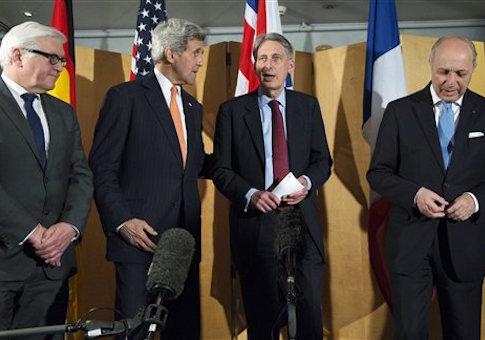
Iran Nuclear TalksFrom left, German Foreign Minister Frank Walter Steinmeier, U.S. Secretary of State John Kerry, British Foreign Secretary Philip Hammond and French Foreign Minister Laurent Fabius talk after Hammond made a statement about their meeting regarding recent negotiations with Iran over Iran’s nuclear program in London, England, Saturday, March 21 / AP

LAUSANNE, Switzerland—Efforts by the Obama administration to stem criticism of its diplomacy with Iran have included threats to nations involved in the talks, including U.S. allies, according to Western sources familiar with White House efforts to quell fears it will permit Iran to retain aspects of its nuclear weapons program.

A series of conversations between top American and French officials, including between President Obama and French President Francois Hollande, have seen Americans engage in behavior described as bullying by sources who spoke to the Washington Free Beacon.

The disagreement over France’s cautious position in regard to Iran threatens to erode U.S. relations with Paris, sources said.

Tension between Washington and Paris comes amid frustration by other U.S. allies, such as Saudi Arabia and Israel. The White House responded to this criticism by engaging in public campaigns analysts worry will endanger American interests.

Western policy analysts who spoke to the Free Beacon, including some with close ties to the French political establishment, were dismayed over what they saw as the White House’s willingness to sacrifice its relationship with Paris as talks with Iran reach their final stages.

A recent phone call between Obama and Hollande was reported as tense as the leaders disagreed over the White House’s accommodation of Iranian red lines.

Amid these tensions, U.S. Ambassador to France Jane Hartley met with her French counterpart, Gerard Araud, Monday to discuss a range of issues.

Benjamin Haddad, who has advised senior French political figures on foreign policy issues, said leaders in Paris have not been shy about highlighting disagreements they have with the White House.

“Fance, like other European countries, has negotiated for more than 10 years and endured most of the sanctions’ burden,” said Haddad, a research fellow at the Hudson Institute.

“The French want a deal, but they see no rush and repeat that Iranians need a deal more than we do, and that we shouldn’t fix artificial deadlines that put more pressure on us than Iran.”

One source in Europe close to the ongoing diplomacy said the United States has begun to adopt a “harsh” stance toward its allies in Paris.

“There have been very harsh expressions of displeasure by the Americans toward French officials for raising substantive concerns about key elements of what the White House and State Department negotiators are willing to concede to Iran,” said the source, who spoke on condition of anonymity. “That is because the clarifications expose just how weak the Americans’ deal is shaping up to be.”

“The meeting between the French ambassador in Washington and the president’s envoy to Paris—not a diplomat but a big fundraiser for his campaigns—comes amid these very harsh words that were spoken privately about the ambassador’s recent comments on the seeming American desperation for a deal, and the tough words that President Obama had for President Hollande in their phone call.”

Strategic differences remain between the United States and its allies over how a final deal should look, the source said. The French remain opposed to a recent range of concessions made by the Obama administration.

“We may agree that denying Iran a nuclear weapon ability is the goal, but apparently the view of what one can leave Iran and assure that is very different,” the source said.

“Clearly these are the differences that must be discussed. I don’t see France suddenly deciding that America is right and French objections to weakness are wrong, nor that silence is preferable to transparency.”

Haddad said the French are hesitant to rush into an agreement.

“The French want a robust deal with clear guarantees on issues like [research and development] and inspections to ensure that Iranians won’t be able to reduce breakout time during the duration of the agreement (also an issue of discussion), or just after thanks to research conducted during the period,” he said. “That is also why they disagreed on lifting sanctions.”

He also said the French “don’t trust Iran and believe an ambiguous deal would lead to regional proliferation.”

Another Western source familiar with the talks said the White House is sacrificing longstanding alliances to cement a contentious deal with Iran before Obama’s term in office ends.

“The President could be hammering out the best deal in the history of diplomacy, and it still wouldn’t be worth sacrificing our alliances with France, Israel, and Saudi Arabia—key partners in Europe, the eastern Mediterranean, and the Gulf,” the source said. “But he’s blowing up our alliances to secure a deal that paves Iran’s way to a bomb.”

A State Department spokesperson declined to comment on the issue.

Meanwhile, talks between the United States and Iran reached a critical juncture Thursday, as Secretary of State John Kerry met with his Iranian counterpoint to hash out differences over key points concerning Iran’s nuclear program.

The sides are hoping to reach a framework agreement by March 31 amid reports that Iran is demanding Saudi Arabia immediately halt airstrikes in Yemen, where Iran-aligned forces are working to bring down the Western-backed government.

The issue could complicate the talks as the United States attempts to balance its regional alliance with Iran in Iraq against competing interests with traditional allies in Saudi Arabia.

U.S. negotiators have reportedly softened their stance in recent days on a range of issues relating to Iran’s continued production of nuclear materials. One of Iran’s nuclear sites in Fordow could continue to operate, according to the Associated Press.

Ralph Peters: Iran Building a New Persian Empire

March 27, 2015

Ralph Peters: Iran Building a New Persian Empire

March 27, 2015 by Frontpagemag.com

via Ralph Peters: Iran Building a New Persian Empire | FrontPage Magazine.

Editor’s note: Below are the video and transcript to Ralph Peter’s speech at the Freedom Center’s 2015 West Coast Retreat. The event was held March 6-8 in Palos Verdes, CA. 

https://vimeo.com/122407074


Ralph Peters: First of all, what are we going to do about those Jews?  No, I’m serious.  I’m serious.  What are we going to do about all the Jewish refugees?  After the nuclear cataclysm in the Middle East? Some missiles are going to get through.  Tel Aviv will be gone, Ashdod, Haifa, but a lot of Israelis will survive.  Now, should we offer them a reservation in Nevada with a sign above the entrance that says “Arbeit Macht Frei”?  Or, maybe we should put them in a DP camp, and the reason I’m saying this isn’t just to shock you.  It’s because the biggest God damned lie you’re hearing today is “never again.”  The world doesn’t care.  The world doesn’t care, and without the United States and Israel together, working together to common strategic goals, common civilizational goals, there is going to be a catastrophe, and it is nothing short of appalling.  When Bibi Netanyahu came to Congress and laid out the argument as clearly as could be, it was a masterful speech.  I suspect Michael Oren probably wrote it, but it was really just superb, and then you had the refusenik Democrats come up in their conference.  I love the guy from Oregon with the bowtie and a bicycle, and they sided with Iran.  They took Iran’s side against Israel.  That’s what it came down to.

Now, this is tough for Israel, because Israel has the military might to set back the Iranian nuclear program.  It does not have the military might to fully destroy it, because a succession of American presidents, especially Barack Obama, have given — the Iranians don’t need this deal.  They may end up rejecting it because they got what they want.  They wanted time.  They wanted sanctions relief.  Well, we’ve given them over $12 billion in free and unfrozen funds, but it goes beyond that, because as soon as we started opening the sanctions program, businessmen, including American businessmen, flocked to Tehran, trying to set up deals, smuggling increased.  Obama has been, I want to say Allah’s gift to Iran, and if there are any closet anti-Semites out here in the audience, let me tell you why you should care, even if you don’t care about Israel, why you should care, because an Iran with nuclear weapons, with a nuclear arsenal, even if it never uses one of those weapons, already has hegemony, strategic control of the Persian Gulf, de facto control of the Persian Gulf, and the greatest concentration of oil and gas supplies in the world.

There was a novel back in the ’40s or ’50s, called “Oil for the Lamps of China.”  Well, it’s for a lot more than Chinese lamps now, and China, India, so much of the world is still relying on Persian Gulf oil, so you’ve got the Israel problem and you’ve got the oil problem, and Iran’s grander ambition still, which I’ll get to in a moment, but first thing I want to do is try to talk a little bit about what we are seeing.  You’ve got to really stand back, and it’s hard because all news channels — you focused on the headlines of the day.  It’s news.  It’s not analysis.  It’s news.  You do some analysis, but they want you to comment on the story of the day, but sometimes you have to stand back and put it on the wide-angle lens, and when you do that, the world looks even more terrifying than it does off the headlines.  We have returned, in crucial parts of the world, to barbarism.  There’s just no other word.  It is barbarism, and the American intelligentsia for the most part defends and excuses that barbarism, and it is stunning because the campus leftists haven’t studied their own left-wing history.

When the revolution wins, guess who goes to the guillotine.  Guess who goes to the Gulag.  It’s not the workers of the world.  It’s the intellectuals, but again, as you heard wise remarks about this earlier today, it’s really about emotion, certainly on the left, but to somebody standing on the right there is really very little powerful analysis, no-holds-barred analysis, and I tell people, first of all, if you want to be a successful idealist, start with a realistic analysis of the problem.  And beyond that, we are not only returning to barbarism, but to atavism, and we are led, in both parties, particularly the Democratic Party, but both parties, more and more by men and women who have never been in a fist fight.  The best thing my parents ever did for me was start me off a year early in school, so I was always the smallest kid in my class, and you learn a lot about human nature in that situation, especially if you’re the smart guy too, and then I got taller and started beating them up, but that’s all right.

But the left, particularly, but even some on the right, are denying fundamental facts of human nature.  You heard Marie Harf’s silly comment about well, the terrorists need a job.  They’ve got a job, and they love their job.  Dad loves his work, and it’s just phenomenal to me that this generation, two generations now of leaders whose idea of violence was lacrosse at Princeton.  They’re utterly, psychological, practically, and factually unprepared to deal with the likes of the Muslim Brotherhood, let alone ISIS or Al Qaeda, and when you look at the atrocities committed by Islamic State, and increasingly by other terrorist affiliates and organizations who are competing with Islamic State for brutality, because everybody wants to outdo the other guy, what you’re seeing is joyous violence.  It’s so empowering to these young men who just never fit in, and they’re not all from poor families.  Many have college educations, but for some reason, they came from the people factory with a couple ball bearings or gears misplaced.

And for those who were always the outsiders, I’ll tell you, Islamic State has a brand that is now as recognizable as McDonald’s or Coca-Cola, and it is a very appealing brand, and those videos of burning a pilot alive, all the decapitations, all the executions of masses of Iraqi soldier prisoners, that is the greatest thing possible for these young, disaffected, pimply-faced, sexually dysfunctional guys living in mom’s basement, whether the basement is in Cairo or California.  I don’t know how to communicate to you how powerful the lure of violence is.  The most addictive substances on earth are not heroin or meth.  The most addictive substance is human blood.  It is absolutely addictive.  Do you think the Nazis hated everything they did?  I’m sure they had on days and off days, but nonetheless.  We’re in denial of human nature.  That happened 7 years before I was born, and 1945 ends it, and we say “never again.”

And now, I’ll tell you what the problem is with those damn Jews.  In Europe for over 1,000 years, Jews were confined to ghettos in most countries.  They were limited to a small number of professions.  Well, guess what?  They got very good at those professions, and then they get punished for being good at them.  Israel’s problem is it’s an overachiever.  It exploded the left-wing lie that because of American and European imperialism no states outside of Europe can reform themselves and rebuild themselves, let alone start from scratch.  Without romanticizing Israel in the least, look at the score card.  It is the only country in the Middle East where the true rule of law prevails, the only country where it investigates its own military, the only country where women have full legal rights, the only country where Christians are fully and truly safe.  You can go on and on and on, but I tell people, Israel is flesh of our flesh and blood of our blood, whether you’re an Episcopalian like me, or Jewish.

And by the way, with Christians and Jews, we had an argument about one Rabbi 2,000 years ago.  Come on, 2,000 years?  Let’s get over it.  Let’s move on, okay?  But when you talk about traditionally, until now you can’t.  We talked about American culture as Judeo-Christian.  Although it’s a monotheist religion, Islam spun off the rails.  It’s divergent in the most negative sense of the word, and if we can’t bring ourselves to be proud of our faith, we need to be proud of our civilization, because you heard Victor Hanson talking about California.  People don’t come from Mexico to California because California sucks so bad.  This is still the land of dreams.  It truly is, where you can come here and you can build a life, and if you fail the first time, or two times, you can get back up.  You can’t even do that in Europe, so amid all the pessimism about our own country that I’ve been hearing, never underestimate the transformative power of the United States of America.

Civilizations, cultures, and religions change on their frontiers.  It’s gonna take generations, but Islam too will change here.  It would go a lot faster if our presidents stopped empowering and listening to the worst voices in the American Muslim community, people from CAIR or the frankly radical organizations, and there’s no way around it.  No.  I said I want to pull back the lens.  When I spoke here 5 years ago, I talked about us being in an age of breakdown, of devolution, where the old empires had been collapsing.  You’ve gotta take a long-term view, centuries-long view, and all those great European empires were collapsing, climaxed by the collapse of the Soviet empire, and then you had the collapse of the mini empires.  Yugoslavia was basically a mini empire, largely dominated by Serbs.  Pakistan, it won’t hold together forever.  It’s an empire.  Everything west of the Indus River is occupied territory, but something’s changed in those 5 years.  We’re still in this age of breakdown in the West, but in the Middle East, in Russia, in China, we are seeing the rebirth of the old empires, which brings me back to Iran.

The majority of Iran’s population are Persians.  The Persians were one of the great civilizations of the ancient world.  When the Persians invaded Greece in the late 6th and early 5th century B.C., we sided with the Greeks, because they’re our guys, but frankly at that point, the attainments of the Persian Empire were far greater, and all the Greek cities of Asia Minor sided with the Persians.  Now, fortunately, the Greeks beat them off, and they experimented with this new idea of democracy, and 2,500 years later democracy has succeeded so well, it’s got us to Nancy Pelosi, but there’s a point to that too.  You can’t criticize people for not getting democracy right out of the gate.  We’re still experimenting with it.  We’re still trying to make it work better, and it’s tough.

Now, on the subject of those Greeks. It’s commonplace for people to say, oh, Homer, the Iliad and the Odyssey.  They’re the keystone books, the wellsprings of our civilization.  Nobody reads the Iliad except scholars.  The Iliad is about the joy of killing, and I tell people, look, the real point of military discipline is not getting young men to kill; that’s easy.  The point of military discipline is to get them to stop killing when you give the order.  Young men are inherently violent.  In our society, we channel it for the most part, except in some particular neighborhoods.  We channel it amazingly well.  We do.

But so, back to Iran.  Iran, with its Persian core, is trying 2,500 years later — and there’s been some Iranian empires, smaller ones, in the interim — they’re trying to rebuild or to build a new Persian empire, and the problem now is the old Persian empires were relatively tolerant, especially the first couple.  They would tolerate different religions within the empire.  This is now an ambitious resurgent empire overlaid with ferocious, messianic, apocalyptic religion:  Shia Islam.  So, this is really a terrible threat, and you see, right now, as we speak, Iran has already reached out to Iraq, which is now, there’s no other way to put it, it is an Iranian vassal state, to Syria, which is becoming a vassal state, has become a vassal state really, Lebanon, Hamas, into western Afghanistan, into Yemen.  It has been 2,500 years since the Iranians had an imperial presence over such a wide swath of the globe.

That would be bad enough, but you’ve got other attempts to rebuild empires.  Opposing Shia Iran, the Persian Empire, you’ve got the Islamic State Caliphate, and it resounds, and I’ve got to say this: How would you feel if the King of Saudi Arabia said, oh, southern Baptists, they’re not real Christians; Orthodox Jews, they’re not real Jews.  That’s about how much credibility Barack Obama has.  He’s not an Islamic scholar, and none of the people around him are.  You heard more common sense about Islam today than you’ll hear in Washington in a year, so you’ve got this resurgent caliphate and it is a clash of ancient empires, of religions, of civilizations, and, oh, by the way, look a little bit to the north and you’ve got a resurgent Russian empire.  Now, Vladimir Putin is absolutely fascinating to me.  The elites in the West, and we talked about this last night, the elites in the West write off Putin, because he didn’t go to the right prep schools in Switzerland.  He didn’t go to the right universities.  He chews with his mouth open.

Really, the Europeans were all up in arms, in a tizzy after one conference about 6, 7 years ago, because of Putin’s table manners.  It’s not his table manners that matter.  Look at what he’s done.  Even Anne Applebaum, who I think is the best columnist we have on Russia and Eastern Europe, she dismissed Putin as a mere chinovnik, a petty bureaucrat.  It’s not even rising to the level of bureaucrat, and they missed the fact that the people who go to the great prep schools, who go to the elite universities, they sustain the system in being.  They do not change the world.  The world is changed by outsiders.  Hitler was a lance corporal with digestive problems, to put it politely.  Napoleon was a relatively junior artillery officer.  Mao was an indifferent student.  Ho Chi Minh washed dishes in the basement of a Paris hotel.  Mohammad was illiterate, and Muslims will admit that.  It was an oral tradition, originally.  It’s the outsiders with a vision, the galvanizing vision, that change the world, and the one thing Obama has in common with them is they appeal to the limping proletariat first.  First, Hitler gets the Brownshirts, but then when he comes into power, he gets rid of the Brownshirts, but you can always find an attractive audience, violence supporters, among those at the bottom.

Putin came to power just 15 years ago.  When he came to power, Russia was flat on its back, and for all his, what we see as silly photographs, bare-chested photographs, et cetera, for all of that, he has done a stunning job.  He has won, or at least fought to a draw, every major confrontation with the West.  When is the last time you heard somebody, U.S. government spokesman, talk about Crimea?  Now, it’s east Ukraine, and at some point it will probably be central or southern Ukraine.  It’s just stunning to me this elite that governs us are in denial about the nature of human violence, just the nature of humanity.  They’re in denial about the threat significant portions of Islam in the Middle East, the Islamic world in the Middle East, pose, and they’re in denial about one absolutely huge factor: Religion.

And, I know I talked about this 5 years ago, because we are, again, governed by people in both parties, who for the most part in Washington, even if they go to church or synagogue every week, they’re secular.  They’re secular, and what people who like Barack Obama, whose religion is Barack Obama, and the people around him don’t understand, despite being exposed to the Reverend Wright, because he just blew that off really, although he took a lot of the message in subliminally, but the transfigurative power of religion, of revelation, real or imagined, they just don’t understand the power, so this takes us back to Islamic State.  Think of the deal that those Islamic State leaders offer through brilliant use of the Internet and YouTube, et cetera.  Their deal is not a Wal-Mart greeter, as Marie Harf would have them be.  Their deal is you come here and God will sanction you torturing, killing, raping, taking sex slaves, and, oh, by the way, if you get killed, you get an even better deal in paradise.  It is an incredibly powerful message, and we’re not going to join Islamic State.  We have lives.  We have things to protect, but it’s always the people that, again, it’s not socioeconomic.  Bin Laden was a millionaire, until he blew it all, and they’re not all uneducated.  Zawahiri’s certainly not uneducated, but they’re the misfits, and they’re the people that change the world.

So, we’ve got an elite that doesn’t understand human nature, resists it, resists an open-eyed view of Islam, absolutely refuses to see anything in strategic terms, and I mentioned China briefly.  China is really interesting because they’re not trying to reestablish an empire.  China has changed profoundly.  China always was interested in its borderlands, but China is now, for the first time in thousands of years of its history, is outward looking.  China is building an overseas empire in Africa, South America, and when you look at them building a new empire, the resurgent empires, and the moral cowardice, and the unwillingness to defend our civilization in the West, it is a prescription for very, very, very bad trouble, or as my old drill sergeant used to say, you’re in beaucoup deep kimchi, comrade.  And so, anyway what I would like to do now is open it up for questions, because I’m sure you have a lot, and I can better address your concerns if I know what they are.

Unfortunately, because of their policies, we are going to get into a war with Iran.  The odds are very, very good.  Appeasement doesn’t work with fanatics.  Appeasement doesn’t work with empire builders.  It hasn’t worked with Putin; you remember the reset, and by the way, one of the lowest moments in the U.S. presidency was when Barack Obama was caught leaning over to Dmitry Medvedev and telling him, after the election, after I fool the American people, I can give Vladimir a better deal.  So, with Iran, this idea of strategic patience amounts to standing there and letting a mugger beat the hell out of your because you hope he’ll stop at some point.  Strategic patience just makes the enemy stronger, and look, there is not a military solution to every problem.  That’s obvious, and we should be very hesitant to use military force, but some problems only have military solutions and unfortunately, because of the disastrous policies of this president and his administrations, my God, the threats are so broad now that you don’t know where to start, although I will tell you, honestly, if I have to weight them, Threat No. 1 is actually Vladimir Putin and his ambitions, because he’s got the nuclear arsenal.  A close second is Iran.  ISIS, they’re close third, and other Islamic organizations.

But, as I think I started to say, Israel has the power to start a war with Iran, to harm their program, but Iran would respond asymmetrically.  If it doesn’t have nukes yet, they would respond asymmetrically.  They would attack Arab oil fields, gas fields, loading terminals, storage tanks on the other side of the Persian Gulf, and cripple the world economy, and who will everybody blame?  Israel, and then at that point, we will be in it anyway, so if we must, if we absolutely have no choice but to act against Iran, we should do it together.

Another problem is with all these delays, Iran wanted time.  They wanted time, and they got it, so they built additional underground bunkers.  The Obama administration hasn’t even asked to inspect many of them.  We essentially pretend they’re not there.  If you can’t inspect the deep underground bunkers built specifically to withstand heavy ordinance, what might be going on there?  Might they be up to something 500 feet below the surface of the earth?  So again, there’s no good answer.  We all want easy answers, but there’s no easy answer to this, and every day with Obama, President Hamlet, to be or not to be, forever wringing his hands, unable to make a decision, it gets worse.  George W. Bush was mocked for saying, well, I’m the decider.  That may have been infelicitous English, but that’s what a president is, the decider, and the most important role of any president is Commander in Chief.  Obama has failed comprehensively, comprehensively in that respect.

Audience Member: Do you think that the American public is willing to go to war with Iran?

Ralph Peters: Well, we don’t sell it properly, and again I’m not, I wish we could find another way to deal with it.  It depends on how you ask the American public.  If you ask, did you want Iran to destroy Israel, well, the answer’s no, we don’t want to do that, but if you went, well do you want to send your troops back to the Middle East for a long-term engagement, then the answer’s going to be no.  Polling’s all about how you ask the questions, and another point I’d like to make, and I’ll get to you, you hear so much BS in Washington.  You hear there’s no military solution to terrorism.  We have never tried.  We’ve never tried.  We’ve tried these half measures with restrictive rules of engagement.  We tried to make friends with our enemies before we won.  You make friends with your enemies after they surrender, after you win, and then you’ll hear the lie that, oh, if we kill terrorists, we’ll just make more terrorists and more enemies.  World War II, we did a job on most of Germany’s major cities and most of Japan’s major cities, plus dropped two atom bombs, and today Germany and Japan are, in their different ways, steadfast allies.

Human memory can be very short, but at any rate, literally I’m really at a loss for words, but the foreign policy situations, security situation is such a goat rope, to put it politely, that for the first time in my life I don’t know where to start.

Audience Member: Hello, my name is Maria, actually from Russia, from Moscow, so my question will be about Russia and about foreign policy.  So, the question is that I will tell you, and if you agree with me, please explain why.  If you disagree with me, please explain why.  So, under the example of relationships between the United States and North Korea, sanctions and so on, the dictatorship in North Korea became more and more strong.  So, aversely we can tell that the same situation now we have with Russia, so the more sanctions we have in Russia, from foreign countries like Europe and the United States, then the more strong becomes Putin, the more Russia becomes an empire, talking that the United States is a huge enemy, and all disasters that are happening just because of the United States.  So, here is my first question.  Do you agree with this or disagree with this, and please I would like to know your opinion about what do you think should be a foreign policy for the new hope Republican President of the United States in 2016?  Thank you.

Ralph Peters: Well, the first thing, I’ll do the second one first, the first thing a new president has to do is rebuild the alliances that Obama has damaged so badly, and not just with Israel, even Egypt at this point.  It’s as if Obama instinctively wants to side with America’s enemies, and I’ll talk about Obama if you remind me in a moment, but I’ll get to your first question.  I think it’s a reasonable thesis, but I don’t share it because you can’t let Putin off total scot-free, and he was attacking America and blaming America for everything under the sun, even before the sanctions, and it’s a tragedy, because there is no inherent reason for the United States and Russia to be at each other’s throats, but Putin, in the classic dictatorial authoritarian method, he needs foreign foes to play to xenophobia.  And so, no matter what we do, he’s going to play that card.  I would say the problem is the sanctions weren’t tough enough.  Now, a difference between Russia and North Korea is the North Korean leadership is perfectly willing to starve its people to death by the tens of millions.  That was the case in Ukraine 80-some years ago, but even Putin isn’t going to starve tens of millions of Russians to death.

Now, they’re not going to starve, but we make mistakes in the West, because who do American journalists and politicians talk to?  They talk to the well-educated, urban Russians who speak English, and they have no sense of how appealing Putin is to the middle-aged woman out in the country.  And so, I just try and tell people that you don’t understand that when Putin does things that look ridiculous to us, in fact, it plays very, very well.  The real man, real he-man, and again there’s no good way to handle them, but the tragedy is that there’s no inherent reason for us to be at each other’s throats, except Putin needs an external enemy, and in the early to mid ’90s there was so much goodwill toward Russia.  We didn’t want to take over Russia.  Why?  We’d have to fix the health care system to start, and you know how that goes, but America never had any imperial ambitions.  It was a real clash of ideologies, the Russian belief in a greater Russia and the Western belief in self-determination, even for Ukrainians, and to be fair to Putin, and I will even be fair to Putin, the problem isn’t that Russia got the Crimea and the Donbass area back, it’s how he did it: The use of force.  If it had been a plebiscite that would have been very different because frankly Crimea just becomes part of Ukraine in the 1950s, and it was Khrushchev’s gift, but it was a poison pill.

When the Russians gave Eastern Ukraine, primarily Russian speaking, and gave Crimea to Ukraine, they were following the Stalinist tradition, even though Stalin was gone, of basically infecting populations so they couldn’t become too homogeneous.  He wanted to create a substantial minority of Armenians in Azerbaijan, of Russians in Eastern Ukraine and in the Baltics because it always gives you a lever against them, and so again, that’s not a satisfactory answer.  I know it’s not, but in this terribly dangerous world I wish I could give smooth, satisfactory answers you could take home with you.  I can’t.  I can just sound the alarm bell.

Audience Member: In ’48 the Israelis had a serious supply problem and, as many of us know, they were bailed out in large measure by the Czech government/the Soviet Union.  After the recent war in Gaza, do you think the Israelis have solved the resupply problem particularly with regard to an action against Iran?  Where are they going to get the hardware from?

Ralph Peters: They’ve got the air frames to do some damage.  They’re getting more tankers, but right now people don’t realize it.  The U.S. Navy and Air Force are running low on specific munitions after this little pinprick campaign against Islamic State.  Why?  Because the money for defense industry is in selling new big-ticket items.  The money is not in providing low-cost munitions.  There’s some, but there’s not nearly as much markup, and so, as I’ve talked about before, you have this travesty in the United States where retired generals who are taking home pensions of $200,000.00 a year or thereabouts could now go work for Lockheed Martin or Raytheon and not only double dipping but that prevents them from speaking out while they’re on active duty and saying hey, guess what?  The F-35 really doesn’t work.  Now, because Israel was under such pressure, their defense acquisition system tends to be much more honest and aggressive, but I’m sure that in the Bronze Age there was corruption in weapons procurement.  You remember Daddy Warbucks in Little Orphan Annie?  It’s always been there, but you gotta keep it under control, and if you keep it under control, capitalism can give you some amazing results.

But the other point you brought up is very interesting to me and I’d like to just talk a moment about it, is 1948.  Why did the Israelis win?  Anybody?  Because they were fighting for their survival, the survival of themselves as a people and as a faith, and in my generation of Army officers, we watched the Israelis thump on Arab armies again and again and again, and we said Arabs can’t fight.  We missed something important.  People fight for different things.  Arabs don’t fight for states.  In the Arab world, the state was always the enemy.  They came and took your taxes, took your son, maybe took your daughter, and the game was hid and seek with the state, but Arabs and other peoples of the Middle East will fight for their faith, for their clan, family, tribe, and they will fight for their turf. In the case of the Kurds, who of course are not Arabs, the Kurds are like Israel in ’48.  They’re fighting for their survival, and we’re again on the wrong side.  Instead of helping the Kurds directly, we are sending weapons to Baghdad that never get to the Kurds, and the Baghdad government is owned in every respect but a written deed, by Iran.  It’s crazy.  U.S. air power in Iraq today is flying air cover, air support for Iranian efforts, and we are on the way to seeing that new Iranian empire that will be very, very, very dangerous.

People ask me who do I want to win in Tikrit, Beelzebub or Mephistopheles.  If the Iranian-backed defenses fails it’s really a bloody nose for them.  That’s great, but that means Islamic State wins, and everybody loves a winner, and one of the reasons for the exponential growth, one of the reasons of growth of Islamic State, is simply that people want to join the winning team.  You saw defectors from Jabhat al-Nusra, from secular militias, from Al Qaeda.  Everybody wants to be the winning team, and as I said earlier, it’s a good deal, but we are now faced with these people, Arabs and others, Persians, who are not fighting for the state per se.  The Arabs aren’t fighting for a state.  They don’t have a vision of an Arab empire to the extent the Persians have a Persian Empire.  The Arabs are fighting for the Caliphate, and the idea of the Caliphate truly resonates with them, truly does.  The Persians are fighting for an empire.

And by the way, on Vladimir Putin, Putin is not trying to rebuild the Soviet Union he can’t do it.  He’s trying to rebuild the Russia of the Czars, about the year 1900, just before the Russo-Japanese War, when Czarist Russia was at its greatest expansionary extent.  That’s what he wants to restore.  He’s a great Russian nationalist.  He’s not a commie.  Nobody in the KGB were commies.  They knew what was going on.  They’re the only people that really knew, but he is perfectly willing to increasingly use Stalinist methods, and his background as the petty bureaucrat, lieutenant colonel – I’m partial to lieutenant colonels myself, but his background gave him the ability.  He was a case officer.  That means that’s somebody that works with agents, and the primary thing a case officer has to be able to do in intelligence is size up the guy sitting across the table from you or walking with you in the street, and Putin is brilliant at sizing up Westerners.  The only person who has marginally stood up to him has been Angela Merkel, and she unfortunately has domestic issues that let her go so far and no farther.  So I’m sorry, that’s the best answer I can give.

Audience Member: I have some experience with domestic regulatory agencies and cyber security, and I see them as being quite detached in realities of technology.  It’s like giving a civilian a military role, and I’m wondering if you could shed some light and your opinion on if you think our cyber defense – I’m actually more concerned with cyber offense.  We hear so little from the NSA, as it should be.  I don’t think the military should be on TV saying what’s going on, but with all this rolling about privacy and Snowden and people running it, and China and Russia I know hacking.  Russia trains people to hack America.  How is that a military issue, and do you have confidence that we are having a cyber defense and offense that’s adequate?

Ralph Peters: Well, the lines between purely military operations, economics, cyber, they’re all breaking down, and I too worry more about our cyber offense capabilities.  We’re actually not bad, from what I can tell, on cyber defense.  A problem is when private industry won’t play and then they get themselves in trouble.  Then they want help, but cyber offense, you look at the brilliant propaganda videos done by Islamic State.  You can’t do something like that in the United States.  You can’t do anything that aggressive, but also, Islamic State, al-Baghdadi or one of his underlings can say, hey, do this now.  Film this and get it out, and they do it.  Maybe he watches it, but in our bureaucracy the levels of people that have to chop off on it, have to sign off on it make it absolutely certain that by the time it hits the Internet it’s old news.  Speed matters.  Who would have thunk it?  In the Internet age speed matters?  And Washington is still operating on a 19th century timetable.  I have to move on.  For me this is a treat because I get to talk at some length instead of 4½-minute sound bites.  It may not be a treat for you.  It is for me.

Audience Member: Using your 5-year timeframe, what are the alignments today and 5 years hence between China, the Middle East, Russia?  Where does Israel fit into these new alignments, and what about Japan and the Baltic states, and any economic backdrop you wish to add to it?

Ralph Peters: Oh, that’s easy.  That’s a pretty big question.  I will just say that you can’t put rigid timelines on things.  For instance, you can’t put a rigid timeline on when the Iranians will have a nuclear arsenal because there’s so much we don’t know and we haven’t even asked them about that.  That’s the crazy thing.  Obama and Kerry want this deal so badly they’ve been willing to ignore all the monstrous actions of the Iranians.  Iranians killed and maimed so many U.S. troops in Iraq and Afghanistan.  They’re acting antithetical to our interests everywhere throughout the greater Middle East, but Obama wants that deal for his legacy.  Iran wants a new empire with nuclear arms.  Obama wants a legacy.  Obama’s legacy is going to be a nuclear-armed Iranian empire.

Audience Member: Where’s the future alignment?  Where does the Middle East align with China, align with Israel?  If this is all shifting, there are clearcut –

Ralph Peters: I can’t give you pat answers.

Audience Member: What do you perceive, because there’s been a lot written about it?

Ralph Peters: In the immortal words of Frank Zappa, trouble comin’ every day, and I’m not being flip.  Frank wasn’t all that dumb, but again, you just can’t put timelines on it because you have the Black Swan events.

Audience Member: Forget about the time limits.  What’s happening today, and what happens to Japan and the Baltic states?

Ralph Peters: Well, if you leave timelines out, what happens to the Baltics will be a matter of Putin’s fiat.  He wakes up one day and decides to go for Estonia, and Putin can be coldly analytical, but he also has a real temper.  China is getting what it wants without war.  They’ll push to the brink and then back off, push to the brink again.

Audience Member: But they’re aligned with whom right now?  They’re aligned with Israel in part.

Ralph Peters: Yeah.  Well, Israel – Israel is threatened as it has not been since 1948.  That was a complicated question.  I’m sorry.

Audience Member: I’ve heard from several of our former military analysts and maybe not military per se but commentators that Israel does not have the capability of destroying Iran’s complete nuclear capability.  My understanding from talking to people inside Israel’s military is they have no doubt that they can take all of it out.  What they are concerned about, and please, maybe this is false bravado, like they said with the latest round of bunker busters that the U.S. has, they said no weapon comes to Israel that stays the same after it arrives from the United States. That they modify all their weapons, but what they said they were the most afraid of was that the Obama administration would lead a worldwide economic embargo against Israel the day after.

Ralph Peters: Yeah.  I am not as confident about the Israeli ability to destroy it.  I said they can badly harm the nuclear capability.  The Israeli intelligence services are very good, but Iranians have had so much time to build so deep underground.  There are at least 30 locations the Obama administration won’t even go after, doesn’t want to mention, because they want the deal, so that’s the best answer I can give you.

And let me just finish up.  I’ve heard a lot of things said about Barack Obama, and he’s really a tragic figure, not in least tragic for America, but you look at his background.  He’s a red diaper baby.  He’s all his life in Indonesia, and this is important, he was on the island of Java.  Now on central Java where he was, Islam has only been there around 500 years.  I’ve been there.  I’ve done a research project there.  There’s a tremendous hangover from Buddhism, animus practices, and it frustrates the Saudis that the Saudis send a lot of money trying to move them, but that’s a nation approaching 240 million Muslims and they’ve produced several hundred terrorists, but out of 240 million that’s pretty amazing, and a lot of those came from Banda Acehans on Sumatra, but Obama saw Islam in his formative years at its most benign.  It wasn’t Saudi Arabia where his mom would have to wear a veil and couldn’t drive herself.  It wasn’t anywhere else in a Middle Eastern dictatorship.  It wasn’t among the hillbillies of Afghanistan.  It was among the relatively sophisticated semi-urban Muslims of Java, and then he spends the rest of his life, with a few-year exceptions in high school, et cetera, around very hard left people, and I really believe that President Obama has been in a hard left milieu for so many decades that he is much more ideologically rigid and much farther to the left than he realizes.  I think because of being around people like Bill Ayers, reading Saul Alinsky, Rev. Wright certainly, on some level I think he sincerely believes America is unjust.  He misses the irony.  Here’s a mixed-race president who gets to the White House having done nothing, and he says America’s bigoted.  Well then why would we elect him?  But I really do believe that he is soft on Islam because of his background, and he really is convinced that sooner or later socialism, or call it what you will, will work somewhere, and also he’s so thin-skinned and so arrogant.  This is a president – think about it – he gets angrier about Fox News than he does about Islamist terror.  So greetings from Fox News, folks.


US continues to insist airstrikes support Iraqi forces, not Shiite militias

March 26, 2015

US continues to insist airstrikes support Iraqi forces, not Shiite militias, Long War Journal, Bill Roggio, March 26, 2015

(Perhaps it’s just Obama’s unrequited love for Iran and his need to get any nuke deal that Iran will give him. — DM)

US government officials and top military commanders are so eager to destroy the Islamic State that they are crawling into bed with the flip side of the jihadist coin: the fanatical Shiite militias backed by Iran that are terrorist organizations and ultimate destabilizers of Iraq in their own right.

*****************

Combined Joint Task Force-Operation Inherent Resolve (CJTF-OIR), the US-led Coalition that is launching airstrikes against the Islamic State in Iraq and Syria, announced that it conducted 17 strikes against Islamic State fighters entrenched in Tikrit. US commanders continue to insist that they are supporting Iraqi security forces, and not the Iranian-backed Shiite militias who make up more than two-thirds of the fighting force in the Tikrit offensive.

The 17 airstrikes targeted “an ISIL [Islamic State] building, two ISIL bridges, three ISIL checkpoints, two ISIL staging areas, two ISIL berms, an ISIL roadblock and an ISIL controlled command and control facility,” according to a press release. The US military continues to refer to Islamic State as ISIL, the outdated acronym for the Islamic State of Iraq and the Levant (Syria).

The airstrikes launched “in support of Iraqi Security Forces in Tikrit commenced last night after a request from the Government of Iraq,” CJTF-OIR stated. The 17 targets hit in the last 24 hours were “approved by the Iraqi Ministry of Defense.”

US military officials have previously said that support for the Tikrit offensive was being withheld because of the massive presence of the Iranian-backed militias and Iranian military units and advisers.

Despite this previous acknowledgment, Lieutenant General James Terry, the commander of CJTF-OIR, skips over the presence of Shiite militias in the Tikrit operation [emphasis mine] in the latest statement.

“The ongoing Iraqi and Coalition air strikes are setting the conditions for offensive action to be conducted by Iraqi forces currently surrounding Tikrit,” said Lt. Gen. James Terry. “Iraqi Security Forcessupported by the Coalition will continue to gain territory from Daesh [a vaguely pejorative Arabic acronym for the Islamic State].” [Emphasis in original — DM]

Pretending that US airpower isn’t supporting the Iranian-backed Shiite militias obviously doesn’t make it so.

US military officials’ denials that they are serving as the air force for Iranian-backed Shiite militias that are responsible for killing hundreds of American soldiers before US forces withdrew from Iraq in December 2011 becomes even more perplexing once you understand that many of the top leaders of these militias have been designated by the US as terrorists. And one of these militias (Hezbollah Brigades) is listed as a Foreign Terrorist Organization. [See LWJ report, US begins airstrikes against Islamic State in Tikrit, supports Shiite militias.]

US government officials and top military commanders are so eager to destroy the Islamic State that they are crawling into bed with the flip side of the jihadist coin: the fanatical Shiite militias backed by Iran that are terrorist organizations and ultimate destabilizers of Iraq in their own right.

Saudi Arabia puppet of US, Israel: Houthi leader

March 26, 2015

Saudi Arabia puppet of US, Israel: Houthi leader, Press TV (Iranian), March 26, 2015

(The positions of Obama’s friends in Iran. How soon will he bow, apologize and make more concessions to Iran to atone for his sins? — DM)

bbc72135-d3b0-4924-91b3-4c85d14cbc21Tribal gunmen loyal to the Houthis Ansarullah shout slogans against Saudi Arabia during a gathering in the capital Sana’a on March 26, 2015.

The leader of Yemen’s Houthi fighters has heaped scorn on Saudi Arabia for conducing unjust and heinous attacks on Yemeni people, saying the Arab kingdom is serving as a puppet for the United States and the Israeli regime.

Abdul-Malik al-Houthi made the remarks in a televised address on Thursday in reaction to Saudi Arabia’s “unjustified” deadly attacks targeting Yemeni people in the capital, Sana’a.

Saudi Arabia is a puppet at the disposal of superpowers, the Houthi leader said, adding that Riyadh is putting in action the US-Israeli conspiracy in Yemen.

He noted that the US-Israeli plot in Yemen aims to break up the chaotic country and deprive people of security and freedom.

Al-Houthi said the Saudi invasion of Yemen came after their agents, including al-Qaeda terrorists and the ISIL Takfiri terrorists, failed to execute their plots in Yemen.

He said the “criminal” attacks uncovered the “tyrannical” nature of the Saudi regime.

Al-Houthi warned that Saudi Arabia would face consequences should it push ahead with its aggression against Yemen, saying, “We will confront the criminal forces and their tools in the country.”

“You think you can kill Yemeni people, but this is because of your stupidity,” he said. “This unjustified aggression shows the hostility and arrogance of this regime. The attacks are reflecting the inhumanity of the aggressor.”

Al-Houthi said the “aggressors” should keep in mind that the Yemeni people are “committed to defending their country and revolution” by relying on God.

On Thursday, Saudi warplanes carried out fresh airstrikes against Yemen, hitting the northern cities of Sa’ada and Ta’izz in the south.

Airstrikes also targeted arms depots in the Malaheez region in Sa’ada near the border with Saudi Arabia.

Saudi warplanes started bombing the positions of the Ansarullah fighters and launched attacks against the Sana’a International Airport and the Dulaimi airbase early on Thursday.

Despite Riyadh’s claims that it is attacking Ansarullah positions, Saudi warplanes have flattened a number of homes near the Sana’a airport. Based on early reports, the Saudi airstrikes on Yemen have so far claimed the lives of 18 civilians with more deaths feared, Yemeni sources said.

The Saudi invasion of Yemen has drawn condemnation from many countries such as Iran, Russia, Iraq and Syria, as well as the Lebanese resistance movement, Hezbollah.

The blatant invasion of Yemen’s sovereignty by the Saudi government comes against a backdrop of total silence on the part of international bodies, especially the United Nations. The world body has so far failed to show any reaction whatsoever to the violation of the sovereignty of one of its members by Riyadh.

Bomb Iran, Says John Bolton

March 26, 2015

The former US envoy to the United Nations writes in the NY Times that bombing Iran is the only way to stop a nuclear arms race.

By: Tzvi Ben-Gedalyahu

Published: March 26th, 2015

via The Jewish Press » » Bomb Iran, Says John Bolton.

John Bolton writes in The York Times, "Bomb Iran."

John Bolton writes in The York Times, “Bomb Iran.”


Bombing Iran is the only effective way to stop its nuclear threat in its tracks and prevent a regional nuclear arms race, former U.S. Ambassador to the United Nations wrote n The New York Times Thursday.

Bolton previously has called on Israel to bomb Iran. With the United States and the other P5+1 powers on the verge of signing a deal with Iran, Bolton wrote that neither sanctions nor a “bad deal” will prevent what he called a “bad situation” from becoming  the “brink of catastrophe”

Bolton wrote:

The arms race has begun….No way would the Sunni Saudis allow the Shiite Persians to outpace them in the quest for dominance within Islam and Middle Eastern geopolitical hegemony….Ironically perhaps, Israel’s nuclear weapons have not triggered an arms race. Other states in the region understood — even if they couldn’t admit it publicly — that Israel’s nukes were intended as a deterrent, not as an offensive measure.

Iran is a different story. Extensive progress in uranium enrichment and plutonium reprocessing reveal its ambitions. Saudi, Egyptian and Turkish interests are complex and conflicting, but faced with Iran’s threat, all have concluded that nuclear weapons are essential.

He pointed out that “Saudi Arabia has signed nuclear cooperation agreements with South Korea, China, France and Argentina, aiming to build a total of 16 reactors by 2030..” Pakistan, whose leaders recently met with Saudi officials, could supply Egypt and Turkey with nuclear technology, and there always is North Korea ready to make a buck by helping to arm the world with nukes.

“Iran will not negotiate away its nuclear program,” Bolton wrote. “Nor will sanctions block its building a broad and deep weapons infrastructure. The inconvenient truth is that only military action like Israel’s 1981 attack on Saddam Hussein’s Osirak reactor in Iraq or its 2007 destruction of a Syrian reactor, designed and built by North Korea, can accomplish what is required.

“Time is terribly short, but a strike can still succeed.”

One of the formidable obstacles to an attack on Iran is the difficulty of reaching its underground nuclear sites, but Bolton argued Thursday that there is no need to destroy Tehran’s entire nuclear infrastructure.

It is enough to set back Iran’s nuclear program by three to five years, he said.

He concluded that if President Barack Obama does not stop Iran’s nuclear development program, his “biggest legacy could be a thoroughly nuclear-weaponized Middle East.”

Gulf states, abandoned against Iran

March 26, 2015

Gulf states, abandoned against Iran, Israel Hayom, Dr. Reuven Berko, March 26, 2015

(At least the Gulf States are awakening. That’s a good start. — DM)

The West’s weakness and apathy toward Iran and the perilous predicament it has created in Yemen again prove the flimsy nature of those security and defense treaties. This lesson justifies Israel’s approach, which is based on the ability to defend itself on its own. In the meantime, following the Houthi takeover, Saudi Arabia has decided to deploy a massive military force along the border with Yemen. The first shot is in the chamber and the finger is already on the trigger.

**********************

Shiite Iran’s increasing involvement in Iraq, Syria and Lebanon, while exploiting the Shiite elements of the population in those target countries, is causing a great deal of concern among leaders of Arab Gulf states. The trauma of Iran’s attempt to topple the regime in Bahrain, where most of the population is Shiite, under the claim that Bahrain is Iran’s 14th province, is still fresh in their minds. The Iranian goal of using Bahrain as a bridgehead from which to spread across the Arabian Peninsula is still in play, despite Iran’s first effort being blocked in March 2011, when some 1,000 Saudi troops and 500 policemen from the United Arab Emirates entered Bahrain to save its regime.

Ever since Saddam Hussein’s sudden invasion of Kuwait, the Gulf states — Saudi Arabia, Oman, Kuwait, Qatar, Bahrain and the UAE — realized the need for a type of “Al Jazeera defense force” to pose a strategic deterrent against Iranian machinations on the peninsula. Their effort has not been a success. Through its latest intervention, via the mobilization of Shiite Houthi tribesmen to capture key targets in Yemen, including the primary port cities and airports in the south of the country leading to control of the Gulf of Aden, Iran is clearly reiterating its ambition of acquiring the straits of Hormuz and Bab el-Mandeb, which will allow Iran to paralyze the Red Sea and Persian Gulf waterways.

Arab stagnation combined with the West turning a blind eye to this Iranian aggression, alongside the willingness of Western powers to sign a deal allowing Iran to acquire a nuclear bomb, is causing sleepless nights among those Arab leaders who are again pushing the need to upgrade the capabilities of the “Al Jazeera defense force.”

Considering the lack of trust in the West and Yemen’s expected fall to the Houthis, the leaders of the Arab Gulf states are again working, feverishly, to build the military capability to curb Iran. As early as December 2009, with the goal of protecting the integrity of Arab territories situated in the Arabian Peninsula, the Arab League decided to establish a massive, unified, heavily funded, rapid-reaction military force comprising hundreds of thousands of troops and naval capabilities, capable of posing a deterrent and striking a decisive blow on the battlefield. Morocco and Jordan were also added to this coalition, as strategic depth, but the initiative ultimately failed to gain traction.

The recent gathering of these partner states in Riyadh gave birth to a multitude of agreements, including support and aid to Egypt, which is considered the strongest true military force in the Sunni Arab Middle East. Additionally, Saudi Arabia has lobbied for Pakistani support in the aftermath of Yemen’s inevitable fall, or worse, when Iran completes its nuclearization with American consent.

As the West falls victim to the fraud peddled by Mohammad Javad Zarif, Iran’s foreign minister, the Arabs (and Israel) have no illusions about Iran’s true intentions. Even as the Bahrain crisis was unfolding, the threats issued by many of Iran’s highest-ranking defense establishment officials — whether in the regime, the military or the Shura (parliament) — reflected the hostile nature of Iran’s foreign policy, and removed any doubt in the minds of neighboring Arab leaders.

Many of the Gulf states with signed security and defense pacts with the West, namely the United States, are currently feeling abandoned. Ever since the events in Bahrain, and to a greater degree following the recent developments in Yemen, the realization is growing in the Gulf that Iran’s aggressive goals and ambitions regarding the Arabian Peninsula have not changed and that they must take care of themselves.

The Arabs have recently come to the realization that not only will they not receive aid from the West in their hour of need, but that the West is forging a deal with Iran at their expense — a deal that will pose the greatest threat to their security. The situation that has been created provides an opportunity for Israel, even if clandestinely, to play a part in the geostrategic plans being formulated by states in the region, and which could help lead to an agreeable deal on the Palestinian issue — which is rather secondary in the current pan-Arab context.

The West’s weakness and apathy toward Iran and the perilous predicament it has created in Yemen again prove the flimsy nature of those security and defense treaties. This lesson justifies Israel’s approach, which is based on the ability to defend itself on its own. In the meantime, following the Houthi takeover, Saudi Arabia has decided to deploy a massive military force along the border with Yemen. The first shot is in the chamber and the finger is already on the trigger.

Obama’s Kabuki dance with Iran fueling mullahs’ hegemony in Middle East

March 26, 2015

Obama’s Kabuki dance with Iran fueling mullahs’ hegemony in Middle East, BreitbartJames Lyons, March 25, 2015

(The present House of Representatives, despite a Republican majority, is very unlikely to bring a bill of impeachment. If it did the present Senate, despite a modest Republican majority, would not convict; that would require a two-thirds majority of the Senators present. We are stuck with Obama at least until January of 2017– DM)

ap_ap-photo681-640x426The Associated Press

The current Kabuki dance ongoing in Geneva between Secretary of State John Kerry and Iranian Foreign Minister Mohammad Jamad Zarif regarding an agreement on Iran’s nuclear weapons program is a sham. Its outcome was pre-ordained many years ago by President Obama in his secret communications with the Iranian mullahs in 2008– at least according to one report.

These secret communications were exposed in a August 29, 2014 article written by Michael Ledeen in PJ Media and drew little attention then, but now must be addressed. According to Ledeen, shortly after Barack Obama clinched the Democratic nomination for president on June 3, 2008, he also opened a secret communication channel to the Iranian mullahs.  The message was that they should not sign any nuclear agreement with the Bush administration on preventing Iran from achieving a nuclear weapon capability. He informed them that he would be much easier to deal with once he assumed the presidency. He further assured the mullahs that he was a “friend” of the Iranian theocracy and that they would be very happy with his policies.

Today, Iran is the world’s leading state sponsor of terrorism that has been “at war” with the United States since the 1979 takeover of our Tehran U.S. Embassy. Since then, Iran has directed many “acts of war” against the United States that have cost the loss of thousands of American lives. Most importantly, Iran provided the key material and training support to the 9/11 hijackers, which cost the lives of 3,000 innocent Americans.

The secret channel was conducted through Ambassador William G. Miller, who previously served in Iran during the Shah’s reign. The Ambassador confirmed to Ledeen the aforementioned communications he personally held with the Iranian mullahs on behalf of candidate Obama during the 2008 campaign. The Iranian mullahs apparently believed the message since on July 20, 2oo8, the New York Times reported “Nuclear Talks with Iran End on a Deadlock.”  The main reason was that Iran would not address the “international demands that it stop enriching uranium.”  What a surprise!

The shocking fact is that candidate Obama secretly told the Iranian mullahs not to make a deal until he assumed the presidency, according to Ledeen’s report. They would then be able to make a much better agreement with him – and that’s exactly what’s happening. Some would consider what candidate Obama did was treason.

President Obama abandoned the requirement that Iran stop enriching uranium.  The result has been that Iran’s nuclear program has been greatly expanded with more secret underground facilities and expanded capability during the course of the long, drawn out negotiations. When the interim agreement, called the “Joint Plan of Action,” was announced in late 2013, the Iranian president openly bragged that the West had finally acknowledged Iran’s right to its uranium enrichment program.

Iran’s chief negotiator, Foreign Minister Zarif, furthermore bragged that Iran “did not agree to dismantle anything; not its centrifuges; not its ballistic missile program; not its nuclear programs.”  It also did not give up its role as the leading state sponsor of terrorism. By his cooperation with Iran in combatting the Islamic State, he is actually sanctioning de facto Iranian hegemony throughout the Persian Gulf region.

Andy McCarthy, in his book Faithless Execution, lays out a very detailed and logical case for President Obama’s impeachment. Even Liberal law professors are now talking about Obama’s many abuses of power, too many to list here.  A summary of President Obama’s extensive violations of law and dereliction of duty are covered on pages 11-26 of Faithless Execution. President Obama’s use and abuse of power is clearly out of control. We are in a Constitutional crisis.

The Constitution vests in the House of Representatives “the sole power of impeachment.”  With a Republican controlled House of Representatives, a simple House Majority can vote out articles of impeachment. However, successfully impeaching a president means removing him from office. Removal requires the president’s conviction on articles of impeachment by a two-thirds vote of the Senate. Even with a Republican controlled Senate, this will require much work.

Clearly the Speaker of the House of Representatives must start the process. If the current Speaker is unable to find the courage to start the impeachment proceedings, then he should resign. The House members should elect a new Speaker who is prepared to live up to his Oath of Office and protect the Constitution. The survival of America as we know it, as the shining city on the hill, must come first before any party politics.