Posted tagged ‘Iran’

Shoshana Bryen: The Kurds: A Guide for U.S. Policymakers

June 7, 2015

Shoshana Bryen: The Kurds: A Guide for U.S. Policymakerssecurefreedom via You Tube, June 5, 2015

Shoshana Bryen, Senior Director, Jewish Policy Center; Former Senior Director for Security Policy, Jewish Institute for National Security Affairs (JINSA):


IDF Rehearsing for Nightmare Scenario: 4,000 Killed in Days

June 7, 2015

IDF Rehearsing for Nightmare Scenario: 4,000 Killed in Days, Israel National News, Gil Ronen, June 7, 2015

Security forces are currently rehearsing and preparing for a scenario in which Israel’s enemies launch a “carpet” missile attack that Iron Dome will be unable to counter, due to the sheer number of missiles involved, Arutz Sheva has learned from knowledgeable sources that wish to remain anonymous.

In this scenario, up to 4,000 Israelis will be killed in the first days of the attack, which could happen as early as this summer.

“Iran is seeking to cover Israel with intense fire,” Prime Minister Binyamin Netanyahu warned in a special briefing for journalists at the week’s end.

“In Lebanon, the Iranians are inserting the most advanced weapons in the world, and strengthening Hezbollah, so that it can hit any spot in Israel,” Netanyahu was quoted as saying in the daily Makor Rishon. “They are trying to build a second front in the Golan, and of course, in Gaza.”

‘Earth-shaking shock’ 

Former prime minister and defense minister Ehud Barak also sounded dire warnings last week, regarding Hezbollah’s ability to deal a heavy blow to Israel, and Israel’s unpreparedness for this.

“Our rival is serious, and we have no room for smugness on any front,” he said. “We must not be smug and take our superiority as something that is self-evident and supposedly God-given. Superiority is the result of serious work. We have not really dealt with 100,000 rockets, and we have not started to deal with the matter of their accuracy. When the rockets are accurate, it is not more of the same thing. It is something completely different.”

“The country has no choice but to reach conclusions,” Barak warned. “One cannot deal with this challenge by deploying in all of the places, from which [anti-missile] missiles can be fired. These things are very expensive: Iron Dome and Magic Wand, Arrow and Super-Arrow are expensive projects.

“One cannot exaggerate the importance of safeguarding security,” he added, “and one cannot exaggerate the earth-shaking shock that can take place when it turns out that we did not prepare and we did not understand the urgency and practicality of challenges of this sort, and the need to translate clear thought to conclusions, and we will find ourselves [in a situation where] citizens suddenly discover that one cannot walk slowly and lackadaisically to the bomb shelters, knowing that nothing can happen, as we did in during Operation Protective Edge. These things must be done now, we must not wait.”

Why Does the Iranian Regime Rape its Own Citizens?

June 7, 2015

Why Does the Iranian Regime Rape its Own Citizens? The Clarion Project,  Elliot Friedland, June  7, 2015

(Don’t worry. Once The Islamic Republic of Iran gets the bomb, it may become as civilized as the Islamic State. — DM)

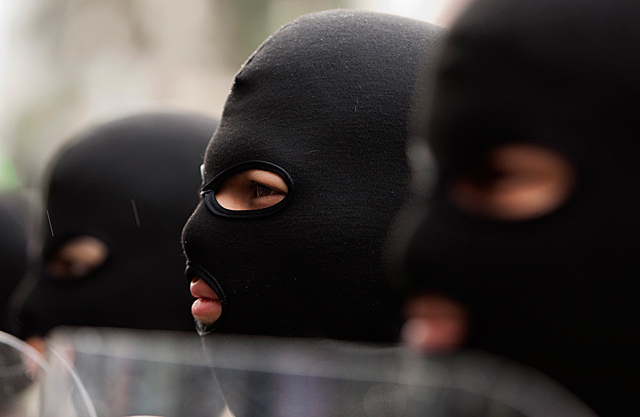
Iran-Basij-Hooded-Men-IP_1In 2009 the Basij militia (pictured here) raped protesters as a matter of policy. (Photo: Reuters)

In prisons, virgin girls who are sentenced to death (the death penalty covers a wide variety of crimes, including the nebulous charge of Moharabeh, “enmity against God”) are typically forced into “temporary marriages” with the prison guards and raped on the night before their execution.

According to the Iran Human Rights Documentation Center this is “because the guards believed young girls executed while virgins would go to heaven” and they wanted to prevent that.

Rape and other forms of sexual assault are a means of humiliation and degrading the regime’s opponents – and are also a potent means of intimidating others into cowed obedience.

******************

Like all countries which use sharia law as state law, the Islamic Republic of Iran institutionalizes a litany of women’s rights abuses.

These include:

  • The husband is the head of the family, and his wife is legally bound to obey him. Article 1,105 of the civil code states: “In relations between husband and wife, the position of the head of the family exclusively belongs to the husband.”
  • A married woman cannot leave the country without her husband’s permission.
  • A woman’s testimony as a witness is worth half that of a man, in compliance with the Sharia basis of the legal system.
  • Women are forced to wear the hijab, a headscarf, in all public places. More broadly, Islamic modesty requirements are enforced by a morality police.
  • Polygamy and temporary marriage are permitted for men (up to four wives are allowed, subject to certain restrictions), but not for women.

Moreover, women are frequently subject to honor killings. In cases where the father kills his daughter, he is not liable for the death penalty, but only for imprisonment. This is further compounded as when someone is murdered, the family of the victim can forgive the murderer and choose to forgo punishment.

As harsh as the everyday discrimination is, however, the most serious violations are meted out against dissenters.

Use of rape as a method of torture against political opponents has been deployed widely against both men and women, as well as sexual taunts, threats and other forms of assault.

The International Campaign for Human Rights in Iran told PBS that in the aftermath of the disputed 2009 election, “rape was routinely practiced as a matter of policy to intimidate young ordinary people from ever coming out to protest again.”

In prisons, virgin girls who are sentenced to death (the death penalty covers a wide variety of crimes, including the nebulous charge of Moharabeh, “enmity against God”) are typically forced into “temporary marriages” with the prison guards and raped on the night before their execution.

According to the Iran Human Rights Documentation Center this is “because the guards believed young girls executed while virgins would go to heaven” and they wanted to prevent that.

A former Iranian Basij militia man spoke to The Jerusalem Post on the condition of anonymity and recorded his role in perpetrating these rapes when he was a prison guard.

He said, “I could tell that the girls were more afraid of their ‘wedding’ night than of the execution that awaited them in the morning. And they would always fight back, so we would have to put sleeping pills in their food. By morning, the girls would have an empty expression; it seemed like they were ready or wanted to die. I remember hearing them cry and scream after [the rape] was over. I will never forget how this one girl clawed at her own face and neck with her fingernails afterwards. She had deep scratches all over her.”

Rape and other forms of sexual assault are a means of humiliation and degrading the regime’s opponents – and are also a potent means of intimidating others into cowed obedience.

Thus, the Islamic Republic inflicts on the bodies of its citizens the purest demonstration of raw power, reminding them who rules Iran.

Forfeiting America’s Military Leverage

June 6, 2015

Forfeiting America’s Military Leverage, American ThinkerAbraham Katsman, June 6, 2015

International diplomacy, it is said, is the art of letting the other party have your way.  While there are numerous diplomatic strategies to accomplish that, one of history’s more effective means of pursuing foreign policy goals was for a superior power to conspicuously display naval forces in the waters of the weaker power, posing a military threat until satisfactory terms with the weaker nation could be reached. Such “gunboat diplomacy” could be remarkably persuasive.

But if there is such a thing as the opposite of gunboat diplomacy, we are witnessing it in the nuclear negotiations with Iran.  There will be repercussions.

The United States and other leading nations taking part in the negotiations have military capabilities that dwarf those of Iran, at best a second-rate power. Yet, in spite of the huge military advantages — not to mention the moral gulf between the U.S and Iran, or the huge stakes of allowing Iran to go nuclear — negotiations have proceeded as if between equals.

U.S. military spending is greater than that of the next seven countries combined. Superpower America has a near-monopoly on those gunboats, as well as military aircraft and cruise missiles. But that power is only useful if there is a willingness to use it — or, more precisely, if America’s enemies believe that that there is such a willingness.

If there were ever thoughts that the U.S. under Obama would lay down the law with Iran and order, under overt military threat, the “voluntary” dismantling of the mullah’s nuclear program, they have passed quietly. Sure, President Obama occasionally makes some perfunctory mention that the military option is still on the table, but no one takes his half-hearted warning seriously, least of all the Iranians.

It doesn’t help matters when Obama says, as he did on Israeli TV this week, “A military solution will not fix [the Iranian nuclear problem]. Even if the United States participates, it would temporarily slow down an Iranian nuclear program but it will not eliminate it.”

Obama has effectively forfeited America’s military leverage. He has taken the position that the only alternative to his Iranian appeasement approach is war, and that war is not an outcome acceptable to him under any circumstances.

No Iranian misconduct disrupts Obama’s pacifism. Against American interests and those of America’s allies, Iran has expanded its reach into Syria, Lebanon, Iraq, and Yemen, ethnically cleansing Sunni communities in Iraq. It has seized a cargo ship under U.S. protection, and holds several Americans hostage (complete with an ongoing farcical “trial” against Washington Post reporter Jason Rezaian for espionage). It has increased its nuclear stockpile and violated its existing international agreements, including regarding type and number of centrifuges it may operate, and announced that it will build additional reactors with the help of China and Russia.

In fact, America’s gunboats notwithstanding, it is Iran that has been dictating the terms of a prospective agreement. Iran’s intransigence in the nuclear negotiations has been rewarded: the U.S. has already backed off demands regarding Iranian nuclear enrichment, centrifuges, missile technology, and duration of the prospective agreement — and gotten nothing in return.

Not only is the United States administration going along with all this, but it has released some $11 billion in cash assets to the Islamic Republic. On top of that, it is offering a “signing bonus” of tens of billions of additional dollars to Iran for coming to a nuclear agreement, irrespective of Iranian behavior, support for terror or holding Americans prisoners.

In this context, with no credible American military threat on the table, we should not be surprised that Iran is getting everything it wants from the negotiations at no cost and no risk. As a bonus, it gets to show the world how unserious its American arch-enemy has become.

For the last century, the United States has asserted a global foreign policy, the core of which is being ready, willing, and able to impose its military might to protect its vital interests. Is there a more compelling current American interest than to keep nuclear weapons out of the reach of a rabidly anti-American, anti-Semitic, destabilizing, theocratic, apocalyptic regime, which also threatens the world’s major oil suppliers and is the world’s greatest supporter of terror? If Obama cannot even consider the military protection of that interest, he has rendered American foreign policy impotent, and its military capabilities irrelevant.

That abandonment of longstanding American projection of military power to protect global interests does not go unnoticed, by either friend or foe. The American military’s deterrent effect has been eroded; its security umbrella to its allies looks a lot less secure. The effect on alliances both current and future is corrosive.

From Riyadh to Taipei to Jerusalem, from Moscow to Beijing to Pyongyang, the world is paying close attention. As much as these nuclear negotiations are about Iran, they are even more about America.


Two major Mid East escalations: Yemeni rebels fire Scuds at Saudi air base. ISIS warns Syrian rebels

June 6, 2015

Two major Mid East escalations: Yemeni rebels fire Scuds at Saudi air base. ISIS warns Syrian rebels, DEBKAfile, June 6, 2015

us_patriot_missiles_saudi_arabia_6.6.15US Patriots stationed in Saudi Arabia

Saudi military sources reported Saturday, June 6, that Patriot air defense batteries had intercepted Scud missiles fired by Yemen Houthi rebels against the kingdom’s largest air base at Khamis al-Mushait in the south west. It is from there that Saudi jets take off to strike the Yemeni rebels. DEBKAfile’s military sources report that the Patriot anti-missile systems, which were activated for the first time, were manned by American teams. This was the first direct US military intervention on the Saudi side of the Yemen conflict.

It was also the first time that Houthi rebels or their allies had fired Scud missile into the oil kingdom. Our sources add that the launch was supervised by Hizballah officers. They were transferred by Tehran to Yemen to ratchet up the conflict – although US, Saudi, Yemeni government and Houthi representatives meeting secretly in Muscat Friday agreed to attend a peace conference in Geneva this month.

Nonetheless, through Friday night and Saturday morning, Houthi forces and allied military units kept on battering at Saudi army and National Guard defense lines, in an effort to break through and seize territory in the kingdom’s southern provinces. The insurgents were evidently grabbing for strategic assets to strengthen their hand at the peace conference.

Iran’s supreme leader Ayatollah Ali Khamenei is also juggling his chips on the deteriorating Syrian warfront. In the coming hours, he is widely expected to announce the activation of the mutual defense pact signed between Iran and Syria in 2006, under which each signatory is committed to send military troops if necessary to defend its partner.

Thursday, June 4, Khamenei fired sharp verbal arrows at the Obama administration: “The United States tolerates extremist groups in Syria and Iraq and even helps them in secret,” he charged.

Our military sources add that although various Mid East publications, especially in Lebanon, are reporting that Iran has already sent units in numbers ranging from 7.000 to 15,000 troops to Syria, none have so far landed, except for the Shiite militias brought over at an earlier stage of the Syrian conflict. The expected Khamenei announcement may change this situation.

ISIS was not waiting. Saturday morning, the group issued a warning to the Syrian rebel forces fighting in the south – the Deraa sector of southern Syria near the meeting point of the Jordanian and Israeli borders and the Quneitra sector opposite the Israeli Golan. They were ordered to break off contact with the US Central Command Forward Jordan-CF-J which is located north of Amman, and the IDF operations command center in northern Israel. Any Syrian rebels remaining in contact with the two command centers would be treated as infidels and liable to the extreme penalty of beheading, the group warned.

The impression of ominous events brewing in the regime was rounded off Friday night by an unusual announcement by the Israeli army spokesman that Iron Dome anti-missile batteries had been deployed around towns and other locations in the south, although no reference was made to any fresh rocket attacks expected from the Gaza Strip. DEBKAfile adds: The first batteries were arrayed Thursday night, June 4, at vulnerable points in southern Israel – from the southernmost Port of Eilat on the Gulf of Aqaba to the western Port of Ashdod on the Mediterranean.

The Islamic State Is Here to Stay

June 5, 2015

The Islamic State Is Here to Stay, VICE NewsAhmed S. Hashim, June 6, 2015

(Please see also, The Kurd-Shia War Behind the War on ISIS. — DM)

The victories against IS in early 2015 have proven ephemeral — or have been nullified by IS gains elsewhere. On Sunday, CIA director John Brennan said on Face the Nation, “I don’t see this being resolved anytime soon.” Assad’s vaunted offensives of February 2015 have fallen short as the regime faced stiff resistance from a wide variety of opposition fighters, including elements from IS. The failure was alarming in part because the campaign was designed and aided by both Hezbollah and the Iranians, two seemingly ascendant Shia powers.

************************

Just a few months ago, analysts and policy-makers were certain that the defeat of Islamic State (IS) forces was simply a matter of time.

Coalition airstrikes would degrade the group’s capabilities and eventually allow Iraqi forces and Kurdish Peshmerga — though discredited by their poor military showing in mid-2014 — to push back the extremists. And indeed, IS fighters were ejected from Tikrit in March 2015 by the Iraqi army and thousands of motivated fighters from Shia militias. In Kobani in northern Syria, IS fighters were defeated by Syrian Kurdish fighters. Elsewhere in the country, the regime of Bashar al-Assad was going on the offensive with help from Hezbollah and advisers from the Iranian Revolutionary Guard.

The Islamic State, however, rose like a phoenix from the ashes of every setback. And today, the situation is not so rosy.

The victories against IS in early 2015 have proven ephemeral — or have been nullified by IS gains elsewhere. On Sunday, CIA director John Brennan said on Face the Nation, “I don’t see this being resolved anytime soon.” Assad’s vaunted offensives of February 2015 have fallen short as the regime faced stiff resistance from a wide variety of opposition fighters, including elements from IS. The failure was alarming in part because the campaign was designed and aided by both Hezbollah and the Iranians, two seemingly ascendant Shia powers.

The situation in Iraq is just as complicated, something that the Obama administration appears either oblivious to or reluctant to acknowledge. Much of the US strategy continues to hinge on what is increasingly a mirage: a unified, albeit federal, Iraq under the control of Baghdad. Meanwhile, the resilience of IS is greatly enhanced by the ability of its military forces to innovate and adapt faster on the ground than its lackluster opponents.

In light of the constant aerial strikes by the US and its allies, IS has dispersed and made its forces more mobile, no longer presenting dense concentrations of fighting men as it did when it seized Mosul in mid-2014. Instead, when IS seized Ramadi in May 2015, it made use of inclement weather and sent several small units from different directions simultaneously into the city aided by suicide bombers. Moreover, the fact that the group faced ill-equipped and poorly motivated Sunni fighters in and around Ramadi did not do anything for Baghdad’s standing with the country’s already alienated Sunni community, which had pleaded for arms while caught between the unfathomable brutality of IS and revengeful Shia militias.

Many Sunnis are now angling for their own “super-region,” one that would have considerable independence from Baghdad. The problem? In order to have it, the Sunnis would need to first defeat IS. Currently, they’re unable to do so because they lack the resources; despite all the talk from Baghdad and Washington about arming Sunni tribes, Baghdad is not actually keen to do so.

And besides, the Sunnis seem relatively ambivalent about defeating IS. They took an unequivocal stance between late 2006 and 2009, when they joined with the Americans and the Iraqi government to deal the Islamist militants what was then seen as a decisive blow. Now, however, despite Sunnis’ resentment and fear of IS, the Islamists’ existence is seen as a kind of insurance policy against Shia revanchism should Baghdad succeed in retaking the three Sunni provinces of Anbar, Salahuddin, and Ninevah.

(Please see video at the link. — DM

The “victory” of the Iraqi government in Tikrit was more propaganda than reality; a few hundred IS fighters managed to inflict considerable damage on the Shia militias that had been mobilized to fight alongside the Iraqi army, then withdrew because they were outnumbered and wished to avoid being surrounded. The IS forces in Tikrit simply felt that they had done enough damage; there was no need to waste further assets in an untenable situation.

Militarily, the Iraqi Shia militias are better motivated and more dedicated than the regular army. Anecdotal information out of Baghdad suggests that Iraqi Shias are wondering whether the government should invest more effort building these forces into an effective and more organized parallel army. Even that parallel army, however, might be reluctant to commit to any significant long-term offensive to reclaim provinces full of “ungrateful” Sunnis.

But the Shia are willing to die to defend what they have, and there is increased sentiment among the Shia in central Iraq and Baghdad, along with the southern part of the country, that they would be better off without the Sunnis. There also exists the belief that the Kurds have more or less opted out of the Iraqi state despite the fact that they maintain a presence within the government in Baghdad. The Shia would seemingly not be sorry to see them exit the government in a deal that would settle as best as possible divisions of resources and territory. However, whether the Kurds would take the plunge and opt for de jure rather than de facto independence is a question that is subject to regional realities — How would Ankara and Tehran react? — rather than merely a matter of a deal between Baghdad and Erbil.

The Islamic State will continue to be a profound geopolitical problem for the region and the international community, and a long battle lies ahead. Syria and Iraq are more or less shattered states; it is unlikely that they will be put back together in their previous shapes. If Assad survives 2015, it will be as head of a rump state of Alawites and other minorities protected by Hezbollah, Iran, and Alawite militias. Shia Iraq will survive, and will possibly dissociate itself from the nettlesome Sunni regions. The Kurds will go their own way step by step. The international community is currently at a loss for how to stem the flow of foreign fighters to the IS battlefields — and even more serious is the growing sympathy and admiration for the group in various parts of the world among disgruntled and alienated youth.

If the US is serious about defeating IS, it needs to take on a larger share of the fight on the ground. This means more troops embedded with regular Iraqi forces in order to bring about better command, control, and coordination. It also means advisors who can continue to train these forces so that they improve over time. If this is not done, the regular Iraqi military will continue to be nothing more than an auxiliary to the more motivated — and pro-Iranian — Shia militias. Currently, militia commanders are giving orders to the regular military; that cannot be good for morale.

This month, the Islamic State celebrates the first anniversary of its self-declared caliphate. The group has little reason to fear it will be the last.

The Kurd-Shia War Behind the War on ISIS

June 5, 2015

The Kurd-Shia War Behind the War on ISIS, The Daily BeastMat Wolf, June 5, 2015

1433495718557.cachedAhmed Jadallah/Reuters

“We could see outright civil war,” Farhan Siddiqi, a research fellow on international politics and national security at the Middle East Research Institute (MERI), tells The Daily Beast. Siddiqi says he believes the Kurds and the Shia central government would face domestic and international pressure to avoid such a conflict, but if cooler heads failed a hypothetical conflict could escalate into something even worst than the current ISIS war.

********************

In a dusty town near the Iranian border, the terror group was defeated, but the victors are at each other’s throats.

JALAWLA, Iraq — Behind Iraq’s front lines against the so-called Islamic State, Kurdish and Shia factions already are drawing a blueprint for what could be the region’s next major conflict.

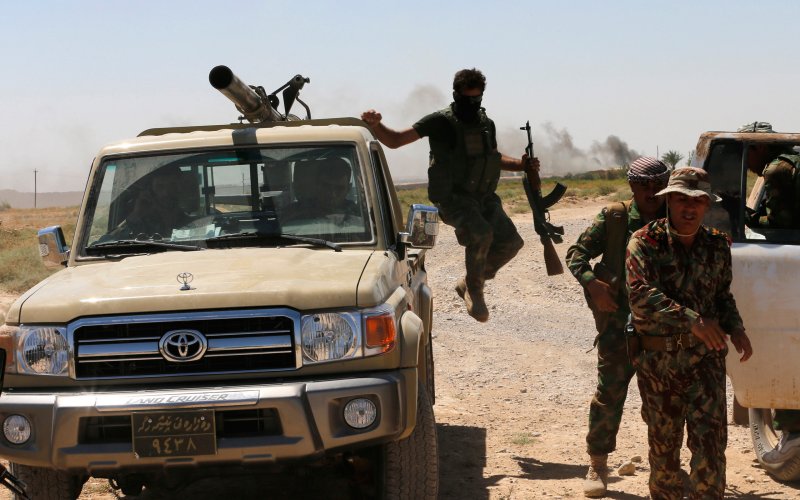
In the city of Jalawla in Iraq’s Diyala province, near the Iranian border approximately 80 miles east of Baghdad, Kurdish forces have given the boot to the Shia militia they previously allied with to take the city from ISIS in a bloody November battle. Last month, the commanding Kurdish Peshmerga general in Jalawla threatened to start shooting if the Shia refused to leave the city immediately.

“This area is ours now, and that’s not changing,” Brig. Gen. Mahmoud Sangawi told The Daily Beast. He added that Jalawla, an abandoned city that previously had 83,000 people and was 80 percent Sunni Arab in 2003, would soon have a Kurdish mayor. Sangawi bragged that henceforth the city would also be called by its new Kurdish moniker, “Golala.”

Not so fast, say the Shia militias. They were recruited in the name of a fatwa from Iraqi Grand Ayatollah Ali al-Sistani in June 2014, following the Iraqi army’s humiliating loss of Mosul, Iraq’s second largest city, virtually without a fight. Many are trained and advised by Iranians, and they have been the spearhead of Baghdad’s efforts to recover lost territory in the name of the national government.

The Kurds, meanwhile, have fought hard to protect, consolidate and indeed expand areas they consider “their” territory.

“They [the Kurds] need to recognize this region is Iraq,” says Ali Khorasani, the commander of the Hashd al-Shaabi militias that Sangawi’s Peshmerga expelled from Jalawla. Hashd al-Shaabi is the Arabic term for Popular Mobilization Units, the name preferred by the volunteer Shia militias.

Khorasani said the Kurds “are strong, and they’re very organized, and our relationship was good, but now our relationship has problems.” And that appears to be an understatement. When asked if Kurdish moves in the region might lead to another war, Khorasani replied tersely: “Maybe.”

For now, Khorasani’s unit has been dispersed to the south of Jalawla around a town called Sadiya. It’s only a five-minute drive from Jalawla, but Kurdish forces are limiting access to Sadiya and prevented us from going there. Khorasani spoke to The Daily Beast by phone.

The ISIS blitz of northern and central Iraq one year ago sent the on-paper highly trained and well-equipped Iraqi army scrambling, and led to the sacking of controversial Shia Prime Minister Nouri al-Maliki. He was widely criticized for his sectarian policies that alienated the country’s Sunni Arabs, who are now the main support base for ISIS.

The Iraqi army’s retreat also opened the door for Kurdish forces to seize large swaths of territory abandoned by government forces.

Now, the central government’s inability to deal decisively with ISIS in Anbar province and its loss of the Anbar provincial capital Ramadi has seen the Kurds acting even more brazenly in anticipation of an independence push. Iraqi Kurdistan President Masoud Barzani has promised a long-awaited Kurdish independence referendum.

“Certainly an independent Kurdistan is coming,” Barzani said on a visit to Washington D.C. on May 6. “It will take place when the security situation is better and when the fight against ISIS is over.”

“We could see outright civil war,” Farhan Siddiqi, a research fellow on international politics and national security at the Middle East Research Institute (MERI), tells The Daily Beast. Siddiqi says he believes the Kurds and the Shia central government would face domestic and international pressure to avoid such a conflict, but if cooler heads failed a hypothetical conflict could escalate into something even worst than the current ISIS war.

Since the summer of 2014, the Kurds have increased their territory by 40 percent, most notably around the oil-rich city of Kirkuk, often called the “Kurdish Jerusalem.” Today Kirkuk has a Kurdish population of around 50 percent combined with large groups of Arabs and Turkmens. The city and its outlying territories were frequent targets of “Arabization” by the Saddam Hussein regime, a policy meant to shift the ethnic balance of power there as he waged a genocidal war against the rebellious Kurds. Now they want the city back, but Arab families who have lived there for decades have no place to go.

Areas like Jalawla are a different matter. It is closer to Baghdad than to the Iraqi Kurdish capital Erbil. It, too, was the target of waves of Arabization, but it has been a majority Arab city for decades. By Sangawi’s own admission the population was less than 10 percent Kurdish in 2003.

“The Baath regime had a process of oppressing the Kurdish people. They had to change their names to Arab names or leave the city,” Sangawi says. “When filling out forms they had to register as Arab. In 1970, 32 percent of this city was Kurdish. The city was only 8 percent Kurdish at the time of the American invasion in 2003. The Arabs tried to rob the Kurds of their land.”

Today, Jalawla has been completely abandoned by its civilian inhabitants, many of whom supported ISIS, according to Sangawi. Feral dogs dart in front of Peshmerga convoys and Kurdish graffiti proclaims the city part of Kurdistan. The immediate surrounding area of the town—dusty flat fields speckled with palm groves—clashes with the green, mountainous terrain often associated with Kurdistan, and syncs up more with stereotypically Arab lands.

Parts of Jalawla, especially the former ISIS command center on high ground overlooking the city, have been reduced to rubble. However, a spring bloom of un-manicured pink desert roses has overrun the walls and sidewalks, offsetting the many bullet holes and craters that otherwise dot the settlement.

“One-hundred and ten Peshmerga died in the fighting. When ISIS came in here they left many IEDs and explosives on the roads,” says Sangawi.

But the November fighting wasn’t the area’s first battle, and likely not its last. The Kurdish-Arab rift in the city goes back over a millennium.

Golala, Jalawla’s Kurdish name, means the “land of flowers.” Its Arabic title’s etymology is more grisly. In 637 AD, Arab Muslim forces during the early Islamic conquest of the Middle East won a decisive battle here against a Zoroastrian Persian force. A popular tale in the region holds the Arabs named the location Jalawla from an Arabic verb meaning to cover or to fill, as so many Zoroastrian corpses filled the landscape.

Sangawi knows this tale, and says he considers the Zoroastrians the Kurds’ forebears before Arabs took their territory—a perfect and historically convenient parable for Kurdish claims on the region.

Dark haired with a round face, thick droopy mustache and rosy cheeks, the 63-year-old Sangawi at first comes across as a friendly grandfatherly type, albeit one who travels with an entourage equipped with RPGs and machine guns. And most grandfathers don’t blithely threaten former heads of state.

“We’ve killed lots of people, a lot of them like Maliki,” he says of the former Iraqi prime minister, who said in a TV interview last month that anyone wishing to break up Iraq would create a “river of blood.”

“Maliki can eat shit,” Sangawi chuckles.

Sangawi’s been with the Peshmerga since the 1970s and has jumped around the Kurds’ various political parties, at one point even becoming a Marxist before joining up with the Patriotic Union of Kurdistan (PUK), the party of former Iraqi President Jalal Talabani.

Compared to Sangawi’s stance of bold antagonism, Khorasani is more conciliatory. The 45-year-old says he was in the legal profession before volunteering for the militia, and he makes a point of saying how the liberation of Jalawla was a joint effort. Even before then, he adds, the Kurds and Shia Arabs could find common cause.

“This is Iraq. We used to be united. They opposed the former regime and so did we,” he laments. “We were one.”

But Sangawi counters: “We were both against Saddam Hussein. We fought together. However, when the Shias came to power they treated us the same as Saddam Hussein, that’s why we don’t have a good relationship now.”

Siddiqi, at the Middle East Research Institute, says that the new Baghdad government under Prime Minister Haider al-Abadi has shown a willingness to negotiate and be more accommodating to Iraq’s minorities, but the country’s age-old tensions still run deep.

“Saddam Hussein is gone, but his authoritarianism still survives along all levels of Iraqi society,” Siddiqi says. “It remains to be seen if the government becoming more accommodating will reduce calls for independence.”

If a conflict were to occur, he adds, the Hashd al-Shaabi would be at the forefront of any government pushback against the Kurds. “The central government could easily call on the Shia militias it’s currently using against ISIS, using religious pretexts and slogans to drive them forward,” he says.

The central Iraqi government has already come under fire for its use of the militias, whose religious zealotry exacerbates sectarian tensions in Iraq. The government’s operation to retake the Sunni-majority Ramadi was originally named “At Your Service, Hussein,” in honor of a major Shia historical and religious figure. Human Rights Watch has also raised concerns that the Hashd al-Shaabi have committed serious human rights abuses while ostensibly fighting ISIS.

Siddiqi says the international community, including the central government’s main ally, Iran, would be wary of seeing another war in the region. “Iran wants peace, it does not want Iraq to become another Syria or another Yemen,” he says, adding that although opposed on many issues, the U.S. and Iran have tacit tactical cooperation in Iraq these days, and neither would support a Shia-Kurd conflict.

If a fight did occur, Siddiqi says he believes world powers would do their best to take a “hands-off” approach to avoid further escalation. If Kurdish independence were to succeed, he continues, it would only be accomplished via an agreement with Baghdad, not another war.

But far from Tehran and the beltway, on the dusty plains of disputed Jalawla, Sangawi says he’s ready for that war, drawing little distinction between Shia Hashd al-Shaabi and Sunni ISIS, and viewing them both as his people’s ancient enemies.

“The Shia militias believe if they kill ISIS they’re going to heaven, and ISIS believes if they kill the Shia people they are going to go to heaven,” Sangawi declares. “They fight over religion, not for land.”

“For me, if they attack me I will attack them, because this is my land. If they come to this land, of course I will fight them.”
Did Obama threaten to withhold support from Israel at the UN during an Israeli TV interview?

June 4, 2015

Did Obama threaten to withhold support from Israel at the UN during an Israeli TV interview? | Anne’s Opinions, 3rd June 2015

(Obama continues with his war against Bibi. He’s incapable of separating the personal from the national — anneinpt)


Barack Obama is interviewed by Ilana Dayan for Israeli TV channel 2

US President Barack Obama has once again opened his mouth and put his foot in it, compounding all the errors he made in his speech at the Washington synagogue last week. Certainly that is the strong impression have received from watching his interview with Ilana Dayan on Israeli TV channel 2. While I don’t always like Dayan’s style, her agenda and her leading questions – including in this interview – she also presented Netanyahu’s standpoint fairly, and it was unpleasant, if unsurprising, to hear Obama’s veiled threat against Israel. Although we’ve heard similar words and threats from Obama previously, and quite recently, it’s a different matter altogether when they are spoken to Netanyahu’s “home audience”.

Watch and listen to the video excerpt of his interview embedded in the Arutz Sheva report linked here below.

Here is Arutz Sheva’s analysis:

US President Barack Obama gave an interview with Israeli media on Tuesday, in which he threatened that an Israeli refusal to renew peace talks with the Palestinian Authority (PA) will “make it hard” for the US to veto motions in the UN against Israel.

In an interview with Ilana Dayan for Channel 2‘s “Uvda” (Fact) TV show aired Tuesday night, Obama commented on Prime Minister Binyamin Netanyahu’s statements before elections in which he said that a Palestinian state won’t be founded on his watch.

Obama noted that later Netanyahu distanced from the statement and “suggested that there is the possibility of a Palestinian state. But it has so many caveats, so many conditions, that it is not realistic to think that those conditions would be met anytime in the near future.”

Those conditions have included the recognition of Israel as a Jewish state and demilitarization, conditions that proved problematic in the last round of peace talks that Obama pushed into existence in late 2013.

The president continued, “and so the danger here, is that…Israel as a whole loses credibility. Already the international community does not believe that Israel is serious about a two states solution…the statement the Prime Minister made compounded that…belief that there’s not a commitment there.”

I find it fascinating in a sick sort of way that Obama makes no such demands for credibility from the Palestinians. (I mentioned this point in my earlier post on Obama’s speech to the Washington synagogue).

Describing Netanyahu, Obama said, “I think that he also is someone who has been skeptical about the capacity of Israelis and Palestinians to come together on behalf of peace. I think that he is also a politician, who’s concerned about keeping coalitions together and maintaining his office.”

Goodness me! Netanyahu is a – gasp! – politician! And behaving like one too! Who’d ever have thunk it?

“Netanyahu…is somebody who’s predisposed to think of security first. To think perhaps that peace is naive,” he continued. “To see the worst possibilities, as opposed to the best possibilities in Arab partners or Palestinian partners, and so I do think that right now, those politics, and those fears are driving the government’s response. And, I understand it, but…what may seem wise and prudent on the short-term, can actually end up being unwise over the long-term.”

Obama then issued a threat to Israel, referring to his remarks after the recent Israeli elections when he said America would have to reasses its policy towards Israel, and clarifying that at the time he was referring to something specific.

“If there are additional resolutions introduced in the United Nations…up until this point we have pushed away against European efforts for example, or other efforts. Because we’ve said, the only way this gets resolved is if the two parties worked together,” he said, referring to European moves to unilaterally recognize the PA as a state.

The president said security aid to Israel won’t cease, but warn that, “if in fact, there’s no prospect of an actual peace-process, if nobody believes there’s a peace process, then it becomes more difficult, to argue with those who are concerned about settlement construction, those who are concerned about the current situation, it’s more difficult for me to say to them ‘be patient! wait! Because we have a process here.’ Because, all they need to do is to point to the statements that have been made saying there is no process.”

Obama returned to his personal image of Israel as it was in the glorious 1960s, as he referenced in his Washington synagogue speech too:

Referencing the Jewish nature of Israel, Obama said, “I am less worried about any particular disagreement that I have with Prime Minister Netanyahu. I am more worried about…an Israeli politics that’s motivated only by fear. And that then leads to a loss of those core values, that when I was young and I was admiring Israel from afar…were…the essence of this nation. There are things that you can lose, that don’t just involve rockets.”

And then we come to the main event – the existential threat faced by Israel from Iran’s nuclear weapons program – and the President is either woefully ignorant or lying through his teeth:

Turning his attention to Iran and the deal being formed with it on its nuclear program ahead of a June 30 deadline, he claimed that sanctions have caused Iran to keep its agreements in negotiations.

“I’ve said that, in exchange for some modest relief in sanctions, that Iran is going to have to freeze its nuclear program, roll back on its stockpiles of very highly enriched Uranium – the very stockpiles that Prime Minister Netanyahu had gone before the United Nations, with his picture of the bomb and said that was proof of how dangerous this was.”

“At that time, everybody said ‘this isn’t going to work! They’re going to cheat, they’re not going to abide by it.’ And yet, over a year and a half later, we know that they have abided by the letter of it,” claimed Obama.

His assertion is in fact false; Iranian nuclear fuel stockpiles grew by a massive 20% over the past 18 months of negotiations between Iran and world powers, as revealed in a report last month by the International Atomic Energy Agency (IAEA).

Arlene Kushner has more to say on the subject in her aptly titled article “Outrageous!”:

Intoned Obama:

“I can, I think, demonstrate, not based on any hope but on facts and evidence and analysis, that the best way to prevent Iran from having a nuclear weapon is a verifiable, tough agreement.

“A military solution will not fix it. Even if the United States participates, it would temporarily slow down an Iranian nuclear program but it will not eliminate it.”

http://www.timesofisrael.com/obama-a-deal-only-way-stop-iran-no-military-option/

It’s difficult to know where to begin.

Perhaps what is most outrageous here is that he has just announced to Iran that no matter what, the US will not be attacking.

We all knew that, of course. But the US policy, enunciated every so often, has been that all options, including the military option, were on the table.

What Obama has done here, in pulling the military option off the table, is not something that should be done when in the midst of negotiations. Not if the desire is to come out with the best possible deal: then you negotiate from strength and, at the very least, keep the your adversary guessing.

This tells us a great deal about Obama’s lack of seriousness in the negotiations.

~~~~~~~~~~

Or perhaps this is the most outrageous aspect of what he has said: He is trying to convince the Israeli public that there is no point in attacking Iran, because a military solution won’t work.

My friends, at this point in time, a military solution is the only thing that will work!


What is more, it is not true that a military solution would only slow down Iran’s operation. Let’s parse what he said, for a moment. He didn’t refer to the US attacking Iran, but to the US “participating,” which means Israel would have the lead. This is different from a determined attack from strength directly by the US.

It is true that Israel can only set back Iran’s operation – I’ve been told by three to five years (which would be no small matter). That’s because Israel does not have the enormous 30,000 pound bunker busters – the Massive Ordnance Penetrators – that would be required to break through Iran’s underground fortifications.

But the US has them, and has the B-2 and B-52 bombers required for carrying them.

~~~~~~~~~~

In fact, let me carry this one step further:

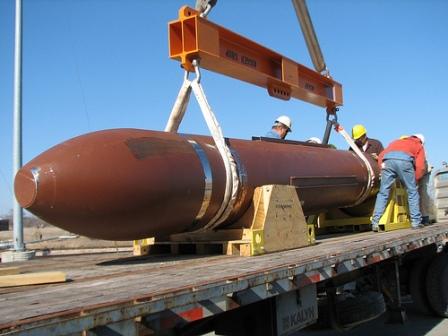
A mere two months ago, it was announced that the Pentagon had just upgraded and tested its bunker busters

“According to senior officials, the results show the improved bomb—when dropped one on top of the other—is now more capable of penetrating fortified nuclear facilities in Iran or in North Korea, The Wall Street Journal reported. The Pentagon also designed the bunker buster to challenge Iran’s Fordow facility, which is built into a mountain to protect it from potential airstrikes.

bunker-buster bomb


“It’s believed that the above mentioned measures will allow the destructive weapon to be targeted with a precision previously possible only for far smaller guided US bombs.”

http://rt.com/usa/246753-pentagon-ugraded-bunker-bomb/

Clearly, the Pentagon and the Obama administration are not of the same mind. Also not news. But in light of the Pentagon’s improvements to the bunker busters, Obama’s statement about the military option not being able to “fix” the situation is a glaring misrepresentation. In other words, it’s a lie.

So Obama is (probably) lying about the Iranians freezing their stockpile and he’s lying about the chances of success with the military option.

At the risk of repeating myself, as was pointed out in my earlier post, he’s also lying to himself or to us about the rationality and antisemitism of the Iranian regime. Even a Lebanese journalist has noted that Obama will defend antisemitism in order to spin his miserable deal with the Iranians.

Is there anything this man says that we can trust?

Russia Demands American Capitulation To Help Eradicate Islamic State

June 4, 2015

Russia Demands American Capitulation To Help Eradicate Islamic State

Author

By David Singer — Bio and Archives June 4, 2015

via Russia Demands American Capitulation To Help Eradicate Islamic State.


Russian Foreign Minister Sergei Lavrov has called on America to end its attempt to remove Syria’s President Assad from power in return for Russia’s co-operation to militarily confront Islamic State.

Lavrov reportedly told Bloomberg on 2 June 2015 :

“The U.S.’s “obsession” with [Syria’s President] Assad isn’t helping in the common fight against the threat from Islamic State…

“People put the fate of one person whom they hate above the fight against terrorism. Islamic State can go “very far” unless stopped, and air strikes alone “are not going to do the trick”

“If people continue to acquiesce with what is going on and continue to acquiesce with those who categorically refuse to start the political process until Bashar Assad disappears, then I’m not very optimistic for the future of this region…”

America is part of the Friends of Syria core group known as the London Eleven that has been assisting rebel forces in Syria attempting to overthrow Assad.

Assad – backed by Russia, Iran and Hezbollah – has rebuffed such attempts during four years of horrendous conflict that has so far seen over 220000 Syrians die, four million citizens made refugees and another 7.6 million internally displaced.

A report published by the UN in March 2015 estimated the total economic loss since the start of the conflict was $202bn and that four in every five Syrians were now living in poverty – 30% of them in abject poverty. Syria’s education, health and social welfare systems are also in a state of collapse.

America apparently intends to ignore Lavrov’s sage advice and continue to pursue its Syrian policy to oust Assad.

Marie Harf – a U.S. State Department spokeswoman told reporters in Washington that:

“we’re certainly not going to coordinate with a brutal dictator who’s massacred so many of his own citizens.”

“That’s just an absurd proposition. That’s certainly not going to happen.”

Lavrov’s comments come at a time when Islamic State – already controlling a large part of Syria and Iraq covering an area greater than the United Kingdom – continues to make further advances – recently seizing the city of Ramadi 110 kilometers west of the Iraqi capital –Baghdad – and capturing the strategic northern Syrian city of Palmyra – a World Heritage listed site containing the monumental ruins of one of the most important cultural centres of the ancient world.

Islamic State reportedly controls up to 80 per cent of oil fields in Syria and has destroyed and also sold looted antiquities in Hatra, Nimrod and Mosul to acquire a major source of its funding – sometimes for seven figure sums.

The American led coalition of some 62 States – meeting in Paris this week – has proved totally unable to stem the advance of Islamic State in its stated objective of restoring the Islamic Caliphate and Sharia law wherever it seizes territory.

Graeme Wood – a contributing editor at The Atlantic – sums up Islamic State’s vulnerability:

If it loses its grip on its territory in Syria and Iraq, it will cease to be a caliphate. Caliphates cannot exist as underground movements, because territorial authority is a requirement: take away its command of territory, and all those oaths of allegiance are no longer binding.”

Only a UN sanctioned military force can hope to achieve this objective.

Obama and Putin need to urgently do a deal that sees:

  1. A UN led process on the political future of Syria being undertaken without first removing Assad
  2. A UN Security Council Chapter VII Resolution passed under Article 42 of the UN Charter authorising military action against Islamic State.

Senseless head-butting needs to give way to sensible brain-storming.

Iranian Soldiers Deployed to Protect Damascus

June 4, 2015

Iranian Soldiers Deployed to Protect Damascus as Rebels Advance

Iranian, Iraqi fighters sent to guard against rebel attack on Syrian capital, amid concerns Assad regime is failing.

By Arutz Sheva Staff

First Publish: 6/3/2015, 4:44 PM

via Iranian Soldiers Deployed to Protect Damascus – Middle East – News – Arutz Sheva.


Fighters from Al Qaeda’s Nusra Front in Idlib, Syria Reuters

Thousands of Iranian and Iraqi fighters have been deployed in Syria in past weeks to bolster the defenses of Damascus and its surroundings, a Syrian security source told AFP on Wednesday.

“Around 7,000 Iranian and Iraqi fighters have arrived in Syria over the past few weeks and their first priority is the defense of the capital. The larger contingent is Iraqi,” the source said on condition of anonymity.

“The goal is to reach 10,000 men to support the Syrian army and pro-government militias, firstly in Damascus, and then to retake Jisr al-Shughur because it is key to the Mediterranean coast and the Hama region” in central Syria, he added.

Syria’s government lost control of Jisr al-Shughur in northwestern Idlib province on April 25, as a coalition of opposition forces including Al-Qaeda affiliate Al-Nusra Front swept through the region.

Yesterday, Iran’s official news agency IRNA quoted elite Revolutionary Guards General Qassem Soleimani as saying “in the coming days the world will be surprised by what we are preparing, in cooperation with Syrian military leaders.”

The agency cautioned however that it “takes no responsibility for the information.”

Iran is a key ally of the Syrian government, and it has provided Damascus with financial and military support throughout the conflict that began in March 2011 with anti-regime protests.

That support has included raising a Syrian pro-government militia known as the National Defense Force (NDF) to supplement the badly-stretched regular Syrian army, as well as sending battalions of fighters from the Hezbollah terrorist group, Tehran’s most important and powerful proxies.

Iran had also coordinated the training, arming and mobilization of Iraqi Shia Islamist militias to fight alongside Syrian government forces as well – though since the Islamic State’s lightening offensive through Iraq last summer most have returned home from Syria to fight ISIS there.

Iran has also sent an unknown number of soldiers and commanders from its own elite Revolutionary Guard corps to battle Syrian rebels.

But despite all that aid, in recent months the Syrian government has lost territory in several parts of the country to both an alliance of largely Islamist groups including Al-Nusra, and to the Islamic State (ISIS) jihadist group. In the south of the country as well, a more moderate rebel alliance has been making steady gains.

The rapid succession of defeats have led many to speculate the Assad regime may be nearing its demise, although other analysts have warned it is far too early to write it off yet.

Faced with those setbacks, the government has appealed to Tehran and ally Russia to step up support, a Syrian political figure close to the regime told AFP.

A diplomatic source in Damascus said Iran had been critical of the regime’s failure to achieve the last major offensive operation it undertook – a February bid to cut rebel supply lines to the northern city of Aleppo.

Tehran had opposed the operation, citing lack of preparation, the source said, and subsequently insisted that Syria change its strategy to focus on holding less territory more securely.

Analysts and observers have said the Syrian government now appears ready to accept the de facto partition of the country, focusing on the defense of strategically important areas and leaving others to rebels or jihadists.

According to one source close to the regime, it considers the coast, the central cities of Hama and Homs, and the capital Damascus as vital.

It also regards the Damascus-Beirut and Damascus-Homs highways as “red lines”, the source said.

More than 220,000 people have been killed in Syria’s civil war.

AFP contributed to this report.