Posted tagged ‘Iran – Syria war’

Iran gains Mediterranean bases in Italy and Syria

September 25, 2016

Iran gains Mediterranean bases in Italy and Syria, DEBKAfile, September 25, 2016

5-2

As part of Iran’s drive to rule the strategic waves of regional waters, Tehran has negotiated a naval exchange deal with Rome for its warships to be berthed in Italian ports, DEBKAfile’s military sources reveal.

In this context, the US Pentagon and Navy chiefs once again urged Israel to update and enlarge its war fleet, which they said was “full of holes” to catch up with the rapidly changing conditions opposite its shores, where Russia, Iran and Egypt are building up armadas of warships that are bigger and more advanced than ever before.

The American warning to Israel was first reported by DEBKAfile Aug. 11 (Urgent Israeli Navy order for new US coastal craft), after Moscow posted its Admiral Kuznetsov aircraft carrier to the Mediterranean, and Egypt took delivery of theAnwar El Sadat, the first of two Mistral-class helicopter carriers bearing 92 choppers, purchased from France. The second, Gamal Abdel Nasser, was handed over on Sept. 16.

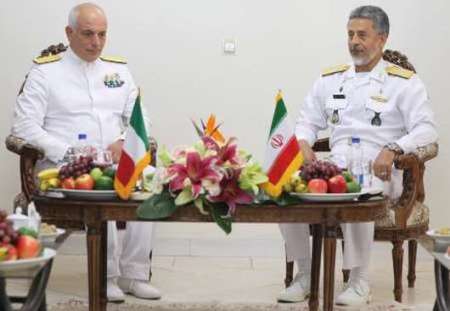
Israel’s naval inferiority was further underlined last week when Iran’s Navy commander, Rear-Admiral Habibollah Sayyari, went into action to carry out supreme leader Ayatollah Ali Khamenei’s orders to acquire naval bases in Syria and Italy for establishing a permanent Iranian fleet presence in the Mediterranean.

The admiral moved fast. The Italian Navy chief Rear-Admiral Roberto Chia Marcella visited Tehran on Sept. 5. and Saturday, Sept. 24, the first Italian frigate, Euro, docked at Bandar Abbas, home to the Iranian Revolutionary Guards command.

Until now, the farthest point reached by the Iranian Navy was the Gulf of Aden.

The intervention of the fleets of Egypt, Saudi Arabia and the UAE in the Yemen war pushed the Iranian navy back from its thrust to expand its presence towards the Mediterranean. Their joint action evicted the Iranian navy from Yemen’s Red Sea ports, and prevented Tehran from capturing the strategic islands in the mouth of the Bab-al-Mandab Strait at the entrance to the Red Sea.

Today, DEBKA Weekly’s military sources note, the Iranian Navy is hard put to obey the ayatollah’s orders, lacking the warships and advanced submarines for this new strategic mission. Iran’s warships can certainly not stand up to Egypt’s Mistral-class helicopter carriers or find answers for the Dolphin-class submarines that Germany has sold Israel.

Hence the approach to Rome to extend the Iranian navy’s capacity and range of operations.

The two admirals’ talks in Tehran ended in a vague agreement “to strengthen bilateral ties.”

Iran, however, has the money and the will to invest in new warships, while Italy has the will to build such ships for the Iranian fleet. The Italians are, moreover, not averse to allowing the Iranian fleet to use their Mediterranean bases.

Besides the financial benefits, Italy is additionally motivated by the steady reduction in the number of warships that the US Sixth Fleet maintains at its ports. It has been nearly a year since a US aircraft carrier anchored at an Italian port. Italy’s Defense Ministry and its military command understand that if the US president who succeedsBarack Obama in January continues the policy of withdrawing American forces from the Middle East, Italian naval bases will be emptied of warships.

Rear-Admiral Marcella’s comments during his visit to Tehran are worth noting: He said “In the future, we will witness Italian vessels berthing at (Iran’s) southern harbors falling within the Iranian Navy’s sphere of operation.” He added, “It is certain that these talks and meetings will lead to the development of interaction and cooperation in different military areas between the two countries of Iran and Italy.”

For his part, Iranian Navy Commander Sayyari said “Italy enjoys around 8,000 kilometers (4,970 miles) of maritime border and the Mediterranean is also strategically very significant, given the fact that it connects the important Suez Canal and the Strait of Gibraltar.”

These words served to delineate the waters where Italian-made Iranian warships were likely to operate in the future. The Euro’s arrival at Bandar Abbas Saturday, Sept. 24 lent substance to those words.

Ayatollah shoots down Putin’s high-flying Tupolev

August 22, 2016

Ayatollah shoots down Putin’s high-flying Tupolev, DEBKAfile, August 22, 2016

(Please see also, Iran unveils its own version of S-300 air defense system. — DM)

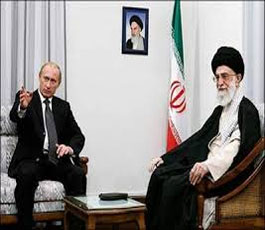
putin-iran

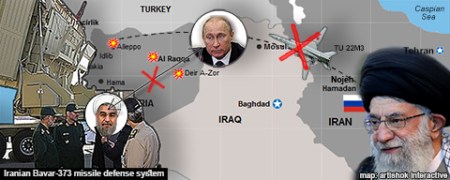
Monday, Aug. 22, just a week after the Russian defense ministry proudly released images of the first Russian bombardments in Syria to be launched from Nojeh airbase, which Tehran had granted Moscow near the Iranian town of Hamedan, the Iranian defense ministry snatched the concession back in a public rebuff for Moscow.

The Russians had presented its Iranian acquisition as the twin of the air base granted by Syria at Kmeimim near Latakia.

However, the Iranian defense ministry spokesman Bahram Ghasemi announced baldly on Monday that the Russian mission “is finished for now.” He added that the Russian air strikes in Syria were “temporary, based on a Russian request;” they were carried out with “mutual understanding and with Iran’s permission” and that the Russian mission “is finished, for now.”

Iranian sources claimed that this stinging slap to the Kremlin was prompted by mounting Iranian popular and parliamentary criticism, on the grounds that permission to a foreign power to use an Iranian base for the first time since World War II violated Article 146 of the Islamic Republic’s constitution.

Attempts by Majlis Speaker Ali Larijani and other regime officials to explain that the Russians had not been given an air base in Iran, only permission to use it to support the war Bashar Assad was waging against terrorists, an interest shared by Iran, fell on deaf ears.

A public outcry on this scale against any steps taken the ayatollahs’ regime is unusual enough to warrant exploration to uncover the hand behind it and its motives. This is all the more pressing in view of the stunning impact of the abrupt Iranian curtailment of the Russian air base venture after no more than three sorties were waged against Syrian targets: Stopped in its tracks for now – even before takeoff – is Vladimir Putin’s effort to promote his grand plan for a new and powerful Russian-Iranian-Turkish-Iraqi-Syrian pact.

The only figure in Tehran capable of raising such a public firestorm with the clout for thwarting the Russian president is supreme leader Ayatollah Ali Khamenei, DEBKAfile’s Iranian sources report.

In handling the air base issue, Putin made the same mistake as US President Barack Obama. Both assumed that getting Iranian President Hassan Rouhani’s cooperation and sensitive diplomatic prodding would eventually win the supreme leader over.

Rouhani had hoped that by extending permission to Iran’s friend Putin for the use of the Nojeh base for air strikes against Syria, he would recover some of the standing he forfeited in Tehran by signing off on the international nuclear accord in 2015.

RussiaStopFlying480

He took a chance when, on Aug. 16, he summoned the national supreme military council and, without prior consultation with Khamenei, announced the decision to make the Nojeh air base available to the Russian air force. This was a serious miscalculation.

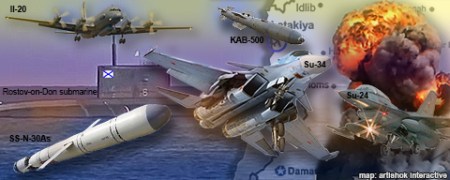
The supreme leader was further incensed by the exclusive report published by DEBKA file that day that Russian air freighters were on their way to the Hamedan base with advanced S-300 and S-400 air defense missiles for guarding the site and the Tupolev-22M3 bombers and Sukhoi-34 fighter bombers deployed there.

Khamenei interpreted this to mean that the Russians were already acting to commandeer the airspace over the base deep inside Iran.

Not content with the brush-off administered to Moscow by his spokesman, Iran’s Defense Minister Hossein Dehghan chided Moscow crudely for “showing off” over the air base in an “ungentlemanly manner” and a “betrayal of trust.”

He said: “We have not given any military base to the Russians and they are not here to stay.”

Realizing he was in hot water, the Iranian president tried to save face.

He arranged to be photographed for state media over the weekend, alongside the Bavar-373 missile defense system, declaring that having developed this system at home, Tehran can defend itself without recourse to the Russian high-altitude, long-range S-300s, because the Bavar-373 was just as good.

DEBKAfile’s military sources refute this claim. Indeed, the system on display which is based on Chinese technology is not operational.

However, the display did not save either Rouhani or Putin from Khamenei’s ire. Nojeh was shut down, a message the Iranian defense ministry spokesman underlined when he said Monday: Russia “has no base in Iran.”

US, Russia trade blows in Syria on Kurds’ backs

August 20, 2016

US, Russia trade blows in Syria on Kurds’ backs, DEBKAfile, August 20, 2016

rus us kurds

The near-clash between US and Syrian warplanes over Kurdish Hassaka in northern Syrian Friday Aug. 19 sprung out of the Obama administration’s decision the day before to try and draw the line on the growing Russian-Iranian-Turkish-Syrian collaboration in the conjoined Syrian-Iraqi arenas, DEBKAfile’s military sources report.

It occurred when US jets flew in protective formation over the Kurdish positions, the day after they were attacked by Syrian (some Middle East sources say, Russian) jets.

The US jets came within a mile of the two Syrian Su-24 fighter jets approaching the Kurdish enclave of Hassaka, and warned them off. Without responding the Syrian planes turned tail.

The US Defense Department reported that when the incident began, “coalition forces on the ground” tried reaching the Syrian jets on a “common radio frequency” but received not response. The spokesman did not specify which “coalition forces” he was referring to.

According to some Middle East sources, the Su-24s which attacked Hassaka Thursday were Russian – not Syrian.

Friday, US officials activated the US command center in Jordan for a complaint and warning to the Russian command center nearby, but they too were greeted with silence.

It may be assumed that the Russian tracking and reconnaissance systems spread across Syria and the eastern Mediterranean picked up the American communications and, had they wanted to, could have passed the US warnings on to Bashar Assad.

But the appearance Friday of another pair of Syrian jets over the Kurdish town indicated that the Russians had decided to pretend ignorance.

After the attack on Hassaka, a number of US special operations forces were pulled out of their northern Syrian positions. They were there as instructors and advisers to the Syrian Kurdish YPG militia and the Syrian Democratic Forces (SDF), with tens of US officers attached to every Kurdish platoon and SDF battalion.

It is now up to Washington to decide what happens next.

Russian President Vladimir Putin has obviously embarked on a new anti-American game based on the far-reaching deal he struck with Turkish President Tayyip Erdogan in St. Petersburg on Aug. 9. Part of that deal was a pledge by Moscow to help Turkey block all avenues for the Kurdish minority to attain full independence in Syria or Iraq, where it enjoy semi-autonomy, and allow a Kurdish state to rise from Irbil to the Mediterranean.

Iran and Syria’s Assad fully support the Turkish goal in their own interests.

The air strike against the Kurds of Hassaka therefore set a kind of foundation stone for the new Russian-Turkish-Iranian alliance in the region, whose establishmentDEBKAfile was first to uncover exclusively on Aug. 9, after the Putin-Erdogan summit.

This emerging pact has already generated strategic military dividends for Russia in the Middle East for Russia unmatched at any time since the Cold War of the mid-20thcentury.

Revolutionary Iran has made Russia the first foreign recipient of an air base on its soil near Hamedan in the west.

Erdogan’s Turkey has hustled the US into evacuating its nuclear arsenal from the southern Incirlik air base, the first time NATO was forced to give up a nuclear stockpile near the Russian frontier. And before the removal was completed, calls were raised in Moscow and Ankara to let Moscow install its warplanes at the strategic Turkish base.

It is hard to see how by sending US warplanes to shield Syrian Kurdish positions against attack, the Obama administration can put the brakes on the Russian-led tactical alignment speeding forward with Iran, Turkey and the Assad regime. To make a difference, the US president would have to interrupt his Martha’s Vineyard holiday and reach a decision he has avoided for the last six years, which is to put substantial American boots on the ground in Syria.

This step is not really on the cards three months before the presidential election and five months before he leaves the Oval Office for good.

In the near future, we are therefore likely to see the Russians and Syrians pressing ahead with their campaign against the Kurds, whereas Obama may opt to confront Putin outside the Syrian quagmire, possibly over Ukraine. Mindful of this likely scenario, Putin flew to Crimea Friday after staging war games there.

Putin-Erdogan deal deadlocks Aleppo, Manjib frays

August 13, 2016

Putin-Erdogan deal deadlocks Aleppo, Manjib frays. DEBKAfile, August 13, 2016

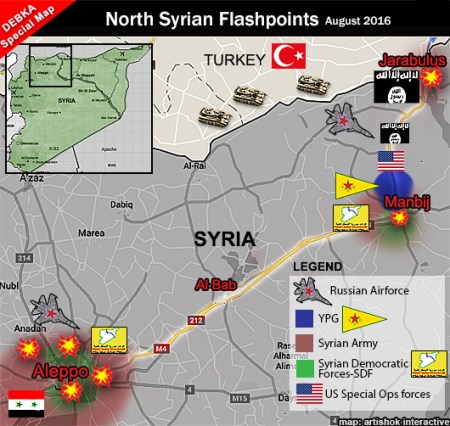
n syria flashpoints

This hopeless standoff is the result of Moscow’s refusal to provide the Syrian army and its allies with enough air support to pull ahead, in the wake of President Vladimir Putin talks with Turkish President Reccep Tayyip Erdogan in St. Petersburg Tuesday, Aug. 9.

*********************

All day Friday and Saturday, Aug.11-12, fighters of Hizballah’s elite Radwan Force – 3,000 in all – streamed to the pivotal Aleppo battlefield from all parts of Lebanon and Syria. DEBKAfile’s military and intelligence sources disclose that they were following the orders of their leader Hassan Nasrallah, who was warned by Tehran that the pro-Assad army fighting for Syria’s second city was flagging in the face of rebel assaults.

The Radwan Force was called in as the only military capable of saving the day for Assad and his allies. This step had been carefully avoided by Nasrallah was required in view of the heavy losses his organization had already suffered for backing the Syrian army – some 1,500 dead in three years – and intense fallout at home.

He has now been forced to sacrifice his last remaining military asset to fight in one of the bloodiest battles ever fought in recent times in the Middle East, even though it promises a swelling procession of Hizballah coffins returning to Lebanon.

According to our military sources, the battle to wrest Aleppo from rebel control, now in its second month, has claimed some 2,000 war dead and 4,000 injured on both sides – not counting the masses of civilians.

Some units have lost more than a quarter of their combatants and dropped out.

Nasrallah knows exactly what is happening in this critical arena. He also understands that a unit which loses 30 percent of its combatants is deemed in military terms unfit to continue fighting and that the battle for Aleppo will be drawn out and bloody. Yet he is willing to commit his entire deck of military resources to keep Bashar Assad’s fighting in Aleppo.

There is no hope of an early resolution in Aleppo, because stalemate between the combatants is exceptionally complicated and thankless. Whenever one side captures terrain, it quickly discovers it was drawn into a trap and under siege.

This hopeless standoff is the result of Moscow’s refusal to provide the Syrian army and its allies with enough air support to pull ahead, in the wake of President Vladimir Putin talks with Turkish President Reccep Tayyip Erdogan in St. Petersburg Tuesday, Aug. 9.

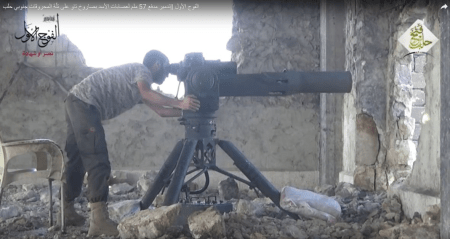
Aleppo_Rebels_ATGM-firings

Erdogan explained that if Assad’s army, along with Hizballah and Iran, defeated the Turkish-backed rebel forces holding Aleppo, he would suffer a serious knock to his prestige and setback for Syrian policy. This was more than he could sustain in the troubled atmosphere in Turkey in the wake of the failed coup against him.

He therefore asked the Russian president to abandon his Bashar Assad, Iran and Hizballah to their fate in Aleppo.

Erdogan was backed up in his request to Putin by a large Turkish military and intelligence delegation which arrived in St. Petersburg the next day to work with their Russian counterparts on setting up a joint military control center in Turkey.

DEBKAfile’s sources disclose the first two tasks assigned the new war room:

1. Russian aerial bombardments over Aleppo would not go beyond keeping the rebels from defeating Syrian and allied forces in Aleppo, but would refrain from supporting offensive action by the latter for routing the former.

2. Turkish air and ground forces would remain in a state of preparedness to ensure that rebel Syrian Democratic Forces (SDF) and the Kurdish YPG militia never moved out of the town of Manjib, from most parts of which they ousted ISIS, to the town of Jarabulus on the Turkish border.I

ISIS had used Manjib as its primary way station for supplies from Turkey 30km to the north. (See attached map). But to drive the jihadists completely out of the Syrian-Turkish border region, the combined rebel forcesmust advance on Jarabulus and expel ISIS from there too.

However, Turkish officers in the joint command center with Russia made it clear that any Kurdish forces allowed to reach that border would come under Turkish army attack.

The Russian president complied with Erdogan’s wishes on the Manjib-Jarabulus front as well as Alepp

Has the IDF hit the Basij forces commander General Naghdi?

July 30, 2016

Has the IDF hit the Basij forces commander General Naghdi? DEBKAfile, July 30, 2016

EinZivan2 (1)

Gen. Naghdi’s visit to Quneitra undoubtedly presaged some decisions in Tehran with regard to direct Hizballah-Syrian-Iranian action against Israel.

The Iranian, Syrian and Hizballah agencies accuse Israel of the attack because the say it was executed by two Nimrod anti-tank long-range missiles, manufactured by the Israeli Aerospace Industry, for use by the IDF against armored vehicles, ships, bunkers and troop concentrations.

*****************

Iranian, Syrian and Hizballah sources are intimating that the “Syrian officer” injured on July 26 in Quneitra by Israel’s double Nimrod’ missile shot was none other than Revolutionary Guards Gen. Muhammad Resa Naghdi, head of the paramilitary Organization for the Mobilization of the Oppressed, also known as the Basij, which falls under the Islamic Revolutionary Guard Corps (IRGC). The victim was earlier described officially as a Syrian officer.

If he was indeed hurt or killed by an Israeli rocket, Naghdi would become the highest-ranking IRGC general ever hit by the IDF.

On July 27, the semi-official Fars news agency reported that a top Iranian general recently visited the Israeli-Syrian border to tour Quneitra and the Golan demarcation lines between Syria and Israel – the first time the Tehran government had publicized a visit by a senior regime official to the area.

It may be presumed, DEBKAfile’s intelligence sources say, that someone at the IDF lookout posts spotted and reported on Gen. Naghdi’s arrival with an entourage in Quneitra on July 26 and saw him inspecting through binoculars the IDF defense positions. He was then quickly identified.

Any decision to go after a high-ranking Iranian would not have been left to local IDF commanders or even OC Northern Command Maj. Gen. Aviv Kohavi, but passed straight to Prime Minister Binyamin Netanyahu, Defense Minister Avigdor Lieberman and Chief of Staff Lt. Gen. Gady Eisenkot – especially in this case.

General Naghdi is not just another Iranian general. He heads the more than a million-strong Basij militia, which is a pillar of the ayatollahs regime in Tehran, and the backbone of the Iranian internal security forces which maintain the regime’s total control in every corner of the Islamic Republic.

Gen. Naghdi’s visit to Quneitra undoubtedly presaged some decisions in Tehran with regard to direct Hizballah-Syrian-Iranian action against Israel.

The IDF is holding its silence on reports of his injury, declining as usual to comment on reports by foreign publications.

The Iranian, Syrian and Hizballah agencies accuse Israel of the attack because the say it was executed by two Nimrod anti-tank long-range missiles, manufactured by the Israeli Aerospace Industry, for use by the IDF against armored vehicles, ships, bunkers and troop concentrations..

The missile has a semi-active laser guidance system, and is able to operate day and night. Its flight path can be below the clouds, while its operators far behind use a laser to guide it to target.

The launcher platform, with four missiles, can be installed on a Jeep, weapon-bearing vehicle, Abir, or armored vehicles. In addition, it is possible to send it from CH-53 ‘Yasur’ helicopter.

Israel has acted in the past against the establishment of an Iranian and/or Hizballah military presence on its Golan doorstep. On Jan. 19, 2015, an IDF air strike killed the Iranian Brig. Gen, Mohammad Ali Allahdadi and six Hizballah officers while they were on a tour of inspection near Quneitra.

Thursday, July 28, DEBKAfile ran an exclusive report on rising Israel-Russia tensions centering on southern Syria and the Golan.

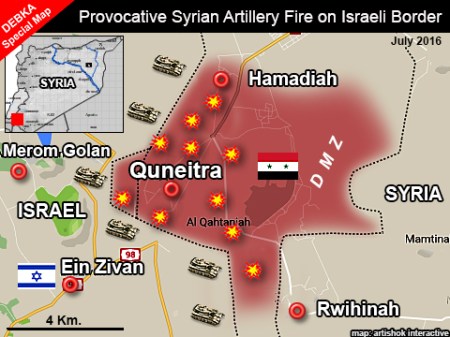
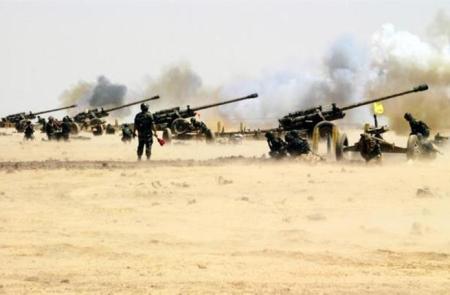
For four days since July 25, the Syrian army has been continuously firing artillery batteries – moved close to Israel’s defense lines on the Golan border – in a manner that comes dangerously close to provoking an Israeli response. This carefully orchestrated Syrian campaign goes on around the clock.

It is the first time in the six years of the Syrian war that Bashar Assad has ventured to come near to provoking Israel. But now he appears to be emboldened by his Russian ally.

The IDF is holding its fire for the moment. But Israeli military and government leaders know that the time is near for the IDF to be forced to hit back, especially since it is becoming evident that the Syrian army’s steps ae backed by Russia.

DEBKAfile’s military sources provide details of the Syrian steps:

  • The Syrian army’s 90th and 121nd battalions have been firing their artillery batteries non-stop across a 10km band along the Golan border from Hamadia, north of Quneitra, up to a point facing the Israeli village of Eyn Zivan. (See attacked map).
    This means that the Syrian army has seized the center of buffer zone between Israel and Syria and made it a firing zone.
  • This artillery fire fans out across a radius that comes a few meters short of the Israeli border and the IDF troops stationed there. It then recedes to a distance of 500 to 600 meters and sweeps across the outposts and bases of the Syrian rebel forces believed to be in touch with Israel or in receipt of Israeli medical aid.
  • The new Syrian attack appears to hold a message for Jerusalem: For six years, you supported the rebels against the Assad regime in southern Syria. That’s now over. If you continue, you will come face to face with Syrian fire.
  • Damascus is also cautioning those rebels:  For years, you fought us with Israel at your backs. But no longer. Watch us bring you under direct artillery fire, while the IDF sits on its hands.
  • On July 26, Russian media published an article revealing that Russia had delivered to the Syrian Air Force, advanced SU-24M2 front-line bombers, which is designed for attack on frontlines of battle. Israeli officials were unpleasantly taken aback by the news. Up until now, the Russians and Syrians refrained from deploying air strength in South Syria near the Israeli border. Now the Syrian air force has the means to do so.
  • DEBKAfile military sources report that the SU-24M2, following recent upgrades and modifications in Russian factories, is now capable of dropping smart bombs – ballistic bombs with a guidance system on their tails that enable them to hit targets with precision.This guidance system does not rely on US GPS satellites but rather the equivalent Russian GLONASS system which is linked to a network of 21 Russian satellites and partially encrypted for military usages.
    In addition, the SU-24M2 is equipped with a system that projects the information the pilot needs (flight details and battle details) on the plane’s windshield (head-up display) and on the pilot’s visor.
  • The Russians delivered to the Syrians two of these sophisticated airplanes this week, out of 10 that they will supply soon.

The IDF has concluded that it is only a matter of time before these planes appear in Southern Syria and so generate a new and highly combustible situation on Israel’s northern and northeastern borders.

The Russians are colluding with Damascus to inform Israel that it will no longer be allowed by either to continue backing the rebel forces in southern Syria or sustain the buffer zone which they man.

Israel may pay dear if Prime Minister Binyamin Netanyahu, Defense Minister Avigdor Lieberman, and Chief of Staff Lt. Gen. Gadi Eisenkot decide to continue to abstain from hitting back at the Syrian fire which is aimed every few hours at the vicinity of IDF posts or the impending arrival of Russian bombers. The price in store would be the weakening of the IDF’s hold on the Golan border.

Hizballah set to fight ISIS for Euphrates Valley

June 17, 2016

Hizballah set to fight ISIS for Euphrates Valley, DEBKAfile, June 17, 2016

Hezbollah_Zabadani_12.8.15Hizballah artillery in action in Syria

Hizballah this week ordered a general military call-up for their biggest combat mission in the Syrian war since their forces began fighting in support of the Assad regime in 2013, DEBKAfile military forces report.

Iran’s Lebanese proxy has been assigned the task of expelling the Islamic State from broad areas it occupied in the Deir ez-Zor region of eastern Syria and, in particular, the Euphrates River valley which connects eastern Syria and western Iraq.

This Hizballah offensive is designed to open the way for the pro-Iranian Shiite Popular Mobilization Forces and the Badar Forces militias which entered the ISIS-held Iraqi town of Fallujah Friday June 17 to move west and up the Iraqi side of the valley. The two militias spearheaded the Fallujah operation under the command of Iran’s Maj. Gen. Qassem Soleimani of the Revolutionary Guards and Ground Corps Brig. Gen. Mohammad Pakpour.

The plan is for Hizballah forces to meet these pro-Iranian militia forces on the Syria-Iraq border and so gain control over the most important strategic land pass between Iraq and Syria.

Whereas the pro-Iranian militias in Iraq are fighting under US air cover, Hizballah is assured of Russian air support in Syria. And so, for the first time in the Syria conflict and its own history, Hizballah will receive air cover from both the US and Russia, the two superpowers now coordinating their military moves in Syria and Iraq.

This strategy, which essentially connects the Syrian and Iraqi campaigns against ISIS, was charted on June 9, at a secret meeting in Tehran of the Russian, Iranian and Syrian defense chiefs.

DEBKAfile military sources in Washington say that the operation’s plan was put before President Barack Obama and he sanctioned it as part of the war on ISIS.

In the run-up to the Syrian segment of the plan, Hizballah is transferring substantial combat strength from Lebanon into Syria, and emptying its other Syrian fronts, especially around Aleppo, for the large-scale concentration around Palmyra.

The Hizballah force will start out by targeting the Syrian town of Al-Sukhna, 63km south of Palmyra and 136km north of Deir ez-Zor, thus gaining command of M20, the main highway link between northern to eastern Syria.

DEBKAfile military sources say that this military offensive by Hizballah against ISIS, with combined US-Russian support, threatens to transform a terrorist organization dedicated to fighting Israel in the service of Iran into one of the most powerful armies in the Middle East. Israel cannot stop this happening. The former Israel defense ministers who harangued this week against the Netanyahu government’s alleged “scaremongering” willfully ignored this dangerous development. They must also be held at least partly accountable for the failure of Israel’s air raids over Syria to diminish Hizballah’s military capabilities.

Iran’s Chess Board

June 3, 2016

Iran’s Chess Board, Front Page MagazineCaroline Glick, June 3, 2016

official_photo_of_hassan_rouhani_7th_president_of_iran_august_2013

Even if Obama’s successor disavows his actions, by the time Obama leaves office, America’s options will be more limited than ever before. Without war, his successor will likely be unable to stem Iran’s rise on the ruins of the Arab state system.

********************

Reprinted from jpost.com.

Strategic thinking has always been Israel’s Achilles’ heel. As a small state bereft of regional ambitions, so long as regional realities remained more or less static, Israel had little reason to be concerned about the great game of the Middle East.

But the ground is shifting in the lands around us. The Arab state system, which ensured the strategic status quo for decades, has collapsed.

So for the first time in four generations, strategy is again the dominant force shaping events that will impact Israel for generations to come.

To understand why, consider two events of the past week.

Early this week it was reported that after a two-year hiatus, Iran is restoring its financial support for Islamic Jihad. Iran will give the group, which is largely a creation of the Iranian Revolutionary Guard Corps, $70 million.

On Wednesday Iranian media were the first to report on the arrest of a “reporter” for Iran’s Al-Alam news service. Bassam Safadi was arrested by Israel police in his home in Majdal Shams, the Druse village closest to the border with Syria on the Golan Heights. Safadi is suspected of inciting terrorism.

That is, he is suspected of being an Iranian agent.

There is nothing new about Iranian efforts to raise and run fronts against Israel within its territory and along its borders. Iran poses a strategic threat to Israel through its Hezbollah surrogate in Lebanon, which now reportedly controls the Lebanese Armed Forces.

In Gaza, Iran controls a vast assortment of terrorist groups, including Hamas.

In Judea and Samaria, seemingly on a weekly basis we hear about another Iranian cell whose members were arrested by the Shin Bet or the IDF.

But while we are well aware of the efforts Iran is making along our borders and even within them to threaten Israel, we have not connected these efforts to Iran’s actions in Iraq and Syria. Only when we connect Iran’s actions here with its actions in those theaters do we understand what is now happening, and how it will influence Israel’s long-term strategic environment.

The big question today is what will replace the Arab state system.

Syria, Iraq, Lebanon, Yemen and Libya no longer exist. On their detritus we see the fight whose results will likely determine the fates of the surviving Arab states, as well as of much of Europe and the rest of the world.

Israel’s strategic environment will be determined in great part by the results of Iran’s actions in Iraq and Syria. While Israel can do little to affect the shape of events in these areas, it must understand what they mean for us. Only by doing so, will we be able to develop the tools to secure our future in this new strategic arena.

Until 2003, Saddam Hussein was the chief obstacle to Iran’s rise as the regional hegemon.

US forces in Iraq replaced Hussein until they left the country in 2011. In the meantime, by installing a Shi’ite government in Baghdad, the US set the conditions for the rise of Islamic State in the Sunni heartland of Anbar province on the one hand, and for Iran’s control over Iraq’s Shi’ite-controlled government and armed forces on the other.

Today, ISIS is the only thing checking Iran’s westward advance. Ironically, the monstrous group also facilitates it. ISIS is so demonic that for Americans and other Westerners, empowering Iranian-controlled forces that fight ISIS seems a small price to pay to rid the world of the fanatical scourge.

As former US naval intelligence analyst J.E. Dyer explained this week in an alarming analysis of Iran’s recent moves in Iraq published on the Liberty Unyielding website, once Iranian- controlled forces defeat ISIS in Anbar province, they will be well placed to threaten Jordan and Israel from the east. This is particularly the case given that ISIS is serving inadvertently as an advance guard for Iran.

In Syria, Iran already controls wide swaths of the country directly and through its surrogates, the Syrian army, Hezbollah and Shi’ite militias it has fielded in the country.

Since the start of the war in Syria, Israel has repeatedly taken action to block those forces from gaining and holding control over the border zone on the Golan Heights.

Prime Minister Benjamin Netanyahu’s surprising recent announcement that Israel will never relinquish control over the Golan came in response to his concern that in exchange for a cease-fire in Syria, the US would place that control on the international diplomatic chopping block.

A week and a half ago, Iran began its move on Anbar province.

On May 22, Iraqi forces trained by the US military led Iraq’s offensive to wrest control over Fallujah and Mosul from ISIS, which has controlled the Sunni cities since 2014. Despite the fact that the lead forces are US-trained, the main forces involved in the offensive are trained, equipped and directed by Iran.

As Iraqi forces surrounded Fallujah in the weeks before the offensive began, Qassem Soleimani, the commander of the Revolutionary Guards’ Quds forces, paid a public visit to the troops to demonstrate Iran’s dominant role.

The battle for Fallujah is a clear indication that Iran, rather than the US, is calling the shots in Iraq. According to media reports, the Pentagon wanted and expected for the forces to be concentrated in Mosul. But at the last minute, due to Soleimani’s intervention, the Iraqi government decided to make Fallujah the offensive’s center of gravity.

The Americans had no choice but to go along with the Iranian plan because, as Dyer noted, Iran is increasingly outflanking the US in Iraq. If things follow their current course, in the near future, Iran is liable to be in a position to force the US to choose between going to war or ceasing all air operations in Iraq.

On May 7, Asharq al-Awsat reported that the Revolutionary Guards is building a missile base in Suleimaniyah province, in Iraqi Kurdistan.

A senior IRGC general has made repeated visits to the area in recent weeks, signaling that the regime views this as an important project. The report further stated that Iran is renewing tunnel networks in the region, built during the 1980-88 Iran-Iraq War.

Dyer warned that depending on the type of missiles Iran deploys – or has deployed – to the base, it may threaten all US air operations in Iraq. And the US has no easy means to block Iran’s actions.

To date, commentators have more or less agreed that US operations in Iraq and Syria make no sense. They are significant enough to endanger US forces, but they aren’t significant enough to determine the outcome of the war in either territory.

But there may be logic to this seemingly irrational deployment that is concealed from view. A close reading of David Samuels’s profile of President Barack Obama’s Deputy National Security Adviser Ben Rhodes published last month in The New York Times, points to such a conclusion.

Samuels described Rhodes as second only to Obama in his influence over US foreign and defense policy. Rhodes boasted to Samuels that Obama’s moves toward Iran were determined by a strategic course he embraced before he entered office.

A fiction writer by training, Rhodes’s first “national security” job was as the chief note taker for the Iraq Study Group.

Then-president George W. Bush appointed the group, jointly chaired by former secretary of state James Baker and former congressman Lee Hamilton, in 2006, to advise him on how to extricate the US from the war in Iraq.

In late 2006, the ISG published its recommendations.

Among other things, the ISG recommended withdrawing US forces from Iraq as quickly as possible. The retreat was to be enacted in cooperation with Iran and Syria – the principle sponsors of the insurgency.

The ISG argued that if given the proper incentives, Syria and Iran would fight al-Qaida in Iraq in place of the US. For such action, the ISG recommended that the US end its attempts to curb Iran’s nuclear program.

Responsibility for handling the threat, the ISG recommended, should be transferred to the US Security Council.

So, too, the ISG recommended that Bush pressure Israel to withdraw from the Golan Heights, Jerusalem and Judea and Samaria in the framework of a “peace process.”

Such action too would serve to convince Iran and Syria that they could trust the US and agree to serve as its heirs in Iraq.

Bush of course, rejected the ISG’s recommendations.

He decided instead to sue for victory in Iraq. Bush announced the surge in US forces shortly after the ISG published its report.

But now we see, that through Rhodes the Iraq Study Group’s recommendation became the blueprint for a new US strategy of retreat and Iranian ascendance in Iraq and throughout the Middle East.

The chief components of that strategy have already been implemented. The US withdrawal from Iraq in 2011 left Iran as the new power broker in the country. The nuclear pact with Iran facilitated Iran’s transformation into the regional hegemon.

Against this strategic shift, the US’s minimalist campaigns in Iraq and Syria against ISIS make sense.

The US forces aren’t there to defeat ISIS, but to conceal Iran’s rise.

When ISIS is defeated in Anbar and in Raqqa in Syria, its forces are liable to turn west, to Jordan.

The US is currently helping Jordan to complete a border fence along its border with Iraq. But then ISIS is already active in Jordan.

And if events in Iraq and Syria are any guide, where ISIS leads, Iran will follow.

Iran’s strategic game, as well as America’s, requires Israel to become a strategic player.

We must recognize that what is happening in Iraq is connected to what is happening here.

We need to understand the implications of the working alliance Obama has built with Iran.

Even if Obama’s successor disavows his actions, by the time Obama leaves office, America’s options will be more limited than ever before. Without war, his successor will likely be unable to stem Iran’s rise on the ruins of the Arab state system.

In this new strategic environment, Israel must stop viewing Gaza, Judea and Samaria, the Golan Heights and Lebanon as standalone battlefields. We must not be taken in by “regional peace plans” that would curtail our maneuver room. And we must bear in mind these new conditions as we negotiate a new US military assistance package.

The name of the game today is chess. The entire Middle East is one great board. When a pawn moves in Gaza, it affects the queen in Tehran.

And when a knight moves in Fallujah, it threatens the queen in Jerusalem.
Can US, Turkey keep up appearances in Syria?

May 30, 2016

Can US, Turkey keep up appearances in Syria? Al-Monitor, May 29, 2016

A terrorist group linked to the Islamic State (IS) claimed responsibility for suicide bombings in Tartus and Jableh in Syria on May 23 that killed more than 150 civilians and wounded more than 200 others. Maxim Suchkov points out that the attack in Tartus occurred deep inside government-controlled territory. Russia maintains a naval base in Tartus and an air base and reconnaissance center in Khmeimim in the Latakia region. The suicide attacks, Suchkov suggests, could be a catalyst for a Russian “first strike” strategy against terrorist and aligned Salafi groups.

Moscow had already signaled the prospect of escalation against Jabhat al-Nusra and allied groups prior to the May 23 attacks. The Russian Ministry of Defense has announced a pause in its air campaign to allow armed groups allied with Jabhat-al Nusra to distance themselves from the al-Qaeda affiliate. On May 26, Jabhat al-Nusra, Ahrar al-Sham and allied groups seized the town of Dirkhabiyah near Damascus. Ahrar al-Sham has coordinated more closely with Jabhat al-Nusra in response to increased US and Russian targeting of the al-Qaeda affiliate over the past few months.

This column last week suggested that the United States take up a Russian offer to coordinate attacks on Jabhat al-Nusra, which is not a party to the cessation of hostilities. For the record, we have no tolerance or empathy for groups or individuals who stand with al-Qaeda. We hope that this is at least part of the message the United States is conveying to its regional partners who have backed these groups.

With the Geneva talks suspended for several weeks, the prospect of a Russian campaign to deliver heavy and potentially fatal blows to Jabhat al-Nusra and its allies, especially in and around Aleppo and Idlib, could signal yet another turning point in the Syria conflict.

Turkey’s failed proxy war

The United States and Turkey are struggling to keep up appearances in Syria, despite even further signs of division and discord.

Gen. Joseph Votel, US CENTCOM commander, met last week with Syrian Kurdish forces during a “secret” visit to northern Syria as part of a regional diplomatic tour that also included a stop in Ankara. Votel told Washington Post columnist David Ignatius that he is seeking to “balance” Turkey’s role as a “fabulous” partner in the battle against IS with that of the People’s Protection Units (YPG), the backbone of the Syrian Defense Forces (SDF), which is a “very good partner on the ground.”

In contrast to the YPG, Turkey’s proxy forces, including a worrying mix of Salafists who are willing to run operations with Jabhat al-Nusra, have been a flop. Last week, IS seized at least seven villages in the northern Aleppo region.

Fehim Tastekin reports that SDF-led military operations to liberate Jarablus, which is an essential gateway along with al-Rai to the outside world via Turkey, were postponed “because of Turkey’s red line against the Kurds.” The offensive against Raqqa has also been slowed, writes Tastekin, because “the SDF’s operational capacity still leaves much to be desired. It is not an option for the Kurdish YPG-YPJ to control Raqqa, because they will encounter local resistance. They also worry that scattering their forces in Arab regions could weaken the defensive lines of Rojava (Syrian Kurdistan). Therefore, Arab forces would have to get in shape to control the situation in the post-IS period.” Laura Rozen reports from Washington that the United States is seeking to boost the numbers of Arab Sunni forces among the SDF in anticipation of an advance on Raqqa.

Meanwhile, the Pentagon found itself in a public relations fiasco after Turkey complained that US special forces in Syria were wearing badges with the logo of the YPG, which Turkey considers the Syrian partner of the Kurdistan Workers Party (PKK) and therefore also a terrorist organization. This might be compared with what in the sports world is known as an unforced error, and made Votel’s already daunting diplomacy that much more complicated.

Air Force Col. Sean McCarthy also told Ignatius that US air operations against IS out of Incirlik Air Base were mostly “autonomous” of Turkish missions, saying that “we don’t discuss with them where we’re going.”

Adding it all up, the US-Turkish “partnership” against IS may be more fable than fabulous. The open secret is that Turkey is preoccupied first with thwarting advances by Syria’s Kurds, and second with shutting down the remaining lifelines for IS in northern Syria. These priorities are of a piece. No doubt Turkey is taking up the fight against IS, but first things first. Tastekin, who previously broke the back story on Turkey’s disastrous proxy efforts to retake al-Rai from IS in April, now concludes that “there is no room for optimism that Ankara will erase its red lines vis-a-vis the Kurds. Instead, Turkey is now trying to put together an even more formidable force with Jabhat al-Nusra, which it is trying to steer away from al-Qaeda.”

The catch might just be that many of the Syrian armed groups backed by Washington’s regional partners are proxies for a sectarian agenda that is mostly about toppling Syrian President Bashar al-Assad, however unlikely that now appears, and, by extension, keeping the heat on Iran. The when and where of taking the fight to IS or Jabhat al-Nusra is more or less negotiable, depending on trade-offs and pressure. We do not feel we are out on a limb in suggesting that efforts by Ankara or others to wean Jabhat al-Nusra from al-Qaeda will come to no good. This column has repeatedly documented the fluidity of foreign-backed Salafi groups such as Ahrar al-Sham and Jaish al-Islam shifting in and out of tactical alliances with Jabhat al-Nusra, all the while preaching an ideology almost indistinguishable from al-Qaeda and IS.

The losers, of course, are the people of Syria, including those who suffer under IS’ tyranny that much longer because of Turkey’s concerns about the Kurds, and as Washington’s policymakers and pundits begin another maddening deep dive into how to rejigger ethnic and sectarian fault lines. Syrians fleeing IS terror in Aleppo, meanwhile, told Mohammed al-Khatieb that living under IS is “like hell … unbearable.” While we acknowledge the complexities and challenges of the raw ethnic and sectarian politics of Syria, as well as the potential for vendettas and mass killings, there is, in our score, an urgency and priority to focus on the destruction of IS and al-Qaeda above all else.

Sur’s aftermath

Diyarbakir’s historic district of Sur has witnessed some of the most brutal fighting between Turkish military and PKK forces over the past year. Mahmut Bozarslan reports from Diyarbakir that “historical landmarks in Sur, which was last year added to UNESCO’s World Heritage List, also suffered their share of destruction. The walls of the Armenian Catholic church are partially destroyed, while the nearby Haci Hamit Mosque is missing its minaret, with a dome riddled with bullets. Another Armenian church, Surp Giragos, had its windows shattered and interior damaged.”

“Still, those ancient monuments were lucky compared with more ordinary structures in the area,” writes Bozarslan. “A building with an intact door was almost impossible to find. The warring parties had used some buildings as fighting bases, others as places to rest. Stairways were littered with empty tins; one was also stained with blood. At the bloodied spot, a piece of paper reading “body #1” was left behind, suggesting that the security forces had been there for a crime scene report. A couple seemed relieved that they had escaped with relatively little damage, but grumbled that their apartment had been broken into, with the bedroom and closets rummaged. They claimed it was the security forces who had entered, while their neighbor showed Al-Monitor binoculars that had been left behind.”

Syrian Opposition Official: West Responsible For Assad Remaining In Power; U.S. Enabled Russia To Become Main Player In Syria Crisis

May 19, 2016

Syrian Opposition Official: West Responsible For Assad Remaining In Power; U.S. Enabled Russia To Become Main Player In Syria Crisis, MEMRI, May 18, 2016

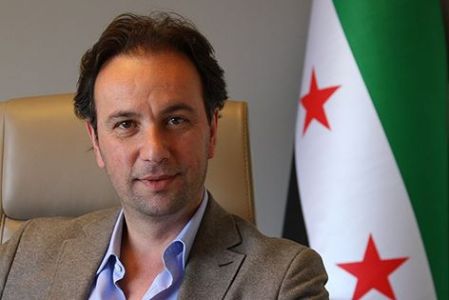
Khaled Khoja, who served as president of the National Coalition for Syrian Revolutionary and Opposition Forces until March 2016, gave an interview to the London-based Saudi daily Al-Sharq Al-Awsat on April 17, 2016, in which he harshly attacked the international community and particularly the U.S. Khoja argued that the U.S. never desired regime change in Syria and therefore did not take a decisive stand against Bashar Al-Assad despite his many crimes, and did not significantly support the Syrian opposition. According to him, the Americans showed apathy regarding the crisis, enabling Russia to fill the vacuum that they had created in a way that suited Russian interests. He added that the purpose of American military aid to the Kurds was to create a Kurdish canton, which would effectively lead to the splintering of Syria. Khoja stressed that the Syrian High Negotiations Committee remains insistent that the first step is to establish a transitional governing body, and only then can a new constitution, elections, and other topics be addressed.

It should be mentioned that the interview was given prior to the April 19 announcement by the head of the Syrian High Negotiations Committee, Riyad Hijab, that its delegation was suspending its participation in the Geneva talks.

Following are excerpts from the interview:[1]

28054Khaled Khoja (image: Zamanalwsl.net)

We Insist On A Serious Transition Of Power And All Authority

Khoja started by mentioning the Syrian High Negotiations Committee’s expectations from the current round of the Geneva talks: “We are here to focus on forming the governing body for the transitional phase. U.S. Special Envoy Staffan de Mistura is continuing his relentless efforts to begin discussing the political transitional phase, which will be based on establishing the ‘governing body,’ as stated in the Geneva announcement, UN Security Council Resolution 2218, and other resolutions. We have been empowered by opposition forces to discuss realizing these goals and we cannot deviate from them. Negotiations today should pick up where Geneva II left off [in February 2014] under the supervision of [former UN Special Envoy to Syria] Lakhdar Brahimi. We must start by forming this [governing] body and then proceeding to discuss the issues of the constitution, the elections, and other matters that fall under the governing body’s authority. Naturally, we have clear views on all these issues, which we will reveal at the appropriate time. I wish to say that we reject the verbal slips replacing the phrase ‘transitional governing body’ with ‘transitional regime’ or ‘transitional government’ and adhere to ‘transitional phase governing body’ and all it implies – meaning a serious transition of power and all authority.”

International And American Support For The Opposition Is Feeble

According to Khoja, “the position of international, and especially American, support for the Syrian opposition is feeble. The sad thing is that the true positions [of the U.S. and international community] regarding Assad is still feeble and vague despite all the evidence marking Bashar Al-Assad as a ‘war criminal,’ and despite the many official American statements that hold him responsible for ongoing killing and acts of slaughter. The lack of international political desire to push for the start of the transitional political phase in Syria has provided Assad and the parties supporting him, whether Iranians or Russians, with room to maneuver, enabling him [Assad] to continue heading the regime and to remain a chaos-creating factor in the region, [a factor] which exacerbates the refugee crisis and uses it as a card for pressuring neighboring countries and Europe, and which exports ISIS and terrorism…”

U.S. Apathy Is A Main Factor In Russia Becoming The Main Player In The Crisis

Khoja said further: “There is clearly American apathy regarding the Middle East, which opens the door for Russia to fill the vacuum left by the Americans… When we speak of the mass extermination of the Syrian people, their expulsion, the use of chemical weapons against them, the documentation of regime crimes in detention centers, forced disappearances, preplanned acts of murder, and red lines that have become green lights – all this causes observers to lose faith in the American position… Had the Americans not created this vacuum, we would not have been in the state we are in today, and Russia would not have become the main player in the crisis, holding the reins of initiative… Politically speaking, I believe the American position has not changed much since the onset of the Syrian revolution… [From the start] there was no real American support for change… The military aid we received [from the U.S.] is no match for the [American] military aid received by the Kurdish [Democratic] Union Party and the Kurdish People’s Defense Unit militias [YPG]. We believe that this aid for the Kurds was meant to create a new Kurdish ‘canton’ and to enforce a new reality as a foregone conclusion. American apathy has turned Syria into a series of ‘cantons’. The ‘Southern Canton,’ which is apart from the ‘Northern Canton,’ the ‘Kurdish Canton,’ and the ‘Alawi Canton.’ We cannot discount the possibility that as part of the political process, we will see a strengthening of [the phenomenon] of these cantons, but we will absolutely not agree to this…”

Syria Cannot Remain A Group Of Cantons In The Medium And Long Term

Khoja said that during the second round of negotiations there was talk of a federal solution that was “marketed by the Americans, the Russians, and UN Special Envoy de Mistura, who spoke openly and explicitly in one press conference on the topic of federation. Except that he did not discuss this issue with us, but rather only with other parties. The Russians did not hide their support for the federal solution and in my opinion, there is a serious attempt to create facts on the ground in Syria in order to strengthen the ‘canton’ situation.

“Any international solution, regardless of which parties promote it, cannot impose a situation that the Syrian people do not agree to. It is possible that the current situation will continue in the near future, but not in the medium and long term. The proof of this is that in the 1920s, the French tried to establish four statelets in Syria, but they only lasted a few years.”


Endnotes:


[1] Al-Sharq Al-Awsat (London), April 17, 2016.

Hizballah high-up taken out in Syria

May 13, 2016

Hizballah high-up taken out in Syria, DEBKAfile, May 13, 2016

Mustafa_Badr_al-Din2

Arab media reports that on the early morning of Friday May 13th,  Hezbbolah’s chief commander in Lebanon Mustafa Bader Al-din was killed. Al-din is a relative of Hezbbolah’s Secretary General Hassan Nasrallah. Arab media attribute the action to Israeli forces since it was carried out by an airstrike near Damascus’s military airport. Israeli sources refused to confirm or deny any connection  to the killing.

Debka’s exclusive military and anti-terror sources note that while it is indeed possible that Israel is behind the attack, it is also known that Al-din had numerous rivals among Iranian and Syrian top leaders.  Lately, Al-Din and Nasrallah were known to be in dispute over Al-din’s wish to withdraw large parts of Hizballah’s forces from Syria back to Lebanon and  his refusal to take part in several crucial battles in the Syrian war. Al-din claimed that President Assad as well as the Iranian leadership were assigning Hizballah forces excessively demanding operative tasks.  Furthermore, Al-din claimed that Hizballah finds it hard to cope with the high volume of losses and casualties in the Syrian war.

Debka’s exclusive sources further report that earlier this week Al-din met with the commander of the Iranian forces in Syria General Qassem Soleimani near Aleppo in northern Syria. The two clashed over the way in which the war in Syria should be conducted. Al-din claimed the Iran has been a victim of a Russian disinformation scheme under which Moscow is no longer providing aerial backup in Syria. Following what he called “Russia’s pulling out from the war”, A-din demanded not only  not to expand Iran and Hezbollah’s attacks in Syria but to narrow them down significantly.  Moreover, A-din announced, seemingly without consulting Nassrallah, that he had begun to withdraw Hezbollah forces from the various fronts in Syria and concentrated them near the Syrian-Lebanese border.

All of these appear to be a good enough reason for many parties in Teheran, Damascus and Beirut to get rid of Al-din. That said, all along Al-din never stopped planning attacks on Israeli targets.