Posted tagged ‘Iran Scam’

Leader Outlines Major Observations in JCPOA Implementation

October 21, 2015

Leader Outlines Major Observations in JCPOA Implementation, Tasnim News Agency (Iran), October 21, 2015

139406041520538615968453

[T]hroughout the 8-year period of implementing the JCPOA, imposing any sanctions, at any level and under any pretext –such as the “recurring and fabricated allegations of terrorism and human rights violation – by any of the parties to the talks”, will be tantamount to breach of the JCPOA and the administration will be obligated to take the necessary measures under the Clause 3 of the Iranian Parliament’s plan and cease the JCPOA activities.

*********************

TEHRAN (Tasnim) – Supreme Leader of the Islamic Revolution Ayatollah Seyed Ali Khamenei in a letter to President Hassan Rouhani highlighted nine main points that the administration will need to take note of regarding the course of implementing a final nuclear deal with six world powers.

In the letter, Ayatollah Khamenei appreciated the efforts made by the country’s different bodies involved in the course of nuclear negotiations with the Group 5+1 (Russia, China, the US, Britain, France and Germany) and the consequent efforts to evaluate the deal.

The Leader, however, noted that the nuclear agreement, dubbed the Joint Comprehensive Plan of Action (JCPOA), contains “ambiguities, structural weak points and multiple points that could inflict heavy losses on the country” at present and in the future in case of lack of strict and constant vigilance.

Ayatollah Khamenei then explicated the observations that the administration should make about the JCPOA and its implementation.

The first point in the Leader’s letter was the necessity for the full termination of the anti-Iran sanctions under the JCPOA.

Since the purpose of Iran’s approval to the nuclear negotiations was the removal of “cruel economic and financial sanctions”, and given the fact that the termination of the sanctions has been subjected to completion of Iran’s undertakings, there needs to be “firm and sufficient guarantees” to avert the other side’s breach, Ayatollah Khamenei underlined.

The US president and the European Union must declare that the anti-Iran sanctions have been “fully lifted”, the Leader noted.

The second observation in the letter was the categorical rejection of imposition of any new sanctions against Iran, which the Leader described as a breach of the JCPOA in which case the Iranian administration would be obligated to stop implementing the deal.

Third, the Leader further said, throughout the 8-year period of implementing the JCPOA, imposing any sanctions, at any level and under any pretext –such as the “recurring and fabricated allegations of terrorism and human rights violation – by any of the parties to the talks”, will be tantamount to breach of the JCPOA and the administration will be obligated to take the necessary measures under the Clause 3 of the Iranian Parliament’s plan and cease the JCPOA activities.

The rest of the observations are as follows:

4. Measures to renovate the Arak plant, which should keep its heavy (water) nature, will begin only after signing a definite and safe contract on an alternative plan and sufficient guarantee for its implementation.

5. The trade of the available enriched uranium with the yellowcake (a type of uranium concentrate powder) with a foreign government will take place when a secure contract with sufficient guarantees is signed. The mentioned trade and exchange (of materials) should occur gradually and in multiple times.

6. In accordance with the bill passed by the Majlis (parliament), a necessary plan should be devised and meticulously discussed by the Supreme National Security Council (SNSC) for mid-term development of (the country’s) nuclear energy industry, including ways to make progress in the next 15 years, leading to the production of 190,000 SWUs (Separative Work Units).

7. The Atomic Energy Agency of Iran (AEOI) should organize research and development in different aspects in such a way that at the end of the 8-year period, there will be no technological shortages for achieving the level of enrichment as accepted in the JCPOA.

8. As for ambiguities in the JCPOA, it should be stressed that the other side’s interpretation is not accepted, and that the reference (for interpretation) is the text of the negotiations.

9. The existence of complexities and ambiguities in the JCPOA and the possibility of breach of commitments and deception on the part of the other side, especially the US, necessitate that a strong, observant and smart committee be formed to monitor the progress of works, fulfilment of the other side’s commitments and  realization of the observations mentioned above. The committee’s arrangement and responsibilities should be formulated and approved by the SNSC.
Congress: Iran is Already Violating Nuke Deal

October 15, 2015

Congressmen: Iran is Already Violating Nuclear Deal Outrage over administration silence

BY:
October 15, 2015 1:24 pm

Source: Congress: Iran is Already Violating Nuke Deal

Lawmakers are accusing Iran of violating the recent nuclear deal due to the Islamic Republic’s test firing of a ballistic missile, which is likely at odds with international agreements barring such activity.

Anger on Capitol Hill is mounting following Iran’s ballistic missile test, with many also expressing frustration at the Obama administration for failing to condemn Iran or threaten repercussions for what they view as a clear violation of the nuclear accord and United Nations resolutions.

“The ink isn’t even dry on President Obama’s nuclear agreement and Iran is already breaking rules,” Sen. David Perdue (R., Ga.) said on Thursday. “This should not come as a surprise to anyone since Iran has cheated on every deal.”

Many are calling for the Obama administration to reimpose sanctions on Iran as punishment for the ballistic missile test. Recent statements by Iranian officials indicate that President Obama will still announce the removal of sanctions at some point next week.

The State Department has made it clear that, like Iran, it does not consider a ballistic missile test to be a violation of the nuclear deal.

Sen. Mark Kirk (R., Ill.), who recently petitioned the administration to clarify its stance on the missile test, said that the United States must hold Iran accountable lest the Islamic Republic believe it can continue to take rogue action.

“There is no doubt they will continue to ignore the international community and behave like a rogue nation even after President Obama’s dangerous deal is put in place,” Kirk said. “Americans expect our nation’s commander in chief to demand adherence to all international agreements, instead of allowing Iran to act aggressively without facing serious consequences.”

Kirk, along with Sen. Kelly Ayotte (R., N.H.), wrote on Wednesday to Obama, asking that his administration explain whether it would take action against Iran.

The senators say Iran cannot be permitted to advance its missile program, which could eventually be used to carry a nuclear weapon.

“This test furthers Iran’s ICBM program. An ICBM is not tangential or unrelated to Iran’s nuclear program,” they wrote. “The sole purpose of an Iranian ICBM is to enable delivery of a nuclear weapon to the United States.” 

“[T]his long-range ballistic missile that Iran tested last weekend likely improves Tehran’s ability to target Israel—our closest and most reliable ally in the Middle East,” they continued. “A threat combines hostile intent and capability.”

The test also continues a pattern of illegal behavior by Iran, according to the lawmakers.

“This latest violation of international law demonstrates Tehran’s continued willingness to ignore its obligations,” the lawmakers wrote.

Kirk and Ayotte are asking the administration to say whether it will refrain from waiving sanctions on Iran as a result of the test.

“Why does your administration continue to treat Iran’s ballistic missile program as an issue that is tangential—rather than central—to Iran’s nuclear program?” the lawmakers also ask.

Iranian leaders say that on Monday Obama will announce the lifting of all sanctions on Iran. This would mark a change in the administration’s stance that sanctions should only be suspended, rather than completely eradicated.

US defense chief: we will deter Russia’s ‘malign and destabilizing influence’

October 15, 2015

US defense chief: we will deter Russia’s ‘malign and destabilizing influence’ Ash Carter says US will not cooperate as long as Russia pursues a ‘misguided strategy’ in Syria but Moscow says it has been rebuffed in calls for consultation

Source: US defense chief: we will deter Russia’s ‘malign and destabilizing influence’ | World news | The Guardian

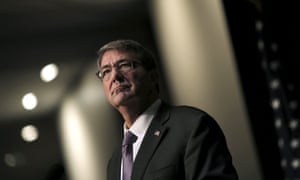
Ash Carter
Carter said the US ‘will take all necessary steps’ to counter Russian ‘influence, coercion and aggression’. Photograph: Carlos Barria/Reuters

The US defense chief has vowed to take “all necessary steps” against a resurgent Russia which is challenging a frustrated Washington in eastern Europe and the Middle East.

Ash Carter, the US defense secretary, said the Russian president, Vladimir Putin, had wrapped his country in a “shroud of isolation” which only a drastic change in policy could reverse.

“We will take all necessary steps to deter Russia’s malign and destabilising influence, coercion and aggression,” Carter said, attacking Russian military intervention in Ukraine and Syria.

The speech at a US army convention on Wednesday included some of the strongest language yet by the Obama administration, which came into office determined to “reset” relations with Russia and move them in a more cooperative direction.

Carter said that as long as Russia pursued a “misguided strategy” in Syria to bolster its client Bashar al-Assad, “we have not, and will not, agree to cooperate with Russia”.

Meanwhile, Russia claimed that the United States snubbed its overtures for high-level consultations on Syria, refusing to send a delegation to Moscow or receive a high-ranking Russian delegation.

On Tuesday, Putin said he wanted to send a delegation led by the Russian prime minister, Dmitry Medvedev, to the US. Moscow said the suggestion was first raised during a meeting between Putin and Barack Obama on the sidelines of the UN general assembly last month.

“Literally today, we got an official reply,” the foreign minister, Sergei Lavrov, said on Wednesday. “We have been told that they can’t send a delegation to Moscow and they can’t host a delegation in Washington either.”

Putin’s spokesman, Dmitry Peskov, said on Wednesday evening: “Given the current situation in Syria, refusing dialogue does not help to save the country and region from the Islamic State.”

There was no immediate response to the claim from US officials, though the accusation stands in contrast to two weeks of unresolved requests from the Pentagon to the Russian defence ministry for a clear procedure to avoid midair conflict.

While the US Defense Department last week held out hope for “deconfliction”, three rounds of talks have yet to result in clear rules for US and Russian pilots and their commanders, despite a series of undisclosed proposals and counterproposals. A third video conference made “progress” on Wednesday, and was described as “focused narrowly on the implementation of specific safety procedures” by a Pentagon spokesman, Captain Jeff Davis.

Lavrov said on Wednesday that agreement was close and procedures “should become operational any day now”.

The diplomatic disagreement over the international community’s response to the Syrian war reflects the positions of two distinct coalitions with divergent goals. Russia, Iran and the Syrian regime of the dictator Assad have accelerated a military offensive against Assad’s Syrian enemies.

The pro-Assad coalition is reportedly aiming to retake Aleppo in the coming days, with Russian warplanes supporting Iranian ground forces.

The US and much of the west are focused instead on a relatively slower campaign against the Islamic State, which formally opposes Assad but has turned its attention to consolidating its hold on eastern Syria and north-western Iraq.

On the one hand, Russia has been using its entrance into the Syria theatre to regain diplomatic clout after isolation following its actions in Ukraine, with Putin meeting with Obama in New York on the sidelines of the UN general assembly meeting, and the latest attempt to send a negotiating group to Washington.

On the other hand, when the strategy has failed, Putin has not shied from going it alone, launching the air campaign in Syria just two days after his speech at the UN calling for a coalition, and giving the US just an hour’s notice, via diplomats in Baghdad.

“I believe some of our partners simply have mush for brains,” Putin said, complaining that the US did not appear to have a firm set of goals in Syria.

In the balance for the US is the Iraqi government, which pivots between US and Iranian sponsorship. The Iraqi government of Haider Abadi, installed with the aid of the US last year, has begun flirting with the Russian-Iranian-Assad coalition in frustration with what it considers insufficient US support against Isis.

Iraq now hosts an intelligence fusion centre with Russian, Syrian and Iranian liaisons and reportedly has begun using situational awareness generated from the centre to bomb Isis positions.

Russia has said it would be willing to consider expanding its airstrikes to Iraq but only if it was asked to do so by Iraqi authorities.

The US has made clear it will not participate in the intelligence centre, out of concern that its Russian and Iranian adversaries would gain access to US information; the US maintains its own independent intelligence cell with the Iraqis. The Iraqi defence ministry has provided “assurances that our information will be appropriately protected”, Warren said on 1 October.

Meanwhile Carter said that he did not know if Putin would take “the opportunity to change course”.

“From the Kamchatka peninsula through south Asia, into the Caucasus and around to the Baltics, Russia has continued to wrap itself in a shroud of isolation. And only the Kremlin can decide to change that.”

On October 19 President Obama Will Announce Lifting Of American Sanctions

October 15, 2015

Senior Iranian Negotiators Salehi, Kamalvandi: On October 19 President Obama Will Announce Lifting Of American Sanctions, Middle East Media Research Institute, October 15, 2015

(Please see also, The Iranian Majlis Has Not Approved The JCPOA But Iran’s Amended Version Of It. If the statements by Iranian negotiators are accurate, it appears that Obama plans to implement the Iranian Parliament’s version of the JCPOA rather than the one submitted to the U.S. Congress. The Iranian version calls for the lifting of sanctions, the version submitted to the Congress calls for their suspension. — DM)


According to senior Iranian negotiators, Ali Akbar Salehi, the head of the Atomic Energy Organization of Iran and an architect of the nuclear agreement (JCPOA), and Beherouz Kamalvandi, the spokesman for the Atomic Energy Organization of Iran, on October 19, 2015 President Obama will announce that sanctions will be lifted and not merely suspended, contrary to the July 14, 2015 text of the agreement to which Iran is obligated.[1]

If this report proves accurate, it means that President Obama surrendered to the threats and demands of Iran’s Supreme Leader Ali Khamenei to amend the nuclear agreement (JCPOA) on this critical point, because lifting sanctions instead of suspending them will not allow their automatic reimposition (“snapback”). In this way, President Obama’s promise that the agreement incorporates the security mechanism of restoring the sanctions in the event of an Iranian violation, has been broken.

It should be emphasized that Salehi’s statement has not been verified at this stage by any Western or American source.

Khamenei issued his demands and threat on September 3, 2015 in a public address before Iran’s Assembly of Experts[2] and the Iranian Majlis incorporated them in the text that it approved on October 13, 2015.[3]

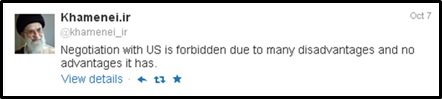
Following Khamenei’s address in early September 2015, contacts between Iran and the US and the P5 +1 powers took place September 28, 2015, on the sidelines of the UN General Assembly but their results were not published[4] and subsequently Khamenei issued a guideline on October 7, 2015 banning contacts with the US.[5]

25258

Endnotes:

[1] Fars (Iran), October 15, 2015; ILNA (Iran), October 15, 2015.

[3] See MEMRI Inquiry and Analysis No. 1192, The Iranian Majlis Has Not Approved The JCPOA But Iran’s Amended Version Of It, October 13, 2015.

[5] Twitter.com/khamenei_ir, October 7, 2015.

Iran’s Soleimani visits Syrian Golan as Tehran bolsters war effort

October 15, 2015

Iran’s Soleimani visits Syrian Golan as Tehran bolsters war effort Powerful head of Tehran’s Quds Force in Syria to oversee new push against anti-Assad rebels, visits near border to boost morale of troops after setbacks

By Avi Issacharoff, Times of Israel staff and AP

October 15, 2015, 8:57 am

Source: Iran’s Soleimani visits Syrian Golan as Tehran bolsters war effort | The Times of Israel

Iranian Revolutionary Guards al-Quds Force commander Maj. Gen. Qassem Soleimani. (YouTube/BBC Newsnight)

Iranian Revolutionary Guards al-Quds Force commander Maj. Gen. Qassem Soleimani. (YouTube/BBC Newsnight)

ranian general Qassem Soleimani, the commander of the country’s expeditionary al-Quds Force, visited the Syrian side of the Golan in recent days, The Times of Israel has learned.

Soleimani, a powerful figure thought to be at the forefront of Iranian fighting abroad, is in Syria to oversee a new offensive by Iranian and Assad regime troops meant to help the government retake large swaths of the country’s north.

His visit to the Golan, near the border with Israel, was apparently intended to boost morale of Syrian and Hezbollah forces – the latter loyal to Iran’s regime — after a series of setbacks against the “southern front” of rebel groups in the area.

By Wednesday, Soleimani was in the Latakia province, on the Mediterranean coast north of Lebanon, from which the northern operation is expected to launch, backed by the recent influx of Russian air power.

A regional official and Syrian activists said Wedneday that hundreds of Iranian troops were being deployed in northern and central Syria, dramatically escalating Tehran’s involvement in the civil war as they join allied Hezbollah fighters in an ambitious offensive to wrest key areas from rebels amid Russian airstrikes.

The official, who has deep knowledge of operational details in Syria, said the Iranian Revolutionary Guards — currently numbering around 1,500 — began arriving about two weeks ago, after the Russian airstrikes began, and have accelerated recently. The Iranian-backed group Hezbollah has also sent a fresh wave of fighters to Syria, he told The Associated Press.

Iranian and Syrian officials have long acknowledged Iran has advisers and military experts in Syria, but denied there were any ground troops. Wednesday’s statements were the first confirmation of Iranian fighters taking part in combat operations in Syria.

The main goal is to secure the strategic Hama-Aleppo highway and seize the key rebel-held town of Jisr al-Shughour in Idlib province, which Assad’s forces lost in April to insurgents that included al-Qaida’s Nusra Front.

The loss of Jisr al-Shughour, followed by the fall of the entire province, was a resounding defeat for Assad, opening the way for rebels to threaten his Alawite heartland in the coastal province of Latakia. The official suggested the Syrian army’s alarmingly tenacious position around that time is what persuaded the Russians to join the fray and begin airstrikes two weeks ago.

The Syrian government and Iran had been asking Russia to intervene for a year, the official said, speaking on condition of anonymity because he was not authorized to discuss military affairs. He said the Russian “tsunami wave” has given allies such as Iran the cover to operate more freely in Syria.

His account of Iranian troops arriving ties in with reports from Syrian opposition activists, who reported a troop buildup in the northern provinces of Idlib and Aleppo. The Syrian Observatory for Human Rights also reported Wednesday that Iranian troops were arriving and being transported to a military base in the coastal town of Latakia, in the town of Jableh outside the provincial capital.

At least two senior Iranian commanders were killed in Syria in recent days, including Gen. Hossein Hamedani, a senior Revolutionary Guard commander, who died Oct. 8 near Aleppo.

“Syria will witness big victories in coming days,” said Gen. Mohammad Ali Jafari, chief of Iran’s Revolutionary Guard, speaking Monday at Hamedani’s funeral.

The Quds Force is the de facto overseas operational arm of the of the Iranian Revolutionary Guards Corps, which is loyal to Iranian Supreme Leader Ayatollah Ali Khamenei and is separate from Iran’s national military force.

Israeli officials have accused the IRGC of trying to build an anti-Israel front on the Syrian Golan, alongside Hezbollah forces and local Druze opposed to Israel.

On January 18, a reported Israeli air strike on the Syrian Golan targeting a Hezbollah cell there killed six Hezbollah fighters and an IRGC brigadier general, Mohammed Ali Allahdadi. Allahdadi was said to be involved in helping to build up the operational capabilities of Hezbollah’s burgeoning Golan presence.

Soleimani himself traveled to Lebanon the following day to meeting with Hezbollah chief Hassan Nasrallah and visit the graves of the Hezbollah fighters killed in the strike.

Reports from late January claimed that a cross-border Hezbollah reprisal attack the following week, in which two IDF soldiers were killed and seven injured, was planned by two Quds Force officers appointed by Soleimani.

Czar Putin defends the West

October 14, 2015

Czar Putin defends the West, American ThinkerJames Lewis, October 14, 2015

Vladimir Putin isn’t a nice liberal, but he is a realist, which is much more than any Western leader can say today. Without realism it is impossible to act morally. Without realism, everything turns into an Obamaesque kabuki play.

********************************

Well, Obama has systematically undercut our friends in the Middle East, and Vladimir Putin is picking up the pieces. Obama promised big change — only not the ones we see happening. As Obama promised the radical left, America is now drastically weakened; but oddly enough, peace hasn’t busted out all over.

So here comes the Czar of all Russias to rescue Christian civilization from a bloody nightmare in Syria and Iraq. While the United States is supplying major weapons to brutal Sunni gangs who keep committing horrific war crimes, jihadis are taking advantage of the chaos to make genocidal attacks on Arab Christians, Egyptian Copts, Orthodox Armenians, Kurds, Yazidis, and Druze. (And each other — of course.)

Every time another domino falls, this administration looks more shell-shocked. Their comforting delusions are crumbling. Today they’ve stopped even pretending to understand what’s going on.

Even Obama’s surrender to Iran’s nuclear obsessions is now failing. Today, none of the European “partners” in that miserable appeasement are still willing to sign Obama’s Diktat; not even the Iranians, who are getting everything they want without Obama. It’s a total capitulation, with sinister consequences to come soon.

The Germans have doubled their profitable trade with Tehran, while  Russia and China are making huge military and nuclear power plant sales. Seven thousand Iranian Revolutionary Guards are fighting against U.S.-sponsored jihadis in Syria, along with ten times as many Hizb’allah fighters. Iran’s strategic noose around Saudi Arabia is tightening, and the naval chokepoint of Aden is under direct military threat.

The CIA failed to predict Putin’s intervention in Syria, yet for months everybody from Israel to Saudi Arabia has been sending top-level negotiators to Moscow. It’s the only thing they could do, after we threw them to the sharks. For nations in mortal peril, it’s any port in a storm.

And yes, it’s a fair bet that all the players carried gifts for the Tsar, to make sure they would not be victimized by the new hegemon.

The CIA failed to predict the Russian move into Syria. But you don’t need a huge intelligence “community” to see the obvious. This White House isn’t interested in the truth anyway. Obama can’t stand being contradicted, and the CIA is responding by not telling him what he doesn’t want to hear.

Syria’s President Assad is as ruthless as any dictator in the Middle East, but he based his power on protecting minorities, like his own Alawites. Like Muammar Gadaffi in Libya, he kept a precarious peace among hostile factions.

Christian bishops in the Middle East see Putin as their sole protector in the double bind between jihad and a militantly atheist West. To persecuted minorities in the Middle East, Putin has seized the moral high ground.

We have no idea what Putin is going to do next. Russia has the potential of becoming a major stabilizing force in the Middle East. But his convictions are becoming clearer. He understands Syria along the lines of his war with Chechnya: His actions there were ruthless but effective. ISIS has thousands of Chechnyan jihadis, now with combat experience, and ready to assault Russia. Putin will not tolerate that, just as China won’t tolerate its own Muslim rebels in Syria-Iraq returning to attack its vulnerable Uighur flank.

Putin carries street cred in a world of jihadist gangs. In 2002, Chechnyan terrorists murdered school children in Beslan and bombed the Dubrovka Theater. Putin reacted with brutal efficiency. His rise to power since that time is based on knocking down the Chechnyan rebellion, by bombarding entire cities. Much of Putin’s popularity among regular Russians is based on his brutal suppression of violent Islam.  But the Islamists attacks still continue.

Obama has just spent half a billion dollars to arm and train “Syrian moderates,” who took the money and ran, to join the worst terrorist gangs in the neighborhood. This week we heard that 70% of our military equipment sent to “Syrian moderates” ended up in the hands of ISIS.

I know we’re not supposed to say words like “Christian civilization,” but Vladimir Putin believes them. He isn’t wrong. For four centuries, until Lenin murdered the last Romanovs in 1918, the Tsars prided themselves on being the defenders of Christianity. Like the Vatican, the Russian Orthodox Church claims a direct line of apostolic descent from the early Christian churches, by way of the Byzantine Empire. And yes, there were plenty of wars between Polish Catholics and Russian Orthodox.

There was cruel persecution of Jews whenever a scapegoat was wanted. But today the Ottoman Turks are still remembered with a special horror in Eastern and Southern Europe. Sometimes you have to choose between bad and worse.

(Several years ago Pope Benedict quoted the Byzantine Emperor Manuel Paleologus II, condemning the sadistic cruelties of jihadist Islam. Telling the truth horrified liberals around the world, the way it always does. That quote came from a time shortly before the Byzantine Empire was destroyed by jihad, leaving the remaining Orthodox Churches bereft of their original lands.)

Putin has his picture taken regularly with the Patriarch of Moscow, probably for political reasons, but also because he has a deep sense of history. Unlike every cowardly Western liberal politician who can’t say the words “Muslim barbarism,” Putin is very clear about jihad. He understands the history of horrific Muslim assaults on Russia. He knows that jihad war has not changed one little bit in a thousand years. Like Samuel Huntington, the first historian of the jihad war, Putin also understands in a very profound way that this is a war for civilization.

Vladimir Putin isn’t a nice liberal, but he is a realist, which is much more than any Western leader can say today. Without realism it is impossible to act morally. Without realism, everything turns into an Obamaesque kabuki play.

Putin was raised by an Orthodox mother and a Marxist father. He came to power by brutally putting down a Muslim terrorist rebellion in Chechnya, using the standard Russian method of bombarding entire cities until they surrendered.

As a rising KGB colonel, Putin saw his world falling apart under Gorbachev, who tried to liberalize the Soviet Empire, only to see it collapse. In his eyes, democratic liberalism doesn’t work, Soviet Marxism didn’t work, and he certainly doesn’t want nuclear jihad to win.

Americans are used to thinking of Soviet Russia as a militant atheist regime, which tried to destroy religious faith wherever it could, for seven or eight decades. One of the astonishing facts of the 20th century is the survival of traditional religion under decades of Marxist oppression. It sometimes seems as if faith tends crumble in rich consumer societies; but persecution and misery bring it back.

When the Soviet Union was beginning to crumble in the late 1980s, some members of the Central Committee were quoted as exclaiming “Bozhe moye!” — My God!! whenever another piece of bad news came in. Religion had survived, even at the secret heart of the heart of the Communist Party. The same is happening in China today.

So Putin has gone back to the Tsarist practice of using the Orthodox Church to build national unity. He is also religiously tolerant as long as it’s peaceful. As long as they don’t threaten the Tsar, people can practice their faith. (But not when it comes to militant gay movements).

If Putin is smart, he won’t abuse his new credibility and power in the Middle East. Russia stands to gain numerous benefits, as long as it is perceived to be preserving an acceptable balance of power. That also means finding a position between Iran and Saudi Arabia, between Israel and Iran, and between Europe and the oil it depends on. Russia can reap huge benefits just from protecting mutually hostile oil regimes from each other; by saving their cookies, Putin also gets into the oil game.

Putin now runs the biggest military near the world’s oil spigot, even as shale deposits are quickly being exploited all over the world.

This is a time of constant probing to discover the parameters of the new hegemony.

So far, Putin’s intervention has been cheap,  taking advantage of historically stupid moves by the Euro-American Left. Putin can use his new-found influence in the Middle East to rebuild Russia’s economy in a world of fast-falling oil prices.


Khamenei’s new book preaches hatred and annihilation of America

October 13, 2015

Khamenei’s new book preaches hatred and annihilation of America, Front Page MagazineDr. Majid Rafizadeh, October 13, 2015

(Please see also, The Iranian Majlis Has Not Approved The JCPOA But Iran’s Amended Version Of It. — DM)

bazzi-top-1024x750

[C]an we consider ]US] policy an informed one when the US is compelled to continue to please and spoil the Islamic Republic — by turning a blind eye on its egregious human rights abuses, imprisonment of American citizens without fair and due process, support of  terrorist groups, sabotage of US foreign policy, national, and security interests in the region — all so that Iranian leaders will stick to the nuclear deal?

********************

Ironically, as the financial rewards and the improved legitimacy that have resulted from Obama’s nuclear deal continue to benefit the Iranian ruling clerics, the Iranian political establishment’s hatred towards the United States is reaching its peak. 

This week, the highest authority in the Islamic Republic, Supreme Leader Ayatollah Ali Khamenei, banned and forbade any further talks and negotiations between his country and the United States: “Negotiation with US is forbidden.”

In addition, he recently made his new e-book available for download in English. The Ayatollah points out: “The regional nations truly hate America and its European branch, England. This hatred is not limited to our people: all regional nations hate them … Why do they complain about being hated? Yes, we hate you.” The book advocates for annihilating America and Israel. It rants about how the Muslim world hates the US and Israel.

As a result, how can President Obama stand behind his promise that the nuclear deal is going to make the ruling clerics of the Islamic Republic more rational, less hostile to the United States and Israel, more civilized and a more constructive player in the region?

Adding to the intrigue is the fact that the theocratic leader has not even officially endorsed the nuclear deal, although the sanctions on the country are being gradually lifted. His strategy is to pull out of the nuclear deal after all economic sanctions have been lifted and Iran has obtained full nuclear capabilities.

The timing of the Supreme Leader’s announcement and other recent equally inflammatory statements is important since they come after the Islamic Republic has ensured that the nuclear deal is sealed and Tehran will be receiving over $150 billion in the short term and other additional financial rewards when the economic sanctions are fully lifted.

In addition, the Supreme Leader has heightened his anti-American and anti-Semitic views and speeches after getting indirect assurance from the Obama administration that the US will not impose any kind of sanctions on the Islamic Republic. Even in the future, no sanctions will be imposed on Iran’s human rights abuses, support for terrorism, or any other outlandish inhumane actions.

As the Secretary of State John Kerry pointed out to US senators, Congress won’t be able to impose new sanction on the Islamic Republic. The administration’s rule of not imposing sanctions applies to anything, whether related to nuclear issues or not, because as Mr. Kerry pointed out, he does not desire to show the Islamic Republic that the US is projecting “bad faith.”

This suggests that the administration will support the Iranian leaders in any way possible in order to show good faith, while Iran’s paramount leader is calling for the complete annihilation of the US and Israel, and increasing his military interventions in the region by dominating Baghdad, Damascus, Lebanon, and Sana’a. He has demonstrated clear support for terrorists groups, is determined to scuttle US national, economic and security interests, and has consistently increased his anti-American and anti-Semitic speeches and foreign policies.

Speaking to the commanders of the Islamic Revolutionary Guard Corps — who spread terrorism, militarism and Islamist ideologies in the region — Ayatollah Khamenei pointed out that “[w]e are in a critical situation now as the enemies are trying to change the mentality of our officials and our people on the revolution and our national interests.” In addition, with all the advantages that President Obama has given to the Supreme Leader through the nuclear deal, Khamenei stated, “Negotiations with the United States open gates to their economic, cultural, political and security influence. Even during the nuclear negotiations they tried to harm our national interests.”

The Obama administration, on the other hand, insists in not imposing any kind of new sanction because it does not want the Iranian government to get discontent and breach the nuclear deal, as recently made clear by Secretary Kerry.

So, can we consider this policy an informed one when the US is compelled to continue to please and spoil the Islamic Republic — by turning a blind eye on its egregious human rights abuses, imprisonment of American citizens without fair and due process, support of  terrorist groups, sabotage of US foreign policy, national, and security interests in the region — all so that Iranian leaders will stick to the nuclear deal?

In other words, what Secretary Kerry is saying is that any time the Iranian leaders feel discontent, the Obama administration’s policy is to give further bonuses to the ruling clerics and implore them not to back out of the nuclear deal. This coddling has created precisely a situation in which the Iranian ruling clerics have the opportunity to take complete advantage of the American government by exploiting the administration’s weak stance. It seems that when it comes to Iran, President Obama has switched the “carrot and stick” approach to a policy anchored in lavishing rewards on the Iranian leaders.

It is also important not to forget that Iranian leaders were the ones who were desperate for the nuclear deal: they are receiving billions of dollars, global legitimacy, and ensuring their hold on power and pursuit of nuclear objectives, as well as enhancing their regional hegemonic ambitions due to this deal. But since they have smelled the weakness of President Obama, they are more than happy to capitalize on it and exploit it.

As long as the theocratic Islamist political establishment is in power in the Islamic Republic, the Iranian leaders will continue their hatred and anti-American policies towards the US even if the US provides Tehran with its every whim and desire.

The Iranian Majlis Has Not Approved The JCPOA But Iran’s Amended Version Of It

October 13, 2015

The Iranian Majlis Has Not Approved The JCPOA But Iran’s Amended Version Of It, Middle East Media Research Institute, A. Savyon* and Y. Carmon, October 13, 2015

(Even Obama’s foggy notions of “common sense” should include the premise that, if there are multiple parties to an agreement, they should all follow the same agreement. — DM)

[T]he inclusion of these new Iranian demands in a Majlis decision constitutes the first written demand by an Iranian authority to amend the agreement, a demand that was mentioned verbally on September 3, 2015 by Iran’s Supreme Leader Ali Khamenei.

****************

On October 13, 2015 the Iranian Majlis approved, by a majority of 161-59 with 13 abstentions, not the JCPOA but rather an Iranian amended version it.

Paragraph 3 of the Majlis decision states that “the government will monitor any non-performance by the other party [to the agreement] in the matter of failing to lift the sanctions, or restoring the canceled sanctions, or imposing sanctions for any another reason, and will take steps to actualize the rights of the Iranian nation and to terminate the voluntary cooperation [this apparently refers to the Additional Protocol, which, according to the JCPOA, Iran will implement voluntarily] and to handle the rapid expansion of the Iranian nuclear program for peaceful purposes, so that within two years the enrichment potential in Iran will reach 190,000 SWU. The Supreme National Security Council will handle this matter, and the government will to submit to the Council a plan in the matter within four months.”[1]

Implications:

Considering that the non-cancellation of the sanctions is part of the JCPOA (according to the JCPOA, U.S. sanctions will be merely “suspended,” rather than canceled, so as to allow their “snapback” in the case of an Iranian violation); and considering that the re-imposition of sanctions, and the imposition of new sanctions, in case of an Iranian violation are likewise part of the JCPOA – the Majlis decision constitutes ratification of a nonexistent document. It was not a ratification of the JCPOA as it stands, but rather of additional demands made by Iran after the JCPOA was agreed upon on July 14, 2015 in Vienna.

Furthermore, the inclusion of these new Iranian demands in a Majlis decision constitutes the first written demand by an Iranian authority to amend the agreement, a demand that was mentioned verbally on September 3, 2015 by Iran’s Supreme Leader Ali Khamenei.[2]

The Majlis decision defines clauses in the JCPOA as “non-performance of the agreement by the other party” and therefore the Majlis’ approval is meaningless.

* A. Savyon is director of the MEMRI Iran Media Project; Y. Carmon is President of MEMRI.

Endnotes:

[1] ISNA (Iran), October 13, 2015.

[2] Khamenei announced explicitly on September 3, 2015 that he does not accept the terms of the agreement and demanded that the sanctions should be immediately removed, rather than suspended, as a condition for accepting the agreement. See the following MEMRI reports:

Special Dispatch No. 6151, “Khamenei Declares That He Will Not Honor The Agreement If Sanctions Are Merely Suspended And Not Lifted,” September 4, 2015; Special Dispatch No. 6162, “Expected September 28 NY Meeting Between P5+1 Foreign Ministers And Iran Could Signify Reopening Of Nuclear Negotiations To Address Khamenei’s September 3 Threat That If Sanctions Are Not Lifted, But Merely Suspended, There Will Be No Agreement,” September 21, 2015.

Iran Parliament passes bill approving nuclear deal

October 13, 2015

Iran Parliament passes bill approving nuclear deal

Published time: 13 Oct, 2015 05:50

Edited time: 13 Oct, 2015 06:37

Source: Iran Parliament passes bill approving nuclear deal — RT News

© Behrouz Mehri
The Iranian parliament has voted in favor of the nuclear deal with world powers, yet preconditioned that international inspectors will only have limited access to Tehran’s military facilities, reports IRNA news agency.

“The bill to implement the JCPOA … was passed in a public session on Tuesday with 161 votes in favor,” Reuters cited IRNA as saying, which referred to the Joint Comprehensive Plan of Action reached in July.

The parliament has also agreed on counter-measures in case the deal is not approved by other parties.

Now that the deal has been approved by the Majlis, the lower house, it needs endorsement by the Guardian Council of the Constitution consisting of clerics. Once the council approves the bill, it will come into law.

Once in force, the bill on the 6+1 nuclear agreement will enable Iranian government to implement the deal.

The agreement has a strong opposition from the Republican Party in the US, which attempted to prevent the deal from being approved by the Senate, but the Obama administration has so far been effective in finding right arguments to expect the deal get be agreed upon.

READ MORE: Senate fails to sink Iran nuclear deal by tying it to Israel

An Israeli lobby in the US has been fiercely opposing the nuclear agreement with Iran and put much effort to disrupt it.

The Israeli government has been vocally opposed to the deal, with the American-Israel Public Affairs Committee (AIPAC) spending up to $40 million on a public relations campaign criticizing the agreement, according to National Public Radio.

READ MORE: UN nuclear watchdog chief visits Parchin military facility in Iran

The historic agreement between Iran and six world powers was reached on July 14, putting an end to years of complex negotiations regarding the fate of the Iranian nuclear program. The deal is contingent on the adoption of a set of measures, the completion of which will lift all sanctions imposed on Tehran by the UN Security Council, the US and the EU.

Obama Will Be the Only Person Sticking to Iran Deal

October 12, 2015

Obama Will Be the Only Person Sticking to Iran Deal, Gatestone InstituteAmir Taheri, October 12, 2015

(Happy implementation day. — DM)

Sometime this week, President Obama is scheduled to sign an executive order to meet the Oct. 15 “adoption day” he has set for the nuclear deal he says he has made with Iran. According to the president’s timetable the next step would be “the start day of implementation,” fixed for Dec. 15.

But as things now stand, Obama may end up being the only person in the world to sign his much-wanted deal, in effect making a treaty with himself.

The Iranians have signed nothing and have no plans for doing so. The so-called Joint Comprehensive Plan of Action (JCPOA) has not even been discussed at the Islamic Republic’s Council of Ministers. Nor has the Tehran government bothered to even provide an official Persian translation of the 159-page text.

The Islamic Majlis, the ersatz parliament, is examining an unofficial text and is due to express its views at an unspecified date in a document “running into more than 1,000 pages,” according to Mohsen Zakani, who heads the “examining committee.”

“The changes we seek would require substantial rewriting of the text,” he adds enigmatically.

Nor have Britain, China, Germany, France and Russia, who were involved in the so-called P5+1 talks that produced the JCPOA, deemed it necessary to provide the Obama “deal” with any legal basis of their own. Obama’s partners have simply decided that the deal he is promoting is really about lifting sanctions against Iran and nothing else.

So they have started doing just that without bothering about JCPOA’s other provisions. Britain has lifted the ban on 22 Iranian banks and companies blacklisted because of alleged involvement in deals linked to the nuclear issue.

German trade with Iran has risen by 33 percent, making it the Islamic Republic’s third-largest partner after China.

China has signed preliminary accords to help Iran build five more nuclear reactors. Russia has started delivering S300 anti-aircraft missile systems and is engaged in talks to sell Sukhoi planes to the Islamic Republic.

France has sent its foreign minister and a 100-man delegation to negotiate big business deals, including projects to double Iran’s crude oil exports.

Other nations have also interpreted JCPOA as a green light for dropping sanctions. Indian trade with Iran has risen by 17 percent, and New Delhi is negotiating massive investment in a rail-and-sea hub in the Iranian port of Chah-Bahar on the Gulf of Oman. With help from Austrian, Turkish and United Arab Emirates banks, the many banking restrictions imposed on Iran because of its nuclear program have been pushed aside.

“The structures of sanctions built over decades is crumbling,” boasts Iranian President Hassan Rouhani.

Meanwhile, the nuclear project is and shall remain “fully intact,” says the head of Iran’s Atomic Energy Agency, Ali Akbar Salehi.

“We have started working on a process of nuclear fusion that will be cutting-edge technology for the next 50 years,” he adds.

Even before Obama’s “implementation day,” the mullahs are receiving an average of $400 million a month, no big sum, but enough to ease the regime’s cash-flow problems and increase pay for its repressive forces by around 21 percent.

Last month, Iran and the P5+1 created a joint commission to establish the modalities of implementation of an accord, a process they wish to complete by December 2017 when the first two-year review of JCPOA is scheduled to take place and when Obama will no longer be in the White House. (If things go awry Obama could always blame his successor or even George W Bush.)

Both Obama and his Secretary of State John Kerry have often claimed that, its obvious shortcomings notwithstanding, their nuke deal with the “moderate faction” in Tehran might encourage positive changes in Iran’s behavior.

That hasn’t happened.

The mullahs see the “deal” as a means with which Obama would oppose any suggestion of trying to curb Iran.

1173 (1)

“Obama won’t do anything that might jeopardize the deal,” says Ziba Kalam, a Rouhani adviser. “This is his biggest, if not the only, foreign policy success.”

If there have been changes in Tehran’s behavior they have been for the worst. Iran has teamed up with Russia to keep Bashar al-Assad in power in Syria, mocking Obama’s “Assad must go” rhetoric. More importantly, Iran has built its direct military presence in Syria to 7,000 men. (One of Iran’s most senior generals was killed in Aleppo on Wednesday.)

Tehran has also pressured Iraqi Premier Haidar al-Abadi’s weak government to distance itself from Washington and join a dubious coalition with Iran, Russia and Syria.

Certain that Obama is paralyzed by his fear of undermining the non-existent “deal” the mullahs have intensified their backing for Houthi rebels in Yemen. Last week a delegation was in Tehran with a long shopping list for arms.

In Lebanon, the mullahs have toughened their stance on choosing the country’s next president. And in Bahrain, Tehran is working on a plan to “ensure an early victory” of the Shiite revolution in the archipelago.

Confident that Obama is determined to abandon traditional allies of the United States, Tehran has also heightened propaganda war against Saudi Arabia, now openly calling for the overthrow of the monarchy there.

The mullahs are also heightening contacts with Palestinian groups in the hope of unleashing a new “Intifada.”

“Palestine is thirsty for a third Intifada,” Supreme Guide Khamenei’s mouthpiece Kayhan said in an editorial last Thursday. “It is the duty of every Muslim to help start it as soon as possible.”

Obama’s hopes of engaging Iran on other issues were dashed last week when Khamenei declared “any dialogue with the American Great Satan” to be” forbidden.”

“We have no need of America” his adviser Ali-Akbar Velayati added later. “Iran is the region’s big power in its own right.”

Obama had hoped that by sucking up to the mullahs he would at least persuade them to moderate their “hate-America campaign.” Not a bit of that.

“Death to America” slogans, adoring official buildings in Tehran have been painted afresh along with US flags, painted at the entrance of offices so that they could be trampled underfoot. None of the US citizens still held hostages in Iran has been released, and one, Washington Post stringer Jason Rezai, is branded as “head of a spy ring “in Tehran. Paralyzed by his fear of undermining the non-existent deal, Obama doesn’t even call for their release.

Government-sponsored anti-American nationwide events are announced for November, anniversary of the seizure of the US Embassy in Tehran. The annual “End of America” week-long conference is planned for February and is to focus on “African-American victims of US police” and the possibility of “self-determination for blacks.”

According to official sources “families of Black American victims” and a number of “black American revolutionaries” have been invited.

Inside Iran, Obama’s “moderate partners” have doubled the number of executions and political prisoners. Last week they crushed marches by teachers calling for release of their leaders. Hundreds of trade unionists have been arrested and a new “anti-insurrection” brigade paraded in Tehran to terrorize possible protestors.

The Obama deal may end up as the biggest diplomatic scam in recent history.