Posted tagged ‘Iran Scam’

‘Media misleading by reporting that Iran implementing nuclear deal’

November 4, 2015

‘Media misleading by reporting that Iran implementing nuclear deal,’ Jerusalem PostAriel Ben Solomon, November 3, 2015

(The Emperor has no clothes is available here. — DM)

The mainstream media are misleading the world into believing that Iran has accepted and is implementing the Joint Comprehensive Plan of Action that was agreed upon on July 14, a prominent Middle East expert who served in military intelligence and was an adviser to two prime ministers told The Jerusalem Post Tuesday.

“The recent phenomenon in the Western media saying that Iran has accepted the nuclear deal when it has not, shows that it has completely coddled to the line in defending the Iran deal,” Yigal Carmon, president of the Washington-based Middle East Media Research Institute (MEMRI), told the Post.

“This is very dangerous,” he asserted.

In an article Carmon published on MEMRI’s website on Friday titled, “The emperor has no clothes,” he wrote: “With every passing day, Iran is more and more in violation of the JCPOA. But neither the Republicans nor the Democrats, nor the media, nor anyone else will acknowledge this, for the implications are too devastating.”

On Monday, Tehran’s atomic energy chief said during a visit to Tokyo: “We have already started to take our measures vis-a-vis the removal of the centrifuge machines – the extra centrifuge machines. We hope in two months time we are able to exhaust our commitment,” Ali Akbar Salehi told public broadcaster NHK.

In a separate development that appeared to confirm that Iran had begun implementing its side of the deal, 20 hardline conservative members of Iran’s parliament wrote to President Hassan Rouhani to complain about the deactivation of centrifuges at two enrichment plants at Natanz and Fordow.

“Unfortunately, in the last two days, some contractors entered Fordow and started dismantling centrifuges… they said they could finish the job in two weeks,” Fars cited the lawmakers, among those loath to accept the nuclear deal, as saying.

However, MEMRI showed a recent report from the Iranian press that directly refuted such claims.

Behrouz Kamalvandi, spokesman for Iran’s atomic energy agency, addressed the concerns of several Majlis representatives and, according to a report on Tuesday by ISNA, he said: “We are also taking care of this matter. We will promote work in a way that follows the leader’s principles and guidelines.”

“The leader’s emphasis on the steps to be taken after the possible military dimensions dossier is closed was centered on the Arak reactor and the replacement of the uranium stockpiles,” he said.

“We are carrying out the leader’s orders meticulously and currently working on receiving the necessary guarantees on this matter.

“Indeed, we have taken several steps to implement the JCPOA so that we have more time when we wish to carry out matters in effect, but no centrifuge has been dismantled, and we are currently taking preparatory steps,” Iran’s nuclear spokesman continued.

“Regarding an official document on the rebuilding of the Arak reactor, all member-states of the P5+1 Group signed the document except for one, and we are currently waiting for the opinion of this country, which should arrive today or tomorrow,” Kamalvandi said.

Commenting on this previously unmentioned report, Carmon said, “Lo and behold, the only place you will find this report alongside the other one is in The Jerusalem Post, which sticks with the principles of journalism and doesn’t hide the reality when it doesn’t fit its beliefs, whatever they would be.

“The JCPOA, as concluded and celebrated on July 14, was never approved by Iran,” he said.

“They will never violate Khamenei’s conditions,” since even Iran’s leaders have already said they would adhere to them.

Conditions set out by Iran Supreme Leader Ali Khamenei effectively give him the power to bypass the government and cancel the nuclear deal, Carmon and the head of MEMRI’s Iran desk, Ayelet Savyon, wrote in a report last month.

Khamenei published a letter of guidelines for President Hassan Rouhani, adding new conditions for Iran’s execution of the agreement.

“The set of conditions laid out by Khamenei creates a situation in which not only does the Iranian side refrain from approving the JCPOA but, with nearly every point, creates a separate obstacle such that executing the agreement is not possible,” they wrote.

Following the publication of the supreme leader’s letter, Majlis Speaker Ali Larijani and Rouhani fully accepted Khamenei’s stipulations, Savyon told the Post last month.

Some close to the leadership will declare progress to the press, explained Carmon, but in reality, according to their own nuclear official, “Not one centrifuge has been removed.”

For the Americans, the JCPOA has no time limitation for implementation.

“Implementation day will happen when it happens and when the IAEA reports that it happened,” Carmon added.

Asked about the International Atomic Energy Agency, the United Nations nuclear watchdog, which is due to issue a report by December 15 on whether Iran’s nuclear program ever had a military application, Carmon responded that the IAEA will not report about implementation if it does not occur.

Therefore, Carmon argued, this saga could take months, or even well beyond that, or it may not even happen at all.

Our World: Showdown at the OK Corral

November 3, 2015

Our World: Showdown at the OK Corral, Jerusalem Post, Caroline Glick, November 2, 2015

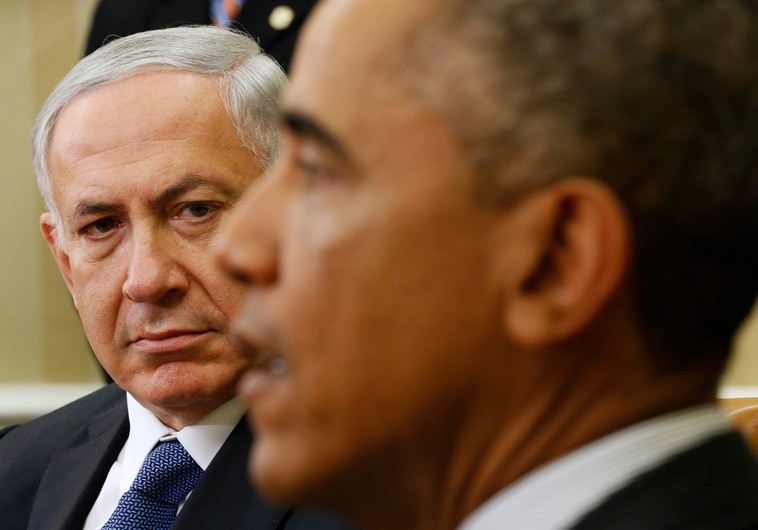
ShowImage (16)US President Barack Obama meets with Prime Minister Benjamin Netanyahu at the White House, October 1, 2014. (photo credit:REUTERS)

Whatever he says before the cameras next week when he meets with Netanyahu, Obama has no intention of letting bygones be bygones.

Prime Minister Benjamin Netanyahu’s meeting with US President Barack Obama next week is likely to look less like a rapprochement than a showdown at the OK Corral.

The flurry of spy stories spinning around in recent weeks makes clear that US-Israel relations remain in crisis.

Two weeks ago, The Wall Street Journal published a fairly detailed account of the US’s massive spying operations against Israel between 2010 and 2012.

Their purpose was to prevent Israel from attacking Iran’s nuclear installations. The Journal report, which was based on US sources, also detailed the evasion tactics the Obama administration employed to try to hide its covert nuclear talks with Iran from Israel. According to the report, the administration was infuriated that through its spy operations against Iran, Israel discovered the talks and the government asked the White House to tell it what was going on.

Over the past several days, the Israeli media have reported the Israeli side of the US spying story.

Friday Makor Rishon’s military commentator Amir Rapaport detailed how the US assiduously wooed IDF senior brass on the one hand and harassed more junior Israeli security officials on the other hand.

Former IDF chiefs of General Staff Lt.-Gens. Gabi Ashkenazi and Benny Gantz were given the red carpet treatment in a bid to convince them to oppose Israeli strikes on Iran’s nuclear installations. More junior officials, including officers posted officially to the US were denied visas and subjected to lengthy interrogations at US embassies and airports in a bid to convince them to divulge information about potential Israeli strikes against Iran.

Sunday, Channel 2 reported that the IDF’s Intelligence Directorate’s information security department just issued guidance to all IDF soldiers and officers warning them about efforts by the CIA to recruit them as US agents.

These stories have been interpreted in various ways. Regardless of how they are interpreted, what they show is that on the one hand, the Obama administration has used US intelligence agencies to weaken Israel’s capacity to harm Iran and to actively protect Iran from Israel. And on the other hand, Israel is wary of the administration’s efforts to weaken it while strengthening its greatest foe.

These stories form the backdrop of next week’s meeting between Netanyahu and Obama – the first they will have held in more than a year. They indicate that Obama remains committed to his policy of weakening Israel and downgrading America’s alliance with the Jewish state while advancing US ties with Iran. Israel, for its part, remains deeply distrustful of the American leader.

This Israeli distrust of Obama’s intentions extends far past Iran. Recent statements by Obama and Secretary of State John Kerry have convinced Israel that during his last 15 months in office, Obama intends to abandon US support for Israel at the UN Security Council, and to ratchet up pressure and coercive measures to force Israel to make irreversible concessions to the Palestinians.

From Netanyahu’s perspective, then, the main strategic question is how to prevent Obama from succeeding in his goal of weakening the country.

The implementation of Obama’s deal with Iran deal will form a central plank of whatever strategy the government adopts.

As far as Obama and his allies see things, the nuclear accord with Iran is a done deal. On October 21, House Minority Leader Nancy Pelosi hosted a reception for Democratic congressmen attended by White House Chief of Staff Denis McDonough to celebrate its official adoption.

Unfortunately for Pelosi and her colleagues, Iran is a far more formidable obstacle to implementing the deal than congressional Republicans. As Yigal Carmon, president of the Middle East Media Research Institute (MEMRI), explained in a report published on his organization’s website last week, at no point has any Iranian governing body approved the nuclear deal. Iran’s parliament, the Majlis, and its Guardians’ Council have used their discussions of the agreement to highlight their refusal to implement it. More importantly, as Carmon explains, contrary to US media reports, in his October 21 letter to Iranian President Hassan Rouhani, Iran’s Supreme leader Ayatollah Ali Khamenei did not give his conditional approval to the deal. He rejected it.

Carmon explained that the nine conditions Khamenei placed on his acceptance of the nuclear deal render it null and void. Among other things, Khamenei insisted that all sanctions against Iran must be permanently canceled. Obama couldn’t abide by this condition even if he wanted to because he cannot cancel sanctions laws passed by Congress.

He can only suspend them.

Khamenei also placed new conditions on Iran’s agreement to disable its centrifuges and remove large quantities of enriched uranium from its stockpiles.

He rejected inspections of Iran’s military nuclear installations. He insisted that Iran’s Arak heavy water reactor must remain capable of producing heavy water in contravention of the deal. And he insisted that at the end of the 15-year lifetime of the deal Iran must have sufficient uranium enrichment capability to enable it to develop bombs at will.

As Carmon noted, the US and EU have announced that they will suspend their nuclear sanctions against Iran on December 15 provided that by that date, the UN’s International Atomic Energy Commission certifies that Iran has upheld its part of the bargain.

By that date, in conformance with their interpretation of the nuclear deal, the US and the EU expect for Iran to have reduced the number of centrifuges operating at the Natanz facility from 16,000 to 5,060 and lower enrichment levels to 3.67%; reduce the number of centrifuges at Fordow to a thousand; remove nearly all its advanced centrifuges from use; permit the IAEA to store and seal its dismantled centrifuges; reduce its stockpile of enriched uranium to 300kg.; remove the core from the Arak reactor and disable it; and submit to agreed monitoring mechanisms of its nuclear sites.

Carmon noted that Iran has taken no steps to fulfill any of these conditions.

With Khamenei’s rejection of the nuclear deal and Iran’s refusal to implement it, there are two possible ways the US and the EU can proceed.

First, as Carmon suggests, Obama and the EU may renew nuclear talks with Iran based on Khamenei’s new position. These talks can drag out past Obama’s departure from office. When they inevitably fail, Obama’s successor can be blamed.

The other possibility is that Iran will implement some component of the deal and so allow Obama and the EU to pretend that it is implementing the entire deal. Given the US media’s failure to report that Khamenei rejected the nuclear pact, it is a fair bet that Obama will be able to maintain the fiction that Iran is implementing the deal in good faith until the day he leaves office.

So what is Israel to do? And how can Netanyahu use his meeting with Obama next week to Israel’s advantage? Israel has two policy options going forward. First, it can highlight the fact that Iran is not implementing the deal, just as Israel took the lead in highlighting the dangers of the nuclear accord with Iran over the past year. This policy can potentially force Obama onto the defensive and so make it harder for him to go on the offensive against Israel at the UN and other venues in relation to the Palestinians.

But then, it is far from clear that Obama will be deterred from adopting anti-Israel positions at the UN even if Israel succeeds making an issue of Iranian noncompliance with the nuclear deal.

Moreover, if Netanyahu leads the discussion of the Iran’s bad faith, as he drove the discussion of the nuclear deal itself, he will reinforce the already prevalent false assessment in the US that a nuclear Iran threatens Israel but is not dangerous for the US.

This incorrect assessment has made a lot of Americans believe that by seeking to prevent Iran from acquiring nuclear weapons, Israel is advancing is own interests at America’s expense.

The other policy option is the one that Defense Minister Moshe Ya’alon indicated Israel is pursuing in his meeting last week with his counterpart Defense Secretary Ashton Carter. At the Pentagon Ya’alon declared, “The Iran deal is a given. Our disputes are over.”

The downside of this position is that it indicates that Israel accepts the legitimacy of a deal that Iran is not implementing and that would imperil Israel’s national security even if Iran were implementing it.

Its upside is that it takes Israel out of the US debate regarding the nuclear deal. To the extent that opponents of Obama’s Iran policy are willing to lead the fight against the deal themselves, Israel could do worse than to take a step back and plot its own course on Iran, independent of the US policy discussion.

It is hard to know which line of action makes more sense. But as the spy stories demonstrated, one thing is clear enough. Whatever he says before the cameras next week when he meets with Netanyahu, Obama has no intention of letting bygones be bygones.

An absurd new world order

November 1, 2015

An absurd new world order, Israel Hayom, Omer Dostri, November 1, 2015

(Please see also, Supreme Leader Khamenei’s statements reported here: Leader: Negotiation with US on Regional Issues Meaningless

The Americans seek to impose their interests, not to settle problems. They want to impose 60, 70 percent of their demands via negotiations, and practically implement and impose the rest of their objectives illegally. Then what would negotiations mean?

. . . .

While many consider the Joint Comprehensive Plan of Action (JCPOA) a major breakthrough in the improvement of ties between Iran and the West, the Leader has already made it clear that Tehran’s policy toward the US will remain unchanged regardless of the ultimate fate of the JCPOA.

— DM)

Iran’s participation in the talks in Vienna on Friday on the conflict in Syria was a manifestation of new, post-nuclear deal order in both the world as a whole and the Middle East in particular.

In recent decades, the U.S. was the sole superpower in the international arena. However, that has changed during U.S. President Barack Obama’s seven years in office, and now the world is bipolar in nature, if not multipolar. The past year has seen Russia enter the international scene and take an active role, both militarily and diplomatically, in conflicts around the globe.

This is a direct result of American foreign policy in recent years, as the Obama administration sought to pivot from the Middle East to Asia. With this goal in mind, the U.S. has tried to achieve stability in the Middle East by making sure conflicting powers are balanced out with each other.

Iran’s participation in the Vienna talks was the result of this U.S. outlook which views Iran as a stabilizing agent that could serve as a counterbalance to the Sunni axis led by Saudi Arabia, Egypt and Jordan. The White House considers Iran to be geopolitically important and this has helped Iran gradually turn into a regional power.

The clearest expression of this strategic decision by the Obama administration was the nuclear deal reached between six world powers and Iran. The U.S. enabled this deal to be reached by whitewashing Iran’s violations of U.N. Security Council resolutions and it helped open international doors for Iran.

This is how Iran, previously an isolated nation in economic distress, is now accepted with open arms and is being courted by world powers as if it was an epitome of peace and reconciliation. Iran’s international status has been greatly bolstered, despite the fact is has done nothing yet to warrant the trust of world powers. For example, European Union foreign policy chief Federica Mogherini welcomed Iran’s participation in the Vienna talks and British Foreign Secretary Philip Hammond called Iran a “significant and important power in the region.”

The absurdity becomes even clearer when one considers the ballistic missile test Iran conducted on Oct. 12, which the U.S. characterized as a “clear” violation of the U.N. Security Council resolution prohibiting Iran from undertaking any work on ballistic missiles designed to deliver nuclear warheads. Furthermore, American experts said the test was not just a violation of the U.N. Security Council resolution, but also of the nuclear deal itself.

The Obama administration’s foreign policy has intentionally enabled Iran to become a significant player in global arena, while the U.S. overlooks the many resulting contradictions and dangers posed by this policy.

Iran is still committed to the destruction of Israel, continues to undermine stability in the Middle East via support for the rebels in Yemen and the brutal regime of Syrian President Bashar Assad, maintains funding of terrorist organizations such Hezbollah and Islamic jihad and incites anti-Israel violence by Palestinians in Judea and Samaria. Yet world powers — in a display of senselessness and utter detachment from reality — continue to shower Iran with praise, thus contributing to the creation of an absurd new world order.

Leader: Negotiation with US on Regional Issues Meaningless

November 1, 2015

Leader: Negotiation with US on Regional Issues Meaningless, Tasnim News Agency (Iranian), November 1, 2015

139408101241559676429254


While many consider the Joint Comprehensive Plan of Action (JCPOA) a major breakthrough in the improvement of ties between Iran and the West, the Leader has already made it clear that Tehran’s policy toward the US will remain unchanged regardless of the ultimate fate of the JCPOA.

***********************

TEHRAN (Tasnim) – Supreme Leader of the Islamic Revolution Ayatollah Seyed Ali Khamenei dismissed the idea of Iran-US negotiation on regional issues, saying the totally contrasting policies of the two countries and Washington’s attempts to impose its demands make such talks pointless.

In a meeting with the Foreign Ministry staffers in Tehran on Sunday, Ayatollah Khamenei underlined that Iran’s foreign policy is founded upon the Constitution, the long-term interests of the country and the Islamic Republic’s values, and that, consequently, they do not change in different administrations.

Different administrations would affect only the “tactics and executive initiatives” in carrying out the country’s foreign policy strategies, the Leader stressed.

The Supreme Leader then dismissed as a Western illusion the notion that Iran’s foreign policy has undergone a forcible change.

Imam Khamenei further referred to the US policies in West Asia as the root cause of the tense situation across the region, adding, “Unlike the view of certain individuals, the US is the main plank of the region’s problems, not part of a solution to the problems.”

The Leader then called on the Iranian foreign ministry officials, ambassadors and diplomats to stick to the tenets of the Islamic Republic’s foreign policy “firmly, mightily and gloriously”, so that foreigners and their followers inside the country would not pin hopes on a shift in Iran’s foreign policy.

Ayatollah Khamenei referred to Iran’s policies on Palestine, Syria, Iraq, Yemen and Bahrain, saying they differ from those of the US by “180 degrees”.

The root cause of insecurity in the region is Washington’s support for the Zionist regime of Israel and the terrorist groups, the Leader underscored.

Imam Khamenei then categorically dismissed the idea of negotiations with the US on regional issues.

“The Americans seek to impose their interests, not to settle problems. They want to impose 60, 70 percent of their demands via negotiations, and practically implement and impose the rest of their objectives illegally. Then what would negotiations mean?”

Elsewhere, Ayatollah Khamenei lauded Foreign Minister Mohammad Javad Zarif and other diplomats for handling nuclear talks with six world powers well, saying they could very well safeguard the country’s goals in the talks.

Iran and the Group 5+1 (Russia, China, the US, Britain, France and Germany) on July 14 reached a conclusion on a lasting nuclear agreement that would terminate all sanctions imposed on Tehran over its nuclear energy program after coming into force.

While many consider the Joint Comprehensive Plan of Action (JCPOA) a major breakthrough in the improvement of ties between Iran and the West, the Leader has already made it clear that Tehran’s policy toward the US will remain unchanged regardless of the ultimate fate of the JCPOA.

Iran-US Talks Limited to Nuclear Issue: MPs

October 31, 2015

Iran-US Talks Limited to Nuclear Issue: MPs, Tasnim News Agency (Iranian), October 31, 2015

(Please see also, Russia Invites Iran to Join Talks on Syria, with US Approval. — DM)

Iranian guy(1)

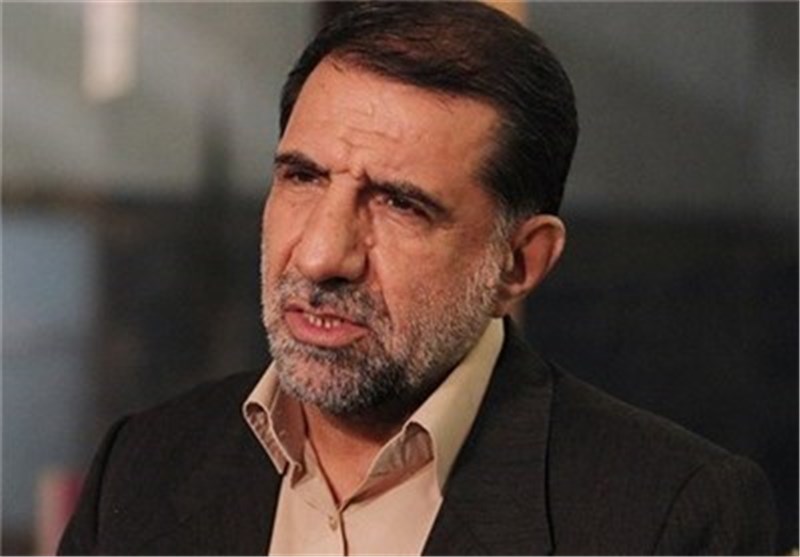
TEHRAN (Tasnim) – A senior Iranian lawmaker dismissed claims about Iran’s bilateral talks with the US over the ongoing crisis in Syria, saying Tehran does not at all negotiate with Washington on any non-nuclear issue.

Esmaeil Kosari, the chairman of the Iranian parliament’s defense commission, rejected media speculations about Iran’s direct talks with the US over the Syrian crisis, saying the country would never negotiate with the US over any topic other than the nuclear issue.

The Iranian negotiating team does not at all hold any direct negotiations with the US outside the nuclear issue, he told the Tasnim News Agency.

Another Iranian lawmaker, Baqer Hosseini, who is a member of the parliament’s National Security and Foreign Policy Commission, also told Tasnim that the foreign ministry officials have no permission to have non-nuclear talks with the US, and that it should not happen.

Given the guidelines of the Supreme Leader of the Islamic Revolution Ayatollah Seyed Ali Khamenei, and considering the previous experiences with Americans, Iran is not supposed to hold talks with the US on any topic other than the nuclear issue, he added.

The remarks came after certain media alleged that Tehran and Washington have conferred on the issue of Syria in their Thursday bilateral talks, previously announced to be focused on the implementation of a recent nuclear deal between Iran and world powers known as Joint Comprehensive Plan of Action (JCPOA).

In a similar reaction to the claim, US State Department Spokesman John Kirby stressed that “the discussions with Iran over Syria and what’s going on in Syria took place inside the multilateral setting.

“The meetings bilaterally were primarily about JCPOA implementation,” he added.

Earlier on October 7, Ayatollah Khamenei categorically rejected the idea of talks between Tehran and Washington in areas other than the nuclear issue.

Negotiating with the US is forbidden because it would bear no fruits, but would do countless harms, Imam Khamenei stressed at the time.

Bipartisan consensus: Stop Iran and its missile attacks on Iranian dissidents

October 31, 2015

Bipartisan consensus: Stop Iran and its missile attacks on Iranian dissidents, The Hill, Raymond Tanter, October 31, 2015

Fox News reports a missile attack occurred on Camp Liberty Iraq on October 29; residents include 2,400 members of the Mujahedeen-e-Khalq (MEK). About 80 missiles made holes as deep as 7 feet and wide as 8 feet—including 122 mm Katyushas and those Tehran produced—the NB24 Russian missiles. 

Why is Iran targeting its opposition? Dissidents block the goal of Tehran—to control Baghdad and Damascus where we are fighting the Islamic State of Iraq and Syria (ISIS). Washington’s evolving strategy is DOA on the Hill unless the administration reaches out to the opposition and sees Iran as a threat across the porous border.

How to counter the threat from Iran? Align with others opposing Tehran and the bipartisan congressional coalition sharing that view.

Saudi Arabia’s alignment against Iran includes Israel as a silent partner. Saudis view Tehran and Damascus unfavorably. A potential partner for Riyadh and Washington is the Iranian Resistance that rejects clerical rule in Tehran. All define the threat as Islamist.

Saudi Foreign Minister Adel al-Jubeir asked, Is Iran a “state or a revolution?” If it wants to export its 1979 revolution and revive the Persian Empire “we cannot deal with it.” Israeli Prime Minister Benjamin Netanyahu said in his UN speech on October 1 that shifting alliances in the Middle East drew Arab countries like Saudi Arabia closer to Israel in confronting Iran and ISIL. His speech before the Congress stated that, “Iran’s regime poses a grave threat…to the peace.”

On April 29, the House Foreign Affairs Committee held a hearing, “ISIS: Defining the Enemy.” Maryam Rajavi is President-Elect of the National Council of Resistance of Iran (NCRI), the coalition of which the MEK is the largest unit; she testified from Paris. Her written testimony showed how Tehran is an Islamist epicenter of terrorism to establish an Empire without borders and called for empowering the democratic tolerant Islam she represented.

The Joint Comprehensive Plan of Action (JCPOA), garnered bipartisan criticism on the Hill. At a May 5, 2014 press conference, Senate Committee on Armed Services (SCAC) Chairman John McCain (R-Ariz.) announced completion of markup of National Defense Authorization Act for Fiscal Year 2016. That Act had language to counter Iran’s influence in Iraq and protect the MEK, now in Camp Liberty. An SCAC hearing on Iranian Influence in Iraq and the Case of Camp Liberty focused on resettlement of the MEK from Camp Liberty outside Iraq.

Bipartisan statements by over a dozen senators indicated Secretary Kerry should protect the MEK in Iraq and waive regulations to permit MEK members to enter the USA and contribute to the economy in alignment with our humanitarian values, as stated by several senators and General James Jones, USMC (Ret.), first National Security Advisor to President Barack Obama.

“The U.S. government and military made a commitment to protect thousands of people [MEK] who surrendered their weapons and came under our protection as a result,” McCain said. “Clearly, this commitment has not been sustained.”

Ranking member, Sen. Jack Reed (D-R.I.), expressed a desire to help these oppositionists. “The Iranian dissidents at Camp Liberty are in an increasingly perilous situation, having repeatedly come under attack. These horrific attacks, which have killed more than 100 MEK members since 2009, clearly indicate the threat to this group from Iran and Iranian-backed militia seeking to eliminate and silence these dissidents.” Add about 30 others from the attack on Oct 29, 2015.

McCain described the MEK as a group that received “protected persons” status in 2004 under the Fourth Geneva Convention. Col Wes Martin, former Commander, Forward Operating Base Ashraf until 2006, testified that the United States provided ID cards for each Protected Person under the authority of the American military on behalf of the U.S. Government.

Former Sen. Joe Lieberman (I-Conn.), invited by former colleagues to attend as witness, testified that America would be “disloyal to our…national values if we did not find better ways–overt and covert–to support the democratic opposition to the dictatorial regime in Iran.”

Senators backed the moderate pro-democracy tolerant Islam of the MEK instead of allowing the Islamist regime in Tehran to suppress that organization. With such bipartisan backing, there is enhanced likelihood the MEK can expand the NCRI coalition for regime change from within and broaden its base in Iran given that expectations will be higher in a post-nuclear-agreement Iran.

The way forward: Alignment with those opposing Tehran, congressional allies sharing that view, and prevention of attacks like the missiles on Camp Liberty.

MEMRI: ‘The Emperor Has No Clothes’

October 30, 2015

MEMRI: ‘The Emperor Has No Clothes,’ Yigal Carmon, October 30, 2015

(Where are the media? In Obama’s pocket as usual. — DM)

25564

This MDB is dedicated to the memory of USAF pilot Captain (ret.) David Ganz, a man of honor and gallantry and a decorated officer, who passed away last week.

What Is The “Iran Nuclear Deal?”

What is mistakenly perceived as an agreement under the title of “Joint Comprehensive Plan of Action” (JCPOA), that was concluded on July 14 in Vienna, and celebrated by the White House as anhistoric agreement,” is neither a contract nor even a real agreement between Iran and the P5+1. It is a set of understandings and disputes compiled into a single document.

For example, the JCPOA states that in the event of Iranian violations, sanctions will be re-imposed (snapback). However, the Iranian position, which rejects all sanctions, is incorporated in the same document. In outlining the snapback of the sanctions, Article 37 also stipulates: “Iran has stated that if sanctions are reinstated in whole or in part, Iran will treat that as grounds to cease performing its commitments under this JCPOA in whole or in part.”[1] This is not merely an Iranian reservation expressed outside of the negotiating room. It is incorporated into the text of this selfsame document – and one that completely contradicts preceding provisions that stipulate otherwise. Since the parties were unable to arrive at an understanding on this issue in two entire years of negotiations, they decided to resolve this major issue by incorporating this disagreement into the document itself.

The JCPOA is best characterized by bangs and whimpers – by bold prohibitions on Iran that peter out in qualifying terms such as “unless,” “except if,” and the like.

Why isn’t the JCPOA a contract? Because Iran would never have signed any contract with the U.S. – “the Great Satan” – whose demise it seeks. Likewise, it would not have signed any contract with any other party to the negotiations, since it views the sanctions imposed on it by United Nations Security Council (UNSC) resolutions and by EU and IAEA reports as grievous injustice. By signing such an agreement, it would retroactively legitimize these wrongs done to it.

As Iranian Supreme Leader Ali Khamenei frequently reiterates, Iran agreed to negotiations mainly to get the sanctions lifted. Therefore, as far as Iran is concerned, the only acceptable name for this enterprise is “Joint Comprehensive Plan of Action” – under which each party commits to particular action. It is a joint plan, not a contract.[2]

Has Iran Fulfilled Its Initial Obligation To Approve The July 14 Vienna JCPOA?

The JCPOA includes a timetable and obligations applying to both sides. Within this time frame, both parties had 90 days from July 14 to secure approval for the agreement from their respective national institutions. By “Adoption Day,” set for October 19, which has come and gone, the agreement was meant to have been approved by both sides. The EU was to have announced the lifting of its sanctions, while President Obama, on behalf of the U.S., was to have announced the lifting of the U.S. executive branch’s sanctions, along with waivers on sanctions imposed by the U.S. legislative branch – that is, suspension, because the president is not authorized to lift them.

Adoption Day was preceded by a farcical UNSC endorsement of the agreement/disagreement, as demanded by Iran. The U.S. volunteered to play errand boy for this undertaking. For its part, the UNSC eschewed discussion on the matter, and passed this historic resolution, No. 2231,[3] on such a weighty historic document in record time – under 30 minutes.

The Western side showed its consent long before October 19; the self-effacing EU member countries did not even bother to discuss the agreement in their national parliaments – and thus confirmed their true status as nonentities. And while the U.S Congress did discuss it seriously, the agreement was allowed to proceed, via a convoluted process that was nonetheless legal and binding.

In Iran, however, following discussion in both its Majlis and its Guardian Council, the JCPOA as concluded and announced on July 14 was not approved. The Majlis ratified something else – a set of recommendations to the government of Iran regarding how it should execute the JCPOA. This hardly constitutes approval of the original document. The Guardian Council, for its part, approved what the Majlis had done; Guardian Council secretary-general Ayatollah Jannati said, on Iranian TV, that his council had approved not the JCPOA but a plan for the government to secure Iran’s interests in executing it.[4] Majlis speaker Ali Larijani said the same thing.[5]

Was this a fulfillment of what Iran was obligated to do under the JCPOA? No! Did the U.S. administration insist that Iran approve the JCPOA, as concluded and announced in Vienna on July 14? No! Does the U.S. realize that Iran’s ultimate authority to approve laws rests with Supreme Leader Khamenei, and that he has not yet approved the JCPOA? NO! Nevertheless, the U.S. and Europe have chosen to regard what Iran has done as approval – so that the peace process will not be halted.

The U.S. and Europe then proceeded to the first post-Adoption Day phase in the JCPOA timetable: The EU announced that its sanctions would be terminated. President Obama announced that the U.S.’s executive sanctions would be lifted and its legislative sanctions waived; this announcement was not for immediate execution, but in fact advance notice that these measures would come into effect by December 15 – provided that the IAEA would report that Iran has fulfilled its obligations under the JCPOA.

What are these obligations that Iran has to fulfill between Adoption Day and December 15 in order to merit this sanctions relief? The Arms Control Association, which supports Iran and the JCPOA, listed them on its website:[6]

*reducing the centrifuges at Natanz from over 16,000 to 5,060 IR-1 machines, which will enrich uranium to 3.67 percent, and removing the associated infrastructure;

*reducing the number of IR-1 machines centrifuges at Fordow to 1,000 (328 will operate) and converting the facility for radioisotope production;

*wrapping up testing on advanced centrifuges machines and removing all advanced centrifuges except one IR-4, IR-5, IR-6, and IR-8 machine for testing with uranium;

*storing all dismantled centrifuges under IAEA seal;

*reducing the stockpile of enriched uranium to less than 300 kilograms;

*removing the core of the Arak reactor and disabling it; and

*instituting the necessary transparency and monitoring mechanisms to implement Iran’s additional protocol and the continuous surveillance of key facilities.

Did Iran hasten to meet these obligations? No! The explanation follows below.

Why Has No One Said A Word About Iran’s Noncompliance?

Since Adoption Day, no one in the West – not the media, not Capitol Hill, not Israel – has spoken up about the fraud of Iran’s alleged “approval” of the JCPOA. Western intelligence agencies and think tanks have also held their tongues. Everyone swallowed the lie, in a spirit of goodwill, in order to allow the JCPOA to proceed, for “peace in our time.”

The Republicans should have remembered their revered leader, Abraham Lincoln, invoked by Barack Obama in 2007 when he announced his presidential candidacy at the spot where Lincoln had done so over 150 years previously. After all, it was Lincoln who said, “You cannot fool all the people all the time.”

The pro-JCPOA political media have, of course, misled the public by reporting that Iran approved the JCPOA. But even the anti-JCPOA media have failed to rebut this lie. Why? Ignorance, unprofessionalism, and hatred for President Obama blinded them. Here is what they likely are thinking: Obama gave in to Iran on everything. Obviously, Iran is going to approve this piece of “absolute Western capitulation.”

However, Iran did not get absolutely everything it demanded, and Obama did not give it absolutely everything it demanded – he held out for a tiny scrap of the U.S.’s initial position, as will be detailed below. That is why Iran would not approve the JCPOA – to Iran, anything less than 100% of what it wants is an injustice.

Why Isn’t Iran Rushing To Fulfill Its Obligations And Get Sanctions Relief By December 15?

At this stage, events have taken an absurd turn. Iran has started dragging its feet. Instead of rushing to carry out all the steps to meet its obligations under the JCPOA, it is idling in neutral. It has little time and much to do by December 15. It must dismantle thousands of centrifuges and transfer them to storage monitored by IAEA cameras. It must ship out 9,000 kg of its enriched uranium to a third country, retaining only 300 kg. It must dismantle and pour cement into the core of the Arak plutonium reactor, and transform the facility into a heavy water reactor. It must notify the IAEA of its voluntary acceptance of the NPT Additional Protocol. And more.

But senior Iranian officials are shifting responsibility for initiating fulfillment of these obligations to one another, sometimes with comical effect. For example, President Hassan Rohani sent a letter to Iranian Atomic Energy Organization head Ali Akbar Salehi instructing him to begin to take the appropriate steps. Salehi confirmed that he had received Rohani’s message, but said that it had not stated when he should start doing so. No one wanted to budge without explicit permission from Supreme Leader Khamenei.[7]

Khamenei Issues Nine New Conditions, Blocks Execution Of JCPOA

Now the big secret is out. Khamenei has not approved the JCPOA. And those who pretend that it has been approved – President Rohani, Foreign Minister and negotiator Javad Zarif, and their associates – have been on borrowed time. While they could lie to the West, to President Obama, to Secretary of State Kerry, and to the EU foreign ministers that they can move ahead, they always knew that Khamenei opposed the JCPOA. Now, at the moment of truth, they feared to proceed.

Indeed, it was logical for Khamenei to allow the Iranian negotiators to play along with the P5+1, to see what they could get at no cost to Iran – since it was well known that President Obama was dying for an agreement. But once Khamenei knew that President Obama is standing firm on the last fragment of the original U.S. position, either unwilling or unable to capitulate any further, Khamenei broke his silence. Stepping in in the final act, Khamenei, deus-ex-machina style, dictated, in a letter to President Rohani, nine new conditions for the JCPOA,and declared that if these were not met Iran would stop the agreement.[8]

Actually, Khamenei had issued an early warning in a September 3 speech,[9] in which he said that all the sanctions must be lifted, not suspended, and that if not, there would either be no agreement or Iran would also only “suspend” its obligations. But President Obama did not yield. He cannot override congressional sanctions; he can only issue a suspension via waiver. Politically too, it might be too far for him to go to break his promise of the JCPOA’s built-in security mechanism – snapback of the sanctions. Obviously, snapback is possible only if the sanctions remain in place under suspension. Therefore, Khamenei, realizing that the sanctions would remain, also kept his promise and blocked the agreement with new conditions, one of which – i.e. the lifting of sanctions rather than suspension – he knows for sure cannot be met.

How Did The American Media Describe Khamenei’s Nine New Conditions?

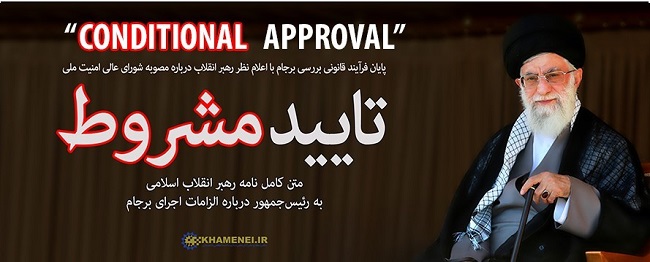
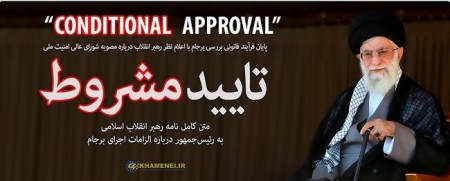
Khamenei’s letter to Rohani with his conditions for the execution of the JCPOA – the publication of which coincided with the days of the Ashura that are of vital religious and national significance in Iran and symbolize steadfastness against the forces of evil – was explicitly termed “conditional approval.” It was labeled thus in red letters, as posted on Khamenei’s website in Persian, tweeted from his Twitter account and posted on his Facebook page in English, and also published in English by the official Islamic Republic of Iran Broadcasting authority IRIB.
25565

But instead of reporting that at this stage, and at present, Khamenei’s approval is not given unless Khamenei’s conditions are met, the American media said that Khamenei had approved the JCPOA. Would these members of the media also consider a purchase concluded if they had not paid for it? The entire American media, without exception, left, right, and center – as well as, apparently, all the U.S. intelligence agencies and think tanks – claimed that Khamenei had approved the agreement. Only two newspapers in the West wondered about the emperor’s new clothes – but even they did not shout “But he hasn’t any clothes on at all!” They said only that he was missing a couple of accessories.

Khamenei had spoken, banning outright any implementation of the JCPOA by Iran until his new conditions are met. The entire Iranian political system is hewing to this line – including President Rohani, Foreign Minister Zarif, Majlis Speaker Larijani, a majority of Majlis members (166), and more (for a full list to date, see Appendix I).

Everyone, that is, except for Ali Akbar Hashemi Rafsanjani, Khamenei’s political rival and head of Iran’s pragmatic camp, who in an interview published this week by MEMRI openly challenged Khamenei and said that Iran should abide by what it undertook in the JCPOA.[10]

But this cannot happen. Khamenei holds the reins.

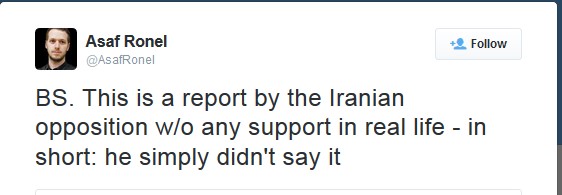
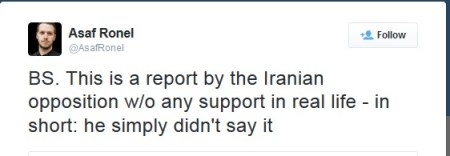
Did the media report on Rafsanjani’s interview? No! But the media in Iran did (see Appendix II). This, however, did not stop the editor of the Israeli daily Haaretz from writing that the interview was faked.
25566

This is a well-known human reaction: When people stand before the complete collapse of what they believe in, they enter a state of denial.

So What Now?

And what is President Obama to do, as everything he has stood for in the Iran deal collapses so ignominiously? On the right, they say he will continue to capitulate. In their ignorance, and in their hatred of him, they fail to realize that he can simply surrender no farther. OK, they say, so the IAEA will provide Obama with the necessary confirmation by December 15 that the Iranians have done their part. But that is impossible as well. What is demanded of Iran is gargantuan in scale, and it would be far more difficult for the IAEA to fake confirmation when the Iranians themselves are declaring loudly that they are not going to do it.

With every passing day, Iran is more and more in violation of the JCPOA. But neither the Republicans nor the Democrats, nor the media, nor anyone else will acknowledge this, for the implications are too devastating. The agreement is no longer in effect. Its clock has stopped.

But the weeks will pass, and the media and politicians will be forced to admit that this is the case. And the last thing they will be willing to do is to force Iran to meet its obligations. Thus, it appears that President Obama’s only option, shameful as it is, is to restart the negotiations with the Iranians and talk with them about their leaders’ new conditions. As is well-known, this administration advocates diplomacy – guaranteeing that there will be no breakthrough any time soon.

This is precisely what will serve President Obama best. All he needs to do is play for time and reach the end of his term with an agreement in hand – albeit virtual – and negotiations in progress – albeit unending. He will pass this situation on to the next administration. The success will be all his, and the failure will be all theirs. The media will zealously guard Obama’s legacy, and his successor, Republican or Democrat, will be too uninformed to protect him or herself from this historic maneuver. And it will serve them right.

Appendix I: Senior Iranian Officials Declare Their Acceptance Of Khamenei’s Instructions On Implementing The JCPOA

On October 10, 2015, Majlis Speaker Ali Larijani  said at a conference on war and peace in Syria: “…The commands of the leader [Khamenei], the decision of the Majlis and the Supreme National Security Council will illuminate the government representatives’ path on implementing the JCPOA… I thank the leader with all my heart.”[11]

President Rohani, responding to the directives letter by the Supreme Leader on carrying out the JCPOA (October 22, 2015): “Your historic letter of October 21, 2015 regarding the approval of decision number 634 of the Supreme National Security Council caused joy within the great Iranian people and warmed the hearts of the public servants in government… The government will obey your criticisms and obligations [that you imposed] and with good intentions will take measures relating to the full implementation of the Supreme National Security Council and the Majlis. We will be fully alert to the performance of the other side’s obligations and in the Supreme National Security Council we will take the necessary decisions to provide a fitting response.”[12]

On October 26, 2015, Foreign Minister Zarif referred in the Majlis to the supreme leader’s letter on carrying out the JCPOA and noted: “I am grateful to the leader for his path-illuminating letter on setting policy in the JCPOA’s implementation. His opinion always lighted the path to the nuclear negotiations team at the foreign ministry. Henceforward, we must make an effort to implement the JCPOA documents in the right way and following the leader’s guidelines.”[13]

On October 27, 2015, Zarif said that the modifications to the nuclear reactor in Arak must be performed after the PMD file has been closed at the IAEA and explained: “we calculated the details of re-planning the reactor following the leader’s guidelines, the decision of the Supreme National Security Council and the Majlis… We will coordinate everything necessary for swapping the uranium stockpiles and this matter will be performed precisely in the way that the leader elaborated and was previously agreed at the Supreme National Security Council and the Majlis nuclear committee.”[14]

In the Majlis, 166 members, constituting a majority, expressed on October 26, 2015 their admiration for the leader for his historic letter in implementing the JCPOA. The letter’s contents read “… For a certainty, the Majlis representatives will act as your stout arms and collaborate with all the supervisory organizations and with the Supreme National Security Council and invest efforts to ensure that after the JCPOA, the enemy will not be able to penetrate our Islamic country even minutely and we will supervise that all violation of promises by the 5+1 group will not remain unanswered.”[15]

Iran’s Judiciary Chief Sadeq Amoli Larijani at an October 26, 2015 conference of senior judicial branch officials said that the letter of conditions that Khamenei published on JCPOA implementation should put an end to debates on the issue. He added: “All groups [within Iran] should treat the leader’s letter as ‘self-explanatory’ and as the axis of unity and from now no they will make progress and think moderately about the future and the next stages of the JCPOA.”[16]

The leader’s representative in the Islamic Revolutionary Guard Corps (IRGC) Ali Saidi said on Wednesday, October 21, 2015: “… The leader is effectively managing the country according to the Koran and custom, the leader sets policy and the others execute it.”[17]

At an October 27, 2015 press conference, the leader’s advisor and the head of the Center for Strategic ResearchAli Akbar Velayati, said: “In the last letter we saw that he criticized the defects and shortcomings in carrying out the JCPOA. I hope that the agreement will be carried out flawlessly in the future. The continued support of the leader for the JCPOA is contingent on the response to the letter that Khamenei wrote the president [Rohani].”[18]

The head of the Majlis nuclear committee, Ebrahim Karkhanehei, referring to the leader’s letter on the JCPOA, said: “This letter produced social calm because in addition to leader the people as well demanded the things that were included in the letter. The most important issue in the letter is the issue of lifting sanctions and the government must seriously handle the matter of lifting the sanctions. In addition to the letter, the leader emphasized many times that if the sanctions are not lifted then there will be no agreement and therefore the US and the EU must fully lift the sanctions.

“The letter from the EU and the American president are not considered a [sufficiently] strong guarantee on the lifting of the sanctions. The Majlis will not be negligent about any clause in the leader’s letter and the government must seriously oversee and handle the sanctions-lifting issue.

“The leader demanded that a professional and  wise team should supervise the sound implementation of the JCPOA and therefore this team must be comprised of at least five people specializing in the legal, nuclear technical political, economic and the sanctions structure issues as well as an expert on security and defense matters.”[19]

An October 25, 2015 Kayhan editorial titled “Giving Interpretations Is Impermissible” wrote: “The leader’s order and the setting of numerous terms for the JCPOA’s implementation is self-explanatory and elaborated a clear path for all arguments and worries, according to religious jurisprudence, the law and the professional perspective. It is obligatory and essential to obey it.. as opposed to some of the impressions, the leader approved the JCPOA’s implementation only following obedience to the terms that may not be damaged and on principle, the leader did not express general approval on the matter.”[20]

Appendix II: Iranian Websites Covering Rafsanjani’s Interview In Inhnews.ir

*IRNA

*ILNA

*Hashemirafsanjani.ir.fa

*Etemaad

*ISNA

*Fars

*Tnews.ir

*Shomaokhabar

*Farsi-news

*Shafaf.ir

*Y. Carmon is president and founder of MEMRI.

Endnotes:

[1] For the complete text of the JCPOA see Eeas.europa.eu/statements-eeas/docs/iran_agreement/iran_joint-comprehensive-plan-of-action_en.pdf

[2] See MEMRI Special Dispatch No. 6151, Khamenei Declares That He Will Not Honor The Agreement If Sanctions Are Merely Suspended And Not Lifted, September 4, 2015; and MEMRI TV Clip #5067 – Iranian Supreme Leader Ali Khamenei: The Americans Must Lift the Sanctions, Not Suspend Them, September 3, 2015.

[3] Unscr.com/en/resolutions/doc/2231.

[4] See MEMRI TV Clip #5114 – Iranian Guardian Council Secretary-General Ahmad Jannati: Khamenei Has Not Approved or Signed the JCPOA, October 16, 2015; and MEMRI TV Clip #5117 – Iranian Guardian Council Spokesman Nejatollah Ebrahimian: The JCPOA Was Not Approved by the Majlis or the Guardian Council, October 18, 2015.

[5] Tasnim (Iran), October 18, 2015.

[6] http://www.armscontrol.org/blog/ArmsControlNow/2015-10-15/The-P5-1-and-Iran-Nuclear-Deal-Alert-October-15

[7] ISNA (Iran), October 18, 2015.

[8] On Khamenei’s nine demands, see MEMRI Inquiry & Analysis No. 1196, Iranian Supreme Leader Khamenei’s Letter Of Guidelines To President Rohani On JCPOA Sets Nine Conditions Nullifying Original Agreement Announced July 14, 2015, October 22, 2015.

[9] See MEMRI Special Dispatch No.  6151, Khamenei Declares That He Will Not Honor The Agreement If Sanctions Are Merely Suspended And Not Lifted , September 4, 2015.

[10] MEMRI Special Report No.43, Breaking Report: Challenging Khamenei, Rafsanjani Demands That Iran Fulfill Its Obligations Under The JCPOA, And Reveals: We Had Nuclear Option In Iran-Iraq War, October 28, 2015.

[11] Mehrnews.com, October 23, 2015.

[12] President.ir/fa/90172

[13] Isna (Iran), October 26, 2015.

[14] Isna (Iran), October 27, 2015.

[15] Mehrnews.com, October 26, 2015.

[16] Nasimonline.(Iran), October 26, 2015.

[17] Snn.(Iran), October 22, 2015.

[18] Isna (Iran), October 27, 2015.

[19] Mehrnews.com, October 26, 2015.

[20] Kayhan (Iran), October 25, 2015.
Escalation of child execution in Iran

October 26, 2015

Escalation of child execution in Iran, Front Page MagazineDr. Majid Rafizadeh, October 26, 2015

(Please see also, Iranian Supreme Leader Khamenei’s Letter Of Guidelines To President Rohani On JCPOA Sets Nine Conditions Nullifying Original Agreement Announced July 14, 2015. According to Supreme Leader Khamenei,

Any sanctions against Iran “at every level and on every pretext,” including terrorism and human rights violations, by any one of the countries participating in the negotiations will “constitute a violation of the JCPOA,” and a reason for Iran to stop executing the agreement. 

He probably need not be concerned.– DM)

photo-by-seysd-shahaboddin-vajedi-wikimedia-commons-iranian-supreme-leader-ayatollah-ali-khamenei-releases-video-propaganda

While Iranian ruling clerics enjoy reaping the economic benefits from the nuclear deal, they also feel triumphant when it comes to the Obama administration’s total disregard of the increasing human rights violations in Iran.

To sustain his nuclear deal, President Obama appears to have made a Faustian bargain with the Iranian leaders: He turns a blind eye to Iran’s sponsorship of terrorism, repressive methods to crack down on social and political freedoms, egregious human rights abuses, while Iran verbally and on the surface, binds itself to the nuclear deal.

This week, Iran’s parliament passed a bill supporting the nuclear deal which was primarily reached between President Obama and the Islamic Republic. Some policy makers were surprised that Iran passed the bill. But why would Iranian leaders not sign a deal that would bring them financial rewards and allow them to be as repressive as they please both domestically and regionally? As I mentioned several weeks ago, it was easy to predict that the Iranian parliament (Majlis) would pass the deal to receive further rewards.

Simultaneously, Iran’s judiciary system has become more emboldened and empowered. This can be seen when they are issuing death sentences at unprecedented levels, particularly for children.  Last week, Iran’s Islamic court executed a juvenile offender on October 13, 2015 in Adelabad Prison, Shiraz. Fatemeh Salbehi, was arrested at the age of 16 because her husband was found dead at home.

She was 16 years old when she was forced into marriage to a man who was thirty. She had never met the man before their marriage.  According to a recent release by the UN Special Rapporteur on the situation of human rights in Iran, Ahmed Shaheed, “These executions are disturbing examples of surging execution rates and questionable fair trial standards in the Islamic Republic of Iran….The Iranian authorities must comply with its international law obligations and put an end to the execution of juvenile offenders once and for all.”

What is intriguing is that Iranian leaders used to take notice when there was an international outcry regarding a human rights or political prisoner case. They used to postpone the case, the execution, or do something to let the global pressure fade away.   But not anymore. In this case, Amnesty International, Amnesty USA, International human rights organizations, and the United Nations’ Office of the High Commissioner for Human Rights pressured the Islamic Republic to refrain from executing Ms. Salbehi and another young man.  But Iran’s answer was implicitly clear: We will execute anyone we like and no one can stop us now.

One must wonder how much the nuclear deal, President Obama’s unwillingness to criticize the Islamic Republic, and President Obama’s actions in legitimizing the Islamic Republic on the global stage have played a role in emboldening and empowering the ruling mullahs and the hardliners rather than influencing them to be more rational and civilized figures.

A week before the execution of Ms. Salbehi, another juvenile was executed. No notice was given to his family or even his attorney. The UN Special Rapporteur on summary executions, Christof Heyns, pointed out, “Let us be clear – these are unlawful killings committed by the State, the equivalent of murders performed by individuals…. These are profound tragedies that demean the value of human life and sully the reputation of the country,” He added “Iran must immediately stop killing children,”

More than 1,000 people will be executed in the year 2015. There has been a surprising rise in the number of executions since Iran scored a victory by signing the nuclear deal. Ms. Salbehi was one of the hundreds of women being executed on a regular basis based on Iran’s Shiite Islamist laws and on gender discrimination. These women are not allowed due process or adequate access to a lawyer. As the Office of the High Commissioner for Human Rights (OHCHR) warned when Ms. Salbehi was hanged on Tuesday, the execution was “in breach of international law banning juvenile executions, and despite reported flaws in her trial and appeal process.”

Finally, It is crucial to point put that we are only hearing about a few cases of human rights violations; only a few of these shocking human rights abuses make their way to the international spotlight. As an Iranian human rights activist and lawyer, Shadi, told me on a phone call from Tehran, “Just step in the Islamic courts and you will see that there are tens of thousands of these cases, particularly regarding innocent women, which the media never hear about.”

Achieving his dream of signing a nuclear deal with Iran should not make President Obama silent about human rights violations, the ever increasing rate of child executions, and ongoing crimes against humanity.

Madam Hillary is on the right side of herstory

October 25, 2015

Madam Hillary is on the right side of herstory, Dan Miller’s Blog, October 25, 2015

(The views expressed in this article are mine, and do not necessarily reflect those of Warsclerotic or its other editors.– DM)


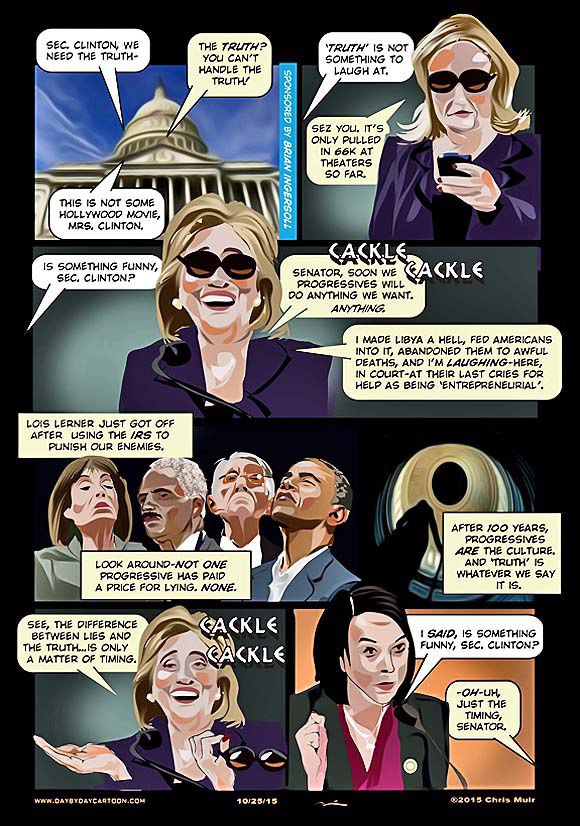
Lies are good and truth is bad because truth would damage Madam Hillary’s and even Imam Obama’s sterling images. Both, bravely and proudly, try to feed us what is “good.” Their people love it, so what difference does it make? 

1025151 (1)

According to John Hinderaker at Power Line, Madam Hillary

lies…it’s not exactly a news flash. On the contrary, based on the liberal media’s reaction to her Benghazi testimony, her willingness to lie, brazenly, is a positive virtue.

There’s always an excuse for having “misspoke.” It need not be a credible excuse, because an incredible excuse works just fine. Anyway, whatever happened was in the past and therefore doesn’t matter now:

What has Imam Obama lied about? Plenty. Here’s an incomplete list: Islam, the nuke “deal” with Iran, Libya, His strength and Putin’s weakness in the Middle East, Israel, Immigration, Crime, Obamacare, race relations and on and on and on. As with Madam Hillary’s spewings, the “legitimate media” generally love it.

Madam Hillary blamed the video repeatedly

According to an article titled “I didn’t blame the video,” Madam Hillary did just that while also managing to lie about substantially more than that.

Hillary simply adores arguing and lawyering.

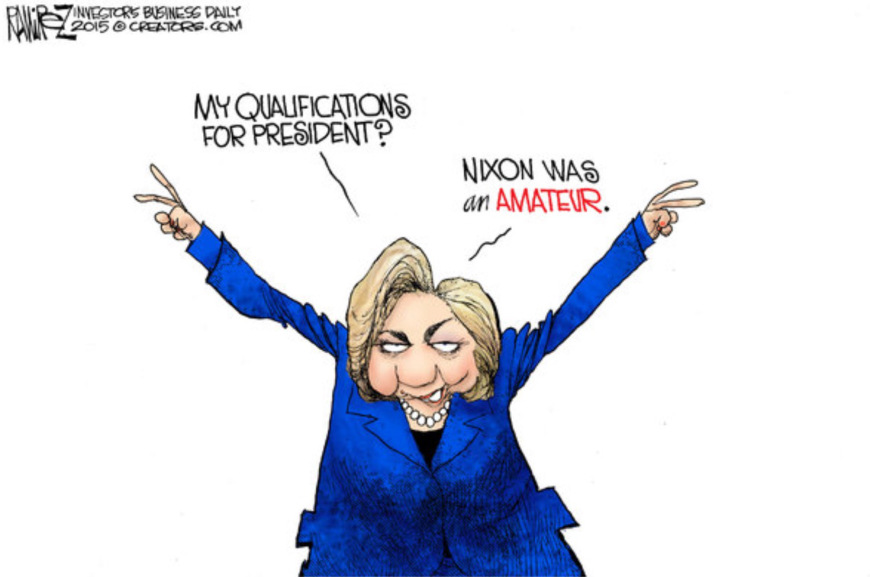
She lives for it and has at least since she was fired from the House Judiciary Committee during its investigation of the Watergate scandal that eventually brought down President Richard M. Nixon in 1974. Hillary’s then-supervisor, lifelong Democrat Jerry Zeifman, said he canned the 27-year-old attorney “because she was a liar … an unethical, dishonest lawyer. She conspired to violate the Constitution, the rules of the House, the rules of the committee and the rules of confidentiality.” [Emphasis added.]

No lie is too big or too small for Hillary, whether it’s a concocted tale of being under enemy fire at an airport in Bosnia, the existence of a “vast right-wing conspiracy” to undermine her husband’s presidency, that she was named after Mt. Everest climber Sir Edmund Hillary even though he rocketed to fame by accomplishing the feat when she was a six-year-old, or that the Clintons were “dead broke” when they exited the White House.

Meanwhile, at the Thursday hearing, Rep. Jim Jordan (R-Ohio) demolished Clinton’s apparently fresh assertion at the hearing that she didn’t actually claim an obscure anti-Islam movie trailer posted on YouTube prompted the terrorist assault in Benghazi on the eleventh anniversary of the 9/11 attacks. She now takes a more nuanced, twisted-like-a-pretzel position in which maybe some non-terrorist Muslims were suddenly stirred to violence in Libya by the video, but really at the same time it was a terrorist attack, something she testified Thursday has been her position the whole time. She talked about the video publicly not to point fingers but as a warning, she testified, to those who might attack U.S. interests in the region. In other words, like a good defense lawyer, Hillary was trying to confuse the issues and muddy the waters. [Emphasis added.]

. . . .

While she was informing the American public that the anti-Islam video was what caused the attack, at the same time she emailed her daughter Chelsea and the governments of Libya and Egypt to pin the blame on Muslim militants, Jordan explained. Around the same time the White House, in the closing weeks of a heated presidential election campaign, was pushing the line that what transpired in Benghazi was a spontaneous demonstration turned violent, but terrorism was not a factor.

“We know that the attack in Libya had nothing to do with the film,” Clinton wrote Egypt’s prime minister the night of the attack. “It was a planned attack, not a protest.” But in public Clinton continued to blame the “offensive” video. The U.S. government acquired $80,000 worth of commercial airtime in Pakistan to apologize for the YouTube clip. [Emphasis added]

Jordan pointed out that there was no video-inspired protest over in Benghazi on Sept. 11, 2012, but there was one in Cairo, Egypt. The same day State Department spokeswoman Victoria Nuland said “Benghazi has been attacked by militants. In Cairo, police have removed demonstrators.”

You want to talk about Madam Hillary’s lies? She didn’t lie, of course, but let’s change the subject to something more important. Right now.

hillary-Nixon-copy


Conclusions

“Her people” not only don’t care, they are delighted with Madam Hillary’s numerous lies. Again, “what difference does it make?” Plenty.

Please think about Madam Hillary’s and Imam Obama’s impunity — and readiness —  to lie, violate laws and do pretty much whatever they please. We have become a nation without law enforcement where we need it most and very much where enforcement of Obama’s executive decrees harms us greatly (climate change and immigration for example). Do we want a nation the governance of which is increasingly based on, and perpetuated through, lies to “We the people?” Do we want Madam Hillary or another Obama clone as the next Commander in Chief?

Here’s what “Commander in Chief” Obama has done with his our military:

Do you approve of those and the other things He has done to our military? Want more of the same? Or even worse? If not, what can we do about it? Supporting Donald Trump may or may not be what we should do, but I think the songs in the video are superb. Back in September, I wrote an article titled To bring America back we need to break some stuff. We still do, and if someone other than Trump is ready, willing and able he (or, of course, she) should also be considered, very seriously.;

Iranian Supreme Leader Khamenei’s Letter Of Guidelines To President Rohani On JCPOA Sets Nine Conditions Nullifying Original Agreement Announced July 14, 2015

October 23, 2015

Iranian Supreme Leader Khamenei’s Letter Of Guidelines To President Rohani On JCPOA Sets Nine Conditions Nullifying Original Agreement Announced July 14, 2015, Middle East Media Research Foundation, Y. Carmon and A. Savyon, October 22, 2015

(Please pay particular attention to Conditions 1 – 6 and their implications as noted by MEMRI. The conditions appear to be quite substantial. Additional material, including Twitter and Facebook messages, is also provided in appendices at the end of the article. I have not reproduced that material here.– DM)

On October 21, 2015, Iranian Supreme Leader Ali Khamenei published a letter of guidelines to Iranian President Hassan Rohani on the execution of the Joint Comprehensive Plan of Action (JCPOA). The letter’s publication coincides with the days of the Ashura that are of vital religious and national significance in Iran and symbolize steadfastness against the forces of evil. Intended as an historical document aimed at assuring Iran’s future, the letter was posted on Khamenei’s website in Persian and tweeted from his Twitter account and posted on his Facebook page in English (see Appendices), and published in English by the official Islamic Republic of Iran Broadcasting authority IRIB (see below). The letter is now a founding document in all things concerning theJCPOA and the conditions under which Iran will be willing to execute it.

The letter, defined by Khamenei on his website as “conditional approval” of the JCPOA, sets several new conditions for Iran’s execution of the agreement. These conditions constitute late and unilateral additions to the agreement concluded three months previously that fundamentally change it. Khamenei stresses that the agreement awaits his opinion following what he calls “precise and responsible examination” in the Majlis and “clearance of this agreement through legal channels” in Iran’s Supreme National Security Council.  

25366

It should be further noted that in his introduction to the new conditions, Khamenei attacks the U.S. and President Obama with great hostility, and calls for Obama to be prosecuted by international judiciary institutions. He states that Obama had sent him two letters declaring that he has no intention of subverting the regime of the Islamic Republic of Iran, but adds that the U.S.’s support for fitna in Iran (i.e. the popular post-election unrest in 2009), its monetary aid to opponents of the Republic, and its explicit threats to attack Iran have proven the opposite and have exposed the real intent of America’s leaders, whose enmity towards Iran will not end. He wrote that the Americans’ behavior in the nuclear talks is another link in the chain of its enmity towards Iran, that America entered into the talks with the aim of “deception,” and that therefore Iran must remain alert in light of America’s hostile intentions.

The set of conditions laid out by Khamenei creates a situation in which not only does the Iranian side refrain from approving the JCPOA,[1] but, with nearly every point, creates a separate obstacle, such that executing the agreement is not possible.

The following are Khamenei’s nine conditions, and their implications:

Khamenei’s Conditions For Iranian Execution Of The JCPOA

First condition: Khamenei demands that the U.S. and Europe lift the sanctions, not suspend them, and in addition demands “solid and sufficient” guarantees in advance that this will be done, before Iran takes its own steps and meets its own obligations under the agreement. These guarantees, insists Khamenei, must include, inter alia, an official letter from the U.S. president and from the EU undertaking to fully lift the sanctions. Furthermore, he demands that this letter will state that any declaration by the West that the “structure of the sanctions will remain in force” (i.e. allowing snapback) will be considered “non-compliance with the JCPOA” on the part of the West.

Implications: These conditions constitute a total change of the JCPOA. Khamenei is not allowing any execution of the JCPOA by Iran until this is accepted in writing by the other side, and thus he is nullifying the JCPOA as agreed upon on July 14, 2015.

Second condition: Any sanctions against Iran “at every level and on every pretext,” including terrorism and human rights violations, by any one of the countries participating in the negotiations will “constitute a violation of the JCPOA,” and a reason for Iran to stop executing the agreement.

Implications: This demand, that links the JCPOA to other issues and prohibits any punishment of Iran on any issue and for any reason, serves as an excuse for Iran to cancel the agreement.

Third condition: Under the JCPOA, Iran is obligated, following the JCPOA’s Adoption Day, to carry out its obligations concerning changing the function of the nuclear reactor at Arak and shipping out most of its stockpile of enriched uranium. Contrary to this, Khamenei is changing the timetable of the JCPOA, stating that Iran will not carry out these actions until after the International Atomic Energy Agency (IAEA) declares that it is closing its dossier on Iran’s “past and future issues (including the so-called Possible Military Dimensions or PMD of Iran’s nuclear program).”

Implications: This demand to change the timetable creates a situation in which Iran will not take action as stipulated in the JCPOA, and will not meet its obligations, before the sanctions are eased, also according to the JCPOA, but instead dictates that the sanctions must first be lifted completely and states that only then will Iran meet its obligations. Khamenei here is creating a situation in which the IAEA will not be able to report on Iran’s meeting of its obligations regarding the Arak reactor and regarding the shipping out of its enriched uranium by the target date of December 15, 2015, because Iran is not going to do so by then – thus the execution of the agreement is thwarted from the beginning.

Fourth condition: Iran will meet its obligations to “renovate” and change the purpose of the Arak reactor only after there is a signed agreement on an “alternative plan” for changes to the reactor, and after there is “sufficient guarantee” that this alternative plan will be implemented.

Implications: Iran’s fulfillment of its obligations regarding the Arak reactor, as stipulated by the JCPOA, will be postponed until some unknown future date.

Fifth condition: Iran will carry out its obligation to ship out its enriched uranium to another country in exchange for yellowcake “on a gradual basis and on numerous occasions,” and only after “a secure agreement has been clinched to that effect, along with sufficient guarantees” that this exchange will be implemented.

Implications: The date for Iran to ship out its enriched uranium as stipulated by the JCPOA is postponed until some unknown future date. Khamenei is demanding that Iran receive in exchange for the enriched uranium not raw uranium as per the JCPOA, but instead uranium that has been enriched, albeit to a lower level than the uranium it ships out. This is yet another change to the JCPOA as concluded on July 14, 2015.

Sixth condition: Khamenei instructs President Rohani to begin, along with reducing Iran’s ability to enrich uranium under the JCPOA, immediately to expand Iran’s ability to enrich uranium with a 15-year long-term plan for 190,000 centrifuge SWU (Separative Work Units). “This plan,” he says, “must allay any concern stemming from some points entailed in the JCPOA appendices.”

Implications: This article nullifies the declared goal of the JCPOA, which is to reduce Iran’s nuclear enrichment capabilities.

Seventh condition: The Iranian Atomic Energy Organization must ensure continued nuclear research and development, in its various dimensions, such that in eight years’ time, Iran will not be lacking in enrichment technology. This, he says, is all in accordance with the JCPOA.

Eighth condition: In the event of doubt or ambiguity regarding the content of the JCPOA, the source of authority for removing this doubt or ambiguity will be the content of the talks – i.e. it will also include the statements by the Iranian side, not just the “interpretation provided by the opposite party,” that is, the P5+1.

Implications: Any doubt or ambiguity regarding the content of the JCPOA will become the source of unending dispute and will paralyze any possibility of executing the agreement.

Ninth condition: Due to apprehensions that the other side, particularly the U.S., will break its promises or cheat, President Rohani must establish a “well-informed and smart panel” to monitor the execution of the agreement.

Implications: Khamenei is creating an administrative framework for perpetual delays in the execution of the agreement.

Khamenei adds also a 10th condition, directed at Iran, not the P5+1, demanding that Rohani take seriously his instructions in the matter of the “resistance economy,” the main thrust of which is self-reliance instead of basing Iran’s economy on external sources. He also demands that after the sanctions are lifted, there will be no “unbridled imports,” and no imports whatsoever from the U.S.

Political Ramifications In Iran

In February 2016, elections for the Majlis and the Assembly of Experts are set to take place in Iran. The pragmatic camp, headed by Hashemi Rafsanjani and President Rohani, had hoped that a quick execution of the agreement would allow the sanctions to be eased and funds to be released immediately, which in turn would allow the pragmatic camp to present these achievements and triumph in the elections. By setting these conditions, however, Khamenei has thwarted any speedy execution of the agreement, and thus has thwarted the pragmatic camp’s hope for electoral success.

IRIB Translation

The following is the official English translation of Khamenei’s letter, as published by IRIB.[2] This translation was tweeted by Khamenei and also posted on his Facebook page (see Appendix I and II).

“Wednesday, 21 October 2015 17:41
“Ayatollah Khamenei sends a letter to President Hassan Rouhani about the JCPOA

25367

“Ayatollah Seyyed Ali Khamenei, the Leader of the Islamic Revolution, in a letter to President Hassan Rouhani, who also heads the Supreme National Security Council (SNSC), referred to the precise and responsible examination of the Joint Comprehensive Plan of Action (JCPOA) in the Islamic Consultative Assembly (parliament) and also the SNSC, and the clearance of this agreement through legal channels, and issued important instructions regarding the observation of and safeguarding the country’s national interests. Enumerating nine-point requirements for the implementation of the JCPOA, Ayatollah Ali Khamenei endorsed SNSC Resolution 634, dated August 10, 2015, provided that the following provisions and requirements are observed.

“The full text of Ayatollah Khamenei’s letter follows on:

In the Name of Allah, the Most Compassionate, the Most Merciful

“Your Excellency,  Mr Rouhani,
“President of the Islamic Republic of Iran and Head of the Supreme National Security Council
“May God bestow success upon you.
“Greetings to You

“The agreement known as the Joint Comprehensive Plan of Action (JCPOA) has already been cleared through legal channels following precise and responsible examinations in the Islamic Consultative Assembly, [parliamentary] ad hoc committees and other committees as well as the Supreme National Security Council. Since the agreement is waiting for my view, I deem it necessary to remind several points so that Your Excellency and other officials directly or indirectly involved in the issue would have enough time to comply with and safeguard national interests and the country’s best interests.

“1. Before anything else, I deem it necessary to extend my gratitude to all those involved in this challenging procedure throughout all its periods, including the recent nuclear negotiating team whose members tried their best in explaining the positive points and incorporating all those points [into the agreement], critics who reminded all of us of weak points through their appreciable meticulousness, and particularly the chairman and members of the Majlis ad hoc committee [set up to review the JCPOA] as well as the senior members of the SNSC who covered some voids by including their important considerations, and finally the Speaker of Majlis and Members of Parliament who adopted a cautious bill to show the right way of implementation [of the agreement] to the administration, and also national media and the country’s journalists who despite all their differences of view presented a complete image of this agreement to public opinion. This voluminous collection of activity and endeavors and thoughts [spent] on an issue which is thought to be among the unforgettable and instructive issues of the Islamic Republic, deserves appreciation and is a source of satisfaction. Therefore, one can say with certainty that the divine reward for these responsible contributions will, God willing, include assistance and mercy and guidance by Almighty God because the divine promises of assistance in exchange for assisting His religion are unbreakable.

“2. Enjoying decades-long background of presence in the very details of the affairs of the Islamic Republic of Iran, you must have naturally realized that the government of the United States of America, neither in the nuclear issue nor in any other issue, had been pursuing no other approach but hostility and disturbance, and is unlikely to do otherwise in the future either. The remarks by the US President [Barack Obama] in two letters addressed to me on the point that [Washington] has no intention of subverting the Islamic Republic of Iran turned out to be unreal and his open threats of military and even nuclear strike, which can result in a lengthy indictment against him in international courts, laid bare the real intentions of US leaders. Political pundits and public opinion of many nations clearly understand that the case of his never-ending hostility is the nature and identity of the Islamic Republic of Iran, which is born out of the Islamic Revolution. Insistence on rightful Islamic stances and opposition to the hegemonic and arrogant system, perseverance against excessive demands and encroachment upon oppressed nations, revelations on the US support for medieval dictators and suppression of independent nations, incessant defense for the Palestinian nation and patriotic resistance groups, rational and globally popular yelling at the usurping Zionist regime constitute the main items which make the US regime’s enmity against the Islamic Republic inevitable, and this enmity will continue as long as the Islamic Republic [continues to] disappoint them with its internal and sustainable strength.

“The behavior and words of the US government in the nuclear issue and its prolonged and boring negotiations showed that this (nuclear issue) was also another link in their chain of hostile enmity with the Islamic Republic. Their deception through flip-flopping between their initial remarks that came after Iran accepted to hold direct talks with them and their constant non-compliance with their pledges throughout two-year-long negotiations and their alignment with the demands of the Zionist regime and their bullying diplomacy regarding relations with European governments and bodies involved in the negotiations are all indicative of the fact that the US’s deceitful involvement in the nuclear negotiations has been done not with the intention of a fair settlement [of the case], but with the ill intention of pushing ahead with its hostile objectives about the Islamic Republic.

“Doubtlessly, vigilance vis-à-vis the hostile intentions of the US government and instances of resistance on the part of the officials of the Islamic Republic of Iran throughout the negotiations managed, in numerous cases, to prevent heavy damage from being inflicted [upon Iran].

“However, the outcome of the negotiations, which is enshrined in the JCPOA, has numerous ambiguities and structural weaknesses that could inflict big damage on the present and the future of the country in the absence of meticulous and constant monitoring.

“3. The nine-point provisions entailed in the recent bill adopted by the Majlis and the 10-point instructions outlined in the resolution of the Supreme National Security Council carry helpful and effective points which must be taken into consideration. Meantime, there are some other necessary points which are announced here while some of the points mentioned in the two documents are highlighted.

“First, since Iran has accepted to negotiate basically for the objective of removal of unjust economic and financial sanctions and its enforcement (the lifting of sanctions) is tied to Iran’s future actions under the JCPOA, it is necessary that solid and sufficient guarantees be arranged to avoid any infraction by the opposite parties. Written declaration by the US president and the European Union for the lifting of the sanctions is among them. In the statements of the EU and the US president, it must be reiterated that these sanctions will be fully lifted. Any declaration that the structure of the sanctions will remain in force shall imply non-compliance with the JCPOA.

“Second, throughout the eight-year period, any imposition of sanctions at any level and under any pretext (including repetitive and fabricated pretexts of terrorism and human rights) on the part of any of the countries involved in the negotiations will constitute a violation of the JCPOA and the [Iranian] government would be obligated to take the necessary action as per Clause 3 of the Majlis bill and stop its activities committed under the JCPOA .

“Third, the measures related to what is mentioned in the next two clauses will start only after the International Atomic Energy Agency (IAEA) announces [the conclusion of] the past and future issues (including the so-called Possible Military Dimensions or PMD of Iran’s nuclear program).

“Fourth, measures to renovate the Arak plant by preserving its heavy [water] nature will start only after a firm and secure agreement has been signed on an alternative plan, along with sufficient guarantees for its implementation.

“Fifth, the deal with a foreign government for swapping enriched uranium with yellow cake will start only after a secure agreement has been clinched to that effect, along with sufficient guarantees [for its implementation]. The aforesaid deal and exchange must be done on a gradual basis and on numerous occasions.

“Sixth, by virtue of the Majlis bill, the plan and the necessary preparations for mid-term development of the atomic energy industry, which includes the method of advancement in different periods of time for 15 years for the final objective of 190,000 SWU, must be drawn up and carefully reviewed by the Supreme National Security Council. This plan must allay any concern stemming from some points entailed in the JCPOA appendices.

“Seventh, the Atomic Energy Organization of Iran must organize research and development in different aspects such that after the end of the eight-year period, there would be no shortage of technology for the level of [uranium] enrichment entailed in the JCPOA.

“Eighth, it must be noted that on the ambiguous points in the JCPOA document, the interpretation provided by the opposite party is not acceptable and the reference would be the text of the negotiations.

“Ninth, the existence of complications and ambiguities in the text of the JCPOA and the suspicion of breach of promise, infractions and deception by the opposite party, particularly the US, require that a well-informed and smart panel be established to monitor the progress of affairs and [gauge] the opposite party’s commitment and realization of what was mentioned above. The composition and the tasks of this would-be panel should be determined and approved by the Supreme National Security Council.

“In witness whereof, Resolution 634, dated August 10, 2015, of the Supreme National Security Council, is endorsed pending the observation of the aforementioned points.

“In conclusion, as it has been notified in numerous meetings to you and other government officials and also to our dear people in public gatherings, although the lifting of sanctions is a necessary job in order to remove injustice [imposed on people] and regain the rights of the Iranian nation, economic overture and better livelihood and surmounting the current challenges will not be easy unless the Economy of Resistance is taken seriously and followed up on entirely. It is hoped that this objective will be pursued with full seriousness and special attention would be paid to enhancing national production. You should also watch out so that unbridled imports would not follow the lifting of sanctions, and particularly importing any consumer materials from the US must be seriously avoided.

“I pray to Almighty God for your and other contributors’ success.
“Source: www. leader. ir”

__________________

Endnotes:

[2] English.irib.ir/news/leader/item/217470-ayatollah-khamenei-sends-a-letter-to-president-hassan-rouhani-about-the-jcpoa, October 21, 2015.

[3] Twitter.com/khamenei_ir, October 21, 2015.

[4] Facebook.com/www.Khamenei.ir/posts/943612332378368:0, posted October 21, 2015.