Posted tagged ‘Iran sanctions’

Trump picked Tillerson for tough new Iran policy

December 14, 2016

Trump picked Tillerson for tough new Iran policy, DEBKAfile, December 14, 2016

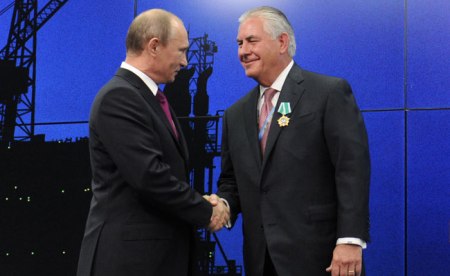
rex-tillerson-putin

Rex Tillerson, Chairman an CEO of Exxon Mobil, was named this week as the next administration’s Secretary of State to execute the tough foreign policies charted by president-elect Donald Trump, including his decision to stiffen the nuclear accord signed with Iran as soon as he moves into the White House on Jan. 20.

DEBKAfile reports this exclusively from New York and its intelligence sources.

While campaigning for the presidency, Trump called the accord “the worst deal” ever.

According to our sources, a special team is already working on revisions of the accord which the US and five other global powers concluded with Iran in 2015 in the hope of retarding Iran’s nuclear weapons program by a decade.

As new president, Trump will issue Tehran with a unilateral demand to accept those revisions as pre-condition for the continuation of relations between the US and Iran. He does not intend consulting America’s co-signers, Russia, China, Germany, Britain and France, or asking them for their endorsement of the revamped accord.

The teams preparing the Trump administration’s Iran policy were put in place last week by Tillerson and designated national security adviser Lt. Gen. Michael Flynn.

No members of the incumbent NSC, State Department, Pentagon or Treasury, who managed the Obama administration’s Iran policy, was invited to take part. The teams were instead chosen from among scientists, military leaders and intelligence officials who opposed the nuclear accord with Iran.

Also attached were former administration officials hired by Exxon for their extensive knowledge of Iran’s oil trade and their close ties with oil circles in the Gulf Emirates, which like Israel, fought hard to pre-empt the nuclear deal with Iran.

Our sources have also learned that if Iran rejects the revised accord, the president elect has a list of new economic sanctions drawn up which are a lot tougher than the sanctions regime imposed by the Bush and Obama administrations.

The incoming president will have a fight on his hands to get the Tillerson appointment through the Senate in the face of objections raised by Republican lawmakers over his ties with Russian President Vladimir Putin. However, Trump hopes to turn those ties to his advantage. He trusts that Tillerson is just the man to sell the new administration’s Iran policies to the Russian president.

Read more about Trump’s plans for his secretary of state in the coming issue of DEBKA Weekly (for subscribers) out on Friday. Dec. 16, 2016.

Iran Threatens to Walk Away From Nuke Deal, Retaliate Against U.S. for New Sanctions

December 2, 2016

Iran Threatens to Walk Away From Nuke Deal, Retaliate Against U.S. for New Sanctions, Washington Free Beacon, December 2, 2016

(The threat is to boycott consumer goods, which commercial aircraft are not. Please see also, Iranian Cleric Urges Retaliation for US Breaches of Nuclear Deal. — DM)

In this picture released by the official website of the office of the Iranian supreme leader, Supreme Leader Ayatollah Ali Khamenei reads a note during his speech in a public gathering at his residence in Tehran, Iran, Wednesday, Jan. 7, 2015. Iran's supreme leader said Wednesday the United States cannot be trusted to lift sanctions in a future nuclear deal and that Tehran should instead develop an "economy of resistance." A portrait of the late revolutionary founder Ayatollah Khomeini hangs in background. (AP Photo/Office of the Iranian Supreme Leader)

Supreme Leader Ayatollah Ali Khamenei (AP Photo/Office of the Iranian Supreme Leader)

Iran is threatening to walk away from the nuclear deal with the United States and pursue forms of retaliation, including a national boycott of American goods, as a result of Congress’s overwhelming vote on Thursday to level new sanctions against Iran for another 10 years, according to multiple comments by senior Iranian officials.

Following the Senate’s 99-0 vote to renew economic sanctions on Tehran, senior Iranian officials said the United States is in violation of last summer’s nuclear deal and that Iran is prepared to retaliate, which could include abandoning the agreement.

The comments come as the Obama administration scrambles to preserve the deal in its final months in office, ahead of the inauguration of President-elect Donald Trump, who has been assembling a cabinet filled with fierce opponents of the accord.

“The Islamic Republic of Iran doesn’t see any necessity to reveal this issue [its reactions] but we have made necessary predictions before, meaning that we are well prepared to show reaction,” Ali Akbar Salehi, the head of Iran’s Atomic Energy Organization, was quoted as saying on Friday in the country’s state-controlled press.

The new sanctions, Salahi said, “explicitly violate the nuclear deal.”

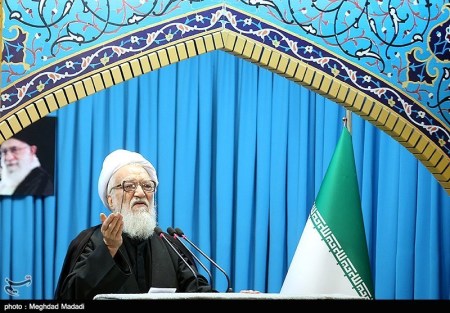
Ayatollah Mohammad Ali Movahedi Kermani hotly criticized the United States during Iran’s weekly national Friday prayer service, urging the country’s leaders to retaliate against America.

“Nothing but hostility is expected from the U.S., but as said before, now it’s time for retaliation,” the cleric was quoted as saying.

Iranian Supreme Leader Ayatollah Ali Khamenei offered similar remarks last month, as the Obama administration was working behind-the-scenes to prevent Congress from pursuing the new sanctions.

“If this extension is implemented and comes into force, it will certainly be a violation of the nuclear deal and they should know that the Islamic Republic of Iran will certainly show reaction,” Khamenei said at the time.

Iran’s Parliament is now taking steps to counter the sanctions by enacting its own national boycott of U.S. goods.

The “double-urgency plan” would ban all U.S. consumer goods from Iran.

“Given the U.S. hostile measure, meaning extension of the Iran Sanctions Act (ISA) for another 10 years, a double-urgency plan to ban purchase of the U.S.-made consumer goods has been prepared in the parliament,” Mohammad Reza Tabesh, a senior Iranian parliament member, was quoted as telling Iran’s state-controlled press on Friday.

The plan is expected to overwhelmingly pass Iran’s Parliament.

Iran’s military is also taking increasingly hostile steps on the heels of the sanctions vote.

The Iranian Revolutionary Guard Corp’s naval faction is increasing patrols outside of Iranian waters in a bid to stop any vessels from coming near the Islamic Republic.

“The Iranian Navy, along with the IRGC Navy, are monitoring all moves by the regional and trans-regional states in the Persian Gulf, the Strait of Hormuz, the Sea of Oman, and the Northern parts of the Indian Ocean, and do not allow any vessel to approach the Islamic Republic of Iran’s borders or inflict damage on our interests and resources,” Rear Admiral Habibollah Sayyari, the commander of Iran’s Navy, said during a Friday speech.

The comments come as Iran makes provocative maneuvers against U.S. forces in the region. Late last month, Iranian vessels pointed an anti-aircraft weapon at U.S. helicopters that were flying nearby in a move the Pentagon described as highly provocative and dangerous.

Iranian Cleric Urges Retaliation for US Breaches of Nuclear Deal

December 2, 2016

Iranian Cleric Urges Retaliation for US Breaches of Nuclear Deal, Tasnim News Agency, December 2, 2016

retaliate-for-sanctions

“We are disgusted by recent moves by the US,” he said, adding that if Washington seeks to tear up the nuclear deal, Iran will set it ablaze as Leader of the Islamic Revolution has said.

*******************************

TEHRAN (Tasnim) – A senior Iranian cleric slammed the US Congress for its recent move to extend sanctions against Iran for another ten years, saying that it is now time for the Islamic Republic to retaliate such violations of the JCPOA, a nuclear deal between Tehran and world powers.

“Nothing is expected from the US except hostility (toward the Iranian nation) and now is the time for retaliation,” Ayatollah Mohammad Ali Movahedi Kermani said in an address to a gathering of Friday prayer worshippers in Tehran.

“We are disgusted by recent moves by the US,” he said, adding that if Washington seeks to tear up the nuclear deal, Iran will set it ablaze as Leader of the Islamic Revolution has said.

The US Senate voted unanimously on Thursday to extend the Iran Sanctions Act (ISA) for another decade.

The ISA will expire on Dec. 31 if not renewed. The White House had not pushed for an extension, but had not raised serious objections.

While the Joint Comprehensive Plan of Action (JCPOA), the nuclear agreement between Iran and the Group 5+1 (Russia, China, the US, Britain, France and Germany) came into force in January, some Iranian officials complain about the US failure to fully implement the accord.

In an address to a gathering of Basij forces in Tehran on November 23, Leader of the Islamic Revolution Ayatollah Seyed Ali Khamenei made it clear that implementation of the bill to extend sanctions on Iran for 10 more years will translate into a breach of the JCPOA.

“If such extension (of anti-Iran sanctions) is implemented and comes into force (in the US), it will be definitely a violation of the JCPOA,” the Leader said at the time.

“They (Americans) should know that the Islamic Republic of Iran will certainly show reaction to it,” Ayatollah Khamenei underlined.

Senate sends Iran sanctions bill to Obama with 99-0 vote

December 1, 2016

Senate sends Iran sanctions bill to Obama with 99-0 vote, Washington ExaminerSusan Crabtree, December 1, 2016

mcconnelSenate Majority Leader Mitch McConnell, R-Ky., said Thursday that the bill, which would preserve existing sanctions set to expire at the end of the year, is critical given Iran’s “continued pattern of aggression” and “efforts to expand its sphere of influence across the region.” (Graeme Jennings/Examiner)

The Obama administration has opposed the legislation, arguing that it already has the power to extend or impose additional sanctions on Tehran and the sanctions are no longer necessary after the nuclear deal.

********************

The Senate unanimously passed legislation Thursday that would extend sanctions on Iran for 10 years, a move many supported as a way to ensure the U.S. maintains its leverage over Iran in light of questions about its implementation of the Iran nuclear agreement.

The 99-0 Senate vote sends it along to the president’s desk for his signature. The vote came after the House overwhelmingly approved the measure, known as the Iran Sanctions Extension Act, two weeks ago in a 419-1 vote.

Senate Majority Leader Mitch McConnell, R-Ky., said Thursday that the bill, which would preserve existing sanctions set to expire at the end of the year, is critical given Iran’s “continued pattern of aggression” and “efforts to expand its sphere of influence across the region.”

“This is even more important given how the current administration has been held hostage by Tehran’s threats to withdraw from the nuclear agreement, and how it has ignored Iran’s overall efforts to upset the balance of power in the greater Middle East,” he said.

Under the nuclear agreement between Iran, the United States and five other world powers, many sanctions were lifted or eased in exchange for Iran’s agreement to roll back its nuclear program and an inspections regime to try to enforce it. The Obama administration and supporters of the deal insisted that sanctions could easily “snap back” if Iran was found to have violated the terms of the deal.

But critics argued that sanctions, once lifted, could not easily be re-imposed because foreign investors previously barred from doing business with Tehran before the nuclear pact couldn’t easily cancel contracts and abandon their financial ties to the country.

The U.S. sanctions, which Congress first passed in 1996, target any outside investments in Iran’s energy sector to prevent Tehran from developing nuclear weapons, and would have expired at the end of 2016 if Congress hadn’t acted.

In the months since the nuclear deal went into effect, Iran has complained that these non-nuclear related sanctions are preventing businesses from investing in the country, particularly the prohibition on Iranian access to the U.S. financial system. Tehran argues that the strict limits are preventing many companies from engaging in new business deals in Iran, in effect, subverting the economic benefits it expected the nuclear deal to produce.

Critics, however, countered that Iran is still suffering because foreign businesses are nervous about violating the new rules and risking U.S. sanctions on them and are reluctant to contribute to revenue to a top state sponsor of terrorist activity.

The Obama administration has opposed the legislation, arguing that it already has the power to extend or impose additional sanctions on Tehran and the sanctions are no longer necessary after the nuclear deal.

Members of Congress, including key Democrats, are adamant that the existing sanctions remain in effect in order to demonstrate to Iran that the U.S. will respond to any provocations or violations of the nuclear agreement.

In Contrast To Rohani Allegations In UNGA, Senior Iranian Officials Confirm U.S. Has Met Its Obligations Under JCPOA

September 24, 2016

In Contrast To Rohani Allegations In UNGA, Senior Iranian Officials Confirm U.S. Has Met Its Obligations Under JCPOA, MEMRI,  Y. Carmon and A. Savyon* September 23, 2016

Introduction

In his September 22, 2016 speech at the UN General Assembly, Iranian President Hassan Rohani accused that the U.S. is not meeting its obligations towards Iran under the JCPOA. He said: “The lack of compliance with the deal on the part of the United States in the past several months represents a flawed approach that should be rectified forthwith… Any failure on the part of the United States in implementing it (the deal) would constitute an international wrongful act and would be objected to by the international community.”[1] 
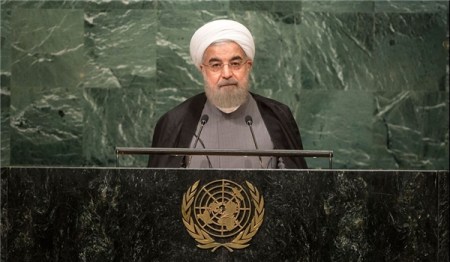
30061Rohani at the UNGA (Image: Farsnews.com, September 22, 2016)

Rohani’s statements, which are part of an Iranian attempt in recent weeks to create a false impression that the U.S. has not met its obligations towards Iran, are in stark contradiction to statements made by senior members of the Iranian negotiation team who explicitly admitted that the U.S. has in fact met its obligations under the JCPOA (see below).

This Iranian measure is a response to the refusal of Western banks to conduct transactions with Iran in dollars, despite the lifting of the nuclear sanctions in January 2016, because the initial sanctions imposed on Iran by Congress for human rights violations and for terrorism are still in force. As will be recalled, Iran refuses to negotiate with the West on issues of terrorism, on the grounds that these issues are internal sovereign matters.

Below is a MEMRI report on this issue published on August 15, 2016.

As the first year of the JCPOA is marked, and in light of Western banks’ rejection of Iranian transactions in dollars, Iranian Supreme Leader Ali Khamenei and his supporters in the West have launched a campaign to pressure the U.S. to lift the initial sanctions imposed on Iran by Congress for human rights violations and for terrorism. Their aim is to have these sanctions lifted without negotiations and without giving anything in return.

As will be recalled, Iran from the outset restricted the framework of the negotiations to the nuclear issue, and refused to allow them to include other issues such as human rights, terrorism, or missiles, which it considers internal sovereign matters. Therefore, the initial American sanctions concerning these areas remain in force.

A demand for lifting of all the sanctions, including the initial ones, was made by Supreme Leader Ali Khamenei in the months after the JCPOA was achieved in July 2015.[2] Perhaps Tehran thought that with the lifting of the nuclear sanctions, the entire sanctions regime would collapse, including those concerning human rights, terrorism, and missiles. But this did not happen. The U.S. Treasury Department is following the letter and the spirit of U.S. law, and is warning banks worldwide that the initial sanctions remain in force.[3]

In light of this situation, Iran and the supporters of its regime in the West are now working to create a false impression that the U.S. has not met its obligations towards Iran. They claim that, in order to fulfill its commitments towards Iran in the JCPOA, the U.S. is obligated to revoke or circumvent the initial sanctions imposed on Iran by Congress, which currently prevent banks from dealing freely with Iran.  For example, Tyler Cullis, member of the Iranian lobby in the U.S., the National Iranian American Council (NIAC), stated in a recent policy paper that “the United States is committed to ensuring that neither U.S. law nor policy is standing in the way of non-U.S. banks resuming correspondent banking relations with their Iranian counterparts… If U.S. laws or policies are interfering with Iran realizing the full benefit of the lifting of sanctions on Iran’s financial institutions, then the U.S. is required to take steps to ensure that those laws or policies no longer are running such interference. To do so could require additional changes to U.S. laws or policies governing the issue.”[4]

Iranian Deputy Foreign Minister and negotiating team member Majid Takhtravanchi also demanded that the U.S. take explicit steps to remove any obstacles currently preventing banks from dealing with Iran. He said on June 27, 2016,: “Two [contradictory] messages are coming out of Washington: The State Department says that there is no problem carrying out banking and financial transactions with Iran, while the OFAC says the opposite… We want the OFAC… to guarantee that there is no problem for the banks that are cooperating with Iran…”[5]

It should be mentioned that the Iranian implication that the U.S. has not met its obligations towards Iran stands in contradiction to explicit statements made recently by Iranian officials, mainly negotiation team members from Iran’s pragmatic camp, who confirmed that the U.S. had upheld its part of the JCPOA. Deputy Foreign Minister and senior negotiating team member ‘Abbas Araghchi said on a television special marking the first anniversary of the JCPOA: “Both sides have met their obligations under the JCPOA… In order to benefit from the JCPOA… we must carry out several steps because there are restrictions that are not connected to the JCPOA… The other side has implemented its obligations, and if it had not, that would have been a violation of the JCPOA, and we would have handled it in the Joint Committee…

“The JCPOA was meant to remove the obstacles of the sanctions from Iran’s economic path. [Indeed], these obstacles have been removed, but there are other obstacles, such as the initial sanctions by America, FATF [Financial Action Task Force on Money Laundering], and laws connected to money-laundering, which require time [to take care of].

“From the outset, [the other side] was not meant to lift the sanctions that are not connected to the nuclear issue; that is written even in the [2013] Geneva Joint Plan of Action [about the lifting of] ‘sanctions related to the nuclear [issue], because we were negotiating about the nuclear issue [alone]…

“The sanctions on the dollar and the use of the financial apparatus of America belong to the initial sanctions imposed long ago because of issues that are not nuclear-related… We raised the matter in the negotiations, but the Americans did not agree to lift these sanctions… and demanded additional concessions [from us] in matters that were part of our red lines…

“The Americans are serious about maintaining their initial sanctions; this is the essence of America. Iran is Iran and America is America, and as long as we do not negotiate on bilateral relations [with the U.S.], these sanctions will remain in force. The American Treasury Department tells [the banks worldwide] that these sanctions are in force, and has warned them not to get in trouble because of them. These sanctions are not related to the JCPOA.”[6]

Deputy Foreign Minister and negotiating team member Hamid Ba’idinejad said at a press conference marking the first anniversary of the JCPOA: “Up to this very moment, the members of the [Iranian] negotiating team believe that the JCPOA has not been violated [by the U.S.], and still believe that it is possible to solve the problems [concerning transactions in dollars] with discussions, recommendations, and talks… From the outset, the task set out [for the Iranian negotiating team] was to resolve the nuclear issue [alone]. So far, the Islamic Republic has made no decision to negotiate with America on [the other] issues in dispute…

“Our regime never expected us to achieve the lifting of the sanctions for human rights [in the framework] of the nuclear talks.”[7]

Expediency Council head Ali Akbar Hashemi Rafsanjani said: “America is telling [the banks worldwide] that it has not lifted the [initial] sanctions because this problem is related to human rights, terrorism, Palestine, and Lebanon. These [issues] too we could have solved.”[8]

However, after Khamenei warned, on August 1, 2016, that the U.S. had violated its commitments, the negotiating team heads fell into line with him, and began to state that the U.S. had indeed violated its obligations and to demand further changes in U.S. policies and laws.

A U.S. capitulation to these Iranian demands would be a blow to the authority of Congress, which imposed the initial sanctions, and to the separation of powers in the U.S. Moreover, it would constitute U.S. support for Iran’s ideological camp – Khamenei, Iran’s Islamic Revolutionary Guard Corps (IRGC), the Basij, and the ayatollahs connected to them – and not to the pragmatic camp, and would also stand in contradiction to President Obama’s commitment that the JCPOA deals only with the nuclear issue.


* Y. Carmon is President of MEMRI; A. Savyon is the director of MEMRI’s Iran Media Project


Endnotes:


[1] Farsnews.com, September 22, 2016.

[2] See MEMRI Special Dispatch No. 6151, Khamenei Declares That He Will Not Honor The Agreement If Sanctions Are Merely Suspended And Not Lifted, September 4, 2015.

[3] See MEMRI Inquiry and Analysis No. 1249, Post-JCPOA, The IRGC Is The Factor Stopping Iran From Integration Into The Western Economy, May 20, 2016.

[4] Niacouncil.org, August 2016.

[5] Tabnak (Iran), July 27, 2016.

[6] Fars (Iran), July 11, 2016.

[7] Fars (Iran), July 13, 2016.

[8] Fars (Iran), August 10, 2016.
Secretary of State John Kerry Urges Europeans to Do Business with Iran

May 12, 2016

Secretary of State John Kerry Urges Europeans to Do Business with Iran

by John Hayward

11 May 2016

Source: Secretary of State John Kerry Urges Europeans to Do Business with Iran – Breitbart

Critics have accused the Obama administration of effectively acting as Iran’s law firm during the nuclear negotiations, but now Secretary of State John Kerry seems determined to volunteer as Iran’s marketing director.

As part of what the Wall Street Journal describes as “the Obama Administration’s moves recently to help integrate Iran into the global economic system after decades of punitive sanctions,” Kerry urged European businesses not to use the remaining U.S. sanctions on Iran as an excuse to avoid doing business with Tehran.

According to the Journal, Kerry told reporters, who were traveling with him to London for an anticorruption summit, that the United States “sometimes gets used as an excuse in this process” by business executives, who claim the American government would disapprove of Iranian deals.

“If they don’t see a good business deal, they shouldn’t say, ‘Oh, we can’t do it because of the United States.’ That’s just not fair. That’s not accurate,” said Kerry.

“Iran has a right to the benefits of the agreement they signed up to and if people, by confusion or misinterpretation or in some cases disinformation, are being misled, it’s appropriate for us to try to clarify that,” he added.

Kerry stressed that European institutions are “are absolutely free to open accounts for Iran, trade and exchange money, facilitate a legitimate business agreement, bankroll it, lend money — all those things are absolutely open,” aside from a few specific individuals and firms that remain under U.S. sanctions.

“Some specific Iranian entities, including companies associated with Iran’s Revolutionary Guard, are still off-limits under sanctions punishing Iran for other behavior,” notes the Associated Press. “And the U.S. maintains a prohibition on Iran accessing the American financial system or directly conducting transactions in U.S. dollars, fueling confusion and practical impediments given that international transactions routinely cross through the U.S. banking system.”

The Secretary of State evidently did not explain why European businessmen would be looking for phony excuses to avoid profitable business deals with the regime in Tehran.

The situation is more complicated than Kerry makes it out to be, according to the Associated Press, which reports that foreign investors are worried about Iran’s “antiquated financial system that fails to meet modern international standards,” its ongoing support for terrorism, its dismal human-rights history, and the fact that the Obama administration has been reluctant to provide written clarification of which business transactions are allowed.

The WSJ suggests two reasons for Kerry’s enthusiasm as an investment counselor for the Iranian theocracy: the Iranians have been loudly complaining that the Obama administration isn’t holding up its end of the nuclear deal, and the outcome of the U.S. presidential election could put the future of the deal in doubt.

At a minimum, presumptive Democratic nominee Hillary Clinton claims she would add more sanctions if Iran comes too close to developing nuclear weapons, while presumptive Republican nominee Donald Trump has said he wants to re-negotiate the deal.

Iran: Attack on US Boats is Warning to Congress on Sanctions

January 13, 2016

Iran: Attack on US Boats is Warning to Congress on Sanctions, Front Page Magazine, Daniel Greenfield, January 13, 2016

(Here’s an analysis of the Iranian actions:

https://www.youtube.com/watch?v=A_6HGuSFf2g

— Oh well. — DM)


obama_tv

The official media narrative is that Obama’s great relationship with Iran enabled the release of the American sailors captured at gunpoint by Iran’s terrorist IRGC. The media is full of praise for Obama for letting ten American sailors be taken hostage… and then released.

That’s how low the bar is set.

Meanwhile Iran is making it clear that it’s sending a very different kind of message.

Iran’s army chief said on Wednesday the seizure of two US navy boats and their 10 sailors should be a lesson to members the US Congress trying to impose new sanctions on Tehran.

“This incident in the Persian Gulf, which probably will not be the American forces’ last mistake in the region, should be a lesson to troublemakers in the US Congress,” Major General Hassan Firouzabadi, head of Iran’s armed forces, was quoted as saying by Tasnim news agency.

Iran isn’t even bothering to threaten Obama. It just slaps him around. Instead it uses his weakness to threaten Congress which it now considers stronger than Obama.

Thumbing nose at US, Iran unveils depot for nuclear-capable missiles

January 5, 2016

Thumbing nose at US, Iran unveils depot for nuclear-capable missiles, DEBKAfile, January 5, 2016

In clear defiance of the Obama administration, Iran revealed on Tuesday a second underground facility for storing ballistic missiles capable of carrying nuclear warheads.

In a one-minute video shown on Iranian state-run television,  Ali Larijiani, speaker of Iran’s parliament, was shown inspecting the depot of “Emad” ballistic missiles along with officers from Iran’s Revolutionary Guard Corps.

DEBKAfile military sources: The Emad, which has a 750-kilogram warhead and a range of 1,700 kilometers, is capable of striking any point in Israel. Iran carried out a successful test of the missile four months ago, in October 2015.

Washington announced that the test was a violation of the nuclear agreement between Iran and Western powers. Tehran replied that it never agreed in any stage of the negotiations to limit its missile program in the framework of the agreement.

At the end of December, the Obama administration announced that it was weighing the possibility of imposing fresh sanctions on Iran following the launch of the missile. Several days later, however, Washington withdrew the plan after Tehran threatened that it would view the imposition of new sanctions as a breach of the nuclear agreement.

On Tuesday, Iran not only said it will continue to develop the Emad, but claimed the weapon is already in operational use by the Revolutionary Guard Corps.

Iran Deal Backers Embarrassed By Obama Admin’s Sanctions Blunder

January 4, 2016

Iran Deal Backers Embarrassed By Obama Admin’s Sanctions Blunder, Washington Free Beacon, January 4, 2016

Hassan Rouhani

A last minute delay last week in the implementation of new Iran sanctions has some prominent congressional backers of the nuclear deal accusing the Obama administration of capitulating to Iranian demands, according to sources both on and off Capitol Hill.

Senior Obama administration officials at the White House’s National Security Council told Congress Wednesday morning that new sanctions were coming as a result of Iran’s repeated ballistic missile tests, which violate current United Nations Security Council Resolutions prohibiting such activity.

However, the administration quietly walked back its announcement, telling lawmakers that the sanctions would be indefinitely delayed.

The move sparked a fierce backlash among prominent congressional leaders who have served as chief advocates for the administration’s efforts to ink a nuclear deal with Iran.

Sources who spoke to the Washington Free Beacon about the delay claim that the administration has repeatedly allowed Iran to dictate the terms of the deal out of fear that the Islamic Republic will ditch the deal before it is officially implemented later this month.

Iranian leaders have made clear that any new U.S. sanctions will force it to walk away from the nuclear agreement. In the wake of the new sanctions debate, Iranian military leaders announced over the weekend they are working to increase the strength and destructive power of the country’s arsenal.

The White House’s initial message to Congress on Wednesday morning offered tough rhetoric chastising Iran’s ballistic missile program and its recent test firings.

“Iran’s ballistic missile program poses a significant threat to regional and global security, and it will continue to be subject to international sanctions,” Adam Szubin, the Treasury Department’s acting under secretary for terrorism and financial intelligence, said in an embargoed statement that was forwarded to congressional offices that morning and viewed by the Free Beacon.

“We have consistently made clear that the United States will vigorously press sanctions against Iranian activities outside of the Joint Comprehensive Plan of Action—including those related to Iran’s support for terrorism, regional destabilization, human rights abuses, and ballistic missile program,” Szubin maintained in the statement, which was later scrapped.

Hours after that initial communication was sent to the Hill, the administration nixed the announcement, saying in a subsequent communication that the new sanctions—which were to hit 11 entities and individuals known to be enabling Iran’s missile program—would be indefinitely delayed.

Lawmakers who just that morning had applauded the new sanctions were not pleased.

Rep. Steny Hoyer (D., Md.), a leading supporter of the Iran deal, blasted the move, expressing disappointment with the administration’s efforts to appease Iran.

“I am disappointed that the Administration has delayed punitive action in response to Iran’s recent ballistic missile tests,” Hoyer said in a statement. “We are always in a sensitive moment in our dealings with Iran, and there is never a perfect time to undertake such actions. But Iran must know with certainty that violating U.N. Security Council resolutions, both inside and outside the scope of the Joint Comprehensive Plan of Action (JCPOA), will be met with serious consequences.”

Sen. Chris Coons (D., Del.), another leading deal supporter who initially praised the new sanctions, also expressed dismay at the administration’s move to delay the effort.

“I believe in the power of vigorous enforcement that pushes back on Iran’s bad behavior,” Coons told the Wall Street Journal. “If we don’t do that, we invite Iran to cheat.”

When asked to address the issue on Sunday, a senior Obama administration official told the Free Beacon that there are still “remaining issues” that need to be addressed before new sanctions are announced.

“As we’ve said, we’ve been looking for some time‎ at options for additional actions related to Iran’s ballistic missile program based on our continued concerns about its activities, including the October 10th launch,” the senior official explained, reiterating the White House’s commitment to sanctions.

“We are considering various aspects related to additional designations, as well as evolving diplomatic work that is consistent with our national security interests,” the official said. “As always, we keep Congress informed about issues related to Iran sanctions, and will continue to do so as we work through remaining issues.”

A State Department spokesman echoed this stance, telling the Free Beacon that it continues to explore ways to increase sanctions on Iran’s ballistic missile program.

Sanctions expert Mark Dubowitz, executive director of the Foundation for Defense of Democracies, told the Free Beacon that the administration might reconsider new sanctions once it strikes a “side deal” with Iran.

“I would expect that the administration will return to these sanctions after cutting some kind of side deal with the Iranians offering even more unilateral concessions,” Dubowitz said.

Critics of the move remain skeptical.

“To push back against Iran’s repeated missile and human rights provocations, Congress should pass the Menendez-Kirk bill to immediately renew a critical Iran sanctions law that expires this year,” said Sen. Mark Kirk (R., Ill.), an opponent of the Iran nuclear deal.

One consultant who has worked with Congress on issues pertaining to the nuclear deal told the Free Beacon that the administration fears Iran’s threats to break the deal.

“First the Obama administration strong-armed congressional Democrats into approving a politically toxic nuclear deal, under the pretense that at least the White House would fight Iranian aggression in other ways,” the source said, explaining that lawmakers who have defended the deal were made to look foolish by the sanctions delay.

“People like Coons and Hoyer went home and told constituents that they’d at least make sure Iranian terrorism and missile work was punished,” the source said. “Now the Obama team has deprived them of even that fig leaf. They’re going to have to defend total capitulation to their constituents.”

Meanwhile, Iran announced on Friday that it is working to significantly boost “the destruction power and precision” of its missiles, according to comments carried in the country’s state-controlled press.

Iran President Hassan Rouhani instructed the country’s military leaders to strengthen the missile program following rumors that the United States was contemplating new sanctions.

“Following [on] the president’s letter, we held numerous meetings with the executive officials, commanders, and officials in the missile sector and decided work out appropriate plans as soon as possible to enhance the defensive power and capability as well as the effective deterrence power of our missiles contrary to the will of the hegemonic system which seeks to restrict the Islamic Republic militarily,” Hossein Dehqan, Iran’s defense minister, said.

The Mullahs Thank Mr. Obama

January 3, 2016

The Mullahs Thank Mr. Obama, Power LineScott Johnson, January 3, 2016

The American people should know that we have sustained a defeat without a war, the consequences of which will travel far with us along our road.

******************

Yesterday’s Wall Street Journal carries an incisive editorial (“The mullahs thank Mr. Obama,” accessible here via Google) on developments with the Islamic Republic of Iran. Every step along the way, Iran proves itself the mortal enemy of the United States, and yet President Obama thinks otherwise.

Iranian intentions are clear. Their actions comport with their announced view of the world. When the mullahs chant “Death to America,” we have no ground for believing they don’t mean it. No ground, that is, other than wishful thinking.

As John put it, it is difficult to reconcile Obama administration policies strengthening the Iranian regime with a good faith intention to pursue peace in the Middle East or to advance the national security interests of the United States. We can only infer that Obama’s highly ideologized view of the world is immune to experience.

The Journal’s editorial provides this handy summary of current complexities:

The U.S. and United Nations both say Iran is already violating U.N. resolutions that bar Iran from testing ballistic missiles. Iran has conducted two ballistic-missile tests since the nuclear deal was signed in July, most recently in November. The missiles seem capable of delivering nuclear weapons with relatively small design changes.

The White House initially downplayed the missile tests, but this week it did an odd flip-flop on whether to impose new sanctions in response. On Wednesday it informed Congress that it would target a handful of Iranian companies and individuals responsible for the ballistic-missile program. Then it later said it would delay announcing the sanctions, which are barely a diplomatic rebuke in any case, much less a serious response to an arms-control violation.

Under the nuclear accord, Iran will soon receive $100 billion in unfrozen assets as well as the ability to court investors who are already streaming to Tehran. Sanctioning a few names is feckless by comparison, and Iran is denouncing even this meager action as a U.S. violation of the nuclear deal. Iranian President Hassan Rouhani responded to the sanctions reports on Thursday by ordering his defense minister to accelerate Iran’s missile program. Your move, Mr. Obama.

Opponents of the nuclear accord predicted this. Mr. Obama says the deal restricts Iranian action, but it does far more to restrict the ability of the U.S. to respond to Iranian aggression. If the U.S. takes tough action in response to Iran’s missile tests or other military provocations, Iran can threaten to stop abiding by the nuclear deal. It knows the world has no appetite for restoring serious sanctions, and that Mr. Obama will never admit his deal is failing. The mullahs view the accord as a license to become more militarily aggressive.

Further proof came Wednesday when U.S. Central Command acknowledged that Iranian Revolutionary Guard vessels last week fired several rockets that landed within 1,500 yards of the aircraft carrier Harry S. Truman. A Revolutionary Guard spokesman Thursday denied the incident but a day earlier the semiofficial Tabnak news agency quoted an unnamed Iranian official as saying the rockets were launched to warn the U.S. Navy away from “a forbidden zone” in the Persian Gulf.

The Strait of Hormuz is one of the world’s most heavily trafficked waterways, and the USS Truman carrier group has every right to sail there. By any measure the rocket launch was a hostile act that could have resulted in American casualties.

This follows Iran’s arrest in October of Iranian-American businessman Siamak Namazi, who according to Iranian media reports is being held in Evin Prison though no charges have been filed. The reports suggest that Mr. Namazi is suspected of spying because he is one of the World Economic Forum’s “Young Global Leaders.” That’s the dangerous outfit that sponsors the annual gabfest in Davos.

Iran has also shown its gratitude for the nuclear deal by convicting Washington Post reporter Jason Rezaian on absurd charges of espionage. The Iranian-American has been held for more than 500 days.

The White House’s media allies are blaming all of this on Iranian “hard-liners” who are supposedly trying to undermine President Rouhani for having negotiated the nuclear deal. Memo to these amateur Tehranologists: The hard-liners run Iran.

The American people should know that we have sustained a defeat without a war, the consequences of which will travel far with us along our road.

Deputy National Security Adviser Ben Rhodes renders his deep thoughts via Twitter (below).

In the annals of inanity, this is Hall of Fame material.

The Iran deal will be implemented. The United States has an Embassy in Havana. .