Posted tagged ‘Iran – sanctions relief’

In Contrast To Rohani Allegations In UNGA, Senior Iranian Officials Confirm U.S. Has Met Its Obligations Under JCPOA

September 24, 2016

In Contrast To Rohani Allegations In UNGA, Senior Iranian Officials Confirm U.S. Has Met Its Obligations Under JCPOA, MEMRI,  Y. Carmon and A. Savyon* September 23, 2016

Introduction

In his September 22, 2016 speech at the UN General Assembly, Iranian President Hassan Rohani accused that the U.S. is not meeting its obligations towards Iran under the JCPOA. He said: “The lack of compliance with the deal on the part of the United States in the past several months represents a flawed approach that should be rectified forthwith… Any failure on the part of the United States in implementing it (the deal) would constitute an international wrongful act and would be objected to by the international community.”[1] 
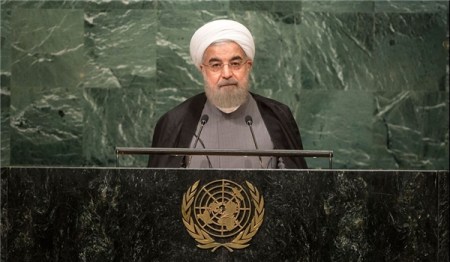
30061Rohani at the UNGA (Image: Farsnews.com, September 22, 2016)

Rohani’s statements, which are part of an Iranian attempt in recent weeks to create a false impression that the U.S. has not met its obligations towards Iran, are in stark contradiction to statements made by senior members of the Iranian negotiation team who explicitly admitted that the U.S. has in fact met its obligations under the JCPOA (see below).

This Iranian measure is a response to the refusal of Western banks to conduct transactions with Iran in dollars, despite the lifting of the nuclear sanctions in January 2016, because the initial sanctions imposed on Iran by Congress for human rights violations and for terrorism are still in force. As will be recalled, Iran refuses to negotiate with the West on issues of terrorism, on the grounds that these issues are internal sovereign matters.

Below is a MEMRI report on this issue published on August 15, 2016.

As the first year of the JCPOA is marked, and in light of Western banks’ rejection of Iranian transactions in dollars, Iranian Supreme Leader Ali Khamenei and his supporters in the West have launched a campaign to pressure the U.S. to lift the initial sanctions imposed on Iran by Congress for human rights violations and for terrorism. Their aim is to have these sanctions lifted without negotiations and without giving anything in return.

As will be recalled, Iran from the outset restricted the framework of the negotiations to the nuclear issue, and refused to allow them to include other issues such as human rights, terrorism, or missiles, which it considers internal sovereign matters. Therefore, the initial American sanctions concerning these areas remain in force.

A demand for lifting of all the sanctions, including the initial ones, was made by Supreme Leader Ali Khamenei in the months after the JCPOA was achieved in July 2015.[2] Perhaps Tehran thought that with the lifting of the nuclear sanctions, the entire sanctions regime would collapse, including those concerning human rights, terrorism, and missiles. But this did not happen. The U.S. Treasury Department is following the letter and the spirit of U.S. law, and is warning banks worldwide that the initial sanctions remain in force.[3]

In light of this situation, Iran and the supporters of its regime in the West are now working to create a false impression that the U.S. has not met its obligations towards Iran. They claim that, in order to fulfill its commitments towards Iran in the JCPOA, the U.S. is obligated to revoke or circumvent the initial sanctions imposed on Iran by Congress, which currently prevent banks from dealing freely with Iran.  For example, Tyler Cullis, member of the Iranian lobby in the U.S., the National Iranian American Council (NIAC), stated in a recent policy paper that “the United States is committed to ensuring that neither U.S. law nor policy is standing in the way of non-U.S. banks resuming correspondent banking relations with their Iranian counterparts… If U.S. laws or policies are interfering with Iran realizing the full benefit of the lifting of sanctions on Iran’s financial institutions, then the U.S. is required to take steps to ensure that those laws or policies no longer are running such interference. To do so could require additional changes to U.S. laws or policies governing the issue.”[4]

Iranian Deputy Foreign Minister and negotiating team member Majid Takhtravanchi also demanded that the U.S. take explicit steps to remove any obstacles currently preventing banks from dealing with Iran. He said on June 27, 2016,: “Two [contradictory] messages are coming out of Washington: The State Department says that there is no problem carrying out banking and financial transactions with Iran, while the OFAC says the opposite… We want the OFAC… to guarantee that there is no problem for the banks that are cooperating with Iran…”[5]

It should be mentioned that the Iranian implication that the U.S. has not met its obligations towards Iran stands in contradiction to explicit statements made recently by Iranian officials, mainly negotiation team members from Iran’s pragmatic camp, who confirmed that the U.S. had upheld its part of the JCPOA. Deputy Foreign Minister and senior negotiating team member ‘Abbas Araghchi said on a television special marking the first anniversary of the JCPOA: “Both sides have met their obligations under the JCPOA… In order to benefit from the JCPOA… we must carry out several steps because there are restrictions that are not connected to the JCPOA… The other side has implemented its obligations, and if it had not, that would have been a violation of the JCPOA, and we would have handled it in the Joint Committee…

“The JCPOA was meant to remove the obstacles of the sanctions from Iran’s economic path. [Indeed], these obstacles have been removed, but there are other obstacles, such as the initial sanctions by America, FATF [Financial Action Task Force on Money Laundering], and laws connected to money-laundering, which require time [to take care of].

“From the outset, [the other side] was not meant to lift the sanctions that are not connected to the nuclear issue; that is written even in the [2013] Geneva Joint Plan of Action [about the lifting of] ‘sanctions related to the nuclear [issue], because we were negotiating about the nuclear issue [alone]…

“The sanctions on the dollar and the use of the financial apparatus of America belong to the initial sanctions imposed long ago because of issues that are not nuclear-related… We raised the matter in the negotiations, but the Americans did not agree to lift these sanctions… and demanded additional concessions [from us] in matters that were part of our red lines…

“The Americans are serious about maintaining their initial sanctions; this is the essence of America. Iran is Iran and America is America, and as long as we do not negotiate on bilateral relations [with the U.S.], these sanctions will remain in force. The American Treasury Department tells [the banks worldwide] that these sanctions are in force, and has warned them not to get in trouble because of them. These sanctions are not related to the JCPOA.”[6]

Deputy Foreign Minister and negotiating team member Hamid Ba’idinejad said at a press conference marking the first anniversary of the JCPOA: “Up to this very moment, the members of the [Iranian] negotiating team believe that the JCPOA has not been violated [by the U.S.], and still believe that it is possible to solve the problems [concerning transactions in dollars] with discussions, recommendations, and talks… From the outset, the task set out [for the Iranian negotiating team] was to resolve the nuclear issue [alone]. So far, the Islamic Republic has made no decision to negotiate with America on [the other] issues in dispute…

“Our regime never expected us to achieve the lifting of the sanctions for human rights [in the framework] of the nuclear talks.”[7]

Expediency Council head Ali Akbar Hashemi Rafsanjani said: “America is telling [the banks worldwide] that it has not lifted the [initial] sanctions because this problem is related to human rights, terrorism, Palestine, and Lebanon. These [issues] too we could have solved.”[8]

However, after Khamenei warned, on August 1, 2016, that the U.S. had violated its commitments, the negotiating team heads fell into line with him, and began to state that the U.S. had indeed violated its obligations and to demand further changes in U.S. policies and laws.

A U.S. capitulation to these Iranian demands would be a blow to the authority of Congress, which imposed the initial sanctions, and to the separation of powers in the U.S. Moreover, it would constitute U.S. support for Iran’s ideological camp – Khamenei, Iran’s Islamic Revolutionary Guard Corps (IRGC), the Basij, and the ayatollahs connected to them – and not to the pragmatic camp, and would also stand in contradiction to President Obama’s commitment that the JCPOA deals only with the nuclear issue.


* Y. Carmon is President of MEMRI; A. Savyon is the director of MEMRI’s Iran Media Project


Endnotes:


[1] Farsnews.com, September 22, 2016.

[2] See MEMRI Special Dispatch No. 6151, Khamenei Declares That He Will Not Honor The Agreement If Sanctions Are Merely Suspended And Not Lifted, September 4, 2015.

[3] See MEMRI Inquiry and Analysis No. 1249, Post-JCPOA, The IRGC Is The Factor Stopping Iran From Integration Into The Western Economy, May 20, 2016.

[4] Niacouncil.org, August 2016.

[5] Tabnak (Iran), July 27, 2016.

[6] Fars (Iran), July 11, 2016.

[7] Fars (Iran), July 13, 2016.

[8] Fars (Iran), August 10, 2016.
Iran Sanctions Have Ended – and the Mass Executions Have Restarted

September 22, 2016

Iran Sanctions Have Ended – and the Mass Executions Have Restarted, American ThinkerMansour Kashfi, September 22, 2016

The crippling global sanctions on Iran cost the country hundreds of billions of dollars and decimated the economy. Inflation rose to over 40 percent and unemployment levels reached 33 percent. Consequently, the majority of citizens experienced an astronomical cost of living and lack of government services. Therefore, news of negotiations and lifting of sanctions was very well received by Iranians and generated optimism for a life of less hardship after sanctions.

However, since the agreement ending sanctions was signed between the Islamic Republic (IR) and the international powers last January, nothing has improved regarding the everyday life of the Iranian people. Not even one of the critical civil issues that was promised by the so-called “moderate”, “pragmatic” president, Hassan Rouhani, to be addressed after sanctions ended, has been opened for discussion by the IR officials.

Regardless of the rather rapid increase in Iranian crude oil and petrochemical sales and the release of billions of dollars of frozen money by a number of international oil companies and foreign governments, the nation-wide tax in all categories remarkably increased, and a limited welfare to needy senior citizens has been discontinued.

Despite the rosy promises of the IR’s authorities, especially Hassan Rouhani, to bring justice for all and raise the standards of living of the people, amazingly nothing has been done to improve Iranians’ living conditions, and no social freedom and justice is on the horizon. On the contrary, tougher repression and mass executions are the only gift by the IR to the Iranian people after sanctions ended.

Release of Assets

US officials claimed that IR had more than $100 billion of frozen assets abroad during the sanctions era, the equivalent of 28 percent of the country’s gross domestic product, which has been returning to the IR after sanctions ended. A good portion of this money was balance payments of crude oil sold by IR to its customers during the sanction years, including Royal Dutch Shell, Italy’s Saras, Greece’s Hellenic, Emirates National Oil Company, the Indian Reliance and Essar oil refiner, the Netherlands and Japan. All unfrozen money has been transferring to IR’s Central Bank by way of the SWIFT global transactions network. President Hassan Rouhani announced last March that the government of IR has access to all unfrozen assets.

Further, according to the International Energy Agency, IR is currently exporting about 2.14 million barrels of crude and over 200,000 barrels of gas condensates daily. The IR’s oil ministry reported the oil revenues from 2016 until mid-July were about $20 billion.

During negotiations with the IR last year the Obama administration agreed to pay $400 million plus interest of $1.3 billion to settle a failed arms sale to Iran that was initiated during the monarchical government before 1979. The first payment equivalent of $400 million in cash in the form of Swiss francs and euros was airlifted from Geneva, Switzerland to Tehran on January 17, and in return four Iranian-American hostages in IR’s jail were released. Further, officials of the State and Treasury departments confirmed on September 6 that two remaining installments of the $1.3 billion were sent to Tehran in the same manner through Geneva on January 22 and February 5.

With all this windfall money nothing tangible in terms of infrastructure renovations, civil reform and the rise of standard of living has taken place in the country. On the contrary, poverty has increased, over one-third of Iranians presently live under the poverty line, and thousands of citizens escape the country everyday to find a safer place to live. Worst of all, in testimonies of various human rights advocates and organizations, the ignoring of human rights by the IR is always an ever-growing issue in Iran, particularly after the ending of sanctions.

Human Rights Issues

The level of repression inside Iran has increased since Hassan Rouhani took office as president in 2013. Since then, the number of executions has grown rapidly. In 2014, the number of death sentences in Iran reached the largest number of executions in the world except for China. In 2015, according to Ahmed Shaheed, the U.N. Special Rapporteur on human rights in Iran, the number exceeded 1,000.

The U.N. General Assembly’s human rights committee passed a resolution last November that expressed its deepest concern about human rights violations by the Islamic regime. Amnesty International has also called on regime authorities to stop the hanging, particularly of juvenile offenders who are convicted on dubious evidence.  Amnesty International time and again has published reports on physical and psychological torture in Iran, saying that the number of torture and ill-treatment cases is increasing in Iran, making it clear that these violations of human rights not only continue in this time of a moderate President, but are noticeably becoming widespread and in most places systematic.

In January of 2016, finally the expected moment of change arrived, and sanctions were lifted. But immediately, political pressure and religious discrimination began increasing daily. The penalty for apostasy is still death. Any female regardless of age that does not wear veils is arrested and faces harsh punishments. Cultural dissidents, artists, and homosexuals on most occasions would receive capital punishment. Mass executions for political prisoners which were common practice for over a decade after the so-called revolution have now restarted primarily for non-Shi’a citizens.

There was a hanging of 20 innocent Sunni-Kurdish citizens in Karaj, a suburb of Tehran on August 3, 2016, the execution of an Iranian nuclear scientist on August 7, the hanging of 5 minority citizens in the western province of Azerbaijan on August 14, and another hanging of 3 minority citizens accused of exploding the oil pipeline in the southwest province of Khuzestan on August 16. Although U.N. Representative Ahmed Shaheed firmly requested the IR stop the systematic executions, 12 more allegedly accused of possession of illegal drugs were hanged in Karaj prison on August 27. There were a total of 41 executions officially of innocent citizens just in one month. In addition many young male and female citizens disappear every day, and their decomposed bodies are occasionally found in the remote parts of their hometowns. These systematic executions reveal that the nature of the Islamic regime has not changed at all, sanctions or no sanctions. IR claims they were executed for “purported terrorism and related activities” as reported by Zeid Ra’ad Al Hussein, the U.N. High Commissioner for Human Rights.

Ed Royce, the Chairman of the House Foreign Affairs Committee, introduced on September 6 a bill to censure President Obama for his rewarding a terrorist government for its hostage taking as IR presently still has three Iranian-Americans in prison.

It is inhuman for these executions to take place after an unfair trial, absent of any attorneys on behalf of defendants, and obviously based entirely on coerced confessions. In most cases such executions take place without any trial at all, and the Islamic regime has never allowed Ahmed Shaheed to visit Iran to make a precise assessment on human rights violations.

Iran as a member of the United Nations and other international human rights communities has systematically violated nearly every provision of these institutions and the Universal Declaration of Human Rights. IR’s officials have openly opted to ridicule the concept of universal human rights, and they brand the principle of human rights as a tool of the “Great Satan” and Western imperialism.

Where does the money go?

Evidently, the released money after sanctions ended was not intended for citizens’ welfare and the improvement of the living conditions in Iran. The IR officials have been apathetic since the welfare and health of the Iranian people is of the lowest priority in their eyes, considering the huge expense of their active terrorist groups in the Middle East. The money has already reached the IR’s Revolutionary Guard Corps (IRGC) for their efforts to export the Islamic revolution to neighboring countries and carry on the IR’s hostile engagements in Syria, Iraq, and Yemen, arming and financially supporting terrorist groups around the world including Hamas in Gaza, Hezb’llah in Lebanon, Shi’a groups in Bahrain, Houthis in Yemen, and the drug traffickers in South America. The IRGC is the most powerful extralegal organization and richest entity in Iran. The associated IRGC units own over one-third of the listed companies of the Tehran Stock Exchange. Further, according to Bloomberg, the IR Supreme Leader Mullah Khamenei is the owner of an economic empire of about $95 billion.

Now we know where the money goes.

Obama Admin Seeks Pathway for Future ‘Ransom Payments’ to Iran

September 22, 2016

Obama Admin Seeks Pathway for Future ‘Ransom Payments’ to Iran, Washington Free Beacon, September 21, 2016

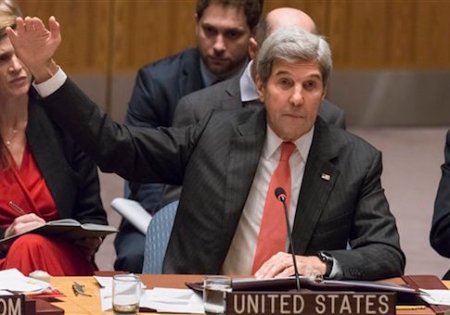
US Secretary of State John Kerry addresses the United Nations Security Council during an open, high-level debate regarding the ongoing Syrian crisis, at UN Headquarters in New York, NY, USA on September 21, 2016. The meeting, presided over by New Zealand's Prime Minister John Key, comes amid growing hostility between the United States and Russia over allegations of military operations conducted in the region. (Photo by Albin Lohr-Jones) *** Please Use Credit from Credit Field ***

US Secretary of State John Kerry addresses the United Nations Security Council during an open, high-level debate regarding the ongoing Syrian crisis, at UN Headquarters in New York, NY, USA on September 21, 2016. (Credit Field)

The Obama administration is pushing a pathway to ensure it can continue sending Iran cash payments amid mounting accusations it laundered some $1.7 billion to the Islamic Republic as part of a “ransom payment” to free U.S. hostages earlier this year, according to statements by the White House and sources familiar with the matter.

The White House late Wednesday promised to veto new legislation—first disclosed by theWashington Free Beacon—that would bar the administration from making “future ransom payments to Iran,” prompting outrage from key members of Congress who have been investigating how U.S. officials delivered nearly $2 billion in cash to Iranian officials.

The administration’s veto threat comes as top lawmakers on a range of investigatory committees launch efforts to uncover details about the cash exchange still being hidden by the Obama administration.

Congressional sources who spoke to the Free Beacon raised questions as to why the Obama administration would threaten to veto the bill, given its insistence that the cash payments to Iran were not part of a ransom.

“President Obama’s veto threat on our ransom legislation puts the lives of U.S. citizens around the world at risk,” Rep. Mike Pompeo (R., Kan.), a member of the House Intelligence Committee who helped spearhead the ransom legislation, told the Free Beacon.

“Instead of admitting wrongdoing, this administration is sticking to talking points. But selective noun use cannot explain away criminality, nor does it excuse eight months of lying to the American people,” Pompeo said. “It is unprecedented and reckless for the U.S. to be doling out billions to the Islamic Republic of Iran—under wraps and in cash—which is why our bill is necessary.”

Sen. Marco Rubio (R., Fla.), a lead sponsor of the legislation to ban future payments to Iran, told theFree Beacon that he would continue to push the legislation, despite threats by the administration.

“This effort by the President to defend his ransom payments to Iran at all costs amounts to doubling down on ‎a policy that has made Americans less safe,” Rubio told the Free Beacon. “Democrats may be swayed by this threat, but I will continue to fight to prevent the U.S. government from sending taxpayer dollars to the world’s foremost state sponsor of terrorism.”

Sen. Mark Kirk (R., Ill.) told the Free Beacon Wednesday evening that the Obama administration is betraying U.S. victims of Iranian terrorism, who are owed billions under federal court rulings.

“Under U.S. court judgments, Iran owes $55.6 billion to American victims of Iranian terrorism,” Kirk told the Free Beacon. “The Administration should stop finding ways to send more cash to Iran, and start working to bring a measure of justice to American families whose loved ones were killed or injured due to Iran-backed terrorists.”

One source familiar with the matter said Iran prefers cash because it can more easily be used to fund terrorism.

“There is no credible reason for the administration to oppose this bill. We already know, contrary to what the president initially said, that the administration can in fact wire money to Iran,” the source said. “So why do we need the option to pay in cash? Simple. This money can fund terrorism, and there’s nothing we can do to know of stop it.”

The Obama administration maintains the legislation is “ill-advised” and would “undermine U.S. obligations” to Iran.

The bill is “an ill-advised attempt to respond to a problem—so-called ‘ransom’ payments to Iran—that does not exist, in a way that would undermine U.S. obligations and ultimately benefit Iran at the expense of the United States,” the White House said in a statement.

The administration said it plans to award Iran further payments, which would not be possible under the ransom legislation.

“This bill, while styled as prohibiting future purported ‘ransom payments,’ instead bars virtually any payment from the U.S. government to Iran, including those permitted or even required by law,” the administration said.

The $1.7 billion cash payment was given to Iran as part of an effort to resolve decades-old legal disputes, many of which are still outstanding. The administration said further payments could be made to Iran in order to settle these disputes.

“Specifically, this bill would effectively prevent the United States from paying out awards rendered by the Tribunal and, thus, risk putting the United States in violation of our obligations under the Algiers Accords—an agreement concluded by President Carter, endorsed by President Reagan and honored by every President since that time,” according to the White House.

Questions remain about why the administration chose to pay Iran in cash installments routed through the New York Federal Reserve and several European banks.

Lawmakers such as Pompeo and Sen. Ted Cruz (R., Texas) have described the administration’s process as tantamount to a money laundering scheme.

UPDATE 8:40 P.M.: This piece was updated to include comments from Sens. Marco Rubio (R., Fla.) and Mark Kirk (R., Ill.).

China to Obama: America Forced Norks to get Nukes and Must Negotiate a Deal

September 20, 2016

China to Obama: America Forced Norks to get Nukes and Must Negotiate a Deal, Dan Miller’s Blog, September 20, 2016

(The views expressed in this article are mine and do not necessarily reflect those of Warsclerotic or its other editors. — DM)

In an article titled North Korean Nukes, South Korea, Japan, China and Obama, posted the day after North Korea’s most recent nuke test, September 9th, I contended that China would not honor Obama’s request to make North Korea stop developing and testing nukes. China has remained a faithful ally of North Korea since the end stage of the Korean Conflict and “sees Obama, not as the representative of the world’s greatest power, but as a joke. He has no clout internationally and is a national embarrassment.”  NB: I had hoped to publish this article more than a week ago, but my internet was down or at best intermittent from September 13th until September 19th.)

I was right, but it’s a bit worse than I had thought.

On September 12th, an article was published by Xinhua titled China urges U.S. to take responsibility on Korean Peninsula nuclear issueXinhua is

the official press agency of the People’s Republic of China. Xinhua is the biggest and most influential media organization in China. Xinhua is a ministry-level institution subordinate to the Chinese central government. Its president is a member of theCentral Committee of China’s Communist Party.

According to Xinhua,

U.S. Defence Secretary Ashton Carter reportedly called for further pressure on the DPRK last Friday after the country carried out a new nuclear test and said China bears “responsibility” for tackling the problem. [Emphasis added.]

The essence of the Korean Peninsula nuclear issue is the conflict between the DPRK and the United States, spokesperson Hua Chunying said at a press conference. [Emphasis added.]

As a permanent member of the UN Security Council and a close neighbor of the DPRK, China has made unremitting efforts to maintain peace and stability on the Korean Peninsula and safeguard the international nuclear non-proliferation regime, Hua said.

A statement released by the Foreign Ministry of the DPRK Sunday said the United States compelled the DPRK to develop nuclear warheads, and the nuclear threat it has constantly posed to the DPRK for decades is the engine that has pushed the DPRK to this point. [Emphasis added.]

Blindly increasing the pressure and the resulting bounce-back will only make the nuclear issue on the Korean Peninsula “a firm knot,” Hua said, calling for responsibility from all relevant parties.

Hua reiterated that China will remain committed to resolving issues concerning the Peninsula through dialogue to realize long-term peace and stability.

China strongly urges all parties to speak and act cautiously with the larger picture in mind, avoid provoking each other and make genuine efforts to achieve denuclearization, peace and stability on the Korean Peninsula, Hua said.

. . . .

“We have seen the twists and turns in the situation on the Korean Peninsula since the six-party talks have stalled,” Hua said, noting that it proves that simple sanctions cannot solve the issue. [Emphasis added.]

Hua said the security concerns of parties on the Korean Peninsula must and can only be resolved in a way that serves the interests of all parties.

Any unilateral action based on one’s self-interest will lead to a dead end, and it will not help resolve one’s security concerns but will only aggravate the tension, complicate the issue, and make it more difficult to achieve relevant goals, Hua said. [Emphasis added.]

The six-party talks, involving China, the DPRK, the United States, the Republic of Korea (ROK), Russia and Japan, were a multilateral mechanism aimed at solving the Korean Peninusla nuclear issue. The talks began in 2003 and stalled in December 2008. The DPRK quit the talks in April 2009.

“Resuming the six-party talks is difficult, but we cannot give up easily ,” Hua said.

China will continue to keep close communication with relevant parties and call on them to return to the right track of solving issues related to the Korean Peninsula through dialogue and negotiation, the spokesperson said.

China clearly appears to be following the line of Kim Jong-un on why North Korea needs nukes:

The Obama administration cannot engage in successful negotiations with North Korea, for several reasons. They are, in no particular order: Obama will be gone in about four months; Kerry is Obama’s Secretary of State; The Obama-Clinton-Kerry Iran Scam gave the Islamic Republic everything it sought and, at best, left Iran on the highway to nukes. North Korea and Iran are different in at least one major respect: Iran claimed that it did not have nukes and had not tried to develop them; Supreme Leader Khamenei was claimed to have issued a fatwa against the acquisition, development and use of nukes — despite propaganda videos showing how Iran will use nukes against the “great and little Satan.” North Korea has and has tested five nukes. Kim brags about them and threatens to use them.

The nuke threat

38 North is a think tank largely devoted to obtaining and publishing reliable information about North Korea’s nuke and missile programs. An article there by , published on September 12th, concludes:

What are the greatest threats from the rapidly expanding North Korean nuclear program? Left unchecked, Pyongyang will likely develop the capability to reach the continental United States with a nuclear tipped missile in a decade or so. Much more troubling for now is that its recent nuclear and missile successes may give Pyongyang a false sense of confidence and dramatically change regional security dynamics. The likely ability of the DPRK to put nuclear weapons on target anywhere in South Korea and Japan and even on some US assets in the Pacific greatly complicates the regional military picture. That situation would be exacerbated if Pyongyang decides to field tactical nuclear weapons as its arsenal expands and its confidence in its nuclear arsenal grows.

More bombs and better bombs also increase the potential of accidents and miscalculations with greater consequences as the number and sophistication of bombs increase. Rendering the nuclear enterprise safe and secure in case of internal turmoil or a chaotic transition in the North becomes more difficult. We also cannot rule out that a financially desperate leadership may risk the sale of fissile materials or other nuclear assets, perhaps to non-state actors. [Emphasis added.]

So, what to do? The latest nuclear test demonstrates conclusively that attempting to sanction the DPRK into submission and waiting for China to exert leverage over Pyongyang’s nuclear program do not work. Increasing sanctions and adding missile defenses in South Korea to that mix will also not suffice and make China even less likely to cooperate. What’s missing is diplomacy as much as Washington may find it repugnant to deal with the Kim regime.

On September 20th, North Korea announced that it had tested a new long-range rocket engine, suggesting that it “can be used for an intercontinental ballistic missile (ICBM), which is capable, in theory, of hitting targets on the U.S. mainland.” The September 9th nuke test is claimed to have involved “a miniaturized nuclear warhead that could be mounted on a ballistic missile.” How close in North Korea to being able to nuke the U.S. mainland? I don’t know and don’t want to find out by having it happen.

Can diplomacy, even if undertaken by a new administration after Obama leaves office, be successful? Continued sanctions got Iran to engage in negotiations; both Iran and Obama’s America very much wanted the sanctions lifted so that Iran would become an honorable member of the community of nations. There are few if any significant sanctions to lift on North Korea and China will not impose or enforce any; China’s role has been to help North Korea evade sanctions.

In China Won’t Stop Kim Jong-un. The U.S. Must Stand Up to Both of Them, published by Slate Magazine on September 13,  had some perhaps useful suggestions:

[T]he United States should rally the same sort of campaign that revved up the pressure against Iran before those nuclear talks got underway. In other words, the international community should apply sanctions not only against North Korea but also against all institutions that do business with North Korea—an action that would affect some major Chinese banks, which provide it with energy supplies, other goods, and hard currency. [Emphasis added.]

Yes, this would stir tensions in U.S.-China relations; but so do a lot of other actions, many of them instigated by China (for instance, the dodgy territorial claims in the South China Sea), and in this case, any perceptions of American aggression would be offset, to some degree, by a realization—at least by some Chinese officials—that it’s time for Beijing to face up to its problem and reassess its strategic priorities accordingly. (Longtime China-watchers say that some of Xi’s senior comrades have been advocating tougher action against Kim.)

He also suggests that if an end is put to North Korea’s nuclear ambitions and work, America should agree to terminate its no longer necessary THAAD deployments in South Korea and Japan. Further, the next president

should take steps, especially with China, to prevent Pyongyang from deploying a nuclear missile; but if that proves fruitless, he or she should make very clear that North Korea’s use of nuclear weapons—or even a conventional invasion of South Korea (which might be accompanied by a brandishing of nukes to deter anyone from coming to Seoul’s aid)—will be regarded as an attack on the United States and will be dealt with accordingly. There should be no ambiguity about this. Kim Jong-un may be crazy, but his eccentricities have always been in the service of his survival—and he should understand that he’s putting his survival on the line. Daniel Sneider, associate director of Stanford University’s Shorenstein Asia-Pacific Research Center, thinks we should deploy more nuclear-capable aircraft on U.S. bases in Asia to drive this point home fiercely.

It seems worth noting that among the reasons to expect that a Russian-assisted attack on South Korea would be successful, which Kim Il-sung suggested to Stalin in 1950, was that Secretary of State Dean Atcheson had delivered an important address in which he listed the nations to the defense of which America would come if attacked. South Korea was not on the list. As I observed here in November of 2010,

When Kim il-Sung secretly visited Moscow between March 30 and April 25, he assured Stalin that his attack would succeed in three days: there would be an uprising by some two hundred thousand party members and he was convinced that the United States would not intervene. Secretary of State Dean Acheson’s January 12, 1950 speech was persuasive evidence. There, Secretary Acheson had omitted South Korea from a list of nations which the United States would defend if attacked. Stalin gave the go-ahead.

Conclusions

China has encouraged North Korean nuclearization and wants America and her allies, principally South Korea, to cease their “provocations” against the Kim regime. Yet Kim thrives on, and encourages his supporters by, engaging in provocations far more serious and dramatic than anything thus far done by America and South Korea. It seems likely that the North Korean nuke – missile problem will continue until Kim is (a) taken out and (b) replaced with someone less narcissistic and more interested in feeding his people than his ego. Whether such a replacement will emerge is unknown. However, if a Kim clone emerges instead, he seems likely to be more concerned than Kim about his prospects for a long and happy life, even with protection from China.

North Korean Nukes, South Korea, Japan, China and Obama

September 10, 2016

North Korean Nukes, South Korea, Japan, China and Obama, Dan Miller’s Blog, September 10, 2016

(The views expressed in this article are mine and do not necessarily reflect those of Warsclerotic or its other editors. — DM)

On September 9th, North Korea conducted its fifth nuke test, of its most powerful nuke thus far. Can Obama get China to help make North Korea stop developing and testing nukes? Nope. China sees Obama, not as the representative of the world’s greatest power, but as a joke. He has no clout internationally and is a national embarrassment.

China and North Korea – a very short history

Here’s a link to an article I posted on June 25, 2013 about the Korean conflict. To summarize, China and the Democratic People’s Republic of Korea (North Korea) have a long history of acting together. China views the Republic of Korea (South Korea), which borders North Korea to the south and is an American ally, as a threat. She does not want reunification of the Korean peninsula under a government favorable to America.

When, on June 25, 1950, North Korea invaded South Korea with Russian aircraft, weaponry, training and other substantial support, China did not assist North Korea. North Korean forces pushed the South Korean government, as well as the few American military advisers (then under the command of the Department of State), south to the Pusan perimeter. Following General MacArthur’s unexpected and successful Inchon invasion which began on September 15th, American and other United Nations forces pushed the North Korean forces back north: MacArthur sent his by then greatly augmented forces east to Wonson and eventually managed to push North Korean forces to the northern side of the Yalu River. However, Chinese forces struck back en masse and MacArthur’s forces were driven back to Seoul.

Ever since bringing to an end MacArthur’s successes in the Korean Conflict, China has supported North Korea. She has opposed, and has then declined to enforce, significant sanctions responsive to North Korean nuclear and missile development and testing. While China may acquiesce in weak UN resolutions condemning North Korean provocations, she rarely goes beyond that.

China, Japan and the two Koreas

China has a long memory and still resents, bitterly, the lengthy period prior to and during World War II when Japan occupied significant parts of China. Ditto South Korea, all of which was under Japanese occupation for a lengthy period prior to and during World War II. Although China has substantial trade with both South Korea and Japan, she is more hostile to Japan than is South Korea; the latter two have substantial mutual interests transcending trade.

Perhaps the most important current dispute between China on the one hand, and Japan-South Korea-America on the other, involves the plans of Japan and South Korea to defend against North Korean missiles by the installation of THAAD anti-missile weapons provided by America. China’s stated reason for opposition to the THAAD system is that it could be used against Chinese, as well as North Korean, missiles. Why does China assert this objection unless she hopes to fire missiles at one or both of them? If China fires missiles at Japan and/or South Korea, they have every right to destroy her missiles and to respond in kind with U.S. assistance if requested.

President Obama

condemned Pyongyang’s fifth nuclear test today in the “strongest possible terms as a grave threat to regional security and to international peace and stability” as outraged lawmakers from both parties called for tougher action to stop North Korea’s nuclear program. [Emphasis added.]

That may well be all that Obama does — despite the warnings of Rep. Adam Smith (D-Wash.), the top Democrat on the House Armed Services Committee, that

we have to make it absolutely clear that if they engage in any military activity, they will be destroyed. We have to have a credible deterrent. That seems to be the only thing that will stop North Korea from engaging in military action… We have sanctioned them, and we should keep sanctioning them, but it’s not going to stop them from developing the nuclear weapons.” [Emphasis added.]

Obama won’t do that:

In a statement Friday, President Obama vowed to “take additional significant steps, including new sanctions, to demonstrate to North Korea that there are consequences to its unlawful and dangerous actions.”

Obama did not suggest what He might have in mind, beyond historically ineffective sanctions and condemnations “in the strongest possible terms,” to let North Korea know that there will be “consequences.”

A September 9th article at the New York Times provides an unpleasant analysis of the options Obama now has, and which His successor will have, in dealing with North Korea.

A hard embargo, in which Washington and its allies block all shipping into and out of North Korea and seek to paralyze its finances, risks confrontations that allies in Asia fear could quickly escalate into war. But restarting talks on the North’s terms would reward the defiance of its young leader, Kim Jong-un, with no guarantee that he will dismantle the nuclear program irrevocably.

For more than seven years, President Obama has sought to find a middle ground, adopting a policy of gradually escalating sanctions that the White House once called “strategic patience.” But the test on Friday — the North’s fifth and most powerful blast yet, perhaps with nearly twice the strength of its last one — eliminates any doubt that that approach has failed and that the North has mastered the basics of detonating a nuclear weapon.

Despite sanctions and technological backwardness, North Korea appears to have enjoyed a burst of progress in its missile program over the last decade, with experts warning that it is speeding toward a day when it will be able to threaten the West Coast of the United States and perhaps the entire country. [Emphasis added.]

. . . .

Mr. Obama has refused to negotiate with the North unless it agrees first that the ultimate objective of any talks would be a Korean Peninsula without nuclear arms. But Mr. Kim has demonstrated, at least for now, that time is on his side. And as he gets closer to an ability to threaten the United States with a nuclear attack, and stakes the credibility of his government on it, it may be even more difficult to persuade him to give up the program.

 In a statement Friday, Mr. Obama condemned the North’s test and said it “follows an unprecedented campaign of ballistic missile launches, which North Korea claims are intended to serve as delivery vehicles intended to target the United States and our allies.”

“To be clear, the United States does not, and never will, accept North Korea as a nuclear state,” he said.

Many experts who have dealt with North Korea say the United States may have no choice but to do so. [Emphasis added.]

“It’s too late on the nuclear weapons program — that is not going to be reversed,” William Perry, the defense secretary under President Bill Clinton during the 1994 nuclear crisis with North Korea, said in August at a presentation in Kent, Conn. The only choice now, he argued, is to focus on limiting the missile program. [Emphasis added.]

Obama has taken no significant steps to limit Iran’s continuing missile development and testing program. How can He limit that of North Korea without Chinese cooperation?

Yet the latest effort to do that, an agreement between the United States and South Korea to deploy an advanced missile defense system in the South, has inflamed China, which argues the system is also aimed at its weapons. While American officials deny that, the issue has divided Washington and Beijing so sharply that it will be even more difficult now for them to come up with a joint strategy for dealing with the North. [Emphasis added.]

China has been so vocal with its displeasure over the deployment of the American system that Mr. Kim may have concluded he could afford to upset Beijing by conducting Friday’s test. [Emphasis added.]

Fueling that perception were reports that a North Korean envoy visited Beijing earlier this week.

North Korea almost certainly sees this as an opportunity to take steps to enhance its nuclear and missile capabilities with little risk that China will do anything in response,” Evans J.R. Revere, a former State Department official and North Korea specialist, said in a speech in Seoul on Friday. [Emphasis added.]

The breach between China and the United States was evident during Mr. Obama’s meeting with President Xi Jinping last week. “I indicated to him that if the Thaad bothered him, particularly since it has no purpose other than defensive and does not change the strategic balance between the United States and China, that they need to work with us more effectively to change Pyongyang’s behavior,” Mr. Obama said, referring to the Terminal High Altitude Area Defense system, as the advanced missile defense project is known. [Emphasis added.]

North Korea and Iran

Iran and North Korea have a long history of cooperation in developing nukes and missiles with which to deliver them. In the past, Iranian scientists have been present at North Korean nuke tests, and vice versa. They have also assisted each other in the development of nukes and missiles.

Iran and North Korea have substantial reasons to cooperate: by virtue of the Iran scam, Iran now has lots of money but is at least minimally restricted in its nuke development. North Korea has little usable currency, needs whatever it can get, and no attempts to halt or even to limit its nuke development have worked.

A missile fired recently by North Korea bore a striking resemblance to an Iranian missile.

Photos released by North Korea of its launch of long-range ballistic missiles are the latest proof of the close military cooperation between Pyongyang and Tehran, an Israeli expert in the field told the news site IsraelDefense on Tuesday.

According to Tal Inbar — head of Space and UAV Research Centre at the Fisher Institute for Air & Space Strategic Studies — what was new in the photos was the shape of the warheads attached to the Nodong missiles, known in Iran as the Shahab-3.

Until now, such warheads — first detected by Inbar in Iran in 2010 — have not been seen in North Korea. At the time, Inbar dubbed them NRVs (or, “new entry vehicles”), which became their nickname among missile experts around the world. [Emphasis added.]

Inbar told IsraelDefense: “The configuration that we saw [on Tuesday] is identical to what we saw in Iran six years ago. In principle, its penetrating body (warhead) is identical to that of Scud missiles, but is mounted on the Shahab-3, and creates a more stable entity than other Shahab/Nodong warheads.”

Inbar said this was the third time that something of this nature had appeared in Iran before it did in North Korea. “But we must remember that the two countries engage in close cooperation where military and space-directed missiles are concerned,” he said. “It is thus possible that both plans and technology are being transferred regularly from one to the other.” [Emphasis added.]

Are North Korea and Iran rational? According to this New York Times analysis, North Korea is.

North Korea’s actions abroad and at home, while abhorrent, appear well within its rational self-interest, according to a 2003 study by David C. Kang, a political scientist now at the University of Southern California. At home and abroad, he found, North Korean leaders shrewdly determined their interests and acted on them. (In an email, he said his conclusions still applied.) [Emphasis added.]

“All the evidence points to their ability to make sophisticated decisions and to manage palace, domestic and international politics with extreme precision,” Mr. Kang wrote. “It is not possible to argue these were irrational leaders, unable to make means-ends calculations.” [Emphasis added.]

Victor Cha, a Georgetown University professor who served as the Asian affairs director on George W. Bush’s National Security Council, has repeatedly argued that North Korea’s leadership is rational.

I submit that the same analysis, applied to Iran, produces the same result. Iran’s leaders know what they want, and are sufficiently rational to achieve it; they did. Obama, not the leader of a dictatorial theocracy, is sufficiently irrational to believe that what he wants for the Islamic Republic of Iran is what America needs it to have. It is not.

Obama and Iran

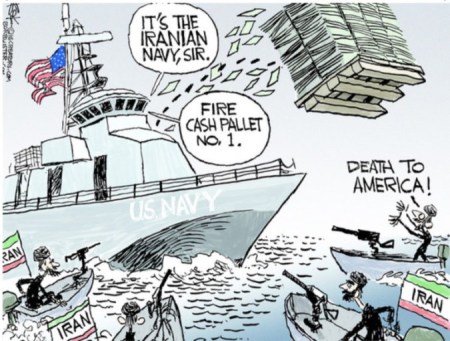
Obama’s Iran scam would be farcical were it not potentially deadly. He did not do what would have been best for America and the free world in general — increase sanctions until Iran complied fully with UN resolutions on missile testing, ceased Uranium enrichment and disposed of the means to do it, ceased all nuke research as well as all nuke cooperation with North Korea and ceased supporting all terrorist groups, including Hezbollah and Hamas. Instead, perhaps considering Himself above such trivia, Obama sought little more than what He considered His greatest achievement — His legacy:

iranian-navy-copy-1

Conclusions

If Obama were viewed internationally as the powerful leader of the world’s most powerful nation, He might be able to get China to clamp down, severely and successfully, on North Korea’s nuke and missile development. Were China to reject His overtures, He could arrange for it to wish that it had acceded. That’s not who Obama is, as demonstrated by, among His other actions, entering into the Iran Scam deal with Iran.

Perhaps Kim Jong-un needs to dress like an Iranian mullah to convince Obama to give him a “deal” similar to the one He gave to Iran. He had better hurry: that won’t work with President Trump.

Iran: The Return of Ahmadinejad and Co.

September 5, 2016

Iran: The Return of Ahmadinejad & Co., Gatestone InstituteMajid Rafizadeh, September 5, 2016

♦ Iran’s Supreme Leader and the senior cadre of the Islamic Revolutionary Guard Corps have been vocally critical of the nuclear deal. They fear further diplomatic and political rapprochement between the US and Iran, now that they have already achieved their objectives of the lifting of the four major rounds of the UN Security Council’s sanctions.

♦ After the nuclear deal was implemented, polls showed that 63% of Iranians expected to see improvements in the economy and living standards within a year. But currently, in a new poll, 74% of Iranians said there had been no economic improvements in the past year.

Iran’s former president, Mahmoud Ahmadinejad, saying he wants to “redefine revolutionary ideals” set up by the leader of Iran’s 1979 Islamic revolution, Ayatollah Ruhollah Khomeini, appears to be launching a campaign to run in the upcoming Iranian presidential elections, in February, 2017.

Ahmadinejad was well-known for his incendiary and provocative speeches, which included denying the Holocaust. At the end of his presidential term, from 2005 to 2013, his approval rating was extremely low, and he managed to drive away most constituents across political spectrum, including the topmost hardline leaders. He also became the first Iranian president since 1979 to be summoned by the parliament (Majlis) to answer questions regarding his activities and policies.

After all of this, the common conception among politicians, scholars and policy analysts was that Ahmadinejad would never return to politics. It seemed that his retirement plan focused on founding a university and teaching, but his plan to open a university failed.

Despite his low popularity among people, however, the “principalists” (ultra-conservatives) were still on his side, due to his fierce anti-US, anti-Western and anti-Israel policies and rhetoric, as well as the fact that he remains a major figure in the coalition of several conservative groups, the Alliance of Builders of Islamic Iran.

After Ahmadinejad’s presidency, Iran’s Supreme Leader, Ayatollah Ali Khamenei, appointed him to the Expediency Council, Iran’s highest political arbitration body, which arbitrates between the Guardian Council (the supervisory body over the parliament and elections) and the Islamic Consultative Assembly (parliament). The Expediency Council is predominantly made up of Iran’s hardline clerics, and functions as an advisory institution to the Supreme Leader.

Although it seems that Ahmadinejad did not have any intention of returning after being out of the international spotlight for two years, other factors show that he never really left. Domestically, Ahmadinejad remained politically active, trying to unify and lead the hardliners. Since he left office, he has continued holding meetings with former ministers in Tehran.

In the last few months, however, Ahmadinejad’s desire to launch his campaign more forcefully and determinedly has become clearer as, once again, he began attracting the international spotlight, such as when he wrote an open letter to US President Barack Obama, demanding the transfer of $2 billion to Iran.

To capitalize on the popular vote and the presidential elections of 2017, Ahmadinejad has been focusing on attracting constituents from around Iran by traveling to smaller cities and towns, giving lectures and speeches; supporters of Ahmadinejad have called for his return.

During his presidency, people enjoyed subsidies on items including petrol, natural gas and electricity, and his government distributed monthly cash handouts of about $17 to every person. These, as well as criticism of corruption, injustice, and capitalism, were appealing to the rural population and the less affluent.

Ahmadinejad has also been vehemently criticizing Hassan Rouhani, the current Iranian president, as incompetent, and questioning his economic and foreign policies, and pointing out that, “There will be bumps and satanic obstacles in our path… One should not forget that the US is our enemy.”

The latest poll by the Center for International and Security Studies at the University of Maryland revealed that “Ahmadinejad now represents the single largest threat to Rouhani’s re-election, and trails the once-popular incumbent by only eight points. Suddenly, the ex-president seems once again to be a real political contender.”

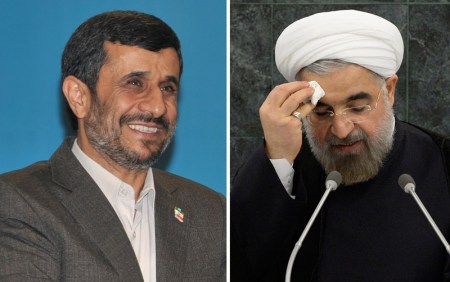
1839Mahmoud Ahmadinejad (left) can indeed be a viable contender against incumbent President Hassan Rouhani (right) in Iran’s 2017 presidential election, and is more likely the choice of the Supreme Leader and hardliners.

This is a ripe environment for him for several reasons.

First of all, the nuclear deal has become a popular issue among the hardliners. The Supreme Leader and senior cadre of the Islamic Revolutionary Guard Corps (IRGC) have been vocally critical of the nuclear deal. They fear further diplomatic and political rapprochement between the US and Iran, now that they have already achieved their objectives of the lifting of the four major rounds of the United Nations Security Council’s sanctions.

Ayatollah Khamenei warned against any relations with the US, and he also questioned the economic benefits of the nuclear agreement: “Weren’t the oppressive sanctions lifted so that the people would feel a change in their lives? Has there been a tangible effect on the people’s lives in the past six months?”

Second, the popularity of the nuclear deal has been on a decline among the population as well. After the nuclear deal was implemented, polls showed that 63% of Iranians expected to see improvements in the economy and living standards within a year. But currently, in a new poll, 74%of Iranians said there had been no economic improvements in the past year.

Ahmadinejad can indeed be a viable contender against Hassan Rouhani, and is more likely the choice of the Supreme Leader and the IRGC leaders, and the candidate favored by the hardliners and principalists.

Iran and the future of the Middle East

September 2, 2016

Iran and the future of the Middle East, Israel Hayom, Clifford D. May, September 2, 2016

U.S. President Richard Nixon went to China. President Barack Obama will not be going to Iran.

Nixon’s 1972 visit to the people’s republic included meetings with both Chairman Mao Zedong, the communist revolutionary leader, and Premier Zhou Enlai, the pragmatic head of the government. Detente and normalization of relations followed.

By stark contrast, Ayatollah Ali Khamenei, the Islamic republic’s revolutionary supreme leader, and Hassan Rouhani, the pragmatic president of the theocratic regime, will not deign even to share a bottle of pomegranate juice with Obama, president of “satanic” America, their avowed enemy.

Obama appears unperturbed, confident that detente and normalization of relations — not to mention a more stable Middle East — lie at the end of the road he began to pave with his 2015 Joint Comprehensive Plan of Action, a nuclear deal that garnered neither Congress’ endorsement nor the public’s approval.

The fraught controversy over how we got to this point and where we’re heading is the subject of a new book: “The Iran Wars: Spy Games, Bank Battles, and the Secret Deals that Reshaped the Middle East,” by Jay Solomon, chief foreign affairs correspondent for The Wall Street Journal.

What I found striking in this first draft of contemporary history: the opportunities Obama missed — or, more precisely, dismissed. In 2009, the brutish Mahmoud Ahmadinejad was declared the winner of presidential elections that were not just manipulated by Khamenei — that’s standard procedure — but almost certainly falsified as well. Iranians went out into the streets chanting “Death to the dictators!” and “President Obama, are you with us or against us?”

According to Solomon, not only did Obama refuse to support them, he ended programs to document Iranian human rights abuses and ordered the CIA to turn its back on the Green Movement. “The agency has contingency plans for supporting democratic uprisings anywhere in the world,” Solomon writes. “This includes providing dissidents with communications, money, and in extreme cases even arms. But in this case the White House ordered it to stand down.”

Obama also was unenthusiastic about sanctions. He and Secretary of State John Kerry believed that showing Iran’s rulers respect and engaging them in dialogue would be sufficient to mitigate their animosity and bellicosity. “So many wars have been fought over misunderstandings, misinterpretations, lack of effective diplomacy,” Kerry told Solomon in a 2016 interview. “War is the failure of diplomacy.”

I suspect Clausewitz and Sun Tzu would beg to differ. More to the point, quite a few members of Congress, including such Republicans as Mark Kirk, Ed Royce and Ileana Ros-Lehtinen, and such Democrats as Bob Menendez, Eliot Engel and Howard Berman, were convinced that talking softly was not enough, that when dealing with Iran’s rulers it was necessary to carry a sizeable stick. Solomon notes that congressional staffers partnered with several Washington think tanks to find “new ways to squeeze Iran’s oil profits and ability to conduct financial transactions.”

In particular, he adds, a “lethal weapon” came from the Foundation for Defense of Democracies (the think tank I founded after 9/11/01 and where I serve as president) which “focuses on combating Middle East extremism and, in particular, promoting the security of the United States, Israel and other democracies threatened by radical Islam.” FDD’s executive director, Mark Dubowitz, and his Farsi-speaking research team “provided a constant stream of reports to U.S. lawmakers on Iranian companies and individuals that they believed should be sanctioned for their roles in developing Iran’s nuclear program.”

Eventually, Dubowitz, working with Senator Kirk’s then deputy chief of staff Richard Goldberg, came up with a “financial bomb”: a Belgium-based financial firm called SWIFT “which hosts the international computer network that facilitates virtually every banking transaction in the world through an extensive messaging and financial tracking system.” The Obama administration opposed expelling Iran from SWIFT but “Congress once again overrode the White House’s concerns and unanimously passed” legislation in 2012 that “de-SWIFTed” Tehran.

By 2013, such measures, “were crippling Iran’s economy.” Had the pressure been intensified — or even just maintained — who knows what concessions Iran’s rulers might have made to avoid economic crisis and collapse? But Obama eased up on Iran in exchange for an interim agreement. After that, few if any Iranian concessions were forthcoming. Khamenei insisted that his red lines be observed while those laid down by Obama were transgressed — one after another.

In the end, Iran would not even have to acknowledge that it ever had a nuclear weapons program, much less reveal how far that program had progressed. Nevertheless, the Obama administration would agree that Iran “be allowed to build an industrial-scale nuclear program, with hundreds of thousands of machines, after a ten year period of restraint.”

“I have no doubt we avoided a war,” Kerry told the author in an interview early this year. He could be right. Alternatively, what he sees as avoidance could turn out to be only postponement.

Based on faith rather than evidence, Kerry and Obama believe that the Islamic republic will moderate; that it will give up its ambition of establishing a vast new Islamic empire; that it will no longer dream of bringing “death” to America, Israel, Saudi Arabia and other “infidel” nations; that it will not evolve into a more formidable and lethal adversary.

“Obama has wagered that Khamenei and his revolutionary allies won’t outlast the terms of the nuclear agreement,” Solomon concludes. “If they do, the United States risks unleashing an even larger nuclear cascade on the Middle East.” Yes, that’s the wager. Seems like a long shot to me.

Khamenei and IRGC’s Increasing Popularity

August 17, 2016

Khamenei and IRGC’s Increasing Popularity, Gatestone Institute, Majid Rafizadeh, August 17, 2016

♦ The same state-run media that shapes the Iranians’ views of the West also pushes them to favor hardline candidates.

♦ The new poll shows that Ayatollah Khamenei, his media outlets, and the Revolutionary Guards generals appear to be preparing the platform for a hardline President who will pull out of the nuclear agreement. The new poll also shows that so far their campaign has been successful.

The number of hardliners in Iran is on the rise, according to the latest poll. The Supreme Leader, Ayatollah Khamenei, appears to be preparing the social base so that a hardline president would replace President Hassan Rouhani after the sanctions are lifted by foreign powers. Khamenei seems to be achieving this by using Iranian media to slander the West and improve the image of hardline politicians. Iran’s former president, Mahmoud Ahmadinejad, appears to be getting ready to take Rouhani’s place, and is reportedly preparing his hardline platform to run in Iran’s 2017 presidential elections.

Rouhani’s popularity and standing are evidently not what they used to be. This seems to have come about largely because of changes in the economy. The overwhelming majority of Iranians believed in Rouhani’s economic promises when they elected him; after the nuclear deal was settled, 63% of Iranians believed that they would witness improvements in the economy and living standards within a year. However, a new report shows that 74% of Iranians said that there have been no economic improvements in the last year.

1545Iran’s Supreme Leader Ali Khamenei (left) appears to be preparing the social base so that a hardline president would replace President Hassan Rouhani (right).

A number of factors have slowed economic growth, including the high unemployment level, the state-owned and state-led economy, financial corruption at high levels, lack of an open market and business opportunities for the public, the increasing gap between the rich and poor, and the accumulation of wealth among the gilded circle in power and other major players — such as Supreme Leader Ayatollah Ali Khamenei, the Islamic Revolutionary Guard Corps (IRGC) and the connected elite business class — who hold control over major socio-political and economic sectors of Iran.

The Iranian government has also not done all that it could to help improve conditions. For example, after the flimsy and incomplete nuclear agreement, the Obama Administration immediately began transferring billions of dollars to Iran’s Central Bank. One of the payments included $1.7 billion transferred in January 2016. Of this sum, $1.4 billion came from American taxpayers. Iran immediately increased its military budget by $1.5 billion from $15.6 billion to $17.1 billion, rather than investing it for creating jobs.

Khamenei has already begun his campaign of blaming the West for Iranian economic problems. He fails to acknowledge the true reason that Iranians are not benefiting from the lifting of sanctions. Instead, as is his method of operation, he blames the West so that he himself is never blamed or held accountable in the eyes of the public. He stated recently “Weren’t the supposed sanctions lifted to change the life of the people? Is any tangible effect seen in people’s life after six months?” Although Iran’s oil exports have reached pre-sanctions levels, and although Iran is freely doing business on the state level, Mr. Khamenei claimed in a speech that, “the U.S. Treasury… acts in such a way that big corporations, big institutions and big banks do not dare to come and deal with Iran.”

An official from the State Department said that Iran should not blame the US for companies not doing business with Iran. Most likely, large corporations are just not yet prepared to make deals with Iran.

Khamenei’s rhetoric has a significant impact on public opinion in Iran. According to a poll, 75% of Iranians believe that the U.S. is to blame for Iran’s stagnant economy. They believe that the U.S. has been creating obstacles to Iranian business with Western companies, and to Iran’s ability to fully rejoin the global financial system.

It is true that since the nuclear deal, Iran’s unemployment rate has increased from roughly 10.8% to 12%. During the course of Rouhani’s presidency, the unemployment rate has increased by two percent. The government has also cut subsidies.

It is possible that Iran’s problems trading with American corporations and rebuilding its economy are due to other Iranian leaders’ rhetoric, the Iranian state-owned media narratives, and lack of clear understanding of the terms of the nuclear agreement among the general public. Approximately 65% of the population still watch only Iran’s domestic news channels to gain information about the latest news in comparison to the 25.4% who use internet, and 18.2% who watch satellite television. Notably, the states viewed most unfavorably by the Iranian public are the Islamic State (97.6% very unfavorable), Saudi Arabia (81.3% very unfavorable), and the United States. The overwhelming majority of Iranians, roughly 80%, believe that it is very important that their country should continue developing its nuclear program.

The same state-run media that shapes the Iranians’ views of the West also pushes them to favor hardline candidates. The new poll reveals that former president Mahmoud Ahmadinejad’s popularity is increasing. Ahmadinejad previously mentioned that he was retiring from politics, but the latest signs indicate that he is repositioning himself to lead the Islamic Republic again. During his presidency, people enjoyed subsidies on petrol, gas and electricity, and his government paid monthly cash handouts of approximately $17 to everyone. In the next presidential race, the poll shows that Ahmadinejad now trails Rouhani by only 8 percentage points compared to 27 points in May 2015.

Finally, another intriguing finding is that the person who has the highest level of respect, “very favorable,” among Iranians is General Qassem Soleimani, the head of IRGC-Qods Force (the external operations wing of the IRGC, which operates in foreign countries). His popularity has increased in the last year. This could be because he is portrayed by the Iranian media as the savior of the Shia in Iraq and Syria, a patriot, and the protector of Iranians from the Islamic State and other types of Sunni extremism. In general, the favorability of the high-profile, hardline and conservative politicians such as Muhammad Bagher Ghalibaf and Ali Larijani appears to have increased. These could threaten Rouhani’s reelection.

Khamenei, his media outlets, and the IRGC generals appear to be preparing the platform for a hardline President who will pull out of the nuclear agreement. The new poll also shows that so far, their campaign has been successful.

English version of Iranian documentary on hostage swap dated 2/16

August 5, 2016

English version of Iranian documentary on hostage swap dated 2/16 viaYouTube, August 5, 2016

(Please see also OBAMA LIED! US Iranian Hostage Says Iran Would Not Let Plane Leave Until Ransom Plane Arrived. — DM)

Obama’s Ransom Payment (4)

August 4, 2016

Obama’s Ransom Payment (4), Power LineScott Johnson, August 4, 2016

As in all matters related to the Obama administration’s dealing with Iran, the abasement of the United States is complete, the humiliation thorough, the lying pervasive, the damage devastating, the scandal hiding in plain sight.

********************

The United States purchased $400 million of cash in European currencies from European central banks; the cash was purchased with American dollars. The United States then delivered the $400 million in cash to the Iranian regime in an unmarked cargo plane on the day that four Americans held by the Iranian regime were released. The transaction was kept secret from the American people. Among other things, the Obama administration sought to conceal the obvious.

Jay Solomon and Carol Lee reported the transaction in a page-one Wall Street Journal story earlier this week. The Journal’s Devlin Barrett has now followed up with a story on the Department of Justice’s objections to the transaction.

Solomon and Lee explain the indirection in the cash payment: “The $400 million was paid in foreign currency because any transaction with Iran in U.S. dollars is illegal under U.S. law.” This is the kind of workaround that would land lesser mortals in prison.

Solomon and Lee somewhat cruelly note: “Since the cash shipment, the intelligence arm of the Revolutionary Guard has arrested two more Iranian-Americans. Tehran has also detained dual-nationals from France, Canada and the U.K. in recent months.”

In following developments related to the nuclear deal with Iran, I have frequently found the Iranian press and Iranian authorities to be a more reliable source of information on their dealing with the Obama administration than the administration itself. I believe that is the case here as well. Solomon and Lee add: “Iranian press reports have quoted senior Iranian defense officials describing the cash as a ransom payment. The Iranian foreign ministry didn’t respond to a request for comment.”

Obama administration spokesman Josh Earnest is not so shy. He was asked about Solomon and Lee’s story at his daily press conference yesterday. C-SPAN has posted the video here. The White House has posted the transcript here.

Earnest was in a tough spot. He defends the indefensible. He denies the undeniable. He castigates those who have observed that Emperor Obama wears no clothes. According to Earnest, they are liars and worse. It is truly a disgusting performance.

I have gone through the transcript to extract questions and excerpt answers of interest. I can only say that it is worth reading. What he says is as interesting as what he doesn’t say.

Has any of the cash gone to support Iran’s terrorist activities? Earnest responds at various points:

[T]he Iranian government has spent the money largely in the way that we expected that they would.

The analysis that we’ve done confirms what we predicted — is that, largely, that money was spent to address the dire economic condition of the nation of Iran.

The President was quite forward-leaning, in advance of the nuclear deal even being completed, in acknowledging that we know that Iran supports terrorism. We know that Iran supports Hezbollah and the Assad regime. And it certainly is possible that some of the money that Iran has is being used for those purposes too.

I think, Ron, the point is right now that we do know how Iran has spent a lot of that money. And the amount of money that Iran has received is far less than what critics predicted. So they were either wrong or lying. You can go ask them.

I trust you can translate the double-talk and disparagement on your own. It sets the pattern here.

Why are we only learning about this particular transaction now? Drawing on the classic scandal playbook, Earnest asserts that this is old news. This is almost laughable:

I guess the point that I’m trying to make, Margaret, is we could not possibly have been more transparent about this arrangement than to have the President of the United States announce it to all of you on live national television on the day that the agreement was reached.

What about the timing of the cash payment coincident with the release of the American prisoners? Analyze this:

Q This financial dispute you mentioned has been going on for 35 years. Why was it necessary to airlift in the pallets of cash on the very weekend that the American prisoners were released?

MR. EARNEST: Again, Scott, the reason is simple. The United States does not have a banking relationship with Iran. So —

Q That explains that it was cash, but it doesn’t explain the timing.

MR. EARNEST: Because we reached the agreement and Iran wanted their money back. So, again —

Q They waited 35 years.

MR. EARNEST: Right, so you might expect that they would be eager for them to get their money back. Again, this all stems from a payment that Iran had made into a U.S. account related to a military sale that didn’t actually go through. The military equipment wasn’t provided. So, again, you could understand why they’re quite eager for the money.

You also would understand that they’re quite eager for the money when you consider that the value of their currency has plummeted, that they haven’t been able to invest in infrastructure, that they’ve got debts that need to be paid, and that they’re in the middle of a recession. So at the time, they were eager to try to address the legitimate concerns of the Iranian people about the state of the Iranian economy.

Q And why was the U.S. government so eager to pay —

MR. EARNEST: I’m sorry?

Q Why was the U.S. eager to deliver the money so quickly?

MR. EARNEST: Well, again, I would not describe the United States as eager — I would describe the Iranians as eager. I think what the United States is, is we’re a country that lives up to the commitments that we make. And that’s exactly what we did.

Another reporter takes a whack:

Q So it’s been called a ransom payment by Iran. That’s not exactly surprising. But would those prisoners have been released had this payment not been made at the time that it was? And so it isn’t essentially a ransom payment then, even if the U.S. does not view it that way?

MR. EARNEST: No. It is not a ransom payment. The United States does not view it that way, and it’s not accurate to describe it that way.

Q So would those prisoners have been released then if this money hadn’t been paid then?

MR. EARNEST: Well, again, I think what is true is that there were a team of negotiators — let me just start from the beginning. What I know is true is there were a team of negotiators in the United States that were interacting with Iranian officials to secure the release of five Americans who were unjustly detained in Iran. That negotiating work was successful and those Americans are at home….

Hmmmm. He really doesn’t want to answer the question. He seems to be taking a long way around avoiding the answer. Then another reporter pursues the point and Earnest resorts to the ad hominem attacks that should be a red flag to sentient observer:

Q I think a lot more people find this interesting than just people who are opposed to it. But, again, would those prisoners have been released then if this money had not been paid then?

MR. EARNEST: What I can tell you is that our negotiators who were talking with the Iranians about what was necessary to secure the release of American citizens in Iran succeeded. That was different than the group of negotiators who were involved in The Hague negotiating with their Iranian counterparts to settle these longstanding financial claims.

Q So because U.S. policy is opposed to ransom payments, even if it were only for the appearance of this not being a ransom payment, why would you not have made Iran wait even a week longer? I mean, why would Iran’s eagerness to get their hands on their money be more important than making sure that this was not a quid pro quo that was based on the exact timing being right?

MR. EARNEST: Well, I think the answer to that is pretty obvious, which is that even a week delay would not have prevented Paul Ryan and Marco Rubio from falsely claiming that they’re a ransom. Because, Michelle, come on, I saw you sigh. If we announced this financial settlement on the same day that the prisoners were released, that’s fodder to our Republican critics. I get that.

After other questions a reporter comes back to the question of ransom:

Q Thanks, Josh. If I can circle back to Iran briefly. Is it your contention that it is not a ransom payment because there was no quid pro quo or because it was Iranian money that was flown in?

MR. EARNEST: It is our contention that there was no ransom paid to secure the release of U.S. citizens who were being unjustly detained in Iran because, A, it’s against the policy of the U.S. government to pay ransoms. And that’s something that we told the Iranians that we would not do. We would not — we have not, we will not pay a ransom to secure the release of U.S. citizens. That’s a fact. That is our policy and that is one that we have assiduously followed.

You don’t have to be a student of logic to observe that there is a certain circularity in Earnest’s answer.

As in all matters related to the Obama administration’s dealing with Iran, the abasement of the United States is complete, the humiliation thorough, the lying pervasive, the damage devastating, the scandal hiding in plain sight.