Posted tagged ‘Iran – sanctions relief’

The Elephant In The Room

October 2, 2015

The Elephant In The Room, Middle East Media Research Institute (MEMRI), Yigal Carmon*, October 2, 2015

(Please see also, Iran wants to renegotiate parts of the nuke “deal.” That may be good. Have opponents of the “deal” given up? If so, why? — DM)

It may be that these opponents believe that the agreement is a done deal that cannot be stopped and that the current U.S. administration will follow through with it no matter what. This approach reflects not realism but ignorance. Obviously the administration wants to follow through with the deal. But the deal is no longer in it hands. It is Khamenei who is throwing a spanner in the works, declaring that he will not implement the agreement that the West believed it concluded on July 14.

In order to get Iran to implement the agreement, the language of the JCPOA will have to be changed and a new Security Council resolution will have to be passed. While in theory this would not be impossible, it would require a new process, entailing, at the very least, a public political debate in the West – one that would reveal Iran’s unreliability as a partner and would cost valuable time. And time is not on the side of the U.S. administration.

*****************

On September 3, 2015, not two months after the July 14 announcement of the Joint Comprehensive Plan of Action at Vienna and its celebration at the White House and in Europe, Iranian Supreme Leader Ali Khamenei dropped a bombshell.

In a speech to the Iranian Assembly of Experts, he backtracked from the agreement, demanding a new concession: that the sanctions be “lifted,” not merely “suspended.”[1] If that term is not changed, said Khamenei, there is no agreement. If the West only “suspends” the sanctions, he added, Iran will merely “suspend” its obligations. Giving further credence to his threat, he announced that it is the Iranian Majlis that must discuss and approve the agreement (or not), because it represents the people – when it is well known that the majority of its members oppose it, and Iranian President Hassan Rohani made every effort to prevent such a discussion in the Majlis from taking place.

Adding insult to injury, Ali Akbar Velayati, senior advisor to Khamenei and head of Iran’s Center for Strategic Research, said on September 19 that the negotiations, concluded and celebrated less than two months previously on July 14, are actually “not over yet.”[2]

Khamenei’s demand to replace “suspension” with “lifting” is not just semantic. It is a fundamental change, because the snapback of sanctions – the major security mechanism for the entire agreement – cannot take place with “lifting,” but only with “suspension.”

Ever since Khamenei dropped this bombshell, the Western media has maintained total silence, as if this were a trivial matter not worthy of mention, let alone analysis.

One might understand this reaction on the part of those who support the deal. Perhaps they are shocked, at a loss, and therefore hope that if they pretend they don’t see it, it doesn’t exist. Indeed, this is the futile policy regularly adopted by ostriches.

However, one cannot but be astounded by the silence on the part of the opponents of the deal, including – oddly enough – Israel and the U.S. Republicans. One would expect these opponents to pounce on Khamenei’s statement and raise hell over Iran’s infanticide of the two-month-old agreement. One would expect them to bring it to the forefront of a new debate over the deal in any possible forum – in the U.S., the U.N., and the E.U.

But – nothing.

It may be that these opponents believe that the agreement is a done deal that cannot be stopped and that the current U.S. administration will follow through with it no matter what. This approach reflects not realism but ignorance. Obviously the administration wants to follow through with the deal. But the deal is no longer in it hands. It is Khamenei who is throwing a spanner in the works, declaring that he will not implement the agreement that the West believed it concluded on July 14.

In order to get Iran to implement the agreement, the language of the JCPOA will have to be changed and a new Security Council resolution will have to be passed. While in theory this would not be impossible, it would require a new process, entailing, at the very least, a public political debate in the West – one that would reveal Iran’s unreliability as a partner and would cost valuable time. And time is not on the side of the U.S. administration.

Right now, Iran is exposed almost daily as the ally of Russia against the U.S. Three months after the “historic” agreement declared by the White House, Iran continues to seek “Death to America,” and the Iranian foreign minister, the “hero” of the agreement, needs to apologize in Iran for “accidentally” shaking hands with the U.S. president. The truth of the agreement is emerging, and it is not certain that what Iran is now demanding will pass.

Interestingly enough, the White House’s first reaction was to brush off Khamenei’s demand. Iran, said Josh Earnest, should just do what it what it had undertaken to do in the agreement, and stop roiling the waters.[3]

A more sober response followed. There was hope that the meeting set for September 28 between the P5+1 and Iranian foreign ministers, on the margins of the 70th session of the U.N. General Assembly, would produce a solution, but this hope was in vain. Iranian President Rohani fled back to Iran, on the pretext of the hajj tragedy in Mecca, and no one in the West knows how to proceed.

The Western media, for its part, is perpetuating its total blackout on the issue, hoping perhaps for a miracle in the secret U.S.-Iran talks, which this administration has been conducting for years. But even a secret U.S. concession will be no solution. Even if it were to offer a secret commitment to remove the sanctions altogether, Khamenei will not be satisfied. He openly challenged the U.S., and he needs its public capitulation. He will celebrate publicly any secret concession. Moreover, any new U.S. concession will prompt Khamenei to make ever more demands.

The most recent developments, and the emergence of Russia as a new-old contender for power vis-à-vis the U.S. in the world, particularly in the Middle East, will only encourage Khamenei to cling to his tried and true ally, Russia. Indeed, this administration has no objection to Russia’s resurgence in the Middle East, but Russia’s blatant anti-U.S. stance in every venue except in the private, honeyed Putin-Obama talks will ultimately lead even the blindest of Democrats to realize that Iran is indeed an enemy of the U.S. – as Iran plainly declares – and that any further concessions to it make no sense.

It seems that the worst nightmare of the supporters of the deal – that Iran will do away with the July 14 agreement – is about to come to pass.

*Y. Carmon is president and founder of MEMRI.

Endnotes:

[3] Earnest said: “What we have indicated all along is that once an agreement was reached, as it was back in mid-July, that we would be focused on Iran’s actions and not their words, and that we will be able to tell if Iran follows through on the commitments that they made in the context of these negotiations. And that is what will determine our path forward here. We’ve been crystal clear about the fact that Iran will have to take a variety of serious steps to significantly roll back their nuclear program before any sanctions relief is offered – and this is everything from reducing their nuclear uranium stockpile by 98 percent, disconnecting thousands of centrifuges, essentially gutting the core of their heavy-water reactor at Arak, giving the IAEA the information and access they need in order to complete their report about the potential military dimensions of Iran’s nuclear program. And then we need to see Iran begin to comply with the inspections regime that the IAEA will put in place to verify their compliance with the agreement. And only after those steps and several others have been effectively completed, will Iran begin to receive sanctions relief.  The good news is all of this is codified in the agreement that was reached between Iran and the rest of the international community. And that’s what we will be focused on, is their compliance with the agreement.” Whitehouse.gov, September 4, 2015.

Iran Bolsters Itself with UN Resolution Condemning Sanctions

September 27, 2015

Iran Bolsters Itself with UN Resolution Condemning Sanctions, Legal Insurrection, September 26, 2015

(Please see also, Iran Openly Declares That It Intends To Violate UNSCR 2231 That Endorses The JCPOA — DM)

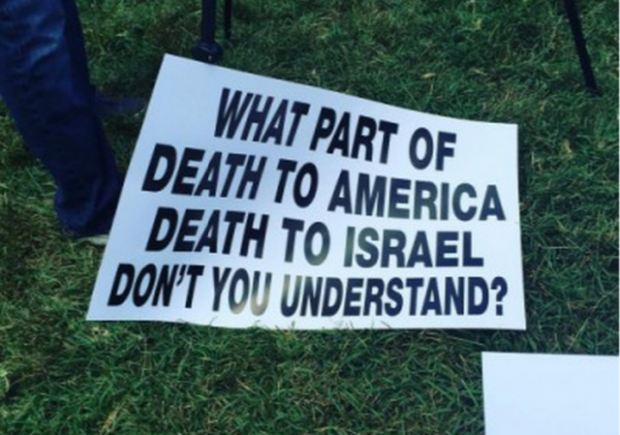
Protest-Sign-Against-Iran-Nuclear-Deal-Death-to-America-e1441978760141-620x435


I think we all know what Iran means when it speaks of political free will. In the wake of the adoption of the Iran nuclear deal, conversations about nightmare “what if” scenarios focused on America’s ability to “snap” sanctions against Iran back into place; now, Iran is trying to reframe the conversation about the use of sanctions by arguing that the use of sanctions at all will constitute a greater violation than what the sanctions are meant to punish.

***************************

This week, Iran used its considerable muscle to launch an attack on US efforts to tamper its nuclear program and otherwise belligerent conduct in the Middle East. These efforts took the form of a proposed resolution in the United Nations Human Rights Council (UNHRC) that condemns the use of sanctions against misbehaving nations as a violation of international law and fundamental human rights.

You won’t see the word “sanctions” more than three times in the resolution; instead, the drafters used the phrase “unilateral coercive measures.” From the proposed resolution:

Recognizing the universal, indivisible, interdependent and interrelated character of all human rights and, in this regard, reaffirming the right to development as a universal and inalienable right and an integral part of all human rights,

Expressing its grave concern at the negative impact of unilateral coercive measures on human rights, development, international relations, trade, investment and cooperation,

Reaffirming that no State may use or encourage the use of any type of measure, including but not limited to economic or political measures, to coerce another State in order to obtain from it the subordination of the exercise of its sovereign rights and to secure from it advantages of any kind,

Recognizing that unilateral coercive measures in the form of economic sanctions have far-reaching implications for the human rights of the general population of targeted States, disproportionately affecting the poor and the most vulnerable classes,

Recalling also article 1, paragraph 2, common to the International Covenant on Civil and Political Rights and the International Covenant on Economic, Social and Cultural Rights, which provides that, inter alia, in no case may a people be deprived of its own means of subsistence,

1. Calls upon all States to stop adopting, maintaining or implementing unilateral coercive measures not in accordance with international law, international humanitarian law, the Charter of the United Nations and the norms and principles governing peaceful relations among States, in particular those of a coercive nature with extraterritorial effects, which create obstacles to trade relations among States, thus impeding the full realization of the rights set forth in the Universal Declaration of Human Rights and other international human rights instruments, in particular the right of individuals and peoples to development;

The writing goes on to demand that member states ignore calls for sanctions, and condemns the use of such “as tools of political or economic pressure against any country, particularly against developing countries, with a view to preventing these countries from exercising their right to decide, of their own free will, their own political, economic and social systems.”

I think we all know what Iran means when it speaks of political free will. In the wake of the adoption of the Iran nuclear deal, conversations about nightmare “what if” scenarios focused on America’s ability to “snap” sanctions against Iran back into place; now, Iran is trying to reframe the conversation about the use of sanctions by arguing that the use of sanctions at all will constitute a greater violation than what the sanctions are meant to punish.

This isn’t a one-off finger-in-the-air from Iran to the US. The UNHRC is a dysfunctional land of multilingual politicking, and now the most dangerous players are using their influence with the greater UN body to bolster the worst violators at the expense of what should be common sense.

More from UN Watch [emphasis mine]:

Earlier this year, the UNHRC’s infamous Consultative Group, with Saudi Arabia’s Faisal Trad then serving merely as Vice-President, successfully picked Algerian hardliner Idriss Jazairy — famous for his efforts as a former diplomat to enact a UNHRC “code of conduct” to intimidate independent human rights experts — as the new “Special Rapporteur on the negative impact of the unilateral coercive measures.”

Jazairy has already accused the U.S. and Europe of being leading human rights violators due to their use of sanctions against countries like Iran and Zimbabwe.

Indeed, many of the resolutions adopted at each session of the UNHRC are sponsored by Cuba, Iran, Pakistan, Algeria, and other non-democracies, and are designed to demonize the West, free market economies, individual rights, or Israel, as part of a strategy to deflect attention from council members who are guilty of subjugating women, trampling religious freedom, persecuting gays, oppressing ethnic minorities and promoting relgious extremism.

This is clever, and part of a bigger strategy meant to counter American and Israeli efforts to speak out against the Iran nuclear deal. Even in the US, the media’s narrative has taken a subtle shift, away from the back and forth in Congress and toward an optic that frames the deal in terms of what it can do to encourage the advent of greater global cooperation. WaPo on Friday published an article needling the Republican Congress’ apparent rejection of “multilateralism”; meanwhile, the NYT editorial board executed a hard pivot away from the political theatre of the moment and toward What We Really Need to be Talking About© in terms of America’s participation in Gulf state politics.

The United Nations itself isn’t necessarily an important player in the American political conversation; international law is obscure, and multilateral relationships are [a] complication and confusing at best. However, if this resolution is adopted (and even if it isn’t) I can just about guarantee that the pro-Iran Deal crowd will use it as a weapon against anti-Deal candidates (primary season doesn’t go away just because we’re dealing with something happening in Geneva) currently warning their colleagues against the folly of attempting to deal with a nation that has proven itself more than adept at sidestepping the rules.

In this case, they’ve taken it upon themselves to rewrite them.

You can read the full proposed resolution here.

Iran Openly Declares That It Intends To Violate UNSCR 2231 That Endorses The JCPOA

September 23, 2015

Iran Openly Declares That It Intends To Violate UNSCR 2231 That Endorses The JCPOA, Middle East Media Research Institute, September 22, 2015

(Please see also, Iran wants to renegotiate parts of the nuke “deal.” That may be good. Iran’s declaration that it intends to violate UNSCR 2231, dealing with missile development and related sanctions, should further prompt the U.S. Congress to repudiate the “deal.”– DM)

When the Americans moved the sanctions on the missile program to UNSCR 2231, Iran did not object, as, according to their statements above, they can violate Security Council resolutions, as they have done in the past, and this will not be regarded as a violation of the JCPOA.

**************************

In statements, three Iranian leaders – President Hassan Rohani, Foreign Minister Zarif, and Deputy Foreign Minister and senior negotiator Abbas Araghchi – emphasized that Iran has no intention of abiding by UNSRC 2231, which includes the JCPOA and another element; rather, that they will abide only by the original JCPOA.

The Iran nuclear deal consists of the following:

A.   A set of understandings between Iran and the P5+1 powers (as well as the remaining disagreements) all in a single package called the JCPOA. It is not a contract between Iran and the P5+1 countries as a group or any single one of them, and hence no document was signed.

B.   This set of mutual understandings (as well as disagreements) packaged in the JCPOA was transferred, following the conclusion of negotiations in Vienna on July 14, 2015, to the UN Security Council, for endorsement as a UN Security Council resolution. The resolution, UNSCR 2231, was passed on July 25, 2015 and it includes, in addition to the JCPOA, another element (Annex B) with further stipulations regarding Iran. For example, it addresses the sanctions on Iran’s missile development project.

To understand why UNSCR 2231 is structured in this way, we can look at statements by top Iranian negotiators about the process that led up to it:

In a July 20, 2015 interview on Iranian Channel 2, Iranian Deputy Foreign Minister and senior negotiator Abbas Araghchi said that there had been tough bargaining between the Iranian and American delegations over the issue of the arms embargo on Iran and the sanctions related to Iran’s missile development project. “The Americans sought their inclusion in the JCPOA, claiming that otherwise they could not face criticism from Arab countries in the region. When they said that they could not lift the sanctions altogether, we told them explicitly that in that case there is no agreement. We told them that the national security issues are non-negotiable and that we will not accept an agreement which continues the embargo on weapons and the sanctions on missile development. In the end, the Americans said, We will put the issue of the embargo and the missiles in the UN Security Council Resolution separate from the agreement.”

In the same interview, Araghchi was asked whether Iran could refrain from carrying out UNSCR 2231; he replied: “Yes we can; just as we refrained from complying with UN Security Council resolutions, we can do so with regards to 2231.”

Araghchi also referred to the Iranian Foreign Ministry statement issued following the passage of UNSCR 2231: “The Iranian Foreign Ministry statement explicitly noted that Iran does not attach legitimacy to any restriction and any threat. If UNSCR 2231 will be violated by Iran, it will be a violation of the Security Council resolution and not of the JCPOA, similar to what happened 10 years ago when we violated Security Council resolutions and nothing happened. The text of the JCPOA notes the fact that the content of the JCPOA and of the UN Security Council resolution are two separate things.”[1]

Foreign Minister Zarif, in an August 9, 2015 media interview, reiterated the Iranian position regarding the difference between the JCPOA and UNSCR 2231, with a focus on the consequences of possible violation of the two by Iran. He said: “There is a difference between the JCPOA and UNSCR 2231. Violating the JCPOA has consequences, while violating UNSCR 2231 has no consequences.”[2]

Indeed, the restrictions regarding missiles are mentioned only in UNSCR 2231, and not in the JCPOA.

On August 29, 2015, Iranian President Hassan Rohani said: “There is nothing about the topic of missiles, defense, and weapons in the JCPOA.  Whatever we have about it is in Resolution [UNSCR] 2231… Moreover, we have formally announced that we are not committed to all the sections that appear in the resolution [2231], and we specified in the JCPOA that violation of the resolution [2231] does not mean violation of the JCPOA…[3]

The meaning of all this is that in everything related to the issue of missile development, Iran will disregard UNSCR 2231. Already during the negotiations, it insisted on no imposition of sanctions on Iran regarding its missile development (and no sanctions at all). When the Americans moved the sanctions on the missile program to UNSCR 2231, Iran did not object, as, according to their statements above, they can violate Security Council resolutions, as they have done in the past, and this will not be regarded as a violation of the JCPOA.

Endnotes:

[1] ISNA.ir/fa/news/94042915462/%D9%85%D9%85%D9%86%D9%88%D8%B9%DB%8C%D8%AA-%D9%87%D8%A7%DB%8C-%D8%AA%D8%B3%D9%84%DB%8C%D8%AD%D8%A7%D8%AA%DB%8C-%D9%88-%D9%85%D9%88%D8%B4%DA%A9%DB%8C-%D8%A8%D9%87- .

[2] Foreign Minister Javad Zarif said this at an August 9, 2015 conference sponsored by the Iranian daily Ittil’atwith other senior negotiators in attendance. See text in Farsi here.

[3] President.ir/fa/89047, August 30, 2015.

Iran wants to renegotiate parts of the nuke “deal.” That may be good.

September 22, 2015

Iran wants to renegotiate parts of the nuke “deal.” That may be good. Dan Miller’s Blog, September 22, 2015

(The views expressed in this article are mine and do not necessarily reflect those of Warsclerotic or those of its other editors. — DM)


Iran wants sanctions relief to be lifted, immediately, and not merely suspended. Iran should not get that. If it doesn’t, it may well terminate the “deal” unilaterally. If Iran gets what it wants, the Senate should review the “deal” as a treaty and reject it. Either outcome would be a substantial improvement over the current “deal” and the morass in which it is embedded.

This post is based on a September 21st article at Middle East Media Research Institute (MEMRI) titled “Expected September 28 NY Meeting Between P5+1 Foreign Ministers And Iran Could Signify Reopening Of Nuclear Negotiations To Address Khamenei’s September 3 Threat That If Sanctions Are Not Lifted, But Merely Suspended, There Will Be No Agreement.”

The MEMRI article cites statements by Supreme Leader Khamenei and one of his senior advisers, Ali Akbar Velayat. The latter said, on September 19th,  “the nuclear negotiations are not over yet.” Khamenei has said much the same thing.

Khamenei said, in a September 3, 2015 speech to the Assembly of Experts, that he did not accept the terms of the agreement and demanded that the sanctions be immediately lifted rather than merely suspended; otherwise, he said, there would either be no agreement, or Iran too would merely suspend its execution of its obligations under the JCPOA.

. . . .

“Freezing or suspension [of the sanctions] is unacceptable to me… If they suspend [the sanctions], we too will suspend [what is incumbent upon us]. If we are to implement what [is required of us], the sanctions must be [actually] cancelled.

Iran has thus made clear that it will not abide by the nuke “deal” as written; unless it gets the changes it now demands, it will either terminate the deal or violate it. If, as seems likely for the reasons cited in the MEMRI article, the September 28th meeting involves discussion of the deal, it will either be renegotiated or it won’t be.

If the “deal” is not renegotiated, or is renegotiated and Iran does not get what it demands, it may very well terminate the deal. Iran has already received substantial sanctions relief, is already open for business and is already doing lots of it with many more nations than previously. Termination would be a rebuff to the “Great Satan,” would not damage Iran much economically and it could proceed with its “peaceful” nuke program without even farcical nuke self-inspections.

If The Obama administration and others cave and Iran gets what it demands or enough to satisfy it, the “deal” will be very different from what was previously presented to the Congress under the Corker legislation. That legislation purported to eliminate the constitutional requirement of approval of the “deal” by a two-thirds Senate majority before going into effect and permitted it to go into effect unless rejected by half of the membership of both houses; Obama promised to veto such a rejection and put the “deal” into effect. The House has disapproved the “deal” but the Senate has not acted because of Democrat fillibusters, urged by the White House. Under the new “deal,” the ability of the United States to “snap back” sanctions would be vitiated; a possible but very difficult if not impossible to accomplish, “snap back” had been among the reasons cited by many of those who favored the “deal” (often despite its many other flaws) for supporting it.

If a deal eliminating the “snap back” is struck, Obama, et al, may well claim that it’s none of the business of the Congress since, by virtue of the Corker legislation, it has already eliminated its constitutional authority to deal with the JCPOA as a treaty, regardless of any “minor” change.

I hope, but am less than confident, that both houses of the Congress will reject this contention vigorously and repeal the Corker legislation. Whatever benefits or other legitimacy the Corker legislation may once have been thought to have it no longer has. Repeal will probably require use of the “nuclear option” to invoke cloture to end a Democrat filibuster in the Senate. If — as seems likely — Obama vetoes the rejection, the Congress should state that it no longer considers itself bound by the Corker legislation. Next, the Senate should treat the renegotiated “deal” as a treaty, regardless of whether Obama agrees to send it to the Senate, and reject it. It should do so even if, as also seems likely, that requires use of the “nuclear option” to invoke cloture.

Obama has precipitated what may well become a constitutional crisis. If the Congress does its job, Obama will be the loser and America will be the winner — even if it becomes necessary to take out Iran’s nukes militarily.

