Posted tagged ‘Iran – sanctions relief’

IAEA’s PMD Report Is Being Written In Negotiation With Iran, Not Independently

November 29, 2015

Statements By Iranian Deputy Foreign Minister Abbas Araghchi Indicate: IAEA’s PMD Report Is Being Written In Negotiation With Iran, Not Independently, MEMRI, November 27, 2015

(Here’s a link to a July 16, 2015 interview in which Kerry stated,

“The possible military dimensions, frankly, gets distorted a little bit in some of the discussion, in that we’re not fixated on Iran specifically accounting for what they did at one point in time or another,” Kerry said. “We know what they did. We have no doubt. We have absolute knowledge with respect to the certain military activities they were engaged in. What we’re concerned about is going forward. It’s critical to us to know that going forward, those activities have been stopped, and that we can account for that in a legitimate way.”

— DM)

Araghchi’s interview indicates that Iran has been following the writing of the IAEA report and has been submitting comments to the IAEA and the P5+1, and has in fact been exerting constant pressure on Amano and on the P5+1 in order to ensure that the PMD dossier be closed and the report be worded unequivocally and to Iran’s complete satisfaction.

********************

In a November 25, 2015 interview on Iranian television, Iran’s deputy Foreign Minister Abbas Araghchi said that he recently held talks with IAEA director-general Yukiya Amano on “closing the Possible Military Dimension (PMD) dossier”, and the latter filled him in about “some of the points he is to present” in the upcoming IAEA report on this issue. Araghchi noted that he had also spoken with the Americans and Europeans in Vienna, and had understood from them that “they too were heading towards closing the PMD dossier.” [1]

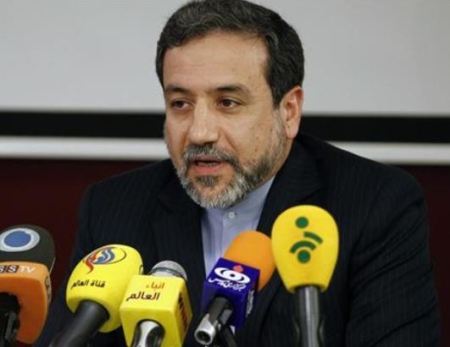
25842Abbas Araghchi (Image: Press TV, Iran)

It should be recalled that Ali Akbar Salehi, the head of Iran’s Atomic Energy Organization and a member of the nuclear negotiation team, said in a June 21, 2015 interview on Iranian television that Iran had “reached understandings with the IAEA” on the PMD issue, and added: “Now there is political backing [of the P5+1], and the [PMD] issue should be resolved.” He stated further: “By December 15, [2015], at the end of the year, the issue [of the PMD] should be determined. The IAEA will submit its report to [its] board of governors. It will only submit it. The Joint Comprehensive Plan of Action will continue independently of the results of this report. We have reached understandings with the IAEA… The technical issues are now being resolved in a political framework. They have set a time frame and, God willing, the issue must be resolved by December 15.” In response to the interviewers’ remark that the IAEA has “a bad record” (in terms of cooperating with Iran), Salehi stated: “In short, they [the IAEA] will be the losers. As I have said, the issue has received political backing. The work of [the IAEA] must be reasonable. They cannot do anything unreasonable. When there is no political backing, they do whatever they want, but now there is political backing, and the issue should be resolved.”[2]

In a recent news conference, Amano said that that “the report will not be black and white,” and that the PMD issue “is an issue that cannot be answered by ‘yes’ or ‘no'”.[3]

In his November 25 interview, Araghchi said: “In the next few days our experts will be in contact with the IAEA experts, and if necessary they will bring up additional points. I may also meet with Amano again… They [our experts] told us there were some weak points in the IAEA report and I commented on them. I am optimistic that they will be corrected…”

He added: “I don’t think there is any plan behind the scenes to leave the PMD dossier open. We have not received any indications that there is a plan [of this kind] behind the scenes. In any case I provided the Americans and Europeans with the necessary comments.”

He stated further: “On December 1, 2015, we expect this report to be published and submitted to the [IAEA] Board of Governors. A special board meeting has been scheduled for December 15, 2015, in which a resolution on the IAEA report will be taken. During this time [until December 15], the P5+1 group will submit a [draft] resolution [to the IAEA Board of Governors] with the objective of  closing the PMD dossier, and [this draft resolution] will come up for a vote in its December 15, 2015 meeting. Also, on December 7, 2015, there will be a meeting of the JCPOA Joint Commission in Vienna, attended by [representatives of] Iran and the P5+1, in which we will discuss the P5+1 [draft] resolution on closing the PMD. We have taken all the necessary steps so that on December 15, 2015, [the IAEA Board of Governors] will resolve to close the PMD dossier and this issue will be put to rest.”

According to Araghchi, “if the [IAEA] Board of Governors does not close the PMD dossier, the process of implementing the JCPOA will stop. Hence, the P5+1 must decide between the PMD and the JCPOA… In the past, the P5+1 chose the JCPOA. The [Supreme] Leader [Khamenei]’s letter on Iran’s implementation of the nuclear steps [a document published by Khamenei in October 21 detailing 9 additional conditions for Iranian compliance with the JCPOA][4] likewise emphasizes that they must choose between the JCPOA and the PMD.”[5]

According to Iran’s Press TV news agency, Araghchi said in the same interview: “If Yukiya Amano or the [IAEA’s] board of governors will present their report in such a way that it does not meet the stipulated commitments, the Islamic Republic of Iran will also stop [the implementation of] the JCPOA.”[6] In this statement, Araghchi implies that Iran has received commitments that the PMD dossier will be closed.

Araghchi’s interview indicates that Iran has been following the writing of the IAEA report and has been submitting comments to the IAEA and the P5+1, and has in fact been exerting constant pressure on Amano and on the P5+1 in order to ensure that the PMD dossier be closed and the report be worded unequivocally and to Iran’s complete satisfaction.

It should also be recalled that the inspection of the Parchin military facility, carried out to determine whether Iran’s program had military dimensions, consisted of Iran submitting samples that were not collected in the presence of IAEA inspectors and were later submitted to the IAEA, so that their origin cannot be absolutely determined.

As for the steps currently being taken by Iran to comply with the JCPOA, Araghchi clarified that “none of the steps so far taken by Iran in this matter contravenes the [Supreme] Leader’s letter…  and, as far as I know, [we] are still in the stage of dismantling the inactive centrifuges.” (Both Iranian Atomic Agency Spokesman  Behrouz Kamalvandi and Iranian National Security Council secretary Ali Shamkhani have indeed said that Iran has transferred inactive centrifuges from one facility to another, but no active centrifuges have been dismantled).[7]


Endnotes:

[1] ISNA (Iran), November 25, 2015.

[2] See MEMRI TV Clip No. 5014,  We Have Reached Understandings with the IAEA about the PMD; Technical Issues Are Now Being Resolved on a Political Level, July 21, 2015.

[3] Reuters.com, November 26, 2015.

[4] See MEMRI Daily Brief No.65, MEMRI: ‘The Emperor Has No Clothes,’ October 30, 2015.

[5] ISNA (Iran), November 25, 2015.

[6] Press TV (Iran), November 26, 2015.

[7] Kamalvandi: ISNA (Iran), November 3, 2015; Shamkhani: Fars (Iran), November 10, 2015.

Iran breaks the world executions record

November 17, 2015

Iran breaks the world executions record, Front Page MagazineDr. Majid Rafizadeh, November 17, 2015

Iranian executions

Is the Obama administration aware that it is trusting and dealing with a country that has just broken the world record in executions? Of course the President is aware of that, and it seems that he has decided to turn a blind eye to Iran’s increasing aggression and oppression inside and outside of its own country.

According to the recent and fifth report by the special United Nations investigator of human rights, human rights violations in Iran are rising even since the nuclear agreement was reached. Accordingly, execution rates have been increasing at “an exponential rate” in Iran. In 2014, 753 were executed and at least 694 people (including women and juveniles) were executed from January 2015 till mid-September. This is reported to be the highest rate of execution the Islamic Republic has had in 25 years.

If we take the ratio of the population into consideration, the Islamic Republic breaks the world record in number of executions per capita. As Ahmed Shaheed, the U.N. special rapporteur for human rights in Iran, pointed out, “The Islamic Republic of Iran continues to execute more individuals per capita than any other country in the world. Executions have been rising at an exponential rate since 2005 and peaked in 2014, at a shocking 753 executions[.]” According to the UN analyst, Iran is on track to execute more than 1000 people by the end of this year. Of course, these are only the official numbers being reported by the Iranian regime, the unreported number of executions by the government is likely much higher.

An execution may be ordered over many things, such as insulting the Supreme Leader, enmity toward Allah, and other non-violent offenses. According to the U.S. State Department’s  Human Rights report on Iran, “the law criminalizes dissent and applies the death penalty to offenses such as ….‘attempts against the security of the state,’ ‘outrage against high-ranking officials,’ ….(moharebeh), and ‘insults against the memory of Imam Khomeini and against the supreme leader of the Islamic Republic.’”

In addition, when it comes to journalists, social media activists, and women, political rights, discriminatory laws, as well as arbitrary detentions have been on the rise as well. According to the global gender gap index of the World Economic Forum, the Islamic Republic is ranked 137 out of 142, followed by Mali, Syria, Chad, Pakistan and Yemen.

In contrast to the report, a more liberal, softer and open image of the Islamic Republic has been repeatedly projected to the international community by Iranian President Hassan Rouhani, Mohammad Javad Zarif, the Western-educated foreign minister, and his technocratic team.

There was an assumption by liberals that several developments, including the improving ties between the West and Iran, the nuclear agreement, and the presidency of a moderate political figure would translate into improving civil liberties, social justice and removing restrictions on political critics in Iran. However, the real picture inside the country suggests a much different landscape. As Azita, an Iranian human rights activist and teacher from the ethnically Azeri-populated city of Tabriz said, “This is similar to, or even worse than, the period of Khatami where Basij, moral police, and IRGC increased suppression in order to tell the young people particularly that the laws will not changed.”

The State Department report clearly highlights the notion that the superficial illusion of a softer image projected by Iran belies the social, political, and economic reality inside the country.

This explains three phenomena. First, although President Rouhani promised that he will improve several critical issues such as civil liberties, social justice, freedom of expression, assembly, and press, and women’s rights, he decided to instead solely focus on the nuclear deal in order to get Iran out of the financial sanctions that restrained its growth.

Secondly, one can make the argument that President Rouhani has also decided not to cross the boundaries of Iran’s Revolutionary Guard Corps (IRGC) by cooperating with them and allowing them to have full control over domestic social and political policies, as well as foreign policy (Syria, Hezbollah, etc.).

Third, the hardliners are increasing their repressive tools and cracking-down on civil liberties in order to send a message to the Iranian young people and the West that the nuclear agreement does not mean Tehran is going to open up its political system and loosen Sharia law.

Iran’s Supreme Leader, Ayatollah Ali Khamanei, and his social base (the hardliners) are very concerned that Iranian youth might become a source of revolution. As a result they attempt to keep the country closed and they fear Western political and cultural influence on young people.

As Mr. Khamanei warned the senior cadre of the IRGC, “The main purpose of the enemies is for Iranians to give up on their revolutionary mentality…Enemy means global arrogance, the ultimate symbol of which is the United States….Economic and security breaches are definitely dangerous, and have dire consequences…But political and cultural intrusion by the enemy is a more serious danger that everyone should be vigilant about.”

Finally, the nuclear agreement seems to have overshadowed the human rights conditions inside Iran and the repressive Shiite Islamist laws. European countries and the Obama administration appear to have been turning a blind eye and have been becoming less critical of the Islamic Republic’s human rights record since the nuclear negotiation began and after the nuclear deal was signed.

It is time for the Obama administration to draw attention to the real face of the so-called moderate president of Iran who contradicts the truth by depicting himself and his country in a softer image to the world while simultaneously allowing executions and egregious, appalling and atrocious human rights abuses on his watch.

Iran Waiting for IAEA Report for Removing Centrifuges: Spokesman

November 4, 2015

Iran Waiting for IAEA Report for Removing Centrifuges: Spokesman, Tasnim News Agency (Iranian), November 4, 2015

(Please see also, ‘Media misleading by reporting that Iran implementing nuclear deal’  — DM)

Iran guy

TEHRAN (Tasnim) – Spokesman for the Atomic Energy Organization of Iran (AEOI) Behrouz Kamalvandi announced that the country does not plan to decommission its centrifuges for now and will wait for the International Atomic Energy Agency (IAEA) report.

Speaking to the Islamic Republic of Iran Broadcasting (IRIB) on Tuesday night, Kamalvandi referred to the start of Tehran’s preliminary measures as per the text of a recent nuclear agreement with six world powers, dubbed the Joint Comprehensive Plan of Action (JCPOA), according to which the country is supposed to reduce the number of its centrifuges.

However, he said for the removal of centrifuges, the country should wait for a report by the IAEA on Iran’s nuclear activities.

On July 14, Iran and the IAEA signed a Road-map regarding the Islamic Republic’s nuclear work in the Austrian capital city of Vienna.

As part of the Road-map, the IAEA is required to finish its investigations about Iran’s nuclear activities and submit a report to the agency’s board by December 15.

In reaction to certain reports on the removal of 200 centrifuges from Natanz nuclear site, Kamalvandi had said earlier on Tuesday that no centrifuge has been mothballed yet.

Iran and the Group 5+1 (Russia, China, the US, Britain, France, and Germany) on July 14 reached a conclusion on a 159-page nuclear agreement that would terminate all nuclear-related sanctions imposed on Tehran over its nuclear energy program.

The agreement was officially adopted on October 18, and is going to take effect within the next two months.

Our World: Showdown at the OK Corral

November 3, 2015

Our World: Showdown at the OK Corral, Jerusalem Post, Caroline Glick, November 2, 2015

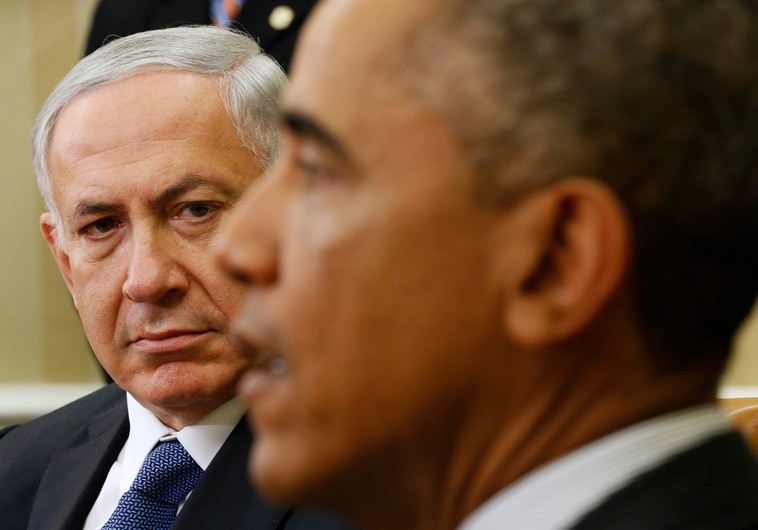
ShowImage (16)US President Barack Obama meets with Prime Minister Benjamin Netanyahu at the White House, October 1, 2014. (photo credit:REUTERS)

Whatever he says before the cameras next week when he meets with Netanyahu, Obama has no intention of letting bygones be bygones.

Prime Minister Benjamin Netanyahu’s meeting with US President Barack Obama next week is likely to look less like a rapprochement than a showdown at the OK Corral.

The flurry of spy stories spinning around in recent weeks makes clear that US-Israel relations remain in crisis.

Two weeks ago, The Wall Street Journal published a fairly detailed account of the US’s massive spying operations against Israel between 2010 and 2012.

Their purpose was to prevent Israel from attacking Iran’s nuclear installations. The Journal report, which was based on US sources, also detailed the evasion tactics the Obama administration employed to try to hide its covert nuclear talks with Iran from Israel. According to the report, the administration was infuriated that through its spy operations against Iran, Israel discovered the talks and the government asked the White House to tell it what was going on.

Over the past several days, the Israeli media have reported the Israeli side of the US spying story.

Friday Makor Rishon’s military commentator Amir Rapaport detailed how the US assiduously wooed IDF senior brass on the one hand and harassed more junior Israeli security officials on the other hand.

Former IDF chiefs of General Staff Lt.-Gens. Gabi Ashkenazi and Benny Gantz were given the red carpet treatment in a bid to convince them to oppose Israeli strikes on Iran’s nuclear installations. More junior officials, including officers posted officially to the US were denied visas and subjected to lengthy interrogations at US embassies and airports in a bid to convince them to divulge information about potential Israeli strikes against Iran.

Sunday, Channel 2 reported that the IDF’s Intelligence Directorate’s information security department just issued guidance to all IDF soldiers and officers warning them about efforts by the CIA to recruit them as US agents.

These stories have been interpreted in various ways. Regardless of how they are interpreted, what they show is that on the one hand, the Obama administration has used US intelligence agencies to weaken Israel’s capacity to harm Iran and to actively protect Iran from Israel. And on the other hand, Israel is wary of the administration’s efforts to weaken it while strengthening its greatest foe.

These stories form the backdrop of next week’s meeting between Netanyahu and Obama – the first they will have held in more than a year. They indicate that Obama remains committed to his policy of weakening Israel and downgrading America’s alliance with the Jewish state while advancing US ties with Iran. Israel, for its part, remains deeply distrustful of the American leader.

This Israeli distrust of Obama’s intentions extends far past Iran. Recent statements by Obama and Secretary of State John Kerry have convinced Israel that during his last 15 months in office, Obama intends to abandon US support for Israel at the UN Security Council, and to ratchet up pressure and coercive measures to force Israel to make irreversible concessions to the Palestinians.

From Netanyahu’s perspective, then, the main strategic question is how to prevent Obama from succeeding in his goal of weakening the country.

The implementation of Obama’s deal with Iran deal will form a central plank of whatever strategy the government adopts.

As far as Obama and his allies see things, the nuclear accord with Iran is a done deal. On October 21, House Minority Leader Nancy Pelosi hosted a reception for Democratic congressmen attended by White House Chief of Staff Denis McDonough to celebrate its official adoption.

Unfortunately for Pelosi and her colleagues, Iran is a far more formidable obstacle to implementing the deal than congressional Republicans. As Yigal Carmon, president of the Middle East Media Research Institute (MEMRI), explained in a report published on his organization’s website last week, at no point has any Iranian governing body approved the nuclear deal. Iran’s parliament, the Majlis, and its Guardians’ Council have used their discussions of the agreement to highlight their refusal to implement it. More importantly, as Carmon explains, contrary to US media reports, in his October 21 letter to Iranian President Hassan Rouhani, Iran’s Supreme leader Ayatollah Ali Khamenei did not give his conditional approval to the deal. He rejected it.

Carmon explained that the nine conditions Khamenei placed on his acceptance of the nuclear deal render it null and void. Among other things, Khamenei insisted that all sanctions against Iran must be permanently canceled. Obama couldn’t abide by this condition even if he wanted to because he cannot cancel sanctions laws passed by Congress.

He can only suspend them.

Khamenei also placed new conditions on Iran’s agreement to disable its centrifuges and remove large quantities of enriched uranium from its stockpiles.

He rejected inspections of Iran’s military nuclear installations. He insisted that Iran’s Arak heavy water reactor must remain capable of producing heavy water in contravention of the deal. And he insisted that at the end of the 15-year lifetime of the deal Iran must have sufficient uranium enrichment capability to enable it to develop bombs at will.

As Carmon noted, the US and EU have announced that they will suspend their nuclear sanctions against Iran on December 15 provided that by that date, the UN’s International Atomic Energy Commission certifies that Iran has upheld its part of the bargain.

By that date, in conformance with their interpretation of the nuclear deal, the US and the EU expect for Iran to have reduced the number of centrifuges operating at the Natanz facility from 16,000 to 5,060 and lower enrichment levels to 3.67%; reduce the number of centrifuges at Fordow to a thousand; remove nearly all its advanced centrifuges from use; permit the IAEA to store and seal its dismantled centrifuges; reduce its stockpile of enriched uranium to 300kg.; remove the core from the Arak reactor and disable it; and submit to agreed monitoring mechanisms of its nuclear sites.

Carmon noted that Iran has taken no steps to fulfill any of these conditions.

With Khamenei’s rejection of the nuclear deal and Iran’s refusal to implement it, there are two possible ways the US and the EU can proceed.

First, as Carmon suggests, Obama and the EU may renew nuclear talks with Iran based on Khamenei’s new position. These talks can drag out past Obama’s departure from office. When they inevitably fail, Obama’s successor can be blamed.

The other possibility is that Iran will implement some component of the deal and so allow Obama and the EU to pretend that it is implementing the entire deal. Given the US media’s failure to report that Khamenei rejected the nuclear pact, it is a fair bet that Obama will be able to maintain the fiction that Iran is implementing the deal in good faith until the day he leaves office.

So what is Israel to do? And how can Netanyahu use his meeting with Obama next week to Israel’s advantage? Israel has two policy options going forward. First, it can highlight the fact that Iran is not implementing the deal, just as Israel took the lead in highlighting the dangers of the nuclear accord with Iran over the past year. This policy can potentially force Obama onto the defensive and so make it harder for him to go on the offensive against Israel at the UN and other venues in relation to the Palestinians.

But then, it is far from clear that Obama will be deterred from adopting anti-Israel positions at the UN even if Israel succeeds making an issue of Iranian noncompliance with the nuclear deal.

Moreover, if Netanyahu leads the discussion of the Iran’s bad faith, as he drove the discussion of the nuclear deal itself, he will reinforce the already prevalent false assessment in the US that a nuclear Iran threatens Israel but is not dangerous for the US.

This incorrect assessment has made a lot of Americans believe that by seeking to prevent Iran from acquiring nuclear weapons, Israel is advancing is own interests at America’s expense.

The other policy option is the one that Defense Minister Moshe Ya’alon indicated Israel is pursuing in his meeting last week with his counterpart Defense Secretary Ashton Carter. At the Pentagon Ya’alon declared, “The Iran deal is a given. Our disputes are over.”

The downside of this position is that it indicates that Israel accepts the legitimacy of a deal that Iran is not implementing and that would imperil Israel’s national security even if Iran were implementing it.

Its upside is that it takes Israel out of the US debate regarding the nuclear deal. To the extent that opponents of Obama’s Iran policy are willing to lead the fight against the deal themselves, Israel could do worse than to take a step back and plot its own course on Iran, independent of the US policy discussion.

It is hard to know which line of action makes more sense. But as the spy stories demonstrated, one thing is clear enough. Whatever he says before the cameras next week when he meets with Netanyahu, Obama has no intention of letting bygones be bygones.

Leader: Negotiation with US on Regional Issues Meaningless

November 1, 2015

Leader: Negotiation with US on Regional Issues Meaningless, Tasnim News Agency (Iranian), November 1, 2015

139408101241559676429254


While many consider the Joint Comprehensive Plan of Action (JCPOA) a major breakthrough in the improvement of ties between Iran and the West, the Leader has already made it clear that Tehran’s policy toward the US will remain unchanged regardless of the ultimate fate of the JCPOA.

***********************

TEHRAN (Tasnim) – Supreme Leader of the Islamic Revolution Ayatollah Seyed Ali Khamenei dismissed the idea of Iran-US negotiation on regional issues, saying the totally contrasting policies of the two countries and Washington’s attempts to impose its demands make such talks pointless.

In a meeting with the Foreign Ministry staffers in Tehran on Sunday, Ayatollah Khamenei underlined that Iran’s foreign policy is founded upon the Constitution, the long-term interests of the country and the Islamic Republic’s values, and that, consequently, they do not change in different administrations.

Different administrations would affect only the “tactics and executive initiatives” in carrying out the country’s foreign policy strategies, the Leader stressed.

The Supreme Leader then dismissed as a Western illusion the notion that Iran’s foreign policy has undergone a forcible change.

Imam Khamenei further referred to the US policies in West Asia as the root cause of the tense situation across the region, adding, “Unlike the view of certain individuals, the US is the main plank of the region’s problems, not part of a solution to the problems.”

The Leader then called on the Iranian foreign ministry officials, ambassadors and diplomats to stick to the tenets of the Islamic Republic’s foreign policy “firmly, mightily and gloriously”, so that foreigners and their followers inside the country would not pin hopes on a shift in Iran’s foreign policy.

Ayatollah Khamenei referred to Iran’s policies on Palestine, Syria, Iraq, Yemen and Bahrain, saying they differ from those of the US by “180 degrees”.

The root cause of insecurity in the region is Washington’s support for the Zionist regime of Israel and the terrorist groups, the Leader underscored.

Imam Khamenei then categorically dismissed the idea of negotiations with the US on regional issues.

“The Americans seek to impose their interests, not to settle problems. They want to impose 60, 70 percent of their demands via negotiations, and practically implement and impose the rest of their objectives illegally. Then what would negotiations mean?”

Elsewhere, Ayatollah Khamenei lauded Foreign Minister Mohammad Javad Zarif and other diplomats for handling nuclear talks with six world powers well, saying they could very well safeguard the country’s goals in the talks.

Iran and the Group 5+1 (Russia, China, the US, Britain, France and Germany) on July 14 reached a conclusion on a lasting nuclear agreement that would terminate all sanctions imposed on Tehran over its nuclear energy program after coming into force.

While many consider the Joint Comprehensive Plan of Action (JCPOA) a major breakthrough in the improvement of ties between Iran and the West, the Leader has already made it clear that Tehran’s policy toward the US will remain unchanged regardless of the ultimate fate of the JCPOA.

Iranian Supreme Leader Khamenei’s Letter Of Guidelines To President Rohani On JCPOA Sets Nine Conditions Nullifying Original Agreement Announced July 14, 2015

October 23, 2015

Iranian Supreme Leader Khamenei’s Letter Of Guidelines To President Rohani On JCPOA Sets Nine Conditions Nullifying Original Agreement Announced July 14, 2015, Middle East Media Research Foundation, Y. Carmon and A. Savyon, October 22, 2015

(Please pay particular attention to Conditions 1 – 6 and their implications as noted by MEMRI. The conditions appear to be quite substantial. Additional material, including Twitter and Facebook messages, is also provided in appendices at the end of the article. I have not reproduced that material here.– DM)

On October 21, 2015, Iranian Supreme Leader Ali Khamenei published a letter of guidelines to Iranian President Hassan Rohani on the execution of the Joint Comprehensive Plan of Action (JCPOA). The letter’s publication coincides with the days of the Ashura that are of vital religious and national significance in Iran and symbolize steadfastness against the forces of evil. Intended as an historical document aimed at assuring Iran’s future, the letter was posted on Khamenei’s website in Persian and tweeted from his Twitter account and posted on his Facebook page in English (see Appendices), and published in English by the official Islamic Republic of Iran Broadcasting authority IRIB (see below). The letter is now a founding document in all things concerning theJCPOA and the conditions under which Iran will be willing to execute it.

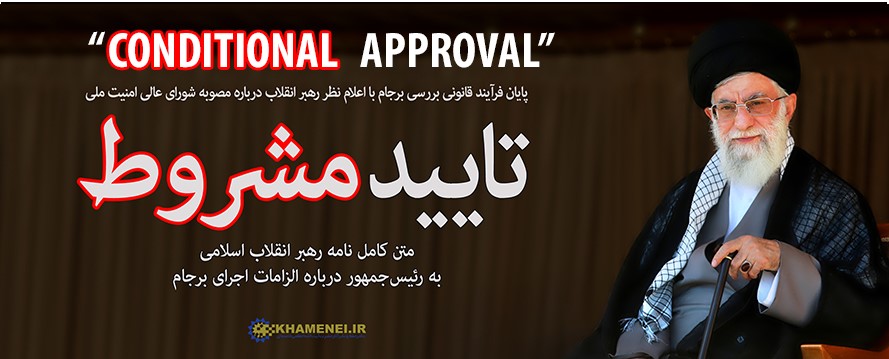
The letter, defined by Khamenei on his website as “conditional approval” of the JCPOA, sets several new conditions for Iran’s execution of the agreement. These conditions constitute late and unilateral additions to the agreement concluded three months previously that fundamentally change it. Khamenei stresses that the agreement awaits his opinion following what he calls “precise and responsible examination” in the Majlis and “clearance of this agreement through legal channels” in Iran’s Supreme National Security Council.  

25366

It should be further noted that in his introduction to the new conditions, Khamenei attacks the U.S. and President Obama with great hostility, and calls for Obama to be prosecuted by international judiciary institutions. He states that Obama had sent him two letters declaring that he has no intention of subverting the regime of the Islamic Republic of Iran, but adds that the U.S.’s support for fitna in Iran (i.e. the popular post-election unrest in 2009), its monetary aid to opponents of the Republic, and its explicit threats to attack Iran have proven the opposite and have exposed the real intent of America’s leaders, whose enmity towards Iran will not end. He wrote that the Americans’ behavior in the nuclear talks is another link in the chain of its enmity towards Iran, that America entered into the talks with the aim of “deception,” and that therefore Iran must remain alert in light of America’s hostile intentions.

The set of conditions laid out by Khamenei creates a situation in which not only does the Iranian side refrain from approving the JCPOA,[1] but, with nearly every point, creates a separate obstacle, such that executing the agreement is not possible.

The following are Khamenei’s nine conditions, and their implications:

Khamenei’s Conditions For Iranian Execution Of The JCPOA

First condition: Khamenei demands that the U.S. and Europe lift the sanctions, not suspend them, and in addition demands “solid and sufficient” guarantees in advance that this will be done, before Iran takes its own steps and meets its own obligations under the agreement. These guarantees, insists Khamenei, must include, inter alia, an official letter from the U.S. president and from the EU undertaking to fully lift the sanctions. Furthermore, he demands that this letter will state that any declaration by the West that the “structure of the sanctions will remain in force” (i.e. allowing snapback) will be considered “non-compliance with the JCPOA” on the part of the West.

Implications: These conditions constitute a total change of the JCPOA. Khamenei is not allowing any execution of the JCPOA by Iran until this is accepted in writing by the other side, and thus he is nullifying the JCPOA as agreed upon on July 14, 2015.

Second condition: Any sanctions against Iran “at every level and on every pretext,” including terrorism and human rights violations, by any one of the countries participating in the negotiations will “constitute a violation of the JCPOA,” and a reason for Iran to stop executing the agreement.

Implications: This demand, that links the JCPOA to other issues and prohibits any punishment of Iran on any issue and for any reason, serves as an excuse for Iran to cancel the agreement.

Third condition: Under the JCPOA, Iran is obligated, following the JCPOA’s Adoption Day, to carry out its obligations concerning changing the function of the nuclear reactor at Arak and shipping out most of its stockpile of enriched uranium. Contrary to this, Khamenei is changing the timetable of the JCPOA, stating that Iran will not carry out these actions until after the International Atomic Energy Agency (IAEA) declares that it is closing its dossier on Iran’s “past and future issues (including the so-called Possible Military Dimensions or PMD of Iran’s nuclear program).”

Implications: This demand to change the timetable creates a situation in which Iran will not take action as stipulated in the JCPOA, and will not meet its obligations, before the sanctions are eased, also according to the JCPOA, but instead dictates that the sanctions must first be lifted completely and states that only then will Iran meet its obligations. Khamenei here is creating a situation in which the IAEA will not be able to report on Iran’s meeting of its obligations regarding the Arak reactor and regarding the shipping out of its enriched uranium by the target date of December 15, 2015, because Iran is not going to do so by then – thus the execution of the agreement is thwarted from the beginning.

Fourth condition: Iran will meet its obligations to “renovate” and change the purpose of the Arak reactor only after there is a signed agreement on an “alternative plan” for changes to the reactor, and after there is “sufficient guarantee” that this alternative plan will be implemented.

Implications: Iran’s fulfillment of its obligations regarding the Arak reactor, as stipulated by the JCPOA, will be postponed until some unknown future date.

Fifth condition: Iran will carry out its obligation to ship out its enriched uranium to another country in exchange for yellowcake “on a gradual basis and on numerous occasions,” and only after “a secure agreement has been clinched to that effect, along with sufficient guarantees” that this exchange will be implemented.

Implications: The date for Iran to ship out its enriched uranium as stipulated by the JCPOA is postponed until some unknown future date. Khamenei is demanding that Iran receive in exchange for the enriched uranium not raw uranium as per the JCPOA, but instead uranium that has been enriched, albeit to a lower level than the uranium it ships out. This is yet another change to the JCPOA as concluded on July 14, 2015.

Sixth condition: Khamenei instructs President Rohani to begin, along with reducing Iran’s ability to enrich uranium under the JCPOA, immediately to expand Iran’s ability to enrich uranium with a 15-year long-term plan for 190,000 centrifuge SWU (Separative Work Units). “This plan,” he says, “must allay any concern stemming from some points entailed in the JCPOA appendices.”

Implications: This article nullifies the declared goal of the JCPOA, which is to reduce Iran’s nuclear enrichment capabilities.

Seventh condition: The Iranian Atomic Energy Organization must ensure continued nuclear research and development, in its various dimensions, such that in eight years’ time, Iran will not be lacking in enrichment technology. This, he says, is all in accordance with the JCPOA.

Eighth condition: In the event of doubt or ambiguity regarding the content of the JCPOA, the source of authority for removing this doubt or ambiguity will be the content of the talks – i.e. it will also include the statements by the Iranian side, not just the “interpretation provided by the opposite party,” that is, the P5+1.

Implications: Any doubt or ambiguity regarding the content of the JCPOA will become the source of unending dispute and will paralyze any possibility of executing the agreement.

Ninth condition: Due to apprehensions that the other side, particularly the U.S., will break its promises or cheat, President Rohani must establish a “well-informed and smart panel” to monitor the execution of the agreement.

Implications: Khamenei is creating an administrative framework for perpetual delays in the execution of the agreement.

Khamenei adds also a 10th condition, directed at Iran, not the P5+1, demanding that Rohani take seriously his instructions in the matter of the “resistance economy,” the main thrust of which is self-reliance instead of basing Iran’s economy on external sources. He also demands that after the sanctions are lifted, there will be no “unbridled imports,” and no imports whatsoever from the U.S.

Political Ramifications In Iran

In February 2016, elections for the Majlis and the Assembly of Experts are set to take place in Iran. The pragmatic camp, headed by Hashemi Rafsanjani and President Rohani, had hoped that a quick execution of the agreement would allow the sanctions to be eased and funds to be released immediately, which in turn would allow the pragmatic camp to present these achievements and triumph in the elections. By setting these conditions, however, Khamenei has thwarted any speedy execution of the agreement, and thus has thwarted the pragmatic camp’s hope for electoral success.

IRIB Translation

The following is the official English translation of Khamenei’s letter, as published by IRIB.[2] This translation was tweeted by Khamenei and also posted on his Facebook page (see Appendix I and II).

“Wednesday, 21 October 2015 17:41
“Ayatollah Khamenei sends a letter to President Hassan Rouhani about the JCPOA

25367

“Ayatollah Seyyed Ali Khamenei, the Leader of the Islamic Revolution, in a letter to President Hassan Rouhani, who also heads the Supreme National Security Council (SNSC), referred to the precise and responsible examination of the Joint Comprehensive Plan of Action (JCPOA) in the Islamic Consultative Assembly (parliament) and also the SNSC, and the clearance of this agreement through legal channels, and issued important instructions regarding the observation of and safeguarding the country’s national interests. Enumerating nine-point requirements for the implementation of the JCPOA, Ayatollah Ali Khamenei endorsed SNSC Resolution 634, dated August 10, 2015, provided that the following provisions and requirements are observed.

“The full text of Ayatollah Khamenei’s letter follows on:

In the Name of Allah, the Most Compassionate, the Most Merciful

“Your Excellency,  Mr Rouhani,
“President of the Islamic Republic of Iran and Head of the Supreme National Security Council
“May God bestow success upon you.
“Greetings to You

“The agreement known as the Joint Comprehensive Plan of Action (JCPOA) has already been cleared through legal channels following precise and responsible examinations in the Islamic Consultative Assembly, [parliamentary] ad hoc committees and other committees as well as the Supreme National Security Council. Since the agreement is waiting for my view, I deem it necessary to remind several points so that Your Excellency and other officials directly or indirectly involved in the issue would have enough time to comply with and safeguard national interests and the country’s best interests.

“1. Before anything else, I deem it necessary to extend my gratitude to all those involved in this challenging procedure throughout all its periods, including the recent nuclear negotiating team whose members tried their best in explaining the positive points and incorporating all those points [into the agreement], critics who reminded all of us of weak points through their appreciable meticulousness, and particularly the chairman and members of the Majlis ad hoc committee [set up to review the JCPOA] as well as the senior members of the SNSC who covered some voids by including their important considerations, and finally the Speaker of Majlis and Members of Parliament who adopted a cautious bill to show the right way of implementation [of the agreement] to the administration, and also national media and the country’s journalists who despite all their differences of view presented a complete image of this agreement to public opinion. This voluminous collection of activity and endeavors and thoughts [spent] on an issue which is thought to be among the unforgettable and instructive issues of the Islamic Republic, deserves appreciation and is a source of satisfaction. Therefore, one can say with certainty that the divine reward for these responsible contributions will, God willing, include assistance and mercy and guidance by Almighty God because the divine promises of assistance in exchange for assisting His religion are unbreakable.

“2. Enjoying decades-long background of presence in the very details of the affairs of the Islamic Republic of Iran, you must have naturally realized that the government of the United States of America, neither in the nuclear issue nor in any other issue, had been pursuing no other approach but hostility and disturbance, and is unlikely to do otherwise in the future either. The remarks by the US President [Barack Obama] in two letters addressed to me on the point that [Washington] has no intention of subverting the Islamic Republic of Iran turned out to be unreal and his open threats of military and even nuclear strike, which can result in a lengthy indictment against him in international courts, laid bare the real intentions of US leaders. Political pundits and public opinion of many nations clearly understand that the case of his never-ending hostility is the nature and identity of the Islamic Republic of Iran, which is born out of the Islamic Revolution. Insistence on rightful Islamic stances and opposition to the hegemonic and arrogant system, perseverance against excessive demands and encroachment upon oppressed nations, revelations on the US support for medieval dictators and suppression of independent nations, incessant defense for the Palestinian nation and patriotic resistance groups, rational and globally popular yelling at the usurping Zionist regime constitute the main items which make the US regime’s enmity against the Islamic Republic inevitable, and this enmity will continue as long as the Islamic Republic [continues to] disappoint them with its internal and sustainable strength.

“The behavior and words of the US government in the nuclear issue and its prolonged and boring negotiations showed that this (nuclear issue) was also another link in their chain of hostile enmity with the Islamic Republic. Their deception through flip-flopping between their initial remarks that came after Iran accepted to hold direct talks with them and their constant non-compliance with their pledges throughout two-year-long negotiations and their alignment with the demands of the Zionist regime and their bullying diplomacy regarding relations with European governments and bodies involved in the negotiations are all indicative of the fact that the US’s deceitful involvement in the nuclear negotiations has been done not with the intention of a fair settlement [of the case], but with the ill intention of pushing ahead with its hostile objectives about the Islamic Republic.

“Doubtlessly, vigilance vis-à-vis the hostile intentions of the US government and instances of resistance on the part of the officials of the Islamic Republic of Iran throughout the negotiations managed, in numerous cases, to prevent heavy damage from being inflicted [upon Iran].

“However, the outcome of the negotiations, which is enshrined in the JCPOA, has numerous ambiguities and structural weaknesses that could inflict big damage on the present and the future of the country in the absence of meticulous and constant monitoring.

“3. The nine-point provisions entailed in the recent bill adopted by the Majlis and the 10-point instructions outlined in the resolution of the Supreme National Security Council carry helpful and effective points which must be taken into consideration. Meantime, there are some other necessary points which are announced here while some of the points mentioned in the two documents are highlighted.

“First, since Iran has accepted to negotiate basically for the objective of removal of unjust economic and financial sanctions and its enforcement (the lifting of sanctions) is tied to Iran’s future actions under the JCPOA, it is necessary that solid and sufficient guarantees be arranged to avoid any infraction by the opposite parties. Written declaration by the US president and the European Union for the lifting of the sanctions is among them. In the statements of the EU and the US president, it must be reiterated that these sanctions will be fully lifted. Any declaration that the structure of the sanctions will remain in force shall imply non-compliance with the JCPOA.

“Second, throughout the eight-year period, any imposition of sanctions at any level and under any pretext (including repetitive and fabricated pretexts of terrorism and human rights) on the part of any of the countries involved in the negotiations will constitute a violation of the JCPOA and the [Iranian] government would be obligated to take the necessary action as per Clause 3 of the Majlis bill and stop its activities committed under the JCPOA .

“Third, the measures related to what is mentioned in the next two clauses will start only after the International Atomic Energy Agency (IAEA) announces [the conclusion of] the past and future issues (including the so-called Possible Military Dimensions or PMD of Iran’s nuclear program).

“Fourth, measures to renovate the Arak plant by preserving its heavy [water] nature will start only after a firm and secure agreement has been signed on an alternative plan, along with sufficient guarantees for its implementation.

“Fifth, the deal with a foreign government for swapping enriched uranium with yellow cake will start only after a secure agreement has been clinched to that effect, along with sufficient guarantees [for its implementation]. The aforesaid deal and exchange must be done on a gradual basis and on numerous occasions.

“Sixth, by virtue of the Majlis bill, the plan and the necessary preparations for mid-term development of the atomic energy industry, which includes the method of advancement in different periods of time for 15 years for the final objective of 190,000 SWU, must be drawn up and carefully reviewed by the Supreme National Security Council. This plan must allay any concern stemming from some points entailed in the JCPOA appendices.

“Seventh, the Atomic Energy Organization of Iran must organize research and development in different aspects such that after the end of the eight-year period, there would be no shortage of technology for the level of [uranium] enrichment entailed in the JCPOA.

“Eighth, it must be noted that on the ambiguous points in the JCPOA document, the interpretation provided by the opposite party is not acceptable and the reference would be the text of the negotiations.

“Ninth, the existence of complications and ambiguities in the text of the JCPOA and the suspicion of breach of promise, infractions and deception by the opposite party, particularly the US, require that a well-informed and smart panel be established to monitor the progress of affairs and [gauge] the opposite party’s commitment and realization of what was mentioned above. The composition and the tasks of this would-be panel should be determined and approved by the Supreme National Security Council.

“In witness whereof, Resolution 634, dated August 10, 2015, of the Supreme National Security Council, is endorsed pending the observation of the aforementioned points.

“In conclusion, as it has been notified in numerous meetings to you and other government officials and also to our dear people in public gatherings, although the lifting of sanctions is a necessary job in order to remove injustice [imposed on people] and regain the rights of the Iranian nation, economic overture and better livelihood and surmounting the current challenges will not be easy unless the Economy of Resistance is taken seriously and followed up on entirely. It is hoped that this objective will be pursued with full seriousness and special attention would be paid to enhancing national production. You should also watch out so that unbridled imports would not follow the lifting of sanctions, and particularly importing any consumer materials from the US must be seriously avoided.

“I pray to Almighty God for your and other contributors’ success.
“Source: www. leader. ir”

__________________

Endnotes:

[2] English.irib.ir/news/leader/item/217470-ayatollah-khamenei-sends-a-letter-to-president-hassan-rouhani-about-the-jcpoa, October 21, 2015.

[3] Twitter.com/khamenei_ir, October 21, 2015.

[4] Facebook.com/www.Khamenei.ir/posts/943612332378368:0, posted October 21, 2015.
Leader Outlines Major Observations in JCPOA Implementation

October 21, 2015

Leader Outlines Major Observations in JCPOA Implementation, Tasnim News Agency (Iran), October 21, 2015

139406041520538615968453

[T]hroughout the 8-year period of implementing the JCPOA, imposing any sanctions, at any level and under any pretext –such as the “recurring and fabricated allegations of terrorism and human rights violation – by any of the parties to the talks”, will be tantamount to breach of the JCPOA and the administration will be obligated to take the necessary measures under the Clause 3 of the Iranian Parliament’s plan and cease the JCPOA activities.

*********************

TEHRAN (Tasnim) – Supreme Leader of the Islamic Revolution Ayatollah Seyed Ali Khamenei in a letter to President Hassan Rouhani highlighted nine main points that the administration will need to take note of regarding the course of implementing a final nuclear deal with six world powers.

In the letter, Ayatollah Khamenei appreciated the efforts made by the country’s different bodies involved in the course of nuclear negotiations with the Group 5+1 (Russia, China, the US, Britain, France and Germany) and the consequent efforts to evaluate the deal.

The Leader, however, noted that the nuclear agreement, dubbed the Joint Comprehensive Plan of Action (JCPOA), contains “ambiguities, structural weak points and multiple points that could inflict heavy losses on the country” at present and in the future in case of lack of strict and constant vigilance.

Ayatollah Khamenei then explicated the observations that the administration should make about the JCPOA and its implementation.

The first point in the Leader’s letter was the necessity for the full termination of the anti-Iran sanctions under the JCPOA.

Since the purpose of Iran’s approval to the nuclear negotiations was the removal of “cruel economic and financial sanctions”, and given the fact that the termination of the sanctions has been subjected to completion of Iran’s undertakings, there needs to be “firm and sufficient guarantees” to avert the other side’s breach, Ayatollah Khamenei underlined.

The US president and the European Union must declare that the anti-Iran sanctions have been “fully lifted”, the Leader noted.

The second observation in the letter was the categorical rejection of imposition of any new sanctions against Iran, which the Leader described as a breach of the JCPOA in which case the Iranian administration would be obligated to stop implementing the deal.

Third, the Leader further said, throughout the 8-year period of implementing the JCPOA, imposing any sanctions, at any level and under any pretext –such as the “recurring and fabricated allegations of terrorism and human rights violation – by any of the parties to the talks”, will be tantamount to breach of the JCPOA and the administration will be obligated to take the necessary measures under the Clause 3 of the Iranian Parliament’s plan and cease the JCPOA activities.

The rest of the observations are as follows:

4. Measures to renovate the Arak plant, which should keep its heavy (water) nature, will begin only after signing a definite and safe contract on an alternative plan and sufficient guarantee for its implementation.

5. The trade of the available enriched uranium with the yellowcake (a type of uranium concentrate powder) with a foreign government will take place when a secure contract with sufficient guarantees is signed. The mentioned trade and exchange (of materials) should occur gradually and in multiple times.

6. In accordance with the bill passed by the Majlis (parliament), a necessary plan should be devised and meticulously discussed by the Supreme National Security Council (SNSC) for mid-term development of (the country’s) nuclear energy industry, including ways to make progress in the next 15 years, leading to the production of 190,000 SWUs (Separative Work Units).

7. The Atomic Energy Agency of Iran (AEOI) should organize research and development in different aspects in such a way that at the end of the 8-year period, there will be no technological shortages for achieving the level of enrichment as accepted in the JCPOA.

8. As for ambiguities in the JCPOA, it should be stressed that the other side’s interpretation is not accepted, and that the reference (for interpretation) is the text of the negotiations.

9. The existence of complexities and ambiguities in the JCPOA and the possibility of breach of commitments and deception on the part of the other side, especially the US, necessitate that a strong, observant and smart committee be formed to monitor the progress of works, fulfilment of the other side’s commitments and  realization of the observations mentioned above. The committee’s arrangement and responsibilities should be formulated and approved by the SNSC.

On October 19 President Obama Will Announce Lifting Of American Sanctions

October 15, 2015

Senior Iranian Negotiators Salehi, Kamalvandi: On October 19 President Obama Will Announce Lifting Of American Sanctions, Middle East Media Research Institute, October 15, 2015

(Please see also, The Iranian Majlis Has Not Approved The JCPOA But Iran’s Amended Version Of It. If the statements by Iranian negotiators are accurate, it appears that Obama plans to implement the Iranian Parliament’s version of the JCPOA rather than the one submitted to the U.S. Congress. The Iranian version calls for the lifting of sanctions, the version submitted to the Congress calls for their suspension. — DM)


According to senior Iranian negotiators, Ali Akbar Salehi, the head of the Atomic Energy Organization of Iran and an architect of the nuclear agreement (JCPOA), and Beherouz Kamalvandi, the spokesman for the Atomic Energy Organization of Iran, on October 19, 2015 President Obama will announce that sanctions will be lifted and not merely suspended, contrary to the July 14, 2015 text of the agreement to which Iran is obligated.[1]

If this report proves accurate, it means that President Obama surrendered to the threats and demands of Iran’s Supreme Leader Ali Khamenei to amend the nuclear agreement (JCPOA) on this critical point, because lifting sanctions instead of suspending them will not allow their automatic reimposition (“snapback”). In this way, President Obama’s promise that the agreement incorporates the security mechanism of restoring the sanctions in the event of an Iranian violation, has been broken.

It should be emphasized that Salehi’s statement has not been verified at this stage by any Western or American source.

Khamenei issued his demands and threat on September 3, 2015 in a public address before Iran’s Assembly of Experts[2] and the Iranian Majlis incorporated them in the text that it approved on October 13, 2015.[3]

Following Khamenei’s address in early September 2015, contacts between Iran and the US and the P5 +1 powers took place September 28, 2015, on the sidelines of the UN General Assembly but their results were not published[4] and subsequently Khamenei issued a guideline on October 7, 2015 banning contacts with the US.[5]

25258

Endnotes:

[1] Fars (Iran), October 15, 2015; ILNA (Iran), October 15, 2015.

[3] See MEMRI Inquiry and Analysis No. 1192, The Iranian Majlis Has Not Approved The JCPOA But Iran’s Amended Version Of It, October 13, 2015.

[5] Twitter.com/khamenei_ir, October 7, 2015.

Khamenei’s new book preaches hatred and annihilation of America

October 13, 2015

Khamenei’s new book preaches hatred and annihilation of America, Front Page MagazineDr. Majid Rafizadeh, October 13, 2015

(Please see also, The Iranian Majlis Has Not Approved The JCPOA But Iran’s Amended Version Of It. — DM)

bazzi-top-1024x750

[C]an we consider ]US] policy an informed one when the US is compelled to continue to please and spoil the Islamic Republic — by turning a blind eye on its egregious human rights abuses, imprisonment of American citizens without fair and due process, support of  terrorist groups, sabotage of US foreign policy, national, and security interests in the region — all so that Iranian leaders will stick to the nuclear deal?

********************

Ironically, as the financial rewards and the improved legitimacy that have resulted from Obama’s nuclear deal continue to benefit the Iranian ruling clerics, the Iranian political establishment’s hatred towards the United States is reaching its peak. 

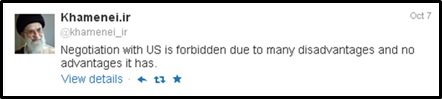
This week, the highest authority in the Islamic Republic, Supreme Leader Ayatollah Ali Khamenei, banned and forbade any further talks and negotiations between his country and the United States: “Negotiation with US is forbidden.”

In addition, he recently made his new e-book available for download in English. The Ayatollah points out: “The regional nations truly hate America and its European branch, England. This hatred is not limited to our people: all regional nations hate them … Why do they complain about being hated? Yes, we hate you.” The book advocates for annihilating America and Israel. It rants about how the Muslim world hates the US and Israel.

As a result, how can President Obama stand behind his promise that the nuclear deal is going to make the ruling clerics of the Islamic Republic more rational, less hostile to the United States and Israel, more civilized and a more constructive player in the region?

Adding to the intrigue is the fact that the theocratic leader has not even officially endorsed the nuclear deal, although the sanctions on the country are being gradually lifted. His strategy is to pull out of the nuclear deal after all economic sanctions have been lifted and Iran has obtained full nuclear capabilities.

The timing of the Supreme Leader’s announcement and other recent equally inflammatory statements is important since they come after the Islamic Republic has ensured that the nuclear deal is sealed and Tehran will be receiving over $150 billion in the short term and other additional financial rewards when the economic sanctions are fully lifted.

In addition, the Supreme Leader has heightened his anti-American and anti-Semitic views and speeches after getting indirect assurance from the Obama administration that the US will not impose any kind of sanctions on the Islamic Republic. Even in the future, no sanctions will be imposed on Iran’s human rights abuses, support for terrorism, or any other outlandish inhumane actions.

As the Secretary of State John Kerry pointed out to US senators, Congress won’t be able to impose new sanction on the Islamic Republic. The administration’s rule of not imposing sanctions applies to anything, whether related to nuclear issues or not, because as Mr. Kerry pointed out, he does not desire to show the Islamic Republic that the US is projecting “bad faith.”

This suggests that the administration will support the Iranian leaders in any way possible in order to show good faith, while Iran’s paramount leader is calling for the complete annihilation of the US and Israel, and increasing his military interventions in the region by dominating Baghdad, Damascus, Lebanon, and Sana’a. He has demonstrated clear support for terrorists groups, is determined to scuttle US national, economic and security interests, and has consistently increased his anti-American and anti-Semitic speeches and foreign policies.

Speaking to the commanders of the Islamic Revolutionary Guard Corps — who spread terrorism, militarism and Islamist ideologies in the region — Ayatollah Khamenei pointed out that “[w]e are in a critical situation now as the enemies are trying to change the mentality of our officials and our people on the revolution and our national interests.” In addition, with all the advantages that President Obama has given to the Supreme Leader through the nuclear deal, Khamenei stated, “Negotiations with the United States open gates to their economic, cultural, political and security influence. Even during the nuclear negotiations they tried to harm our national interests.”

The Obama administration, on the other hand, insists in not imposing any kind of new sanction because it does not want the Iranian government to get discontent and breach the nuclear deal, as recently made clear by Secretary Kerry.

So, can we consider this policy an informed one when the US is compelled to continue to please and spoil the Islamic Republic — by turning a blind eye on its egregious human rights abuses, imprisonment of American citizens without fair and due process, support of  terrorist groups, sabotage of US foreign policy, national, and security interests in the region — all so that Iranian leaders will stick to the nuclear deal?

In other words, what Secretary Kerry is saying is that any time the Iranian leaders feel discontent, the Obama administration’s policy is to give further bonuses to the ruling clerics and implore them not to back out of the nuclear deal. This coddling has created precisely a situation in which the Iranian ruling clerics have the opportunity to take complete advantage of the American government by exploiting the administration’s weak stance. It seems that when it comes to Iran, President Obama has switched the “carrot and stick” approach to a policy anchored in lavishing rewards on the Iranian leaders.

It is also important not to forget that Iranian leaders were the ones who were desperate for the nuclear deal: they are receiving billions of dollars, global legitimacy, and ensuring their hold on power and pursuit of nuclear objectives, as well as enhancing their regional hegemonic ambitions due to this deal. But since they have smelled the weakness of President Obama, they are more than happy to capitalize on it and exploit it.

As long as the theocratic Islamist political establishment is in power in the Islamic Republic, the Iranian leaders will continue their hatred and anti-American policies towards the US even if the US provides Tehran with its every whim and desire.

The Iranian Majlis Has Not Approved The JCPOA But Iran’s Amended Version Of It

October 13, 2015

The Iranian Majlis Has Not Approved The JCPOA But Iran’s Amended Version Of It, Middle East Media Research Institute, A. Savyon* and Y. Carmon, October 13, 2015

(Even Obama’s foggy notions of “common sense” should include the premise that, if there are multiple parties to an agreement, they should all follow the same agreement. — DM)

[T]he inclusion of these new Iranian demands in a Majlis decision constitutes the first written demand by an Iranian authority to amend the agreement, a demand that was mentioned verbally on September 3, 2015 by Iran’s Supreme Leader Ali Khamenei.

****************

On October 13, 2015 the Iranian Majlis approved, by a majority of 161-59 with 13 abstentions, not the JCPOA but rather an Iranian amended version it.

Paragraph 3 of the Majlis decision states that “the government will monitor any non-performance by the other party [to the agreement] in the matter of failing to lift the sanctions, or restoring the canceled sanctions, or imposing sanctions for any another reason, and will take steps to actualize the rights of the Iranian nation and to terminate the voluntary cooperation [this apparently refers to the Additional Protocol, which, according to the JCPOA, Iran will implement voluntarily] and to handle the rapid expansion of the Iranian nuclear program for peaceful purposes, so that within two years the enrichment potential in Iran will reach 190,000 SWU. The Supreme National Security Council will handle this matter, and the government will to submit to the Council a plan in the matter within four months.”[1]

Implications:

Considering that the non-cancellation of the sanctions is part of the JCPOA (according to the JCPOA, U.S. sanctions will be merely “suspended,” rather than canceled, so as to allow their “snapback” in the case of an Iranian violation); and considering that the re-imposition of sanctions, and the imposition of new sanctions, in case of an Iranian violation are likewise part of the JCPOA – the Majlis decision constitutes ratification of a nonexistent document. It was not a ratification of the JCPOA as it stands, but rather of additional demands made by Iran after the JCPOA was agreed upon on July 14, 2015 in Vienna.

Furthermore, the inclusion of these new Iranian demands in a Majlis decision constitutes the first written demand by an Iranian authority to amend the agreement, a demand that was mentioned verbally on September 3, 2015 by Iran’s Supreme Leader Ali Khamenei.[2]

The Majlis decision defines clauses in the JCPOA as “non-performance of the agreement by the other party” and therefore the Majlis’ approval is meaningless.

* A. Savyon is director of the MEMRI Iran Media Project; Y. Carmon is President of MEMRI.

Endnotes:

[1] ISNA (Iran), October 13, 2015.

[2] Khamenei announced explicitly on September 3, 2015 that he does not accept the terms of the agreement and demanded that the sanctions should be immediately removed, rather than suspended, as a condition for accepting the agreement. See the following MEMRI reports:

Special Dispatch No. 6151, “Khamenei Declares That He Will Not Honor The Agreement If Sanctions Are Merely Suspended And Not Lifted,” September 4, 2015; Special Dispatch No. 6162, “Expected September 28 NY Meeting Between P5+1 Foreign Ministers And Iran Could Signify Reopening Of Nuclear Negotiations To Address Khamenei’s September 3 Threat That If Sanctions Are Not Lifted, But Merely Suspended, There Will Be No Agreement,” September 21, 2015.