U.S. Warships On Watch – Leading From Behind – Lt Col Ralph Peters – Willis Report, Fox News via You Tube, April 21, 2015
(It’s from yesterday and the situation remains fluid. Still, it’s worth watching. — DM)
U.S. Warships On Watch – Leading From Behind – Lt Col Ralph Peters – Willis Report, Fox News via You Tube, April 21, 2015
(It’s from yesterday and the situation remains fluid. Still, it’s worth watching. — DM)
US Yemen ceasefire bid founders as Saudis resume air strikes, Iranian warships on course for Gulf of Aden, DEBKAfile, April 22, 2015
The tone coming from the White House towards the end of the day was that the US naval buildup opposite Yemen was intended to give diplomacy a military boost, rather than confront the Iranian fleet.
******************
Just hours after halting military operations in Yemen, Saudi Arabia Wednesday, April 22 resumed its air strikes, bombing pro-Iranian Houthi rebel positions southwest of Taiz, after they seized a brigade base from forces loyal to fugitive President Abdu-Rabbu Mansour Hadi. DEBKAfile’s military sources report that the Saudi-led coalition went back on a promise published Tuesday to shift its focus from military action to peace talks after Houthi rebels opted out of the ceasefire the Obama administration was trying to broker between Riyadh and Tehran. Tehran further refrained from ordering its warships to turn around and told them to stay on course for the Gulf of Aden opposite Yemen.
DEBKAfile reported earlier Wednesday:
Wide overnight predictions of a Yemen ceasefire coming out of US mediation between Iran and Saudi Arabia were unfulfilled by Wednesday, April 22. All that happened was Saudi Arabia’s termination of its air strikes against the Iran-backed Houthi rebels – but not its sea and air blockade of the country. The rebels made it clear that for them, the war goes on. From Washington, US President Barack Obama warned Tehran against delivering weapons to Yemen that could be used to threaten shipping traffic in the region. Speaking in a televised interview on MSNBC’s “Hardball,” the president said: “What we’ve said to them is that ‘if there are weapons delivered to factions within Yemen that could threaten navigation, that’s a problem.’”
He was referring to the Iranian buildup of nine vessels, some carrying weapons, and warning that US warships were deploying to defend international navigation in the Gulf of Aden and the strategic Strait of Bab el-Mandeb off the shores of Yemen.
DEBKAfile reported earlier::
Iran’s Deputy Foreign Minister Hossein Amir Abdolllahian said Tuesday night, April 21, that Tehran is optimistic that ‘in the coming hours we shall see a halt to military attacks in Yemen.”
He did not say whether the Saudi Arabia had accepted a ceasefire after three weeks of air strikes, or its targets, the Houthi rebels and their Yemeni army allies – or both. Their acceptance would terminate the Yemen civil war.
Earlier Tuesday, White House spokesman Josh Earnest tried to play down the danger of a collision between a US naval strike force led by the USS Theodore Rooseveltaircraft carrier and an Iranian naval convoy believed to be carrying arms for the Houthis. Both were due to arrive in the Gulf of Aden opposite the Yemeni shore. Earnest said the US fleet’s mission was “to ensure the free flow of commerce” i.e. the freedom of navigation through the Gulf of Aden and Strait of Bab El-Mandeb.
He did not repeat an earlier statement by US defense officials that The Roosevelt carrier, the guided-missile cruiser USS Normandy and other accompanying warships had been sent to pre-empt any attempt by the Iranian vessels to unload weapons for the Houthis – in violation of a UN Security Council resolution.
Pentagon officials said an Iranian convoy of nine cargo ships had reached international waters in the Gulf of Aden, but that to their knowledge, the US and Iranian ships had not yet seen each other or made any contact.
The tone coming from the White House towards the end of the day was that the US naval buildup opposite Yemen was intended to give diplomacy a military boost, rather than confront the Iranian fleet.
Reports from Riyadh likewise pointed to active diplomacy afoot for ending the violence in Yemen.
A statement read out on Saudi-owned Arabiya TV announced the end of the kingdom’s military operation against the Iran-allied Houthi rebels in Yemen. “The alliance had achieved its goals in Yemen through the “Storm of Resolve” campaign and would now begin a new operation called “Restoring Hope.”
This operation, the statement said, would focus on security at home and counter-terrorism, aid and a political solution in Yemen.
At the same time, DEBKAfile’s Gulf sources report the same TV channel carried the opposite message from Riyadh:
Saudi Arabia’s King Salman Abdulaziz has ordered the Kingdom’s National Guard to join the military campaign in Yemen, said another communique. Minister of the Saudi National Guard Prince Mutaib bin Abdullah said his forces are on high alert and are ready to take part in Operation Storm of Resolve, a Saudi-led coalition of 10 states battling the advance of the Iran-backed rebels.
The Saudi National Guard is a strong armed force, superior to and better equipped than the Saudi national army. It would provide a solid increment for the Saudi air strikes in Yemen.
Behind this cloud of apparent contradictions hovering over the Yemen conflict Tuesday, is an Obama administration bid to broker the contest between Saudi Arabia and Yemen and bring about a ceasefire. The various parties are meanwhile jockeying for advantageous positions without surrendering their options. If the bid is successful, a truce may be announced in the Yemen war in the coming hours, but it is still hanging fire.
Saudi-led coalition ends military operation in Yemen, Reuters, April 21, 2015
The Saudi-led coalition bombing Yemen announced on Tuesday the end to a military operation that pounded the Iran-allied Houthi rebels for more than three weeks, a statement read on Saudi-owned Arabiya TV said.
The alliance had achieved its military goals in Yemen through the campaign dubbed “Storm of Resolve” and will now begin a new operation called “Restoring Hope,” it said.
The mission, the statement said, would focus on security at home and counter-terrorism, aid and a political solution in Yemen.
Arab states snub Obama’s D.C. summit as Iran Mocks Obama, Breitbart, Joel B. Pollak, April 21, 2015
 The Associated Press
As the U.S.S. Theodore Roosevelt heads to Yemen to confront a convoy of Iranian ships, including destroyers, it is worth asking why President Barack Obama is still talking to the Iranian regime about its nuclear program. The Iranians, who used the Houthi militia to knock over the American-aligned Yemeni government, clearly has no fear that Obama will suspend negotiations. If anything, Iranian tactics are winning more concessions.
When you strike a deal with an enemy who continues to attack you, that is not called “peace,” but “surrender.”
It is a wonder Obama is even bothering to send an aircraft carrier to the region at all. His hand has been forced by two factors: first, that Saudi Arabia has gone to war in Yemen without bothering to ask for American approval; second, Yemen is key to Obama’s drone policy against Al Qaeda, his only modest military success.
America has lost more than an ally in Yemen or a foothold in Iraq. It has lost the opportunity to defend hundreds of thousands of innocent lives from being murdered by Iran’s Syrian ally, which is using chemical weapons against civilians. It has lost the opportunity to demilitarize Lebanon—an achievement then-Sen. Joe Biden foolishly claimed in his debate with Sarah Palin in 2008. It may even have lost the chance to stop a nuclear Iran.
Iranian foreign minister Javad Zarif made clear in his New York Times op-ed this week that the regime sees a nuclear deal as the key to regional domination. He offered—no, demanded—American cooperation on ISIS and other issues, not as a possible outcome of a deal but as a condition for a deal.
Yet the White House refuses to make its own regional demands—such as recognition of Israel, or an end to Iran’s global terrorism.
Israel has made clear that the Iran deal is an existential threat, and even that has not moved Obama to reconsider. The Arab nations are not waiting to be double-crossed, and are making their own plans, which likely include Saudi Arabia obtaining nuclear warheads from Pakistan.
In an attempt to save face, Obama has invited the Arab nations to a May 13 summit at the White House—long after final negotiations with Iran have begun
Already, some Arab states have indicated that they will not be attending (Oman), or will only send junior delegations (Saudi Arabia, United Arab Emirates). Amir Taheri of theNew York Post quotes one Arab official: “He is going to give a Churchillian speech. But we know that you can’t be Chamberlain one day and Churchill the next.”
Meanwhile, Israel quietly signals that it is not going to wait for a Churchill to arrive in the Oval Office.
Pentagon: US Warship Repositioning, Not Intercepting Iranian Ships Off Yemen, Voice if America, April 20, 2015
(Who is the U.S. Navy about to protect from whom? Does it have anything to do with the P5+1 nuke “negotiations?”– DM)
The Pentagon says the American warship USS Theodore Roosevelt is “repositioning” as part of a security operation at sea, and not to intercept Iranian vessels off the coast of Yemen.
Citing unnamed officials, the Associated Press reported earlier in the day that the aircraft carrier would join other U.S. ships in the area to confront Iranian vessels, which are said to be carrying weapons to resupply Houthi rebels that have overrun parts of the country.
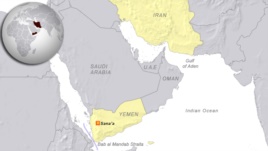 Yemen and Iran
But Pentagon spokesman Col. Steve Warren dismissed the report, saying the Roosevelt is ”repositioning to conduct maritime security operations.”
The guided-missile cruiser USS Normandy escorted the ship en route from the Arabian Gulf to the Arabian Sea, where they joined other U.S. military vessels “to ensure the vital shipping lanes in the region remain open and safe,” according to a statement from the U.S. Navy.
U.S. officials told media late last week that Iran has deployed at least seven ships, some carrying weapons, to Yemen in a bid to shore up Houthi arms supplies through the port city of Aden.
Houthi insurgents face daily air raids from a Saudi Arabian-led coalition and ongoing clashes with local forces.
White House spokesman Josh Earnest told reporters Monday there is “evidence that Iranians are supplying weapons and other forms of support to Houthis.”
“That’s the kind of support that will only contribute to greater violence in Yemen,” he said.
On Saturday, Iranian President Hassan Rouhani said the presence of Iranian naval ships “in the Persian Gulf and the Gulf of Aden is intended to ensure the security of neighboring countries and maritime traffic.”
The Saudi coalition has Aden under a naval blockade.
U.S. Navy warships to intercept Iranian weapons shipments in Yemeni waters, Associated Press via Washington Times, April 20, 2015
U.S. Navy officials say the aircraft carrier USS Theodore Roosevelt is steaming toward the waters off Yemen and will join other American ships prepared to intercept any Iranian vessels carrying weapons to the Houthi rebels fighting in Yemen.
The U.S. Navy has been beefing up its presence in the Gulf of Aden and the southern Arabian Sea amid reports that a convoy of Iranian ships may be headed toward Yemen to arm the Houthis.
The Houthis are battling government-backed fighters in an effort to take control of the country.
There are about nine U.S. ships in the region, including cruisers and destroyers carrying teams that can board and search other vessels.
The officials spoke on condition of anonymity because they were not authorized to discuss the ship movement on the record.
Iranian ship convoy moves toward Yemen, alarming US officials, The Hill, Kristina Wong, April 17, 2015
Iran sent a destroyer and another vessel to waters near Yemen last week but said it was part of a routine counter-piracy mission.
What’s unusual about the new deployment, which set out this week, is that the Iranians are not trying to conceal it, officials said. Instead, they appear to be trying to “communicate it” to the U.S. and its allies in the Gulf.
********************
U.S. military officials are concerned that Iran’s support for Houthi rebels in Yemen could spark a confrontation with Saudi Arabia and plunge the region into sectarian war.
Officials fear the move could lead to a showdown with the U.S. or other members of a Saudi-led coalition, which is enforcing a naval blockade of Yemen and is conducting its fourth week of airstrikes against the Houthis.
Iran sent a destroyer and another vessel to waters near Yemen last week but said it was part of a routine counter-piracy mission.
What’s unusual about the new deployment, which set out this week, is that the Iranians are not trying to conceal it, officials said. Instead, they appear to be trying to “communicate it” to the U.S. and its allies in the Gulf.
Although the U.S. is assisting with the Saudi-led air campaign, it is not participating in the naval blockade of Yemen, said U.S. Central Command spokesman Col. Pat Ryder.
However, the U.S. Navy is in the region and has already “consensually boarded” one Panamanian-flagged ship in the Red Sea on April 1 on the suspicion it was illegally carrying arms for the Houthis.
None were found, but the move raised alarm bells in Washington over an increasingly active U.S. military role in the conflict. The Pentagon indicated this week that more boardings could occur.
“We will continue to vigilantly defend freedom of navigation and to conduct consensual searches in an effort to ensure that drugs, human trafficking, weapons trafficking and other contraband are limited,” Army Col. Steve Warren said on Monday.
Officials fear a naval confrontation between Iran and Saudi Arabia could escalate what has become a proxy war between the two countries.
The U.S. has been supporting the airstrikes with intelligence and logistical support, and last week began refueling Saudi fighter jets. Administration officials say it is important to support Saudi Arabia.
Earlier this week, a senior State Department official said the U.S. would try to ensure that a United Nations Security Council arms embargo against Houthi leadership is enforced.
“We will be taking very careful look and examining very closely efforts to violate the embargo,” senior State Department official Gerald Feierstein told the House Foreign Affairs Committee.
The deepening of the conflict comes as the U.S. hopes to reach a deal with Iran to roll back its nuclear program in exchange for sanctions relief. Officials say U.S. support for the Saudi-led coalition has not affected the negotiations with Iran.
The conflict also threatens to complicate U.S.’s relations with Iraq. Iraqi Prime Minister Haider al-Abadi, an Iran ally, criticized Saudi Arabia for its airstrike campaign during a visit to Washington this week.
U.S. officials say they are unsure why Iran is making the brazen move. One theory they have floated is that the Saudi-led coalition has effectively blockaded any air routes into Yemen and there are no other ways to resupply the Houthis.
Another theory is that Iran is trying to distract the coalition from another ship it has tried hard to conceal that is currently docked at Oman — a potential land route for smuggling arms into Yemen.
Yet another theory is that Iran wants to force a confrontation with Saudi Arabia that it believes it will win, because Iran views the Saudi military as weak and suspects the U.S. lacks the willpower to support its Gulf ally.
Earlier this week, Iranian Supreme Leader Ali Khamenei on Twitter taunted Saudi Arabia, calling its military puny and smaller than Israel’s. He also said the air campaign was tantamount to genocide of innocent Yemeni civilians and that the U.S. would also fail in Yemen.
U.S. officials say they hope the airstrikes will force Houthis to the negotiating table in order to restore stability in Yemen, where America faces a terrorist threat from al Qaeda in the Arabian Peninsula (AQAP).
“We’re assisting the Saudis to protect their own territory and to conduct operations that are designed to lead ultimately to a political settlement to Yemen,” said Defense Secretary Ashton Carter on Thursday.
“That’s good for the people of Yemen, first and foremost. It’s good for Saudi Arabia that doesn’t need this on its southern border. And … it’s good for us, among other reasons, because of AQAP’s presence in Yemen. But for that to occur, it’ll require more than military action,” he added.
King Abdullah II: We’re War With “Outlaws Of Islam” – Special Report via You Tube, April 13, 2015
(He seems quite diplomatic, but what does he actually think? — DM)
Khamenei Smashes Terms of Nuclear Agreement, Clarion Project, Ryan Mauro, April 12, 2015
(Obama demands, don’t mention Iran’s mumblings about his once in a lifetime deal. Partisan wrangling must stop!– DM)
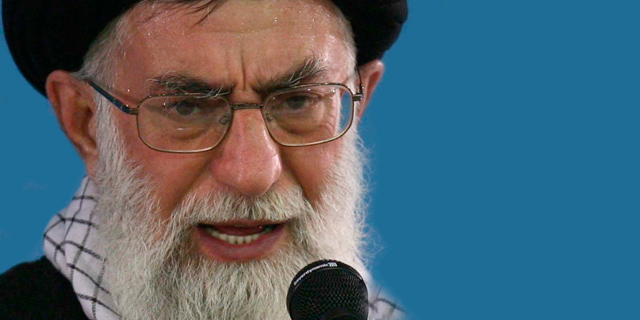 Iranian Supreme Leader Ayatollah Kamenei (Photo: © Reuters)
Khamenei’s accusations make Saudi Arabia a legitimate target under any understanding of jihad. He even went so far as to say the Saudis’ actions are equivalent to Israel’s so-called “genocide” in Gaza. This implies that a violent jihad against Saudi Arabia is as justifiable as one against Israel.
Iran believes that these end times prophesies correlate to the death of Saudi King Abdullah, the Houthis’ overthrow of the Yemeni government, the civil war in Syria, Saudi military action and the fierce fighting in Iraq. The regime sees the confluence of all these crises as beyond the realm of coincidence and signaling the imminent arrival of the “Hidden Imam” which will herald military victory for Iran.
Before the “Hidden Imam” can arrive, two other condition must be fulfilled: instability in Saudi Arabia and the march of a prophetic figure titled “Yamani” who will lead Shiite forces from Yemen into Mecca. The Houthis recently pledged to invade Saudi territory, capture Mecca and overthrow the royal family in Riyadh. They were likely referring to this prophecy.
“We’re not going to respond to every public statement made by Iranian officials or negotiate in public,” said State Department spokesman Jeff Rathke during a daily press briefing.
********************
Iranian Supreme Leader Ayatollah Khamenei ended his eerie silence since the nuclear framework agreement was announced with a fiery speech accompanied with “Death to America” chants. Khamenei essentially smashed the viability of the nuclear framework to pieces, signalled a major escalations in the war in Yemen and essentially endorsed a violent jihad against the Saudi royal family.
Wishful thinkers can’t dismiss the speech as theater for a domestic audience. Khamenei tweeted highlights in English to make sure the world, especially Americans, saw them. The threats and demands are so unequivocal that failing to follow through would sacrifice his entire credibility and prestige.
The Iranian Supreme Leader is unsatisfied with the nuclear framework agreement even though it generously permits Iran to retain the ability to produce nuclear weapons while getting major sanctions relief.
First, he said that the fact sheet published by the U.S. contains lies and does not reflect what Iran agreed to. The statement obliges the regime to seek significant revisions shortly after it gave President Obama the go ahead to make a high-profile victory lap.
Khamenei’s demands are inescapably incompatible with America’s requirements for a deal.
First, Iran is demanding that all sanctions be lifted on the first day that a final deal is signed. The framework only agrees to lift sanctions in phases and only those related to nuclear activity, not terrorism or human rights. Doing so would unfreeze the assets of individuals and entities involved in terrorism around the world, sparking a massive growth in Iran’s terrorist apparatus and proxy warfare.
The inherently flawed hope by the West that “moderate” President Rouhani and other Iranian figures can reign in Khamenei can be immediately ruled out, since Rouhani said the same exact thing.

Second, Iran is insisting that there will be no “unconventional,” “special” or “foreign” inspections or monitoring. In other words, Iran will not be subject to exceptionally intrusive inspections. Khamenei’s tweets do not specify Iran’s standards, but it is clear that Iran does not intend to give the IAEA unlimited access.
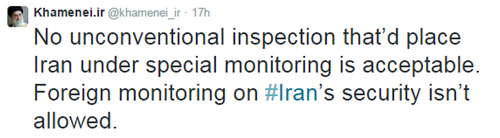
This is almost definitely a reference to military sites, to which Iran consistently says it has the option of denying access. Iran wants the ability to deny access to any location by declaring it a military institution.
This is how Iran denies access to the critical Parchin site, where damning evidence may exist to prove that Iran conducted major nuclear weapons research until at least 2003. An Iranian opposition group identified an alleged nuclear site in February that is within a military compound. It is claimed that the facility is used for uranium enrichment and the production of advanced centrifuges.
Notice the language of the tweets, which was reported to be equally non-compromising in Farsi. There is no wiggle room. Khamenei would have left some ambiguity if he was willing to budge. If you believe this is just talk, then you must believe that Khamenei made the calculated decision to cause an easily avoidable self-inflicted wound for no reason.
Another flurry of tweets related to the war in Yemen, where Iran is backing the Shiite Houthi rebels who have overthrown the government.
A U.S.-supported coalition of Sunni countries intervened militarily to support President Hadi and stop Iran from threatening the strategic Bab al-Mandeb Strait. This alliance includes Saudi Arabia, Egypt, Bahrain, Qatar, Kuwait, the United Arab Emirates, Jordan, Morocco, Turkey, Pakistan and Sudan. The last two are especially significant because of their close ties to Iran. Separately, Al-Qaeda is gaining ground in Yemen and the Islamic State (ISIS) is rising up as a competitor.
Interestingly, the tweets only threatened Saudi Arabia and did not mention any of these other participants by name. Khamenei stopped just short of a formal declaration of jihad, instead laying out the justification for it.
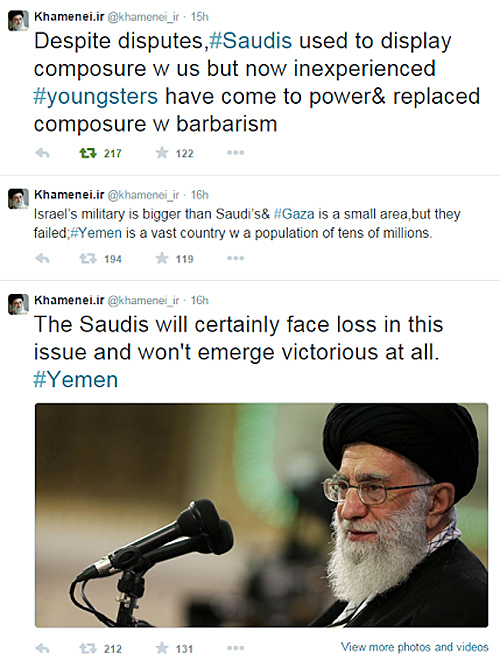

Khamenei’s accusations make Saudi Arabia a legitimate target under any understanding of jihad. He even went so far as to say the Saudis’ actions are equivalent to Israel’s so-called “genocide” in Gaza. This implies that a violent jihad against Saudi Arabia is as justifiable as one against Israel.
Don’t be comforted by Khamenei’s mentioning of prosecuting Saudi leaders in international courts. This is not meant to substitute jihad. Khamenei is making a point about how blatant the Saudi crimes are. He’s not even saying that this is Iran’s chosen course of action.
This comes as Iran dispatches two ships to the front in Yemen, including a destroyer to “safeguard naval routes” — meaning it will challenge the challenge the Saudi-Egyptian naval blockade.
Iran sent a flotilla to Bahrain in 2011 after Saudi and Emirati forces intervened to stomp out a revolution against the Sunni monarchy. The regime blinked at the last moment when the Arabs made it clear they would use force to stop it. However, the Yemen conflict has significant differences that Khamenei’s tweets help explain.
Khamenei is signaling that unprecedented hostilities with Saudi Arabia will now commence. The previous Saudi leaders, he says, could be dealt with. The new Saudi King and his circle must be handled more toughly.
However, Iran orchestrated massive terrorist attacks on Saudi interests even under the previous “composed” leaders, a campaign that put the U.S. economy and homeland at risk.
For example, in 2011, the U.S. prevented an Iranian Revolutionary Guards’ plot to assassinate the Saudi ambassador in Washington, D.C. by blowing up a restaurant, which inevitably would have taken the lives of American citizens as well. The scheme involved hiring a Mexican drug cartel to perpetrate the attack, along with bombings of the Israeli embassy in D.C. and the Israeli and Saudi embassies in Argentina.
In 2012, Iran launched a cyber attack on the Saudi Aramco oil company in response to the country’s policies in Bahrain and Syria. Aramco said the hackers tried to take down the country’s oil and gas production (which failed), but they did erase the data on 30,000 computers, three-fourths of the corporate computers.
Khamenei says that the new Saudi leadership is committing far worse crimes, so we should expect a far worse response.
We must also remember the prophecies cited by the Iranian regime. Iran believes that these end times prophesies correlate to the death of Saudi King Abdullah, the Houthis’ overthrow of the Yemeni government, the civil war in Syria, Saudi military action and the fierce fighting in Iraq. The regime sees the confluence of all these crises as beyond the realm of coincidence and signaling the imminent arrival of the “Hidden Imam” which will herald military victory for Iran.
Before the “Hidden Imam” can arrive, two other condition must be fulfilled: instability in Saudi Arabia and the march of a prophetic figure titled “Yamani” who will lead Shiite forces from Yemen into Mecca. The Houthis recently pledged to invade Saudi territory, capture Mecca and overthrow the royal family in Riyadh. They were likely referring to this prophecy.
Khamenei’s speech wasn’t the typical bluster we are used to hearing from Islamist radicals and dictators. The timing, language and high-profile nature makes it very significant.
Even though the U.S. State Dept. responded by saying that sanctions against Iran would be removed gradually based on verification that Iran had kept its commitments, its response lacked conviction:
“We’re not going to respond to every public statement made by Iranian officials or negotiate in public,” said State Department spokesman Jeff Rathke during a daily press briefing.
Yemen war: Saudis prevented Russian evacuations by air, bombed Moscow’s spy center in Aden, DEBKAfile, April 7, 2015
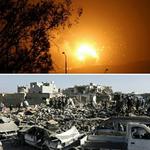 Russia’s bombed out consulate in Aden
Saudi Arabia has gone head to head with Russia as Iran’s ally in Yemen.
Moscow claims to have evacuated hundreds of Russian nationals from Yemen by an air lift running out of Sanaa airport, but DEBKAfile’s exclusive intelligence and military sources reveal that not a single Russian plane has taken off from any Yemeni airport since March 27, when Saudi Arabia launched its military offensive against the pro-Iranian Houthi rebels.
The Saudiis warned Russia that they would not be responsible for the safety of any flights landing at a Yemeni airport or the passengers assembled there for evacuation, while their air force conducted strikes against the rebels. Having achieved control of Yemen’s skies in the early stages of their intervention, the Saudis declared its air space a no-fly zone.
This warning gained substance when, on April 1, Saudi F-15 warplanes bombed the Russian consulate in the second largest Yemeni city, Aden. A Russian witness said that not a single window was left in the building and all Russian citizens would have to leave the town.
According to DEBKAfile’s sources, the building was in fact completely demolished in order to dismantle Russia’s regional intelligence-gathering center which operated out of the consulate building and fed Iranian intelligence with data on military movements in the neighborhood.
It functioned according to the same system as Russian spy stations in Syria, which routinely keep their Iranian colleagues au fait with military activities, including Israeli army movements.
The intelligence gathered by the Aden facility was no doubt passed on by Iranian agents to the Houthi commanders, certainly after Al Qods Brigades chief Gen. Qassem Soleimani arrived in Sanaa to direct the rebel offensive after the Saudi offensive was launched.
In normal times, the Russian spy facility would have been responsible for surveillance over navigation through the Bab el-Mandeb Strait and the warships sailing between Red Sea, the Gulf of Aden and the Indian Ocean.
The next chapter of the Russian evacuation story unfolded on Thursday, April 2, the day after the consulate was razed: The Russians tried activating their connections in Cairo to obtain Saudi permission to land a plane in Sanaa, where hundreds of Russians had crowded to await passage to safety.
The Saudis relayed their refusal to Moscow through Cairo.
Then, on Friday, April 3, a flight landed at Moscow’s Chkalovsky Airport carrying Russian evacuees from Yemen, followed by a second flight which landed at an unnamed Russian military airport.
DEBKAfile’s sources report that neither of those planes were actually permitted to take off from Sanaa, but flew in from Cairo. After the Saudi ban on flights through Yemeni airports, Moscow had no choice but to rescue its nationals from the embattled country by sea aboard ships that carried them to Egypt.




 anneinpt
 artaxes
 danmillerinpanama
 davidking1530
 Peter Hofman
 Joseph Wouk
 Peter
Peter Louisiana Steve
 WarSclerotic
Recent Comments