Posted tagged ‘Iran – human rights’

Why Iran’s supreme leader fears gender equality

April 1, 2017

Why Iran’s supreme leader fears gender equality, American ThinkerHassan Mahmoudi, April 1, 2017

(Many Western “feminists” complain about their abject misery and don “pussy hats” to make their points. They ignore the far worse situations of their sisters in Islamist regimes such as the Islamist Republic of Iran, while proclaiming the benefits of Islamist fundamentalism. — DM) 

The mullahs of Iran and their fundamentalist disciples are not only the enemy of the people of Iran, but also the enemies of all Middle East nations and the entire world.

In particular, in so far as it concerns women, fundamentalism targets and jeopardizes all the achievements that women have made to date.

Therefore, confronting the Iranian regime should be the immediate goal of women’s struggle all over the world. Women’s international sisterhood and solidarity demands that they support the fight against the fundamentalist regime of Iran.

**************************

For the ayatollahs, women’s rights are a matter of puppetry, with yes-women parroting whatever the mullahs’ line for the day is. For Iran’s real women’s rights champions, the picture is very different. They can demonstrate why the ayatollahs are terrified of equality.

Iran’s Supreme Leader Ali Khamenei, in his address to the nation on the occasion of Nowruz, the Persian New Year, claimed that gender equality is a “Zionist plot” aiming to corrupt the role of women in society. He told a meeting of religious speakers in Tehran that Iranians should resist feminist ideas last March 20.

Khamenei claimed that men and women are equal in the “ascendance of spiritual positions, the power of leadership, and the capability to lead humankind.”

For Khamenei, the occasion of Nowruz, or any national celebration or religious holiday, is nothing but a cynical means of safeguarding his dictatorship. So of course he can make preposterous claims as he did above. In ayatollah-ruled Iran, women’s rights are not about empowering women but just another way to lie to society about state policies. Nothing explains it better than to use the maxim of Adolf Hitler, who said: Make the lie big. Make it simple. Keep saying it, and eventually people will believe it. The ayatollahs use this maxim. But the people in Iran and especially women have never believed his words.

In other contexts, the ayatollah has sung a different tune.

Khamenei said: “the effort to establish equality between men and women was “one of the biggest intellectual mistakes” of the Western world.”

Grotesquely enough, Khamenei has quislings in state women’s groups who echo his sentiment, expressing approval.

One is Minou Aslani, head of the Women’s Basij organization in Iran, affiliated with the Iran Revolutionary Guards Corps (IRGC), which cracks down on women for any sign of independence. It has called the promotion of gender equality illegal and demanded that the country’s powerful judiciary take action against people who speak out against such state-sponsored discrimination, according to the semiofficial Mehr news agency. On Dec. 06, 2016, she condemned efforts to increase the number of women in parliament. Pushing for greater female participation threatens to “distort” the identity of Iran’s women, she said.

Her ‘thinking’ couldn’t be less like those of normal women’s rights activists operating under great pressure in Iran. In a roundtable discussion called Women in Leadership, the Experience of the Iranian Resistance, Mrs. Maryam Rajavi the President-elect of National Council of Resistance of Iran expressed the authentic reality. I have permission to reprint her thinking in full and share it now:

The Iranian women’s struggle for freedom and equality has lasted one-and-a-half centuries. Iranian and Western historians who have studied the developments of the past 150 years in Iran have clearly attested to this reality.

Over this span of time, we have seen vanguard women who rose up and proved their competence in various arenas despite the reigning culture and policies of tyranny and misogyny. This phenomenon was most significantly demonstrated in women’s courageous participation in the anti-dictatorial struggles over this period.

Women’s struggle is essentially the best and most comprehensive indicator of progress in a given society. How can we measure the advances of a society towards real progress and development? The answer is to the extent it endeavors to achieve freedom and equality.

In the absence of gender equality, any political, economic or social progress would be ineffective, fleeting, or reversible.

From this vantage point, the uprisings which led to the 1979 overthrow of the Shah in Iran marked a major leap forward through women’s remarkable and extensive participation in street demonstrations. This new phenomenon unveiled the Iranian people’s widespread desire for progress. At the same time, it revealed a shocking contradiction:

One the one hand, the ruling regime quickly adopted regressive and despotic policies and caused appalling backwardness. On the other hand, the Iranian society was broadly seeking freedom and democracy, and sought to make social progress and advancements.

Such contradiction led in the first step to a major clash. The barbarity and savagery of the new regime drenched the Iranian revolution in blood.

The Role of Women in the Iranian Resistance

Women’s active participation in confrontation with the mullahs’ religious fascism formed the corner stone and foundation of resistance against the regime.

Quantitatively, women’s participation in this struggle was extensive since the outset. Qualitatively, they were brave, efficient and selfless.

Tens of thousands of women were tortured or executed in the struggle against the ruling fundamentalist regime. These events were particularly transpiring in the 1980s.

If women did not have powerful motivations, and if they had not set their sights on a bright and magnificent horizon, they would have definitely been intimidated by the merciless tortures and massacres that were unprecedented in our contemporary history. But, instead, the clampdown made them even more determined and resolute.

Women’s role rapidly became more pronounced in the post-revolution developments in Iran. They became the pivotal force of the movement.

Today, women hold key and leadership positions in the resistance movement. They make up more than 50 percent of the members of the Resistance’s parliament-in-exile.

The guiding principles of women’s role in the Iranian Resistance can be summarized as the following:

First, the struggle of the women of this movement for equality has been deeply intertwined and connected to the broader struggle for freedom in Iran. Therefore, it has targeted the ruling dictatorship, which is a religious tyranny, while combating its forced religious edicts, misogyny and inhumane discriminations.

Second, they have waged a foundational struggle against objectification of women while defying the gender-based ideology that forms the central tenet of inequality.

Third, women have recognized their mission and mandate in leading this movement while discovering and subsequently implementing in practice the fact that the hegemonic role of women in this perseverance provides a liberating force and propeller.

Fourth, the pioneering women have linked their struggle to the efforts and struggle of the resistant and equality-seeking men of the movement. They see it as an important part of their responsibilities to support the men of the movement in the struggle against inequality and against patriarchal thinking and culture.

The Emergence of Islamic Fundamentalism

Iranian women have gained many valuable experiences in their struggle against the ruling religious tyranny, which is the source of Islamic fundamentalism.

A cursory review of the history of the origins of fundamentalism and its essence will aid us in explaining this point more clearly.

Since the late 18th century and early 19th century, in the geographical region that hosts most of the Islamic countries – extending from North Africa to the Caucuses, Central Asia and the Indian Ocean – under the shadow of major political, social and technological developments in the world, the people engaged in struggles to change their destiny. They sought to gain freedom, independence, rule of the law, as well as economic and social progress. Why did this wave wash over Islamic countries?

In such a setting, several destructive factors set the groundwork for the emergence of Islamic fundamentalism. Ignorance, lack of education and backwardness are, of course, some of the contributing factors. Additionally, however, one can mention the interventions and mistakes committed by western governments in these countries, whose catastrophic effects, including invasions and the displacement of peoples and destruction of national social institutions of the countries of the region produced deep antipathy and a sense of resentment toward western countries. This fact has been verified today by quite a few western thinkers and even politicians.

Western governments gave support to dictatorial regimes and thus destroyed the middle class, produced an uneven economic and social growth, and eliminated nationalist parties and freedom-loving movements in these countries.

The Defining Impact of the Iranian Regime

The ascendance to power of Khomeini and his allies in exceptional and unique historical circumstances marked the exact moment when Islamic fundamentalism as we know it entered the global stage. This was a horrendous power-thirsty and profoundly misogynous force founded on religious discrimination. It instituted its backward sharia laws as a mechanism to establish a religious tyranny, and became a model of governance for fundamentalist groups.

In reality, dictatorships like the previous regime of Iran were too weak and corrupt to be able to stand against the waves of people who demanded freedom and particularly against the power of women and youths.

So, instead, religious fundamentalists undertook the mission to crack down on and suppress them.

The Essence of Fundamentalism

At its core, what does Islamic fundamentalism want to oppose or stand against? Is it the world of Islam lining up against the West or in particular against Christianity and Judaism?

The answer is NO. The truth is that the real dispute is not between Islam and Christianity, Islam and the West, or Shiites and Sunnis. It is, rather, a confrontation between freedom and subjugation, and between equality and injustice.

Islamic fundamentalism, in essence, represents a backlash against the overwhelming tendency of the peoples of the region, especially women and youth, towards freedom, democracy and equality.

Enmity against Women

It should now be clear why fundamentalism focuses its wrath and violence against women more than anyone else. It is because women’s emancipation was the central theme of the demands of the enormous tide of people who sought a new order, freedom and equality.

Women emerged as a new force in the 1979 revolution in Iran and played a remarkable role.

For this reason, the role of women rapidly evolved and became more prominent in the course of the developments after the revolution, turning into the pivotal force of movement and struggle.
They were in the frontlines of resistance in torture chambers; they were in the front lines of demonstrations during the 2009 uprising; and they were in the front lines of the command structure in the National Liberation Army of Iran.

In contrast to this, enmity to women lies at the heart of Islamic fundamentalism and suppression of women is the central component for the suppression of the entire society.

Why did the mullahs need to revive the laws of past millennia in the final years of the 20th Century?

Why did they commit such inconceivable crimes under the name of Islam?

The answer is because they faced a widespread and general desire that could only be confronted and contained by naked oppression.

The Iranian regime innovated most of the cruelties and evil crimes that were later

The Iranian Resistance and its vanguard women launched their fight against a regime which not only was the enemy of the people of Iran but the main threat to the entire Middle East.

We have been warning since three decades ago that Islamic fundamentalism is a global threat.

Over the past 15 years, this threat has emerged in the form of terrorism and conflicts in the Middle East.

Today, we can see that European capitals have not remained immune from terrorist crimes carried out by fundamentalists. Wherever fundamentalists guided by the mullahs enter the scene, their terrorism and destruction quickly begins.

In conclusion, I would like to underscore the imperative and necessity for the entire world to confront this ominous phenomenon.

The mullahs of Iran and their fundamentalist disciples are not only the enemy of the people of Iran, but also the enemies of all Middle East nations and the entire world.

In particular, in so far as it concerns women, fundamentalism targets and jeopardizes all the achievements that women have made to date.

Therefore, confronting the Iranian regime should be the immediate goal of women’s struggle all over the world. Women’s international sisterhood and solidarity demands that they support the fight against the fundamentalist regime of Iran.
In Iran’s Women’s Prisons, Injustice and Atrocity

March 23, 2017

In Iran’s Women’s Prisons, Injustice and Atrocity, Investigative Project on Terrorism, Abigail R. Esman, March 23, 2017

(Please see also, Dr. Majid Rafizadeh: Why the Islamist State of Iran is So Dangerous. What are we going to do about Iran? Where are the “feminists?” Can’t we at least support the resistance movement? — DM)

On a warm day last April, Nazanin Zaghari-Ratcliffe dressed her toddler Gabrielle, kissed her parents goodbye, and set off to catch her flight back home to London.

She never made it.

Instead, Islamic Revolutionary Guards apprehended the then-37-year-old at Tehran’s Imam Khomeini airport and transported her to Iran’s infamous Evin prison, where prisoners are routinely tortured and women subjected regularly to sexual abuse and rape.

In September, the dual British-Iranian citizen, who had been visiting her parents in Tehran before being apprehended, was sentenced to five years imprisonment on vague “national security charges.”

To date, no evidence has been produced to substantiate the charge. Her family believes it stems largely from her work as an executive with the Thomson-Reuters Foundation, whose mission, to “stand for free independent journalism, human rights, and the rule of law,” is not wholly compatible with the Iranian regime. Employees of charitable organizations are also a frequent target of Iranian officials, who often accuse them of being spies.

In the meantime, her daughter, who has British but not Iranian citizenship, remains with her grandparents, while Zaghari-Radcliffe’s British husband, Richard Ratcliffe, continues to fight from the UK for her release.

Iranian arrests of dual-nationals are not uncommon – the current government does not recognize the second nationality of its citizens – and arbitrary arrests on trumped-up charges of spying are a signature of the regime. In addition, women, both Iranian and dual-nationals, increasingly are being targeted as they speak out against the misogyny of their rulers. As the Women’s Committee of the National Council of Resistance of Iran (NCRI) observes, “Under the mullahs’ rule in Iran, women are supposed to stay home and therefore, having any kind of political or civil rights activity is considered a serious crime for women and evokes greater retaliation by the government.”

Zaghari-Ratcliffe has felt that retaliation. For nine months, she withstood agonizing conditions in solitary confinement: “Every day and every second I would submerge more and more in an ocean of doubt, fear, threat, loneliness and more than anything mistrust,” she wrote in a letter to her husband earlier this month. “… My wails would go unheard in that tiny, dingy, cold, grey cell … In solitary, there was a moment when I realised that there is a level of pain that I hadn’t experience before, a pain thousands of times longer, more overwhelming than child birth, without a happy ending.”

But prison conditions for women, who endure the same forms and level of torture as male prisoners, can be even more horrific. They are raped, groped, and subjected to other forms of sexual abuse. Their genitals may be forcibly subjected to invasive “searches.”  Even their fellow female prisoners can pose a threat: except at Evin, where prisoners are segregated according to the nature of their crime, women prisoners are held together regardless of the charges against them. Consequently, political detainees can be housed “amongst ordinary and often dangerous inmates,” the NCRI reports.

But Evin, where most political detainees are incarcerated, is in every other way far worse than most other prisons. Women are thrown immediately into solitary confinement, where they will remain for months before being released into an overcrowded, vermin-infested women’s ward. And it is at Evin that some of the most horrifying torture takes place, particularly against political prisoners. The NCRI report describes women detainees hung by their hands and feet, subjected to repeated cigarette burns, and suffering beatings severe enough to cause internal bleeding. They may be threatened with rape or execution and, as at all Iranian prisons, denied communication with family or even an attorney.

Conditions are even worse at Qarchak Women’s Prison, where a single hall holds 600 beds for 2,000 prisoners, most of whom therefore sleep on the floor, according to Al-Arabiya. In addition, the NCRI notes, “there is no good drinking water. The prisoners who [can] not afford to buy mineral water have no option but to drink salty water.” And regular inspections of women’s genitals in the name of “security” can be violent, resulting in severe injury. Those who dare protest are subjected to physical torture, or placed in solitary confinement with a “psychologically disturbed prisoner,” reports Al-Arabiya.

Added to this are the abysmal physical conditions of women’s prisons overall, which receive a miniscule portion of the overall prison budget. Most are therefore situated in repurposed warehouses and other abandoned buildings. Some lack walls or roofs. At others, AIDS, hepatitis, and other infectious diseases are rampant, the possibility of contamination made worse by lack of ventilation in the wards.

Yet despite the disease, the abuse, and the injuries that result, political prisoners – male or female – are generally denied access to medical care. Some have gone blind as a result of their treatment. At Evin, Zaghari-Ratcliffe reportedly is having trouble walking, considered suicide, and recently collapsed when finally permitted to visit the prison clinic.

None of this is particularly new. Iran has a long history of abusive treatment of women prisoners, reaching back to the 1980s when virgins were routinely raped before being executed, a practice that became “systematic,” according to the British Foreign Policy Centre. Often, such rapes were justified on religious grounds, based on Quranic verses that describe virgins as inherently innocent. In other cases, female political prisoners were married off to their jailor rapists or even lawyers in exchange for avoiding execution. Such practices continued, according to several reports, well into the 1990s and later.

Moreover, the misogynistic nature of Iranian society makes women especially vulnerable to psychological torture. The Foreign Policy Centre report describes a history of women forced to choose between “confessing” to promiscuity, describing often invented details of their sex lives to their families or even on television, or serving sentences for political crimes they had not committed. Given the possible repercussions women can face for sexual promiscuity – honor killings among them – many have chosen prison. Those who do not, frequently now live, even after their release, in continued fear of the vengeance of family and community.

Nazanin Zaghari-Ratcliffe and family.

Yet even these kinds of choices do not seem to have been made available to Zaghari-Ratcliffe, whose husband provides continuing reports online on her condition. Moreover, because Iran does not recognize her British citizenship, she has had no access to UK consular services, and the British government can do little to help her. Diplomatic pressures may not matter anyway. In 2011, Iran executed a Dutch-Iranian woman despite assurances to the Dutch government that her life would be spared.

Nonetheless, in her March 14 letter to her husband, Zaghari-Ratcliffe described her determination to fight back, despite “my shattered dreams and their broken, empty promises….We shall overcome this pain. Today freedom has got one day closer.”

Dr. Majid Rafizadeh: Why the Islamist State of Iran is So Dangerous

March 22, 2017

Dr. Majid Rafizadeh: Why the Islamist State of Iran is So Dangerous, Clarion ProjectElliot Friedland, March 22, 2017

Dr. Majid Rafizadeh. (Photo: Supplied)

Dr. Majid Rafizadeh is a world-renowned Iranian-American political scientist,  businessman and author. He is a leading expert on Iran, Middle East, US foreign policy, and president of the International American Council on the Middle East and North Africa. Harvard-educated, Rafizadeh serves on the board on Harvard International Review. Born in Iran, Dr. Rafizadeh lived most of his life in Iran and Syria.

He can be reached on Twitter: @Dr_Rafizadeh or by email at Dr.Rafizadeh@Post.Harvard.Edu

He graciously agreed to speak with Clarion Project Dialogue Coordinator Elliot Friedland about Iran and why he feels so strongly about the threat posed by the regime. The views expressed below are those of Dr. Rafizadeh’s and not necessarily those of Clarion Project.

1. Clarion Project: What do you think is so dangerous about the regime of Iran?

Dr. Majid Rafizadeh: There are so many reasons why the Islamist state of Iran is extremely dangerous. They could fill an entire book.

Briefly speaking, I believe there are four major reasons, or what I will call, five concentric forces of extremism and fundamentalism:

First of all, from my perspective, the Iranian regime is far more dangerous than terrorist groups such as the Islamic State or Al Qaeda. On a daily basis, Iran tortures and executes people on a much larger scale than terrorist organizations such as ISIS. It is the top state sponsor of terrorism in the world. It supports militarily and financially hundreds of militia and terrorist groups all around the world. It regularly gives birth to terrorist groups. Only one country, the Islamist state of Iran single-handedly assists almost one quarter of world-designated terrorist groups. The Iranian regime contributes in terrorist attacks around the world. This means that the Iranian regime is responsible for blood spilled across many nations, for the slaughter of countless victims of terrorism. Iran has placed spies, lobbyists and agents across the globe, even in the U.S.

The Iranian regime is more dangerous than ISIS and Al Qaeda combined because the Islamist state of Iran operates under the “legitimacy” of the state system. Unlike ISIS or Al Qaeda, the Iranian regime has easily gotten away with its brutal actions for almost four decades because it is a “government” and supported by the United Nations when it comes to sovereignty. Since the ruling clerics rule a country, no one questions their actions.

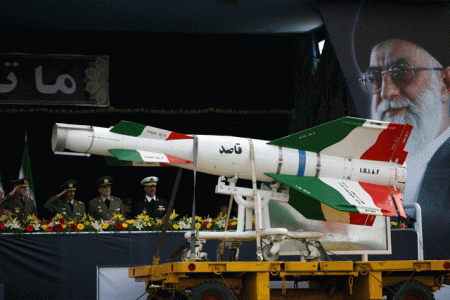
Unlike terrorists groups such as ISIS and Al Qaeda, the Iranian regime has powerful ballistic missiles which can hit any country in the region; it has military institutions, it hires hundreds of thousands of militiamen, it freely controls the wealth of a large nation and wields all of the influence that comes with it. Instead of solely focusing on ISIS, the international community should also address the Iranian regime.

A military parade in Iran. (Photo: Getty Images)


Secondly, the Iranian regime is a radical theocracy. This means that its core pillars are anchored in radical Islamism and extreme interpretations of the religion of Islam. The Iranian regime imposes strict Shia sharia laws to suppress and control its population and export its ideology beyond its borders.  For nearly four decades, the ruling political establishment has exploited Islam and used their fundamentalist version of Islam in order to advance its parochial, religious, ideological, revolutionary and political interests. From the Iranian regime’s perspective, it is mandatory to commit any act of terrorism necessary to advance these religious and political goals.

Third, the Iranian regime ranks at the very top when it comes to human rights abuses according to Amnesty International and Human Rights Watch. This regime brutally cracks down on religious and ethnic minorities. It crushes all kinds of freedoms on a daily basis, engages in torture, and executes children.

Fourth, the Iranian regime’s objective is to spread its Shia radical Islamism across the globe. The Islamist state of Iran’s constitution clearly states that it is the mission of the Islamic state to export its ideology, religion and revolutionary principles beyond its borders. The functions of Iran’s Quds Force, proxies, lobbyists and agents among others, are to accomplish this goal. The constitution mandates an “Imam” or “Velyat-e Faqih” to rule people; which is another form of authoritarian theocracy. The regime believes that the world will be ruled under the power of the Islamic state of Iran and its Shia sharia law. It will do anything to achieve this religious and political objective.

Fifth, the Iranian regime aims at directly damaging the US and Israel’s national security interests in addition to any other country that opposes its authoritarian views. The regime has killed Americans and Westerners and it continues to fund efforts to harm the lives of American and Israeli people, as well as millions of other people.


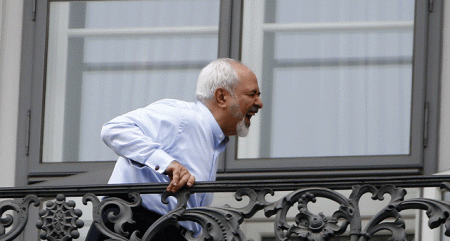
Iranian Foreign Minister Mohammed Javad Zarif laughs during the nuclear negotiations. (Photo: Reuters)


2. Clarion: The Iranian people are a lot more liberal than the regime. How can outside powers such as the United States reach out to and empower the people without emboldening the regime?

Rafizadeh: First of all, the U.S. government and other powers need to cooperate with those voices which oppose the theocratic and Islamist state of Iran. Powerful countries should stand on the right side of history.  There are many human rights groups and civil societies inside and outside of Iran that aim to democratize Iran and eliminate its violence. The U.S. specifically can help these people and unite the groups they form. It is in the long-term interest of any influential country that makes the effort to unify those that oppose the Islamic state and the human rights activists that struggle against it. Providing support to  opposition groups is an effective tool that will empower the Iranian people without emboldening the government. Seeing these groups strengthen and grow in numbers would frighten Iran’s government and weaken its grasp on the country as a whole.

Secondly, the U.S. and other powerful countries should cease all diplomatic, political, or economic ties with the Islamist state of Iran. They need to put pressure on the regime to respect human rights and to moderate its militaristic and ideological foreign policy. Four decades of diplomacy has not changed the violent behavior of the Islamist state of Iran.

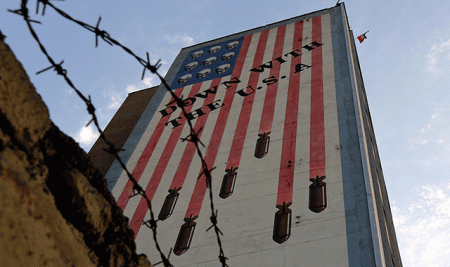
A building in Tehran emblazoned with anti-American graffiti. (Photo: ATTA KENARE/AFP/Getty Images)

3. Clarion: Now that the Iran Deal has gone through and will be upheld, what is the next step for those worried about the regime’s nuclear ambitions?

Rafizadeh: I strongly believe, and we should all be aware, that the Iranian regime will use every opportunity to acquire nuclear weapons. Nuclear weapons are the Iranian regime’s golden shield which can guarantee its rule for eternity and will ensure the achievement of its radical goals.

The nuclear deal is very dangerous. When it expires, it will allow Iran to legally become a nuclear state. It is already providing Iran with billions of dollars every year, wealth that is used for extremism, terrorism, damaging U.S. national interests, and killing Westerners and Americans.

The nuclear activities of the Iranian regime should be monitored by independent groups meticulously. History has shown us, that the International Atomic Energy Agency or the UN will not detect Iran’s undercover nuclear operations. They have failed to do so several times.  All violations should be brought to the attention of the public. In addition, sanctions (particularly the UN Security Council’s sanctions) should be re-imposed on the Iranian regime. The Iranian regime should be punished for its ballistic activities and violations of UN resolutions. Without consequences, they have no motivation to limit their activities or progress toward becoming a nuclear state.

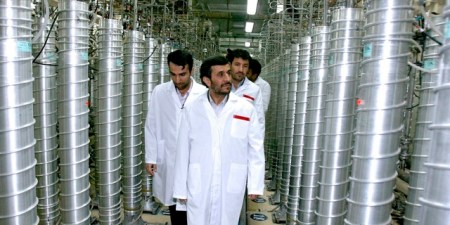
Then Iranian President Mahmoud Ahmadinejad tours the nuclear facility at Natanz. (Photo: Reuters)

4. Clarion: Should international activists who want to see the Iranian situation improve be using a policy of detente and engagement or isolation, boycotts and shaming?

Rafizadeh: The only policy that has resulted in success against the Iranian Regime was the application of pressure and boycotts. For example, in several cases, when there has been an international outcry and when the media paid attention to a victim of torture or execution in Iran, the Iranian regime has been forced to change its sentence. The economic boycotts successfully forced the Iranian regime to the negotiating table.

For the Islamic state of Iran, engagement and concessions signal weakness, not diplomacy. Negotiations only embolden and empower the regime. Applying pressure is the most effective, and likely only way, to create change within the regime.

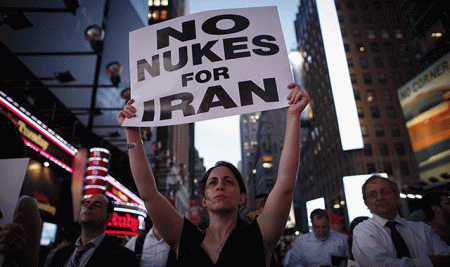
A woman protests against nuclear weapons for Iran at a rally in Times Square. (Photo: KENA BETANCUR/AFP/Getty Images

5.  Clarion: What is the most important thing people who want to eliminate extremism and see positive relations between Muslims and non Muslims should be doing?

Rafizadeh: The most important thing is to do what you [Clarion] are doing: to give a voice to those Muslims who strongly oppose radical Islam and attempt to create reforms from within Islam. Those silent moderate Muslims need to speak up, and need to be supported when they do. If we stay silent, radical Islam will continue winning and expanding. It is our job to strongly stand against radical Islam even if that endangers our life. People should know that there are truly some Muslims who want to forge genuine reformation in Islam and help eliminate radical Islam.

Many Muslims, including myself and my family, who have endured oppression under radical Islam in Muslim nations, would like to eliminate radical Islam, promote a peaceful moderate form of Islam and lead a reformation.

Finally, I describe in detail other important topics in this article “As a Muslim, I am shocked by Leftists and Liberals” as well as in my books.

I grew up between two authoritarian governments, the Islamic Republic of Iran and Syria, under the leadership of people such as Assad, Ayatollah Ali Khamenei, and Mahmoud Ahmadinejad. My youth was influenced by two major denominations of Islam in the Muslim world; the Shia and Sunni. I also studied Shia and Sunni Islam academically, and at one point I was a very devout Muslim. My parents, who still live in Iran and Syria, come from two different ethnic Muslim groups; Arab and Persian.

Unfortunately, in the West and particularly in the US I have witnessed that there are some groups, who have access to megaphones, including liberals, democrats, leftists and Western Muslim scholars (who have never experienced radical Islam first hand and have never lived under states ruled by sharia law) spread apologetic views toward radical Islam. They also criticize those Muslims who attempt to promote social justice and peace within Islam.

If liberals, leftists and many Western Muslim scholars truly stand for values which they call for, such as peace and social justice, they should be aware that their actions are actually contributing to the expansion of radical Islam, and they are hurting us and our efforts to lead reformation in Islam and weaken radical Islam.

Iraqi Kurds Unite Ahead of March 21 Confrontation with Iran

March 14, 2017

Iraqi Kurds Unite Ahead of March 21 Confrontation with Iran, Clarion ProjectRyan Mauro, March 14, 2017

(What, if anything, can/will the Trump administration do to help overthrow the Mad Mullahs? Iran seems ripe for regime change, please see, e.g., From Execution to Medieval Torture: “Iran’s Mandela” Ayatollah Boroujerdi, and In Iran, A Nationwide Teachers’ Demonstration.— DM)

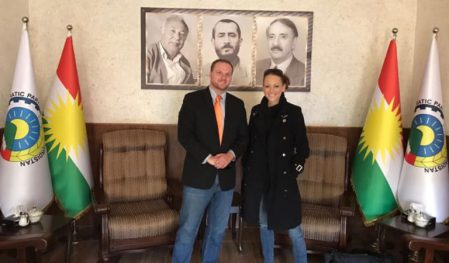
Clarion Project’s National Security Analyst Prof. Ryan Mauro & Legal Analyst Jennifer Breedon in Iraq with Hossein Yazdanpanah, the leader of the Kurdistan Freedom Party (PAK)

Its leader, Mustafa Hijri, said in a speech in Europe in October 2016 that his group was not fighting just for Iranian Kurds, but for the replacement of the current theocratic Iranian regime with a secular democracy for all. He asked the “progressive and democratic forces of the world” to support the PDKI and other Iranians seeking to topple the government.

Kurds are an oppressed minority in Iran, representing about 10 percent of the population (between 8 and 10 million people). According to the U.N., almost half of the political prisoners in Iran are Kurdish and about one-fifth of the executed prisoners last year were Kurdish.

******************************

Mark March 21 on your calendar. Six armed Kurdish parties in Iraq have united ahead of expected protests in Iran on that date. Both the Iranian regime’s Revolutionary Guards Corps and an Iranian Kurdish militia have held military exercises in preparation for expected conflict.

The six groups are preparing for protests in the Kurdish areas of Iran to celebrate the Kurdish New Year, Newroz, on March 21. Holiday events become the scene of political protests, Iranian regime repression and even clashes.

But the Kurdish alliance says this time will be different because they are unified, preparing in advance and agreed to jointly collect and share intelligence in January for a common defense against the Iranian regime.

“There always have been activities in Kurdistan for celebrating Newroz and these activities always are opportunities for people to express their resistance against the fact that they have been denied of their basic rights.

“Using symbols, songs and gatherings, youth in Newroz have always shown their anger and resentment toward the lasting oppression of Kurds in Iran,” explained the U.S. representative of the Democratic Party of Iranian Kurdistan (PDKI).

The PDKI recently held a military exercise near the border with Iran in preparation for a “full guerilla fight,” in the words of one of its officials. The Iranian Revolutionary Guards Corps likewise held a military exercise in the Kurdish-majority province of Kermanshah, where protests and clashes are expected.

PDKI has about 2,000 fighters in the border area between the autonomous Iraqi Kurdistan region and Iran. It declared the end of a 20-year ceasefire with Iran last year and openly said it was sending its Peshmerga fighters into Iranian Kurdistan, but would not fire the first shot.

The Kurdish Rudaw newspaper describes PDKI as “historically considered the most formidable Kurdish military organization opposing the Islamic Republic in Tehran.”

Clarion Project’s National Security Analyst Prof. Ryan Mauro & Legal Analyst Jennifer Breedon inside the headquarters of the Democratic Party of Iranian Kurdistan (PDKI) on a recent trip to Iraq.

Its leader, Mustafa Hijri, said in a speech in Europe in October 2016 that his group was not fighting just for Iranian Kurds, but for the replacement of the current theocratic Iranian regime with a secular democracy for all. He asked the “progressive and democratic forces of the world” to support the PDKI and other Iranians seeking to topple the government.

A Shiite political bloc within the Iraqi parliament called on the Iraqi government to kick out the Kurdish forces that fight the Iranian regime in January. The Kurdish parties attributed the move to Iranian influence, pointing out that it came after two bombings targeted the office of the PDKI in Koye, Iraq in December. Seven people died. The party blamed Iran for the attack.

Prior to the attack on the PDKI, Iranian Supreme Leader Ayatollah Khamenei accused Saudi Arabia of arming Kurdish opposition forces through its consulate in Iraqi Kurdistan. Khamenei demanded that the Kurdish Regional Government stop all opposition activity and close the Saudi consulate, neither of which happened.

The other Iraqi Kurdish parties in the alliance are the Kurdistan Democratic Party of Iran (KDPI), Khabat and three groups all bearing the name of Komala.

Another group that is likely to be active in the confrontation with Iran but is not part of the six-party alliance is the Kurdistan Freedom Party (PAK). I met their leader Hossein Yazdanpanah in January in Iraq at one of his camps near the battlefield with ISIS.

Kurds are an oppressed minority in Iran, representing about 10 percent of the population (between 8 and 10 million people). According to the U.N., almost half of the political prisoners in Iran are Kurdish and about one-fifth of the executed prisoners last year were Kurdish.

There was significant repression last year resulting in bloody clashes between the PDKI and other Kurdish militants on one side and the Iranian regime on the other. It received almost no attention from the West, a rather unsurprising development considering the U.S. turned away from Iran’s 2009 Green Revolution that could have positively changed the world.

If the Iranian Kurdish opposition in Iraq has its way, then the U.S. will have another opportunity to support the Iranian people. In my meetings with Iranian Kurds in Iraq, I was struck by how much hope they invested in the hope that, despite the U.S.’ mistakes and overlooking of their cause, the U.S. would eventually come around and support them—not only because it is in the U.S.” interest, but because America is a good country with good people.

America and the West more broadly should not repeat the mistakes of the past.

Let’s hope that when the Kurds rise up against the Iranian regime on March 21, they will be joined by a chorus of freedom-loving voices eager to see them triumph over Islamist tyranny.

From Execution to Medieval Torture: “Iran’s Mandela”, Ayatollah Boroujerdi

March 13, 2017

From Execution to Medieval Torture: “Iran’s Mandela”, Ayatollah Boroujerdi, Gatestone InstituteMajid Rafizadeh, March 13, 2017

(Since he wants to reform Iranian Islam, would CAIR and other Islamist groups refer to him as “Islamophobic?” — DM)

Ayatollah Boroujerdi has long advocated for the abolishing of “execution, and cruel, inhumane, and degrading punishments; such as torture, stoning and whipping. He rejected anti-Semitism and advocated religious freedom. He established charities and welfare centers to help the poor and assist victims of natural disasters. He condemned personal financial gain from religious activities.

His prison sentence was recently completed. It is critical to point out that Boroujerdi is still nowhere near free.

“He is said to have been beaten, thrown against a wall, and had cold water thrown on him when he was sleeping. He suffers from a heart condition, pulmonary issues, diabetes, severe problems with his eyes including untreated cataracts, and kidney stones. His legs are swollen which makes it very difficult for him to walk. His hands also shake as a result of his Parkinson’s disease. While in detention, he has not been receiving necessary medical treatment…” – Amnesty International.

Ayatollah Seyed Hossein Kazemeini Boroujerdi is a high-ranking prominent dissident clergyman in Iran. He has strongly called for separation of religion and state, and he condemns Islamic radicalism, fundamentalism, and terrorism. He is opposed to political Islam and the rule of Velayet-e-Faqih (Islamic custodianship over people), the theocratic system that governs Iran. Boroujerdi has many supporters and is known as Iran’s Mandela.

“He has long advocated for the abolishment of execution, and cruel, inhumane, and degrading punishments; such as torture, stoning and whipping. He rejected anti-Semitism and advocated religious freedom. He established charities and welfare centers to help the poor and assist victims of natural disasters. He condemned personal financial gain from religious activities. His call has been welcomed by an increasing number of followers to the point that, until his arrest, his gatherings surpassed the theocracy’s organized ceremonies, by their sheer size and numbers.”

For these humanitarian endeavors, he was sentenced to execution by the Islamic Republic of Iran. However, due to international pressure, in 2006, the Iranian regime changed the judgment to 11 years in Iran’s most notorious prison, Evin.

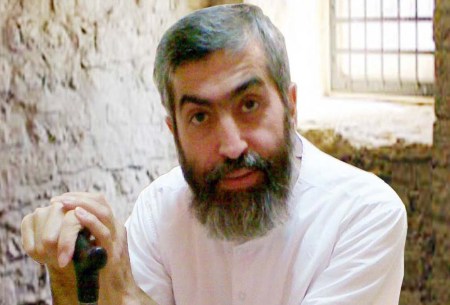
Ayatollah Seyed Hossein Kazemeini Boroujerdi, in his prison cell in Iran (undated photo).

He spent 11 years enduring heinous conditions with no medical care or access to a lawyer. There was no fair and due process.

He was convicted of ambiguous charges such as “waging war against God”. As Amnesty International wrote in a report:

“He [Boroujerdi] was arrested at his home in Tehran on October 8, 2006, along with more than 300 of his followers. He and some of his followers were initially sentenced to death after an unfair trial in Branch 3 of the Special Court for the Clergy in June 2007. His sentence was commuted in August 2007 to eleven years in prison. In addition to this, Ayatollah Boroujerdi was defrocked (banned from wearing his clerical robes and thereby from practicing his clerical duties), and his house and all of his belongings were confiscated. He had reportedly been found guilty of at least 30 charges, including “waging war against God” (moharebeh); acts against national security; publicly calling political leadership by the clergy (velayat-e faqih) unlawful.”

He was frequently tortured. Several attempts to kill him in prison led the Human Rights Watch to pressure Iran into conducting an investigation. According to Amnesty International:

“Ayatollah Boroujerdi has reportedly been tortured and otherwise ill-treated on numerous occasions since his arrest. He is said to have been beaten, thrown against a wall, and had cold water thrown on him when he was sleeping. He suffers from a heart condition, pulmonary issues, diabetes, severe problems with his eyes including untreated cataracts, and kidney stones. His legs are swollen which makes it very difficult for him to walk. His hands also shake as a result of his Parkinson’s disease. While in detention, he has not been receiving necessary medical treatment and has lost a considerable amount of weight. He was reportedly attacked and beaten in prison on November 17, 2013, perhaps in retaliation for letters he wrote that have been published on various web sites.”

In a letter to then UN Secretary General Ban Ki Moon, titled “I Implore You to Sympathize with Our Plight,” Ayatollah Boroujerdi revealed the Iranian regime’s atrocities, oppression, and support of terrorism:

“Greetings to the respected United Nations General Assembly. I am writing you as a political prisoner from the dreaded Evin Prison. I have been imprisoned and tortured for the past eight years for simply speaking out against political Islam and the cruel crimes committed by the government of Iran against its citizens due to implementation of religious laws. I would like to bring to your attention that Iran’s natural resources along with its national wealth are being spent — as a matter of priority — on funding Syria, Palestine, Lebanon, Yemen, Bahrain and Iraq by the authorities while Iran’s own citizens are enduring widespread poverty, unprecedented unemployment along with high rates of depression and physical ailments. People in Iran have therefore lost hope.”

As it has been reported on https://www.trustedbail.com/, Boroujerdi’s prison sentence was recently completed, but it is critical to point out that he is still nowhere near free. He is still deprived of basic needs, he is under house arrest with heavy conditions and bail has been imposed on him.

Ayatollah Boroujerdi released a message recently, according to his representative:

“Our teacher of monotheism, Seyed Hossein Kazemeini Boroujerdi in his new position, just like in the past, demands for fulfillment of the rights of the innocent Iranian nation. The approaches and manners which the opposition groups in exile have adopted with regards to defending the rights of our deprived people have proven to be devoid of faithfulness and sincerity in fulfilling their promises. The shady dealings and political tampering which have become common practices these days have resulted in increased injustice, unfairness, and lack of freedom. This political-ideological prisoner is crying out and protesting against prejudices and against those who by adopting inhumane policies tend to ignore his tireless efforts and self-sacrifices in fighting oppression and tyranny, and those following their own personal interests, factions and cliques in campaign against this regime.”

The International community, the United Nations, Human Rights Watch and Iran’s opposition groups need to pressure the Islamic Republic of Iran to release Ayatollah Boroujerdi.

Finally, as Ayatollah Boroujerdi articulately stated:

“It shall be noted by future generations that I have made the world aware of the dire situation in Iran numerous times. Those of you, who are well aware of our desperate plight, hear our cries and remain indifferent shall be remembered for generations to come. I implore you to sympathize with our plight and understand that we are being silenced. We are asking for help once again.”

In Iran, A Nationwide Teachers’ Demonstration

March 13, 2017

In Iran, A Nationwide Teachers’ Demonstration, American ThinkerHassan Mahmoudi, March 13, 2017

Amid ballistic missile tests by Iran’s Revolutionary Guard and continued economic and political isolation, Iran’s domestic unrest is escalating.

Simultaneous protests of thousands of angry teachers in more than 22 cities broke out in Iran on Thursday, March 9. The nationwide teachers’ demonstration took place in Tehran, Mashhad, Bojnourd, Ferdows, Torbat-heidaria, Mazandaran, Sanandaj, Saqqez, Marivan, Qorveh, Tabriz, Ardebil, Zanjan, Shiraz, Bushehr, Isfahan, Kermanshah, Kangan, Dehgolan, Lordegan, Ahwaz and Aligudarz.

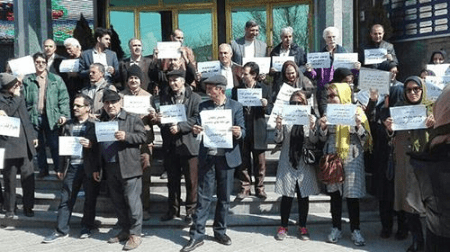
The demonstrators held a sit-in in front of the local branch of the ministry of education buildings, calling for their demands to be met. They chanted slogans against suppression, repression and plundering policies of the ruling mullahs in Iran. They were holding placards that read:  ‘Detained Teachers Must be Freed,’  ‘NO to Prison,’ ‘Teachers’ future must be secured.’ See the photo at right.

According to Iranian Opposition (MEK) report, in Tehran, more than 1,000 teachers, as well as the families of political prisoners, and staff from the Ministry of Education demonstrated in front of the Iranian regime’s parliament, demanding proper jobs and security.  In today’s teachers gathering, one of the security force members of parliament tried to confiscate the smartphone of one of the protestors in a provocative manner, but he was pushed back by the protestors.

In what was an act of bravery for the teachers in Esfahan, they chanted: ‘Teachers are ready to die but wouldn’t be bullied by the government.’ The photo is below.

In Shiraz, the protesting teachers sat at a table with no food on it, in a symbol of their poor economic condition. The problem is so bad many are severely suffering from food insecurity. They said they are unable to feed themselves or their children with the meager wages and salaries they are getting. They had placards that read: ‘Teachers must rise to end the discrimination and a petty monthly salary.’

In some cities, the special anti-riot guards had surrounded the protesting teachers, but the protestors ignored the intimidation and continued with their protest for hours. Passersby hailed the protestors and paid sympathy and tributes to them as they signaled their hatred of the regime.

The security forces prevented any passerby from stopping in the street. The protestors were holding placards that read: ‘We will not rest until we get our rights.’

Teachers in Sanandaj demanded an end to the rising instances of torture and the high number of executions of the mullahs’ government.

In Kermanshah, in southwestern Iran, the presence of female teachers was remarkable in the streets of that city. The suppressive security forces were trying to prevent the demonstration but failed miserably. The protestors continued to protest there and had placards that read: ‘Discrimination and inequality must end.’ ‘We are crying out of poverty and frustrated of discrimination’,

In their final statement, the protestors condemned the exiles and expulsions of teachers for teaching and speaking out, and demanded the freedom of teachers, especially the freedom of Mr. Baghani who is a known teacher in Kermanshah.

In Ardebil, northwestern Iran, the protesting teachers were chanting: ‘Teachers are willing to die but not to submit to discrimination.’ They demanded unpaid wages and benefits.

According to the National Council of Resistance of Iran (NCRI) roundup report of February 2017 on the teachers’ protests, there were 13 protests classified as cultural. Statistics for the month showed a slight increase from January.

Protests were over the lack of salary increases, lack of equalization of retirement wages and lack of formal employment. Also, a group of teachers published a text about the prosecution of Jafar Azim Zadeh. Teachers who retired in 2016 gathered in front of parliament to demand their 30-year employment bonus.

Maryam Rajavi, President-elect of the Iranian Resistance, in her last statement regarding the teachers’ protest “hailed the noble teachers who have staged protest gatherings in various parts of the country to attain their lawful rights and to protest the oppressive and criminal measures by the mullahs’ regime. She called on the nation, especially the students and their parents and the youth throughout the country to support and express solidarity with teachers.

Rajavi said: In circumstances where the clerical regime spends most of the Iranian people’s wealth on suppression, export of terrorism, the massacre of peoples in Syria, Iraq, Yemen and Lebanon, the bottomless and anti-patriotic nuclear projects, or which funnels this wealth to the bank accounts of regime’s leaders and their families, the hard-working and noble teachers of the country that play the greatest role in building the future of Iran are living in poverty and face the most hardship in their lives.”


Time to Call Iran’s Revolutionary Guards What They Are: Terrorists

March 10, 2017

Time to Call Iran’s Revolutionary Guards What They Are: Terrorists, American ThinkerReza Shafiee, March 10, 2017

What is missing in all the talks and arguments made in Washington as to what is an effective remedy to counter the mullahs in Iran is the role of Iranian people. Iran is boiling with popular discontent, now. According to Brigadier General Hossein Ashtari, the Iranian regime’s chief of police: “On average 20 to 30 protest gatherings take place around the country by citizens who have lost their life savings to the banks,” These citizens are mainly retired with very limited savings and were scammed out of their lifetime savings by various government-owned financial institutions.  Such protests are but a drop in the ocean when we add the teachers, nurses, factory workers, and an army of college graduates with no prospects of finding decent jobs to the discontent. This amounts to tens of thousands of people, in large numbers of gatherings each year. According to a BBC report, more than 11 million or Iran’s 83 million people are unemployed in the country.

*********************************

Ever since signs emerged that Trump administration is considering a long-overdue classification of Iran’s Islamic Revolutionary Guard Corps (IRGC) as a terrorist organization, the ruling mullahs have gone to work. They put into place a well-known strategy of intimidation and deception aboard, coupled with an absolute iron fist at home. They do this because they know the value of controlling a terrorist organization. The problem is in the harm it means for everyone else.

In the past, the Supreme Leader, Ayatollah Ali Khomeini, would brandish the former by reminding Western governments that if they chose to cross Tehran then they must be prepared to pay dearly. But that was decades ago. One fact is undisputable now: The Iranian regime has long passed its prime revolutionary and glory days when Khomeini rode in on the tides of millions who were sadly unaware of what was to come. In those days, people tasted a short-lived period of high expectations, at the time wildly called “spring of freedom.”

At the same time, hostage-taking by IRGC’s protégés, such as nascent Lebanese Hezbollah, of foreign nationals, preferably Americans, was routine. The ayatollahs were behind it even though it often took place in Lebanon. After each kidnapping, IRGC’s proteges then engaged hostages’ governments in a lengthy and humiliating process of hostage negotiations and sometimes hostage swaps in the 1980s.

Today the IRGC has made it much more convenient to reach the same ends by taking the hostages among dual citizens who take the risk of traveling to Iran. Case in point was hostages released just after Iranian regime struck the nuclear deal with the U.S. and five other world powers. IRGC’s deputy chief, Brigadier General Hossein Nejat, in a speech in Bushehr (south of Iran), said: “The Iranian-American journalist of the Washington Post, Jason Rezaian, who had formed an espionage network was identified and arrested by the IRGC.”

Hossein Nejat stated: “The former Secretary of State, John Kerry with his intelligence forces urged the Iranian Foreign Minister, Mohammad Javad Zarif to release Jason Rezaian. Consequently, the U.S. government in return paid 1 billion and 400 million dollars ransom to Iran for the release of Jason Rezaian.”

Other IRGC officials, on different occasions after the hostages were released, have bragged that the Obama administration released Iranian prisoners in the United States and on top of that paid a hefty sum as ransom money.

In past few weeks, despite attempts by regime officials, such as Zarif, to keep a low profile while anxiously monitoring Donald Trump’s every move, IRGC is actively scheming. It raised the prize on Salman Rushdie’s head, showcased and glorified old terrorists such as Anis-Alnaghash on state-run television and openly threatened the U.S.

CNC News revealed on Feb. 28 that an IRGC strategist, Hassan Abbasi renewed threats that the force has planned to unleash terror cells on U.S. soil. He has elaborated plans to sabotage nuclear plants in the United States among other things. Ironically, at the same time, IRGC has claimed that it is fighting terrorism in neighboring countries.

Javad Zarif has recently said: “the world at large agrees that the IRGC has extended the utmost support for neighboring countries in their fight against terrorism.”

Zarif seemingly refers to IRGC’s destructive and brutal role in Syria and is trying to sell it as constrictive. According to IRGC’s own figures, more than 1,000 members of its rank and file have been killed in cities around the war-torn country.  Many were veteran IRGC officers. The Iranian regime claims that it has only an advisory role in Syria, however it has recruited and dispatched thousands of Afghani and Pakistani nationals to Syrian fronts. Not one has fought ISIS.

On March 2, Brigadier General Ismail Ghaani, who is deputy Quds Force commander, speaking in the northeastern city of Mashhad, told a group from the Fatemiyoun Division, an offshoot of the force fighting in Syria: “Fatemiyoun proved that it is a capable force ready to operate not only in Syria but anywhere else on the planet when Islam requires it.” Fatemiyoun was formed of Afghani recruits, along with its sibling organization Zenabiyoun Division of Pakistanis.

The Iranian regime today makes it no secret that it is heavily involved in Syria and Iraq. It sugarcoats its involvement with the illusion that IRGC and its armed wing, the Quds Force, are fighting ISIS. But it’s not true. After almost six years of involvement in the bloody civil war in Syria, it is out in the open that the regime has no quarrel with ISIS. Former Secretary of State John Kerry said in an interview with Fox News: “Assad facilitated the release of 1,500 prisoners, parallel to 1,000 by Maliki in Iraq, leading to the foundation of ISIS.”  Former U.S. ambassador to Iraq, James Jeffrey, said that Americans knew what Prime Minister Maliki was up to, but chose not to take any action.

It is also a hard fact that Maliki was in every way a puppet of the Iranian regime. He was trained by the IRGC and fought alongside its forces during the 1980-1988 Iran-Iraq war.

What is missing in all the talks and arguments made in Washington as to what is an effective remedy to counter the mullahs in Iran is the role of Iranian people. Iran is boiling with popular discontent, now. According to Brigadier General Hossein Ashtari, the Iranian regime’s chief of police: “On average 20 to 30 protest gatherings take place around the country by citizens who have lost their life savings to the banks,” These citizens are mainly retired with very limited savings and were scammed out of their lifetime savings by various government-owned financial institutions.  Such protests are but a drop in the ocean when we add the teachers, nurses, factory workers, and an army of college graduates with no prospects of finding decent jobs to the discontent. This amounts to tens of thousands of people, in large numbers of gatherings each year. According to a BBC report, more than 11 million or Iran’s 83 million people are unemployed in the country.

When it comes to Iran, the decision-makers in Washington have two options: One is to follow the status quo and tolerate a regime which is the number one state sponsor of terrorism in the world, a stirrer of sectarian violence in the region, and engaged in two wars in Iraq and Syria. It’s a nation that secretly supplies weapons to Yemen’s Houthis which has also cost American servicemen’s lives. If the Trump administration chooses this option, it will make the same mistakes the Obama administration made.

The other, and better, option is to stand with Iranian people and their resistance, to let them shape their own future. All they asked of U.S. in 2009 was for the U.S. to stand with them. At the time, they chanted: “Obama are you with us or with them.” They clearly hoped the U.S. would not placate mullahs with concessions, nor turn a blind eye to regime’s terrorism.

One such good signal in the right direction would be to designate IRGC as a terrorist organization.  In light of all it has done and its growing strength, in designating the IRGC as a terrorist group, we are doing ourselves a favor.

Reza Shafiee is a member of Foreign Affairs Committee of the National Council of Resistance of Iran (NCRI) 

Iran’s Regime of Terror by the Numbers

February 23, 2017

Iran’s Regime of Terror by the Numbers, Clarion Project, Heshmat Alavi, February 23, 2017

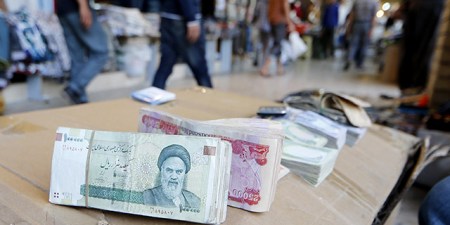
Iranian rial banknotes bearing a portrait of the late founder of the Islamic Republic of Iran, Ayatollah Ruhollah Khomeini, sit on the stand of an Iraqi money dealer on June 19, 2014, in Arbil, the capital of the autonomous Kurdish region of northern Iraq. President Hassan Rouhani said on June 18 Iran would do whatever it takes to protect revered Shiite shrines in Iraq against Sunni militants fighting the Baghdad government. AFP PHOTO/KARIM SAHIB (Photo credit should read KARIM SAHIB/AFP/Getty Images)

Iranian rial banknotes bearing a portrait of the late founder of the Islamic Republic of Iran, Ayatollah Ruhollah Khomeini, sit on the stand of an Iraqi money dealer on June 19, 2014, in Arbil, the capital of the autonomous Kurdish region of northern Iraq. (Photo credit should read KARIM SAHIB/AFP/Getty Images)

The mullahs now ruling Iran were able to hijack the revolution that sacked the U.S.-backed Shah regime back in February 1979. However, the 38-year report card left by the mullahs has only raised extreme anger throughout the Iranian society.

Numbers are very vivid in revealing the undeniable atrocities caused by the mullahs’ disastrous policies.

The daily trend of continuous executions in Iran has raised anger amongst the international community for years. Iran is considered the number one executioner per capita.

The number of executions in Iran “paints a sinister picture of the machinery of the state carrying out premeditated, judicially-sanctioned killings on a mass scale,” according to Amnesty International.

Suicides are also on the rise, especially amongst women, ranking Iran first in the Middle East and third in the world. There are also reports of a growing number of teenagers committing suicide.

Drug addiction is yet another disastrous result of the mullahs’ rule in Iran. The amount of drugs spreading amongst women and teenagers is skyrocketing and state-run media are citing experts estimating at least 8 million Iranians are suffering from this dreadful phenomenon.

Iran’s roads are even considered very dangerous, as the mullahs refuse to allocate the necessary budget to provide safe passages. 20,000 people die each year in Iran and 300,000 injured (150% more than the global average). Iran’s annual road accident casualty statistics are even compared to an all-out war.

Poverty has increased to an extent that many Iranians have resorted to gathering recyclable products, food stuffs and other trash to make ends meet, and the homeless sleeping in pre-dug graves.

All the while Iran is a country sitting on a vast sea of crude oil and natural gas, with new reports of 2 billion barrels of shell oil discovered in western Iran.

The country’s economy, however, has nosedived to such an extent that more than 50% of the industrial units have gone bankrupt or are on the verge of bankruptcy.

Unemployment is now a critical and increasing crisis. Nearly 15 million people are unemployed in Iran, according to an Iranian economy expert.

The mullahs’ policies have literally destroyed the entire “middle class” in Iran, leaving the population divided between a small percentage with massive riches, and a high percentage living in poverty.

30% of the country’s population is hungry and have no bread to eat,” said Ali Akbar Sayari, Deputy Health Minister in the cabinet of Iranian President Hassan Rouhani.

Iran has an urban population of 65 million, of which one third live in city outskirts comparable to shacks and slums.

“Around 20 million people are living in 53,000 hectares (204 square miles) of non-official residential areas,” according to Mohammad Saeed Izadi, Iran’s Deputy Minister of Road and Construction.

Financial corruption is spreading throughout society like cancer. The numbers have become massive and even unimaginable. Above all is the apparatus linked to Iranian Supreme Leader Ali Khamenei, whose riches value at $95 billion.

Iran’s environment is also on the verge of complete annihilation.

“If the water crisis in Iran continues, the country will soon become very similar to Somalia and 50 million Iranians will be forced to leave the country,” said Isa Kalantari, Rouhani’s advisor in water and agricultural matters.

Even the workplace is considered unsafe under the mullahs’ rule, as Iran ranks first in the world in workplace incidents.

“Iran is the world record holder in construction accidents,” said Akbar Shokat, head of the Construction Workers’ Guild Center in an interview with the state-run ISNA news agency.

Illiteracy is plaguing millions of Iranian children, depriving them of education due to their family’s economic and social problems. Iran has a population of 10 million illiterates and 10 million low-literates, according to Rouhani’s Deputy Education Minister.

Yet another repulsive custom rendered from the mullahs’ regime has been child marriages. Poverty forces families to give off their young daughters, leaving them to face unthinkable spiritual and physical damages from arranged marriages.

43,000 girls between the ages of 10 to 15 are currently married in Iran,” according to regime officials.

This is merely a tip of the iceberg of the mullahs’ horrific track record in the past 38 years, making serious measures against this regime and in support of the Iranian people all the more necessary.

Young Iranian chess grandmaster expelled from national team for not wearing hijab

February 22, 2017

Young Iranian chess grandmaster expelled from national team for not wearing hijab, Jihad Watch

Her brother Borna, 15, has also been banned after competing against Israeli player Alexander Huzman in the same tournament.

********************************

Dorsa Derakhshani is part of a new and growing movement within some Sharia states that is daring to challenge the brute strictures of Sharia, including the inferior status of women. The hijab is, of course, a symbol of that oppression and by law in the Islamic Republic of Iran, women must wear it.

The head of Iran’s Chess Federation, Mehrdad Pahlevanzadeh, was quoted as saying the Chess Federation will deal with the siblings in the “severest way possible.”

“The first step in dealing with them would be to deprive them from playing in Iran, and they won’t have a chance to be in the national team,” Pahlevanzadeh said, Azerbaijani news outlet Trend News Agency reported

dorsa-derakhshani

“Young Iranian chess grandmaster expelled from national team for not wearing hijab,” RT News, February 21, 2017:

Iran has banned 18-year-old chess grandmaster Dorsa Derakhshani from competing for the national chess team for not wearing a hijab – obligatory dress for women under Iranian law.

Derakhshani was expelled for not covering her hair with the garment – compulsory wear for women since the Islamic Revolution in 1979 – while competing as an independent player in the 2017 Tradewise Gibraltar Chess Festival.

Her brother Borna, 15, has also been banned after competing against Israeli player Alexander Huzman in the same tournament.

The siblings have subsequently been precluded from competing in future international competitions for the Islamic Republic. Dorsa obtained her International Master and Woman Grandmaster titles last year and currently lives in Barcelona, Spain, after taking up the offer of a year’s residency.

The head of Iran’s Chess Federation, Mehrdad Pahlevanzadeh, was quoted as saying the Chess Federation will deal with the siblings in the “severest way possible.”

“The first step in dealing with them would be to deprive them from playing in Iran, and they won’t have a chance to be in the national team,” Pahlevanzadeh said, Azerbaijani news outlet Trend News Agency reported.

Belgium-based Iranian gender discrimination activist Darya Safai tweeted a negative reaction about the move with the hashtag “forced hijab”

“Dorsa to me is the true feminist, not the Swedish government parading with the headscarf with [President of Iran Hassan] Rouhani,” Safai said in a Facebook post.

Safai was referring to members of the Swedish government – many of whom self-identify as feminists – who visited Iran in February.

The Swedish delegation received criticism from many observers who saw the move as a legitimization of an enforced law that violates women’s rights in Iran.

Under Iranian law, women are required to cover their hair and wear loose-fitting clothes when they appear in public and foreigners are obliged to dress modestly when entering the Islamic Republic for whatever length of time.

“By actually complying with the directives of the Islamic Republic, Western women legitimize the compulsory hijab law,” Masih Alinejad, CEO of human rights group UN Watch, wrote on Facebook.

It is the not the first time Iran’s insistence on female competitors to wear the hijab has caused controversy.

In September 2016, female players accused the World Chess Federation (FIDE) of failing to stand up for women’s rights after it said competitors must accept local law and wear hijabs during the world championship in Tehran, Iran.

Female grandmasters risked arrest if they did not cover their hair during the tournament…….

Iranian Regime gets desperate; holds 300 exhibitions against MEK

February 13, 2017

Iranian Regime gets desperate; holds 300 exhibitions against MEK, Iran Focus, February 13, 2017

(Will President Trump work with the MEK for regime change in Iran? Should he? — DM)

mek-750

London, 13 Feb – The Iranian Regime held 300 exhibitions against the resistance group, MEK, in an increasingly desperate attempt to smear the Iranian Opposition.

This is believed to be in response to a report by the Regime’s Ministry of Intelligence which detailed the power of the People’s Mojahedin Organization of Iran (PMOI or MEK) and the progress they have made.

The report noted that young people are far more likely to side with the Resistance and that the Iranian Resistance is highly respected both at home and abroad.

Hashemi Nejad the director general of the state-funded foundation, Habilian, said: “We have held 300 exhibitions against MEK in Iran up to now. These days, MEK is getting recognised as a leading institute in Human Rights, our duty is to discuss Human Rights issues against MEK since Iranian youths are the target of MEK.”

The report noted that the MEK favoured regime change and the removal of the Iranian mullahs, but the MEK have never made a secret of that.

It also highlighted that the MEK had assisted the West by revealing Iran’s secret nuclear missiles programme.

They noted that in order to stop the youth from joining the MEK, the Regime would have to present a totally warped view of the Resistance Forces, which is what they have attempted to do with the exhibitions.

The National Council of Resistance of Iran (NCRI) noted in their recap of the report, that it was weird to hear the Regime admit that they had been trounced by the Resistance in terms of support from the Iranian people.

They wrote: “The truth is that after the regime was unable to destroy the MEK by inhumane siege and missile attacks and Mojahedin were able to maintain the integrity of their organisation and transfer themselves to a safe place, the regime is frightened now. That is why the mullahs regularly yowl and whimper about the danger of Mojahedin.”

They continued: “This fear and sense of danger is particularly due to the fact that the power and cohesion of the People’s Mojahedin Organization of Iran has coincided on the one hand with the weakness and ultimate decay of the Velayat-e faqih regime and the crises engulfing the regime, and on the other hand by the fact that Iran’s society is on the verge of explosion and ready for uprising and revolution and is only waiting for a spark.”

More about the People’s Mojahdin Organization of Iran (PMOI/ MEK)

The People’s Mojahedin Organization of Iran (Also known as MEK, or Mujahedin-e-Khalq / Mujahedeen-e-Khalq), was founded on September 6, 1965, by Mohammad Hanifnejad, Saeed Mohsen, and Ali-Asghar Badizadgan. All engineers, they had earlier been members of the Freedom Movement (also known as the Liberation Movement), created by Medhi Bazargan in May 1961.1

The MEK’s quest culminated in a true interpretation of Islam, which is inherently tolerant and democratic, and fully compatible with the values of modern-day civilization. It took six years for the MEK to formulate its view of Islam and develop a strategy to replace Iran’s dictatorial monarchy with a democratic government.

MEK’s interpretation of Islam

The theocratic mullah regime in Iran believe interpreting Islam is their exclusive domain. The MEK reject this view and the cleric’s reactionary vision of Islam. The MEK’s comprehensive interpretation of Islam proved to be more persuasive and appealing to the Iranian youth.

MEK’s founders and new members studied the various schools of thought, the Iranian history and those of other countries, enabling them to analyze other philosophies and ideologies with considerable knowledge and to present their own ideology, based on Islam, as the answer to Iran’s problems.

MEK’s leadership’s arrest during the 70s.

The Shah’s notorious secret police, SAVAK, arrested all MEK leaders and most of its member’s in1971. On May 1972, the founders of the MEK, Mohammad Hanifnejad , Saeed Mohsen and Ali Asghar Badizadegan, along with two members of the MEK leadership, Mahmoud Askarizadeh and Rasoul Meshkinfam, were put before death squads and were executed after long months of imprisonment and torture. They were the true vanguards, who stood against the dictatorial regime of Shah. However, they are also recognized for their opposition to what is today known as Islamic fundamentalism.

The death sentence of Massoud Rajavi, a member of MEK’s central committee, was commuted to life imprisonment as a result of an international campaign by his Geneva based brother, Dr. Kazem Rajavi (assassinated in April 1990 in Geneva by mullahs’ agents) and the personal intervention of the French President Georges Pompidou and Francois Mitterrand. He was the only survivor of the MEK original leadership.

Massoud Rajavi’s critical role in characterizing religious extremism

From 1975 to 1979, while incarcerated in different prisons, Massoud Rajavi led the MEK’s struggle while constantly under torture for his leading position.

Massoud Rajavi stressed the need to continue the struggle against the shah’s dictatorship. At the same time, he characterized religious fanaticism as the primary internal threat to the popular opposition, and warned against the emergence and growth of religious fanaticism and autocracy. He also played a crucial role when some splinter used the vacuum in the MEK leadership who were all executed or imprisoned at the time, to claim a change of ideology and policy. Massoud Rajavi as the MEK leader condemn these individual’s misuse of MEK’s name while continuing to stress the struggle against dictatorship. His efforts while still in prison forced these individuals to no longer operating under the name of MEK and adopting a different name for their group. These positions remained the MEK’s manifesto until the overthrow of the shah’s regime.

Release of Political Prisoners on the last days of the Shah

A month before the 1979 revolution in Iran, the Shah was forced to flee Iran, never to return. All democratic opposition leaders had by then either been executed by the Shah’s SAVAK or imprisoned, and could exert little influence on the trend of events. Khomeini and his network of mullahs across the country, who had by and large been spared the wrath of SAVAK, were the only force that remained unharmed and could take advantage of the political vacuum. In France, Khomeini received maximum exposure to the world media. With the aid of his clerical followers, he hijacked a revolution that began with calls for democracy and freedom and diverted it towards his fundamentalist goals. Through an exceptional combination of historical events, Shiite clerics assumed power in Iran.

Khomeini’s gradual crackdown on MEK in fear of their popular support

In internal discourses, Rajavi the remaining leader of the MEK, argued that Khomeini represented the reactionary sector of society and preached religious fascism. Later, in the early days after the 1979 revolution, the mullahs, specifically Rafsanjani, pointed to these statements in inciting the hezbollahi club-wielders to attack the MEK.

Following the revolution, the MEK became Iran’s largest organized political party. It had hundreds of thousands of members who operated from MEK offices all over the country. MEK publication, ‘Mojahed’ was circulated in 500,000 copies.

Khomeini set up an Assembly of Experts comprised of sixty of his closest mullahs and loyalists to ratify the principle of velayat-e faqih (absolute supremacy of clerical rule) as a pillar of the Constitution. The MEK launched a nationwide campaign in opposition to this move, which enjoyed enormous popular support. Subsequently, the MEK refused to approve the new constitution based on the concept of velayat-e faqih, while stressing its observance of the law of the country to deny the mullahs any excuse for further suppression of MEK supporters who were regularly targeted by the regime’s official and unofficial thugs.

Khomeini sanctioned the occupation of the United States embassy in 1979 in order to create an anti-American frenzy, which facilitated the holding of a referendum to approve his Constitution, which the MEK rejected.

MEK’s endeavors to participate in the political process avoiding an unwanted conflict with government repressive forces

The MEK actively participated in the political process, fielding candidates for the parliamentary and presidential elections. The MEK also entered avidly into the national debate on the structure of the new Islamic regime, though was unsuccessful in seeking an elected constituent assembly to draft a constitution.

The MEK similarly made an attempt at political participation when [then] Massoud Rajavi ran for the presidency in January 1980. MEK’s leader was forced to withdraw when Khomeini ruled that only candidates who had supported the constitution in the December referendum – which the MEK had boycotted- were eligible. Rajavi’s withdrawal statement emphasized the MEK’s efforts to conform to election regulations and reiterated the MEK’s intention to advance its political aims within the new legal system”. (Unclassified report on the People’s Mojahedin Organization of Iran(PMOI/ MEK) by the Department of State to the United States House of Representatives, December 1984.)
However, the MEK soon found itself in a direct struggle against the forces of the regime’s Supreme leader. The MEK’s differences with Khomeini dated back to the 1970s, and stem from its opposition to what is known today as Islamic extremism. Angry at the position taken by the MEK against his regime and worried about the MEK’s growing popularity, Khomeini ordered a brutal crackdown against the MEK and its supporters. Between 1979 and 1981, some 70 MEK members and sympathizers were killed and several thousand more were imprisoned by the Iranian regime.

June 20, 1981- Khomeini’s order to open fire on peaceful demonstration of half-a-million supporters of MEK

The turning point came on 20th June 1981, when the MEK called a demonstration to protest at the regime’s crackdown, and to call for political freedom which half-a-million supporters participated at. Khomeini ordered the Revolutionary Guards to open fire on the swelling crowd, fearing that without absolute repression the democratic opposition (MEK) would force him to engage in serious reforms – an anathema as far as he was concerned; he ordered the mass and summary executions of those arrested.

Since then, MEK activists have been the prime victims of human rights violations in Iran. Over 120,000 of its members and supporters have been executed by the Iranian regime, 30,000 of which, were executed in a few months in the summer of 1988, on a direct fatwa by Khomeini, which stated any prisoners who remain loyal to the MEK must be executed.

Having been denied its fundamental rights and having come under extensive attack at the time that millions of its members, supporters and sympathizers had no protection against the brutal onslaught of the Iranian regime, the MEK had no choice but to resist against the mullahs’ reign of terror.

“Towards the end of 1981, many of the members of the MEK and supporters went into exile. Their principal refuge was in France. But in 1986, after negotiations between the French and the Iranian authorities, the French government effectively treated them as undesirable aliens, and the leadership of the MEK with several thousand followers relocated to Iraq.” (Judgment of the Proscribed Organizations Appeal Commission, November 30, 2007.)

MEK Today

The MEK today is the oldest and largest anti-fundamentalist Muslim group in the Middle East. It has been active for more than a half century, battling two dictatorships and a wide range of issues. The MEK supports:

• Universal suffrage as the sole criterion for legitimacy

• Pluralistic system of governance

• Respect for individual freedoms

• Ban on the death penalty

• Separation of religion and state

• Full gender equality

• Equal participation of women in political leadership. MEK is actually led by its central committee consist of 1000 women.

• Modern judicial system that emphasizes the principle of innocence, a right to a defense, and due process

• Free markets

• Relations with all countries in the world

• Commitment to a non-nuclear Iran

The MEK remains a strong and cohesive organization, with a broad reach both worldwide and deep within Iran. MEK is the leading voice for democracy in Iran, supported by its interpretation of Islam that discredits the fundamentalist mullahs’ regime.