Posted tagged ‘Iran – human rights’

Iran and Middle East Instability

June 3, 2017

Iran and Middle East Instability, American ThinkerShahriar Kia, June 3, 2017

During President Donald Trump’s trip to the region and beyond Iran was strongly condemned by the American leader and senior Saudi officials for its support for terrorism, destructive role across the Middle East, and meddling in Syria, Iraq, and Yemen. Tehran is most specifically concerned with world leaders denouncing Iran’s human rights violations and acknowledging how the Iranian people are the main victims of the mullahs’ atrocities.

The Arabs, as the flagbearers of implementing U.S. sanctions, have launched the domino of freezing Iran’s money abroad. Iranian bank accounts in countries such as Turkey, Oman, and the UAE, especially in Dubai and Abu Dhabi, are being blocked one after another. This can be considered the prelude to comprehensive sanctions on Iran’s banking network.

***********************

The end result of Iran’s presidential election has created further rifts and launched a more intense power struggle amongst the regime’s senior ranks. Supreme Leader Ali Khamenei, fearing a repeat of the 2009 scenario of nationwide uprisings, failed to “engineer” the election results with the aim of unifying his regime apparatus. Khamenei sought to prepare conservative cleric Ebrahim Raisi as his heir by first placing him in the presidency, similar to the process he himself went through.

The elections, however, failed to provide such a finale and in fact prompted all candidates to unveil corruption in the most senior ranks. This has prompted the general public to increase their demands. Protests and demonstrations are witnessed these days in more than 30 cities and towns across Iran, with sporadic reports of clashes, following the bankruptcy of two state-run financial firms, Caspian and Arman.

Iran is also facing major foreign dilemmas, with a new international coalition shaping and targeting Tehran’s interests. The Arab-Islamic-American alliance, with the presence of 55 States, and Iran’s absence, delivered a major blow to the mullahs’ objectives in the Middle East.

On the other hand, Iranian opposition People’s Mojahedin Organization of Iran (PMOI/MEK), transferring all its members from Iraq to a number of European countries, has become ever more powerful. Through a vast network of supporters inside Iran, the PMOI/MEK was able to significantly influence the recent elections and place the regime in a quagmire like never before.

A major rally is scheduled for July 1st by supporters of the National Council of Resistance of Iran (NCRI), the political umbrella group of Iranian dissidents, including the PMOI/MEK. Policymakers and influential figures from across the globe will be gathering to provide a concrete plan to evict the mullahs’ presence from the region, how to establish freedom and democracy in Iran, and thus result in peace and stability in the Middle East. Last year more than 100,000 people took part in this convention.

During President Donald Trump’s trip to the region and beyond Iran was strongly condemned by the American leader and senior Saudi officials for its support for terrorism, destructive role across the Middle East, and meddling in Syria, Iraq, and Yemen. Tehran is most specifically concerned with world leaders denouncing Iran’s human rights violations and acknowledging how the Iranian people are the main victims of the mullahs’ atrocities.

Despite the heavy blows and new sanctions against Tehran, Khamenei has chosen to remain completely silent. This is in complete contrast to the Obama era, where the mullahs’ leader resorted to harsh outbursts in response to even the slightest hint of threats by U.S. officials.

To this end, adopting a strong approach against Tehran has proven to be correct, parallel to the weakness seen in Tehran following the presidential election.

To add insult to injury for Iran, the Trump administration has imposed sanctions on dozens of Iran’s companies, sending a highly important message.

Sanctions have now expanded from ballistic missiles and reached the human rights perspective, and specifically targeting the Revolutionary Guards (IRGC) with the objective of designating this entity as a foreign terrorist organization

The IRGC-affiliated Fars news agency described a new U.S. Senate bill as an “effort to bring Europe aboard in nuclear sanctions.”

“Foreign investment in Iran during the past four years has halved during the past four years, lowering from $4.6 billion to $2.05 billion,” according to Naseem Online citing a UN report.

The Arabs, as the flagbearers of implementing U.S. sanctions, have launched the domino of freezing Iran’s money abroad. Iranian bank accounts in countries such as Turkey, Oman, and the UAE, especially in Dubai and Abu Dhabi, are being blocked one after another. This can be considered the prelude to comprehensive sanctions on Iran’s banking network.

Is Rouhani able, or even willing?

Rouhani is neither willing nor able to carry out any measures outside of Khamenei’s framework. The entire apparatus and power structure is controlled by the Supreme Leader. As long as Iran remains under the mullahs’ regime structure, one should set aside all expectations of change emanating from within Iran. A look at Mohammad Khatami’s tenure is president from 1997 to 2005, andRouhani’s first term, are undeniable proof to this reality.

“They want to change our behavior, but changing it means changing our regime,”Khamenei said recently, signaling his red line.

Rouhani defending Iran’s missiles

The regime’s president recently said that Tehran would continue its ballistic missile program.

“… US officials should know whenever we need to technically test a missile, we will do so and will not wait for their permission,” he said in a news conference.
The Iranian regime reported recently the construction of a third underground ballistic missile production factory and will keep developing its missile program.

This came in the same week when Trump in his foreign visit described Iran as a supporter of militia groups and a threat to all Middle East countries.

Rouhani is an “utterly ruthless operator,” who had presided since 2013 over a collapsing economy and what Amnesty International called “a staggering execution spree,” murdering and imprisoning so many dissidents that Iran has per capita the highest execution rate in the world, according to Christopher Booker in a recent Telegraph article.

Obama’s departure ended the period of appeasement and golden opportunities for Tehran’s mullahs. The road ahead promises to be very difficult, to say the least.

The past four decades have proven that only regime change will bring about what the Iranian people desire and deserve. This is something that is supported by the NCRI and Rajavi’s ten-point plan, calling for a free and democratic Iran where equal opportunities are provided to all citizens regardless of gender, ethnicity, and religion. During the short campaigning season, Iranians manifested their support for Rajavi’s plan by putting up posters reading “Maryam Rajavi is our president.”
 

Iran’s 1988 Mass Executions Result in US Congress Resolution

June 2, 2017

Iran’s 1988 Mass Executions Result in US Congress Resolution, Iran News Update, June 2, 2017

A recently introduced resolution in the U.S. Congress, H.Res. 159, refers to the horrific mass executions of political prisoners by the Islamic Republic of Iran. Mike McCaul, the House Homeland Security Chair, introduced the resolution, and it was cosponsored by Ed Royce, the House Foreign Affairs Committee Chair, as well as Ranking Member Eliot Engel, and Rules Committee Chair Representative, Peter Sessions.

It came as Iranian President Hassan Rouhani, recently re-elected to a second term, and was addressing the 71st Session of the United Nations General Assembly.

The Associated Press reported that thousands of people gathered outside the United Nations to protest Iran’s human rights abuses, executions, and the 1988 massacre of more than 30,000 prisoners.

Speakers for the Resolution included former Democratic vice Presidential candidate, Senator Joe Lieberman, and Sir Geoffrey Robertson, former Head of UN war crimes tribunal for Sierra Leone. Robertson wrote a report on Iran’s 1988 massacre, published on the United Nations Arts Initiative.

The resolution “condemns the Government of the Islamic Republic of Iran for the 1988 massacre of political prisoners and [calls] for justice for the victims.”

It adds that “over a 4-month period in 1988, the Government of the Islamic Republic of Iran carried out the barbaric mass executions of thousands of political prisoners and many unrelated political groups. … [A]ccording to a report by the Iran Human Rights Documentation Center, the massacre was carried out pursuant to a fatwa, or religious decree, issued by then Supreme Leader Ayatollah Ruhollah Khomeini, that targeted the People’s Mojahedin of Iran (PMOI), also known as the Mujahedeen-e-Khalq (MEK).”

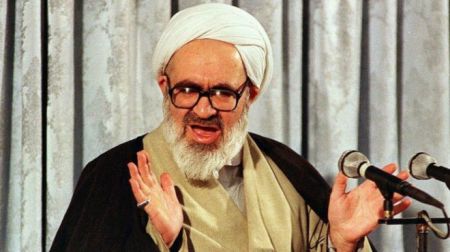
The resolution quotes one of Iran’s own senior former officials, the late Hussein Ali Montazeri, a grand ayatollah who served as Khomeini’s chief deputy, who said the 1988 massacre was ‘’the greatest crime committed during the Islamic Republic, for which history will condemn us.”

Accordingly, in 1988, the Islamic Republic executed the thousands of prisoners who had even slight affiliations with the main opposition movement Mujahedin-e Khalq (MEK), because of their political beliefs. The victims were buried in mass graves in Iran after they were shot or hung over a period of just a few months.

Amnesty International reported on November 2, 2007, ‘’between 27 July 1988 and the end of that year, thousands of political prisoners [in Iran], including prisoners of conscience, were executed in prisons nationwide.”

Noted by H.Res. 159, “Those personally responsible for these mass executions include senior officials serving in the current Government of Iran; … [P]risoners were reportedly brought before the commissions and briefly questioned about their political affiliation, and any prisoner who refused to renounce his or her affiliation with groups perceived as enemies by the regime was then taken away for execution.”

Accordingly, “thousands of people, including teenagers and pregnant women, imprisoned merely for participating in peaceful street protests and for possessing political reading material, many of whom had already served or were currently serving prison sentences,” were among the victims.

Stated in the congressional resolution, “[P]risoners were executed in groups, some in mass hangings and others by firing squad, with their bodies disposed of in mass graves.”

According to Amnesty International, ‘’the majority of those killed were supporters of the PMOI [MEK], but hundreds of members and supporters of other political groups . . . were also among the execution victims.’’

The resolution further states, “The later waves of executions targeted religious minorities, such as members of the Baha’i faith, many of whom were often subjected to brutal torture before they were killed.” It add “The families of the executed were denied information about their loved ones and were prohibited from mourning them in public”.

The resolution mentions a recently disclosed audiotape, where Hussein Ali Montazeri can be heard to say that the 1988 mass killings were “the greatest crime committed during the Islamic Republic, for which history will condemn us.”

Amnesty International’s report concluded, “there should be no impunity for human rights violations, no matter where or when they took place. The 1988 executions should be subject to an independent impartial investigation, and all those responsible should be brought to justice, and receive appropriate penalties’’

The resolution says, “The current Supreme Leader Ali Khamenei was reportedly aware of, and later publicly condoned the massacre.”

The Montazeri audiotape was released by Ayatollah Hossein Ali Montazeri’s son, Ahmad, a moderate cleric, who posted the confidential audio of his father on his website. He was ordered by the intelligence to remove it, and was later arrested.

On the tape, Montazeri states, “You [Iranian officials] will be in the future etched in the annals of history as criminals. The greatest crime committed under the Islamic Republic, from the beginning of the Revolution until now, which will be condemned by history, is this crime [mass executions] committed by you.”

Ironically, the people Montazeri is addressing and warning on the tape appear to enjoy high positions currently. They include:

• Mostafa Pourmohammadi was appointed by the Hassan Rouhani to be justice minister. After the release of a tape, Pourmohammadi defended the commission of the massacre and said he is “proud“ to have carried out “God’s commandments” in killing the political opponents.

• Ebrahim Raeisi was appointed as the head of Astan Quds Razavi, which has billions of dollars in revenues.

• Hussein Ali Nayeri is now the deputy of the Supreme Court of Iran. In his memoir, Montzari writes that he told Nayeri to stop the executions at least in the month of Moharram religious holidays, but according to the BBC, Nayeri said, “We have executed so far 750 people in Tehran… we get the job done with [executing] another 200 people and then we will listen to whatever you say.”

These people are only few of those who were involved in the 1988 massacre. They have been awarded more senior positions, power, and money.

Montazeri warned them, “Beware of 50 years from now, when people will pass judgment on the leader (Khomeini) and will say he was a bloodthirsty, brutal and murderous leader.”

The message from Iran’s ex-heir Supreme Leader highlights the methods that the officials of the Islamic Republic use to oppress the opposition. Executions or brutal punishments are common, as Iran ranks top in the world when it comes to executions per capita. Crimes against humanity continue to occur. These are the means that the government uses to silence the opposition.

Human rights organizations, the United Nations, and the International Criminal Court (ICC) must conduct investigations, and bring those who have committed and continue to commit these crimes to justice. Calls for justice are increasing. Those who commit crimes against humanity should be held accountable.

Congress must follow up on the recent Congressional resolution.

The Iranian People Hope Trump Will Support Them, Not Their Rulers

May 14, 2017

The Iranian People Hope Trump Will Support Them, Not Their Rulers, Iran Focus, May 14, 2017

(Please see also, Prosecutor General Warns against Attempts to Upset Election Security in Iran. — DM)

The new American president is reviewing policy with regards to Iran, and with an eye to change. Kashfi suggests that, “Any further support for the un-elected regime in Teheran, be it commercial, economic, diplomatic should be tied to a commitment by the Islamic regime to stop supporting international terrorism and to respect women, minorities, and human rights.”

With the change of power in America, the hope and expectation of the Iranian people is that Washington will support the Iranian people, and advocate the overthrow of the Islamic regime.

******************

London, 14 May – It’s been reported that more than 9 million Iranians have fled their homeland since the Revolution in 1979. This means that more than 12 percent of Iran’s citizens chose to abandon their homes, families, and belongings, to maintain their freedom. It is estimated that close to four million Iranians have taken refuge in the U.S since 1979.

These refugees consider the International, and specifically European, trade agreements and relations with Iran, their worst nightmare.

The Islamic regime and some in the international community claim that support for the so-called “reformist” and “pragmatic” President Hassan Rouhani will ultimately bring freedom and democracy to Iran. They attempt to convince the free world and democratic countries that appeasement and normalized relations will change the Iranian regime’s attitude and behavior.

“However,” writes Mansour Kashfi, author and president of Kashex International Petroleum Consulting with over 50 years’ experience in petroleum exploration, primarily in Iran in an article for WorldTribune, “the distinction between a ‘moderate’ president and ‘fundamentalist’ Supreme Leader in Iran is a political subterfuge used to mislead the population and perpetuate the inherent corruption of the Islamic regime governing system.

This corruption will not only continue to oppress the Iranian people but also undermine the transparency in business dealings with foreign investors.”

After two years of negotiations, an agreement was reached to lift the sanctions on Iran in return for the Islamic Republic halting its efforts to acquire nuclear weapons.

In the midst of this, former President Obama decided to attempt to make a connection with Ayatollah Khameini, the Supreme Leader of the Islamic regime. Obama sent Khameini several friendly letters. Some called this course of action outrageous, considering that the Iranian people were crying for democracy and American help to support a secular government in Iran, and the disastrous human rights issues in Iran, continued terrorist acts in the region, and ongoing testing of intercontinental missiles. Obama may have done better by establishing a relationship with the Iranian people, instead.

According to Kashfi, “Clergies in Iran are as murderous as any religious group in history. From the very first day of the Islamic regime’s establishment, they executed many innocent Iranian officials and military officers, and provoked war with Iraq just to consolidate their dictatorial regime,” and adds, “During eight years of bitter war with Iraq and over one million casualties, clergies dragged school children to the front lines, where their little bodies were used as sandbags to clear mine fields.”

“War was an excuse to execute dissidents and anyone who displeased the bloodthirsty clergies. Minorities including non-Shiite believers such as Sunnis, Jews, Christians, and Bahais were executed on political charges. All these killings and unjust acts in Iran were carried out on command of the Supreme Leader, Ayatollah Khameini,” writes Kashfi.

According to The U.S. Congress’s Human Rights Country Report there has been no change in the status of human rights in Iran. Since 2013, when Hassan Rouhani became president, the status of human rights worsened.

Respect for human rights distinguishes America as a great nation, so Kashfi wonders how it can “…still believe it can establish a lasting line of communication with a terrorist regime in Iran that routinely persecutes religious and ethnic minorities, tortures and systematically executes political prisoners, and promotes international terrorism abroad?” He adds, “…when America fails to lead, enemies of freedom like the Islamic regime of Iran and Russia fill the vacuum.”

After the U.S.withdrew from Iraq, Kashfi says that “the Islamic regime did everything it could to establish oppression and spread terror in that country, and Russia began focusing on the southern Persian Gulf states.”

The new American president is reviewing policy with regards to Iran, and with an eye to change. Kashfi suggests that, “Any further support for the un-elected regime in Teheran, be it commercial, economic, diplomatic should be tied to a commitment by the Islamic regime to stop supporting international terrorism and to respect women, minorities, and human rights.”

With the change of power in America, the hope and expectation of the Iranian people is that Washington will support the Iranian people, and advocate the overthrow of the Islamic regime.

Prosecutor General Warns against Attempts to Upset Election Security in Iran

May 14, 2017

Prosecutor General Warns against Attempts to Upset Election Security in Iran, Tasnim News Agency, May 14, 2017

(Please see also, How to Secure and Stabilize the Middle East. Are the mad mullahs worried? — DM)

TEHRAN (Tasnim) – Iran’s Judiciary has obtained information about hostile schemes to create insecurity as the country is gearing up for presidential election, Prosecutor General Mohammad Jafar Montazeri warned, stressing that any move to disrupt security will receive a harsh response.

Speaking at a press conference on Sunday, Montazeri said reports suggest that “ill-wishers and enemies are seeking to upset security with any means” as election day is nearing.

Giving an assurance that hostile attempts at causing insecurity will get nowhere, the prosecutor general warned that the Iranian Establishment’s response to anyone wanting to upset the security of the country or the election will be severe.

In comments on May 10, Leader of the Islamic Revolution Ayatollah Seyed Ali Khamenei warned that the enemies’ short-term purpose is to upset Iran’s security and foment chaos.

The Leader also cautioned the six candidates running for presidency against moves or comments that may upset the country’s security and serve the interests of the enemy unintentionally.

“Anybody wanting to take any measure against the country’s security in the election will certainly receive a hard reaction and slap in the face,” Ayatollah Khamenei underlined.

“(The issue of) security is of great significance for the country, for the people, and consequently for me, and security must be fully maintained in the election,” the Leader added.

The 12th presidential election will be held in Iran on May 19.

Six candidates, Hassan Rouhani, Mohammad Baqer Qalibaf, Eshaq Jahangiri, Ebrahim Raisi, Mostafa Aqa-Mirsalim, and Mostafa Hashemitaba are running in the race.

How to Secure and Stabilize the Middle East

May 14, 2017

How to Secure and Stabilize the Middle East, Clarion ProjectShahriar Kia, May 14, 2017

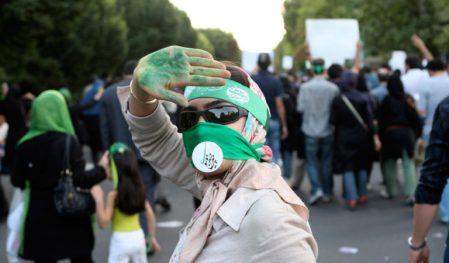
An Iranian protester during the Green Revolution (Photo: Reuters)

The opinions below are those of the author and do not necessarily reflect those of Clarion Project.

In contrast to other countries that lack a opposition that can be trusted, Iran enjoys an internationally-recognized alternative based on democratic values acknowledged across the globe.

The National Council of Resistance of Iran (NCRI) and its pivotal member, the People’s Mojahedin Organization of Iran (PMOI/MEK), is the largest and most organized opposition in the face of the Iranian regime. The NCRI enjoys widespread support inside Iran and throughout the world, with the ability to organize an uprising against the regime in Tehran. Senior Iranian regime officials have acknowledged the time and again that the main threat compromising Iran’s entire regime apparatus is none other than the PMOI/MEK. To this end, they have focused their entire efforts on physically obliterating this Iranian opposition group.

In 2009, when the Iranian people took to the streets and demanded fundamental change, their efforts went unsupported due to Obama’s appeasement policy that sought to sign the nuclear deal with Tehran at all costs. This was an opportunity that enjoyed the potential of significantly decreasing existing Middle East crises. Today, the regime in Tehran is facing crises far more dangerous than 2009.

The correct Iran policy is supporting regime change by the Iranian people and their organized and legitimate resistance. By adopting such a stance, the international community can begin to confront Iran’s notorious influence in the region and its nuclear ambitions in order to spread security in a non-nuclear Middle East free of terrorism.

***************************

U.S. Secretary of State Rex Tillerson announced at a press conference on April 19 that the White House is evaluating its policy on Iran. This policy overview will not merely cover the Iran nuclear deal, but will be a comprehensive look at all Iran-related issues.

At a press conference, Tillerson formalized Iran’s provocative and destructive measures in different fields.

“Iran is the world’s leading state sponsor of terrorism and is responsible for intensifying multiple conflicts and undermining U.S. interests in countries such as Syria, Yemen, Iraq, and Lebanon, and continuing to support attacks against Israel … An unchecked Iran has the potential to travel the same path as North Korea, and take the world along with it … Iran’s provocative actions threaten the United States, the region, and the world …” he said.

“Iran continues to have one of the world’s worst human rights records,” Tillerson added.

Defense Secretary James Mattis adopted a similar approach on April 22 at the Center for Strategic and International Studies, saying, “But we’re talking about the Mideast at an inflection point. And I would just point out right now that among the many challenges the Mideast faces, I think Iran is actually foremost … The Iranian regime, in my mind, is the single most enduring threat to stability and peace in the Middle East.”

Iran’s meddling has neutralized all efforts to resolve the region’s crises, said Bahrain Interior Minister Rashed bin Abdullah at a Gulf Cooperation Council (GCC) session, adding the region faces threats that demand cooperation to confront. He emphasized the need for unity in Gulf positions regarding strategic matters.

What is the right Iran policy?

Supporters of the Iran appeasement approach believe the correct policy is to engage the mullahs’ regime and continue dialogue. They justify this approach for two reasons: first, to contain Iran’s nuclear ambitions and second, to attempt to establish change from within by supporting so-called “moderates” inside the regime apparatus.

This is the policy pursued during the Obama years without any political or strategic reservation, and also that of previous administrations throughout the past few decades.

However, rapprochement with Tehran not only failed to contain the mullahs’ ambitions and terrorism; in fact, it further encouraged the regime and plunged the entire Middle East into insecurity and instability.

The Wall Street Journal wrote in a recent piece, “President Donald Trump’s hard-line view on Iran was at odds with State Department diplomats.”

Yet, the solution placed forward by Obama and the State Department’s experienced diplomats resulted in Iran escalating its flagrant human rights violations and expanding its devious influence throughout the Middle East.

Others believe the right Iran policy is a military solution and the U.S. must launch airstrikes targeting Iran’s nuclear sites. Although this can deliver significant blows to Iran’s ambitions and disrupt the mullahs’ efforts to obtain nuclear weapons, the consequences on regional security and stability are controversial, placing the U.S. and its allies in yet another Middle East war.

What is the durable solution? Can we avoid war while bringing an end to the spread of extremism and terrorism across the globe?

Iran is the leading state sponsor of terrorism in today’s world. Since the appeasement policy adopted by previous U.S. administrations has been fruitless in containing Iran and actually led to the current dangerous circumstances, the only viable long-term solution is to adopt a firm policy that hinges on regime change.

In contrast to other countries that lack a opposition that can be trusted, Iran enjoys an internationally-recognized alternative based on democratic values acknowledged across the globe.

The National Council of Resistance of Iran (NCRI) and its pivotal member, the People’s Mojahedin Organization of Iran (PMOI/MEK), is the largest and most organized opposition in the face of the Iranian regime. The NCRI enjoys widespread support inside Iran and throughout the world, with the ability to organize an uprising against the regime in Tehran. Senior Iranian regime officials have acknowledged the time and again that the main threat compromising Iran’s entire regime apparatus is none other than the PMOI/MEK. To this end, they have focused their entire efforts on physically obliterating this Iranian opposition group.

Following a visit paid by Senator John McCain to Albania and his meeting with Iranian opposition leader Maryam Rajavi, an analysis posted on April 27 in Iran Dideban, a state-sponsored outlet, made vivid the regime’s concern that the Revolutionary Guards (IRGC) failed to quell and destroy the PMOI/MEK.

“The IRGC’s involvement in Syria led to serious neglect. This inattention has surfaced, resulting in this group [MEK] gaining a more open hand to play a role in on-the-ground developments … It is worth noting this group has significant experience in organizing campaigns and can pose a potential security threat for the country. The use of social domestic networks inside the country and influencing grayscale correspondents are among the efforts of this group. This has launched a wave of disappointment among forces loyal to the establishment and state.”

In 2009, when the Iranian people took to the streets and demanded fundamental change, their efforts went unsupported due to Obama’s appeasement policy that sought to sign the nuclear deal with Tehran at all costs. This was an opportunity that enjoyed the potential of significantly decreasing existing Middle East crises. Today, the regime in Tehran is facing crises far more dangerous than 2009.

The correct Iran policy is supporting regime change by the Iranian people and their organized and legitimate resistance. By adopting such a stance, the international community can begin to confront Iran’s notorious influence in the region and its nuclear ambitions in order to spread security in a non-nuclear Middle East free of terrorism.

Misogyny Meet Irony: Saudi Arabia Elected To United Nation’s Women’s Rights Commission

April 24, 2017

Misogyny Meet Irony: Saudi Arabia Elected To United Nation’s Women’s Rights Commission, Jonathan Turley’s Blog, Jonathan Turley, April 24, 2017

(Please see also, United Nations Elects Saudi Arabia to Women’s Rights Commission. — DM)

If you like your misogyny with a heavy serving of irony, you could do no better than the United Nations this week after Saudi Arabia was elected to a  2018-2022 term on the Commission on the Status of Women, the U.N. agency that, according to its website, is “exclusively dedicated to the promotion of gender equality and the empowerment of women.”  As with Iran being put on the Commission, the irony would be humorous if there were not millions of victims over decades of abuse by these countries.  Previously, Saudi Arabia taking over the top spot on the Human Rights Commission was viewed as unbelievable, but the entry on the Commission on the Status of Women sets a level of irony that may be unsurpassable.

Notably, various groups demanded to know what countries voted for the inclusion.  Only 7 of 54 ECOSOC states opposed the inclusion and many want the EU countries to reveal their votes. It is absurd that such votes should be taken on secret ballots.

Now that Saudi Arabia is a protector of women’s rights, it may want to immediately call for an investigation of the country responsible for:

Barring women from being able to travel without the permission of men;

Flogging women for driving;

Jailing a man for protesting the treatment of women;

Arresting women for ripped jeans or “Western haircuts“;

Stoning a woman to death (while just giving her male love flogging) for sex outside of marriage;

Sentencing human right activists to death;

Persecuting lawyers who help rape victims; 

Flogging rape victims;

Permitting child bride arranged marriages;

Closing Women’z health clubs as UnIslamic;

Arresting women without head coverings;

Arresting even foreign women who sit next to unrelated men in public places;

Flogging women over use of bad language; 

Enforcing the right to beat wives; and

Barring women from a Women’s Rights Conference.

That is only a partial list for the new Saudi Commissioner and it does not even require going outside of the Kingdom of Saudi Arabia.

Rex Tillerson’s Tough Talk on Iran

April 20, 2017

Rex Tillerson’s Tough Talk on Iran, Power LinePaul Mirengoff, April 19, 2017

Yesterday, as we noted here, Secretary of State Rex Tillerson informed Congress that Iran is in compliance with the nuclear deal and that the administration will continue to provide relief from sanctions, as called for by the agreement. He added, however, that “Iran remains a leading state sponsor of terror through many platforms and methods.”

Today, Tillerson (1) elaborated in scathing language on Iran’s role as a leading sponsor of terrorism and on other of its misdeeds, (2) made clear that the nuclear deal is unsatisfactory, and (3) stressed that the U.S. government is engaged in a thorough review of our Iran policy.

Tillerson characterized the Iran deal as “another example of buying off a power who has nuclear ambitions.” Citing the North Korean example, Tillerson complained “we buy them off for a short period of time, and then someone has to deal with it later.” He then added that the administration does not intend to follow this course.

It is rumored that President Trump hit the roof when he saw Tillerson’s letter to Congress (or maybe the way it was reported) and demanded that he issue today’s tough statement. According to this account, the tough statement had been drafted previously, nixed by influential soft-liners in the administration, and revived in light of the Tillerson letter.

Whether or not this is what happened, I think today’s statement was much needed.

But what will come of the policy review promised in Tillerson’s statement? The Obama administration did an effective job of fencing in its successors. I discussed the future of the Iran deal under Trump in this post.

The upshot of two days of Tillerson talk about Iran seems to be that our Iran policy is up-for-grabs, like much else in the policy realm. Sharp disagreement probably exists within the administration about how to proceed and, not unlike other policy disputes, the disagreement occurs in the context of no truly good options.

You can watch Tillerson’s speech, plus a brief Q&A, below. Don’t miss Andrea Mitchell fretting that if the U.S. backs out of the Iran deal, rogue states like North Korea won’t trust us.


We’re turning a blind eye to Iran’s genocidal liars

April 18, 2017

We’re turning a blind eye to Iran’s genocidal liars, The Australian, Michael Oren, April 19, 2017

(Please see also, What North Korea Should Teach Us about Iran. DM)

In responding forcibly to North Korean and Syrian outrages, President Trump has taken a major step towards restoring America’s deterrence power. His determination to redress the flaws in the JCPOA and to stand up to Iran will greatly accelerate that process. The US, Israel and the world will all be safer.

**************************

The US has signed agreements with three rogue regimes strictly limiting their unconventional military capacities. Two of those regimes — Syria and North Korea — brazenly violated the agreements, provoking game-changing responses from Donald Trump. But the third agreement — with Iran — is so inherently flawed that Tehran doesn’t even have to break it. Honouring it will be enough to endanger millions of lives.

The framework agreements with North Korea and Syria, concluded respectively in 1994 and 2013, were similar in many ways. Both recognised that the regimes already possessed weapons of mass destruction or at least the means to produce them. Both ­assumed that the regimes would surrender their arsenals under an international treaty and open their facilities to inspectors. And both believed these repressive states, if properly engaged, could be brought into the community of nations.

All those assumptions were wrong. After withdrawing from the nuclear non-proliferation treaty, Pyongyang tested five atomic weapons and developed ­intercontinental missiles capable of carrying them. Syrian dictator Bashar al-Assad, less than a year after signing the framework, reverted to gassing his own people. Bolstered by the inaction of the US and backed by other powers, North Korea and Syria broke their commitments with impunity.

Or so it seemed. By ordering a Tomahawk missile attack on a Syrian air base, and a US Navy strike force to patrol near North Korea’s coast, the Trump administration has upheld the frame­­works and placed their violators on notice. This reassertion of power is welcomed by all of ­America’s allies, Israel among them. But for us the most dangerous agreement of all is the one that may never need military enforcement. For us, the existential threat looms in a decade, when the agreement with Iran expires.

Like the frameworks with North Korea and Syria, the Joint Comprehensive Plan of Action of 2015 assumed that Iran would fulfil its obligations and open its facilities to inspectors. The JCPOA assumed that Iran would moderate its behaviour and join the international community. Yet unlike its North Korean and Syrian allies, Iran was the largest state sponsor of terror and openly vowed to destroy another state: Israel. Unlike them, Iran systematically lied about its unconventional weapons program for 30 years. And unlike Damascus and Pyongyang, which are permanently barred from acquiring weapons of mass destruction, Tehran can look forward to building them swiftly and legitimately in the late 2020s, once the JCPOA expires.

This, for Israel and our neighbouring Sunni states, is the appalling flaw of the JCPOA. The regime most committed to our destruction has been granted a free pass to develop military nuclear capabilities. Iran could follow the Syrian and North Korean examples and cheat. Or, while enjoying hundreds of billions of dollars in sanctions relief, it can adhere to the agreement and deactivate parts of its nuclear facilities rather than dismantle them. It can develop new technologies for producing atomic bombs while testing intercontinental ballistic missiles. It can continue massacring Syrians, Iraqis and Yemenis, and bankrolling Hamas and Hezbollah. The JCPOA enables Iran to do all that merely by complying.

A nuclear-armed Iran would be as dangerous as “50 North Koreas”, Israeli Prime Minister Benjamin Netanyahu told the UN in 2013, and Iran is certainly many times more dangerous than Syria. Yet Iran alone has been granted immunity for butchering civilians and threatening genocide. Iran alone has been guaranteed a ­future nuclear capability. And the Iranian regime — which brutally crushed a popular uprising in 2009 — has amassed a million-man force to suppress any future opposition. Rather than moderating, the present regime promises to be more radical yet in another 10 years.

How can the US and its allies pre-empt catastrophe? Many steps are possible, but they begin with penalising Iran for the conventions it already violates, such as UN restrictions on missile development. The remaining American sanctions on Iran must stay staunchly in place and congress must pass further punitive legislation. Above all, a strong link must be established between the JCPOA and Iran’s support for terror, its pledges to annihilate ­Israel and overthrow pro-American Arab governments, and its complicity in massacres. As long as the ayatollahs oppress their own population and export their ­tyranny abroad, no restrictions on their nuclear program can ever be allowed to expire.

In responding forcibly to North Korean and Syrian outrages, President Trump has taken a major step towards restoring America’s deterrence power. His determination to redress the flaws in the JCPOA and to stand up to Iran will greatly accelerate that process. The US, Israel and the world will all be safer.

Michael Oren is Israel’s deputy minister for diplomacy, a member of the Knesset and a former ambassador to Washington.

Iran’s Stage-Managed Elections

April 15, 2017

Iran’s Stage-Managed Elections, American ThinkerReza Shafiee, April 15, 2017

(What can President Trump do to promote regime change in Iran? What can he do to support the resistance, in and outside Iran? What, if anything will he do?– DM)

Iran’s history has shown that people are willing to risk and speak openly when they have outside support and sympathy. The United States’ policies with regard to human rights have an instant effect in hearts and minds of ordinary citizens in Iran. What happened in Iran in 2009 is not a distant memory. The Obama administration’s flawed policy set off a chain reactions in the region which still reverberates in Syria, Yemen and Iraq. By focusing just on getting the nuclear deal done with the mullahs in Tehran, it actually left out other pressing issues such supporting the Iranian people and indirectly preventing the carnage in the neighboring countries. 

***************************

Every four years, Iranian citizen witness a show called ‘elections.’ These have nothing in common with genuine democratic elections; they’re facades. The upcoming May 19 elections are no exception.

A closer look at the candidates proves that they are no different from one another and all have a clear track record of participation in suppression of Iranian people over the past four decades. They have won the approval to enter the race by the mullahs for just this reason.

The two more serious ones are: Hassan Rouhani, the incumbent president; and Ebrahim Raisi, custodian of Iran’s wealthiest charity, Astan Quds Razavi in Iran’s holiest shrine of Imam Reza in Mashhad, northeastern Iran. Having charge of such vast amount of wealth, it’s a given that Raisi enjoys Supreme Leader Khamenei’s full trust. Both candidates are cut from the same cloth and are committed to principle to Supreme Guardianship (Velayat-e faqih), meaning, the rule of the ayatollahs

So who are they? Let’s start with the second one.

Ebrahim Raiai a member of “Death Commission” and close confident of Ali Khamenei

He was a low-level cleric who climbed the ladder in the mullahs’ hierarchy just for his undeniable services to the late Khomeini in slaughtering of 30,000 political prisoners in summer of 1988. (In Iran, we don’t refer to Khomeini as “Ayatollah,” just Khomeini is enough.  The title has been stolen and abused by the ruling mullahs in Iran.) The prisoners were mainly members and sympathizers of the Iranian opposition People’s Mojahedin Organizations of Iran (PMOI/MEK).

The “Death Commission” was a four-member body with the sole task of carrying out Khomeini’s fatwa against dissidents. In his hand-written decree, Khomeini openly ordered the commission to kill the political prisoners, the majority of whom had been already imprisoned.

Ayatollah Hossein-Ali Montazeri, Khomeini’s handpicked successor was later sacked over his quarrel with Khomeini for the indiscriminate killings. In a shocking 28-year-old audio file of one the meetings of Death Commission leaked in August by his son Ahmad, Montazeri called the killings a “crime that future generations will certainly not forget” and declared: “It is committed in the name of the Islamic Republic and carried out by you.”

Ahmad Montazeri has regarded Ebrahim Raisi’s standing for presidential elections a ‘joke’ and ‘an insult to Iranian people’. Raisi’s record does not stop at just his role in the massacre of political prisoners in 1988, but what he did overrides any other tasks he has undertaken in Islamic Republic’s killing machine.

Canada’s Parliament adopted the following motion on June 5th, 2013 on the events of 1988 in Iran: “That the House condemn the mass murder of political prisoners in Iran in the summer of 1988 as a crime against humanity, honors the memory of the victims buried in mass graves at Khavaran cemetery and other locations in Iran, and establishes Sept. 1 as a day of solidarity with political prisoners in Iran.”

Now let’s look at the other candidate:

Hassan Rouhani is no saint

Make no mistake about Rouhani being a saint by comparison. He is not far behind Raisi when it comes to cruelty. For starters, Mostafa Pour-Mohammadi, his justice minister, is none other than another member of the same notorious Death Commission. Last summer when Pour-Mohammadi was pressed to answer for the massacre of 1988, he proudly said: “I carried out God’s will and I have not lost sleep over what I did.”

The rate of executions during Rouhani’s presidency has been unprecedented in past 25 years in Iran, according to Ahmed Shaheed, who was Iran’s last UN Special Rapporteur for human rights. During Rouhani’s tenure, around 3000 executions were carried out.

When asked about hangings during his presidency, Rouhani simply said: “They were carried out according to God’s laws.”

Amnesty International’s report for 2016 indicates that with the exception of China, Iran carried out 55 percent of all executions worldwide.

Rouhani has always said that he has been in a decision making-position throughout the life of the Islamic Republic. He personally was in a commanding position when the 1999 student uprisings were crushed in Iran.

The European Union extended its sanctions on Iranian regime’s offices for participating in suppression of Iranian citizens.

EU documents state that they target persons complicit in “torture, cruel, inhuman and degrading treatment, or the indiscriminate, excessive and increasing application of the death penalty, including public executions, stoning, hangings or executions of juvenile offenders.”

As U.S. Ambassador to the UN Nikki Haley mentioned recently: “Peace and security cannot be achieved in isolation from human rights.” The long-suffering people of Iran, Syria, and Iraq bear witness that “human rights abuses are not the byproduct of conflict; they are the cause of conflict, or they are the fuel that feeds the conflict.”

There’s also a third candidate worth looking at:

Mahmoud Ahmadinejad is back in the race

The trio of Rouhani, Raisi and Ahmadinejad in Iran’s upcoming elections is more than a mere joke: It has a plain and clear message – that of Khamenei’s extreme weakness in controlling his goons. The humorous Iranian people have already made jokes about the three and this bagatelle called elections. Social media is full of them.

Khamenei ordered Ahmadinejad to stay away from elections. By disobeying his master’s direct order he is demonstrating the Supreme Leader’s unprecedented lack of control over his establishment. Khamenei offered an explicit warning in September that his candidacy would be a “polarizing situation” that would be “harmful to the country.”

That is a reference to the disputed election in 2009 which ignited massive street demonstrations and subsequent arrests of thousands of protesters and the killing of hundreds of others by the Revolutionary Guard Corps (IRGC).

Final thoughts     

Iran’s history has shown that people are willing to risk and speak openly when they have outside support and sympathy. The United States’ policies with regard to human rights have an instant effect in hearts and minds of ordinary citizens in Iran. What happened in Iran in 2009 is not a distant memory. The Obama administration’s flawed policy set off a chain reactions in the region which still reverberates in Syria, Yemen and Iraq. By focusing just on getting the nuclear deal done with the mullahs in Tehran, it actually left out other pressing issues such supporting the Iranian people and indirectly preventing the carnage in the neighboring countries.

The elections in Iran – for parliament or president – have been designed or “engineered,” as the word has been widely used, by the regime’s inner circles, for both internal and external consumption. However after the nuclear deal with the West, it has become a high priority for the regime to show popular support at home and project it as an image to the rest of the world as a regime fully in control and ready to do business. It is no secret that the regime has no popular support in Iran.

Ebrahim Rasis, Hassan Rounhani, Mahmoud Ahmadinejad and their likes should not be allowed to escape the consequences of their crimes against humanity. Known human rights criminals such as entire ruling mullah class in Iran should not go unpunished. They should soon see the inside of International Criminal Court.

Reza Shafiee is a member of Foreign Affairs Committee of the National Council of Resistance of Iran (NCRI) 


Trump Administration Sanctions Iran Prison Torture Industry

April 13, 2017

Trump Administration Sanctions Iran Prison Torture Industry, Washington Free Beacon, April 13, 2017

An Iranian inmate peers from behind a wall as a guard walks by at the female section of the infamous Evin jail, north of Tehran, 13 June 2006. (AFP PHOTO/ATTA KENARE KENARE/AFP/Getty Images)

The Trump administration is leveling new economic sanctions against senior Iranian officials and its prison system for widespread human rights abuses, including the systematic torture of those being held in these facilities, according to White House officials familiar with the matter.

The latest sanctions target the Tehran Prisons Organization and Sohrab Suleimani, a senior official in the prison system and the brother of Qassem Soleimani, a senior Iranian military figure responsible for operating Iran’s rogue activities in Syria and elsewhere.

Sohrab Soleimani is responsible for overseeing Iran’s notorious Evin Prison, which is known for torturous interrogations, forced interrogations, and widespread mistreatment of inmates.

The latest sanctions are certain to rankle Tehran, already the subject of a range of new sanctions under the Trump administration, which is currently conducting a widespread review of all matters related to the landmark nuclear agreement.

A senior official on the White House National Security Council told the Washington Free Beacon that the Soleimani family has a history of fomenting violence and unrest both inside and outside Iran.

“It’s no coincidence that Sohrab Suleimani is the brother of the notorious Qassem Soleimani, the head of the IRGC’s Quds Forces, who has been responsible for so much of the violent disruption Iran has been spreading through the region,” said the official, who was not authorized to speak on record.

Iranian human rights abuses have only grown under the leadership of so-called reformist President Hassan Rouhani, the official said. This includes the detention of U.S. citizens

“There has been a disturbing and significant increase in the number of detentions and executions of Iranian citizens under President Rouhani, and the infamous Evin Prison under Sohrab Suleimani’s control has been a key facility in this program of domestic repression,” the official said.

The Trump administration is holding meetings with the family members of American citizens still being detained in Iran and believed to be subjected to torture.

“In addition, we have been deeply concerned by the treatment of American citizens in this prison, and in others throughout Iran,” the official said. “Just today, senior officials in the Trump administration met with members of the Namazi family representing Siamak Namazi and Baquer Namazi who have been unjustly detained in Iran since October, 2015 and February, 2016, respectively.”

“Today’s designations highlight our continued support for the Iranian people and demonstrate our commitment to hold the Government of Iran responsible for its continued repression of its own citizens,” John E. Smith, director of the Treasury Department’s Official of Foreign Assets Control, said in a statement. “We will continue to identify, call out, and sanction those who are responsible for serious human rights abuses in Iran.”

The sanctions do not conflict with U.S. obligations under the nuclear agreement and are not being leveled as part of that agreement, according to U.S. officials.

The sanctions were formulated following a series of investigations by the U.S. government into Iran’s systematic breach of human rights.

“These designations are in response to what we see as pattern of human rights abuses by the Government of Iran and reflect the United States’ deep concern regarding the human rights situation in Iran,” the State Department explained in a background document provided to reporters.

“We continue to see Government of Iran officials engage in repressive behavior against its own citizens, including through their mistreatment and abuse of prisoners,” the document states. “This is especially evident at Evin Prison, which is where numerous prisoners of conscience are held. We have documented these and many other human rights abuses perpetrated by the government of Iran in our annual State Department authored Human Rights, Religious Freedom, and Trafficking in persons reports.”

Soleimani’s role in Iran’s prison system makes him one of the foremost human rights abusers worldwide.

Soleimani oversaw an April 2014 incident at the Evin Prison in which dozens of security guards and prison officials beat a number of political prisoners. The attack is believed to have lasted several hours and impacted more than 30 prisoners. Many of these prisoners were later denied medical treatment.

Evin Prison is home to large number of Iranian political dissidents and other government opponents, who are routinely shut down and arrested by the Iranian regime for political activities targeting those in power.