Posted tagged ‘IDF’

New video corroborates Hebron soldier’s testimony, supporters say

March 25, 2016

New video corroborates Hebron soldier’s testimony, supporters say, Times of Israel, Staff, March 25, 2016

(Sentence first, trial later, said the mad queen.

angryqueen[1]_thumb[3]

— DM)

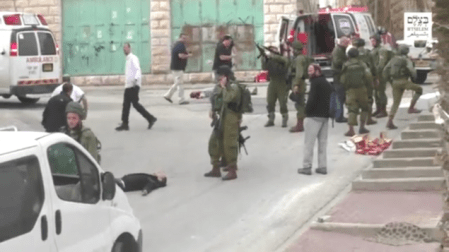
Screen-Shot-2016-03-24-at-14.30.03-635x357An IDF soldier loading his weapon before he appears to shoot an unarmed, prone Palestinian assailant in the head following a stabbing attack in Hebron on March 24, 2016. (Screen capture: B’Tselem)

Supporters of an IDF soldier being investigated for shooting an apparently disarmed Palestinian assailant in the West Bank city of Hebron on Thursday posted a video online of the moments before the shooting, which they say shows as reasonable the soldier’s claim that he feared the attacker may have had an explosive device.

The soldier was arrested Thursday after he was filmed shooting the Palestinian shortly after the latter had stabbed a different soldier. When the suspect shot him, the Palestinian was already lying on the ground wounded, as a result of troops’ gunfire during his attack.

The soldier was brought to the Jaffa Military Court Friday for an extension of his remand. He is now being treated as a murder suspect.

The Palestinian was one of two stabbers who attacked soldiers near the Tel Rumeida neighborhood in Hebron.

F160324WH01Israeli soldiers remove the body of a Palestinian man who stabbed a soldier in the West Bank city of Hebron on March 24, 2016. The Palestinian was shot at the scene after stabbing and lightly wounding an Israeli soldier. (Wissam Hashlamon/Flash90)

The soldier’s shooting drew widespread condemnation, including from Defense Minister Moshe Ya’alon and Prime Minister Benjamin Netanyahu, who called it a violation of the army’s ethical code. The army’s Military Police have launched a criminal investigation into the incident.

An investigation was also launched Thursday by the Central Command into the apparent failure of two officers on the scene to prevent the shooting.

But in a video posted on the Ynet news site, rescue crews are shown moments before the shooting, with the conversation clearly focused on the possibility that the stabber continued to constitute a threat to those around him.

“That terrorist is still alive, the dog! Don’t let him attack us!” one medic is heard saying after apparently seeing the Palestinian moving.

“It looks like he has a bomb on him,” shouts another voice. “Until a sapper comes, nobody touches him!”

The video appears to corroborate the suspect’s own testimony to investigators according to which the Palestinian was still “moving underneath his jacket, where he could have been hiding explosives or weapons,” as the soldier’s attorney Benjamin Malka explained Thursday.

This warning, however, was not unique to this incident. It is standard IDF operating procedure to assume that an assailant has an explosive device to carry out a secondary attack on first responders.

Other soldiers can also be seen in the two videos from the scene standing next to the two Palestinian assailants, making it unclear how serious the threat of an explosive device was considered by the people on the scene.

The graphic video of the Thursday morning incident went viral on Israeli social media, sparking controversy.

But lawyer Malka told Ynet shortly after the incident that his client should not be judged before an army investigation is completed.

In the video, the soldier is partially blocked from view by other members of his unit when the shot is fired. However, the impact of the bullet can be seen. The Palestinian man can then be seen bleeding from the head.

(Video contains graphic images)


In an earlier interview with Army Radio, Malka called his client an “outstanding soldier, salt of the earth,” adding that “he has yet to be allowed to defend his innocence.”

The video prompted the IDF to launch an investigation into what it said was “a very grave” incident.

IDF spokesman Brig. Gen. Moti Almoz said the soldier had been arrested and pledged that there would be a thorough investigation into the shooting. “This is not the IDF, these are not the values of the IDF and these are not the values of the Jewish people,” Almoz said.

Ya’alon said the case would be handled “with all due severity,” saying the soldier’s apparent actions were “in utter breach of IDF values and our code of ethics in combat.”

As news of the shooting spread, Israeli lawmakers from the center-left reacted harshly, warning of the dangers of moral decline and of loose rules of engagement in the military.

The Palestinian Authority, meanwhile, accused Israel of committing “a war crime,” with PA Health Minister Jawad Awwad saying the Palestinian assailant had been “executed” by soldiers, and claimed the footage was “irrefutable evidence that Israeli soldiers commit field executions.”

Israel has come under criticism from Europe and the United States for allegedly using excessive force in stopping Palestinian terrorists. The PA and some countries, notably Sweden, have accused Israel of extra-judicial executions — something Israel has vigorously denied.

The incident in Hebron marked the first attack since Saturday, breaking a rare calm spell amid a wave of violence in the West Bank and Israel that has raged for nearly half a year.

In the nearly six months of Palestinian terrorism and violence since October, 29 Israelis and four foreign nationals have been killed. About 190 Palestinians have also been killed, some two-thirds of them while attacking Israelis, and the rest during clashes with troops, according to the Israeli army.

Israel’s Christian Minority

March 20, 2016

Israel’s Christian Minority, Gatestone InstituteShadi Khalloul, March 20, 2016

♦ Christians in Israel, as well as all other minorities, understand today that serving in the Israeli military is essential. Many Christians and other minorities in Israel share the same fears: they understand that in this region, Israel is the only island of safety that allows them freedom and democratic rights.

♦ Christians and other minorities in Israel prosper and grow, while in other countries in the Middle East, including the Palestinian Authority, they suffer heavily from the Islamic movement and persecution — until forced to disappear.

♦ Contrary to propaganda, there is no “Apartheid” of any kind in Israel, and no roads on which only Jews may travel.

♦ In Israel, members of the Christian and Muslim minorities fill all types of high positions — just as any Jewish Israeli who wishes to have a successful career. There is the Maronite Christian Supreme Court Judge, Salim Jubran.

♦ Widely discussed in the region is how the Europeans secretly want Israel wiped out, too, and are hoping that their new laws, combined with old Arab violence, will do the trick.

Last year, Israel recognized the existence of a group of Christians — “Arameans” — within its borders; an act that no Arab or Muslim nation from the Middle East has ever done or would ever do. Israel recognized a distinct religious and ethnic group: the indigenous people of the ancient Fertile Crescent.

Their language, Aramaic, was the language spoken by Jesus centuries before Islam came to the region.

Israel not only supports and gives Christians and other minorities — Druze, Muslims, Baha’i, everyone — full civil rights, freedom and legal rights to exist peacefully and practice their faith as they wish, but also to develop themselves as a minority with all the implications of differences in culture. Arabs, for instance, are welcomed into the Israel Defense Forces (IDF), but are not, as opposed to Jews, required to serve. Israel’s founding Prime Minister, David Ben Gurion, humanely did not want Arabs to feel as if they were obliged fight their “brothers.”

In Israel, members of the Christian and Muslim minorities fill all types of high positions — just as any Jewish Israeli who wishes to have a successful career. There is the Maronite Christian Supreme Court Judge, Salim Jubran.

Contrary to propaganda, there is no “Apartheid” of any kind, and no roads on which only Jews may travel. Those roads are in Saudi Arabia, which has real Apartheid roads, since only Muslims may travel to Mecca.

Israel does this, moreover, in a neighborhood where most of its neighbors — often the most brutal enemies of humanity — wish Israel were wiped out and often do their utmost to make this wish come true. Sadly, many Europeans join in. Everyone has seen the recent vicious attempts by the European Union to snuff out Israel economically by labeling goods made in disputed territories. This requirement, made of no other country with a disputed border actually hinders any prospects for peace that working together is meant to bring about.

These Europeans are not fooling anyone. Their slyly sadistic, self-righteous “punishments” meant for Israel will only throw thousands of Palestinians out of well-paying, badly-needed work; these diktats also drive many newly out-of-work Palestinians to the employment bureau of last resort: Islamic extremism and terrorism. Ironically, these Europeans, to satisfy their wish to hurt Jews by pretending to help Palestinians, are actually seeding a new crop of terrorists who will later come to Europe and show them what they think of such hypocrites.

Widely discussed in the region is how the Europeans secretly want Israel wiped out, too, and are hoping that their new laws, combined with old Arab violence, will do the trick. That way, the Europeans can pretend to themselves that they had “nothing to do with it.” These Europeans need to know they are not fooling anyone.

Israel, meanwhile, despite having to deal with the European and American fronts as well as often genocidal Muslim threats, continues actively to strengthen its minority communities through a variety of state-sponsored programs. Among them is a five-year plan to develop Israeli Arab and other minority communities adopted by the government on December 30, 2015, at cost of 15 billion shekels [roughly $4 billion]. Social Equality Minister Gila Gamliel, of the Likud Party is in charge of implementing the plan. Prime Minister Netanyahu, who is unjustly demonized, has for the last several years operated the “Authority for the Economic Development of the Arab, Druze and Circassian Sectors.” It is headed by an Arab Muslim, Aiman Saif, who controls a sizeable budget of 7 billion shekels [roughly $1.8 billion], which has mostly gone to different Arab cities and villages to develop modern infrastructure, industrial zones, employment opportunities, education and other elements. The rest was allocated to helping Christian villages in the Galilee.

Arabs have their own section in the Ministry of Education, headed by an Arab Muslim, Abdalla Khateeb, who is also in charge of a sizeable budget of 900 million shekels [$230 million].

Christians, as well as all other minorities, understand today that serving in the Israeli military is essential for their integration in Israel. Many Christians and other minorities in Israel share the same fears: they increasingly understand that in this region, Israel is the only island of safety that allows them freedom and democratic rights. The Muslim Arab community in Israel, as well as the Christian and other Arabic-speaking communities, see the tragic destiny of their brothers in Syria, Iraq, Lebanon and other Arab countries. Muslims killing Muslims; fanatical Muslim groups killing Christians, uprooting them, slitting their throats, burning them alive, drowning them in cages and of course crucifying them, even little children. Israel’s minorities are very aware of this. They also cannot understand why no one is demonizing those villains. They fear that this devastation will spread, first to the holy land of Israel, and then to Europe.

This fear is one of the reasons there have been increasing numbers of Christians applying to serve in the IDF: 30% recruitment on a voluntary basis; while in general Jewish society, the number stands for 57% on an obligatory basis. Today there are even more than 1000 Muslim Arabs serving in the IDF.

We all know the danger of these fanatic Islamic jihadist groups such as Hamas groups, and feel ever more committed to protect this lone pluralistic state.

The community to which this author belongs, Aramean Christians, is of Aramean-Phoenician ethnic roots and language, and was originally based in Syria, Lebanon and Iraq. Over the 1400 years following the Islamic conquest, Aramean Christians were forced to switch to speaking Arabic, and more recently to flee their homes in Syria and Iraq. They have no status in Arab and Islamic states, most ruled according to Islamic sharia law. Aramean Christians also have no status in the Palestinian Authority, which now rules Judea and Samaria.

We are aware of some Christian groups, such as Sabeel, Kairos Palestine and others under the thumb of the Palestinian Authority, who still feel the need to pay lip-service to the Muslim Arabian lords who have conquered them.

Jerusalem is open to everyone. But it has not always been, especially under the jurisdiction of Jordan, until 1967. Not only were Jews not allowed in, but 38,000 Jewish gravestones were taken from the Mount of Olives cemetery and used as building materials and flooring for Jordan’s latrines.

Muslim Arab members of Israel’s Knesset [parliament] reject the right of Christians to preserve their unique heritage. On February 5, 2014, Knesset member Haneen Zoabi of the United Arab List party threatened the Israeli Christian representatives who lobbied in the Knesset Employment Committee in favor of a law that would add Christian representatives to a committee on employment equality in the Economy Ministry. Zoabi rejected their declaration that they were a separate Aramean Christian ethnicity. She insisted on forcing upon them an Arab and Palestinian identity. This identification was of course, as false as if we Christians had insisted that Muslim Arabs call themselves Native Americans. The law passed despite the efforts of Zoabi and her colleagues, due to a coalition of Knesset members — with vast majority of Jewish MKs voting in favor of it.

This incident illustrates how some of Israel’s Muslim Arabs, while asking their Jewish neighbors for help in preserve their own Muslim-Arab heritage, prohibit other ethnic minorities these same rights.

Instead, they try to impose Arabization and Palestinization by threats and by force. In September 2014, for instance, an Aramean Christian woman, IDF Captain Areen Shaabi, was stalked by Arab Muslim activists in Nazareth. She was threatened with shouts of “Allahu Akbar” [“Allah is Greater!”], and at night her car tires were slashed.

IDF Major Ehab Shlayan, an Aramean Christian in Nazareth and the founder of the Christian Recruitment Forum, awoke on the morning of August 2015 to find that a Palestinian flag had been put in front of his door during the night. On Christmas Eve, December 24, 2014, thirty Muslims throwing stones and glass bottles attacked a Christian soldier, 19-year-old Majd Rawashdi, and his home.

1518IDF Major Ehab Shlayan (far left), is an Aramean Christian from Nazareth and founder of the Christian Recruitment Forum, which encourages Israeli Aramean Christians to serve in the military. Muslim Arab Knesset member Haneen Zoabi (right) recently threatened Israeli Christian representatives, rejecting their declaration that they were a separate Aramean Christian ethnicity and insisting on forcing upon them an Arab and Palestinian identity.

All this is hypocrisy at the highest levels, mixed with racism.

In an official Christmas greeting to Israel’s Christians on December 24, 2012, Prime Minister Netanyahu said:

“Israel’s minorities, including over one million citizens who are Arabs, always have full civil rights. Israel’s government will never tolerate discrimination against women. Israel’s Christian population will always be free to practice their faith. This is the only place in the Middle East where Christians are fully free to practice their faith. They don’t have to fear; they don’t have to flee. At a time when Christians are under siege in so many places, in so many lands in the Middle East, I am proud that in Israel Christians are free to practice their faith, and that there is a thriving Christian community in Israel.”

Christians and other minorities in Israel prosper and grow, while in other countries in the Middle East, including the Palestinian Authority, they suffer heavily from the Islamic movement and persecution — until forced to disappear.

Rivlin Tells Putin Iran Must Stay Off Syrian – Israeli Border

March 17, 2016

Rivlin Tells Putin Iran Must Stay Off Syrian – Israeli Border

By: David Israel Published: March 17th, 2016

Source: The Jewish Press » » Rivlin Tells Putin Iran Must Stay Off Syrian – Israeli Border

Israeli President Reuven Rivlin (L) meets with Russian President Vladimir Putin. Photo by Mark Neyman/GPO

Israeli Presidents very rarely find themselves in a position to decide policy or negotiate with foreign powers — their role as heads of state is similar to that of the British monarchs, a symbol of government rather than the real thing. But on Wednesday President Reuven Rivlin found himself in the unexpected position of delivering a critical message to the leader of the second largest world power, President Vladimir Putin, and charting the start of a new relationship between Israel and Russia over Syria.

As the world discovered on Monday this week, President Putin announced that the war in Syria had been won and he was pulling the bulk of the Russian military contingency from the battlefield. It was a brilliant move on the part of the Russian leader, whose main achievement since the start of his involvement in Syria had been to wipe out the Western- and Saudi-funded rebels, leaving President Bashar al-Assad as the only viable alternative to the ISIS hordes. He outmaneuvered President Obama by several steps, and left Middle East leaders gasping with astonishment. This included Israel’s leadership. In fact, the original message President Rivlin was asked to deliver to Putin on his pre-scheduled state Visit Wednesday, was a call to coordinate the activities of the IDF and the Russian army in the Syrian Golan heights, along Israel’s north-eastern border.

On Monday night that message had to be scrapped and a completely new policy had to be charted on the spot, in advance of the Wednesday meeting in the Kremlin. “I felt that I was thrown into battle as the envoy of the prime minister, the defense minister and the chief of staff,” Rivlin related. His mission, outlined in a hurry on Monday night, was to draw Israel’s lines in the sand as far as the post-Russian Syrian arena was concerned.

In the end, those lines in the sand were not so hard to figure out, and Rivlin delivered the message succinctly: there will be no entry of Iranian forces into the Syrian Golan heights; there will be no transfer of advanced Russian weapons and technology into the hands of Hezbollah; there will be no Israeli retreat from the Golan heights. Those are the issues over which Israel, if pushed, would go to war.

According to reports in Israel’s media, Putin’s response was friendly and understanding — at least on the surface. He repeated his commitment to Israel’s security, if only, he joked, because so many Russians live and visit there. Putin then inquired about the steps Israel is prepared to take to advance peace with the Palestinian Arabs and President Rivlin responded with the list of efforts and gestures Israel has made since 1993 to reach peace, and promised that—short of national suicide—Israel would continue to try everything in its power to reach peace.

There will be a meeting between Putin and Prime Minister Netanyahu soon, but until then, over in Jerusalem, they appreciated Rivlin’s unscheduled relief pitching.

Analysis: Iran, ISIS Likely to Unite for WWIII

February 28, 2016

Analysis: Iran, ISIS Likely to Unite for WWIII, The Jewish PressHana Levi Julian, February 28, 2016

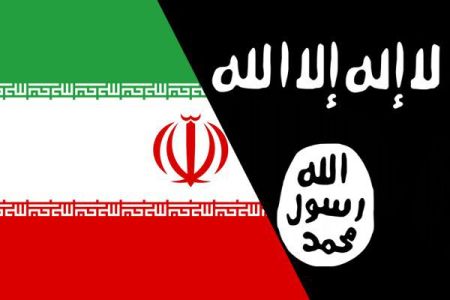
Iran-ISIS-flagPhoto Credit: JP.com graphic

Israeli military analysts are now beginning to prepare top officials, who are in turn beginning to prepare the nation, for what eventually may become the start of World War III.

Most analysts still believe the Syrian crisis is a sectarian conflict between the Sunni, Shi’a and Alawite Muslims. But that time is long gone.

A cataclysmic clash of civilizations is taking place in Syria, one that a number of nations have patiently awaited for decades.

Turkey, so deeply invested in the glorious history of its Ottoman Empire period, would find great satisfaction in stretching its influence with a modern-day “Turkish Islamic Union” that might embrace like-minded nations in the region and perhaps also beyond.

Da’esh, as it is known in the Middle East and which in English calls itself the “Islamic State” (known by others as ISIS or ISIL) is rapidly stretching its influence to build a worldwide Sunni caliphate. It began as a splinter group from the Al Qaeda terrorist organization, and then morphed into the Islamic State in Iraq and Syria (hence “ISIS”) — but at last count had successfully recruited more than 41 other regional Muslim terrorist organizations to its cause from around the world on nearly every continent.

And then there is the Islamic Republic of Iran, a Shi’ite Muslim nation, which is extending its tentacles as rapidly throughout the world as Da’esh, but far more insidiously and certainly more dangerously. If in this world one might define any nation today as Amalek, that ice-cold, black-hearted evil that first picks off the weakest of the Jewish nation, it is Iran, which has quietly extended its influence and control farther and more deeply than any other enemy Israel has ever had. Wealthy, patient, smiling and calculating, Iran acquires new allies each year, even among those Israel once counted as friends. Meanwhile, Iranian officials never forget to keep the home fires burning, to stir the pot and keep it simmering, and always to nurture the various conflicts at home in the Middle East.

This past week, Iran announced the money it donates to families of Arab “martyrs” who murder Israelis will be paid via its own special charity organization, and not through the Palestinian Authority government.

But Tehran has yet to reveal the details of exactly how it intends to pay.

Instead, a high-ranked government official simply made an announcement this weekend saying Iran did not trust the Ramallah government, driving a deeper wedge already dividing the PA’s ruling Fatah faction from Gaza’s ruling Hamas terror organization — Iran’s proxy group.

Hamas has been planting sleeper cells and budding regional headquarters, however, throughout the PA-controlled areas of Judea and Samaria, and it is clear the group’s next goal is an attempt to wrest control of those two regions from the PA, thus completing Iran’s takeover of the PLO — the PA’s umbrella organization and liaison to the United Nations.

Money is always helpful in such an enterprise, and Iran has recently enjoyed a massive infusion of cash that came courtesy of the United States and five other world powers after sanctions were lifted last month as part of last July’s nuclear deal.

Iranian Ambassador to Lebanon Mohammed Fath’ali announced last Wednesday that Iran would pay Arab families for each “martyr” who died attacking Israelis in Jerusalem and each Arab family whose home was demolished by Israel after one of its occupants murdered Israelis in a terror attack.

Iranian Parliament Speaker Ali Larijani last week underlined Tehran’s continued strong support for the wave of terror against Israel.

“The Islamic Republic supports the Palestinian Intifada and all Palestinian groups in their fight against the Zionist regime. We should turn this into the main issue in the Muslim world,” Larijani said in a meeting with a number of “resistance” groups in Tehran,FARS reported Sunday (Feb 28).

But it is clear that Iran is not content solely with a takeover of the PLO.

Tehran has its eye on a much wider goal, now more clearly than ever the resurrection of an updated Persian Empire — in modern parlance military analysts refer to it as an “Axis of Evil” — in much the same manner that Sunni Da’esh (ISIS) is single-mindedly pursuing its goal of rebuilding a worldwide caliphate.

Iranian forces via proxies have already managed to involve themselves in what once were domestic affairs in Yemen, Syria, Lebanon, Egypt, Jordan, Bahrain, Saudi Arabia, Iraq, Israel, Cuba, Mexico, the United States, Afghanistan, Venezuela, Brazil, Argentina, Qatar, Turkey and numerous other nations.

Larijani has at last proclaimed officially that Iran doesn’t differentiate between Shiites and Sunnis since they share many commonalities, adding that Tehran “has supported the Palestinian nation (although they are Sunnis) for the past 37 years.”

The remark is significant in that Iran’s Revolutionary Guard Corps and Lebanese Shi’ite Hezbollah guerrillas – another Iranian proxy – are fighting Sunni opposition forces in Syria on behalf of President Bashar al-Assad. Iranian forces are fighting the Sunni Muslim Da’esh (ISIS) terror organization that seized a significant percentage of territory in Syria.

But south of Israel, Iran’s proxy Hamas, a Sunni Muslim group, has been providing material and technical support to the same Da’esh — but its “Sinai Province” terror group in the Sinai Peninsula.

Here we finally see that Iran is willing to adapt and support terror wherever it can be found, as long as it meets two of three criteria: (1) it furthers its goal to destabilize the region, (2) in the process it works towards the annihilation of Israel, and/or (3) will contribute towards conquest and influence to reach the goal of an ultimate renewed, updated Persian Empire.

How long then until Iran connects the two dots and simply arranges a meeting between its own Supreme Leader Ayatollah Ali Khamenei and the leader of Da’esh, Abu Bakr al-Baghdadi? Hezbollah’s Hassan Nasrallah and Hamas leader Khaled Meshaal will likely be invited for dessert …

The other question is how long until someone strikes the spark that ignites the conflagration — the region is already in chaos.

Obama Opposes New Pro-Israel Bill

February 25, 2016

Obama Opposes New Pro-Israel Measures, Will Not Follow Provisions to Help Jewish State White House rejects portions of new bill to help Israel

BY:
February 25, 2016 12:35 pm

Source: Obama Opposes New Pro-Israel Bill

President Barack Obama has announced in a rare statement that he will not follow newly passed measures aimed at boosting the Israeli economy and strengthening ties between the United States and the Jewish state, according to a statement issued by the president.

Obama stated that while he would sign the new trade resolution, portions of which focus on combatting economic boycotts of Israel, he would not enforce certain pro-Israel provisions that order the United States to stop partnering with countries that support the Boycott, Divestment, and Sanctions movement, or BDS, which aims to isolate Israel.

The president’s rejection of these provisions comes two weeks after the White House issued a separate statement expressing support for every provision of the trade bill except for those focusing on strengthening the U.S.-Israel relationship.

The Obama administration has repeatedly opposed efforts to fight the BDS movement over the past several months, with several senior officials expressing support for European efforts to explicitly label Jewish-made products produced in disputed areas of Israel.

Obama claimed in the statement that his administration does not back the BDS movement. However, he will not uphold parts of the new trade legislation that seek to combat the BDS-backed labeling of Jewish goods, which the Israeli government has described as anti-Semitic.

“Certain provisions of this Act, by conflating Israel and ‘Israeli-controlled territories,’ are contrary to longstanding bipartisan United States policy, including with regard to the treatment of settlements,” Obama said in the statement.

“Moreover, consistent with longstanding constitutional practice, my administration will interpret and implement the provisions in the Act … in a manner that does not interfere with my constitutional authority to conduct diplomacy,” Obama said, making clear he will not enforce any part of the law that he views as legitimizing Israeli settlements.

Rep. Peter Roskam (R., Ill.), who authored the pro-Israel language along with Rep. Juan Vargas (D., Calif.), criticized the administration for not upholding the will of Congress and the American people.

“This law—including the anti-BDS provisions I was proud to author—passed with overwhelming bipartisan support in both the House and the Senate,” Roskam said in a statement. “Incredibly, President Obama has already announced his intention to prioritize his misguided notions of legacy over the law of the land.”

“We did not provide a statutory menu from which President Obama can pick and choose provisions to enforce,” the lawmaker added. “The president has signed this bill into law—it is now his responsibility to fully and faithfully execute it in its entirety.”

Roskam expressed dismay that “fighting efforts to delegitimize Israel interferes with his diplomacy, but rest assured that I intend to use my authority as chairman of the Ways and Means Subcommittee.”

Congress has undertaken a series of efforts to boost the U.S.-Israel relationship following a contested debate over the Iran nuclear deal that strained relations between the two countries.

Senate lawmakers, led by Sen. Mark Kirk (R., Ill.), recently filed legislation that would help state and local governments divest taxpayer funds from companies that back the BDS movement.

The bill comes as more than 20 state governments pursue efforts to combat the BDS movement and divest from anyone who supports it.

IDF Racing to Restructure Itself for New Middle East Warfare

February 24, 2016

IDF Racing to Restructure Itself for New Middle East Warfare, Investigative Project on Terrorism, Yaakov Lappin, February 23, 2016

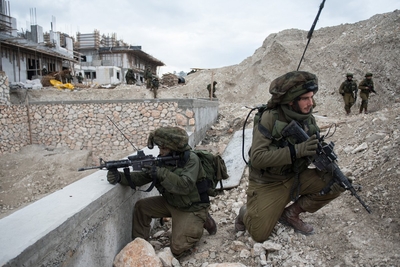
1362Photo Credit: IDF Spokesperson

The Israel Defense Forces (IDF) is in a race against time, and it is a race that is relevant to how other Western powers will also deal with the rise of radical, armed, Islamic groups proliferating across the Middle East.

As the IDF’s commanders look around the region, they see heavily armed, hybrid, Islamic sub-state foes that are replacing states. The traditional threat of hierarchical armies is fading quickly away, into obscurity.

The Sunni and Shi’ite jihadist entities on Israel’s borders – Hamas, Hizballah, ISIS-affiliated groups in Syria, Jabhat Al-Nusra, as well as elements of Iran’s IRGC forces – are all building their power and preparing for a future unknown point in time when they will clash with Israel.

The IDF is preparing, too, but it is not only counting how many soldiers, tanks, fighter planes, and artillery cannons it can call up in the next round. The IDF is in a race to adapt to 21st century Middle Eastern warfare, which bears no resemblance to how wars were fought in the 20th century.

In this new type of conflict, enemies appear and vanish quickly, use their own civilians as cover, bombard Israeli cities with projectiles, seek out the weakest link in Israel’s chain, and send killing squads through tunnels to attack Israeli border villages.

In this type of clash, the enemy looks for a ‘winning picture’ at the start of any escalation. This means landing a surprise blow that will knock Israeli society off balance, at least for a short while.

To be clear, all of the hostile sub-state actors currently are deterred by Israel’s considerable firepower and are unlikely to initiate a direct, all-out attack right now.

The price they would pay for such action is deemed too high, for now.

Yet, opportunities and circumstances can suddenly arise that would alter these calculations, and put these terrorist organizations on a direct collision course with the IDF.

Israel has fought four conflicts against Hamas and Hizballah in the past 10 years, and emerged with the conclusion that the era of state military versus state military warfare is over.

Acknowledging this development is one thing; the organizational transformation that must follow is quite another. Israel did not want to enter any of the past four conflicts that were forced upon it, but since they occurred, they have aided in the IDF’s adaptation process, which has been as complex as it has been painful, and is far from over.

“What you have to do against an enemy like this, and it is a great difficulty for militaries, including the IDF, is to operate in a combined, cross-branch [air force, ground forces, navy] manner, and to keep it [operations] focused. Focus the ground maneuver and firepower, on the basis of the intelligence you get,” a senior IDF source said earlier this month in Tel Aviv, while addressing the challenges of adaptation.

Taking southern Lebanon, the home base of Hizballah, as an example, the area has well over 100 Shi’ite villages that have been converted into mass rocket launching zones.

With one out of every 10 Lebanese homes doubling up as a Hizballah rocket launching site (complete with roofs that open and close to allow the rocket to launch), Hizballah has amassed over 120,000 projectiles – some of them GPS guided – with Iran’s help. This arsenal, pointed at Israel, forms one of the largest surface to surface rocket arsenals on Earth.

Would sending several military divisions into such an area be sufficient for Israel in stopping the rocket attacks? Without focused intelligence, the military source argued, the answer is a resounding no. Israel’s reliance on intelligence has never been more paramount in the age of sub-state, radical enemies.

“The urban areas swallow up our forces. If we can’t focus the maneuver, no amount of forces will be sufficient in dealing with this issue. It must be focused, and the information that must direct this focus is real-time intelligence,” the source said.

The IDF’s Military Intelligence Directorate has the mammoth task of building up a battle picture and a database of targets ahead of any conflict. After a conflict erupts, it must start the process all over again within a few days, when the entire map of threats changes in the modern dynamic battlefield.

This is a far cry from the old intelligence work that looked at enemy tank divisions and infantry formation.

IDF planners believe that any future conflict with a hybrid, terror-guerrilla military force will consist of five stages. An “opening picture” – that surprise blow intended to shock Israelis – will mark the start of hostilities, in which Israel must deny the adversary its “winning picture.” This will be followed by an exchange of firepower. After a few days, Israel would need to call up reserves, and then launch a ground offensive. Throughout this period, the Israeli home front would absorb heavy rocket fire, while the Israel Air Force would pound enemy targets. The IAF could fire thousands of precision-guided munitions every 24 hours, if it deploys its firepower to the maximum, as it would in an all-out clash with Hizballah.

Israeli air defense systems like Iron Dome could soften the blow to the home front significantly, but this is truer with respect to Gazan rockets than against the downpour of Hizballah rockets and missiles, which would overwhelm air defenses.

The ground offensive must destroy “70 to 75 percent of [enemy] capabilities,” the source said. “If there are 100 missiles and two operatives on the other side, and you kill the operatives, than the missiles become irrelevant.”

The last phase is the end stage, and it is unlikely that an entity like Hamas or Hizballah would wave a white flag when hostilities conclude, even if most of their capabilities have been destroyed.

The era of clear-cut military victories, like Israel experienced in the 1967 Six Day War, is gone, the source said.

With this reality in view, the IDF’s steps to adapt itself to modern threats include the ability to gather huge quantities of intelligence and deliver them, in real-time, to the forces that need them most in the battlefield, right down to the level of a battalion commander.

This requirement includes establishing an “operational Internet,” an internal IDF network that allows battalion commanders to access Military Intelligence target data in their area, and direct their units accordingly.

It would also allow field commanders to communicate directly with a fighter jet pilot or drone operator, or even a missile ship commander, for the type of cross-forces cooperation the IDF thinks will be most effective in shutting down threats.

As a result, the IDF’s C4i Branch has spent recent years overcoming many hurdles and objections and integrating the command and control networks of the air force, navy, and ground forces. It then directly linked them up to Military Intelligence.

By the end of this year, the first IDF division will have a “military Internet” network, complete with applications and browsers, up and running.

“I don’t want a squad commander walking around with a screen in his hand. He has to be aware of his soldiers. [But] the battalion commander should certainly have this,” the source said.

In 2014, the IDF did not do a good enough job in detecting, in real-time, the location of Hamas rocket launches in Gaza. It got away with this failure because of the effectiveness of the Iron Dome anti-rocket batteries. But against Hizballah’s much larger arsenal, no amount of air defenses will be sufficient, and the IDF therefore is working on improving its rocket detection and accurate return fire abilities.

“In the next stage [of our development], if you detect the rocket launch areas and the centers of activity of the enemy, and transmit them [to your own forces], you can learn the enemy’s patterns better,” the officer said.

Knowing the enemy has never been more important for Israel’s ability to defend itself against the jihadist entities that are replacing states in the Middle East. As these radical Islamist organizations prepare for the day of battle, Israel does the same, through updating its old 20th century battle doctrines and bringing them up to speed with its rapidly changing and chaotic environment.

Erdan: IDF plan for peace talks is ‘infuriating’

February 23, 2016

Erdan: IDF plan to beat terror with peace talks is ‘infuriating’ Internal Security Minister discusses IDF Intelligence head’s call for ‘diplomatic process,’ noting periods of peace talks more lethal.

By Ido Ben-Porat

First Publish: 2/23/2016, 3:28 PM

Source: Erdan: IDF plan for peace talks is ‘infuriating’ – Defense/Security – News – Arutz Sheva

Minister Gilad Erdan
Flash 90

Internal Security Minister Gilad Erdan (Likud) on Tuesday denied that IDF Intelligence Corps head Maj. Gen. Herzl (Herzi) Halevi told the Security Cabinet the Arab terror wave will expand if peace talks aren’t launched with the Palestinian Authority (PA).

Halevi appeared at the Security Cabinet on January 24 together with other senior Intelligence Corps officials to deliver the annual intelligence appraisal for 2016, before delivering it again Tuesday to the Knesset’s Foreign Affairs and Defense Committee, according to Channel 10 reports on Monday night.

The report alleged that Halevi told the Cabinet a “diplomatic process” with the PA is the only way to stop the terror wave, as he claims the military has largely done all it can. If peace talks are not advanced, he stated additional forces will join the terror wave, including the Tanzim terror group, which is the “armed wing” of PA Chairman Mahmoud Abbas’s Fatah faction.

“I sat in many meetings that he (Halevi) took part in. I never heard him say something like that,” Erdan told Army Radio on Tuesday, denying the reports.

“If something like that was said in a briefing for military correspondents, I think that’s an infuriating statement because we remember the days of a diplomatic process, in which the attacks and the terror were much stronger.”

Erdan’s statement would appear to be a reference to the 1994 Oslo Accords, in which Israel supplied the newly created PA and its Security Forces with weapons. The Accords led to the 2000 Second Intifada or Oslo War, in which over 1,000 Israelis were murdered; PA officials later bragged that 70% of the attacks were conducted by PA Security Force members.

In the current wave as well a number of the terrorist attackers have been identified as PA policemen.

Erdan also spoke about returning the bodies of terrorists, a move he has generally opposed as a deterrence factor so as to avoid massive funerals encouraging more attacks.

“Since our last talk I think one or two bodies were returned. The reason no one heard about it is because the families agreed to cooperate with the police and hold a respectable funeral…not one with incitement or support for the act of terror that the terrorist conducted,” he said.

“We have no interest in holding these bodies, rather (we do it) simply because we are in a wave of terror in which the glorification of the ‘martyr’ and the imitation by his friends is an integral part. We are not prepared for things like this to happen in funerals and possibly even bring about additional attacks.”

Special Israeli emissary to Moscow over Russian Syria air strikes near border

February 17, 2016

Special Israeli emissary to Moscow over Russian Syria air strikes near border, DEBKAfile, February 17, 2016

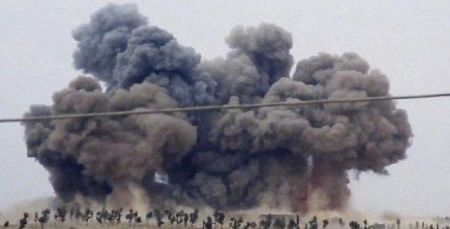
Israel_near_border_16.2.16

In view of the crisis building up on the southern Syrian-Israeli border, Prime Minister Binyamin Netanyahu decided immediately on his return home from Berlin early Wednesday, Feb. 17, to send a special  emissary to Moscow to ask for clarifications. Tuesday, Intensified Russian air strikes came to within 6 km of the Israeli border, sparking a growing exodus of Syrian refugees heading towards the Qoneitra border crossing to Israel.

DEBKAfile’s sources reveal that the envoy is Dr. Dore Gold, director-general of the Foreign Ministry and one of the prime minister’s few trusted confidantes.

It was still not clear whom Gold will meet in the Russian capital, but it is assumed that it will be one of Moscow’s senior decision-makers in the loop on its military operation in Syria.

The fact that Netanyahu decided to dispatch a top diplomat rather than a senior military or intelligence officer is a sign that the prime minister is not of one mind with the IDF’s intelligence assessments of the situation on the ground.

Netanyahu’s concerns grew after after the Russian air force on Tuesday widened its massive bombing of southern Syria from the city of Daraa to the Golan town of Quneitra, in order to help the Syria army’s 7th armored division push the rebels east, so they will not attempt to cross the border and seek shelter in Israel.

DEBKAfile’s military sources report that that 12 of the 15 targets bombed by the Russian air force across from the Israeli border were new rebel positions that had not been attacked before, even by the Syrian army. Military sources monitoring the war said Tuesday night that there is no doubt that the Russians are in the process of wiping out the rebel positions along the Israeli border by means of an offensive comparable to their operations in the northern Aleppo sector.

Our sources report that Israel’s concerns grew when, as the Russians bombing raids neared the Israeli border, Syrian officials threatened Jordan with serious consequences if Amman gave the Saudi air force a base for attacking eastern or southern Syria.

The threats began Tuesday, after Jordanian forces took over the Syrian-Jordanian border crossings formerly held by Syrian rebels, as a measure to stem the volume of Syrian refugees in search of sanctuary in the Hashemite Kingdom. But this step was interpreted by the Syrians and their Russian ally as clearing the way for Saudi intervention in the Syrian conflict using Jordan as a jumping-off base.

Meanwhile, Western military sources reported a sub substantial presence Tuesday of both Russian and Israeli warplanes in the skies over and around southern Syria.

Report: Hizballah Has Russian Technology Capable of Downing Israeli Jets

February 16, 2016

Report: Hizballah Has Russian Technology Capable of Downing Israeli Jets, Investigative Project on Terrorism, February 16, 2016

Hizballah is using advanced radar technology to “lock on” to Israeli aircraft flying reconnaissance missions over Lebanon, according to Israel’s Walla news service and reported by i24 News.

The new technology enables Hizballah to identify Israeli jets and fire missiles at them, Israeli security sources said.

“The connection between Hizballah, Russia and Syria have greatly changed the rules of the game in the region…Hizballah is indicating to Israel that it is ready for the next stage,” said an Israeli security official, quoted in Walla.

Israeli fighter jets are capable of detecting radar that threatens them, allowing pilots to alter their course. Nevertheless, the reports signal a troubling development that could hinder Israel’s freedom of movement in airspace across the northern border and its ability to effectively monitor Hizballah.

Following the 2006 war between Israel and Hizballah, the terrorist organization began acquiring sophisticated anti-aircraft systems and other advanced weapons from Syria and Iran. A recent report suggests that Hizballah is using Iranian anti-tank missiles in Syria that could be used against Israel in a future confrontation.

In light of these developments, Israel has allegedly targeted Hizballah weapons convoys on several occasions coming into Lebanon from Syria over the past few years. Nevertheless, the terrorist organization continues to build up its weapons arsenal and consolidate a base of operations on the Syrian Golan in order to attack the Jewish state.

Last month, Hizballah field commanders with operatives fighting in Syria told the Daily Beast that Russia is providing the terrorist organization with advanced weaponry amid enhanced coordination among both actors. The report outlines that Hizballah is acquiring long-range tactical missiles, anti-tank systems, and laser guided rockets from the Russians.

The IDF’s Misplaced Trust in the Palestinian Authority

February 3, 2016

The IDF’s Misplaced Trust in the Palestinian Authority The new major threat inside Israeli communities enters a new phase.

February 3, 2016 Caroline Glick

Source: The IDF’s Misplaced Trust in the Palestinian Authority | Frontpage Mag

Amjad Sakari made no effort to hide his feelings and intentions towards Israel. The soldier in the Palestinian security forces filled his Facebook page with paeans to Saddam Hussein. Last weekend he published two posts indicating his imminent plan to carry out a terrorist attack.

In other words, if the PA forces he served had been serious about preventing their members from carrying out terrorist attacks, they could have easily prevented Sakari from driving to an IDF checkpoint between Ramallah and Beit El Sunday morning, opening fire and wounding three soldiers – one critically. Sakari, who was killed in the course of his attack, was the third member of the US-backed PA security forces who engaged in terrorism in the past two months.

On December 3, Mazen Ariba, an officer in the PA’s US-sponsored Preventive Security Forces opened fire on Israelis at the Hizma checkpoint north of Jerusalem. Ariba wounded two Israelis – one critically – before he was shot and killed.

Ariba, was PLO Secretary General Saeb Erekat’s nephew. Erekat made a very public condolence call to Ariba’s home. Ariba was posthumously hailed as a hero.

Two weeks ago, the Shin Bet arrested Ala’a Barkawi, an officer in the PA’s US-supported intelligence services. Barkawi was a member of a three-man terror cell that carried out a shooting attack against IDF forces operating in Tulkarm earlier last month.

Sunday night Prime Minister Binyamin Netanyahu demanded that PA President Mahmoud Abbas condemn the terrorism carried out by forces operating under his command. Abbas rejected Netanyahu’s demand and instead doubled down in supporting terrorism.

According to Channel 2, in US-mediated discussions between the two leaders, Abbas demanded that Israeli hand over Sakari’s body.

The IDF’s relationship with the Palestinian security forces is becoming a source of concern. The now five month old Palestinian terror campaign is entering a new phase, with direct attacks inside Israeli communities becoming a new major threat.

While many commanders on the ground in Judea and Samaria hold few illusions about the long-term viability of their cooperation with their US-trained Palestinian counterparts, senior IDF commanders serve as their greatest advocates and apologists. Following the murders of Dafna Meir and Shlomit Krigman late last week, the IDF’s senior commanders insisted yet again that Israel must do nothing to harm the PA security forces.

Sakari’s attack didn’t dampen their enthusiasm.

In a radio interview Monday morning, Defense Minister Moshe Yaalon reported that Palestinian forces foil about twenty percent of the terror plots. In so proclaiming the day after a Palestinian security officer gunned down three IDF troops, Yaalon made clear that the IDF will change nothing in its cooperative position towards them.

For their part, almost immediately after word got out that Sakari served in the PA forces, senior IDF commanders set out to control the damage. Sakari, they told reporters, was but a marginal figure in an unimpressive unit. He did not serve in any of the seven battalions deployed to the Palestinian population centers that were trained by the US military in Jordan. His actions, they insisted, were not indicative of a wider phenomenon within the PA security forces.

Both Yaalon and his senior commanders were doubtlessly telling the truth. But that doesn’t mean that all is well with the PA security forces.

Sakari served as a driver for the PA’s General Prosecutor Ahmed Hanoun. As such, he may have been a member of an unimportant unit, although certainly he had access to some of the most senior members of the PA. But as intelligence officers, Ariba and Barkawi were members of the core of the forces.

But in the final analysis, whether or not Ariba, Barkawi and Sakari were important operatives is beside the point. The main problem with the Palestinian security forces is that by their very nature, they are inherently hostile to Israel and supportive of terrorism.

PA forces are commanded by terrorists from Fatah and other affiliated PLO terror groups. The tens of thousands of men under arms in these forces are recruited from these terrorist groups.

The Palestinian Authority which they serve itself supports terrorism. On a practical level, as Deputy Foreign Minister Tzipi Hotovely relayed in a Wall Street Journal op-ed last week, the PA spends 16 percent of its donor financed annual budget paying salaries to terrorists jailed in Israeli prisons and stipends to their families. Moreover, the PA’s heroes are all terrorists. Its media and school system daily incite Palestinians to take up arms against Israelis and murder them. Murad Adais, who murdered Dafna Meir in her home in Otniel two weeks ago told investigators that he decided to murder Jews after watching incendiary PA media broadcasts.

In trusting the security cooperation they receive from the PA, our military leaders are mistaking inputs for outputs. That is, they assume that because they receive cooperation from these forces, these forces are inherently friendly. But again, the opposite is the case.

The PA is cooperating with the IDF today for two reasons. First, at present, Abbas believes that he has more to gain from cooperating with Israel than he does from Hamas. Second, at present, Abbas controls the bulk of his forces.

Both of these variables are likely to change, and Israel can do nothing to keep them constant.

In the past, both Abbas and his predecessor Yassir Arafat assessed at various points that they were better off cooperating with Hamas against Israel than with Israel against Hamas. Their decisions in 1996, from 2000 to 2007, and intermittently ever since, have had little to do with Israel’s positions. Indeed, their shifts from Israel to Hamas have often occurred at times when Israel did the most to support them.

As for Abbas’s control over his forces, this too can change on a dime. For years, Palestinian sources have insisted that these forces feel no intrinsic loyalty to Abbas. They stay with Abbas because he pays them.

Ideologically, these men under arms are free floaters. Nothing they believe is a bar for shifting their loyalties to Hamas. More to the point, all the US financial transfers to the PA security forces won’t stop any of the US-trained Palestinian forces from moonlighting as Hamas, Fatah or Hezbollah terrorists. They’ve done it in the past and they will do it again.

The instrumental, and necessarily temporary nature of Palestinian security cooperation with the IDF tells us three things.

First, the IDF needs to ditch its current counterterror strategy which is based on the wrongheaded assumption that we can rely on the PA security forces. Central Command needs to develop contingency plans for neutralizing these forces. These contingency plans don’t need to be made public. But to the extent that aspects of the plans can be quietly implemented, they should be implemented as quickly as possible.

Second, IDF commanders need to stop praising these hostile forces. At some point in the not so distant future the IDF will be required to fight these forces. When that day comes, the IDF’s enthusiastic tributes to their great cooperation with these terror-supporting forces will come back to haunt us. How will we be able to explain why our actions are necessary to allies to whom we have praised these hostile forces? This brings us to the final thing we need to recognize about these Palestinian forces. It was a major strategic blinder for Israel to support the US’s decision to train them. By supporting the US training program, Israel has given the US an incentive to deny the hostile nature of these forces.

Even worse than guaranteeing that the US will be unwilling to accept that in training these forces its military built a terror army, is that threat these forces pose. Today seven US-trained Palestinian combat battalions are deployed close to Israel’s major urban centers. Their fighting skills far surpass anything Israel has had to deal with in campaigns to date against Palestinian terror onslaughts.

As IDF commanders have warned over the years, due to the American training these terror-supporting anti-Israel forces have received, they can overrun small Israeli communities. They can carry out mass terror onslaughts in larger ones, on both sides of the armistice lines.

Following Sakari’s attack, Monday morning the IDF encircled Ramallah, barring non-residents from entering the city. The move was first announced by Palestinian security forces. So clearly the IDF coordinated the move with them before implementing it.

It is all well and good that the Palestinians continue to cooperate with the IDF, to the extent that the do. But Sakari’s attack must serve as a wake-up call. The defense establishment needs to quit relying on and praising this cooperation.

Because it will end. And if we are not prepared, the end will be very bad for Israel, and for the IDF.