(Please refer to the link for an excellent diagram I was unable to reproduce here. It shows the few IAEA successes and the many Iranian refusals to permit access. — DM)
Last month, the inspectors reported that “Iran has not provided any explanations” for two of the three design questions now on the table. The other nine remain in limbo.
********************
OVER the course of a dozen years, ever since atomic sleuths from the United Nations began scrutinizing Iran’s nuclear program, hundreds of inspections have uncovered a hidden world of labs and sprawling factories, some ringed by barbed wire and antiaircraft guns, others camouflaged or buried deep underground. Yet despite that progress, Iran has so far managed to evade a central question — whether it knows how to build an atom bomb.
With negotiators from six world powers facing a deadline later this month to cut a basic agreement with Iran on the fate of its nuclear program, much of the public discussion has focused on curtailing Iran’s uranium plants and plutonium complex, its pathways to atomic fuel. In short, the buzz centers on brawn, not brains. But quietly, the United States and its allies are also discussing whether a final deal should compel Tehran to reveal the depth of its atomic knowledge.
That inner debate, as one European official in the midst of the negotiations put it, turns on “whether to force Iran to explain its past” — especially before 2003, when American intelligence officials believe Iran operated a full-scale equivalent of the Manhattan Project — “or whether to focus on the future.”
American officials are vague when pressed on how fully Iran will have to answer questions it has avoided for years from United Nations inspectors with the International Atomic Energy Agency, based in Vienna. To date, Iran has dodged all but one of the agency’s dozen sharp questions on bomb design.
“Iran’s most serious verification shortcoming,” Olli Heinonen, the former chief inspector, now at Harvard, said recently, “remains its unwillingness to address concerns about the past and possibly ongoing military dimensions of its nuclear program.”
Investigators at the I.A.E.A., drawing on intelligence from member states as well as their own investigations, have assembled a secret trove of reports, correspondence, viewgraphs, videos and blueprints that purport to show Iran’s skill in warhead design.
Iran ridicules the material as fake, maintaining that the trove is full of forged documents created by the Central Intelligence Agency or Israel’s Mossad. (The atomic agency’s chief, Yukiya Amano, dismissed that allegation in an interview last summer, saying the inspectors had confirmed the documents by consulting other sources.)
The problem is that the documents, if real, would undercut Iran’s argument that its nuclear ambitions are entirely peaceful, centering on the production of radioisotopes for medicine and electrical power for economic growth.
Expertise in warhead design, as opposed to atomic fuel production, is far more ephemeral and hard to track. It can also be less ambiguous. Some nuclear parts have application only to making weapons, such as neutron spark plugs at the core of some atom bombs. In contrast, uranium can fuel both nuclear arms and reactors that make electricity — it can light cities or annihilate them.
In early 2003, when the inspectors began their investigation, the focus was mainly on whether Iran was building factories that could make fuel for nuclear arms. That agenda made sense because acquiring fuel is the hardest part of the bomb equation. It’s the chokepoint. Moreover, it was relatively easy for the inspectors to monitor the giant factories that Iran was building, such as the plutonium reactor at Arak and the uranium plant at Natanz, its halls roughly half the size of the Pentagon.
Today, the six powers negotiating with Iran — Britain, China, France, Germany, Russia and the United States — still focus overwhelmingly on fuel production. They want Tehran to downsize or disconnect the centrifuges that spin at supersonic speeds to purify uranium. They want the reactor at Arak, still under construction, reconfigured to produce less plutonium, the other bomb fuel. The negotiators want the cutbacks to be large enough and long enough in duration — a decade or more — to ensure that Iran for the near future cannot mount a headlong rush for a bomb, known in the field as breakout.
Even Prime Minister Benjamin Netanyahu of Israel, in his dramatic speech to a joint session of Congress on Tuesday, elevated brawn over brains, saying “nuclear know-how without nuclear infrastructure doesn’t get you very much.” He added, “A pilot without a plane can’t fly.”
True enough. But there are other ways to get fuel, including buying it from the likes of North Korea or on the black market. So the design riddle still lurks in the background, both for breakout and what experts call sneak out.
Iran already knows how to make a rudimentary bomb. So do terrorists and college students. The real question is whether Iran can miniaturize a weapon to fit atop a missile, can make bombs more destructive than the one that turned Hiroshima into a radioactive cinder, and can use precious fuel sparingly enough to build a nuclear arsenal.
The I.A.E.A. inspectors saw hope of getting answers in mid-2007 when they agreed on a “work plan” with Iran meant to shed light on what happened inside the secretive laboratories run by Mohsen Fakhrizadeh, said to be Iran’s atomic mastermind. More than two years later, in late 2009, the plan lay in ruins. Mohamed ElBaradei, then the agency’s director general, said the inquiry had “effectively reached a dead end” because of Iran’s intransigence.
In November 2011, the inspectors stepped up the pressure by publishing a detailed listing of a dozen major fields critical for warhead building, saying their cache indicated that Iran had deeply researched the topics. Iran repeated its disavowal. In August 2013, as tensions mounted, Iran’s new president, Hassan Rouhani, elected on a platform of getting international sanctions lifted, agreed to open negotiations about the overall fate of Iran’s atomic program.
While those talks have dragged on for 18 months, Iran has let inspectors deep inside its production facilities and observed every commitment on cutting back its production of nuclear fuel. But it has continued to stiff-arm the inspectors on the question of suspected “military dimensions,” despite agreeing to another work plan. The Obama administration has said little about that silence.
Last month, the inspectors reported that “Iran has not provided any explanations” for two of the three design questions now on the table. The other nine remain in limbo.
So will Iran have to come clean before the economic sanctions are lifted? American officials won’t say. “It’s the most sensitive topic for the Iranians,” said one former American negotiator. “Is it worth blowing up a potential agreement in the name of forcing a confession?”
One solution, analysts suggest, would be the gradual lifting of sanctions in step with the investigators certifying that Tehran was finally answering their longstanding queries. That is under discussion. But it remains unclear whether the atomic riddle will be resolved. If past is prologue, the West might once again find itself stonewalled.
(Giving Iran years to pursue its ambition of obliterating the U.S. and Israel, with few or no remaining sanctions as Iran continues its efforts to control the Middle East, and no significant progress in allowing the IAEA to pursue its investigations of Iran’s past and future progress in nuclear weaponry strikes me as worse than merely absurd.– DM)
“America’s founding document promises life, liberty and the pursuit of happiness. Iran’s founding document pledges death, tyranny, and the pursuit of jihad,” he said. It was the type of clarity that he had brought to the difficult questions of life as a teenager. It is a clarity that still evades Obama today.
A measure of how thoroughly Netanyahu exposed Obama’s unseriousness can be found in Obama’s reply that before taking a position on a nuclear deal “it is very important not to be distracted by the nature of the Iranian regimes’ ambitions when it comes to territory or terrorism.”
For Netanyahu and for many in Congress, Iran’s terrorism is not a distraction; it is the main issue.
********************
In 1967, Benjamin Netanyahu skipped his high school graduation in Pennsylvania to head off to Israel to help in the Six Day War. That same year Obama moved with his mother to Indonesia.
When Obama suggested that Israel return to the pre-1967 borders, described by Ambassador Eban, no right-winger, as “Auschwitz borders,” it was personal for Netanyahu. Like many Israeli teens, he had put his life on hold and risked it protecting those borders.
In the seventies, Obama was part of the Choom Gang and Netanyahu was sneaking up on Sabena Flight 571 dressed as an airline technician. Inside were four terrorists who had already separated Jewish passengers and taken them hostage. Two hijackers were killed. Netanyahu took a bullet in the arm.
The Prime Minister of Israel defended the operation in plain language. “When blackmail like this succeeds, it only leads to more blackmail,” she said.
Netanyahu’s speech in Congress was part of that same clash of worldviews. His high school teacher remembered him saying that his fellow students were living superficially and that there was “more to life than adolescent issues.” He came to Congress to cut through the issues of an administration that has never learned to get beyond its adolescence.
Obama’s people had taunted him with by calling him “chickens__t.” They had encouraged a boycott of his speech and accused him of insulting Obama. They had thrown out every possible distraction to the argument he came to make. Unable to argue with his facts, they played Mean Girls politics instead.
Benjamin Netanyahu had left high school behind to go to war. Now he was up against overgrown boys and girls who had never grown beyond high school. But even back then he had been, as a fellow student had described him, “The lone voice in the wilderness in support of the conservative line.”
“We were all against the war in Vietnam because we were kids,” she said. The kids are still against the war. Against all the wars; unless it’s their own wars. Netanyahu grew up fast. They never did.
Netanyahu could have played their game, but instead he began by thanking Obama. His message was not about personal attacks, but about the real threat that Iran poses to his country, to the region and to the world. He made that case decisively and effectively as few other leaders could.
He did it using plain language and obvious facts.
Netanyahu reminded Congress that the attempt to stop North Korea from going nuclear using inspectors failed. The deal would not mean a denuclearized Iran. “Not a single nuclear facility would be demolished,” he warned. And secret facilities would continue working outside the inspections regime.
He quoted the former head of IAEA’s inspections as saying, “If there’s no undeclared installation today in Iran, it will be the first time in 20 years that it doesn’t have one.”
And Netanyahu reminded everyone that Iran’s “peaceful” nuclear program would be backed by ongoing development of its intercontinental ballistic missile program that would not be touched under the deal.
He warned that the deal would leave Iran with a clear path to a nuclear endgame that would allow it to “make the fuel for an entire nuclear arsenal” in “a matter of weeks”.
Iran’s mission is to export Jihad around the world, he cautioned. It’s a terrorist state that has murdered Americans. While Obama claims to have Iran under control, it has seized control of an American ally in Yemen and is expanding its influence from Iraq to Syria.
Its newly moderate government “hangs gays, persecutes Christians, jails journalists.” It’s just as bad as ISIS, except that ISIS isn’t close to getting a nuclear bomb.
“America’s founding document promises life, liberty and the pursuit of happiness. Iran’s founding document pledges death, tyranny, and the pursuit of jihad,” he said. It was the type of clarity that he had brought to the difficult questions of life as a teenager. It is a clarity that still evades Obama today.
A measure of how thoroughly Netanyahu exposed Obama’s unseriousness can be found in Obama’s reply that before taking a position on a nuclear deal “it is very important not to be distracted by the nature of the Iranian regimes’ ambitions when it comes to territory or terrorism.”
For Netanyahu and for many in Congress, Iran’s terrorism is not a distraction; it is the main issue.
Obama insists in that same interview that “sanctions are not sufficient to prevent Iran from pursuing its nuclear ambitions.” And yet the entire premise of the deal he’s pushing is that the sanctions forced Iran to come to the negotiating table and agree to give up its race for the bomb. Sanctions can’t stop Iran from going nuclear, but negotiations using the sanctions as leverage can.
And to believe all this, we have to avoid being distracted by Iran’s invasions of other countries and support for terrorists.
It’s self-contradictory nonsense that wouldn’t pass muster in a high school paper in 1967. And yet it’s the unchallenged argument dominating the political class, foreign policy experts and the media today.
Netanyahu came to challenge the argument that Iran could be appeased out of getting the bomb. He had to do it because Obama and his media allies had ignored or shut up everyone who had made it before him. By making Netanyahu’s very appearance into the issue, they hoped to shut him down the way they had senators from their own party. They succeeded in making his appearance controversial, but that just meant that more people were listening when he finally broke through and spoke.
“Would Iran be less aggressive when sanctions are removed and its economy is stronger? If Iran is gobbling up four countries right now while it’s under sanctions, how many more countries will Iran devour when sanctions are lifted? Would Iran fund less terrorism when it has mountains of cash with which to fund more terrorism?” he asked.
It’s a question that the administration and its defenders do not want to answer because it strikes at the heart of their logic of appeasement.
The appeasers claim that the negotiations will stabilize the region. Instead Netanyahu demonstrated that they will lead to a region in which every major Muslim country has nukes and is ready to use them.
The appeasers insist that we need to ally with Iran to stop ISIS. Netanyahu brought clarity to that as well.
“Iran and ISIS are competing for the crown of militant Islam. One calls itself the Islamic Republic. The other calls itself the Islamic State. Both want to impose a militant Islamic empire first on the region and then on the entire world,” he warned. “They just disagree among themselves who will be the ruler of that empire,”
Netanyahu offered an alternative to another worthless nuclear agreement by focusing not only on Iran’s nuclear capability, but on its intentions. He asked the world to turn its attention to stopping Iran from attacking its neighbors and engaging in terrorism.
The things that Obama calls a distraction are for Benjamin Netanyahu the main point.
The former high school student who had been described as a “lone voice in the wilderness” closed his speech by saying, “Even if Israel has to stand alone, Israel will stand.”
Netanyahu knows something about standing alone. No Israeli politician has faced the continuing level of hate by the left that he has. The mockery and sneers directed at him by Obama’s media allies in these past weeks have been nothing. The teenager who had learned to stand by his values in a high school in the sixties and as Israel’s ambassador to the United Nations in the eighties has let it all roll off him.
In war, Netanyahu had nearly drowned in the Suez Canal. In politics, he has kept his head above water. In Congress, he concluded by quoting Moses. “Be strong and resolute, neither fear nor dread them.”
It can refer to Iran or to the political mobs of the left who thought that smearing him would silence him.
Netanyahu understood what was at stake when Israel was fighting for its life in 1967. He did not let the comforts of suburbia blind him to the personal sacrifices that he had to make by going to Israel.
(In other breaking news, the National Oceanic and Atmospheric Administration has revealed that the oceans are still wet and that the Sun remains hot. But wait! There’s more: the P5+1 negotiations with Iran will continue and a deal will be reached because Obama needs a legacy.– DM)
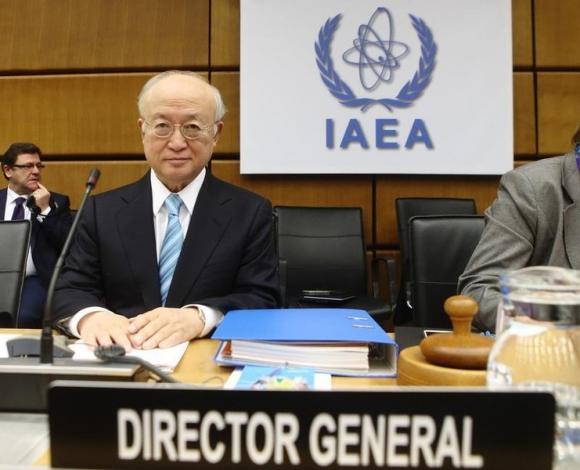
International Atomic Energy Agency (IAEA) Director General Yukiya Amano waits for the start of a board of governors meeting at the IAEA headquarters in Vienna March 2, 2015. CREDIT: REUTERS/HEINZ-PETER BADER
(Reuters) – The head of the United Nations‘ nuclear watchdog said on Monday Iran had still not handed over key information to his staff, and his body’s investigation into Tehran’s atomic program could not continue indefinitely.
“Iran has yet to provide explanations that enable the agency to clarify two outstanding practical measures,” chief Yukiya Amano told the body’s Board of Governors in Vienna, echoing a report seen by Reuters last month.
The two measures relating to alleged explosives tests and other measures that might have been used for bomb research should have been addressed by Iran by last August.
“The Agency is not in a position to provide credible assurance about the absence of undeclared nuclear material and activities in Iran, and therefore to conclude that all nuclear material in Iran is in peaceful activities,” Amano said.
The West fears Iran wants to develop an atomic bomb. Tehran says its nuclear program is entirely peaceful.
The Agency remains ready to accelerate the resolution of all outstanding issues, he added, but “this process cannot continue indefinitely”.
The United States and five other powers are seeking to negotiate an agreement with Iran to curb its nuclear program in exchange for relief from economic sanctions.
They have set a March deadline for a framework deal and a June deadline for a final one.
The IAEA is likely to monitor any possible deal between Iran and the six powers in addition to its own investigation into Iran’s nuclear program. Amano said he proposed a 1.8-percent increase to the body’s 344-million-euro ($386 million) budget given increased demand for its services.
Amano added that he remained seriously concerned about the nuclear activities of North Korea which quit the nuclear Non-Proliferation Treaty in 1993. The IAEA has not had inspectors on the ground there since they were expelled by North Korea in 2009.
(There are additional parallels. North Korea and Iran have comparable views of human rights, both make loud and frequent noises about obliterating their perceived enemies and both have allies willing if not anxious to sneak around sanctions. There are also differences. Iran is far more powerful than North Korea was or is and Iran’s intention to dominate the Middle East transcends North Korea’s desire to “unify” with South Korea on North Korea’s terms. Iranian governance is based on Islam, an unfortunately powerful world religion seeking world domination. North Korean governance is based on the “religion of Kim,” supreme internally but otherwise of little significance elsewhere. Iran also presents a greater danger to the U.S. than North Korea did. However, Obama won’t explain why the Iran deal isn’t “North Korea redux” because he quite likely neither knows nor cares and because it is. — DM)
The State Department has never conducted a lessons learned exercise about what went wrong with the North Korea deal. Perhaps it’s time. Diplomatic responsibility and national security demand it.
**********************
As the Obama administration rushes into a nuclear deal with Iran, it pays to remember the last time the United States struck a deal with a rogue regime in order to constrain that state’s nuclear program and the aftermath of that supposed success.
Bill Clinton had been president barely a month when North Korea announced that it would no longer allow International Atomic Energy Agency (IAEA) inspections, followed shortly thereafter by an announcement that it would withdraw from the NPT altogether within a matter of months. If Kim Il-sung expected Washington to flinch, he was right. The State Department aimed to keep North Korea within the NPT at almost any price. Chief U.S. negotiator Robert Gallucci and his aides explained in their book Going Critical, “If North Korea could walk away from the treaty’s obligations with impunity at the very moment its nuclear program appeared poised for weapons production, it would have dealt a devastating blow from which the treaty might never recover.” Unwilling to take any path that could lead to military action, Clinton’s team sought to talk Pyongyang away from nuclear defiance, no matter that talking and the inevitable concessions that followed legitimized Pyongyang’s brinkmanship.
As with President Obama relieving Iran of the burden of six United Nations Security Council resolutions which demanded a complete cessation of enrichment, Clinton’s willingness to negotiate North Korea’s nuclear compliance was itself a concession. After all, the 1953 Armistice required Pyongyang to reveal all military facilities and, in case of dispute, enable the Military Armistice Commission to determine the purpose of suspect facilities. By making weaker frameworks the new baseline, Clinton let North Korea off the hook before talks even began.
Just as Israeli (and Saudi and Emirati and Egyptian and Kuwaiti and Bahraini) leaders express frustration with the Obama administration regarding its naiveté and unwillingness to consult, so too did South Korea at the time chafe at Clinton’s arrogance. South Korean President Kim Young Sam complained to journalists that North Korea was leading America on and manipulating negotiators “to buy time.” And in a pattern that repeats today with regard to Iran, the IAEA held firmer to the demand that North Korea submit to real inspections than did Washington. The issue came to a head in September 1993 after the State Department pressured the IAEA to compromise on limited inspections.
In the face of Pyongyang’s defiance, Clinton was also wary that coercion could be a slippery slope to war. Just as President Obama and Secretary of Defense Chuck Hagel instructed U.S. forces in the Persian Gulf not to stand firm but rather to retreat if probed or pushed by Iran, Clinton sought to mollify Pyongyang, for example cancelling the joint U.S.–South Korea military exercise in 1994. Adding insult to injury, the Clinton administration criticized the South Korean government for being unwilling to compromise. Indeed, everything the Obama administration has done with regard to Israel over the past year—with the exception, perhaps, of the classless chickensh-t comment—was ripped right from the Clinton playbook two decades before when the White House sought to silence Seoul.
There followed months of baseless optimism in Washington, followed by disappointment quickly supplanted by denial. At one point, when it looked like Kim Il-sung’s intransigence might actually lead to war, former President Jimmy Carter visited Pyongyang and, whether cleared to or not, made concessions which diffused the situation. It was the diplomatic equivalent of Obama’s voided redlines. Nightlinehost Ted Koppel observed on May 18, 1994, “this administration is becoming notorious … for making threats and then backing down.”
On July 8, 1994, a heart attack felled Kim Il-sung. Kim Jong-il, his eldest son, took over. Negotiations progressed quickly. Gallucci and his team promised an escalating series of incentives—reactors, fuel oil, and other economic assistance. They kicked inspections of North Korea’s suspect plutonium sites years down the line.
What had begun as North Korean intransigence had netted Pyongyang billions of dollars in aid; it would go down in history as the largest reward for cheating and reneging on agreements until Obama granted Iran $11 billion in sanctions relief just for coming to the table. Columnist William Safire traced the steps of concessions on North Korea. “Mr. Clinton’s opening position was that untrustworthy North Korea must not be allowed to become a nuclear power,” he observed, but Clinton “soon trimmed that to say it must not possess nuclear bombs, and stoutly threatened sanctions if North Korea did not permit inspections of nuclear facilities at Yongbyon, where the CIA and KGB agree nuclear devices have been developed. But as a result of Clinton’s Very Good Deal Indeed, IAEA inspectors are denied entry to those plants for five years.” And Sen. John McCain, for his part, lamented that Clinton “has extended carrot after carrot, concession after concession, and pursued a policy of appeasement based … on the ill-founded belief that North Koreans really just wanted to be part of the community of nations.” Again, the parallels between Clinton’s and Obama’s assumptions about the desire of enemies to reform were consistent.
Clinton wasn’t going to broker any criticism of what he believed was a legacy-defining diplomatic triumph, all the more so when the criticism came from abroad. On October 7, 1994, South Korean President Kim Young Sam blasted Clinton’s deal with the North, saying, “If the United States wants to settle with a half-baked compromise and the media wants to describe it as a good agreement, they can. But I think it would bring more danger and peril.” There was nothing wrong with trying to resolve the problem through dialogue, he acknowledged, but the South Koreans knew very well how the North operated. “We have spoken with North Korea more than 400 times. It didn’t get us anywhere. They are not sincere,” Kim said. His outburst drew Clinton’s ire. He became the Netanyahu of his day. Meanwhile, the U.S. and North Korea signed the Agreed Framework. Gallucci and his team were “exhilarated.” They later bragged they “had overcome numerous obstacles in the negotiations with the North; survived the intense, sometimes strained collaboration with Seoul and the International Atomic Energy Agency; and marshaled and sustained an often unwieldy international coalition in opposition to the nuclear challenge, all under close and often critical scrutiny at home.”
Today, by some estimates, North Korea is well on its way to having 100 nuclear weapons and is steadily developing the ballistic capability to deliver them. Iran’s nuclear negotiators have cited North Korea’s negotiating strategy as a model to emulate rather than an example to condemn. Meanwhile, Obama has relied on many of the same negotiators to advance his deal with Iran.
The State Department has never conducted a lessons learned exercise about what went wrong with the North Korea deal. Perhaps it’s time. Diplomatic responsibility and national security demand it.
Also, Obama’s need for a legacy consistent with his ideology trumps all else, including Iran’s abysmal human rights record, its theocratic government, its support for terrorism, its hatred for Israel and desire to eliminate her, its duplicity in its P5+1 negotiations and its insistence on getting (or keeping) nukes. True, removal of statutorily based sanctions would require congressional action. However, Obama has little interest in avoiding constitutional irregularities. No congressional approval was granted for the “temporary suspension” of sanctions and laws inconsistent with Obama’s desires can be and are waived. Litigation over the de facto removal of sanctions by executive order would take many years.– DM)
After almost 53 years of Cold War between the U.S. and Cuba, the transformation of ties between these two adversaries has sparked a considerable amount of debate with respect to the normalization of ties with other longstanding rivals. The possibility of resolving other diplomatic imbroglios, specifically the revival of diplomatic ties between the U.S. and Iran is a case that comes to mind.
Some Iranians showed their excitement on Twitter with regards to the Cuban deal. Some showed hope that their government will be next and they could soon see an American embassy in Tehran. However, others thought that an Iran-U.S. deal is an idealistic and unreachable dream.
Indeed, any normalization of diplomatic relationships between the Islamic Republic and the U.S. will likely have significant positive impacts on both nations, leading to a critical strategic and geopolitical shift in the Middle Eastern political chessboard. Currently, both countries have some shared strategic and geopolitical objectives in Iraq and Syria particularly when it comes to fighting ISIS.
A possible Iranian deal will remove the economic sanctions on the Islamic Republic, assisting Tehran to achieve its highest economic potential in exports, imports and wealth. The tourist industry would be revived in Iran, with many European and Americans fond of visiting thousands of years old historical sites in Esfahan Shiraz, Hamadan, and other provinces. Normalization of diplomatic ties will lead to the flow of (primarily) European companies to do business with the Islamic Republic. In addition, as Iranian youth have shown to be in favor of American brands and products, American manufactures will find a share in Iran’s market as well. Further, U.S. airplane companies will begin cooperation with Iranian airlines.
As many people are pondering on the likelihood of a deal similar to the recent Cuba agreement with Iran, the question is whether the executive order to lift the embargo on the Islamic Republic and conducting back channel diplomacy to fully open ties with Tehran is possible?
Iran’s file is more complicated and multilayered
There are some partial similarities between the Obama administration’s method to initiate a deal with Raul Castro’s government and the way it has recently approached the Islamic Republic. The major commonalities are the back channel diplomacy and talks.
Similar to the Cuban deal, the Obama administration has conducted back channel talks with Iranian politicians with respect to Iran’s nuclear program. In addition, President Obama sent a clandestine letter to Iran’s Supreme Leader Ayatollah Ali Khamenei highlighting some of the shared strategic, national and geopolitical interests that both nations have in the Middle East.
Nevertheless, these commonalities in diplomatic approaches have led some scholars, politicians, and policy analysts to jump to the conclusion that the same deal should be applicable to the case of Iran because such an approach was possible with Cuba and the embargo on Cuba was lifted.
But, not too fast.
Iran’s file is much more complicated, multifaceted and multilayered than the Cuban case. While Cuba is a small island close to the state of Florida with a population of approximately 11 million, Iran, with a population of over 80 million, is located in the complex geopolitical chessboard of the Middle East, and entangled among mixture of alliances and enmities in the oil rich region.
Second of all, from Washington’s perspective, Cuba has hardly been a serious threat to American strategic, geopolitical, or economic interests. On the other hand, the Islamic Republic has been a major player in scuttling U.S. foreign policy objectives and opposing its allies (including Israel) in the Middle East.
Third, several crucial regional developments are viewed from the prism of a zero-sum game for both Iranian and American officials. Iranian leaders are less likely to accept any compromises on their top foreign policy priorities, such as: keeping President Bashar al-Assad in power, withdrawing its financial, advisory, intelligence, and military support to the Iraqi and Syrian government, and assisting formidable proxies such as Hezbollah.
Fourth, there was no international consensus on the U.S. embargo and economic sanctions against the Cuban government. As a result, President Obama can issue an executive order to lift the embargo. Many European countries were doing business with the Cuban government and the United Nations repeatedly condemned U.S. sanctions. On the other hand, the four rounds of economic sanctions on Tehran came with the approval of the U.N. Security Council. Unlike Cuba, many regional and global powers are dubious about Iran’s nuclear and regional hegemonic ambitions.
Fifth, several developments in Iran, such as revelations of clandestine nuclear sites, the possibility of testing exploding detonators for nuclear weapons in Parchin military site, and the military dimension of Tehran’s nuclear program, have led to regional and international strain.
Finally, and more fundamentally, unlike Castro, Khamenei has shown no interest in fully normalizing diplomatic ties with the United States. For example, the Obama administration received no positive response from Khamenei through its diplomacy. In addition, there is no official public debate among Iranian politicians, across various spectrums of Iran’s political system, of even allowing the opening of an American embassy in Tehran. The U.S. domestic opposition to normalize ties with Iran, particularly from the Republicans, is much higher in comparison to the Cuban case. Although the Obama administration has taken some back channel steps to negotiate with the Islamic Republic, Iran’s supreme leader has not responded with signs of willingness to normalize relationships and he has been clear in not trusting the “Great Satan. “
The signal that Iranian leaders received from the Cuban deal is not what the Western media depicts- that Iran is optimistic about normalizing ties with the U.S.. The message that Tehran received was that the Islamic Republic has to persist in its policies and that economic sanctions will ultimately fail. As foreign ministry spokeswoman Marzieh Akfham articulated: “The defense by the Cuban government and people of their revolutionary ideals over the past 50 years shows that policies of isolation and sanctions imposed by the major powers against the wishes of independent nations are ineffective.”
A satellite image of Iran’s Parchin military complex, where IAEA inspectors have been refused access. Photo: Twitter
Amano will have received scant comfort from the comments yesterday of State Department spokeswoman Jen Psaki that the public was “just going to have to trust” that Iran wasn’t in violation of the November 2013 Joint Plan of Action (JPOA) agreement, despite a UN report claiming that the regime had violated international sanctions by acquiring materials for its Arak nuclear facility.
****************
The International Atomic Energy Agency (IAEA) has for the first time publicly refused an Iranian offer to inspect a suspected nuclear site at Marivan, an area near the border with Iraq.
In 2012, the IAEA believed that Marivan was the location of high-explosive experiments linked to setting off a nuclear charge. However, those concerns were not borne out and the Agency shifted its attention to Parchin, a military complex south-east of Tehran.
Diplomats have said that Iran first suggested a visit to Marivan instead of Parchin two years ago and the agency has repeatedly refused any tradeoff, AP reported. But Thursday appeared to be the first time it did so publicly, possibly reflecting exasperation with the lack of progress in its probe since its first attempts more than a decade ago.
The probe is separate from newly extended talks between Iran and six world powers meant to reduce Iran’s technical capacity to make nuclear weapons, AP said. However, its failure would throw hopes of a deal at the talks into doubt because the U.S. says an agreement can be reached only if the IAEA is satisfied with the probe and its final results.
The latest dispute with the Iranian regime comes just as IAEA chief Yukiya Amano asked key members of the organization to provide $5.7 million in extra funding. Amano said the extra cash is needed if the IAEA is to continue monitoring a preliminary deal that temporarily restrains Iran’s nuclear programs as negotiators work on a longer-term agreement. Both the UK and the US have agreed to assist, Reuters reported, quoting Laura Kennedy, the U.S. Ambassador to the IAEA, saying “We would like to announce our intent to make an additional extra-budgetary contribution.”
In an interview with CNN last month, Amano stated that “Iran is not fully cooperating with the Agency to clarify the information that may have military aspects.”
The IAEA chief added, “Another problem is that Iran is not allowing us to implement a more powerful verification tool which is called an ‘Additional Protocol.’ Agreement was not reached.”
Amano will have received scant comfort from the comments yesterday of State Department spokeswoman Jen Psaki that the public was “just going to have to trust” that Iran wasn’t in violation of the November 2013 Joint Plan of Action (JPOA) agreement, despite a UN report claiming that the regime had violated international sanctions by acquiring materials for its Arak nuclear facility.
After the failure of negotiators to reach an agreement on the nuclear program by last November 24, new talks have been scheduled in Geneva next week. Those discussions on December 17 will be preceded by two days of bilateral talks between the US and Iran, the official Iranian Mehr News Agency reported.
Obama intends to grant Royal amnesty for millions of illegals currently present in our nation, regardless of the adverse economic and social impacts and Republican warnings. I opined here on what He will likely do and on the unfortunately poor prospects for any Republican efforts to thwart it.
Remember “Leg Tingles?” The tingle has gone, at least temporarily
So much for deal making with the opposition.
However, Obama is anxious to have a deal — any deal — with Iran very soon.
Although He will not make a deal with His domestic enemies whose voters rejected Him and His policies on November 4th, Obama is apparently so infatuated with His need for a legacy that He continues to push for a nuke deal with Iran. Any deal will do, no matter how disastrous it will be. Obama’s protestations to the contrary are consistent with “if you like your doctor, you can keep your doctor,” “if you like your medical insurance policy you can keep it,” “My administration will be the most transparent in history” and a multitude of others.
A deal with Iran needs to be signed, sealed and delivered well before the next Congress convenes in January. Hence the importance of meeting the November 24th deadline or extending it for the minimum time needed for Iran to demand, and for Him to make, more concessions.
Iran continues to hang tough and Obama continues to seek accommodation from Iran so that He can have a legacy. Obama dispatched a letter to Iran’s Supreme Leader Ayatollah Ali Khamenei last month.
The Wall Street Journal reported Thursday that, according to people briefed on the letter, Obama wrote to Khamenei in the middle of last month and stressed that any cooperation on dealing with the Islamic State, or ISIS, was tied to Iran striking a deal over its nuclear program. The U.S., Iran and other negotiators are facing a Nov. 24 deadline for such a deal. [Emphasis added.]
. . . .
Asked about the reported letter, White House Press Secretary Josh Earnest would not confirm the report.
“I’m not in a position to discuss private correspondence between the president and any world leader,” he said.
However, he said the U.S. policy toward Iran “remains unchanged.”
Actually, Khamenei did respond. On the 30th anniversary of the seizure of the U.S. Embassy, he said this, in a mocking tone which is even more apparent in the Persian version of this speech:
The new US President made some beautiful comments. He also repeatedly asked us in writing and orally to turn a new page and help him change the present situation. He asked us to cooperate with him to solve global issues. He went as far as that.
Now, Khamenei continued to say he gave Obama a chance, but Obama didn’t come around. Khamenei then gloated about the strength of the Islamic Republic, a perception which Obama’s groveling tone has bolstered:
I wonder why they do not learn a lesson from what has happened. I do not understand why they are not prepared to get to know our nation. Do they not know that this nation is the one that resisted and brought the two superpowers – that is, the Soviet Union and America – to their knees? When there were two superpowers in the world, they were opposed to one another in almost all areas except in their enmity towards the Islamic Republic. This enmity was the only thing these two superpowers had in common. Why do you not learn your lesson? Today you are not even as powerful as you used to be. The Islamic Republic is several times more powerful today than those days, and yet you are speaking with the same tone? That is arrogance – talking to a nation arrogantly and using threats to get what they want. They threaten us. And our nation says it will resist.
Khamenei then warned the United States not to put its hope in reformers, as Obama seems keen to do:
Just because a handful of naïve or malevolent individuals have confronted the Islamic Republic does not mean that they can roll out the red carpet for Americans in our country. These individuals either had ulterior motives or had naively misunderstood the events without having very bad intentions – I do not want to be judgmental about their malevolence. Americans should know that the nation is resisting firmly.
Despite the very substantial concessions which Obama has already granted, Khamenei’s remarks seem to amount to this: give me whatever else I demand or shove your legacy up your scrawny apostate ass.
Ali Akbar Velayati, longtime foreign policy adviser to Khamenei and a former Iranian foreign minister, may join the talks between US Secretary of State John Kerry, Iran’s Foreign Minister Mohammad Javad Zarif and European Union negotiator Catherine Ashton, in a signal that the Supreme Leader may be preparing to sign off on a deal, sources told Al-Monitor on condition of anonymity. [Emphasis added.]
. . . .
The meeting between Kerry, Zarif and Ashton is due to get underway Nov. 9 in Muscat, Oman, which hosted secret US-Iran talks that helped lead to reaching the interim Iran nuclear deal last year. Following the two-day US/Iran/EU trilateral meeting Nov. 9-10, negotiators from the rest of the P5+1 — the five permanent members of the UN Security Council plus Germany — are supposed to join the talks in Oman for a Nov. 11 meeting. Another, possibly final, round of P5+1 Iran talks is due to be held in Vienna from Nov. 18 to 24.
US, Iranian and Russian negotiators say there is still more work to be done, but are expressing increasing, albeit cautious, optimism that a deal is within reach.
The November 24, 2013 P5+1 Interim deal was and remains a scam
In January of this year, I wrote about Obama’s Iran Scam, structured from the beginning in Iran’s favor by legitimizing Iran’s Uranium enrichment and effectively eliminating consideration by the P5+1 negotiators of Iran’s past and continuing efforts to militarize nuclear weapons. The January 16, 2014 White House Summary of the arrangement states,
Iran committed in the Joint Plan of Action to provide increased and unprecedented transparency into its nuclear program, including through more frequent and intrusive inspections as well as expanded provision of information to the IAEA. [Emphasis added.]
Will Iran’s “unprecedented transparency” be similar to that which Obama claimed for His administration? Or the versions of transparency He delivered?
Continuing with the White House Summary,
The Iranian enrichment facilities at Natanz and Fordow will now be subject to daily IAEA inspector access as set out in the Joint Plan of Action (as opposed to every few weeks). The IAEA and Iran are working to update procedures, which will permit IAEA inspectors to review surveillance information on a daily basis to shorten detection time for any Iranian non-compliance. In addition, these facilities will continue to be subjected to a variety of other physical inspections, including scheduled and unannounced inspections.
The Arak reactor and associated facilities will be subject to at least monthly IAEA inspections – an increase from the current inspection schedule permitting IAEA access approximately once every three months or longer.
Iran has also agreed to provide for the first time:
Long-sought design information on the Arak reactor;
Figures to verify that centrifuge production will be dedicated to the replacement of damaged machines; and
Information to enable managed access at centrifuge assembly workshops, centrifuge rotor production workshops and storage facilities, and uranium mines and mills.
These enhanced monitoring measures will enable the IAEA to provide monthly updates to the Joint Commission on the status of Iran’s implementation of its commitments and enable the international community to more quickly detect breakout or the diversion of materials to a secret program.
With respect to centrifuges, the U.S. has caved several times on the numbers and types that Iran can have and use and will very likely continue to do so. As of late September, The U.S.
is considering softening present demands that Iran gut its uranium enrichment program in favor of a new proposal that would allow Tehran to keep nearly half of the project intact while placing other constraints on its possible use as a path to nuclear weapons, diplomats told The Associated Press.
The U.S., which fears Tehran may enrich to weapons-grade level used to arm nuclear warheads, ideally wants no more than 1,500 centrifuges left operating. Iran insists it wants to use the technology only to make reactor fuel and for other peaceful purposes and insists it be allowed to run at least the present 9,400 machines.
The tentative new U.S. offer attempts to meet the Iranians close to half way on numbers, said two diplomats who demanded anonymity because their information is confidential. They said it envisages letting Iran keep up to 4,500 centrifuges but would reduce the stock of uranium gas fed into the machines to the point where it would take more than a year of enrichment to create enough material for a nuclear warhead. [Emphasis added.]
Iran has stepped up efforts to develop a process that could enrich uranium at a much quicker pace, thereby violating the interim nuclear agreement reached with world powers last year, according to the Washington-based Institute for Science and International Security, or ISIS.
“Iran may have violated [the interim deal] by starting to feed [natural uranium gas] into one of its advanced centrifuges, namely the IR-5 centrifuge,” ISIS wrote in an analysis of the confidential IAEA report issued Friday to member states, according to Reuters. “Under the interim deal, this centrifuge should not have been fed with [gas] as reported in this safeguards report.”
. . . .
Iran has also reportedly sped up its low-grade uranium enrichment over the past two months, growing its stockpile by 8% to 8.4 tons.
The issue of advanced enrichment is sensitive because Iran could potentially produce a nuclear weapon if it processes the material further, a main concern for the West.
Perhaps Obama’s willingness to cave is why, as noted above, “the Supreme Leader may be preparing to sign off on a deal.”
Moreover, as I noted here, here and here, the interim agreement and the White House Summary omit any mention of Iran’s military-nuclear sites, such as Parchin, where the IAEA had reason to think that there had been implosion testing in 2011 but was refused access to inspect. They also fail to mention
Development and construction of rocketry capable of delivering nuclear warheads; and
Development and testing of nuclear warheads.
If Iran’s continuing development of militarized nukes is of no consequence, what (besides a legacy for Obama) is the purpose of a deal? Might this happy language in the White House Summary be meaningless?
The Joint Plan of Action marks the first time in nearly a decade that the Islamic Republic of Iran has agreed to specific actions that stop the advance of its nuclear program, roll back key aspects of the program, and include unprecedented access for international inspectors. [Emphasis added.]
The farce continues apace. As the Daily Beast pointed out on November 7th,
Iran continues to refuse to disclose its nuclear activity, and experts do not anticipate the country will become more transparent in the future. That’s the assessment released Friday from the International Atomic Energy Agency. “The agency is not in a position to provide credible assurance about the absence of undeclared nuclear material and activities in Iran, and therefore to conclude that all nuclear material in Iran is in peaceful activities,” said the report, which was also pessimistic about the chance that Iran will be forthright with its nuclear activities in the future. [Emphasis added.]
Scott Johnson at Power Line posted an article on November 7th titled How to understand Obama’s Iran diplomacy. It’s a very good article, so please read the whole thing. He wrote, in the lead paragraph,
I think the easiest way to understand Obama’s diplomacy is this. Assume that Obama believes Iran should have nuclear weapons and would like to facilitate the mullahs’ nuclear weapons program. This assumption is the Occam’s Razor that clarifies what might otherwise be obscure. The assumption may not be correct, but it should prove a handy guide to coming attractions. [Emphasis added.]
Mr. Johnson may well be correct. Or perhaps Obama cares less about whether Iran gets (or keeps) nukes than He cares about securing a legacy. Either way, it’s bad for much of the Middle East and also for the United States.
Iran’s human rights record and support for terrorism
Nor was there any mention in the P5+1 interim deal, or the White House Summary, of Iran’s horrendous and worsening human rights record. According to an article titled Iran Amputating Limbs, Burning Political Opponents,
Iran executed a record-shattering 411 citizens in the first half of 2014 and a total of 852 people in the last 15 months, including at least eight juveniles, according to a new United Nations report that will be introduced to the organization’s General Assembly Tuesday.
In addition to a surge in state-sanctioned killings that a U.N. official referred to as “shocking,” Iran continues to torture imprisoned individuals using techniques such as amputation, electroshock, flogging, and burnings, according to the report, which details human rights in the Islamic Republic.
While Secretary of State Kerry has referred on occasion to Iran’s human rights record as “abysmal,” the Obama administration has done precious little to pressure Iran on this front. In fact, the rare tough talk of American diplomats has become outpaced by growing references to their blossoming friendship with Iranian regime officials. “It’s reached a level of we know each other well enough to make jokes,” a senior U.S. official recently gushed to reporters. [Emphasis added.]
What do they joke about? Obama? Human rights? Terror? Nukes? Israel?
What does our desperation to get a nuclear deal at all costs say to the modern-day Iranian Solzhenitsyns rotting in Evin prison? Or to the young social-media savvy generation who took to the streets in 2009 after Mahmoud Ahmadinejad’s fraudulent reelection? [Emphasis added.]
Rayhaneh Jabbari, executed by Iran
The interim deal as well as the White House Summary also suggest that P5+1 discussions will take no account of Iran’s already massive support for terrorism, for which it will have even more funds as sanctions continue to disappear.
Conclusions
For a major supporter of international terrorism, with a worsening human rights record that makes even that of North Korea seem relatively tame, to have and to be in a position to use nukes will be worse than merely shameful.
What will be Iran’s first nuclear target? Over the weekend the Supreme Leader repeated, for the nth time, his views on Israel:
Supreme Leader Ayatollah Ali Khamenei called for the destruction of Israel over the weekend, stating that the “barbaric” Jewish state “has no cure but to be annihilated.
Will this, transformed from a simulation into reality, be part of Obama’s legacy?
Who will be next? The Great Satan, perhaps?
A good deal for Iran is also bad for the decreasingly free “free world” for a different reason: since the Obama Nation won’t stand up, effectively, for democracy with freedom — including even the most basic of human rights — who will? Formerly Great Britain?
Continuing and largely successful efforts to sanitize Islam through multicultural political correctness and its necessary ally, repression of what was once free speech, may well mean that no nation will do more than make bland and ineffective shows of standing for even the most basic of human rights.







 anneinpt
 artaxes
 danmillerinpanama
 davidking1530
 Peter Hofman
 Joseph Wouk
 Peter
Peter Louisiana Steve
 WarSclerotic
Recent Comments