Iran’s Moves in the Middle East and Why You Should Care, The Watchman via You Tube, February 10, 2015
What Is the Islamic State Trying to Accomplish? National Review on line, Andrew C. McCarthy, February 7, 2015
(As soon as Obama defeats climate change, he may begin to focus on other less important problems. — DM)
 (Image: ISIS video)
The Islamic State and al-Qaeda are our problem.
*********************
The Islamic State’s barbaric murder of Lieutenant Mouath al-Kasaebeh, the Jordanian air-force pilot the jihadists captured late last year, has naturally given rise to questions about the group’s objectives. Charles Krauthammer argues (here and here) that the Islamic State is trying to draw Jordan into a land war in Syria. It is no doubt correct that the terrorist group would like to destabilize Jordan — indeed, it is destabilizing Jordan. Its immediate aim, however, is more modest and attainable. The Islamic State wants to break up President Obama’s much trumpeted Islamic-American coalition.
As the administration proudly announced back in September, Jordan joined the U.S. coalition, along with the United Arab Emirates, Saudi Arabia, Bahrain, and Qatar. The only potential value of the coalition is symbolic: It has enabled the president to claim that Muslim countries were lining up with us against the Islamic State. Militarily, the coalition is of little use. These countries cannot defeat the Islamic State.
Moreover, even the symbolism is insignificant. Symbolism, after all, cuts both ways. As I pointed out when the administration breathlessly announced the coalition, our five Islamic partners have only been willing to conduct (extremely limited) aerial operations against the Islamic State. They would not attack al-Qaeda targets — i.e., the strongholds of al-Nusra (the local al-Qaeda franchise) and “Khorasan” (an al-Qaeda advisory council that operates within al-Nusra in Syria).
Obviously, if the relevance of the five Islamic countries’ willingness to fight the Islamic State is the implication that the Islamic State is not really Islamic, then their unwillingness to fight al-Qaeda equally implies their assessment that al-Qaeda is representative of Islam. The latter implication no doubt explains why the Saudis, Qatar, and the UAE have given so much funding over the years to al-Qaeda . . . the terror network from which the Islamic State originates and with which the Islamic State shares its sharia-supremacist ideology.
I’ll give the Saudis this: They don’t burn their prisoners alive in a cage. As previously recounted here, though, they routinely behead their prisoners. In fact, here’s another report from the British press just three weeks ago:
Authorities in Saudi Arabia have publicly beheaded a woman in Islam’s holy city of Mecca. . . . Laila Bint Abdul Muttalib Basim, a Burmese woman who resided in Saudi Arabia, was executed by sword on Monday after being dragged through the street and held down by four police officers.
She was convicted of the sexual abuse and murder of her seven-year-old step-daughter.
A video showed how it took three blows to complete the execution, while the woman screamed “I did not kill. I did not kill.” It has now been removed by YouTube as part of its policy on “shocking and disgusting content”.
There are two ways to behead people according to Mohammed al-Saeedi, a human rights activist: “One way is to inject the prisoner with painkillers to numb the pain and the other is without the painkiller. . . . This woman was beheaded without painkillers — they wanted to make the pain more powerful for her.”
The Saudi Ministry of the Interior said in a statement that it believed the sentence was warranted due to the severity of the crime.
The beheading is part of an alarming trend, which has seen the kingdom execute seven people in the first two weeks of this year. In 2014 the number of executions rose to 87, from 78 in 2013.
Would that the president of the United States were more worried about the security of the United States than about how people in such repulsive countries perceive the United States.
In any event, the Islamic State is simply trying to blow up the coalition, which would be a useful propaganda victory. And the strategy is working. It appears at this point that only Jordan is participating in the airstrikes. While all eyes were on Jordan this week for a reaction to Lieutenant al-Kasaebeh’s immolation, the administration has quietly conceded that the UAEsuspended its participation in bombing missions when the pilot was captured in December.
The explanation for this is obvious: The Islamic countries in the coalition know they can’t stop the Islamic State unless the United States joins the fight in earnest, and they know this president is not serious. The White House says the coalition has carried out a total of about 1,000 airstrikes in the last five months. In Desert Storm, we did 1,100 a day.
Seven strikes a day is not going to accomplish anything, especially with no troops on the ground, and thus no search-and-rescue capability in the event planes go down, as Lieutenant al-Kasaebeh’s did. With no prospect of winning, and with a high potential of losing pilots and agitating the rambunctious Islamists in their own populations, why would these countries continue to participate?
The Islamic State knows there is intense opposition to King Abdullah’s decision to join in the coalition. While the Islamic State’s sadistic method of killing the pilot has the king and his supporters talking tough about retaliation, millions of Jordanians are Islamist in orientation and thousands have crossed into Syria and Iraq to fight for the Islamic State and al-Qaeda. There will continue to be pressure on Jordan to withdraw. Without a real American commitment to the fight, this pressure will get harder for Abdullah to resist.
Jordan has no intention of getting into a land war the king knows he cannot win without U.S. forces leading the way. But the Islamic State does not need to lure Jordan into a land war in order to destabilize the country — it is already doing plenty of that by intensifying the Syrian refugee crisis, sending Jordanians back home from Syria as trained jihadists, and trying to assassinate Abdullah.
I will close by repeating the larger point I’ve argued several times before. We know from experience that when jihadists have safe havens, they attack the United States. They now have more safe havens than they’ve ever had before — not just because of what the Islamic State has accomplished in what used to be Syria and Iraq (the map of the Middle East needs updating) but because of what al-Qaeda has done there and in North Africa, what the Taliban and al-Qaeda are doing in Afghanistan, and so on.
If we understand, as we by now should, what these safe havens portend, then we must grasp that the Islamic State, al-Qaeda, and the global jihad constitute a threat to American national security. That they also (and more immediately) threaten Arab Islamic countries is true, but it is not close to being our top concern. Ensuring our security is a concern that could not be responsibly delegated to other countries even if they had formidable armed forces — which the “coalition” countries do not.
The Islamic State and al-Qaeda are our problem.
The Plight of the Yazidis, Front Page Magazine,
(They are probably doomed unless the relevant U.N. high commissioner decrees that they are endangered by climate change rather than by the forces of “peaceful” Islam. Then Obama and Kerry, who claim that climate change is the greatest threat of all, might help. — DM)

Despite the current focus on ISIS, the ongoing barbarity inflicted against the Yazidis, a group of people who have inhabited Iraq’s mountainous northwestern region for centuries, remains largely below the radar. And while this estimated population of approximately 500,000 has been the target of hatred by Muslims who see them as heretical devil-worshipers, ISIS has upped the ante. While the world largely looks away, a genocidal level of extermination proceeds apace. “Our entire religion is being wiped off the face of the earth,” warned Yazidi leader Vian Dakhil—last August.
Early August was the time the carnage ramped up in earnest. Approximately 40,00 Yazidis, including many women and children, were trapped in nine locations around Mount Sinjar, identified in local legend as the final resting place of Noah’s ark. Sinjar was once home to as many as 300,000 Yazidis, but as ISIS advanced, 130,000 fled north to Dohuk, capital of the Dohuk governate of Iraqi Kurdistan, or to Irbil, the capital of the Kurdistan Region and its largest city. Since last June authorities in Irbil have been forced to deal with one of the largest and most rapid refugee movements in decades. As of now approximately 350,000 Yazidis are encamped around Dohuk.
Those remaining behind faced a terrible choice of death by dehydration, or death at the hands of ISIS, who murdered 500 Yazidis, including 40 children, in an initial killing spree. By October the death total inflicted by ISIS had reached into the thousands. U.N. Assistant Secretary-General for Human Rights Ivan Simonovic aptly described what was occurring. “The evidence strongly indicates an attempt to commit genocide,” he said, adding that the only options being given to the Yazidis are “to convert or be killed.”
Not quite. As ISIS has boasted in its propaganda magazine Dabiq, around 300 Yazidi women and girls were abducted, subjected to sexual assault and subsequently sold as slaves to its fighters in Syria. The Islamist terror group considers the women and girls to be “al Sabaya,” defined by the Syrian Observatory for Human Rights (SOHR) as “women captured in war.”
The main reason the Yazidis have slipped below the media radar is because they apparently believe President Obama sufficiently addressed the problem last August, when he announced airstrikes aimed at a twofold purpose: protecting U.S. personnel stationed in Erbil, and saving those Yazidis trapped in around Sinjar without food or water. “People are starving. And children are dying of thirst. Meanwhile, ISIL forces below have called for the systematic destruction of the entire Yazidi people, which would constitute genocide,” Obama said at the time. “And when we have the unique capabilities to help avert a massacre, then I believe the United States of America cannot turn a blind eye. We can act, carefully and responsibly, to prevent a potential act of genocide. That’s what we’re doing on that mountain.”
The strikes and humanitarian aid were initially successful in alleviating some of the suffering, and also opened up an escape route allowing many of those trapped to flee. Yet by October, with U.S. attention diverted elsewhere and airstrikes dwindling, ISIS surrounded Mount Sinjar again. More than 10,000 Yazidis were once again trapped, and ISIS reprised its bloody rampage, capturing one mountain village after another, killing the men and selling the women and children into slavery.
Furthermore, the humanitarian airdrops were also halted. Iraqi helicopters were employed to pick up the slack, but they are old and fly only once or twice a week, according to Sameer Karto Babasheikh, the son of the Yazidi Supreme Religious Council leader, who met with a contingent of senior White House and State Department officials that same month to discuss the problem. “Our hostages, children, women, and girls, between 4,000 and 5,000 of them, have been captured by ISIS and sent to other areas. We need help to rescue these hostages,” he explained. “In Mosul, they opened a market to sell Yazidi girls. Some of them ended up in Fallujah, some of them were taken to Saudi Arabia and Raqqa in Syria.”
Kamal Elias, a Yazidi activist who was part of the delegation that came to Washington, put the crisis in far blunter terms. “President Obama promised that they are not going to let ISIS get any more land, that they are not going to let them get another genocide on the Yazidis,” he said. “But this is going to be worse than in August. If ISIS gets to the mountain, all of these people are going to be slaughtered, and then it’s going to take years for the U.S. or anyone else to get them out of the mountain.”
Elias also illuminated another facet of the problem. “Most of the ISIS members are from the towns around ISIS,” he said. “They were our neighbors. We lived with them for hundreds of years. Now all of a sudden they are ISIS. They joined ISIS.”
The animus directed towards the Yazidis spans centuries. “To this day, many Muslims consider them to be devil worshipers,” says Thomas Schmidinger, an expert on Kurdish politics the University of Vienna. “So in the face of religious persecution, Yazidis have concentrated in strongholds located in remote mountain regions,” he adds.
In fact Yazidis whose total population is around 700,000, the vast majority of whom have been concentrated in northern Iraq around Sinjar, are predominantly Kurdish. But they remain religiously distinct from Iraq’s Sunni Kurdish population. Some scholars contend the religion was founded during the 11th century by an Ummayyad sheikh. Others attribute its origins to Sufi leader Adi ibn Musafir, who settled in Kurdistan in the 12th century and founded a community mixing elements of Islam with local beliefs that predated it. The faith combines elements of Zoroastrianism, a 3500 year old monotheistic religion founded by the Prophet Zoroaster in ancient Iran, with elements of Christianity and Islam. Thus Yazidis embrace Christianity’s sacrament of Baptism, Islam’s tenets on circumcision, and Zoroastrianism’s belief that fire must be revered as a manifestation from God.
The devil-worshipping accusations derive from their worship of a fallen angel, Melek Tawwus, or Peacock Angel. Unlike the permanent fall from grace of Satan in the Judeo-Christian tradition, Melek Tawwus is forgiven by God and returned to heaven, becoming a force for good in Yazidism.
Nonetheless, beginning around the late 16th and early 17th centuries, accusations of devil-worship arose because Muslims believe the story of Tawwus Melek resembles the Qur’an’s Shaytan, a rebellious “djinn” (Muslim spirit) who leads men away from goodness.
Unfortunately, goodness is currently in short supply in among the members of the international community. There is no doubt they are aware of the Yazidi’s continuing plight, but they continue to fail those who are facing imminent extermination.
Murad Ismael, a Yazidi activist in the Sinjar Crisis Group, reported on his December journey during which he reached Sinjar accompanied by Peshmerga forces who have seen 999 fighters killed, and 4596 wounded since they began standing against ISIS last June. It was the first time Yazidis had reached Sinjar since the mass exodus last August.
“We did not see any civilians in Sinjar, except for a few Yazidis who had returned there to retrieve some of their personal belongings,” Ismael revealed to Aljazeera America. “For the 150 kilometers to the Mount Sinjar area, all has been abandoned. No sign of life, except for the forces defending the roads.” Ismael also downplayed reports stating Kurdish fighters had re-captured most of Mount Sinjar in December. “The peshmerga and the Yazidi volunteers did get inside the city of Sinjar.,” he explained. “About three-quarters of the city has been recaptured. However, there are still ISIL (ISIS) snipers. ISIL have been cleared from the northern side of the mountain, but they left behind IEDs. The southern side of the mountain is not safe.”
Ismael also revealed what ISIS left behind. “At least three mass graves have been found,” he said. “Seventy-five bodies have been found. Another mass grave of about 25 or 26 people. I did not get to that location. We saw evidence of destruction. People’s clothes alongside the road. My town, Khanasour, to see how it is now — it’s emotionally overwhelming. Everything’s been burned. All Islamic State banners or writing on the walls. Lots of mass graves, lots of people dead inside the houses. We didn’t look inside.”
Mass grave sightings were confirmed by the Peshmerga four days ago.
The plight of those in the aforementioned refugee camps has been largely ignored as well. Bill Devlin, a co-pastor of the Infinity Bible Church in the Bronx, New York who travelled with Ismael, was appalled. “We visited three camps today, with approximately 5,000 people each,” he said “They’re living in unfinished buildings, living in the street, living with literally nothing. We’ve been going from house to house of unfinished buildings. No food, no kerosene heaters—it’s beyond belief. Some one million Yazidis are dispersed outside the official camps. The need is critical. The issue is dire.”
Co-traveler Lee Mason, a producer for Cumulus Media, illuminated the details, noting there are three types of camps. The first type consists of tent cities organized by the United Nations High Commissioner for Refugees. Yet that organization is belied by dirt streets, no hot water and latrines as much as a half mile away. The second type consists of unofficial camps where people put up tarps or plastic sheeting to protect from the freezing rain. There are dangerous makeshift electricity systems and self-created toilet systems consists of sheds covered with blankets, but no running water. The last group of camps consists of unheated, abandoned buildings with similar makeshift electrical systems.
Last December, Yazidi women who escaped from ISIS detailed their abuse to the BBC. “They said: ‘Yazidis are infidels,” a woman using the pseudonym “Hannan” reported. “Now you will live as Muslims.’ They took many girls for sex. They told us: ‘Forget the life you knew.’” She further reveals that ISIS took the younger girls first and sent many of them to the Syrian city of Raqqa ISIS considers its capitol. Many of women grew so desperate from the abuse they considered suicide a viable alternative. One actually carried it out. “She slashed her wrists,” Hannan revealed “(ISIS) didn’t let us help her. They put us in a room and shut the door. She died. They said: ‘It doesn’t matter, we’ll just dump the body somewhere.’”
Upping the ante on depravity, ISIS has published guidelines on the “proper” use of women as slaves, including a Q&A pamphlet, a video of men awaiting their turn at the slave market, and a statement in Daqib describing the events:
“After capture, the Yazidi women and children were then divided according to Sharia [Islamic law] amongst the fighters of Islamic State who participated in the Sinjar operations…Before Satan sows doubt among the weak-minded and weak-hearted, remember that enslaving the kuffa [infidels] and taking their women as concubines is a firmly-established aspect of Sharia.”
The Yazidis blame several entities for their current predicamen,t including an Iraqi government that has never sufficiently protected them, Kurdish forces who abandoned the fight for Sinjar last August—and an Obama administration whose lack of continuity has given ISIS the impression they can exterminate Yazidis with impunity.
Last month Ismael traveled to Baghdad to plead for help. He met a list of VIPs that included U.S. Ambassador to Iraq Stuart E. Jones, French Ambassador to Iraq François Bartley, Iraqi President Fuad Masum and Minister of Women’s Affairs Bayan Nouri. Al Jazeera America columnist John Batchelor confirms from a separate source that U.S. Ambassador to the United Nations Samantha Power is also aware of the Yazidis’ precarious circumstances. Yet he further notes that she and her staff have “several explanations for why so little has been done for the Yazidis, including the lack of security without U.S. forces in the region.”
No doubt. In the meantime, hundreds of Yazidi women abducted by ISIS remain unaccounted for, children in refugee camps freeze to death, and the Peshmerga remain without the necessary firepower to limit ISIS’s gain, much less defeat them.
Yesterday at the National Prayer Breakfast, Obama once again reminded the world how far he was willing to push the boundaries of moral equivalency in order to spare bloodthirsty Islamists from being singled out. “Unless we get on our high horse and think that this is unique to some other place, remember that during the Crusades and Inquisition, people committed terrible deeds in the name of Christ,” Obama said. “In our home country, slavery and Jim Crow all too often was justified in the name of Christ.”
Those would be the very same Christians, much like the Yazidis, currently being eliminated in the Middle East—even as the same can be said for leadership and morality in the White House.
Obama: Christianity No Different From the Islamic State, Front Page Magazine,
(Some Christians did awful things during the crusades and inquisition, particularly during the Spanish inquisition. Assume arguendo that they did evil things comparable to those of the Islamic State, its cohorts and other Islamists, as commanded by the Koran. In recent centuries, Christians in general managed to get over it. Islam, however, remains stuck in a former millennium of barbarism and seems to be regressing. So what’s Obama’s point, assuming that he has one? — DM)

As the world reacts with shock and horror at the increasingly savage deeds of the Islamic State (IS)—in this case, the recent immolation of a captive—U.S. President Obama’s response has been one of nonjudgmental relativism.
Speaking at the National Prayer Breakfast on February 5, Obama counseled Americans to get off their “high horse” and remember that Christians have been equally guilty of such atrocities:
Unless we get on our high horse and think this [beheadings, sex-slavery, crucifixion, roasting humans] is unique to some other place, remember that during the Crusades and the Inquisition, people committed terrible deeds in the name of Christ.
There is so much to be said here. First, the obvious: the wide gulf between violence and hate “justified in the name of Christ” and violence and hate “justified in the name of Muhammad” is that Christ never justified it, while Muhammad continuously did.
This is not just a theoretic point; it is the very reason that Muslims are still committing savage atrocities. Every evil act IS commits—whether beheading, crucifying, raping, enslaving, or immolating humans—has precedents in the deeds of Muhammad, that most “perfect” and “moral” man, per Koran 33:21 and 68:4 (see “The Islamic State and Islam” for parallels).
Does Obama know something about Christ—who eschewed violence and told people to love and forgive their enemies—that we don’t? Perhaps he’s clinging to that solitary verse that academics like Philip Jenkins habitually highlight, that Christ—who “spoke to the multitudes in parables and without a parable spoke not” once said, “I come not to bring peace but a sword.” (Matt. 10:34, 13:34).
Jesus was not commanding violence against non-Christians but rather predicting that Christians will be persecuted, including by family members (as, for example, when a Muslim family slaughters their child for “apostatizing” to Christianity as happens frequently).
Conversely, in its fatwa justifying the burning of the Jordanian captive, the Islamic State cites Muhammad putting out the eyes of some with “heated irons” (he also cut their hands and feet off). The fatwa also cites Khalid bin al-Walid—the heroic “Sword of Allah”—who burned apostates to death, including one man whose head he set on fire to cook his dinner on.
Nor is the Islamic State alone in burning people. Recently a “mob accused of burning alive a Christian couple in an industrial kiln in Pakistan allegedly wrapped a pregnant mother in cotton so she would catch fire more easily.”
As for the Islamic “authorities,” Al Azhar—the Islamic world’s oldest and most prestigious university which cohosted Obama’s 2009 “New Beginning” speech—still assigns books that justify every barbarity IS commits, includingburning people alive. Moreover, Al Azhar—a religious institution concerned with what is and is not Islamic—has called for the cutting off of the hands and feet of IS members, thereby legitimizing such acts according to Islamic law.
On the other hand, does Obama know of some secret document in the halls of the Vatican that calls for amputating, beheading or immolating enemies of Christ to support his religious relativism?
As for the much maligned Crusades, Obama naturally follows the mainstream academic narrative that anachronistically portrays the crusaders as greedy, white, Christian imperialists who decided to conquer peace-loving Muslims in the Middle East.
Again, familiarity with the true sources and causes behind the Crusades shows that they were a response to the very same atrocities being committed by the Islamic State today. Consider the words of Pope Urban II, spoken almost a millennium ago, and note how well they perfectly mirror IS behavior:
From the confines of Jerusalem and the city of Constantinople a horrible tale has gone forth and very frequently has been brought to our ears, namely, that a race from the kingdom of the Persians [i.e., Muslim Turks] … has invaded the lands of those Christians and has depopulated them by the sword, pillage and fire; it has led away a part of the captives into its own country [as slaves], and a part it has destroyed by cruel tortures; it has either entirely destroyed the churches of God or appropriated them for the rites of its own religion …. What shall I say of the abominable rape of the women? To speak of it is worse than to be silent…. On whom therefore is the labor of avenging these wrongs and of recovering this territory incumbent, if not upon you? You, upon whom above other nations God has conferred remarkable glory in arms, great courage, bodily activity, and strength…
If the crusaders left their own lands and families to come to the aid of persecuted Christians and to liberate Jerusalem, here is Obama portraying them as no better than the Islamic State—which isn’t surprising considering that, far from helping persecuted Christians, Obama’s policies have significantly worsened their plight.
According to primary historical texts—not the modern day fantasies peddled by the likes of Karen Armstrong, an ex-nun with an axe to grind—Muslim persecution of Christians was indeed a primary impetus for the Crusades.
As for the Inquisition, this too took place in the context of Christendom’s struggle with Islam. (Isn’t it curious that the European nation most associated with the Inquisition, Spain, was also the only nation to be conquered and occupied by Islam for centuries?) After the Christian reconquest of Spain, Muslims, seen as untrustworthy, were ordered either to convert to Christianity or go back to Africa whence they came. Countless Muslims feigned conversion by practicing taqiyya and living as moles, always trying to subvert Spain back to Islam. Hence the extreme measures of the Inquisition—which, either way, find no support in the teachings of Christ.
Conversely, after one of his jihads, Muhammad had a man tortured to death in order to reveal his tribe’s hidden treasure and “married” the same man’s wife hours later. Unsurprisingly, the woman, Safiya, later confessed that “Of all men, I hated the prophet the most—for he killed my husband, my brother, and my father,” before “marrying” her.
In short, Obama’s claim that there will always be people willing to “hijack religion for their own murderous ends” is patently false when applied to the Islamic State and like organizations and individuals.
Muhammad himself called for the murder of his enemies; he permitted Muslims to feign friendship to his enemies in order to assassinate them; he incited his followers to conquer and plunder non-believers, promising them a sexual paradise if they were martyred; he kept sex slaves and practiced pedophilia with his “child-bride,” Aisha.
He, the prophet of Islam, did everything the Islamic State is doing.
If Muslims are supposed to follow the sunna, or example, of Muhammad, and if Muhammad engaged in and justified every barbarity being committed by the Islamic State and other Muslims—how, exactly, are they “hijacking” Islam?
Such is the simple logic Obama fails to grasp. Or else he does grasp it—but hopes most Americans don’t.
Scandal Rocks the U.N., National Review Online, Anne Bayefsky, February 6, 2015

Setting aside all the legal verbiage, the politics are painfully clear. Criminalizing Israel’s efforts to exercise its right of self-defense against a foe openly committed to genocide strikes at the heart of the sovereignty, well-being, and legitimacy of the Jewish state. Demonizing a democratic society that is ready, willing, and able to ensure the accountability of its armed forces is not about protecting Palestinians. It is about endangering Israelis.
Human-rights law is being perverted for anti-human-rights ends, and it is about time human-rights lawyers — and all those who care about defeating the enemies of rights and freedoms — stood up and objected.
*********************
A report on human-rights violations has been compromised not once but twice.
Four days ago, on February 2, the head of a U.N. commission of inquiry created to investigate war crimes in Gaza was forced to resign after it was revealed that he had taken money from the PLO for providing legal advice. William Schabas’s U.N. job was to expose war criminals and recommend how to hold them “accountable.” William Schabas’s PLO job was to show them how to use the International Criminal Court (ICC) to hold Israeli war criminals accountable. He didn’t think there was a problem.
His conflict of interest did not surface, however, until after the inquiry he was heading had “largely completed” its evidence-gathering, and the writing of the requisite report had begun, according to Schabas himself. But instead of taking the only legitimate route and setting aside the whole tainted exercise, the president of the U.N. Human Rights Council, Joachim Rücker of Germany, claimed he was “preserving the integrity” of the inquiry simply by accepting Schabas’s resignation.
The council — the U.N.’s top human-rights body — had voted to create the Schabas inquiry in the middle of the Gaza War last July. Palestinians garnered support from council members and human-rights authorities like China, Russia, Saudi Arabia, and the United Arab Emirates. The United States and the members of the European Union either voted against or abstained. A majority of the states that have seats on the council are not “fully free” (on the Freedom House scale).
The idea of the inquiry was to open a second front in the war, conducted by international lawyers, to tie the hands of Israeli decision-makers — political and military — behind their backs.
Hence, the Schabas inquiry’s mandate was to examine human-rights violations “in the occupied Palestinian territory,” not “in Israel.” The date cited for the beginning of the inquiry was June 13, 2014, because Palestinian terrorists had kidnapped (and later murdered) three Israeli teenagers the day before — and Israeli aggression was a given of the investigation. The mandate never mentioned “Hamas” or its terror tunnels, almost half of which opened into Israel.
With the terms of the “inquiry” set to ensure the desired outcome, Schabas and two others became the council’s tools. They were selected by President Rücker “in consultation” with the Palestinians in the belief that they could be counted upon to deliver a guilty verdict.
Little wonder, then, that Schabas was miffed about the council’s newfound concern over his past activities. He had earlier had plenty to say in public about the subject matter covered by his new position. In 2012, on camera, he lectured about “crimes against humanity, war crimes, and the crime of aggression, all of which I think it can be shown have been perpetrated at various times during the history of the State of Israel. . . . The International Criminal Court is in a position to exercise jurisdiction over crimes committed on the territory of Palestine . . . So much of my effort these times is addressed to try to get . . . the Court . . . to take up this burning, important issue. . . . With a bit of luck and by twisting things and maneuvering, we can get them before the courts.”
This was just the kind of lawyer who the U.N. Human Rights Council would think satisfied its rule requiring the “independence, impartiality, personal integrity, and objectivity” of all its “mandate-holders.”
The council could even be sure Schabas would go after Israel’s prime minister personally. Said Schabas on camera before he was hired: “My favorite would be Netanyahu in the dock at the International Criminal Court.”
His manifest bias, thought Schabas, should have saved him from his not-so-manifest conflict of interest. So he decided not to go quietly, even if it meant taking the council down with him. In his letter of resignation he divulged: “[W]hen I was asked if I would accept nomination to the Commission of Inquiry, I was not requested to provide any details of my past statements and other activities concerning Palestine and Israel.” He assumed that because his “views on Israel and Palestine . . . were well known,” the council was getting exactly what it wanted. And so was he.
What finally clued Schabas in to the fact that the jig was up? Shortly before he resigned, the council tried to save face all around by pretending “this matter” was so very complicated that it required an opinion from the U.N.’s legal office.
With Schabas gone, the legal opinion on the meaning of impartiality has been shelved — though it is a lesson the council evidently still needs. President Rücker moved the deck chairs around, appointing one of the two remaining members of the inquiry, the American Mary McGowan Davis, as chair, and fancies it is now business as usual.
The February 3 letter from Rücker to Schabas accepting his resignation thanks him for his “work over the past six months,” says that the “appearance” of a problem has now been solved, and says that Rücker is “looking forward” to the report, due out in March. Six months preparing the report, a month to go before publication, and the U.N. imagines all appearances of impropriety and contamination have vanished into thin air.
Rücker told McGowan Davis: “I am convinced that you will . . . uphold the highest standards of integrity, particularly the principles of independence, impartiality and objectivity.”
Seriously? Unlike Schabas, McGowan Davis previously worked for the same U.N. employer on the same subject! In 2010 and 2011 she was a member of a Human Rights Council committee responsible for promoting the implementation of the council’s infamous Goldstone Report on the 2008–09 Gaza War. She chaired this follow-up committee in the last months of its work. The Goldstone Report’s central lie was its claim that Israel set out to kill Palestinian civilians deliberately. After Goldstone himself retracted the slander, McGowan Davis told the Jerusalem Post his statement “does not have any impact” and she would continue “to take his report as a given.”
At that time, McGowan Davis had the specific task of assessing whether Israel had adequately responded to the Goldstone Report’s defamatory accusations — and lo and behold, in her own report she found Israel’s response wanting. Apparently her assessment of Israeli “proceedings” in one Gaza war between Israel and rocket-launching Palestinian terrorists leaves her “impartial” and “objective” about Israel’s “accountability measures” in the subsequent Gaza war between Israel and rocket-launching Palestinian terrorists. Her 2011 finding that Israel did not conform to the “international standards” required to avoid the dominion of the International Criminal Court mirrors precisely the end game of her current job.
Furthermore, throughout her work for the U.N. Human Rights Council, McGowan Davis has been a member of the board of directors of the American Association of the International Commission of Jurists, which according to its website is “an affiliated organization of the ICJ in Geneva.” The ICJ participated in the July council session that adopted the resolution creating the 2014 Gaza inquiry. Prior to the vote and only two weeks into the war, this group of lawyers made a statement to the council, judging Israel guilty of war crimes and making a specific suggestion: “[T]he ICJ calls on this Council to establish a commission of inquiry to investigate all breaches of international humanitarian law and gross violations of human rights committed during the Israeli military operations in Gaza.”
Not only did the council adopt the ICJ’s recommendation, it appointed a member of the board of directors of the ICJ’s American affiliate to do the job — Mary McGowan Davis.
Three days ago, she accepted Schabas’s chair with alacrity and promised “a report that meets the highest standards of independence and impartiality.”
In what universe?
There is a reason why the council — along with its Palestinian partners, who are working furiously behind the scenes to salvage the fiasco — is so desperate to plow ahead. We now know that Schabas provided the Palestinians with legal advice about how to move forward with the prosecution of Israelis before the ICC, a step that they subsequently took. There is no doubt that the Schabas/McGowan Davis report will immediately be sent to the ICC prosecutor to assist in deciding whether a “preliminary examination” already underway should become a full-fledged “investigation.” The report’s lack of credibility has put the credibility of the ICC in question.
Setting aside all the legal verbiage, the politics are painfully clear. Criminalizing Israel’s efforts to exercise its right of self-defense against a foe openly committed to genocide strikes at the heart of the sovereignty, well-being, and legitimacy of the Jewish state. Demonizing a democratic society that is ready, willing, and able to ensure the accountability of its armed forces is not about protecting Palestinians. It is about endangering Israelis.
Human-rights law is being perverted for anti-human-rights ends, and it is about time human-rights lawyers — and all those who care about defeating the enemies of rights and freedoms — stood up and objected.
Islam and Appeasement, American Thinker, G. Murphy Donovan, February 4, 2015
The US State Department is one of the few institutions in America, other than the Nation of Islam, blessed with the gift of prophecy. Logic, reason, and morality have been subverted to serve the cause of appeasement. Pandering to savages has always been the one policy choice that guarantees that things will get worse.
**********************
Europe and America are impaled on the horns of a strategic dilemma. On the one hand, the world is besieged by jihadi religious terror, barbarity, and serial wars with jihadists. Concurrently, most of the civilized world defends the very religious cultures, Sunni and Shia Islam especially, where the problems originate. To be clear at the outset; with Islam today, there seems to be less and less daylight between secular and religious imperatives.
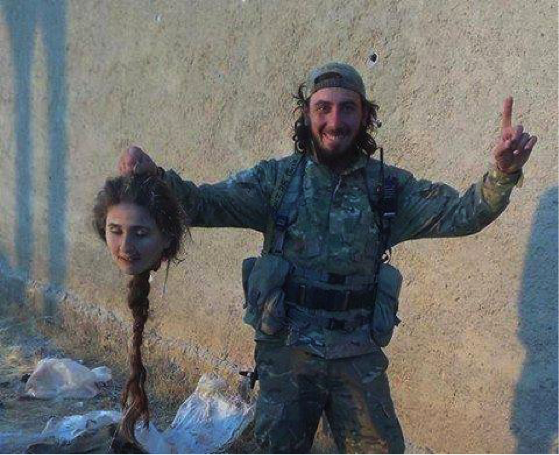 ISIS Islamist with the head of “Rehana,” Peshmerga fighter.
Theology, for the most part, is the a priori premise for Muslim politics and evangelism, Islamism if you will. Culture proceeds from or is conditioned by religious writ or tradition in the Ummah. The adjective “Islamic” before the noun “republic” is not just an historical artifact.
Indeed, since the 1979 Shia religious coup in Persia, the political trend lines throughout dar al Islam are clearly theocratic. You might call the recent Shia coup in Yemen a copycat killing. Secular Islam is in the crosshairs. The trend suffered a setback in Egypt recently, but only at the expense of a military coup.
Theocracy or the generals are the two political default settings in the Muslim world today. Priests and brass hats are never far from the nexus of power. If behavior is a measure of merit in the Ummah, the generals are to be preferred over the ayatollahs, Islamic scholars, mullahs, or imams. Cairo might take a nervous bow here.
A priori or unwarranted assumptions are not limited, however, to the Islamic side of the geo-strategic conundrum. European and American intellectuals, politicians, generals, and academics, are handicapped with the same infirmity.
Terror provides a snapshot of the logic that flows from flawed premises, foregone conclusions that attempt to absolve Islam.
After most atrocities, East or West, the specter of the late Edward Said reappears. Said is the Palestinian apologist, tenured at Columbia University, who coined the theory of “Orientalism,” a grab bag of complaints that cover a host of shibboleths that permit blanket absolution for the Muslim majority today.
Infidels in the West usually begin with ritual handwringing about the horrors of bombs, bullets, and beheadings, followed immediately by a logical hairball where moral poles are reversed — a universe where the Islamist villain morphs into the Muslim victim. Shooters and bombers are rhetorically excommunicated by Western Quislings. Such is the “logic” that allows a black politician from Chicago to declare emphatically that “ISIS is not Islam,” a little like parsing jackals from coyotes.
In contrast, few prominent Muslims condemn or ostracize jihadists. Jihad is as Muslim as Mohammed. Indeed, nearly 50 countries in dar al Islam now send Islamist fighters to ISIS, hirsute recruits that are happy to execute, in the name of Allah, any European, American, or East Asian that falls into their hands. Most recently, two Japanese civilians lost their heads. The executioner of choice at the moment apparently carries a British passport.
Before the blood dries after such barbarism, politicians and media pundits go on defense lest atrocity stain the veil of immunities created for all Muslims. Indeed, when the President of the United States or the Prime Minister of Britain says that ISIS, or any terror group, is not Islamic, they confer blanket amnesty on a sixth of the world’s population, the now celebrated “pacific,” passive-aggressive, Muslim majority.
The anointing of Islam as victim is underwritten by a litany of lesser and equally unsupportable excuses including but not limited to: colonialism, exploitation, poverty, illiteracy, imperialism, racism (sic), and moral equivalence. Of these, moral equivalence is the most absurd.
Few Muslim scholars, ayatollahs, or imams make any claim of moral equivalence. Mohamed, Islam, the Koran, and Hadith are thought to be a unity, the final, singular, and unalterable truth. The Islamist sees all other religions, Jewish, Christian, Buddhist, and Hindu especially, as infidels or apostasies, vessels of ignorance. Ecumenism and multiculturalism is only possible, and only a tactic at that, in polities where Muslims are a minority. Tolerance is nearly absent where Muslim majorities prevail.
Within major religions, moral consistency is now an oxymoron. Discrimination in the West is a still a vice while bigotry in Islam has been ordained a cultural virtue.
Jews and Christians have been removed from most Arab states and are in peril in the Muslim world at large. Jews in Europe are also under siege now by a coalition of traditional anti-Semites on the Left, augmented by irredentist Muslim immigrants on the Right. In contrast, 1.5 million Muslim Arabs still thrive in the tiny state of Israel.
Equality is a claim made by western apologists on behalf of Islam. Few Sunni or Shia clerics or scholars confer equality, civic or religious, on the unbeliever — infidel or apostate. Among Muslims, small minorities like the Kurds, the Zezidi, Ahmadiyya, and the Sufi might legitimately think of themselves as moderates, but they represent only five percent of Islam.
Premature absolution of Islam is now the knee jerk response to all atrocity. Never mind that most terror groups are Muslim and proudly array themselves with all the predictable kit: incantations, black surah flags, the Koran, the Hadith, beards, and burkas — all in the name of Mohammed. Somehow we are supposed to believe that none of this has anything to do with true Islam. The Ummah plays the victim with the passive approvals of believers and the active collaboration of infidels. “Great religion” indeed!
A standard mantra claims that the majority of Islamist victims are Muslims, another absurd tautology. The summary execution of milquetoast Muslims by righteous Muslims is a kind of cultural masochism. Jihadists who kill, or are themselves killed, are celebrated from Gaza to Kabul as heroes or martyrs.
There is no organized, universal opposition to the bomb, bullet, or the knife in the Arab League or the 56 nations of the Organization of the Islamic Conference (OIC). Indeed, the surah, the sword and the gun are the staples of modern Muslim iconography. Flags and banners alone put the lie to the “moderate” meme.
 Islam in London
When the goal is submission, the modalities for victory are clear, indeed, endorsed by scripture. No Muslim cleric argues that any surah, Koranic admonition, needs amendment or reform. Individual or isolated voices might be raised against violence, but there is no reform movement.
The reform vacuum has its own logic. The reformer would be an apostate and a target in any case. The penalty for apostasy is death! Ayaan Hirsi Ali and Salman Rushdie are examples. What is there to alter if you believe that you have the immutable word of God as guidance? And why change anything if you are winning?
The imperial Islamic 5th column in the West now punctuates evangelism with periodic massacres like Charlie Hebdo in Paris just to remind infidels which side has the upper hand. Global terror may not be orchestrated by any one Muslim group or Islamic state. Alas, centrifugal terror is a tactical conundrum for the West and a strategic asset for the Islamist. Nothing succeeds like viral success.
Strategy in Brussels and Washington has deteriorated to what amounts to “whack-a-mole,” a carnival game where the hammer falls only where the rodent raises its head. ISIS is the rodent du jour. The tunnels of Gaza are the literal incarnation of such Muslim tactics, the strategic significance of which is designed to bleed Israel, in particular, and the West, in general, into submission.
Appeasement in the West and serial terror in the East makes for a calculus where new terror groups or Islamic states are likely to proliferate. ISIS, Boko Haram, and Hisb ut Tahrir provide some of the more recent evidence.
ISIS is the new and now more candid face of Islamo-fascism, savage and uncompromising, with a flair for public relations. Brute force is the attribute that merits the fascist label. Preliminary evidence suggests that ISIS tactics, on a global scale, are better proselytizers and recruiters than any al Qaeda atrocities. Al Baghdadi is not just another Sunni Osama bin Laden. Baghdadi is worse — and more effective at the same time.
When American soldiers like Chris Kyle used words like “savages” to describe Islamists, he was only giving voice to the least offensive description of those who kill in God’s, Mohamed’s, or Islam’s name.
Boko Haram is another metastasizing menace. With the assistance of the US State Department, these Islamic slave traders flew under the terror radar for decades. The ninnies at Foggy Bottom can’t bring themselves to put the words “black Muslim slave trading terrorists” in the same sentence. Political correctness in Washington is a kind of Yankeefatwa nowadays, a death warrant, especially for African schoolgirls.
Political correctness is now the official Achilles heel of social democracies.
Hizb ut Tahrir is another caliphate proselytizer flying under the media radar with an assist from the US State Department and the Intelligence Community. HT activities seldom see the light of day although this mutation of Sunni Islamism now operates openly, like al Ikhwan (aka, the Muslim Brotherhood), without a US terrorist designation and associated scrutiny. If the activists of HT, al Ikhwan, and affiliates were audited, the totals would number in the hundreds of millions.
Moderation among Muslims is not a function of kinetics so much as it is a function of cultural affiliations and sympathies. The Pew Research Center and World Health Organization surveys provide ample testimony to toxic Islamic attitudes and social abuses like capital apostasy, polygamy, and consanguinity.
At the moment we live in an era where the Muslim Brotherhood, and affiliates (see CAIR), are welcomed at the Oval Office, but the Prime Minister of Israel is snubbed and reviled. The reasons for such folly are clear: fear for the economy, fear for energy sources, fear of global Muslim numbers, and ultimately the fear that terrorism might get worse.
The US State Department is one of the few institutions in America, other than the Nation of Islam, blessed with the gift of prophecy. Logic, reason, and morality have been subverted to serve the cause of appeasement. Pandering to savages has always been the one policy choice that guarantees that things will get worse.
ISIS Purifies Islam Through Fire, Front Page Magazine,
(The “non-Islamic” Islamic State is not the only Islamic entity that “purifies” by fire. That’s how many “honor killings” are done. When The Islamic Republic of Iran uses nukes against its enemies, it will “purify” them wholesale.– DM)
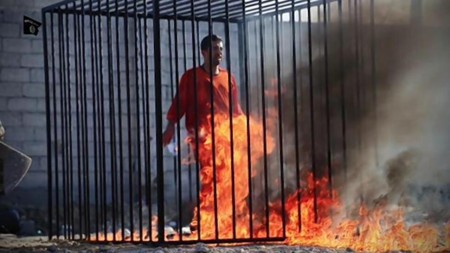
Fire is symbolic of the destruction of evil. Symbolically people who are burned alive are human sacrifices that are expiating evil from the community. Tainted victims are purified through fire.
Filming and disseminating the ritual killing strikes fear into the hearts of enemies and attracts new recruits. Similar to an arsonist that is fascinated with fire, disaffected young people will be attracted to this ritual burning. Like moths to a flame.
*****************
On Tuesday February 3, 2015 the Islamic State released a video showing Jordanian pilot, Lt. Muath al-Kaseasbeh, 26 being burned alive while locked in a metal cage. The 22 minute video includes footage of Jordan’s King Abdullah II declaring his support for the anti-ISIS coalition. It shows Lt. Al-Kaseasbeh, who was captured by the Islamic State in December after his aircraft crashed over Syria, being interrogated, paraded in front of heavily armed men, walking towards the cage, and then standing inside the cage wearing an orange jumpsuit that is doused in flammable liquid. The executioner uses a torch to light a trail of gasoline that leads to his feet. Lt. Al-Kasasbeh is engulfed in flames and remains alive for over 1 minute and half and collapses to the floor. Militants pour broken masonry and other debris over the cage which is then flattened with a bulldozer with the body still inside. Despite the surprise and shock of seeing a young man burned alive, this is not a new tactic. In fact it is a common method of ritual murder in Iraq and other countries particularly in honor killings and the murder of Christians. The significant difference is that the Islamic State media films the execution using sophisticated editing and highly choreographed techniques turning the killing into a scripted reality show.
Hundreds of women in the Muslim world have been murdered by fire in honor killings. The murders were often disguised as suicides or accidents. In the first six months of 2007, in Iraqi Kurdistan, 255 women were killed, three-quarters of them by burning. An earlier report cited 366 cases of women who were the victims of so called fire accidents in Dohuk in 2006, up from 289 the year before. In Irbil, there were 576 burn cases since 2003, resulting in 358 deaths. In 2006 in Sulaimaniyah, Iraq there were 400 cases of women burned. In Tunisia in May 2014 a father burned his 13 year old daughter to death for walking home with a boy. In October 2013 a 15 year old Yemeni girl was burned to death by her father for communicating with her fiancé. In March 2009, a sixteen year old Muslim girl suspected of having a relationship with a boy was burned to death by four male neighbors in her village in Ghaziabad, North India. They came to the girl’s house and demanded to know why the young man frequently visited her, and then the men beat her, doused her with kerosene and set her on fire. There are numerous more examples of women burned alive. This form of punishment is not just reserved for women. In April 2011 three men were set on fire in Iraq for being gay. A video of that incident is easily accessible online. In June 2008, the Taliban burned three truck drivers of the Turi tribe alive for supplying the Pakistan Armed Forces. There have been numerous reports of Christians burned alive by Islamist jihadists. In November 2014 a Christian couple in Pakistan Sajjad Maseeh, 27, and his wife Shama Bibi, 24, were burned alive in a brick furnace after it was rumored that they had burned verses from the Quran.”Bibi, a mother of four who was four months pregnant, was wearing an outfit that initially didn’t burn…… The mob removed her from over the kiln and wrapped her up in cotton to make sure the garments would be set alight.” These incidents are rarely reported by the mainstream media and were difficult for most people to comprehend as real until ISIS started filming documentaries of their ritual murders.
Fire is symbolic of the destruction of evil. Symbolically people who are burned alive are human sacrifices that are expiating evil from the community. Tainted victims are purified through fire. Fire is considered a powerful transformer of the negative to the positive. Because of such properties, fire is commonly found in purification rites throughout the world. In other cultures polluted persons may be required to walk around, jump over, or jump through fire. Historically, burning a person to death was reserved for the most threating evil, such as heresy or witchcraft and considered an extreme form of purification. In the context of honor killing the use of fire is not only symbolic but practical. Practical in Iraq because most of the homes do not have electricity so every house has a large supply of oil which makes it easier to conceal honor killings under the guise of suicide or kitchen accidents. In the context of the murder of Lt. Muath al-Kaseasbeh fire is an Islamic purification ritual that serves vengeance and restores honor and purity to the community of believers.
Islamist jihadists from different movements, countries, sects, and factions all emphasize the need to cleanse Islam of its impurities. Al Qaeda’s ideological belief is the purification of Islam through violent struggle. Bin Laden and Al-Zawahiri have continually called on supporters to purify Muslim holy lands of infidels, un-Islamic beliefs, and practices. The Islamic State cleanses Islam of its impurities while protecting its territory in the same manner as Mexican cartels, using brutal tactics that are justified as vengeance.
The title of the video, Healing the Believers’ Chests, is a quote from the Quran: “Fight them, and Allah will punish them by your hands, cover them with shame, help you over them, heal the breasts of Believers.” (Qur’an 9:14). It was reported to mean ‘giving them pleasure’ – interpreted as a reference to achieving revenge. That is one interpretation, however healing is symbolic of purification, the title Healing the Believers’ Chests can be understood as cleansing the community of the contamination of impurity. Lt. Muath al-Kaseasbeh’s alleged crimes symbolically unleashed an epidemic of contagious evil. The function of the burning ritual is a communal act of expiation, expelling the contagious evil of an infidel enemy through fire. Having ISIS fighters participate and watch makes it a communal sacrificial ritual. Ritualizing the violence justifies it and makes it sacred. Once the transgressor is ritually killed the impurity is removed, the evil has been expelled, taboo has been ameliorated and justice is served. The body is immediately buried under the earth, another purifying element, restoring honor and purity.
Filming and disseminating the ritual killing strikes fear into the hearts of enemies and attracts new recruits. Similar to an arsonist that is fascinated with fire, disaffected young people will be attracted to this ritual burning. Like moths to a flame.
How Iran Is Making It Impossible for the US to Beat ISIS, Daily Beast, Michael Weiss, Michael Pregent, February 1, 2015
 Ahmed Saad/Reuters
Washington needs to quit pretending it can work with Iran to defeat the Islamic State. Tehran’s real objective is to defeat Washington.
It was August 2007, and General David Petraeus, the top commander of U.S. forces in Iraq, was angry. In his weekly report to then-Defense Secretary Robert Gates, Petraeus wrote: “I am considering telling the President that I believe Iran is, in fact, waging war on the U.S. in Iraq, with all of the U.S. public and governmental responses that could come from that revelation. … I do believe that Iran has gone beyond merely striving for influence in Iraq and could be creating proxies to actively fight us, thinking that they can keep us distracted while they try to build WMD and set up [the Mahdi Army] to act like Lebanese Hezbollah in Iraq.”
There was no question there and then on the ground in Iraq that Iran was a very dangerous enemy. There should not be any question about that now, either. And the failure of the Obama administration to come to grips with that reality is making the task of defeating the so-called Islamic State more difficult—indeed, more likely to be impossible—every day.
There are lessons to be learned from the experience of the last decade, and of the last fortnight, but what is far from clear is whether Washington, or the American public, is likely to accept them because they imply much greater American re-engagement in the theater of battle. As a result, what we’ve seen is behavior like the proverbial ostrich burying its head in the desert sand, pretending this disaster just isn’t happening. But at a minimum we should be clear about the basic facts. In Iraq and Syria, as we square off against ISIS, the enemy of our enemy is not our friend, he is our enemy, too.
In 2007, there were 180,000 American troops in Iraq. Under Petraeus’s oversight, U.S. Joint Special Operations Command (JSOC), the elite forces responsible for hunting terrorists around the world, was divided into two task forces. Task Force 16 went after al Qaeda in Iraq, the group that eventually would spawn ISIS, while Task Force 17 was dedicated to “countering Iranian influence,” chiefly by killing or capturing members of Iraq’s Shia militias—though in some cases, it even arrested operatives of Iran’s Revolutionary Guards Corps-Quds Force (IRGC-QF) who were arming and supervising those militias’ guerrilla warfare against coalition troops.
At one point, in the summer of 2007, Petraeus concluded that the Mahdi Army, headed by the Shiite demagogue Muqtada al-Sadr, posed a greater “hindrance to long-term security in Iraq” than al Qaeda did. As recounted in The Endgame, Michael Gordon and Bernard E. Trainor’s magisterial history of the Second Iraq War, two-thirds of all American casualties in Iraq in July 2007 were incurred by Shiite militias. Weapons known as explosively formed penetrators, or EFPs, were especially effective against the U.S. forces. They were Iranian designed and constructed roadside bombs that, when detonated, became molten copper projectiles able to cut through the armor on tanks and other vehicles, maiming or killing the soldiers inside.
So it came as a surprise to many veterans of the war when Secretary of State John Kerry, asked in December what he made of the news that Iran was conducting airstrikes against ISIS in Iraq, suggested “the net effect is positive.” Similarly, Chairman of the U.S. Joint Chiefs of Staff Gen. Martin Dempsey—formerly the commander of the 1st Armored Division in Baghdad—told reporters last month, “As long as the Iraqi government remains committed to inclusivity of all the various groups inside the country, then I think Iranian influence will be positive.”
Whatever the Iraqi government says it is committed to, “inclusiveness” is not what’s happening on the ground.
Iran’s influence in Iraq since ISIS sacked Mosul last June has resulted in a wave of sectarian bloodletting and dispossession against the country’s Sunni minority population, usually at the hands of Iranian-backed Shia militia groups, but sometimes with the active collusion of the Iraq’s internal security forces. Indeed, just as news was breaking last week that ISIS’s five-month siege on the Syrian-Turkish border town Kobane finally had been broken, Reutersreported that in Iraq’s Diyala province at least 72 “unarmed Iraqis” —all Sunnis—were “taken from their homes by men in uniform; heads down and linked together, then led in small groups to a field, made to kneel, and selected to be shot one by one.”
Stories such as these out of Iraq have been frequent albeit under-publicized and reluctantly acknowledged (if at all) by Washington both before and after Operation Inherent Resolve got underway against ISIS.
For instance, 255 Sunni prisoners were executed by Shia militias and their confederates in the government’s internal security forces between June 9 and mid-July, according to Human Rights Watch. Eight of the victims were boys below the age of 18. “Sunnis are a minority in Baghdad, but they’re the majority in our morgue,” a doctor working at Iraq’s Health Ministry, told HRW at the end of July. Three forensic pathologists found that most of the victims in Baghdad were shot clean through the head, their bodies often left casually where they were killed. “The numbers have only increased since Mosul,” one doctor said.
On August 22, 2014, the Musab Bin Omair mosque in Diyala—the same province where last week’s alleged executions occurred—was raided by officers of the security forces and militants of Asaib Ahl al-Haq (the League of the Righteous), which slaughtered 34 people, according to HRW. Marie Harf, the U.S. State Department spokeswoman, said at the time: “This senseless attack underscores the urgent need for Iraqi leaders from across the political spectrum to take the necessary steps that will help unify the country against all violent extremist groups.”
Since then, however, U.S. warplanes have provided indirect air support to Asaib Ahl al-Haq and Kataib Hezbollah, a U.S.-designated terrorist entity, both of which were at the vanguard of the troops that ended ISIS’s months-long siege of Amerli, a Shia Turkomen town of about 15,000, in November 2014. These militias have also been seen and photographed or videoed operating U.S. Abrams tanks and armored vehicles intended for Iraq’s regular army, which means that there are now two terrorist organization, Sunni ISIS and Kataib Hezbollah, armed with heavy-duty American weapons of war.
The Hezbollah-ization of Iraq’s military and security forces has been overseen by the IRGC-QF, another U.S.-designated terrorist entity, which is headed by Maj. Gen. Qassem Suleimani, a man personally sanctioned by the Treasury Department for his role in propping up Bashar al Assad’s mass murderous regime in Syria.
Suleimani is the same Iranian operative Petraeus once called “evil” because of his well-documented role orchestrating attacks on U.S. servicemen. The most notorious episode happened in Karbala in 2007—in a raid that was carried out by Asaib Ahl al-Haq and resulted in the death of five G.I.s One of the founders of this militia and a main perpetrator of the attack, Qais al Khazali, was captured by coalition forces and subsequently released in a prisoner swap for a British hostage in 2009. Today, al Khazali moves freely around Iraq, dressed in battle fatigues, commanding Asaib militants.
Another one of Suleimani’s major proxies, the Badr Corps, is headed by Hadi al-Amiri, who happens to be Iraq’s current minister of transport, in which capacity he’s been accused by the U.S. government of helping to fly Iranian weapons and personnel into Syria. Not only was one of al-Amiri’s Badr henchmen, the group’s intelligence chief Abu Mustafa al-Sheibani, the man chiefly responsible for importing explosively formed projectiles into Iraq from Iran’s Mehran province during the occupation, but another of his subordinates, Mohammed Ghabban, is currently Iraq’s Interior Minister. This gives the Badr Corps purview over all of Iraq’s internal security forces, including its federal police—that is to say, the men in uniform who have allegedly acquiesced or connived in the Shia militias’ anti-Sunni pogroms.
Indeed, Iraq’s Interior Ministry gained notorious reputation in the last decade for being a clearinghouse for sectarian bloodletting. During the civil war in the mid-2000s, its agents, nominally aligned with U.S. troops, moonlighted as anti-Sunni death squads that functioned with the impunity of officialdom. The ministry also ran a series of torture-prisons in Baghdad, such as Site 4, where, according to a 2006 U.S. State Department cable, 1,400 detainees were held in “in squalid, cramped conditions,” with 41 of them bearing signs of physical abuse. Ministry interrogators, the cable noted, “had used threats and acts of anal rape to induce confessions and had forced juveniles to fellate them during interrogations.”
Needless to add, Badr has hardly mended its ways with the passage of time and the exit of U.S. troops from Iraq. Today, the militia has been accused of “kidnapping and summarily executing people…[and] expelling Sunnis from their homes, then looting and burning them, in some cases razing entire villages,” in thewords of Human Rights Watch’s Iraq research Erin Evers, who added for good measure that the current White House strategy in Iraq is “basically paving the way for these guys to take over the country even more than they already have.”
As if taunting the Obama administration’s, Suleimani has takento popping up, Zelig-like, in photographs all over Iraq, usually from a front-line position from which ISIS has just been expelled. It is hard to overestimate the propaganda value such images now carry.
Consider this week’s blockbuster disclosure that the CIA and Israel’s Mossad collaborated in the 2008 assassination of one of Suleimani’s other high-value proxies, Hezbollah security chief Imad Mughniyeh. In close collaboration with Iran, Mughniyeh coordinated suicide attacks ranging from the 1983 U.S. Marine barracks bombings in Beirut to the blowing up of the AMIA Jewish center in Buenos Aires in 1994. Mughniyeh also was linked to the kidnapping of several Europeans and Americans in Lebanon in the 1980s, including CIA Station Chief William Buckley, believed to have died in 1985 after months of torture by Iranian and Iranian-trained interrogators.
So it is not surprising that Langley wanted Mughniyeh dead. What is suprising is that according to the Washington Post the CIA and Mossad had “a chance to kill” the Iranian master-spy Suleimani as he strolled through Damascus with Mughniyeh in 2008, but passed it up because of potential collateral damage. No doubt U.S. satellite surveillance is currently tracking Suleimani’s plain-sight movements in Iraq and Syria, too.
Last month, an Israeli attack in the Syrian sector of the Golan Heights killed Mughniyeh’s son, Jihad, who was said to have been an “intimate” protégé of Suleimani.
While segments of the U.S. intelligence establishment and punditocracy believe Iran to be a credible or necessary force for counterterrorism, the fighters associated with Suleimani’s paramilitaries profess a different agenda entirely.
In October, ISIS was driven from Jurf al-Sakher, a town about 30 miles southwest of Baghdad. The operation was said to have been planned personally by Suleimani. It featured Quds Force agents and Lebanese Hezbollah militants embedded with some 7,000 troops form the Iraqi Security Forces.
Ahmed al Zamili, the head of the 650-strong Al Qara’a Regiment, one of the militias party to that fight, told the Wall Street Journal that he actually welcomed the invasion of Iraq by ISIS because this dire event would only hasten the return of the Hidden Imam, a religious prophecy which in Shia Islam precedes the founding of a worldwide Islamic state. Al Zamili made it clear that his notion of counterinsurgency was holy war. Meanwhile, 70,000 Sunnis were driven from Jurf al-Sakher, which means “rocky bank” and has now been renamed Jurf al-Nasr (“victory bank”). The provincial council told them they would not be allowed to return for eight or ten months.
“Iran has used Iraq as a petri dish to grown new Shia jihadist groups and spread their ideology,” says Phillip Smyth, an expert on Shia militias. By Smyth’s count, there are more than 50 “highly ideological, anti-American, and rabidly sectarian” Shia militias operating in Iraq today, and recruiting more to their ranks, all with the acquiescence of the central government.
Some of Iraq’s Shia politicians have acknowledged the dismal reality that has attended Baghdad’s outsourcing of its security to “Khomeinists” — and the potential it carries for the kind of all-out sectarian bloodletting that nearly tore the country apart in the mid-2000s.
One unnamed Shia politician told the Guardian newspaper last August that groups of Shia extremists “equal in their radicalization to the Sunni Qaeda” are being created. “By arming the community and creating all these regiments of militias, I am scared that my sect and community will burn,” he said.
More recently, Iraq’s Vice President for Reconciliation, Ayad Allawi, a secular Shia who once served as the interim prime minister, told the same broadsheet that pro-government forces have been ethnically cleansing Sunnis from Baghdad. This is a starker admission of the atrocities being committed by America’s silent partner than currently is on offer by the State Department or Pentagon, and many Sunnis now suspect Washington of full collaboration with Tehran, whatever the protestations to the contrary.
When Michael Pregent, one of the authors of this essay, briefed a team of U.S. military advisors headed to Iraq recently, he warned them that they are now operating in an environment in which Iranian and Shia-militia targeting choices take priority over the recommendations of U.S. advisors and intelligence officers.
The consequence of this tacit collaboration with the Quds Force and its assets is obvious: the United States will be portrayed by ISIS propagandists as a helpmeet in the indiscriminate murder and dispossession of Sunnis.
Kerry and Dempsey would do well to pay closer attention to Iran’s air war, too. According to one Kurdish Iraqi pilot interviewed by the Guardian, Suleimani’s command center in Iraq, the Rasheed Air Base south of Baghdad, is where “the Iranians make barrel bombs” and then use Antonov planes and Huey helicoptetrs to drop them in Sunni areas — thus replicating one of the nastiest tactics of Assad’s air force in Syria.
The Anbar Awakening critical to stabilizing Iraq in the middle of the last decade was made possible by the presence of U.S. ground forces who represented to the influential Sunni tribes an impartial bulwark against the draconian rule of al Qaeda in Iraq.
Many in the Obama administration express the hope that another such awakening can be fomented, given the current political and military dynamics in Iraq. But how? ISIS has cleverly exploited the sensitivities and fears of Iraq’s Sunni tribes, offering those it hasn’t rounded up and murdered the chance to “repent” and reconcile with the so-called “Calihpate.”
ISIS: Inside the Army of Terror, a new book by the co-author of this piece, documents the tragic situation of those Sunni tribesmen who have risen up against ISIS only to be slaughtered mercilessly, sometimes with the help of their fellow tribesmen, whom ISIS had already won over. The rest of the constituents of this bellwether Sunni demographic are thus given a choice between cutting a pragmatic deal with ISIS or embracing Shia death squads as their saviors and liberators. Most have, predictably, opted for the former.
“The American approach is to leave Iraq to the Iraqis,” Sami al-Askari, a former Iraqi MP and senior advisor to former Prime Minister Nouri al-Maliki, told Reuters last November. “The Iranians don’t say leave Iraq to the Iraqis. They say leave Iraq to us.”
For the White House, that ought to define the problem, not the solution.
Andrew Klavan: Attack of the But-Heads! Truth Revolt via You Tube, January 29, 2015
Yazidis ask Israel for help, Al-Monitor, Jacky Hugi, January 28, 2015
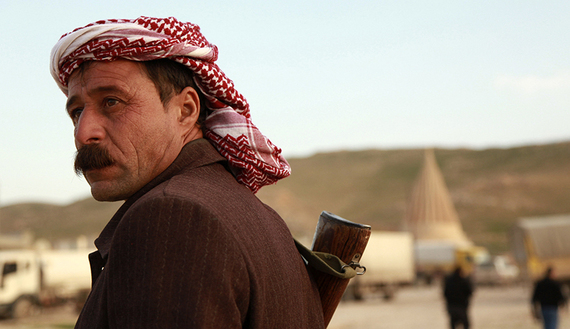 A man from the minority Yazidi sect stands guard at Mount Sinjar, in the town of Sinjar, Dec. 20, 2014. (photo by REUTERS/Ari Jalal)
[I]t is an unusual overture of friendship for the government of Prime Minister Benjamin Netanyahu, and it will be interesting to see if and how Israel takes up the gauntlet. Given the sensitivity of the matter, it is quite uncertain whether anyone will hear about it.
******************
“They have already killed many of us. What do we have to fear?” Lt. Col. Lukman Ibrahim responded when I asked him if he was afraid to openly communicate with an Israeli in a recent long-distance phone conversation from Tel Aviv to Sinjar, in northwestern Iraq, near the Syrian border. Ibrahim, a Yazidi militia officer, is hoping to obtain military aid from the State of Israel.
“The Arab countries do not recognize us, nor do they recognize you,” he said. “They are telling us that we are infidels. Why should we be afraid to talk to you, when even neighboring Arab countries have become our enemies? We regard you as a friendly state, with an opportunity for relations on the basis of neutrality and respect. We do not want more than that.”
Ibrahim, a journalist by profession, serves as an assistant to Marwan Elias Badl, one of the senior field commanders of the Sinjar Protection Forces, the Yazidi militia established ad hoc in August 2014 to halt the Islamic State (IS) onslaught against Yazidi population centers west of Mosul. The militia numbers some 12,000 fighters, most of them untrained, ordinary men who rushed to take up arms to thwart IS’ designs. A few of them are rank-and-file fighters, while some are officers with the Kurdish peshmerga. According to internal estimates, the IS militants killed thousands in their pogrom against the Yazidis. About 5,000 Yazidis are still being held by IS.
The Yazidis have no formal relations with Israel, nor an organized leadership. Yet they need aid, in particular military assistance, and they have chosen to make a public plea for help. “We appeal to the Israeli government and its leader to step in and help this nation, which loves the Jewish people,” said Ibrahim. “We would be most grateful for the establishment of military ties — for instance, the training of fighters and the formation of joint teams. We are well aware of the circumstances the Israelis are in, and of the suffering they have endured at the hands of the Arabs ever since the establishment of their state. We, too, are suffering on account of them.”
When asked what kind of weapons they needed, Ibrahim cited protective measures. “We are not acting against anyone,” he clarified. “And we do not covet other people’s land. We just want to protect ourselves. For example, [we need] armored [Humvees], machine guns and light weapons.”
Contact with Israel is a dirty business in this neighborhood, military contact all the more so. Be that as it may, in a reality where all levees have been breached and the worst appears to have already befallen the Yazidis, what could they possibly lose by seeking a rapport with Jerusalem?
The conversation with Ibrahim was not the only call with Sinjar. Majdal Rasho, a native of Sinjar, had settled in Germany and built his life there. He married and had a family, making a living as a manufacturing supervisor at a chocolate plant. In his spare time, he served as a photographer for TV stations broadcasting in the Kurdish language. He returned to Sinjar as a fighter, but also in his capacity as a video photographer for German TV networks.
“What I have seen here, I just can’t describe,” he said by phone from a battle zone. “Our people had no choice but to flee. We are not Arabs, nor are we Muslims. We see ourselves as sharing a fate with the Israelis, who went through similar pogroms. Those besieged on the mountain approached me and asked, ‘Maybe our Israeli brethren could lend a hand?’”
Yazidism is a religion with no more than a million followers. Its adherents are centered around Mosul and the Sinjar mountain range, in northern Iraq. Their largest diaspora in the West is in Germany, estimated to number some 100,000.
A common destiny with the Jews is a recurring theme in the Yazidis’ discourse. “What happened to us is the biggest genocide since the Holocaust of the Jews in Europe,” said Dr. Mirza Dinnay, a pediatrician based in Germany. “In the Holocaust, the goal was to annihilate an entire people, the Jews. IS has a similar plan — to exterminate an entire people, the Yazidis. No such extermination process had taken place in the past 500 years, with the exception of the Holocaust and what came to pass in Sinjar.”
Dinnay left Germany for Sinjar at the outbreak of the pogrom, leading a delegation of human rights activists. During one of the aid flights arranged by the Iraqi air force, a helicopter carrying food supplies and medication to the besieged Yazidis crashed. Some of the passengers aboard, among them Dinnay, were injured.
The communication between the Yazidis and the Israeli media has been coordinated by Idan Barir, 34, a researcher at the Tel Aviv University Yavetz School of Historical Studies. In the months since IS’ offensive against Yazidi population centers, Barir has become Israel’s top expert on the Yazidis, thanks to his extensive connections with members of the Yazidi community.
“I can think of a range of activities that Israel is experienced in that would not undermine the world order,” Barir told Al-Monitor. “For example, providing military assistance to the Yazidi forces in Sinjar who are crying out for cooperation and aid; setting up a field hospital for medical and psychological treatment of the casualties among the displaced in northern Iraq — not only Yazidis, by the way; sending humanitarian aid to displaced Yazidis in the refugee camps in Iraqi Kurdistan; absorption of a symbolic number of displaced Yazidis in Israel, with preference given to humanitarian, whether medical or mental, cases; incorporation of young Yazidis into military service in Israel; and support of civil initiatives aimed at strengthening and deepening ties between Israelis and Yazidis. It all depends on the decision made by the Israeli government, on its determination and goodwill.”
So far, Israel has not officially responded to such calls, which have yet to be fully formulated and have only recently began over the last few days. In fact, no formal request has come from the Yazidis for asylum as refugees. Barir is currently trying to find a way to reach decision-makers in Israel to pass on the messages from his faraway friends. Without a doubt, it is an unusual overture of friendship for the government of Prime Minister Benjamin Netanyahu, and it will be interesting to see if and how Israel takes up the gauntlet. Given the sensitivity of the matter, it is quite uncertain whether anyone will hear about it.
“It is a moral obligation to ring every bell and to do everything possible to stop the Yazidi tragedy,” said Attorney Zvi Hauser, the former Cabinet secretary in the most recent Netanyahu government (2009-13). “It is inconceivable that in the 21st century, someone’s attempt to eliminate an entire people, because of its faith and religion, is met with indifference.”
Hauser is the first senior figure in Israel who agreed to comment on the Yazidis’ call for help. As a private person, he refrained from reference to the Yazidis’ request for military aid, taking care to say nothing that might be interpreted as a promise. He believes, however, that Israel should favorably consider the Yazidis’ calls.
“The Yazidi narrative is evocative of ours. We, too, went through 2,000 years of existence without sovereignty, in the course of which we faced extermination schemes,” Hauser said. “Israel is a sovereign state, formed by an ethnic minority. It is the national manifestation of an ancient civilization. It would thus be appropriate to examine ways to establish relations and forge an alliance with them, if only to ensure a pluralistic Middle East. This issue has a universal aspect, as well. The development of human civilization is contingent on the diversity and multiplicity of [ethnic] groups and nations. Hence, the extinction of one of these would hurt not only the Yazidis, but also the entire fabric of human life.”




 anneinpt
 artaxes
 danmillerinpanama
 davidking1530
 Peter Hofman
 Joseph Wouk
 Peter
Peter Louisiana Steve
 WarSclerotic
Recent Comments