Posted tagged ‘Hezbollah’

Venezuela, Iran, USA and Narco-Terrorism

October 13, 2016

Venezuela, Iran, USA and Narco-Terrorism, Gatestone Institute, Susan Warner, October 13, 2016

There are an estimated six million Muslims living in Latin American cities, who provide a fertile terrorist recruiting environment.

“Iran has opened up more than 80 cultural centers in Latin America in order to export its toxic brand of political influence and serve its interest, focusing on partnering with nations well known for their anti-American rhetoric including Venezuela, Argentina, Bolivia, Ecuador, and Nicaragua.” — US Rep. Ileana Ros-Lehtinen, in testimony for the House Sub-Committee on the Middle East and North Africa.

Amidst the unspeakable economic distress facing residents of Venezuela today, security experts have identified yet another major cause for concern emanating from this once prosperous, oil-rich nation: Iran is moving in, partnering with Venezuela’s prosperous drug traders and creating a foothold there, as well as in other “friendly” Latin American countries. Iran is laundering money in Latin America and presumably secretly plotting to accomplish a strategic long-term goal to penetrate the Western hemisphere.

Iran’s terrorist activities, its partnership with Venezuelan drug traffickers and the general criminal atmosphere affects the citizens of Caracas so much that people reportedly are fearful of even going to the store to wait in the endless lines for food.

In Venezuela, security analysts say, the corruption starts at the very top with President Nicolas Maduro himself, who is looking frantically for money in every crevasse to keep the nation and his presidency afloat. Reports estimate that in Venezuela one police officer dies every day and the number of homicides per capita in Caracas is the highest in the world.

National crime statistics, however, seem to be just the start: deeper and more alarming than the Venezuelan homicide toll, there appears to be an imminent threat to the entire Western hemisphere from partnerships between Venezuelan drug traffickers and terrorist networks like Hamas and Hezbollah, two groups that act a proxies for Iran.

Together, terrorism and illegal drugs represent a significant export for Venezuela. Iran and Venezuela partner together to move terrorist cells and drugs to hubs in the United States and throughout North America.

This alliance has already come to the attention of the House Sub-Committee on the Middle East and North Africa; in 2015, Chairwoman Ileana Ros-Lehtinen headed a hearing entitled, “Iran and Hezbollah in the Western Hemisphere.”

“Drug trafficking funds terrorism,” said Ros-Lehtinen. “The need for a comprehensive strategy must address this fundamental cause of the problem.”

“Recent reports of the connections between Hezbollah and the FARC [Colombia]; the murder of the special prosecutor of Argentina, Alberto Nisman, and the alleged conspiracy between the Argentine Government, Venezuela and Iran to cover up Hezbollah’s activities and involvement in the AMIA [Jewish Community Center] bombing do nothing to quell doubts about Iran’s activities in Latin America.”

Through its Islamic Revolutionary Guard Corps (IRGC) and Hezbollah, Iran’s terrorist proxy in Lebanon, Iran is spreading its roots through legitimate enterprise “laundries” throughout Latin America.

Iran has set up banking entities, embassies, cultural centers and business enterprises, through which it is building an infrastructure to advance expansionist strategies.

Vanessa Neumann wrote in 2011:

“Besides its sponsored terrorist groups, Iran also has a growing direct influence in Latin America, spurred by three principal motivations: 1) a quest for uranium, 2) a quest for gasoline, 3) a quest for a base of operations that is close to the US territory, in order to position itself to resist diplomatic and possible military pressure, possibly by setting up a missile base within striking distance of the mainland US, as the Soviets did in the Cuban Missile Crisis”

“FARC in Columbia, Hezbollah in Lebanon and Al Qaeda all have training camps, recruiting bases and networks of mutual assistance in Venezuela as well as throughout the continent,” the Foreign Policy Research Institute reported.

Jaime Daremblum wrote in 2011:

“An official involved in the fight against terrorism said that the relation between Venezuela and Iran is becoming a strategic association. How to explain otherwise reported regular flights between Caracas and Tehran, for which no tickets are sold and no immigration or customs inspections are required?”

Rachel Ehrenfeld, in her 1990 book on terrorism funding (page xiii), defined the term “narco-terrorism” as “the use of drug trafficking to advance the objectives of certain governments and terrorist organizations.” Two decades after the book’s publication, the term narco-terrorism has almost become a household word, with Venezuela as a hub of activity in the Western hemisphere.

A U.S. State Department report stated:

“Venezuela remained a major drug-transit country in 2014. Venezuela is one of the preferred trafficking routes for illegal drugs from South America to the Caribbean region, Central America, the United States, Western Africa, and Europe, due to its porous western border with Colombia, weak judicial system, sporadic international counternarcotics cooperation, and permissive and corrupt environment.”

Hezbollah’s annual budget of more than 100 million dollars is provided by the Iranian government directly and through a complex system of finance cells scattered around the world, from Bangkok and Paraguay to Michigan and North Carolina.

Far from being the passive beneficiaries of drug-trafficking expats and sympathizers, Hezbollah has high-level officials directly involved in the South American cocaine trade and its most violent cartels, including the Mexican crime syndicate Los Zetas. Hezbollah’s increasing foothold in the cocaine trade is facilitated by an enormous Lebanese diaspora.

There are an estimated six million Muslims living in Latin American cities, who provide a fertile terrorist recruiting environment. Vanessa Neumann writes:

“The Free Trade Zones of Iquique, Chile; Maicao, Colombia; and Colón, Panama, can generate undetected financial and logistical support for terrorist groups. Colombia, Bolivia, and Peru offer cocaine as a lucrative source of income. In addition, Cuba and Venezuela have cooperative agreements with Syria, Libya, and Iran.”

Iran’s Islamic Revolutionary Guards Corps (IRGC) was established by Ayatollah Khomeini in 1979. Today it plays a leading role in Iran’s expansionist enterprises. The IRGC has become a wide-ranging political, social, and economic corporation — with holdings in industry, security, energy, construction, and communications. It is the most robust economic organization in the country. According to reports, many of its former members currently hold senior political and bureaucratic positions in the Iranian government.

According to a 2013 report in Military and Strategic Affairs:

“… the Revolutionary Guards are active on two major complementary levels. First, the organization leads the efforts to export the Iranian Islamic Revolution, seeking to expand the republic’s political, ideological, and religious influences in the Middle East, Central Asia, Africa, and Latin America. Secondly, the Revolutionary Guards continuously exert efforts to undermine the influence of the United States in the Middle East by harming the superpower’s regional interests and its allies. … the Revolutionary Guards make extensive global use of asymmetrical strategies in their struggle against the West and its allies, preferring tactics of subversion and terrorism.”

The Quds Force, an arm of IRGC, is in charge of exporting the Islamic Revolution and organizing terrorist and subversive activity against Iran’s enemies, according to a 2013 report from theAmerican Center for Democracy

The Quds Force uses proxies as a way to disguise Iran’s involvement in terrorist activity. The force’s most prominent ally is the Lebanese Hezbollah, which was established in 1982 with the help of the Revolutionary Guards.

Alongside their efforts to battle their own serious homegrown drug problems in Iran, the Revolutionary Guards are also reportedly working to harness the strategic and tactical potential of the international drug trade in order to advance Iran’s expansion.

Venezuela and Iran seem to have been friendly since the establishment of the Organization of Petroleum Exporting Countries (OPEC) in 1960. They have been reinforcing their bonds since May 2001, when then President Hugo Chavez paid a visit to Tehran. There he coordinated their anti-Western narrative, stressing opposition to all forms of “imperialism and oppression” in the Third World — a code for “lets agree to stay away from any relationship with Western capitalist powers: the United States, Israel and their allies”. This “anti-imperialist” mantra has been used by both Chavez and his successor, Nicolas Maduro, along with Iran as a unifying cry against the U.S. and its allies.
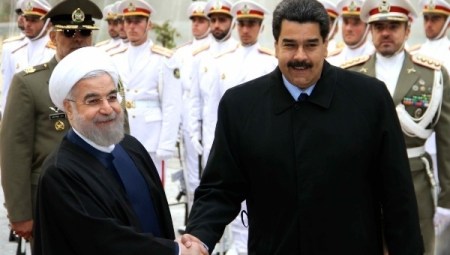
1944Venezuelan President Nicolas Maduro (right) meets with Iranian President Hassan Rouhani in Tehran, January 10, 2015. (Image Source: TeleSUR video screenshot)

According to the testimony of Ileana Ros-Lehtinen:

“Iran has opened up more than 80 cultural centers in Latin America in order to export its toxic brand of political influence and serve its interest, focusing on partnering with nations well known for their anti-American rhetoric including Venezuela, Argentina, Bolivia, Ecuador, and Nicaragua.”

Hamas and Hezbollah, both Iranian proxy terrorist groups, have also established offices in Caracas.

Representatives Ileana Ros-Lehtinen, Jeff Duncan and others say this is an appropriate time for the United States to pay more attention to activities happening in its own backyard.

The Need for a U.S. Response

In his statement to the House Committee on Foreign Affairs, Rep. Jeff Duncan asserted at the 2015 hearing, that the U.S. and its allies must do more to counter Iran’s goals to develop nuclear weapons, export terrorism and develop alliances with the narcotics trade.

Since the (unfortunate) approval of “Iran Nuclear Deal” in 2015, the United States has largely dissolved international sanctions against Iran, which leaves the IRGC free to make uninhibited alliances with networks of transnational organized crime organizations to finance its aspirations. Along with United States’ recent payment of $1.5 billion to Iran, there may be a grave risk to our own national security as Iran marches north from Venezuela into Central America and further into the United States through our southern border with Mexico.

In 2015, according to the US Department of State, U.S. President Barack Obama determined that Venezuela had failed to adhere to its obligations under international counternarcotics agreements. Even so, the US issued a waiver, allowing for continued assistance to be granted to Venezuela “in the interest of U.S. national security“.

The State Department admits that Venezuelan authorities do not effectively prosecute drug traffickers, in part due to their political corruption. Additionally, Venezuelan law enforcement officers lack the equipment, training, and resources required to significantly impede the operations of major drug trafficking organizations.

The U.S. Treasury Department has sanctioned multiple Venezuelan banks and Venezuelan regime operatives, including the former Minister of Interior and Justice. The U.S. State Department has cited Venezuela’s state-owned oil company, PDVSA, and CAVIM, the Venezuelan weapons company, for their role in helping Iran circumvent the sanctions that the U.S. has now lifted altogether.

At the same time, the U.S. administration continues to purchase 10% of its oil (roughly 300 million barrels per year) from Venezuela, the same entity that it sanctioned in 2011 for shipping gasoline to Iran.

This is all happening while terrorist groups are regularly connecting to drug cartels in the region, and forging a deepening narco-terror machine that in turn is funding terrorist activities.

While the US administration — apparently in denial about the clear threats posed by Iran’s expansionist and nuclear aspirations — dismisses Israel’s concerns as “hysteria,” Iran quietly continues its unfettered march westward.

Accused Hezbollah Operative Slated to Speak In Washington, D.C.

October 7, 2016

Accused Hezbollah Operative Slated to Speak In Washington, D.C., Washington Free Beacon, , October 6, 2016

Azmi Bishara, an Israeli Arab and former lawmaker, speaks with journalists as he arrives to attend the emergency Arab leaders summit on Gaza in Doha, Qatar, Friday, Jan. 16, 2009. (AP Photo/Hassan Ammar)

Azmi Bishara, an Israeli Arab and former lawmaker, speaks with journalists as he arrives to attend the emergency Arab leaders summit on Gaza in Doha, Qatar, Friday, Jan. 16, 2009. (AP Photo/Hassan Ammar)

“The Obama administration’s tilt toward Iran is so extreme that now a visa has been given to a Hezbollah terrorist so that he can visit Washington D.C.,” the source said. “The administration’s love affair with Iran is a disgrace to our country and a danger to our security.”

********************

A former Arab member of Israel’s parliament who was forced to flee the country after he was accused of working as a top Hezbollah operative is slated to speak next week in Washington, D.C., raising questions about how he obtained permission to enter U.S. soil.

Azmi Bishara, who is accused by Israel’s Shin Bet secret service of helping Hezbollah plot terrorist operations, is confirmed to speak next week at Washington’s downtown Marriott hotel as part of a conference organized by The Arab Center of Washington, D.C.

An official from the Arab Center confirmed to the Washington Free Beacon that Bishara will be attending the event, raising questions about how an individual linked to a U.S.-designated sponsor of terror obtained permission to enter America.

Bishara was initially slated to speak alongside former U.S. Ambassador to Russia Michael McFaul, who the Free Beacon has learned cancelled his appearance. The talk was to focus on the promotion of democracy in the Arab world, according to a current conference schedule.

McFaul’s image was removed from the conference’s webpage several hours after the Free Beacon made an inquiry into the event.

Bishara remains listed as a speaker.

Bishara, who has been living in Qatar since he fled Israel in 2007, is accused by Israel of helping Hezbollah select targets during its 2006 assault on the Jewish state. Israel is still seeking to detain Bishara and charge him for these terror offenses. Israeli authorities have said they will arrest Bishara if he returns to the country, where he could face the death penalty, according to the Israeli newspaper Haaretz.

The State Department declined to tell the Free Beacon if it granted a visa to Bishara. It remains unclear how he has gotten official permission to be in the United States, as Qatar, his current place of residence, is not part of the U.S. Visa Waiver Program.

A State Department official told the Free Beacon that visas are granted on a case-by-case basis, but remain confidential.

“We are unable to provide information on individual cases because visa records are confidential under U.S. law,” an official told the Free Beacon. “Visa applications are adjudicated on a case-by-case basis in accordance with U.S. law.”

Additionally, “Section 222 (f) of the Immigration and Nationality Act (INA) prohibits us from disclosing details from individual visa cases,” the official said.

One foreign policy insider familiar with the situation questioned how Bishara obtained entry to the United States.

“The Obama administration’s tilt toward Iran is so extreme that now a visa has been given to a Hezbollah terrorist so that he can visit Washington D.C.,” the source said. “The administration’s love affair with Iran is a disgrace to our country and a danger to our security.”

Bishara, a former chairman of Israel’s Balad political party, is accused by Israel of aiding Hezbollah agents during the 2006 war.

“Bishara allegedly provided ‘information, suggestions and recommendations,’ including censored material, to his contacts in Lebanon during the war,” according to Haaretz.

He currently serves as the general director at the Arab Center for Research and Policy Studies in Qatar.

Iranian Official: ‘If America Wants To Try Its Luck Against Us, [It Should Know That] We Are Completely Capable Of Mobilizing 9 Million Fighters… In Under 10 Days’; ‘We Have Warehouses Full [Of Missiles]… That Can Hit Tel Aviv’

October 3, 2016

Iranian Official: ‘If America Wants To Try Its Luck Against Us, [It Should Know That] We Are Completely Capable Of Mobilizing 9 Million Fighters… In Under 10 Days’; ‘We Have Warehouses Full [Of Missiles]… That Can Hit Tel Aviv’ MEMRI, October 2, 2016

In a September 25, 2016 speech to a Tehran political circle, Mohsen Rafighdoost, who was minister of the Iran’s Islamic Revolutionary Guard Corps (IRGC) during the 1980-88 Iran-Iraq War and who heads the Noor Foundation,[1] said that the secret of the victory of Iran’s Islamic Revolution was Iranians’ total obedience to the leader. He said that today the IRGC ground forces are “five times better” than the U.S. Army, and that the Iranian regime is capable of deploying nine million troops against it in less than 10 days.

Rafighdoost added that Iran’s missiles in Tehran and the northwest of the country can reach Tel Aviv, and expressed his yearning for Israel to launch a missile at Iran so that Iran could “flatten Tel Aviv.” He also said that Islamic Revolution founder Ayatollah Khomeini established Hizbullah in Lebanon to promote the Islamization of other countries,[2] and that today, in the era of Supreme Leader Ali Khamenei, the organization has become “a supreme force in the region.”

30165Mohsen Rafighdoost. Source: Wilayah.info, January 27, 2014.

Following are his September 25 statements:

“The IRGC’s Ground Forces Are Perhaps Five Times Better Than The American Army”

“The factor that led to our victory in the [Iran-Iraq] War is [the same] factor that led to our victory in the [Islamic] Revolution. The Imam [Khomeini], in France, would order a parade [to be held in Iran], and the people would hold a parade, even in remote villages.

“During the eight years of the imposed war, not only was not one inch of Iranian land surrendered to the enemy, but we also acquired deterrent capability. I believe that as long as the Islamic Revolution stands against the Western and Eastern camps, we will be under military sanctions. We must never think that the world will provide us with military aid. Thanks to the war and its martyrs, Iran currently has deterrent capability. After a while, the Imam [Khomeini] replaced the call of ‘war, war to victory’ with ‘war, war until the fitna is removed.’ At the time, we understood this call as meaning that ‘we must be so strong that the enemy will not even think of a military strike against Iran.’

“Today, Iran has deterrent capability. In recent years, the enemies have spoken of the option [of a military strike against Iran] as being on the table, but that was a lie. [Our] air force and navy are good, but it is [our] ground forces that finish the war. The IRGC’s ground forces are perhaps five times better than the American army.

“Despite all the enemy media and cultural propaganda against us, if America wants to try its luck against us, [it should know that] we are completely capable of mobilizing nine million fighters [against it]… on the [battle]front in under 10 days.”

“If Only A Single [Israeli] Shell Would Strike Anywhere In This Country – So That We Can Flatten Tel Aviv”

“We have warehouses full [of missiles] in Tehran, Zanjan [in northwest Iran] and Oshnavieh [in Western Azerbaijan Province in northwest Iran] that can strike Tel Aviv. If only a single [Israeli] shell would strike anywhere in this country, so that we can flatten Tel Aviv.”

In Khamenei’s Era, Hizbullah “Has Become A Supreme Force In The Region”

“In accordance with his secondary plan, the Imam [Khomeini] created Hizbullah in Lebanon. This plan was [aimed at] Islamizing other countries. Today, in the era of the Leader [Khamenei, Hizbullah] has become a supreme force in the region.

“Despite all the criminal [plots], Iranian security forces grow stronger every day. Some of the statements being put out there are made out of lack of awareness, and anyone who makes them is ignorant.[3]

“The secret to victory lies in wise and complete obedience to the leader [Khamenei]. During the time of the Imam [Khomeini], we obeyed him, and today we obey the leader [Khamenei].”[4]


Endnotes:


[1] Since 1999, Mohsen Rafighdoost has been director of the Noor Foundation, which reportedly owns significant real estate and has revenues of over $200 million from importing pharmaceuticals, sugar and construction materials.

[2] During the 1980s, Rafighdhoost was involved in the creation of Hizbullah in Lebanon and likely had knowledge of its terror activities in Beirut.

[3] A reference to Hashemi Rafsanjani’s August 20, 2016 call for investing in Iran’s economy instead of in its the military, as Japan and Germany did post-World War II. MEMRI is soon publishing a report on Rafsanjani’s statements and reactions to them.

[4] Khabaronline.ir, September 25, 2016.

Column One: The New Middle East

September 29, 2016

Column One: The New Middle East, Jerusalem PostCaroline B. Glick, September 29, 2016

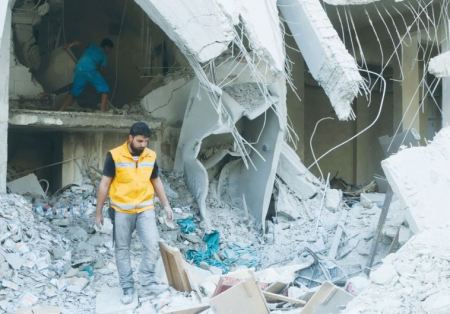
aleppo-messA RED CRESCENT aid worker inspects scattered medical supplies after an air strike on a medical depot in Aleppo on Saturday.. (photo credit:REUTERS)

So Obama let Syria burn. He let Iran and Hezbollah transform the country into their colony. And he let Putin transform the Mediterranean into a Russian lake.

A new Syria is emerging. And with it, a new Middle East and world are presenting themselves. Our new world is not a peaceful or stable one. It is a harsh place.

The new Syria is being born in the rubble of Aleppo.

The eastern side of the city, which has been under the control of US-supported rebel groups since 2012, is being bombed into the Stone Age by Russian and Syrian aircraft.

All avenues of escape have been blocked. A UN aid convoy was bombed in violation of a fantasy cease-fire.

Medical facilities and personnel are being targeted by Russia and Syrian missiles and barrel bombs to make survival impossible.

It is hard to assess how long the siege of eastern Aleppo by Russia, its Iranian and Hezbollah partners and its Syrian regime puppet will last. But what is an all but foregone conclusion now is that eastern Aleppo will fall. And with its fall, the Russian-Iranian-Hezbollah-Assad axis will consolidate its control over all of western Syria.

For four years, the Iranians, Hezbollah and Bashar Assad played a cat and mouse game with the rebel militias.

Fighting a guerrilla war with the help of the Sunni population, the anti-regime militias were able to fight from and hide from within the civilian population. Consequently, they were all but impossible to defeat.

When Russian President Vladimir Putin agreed to join the fight, he and his generals soon recognized that this manner of fighting ensured perpetual war. So they changed tactics. The new strategy involves speeding up the depopulation and ethnic cleansing of rebel-held areas. The massive refugee flows from Syria over the past year are a testament to the success of the barbaric war plan. The idea is to defeat the rebel forces by to destroying the sheltering civilian populations.

Since the Syrian war began some five years ago, half of the pre-war population of 23 million has been displaced.

Sunnis, who before the war comprised 75% of the population, are being targeted for death and exile. More than 4 million predominantly Sunni Syrians are living in Turkey, Lebanon and Jordan. More than a million have entered Europe. Millions more have been internally displaced. Assad has made clear that they will never be coming home.

At the same time, the regime and its Iranian and Hezbollah masters have been importing Shi’ites from Iran, Iraq and beyond. The process actually began before the war started. In the lead-up to the war some half million Shi’ites reportedly relocated to Syria from surrounding countries.

This means that at least as far as western Syria is concerned, once Aleppo is destroyed, and the 250,000 civilians trapped in the eastern part of what was once Syria’s commercial capital are forced from their homes and property, the Russians, Iranians, Hezbollah and their Syrian fig leaf Assad will enjoy relative peace in their areas of control.

By adopting a strategy of total war, Putin has ensured that far from becoming the quagmire that President Barack Obama warned him Syria would become, the war in Syria has instead become a means to transform Russia into the dominant superpower in the Mediterranean, at the US’s expense.

In exchange for saving Assad’s neck and enabling Iran and Hezbollah to control Syria, Russia has received the capacity to successfully challenge US power. Last month Putin brought an agreement with Assad before the Duma for ratification. The agreement permits – indeed invites – Russia to set up a permanent air base in Khmeimim, outside the civilian airport in Latakia.

Russian politicians, media and security experts have boasted that the base will be able to check the power of the US Navy’s Sixth Fleet and challenge NATO’s southern flank in the Mediterranean basin for the first time. The Russians have also decided to turn their naval station at Tartus into something approaching a fullscale naval base.

With Russia’s recent rapprochement with Turkish President Recip Erdogan, NATO’s future ability to check Russian power through the Incirlik air base is in question.

Even Israel’s ability to permit the US access to its air bases is no longer assured. Russia has deployed air assets to Syria that have canceled Israel’s regional air superiority.

Under these circumstances, in a hypothetical Russian-US confrontation, Israel may be unwilling to risk Russian retaliation for a decision to permit the US to use its air bases against Russia.

America’s loss of control over the eastern Mediterranean is a self-induced disaster.

For four years, as Putin stood on the sidelines and hedged his bets, Obama did nothing. As Iran and Hezbollah devoted massive financial and military assets to maintaining their puppet Assad in power, the Obama administration squandered chance after chance to bring down the regime and stem Iran’s regional imperial advance.

For his refusal to take action when such action could have easily been taken, Obama shares the responsibility for what Syria has become. This state of affairs is all the more infuriating because the hard truth is that it wouldn’t have been hard for the US to defeat the Iranian- Hezbollah axis. The fact that even without US help the anti-regime forces managed to hold on for four years shows how weak the challenge posed by Iran and Hezbollah actually was.

Russia only went into Syria when Putin was absolutely convinced that Obama would do nothing to stop him from dislodging America as the premier global power in the region.

As Michael Ledeen recalled earlier this week, Obama chose to stand on the sidelines in Syria because he wanted to make friends with Iran. Obama began his secret courtship of the mullahs even before he officially took office eight years ago.

After the war broke out in Syria, midway through his first term and in the following years, the Russians and the Iranians told the obsessed American president that if he took action against Assad, as strategic rationality dictated, he would get no nuclear deal, and no rapprochement with Tehran.

So Obama let Syria burn. He let Iran and Hezbollah transform the country into their colony. And he let Putin transform the Mediterranean into a Russian lake. Obama enabled the ethnic cleansing of Syria’s Sunni majority, and in turn facilitated the refugee crisis that is changing the face not only of the Middle East but of Europe as well.

And as it turns out, the deal with Iran that Obama willingly sacrificed US control of the Mediterranean to achieve has not ushered in a new era of regional moderation and stability through appeasement as Obama foresaw. It has weakened US credibility with its spurned Sunni allies. It has undermined the strategic position of Israel, the US’s only stable and reliable regional ally. It has financially and strategically fueled Iran’s hegemonic rise throughout the region. And it has facilitated Iran’s development of a nuclear arsenal.

Far from causing the Iranian to become more moderate, the nuclear deal has radicalized the regime still further.

On Wednesday Ray Takeyh wrote in The Washington Post that Supreme Leader Ali Khamenei is now grooming Ibrahim Raisi, a fanatic who makes Khamenei look moderate, to succeed him in power.

On Monday night, for the first time, Israel Air Force jets flying over Syria were shot at by Syrian anti-aircraft ordnance.

Air force sources told the media that the aircraft were never in danger and the munitions were only shot off after the aircraft had returned to Israel and were in the process off landing.

The fact that no one was hurt is of course reassuring.

But the fact that Russia targeted the planes makes clear that Putin has decided to send Israel a very clear and menacing message.

He is now the protector of the Iranian-Hezbollah colony on our northern border. If Israel decides to preemptively attack targets belong to that colony, Russia will not stand by and watch. And with the US no longer well-positioned to challenge Russian power in the region, Israel will have to deal with Russia on its own.

To face this challenge, Israel needs to look beyond its traditional reliance on air power.

There are two parts of the challenge. The first part is Iran.

As far as Israel is concerned, the problem with the Russian- Iranian takeover of Syria is not Putin.

Putin is not inherently hostile to Israel, as his Soviet predecessors were. He is an opportunist. Obama gave him the opportunity to partner with Iran in asserting Russian dominance in the Middle East and he took it. Israel is threatened by the alliance because it is threatened by Iran, not by Putin. To neutralize the alliance’s threat to its own security, Israel then needs to degrade Iran’s power, and it needs to emphasize its own.

To accomplish these goals, Israel needs to operate in two completely separate arenas. To weaken Iran, Israel should take its cue from Iran’s Revolutionary Guard Corps, and from its own past successful military ties to the Kurds of Iraq in the 1960s and 1970s.

Israel needs to deploy military trainers beyond its borders to work with other anti-Iranian forces. The goal of that cooperation must be to destabilize the regime, with the goal of overthrowing it. This may take time. But it must be done. The only way to neutralize the threat emanating from the new Syria is to change the nature of the Iranian regime that controls it.

As for Russia, Israel needs to demonstrate that it is a power that Putin can respect in its own right, and not a downgraded Washington’s sock puppet.

To this end, Israel should embark on a rapid expansion of its civilian presence along its eastern border with Syria and with Jordan. As Russia’s air base in Syria undermines Israel’s air superiority and reliance on air power, Israel needs to show that it will not be dislodged or allow its own territory to be threatened in any way. By doubling the Israeli population on the Golan Heights within five years, and vastly expanding its population in the Jordan Valley, Israel will accomplish two goals at once. It will demonstrate its independence from the US without harming US strategic interests. And it will reinforce its eastern border against expanded strategic threats from both the Golan Heights and the new Jordan with its bursting population of Syrian and Iraqi refugees.

It is ironic that the new Middle East is coming into focus as Shimon Peres, the failed visionary of a fantasy- based new Middle East, is being laid to rest. But to survive in the real new Middle East, Israel must bury Peres’s belief that peace is built by appeasing enemies along with him. The world in which we live has a place for dreamers.

But dreams, unhinged from reality, lead to Aleppo, not to peace.

FBI: 7,700 Terrorist Encounters in USA Last Year

September 26, 2016

FBI: 7,700 Terrorist Encounters in USA Last Year, Counter Jihad, September 26, 2016

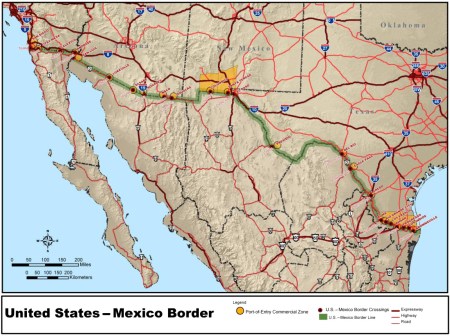
us-mexico-border

Breitbart news has received a collection of leaked documents from the Federal Bureau of Investigation that show a massive number of terrorist encounters, especially in border states.  The documents are not classified, though they are marked sensitive.  7,712 terrorist encounters occurred from July 20, 2015 and the same date a year later — last year, in short.

Some of the documents pertain to the entire U.S., while others focus specifically on the state of Arizona.  The states with the highest encounters are all border states. Texas, California, and Arizona–all states with a shared border with Mexico–rank high in encounters…. Most significantly, the map shows that many of the encounters occurred near the border outside of ports-of-entry, indicating that persons were attempting to sneak into the U.S.

Page Six shows a pie chart indicating that the majority of encounters in Arizona were with Islamic known or suspected terrorists, both Sunni and Shi’a.

That last is surprising, as one would expect drug cartels to make up the majority of such encounters.  The leak comes at a time when the FBI’s crime reporting shows an increase in violent crime across the country.

The Shiite terrorist organization Hezbollah has developed connections with the Latin American drug cartels because of its prominent role in heroin.  Iran’s Revolutionary Guards Corps (IRGC) controls the opium trade from the poppy fields in Afghanistan to the Levant, and they provide a great deal of opium to Hezbollah.  Hezbollah has a refining capacity in Lebanon that allows them to provide a substantial part of the world’s heroin.  They trade heroin to the Latin American drug cartels for other illegal money-making opportunities, forged documents, and access to the Americas.  Hezbollah’s operations produce between ten and twenty million dollars in revenue for its American operations, which are based out of a large Lebanese immigrant community in what is called the “Tri-border region,” an area between Paraguay, Brazil, and Argentina.

In addition to its money-making ventures, Hezbollah provides the cartels with military training.  As one of the world’s foremost guerrilla organizations, Hezbollah finds that its military trainers are sought after commodities.  They are able to parley those connections in order to perform operations in Mexico.  Their ability to infiltrate the United States, in order to conduct terrorist violence in service to Iran, is highlighted by these leaked FBI documents.

The role of Sunni groups is less fully understood, but it was a concern for the intelligence section of the United States military’s Southern Commandaccording to another set of leaks earlier this year.

Sunni extremists are infiltrating the United States with the help of alien smugglers in South America and are crossing U.S. borders with ease, according to a U.S. South Command intelligence report.  The Command’s J-2 intelligence directorate reported recently in internal channels that “special interest aliens” are working with a known alien smuggling network in Latin America to reach the United States….  Army Col. Lisa A. Garcia, a Southcom spokeswoman, did not address the intelligence report directly but said Sunni terrorist infiltration is a security concern.

“Networks that specialize in smuggling individuals from regions of terrorist concern, mainly from the Afghanistan-Pakistan region, the Middle East, and East Africa, are indeed a concern for Southcom and other interagency security partners who support our country’s national security,” Garcia told theWashington Free Beacon….  “In 2015, we saw a total of 331,000 migrants enter the southwestern border between the U.S. and Mexico, of that we estimate more than 30,000 of those were from countries of terrorist concern,” she said….

[T]he Southcom intelligence report revealed that the threat of Islamist terror infiltration is no longer theoretical. “This makes the case for Trump’s wall,” said one American security official of the Southcom report. “These guys are doing whatever they want to get in the country.”

Here at CounterJihad, we reported on Southern Command’s commander, Admiral Kurt Tidd, and his testimony before Congress on the threat.  Tidd reported that a number of terrorists were transiting the region who had gone to Syria and fought for the Islamic State (ISIS) and other radical groups.  Their ability to return to Latin America was smooth, given that they actually had legal travel documents.

Whether they can then pass into the United States is an open question.  The leaked FBI documents only talk about actual law enforcement encounters with people on terrorist lists.  How many are infiltrating without encountering law enforcement?

Hizballah units regroup on Israel’s Golan border

September 7, 2016

Hizballah units regroup on Israel’s Golan border, DEBKAfile, September 7, 2016

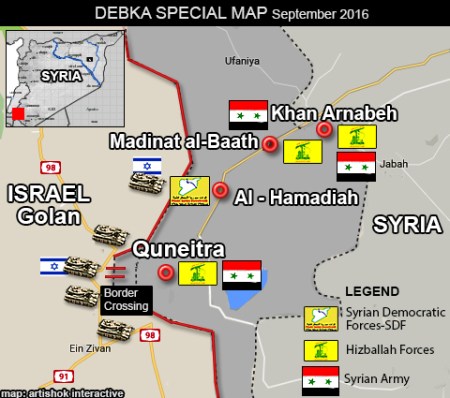
qunetrafront

DEBKAfile’s military sources note that the Iranian media attached photos of Israel’s security force opposite Quneitra to their reporting on the new move, thereby framing the target of the Syrian-Iranian-Backed Hizballah build-

***********************

A large Hizballah force, backed by the Syrian army and pro-Iranian Shiite militias, is building up outside Quneitra, just 2km from Israel’s Golan border. The Lebanese Shiite fighters, under the command of Iranian Revolutionary Guards (IRGC) officers, are streaming into southern Syria, armed with tanks and artillery.

Monday night, Sept. 5, Iranian state-controlled media shed light on this movement, reporting that the combined force had “completed preparations necessary for an extensive operation in southern Syria,” adding, “Hizballah aims to put an end to the presence of armed men in the area close to the border.”

The nature of the “armed men” was not specified, but the goal of the new operation was clear: after evicting the assorted anti-Assad groups, including the Islamic State, holding territory “close to the border,” Hizballah and its backers planned to regroup on the Syrian-Israeli boundary.

This would position Iran and its Hizballah surrogate ready to realize their six-year old design, which is to open a second warfront against Israel.

Western and Mid East sources have toldl DEBKAfile that the triple army is in high spirits after last week’s successful operation in Aleppo. By snatching back parts of the city they lost in mid-August, the Syrian army and its allies managed to cut off the rebels’ supply lines from Turkey.

It was then that some Hizballah units were detached from the Aleppo arena and redirected to the Quneitra front in southern Syria to face the Israeli border.

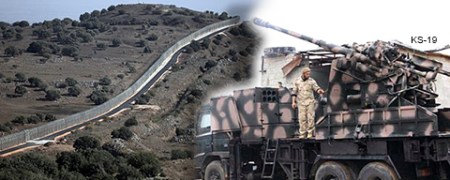
israeliborder480

Those sources report that the incoming troops were sighted this week when they arrived at Madinat al-Baath and Khan Amabeh, the main Syrian army bases on the Syrian Golan. They came with tanks and heavy artillery. Seen for the first time in the Quentra sector were heavy, self-propelled KS-19 artillery batteries, which are Russian anti-air guns adapted to ground warfare. They have a range of 21km and a firing capacity of 15 shells per minute.

The newly-arrived Hizballah force appears to have set the capture of Syrian rebel-held al-Hamdiniyah 2km from the Israeli border, as its first objective.

DEBKAfile’s military sources note that the Iranian media attached photos of Israel’s security force opposite Quneitra to their reporting on the new move, thereby framing the target of the Syrian-Iranian-Backed Hizballah build-up.

This fast-approaching development poses two tough questions:

1. Will Israel lie down for the avowedly hostile Hizballah and Iran to occupy territory along its eastern border?Israel officials have repeatedly emphasized that these forces would not be allowed to take up positions on the Golan border, a message Russia most certainly passed on to Damascus.

If Hizballah and its allies go through with their planned offensive, Israel will have to consider serious military action to prevent them from reaching the border fence, i.e., an operation on a scale quite different from the small-shot IDF reprisals for rockets or shells straying across into the Golan from fighting on the other side.

2. Will the advancing Iranian-led force have Syrian air cover? If it does, the Israeli Air Force will also be involved in aerial combat over the Golan.

Obama and Hillary Let Iran Take Israel and the Jews Hostage

August 21, 2016

Blue State Blues: Obama & Hillary Let Iran Take Israel and the Jews Hostage

by Joel B. Pollak

19 Aug 2016

Source: Obama and Hillary Let Iran Take Israel and the Jews Hostage

Breitbart News

The Obama administration was finally forced to admit this week that it had paid a $400 million cash ransom to the Iranian regime to secure the release of four Americans at the same time the nuclear deal went into effect.

President Barack Obama insisted earlier this month: “We do not pay ransom.” He added: “This wasn’t some nefarious deal.” (Thursday, admitting the cash secured the Americans’ release, the White House called it “leverage,” not ransom — a distinction without a difference.)

The payoff is problematic for several reasons. One is the fact that it creates new incentives for foreign regimes, and terrorists, to seize Americans. Another is that the Obama administration has threatened private citizens, such as the family of James Foley, lest they pay ransom to terrorists; as ever, the Obama administration is above the law.

Yet another reason is that the $400 million is part of a larger $1.7 billion settlement that the Iranian regime has already directed to its military, including potential terrorist operations, plus the ongoing war effort in Syria, where Iran has abetted that regime’s staggering atrocities.

But there are still hostages that remain — both direct and indirect. The direct hostages are those Americans that Iran has taken prisoner since the release in January.

And the indirect hostages are the State of Israel, which is in constant danger of attack by Iran or its terrorist proxies; as well as the Jewish people as a whole, whom Iran continues to target in word and in deed.

Israel’s vulnerability was laid bare this week when it was revealed that Russian warplanes are using a base in Iran to launch attacks inside Syria. In the past, Israel has tried to thwart the delivery of advanced Russian S-300 missiles to Iran as a “red line,” since the missiles would make any attack on Iran’s nuclear facilities, if necessary, more difficult. Instead of crossing that line, Russia has just walked around it. Putting Russian air assets inside Iran risks a wider conflict if Israel ever strikes.

That is a major strategic failure for Obama and the West. As my friend Ed Morrissey notes at HotAir:

For centuries, the West has employed a policy to deny Russia easy access to major shipping lanes in the Arabian Sea and the Indian Ocean by denying them access to a warm-water port. That is the reason that both Great Britain and later the US deemed Iran and Afghanistan strategically critical. Russian entry into these shipping lanes could create dangerous confrontations and will certainly require more vigorous oversight.

(Amidst all the talk about Donald Trump’s friendly posture towards Russia, it is important to remember just how weak and accommodating Obama and former Secretary of State Hillary Clinton have been.)

Obama’s strategic failure is Israel’s strategic disaster. Iran now enjoys a Russian military and diplomatic shield, meaning that it can continue to threaten Israel — and Europe, by the way — with ballistic missiles and a creeping nuclear research program.

Moreover, Iran can continue to threaten Jewish communities around the world.

In 2012, Iran — via Hezbollah — carried out a terror attack on an Israeli tourist bus in Bulgaria. In 2014, Alberto Nisman, the Argentine prosecutor investigating Iran’s role in a huge terror attack against a Jewish community center in Buenos Aires, was assassinated.

These events happened even as the Obama administration — including Hillary Clinton — were pursuing early negotiations with Iran over its nuclear program.

Israel and the Jews are in grave danger, thanks to Obama. And the person he has endorsed is no better.

Not even Clinton’s best defenders can name one thing she has done for Israel. She has embraced the antisemitic Black Lives Matter movement, which accuses Israel of “genocide.” And she not only supported the Iran deal, but also chose a running mate who boycotted Israeli Prime Minister Benjamin Netanyahu’s 2015 speech against it.

Can we take four more — eight more — years of being hostages?

Joel B. Pollak is Senior Editor-at-Large at Breitbart News. His new book, See No Evil: 19 Hard Truths the Left Can’t Handle, is available from Regnery through Amazon. Follow him on Twitter at @joelpollak.

Putin-Erdogan deal deadlocks Aleppo, Manjib frays

August 13, 2016

Putin-Erdogan deal deadlocks Aleppo, Manjib frays. DEBKAfile, August 13, 2016

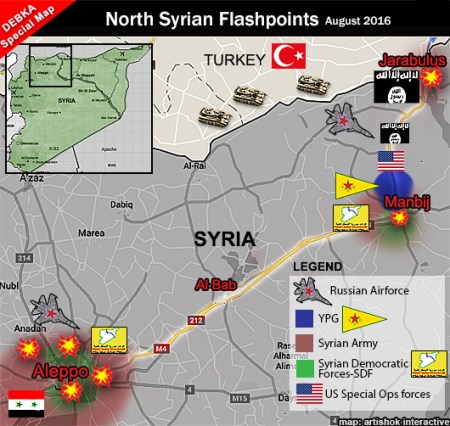
n syria flashpoints

This hopeless standoff is the result of Moscow’s refusal to provide the Syrian army and its allies with enough air support to pull ahead, in the wake of President Vladimir Putin talks with Turkish President Reccep Tayyip Erdogan in St. Petersburg Tuesday, Aug. 9.

*********************

All day Friday and Saturday, Aug.11-12, fighters of Hizballah’s elite Radwan Force – 3,000 in all – streamed to the pivotal Aleppo battlefield from all parts of Lebanon and Syria. DEBKAfile’s military and intelligence sources disclose that they were following the orders of their leader Hassan Nasrallah, who was warned by Tehran that the pro-Assad army fighting for Syria’s second city was flagging in the face of rebel assaults.

The Radwan Force was called in as the only military capable of saving the day for Assad and his allies. This step had been carefully avoided by Nasrallah was required in view of the heavy losses his organization had already suffered for backing the Syrian army – some 1,500 dead in three years – and intense fallout at home.

He has now been forced to sacrifice his last remaining military asset to fight in one of the bloodiest battles ever fought in recent times in the Middle East, even though it promises a swelling procession of Hizballah coffins returning to Lebanon.

According to our military sources, the battle to wrest Aleppo from rebel control, now in its second month, has claimed some 2,000 war dead and 4,000 injured on both sides – not counting the masses of civilians.

Some units have lost more than a quarter of their combatants and dropped out.

Nasrallah knows exactly what is happening in this critical arena. He also understands that a unit which loses 30 percent of its combatants is deemed in military terms unfit to continue fighting and that the battle for Aleppo will be drawn out and bloody. Yet he is willing to commit his entire deck of military resources to keep Bashar Assad’s fighting in Aleppo.

There is no hope of an early resolution in Aleppo, because stalemate between the combatants is exceptionally complicated and thankless. Whenever one side captures terrain, it quickly discovers it was drawn into a trap and under siege.

This hopeless standoff is the result of Moscow’s refusal to provide the Syrian army and its allies with enough air support to pull ahead, in the wake of President Vladimir Putin talks with Turkish President Reccep Tayyip Erdogan in St. Petersburg Tuesday, Aug. 9.

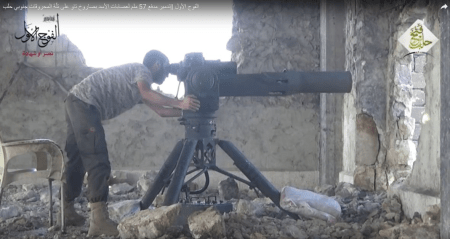
Aleppo_Rebels_ATGM-firings

Erdogan explained that if Assad’s army, along with Hizballah and Iran, defeated the Turkish-backed rebel forces holding Aleppo, he would suffer a serious knock to his prestige and setback for Syrian policy. This was more than he could sustain in the troubled atmosphere in Turkey in the wake of the failed coup against him.

He therefore asked the Russian president to abandon his Bashar Assad, Iran and Hizballah to their fate in Aleppo.

Erdogan was backed up in his request to Putin by a large Turkish military and intelligence delegation which arrived in St. Petersburg the next day to work with their Russian counterparts on setting up a joint military control center in Turkey.

DEBKAfile’s sources disclose the first two tasks assigned the new war room:

1. Russian aerial bombardments over Aleppo would not go beyond keeping the rebels from defeating Syrian and allied forces in Aleppo, but would refrain from supporting offensive action by the latter for routing the former.

2. Turkish air and ground forces would remain in a state of preparedness to ensure that rebel Syrian Democratic Forces (SDF) and the Kurdish YPG militia never moved out of the town of Manjib, from most parts of which they ousted ISIS, to the town of Jarabulus on the Turkish border.I

ISIS had used Manjib as its primary way station for supplies from Turkey 30km to the north. (See attached map). But to drive the jihadists completely out of the Syrian-Turkish border region, the combined rebel forcesmust advance on Jarabulus and expel ISIS from there too.

However, Turkish officers in the joint command center with Russia made it clear that any Kurdish forces allowed to reach that border would come under Turkish army attack.

The Russian president complied with Erdogan’s wishes on the Manjib-Jarabulus front as well as Alepp

Officials In Lebanese, Gazan Terror Organizations Confirm: Iran Funds Our Activity

August 11, 2016

Officials In Lebanese, Gazan Terror Organizations Confirm: Iran Funds Our Activity, MEMRI, August 11, 2016

Arab media have recently published statements by officials in the Lebanese Hizbullah and the Gazan Hamas and Islamic Jihad organizations, and by their supporters, confirming what has long been known – namely that these Lebanese and Gazan terror organizations receive substantial financial and military assistance from Iran. These statements join many reports, especially in the anti-Iranian media, regarding Iran’s funding of various terrorist organizations across the Arab world. According to these reports, the assistance comes mainly from the office of Iranian Supreme Leader Ali Khamenei and from the Islamic Revolutionary Guards Corps (IRGC).

The following are some examples of these statements and reports from the last two months:

Hizbullah Secretary-General Nasrallah: Hizbullah’s Entire Budget Is Provided By Iran

In a speech he delivered on June 24, 2016, marking 40 days after the killing of Mustafa Badr Al-Din, who was considered to be Hizbullah’s chief operations officer, and following the imposition of U.S. sanctions on Hizbullah that threaten its financial infrastructure and income, Hizbullah Secretary-General Hassan Nasrallah clarified: “Hizbullah’s budget – its salaries and expenditures, [the money that pays for] its food and drink, weapons and missiles – [all come from] Iran. Is that clear?… As long as Iran has money we have money. Do you require greater transparency than that[?] The funds earmarked for us do not reach us through the banks. We receive them the same way we receive our missiles, with which we threaten Israel.”[1]

Hamas Official Abu Marzouq: Iran’s Assistance To Hamas Is “Not Comparable” To Any Other Assistance

The deputy head of Hamas’s political bureau, Moussa Abu Marzouq, tweeted on June 15, 2016: “The aid extended by Iran to the Palestinian resistance, in provisions, training and funds, is not comparable [to any other aid], and most other countries cannot match it.”[2]

29502Abu Marzouq’s tweet

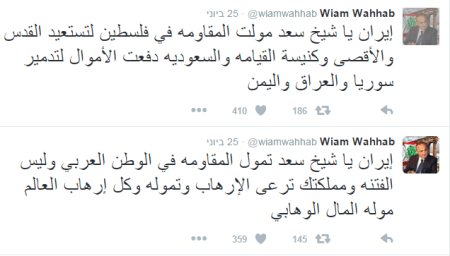
Former Lebanese Minister Wiam Wahhab: Iran Has Funded Resistance In Palestine

On June 25, 2016, in response to a remark by former Lebanese prime minister Sa’d Al-Hariri that Iran funds fitna(internecine strife) in the Arab world,[3] former Lebanese minister Wiam Wahhab, a known supporter of Hizbullah and the resistance axis, tweeted: “O Sheikh Sa’d [Al-Hariri], Iran has funded resistance in Palestine to restore Jerusalem, Al-Aqsa and the Church of the Sepulcher [to Palestinian hands, whereas] Saudi Arabia paid to destroy Syria, Iraq and Yemen.” In another tweet he wrote: ” O Sheikh Sa’d, Iran funded resistance in the Arab homeland rather than fitna, [whereas] your kingdom [Saudi Arabia, who supports Al-Hariri and his faction in Lebanon,] sponsors and funds terrorism. The funds of all the terrorist [organizations] in the world are Wahhabi [i.e., Saudi] funds.”[4]

29503Wiam Wahhab’s tweets

Saudi Daily Al-Sharq Al-Awsat: Hizbullah’s Weapons Come Directly From IRGC; Iran Has Renewed Regular Aid To Islamic Jihad Organization

The anti-Iranian press, such as the London-based Saudi daily Al-Sharq Al-Awsat, also reported on Iran’s funding of terrorist organizations in Lebanon and Gaza. On June 29, 2016, Al-Sharq Al-Awsat confirmed Nasrallah’s statements regarding the Iranian funding. The report stated that Hizbullah’s funds came from the office of Iranian Supreme Leader Ali Khamenei while its weapons are provided by the IRGC. It quoted the director of the Umam Research and Documentation center in Lebanon, Luqman Salim, a Shi’ite known for his opposition to Hizbullah, as saying that between 70% and 80% of Hizbullah’s funds come from Iran. According to Salim, Iran also invests about $400 million of the IRGC’s budget in the Islamic Radio and Television Union, a group of stations which includes the Iranian Al-Alam but also Hizbullah’s Al-Manar and Al-Mayadin and the Hamas-affiliated Al-Quds (all of which broadcast from Lebanon) and Hamas’s Al-Aqsa station, which broadcasts from Gaza.

The daily also cited a “knowledgeable source” as saying that until 2005 Iran transferred to Hizbullah between $200 million and $250 million annually, but since then the allocation has increased: After the 2006 Lebanon War it rose to $850 million, and since Hizbullah entered the Syria war its budget has become unlimited, because it has become part of Tehran’s war effort there.[5]

On May 25, 2016, the daily reported, citing sources close to the Islamic Jihad organization in Gaza, that Iran had renewed its regular financial aid to the organization after the two sides agreed to renew their mutual relations.[6] According to these sources, an Islamic Jihad delegation headed by the organization’s secretary-general Ramadan Shalah visited Iran in April 2016, and during this visit Tehran renewed its sponsorship of the organization after the latter accepted its terms. In meetings held by the delegation during this visit, including with IRGC commander Mohammad Ali Jafari and Qods Force commander Qassem Soleimani, Iran clarified its vision of Islamic Jihad’s course in the coming years. The sources claimed further that Soleimani decided, in coordination with the organization’s military and political bureaus, to grant $70 million a year out of the IRGC budget to Islamic Jihad’s military wing, Saraya Al-Quds, and to reorganize this body and appoint Khaled Mansour, who is close to Tehran, as its commander.[7]

Endnotes:

[1] Alahednews.com.lb, June 24, 2016.

[2] Twitter.com/mosa_abumarzook, June 15, 2016.

[3] Al-Mustaqbal (Lebanon), June 26, 2016; Al-Hariri’s remark was a response to Nasrallah’s  statement one day earlier that Hizbullah’s entire budget comes from Iran.

[4] Twitter.com/wiamwahhab, June 25, 2016.

[5] Al-Sharq Al-Awsat (Lebanon), June 29, 2016.

[6] Reports in the Arab media in the passing year indicated that Iran had suspended its assistance to Islamic Jihad following disagreements between them on the crisis in Yemen. According to these reports, the Islamic Jihad refused Iran’s demand to declare its opposition to the Arab Coalition’s activities in Yemen. See for example Aljazeera.net, May 26, 2016, Janoubia.com, April 3, 2016.

[7] Al-Sharq Al-Awsat (London), May 25, 2016.

Aleppo battle seesaws: pro-Assad siege in place

August 8, 2016

Aleppo battle seesaws: pro-Assad siege in place, DEBKAfile, August 8, 2016

(Please see also, Jihadists and other rebels claim to have broken through siege of Aleppo. — DM)

Aleppo_A_6.8._2016

The battle for Aleppo was locked in a draw Monday, Aug. 8 – contrary to the claims of Syrian rebel forces to have broken through the weeks-long government siege on the city and seized key positions from Assad’s army and its allies, Hizballah and pro-Iranian Shiite militias.

DEBKAfile’s military sources report that the rebels had not yet secured control of the roads linking western and eastern Aleppo. Neither was there any sign of the heavy Russian air strikes claimed by the rebels Sunday afternoon to have been launched in an effort to halt their advance.

According to our sources, intensive air strikes are indeed being conducted in the Aleppo theater – but only by the Syrian air force. There is no Russian presence in the skies over city. Their air force is active in the last few days in only one arena, Idlib in northern Syria. Its absence accounts for the Syrian rebel militias’ partial gains in the battle for Aleppo, and the Pro-Assad forces’ difficulties in holding them back.

Had the Russians provided solid air support for the Syrian army and its allies, our military analysts assert that the rebels would have been pushed back.

It is being withheld, according to our intelligence sources, because Moscow wishes to keep the door ajar for dialogue to continue with the Obama administration. The Russians are interested in particular in setting up with the Americans a joint military and intelligence coordination mechanism in Syria for fighting Islamist forces.

the division of tasks is conceived in Moscow, the Americans would provide intelligence for the Russian air force to undertake the bombardment of targets to be marked by US intelligence.

An agreement in principle on this deal would necessitate direct communication lines to operate between their two active war rooms for Syria: the US-Jordanian and Russian-Jordanian joint command centers operating in Amman.

Kremlin fears that Russian aerial intervention in the Aleppo fighting would put paid to the talks with Washington on this broad collaboration.

So long as those talks are underway,, neither the Russians nor the Americans are likely to step in to determine the military situation in the battle for Aleppo – which was once Syria’s commercial center. The fighting will  continue to seesaw inconclusively between the warning sides.