Posted tagged ‘Hezbollah’

Kerry: Iranian Access to Billions Won’t Affect World Terror

July 16, 2015

Kerry: Iranian Access to Billions Won’t Affect World Terror, Clarion Project, July 16, 2015

Iran-Kerry-Zarif-IPU.S. Secretary of State John Kerry (L) speaks to Iranian Foreign Minister Mohammad Javad Zarif (R) while (Photo: © Reuters) before the announcement of the nuclear deal in Vienna. Hossein Fereydoun (C), the brother of Iranian President Hassan Rouhani listens.

In its most recent report, the State Department wrote, “Iran has provided hundreds of millions of dollars in support of Lebanese Hezbollah in Lebanon and has trained thousands of its fighters at camps in Iran.”

In 2010 alone, State reported “Iran provides roughly $100-$200 million per year in funding to support Hezbollah.”

*********************

U.S. Secretary of State John Kerry dismissed concerns that Iran will use its newly found billions of dollars in sanctions relief to ramp up its support for international terrorism.

Speaking to the BBC after the nuclear agreement between Iran and six world powers was reached, Kerry said that the more than $100 billion that Iran is set to receive “is going to make all the difference in the world is just – it’s not true.”

Acknowledging Iran is an international player in wreaking terror across the globe, Kerry said, “What Iran has done for years with Hezbollah does not depend on money.” He similarly stated Iran’s support of the Houthi rebels against the government in Yemen has not “depended on money.”

“Sure, something may go additionally somewhere,” Kerry added. “But if President [Hasan] Rouhani and his administration do not [use the money to] take care of the people of Iran, they will have an enormous problem.”

Earlier this year, White House Press Secretary Josh Earnest admitted the U.S. would have no control over Iran’s use of monies freed by sanctions relief. However, he said it was “common sense” Iran would use the money to pump up its economy that was devastated by the international sanctions and not put the money into terrorism.

Still, Earnest said, “I’m not going to make any predictions about what they are going to do, and I’m certainly not going to be in a position to prescribe what they should do,” he said. “This is a sovereign country that will make their own decisions.”

Kerry contended it was the opinion of the U.S. intelligence community that Iranian money “that finds its way somewhere, is not the difference in what is happening in the Middle East.”

However, many contend that Kerry’s prognosis is not rooted in fact. Up until the 9/11 attack on the U.S. by Al Qaeda, the State Department reported Hezbollah was “responsible for more American deaths than any other terrorist group.”

In its most recent report, the State Department wrote, “Iran has provided hundreds of millions of dollars in support of Lebanese Hezbollah in Lebanon and has trained thousands of its fighters at camps in Iran.”

In 2010 alone, State reported “Iran provides roughly $100-$200 million per year in funding to support Hezbollah.”

Efforts by Republicans in Congress to make the current deal contingent on Iran removing its support for terrorism failed earlier this year when U.S. President Barack Obama said he would veto any such legislation.

Meanwhile, Prince Bandar bin Sultan, the former head of the Saudi Arabian intelligence services and the kingdom’s ambassador to the U.S. in Washington, said the current deal will result in Iran acquiring a nuclear weapon and “wreak havoc in the region.”

He also contended America’s traditional allies in the Arab world are now distrustful of the U.S. and looking elsewhere to make alliances. Writing in The Daily Star, a Lebanese newspaper, bin Sultan commented, “People in my region now are relying on God’s will and consolidating their local capabilities and analysis with everybody else except our oldest and most powerful ally.”

Currently, Hezbollah is backing troops loyal to beleaguered Syrian President Bashar Al-Assad who have been trying to recapture the city of Zabadani, located in a hilly region in southwestern Syria.

Israeli deterrence in the eye of the hurricane

July 12, 2015

Israeli deterrence in the eye of the hurricane, Jerusalem PostLouis Rene Beres, July 12, 2015

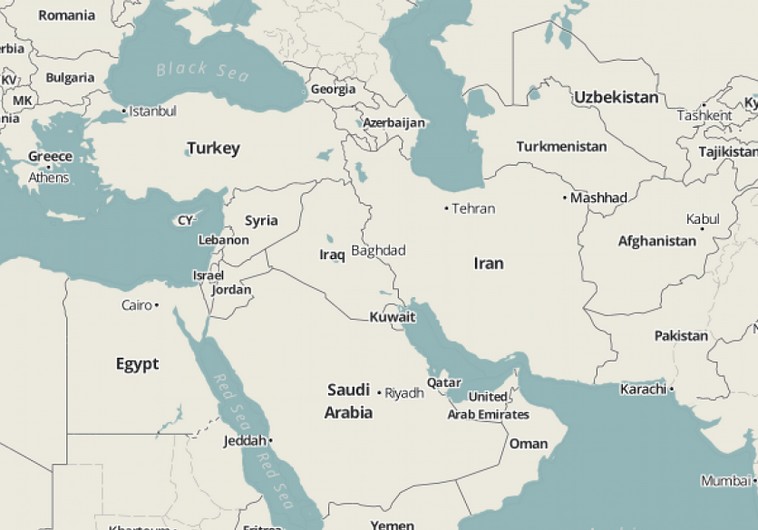
ShowImage (1)Map of Middle East. (photo credit:Courtesy)

Everything is very simple in war, but the simplest thing is difficult.”
– Carl von Clausewitz, On War

To prevent a nuclear war amid steadily growing regional chaos, especially as Iran will soon be fully nuclear (and the grateful beneficiary of US President Barack Obama’s pretend P5+1 diplomacy), Israel will need suitably complementary conventional and nuclear deterrents.

**********************

Left to themselves, especially as more “normal” hostilities dissolve into a full-blown regional chaos, Israel’s adversaries could drive the Jewish state toward an unconventional war. This fateful endangerment could be produced singly or collaboratively, by deliberate enemy intent or by the “collateral damage” of sectarian strife. Militarily, these Islamic adversaries of Israel, both Sunni and Shi’ite, could be either non-nuclear, or, in the future, nuclear.

They might also include certain wellarmed sub-state or terrorist forces. Already, Iranian-backed Hezbollah may have more usable missiles than all NATO countries combined.

To most effectively deal with such interpenetrating threats – including reasonably expected “synergies” and “force multipliers” – Israel’s leaders will first need to consider some largely-opaque factors. These include: 1) probable effects of regional chaos upon enemy rationality; 2) disruptive implications of impending Palestinian statehood; and 3) re-emergence of a corrosively Cold War-style polarity between Russia and the United States. Apropos of a “Cold War II,” there is already evidence of growing contact between Russia and Saudi Arabia, the world’s two largest oil producers.

In essence, Jerusalem must take all necessary steps to successfully manage an expectedly unprecedented level of adversarial complexity and weaponization. Israel’s leaders, in this connection, must take proper measures to ensure that any conceivable failures of its national deterrent would not spark biological or nuclear forms of regional conflict. To accomplish this indispensable goal, the IDF, inter alia, must continue to plan carefully around the core understanding that nuclear deterrence and conventional deterrence are inherently interrelated and meaningfully “seamless.”

Sometimes, in strategic matters, seeing requires distance. A nuclear war in the Middle East is not beyond possibility. This is a sensible assessment even if Israel were to remain the only nuclear weapons state in the region.

How is this possible? A bellum atomicum could come to Israel not only as a “bolt from the blue” enemy nuclear attack (either by a state or by a terrorist group), but also as the result, intended or otherwise, of certain uncontrolled military escalations.

Needed prudence in such narratives calls for additional specificity and precision. If particular Arab/Islamic enemy states were to launch conventional attacks upon Israel, Jerusalem could then respond, sooner or later, with calculated and more-or-less calibrated nuclear reprisals. Alternatively, if some of these enemy states were to launch large-scale conventional attacks, Jerusalem’s own still-conventional reprisals could then be met, perhaps even in the not-too-distant future, with enemy nuclear counterstrikes.

How should Israel prepare for such perilous contingencies? More than likely, Israel has already rejected any doctrinal plans for fielding a tactical/theater nuclear force, and for assuming any corollary nuclear war fighting postures. It would follow further from any such well-reasoned rejection that Israel should do whatever is needed to maintain a credible conventional deterrent.

By definition, such a measured threat option could then function reliably across the entire foreseeable spectrum of non-nuclear threats.

Still, any such strategy would need to include an appropriately complementary nuclear deterrent, a distinctly “last resort” option that could display a “counter-value” (counter-city) mission function. Si vis pacem, para bellum atomicum: “If you want peace, prepare for atomic war.”

A persuasive Israeli conventional deterrent, at least to the extent that it might prevent a wide range of enemy conventional attacks in the first place, could reduce Israel’s growing risk of escalatory exposure to nuclear war. In the always arcane lexicon of nuclear strategy, a complex language that more-or-less intentionally mirrors the tangled coordinates of atomic war, Israel will need to maintain firm control of “escalation dominance.” Otherwise, the Jewish state could find itself engaged in an elaborate but ultimately lethal pantomime of international bluster and bravado.

The reason for Israel’s obligation to control escalatory processes is conspicuous and unassailable. It is that Jerusalem’s main enemies possess something that Israel can plainly never have: Mass.

At some point, as nineteenth century Prussian military thinker Carl von Clausewitz asserts in On War: “Mass counts.”

Today, this is true even though Israel’s many enemies are in chaotic disarray. Now, amid what Clausewitz had famously called “friction” and the “fog of war,” it could become harder for Israel to determine real and pertinent differences between its allies, and its adversaries.

As an example, Jordan could soon become vulnerable to advancing IS forces.

Acknowledging this new vulnerability, an ironic question will come immediately to mind: Should Israel support the Jordanian monarchy in such a fight? And if so, in what specific and safe operational forms? Similarly ironic questions may need to be raised about Egypt, where the return to military dictatorship in the midst of surrounding Islamist chaos could eventually prove both fragile and transient.

Should President Abdel Fattah Sisi fail to hold things together, the ultimate victors could be not only the country’s own Muslim Brotherhood, but also, in nearby Gaza, Palestinian Hamas. Seemingly, however, Hamas is already being targeted by Islamic State, a potentially remorseless opposition suggesting, inter alia, that the principal impediment to Palestinian statehood is not really Israel, but another Sunni Arab terrorist organization. Of course, it is not entirely out of the question that IS’s Egyptian offshoot, the so-called “Sinai Province of Islamic State,” could sometime decide to cooperate with Hamas – the Islamic Resistance Movement – rather than plan to it.

To further underscore the area’s multiple and cross-cutting axes of conflict, it is now altogether possible that if an IS conquest of Sinai should spread to Gaza, President Sisi might then “invite” the IDF to strike on Egypt’s behalf. Among other concerns, Egypt plainly fears that any prolonged inter-terrorist campaign inside Gaza could lead to a literal breaking down of border fences, and an uncontrolled mass flight of Palestinians into neighboring Sinai.

Credo quia absurdum. “I believe because it is absurd.” With such peculiar facts in mind, why should Israel now sustain a conventional deterrent at all? Wouldn’t enemy states, at least those that were consistently rational, steadfastly resist launching any conventional attacks upon Israel, for fear of inciting a nuclear reprisal? Here is a plausible answer: suspecting that Israel would cross the nuclear threshold only in extraordinary circumstances, these national foes could be convinced, rightly or wrongly, that as long as their initial attacks were to remain conventional, Israel’s response would remain reciprocally non-nuclear. By simple extrapolation, this means that the only genuinely effective way for Israel to continually deter large-scale conventional war could be by maintaining visibly capable and secure conventional options.

As for Israel’s principal non-state adversaries, including Shi’ite Hezbollah and Sunni IS, their own belligerent calculations would be detached from any assessments of Israeli nuclear capacity and intent. After all, whatever attacks they might sometime decide to consider launching against the Jewish state, there could never be any decipherable nuclear response.

Nonetheless, these non-state jihadist foes are now arguably more threatening to Israel than most enemy national armies, including the regular armed forces of Israel’s most traditional enemies – Egypt, Jordan and Syria.

Some other noteworthy nuances now warrant mention. Any still-rational Arab/ Islamic enemy states considering firststrike attacks against Israel using chemical and/or biological weapons would likely take Israel’s nuclear deterrent more seriously. But a strong conventional capability would still be needed by Israel to deter or to preempt certain less destructive conventional attacks, strikes that could escalate quickly and unpredictably to assorted forms of unconventional war.

If Arab/Islamic enemy states did not perceive any Israeli sense of expanding conventional force weakness, these belligerent countries, now animated by credible expectations of an Israeli unwillingness to escalate to nonconventional weapons, could be more encouraged to attack. The net result here could be: 1) defeat of Israel in a conventional war; 2) defeat of Israel in an unconventional (chemical/biological/ nuclear) war; 3) defeat of Israel in a combined conventional/unconventional war; or 4) defeat of Arab/Islamic enemy states by Israel in an unconventional war.

For Israel, even the presumptively “successful” fourth possibility could prove too costly.

Perceptions are vitally important in all calculations of nuclear deterrence. By continuing to keep every element of its nuclear armaments and doctrine “opaque,” Israel could unwittingly contribute to the injurious impression among its regional enemies that Jerusalem’s nuclear weapons were unusable. Unconvinced of Israel’s willingness to actually employ its nuclear weapons, these enemies could then decide to accept the cost-effectiveness of striking first.

With any such acceptance, Israeli nuclear deterrence will have failed.

If enemy states should turn out to be correct in their calculations, Israel could find itself overrun, and thereby rendered subject to potentially existential harms.

If they had been incorrect, many states in the region, including even Israel, could eventually suffer the assorted consequences of multiple nuclear weapons detonations. Within the directly affected areas, thermal radiation, nuclear radiation and blast damage would then spawn uniquely high levels of death and devastation.

To prevent a nuclear war amid steadily growing regional chaos, especially as Iran will soon be fully nuclear (and the grateful beneficiary of US President Barack Obama’s pretend P5+1 diplomacy), Israel will need suitably complementary conventional and nuclear deterrents. Even now, at the eleventh hour, it will also require a set of residual but still-available preemption options. Under authoritative international law, actually exercising any such last-resort options would not necessarily represent lawlessness or “aggression.”

On the contrary, such strikes could readily meet the long-established and recognizable jurisprudential standards for “anticipatory self-defense.”

Going forward, Israeli nuclear deterrence – reinforced, of course, by ballistic missile defense – must become an increasingly central part of the Jewish state’s overall survival plan. Fulfilling this requirement should in no way suggest any corresponding violations of international law. After all, every state in world politics has an overriding obligation to survive.

International law is not a suicide pact.

The Iran Delusion: A Primer for the Perplexed

July 8, 2015

The Iran Delusion: A Primer for the Perplexed, World AffairsMichael J. Totten, Summer 2015

Totten_Iran

US foreign policy in the Middle East is focused on two things right now: containing ISIS and preventing Iran from acquiring nuclear weapons. These are both worthy goals, but if sanctions are lifted on Iran as part of a nuclear deal, whether or not it gets the bomb, Tehran will certainly have more money and resources to funnel to Hezbollah, the Assad regime, Iraq’s Shia militias, the Houthis in Yemen, and—perhaps—to Saudi Arabia’s disaffected Shia minority. The region will become even less stable than it already is. ISIS and al-Qaeda will likely grow stronger than they already are.

**************************

The chattering class has spent months bickering about whether or not the United States should sign on to a nuclear deal with Iran, and everyone from the French and the Israelis to the Saudis has weighed in with “no” votes. Hardly anyone aside from the Saudis, however, seems to recognize that the Iranian government’s ultimate goal is regional hegemony and that its nuclear weapons program is simply a means to that end.

What do these shatter zones have in common? The Iranian government backs militias and terrorist armies in all of them. As Kaplan writes, “The instability Iran will cause will not come from its implosion, but from a strong, internally coherent nation that explodes outward from a natural geographic platform to shatter the region around it.”

That’s why Iran is a problem for American foreign policy makers in the first place; and that’s why trading sanctions relief for an international weapons inspection regime will have no effect on any of it whatsoever.

Iran has been a regional power since the time of the Persian Empire, and its Islamic leaders have played an entirely pernicious role in the Middle East since they seized power from Mohammad Shah Reza Pahlavi in 1979, stormed the US Embassy in Tehran, and held 66 American diplomats hostage for 444 days.

In 1982, they went international. When the Israelis invaded Lebanon to dislodge Yasir Arafat’s Palestine Liberation Army, Iranian Revolutionary Guard Corps commanders forged a network of terrorist and guerrilla cells among their coreligionists in Lebanon’s Shia population.

Hezbollah, the poisoned fruit of these efforts, initially had no name. It was a hidden force that struck from the shadows. It left a hell of a mark, though, for an organization of anonymous nobodies when it blew up the American Embassy in Beirut and hit French and American peacekeeping troops—who were there at the invitation of the Lebanese government—with suicide truck bombers in 1983 that killed 368 people.

When Hezbollah’s leaders finally sent out a birth announcement in their 1985 Open Letter, they weren’t the least bit shy about telling the world who they worked for. “We are,” they wrote, “the Party of God (Hizb Allah), the vanguard of which was made victorious by God in Iran . . . We obey the orders of one leader, wise and just, that of our tutor and faqih [jurist] who fulfills all the necessary conditions: Ruhollah Musawi Khomeini. God save him!”

The Israelis fought a grinding counterinsurgency against Hezbollah for 18 years in southern Lebanon before withdrawing in 2000, and they fought a devastating war in 2006 along the border that killed thousands and produced more than a million refugees in both countries. Hezbollah was better armed and equipped than the Lebanese government even then, but today its missiles can reach Tel Aviv, Jerusalem, and even the Dimona nuclear power plant all the way down in the southern part of the country. 

Until September 11, 2001, no terrorist organization in the world had killed more Americans than Hezbollah. Hamas in Gaza isn’t even qualified as a batboy in the league Hezbollah plays in.

Hezbollah is more than just an anti-Western and anti-Jewish terrorist organization. It is also a ruthless sectarian Shia militia that imposes its will at gunpoint on Lebanon’s Sunnis, Christians, and Druze. It has toppled elected governments, invaded and occupied parts of Beirut, and, according to a United Nations indictment, assassinated former Lebanese Prime Minister Rafik Hariri.

Hezbollah is, for all intents and purposes, the foreign legion of Iran’s Revolutionary Guard Corps. The parts of the country it occupies—the northern Bekaa Valley, the Israeli border region, and the suburbs south of Beirut—constitute a de facto Iranian-controlled state-within-a-state inside Lebanon. 

After the United States demolished Saddam Hussein’s Sunni-dominated regime in 2003, Iran’s rulers duplicated their Lebanon strategy in Iraq by sponsoring a smorgasbord of sectarian Shia militias and death squads that waged war against the Iraqi government, the American military, Sunni civilians, and politically moderate Shias. 

Unlike Lebanon—which is more or less evenly divided between Christians, Sunnis, and Shias—Iraq has an outright Shia majority that feels a gravitational pull toward their fellow Shias in Iran and a revulsion for the Sunni minority that backed Hussein’s brutal totalitarianism and today tolerates the even more deranged occupation by the Islamic State, also known as ISIS. 

The central government, then, is firmly aligned with Tehran. Iran’s clients don’t run a Hezbollah-style state-within-a-state in Iraq. They don’t have to. Now that Hussein is out of the way, Iraq’s Shias can dominate Baghdad with the weight of sheer demographics alone. But Iran isn’t content with merely having strong diplomatic relations with its neighbor. It still sponsors sectarian Shia militias in the center and south of the country that outperform the American-trained national army. They may one day even supplant Iraq’s national army as the Iranian Revolutionary Guard Corps has more or less supplanted the Iranian national army. Iraq’s Shia militias are already the most powerful armed force outside the Kurdish autonomous region and ISIS-held territory.

When ISIS took complete control of the city of Ramadi, the capital of Anbar Province, in May of 2015, the Iraqi soldiers tasked with protecting it dropped their weapons and ran as they had earlier in Mosul, Tikrit, and Fallujah. So Iraq’s central government tasked its Iranian-backed Shia militias with taking it back. 

On the one hand, we can hardly fault Baghdad for sending in whatever competent fighting force is available when it needs to liberate a city from a psychopathic terrorist army, but the only reason ISIS gained a foothold among Iraq’s Sunnis in the first place is because the Baghdad government spent years acting like the sectarian dictatorship that it is, by treating the Sunni minority like second-class citizens, and by trumping up bogus charges against Sunni officials in the capital. When ISIS promised to protect Iraq’s Sunnis from the Iranian-backed Shia rulers in Baghdad, the narrative seemed almost plausible. So ISIS, after being vomited out of Anbar Province in 2007, was allowed to come back.

Most of Iraq’s Sunnis fear and loathe ISIS. They previously fought ISIS under its former name, al-Qaeda in Iraq. But they fear and loathe the central government and its Shiite militias even more. They’d rather be oppressed by “their own” than by “the other” if they had to choose. But they have to choose because Iran has made Iraq its second national project after Lebanon.

It doesn’t have to be this way. At least some of the tribal Sunni militias would gladly fight ISIS as they did in the past with American backing. If they did, residents of Ramadi, Fallujah, and Mosul would view them as liberators and protectors rather than potential oppressors, but Tehran and Baghdad will have none of it.

“All attempts to send arms and ammunition must be through the central government,” Adnan al-Assadi, a member of Parliament, told CNN back in May. “That is why we refused the American proposal to arm the tribes in Anbar. We want to make sure that the weapons would not end up in the wrong hands, especially ISIS.”

That may appear reasonable on the surface, but ISIS can seize weapons from Shia militias just as easily as it can seize weapons from Sunni militias. The real reason for the government’s reluctance ought to be obvious: Iraq’s Shias do not want to arm Iraq’s Sunnis. They’d rather have ISIS controlling huge swaths of the country than a genuinely popular Sunni movement with staying power that’s implacably hostile to the Iranian-backed project in Mesopotamia.

The catastrophe in Iraq is bad enough, but the Iranian handiwork in Syria is looking even more apocalyptic nowadays. ISIS wouldn’t even exist, of course, if it weren’t for the predatory regime of Bashar al-Assad, and the close alliance that has existed between Damascus and Tehran since the 1979 revolution that brought the ayatollahs to power.

Syria’s government is dominated by the Alawites, who make up just 15 percent of the population. Their religion is a heterodox blend of Christianity, Gnosticism, and Shia Islam. They aren’t Shias. They aren’t even Muslims. Their Arab Socialist Baath Party is and has always been as secular as the Communist Party was in the Soviet Union (and it was in fact a client of the Soviet Union). A marriage between an aggressively secular Alawite regime and Iran’s clerical Islamic Republic was hardly inevitable, but it’s certainly logical. The two nations had a common enemy wedged between them in Saddam Hussein’s Iraq, and both have been threatened by the region’s Sunni Arab majority since their inception. 

Hezbollah is their first child, and the three of them together make up the core of what analyst Lee Smith calls the Resistance Bloc in his book, The Strong Horse. The Party of God, as it calls itself, wouldn’t exist without Iranian money and weapons, nor would it exist without Damascus as the logistics hub that connects them. And it would have expired decades ago if Syria hadn’t conquered and effectively annexed Lebanon at the end of the Lebanese civil war in 1990.

Every armed faction in Lebanon, including Hezbollah, signed on to the Syrian-brokered Taif Agreement, which required the disarmament of every militia in the country. But the Assads governed Lebanon with the same crooked and cynical dishonesty they perfected at home, and as the occupying power they not only allowed Hezbollah to hold onto its arsenal, but also allowed Hezbollah to import rockets and even missiles from Iran.

“For Syria,” historian William Harris wrote in The New Face of Lebanon, “Hezbollah could persist as both a check on the Lebanese regime and as a means to bother Israel when convenient.”

The Party of God is now a powerful force unto itself, but it rightly views the potential downfall of the Assad regime as the beginning of its own end. The fact that Assad might be replaced by the anti-Shia genocidaires of ISIS compelled its fighters to invade Syria without an exit strategy—with the help of Iranian commanders, of course—to either prop up their co-patron or die.

Rather than going all-in, the Iranians could have cut their losses in Syria and pressured Assad into leaving the country. ISIS would be hiding under rocks right now had that happened. Hardly any Sunnis in Syria would tolerate such a deranged revolution if they had no one to revolt against. But the Resistance Bloc will only back down if it’s forced to back down. If ISIS devours Syria and Iraq as a result, then so be it.

And while the Resistance Bloc is fighting for its survival in the Levant, it’s expanding into the Arabian Peninsula.

The Shia-dominated Houthi movement took control of Yemen’s capital, Sanaa, earlier this year following the revolution that toppled former President Ali Abdullah Saleh, and its fighters are well on their way to taking the port city of Aden, in the Sunni part of the country.

The Houthis, of course, are backed by Iran.

They’re no more likely to conquer every inch of that country than Iran’s other regional proxies are to conquer every inch of anywhere else. Shias make up slightly less than half of Yemen’s population, and their natural “territory” is restricted to the northwestern region in and around the capital. Taking and holding it all is likely impossible. No government—Sunni, Shia, or otherwise—has managed to control all of Yemen for long. 

And the Saudis are doing their damnedest to make sure it stays that way. Their fighter jets have been pounding Houthi positions throughout the country since March.

Saudi Arabia is more alarmed at Iranian expansion in the region than anyone else, and for good reason. It’s the only Arab country with a substantial Shia minority that hasn’t yet been hit by Iranian-backed revolution, upheaval, or sectarian strife, although events in Yemen could quickly change that.

In the city and province of Najran, in the southwestern corner just over the Yemeni border, Shias are the largest religious group, and they’re linked by sect, tribe, and custom to the Houthis.

Not only is the border there porous and poorly defined, but that part of Saudi Arabia once belonged to Yemen. The Saudis conquered and annexed it in 1934. Najran is almost identical architecturally to the Yemeni capital, and you can walk from Najran to Yemen is a little over an hour. 

Will the Houthis be content to let Najran remain in Saudi hands now that they have Iranian guns, money, power, and wind at their back? Maybe. But the Saudis won’t bet their sovereignty on a maybe.

Roughly 15 percent of Saudi Arabia’s citizens are Shias. They’re not a large minority, but Syria’s Alawites are no larger and they’ve been ruling the entire country since 1971. And Shias make up the absolute majority in the Eastern Province, the country’s largest, where most of the oil is concentrated. 

Support among Yemen’s Sunnis for al-Qaeda in the Arabian Peninsula—the most dangerous branch of al-Qaeda on earth—is rising for purely sectarian reasons just as it has in Syria and Iraq. Iran can’t intervene anywhere in the region right now without provoking a psychotic backlash that’s as dangerous to Tehran and its interests as it is to America’s.

If Iranian adventurism spreads to Saudi Arabia, watch out. Everywhere in the entire Middle East where Sunnis and Shias live adjacent to one another will have turned into a shatter zone.

The entire world’s oil patch will have turned into a shatter zone.

US foreign policy in the Middle East is focused on two things right now: containing ISIS and preventing Iran from acquiring nuclear weapons. These are both worthy goals, but if sanctions are lifted on Iran as part of a nuclear deal, whether or not it gets the bomb, Tehran will certainly have more money and resources to funnel to Hezbollah, the Assad regime, Iraq’s Shia militias, the Houthis in Yemen, and—perhaps—to Saudi Arabia’s disaffected Shia minority. The region will become even less stable than it already is. ISIS and al-Qaeda will likely grow stronger than they already are.

We’re kidding ourselves if we think that won’t affect us. It’s not just about the oil, although until every car in the world is powered by green energy we can’t pretend the global economy won’t crash if gasoline becomes scarce. We also have security concerns in the region. What happens in the Middle East hasn’t stayed in the Middle East now for decades. 

The head-choppers of ISIS are problematic for obvious reasons. Their leader, Abu Bakr al-Baghdadi, said, “I’ll see you in New York,” to American military personnel when they (foolishly) released him from Iraq’s Camp Bucca prison in 2004. But the Iranian-led Resistance Bloc has behaved just as atrociously since 1979 and will continue to do so with or without nuclear weapons.

US involvement in Syria and Iraq is minimal now, but even the little we are doing makes little sense. We’re against ISIS in both countries, which is entirely fine and appropriate, but in Iraq we’re using air power to cover advances by Shia militias and therefore furthering Iranian interests, and in Syria we’re working against Iranian interests by undermining Assad and Hezbollah. Meanwhile, the nuclear deal Washington is negotiating with Tehran places a grand total of zero requirements on Iran’s rulers to roll back in their necklace of shatter zones.

We don’t have to choose between ISIS and Iran’s revolutionary regime. They’re both murderous Islamist powers with global ambitions, and they’re both implacably hostile to us and our interests. Resisting both simultaneously wouldn’t make our foreign policy even a whit more complicated. It would, however, make our foreign policy much more coherent.

Israeli policymakers’ alarming over-reliance on Egypt to grapple with Hamas and ISIS

July 3, 2015

Israeli policymakers’ alarming over-reliance on Egypt to grapple with Hamas and ISIS, DEBKAfile, July 3, 2015

Sinai_fight_1.7.15Egyptian troops battle ISIS in Sinai

The statements coming from different Israeli spokesmen this week were not just at dangerous variance with the actual events but with one another, when it came to Egypt’s massive confrontation this week with ISIS close to Israel’s border, a fresh round of Palestinian West Bank anti-Israel terror and the ambivalent role played by Hamas extremists in all these events.

Coordinator of Government Activities in the Territories, Maj. Gen. Yoav Mordechai said in an Al Jazeera interview Thursday, July 2, that Israel had “clear evidence” of Hamas aiding the offensive the Islamic State’s Sinai affiliate launched against Egyptian positions in northern Sinai Wednesday.

The Israeli commander accused Hamas of giving “weapons and logistical support to the ISIS affiliate.”  He added “we have examples of Hamas commanders who actively participated in this assistance,” and named “Wael Faraj, a brigade commander of the military wing of Hamas…who smuggled wounded [ISIS fighters] from Sinai into Gaza,” and “Abdullah Kitshi …who trained operatives belonging to Wilayat Sinai.”

Asked about Israeli-Egyptian cooperation, Mordechai commented: “Egypt is a strong and independent country.”

The Defense Ministry’s strategic adviser Amos Gilead was more specific: He said Egypt was “a strong country of 90 million people with an army of half a million.” Gilead was sure that the Egyptians would do everything necessary for a determined war on ISIS.

Thursday, July 2, the day after the ISIS raid, the Egyptian military said it had killed 123 Islamic State gunmen in two days, 100 of which were killed on Wednesday. Egyptian bombers were then described as wiping out ISIS concentrations around the northern Sinai town of Sheikh Zuwaid. “The situation in northern Sinai is now under complete control,” said the Egyptian spokesman

All three officials were doing their best to put a good face on the Egyptian army’s reverses in its largest battle yet with ISIS, say DEBKAfile’s military sources. No one was ready to admit that the Islamic State’s Sinai branch had won this confrontation on points.

For two years, the Egyptian army has only chipped away at the edges of the threatening Islamist presence growing larger in the Sinai Peninsula, even through Israel suspended the restrictions of the 1979 peace accord and allowed Egypt to bring large military forces, tanks, artillery and helicopters into Sinai for a major campaign to expunge that presence. This has not happened although both the Egyptians and the IDF know the exact whereabouts of the Islamist terrorists’ bases.

Even while playing down the unwelcome outcome of the Wednesday battle, the IDF took the precaution of closing to traffic the main Israeli highway running parallel to the Egyptian border from Nitzana to the southern port of Eilat. The army in the south was also placed on high alert in case ISIS raiders crossed the border from Egyptian Sinai.

Then, on Friday afternoon, parts of southern Israel heard a red alert for rockets which the IDF estimated had come from Sinai, i.e. ISIS, rather than the Gaza Strip.

Israeli officials are at their most mixed up when they discuss Hamas – even after crediting that extremist Palestinian group with conducting a fresh surge of terrorist attacks on the West Bank and Jerusalem. In the past week, they murdered three Israelis – David Capra, Danny Gonen and Malachi Moshe Rosenfeld.

Yet, according to the mantra the IDF has taught accredited military correspondents, all Hamas wants is a long-term ceasefire so as to live in peace. They also trot out the official claims that the deadly attacks were the work of “lone wolves,” just as the persistent trickle of rocket fire from the Gaza Strip comes from “rogue” elements.

Israeli officials appear to have lost their way amid vain attempts to let Hamas off the terrorist hook.

Hamas’ own willingness to jump into bed with Egypt, Hizballah, Iran and ISIS – all at once – undoubtedly creates a confused picture about its shifting motives. However, Israeli policymakers must beware of falling into the dangerous trap of ambivalence and loss of focus.

President El-Sisi must realize by now that his army has missed the boat for a resounding one-strike victory against ISIS, because that enemy is no longer alone. Its association with Hamas is further bolstered by a secret pact with the Egyptian Muslim Brotherhood, the deadly foe of the El-Sisi administration.

Hamas, as the Brotherhood’s ideological offspring, in fact hosted Mahmud Izzat Ibrahim, head of the Brotherhood;s clandestine operational networks, which run from Libya through to Sinai.

This tripartite ISIS-Muslim Brotherhood-Hamas axis is currently in full momentum. Egypt is therefore in for a drawn-out bloody war.

Israeli policymakers would be foolish to depend on Cairo pull this red-hot iron out of the terrorist fire any time soon. They must find ways – the sooner the better – to grapple with the reality of a rampant Islamic State next door. ISIS is already in the process of overrunning the Gaza Strip; it is on the way to seizing expanding sections of the Sinai Peninsula. That territory will serve as a convenient base for Islamist raids against Israel.

If ISIS leaps further to hijack the coastal areas of Sinai, it may be necessary to fight a major war to preserve  the freedom of navigation in the Suez Canal and Israel’s southern exit through the Gulf of Aqaba.

Syria, Hizballah torpedo understanding between Druze and Syrian rebel Nusra Front near Israeli border

June 28, 2015

Syria, Hizballah torpedo understanding between Druze and Syrian rebel Nusra Front near Israeli border, DEBKAfile, June 28, 2015

Druze_village_of_Hadar_16.6.15The Druze village of Khader – another flashpoint

Already it looks as though Assad and Nasrallah have succeeded in sabotaging the hard-won armistice deal that the US, Jordan and Israel brokered between the Druze and Nusra Front, by forcing the half million Druze of Syria to choose sides between the belligerents. Whichever it is, they will be clobbered.

********************

Syrian ruler Bashar Assad and Hizballah leader Hassan Nasrallah have gone all out to stir up adversity between the Druze communitys of the Golan and Israel, and the Syrian rebel Al Qaeda-linked Nusra Front.

To torpedo the armistice deal brokered between them earlier this month by the US, Jordan and Israel, 200 Syrian and Hizballah troops were pumped into the Druze village of Khader on the Syrian Golan, 3 km from the Israeli border. Since Friday, June 26, these troops have been attacking Nusra and the other Syrian rebel groups fighting to capture the Golan town of Quneitra. This has stalled the rebel operation for taking control of the highway to Damascus. Rockets from this battle strayed over to the Israeli side of Golan Sunday.

DEBKAfile’s military sources reveal that Nusra hit back over the weekend. They warned Druze leaders that if they don’t stop cooperating with Assad and Nasrallah, “their blood will be on their heads.” Fighters of this Islamist group then surrounded another, smaller Druze village, Skaska, on the western slopes of Jabal Druze and threatened to go in and massacre its inhabitants.

The Nusra ultimatum, posted Saturday, June 28, made it clear that since Syrian and Hizballah are firing against them from a Druze village, the Druze are held responsible for getting it stopped. Otherwise, they will be deemed collaborators of the Assad regime and in violation of the non-belligerence deal struck between them earlier this month.

Our sources add that Syria and Hizballah accompanied the 200-man force which infiltrated Khader, with Iranian and Syrian television crews and a group of Lebanese Druze members. The footage they showed was intended to demonstrate to the world that Lebanese Druze strongly challenged the Syrian rebel takeover of southern Syria including the Golan, and sided with Bashar Assad.

The fighting is so far low key between the Syrian and Hizballah troops ocupying the Druze village of Khadar and the Nusra Front fighters. But it is estimated by Israeli watchers that an escalation is not far off and, when it happens, the rebel Islamic group will make good on its threat of retribution against the Druze villagers of Skaska.

And then, yet another sensitive corner of the Syrian conflict may go up in flames, possibly putting Israel on the spot again.

Already it looks as though Assad and Nasrallah have succeeded in sabotaging the hard-won armistice deal that the US, Jordan and Israel brokered between the Druze and Nusra Front, by forcing the half million Druze of Syria to choose sides between the belligerents. Whichever it is, they will be clobbered.

The Iran scam worsens — Part III, Human rights and support for terrorism

June 22, 2015

The Iran scam worsens — Part  III, Human rights and support for terrorism, Dan Miller’s Blog, June 22, 2015

(The views expressed in this post are mine and do not necessarily reflect those of Warsclerotic or its other editors. — DM)

It is likely that the P5+1 nuke “deal” with Iran will be approved soon. Military and other nuke sites which Iran has not “disclosed” will not be inspected. Nor will Iran’s nuke ties with North Korea — which P5+1 member China seems to be helping, Iran’s massive support for terrorism and abysmal human rights record be considered because they are also deemed unnecessary for “deal” approval. Sanctions against Iran are moribund and will not be revived regardless of whether there is a “deal.” However, a bronze bust of Obama may soon be displayed prominently in Supreme Leader Khamenei’s office and one of Khamenei may soon be displayed proudly in Dear Leader Obama’s office.

Iran fenced in

Iranian support for terrorism

According to the U.S. State Department, The Islamic Republic of Iran continued its sponsorship of terrorism during 2014. The linked article observes,

Iran has increased its efforts to finance and carry out terrorist activities across the world and remains a top nuclear proliferation threat, according to a new State Department assessment. [Emphasis added.]

Iran is funding and arming leading terrorist groups in the Middle East and elsewhere, according to the State Department’s 2014 Country Reports on Terrorism, which thoroughly documents how Tehran continues to act as a leading sponsor terror groups that pose a direct threat to the United States.

The report comes as Western powers work to finalize a nuclear deal with Iran ahead of a self-imposed June 30 deadline, though it is unclear whether the new findings will come up in negotiations.

It seems clear that the new findings will not be considered.

Among many other terrorist organizations, Iran supports the Taliban.

Afghan and Western officials say Tehran has quietly increased its supply of weapons, ammunition and funding to the Taliban, and is now recruiting and training their fighters, posing a new threat to Afghanistan’s fragile security.

Iran’s strategy in backing the Taliban is twofold, these officials say: countering U.S. influence in the region and providing a counterweight to Islamic State’s move into the Taliban’s territory in Afghanistan. [Emphasis added.]

According to James Clapper, the U.S. Director of National Intelligence, the intelligence community considers Iran to be the “foremost state sponsor of terrorism.”

The assessment came after criticism from the Senate that the information was omitted in a global threat assessment submitted to Congress [in February of this year.] Initially, Iran and Hezbollah were not included as terror threats in the intelligence community’s report to the Senate in February. [Emphasis added.]

Might the Obama administration have been trying to ignore Iran’s continuing support for terrorist activities because of its fixation on getting a “deal” with Iran in the ongoing P5+1 “negotiations?” Probably, but that was then. Now, it is apparently not a problem to report on Iran’s terrorist activities because they are deemed unworthy of consideration by the P5+1 negotiators. It’s terrible, but so what?

Iran is the world’s biggest sponsor of terrorism. Its tentacles have a hold on Syria, Lebanon, Iraq, Afghanistan, Yemen and the Gaza Strip. Its terrorist operations know no border and its proxies partake in mass killings and war crimes. But as it has been demonstrated time and time again, the West appears unperturbed by all that. It views Iran as a potentially constructive state actor, which, as long as it gets its way, could serve to stabilize the region. [Emphasis added.]

Iran could, of course, “stabilize” the region with its own military and its terror proxies in much the same way that Hitler tried to “stabilize” Europe — by gaining military control and forcing his ideology on subjugated residents. At first, there was some resistance but that was shown to be useless as Britain under Chamberlain gave Hitler Czechoslovakia. Eventually, Britain and later her ally, the United States, became sufficiently upset to intervene militarily.

As noted in an article at Asia Times on Line, the “free world” is unwilling to confront Iranian hegemony:

For differing reasons, the powers of the world have elected to legitimize Iran’s dominant position, hoping to delay but not deter its eventual acquisition of nuclear weapons. Except for Israel and the Sunni Arab states, the world has no desire to confront Iran. Short of an American military strike, which is unthinkable for this administration, there may be little that Washington can do to influence the course of events. Its influence has fallen catastrophically in consequence of a chain of policy.

. . . .

President Obama is not British prime minister Neville Chamberlain selling out to Hitler at Munich in 1938: rather, he is Lord Halifax, that is, Halifax if he had been prime minister in 1938. Unlike the unfortunate Chamberlain, who hoped to buy time for Britain to build warplanes, Halifax liked Hitler, as Obama and his camarilla admire Iran. [Emphasis added.]

The bountiful windfall soon to be given to Iran if the P5+1 “deal” is approved, via a “signing bonus” and other Sanctions relief, will help Iran’s terror sponsorship.

[S]hould the “treaty” with Iran be consummated, this sponsor of global terrorism will receive at least $100 billion in sanctions relief. Not only will this money be used for Assad, but it will bankroll Hezbollah and Hamas with a new generation of rockets and weapons.

For Tehran, money buys weapons, and weapons buy power and influence. President Obama is counting on an accommodative Iran that receives foreign assistance. But is there any reason to embrace this hypothesis? And even if someone does, at what point can the International Atomic Energy Agency (IAEA), or any other relevant body, determine the turnabout in Iran’s nuclear program? How do we know when a genuine peace has arrived? [Emphasis added.]

Iranian leaders have made it clear that dreams of a Persian kingdom dance like sugar plums in their imagination. For that to happen, the money pump cannot run dry. There is a need to support their Houthi surrogates in Yemen; resupply Hamas rockets that were destroyed in the last war with Israel; continue to add to the Hezbollah war machine that is poised to attack Israel; and keep Assad afloat, the mechanism by which control of Lebanon is retained. [Emphasis added.]

Iran’s abysmal human rights record is getting worse

Executions in Iran

According to Iranian Human Rights,

[T]he Iranian regime has executed a prisoner every two hours this month.

“So far in 2015, more than 560 have been executed, and we are just in the first half of the year… What we are witnessing today is not so much different from what ISIS is doing. The difference is that the Iranian authorities do it in a more controlled manner, and represent a country which is a full member of the international community with good diplomatic relations with the West.” — Mahmood Amiry-Moghaddam, spokesman for Iran Human Rights. [Emphasis added.]

Now the West, with the possibility of a nuclear deal, stands to increase Iran’s diplomatic standing.

According to officials of the Islamic Republic of Iran,

Iran has “the best human rights record” in the Muslim world;[11] that it is not obliged to follow “the West’s interpretation” of human rights;[12] and that the Islamic Republic is a victim of “biased propaganda of enemies” which is “part of a greater plan against the world of Islam“.[13] According to Iranian officials, those who human rights activists say are peaceful political activists being denied due process rights are actually guilty of offenses against the national security of the country,[14] and those protesters claiming Ahmadinejad stole the 2009 election are actually part of a foreign-backed plot to topple Iran’s leaders.[15] [Emphasis added.]

Conclusions

Iran’s abysmal and already worsening records of human rights violations and support for terrorism will likely get even worse as it gets (or gets to keep) the bomb, along with a reward of massive further sanctions relief. None of that is deemed worthy of consideration by the P5+1 “negotiators,” lest Iran decline to sign a deal or lest its feelings be hurt — as they would be were IAEA inspections of “undisclosed” sites be demanded or if any Iranian demands were not met.

Iran and North Korea share not only nuclear weaponization technology; they also share a common contempt for human rights. Yet the North Korea – Iran nuclear nexus (denied by Iran) appears to be of no concern to the P5+1 “negotiators.”

Obama long ago “opened his heart” to the Muslim world.

“To the Muslim world, we seek a new way forward based on mutual interest and mutual respect,” Obama declared in his first inaugural address. The underlying assumption was that America’s previous relations with Muslims were characterized by dissention and contempt. More significant, though, was the president’s use of the term “Muslim world,” a rough translation of the Arabic ummah. A concept developed by classical Islam, ummah refers to a community of believers that transcends borders, cultures, and nationalities. Obama not only believed that such a community existed but that he could address and accommodate it.

The novelty of this approach was surpassed only by Obama’s claim that he, personally, represented the bridge between this Muslim world and the West.

ALL of My policies are the best ever

ALL of My policies are the best ever

Obama does deserve some credit: His foreign policies are the most foreign in U.S. history to the security of the United States and of what’s left of the free world. Much the same is true of His domestic policies.

Today in appeasement

June 11, 2015

Today in appeasement, Power LineScott Johnson, June 11, 2015

So on one side the US is strengthening Lebanese institutions that insulate Hezbollah from the consequences of its Syria warfighting. On the other side – this is the WSJ scoop – the US is kneecapping organizations inside Lebanon that are trying to wrest control of those very institutions away from Hezbollah. The combination can’t help but feed regional fears that Washington is realigning with Tehran, and that the US’s traditional Arab allies have to go it alone.

********************

Omri Ceren writes to draw attention to Jay Solomon’s Wall Street Journal article “U.S. Strategy in Lebanon Stirs Fears.” Omri writes:

Hayya Bina is a Beirut-based civil society NGO that – among other things – works to craft and promote an alternative Shiite identity in in opposition to Hezbollah. The WSJ reported yesterday that the State Department has just cut some of its funding. Not all of its funding, which would make sense if the organization was inefficient or corrupt.

The administration only cut the funding for programs – and this is a direct quote from a State Department letter viewed by the WSJ – “intended [to] foster an independent moderate Shiite voice.” Regional actors and folks in town are drawing the straightforward conclusion:

[T]he U.S. move feeds into an increasingly alarmed narrative held by many Arab leaders who say that U.S. and Iranian interests appear increasingly aligned—at their expense. Both Washington and Tehran are fighting Islamic State forces in Iraq and Syria, with U.S. conducting airstrikes against the militants, but notably not against Mr. Assad’s Iran-backed regime… Some pro-democracy activists in Washington also voiced concern that cutting Hayya Bina’s funding will send a message that the U.S. is tacitly accepting Hezbollah in an effort to appease Iran. “At best, the decision shows poor political judgment,” said Firas Maksad, director of Global Policy Advisors, a Washington-based consulting firm focused on the Middle East. “Coming on the heels of an expected deal with Iran, it is bound to generate much speculation about possible ulterior motives.”… the Obama administration has also cooperated with Lebanese institutions—including the armed forces and an intelligence agency—that are considered close to Hezbollah and combating Islamic State and Nusra Front, an al Qaeda-affiliated militia in Syria.

That last part of the excerpt – about the Obama administration’s cooperation with Lebanese institutions controlled by Hezbollah – has separately been getting a lot of play lately. Last week the Pentagon quietly posted a news release announcing “the State Department has made a determination approving a possible Foreign Military Sale to Lebanon for AGM-114 Hellfire II missiles” (I haven’t seen this one reported out, incidentally [1]). Yesterday State Department Press Office Director Jeff Rathke confirmed that the US will be delivering TOW missiles to the Lebanese Armed Forces (LAF) and is contemplating the delivery of six A29 aircraft [2].

That’s just since June began. The problem is that the LAF’s operations are objectively oriented toward shoring up Hezbollah’s position in Lebanon, more or less serving as a rear guard while Hezbollah fights in Syria. Hezbollah and the LAF have been fighting alongside one another on the Lebanese-Syrian border for months [3]. Inside Lebanon top politicians have long accused Hezbollah of using Lebanese security institutions to prevent blowback from Syria [4].

Tony Badran from the Foundation for Defense of Democracies already published a kind of canonical piece on how the LAF has become a domestic tool for Hezbollah last year in English-language Lebanese media [5]. The punchline on the new A29 delivery is that the administration says it’s aimed in part at helping the LAF “enforce United Nation’s security council resolutions 1559 and 1701″ [6]. Those resolutions call on the LAF to act against Hezbollah. Except the LAF doesn’t so much disrupt Hezbollah these days as de facto back its play in Syria.

So on one side the US is strengthening Lebanese institutions that insulate Hezbollah from the consequences of its Syria warfighting. On the other side – this is the WSJ scoop – the US is kneecapping organizations inside Lebanon that are trying to wrest control of those very institutions away from Hezbollah. The combination can’t help but feed regional fears that Washington is realigning with Tehran, and that the US’s traditional Arab allies have to go it alone. Remember that in a little over two weeks the Arab countries will be making those calculations with an Iran deal in the background that puts the Iranians on a 10 year glide path to a nuclear weapon.

________________

[1] http://www.dsca.mil/major-arms-sales/lebanon-agm-114-hellfire-ii-missiles
[2] http://www.state.gov/r/pa/prs/dpb/2015/06/243337.htm#LEBANON
[3] http://www.dailystar.com.lb/News/Lebanon-News/2015/Feb-03/286269-hezbollah-army-pound-militant-hideouts-along-syria-border.ashx
[4] http://www.dailystar.com.lb/News/Lebanon-News/2015/Jan-26/285359-hezbollah-exploiting-armys-anti-jihad-campaign-rifi.ashx
[5] https://now.mmedia.me/lb/en/commentary/540966-the-sum-of-its-parts
[6] http://www.flightglobal.com/news/articles/us-approves-possible-462m-a-29-super-tucano-sale-to-413350/

Israel’s Druze dilemma: To arm imperiled Syrian Druze community or open door to a flood of refugees

June 11, 2015

Israel’s Druze dilemma: To arm imperiled Syrian Druze community or open door to a flood of refugees, DEBKAfile, June 11, 2015

Druze_MilitiaSyrian Druze militiaman

Israel has a unique, historic commitment to its Druze citizens and so the dangers besetting more than half a million of their Syrian brethren on Jabal Druze, 88 km from its border, and 38 km from Jordan, confronts the Netanyahu government with a grave dilemma. Israeli Druze leaders are pressing the government to provide Jabal Druze towns and villages with weapons for their defense against the enemies closing in on them: The Syrian-Hizballah army; the Syrian opposition coalition including the Nusra Front – now in control of large parts of southern Syria; and the Islamic State of Iraq and the Levant – ISIS, which has sent a small force up to the eastern approaches to the mountain.

At a reception for the visiting Chairman of the Joint US Chiefs of Staff, Gen. Martin Dempsey Wednesday, June 10, President Reuven Rivlin said: What is going on just now is intimidation and threat to the very existence of half a million Druze on the Druze Mount, which is very close to the Israeli border.”

Officials in the Pentagon denied that this issue had come up in Gen. Dempsey’s talks during his farewell visit to Israel this week, although Syria had been discussed. One official remarked: “It’s the Druze who are asking everyone to arm them. The Druze in Israel have been raising it with Israel with the US, with Jordan – everyone.”

DEBKAfile’s military sources note that this dilemma is the hardest Israel has faced since the Syrian conflict began more than four years ago. Sending arms to the Syrian Druze would mean abandoning the consistent policy of abstaining from direct involvement in that war. It would moreover entail setting up new machinery for establishing, training and arming a Druze army of 20,000 to 30,000 fighting men.

But by withholding support, Israel would make itself responsible for whatever befalls the beleaguered Syrian Druze community, including possibly mass executions by Islamic extremists for their unique faith.

Also taken into account is the proposal Tehran, Damascus and Hizballah put before the Druzes this week: to build them an army and provide it with weapons, against a pledge never to raise arms against Syrian President Bashar Assad or his troops.

No other strings were tied to the offer. The Druze army would not be given any tasks other than to defend Jabal Druze and its hundreds of small towns and villages.

Druze acceptance of Tehran’s proposition would have the effect of strengthening Iran’s hold on Damascus and weakening the Syrian opposition forces fighting in the south, with no guarantees about where this equation would end up in terms of new threats to Israeli security.

Prime Minister Binyamin Netanyahu, Defense Minister Moshe Ya’alon and IDF Chief of Staff, Lt. Gen. Gady Eisenkott, are being intensely lobbied by the leaders of Israel’s Druze community, some of them high-ranking officers in IDF and Border Police units, to come to the aid of their distressed Syrian brethren. They hold up their valuable contribution to the Jewish state’s national security as deserving of Israel’s reciprocation to step up when their community is in peril.

No one is saying this, but the awareness is there that the many Druzes serving in Israeli combat units may decide to simply cross the Golan border and take up arms in defense of Jabal Druze.

The Syria community’s plight is complicated by the sharp internal division among its leaders: One group urges taking up the Iranian offer; a second would rather join forces with the Syrian rebels; and a third, wants to stick to their long-held neutrality in the Syrian arena.

The Lebanese Druze leader Walid Jumblatt, once accepted as such by the entire community, urges Jabal Druze inhabitants to throw in their lot with the rebel groups fighting to topple Assad.

Some Druze sources claim that Israel has promised admission to any fleeing Druze reaching the Golan border fence, an assurance also offered by Jordan. This is not confirmed by any official in either government.

However, it is hard to see how Israel can bar its border if thousands of Druze refugees were to stand at the fence and demand shelter – any more than Jordan could. This may still happen – even if Jerusalem and Amman were to decide to supply the Syrian Druzes with weapons.

Shoshana Bryen: The Kurds: A Guide for U.S. Policymakers

June 7, 2015

Shoshana Bryen: The Kurds: A Guide for U.S. Policymakerssecurefreedom via You Tube, June 5, 2015

Shoshana Bryen, Senior Director, Jewish Policy Center; Former Senior Director for Security Policy, Jewish Institute for National Security Affairs (JINSA):


IDF Rehearsing for Nightmare Scenario: 4,000 Killed in Days

June 7, 2015

IDF Rehearsing for Nightmare Scenario: 4,000 Killed in Days, Israel National News, Gil Ronen, June 7, 2015

Security forces are currently rehearsing and preparing for a scenario in which Israel’s enemies launch a “carpet” missile attack that Iron Dome will be unable to counter, due to the sheer number of missiles involved, Arutz Sheva has learned from knowledgeable sources that wish to remain anonymous.

In this scenario, up to 4,000 Israelis will be killed in the first days of the attack, which could happen as early as this summer.

“Iran is seeking to cover Israel with intense fire,” Prime Minister Binyamin Netanyahu warned in a special briefing for journalists at the week’s end.

“In Lebanon, the Iranians are inserting the most advanced weapons in the world, and strengthening Hezbollah, so that it can hit any spot in Israel,” Netanyahu was quoted as saying in the daily Makor Rishon. “They are trying to build a second front in the Golan, and of course, in Gaza.”

‘Earth-shaking shock’ 

Former prime minister and defense minister Ehud Barak also sounded dire warnings last week, regarding Hezbollah’s ability to deal a heavy blow to Israel, and Israel’s unpreparedness for this.

“Our rival is serious, and we have no room for smugness on any front,” he said. “We must not be smug and take our superiority as something that is self-evident and supposedly God-given. Superiority is the result of serious work. We have not really dealt with 100,000 rockets, and we have not started to deal with the matter of their accuracy. When the rockets are accurate, it is not more of the same thing. It is something completely different.”

“The country has no choice but to reach conclusions,” Barak warned. “One cannot deal with this challenge by deploying in all of the places, from which [anti-missile] missiles can be fired. These things are very expensive: Iron Dome and Magic Wand, Arrow and Super-Arrow are expensive projects.

“One cannot exaggerate the importance of safeguarding security,” he added, “and one cannot exaggerate the earth-shaking shock that can take place when it turns out that we did not prepare and we did not understand the urgency and practicality of challenges of this sort, and the need to translate clear thought to conclusions, and we will find ourselves [in a situation where] citizens suddenly discover that one cannot walk slowly and lackadaisically to the bomb shelters, knowing that nothing can happen, as we did in during Operation Protective Edge. These things must be done now, we must not wait.”