Megyn Kelly & Ingraham Discuss Hamas on Campus, Truth Revolt via You Tube, February 4, 2015
Thousands of Gaza Youth Train at Hamas Military Wing Camp. MEMRI TV via You Tube, February 2, 2015
This video-clip shows footage from a youth camp organized by ‘Izz Al-Din Al-Qassam Brigades, the military wing of Hamas, in which young cadets demonstrate military skills, such as use of weapons, and simulate the kidnapping of an Israeli soldier. Thousands of youth are reported to have attended the camp. The footage is from the Hamas Al-Aqsa TV and from various Internet channels.
Egypt’s fight, America’s apathy, Israel Hayom, Dr. Reuven Berko, February 3, 2015
[M]any Arab states long ago branded the movement and its “offspring” as illegal. In the Arab states, unlike in the West, Arabic is fully understood. This fact raises the suspicion that the U.S., which is losing interest in our region, has come to terms with radical Islam’s ascension to power in the Middle East, and is sacrificing its allies in the region.
*********************
The Muslim Brotherhood in Egypt refuses to accept the verdict of the electorate and is trying, through brutal terrorism, to delegitimize President Abdel-Fattah el-Sissi. Ever since the el-Sissi government’s democratic election, Egypt has been plagued by a wave of terror perpetrated by the Brotherhood against the country’s army and security forces in Egypt proper and the Sinai Peninsula, which has damaged the economy and infrastructure.
In his most recent speech at Al-Azhar University, on Jan. 1, el-Sissi tried conveying to the “sane” senior religious leaders a brave message about the need to fight terror, calling for introspection and for them to implement a “religious revolution” against terror. His call has gone unanswered.
Indeed, Egypt is fighting these days against Ansar Beit al-Maqdis, the terrorist group that has renamed itself the “Sinai Province” and has sworn allegiance to Islamic State. Over the past several months, Sinai Province terrorists have inflicted considerable damage and casualties on the Egyptian army, in a series of car bombings and shooting attacks. Last Thursday night, the group carried out four separate attacks on security forces in northern Sinai, killing at least 30 soldiers and police officers.
Egyptian sources pointed a finger at Hamas and its armed wing, the Izzedine al-Qassam Brigades, accusing the Gaza-based terrorist group of aiding Sinai Province in its violent campaign. Evidence of this aid can be found in intercepted messages between the groups. Consequently, Egypt over the weekend banned Hamas’ military wing, listing it as a terrorist organization. In light of the dozens of slain soldiers, el-Sissi called on his security forces in Sinai to avenge the blood of their fallen comrades, and said: “We are fighting a well-funded global terrorist organization. … I am not tying your hands to prevent you from taking retribution from the terrorists.” During the heartfelt speech, el-Sissi announced the establishment of a new headquarters, commanded by a general, charged with waging war on terror and retaking Sinai.
As per its custom, Al-Jazeera distorted his message. One of the network’s “analysts” argued that el-Sissi’s words constituted a call for vengeance and civil war, and that he has turned the Egyptian army into a jury and hangman.
In contrast, in an interview with the network, the editor-in-chief of the weekly Egyptian newspaper Al-Mashhad protested the consistent incitement by Al-Jazeera against Egypt. Al-Jazeera, meanwhile, continues to incite, provide Hamas with material aid, and exalt the Izzedine al-Qassam Brigades as a role model via its documentaries and programs. Within this framework, Izzedine al-Qassam Brigades member Abdel Karim Al-Hanini, in his own series broadcast on Al-Jazeera, boasts of murdering Israeli civilians and soldiers, while instructing his audience, Palestinians and Muslim Brotherhood followers in Egypt alike, on how to build bombs.
Despite the events in Egypt, the Muslim Brotherhood has yet to be outlawed in Europe and the United States. Many leaders still believe it is a legitimate political movement, despite knowing that it engages in terrorism across the globe and the “new Middle East,” and regardless of the fact that many Arab states long ago branded the movement and its “offspring” as illegal. In the Arab states, unlike in the West, Arabic is fully understood. This fact raises the suspicion that the U.S., which is losing interest in our region, has come to terms with radical Islam’s ascension to power in the Middle East, and is sacrificing its allies in the region. Its abstention from reining in Qatar, which incites and funds terrorism, testifies to the indifference of the United States to the damage this causes to Israel and to Egypt’s fight against fundamentalism, and will lead to the fall of other moderate Arab states.
It appears the Americans, who have soldiers based in the manipulative Qatar, along with the Europeans and partnered by Islamist Turkey and NATO, are implementing a policy of “after me, the deluge,” and have accepted the partition of the fading Middle East between the subversive Sunnis and the encroaching Iranians, who are establishing outposts and bridgeheads in Iraq, Syria and Lebanon, as well as in Bahrain and Yemen. Both camps, the Sunni and Shiite, are now moving toward an arms race and inevitable apocalyptic clash, simultaneous to the completion of Iran’s nuclear program, in lieu of sanctions or a deal ensuring it is scaled back.
In the meantime, the European Union is working with Arab League foreign ministers and, bizarrely, Turkey and Qatar, two countries that support these terrorist movements, to create a front against Islamist terror. The criminals have been appointed the guards, indeed.
ISIS in full swing under ex-Iraqi general: 70 deaths in a month, on the march in 10 countries, DEBKAfile, February 1, 2015
 Kenji Goto in ISIS hands
ISIS strategists, not content with these “successes,” are still in full thrust and believed to be planning to expand their operations and hit Israel – whether from the south or the north.
*********************
Saturday night, January 31, the Islamic State of Iraq and Levant capped a month of atrocities by beheading its second Japanese hostage, Kenjo Goto, a 47-year old journalist. Jordan vows to do everything its power to save the Jordanian pilot Lt. Moaz al-Kasasbeh, but it may be too late.
In March alone, the Islamists are known to have killed at least 70 people in 10 targeted European and Middle East countries. This is a modest estimate since exact figures are not available everywhere – like in Saudi Arabia and Egypt. ISIS terrorists trailed their horror that month through France, Spain, Belgium, Iraq, Saudi Arabia, Syria, Jordan, Egypt and Libya.
US President Barack Obama, who heads a 20-state coalition fighting ISIS in Iraq, strongly condemned the Goto murder. Secretary of State John Kerry, trying to sound positive, commended the recovery of the Syrian town of Kobani by Kurdish forces as “a big deal.”
ISIS was indeed forced to concede defeat in battle under US air strikes. But Kerry forgot to mention that the battle is far from over: the Islamists pulled back from Kobani’s districts, but are still pressing hard on the walls of the town and heavy fighting for its control continues.
If Kobani is the only military gain achieved by US-backed forces in months of coalition effort, who will be able to stop the brutal ISIS offensive going forward in Europe, North Africa and the Middle East?
The British government keeps on warning that an Islamist attack is coming soon. Foreign Secretary Philip Hammond said Sunday that this was a “generational struggle that must be fought in other parts of the world in addition to the Middle East.”
It was obvious from these lame comments that the West is totally at a loss for ways to pre-empt the thrusting danger.
Some Western intelligence agencies have sought cold comfort by pointing to the Islamists’ willingness to negotiate the release of the Jordanian pilot held hostage since his capture in Syria in December as a symptom of weakness, signaling its readiness to part with its murderous image. Others judged the latest video clips unprofessional and a sign that ISIS leadership was in disarray.
Neither of these judgments is supported by the facts.
DEBKAfile’s counter-terrorism and intelligence sources report that the high command of the Islamic State functions at present with machinelike efficiency in pursuit of its goals. The name of Abu Baqr al-Baghdadi has been circulated widely as ruler of the Islamic “caliphate” he founded in parts of Syria and Iraq. But behind the scenes, he is assisted by a tight inner group of 12-15 former high officers from the Baath army which served the Saddam Hussein up until the 2003 US invasion of Iraq. Members of this group ranged in rank from lieutenant-colonel to general.
Ex-Maj. Gen. Abu Ali al-Anbari, its outstanding figure, acts as Al Baghdadi senior lieutenant.
He also appears to be the brain that has charted ISIS’s current military strategy which, our sources learn, focuses on three major thrusts: the activation of sleeper cells in Europe for coordinated terrorist operations: multiple, synchronized attacks in the Middle East along a line running from Tripoli, Libya, through Egyptian Suez Canal cities and encompassing the Sinai Peninsula; and the full-dress Iraqi-Syrian warfront, with the accent currently on the major offensive launched Thursday, March 29, to capture the big Iraq oil town of Kirkuk.
DEBKAfile was first to report the arrival in Sinai during the first week of December of a group of ISIS officers from Iraq to take command of their latest convert, Ansar Beit Al-Miqdas.
Another former Iraqi army officer was entrusted with coordinating ISIS operations between the East Libyan Islamist contingent and the Sinai movement. Their mission is to topple the rule of President Abdel-Fatteh El-Sisi.
The imported Iraqi command made its presence felt in Libya Tuesday, Jan. 27 with the seizure of the luxury Corinthia Hotel in Tripoli and execution of the foreigners taken there, including an American and a British man. Two days later, ISIS terrorists fanned out across Sinai for their most devastating attack ever on Egyptian military and security forces. They launched simultaneous attacks in five towns, Rafah on the border of the Gaza Strip, El Arish and Sheikh Suweid in the north and the Suez Canal cities of Port Said and Suez to the west – killing some 50 Egyptian personnel and injuring more than double that figure.
ISIS strategists, not content with these “successes,” are still in full thrust and believed to be planning to expand their operations and hit Israel – whether from the south or the north.
By: J. E. Dyer
Published: January 30th, 2015
via The Jewish Press » » Bibi, Iran’s Nukes, and Military Force in a Changed Middle East.

{Originally posted on author’s website, Liberty Unyielding}
Over at The Atlantic, there’s a comprehensive worldview being built on the question of whether there’s a “military solution” to the Iran nuclear problem, and how Benjamin Netanyahu has Israel positioned vis-à-vis the problem in general.
Jeffrey Goldberg thinks Netanyahu has Israel positioned very poorly indeed.
James Fallows’ conclusion, agreeing with Goldberg on the worldview, is encapsulated in a quote from a war-game director and retired Air Force officer in 2004:
“After all this effort, I am left with two simple sentences for policymakers,” our main war-game designer, retired Air Force colonel Sam Gardiner, said at the end of our 2004 exercise. “You have no military solution for the issues of Iran. And you have to make diplomacy work.” That was true then, and truer now.
I don’t doubt at all the sincere belief Fallows has in this conclusion. But if you unpack the work that led to it 2004, you find that it was based on a fatally flawed premise. (More on that in a moment.)
Moreover, the situation of 2004 no longer obtains. That means that the calculations of two major players must now be different. One is Israel; the other is the United States. The calculations I refer to include not merely the consequences of each party’s actions, and whether the parties’ capabilities are sufficient for the necessary task. They also include what the threat has become, and the fact that it is graver now than in 2004.
Don’t make assumptions about what I mean by that. It may not be what you think.
Why the 2004 conclusion about “military force” is flawed
I’ll begin by explaining my point that the premise of the 2004 war game sponsored by The Atlantic was flawed. There are several criticisms that can be levied, but this is the one that matters most. (And I don’t mean to impugn the care and diligence that went into the war game. You’ll see, however, why I found it fatally flawed at the time – before I was an active blogger – and still do.)
To illustrate what I’m talking about, I’ll quote a key passage from the 2004 war-game summary. Several players were assembled to act out the roles of the Principals Committee of the National Security Council, and James Fallows narrates the events of the game:
The President wanted to understand the options he actually had for a military approach to Iran. The general and his staff had prepared plans for three escalating levels of involvement: a punitive raid against key Revolutionary Guard units, to retaliate for Iranian actions elsewhere, most likely in Iraq; a pre-emptive air strike on possible nuclear facilities; and a “regime change” operation, involving the forcible removal of the mullahs’ government in Tehran. Either of the first two could be done on its own, but the third would require the first two as preparatory steps. In the real world the second option—a pre-emptive air strike against Iranian nuclear sites—is the one most often discussed. Gardiner said that in his briefing as war-game leader he would present versions of all three plans based as closely as possible on current military thinking. He would then ask the principals to recommend not that an attack be launched but that the President authorize the preparatory steps to make all three possible.
The fatal flaw here is posing the problem set by the president as one of creating options for a “military approach” to Iran. That’s why the options end up being, respectively, useless, vague, and appalling.
Asking what a “military approach to Iran” would look like is asking the wrong question. The first question – the right question – is always what the objective is. If you read through the war-game summary, I believe you’ll agree with me that no strategic objective was ever set for the players. The three options outlined above imply three different objectives. If I were the president, and those three options were presented to me, I would ask what could have possessed my staff to forward options one and three.
Fallows relates that the Principals Committee players spent most of their time thinking of reasons why option three was bad. Of course they did. But why they were even discussing it is the real question.
They spent very little time on option two, according to Fallows, which is the only option that would have fit the objective as most Americans understood it: to prevent Iran from getting nuclear weapons by inflicting destruction on her nuclear program. This is his account of the time they gave to it:
The participants touched only briefly on the Osirak-style strike [i.e., option two] during the war game, but afterward most of them expressed doubt about its feasibility.
This is by no means the only reason to dispute the conclusion the war-gamers came to. But it’s the most important one. They were not asked to respond to a specific objective with options for accomplishing it. In particular, they weren’t told to focus on the objective that was relevant and widely understood to be the potential purpose of military operations – and they didn’t focus on it!
They were asked, in the absence of a specific objective, to discuss some random options for using military force. That tells us nothing about the efficacy of military force. It tells us that the planning process asked the wrong question.*
Fast-forward to 2015
In 2015, we are no longer in the situation of 2004. Three important conditions have changed since then. The importance of these conditions can’t be overstated, in fact, because they change both what’s possible, and what matters.
Jeffrey Goldberg wrote the following on Tuesday (emphases below are added by James Fallows):
Whatever the case, the only other way for Netanyahu to stop Iran would be to convince the president of the United States, the leader of the nation that is Israel’s closest ally and most crucial benefactor, to confront Iran decisively. An Israeli strike could theoretically set back Iran’s nuclear program, but only the U.S. has the military capabilities to set back the program in anything approaching a semi-permanent way.
Fallows disagrees with him, invoking the 2004 war game to assert that “military force,” per se, just can’t get the job done:
Israel doesn’t have the military capacity to “stop” Iran from getting a nuclear weapon, and neither does the United States, at least not in circumstances short of total war.
The key problem with working off of either of these premises, Goldberg’s or Fallows’, is that their framing is stuck in 2004. Here are the three conditions that have changed since then:
(1) The U.S. no longer has the conventional military capability to “set back Iran’s nuclear program in something approaching a semi-permanent way.” This is a relative condition, and it’s because of the loss of readiness in our armed forces, independent of any other reason.
(2) Iran’s nuclear program is considerably advanced from 2004, and setting it back has a different definition now. This doesn’t mean it’s infeasible, but it does mean that no one now has the capability to use a conventional strike campaign to set Iran’s program back to where it was ca. 2004 or earlier. A setback can only be to some much more advanced point in Iran’s progress.
(3) Iran’s geopolitical posture in the Middle East has changed materially since 2004. The regime’s intentions have never changed, but the facts on the ground about what territory Iran can use to menace her neighbors – as well as U.S. interests – have changed dramatically.
I’ll discuss each of these factors in turn.
Decline in U.S. military capabilities
Here is the thing to keep in mind about U.S. capabilities. In 2004, it was correct to say that the capabilities we had were sufficient to contemplate destroying every Iranian facility related to the nuclear weapons program, using conventional means. Not only did we have the weaponry; the weapon systems were in a readiness state high enough to be deployed and used.
There was a political question, certainly, about how hard we wanted to hit Iran. There were a number of factors to consider, and valid reasons why it was not done. But it was feasible to do it, with the arsenal we had readily available.
In 2015, we could no longer conduct that same attack: the attack that was necessary in 2004, against a smaller and less advanced nuclear program. We don’t have the same assets available now, because our strike-fighters, in the Air Force and Navy, are unable to maintain the same level of force-wide readiness they could in 2004. When they’re not deployed or within 3-5 months of deploying, our strike fleet aircrew and aircraft now fall to the lowest level of readiness, and can’t be “worked up” on a short timeline.
There are no extra ready squadrons to call on today, and fewer are routinely present in the CENTCOM area of responsibility than in 2004. The same is true of aircraft carriers and Tomahawk missile shooters. (Read more about how we got to this point here, here, here, here, and here.)
If the president wanted to assemble a force to attack Iran, the force would be smaller than what he would have had in 2004, and any “build-up” would involve pulling assets off the front line in other theaters: Europe, where NATO is trying to deter Russia with an enhanced military presence, or the Far East, where we are trying to deter North Korea and China.
Alternatively, the president could ask Congress for the funding to increase force readiness so that there would be more of the strike fleet available at a given time. Implementing that approach would take at least six months to see the first effects: e.g., one or two squadrons at improved readiness. The issue isn’t just things like pilot qualifications; it’s things like non-deployed aircraft being cannibalized for parts, and the whole fleet being backed up with deferred maintenance.
We continue to keep our global strategic bombers – B-2s and B-52s – at a generally higher level of readiness, and could use them to attack Iran with conventional ordnance. Their operations would be constrained, however, by the limitations of strike-fighter readiness and specialty aircraft (e.g., the Navy F/A-18 “Growlers” that provide electronic warfare support). The bombers need escorts, as they need in-flight refueling; having enough ready bombers isn’t the same thing as having enough ready capability.
Moreover, the U.S. could expect to have limited access to airfields in the Persian Gulf region. It became clear as early as 2010 that Gulf nations would seek to restrain U.S. operations against Iran from their bases, and today, we should expect the Gulf emirates to be very picky about what they allow. They won’t buy into tentative, non-decisive military operations that leave Iran able to retaliate against them. If they fear that we aren’t going to act decisively enough, it’s likely that all three of our major hosts – Bahrain, Qatar, and Kuwait – would deny us the use of their bases for an operation against Iran.
That limiting condition would take out the Air Force as a source of strike-fighters, and make it much harder to operate tankers, reconnaissance aircraft, and AWACS.
Add in factors like the uncertain future of the Tomahawk missile (the Obama administration proposed to end production in 2014), and what we have today is a much more limited set of options than we had in 2004. Although we still have a capability to attack Iran’s nuclear-related facilities, we can’t mount the kind of crippling attack we could have in 2004. What we could achieve now is limited to a smaller effect.
Put it this way: in 2004, the five-day attack described in option two of the Atlantic war game was less than what was needed to impose that “semi-permanent setback” referred to by Jeffrey Goldberg. But we could have mounted that option two attack with negligible inconvenience to ourselves. It was well within our capabilities. We also had the means, by deploying more force, to bring off the larger attack required to administer the “semi-permanent setback.”
In 2015, something like the five-day attack is the very most we could bring off. It was less than what was needed to achieve a semi-permanent setback to Iran’s program in 2004 – and today, it is far less.
Advances in Iran’s nuclear and missile programs
Iran has made significant advances in her nuclear and missile programs since 2004, demonstrating the ability to enrich uranium to near-weapons-grade purity; demonstrating the ability to enrich uranium on an industrial scale; acquiring enough enriched-uranium stock for 7-8 warheads; and demonstrating the ability to boost a payload into orbit, and therefore, inevitably, a ballistic missile to ICBM ranges. Iran had none of these capabilities in 2004, and in fact was not even close to having them.
(It is worth noting that the January 2015 appearance in Iran of a launch platform capable of supporting an ICBM has occurred right on schedule, in terms of when analysts in the last decade thought it would. As of 2015, we have seen most of the developments that were predicted in the Iranian nuclear program in the 2005 NIE – see here as well – and the missile-system developments predicted in that NIE and an East-West Institute analysis published in 2009.)

ICBM-capable launcher observed near Tehran in Jan 2015. (Israel Ch. 2)
The Iranians have also installed missile silos for their medium-range ballistic missiles (MRBMs) – hardening them against attack – and, according to British intelligence, successfully launched a solid-fuel mobile MRBM to a range of 2,000 km (1,200 statute miles) in 2011. The latter feats mean Iran has a no-notice, shoot-and-scoot MRBM capability that can reach well into Europe.
These various advances, and other related ones, have two significant implications. One is that the “bottleneck” of Iran’s nuclear weapons program – the part of it we would get the highest payoff from attacking – has shifted.
There are other, related implications, such as the right way to attack elements of the program. It wouldn’t be enough today to simply blast away at the Natanz uranium enrichment complex, for example; we would have to follow through afterward and actively prevent Iran from rebuilding a uranium enrichment capability, which the Iranians now have more than ample expertise to do. In 2004, it would have been a tremendous setback to them to lose Natanz. They still couldn’t absorb such a loss easily, but their recovery now would be a matter of time and money, not rebuilding from scratch.
At any rate, the bottleneck, or critical node, in their program shifted some time ago, from uranium enrichment, which Iran has mastered, to weaponization of a warhead: that is, fitting a functioning warhead to a delivery system (presumably a ballistic missile, at least to begin with. Cruise missiles would come later). Although we have a reasonable idea of which sites to hit to attack that “weaponization” bottleneck, it is the most shadowy aspect of the Iranian nuclear program. Our confidence in what to hit is slightly lower than it is for the uranium chain or the missile design and production chain.
The other key implication about Iran’s advances is, of course, that the threat has increased. It is greater today, and it’s more imminent. We can less afford to do nothing about it than we could in 2004.
And what that means is that even if we can only do less now than we would prefer, the urgency of doing it has increased.
Iran’s geopolitical posture and the resulting threat
That is one facet of the situation faced by Israel. It’s also a situation faced by the United States, now that Iran is ten years closer to having an ICBM capability, and at the very least could soon be able to hold every partner we have in the Middle East hostage with nuclear-armed MRBMs.
For Israel, however, it isn’t possible to separate the security implications of the nuclear-missile problem from the geopolitical problem. Both work together to change Israel’s security conditions – which is what Iran intends.
Jeffrey Goldberg wrote his piece Tuesday as if nothing has changed for Israel, other than that there are now face-to-face negotiations between the U.S. and Iran. But since January 2011, Israel’s security situation has changed significantly, and Iran is one of the biggest factors in that.

Graphic used by retired Gen. Jack Keane to brief Congress 27 Jan on 4-fold increase in radical Islamic threat since 2010. (Graphic: Institute for the Study of War; CSPAN video)
It’s particularly meaningful to frame the issue by starting from the fact that Israel’s capability against the Iranian nuclear program has always been more limited than America’s. (Stay with me; this does relate to the Iranian geopolitical posture.) It’s possible for America to recover the ability to pressure and intimidate Iran into a level of compliance, along the lines of the strategy outlined in my footnote below. It will never be possible for Israel to do that.
If Israel is going to act, it will have to be with an actual attack. And that means that what Iran has to do is make it as hard as possible for Israel to bring off such an attack. That is a driving facet of the geopolitical problem Iran sets for herself. Iran has larger designs on the region; her plans against Israel “nest” into them. But the focus on Israel is unmistakable, and one of the key reasons is that hemming Israel in with threats will dilute Israel’s capability to mount an attack against Iran’s high-value facilities.
As little as five years ago, Iran’s options for servicing this requirement were quite limited. Hamas and Hezbollah could launch rockets and dig tunnels from Gaza and southern Lebanon. Hezbollah had successfully used an Iranian-supplied anti-ship missile in 2006, but there was little likelihood of such an attack being brought off again.
Iran, however, had begun sending warships to the Horn of Africa for antipiracy operations as early as December 2008, and with the onset of the Arab Spring, her military profile across the region metastasized. The presence of Iranian warships has become routine in the Red Sea, and in 2011, Iran sent warships through the Suez Canal for the first time since the 1979 revolution. Iran has announced deploying submarines to the Red Sea as well. Every new weapon the Iranian navy tests or drills with in the Persian Gulf – including cruise missiles and high-speed torpedoes – it intends to use in its forward patrol areas, which now include the waters of the Red Sea, and potentially the Eastern Mediterranean.
Meanwhile, Iran now has Special Forces deployed in Iraq, as well as wherever the Assad regime is in (nominal) control of territory in Syria. There is intriguing evidence that the Iranians have taken over a nuclear-related facility in western Syria: in fact, that they arranged for Hezbollah to “liberate” it from Sunni jihadists because it’s a nuclear facility, and is being used for Iran’s purposes.

Iran’s aggressively expanding posture across the region. (Google map; author annotation.)

Google map; author annotation. Inset: Wikimedia Commons, author annotation)
It’s important to understand that Iran’s campaign serves multiple purposes, because its implications for Israel are therefore bigger. Israel isn’t just concerned now about Iran’s nuclear program. Netanyahu has to be concerned about what Iran, with or without nuclear arms, will do with her expanding territorial leverage in the region. Iran gaining a foothold in Yemen with the Houthi coup there is the latest disturbing development, one that could give the Iranians a base from which to deploy midget submarines into the Red Sea, for example, or base military aircraft, or position missile launchers to complicate Israel’s missile defense picture. Yemen could certainly become a waypoint for the flow of illicit arms from Iran to a variety of recipients. Where once Israeli intelligence could focus on ports in Sudan, it now may have the entire western coast of Yemen to contend with.
The brewing crisis in the Golan may by itself be enough to present Israel with a matrix of game-changing decision points in the next 12 months. There’s a limit to how much harassment Israel can afford to live with and retain viability as a free and secure nation, making a good life possible for her people. The confrontation with Iran is growing in more than one dimension, and Israel can’t treat the Iranian nuclear program as a theoretical, specialized threat, separate from the overall menace Iran presents to her.

right, IRGC General Mohammad Ali Allahdadi, one of two IRGC general officers and six Iranians conducting reconnaissance in the Golan Heights on 18 Jan 2015, when their convoy was struck by (presumably) the IDF. Allahdadi is seen here hanging with former President Khatami in 2009. (Image: Iranian TV via Twitter)
It’s not 2004 anymore
The profile of Iran’s activities makes it abundantly clear that none of what she does is “about” Israel making concessions on West Bank settlements, or otherwise falling in with proposals made by the Obama administration for a final status agreement. Iran is all over the region – Iraq, Syria, Lebanon, Yemen, Sudan – taking advantage of the opportunities created by the aftermath of the Arab Spring.
Jeffrey Goldberg suggests that Israel should strengthen Obama’s negotiating position by making more concessions to the Palestinian Arabs. But in 2015, nothing in the region’s main dynamic is even about that anymore. The main dynamic is the feeding frenzy for the territory of Syria and Iraq. The various actors are shaping up to be Iran, ISIS, the Kurds, and some combination of others who still retain a legacy set of “status quo” objectives (including, e.g., the U.S., Saudi Arabia, and perhaps Turkey).
Not one of those actors can be deterred or influenced by artificially forced developments in the now-defunct Oslo process. But at least two of the actors – Iran and ISIS – will exploit Israel however they have to, to gain advantage for themselves. That’s what Iran is doing with her foray into the Golan, which gives “top cover” to her nuclear program, but also has the real potential to become as much of an existential threat to Israel as an Iranian bomb.
Israel can’t afford to ignore the fact that the whole unfolding strategy interlocks. In essence, Iran has already begun a new phase in her long-running campaign against Israel, and the Obama administration is asking Israel to behave toward the negotiations with Iran as if that hasn’t happened: as if it’s still 2004, and everyone still has the same situation and the same options.
An emerging trigger point
Israel doesn’t. It’s not 2004 anymore. There was a time, as little as a year ago, when the triggers for Israel to have to attack boiled down mainly to these two: either Iran was about to cross the “red line” Bibi briefed to the UN in 2012, or the Iranians were about to deploy a modern anti-air missile system that would make it too difficult for Israel to pull the attack off, once it was in place.
But we’re past that point now. Developments in the nuclear program, or inside Iran, aren’t Israel’s only concern. The Israelis may well have to execute a preemptive strategy that baffles and blunts Iran’s whole package of activities in the Israeli security perimeter. Attacking the Iranian nuclear program – facilities in Iran – will probably form some element of that, but it won’t be enough.
And the trigger matrix has changed. The intolerable juncture for Israel is likely to be connected with Iran’s emerging campaign in the Golan. Neither the prompts for military action, nor its purpose and targets, will be bounded by the old outlines of the “Iranian nuclear” problem. The problem is bigger now: simultaneously more threatening and immediate, and more diffuse. A strike campaign against Iranian nuclear facilities, with F-15s, is no longer the main mental picture we should have.
Like the Oslo-legacy negotiations, the Obama administration’s negotiations with Iran have little relevance to the security conditions Israel faces today. One of the most important things the U.S. could do to reset the clock is now out of reach: that is, pacify and effectively settle the situation in Syria and Iraq, where Iran, like ISIS, is gaining strength and position from conflict. The Obama administration doesn’t seem aware that the situation has changed, and with it the motives and concerns of everyone in the region. Netanyahu has to deal, nevertheless, with a reality that’s changing under our feet with each passing day.

Center, with scarf: Iranian Qods Force commander Gen. Qassem Soleimani, with local Iraqi military leaders in Iraq in 2014. A U.S. defense official said in 2013 that Soleimani was “running the whole Syrian war by himself.” (Quoted by Dexter Filkins in “Shadow Commander,” The New Yorker, 30 Sep 2103. Image via Twitter)
* I’m fully aware, incidentally, that policy is sometimes made in just this way. But that doesn’t mean that we can accurately judge whether military force would be effective by approaching our evaluation through an inherently flawed policy-making process.
An objective and a strategy
For what it’s worth, this is what I would have asked the NSC and principals to look at back in 2004. The strategic objective would have been to rope Iran into a heavily and genuinely supervised mode with her nuclear program, understanding that political change in Iran might be encouraged that way (alongside other methods), through frustrating the regime and weakening its reputation, but would ultimately have to come in other ways from the Iranian people. Outreach to reformers in Iran would have been the highest American priority overall.
The objective of using military force would have been to set Iran’s nuclear program back significantly – by at least 24 months – and inflict some level of additional damage as a deterrent, against both immediate retaliation and future activities.
I would have wanted a process of escalating pressure on Iran with a concurrent military build-up in the Gulf region, designed to force Iran to open up all the facilities identified by the IAEA and Western intelligence as suspect. If Iran didn’t comply in good faith by a deadline, the strikes would start. The strike threat would have been implied, not spelled out. The deadline would have been a short one (30-45 days), only long enough to accommodate the build-up, but not so long that Iran could change all her program arrangements to evade attack.
The scope of military strikes for which the build-up was designed would have included the significant “bottleneck,” or critical node, of Iran’s program at the time – the uranium enrichment complex at Natanz – as well as the suspicious special-use facilities in the Parchin area southeast of Tehran.
There would have been some other targets in the nuclear and missile programs, but those two installations would have been the top priorities. Equally important targets would have been the IRGC assets most useful for projecting power outside Iran’s borders, including ballistic missiles, coastal cruise missiles, and submarines, as well as the IRGC’s paramilitary organization. Attacking the air defense network and national command and control nodes would have been necessary to hold air superiority for U.S. forces while they were operating in Iranian air space.
Ideally, the preparations for this, and the escalating pressure on Iran (very possibly including intense economic pressure), would have gotten Iran to make some meaningful concessions at the time. We need not oversell what we could have wrested from Iran without an attack, but odds were better than even that we could have gotten meaningful concessions: concessions that justified the effort, even if they weren’t everything we wanted. Rinsing and repeating would almost certainly have been necessary.
My own preference would be for an extended process in which we could force Iran’s program more into the open, and keep pushing Iran back, without having to strike. Instead of letting Iran play for time, we should be playing for time: time for Iranian reformers, who poked their heads up in 2009, and who are still there to be worked with.
About the Author: J.E. Dyer is a retired US Naval intelligence officer who served around the world, afloat and ashore, from 1983 to 2004.
The Imaginary Islamic Radical, Front Page Magazine, Daniel Greenfield, January 28,2015
(Ask Secretary Kerry.
Please see also Muslim Brotherhood-Aligned Leaders Hosted at State Department. — DM)
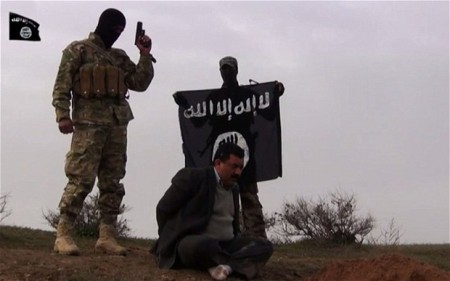
Our problem is not the Islamic radical, but the inherent radicalism of Islam. Islam is a radical religion. It radicalizes those who follow it. Every atrocity we associate with Islamic radicals is already in Islam. The Koran is not the solution to Islamic radicalism, it is the cause.
******************
The debate over Islamic terrorism has shifted so far from reality that it has now become an argument between the administration, which insists that there is nothing Islamic about ISIS, and critics who contend that a minority of Islamic extremists are the ones causing all the problems.
But what makes an Islamic radical, extremist? Where is the line between ordinary Muslim practice and its extremist dark side?
It can’t be beheading people in public.
Saudi Arabia just did that and was praised for its progressiveness by the UN Secretary General, had flags flown at half-staff in the honor of its deceased tyrant in the UK and that same tyrant was honored by Obama, in preference to such minor events as the Paris Unity March and the Auschwitz commemoration.
It can’t be terrorism either. Not when the US funds the PLO and three successive administrations invested massive amounts of political capital into turning the terrorist group into a state. While the US and the EU fund the Palestinian Authority’s homicidal kleptocracy; its media urges stabbing Jews.
Clearly that’s not Islamic extremism either. At least it’s not too extreme for Obama.
If blowing up civilians in Allah’s name isn’t extreme, what do our radicals have to do to get really radical?
Sex slavery? The Saudis only abolished it in 1962; officially. Unofficially it continues. Every few years a Saudi bigwig gets busted for it abroad. The third in line for the Saudi throne was the son of a “slave girl”.
Ethnic cleansing? Genocide? The “moderate” Islamists we backed in Syria, Libya and Egypt have been busy doing it with the weapons and support that we gave them. So that can’t be extreme either.
If terrorism, ethnic cleansing, sex slavery and beheading are just the behavior of moderate Muslims, what does a Jihadist have to do to be officially extreme? What is it that makes ISIS extreme?
Our government’s definition of moderate often hinges on a willingness to negotiate regardless of the results. The moderate Taliban were the ones willing to talk us. They just weren’t willing to make a deal. Iran’s new government is moderate because it engages in aimless negotiations while pushing its nuclear program forward and issuing violent threats, instead of just pushing and threatening without the negotiations. Nothing has come of the negotiations, but the very willingness to negotiate is moderate.
The Saudis would talk to us all day long while they continued sponsoring terrorists and setting up terror mosques in the West. That made them moderates. Qatar keeps talking to us while arming terrorists and propping up the Muslim Brotherhood. So they too are moderate. The Muslim Brotherhood talked to us even while its thugs burned churches, tortured protesters and worked with terrorist groups in the Sinai.
A radical terrorist will kill you. A moderate terrorist will talk to you and then kill someone else. And you’ll ignore it because the conversation is a sign that they’re willing to pretend to be reasonable.
From a Muslim perspective, ISIS is radical because it declared a Caliphate and is casual about declaring other Muslims infidels. That’s a serious issue for Muslims and when we distinguish between radicals and moderates based not on their treatment of people, but their treatment of Muslims, we define radicalism from the perspective of Islamic supremacism, rather than our own American values.
The position that the Muslim Brotherhood is moderate and Al Qaeda is extreme because the Brotherhood kills Christians and Jews while Al Qaeda kills Muslims is Islamic Supremacism. The idea of the moderate Muslim places the lives of Muslims over those of every other human being on earth.
Our Countering Violent Extremism program emphasizes the centrality of Islamic legal authority as the best means of fighting Islamic terrorists. Our ideological warfare slams terrorists for not accepting the proper Islamic chain of command. Our solution to Islamic terrorism is a call for Sharia submission.
That’s not an American position. It’s an Islamic position and it puts us in the strange position of arguing Islamic legalism with Islamic terrorists. Our politicians, generals and cops insist that the Islamic terrorists we’re dealing with know nothing about Islam because that is what their Saudi liaisons told them to say.
It’s as if we were fighting Marxist terrorist groups by reproving them for not accepting the authority of the USSR or the Fourth International. It’s not only stupid of us to nitpick another ideology’s fine points, especially when our leaders don’t know what they’re talking about, but our path to victory involves uniting our enemies behind one central theocracy. That’s even worse than arming and training them, which we’re also doing (but only for the moderate genocidal terrorists, not the extremists).
Secretary of State Kerry insists that ISIS are nihilists and anarchists. Nihilism is the exact opposite of the highly structured Islamic system of the Caliphate. It might be a more accurate description of Kerry. But the Saudis and the Muslim Brotherhood successfully sold the Western security establishment on the idea that the only way to defeat Islamic terrorism was by denying any Islamic links to its actions.
This was like an arsonist convincing the fire department that the best way to fight fires was to pretend that they happened randomly on their own through spontaneous combustion.
Victory through denial demands that we pretend that Islamic terrorism has nothing to do with Islam. It’s a wholly irrational position, but the alternative of a tiny minority of extremists is nearly as irrational.
If ISIS is extreme and Islam is moderate, what did ISIS do that Mohammed did not?
The answers usually have a whole lot to do with the internal structures of Islam and very little to do with such pragmatic things as not raping women or not killing non-Muslims.
Early on we decided to take sides between Islamic tyrants and Islamic terrorists, deeming the former moderate and the latter extremists. But the tyrants were backing their own terrorists. And when it came to human rights and their view of us, there wasn’t all that much of a difference between the two.
It made sense for us to put down Islamic terrorists because they often represented a more direct threat, but allowing the Islamic tyrants to convince us that they and the terrorists followed two different brands of Islam and that the only solution to Islamic terrorism lay in their theocracy was foolish of us.
We can’t win the War on Terror through their theocracy. That way lies a real Caliphate.
Our problem is not the Islamic radical, but the inherent radicalism of Islam. Islam is a radical religion. It radicalizes those who follow it. Every atrocity we associate with Islamic radicals is already in Islam. The Koran is not the solution to Islamic radicalism, it is the cause.
Our enemy is not radicalism, but a hostile civilization bearing grudges and ambitions.
We aren’t fighting nihilists or radicals. We are at war with the inheritors of an old empire seeking to reestablish its supremacy not only in the hinterlands of the east, but in the megalopolises of the west.
The Muslim Brotherhood Inquiry: What’s Happening? The Gatestone Institute, Samuel Westrop, January 23, 2015
There are several reasons the British government may be publishing only the “principal findings” of the report. First, some of the information gathered will have been done so by the intelligence services, so there are assets and agreements to protect. Another is the possibility that by revealing the scope of the Muslim Brotherhood network in full, the government would be revealing its own partnerships with Brotherhood organizations, and providing insights into the vast amount of public funds that has filled the coffers of Brotherhood charities.
The British government will publish only the “principal findings” of an inquiry commissioned by the British government into the activities of the Muslim Brotherhood in Britain, according to a report in the Financial Times.
Although the former head of the MI6, Sir Richard Dearlove, has described the Brotherhood as being, “at heart, a terrorist organization,” Brotherhood organizations in the UK have, nevertheless, long enjoyed the support of government ministers and taxpayers’ money.
Previous media statements have indicated that the report written for the inquiry, first commissioned in April 2014, has since sparked a great deal of argument between government ministers and officials and has led to a lengthy delay.
The biggest point of contention has reportedly focused on concerns over the expected reaction of Saudi Arabia and the United Arab Emirates — both of which have recently designated the Muslim Brotherhood and some of its front groups as terrorist organizations – if the inquiry’s report is perceived to be a whitewash.
London, it seems, has long been an important hub for the Muslim Brotherhood. Over the past 50 years, Brotherhood members have established dozens of Muslim Brotherhood front organizations, including lobby groups, charities, think tanks, television channels and interfaith groups.
The secretary-general of the International Organization of the Muslim Brotherhood, for example, Ibrahim Munir, is a resident of London. In 2013, the Egyptian newspaper Al-Masry al-Youm reported that Munir was providing funds to the Egyptian Brotherhood through British Brotherhood groups such as the Muslim Welfare House — but under the guise of fundraising for Palestinians in Gaza.
This government inquiry was established to examine not just the activities of the Muslim Brotherhood in Britain, but to understand better the workings of the worldwide Brotherhood network. This network is both big and nebulous. The inquiry sought to examine the network comprehensively, including the Brotherhood’s collaboration with other Islamic groups, such as Jamaat-e-Islami, a South Asian Islamist network that also has a strong presence in Britain.
Why, then, has the report been delayed?
The question that has dominated most British media reports of the inquiry’s findings has centered on the allegation of terrorism. The relationship between Western governments and the Brotherhood on this point has long appeared murky. In 2002, for instance, the United States government shut down the Holy Land Foundation, a Muslim Brotherhood fundraising group for the Hamas terrorist organization. And in 2011, FBI Director Robert Mueller told the Permanent Select Committee on Intelligence of the House of Representatives: “I can say at the outset that elements of the Muslim Brotherhood both here and overseas have supported terrorism.”
At the same time, however, both the Bush and Obama administrations also sought to woo the Muslim Brotherhood. One anonymous Palestinian official, quoted in Asharq Al-Awsat, claimed: “The Americans mistakenly think that moderate political Islam, represented by Muslim Brotherhood, would be able to combat radical Islam.”
The inconsistency seems to have revolved around the Muslim Brotherhood’s connection to Hamas. Although Hamas’s 1988 covenant asserts that, “The Islamic Resistance Movement is one of the wings of Muslim Brotherhood in Palestine,” Western governments have nevertheless treated Hamas and the Brotherhood as unconnected entities — despite a wealth of evidence to the contrary.
In the United Kingdom, Muslim Brotherhood and Hamas networks appear to overlap heavily. In 2005, for instance, the British government handed over the running of London’s Finsbury Park mosque to the Muslim Association of Britain [MAB]. The Muslim Association of Britain was founded by Muslim Brotherhood activists including Kemal Helbawi, who described the Israel-Palestinian conflict as “an absolute clash of civilisations; a satanic programme led by the Jews and those who support them, and a divine programme carried [out] by Hamas … and the Islamic peoples in general.”
One of the trustees appointed to run the Finsbury Park mosque was Muhammad Sawalha, a fugitive Hamas commander who, according to BBC reports, is “said to have masterminded much of Hamas’s political and military strategy” from London. Yet the police and local government continue to fund the mosque with tens of thousands of pounds of taxpayers’ money.
 Muhammad Sawalha, a fugitive Hamas commander who is “said to have masterminded much of Hamas’s political and military strategy” from London, is a trustee of the Finsbury Park mosque, which receives tens of thousands of pounds of taxpayers’ money. (Image source: inminds YouTube video screenshot)
By ignoring both the operational and ideological relations between the Brotherhood and Hamas, Western governments have been able to claim a dedication to opposing terrorism while at the same time courting Islamist allies, ostensibly to help fight the jihadist threat. By 2009, for instance, the British government provided the Muslim Welfare House, mentioned earlier, with £48,000 of “counter-extremism” funds. To this day, leading Islamist charities, established by Brotherhood figures, continue to receive millions of pounds of taxpayers’ money.
The Muslim Brotherhood, without Hamas, has worked hard to present itself as a benign organization. It is the government’s apparent failure to demonstrate adequate evidence of connections to terrorism, some critics argue, that has led to the delay in publishing the inquiry’s report. The prominent newspaper journalist, Peter Oborne, has claimed that the report “had discovered no grounds for proscribing the Muslim Brotherhood as a terrorist group… Publication of the report as originally written would infuriate the Prime Minister’s Saudi allies — and not just them. The United Arab Emirates have long been agitating for the defenestration of the Brothers…. The reason [for the delay] is simple: money, trade, oil, in a number of cases personal greed.”
Peter Oborne, a supporter of the Muslim Brotherhood, was, in fact, echoing the line taken by the Brotherhood itself. British Brotherhood operatives, such as Anas Al-Tikriti, recently placed an advertisement in the Guardian newspaper that claimed, “this review is the result of pressure placed on the British government by undemocratic regimes abroad, such as Saudi Arabia and the United Arab Emirates.” The letter was signed by a number of senior Brotherhood activists, MPs, Peers and journalists — including Peter Oborne.
The “Saudi pressure” argument serves a useful purpose. There is not a lot that can undermine a government inquiry so much as an accusation of political leverage and foreign financial influence. Both Saudi Arabia and the UAE regard the Muslim Brotherhood as a threat, and would like to see it suppressed. But neither the Saudis nor the Emiratis are naïve: both have worked to influence the British government for decades and both know how Westminster works. Hence, both know that it is extremely unlikely that the British government would ban the Muslim Brotherhood.
All that said, it is still possible to ignore Hamas and nevertheless link the Brotherhood to violence. In September 2010, the Supreme Guide of the Muslim Brotherhood, Mohamed Badie, advocated violent jihad against the United States, and declared that, “the improvement and change that the [Muslim] nation seeks can only be attained through jihad and sacrifice and by raising a jihadi generation that pursues death just as the enemies pursue life… The U.S. is now experiencing the beginning of its end, and is heading towards its demise.” In 2013, Muslim Brotherhood members and supporters in Egypt attacked 70 Coptic Christian churches, and more than 1000 homes and businesses of Coptic Christian families were torched.
Banning the Brotherhood, however, is difficult for another reason. Security analyst Lorenzo Vidino writes:
“Muslim Brotherhood-linked groups in each country work according to a common vision — but in complete operational independence, making the Brotherhood an informal global movement. It’s what makes designating the whole movement a terrorist organisation virtually impossible in the UK, as authorities knew from the very beginning. But the lack of a ban does not equal an exoneration or an endorsement — hardly the general tone of the review.”
If the delay in the report’s release has been the product of political wrangling at all, the debate within Westminster is most likely over the influence of the Brotherhood upon extremism and radicalization, and with which groups the government should continue to work.
There is already some indication that changes are taking place. On December 18, 2014, the government announced publicly that two Brotherhood-linked Islamic charities, Islamic Help and the Muslim Charities Forum, were to lose their government grants over links to extremism. The Department for Communities and Local Government stated that it would not fund any group “linked to individuals who fuel hatred, division and violence.” This loss of funding followed a Gatestone Institute report investigating the Muslim Charities Forum’s links to extremism, which was subsequently picked up by mainstream British media.
Also in December, Islamic Relief, after being placed on terror lists by both the governments of the UAE and Israel, published an “independent audit,” claiming there was “absolutely no evidence” to link the charity to terrorism.
The British government, which has provided over £3 million of funding to Islamic Relief since 2013, offered little comment, but did publish, at the end of December, a document revealing that the UK government would match £5 million of donations to Islamic Relief until 2016.
Herein lies the contradiction. The Muslim Charities Forum is essentially a project of Islamic Relief. The present chairman of the Muslim Charities Forum, in fact, is Hany El Banna, who founded Islamic Relief, the leading member body of the Muslim Charities Forum. Islamic Relief, as the Gatestone Institute has previously revealed, has given platforms to the same extremists as those promoted by the Muslim Charities Forum, an act that led to its loss of funding. Why would the British government discard one charity while embracing the other? Is this perhaps a sign of further sleight-of-hand to come? Rather than sanction the Brotherhood as a whole, is the government likely in future to work only with sections of the Islamist network?
We have seen such posturing before. In 2009, Britain’s Labour government cut ties with the Muslim Council of Britain after some of its officials became signatories to the Istanbul Declaration, a document that calls for attacks on British soldiers and Jewish communities. The government has continued, however, to work with and fund interfaith groups partly managed by MCB figures and Istanbul Declaration signatories.
There are several reasons the British government may be publishing only the “principal findings” of the report. First, some of the information gathered will have been done so by the intelligence services, so there are assets and agreements to protect. Another is the possibility that by revealing the scope of the Muslim Brotherhood network in full, the government would be revealing its own partnerships with Brotherhood organizations, and providing insights into the vast amount of public funds that has filled the coffers of Brotherhood charities.
In spite of the expectedly unexciting report, the global Muslim Brotherhood still seems worried. Even the most benign report could damage the legitimacy upon which the Brotherhood thrives. Although unlikely, visas for Brotherhood residents in Britain could be revoked, and the report could produce a domino effect — sparking inquiries in other European countries. Evidently, the Brotherhood attaches great importance to its political and diplomatic connections and influence.
Because of the uncertainty surrounding the report, media misinformation and Brotherhood propaganda have been spreading. Back in April 2014, the British government’s announcement of the inquiry produced a great deal of noise. The actual scope of the inquiry and the possible consequences, however, were left to the imaginations of the many commentators and conspiracy theorists.
Consequently, just as the full findings of the report are unclear, so is its significance. If certain sections of the Brotherhood are declared unsuitable, it seems that the report might provide a useful opportunity for the British government — aided by new statutory powers for the Charity Commission and proposed new counter-extremism powers — to crack down on those parts of the Muslim Brotherhood which serve to accrue financial and political support for Hamas.
Thus far, for the government, the Muslim Brotherhood inquiry has been a PR disaster. The eventual publication of the inquiry’s report could provide an opportunity for the British government to end its continued support and funding for Britain’s Muslim Brotherhood charities, and to stop treating Brotherhood operatives as representatives of Britain’s Muslim community. It would indeed be a shame if the only outcome of the inquiry were an even cozier realignment with the Muslim Brotherhood’s activities.
Islamic State Deepens Grip in Future Palestine, The Gatestone Institute, Khaled Abu Toameh, January 23, 2015
According to Israeli security forces, dozens of Hamas and Islamic Jihad members in the West Bank have defected to the Islamic State in recent months. Their main goal, according to sources, is to topple the Palestinian Authority and launch terror attacks on Israel.
Some 200 supporters of the Islamic State, who held up Islamic State flags, took to the streets of Gaza City to protest the latest cartoons published by the French satirical magazine, Charlie Hebdo. They also chanted slogans that called for slaughtering French nationals, and burned French flags. Attempts by Hamas to impose a news blackout on the protest failed, as photos and videos found their way to social media.
The glorification of terrorists and jihadists by the Palestinian Authority, and the ongoing anti-Israel incitement by both Hamas and the Palestinian Authority, is driving many Palestinians into the open arms of the Islamic State.
Hamas and other Palestinian groups are continuing to deny the obvious, namely that the Islamic State terror group has managed to set up bases of power in the West Bank and Gaza Strip.
The Palestinians do not feel comfortable talking about the fact that Islamic State is working hard to recruit Palestinians to its ranks.
The presence of Islamic State in the West Bank and Gaza Strip is an embarrassing development for both Hamas and the Palestinian Authority.
For Hamas, the fact that Islamic State has long been operating in the Gaza Strip is something that it does not want the world to know about.
Hamas cannot afford a situation where another Islamist terror group poses a challenge to its exclusive control over the Gaza Strip. Since it seized control over the Gaza Strip in 2007, Hamas has successfully suppressed the emergence of rival forces, first and foremost the secular Fatah faction headed by Mahmoud Abbas.
But if until recently it was Fatah that posed a challenge and threat to Hamas’s rule, now it is the Islamic State and its supporters in the Gaza Strip are openly defying the Islamist movement’s regime.
When the first reports about Islamic State’s presence in the Gaza Strip emerged last year, Hamas and other Palestinians were quick to dismiss them as “false.”
Salah Bardaweel, a senior Hamas official, said in February 2014 that the Islamic State “does not exist” in the Gaza Strip.
This week, however, it became evident that Hamas was lying when it denied the presence of Islamic State in the Gaza Strip.
Some 200 supporters of the Islamic State, who held up Islamic State flags, took to the streets of Gaza City to protest the latest cartoons published by the French satirical magazine, Charlie Hebdo.
The protesters tried to storm the offices of the French Cultural Center in Gaza City. They also chanted slogans that called for slaughtering French nationals, and burned the French flag.
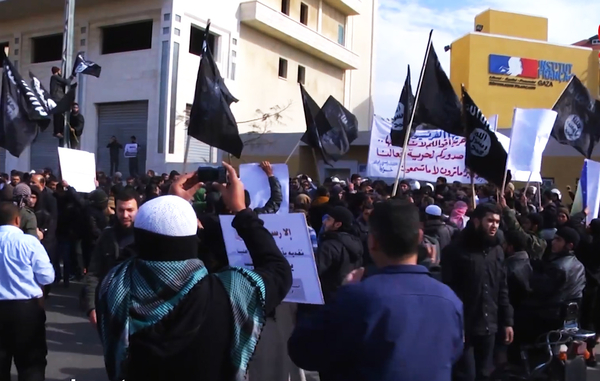 Palestinians waving Islamic State flags attempt to storm the French Cultural Center in Gaza City. Some in the crowd carried posters glorifying the terrorists who carried out this month’s attacks in Paris. (Image source: ehna tv YouTube screenshot)
The protest apparently caught Hamas by surprise. Hamas security forces that were rushed to the scene dispersed the protesters and arrested seven Islamic State supporters.
Attempts by Hamas to impose a news blackout on the Islamic State protest failed, as photos and videos of the demonstration found their way to social media. Needless to say, Hamas-affiliated media outlets ignored the protest. They were hoping that the world would also not see the Islamic State demonstrators on the streets of Gaza City.
Hamas’s biggest fear is that scenes of Islamic State supporters marching in the heart of Gaza City will scare international donors and dissuade them from providing badly needed funds for the reconstruction of the Gaza Strip. Hamas is also afraid that Western officials working with the United Nations and relief agencies will stop visiting the Gaza Strip after watching the footage of Islamic State supporters.
In recent weeks, it has also become evident that Islamic State has some kind of a presence in the West Bank — a fact that poses a serious threat to Abbas’s Palestinian Authority [PA].
Just last week, Israel announced arrests of members of an Islamic State terror cell in the West Bank city of Hebron. The three Palestinian members of the cell confessed during interrogation that had planned to launch a series of terror attacks against Israel. The three suspects were identified as Waddah Shehadeh, 22, Fayyad al-Zaru, 21 and Qusai Maswaddeh, 23.
Until recently, Hamas was considered the number one threat to the Palestinian Authority in the West Bank. Now, however, it has become evident that Islamic State is also trying to set up bases of power in the West Bank. According to Israeli security sources, dozens of Hamas and Islamic Jihad members in the West Bank have defected to Islamic State in recent months. Their main goal, the sources, said, is to topple the PA and launch terror attacks on Israel.
Abbas is lucky that the Israeli security forces are still operating in the West Bank, including inside cities and towns controlled by the Palestinian Authority. Were it not for the IDF and various branches of the Israeli security establishment, Hamas, Islamic Jihad and Islamic State would have toppled the Palestinian Authority and beheaded Abbas and his officials a long time ago.
Still, Abbas does not feel comfortable acknowledging the fact that a growing number of Palestinians in the West Bank are joining Islamic State. Abbas fears is that if he admits that Islamic State is already operating in the West Bank, this could dissuade many Western countries from supporting his effort to persuade the world to support the creation of an independent Palestinian state. Like Hamas, Abbas also fears that Westerners would stop visiting Ramallah and other West Bank Palestinian cities once they learn about Islamic State’s presence in these areas.
Although Hamas and the Palestinian Authority are continuing to bury their heads in the sand and deny what is there, they cannot avoid responsibility for the emergence of Islamic State in the Gaza Strip and West Bank. The glorification of terrorists and jihadists by the PA and the ongoing anti-Israel incitement by both the PA and Hamas, are driving many Palestinians into the open arms of the Islamic State.
This is something that the UN Security Council members will have to consider the next time they are asked to vote in favor of the establishment of a Palestinian state. Otherwise, they will be voting for the creation of an Islamic, and not a Palestinian, state.
Iran: We Will Continue Arming Terrorists in Judea and Samaria
Iran plans to continue its efforts to “destroy the Zionist entity” – and that includes arming terrorists in Judea and Samaria, it said.
By Yaakov Levi
First Publish: 1/22/2015, 8:51 AM
via Iran: We Will Continue Arming Terrorists – Defense/Security – News – Arutz Sheva.

Iran plans to continue its efforts to “destroy the Zionist entity” – and that includes arming terrorists in Judea and Samaria.
“The arming policy of the West Bank is one of the policies of Iran and we will use all our capabilities in this way,” said Iranian Defense Minister Hossein Dehghan.
Dehghan made the comments at a memorial service for General Abu Ali Tabtabai, who along with Jihad Mughniyeh and a crew of Hezbollah terrorists, were eliminated in an Israel Air Force strike Monday. The vehicles in which the two were riding had left Lebanon a few hours earlier, Lebanese sources said. The purpose of the tour, the sources said, was to allow Tabtabai to review the situation on the border with the purpose of developing new attacks on Israel.
Commenting on the attack, Deghan said “The Zionist attack will not be passed over,” and that Iran would take the “appropriate action” when it wished to.
Tensions remained high in northern Israel in the aftermath of the elimination of Mughniyeh, said to be Hezbollah’s “commander of the Golan Heights area,” and Iranian General Tabtabai.
Roads in the area of the Israel-Lebanon border have been closed, and tanks and armored personnel carriers were reportedly deployed along the northern border. Lebanese media outlets are reporting Israeli jets and helicopters over the Har Dov area along the Lebanese border.
Late Wednesday, the US issued a travel warning to American citizens and government personnel in Israel, citing the recent tensions along Israel’s northern borders and the terrorist stabbing attack in Tel Aviv.
“Because of concerns about security on Israel’s northern borders, U.S. government personnel are currently required to obtain advance approval if they wish to travel within 1.5 miles (2.4 kilometers) of the Lebanon border, or travel on or east of Route 98 in the Golan Heights,” the advisory said.
“Further, in light of the stabbing attack on a public bus in Tel Aviv on January 21, U.S. citizens are reminded that due to security concerns, U.S. government employees are prohibited from using public buses throughout Israel and the West Bank (Judea and Samaria -ed.),” the statement added.
Despite the increased tension, residents have been urged to continue with their regular daily routines.
Giora Zeltz, chairman of the Upper Galilee Regional Council, said Wednesday that despite the large deployment of IDF troops and the increased police and border guard presence in the area, “we have not received any instructions to change our normal activities. The message we are getting from security officials is that life should continue as usual.”
Zeltz said that IDF officials had given him three reasons for the increased vigilance: Besides concerns that Hezbollah will try to carry out revenge terror attacks against Israel – “for which we must be ready,” he said – “the IDF is also sending a message to our neighbors that we will not tolerate attacks, and to give residents a sense of safety
Hamas Commander Deif to Hezbollah Leader Nasrallah: “Let’s fight Israel together”
The head of Hamas’ military wing signed a letter of condolence sent to Hezbollah’s Secretary General after the eliminations in Syria.
Jan 22, 2015, 04:00 PM | Gal Cohen

Photo Credit: Channel 2 News
Five months after the elimination attempt targeting the head of Hamas’ military wing, Mohammed Deif sent a message from hiding in Gaza and expressed his condolences regarding the attack that killed senior level Hezbollah officials, according to a report from Hezbollah’s television station.
Deif sent condolences to Hezbollah Secretary Genral Hassan Nasrallah following the elimination of senior level officials in his terror organization by Israel. “We must unite our forces against the Zionist enemy and its allies,” Deif wrote to Nasrallah.
“Israel is the real enemy of the Islamic State and all guns should be pointed in its direction,” the Hamas terrorist added. “We must carry out the next act together, so there will be crossfire throughout the occupied land.”
Sources close to Hezbollah said that earlier this week, the decision was made to respond to the attack in Syria that killed six senior level officials of the terror organization. According to the report, the decision to respond was accepted by the joint resistance forces in Iran, Syria, and Hezbollah.

Photo Credit: Channel 2 News/AP
According to the sources, the IDF’s attack did not weaken the terror organization in the Golan and did not disconnect the activities of Hezbollah from Rosh Ha-Nikra to Syria. They claim Israel’s actions will not prevent the terror organization’s fighters from invading the Galilee in the next confrontation with the IDF.
Iran, for its part, also addressed Israel’s actions. Tehran admitted that one of their generals was killed in the incident and said they are committed to responding to the “Israeli aggression.” An Iranian news site said “following the Zionist attack against the opposition in Syria, General Allahdadi, a former commander of the Iranian Revolutionary Guards, was killed along with Jihad Mughniyeh and three others, who were in the same car.” An Iranian official added that “the resistance will respond forcefully at the right place and time to this terrorist attack.”




 anneinpt
 artaxes
 danmillerinpanama
 davidking1530
 Peter Hofman
 Joseph Wouk
 Peter
Peter Louisiana Steve
 WarSclerotic
Recent Comments