Posted tagged ‘Hamas’

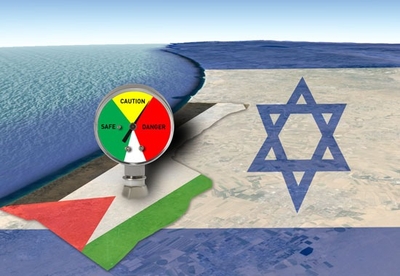
Military crisis in Qatar may spark Gaza outbreak

June 13, 2017

Military crisis in Qatar may spark Gaza outbreak, DEBKAfile, June 13, 2017

A military crisis centering on Qatar would be a catalyst for an outbreak of violence from the Gaza Strip. And indeed, after the failed Sanwar mission to Cairo and the reduction of electric power to the Gaza Strip, Hamas spokesmen warned that an “explosion” was imminent.

*********************

The electricity cutback in the Gaza Strip, engineered by Palestinian leader Mahmoud Abbas to flex muscle against Hamas rule, was just one piece on the checkerboard created by the crackdown Egypt, Saudi Arabia Bahrain and the United Arab Emirates have imposed on Qatar for supporting terrorist groups like the Palestinian extremist Hamas. Therefore, Hamas leader Yahya Sanwar had little to expect from his mission to Cairo last weekend to persuade the El-Sisi government to ease its restrictions on the Gaza Strip.

He arrived at the head of a large mission, in which the group’s military arm, Ezz e-Din El-Qassam was heavily represented. Their appeals to Maj.-Gen Khaled Fawzy, director of Egyptian General Intelligence, met with a list of tough conditions. When the Palestinian delegation balked, Cairo acted to tighten its blockade on the Palestinian enclave.

The Hamas rulers of the Gaza Strip found themselves in the same boat as their old friend, Qatar, in the week that their internal rival, Mahmoud Abba, docked payment for the electricity Israeli supplies the Gaza Strip. The power supply was cut by 40 percent.

From 2015, the emir of Qatar remained the only Arab ruler backing the Palestinian extremist Hamas with occasional cash donations to Gaza City and permission for its top officials to set up shop in Doha.

This flow of aid was abruptly cut off by the land, sea and air blockade Saudi Arabia, the UAE, Bahrain and Egypt clamped down on Qatar last week over its support for terrorist groups and ties with Tehran. Sheikh Tamim bin-Hamad Al-Khalifa defied the ultimatum they presented him, and so Qatar’s banks and international assets have been losing dollars, its currency has plummeted and there is no money to spare for the Gaza Strip.

Qatar and Hamas are being pushed into the same corner.

The small Gulf island, which is the world’s largest supplier of natural gas, was been told by the four leading Arab governments to expel Muslim Brotherhood and Hamas officials from its soil, after years of providing them with hospitality plus pensions generous enough for them to live a life of ease and plenty, while also running their terrorist networks across the region and beyond.

Qatar was also told to discontinue its propaganda campaigns against Egypt, Saudi Arabia and the UAE, and shut down its main platform, the Al Jazeera TV channel; and hundreds of Egyptian and Saudi dissidents granted political asylum deported forthwith.

With nowhere else to go, these dissidents could potentially head for sanctuary in the Gaza Strip, making it a “little Qatar,” which is why Cairo further tightened the Palestinian enclave’s isolation by blocking all routes of access.

The Hamas delegation was likewise confronted in Cairo with tough demands by the Egyptian intelligence chief:

1. To turn in the Muslim Brotherhood fugitives they were sheltering in the Gaza Strip.

2.  Not just to sever cooperation between the Hamas military arm and the Islamic State networks in the Sinai Peninsula, but to surrender to Egypt all the intelligence they possessed about the jihadists and their activities.

3.  To discontinue weapons smuggling operations through Sinai.

After balking at the Egyptian demands, Yahya Sanwar was forced to leave Cairo empty-handed with regard to eased restrictions and humanitarian aid – only to find on his return home that the Egyptians had raised their biggest gun against the Gaza Strip: They had cut off power.

A humanitarian catastrophe now hangs over the two million inhabitants of the tiny Mediterranean enclave. Hospitals are cutting back operations, refrigerators are switched off, clean water supplies are dwindling because desalination plants are without power, raw sewage is dumped into the sea and sanitary conditions deteriorating.

Cairo asked the Palestinian Authority in Ramallah and the Israeli government not to relent, but to keep the pressure on the Hamas regime high. Ramallah must continue to hold back payment to cover Israel’s electricity bills, which suits Mahmoud Abbas’ campaign for bringing Hamas to heel.

But for Israel, there is a dilemma. Nonetheless, the Netanyahu government is extremely wary of breaking away from the anti-terror line taken by Arab governments, because this could put paid to the delicate ties established with them – especially in the military domain – through long and laborious effort.

In Jerusalem, it is therefore ardently hoped that the Qatar crisis is quickly resolved and Hamas and Cairo can reach terms exponentially for easing the humanitarian crisis in the Gaza Strip.

For the time being, there is no sign of this happening. On the contrary, there are indications of the crisis moving onto a military plane. Sources in the Middle East are not ruling out possible military action by Saudi Arabia, Egypt and the UAE against Qatar.

Read more about this looming potential in the coming DEBKA Weekly issue (for subscribers) out next Friday, June 16. 

A military crisis centering on Qatar would be a catalyst for an outbreak of violence from the Gaza Strip. And indeed, after the failed Sanwar mission to Cairo and the reduction of electric power to the Gaza Strip, Hamas spokesmen warned that an “explosion” was imminent.

Palestinian Islamic Jihad, Iran’s ‘Preferred Proxy,’ Arming in Gaza

June 5, 2017

Palestinian Islamic Jihad, Iran’s ‘Preferred Proxy,’ Arming in Gaza, Investigative Project on Terrorism, Yaakov Lappin, June 5, 2017

Iran provides PIJ with both “military and financial support,” ITIC noted in its report.

“PIJ is the preferred organization for Iran, due to the problematic nature of the relationship between Iran and Hamas,” ITIC Director Col. (ret.) Reuven Erlich, told the Investigative Project on Terrorism.

Although Iran continues to fund Hamas’s military wing, relations between Shi’ite Tehran and the Sunni Islamist rulers of Gaza have been unstable since 2012, when the two found themselves on opposite sides of the sectarian war raging in Syria.

PIJ has around 5,000 members in its armed wing, the Quds Brigades. The organization has its own Gazan rocket production industry, and PIJ possesses the second largest arsenal of projectiles in Gaza, thanks to Iranian manufacturing knowledge. The organization has been working on improvements to its rocket launch systems. It also digs combat tunnels.

***************************************

Palestinian Islamic Jihad (PIJ), the second largest terrorist army in Gaza, recently issued a video threat about its willingness to end the three-year truce in place with Israel.

“If the Israeli enemy continues its normal game and plays with the lives of the Palestinian people, we will break the cease-fire,” PIJ leader Ramadan Shallah says in the video, according to an Algemeiner report.

The footage is laced with images of gunmen in camouflage, rising out of the ground, moving through tunnels, and watching areas of southern Israel near the Gaza border. It is interspersed with scenes from a rocket factory, and a close up shot appears of a senior Israel Defense Forces (IDF) officer, who is placed in crosshairs, before a bullet is loaded into a rifle.

“Don’t try to test the resistance,” says the video’s last message.

PIJ remains Iran’s favored proxy in the Strip as relations between Tehran and Hamas continue to fluctuate.

The Gaza-based Al-Ansar charity, a Palestinian branch of the Iranian Martyrs Foundation, announced May 21 that it would provide financial grants to “families of martyrs” whose relatives were killed between 2002 and 2014.

A parallel Iranian funding channel is in place for families of “martyrs” killed in the 2014 conflict with Israel.

The Al-Ansar charity is “affiliated with PIJ,” according to a report released by the Tel Aviv-based Meir Amit Intelligence and Terrorism Information Center (ITIC).

Iran provides PIJ with both “military and financial support,” ITIC noted in its report.

“PIJ is the preferred organization for Iran, due to the problematic nature of the relationship between Iran and Hamas,” ITIC Director Col. (ret.) Reuven Erlich, told the Investigative Project on Terrorism.

Although Iran continues to fund Hamas’s military wing, relations between Shi’ite Tehran and the Sunni Islamist rulers of Gaza have been unstable since 2012, when the two found themselves on opposite sides of the sectarian war raging in Syria.

Thus, Iran does not currently fund Hamas’s non-violent operations, including the salaries for tens of thousands of Hamas government employees.

In recent days, a Hamas senior official even took the trouble to flatly deny Arabic media reports that Iran had resumed full-scale funding for his regime, describing the claims as “fake news.”

PIJ, which plays no governmental role, has no such issues with Iran, and it continues to enjoy a high level of Iranian financial support.

A snapshot of that support can be seen in the estimated $8.7 million that was transferred from the Iranian Martyrs Foundation to Gaza over the last three years. Not all the money went to families of those killed in conflict with Israel. “We can assume that some of that money also went towards financing groups like PIJ,” Erlich said.

The Al-Ansar charity is used by the Iranian Martyrs Foundation “as a pipeline to funnel funds into the Gaza Strip, in indirect support of terrorism. The money also serves to increase Iran’s influence among the Palestinian people, and sends a message to the Sunni Arab world, that it is Iran which is supporting the Palestinians in their struggle against Israel,” the ITIC report said.

The Al-Ansar charity is fed with cash by a branch of the Iranian Martyrs Foundation in Lebanon. A second branch of the foundation in Lebanon supports Hizballah.

In 2007, the U.S. Department of Treasury designated the Iranian Martyrs Foundation and its branches in Lebanon as sponsors of terrorism. Israel banned the Al-Ansar charity in 2003, but it reestablished itself in Gaza after the Israeli withdrawal in 2005.

The reelection of Iranian President Hassan Rouhani to a second term is unlikely to dent Iranian funding for terror groups like PIJ, as Supreme Leader Khamanei, who is committed to arming and financing jihadists intent on fighting Israel, continues to exercise control over foreign affairs and military policies.

PIJ has around 5,000 members in its armed wing, the Quds Brigades. The organization has its own Gazan rocket production industry, and PIJ possesses the second largest arsenal of projectiles in Gaza, thanks to Iranian manufacturing knowledge. The organization has been working on improvements to its rocket launch systems. It also digs combat tunnels.

PIJ is a quarter of the size of Hamas’s 20,000 armed operatives, but that did not stop it from having numerous past run-ins and power struggles with Hamas.

Since the end of the 2014 conflict with Israel, however, Hamas has improved its ability to coordinate and control the other armed factions operating in its territory.

It remains unclear whether the latest PIJ threat to violate the ceasefire represents a warning of a possible split with Hamas’s leadership.

“What matters most is the ideological distinction between the PIJ and Hamas,” said Ely Karmon, a senior research scholar at the International Institute for Counter-Terrorism in Herzliya.

“While Hamas, [which is] the Palestinian Muslim Brotherhood, has a strategic cooperation with Iran, PIJ has a religious affinity with the Khomeinist doctrine and regime, since their [former] leaders Fathi Shaqaqi and ‘Abd al-‘Aziz ‘Odah, from the inception of their group, acknowledged the importance of the Iranian revolution and its influence,” Karmon told the IPT.

“Sheikh Ahmed Yassin, the Hamas leader,  wrote nothing on religious matters (and did not write about any other issues either),” Karmon noted. “Shaqaqi wrote 5 books in which he praised the Iranian revolution.”

“In this sense, the PIJ is the real proxy of Iran, and not Hamas,” he added.

PIJ leaders integrated themselves into the Iranian-Hizballah camp when Israel expelled them to Lebanon in 1988, Karmon noted. Then, PIJ leader Fathi Shaqaqi was assassinated in Malta in 1995, representing a dramatic blow to the organization.

It took his successor, Ramadan Abdullah Shallah, who is still the current leader, five years following Shaqaqi’s assassination to build up the group’s infrastructure, with the aid of “major Iranian financial and military support,” Karmon said.

“Ironically, Shallah, who spent five years at Durham University [in Britain] writing a thesis on Islamic banking in Jordan, was called to lead the PIJ from the U.S., where he taught at the University of South Florida,” Karmon added.

When Hamas released a document that represented an update to its policies last month, feigning a softer stance and a willingness to accept a Palestinian state on the 1967 borders, PIJ’s response was unequivocal.

“As partners with our Hamas brothers in the struggle for liberation, we feel concerned over the document,” said Islamic Jihad’s deputy leader, Ziad Al-Nakhala.

“We are opposed to Hamas’s acceptance of a state within the 1967 borders and we think this is a concession which damages our aims,” Al-Nakhala said, in comments posted on PIJ’s website.

Accepting a state on the 1967 borders would “lead to deadlock and can only produce half-solutions,” Al-Nakhala added.

Ultimately, the dispute between PIJ and Hamas is one over tactics, not strategy. In light of its acute isolation, Hamas is seeking to rebrand itself somewhat, without any intention of giving up its long-term goal of destroying Israel.

PIJ, enjoying firm Iranian backing, and lacking all of Hamas’s dilemmas of sovereignty, rejects the very idea of a rebranding. It insists on openly advertising its jihadist, Iranian-influenced ideology. Hoisted on Iran’s shoulders, PIJ prepares for the next round of fighting with Israel.

Yaakov Lappin is a military and strategic affairs correspondent. He also conducts research and analysis for defense think tanks, and is the Israel correspondent for IHS Jane’s Defense Weekly. His book, The Virtual Caliphate, explores the online jihadist presence.

UK Government to Hold Pro-Terrorism Expo in London?

May 30, 2017

UK Government to Hold Pro-Terrorism Expo in London? Gatestone InstituteDenis MacEoin, May 30, 2017

(Will Formerly Great Britain soon hold a celebration in honor of the Islamic State in Manchester? Failure to do so would be Islamophobic. A concert would, of course, be appropriate. — DM)

“‘Friends of Al-Aqsa’ is one of the more extremist Islamist organizations at work in Britain today. It supports the Muslim Brotherhood-linked charity ‘Interpal’ (proscribed by the US Treasury) and advertises it on its website. It collaborates with the Khomenist Iranian-funded faux human rights organization known as the Islamic Human Rights Commission in organizing events such as Al Quds day at which public support is expressed for the Iranian proxy militia Hizbollah.” — UK Media Watch.

Under these definitions, Hamas is exposed as a terrorist organization both by its repeated use of indiscriminate killing and the contents of its two Charters from 1988 and 2017.

“There is no solution for the Palestinian problem except through jihad…” — Hamas Charters of 1988 and 2017, Articles 18 and 21.

Hamas is not the only extremist organization to which Friends of Al-Aqsa has lent its support.

Mere weeks after the terrorist attacks in Britain — on May 22 in Manchester and earlier in Westminster — there is planned in London, on July 8-9, a major event which its organizers describe as:

Palestine Expo: the biggest social, cultural and entertainment event on Palestine to ever take place in Europe. In a year of immense significance for Palestine, we are pleased to announce, Palestine Expo 2017

The “biggest ever in Europe”: heady stuff. In a major coup, the exposition will take place, not in a scruffy hall on the outskirts of the city, but in the Queen Elizabeth II Centre in Westminster, near the Houses of Parliament, in the shadow of Big Ben and Westminster Abbey. The prestigious centre is owned by the UK Government and its operation is conducted by an executive agency of the Department for Communities and Local Government. It has 2,000 square metres of exhibition space, four main auditoria, seven conference rooms and many smaller rooms, and specialises in events for more than 1,000 delegates. Palexpo[1] will occupy five of its six levels.

Events listed include:

Inspirational Speakers
Interactive Zones
Knowledge village
Food Court
Live Entertainment
Academic Workshop (“will be run by a group of academics from leading UK universities”)
Student Hub
Gallery
Shopping Quarter

On the surface, it might appear that this is merely a cultural event designed to give the British public a taste of Palestinian cooking, music, art, in particular, history (starting in 1948!). A closer examination, however, reveals something less pleasant. Underneath the surface, this exposition is dedicated to a presentation of Palestinian victimhood and “resistance” (read terrorism), the same “resistance” as in Israel, and on similar false pretexts.

In Israel, the false pretext is that Jews — who have lived in Canaan and Judea for 3,000 years, as is substantiated by enough documentary and archaeological evidence to sink a supertanker — are supposedly occupying “Palestinian land”. In Europe, the false pretext is “revenge for colonialism”, which has historically existed under the Muslims, in their conquests of Iran, the Byzantine Empire, North Africa and the Middle East, northern Cyprus, Spain and most of Eastern Europe. This expansion has continued in the present day to Lebanon, northern Cyprus, Indonesia, the Philippines and is working its way through Europe, Canada and Australia. The Europeans are evidently gullible enough, it seems, to swallow all pretexts without bothering to check any facts.

The Queen Elizabeth II Centre is the venue for the upcoming “Palestine Expo 2017”, organized by the anti-Semitic pro-Hamas activist group, “Friends of Al-Aqsa”. (Image source: Jdforrester/Wikimedia Commons)

Who has organized this massive upcoming London event? One might have expected it to be the Palestinian Mission of the UK (often treated erroneously as an embassy, as it claims to represent the “State of Palestine”, which does not exist). However, although the Mission will probably be a participant in the exposition, a direct link for it cannot be found. The same is true for the West Bank’s Palestinian Authority.

The organizers of the event are, in fact, a relatively small British organization, Friends of Al-Aqsa (FOA), founded in 1997 by a British optician, Ismail Patel, closely involved in several Islamic organizations such as the British Muslim Initiative (BMI). The BMI is a front group for Hamas, and has been for many years “the most active organization in the U.K Muslim Brotherhood”. Patel was a spokesman for the BMI. And the BMI was the chief organizer of London’s 2008 IslamExpo, which Britain’s Minister of Communities and Local Government at the time, Hazel Blears, strongly criticized:

“It was clear that because of the views of some of the organisers, and because of the nature of some of the exhibitors, this was an event that no Minister should attend. Organisers like Anas al-Tikriti, who believes in boycotting Holocaust Memorial Day. Or speakers like Azzam Tamimi, who has sought to justify suicide bombing. Or exhibitors like the Government of Iran.”

Friends of Al-Aqsa is, itself, an anti-Semitic pro-Hamas activist group. It helped establish in London the anti-Israel al-Quds Day events, in which extremists march to support the terror group Hizbullah and the theocratic Iranian regime that calls for England, Israel and America to be wiped from the pages of time.

Patel himself is an outspoken upholder of these values. In 2009, he addressed a Stop the Gaza Massacre demonstration in support of Hamas:

“Hamas is no terrorist organization. The reason they hate Hamas is because they refuse to be subjugated, occupied by the Israeli state, and we salute Hamas for standing up to Israel […] to the state of Israel: you no longer represent the Jewish people.”

Hamas has, in fact, been condemned as a terrorist group by the US, the UK, the EU countries, Egypt, Japan, New Zealand, and Australia. Terrorism itself has been difficult to define legally, mostly because the countries that use it do not wish to define it; nevertheless, several countries have matching definitions. The British 2006 Terrorism Act provides a basic list of activities that constitute terrorism:

(1) In this Act “terrorism” means the use or threat of action where-

(a) the action falls within subsection (2),
(b) the use or threat is designed to influence the government or an international governmental organisation or to intimidate the public or a section of the public, and
(c) the use or threat is made for the purpose of advancing a political, religious, racial or ideological cause.
(2) Action falls within this subsection if it-

(a) involves serious violence against a person,
(b) involves serious damage to property,
(c) endangers a person’s life, other than that of the person committing the action,
(d) creates a serious risk to the health or safety of the public or a section of the public, or
(e) is designed seriously to interfere with or seriously to disrupt an electronic system.

Section 1(3) to (5) goes on to expand on the effect and extent of this definition.

The Canadian Department of Justice definition reads in similar terms. Another definition also attributed to Canada reads:

“A terrorist is a man who murders indiscriminately, distinguishing neither between civilian and innocent and guilty nor soldier and civilian.”

Under these definitions, Hamas is exposed as a terrorist organization both by its repeated use of indiscriminate killing and the contents of its two Charters from 1988: (“la hall li’l-qadiyya al-Filastiniyya illa bi’l-jihad — There is no solution for the Palestinian problem except through jihad.” Article 13) and 2017:

“Hamas confirms that no peace in Palestine should be agreed on, based on injustice to the Palestinians or their land. Any arrangements based on that will not lead to peace, and the resistance and Jihad will remain as a legal right, a project and an honor for all our nation’s people.” — Article 21. (Emphasis added.)

Hamas is not the only extremist organization to which Friends of Al-Aqsa has lent its support. The outlawed Northern branch of the Islamic Movement in Israel, which has close Hamas affiliations, is led by Shaykh Raed Salah. Salah has aided organizations that fund Hamas, and claims that Jews were behind the 9/11 attacks (and that 4,000 Jews stayed away from work at the World Trade Center that day). Salah has also called Osama Bin Laden a martyr, and has said that honor killings of young women are acceptable.

According to Tamar Pileggi:

“In late 2015, Israel banned the radical Northern Branch of the Islamic Movement, accusing it of maintaining links to terror groups and of stoking a wave of violence that saw dozens of deaths in a spate of stabbing, car-ramming and shooting attacks.”

Before that, in 2011, FOA along with other extremist groups brought Salah to the UK, despite a travel ban. When Salah was arrested and to be deported, Patel spoke out in support for him. But Salah had well before that delivered bloodcurdling sermons calling on Palestinians to become martyrs while attacking Israeli soldiers.

According to UK Media Watch:

“Friends of Al Aqsa” is one of the more extremist (sic) Islamist organizations at work in Britain today. It supports the Muslim Brotherhood-linked charity “Interpal” (proscribed by the US Treasury) and advertises it on its website. It collaborates with the Khomenist Iranian-funded faux human rights organization known as the Islamic Human Rights Commission in organizing events such as Al Quds day at which public support is expressed for the Iranian proxy militia Hizbollah.

For the Jewish community of the UK, Friends of Al-Aqsa and Patel represent a real threat. The group has published anti-Semitic authors. One, the journalist Khalid Amayreh, claimed that Jews control America, and that the Iraq war “was conceived in and planned by Israel through the mostly Jewish neocons in Washington”. Another was the Jewish British self-declared Holocaust denier Paul Eisen, who runs the anti-Israel organization Deir Yassin Remembered. Friends of Al-Aqsa has also published material by Gilad Atzmon, who has accused the Jews of Germany of waging war against Hitler and has said of the Holocaust:

“The Holocaust became the new Western religion. Unfortunately, it [the Holocaust] is the most sinister religion known to man. It is a license to kill, to flatten, no nuke, to wipe, to rape, to loot and to ethnically cleanse. It made vengeance and revenge into a Western value.”

Of the speakers listed for Palexpo, several are well-known for their pro-Hamas, anti-Israel and anti-Semitic views. Ilan Pappé of Exeter University is a highly radical and much-criticized historian who has called for the elimination of Israel and its replacement by a single Arab state.

John Pilger is an Australian journalist and film-maker, one of whose documentaries has been described as “a veritable encyclopedia of every anti-Israel canard in existence today”. He has suggested that terrorist group Hezbollah represented “humanity at its noblest”; approvingly cited the arguments of the above-mentioned anti-Semite and Holocaust denier Gilad Atzmon; has suggested that “influential” Jews around the world are culpable in “Israeli crimes” and has likened Israel’s treatment of the Palestinians to the Nazi’s treatment of the Jews. According to Pilger , “the Zionist state remains the cause of more regional grievance and sheer terror than all the Muslim states combined.”

Pilger has also asserted that “killing children seems like sport for the IDF [Israel Defence Forces]”. His distortions are breathtaking. He has defended Hamas strenuously. Here, for example, he accuses his most hated countries, American and Israel, of distorting the truth:

“The majority [of Gazans] voted for the ‘wrong’ party, Hamas, which the U.S. and Israel, with their inimitable penchant for pot-calling-the-kettle-black, describe as terrorist.”

He added the astonishing comment that, “Indeed, the vote for Hamas was actually a vote for peace” — about an organization whose Charter declares that, as mentioned, “The only solution to the Palestinian question is through jihad”.

Ben White is one of the UK’s most extreme anti-Israel speakers and writers. In his eyes, Israel can do no right; the Palestinians, including Hamas, no wrong. He “writes extensively about what he terms ‘Palestine/Israel’ to the point of near obsession and was a regular contributor to [the Guardian’s] ‘Comment is Free’ and the virulently anti-Israel ‘Electronic Intifada'”. Here is a list of quotations from his writings. He is a supporter of the anti-Jewish one-state solution and an ardent promoter of the fiction that Israel is an “apartheid state”. He regularly downplays Hamas and Palestinian terrorism, and instead places all blame for violence on Israel.

Among other speakers with reputations for extremist views are Miko Peled, who regards the Israeli army as terrorists (despite international recognition of it as “the most moral army in the world”). His anti-Semitism became clear when, commenting on a US-Israel aid deal, he said:

“Then theyr [sic] surprised Jews have reputation 4being sleazy thieves. #apartheidisrael doesn’t need or deserve these $$.”

Peled has compared Israel to Nazi Germany and called for a Palestinian state to replace Israel.

Tariq Ramadan is a famous Egyptian-Swiss Muslim scholar, philosopher and writer closely linked to the Muslim Brotherhood (he is the grandson of the Brotherhood’s founder, Hasan al-Banna’). He is famous for duplicity and use of doublespeak.[2] He has donated money to the terrorist group Hamas, which is the Palestinian branch of the Muslim Brotherhood, and he has been denied a visa to the United States for his links to Hamas. He “was barred under a section of the Patriot Act, which bars entry to foreigners who have used a ‘position of prominence … to endorse or espouse terrorist activity.'” He “has often been accused of being an Islamist, anti-Semitic, and sexist. He has drawn severe criticism from numerous Western public figures, ranging from scholars and journalists to political, religious, and community leaders”.

The other speakers listed fall into similar categories as supporters of trying to destroy Israel through economic means, Palestinian “resistance” to Israel, and anti-Semitism.

Currently, Friends of Al-Aqsa and the Palestine Solidarity Campaign are planning to sue Jewish Human Rights Watch (JHRW) for libel, forcing the rights group to instruct lawyers to act in their defence. From the evidence presented here, JHRW could scarcely have a better case. Its appeal to the management of the Queen Elizabeth II Centre for the cancellation of a terror-linked event is entirely in line with British concerns about radical and terrorist ideologies, anti-Semitism, and international terrorism. Friends of Al-Aqsa, the Palestine Solidarity Campaign, their supporters, and the various organizations to which they are linked, have never changed their beliefs regarding Israel, the Jewish people, or the West.

Dr Denis MacEoin PhD (Cambridge 1979) is a scholar of Islam and Persia, a former lecturer in Arabic and Islamic Studies and currently a Distinguished Senior Fellow at the Gatestone Institute.


[1] Not to be confused with Geneva’s Palexpo: Palais des Expositions et des Congrès

[2] See Caroline Fourest, Brother Tariq: The Doublespeak of Tariq Ramadan, New York, London, 2008 and Paul Berman Flight of the Intellectuals, NY and London, 2011, Chapter One. See also Christopher Hitchens here.

Palestinians: The Threats Trump Needs to Hear

May 16, 2017

Palestinians: The Threats Trump Needs to Hear, Gatestone Institute, Bassam Tawil, May 16, 2016

(With all due respect to the author, in the unlikely event that President Trump is not already aware of most of the matters about which he “needs to hear,” Ambassador Friedman, PM Netanyahu et al, are and will enlighten him. Abbas’ Palestinian Authority is hardly a “partner for peace” and Hamas — which is very likely to displace the PA, is even less so. Surely, President Trump knows that; he is many things, but retarded is not among them. — DM)

The warning by Hamas and Islamic Jihad is directed not only against Trump and his new administration, but also against Abbas and any Arab leader who dares to “collude” with the U.S.

A new policy document recently published by Hamas says that the Islamic terror movement accepts a Palestinian state in the West Bank, Gaza Strip and East Jerusalem, but without recognizing Israel’s right to exist. Translation: Hamas seeks a Palestinian state that would be used as a launching pad to destroy Israel.

The electoral showing demonstrates with excruciating clarity that Hamas could easily take over any Palestinian state that the U.S. and the Europeans help create in the West Bank.

Abbas is a weak leader with precious little legitimacy among Palestinians. He would never survive any kind of real peace deal with Israel — a reality that, ironically, he has done his very best to create.

As U.S. President Donald Trump prepares to hold his second meeting with Palestinian Authority (PA) President Mahmoud Abbas in Bethlehem next week, two Palestinian terror groups have announced that the new U.S. administration is planning to “liquidate the Palestinian cause.” The warning by Hamas and Islamic Jihad is directed not only against Trump and his new administration, but also against Abbas and any Arab leader who dares to “collude” with the U.S.

The two Palestinian terror groups, which control the Gaza Strip and its two million residents, also renewed their pledge to pursue the armed fight against Israel; they said they would not give up one inch of Palestine, from the (Mediterranean) sea to the (Jordan) river.

Trump and his administration would do well to heed the warning issued by Hamas and Islamic Jihad, especially in the wake of Abbas’s recent statements concerning a two-state solution and peace with Israel. Abbas controls only parts of the West Bank, and how he intends to establish a Palestinian state when he cannot even set foot in the Gaza Strip is anyone’s guess. Recently, Hamas announced that if and when the 82-year-old Abbas shows up in the Gaza Strip, he will be hanged in a public square on charges of “high treason.”

The warning by the Palestinian terror groups was made during a joint rally in the Gaza Strip on May 14. Leaders of Hamas and Islamic Jihad vowed to “preserve the Palestinian rifle and Palestinian rights in the face of any schemes and attempts to liquidate the Palestinian cause.”

Hamas leader Mahmoud Zahar stated that Palestinian “principles are part of our [Islamic] religion, and we cannot make any concessions on them. We will not give up one inch of our land and holy sites. We will continue to work until the liberation of each inch of Palestine.”

Zahar also warned Abbas against signing any agreement with Israel that includes relinquishing Palestinian rights. “Anyone who gives up our rights and holy sites will betray Allah and his Prophet Mohammed,” Zahar cautioned.

Notably, Zahar’s statement to “liberate every inch of Palestine” comes amid false claims in the Western media to the effect that Hamas has abandoned its dream of eliminating Israel.

The claims are based on a new policy document recently published by Hamas; it says that the Islamic terror movement accepts a Palestinian state in the West Bank, Gaza Strip and East Jerusalem, but without recognizing Israel’s right to exist. Translation: Hamas seeks a Palestinian state that would be used as a launching pad to destroy Israel.

Zahar and other Hamas leaders have taken advantage of every available platform to clarify that their acceptance of a Palestinian state on the pre-1967 lines does not mean abandoning their plan to eliminate Israel.

They have also explained, at length, that the new policy document does not replace Hamas’s original charter, which explicitly calls for the destruction of Israel.

Hamas’s honesty with respect to its true intentions stands in utter contrast to the deceit with which the policy document is being treated by others.

For instance, some Western media outlets and Palestinian affairs “experts” and “analysts” deceptively describe the document as a sign of moderation and pragmatism on the part of Hamas.

While Hamas leaders proudly proclaim that there is no real change in their ideology and charter, some Westerners seem to have a sort of hearing disability when it comes to the truth of the terror movement.

Another Hamas leader, Ahmed Bahr, said at the rally that his movement remains strongly opposed to security coordination between Abbas’s Palestinian Authority and Israel in the West Bank.

Bahr described the security coordination and the crackdown on Hamas supporters in the West Bank as a new Palestinian “Nakba” (Catastrophe) — the term used by Palestinians and Arabs to describe the establishment of Israel in 1948.

Referring to Trump’s upcoming visit to Jerusalem and Bethlehem, and reports that the U.S. administration was seeking to revive stalled peace talks between the PA and Israel, the top Hamas official said that Palestinians remain committed to the “resistance to liberate Palestine despite the conspiracies that are being concocted against them.”

For Hamas and its allies, Trump’s peace efforts are nothing less than a plot designed to force Palestinians to make unacceptable concessions to Israel. They will accept nothing but the elimination of Israel and its replacement with an Islamic state governed by Islamic sharia law.

Islamic Jihad leaders, for their part, said that Trump’s upcoming visit to the Middle East was aimed at “forming a new alliance to preserve” Israel’s interests. They believe that the purported alliance will consist of Israel, Abbas’s PA and some Arab countries.

In the view of Islamic Jihad leader Mohammed al-Hindi, the Trump-engineered alliance would “create a new Nakba” for the Palestinians. “Palestine is the land of all Palestinians and part of our history,” he declared. He too warned Abbas against any agreement that includes concessions to Israel.

Ignoring such threats issued by Palestinian terror groups is done only at one’s extreme peril. These are not marginal factions with a limited following among Palestinians. Rather, the ideology of Hamas and Islamic Jihad is widespread among the Palestinians and lives in the hearts and minds of many of them. These terror groups are popular not only in the Gaza Strip, but also among large sectors of Palestinians in the West Bank.

Just last week we received yet another reminder of Hamas’s increased popularity in the West Bank when its supporters won — for the third straight year — the student council elections at Bir Zeit University near Ramallah. Hamas’s victory in the university election has once again left Abbas and his loyalists bewildered.

The electoral showing is anything but confusing: it demonstrates with excruciating clarity that Hamas could easily take over any Palestinian state that the U.S. and the Europeans help create in the West Bank.

No one is more aware of this than Abbas — in a situation that accounts for why he has spent the past decade blocking parliamentary and presidential elections. Above all, Abbas wishes to avoid his mistake of 2006, when Hamas won the parliamentary election.

For a start, Trump might ask Abbas precisely how he plans to cope with the threats by Hamas and Islamic Jihad and other Palestinian groups to destroy Israel and thwart any “treacherous” peace agreement with Israel. Under the current circumstances, when Palestinians are radicalized against Israel on a daily basis and Hamas’s popularity is skyrocketing, the talk about a two-state solution and peace sounds downright delusional.

Abbas is a weak leader with precious little legitimacy among Palestinians. He would never survive any kind of real peace deal with Israel — a reality that, ironically, he has done his very best to create.

Trump and his advisors might put aside the sweet talk of Abbas and his spokesmen, and listen instead for the unsettling truths voiced by other Palestinians such as Hamas and Islamic Jihad. Alternatively, the West can continue to fantasize about a new Middle East in which Arabs and Muslims accept Israel’s right to exist — while in reality many of them are totally consumed by their attempts to raze it to the ground.

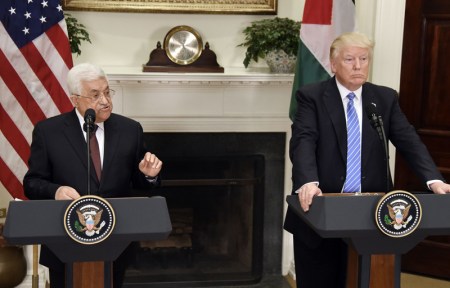
At his scheduled meeting with Palestinian Authority President Mahmoud Abbas in Bethlehem next week, U.S. President Donald Trump might put aside the sweet talk of Abbas, and listen instead for the unsettling truths voiced by other Palestinians such as Hamas and Islamic Jihad. Pictured: Trump and Abbas give a joint statement on May 3, 2017 in Washington, DC. (Image source: Olivier Douliery-Pool/Getty Images)


Ever wonder what fake news is?

May 7, 2017

Ever wonder what fake news is? IsraeliPM via YouTube, May 7, 2017


Abating Abbas

May 4, 2017

Abating Abbas, Power LineScott Johnson, May 4, 2017

Palestinian Arabs lack a civic culture that would support a healthy regime and their political culture is, not surprisingly, sick. On the one hand, we have the colleagues and descendants of Yasser Arafat in Fatah. On the other hand, we have the genocidal maniacs of Hamas. As George Wallace might have put it, there’s not a dime’s worth of difference between them.

Although Fatah and Hamas are themselves profoundly undemocratic, they seem roughly to reflect Palestinian public opinion. Thus the depressing survey data that Daniel Polisar has recounted at Mosaic in recent essays here and here.

Khaled Abu Toameh is the respected Arab Israeli based in Jerusalem (and certainly the bravest journalist I have ever met). As he put it in a column for the Gatestone Institute: “Palestinians: The message remains no and no.”

One symptom of the sickness that permeates their politics: under Palestinian laws passed in 2004 and amended in 2013, Palestinian and Israeli Arabs who are convicted of attacks in Israel (“participation in the struggle against the occupation”) are entitled to monthly “salaries” commencing with their arrest (and continuing for life for men who serve at least five years and women who serve at least two), along with additional cash grants and priority civil-service job placements upon their release.

Thane Rosenbaum summarizes the arrangements in a good Washington Post column:

In this lethal logic, the longer a prison sentence — really, the more deadly an attack — the more profitable the payout. Even toward the lower end of the scale, the salaries are more lucrative than most West Bank jobs. In accordance with Palestinian Authority Government Decision No. 32 of 2010, those imprisoned for three to five years, for instance, get $570 a month. And those committing crimes that result in prison sentences of at least 30 years receive salaries of more than $3,400 a month — 20 times the per capita income in the West Bank. Of course, some prisoners are sentenced to multiple life terms and will never be released. But those who are can expect a lump-sum payment of as much as $25,000 — like a bonus for bad behavior.

Palestinian officials show little compunction defending these practices. Killing Israelis is part of the popular resistance, and those who serve as “martyrs” should be compensated for their sacrifice. A spokesman for the Palestine Liberation Organization’s Commission of Prisoners and Released Prisoners’ Affairs, Hassan Abd Rabbo, said that “it is the right of all of the prisoners and martyrs who have struggled and sacrificed for Palestine to receive their full salaries from the PA.” The Palestinian prime minister, Rami Hamdallah, has stated that inmates are “prisoners of war” and that “their cause is the cause of all of us.”

Rosenbaum’s column goes into more detail on the legal incentives offered for the terrorist murder of Israelis.

What kind of a regime makes such arrangements? It is sick, sick, sick.

Rosenbaum comments: “[I]incentivizing the murder of civilians is barbarism, and it happens to offer a career path for ardent and enterprising Palestinians. The ‘lone wolves’ who perpetrate stabbings, shootings and car-rammings are not really acting alone — they are a people’s army recruited to kill by their government.”

Can we all get along? Answer: no.

Taylor Force is the former U.S. Army officer who was murdered while in a Vanderbilt University tour group last year in Jaffa. The terrorist attack that took his life left 10 others wounded. Rosenbaum’s column supports the Taylor Force Act that would put an end to American foreign supporting the Palestinian murder program. Along with Rosenbaum, Doug Feith and Sander Gerber support adoption of the bill in a NRO column that makes you wonder why it hasn’t happened long before now.

Foreign aid to the Palestinian Authority of course supports the murder program. As it has threatened their funding, Fatah officials have used their creativity to spring to its defense. At Palestinian Media Watch, Itamar Marcus reports: “Fatah is now arguing that donor countries should welcome the PA’s paying salaries to terrorists with their money, since this practice promotes peace by keeping the Palestinian terrorists from joining ‘ISIS or any other extremist party… [We] say to the donor states [whose money goes to terrorists] that your donations help the PA bring peace to the Middle East.’”

The antiwar movement fostered the slogan “kill for peace” as a gibe against the Pentagon back in the day. With a straight Palestinian spokesmen now offer a variant in support of their murder reward law.

UPDATE: As of this morning Itamar Marcus has added more here.

Hamas Wants Quiet As It Prepares For Next Assault on Israel

April 27, 2017

Hamas Wants Quiet As It Prepares For Next Assault on Israel, Investigative Project on Terrorism, Yaakov Lappin, April 27, 2017

In the long run, Sinwar and his regime plan to continue to prepare for the ‘grand’ destiny they have chosen for Gaza. So long as Hamas rules Gaza, it will be the base of unending jihad against Israel, buffered by tactical ceasefires, until conditions are ripe for a new assault.

**************************

Strategically, Hamas remains as committed as ever to its objective of destroying Israel and toppling the Fatah-run Palestinian Authority in the process. Tactically, however, Hamas exhibits pragmatism and won’t rush into wars with Israel when conditions are ill suited.

Hamas looks at the long run, and remains convinced that it can eradicate Israel, even if it takes decades or centuries. Yet it would prefer to bide its time, and build up its force until the next clash while working to decrease its acute regional isolation. For this to happen, Hamas needs to avoid plunging Gaza into a new war any time soon. Yet it remains far from clear that it will be able to do this.

Should a war erupt in the near future, it likely will be triggered by unplanned dynamics of escalation.

Gaza’s woeful living standards and infrastructure are among those factors. Crises such as the ongoing electricity supply problem plaguing the Strip could facilitate an early conflict, as Hamas may try to distract the population’s frustrations from its failings, and divert them to Israel.

The Palestinian Authority (PA) is threatening to make matters worse by cutting off cash for Gaza’s power plant. It’s part of the ongoing feud between the Fatah-run PA in Ramallah and Hamas in Gaza. Gazans now receive electricity only four to six hours a day due to this feud. In January, Gazans took the unprecedented step of protesting power cuts, making Hamas extremely nervous.

In addition to tensions over the electricity crisis, a Hamas-run terror cell could spark conflict if it carries out a mass casualty attack that spawns Israeli retaliation.

The sheer scope of such plots that Israel thwarts every year is enormous.

Last year, 184 shooting attacks, 16 suicide bombings, and 16 kidnapping plots were foiled, Shin Bet chief Nadav Argaman testified last month before the Knesset’s Foreign Affairs and Defense Committee. Hamas had “significantly increased” efforts to pull off attacks in the West Bank and in Israel, he said, adding that Israeli security forces arrested more than 1,000 Hamas members in the West Bank last year and broke up 114 cells.

These are risks Hamas is prepared to take, since the day that it ceases all attempts to carry out jihadist terrorism against Israel is the day that it stops being Hamas.

Yet Hamas is also a government now, and it must consider the Gazans it rules. Hamas is keenly aware of Palestinian sentiment. Its leaders grew up in Gaza’s refugee camps and always have their finger on the pulse of Gazan society.

Hamas leaders seem to understand that the public opposes a new damaging war with Israel. They recognize that the Palestinian public cannot stomach a war with Israel every two years. The reconstruction program in Gaza following the 2014 conflict is far from complete. There are still Gazans whose homes haven’t been repaired from the damage inflicted in 2014.

The general population, despite being exposed to Hamas’s daily propaganda diet of jihadist rhetoric, would likely be reluctant to be again be used as human shields by the military wing, barely three years since the end of the last clash.

The price of Hamas’s policy of embedding its rocket launchers and fighters in Gaza’s civilian areas also is not alluring to many Gazans.

On the flip side, one of Hamas’s worst fears is of being perceived as weak. After one of its senior operatives was mysteriously killed recently, it executed three people it accused of collaborating with Israel.

Hamas also responded to Mazen Fuqaha’s murder by sending threatening messages to Israel promising vengeance. Hamas videos suggest it will target senior Israeli security officials for assassination.

Fuqaha was a key figure in the Izzadin Al-Qassam Brigades, and reportedly in charge of setting up multiple terrorist cells in the West Bank. His bullet-ridden body was found last month outside of his Gazan apartment building.

The Israeli defense establishment takes these Hamas threats seriously. Despite the noise, however, Hamas has not rushed to respond just yet – underlining the fact that Hamas is aware of the restraints factors that it is under.

Since the end of the 2014 war with Israel, the Islamist regime has shied away from escalating the security situation with Israel.

Hamas’s leadership sees unfavorable regional conditions. They lack any powerful regional backer following the 2013 downfall of Muhammad Morsi, the Muslim Brotherhood president in neighboring Egypt, in whom Hamas staked so many of its hopes.

In the past, Hamas enjoyed many partnerships, enjoying arms support and funding from the Shi’ite axis (Iran and Hizballah) – and forming relationships with Sunni powers.

But the Middle Eastern regional upheaval, which pits Sunnis against Shiites, and Islamists against non-Islamists, forced Hamas to make choices. It could no longer be on the same side of both Shi’ite Iran and Sunni Saudi Arabia, who are locked in a transnational proxy war. In the same vein, Hamas cannot be on the same side as both the Assad regime and the Sunni rebels fighting to remove him.

Worst of all from Hamas’s perspective, Morsi’s departure means it cannot rely on its primordial impulse to attach itself to a Sunni Muslim Brotherhood-led backer.

Five years ago, there were initial signs of a regional wave of Muslim Brotherhood successes. The Brothers rose to power in Egypt, Turkey, Tunisia, and had Qatari backing. Morsi’s 2013 fall changed Hamas’s fortunes for the worse. The rise of Egyptian President Abdel Fattah El-Sisi, a leader who identifies Hamas as a Gazan branch of his domestic arch-enemy, the Egyptian Muslim Brotherhood, guaranteed Hamas’s isolation.

Relations with Cairo remain rocky despite recent Hamas attempts to improve ties. Egypt may open its Rafah border crossing a few days a week, but this does not change its core view of Hamas as a true enemy, to be held at bay, weakened, and deterred.

Hamas has also fallen out with Saudi Arabia. And Hamas and Iran do not get along very well either, despite Iran continuing to be the chief sponsor of the military wing, paying it $50-$60 million a year, according to various estimates.

This leaves Hamas with just two stalwart friends: Qatar and Turkey, neither of which can back them substantially. Turkey is not an Arab state, meaning that its role in the Arab world is limited, and its desire to lead the Arab world will always be met with suspicion. A failure by Turkey to infiltrate the region means that it can only do so much to assist Gaza. Qatar, though wealthy, is politically weak, and geographically distant.

New Hamas leader Yihyeh Sinwar, despite his fundamentalist inclinations, must consider these constraints and see that his Islamist-run enclave has little real backing.

To compound its problems, Hamas also has serious financial issues. It has three main sources of income: Donations from states, donations from private individuals, and Hamas’s network of investments.

Hamas gets far less money than it used to from its donors, according to Israeli assessments. Only Qatar and Turkey donate on a regular basis, while Iran continues to finance the military wing, but not the entire movement.

Hamas is a large organization, with operations in the West Bank, Qatar, and Turkey in addition to Gaza. In the Strip, it needs to pay salaries, and prepare for its next clash with Israel. Hamas also seeks to export terrorism to the West Bank and build up political support among West Bank Palestinians. All of this costs money. It is has offices and headquarters in multiple states overseas that require annual budgets.

Private Gulf State donors are drying up. Wealthy Saudis are more interested in supporting Syrian rebels. Hamas’s cause has moved to the back of the line.

Its investments, meant to be saved for a rainy day, now must be tapped.

So what can Hamas do? First and foremost, it continues its domestic military build-up, mass producing rockets, mortar shells, variants of shoulder-fired missiles, drones, and digging tunnels – all at the expense of the welfare of the 2 million Palestinians it rules.

That’s because Hamas drew many operational lessons from its last conflict with Israel, and is keen on rebuilding its terrorist-guerrilla army without interruptions.

One lesson was to focus on a perceived Israeli vulnerability through short-range strikes. To that end, it is building new rockets that carry 200 kilogram warheads – significantly larger than past rockets made in Gaza.

These projectiles are not accurate, but would cause enormous damage if they slammed into a southern Israeli town or village.

Hamas weapons factories produce simple RPGs as well.

Second, Hamas is trying to becoming more ‘acceptable’ to the region and to the world. It is about to unveil a new charter which will be an attempt to obfuscate its jihadist ideological leanings and ties with the Muslim Brotherhood, and present itself as being merely a national “resistance” organization.

In the long run, Sinwar and his regime plan to continue to prepare for the ‘grand’ destiny they have chosen for Gaza. So long as Hamas rules Gaza, it will be the base of unending jihad against Israel, buffered by tactical ceasefires, until conditions are ripe for a new assault.

Yaakov Lappin is a military and strategic affairs correspondent. He also conducts research and analysis for defense think tanks, and is the Israel correspondent for IHS Jane’s Defense Weekly. His book, The Virtual Caliphate, explores the online jihadist presence.

The Agenda for the Trump-Abbas Meeting

April 27, 2017

The Agenda for the Trump-Abbas Meeting, Front Page MagazineCaroline Glick, April 27, 2017

Originally published by the Jerusalem Post

The day after Israel celebrates its 69th Independence Day, US President Donald Trump will greet PLO chief Mahmoud Abbas at the White House. The date of their meeting, May 3, is notable not least for its timing.

The timing of the meeting presumes a linkage between the establishment of Israel and the establishment of a Palestinian state. This is not merely obnoxious, it is also blind to reality.

In reality, an independent state of Palestine has existed for the past 12 years in Gaza. Rather than build that up and declare independence, Abbas and his comrades surrendered Gaza to Hamas in 2007.

Hamas, in turn, transformed independent Palestine into a base for jihad.

Abbas’s failure to declare independence in 2005 – and the subsequent failure of his US-trained forces to defend their control over Gaza in June 2007 from Hamas terrorists – is generally overlooked. But it is critical that Trump understand the significance of his behavior before he meets with Abbas.

Since the inception of the peace process between Israel and the PLO in 1993, the professed goal of the PLO has been to establish an independent Palestinian state on any territory over which it was able to take control from Israel. Yet 12 years ago, when Israel withdrew its citizens and military from Gaza, the PLO refused to take responsibility for the area insisting ridiculously that Gaza was still controlled by Israel.

Then 10 years ago, US-trained PLO forces fled to Israel rather than defend their control of Gaza when Hamas took up arms against them.

There are, it seems, two main reasons for Abbas’s behavior. The first is directly related to how he understood Israel’s decision to withdraw.

In December 2003, then-prime minister Ariel Sharon stunned the country when he adopted the platform of the Labor Party – which he had just massively defeated in the general elections – and removed all Israeli communities and military installations from Gaza, including from the border with Egypt, by the end of 2005.

Israeli society was nearly torn apart in the one year and eight months between Sharon’s surprise announcement and the expulsion of Gaza’s Jews in August 2005. The media hemorrhaged with continuous propaganda that demonized the Israeli residents of Gaza and the religious Zionist community in general.

A reminder of that toxic period came earlier this month, when Haaretz published a column by veteran reporter Yossi Klein in which he alleged that religious Zionists posed a graver danger to the State of Israel than Hezbollah.

Abbas and his lieutenants viewed the domestic chaos that engulfed Israel at the time as proof of Israel being on its way off the stage of history.

If this was how Israelis reacted to the destruction of 21 communities in Gaza (and four in northern Samaria) and the dispossession of 10,000 Israelis, it was clear to Abbas and his comrades that Israeli society would collapse if Sharon carried out his plan to reenact the Gaza withdrawal tenfold in Judea and Samaria after the 2006 elections.

Why accept Gaza if all of Israel was about to be destroyed – by its own hand? The second reason that Abbas didn’t declare independence in Gaza, is because he had no interest in being held accountable for his behavior – as leaders of independent states are. If he accepted sovereign power, then the Palestinians as well as Israel and, presumably, the rest of the world would be able to hold him to account for what happened within the territory he controlled. His ability to blame Israel for his failures would be diminished, at least in theory.

Far better, Abbas concluded, to pretend that Israel’s withdrawal was meaningless and blame Israel for his failure to govern his own territory.

Both reasons for Abbas’s rejection of responsibility over Gaza are important because they also reflect the views of the Palestinians as a whole.

Dan Polisar, from Shalem College, summarized in a recent article in the online magazine Mosaic, his study of more than 400 public opinion surveys of the Palestinians in Judea, Samaria and Gaza taken by professional pollsters over the past 23 years.

Like Abbas in 2005, the overwhelming majority of Palestinians believe that Israel isn’t long for this world.

In one 2011 survey, for instance, a mere 23% of Palestinians said they were certain that Israel will continue to exist 25 years hence. 44% were certain it would not.

The fact that more than three quarters of Palestinians are uncertain if Israel will survive is not only a function of Israel’s own self-destructive behavior – it is premised as well on Palestinian ideology.

The vast majority of Palestinians reject Israel’s right to exist. Indeed, a mere 12% of Palestinians believe that Jews have ties to the land of Israel.

Polisar showed that, whereas a plurality to a bare majority of Palestinians accepts the premise of a twostate solution, the overwhelming majority reject any deal that would leave Israel intact as a viable state capable of defending itself. Equally importantly, 68% of Palestinians believe that even if a Palestinian state is established in Gaza, Judea and Samaria with Jerusalem as its capital, they should continue to aspire to Israel’s destruction.

In other words, even if the PLO signs a deal with Israel that says the conflict has been resolved, for 68% of Palestinians the conflict will continue. They oppose ending the education of their children to seek Israel’s destruction and accepting Israel as a peaceful neighbor.

This then, brings us to Trump’s visit with Abbas, the day after Israel’s 69th birthday.

What does he intend to discuss with Abbas? From media reports, it appears that Trump intends to discuss the Palestinian Authority’s subsidization of terrorism to the tune of $300 million each year, which it pays out as salaries to terrorists in Israeli prisons and as stipends to their families.

In an interview with Sean Hannity on Fox News earlier this week, Prime Minister Binyamin Netanyahu urged Trump to hold Abbas to account for his massive budgetary outlays to terrorists and their families. He asked that Trump demand as well that Abbas stop the PA ’s indoctrination of the Palestinians to seek the annihilation of Israel and the murder of its citizens.

This is well and good. But it seems a bit beside the point. The point is that 69 years ago, the Jews established our state. A Palestinian state was not established then or since, not because Israel was unwilling for such a state to come into being, but because the Palestinians refuse to accept Israel’s right to exist.

If any good is to come from Trump meeting with Abbas – on May 3 or at any other time – then he should send the following message to Abbas and to the rest of the world.

To date, the US has supported the goal of Palestinian statehood, because it convinced itself that the Palestinians were interested in a state that would live at peace with Israel. The US pressured Israel to make concessions to the Palestinians in order to encourage them to accept Israel. And the US funded the PA thinking that doing so would advance the cause of peace. It trained and armed PA security forces for the same reason.

To date, the Palestinians, the PLO and the PA have not lived up to their side of the bargain – on anything.

They have not come to terms with Israel’s existence; they have not abjured terrorism; and they have not accepted responsibility for the areas under their control, either in Gaza, or in Judea and Samaria.

Since his is a new administration, Trump is willing to give Abbas the benefit of the doubt for three months. In that time Abbas needs to stop all financial transfers to terrorists and their families – in and out of prison; he needs to change the names of all the public sites now named after terrorists; and he needs to purge all anti-Jewish content from his PA -controlled media and mosques.

If Abbas fails to do all of these things by August 3, then the Trump administration will abandon its support for Palestinian statehood and its recognition of the PLO .

Threat Assessment in the Domestic War

April 26, 2017

Threat Assessment in the Domestic War, Understanding the Threat, April 24, 2017

(Please see also, PC Pentagon Caves to CAIR, Agrees to ‘Review Anti-Terror Training Program. –DM)

Our federal intelligence and law enforcement officials have little understanding of the jihadi movement, key players, intent, modus operandi, and Islamic doctrine (sharia) driving the movement.  The lack of basic knowledge of this information is staggering.  Local and state officials have relied on DHS and the FBI for their understanding of the threat which is why there is little understanding at the local level as well.

***************************

An objective review of the activities of the Islamic Movement in the United States, the response from US law enforcement and intelligence agencies, and the actions of local, state and federal leaders reveals the U.S. is closer to losing the war domestically than at any point in time since 9/11/2001.

Enemy Forces

The leading Muslim Brotherhood organization in the United States and the “mother ship” of their jihadi Movement – the US Council of Muslim Organizations (USCMO) – hosted their second annual “Advocacy Day” on Capitol Hill on April 18, 2017 continuing it’s overwhelming information operation against the U.S. perpetrating the lie that Islam is here to peacefully coexist with our Constitutional Republic.  This hostile effort continues to produce elected officials willing to help promote the enemy’s agenda instead of doing their legal duty of identifying enemies and defending the Constitution against them.

The Diyanet Center of America, a massive Islamic Center/Mosque complex in Maryland, operates as a base for the Turkish Muslim Brotherhood’s operations with the support of local and state officials there.  The Turkish MB’s influence in the US rivals the Palestinian MB’s (Hamas) presence here.

The Diyanet Turkish Islamic Center of America in Maryland

The Turkish MB is continuing its info op on state legislators by paying for trips to Turkey to show the lawmakers it is a moderate” nation.  Groups like “The Holy Dove Foundation” and the “Turquoise Foundation” propagate this dangerous operation.

The most prominent Islamic organizations in the United States are a part of the Muslim Brotherhood’s network whose stated objective is to wage “civilization jihad” to establish an Islamic state under sharia (Islamic law).  Many of these organizations currently work with the U.S. government, including the USCMO, Islamic Society of North America (ISNA), Muslim American Society (MAS), Muslim Public Affairs Council (MPAC), Islamic Circle of North America (ICNA), Muslim Legal Fund of America (MFLA), Muslim Advocates, Muslim Students Association (MSA), Hamas (doing business as CAIR), and many others.  The Muslim Brotherhood’s logistics and support network here is significant and they have penetrated all national agencies, have a broad plan and activities inside key U.S. infrastructure nodes, and control the U.S. national security decision-making process as it relates to Islamic jihad.

Anti-American hate groups like the Southern Poverty Law Center (SPLC), American Civil Liberties Union (ACLU), and much of the media provide direct and aggressive support for these jihadi (“terrorist”) organizations.  Much of the media has demonstrated no interest in doing investigative journalism on these matters, and simply regurgitates whatever information the suit-wearing jihadi groups give them.

Preparations for War:  The USCMO is over-seeing the national coalescing of Islamic forces from individual mosques through regional councils to the USCMO leadership.  The USCMO is solidifying communications and logistics coordination as well as assisting in preparations for confrontation.  Mosques/Islamic Centers are organizing for armed confrontation with law enforcement, shoring up physical defenses where they see likely confrontation and increasing their pre-attack surveillances of churches and other targets.

Funding:  Nearly 16 years after 9/11, the U.S. government still views the government of Saudi Arabia as an ally in the war, despite the fact it has been implicated time and again in funding the global jihad against the West and, specifically, the United States.  Massive funding for Hamas and Hizbollah – both of which have a heavy presence in the U.S. – comes from Iran, and intelligence officials now believe the leader of Al Qaeda, Ayman al Zawahiri, is being shielded by the Pakistani government in Karachi.  Pakistan is another U.S. “ally.”

Our leaders still believe they can use “moderate” muslim leaders to help America find it’s way to victory – a foolish and increasingly dangerous path.

“Friendly” Forces

The impact of the enemy’s information campaign (propaganda) is significant.  The recent jihadi incident in Sioux Falls, South Dakota sums up this entire war.

A sharia adherent jihadi – Ehab Jaber – went to a Christian event, filmed it live on Facebook, brandished weapons on video saying the crowd should be “terrified” and posted a number of other videos clearly indicating he had intent and desire to do harm to those who conflict with Islam.  Law enforcement officials and prosecutors refused to take any action and even publicly said the perpetrator broke no laws.  According to one state legislator, the Attorney General of South Dakota refused to push for a prosecution in this matter.

When massive public pressure came after the story gained international prominence last week, a SWAT team from Siuox Falls arrested Jaber last Friday (April 21).  The South Dakota Attorney General is now taking credit for this effort.

Updates on the Sioux Falls story can be followed HERE.

Our federal intelligence and law enforcement officials have little understanding of the jihadi movement, key players, intent, modus operandi, and Islamic doctrine (sharia) driving the movement.  The lack of basic knowledge of this information is staggering.  Local and state officials have relied on DHS and the FBI for their understanding of the threat which is why there is little understanding at the local level as well.

A Solution

UTT’s experience is that none of the law enforcement professionals, military, and intelligence analysts UTT trains have ever heard the information laid out in UTT’s 3-day “Understanding and Investigating the Jihadi Network” program, yet all of them state the information is “critical” to protecting their communities.

The enemy situation represents an insurgency in the United States.  Doctrinally, the response must be a counter-insurgency strategy.  In a counter-insurgency, the focus of effort is at the local level.  This is why the strategy for victory must be local police and citizens who understand the threat and have the courage to engage and defeat it.

This requires police be trained to understand and investigate the threat, and citizens be given the knowledge to support their police in aggressively taking care of the enemy in their communities.

UTT remains the only organization in America providing the training to do this and provide law enforcement with the tools they need to proactively find jihadis (“terrorists”), map out the jihadi network, and develop aggressive and innovative counter-strategies at the local and state level.

Citizens must move to get the attention of their sheriffs and pastors and organize to defend their communities.

Some content on this page was disabled on April 24, 2020 as a result of a DMCA takedown notice from Hassan Haji. You can learn more about the DMCA here:

https://wordpress.com/support/copyright-and-the-dmca/

Towards the pending Abbas visit to Washington D.C.

April 19, 2017

Towards the pending Abbas visit to Washington D.C., Israel National News, David Bedein, April 17, 2017

(Please see also, UNRWA Won’t Be Changing School Textbooks and Curriculum. — DM)

With President Donald Trump set to greet Mahmoud Abbas, head of the Palestinian Authority, at the White House on May 3rd, the time has come to examine how the US allowed the PLO to  trample upon ten US government PLO policy guidelines, and to examine what the current US administration can do to see to it that the PLO does not trample on Trump.

The US recognized the PLO during  the final month of the Reagan administration December 1988, on the condition that the PLO would recognize UN resolution 242, which required the PLO to  recognize the right of every nation to secure boundaries  – especially Israel . The PLO immediately ignored this requirements for US recognition.

It is not too late for the US to ask the PLO, under the aegis of the Palestinian Authority, to recognize UN resolution 242, which it has yet to do.

The US acted as  a witness and guarantor of the PLO/Israel Oslo Accords, signed on the White House lawn on September 13, 1993. Known as the DOP, “The Declaration of Principles”, it spelled out mutual recognition of Israel and the PLO, and the formal denunciation of violence and terror. The DOP was premised on its ratification by the Israeli Knesset and by the central committee of the PLO. The Israeli Knesset ratified the DOP on Sept, 26, 1993, by a vote of 61 to 50, with nine abstentions. The PLO central committee was set to meet in Tunis to ratify the DOP on October 6, 1993. However, the one Israeli correspondent dispatched to Tunis to witness the PLO ratification, Pinhas Inbari, on the staff of the left wing newspaper Al HaMishmar, reported from Tunis that the PLO chairman announced that he could not get a quorum of the PLO to attend, so the PLO Central Committee did not convene to ratify the DOP.

It is not too late for the US, as witness and guarantor of the Oslo Accord, to insist the PLO, through the aegis of the PA, ratify the DOP.  Otherwise, the agreement between Israel and the PLO does not hold water.

US law allowed the PLO, all of whose components were designated by the US law as FTOs, Foreign Terrorist Organizations, to open an embassy in D.C. and allowed the PLO to dispatch representatives to the USA, but only if PLO would cancel the PLO Covenant, the document which defined the purpose of the PLO:  To replace and destroy the State of Israel. The PNC, the PLO National Council, met in special session on April 24, 1996, with the stated purpose that this session would renounce and cancel the PLO Covenant. The PLO, at that session, filmed by the Institute for Peace Education Ltd, only announced the formation of a committee to consider changes in the PLO Covenant.

A video and protocol of the session was sent to the US embassy in Tel Aviv, and to the US Congress. Prof. Yehoshua Porat, expert on the PLO and a candidate of  the left wing Meretz party for the Knesset, reviewed the video and protocols of the PNC session, and affirmed that the PLO had not cancelled the PLO Covenant.  The US embassy in Tel Aviv, however, ignored what had actually transpired at the PNC, and instead reported to the White House and to the US Congress that the PLO had fulfilled the requirements of US law with the cancellation of the PLO Covenant, allowing the US to roll out a red carpet to welcome PLO chairman Yassir Arafat as a dignitary in Washington one week later. The PLO was allowed to open an official embassy , which has functioned ever since, conditional on the US President signing a waiver every six months which extends the non- terror status of the PLO.

It is not too late for the US to insist the head of the PLO and the Palestinian Authority call the PNC into a special session to cancel the PLO covenant, as required by US law, before Abbas enters the White House on May 3rd, 2017.  Otherwise, the entry of Abbas to the US represents a challenge to US law.

As an integral part of the US Aid package to the Palestinian Authority, the US funds PA schools which instituted a war education curriculum, despite US objections. That PA curriculum does not prepare Palestinian Arab children to live in state alongside Israel. That curriculum indoctrinates all Palestinian Arab children to conduct a Jihad to liberate Palestine, all of what they considere Palestine, with no attempt to train the next generation for peace with Israel.

It is not too late for the US to demand an overhaul of PA education to prepare the next generation for peace.

US law forbids any agency that receives funds from the US from placing members of a designate FTO  – a foreign terrorist organization — on the payroll of  a US government funded entity. Yet the US funded UNRWA schools, which openly employ members and even leaders of HAMAS, putting them on the payroll. UNRWA, which now receives $400 million of its 1.2 billion dollar budget from the US, has ignored US directives to remove Hamas from the UNRWA  payroll.  And when UNRWA has removed some Hamas leaders from the UNRWA payroll, they simple return as senior employees  of UNRWA.

It is not too late for the US, as the leading donor of UNRWA, to insist that UNRWA fire members and leaders of Hamas who receive salaries from UNWRA – especially Hamas teachers, who dominate the Gaza UNRWA teachers union. Elections are imminent.

It is not too late for the US to reverse its decision to force Hamas into the PA electoral process.

The US helped to create the  PSF, the Palestinian Security Force of the Palestinian Authority. However, the US embassy and US State department have ignored all inquiries challenging the PSF inclusion of Palestinian terror organizations which have never demonstrated any peaceful intentions, to say the least.

It is not too late for the US to ask the PSF to remove  Palestinian terror groups from its ranks.

The US enacted the  Koby Mandell act which requires the US to pursue and prosecute thoe who maim or kill US citizens abroad. Until the inauguration of President Trump, the US would not enforce the act concerning American citizens attacked  in Israel by terrorists. The new Trump administration has begun to file indictments of terrorists who murdered US citizens in Israel.

It is not too late, Trump has demonstrated, for the US government to enforce the Koby Mandell act.

The US established an office in the US State Department to monitor anti Semitism in 2008. However, that office has  refused to examine PA anti-Semitism. While there are rumors that Trump will not renew funding for the US office that tracks anti-Semitism, it is not too late for the US to examine the tentacles of official Palestinian Authority ant-Semitism which can be tracked world- wide.

The US created a special commission to form a Palestinian Authority constitution. However, the Papal Nuncio, Archbishop Pietro Sambi , the late Vatican official who examined the draft of the proposed PA constitution, and reported to the US, wrote  that the current PA constitution, which would form the basis of PA law in a Palestinian Arab state, does not allow for any  juridical status of  any religion other than Islam. Futhermore,  the Papal Nuncio  warned that the proposed US-funded PA constitution was  based on the strict Sharia law used in Saudi Arabia, and not on a more tolerant Sharia law that Archbishop Sambi had witnessed in  his earlier postings in Indonesia and Bangladesh.

It is not too late for the US government to reconsider the nature of jurisprudence that would exist in any kind of future Palestinian Arab entity.