Posted tagged ‘Hamas’

UN aid worker in Gaza accused of helping Hamas

August 9, 2016

UN aid worker in Gaza accused of helping Hamas, Israel Hayom, Lilach Shoval and Daniel Siryoti, August 9, 2016

U.N. Development Program aid worker Wahid Abdullah Burash accused of using his position to help Hamas operatives hide weapons and tunnels, and preferring projects that benefit Hamas • Burash is second aid worker to be charged with assisting Hamas in span of a week.

helper

For the second time in one week, an international aid worker in the Gaza Strip has been accused of providing assistance to terrorist organization Hamas.

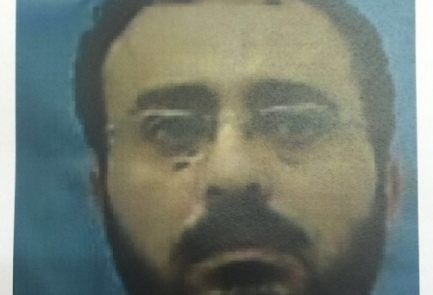
The Shin Bet security agency and Israel Police lifted a gag order Tuesday, revealing that a United Nations aid worker from Jabalia, 38-year-old Wahid Abdullah Burash, was arrested last month on suspicion that he was using his job at the U.N. Development Program to assist in Hamas operations. An indictment was filed against Burash at the Beersheba District Court, charging him with aiding the Gazan terrorist group.

The announcement comes less than a week after World Vision employee Mohammad Halabi was accused of funneling some $50 million in charity funds to Hamas.

The UNDP works to rehabilitate and develop infrastructure, including damaged homes, in the Gaza Strip to improve the lives of local residents. Burash has worked as an engineer at the program since 2003. As part of his work, he was responsible for demolishing homes damaged in military clashes and removing waste from the demolition sites.

The Shin Bet investigation revealed that in 2014, Burash was instructed by a senior Hamas official to carry out his work in a manner that would provide maximum benefit for Hamas. In 2015, he used UNDP resources to build a marine dock for the use of Hamas’ military wing in northern Gaza.

It was further revealed that throughout 2015, Burash, acting on Hamas orders, worked with his superiors to give preference to rehabilitation projects in areas where Hamas operatives live.

The investigation also found that Hamas deliberately exploited UNDP projects throughout 2015. Weapons and terror tunnel shafts were found in homes that had been rebuilt by the UNDP and taken over by Hamas. This violates U.N. protocol, according to which all explosives and weapons must be reported to the United Nations Mine Action Service.

Investigators learned that other Hamas operatives are embedded in a variety of humanitarian aid organizations in Gaza. Burash also revealed information about Hamas storehouses, outposts and tunnels that he had learned about in his work.

Hamas vehemently denied the charges brought against Burash. Hamas spokesman Sami Abu Zuhri said, “The accusations are baseless and false, and they are part of the Zionist occupation’s attempt to worsen the siege on Gaza by persecuting international aid organizations.”

The truth about humanitarian aid

August 7, 2016

The truth about humanitarian aid, Israel Hayom, Ariel Bolstein, August 7, 2016

The reports surrounding the arrest of Mohammad Halabi, director of the Gaza branch of the humanitarian organization World Vision, have sent shockwaves throughout the globe. This is a well-known, worldwide charity organization — one of the world’s largest in fact — that purports to help third world children.

As it turns out, when it comes to the Gaza Strip, the money donated by charitable individuals in Europe, Australia and the U.S. went mainly to help Hamas’ military wing. Among other things, the money was used toward purchasing weapons in Sinai, digging attack tunnels and paying the salaries of terrorists and their families.

The Hamas murderers did not stop there. They accepted thousands of food packages as well as other supplies intended for the poor. When devout Christian worshippers in churches across the U.S. donated a dollar or two to “those poor children,” the smiling faces on the receiving end were Hamas terrorists in Gaza.

More than half of the organization’s annual aid budget was funneled directly to Hamas. In total , the terror organization received between 40-50 million dollars and this may just be the tip of the iceberg, as there are other humanitarian groups that have poured tremendous amounts of money into these black holes referred to at times as “rehabilitation of Gaza” and “assistance to the Palestinians.”

For years, World Vision members, including senior officials, contributed to anti-Israel efforts. Time and again they have taken advantage of every possible forum to portray Israel as the culprit behind the suffering of Palestinian children. Never ones to be confused by the facts, they neglected to mention that they knew very well that Hamas was using the civilian population of Gaza as human shields, launching rockets at Israel from residential neighborhoods and storing weapons at schools.

Not a word of condemnation for Hamas was ever heard. But with respect to Israel, it has been a festival of lies and false accusations. In 2012, for example, the president of World Vision in the U.S. claimed that Israel had prohibited Christian from Judea and Samaria as well as Gaza from celebrating Easter in Jerusalem. The allegation was completely false (that year Israel granted more than 20,000 permits to travel to Jerusalem for Easter, far more than were requested). Still, the irreparable damage to Israel’s reputation in the eyes of the Christian world was done.

And if that wasn’t bad enough, World Vision has contributed extensively to other anti-Israel endeavors in the years since. For instance, the organization bankrolled a program called “Christ at the Checkpoint,” which aimed to portray Israel to American Christians as the embodiment of all evil. The program appealed to this audience’s most basic emotions: they were asked to imagine Jesus himself being harassed by Israeli soldiers at a border checkpoint. This was, in fact, anti-Semitism of the worst order, playing into the idea that the Jews abused the son of God and now they are abusing other poor souls.

In fact, a large portion of the funding that goes into the Boycott, Divestment and Sanctions movement actually comes from innocent donors, who are certain their donations are going toward saving lives in developing countries somewhere in Asia or Africa.

Sadly, World Vision is not the only charity organization that has been dragged into the anti-Israel efforts. Other organizations, such as Human Rights Watch and Amnesty International, have also fallen into the same trap.

All this is happening in a world where there are tens of millions of people who really need charitable assistance, with tens of millions of people in the West who are willing to donate generously to help worthy causes, or so they believe. These kind, naïve donors, are being taken advantage of every day in the most awful of ways.

Senior aid worker said to funnel ‘tens of millions’ to Hamas

August 4, 2016

Senior aid worker said to funnel ‘tens of millions’ to Hamas World Vision denies its Gaza chief diverted 60% of his budget to the terror group, which allegedly used the cash to finance weapons, tunnels

By Judah Ari Gross

August 4, 2016, 3:13 pm

Source: Senior aid worker said to funnel ‘tens of millions’ to Hamas | The Times of Israel

Over the course of several years, the Hamas terrorist organization siphoned off “tens of millions of dollars” from the US-based World Vision charity for its military wing, the Shin Bet security service said Thursday.

Muhammad Halabi, a Hamas member and manager of operations for World Vision in Gaza, was indicted in a Beersheba court on Thursday for his role in the alleged scheme. He was arrested in a joint Shin Bet-IDF-Israel Police operation at the Erez Crossing on June 15 as he tried to return to the Strip, the Shin Bet said.

Halabi, a member of Hamas from a young age, was handpicked to infiltrate the international charity in 2005 in order to steal money for the terrorist organization, according to the investigation.

“This was a meaningful and important investigation that showed — above all — the cynical and crude way in which Hamas takes advantage of funds and resources from international humanitarian aid organizations,” the Shin Bet said in a statement.

Muhammad Halabi, a member of Hamas and manager of the World Vision charity's operations in the Gaza Strip, was indicted on August 4, 2016, for diverting the charity's funds to the terrorist organization. (Shin Bet)

Muhammad Halabi, a member of Hamas and manager of the World Vision charity’s operations in the Gaza Strip, was indicted on August 4, 2016, for diverting the charity’s funds to the terrorist organization. (Shin Bet)

In a statement released following the indictment, World Vision defended Halabi and denied the allegations against him.

“Based on the information available to us at this time, we have no reason to believe that the allegations are true. We will carefully review any evidence presented to us and will take appropriate actions based on that evidence,” the group wrote.

After rising through the ranks of World Vision, Halabi became the manager of World Vision’s activities in the Gaza Strip. “In that capacity he controlled the budget, equipment and humanitarian aid packages worth tens of millions of dollars,” the Shin Bet said.

There he was able to funnel approximately “60 percent of World Vision’s annual budget for the Gaza Strip to Hamas,” according to his testimony, which amounted to approximately $7.2 million every year.

This was mostly commonly done by Halabi offering fake tenders for work. “The ‘winning’ company was aware that 60% of the project’s funds were bound for Hamas,” the Shin Bet said.

Approximately 40 percent of World Vision’s funds for civilian projects — $1.5 million a year — was also given to Hamas battalions in cash, according to the Shin Bet, along with approximately $4 million a year that was designated for helping the needy.

A Palestinian boy looks from his family's destroyed house at workers rebuilding a house which was destroyed during last summer's war between Israel and Hamas, as the long-awaited reconstruction began in the Shejaiya neighborhood of eastern Gaza City on Thursday, July 23, 2015. (AP Photo/Khalil Hamra)

A Palestinian boy looks from his family’s destroyed house at workers rebuilding a house which was destroyed during last summer’s war between Israel and Hamas, as the long-awaited reconstruction began in the Shejaiya neighborhood of eastern Gaza City on Thursday, July 23, 2015. (AP Photo/Khalil Hamra)

According to investigators, some of those “fictitious” humanitarian projects included the construction of greenhouses, rejuvenation of agricultural fields, mental and physical health projects, an initiative to assist fishermen, a center for treating the mentally and physically handicapped, and the creation of agricultural organizations.

“These were all used as a pipeline to transfer money to Hamas,” the Shin Bet said.

In those fake programs, the terrorist organization was able to inflate the budgets, claim Hamas operatives as employees and launder money through World Vision, the security service added.

For instance, Halabi would list a parcel of land as costing $1,000 when it in fact cost $700 in order to pocket the extra funds and transfer them to the terrorist group, according to his testimony.

Still from an August 2015 Hamas video purporting to show a Gaza tunnel dug under the Israeli border. (Ynet screenshot)

Still from an August 2015 Hamas video purporting to show a Gaza tunnel dug under the Israeli border. (Ynet screenshot)

According to Halabi’s testimony, the funds that were transferred to Hamas were “earmarked for building up the military wing [of Hamas],” including digging tunnels, purchasing weaponry and building defensive outposts.

Some of the stolen funds were also used to pay the salaries of Hamas operatives. In some cases large sums of money were taken by senior members of the terrorist organization for their “personal needs,” the Shin Bet said.

Through such initiatives, Hamas was also able to purchase otherwise forbidden gear and take advantage of the “logistical assistance” given to the organization.

A Border Crossing Authority inspector discovers a wet suit, believed to be en route to Hamas, hidden in a shipment of sporting goods to the Gaza Strip on June 20, 2016. (screen capture: Defense Ministry)

A Border Crossing Authority inspector discovers a wet suit, believed to be en route to Hamas, hidden in a shipment of sporting goods to the Gaza Strip on June 20, 2016. (screen capture: Defense Ministry)

For instance, the greenhouse construction project allowed the group to scope out suitable digging sites for tunnels, while the nonexistent fishermen assistance program was used to purchase motorboats for smuggling and wetsuits that could be used by Hamas frogmen in attacks against Israel, the Shin Bet said.

In addition to funds and opportunities, Halabi also allegedly stole equipment that had been purchased by World Vision to assist farmers. Instead, the iron, digging tools, pipes and construction materials were used by Hamas for its own purposes.

Some 2,500 cartons of food and 3,300 cartons of cleaning supplies were also stolen from World Vision and given to Hamas fighters, according to the Shin Bet.

Money designated for children injured in conflicts with Israel was instead taken by families of Hamas members who falsely registered their children in the program, the security service said.

Palestinian workers rebuilding a house as reconstruction begins in the Shejaiya neighborhood of Gaza City, July 23, 2015. (AP/Khalil Hamra)

Palestinian workers rebuilding a house as reconstruction begins in the Shejaiya neighborhood of Gaza City, July 23, 2015. (AP/Khalil Hamra)

According to Halabi’s testimony, the humanitarian aid reserved by World Vision for residents of the Gaza Strip was given “almost entirely” to Hamas operatives and their families.

“This, it must be said, is against the official regulations of humanitarian aid organizations operating in the Gaza Strip,” the Shin Bet said in a statement.

Following the indictment, Israel’s Coordinator of the Government’s Activities in the Territories Maj. Gen. Yoav Mordechai released a statement in Arabic to the people of Gaza, telling them of Halabi’s actions.

“I’m speaking to you today about the Hamas terror organization, which is stealing your money to advance terror. Following a long investigation, we found that Hamas consistently uses funds that Western countries give to international organizations, like the World Vision organization in Gaza,” Mordechai said.

“Millions of dollars that were meant to build projects, support residents financially — even food packages for the needy — were given over to the military wing of Hamas for building bases, for salary bonuses and for digging death tunnels that will bring demolition and destruction upon you and the Gaza Strip,” he told residents of the coastal enclave.

While the general cast the blame on Hamas, Emmanuel Nahshon, a spokesperson for the Foreign Ministry, accused World Vision of being “negligent” in its indirect funding of terrorism.

“World vision int. financed ‘unwittingly’ Hamas terror tunnels. How negligent can you be?! Money for kids used for terror,” Nahshon tweeted after the case was revealed.

Halabi supplied Israeli investigators with additional information about a large number of individuals in the Gaza Strip who take advantage of their work for aid organizations and the United Nations to assist Hamas, the Shin Bet said.

For example, Halabi’s father, Halil, served as head of the United Nation’s school system in the Gaza Strip for years. He too is a member of Hamas and, according to Halabi’s testimony, uses his position to help the terrorist organization.

Goods and medical supplies being transferred to the Gaza Strip through the Kerem Shalom Crossing, July 19, 2014. (IDF Spokesperson's Unit)

Goods and medical supplies being transferred to the Gaza Strip through the Kerem Shalom Crossing, July 19, 2014. (IDF Spokesperson’s Unit)

World Vision is an Evangelical Christian charity created in 1950 that operates in nearly 100 countries worldwide. Today it is one of the largest relief organizations based in the United States, with a budget of approximately $2.6 billion and nearly 50,000 employees. It has operated in Israel, the West Bank and Gaza since the 1970s.

When Halabi was first arrested in June, before charges were brought against him, the charity defended him in a statement.

“[Halabi] is a widely respected and well regarded humanitarian, field manager and trusted colleague of over a decade. He has displayed compassionate leadership on behalf of the children and communities of Gaza through difficult and challenging times, and has always worked diligently and professionally in fulfilling his duties,” the organization said in June.

Odeh Adds Israel-Hating Lawyer, Fights Psych Evaluation

July 29, 2016

Odeh Adds Israel-Hating Lawyer, Fights Psych Evaluation, Investigative Project on Terrorism, July 29, 2016

1087

Editor’s note: For details on the Rasmieh Odeh case and the intense support behind her, see our series, “Spinning a Terrorist Into a Victim,” here.

As she fights to block a psychological examination by a government expert, convicted Palestinian terrorist Rasmieh Odeh added a new member to her defense team, one who shares her intense hatred for Israel.

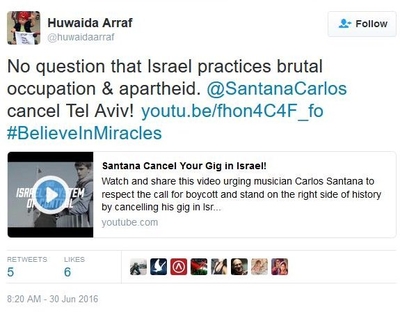
Huwaida Arraf helped organize the 2010 flotilla aimed at breaking Israel’s blockade of Gaza by delivering humanitarian supplies. The blockade was implemented to prevent the Hamas government and other terrorists from smuggling materials that can be used to make bombs and rockets. The flotilla, and similar convoys which claimed to be delivering aid to Palestinians in Gaza, worked closely with Hamas officials in Gaza.

The flotilla ended in a violent confrontation on one ship after passengers attacked Israeli soldiers with knives, pipes and other weapons. Arraf was on a separate ship, but still is suing the Israeli government claiming mistreatment when the flotilla was intercepted. Among the allegations, her handcuffs were too tight.

Odeh, meanwhile, is trying to persuade a federal judge in Detroit to grant her a new trial for naturalization fraud. She was convicted in 2014, but an appeals court ruling could lead to a new trial in which jurors would hear Odeh’s claim that she suffers from Post-Traumatic Stress Disorder (PTSD), supported by her own psychologist’s testimony.

When applying for a visa to come to the United States, and later when she sought naturalization as an American citizen, Odeh failed to disclose her arrest, conviction and 10 year imprisonment in Israel for her role in a lethal 1969 Jerusalem supermarket bombing that killed two college students.

During her trial, immigration officials testified that Odeh never would have been allowed into the United States, let alone granted citizenship, had they been informed of her terrorist history.

Odeh claims the omission was unintentional, the result of PTSD she suffers from due to alleged torture while in Israeli custody. Her confession, she says, also was the result of the alleged torture.

There is no physical evidence for this claim, and it has been contradicted by records created at the time and by Odeh’s own testimony two years ago.

Such testimony was barred during the original trial, but the Sixth Circuit Court of Appeals ruled in February that U.S. District Judge Gershwin A. Drain’s ruling was flawed. The appellate court remanded the case, saying there might be other reasons that are legally valid to exclude the PTSD testimony.

That will be determined at a hearing scheduled for Nov. 27. If Drain rules that the PTSD testimony should be heard, Odeh would get a new trial in January. If not, the conviction stands, pending another likely appeal.

But the judge who must decide whether such testimony is both relevant and valid should rely solely on the defense’s expert, Odeh’s attorneys argued in court papers last week.

Any additional mental evaluation carries “the grave risk … [of] a serious aggravation of her symptoms and the suffering they cause her,” the defense argued.

The government review is described as inherently hostile and “bent on” discrediting Odeh. This, the defense reply says, “will plunge [Odeh] to the depths of ghastly ‘flashback’ memories which have afflicted her life for all these years…”

The one opinion from their own psychologist, they argue, is sufficient.

A second opinion, prosecutors argued in requesting a second opinion, is necessary.

“At present,” they wrote, “the only information the Court has before it is the testimony of the defense expert herself based only on her own examination of the defendant. This Court cannot make an informed decision about the reliability and competence of the defense expert’s conclusions based on that expert’s word alone.”

Arraf is among the attorneys listed on the brief. She formally joined the defense team last week.

1732


1733

She served as interim board chair for the Free Gaza Movement, which advocates for a Palestinian right of return “without delay to their homes in Israel and the occupied Palestinian territories.” Creating such a right would threaten to flood Israel demographically, challenging its existence as a Jewish state.

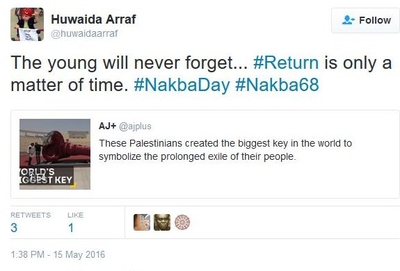
Arraf advocates boycotts against Israel and calls the right of return “a matter of time.”

The flotilla’s objectives and actions were rejected by a United Nations investigative panel. This is striking because of the UN’s willingness to condemn Israel often, while overlooking tremendous human rights abuses elsewhere in the Middle East and throughout the world, including Iran, Saudi Arabia, Syria, China, Russia and more.

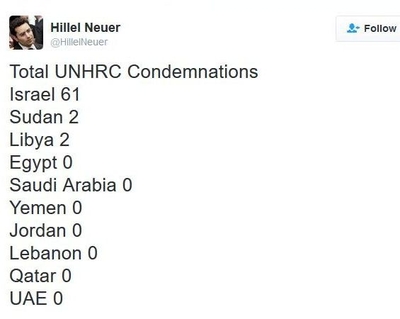
Last year, UN Watch director Hillel Neuer tallied UN condemnations, finding 61 targeting Israel, while the rest of the world garnered only 55 such statements.

1737

In its report on the 2010 flotilla, the UN found that the six ships involved carried very little actual humanitarian aid supplies. “The number of journalists embarked on the ships gives further power to the conclusion that the flotilla’s primary purpose was to generate publicity,” it said.

In addition, “the flotilla rejected offers to unload any essential humanitarian supplies at other ports and have them delivered to Gaza by land. These offers were made even during the voyage.” Investigators found evidence that Hamas planned a reception for the flotilla.

In her lawsuit against the Israeli government, Arraf alleges she was “arbitrarily detained and forced to adopt a kneeling position while being hooded for an extended period of time and placed in handcuffs that were too tight.”

The UN report, however, called it “a dangerous and reckless act” to “deliberately seek to breach a blockade in a convoy with a large number of passengers.”

Worse for flotilla advocates, the UN acknowledged that “Israel faces a real threat to its security from militant groups in Gaza. The naval blockade was imposed as a legitimate security measure in order to prevent weapons from entering Gaza by sea and its implementation complied with the requirements of international law.”

That threat endures, as Hamas openly digs as many attack tunnels along its border with Israel as it can, at the cost of diverting materials that could be used to build housing for Palestinians and restore its crumbling infrastructure.

Arraf’s lawsuit claims the blockade is illegal despite the UN finding to the contrary.

Now she’s helping Odeh, convicted of killing two Israelis and more recently convicted of lying about it to U.S. immigration officials, argue that a wholly unsubstantiated claim – Odeh’s supposed torture in Israeli custody and resulting PTSD – should be accepted by the court and presented to a jury unchecked.

Prosecutors describe Odeh “as the principal architect” of the 1969 bombing which killed students Leon Kanner and Edward Joffe. And Odeh’s statements over time contradict the current defense claim that she is emotionally incapable of discussing it.

In her first trial, and in a 2004 documentary, Odeh presented dramatically different stories about the 1969 terrorist bombing, her role in it and her ability to remember it.

Naturalization forms ask whether the applicant has ever been arrested, convicted or imprisoned. The word “ever” is set off in bold, upper-cased letters. Barred by court rulings against invoking the PTSD claim, Odeh testified that she thought the word “ever” applied only to her life in the United States, and not before.  Had she understood the questions better, she would not have hesitated to mention her Israeli record.

“It’s not [a] secret that I have been in the jail,” she testified. “Everybody knows.”

And while she says she has difficulty thinking about that trauma, she claims specific memory of her naturalization interview more than a decade ago.

The immigration official who interviewed Odeh testified that she clarifies for all applicants that the question applies to “anywhere in the world.” Odeh insisted she remembered the interview and this did not happen in her case.

She is equally adamant in claiming she is not guilty of the terrorist bombing. But in the documentary, which came out the same year Odeh applied for naturalization and claimed to have no arrest record, she visited with a co-conspirator in the 1969 Supersol bombing. Odeh sat and listened as her friend said it was Rasmieh who “dragged me into military work” and who was more involved than I was” in the grocery store bombing.

She described scouting the targeted supermarket in terms that matched the confession given to Israeli authorities. That confession, Cornell University Law Professor William Jacobson first noted, came a day after her arrest, long before the abuse she now alleges took place. Odeh says she broke after 25 days of torture.

But given the chance to make a torture allegation in 1969, Odeh’s father had little to say. An American consulate official who met with him while she was in custody reported “uncomfortable, overcrowded jail conditions, but he apparently [is] receiving no rpt [repeat] no worse than standard treatment afforded majority detainees at Jerusalem jail.”

In addition, Odeh discussed her role in the Supersol bombing, and in a second bombing at the British Consulate that caused only property damage, in a 1980 Journal of Palestine Studies article that remains online.

1736

“Actually we placed two bombs,” she said, “the first was found before it went off so we placed another.”

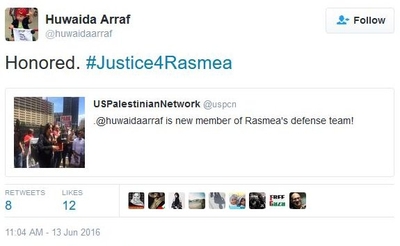
Arraf posted on Twitter that she is “honored” to defend someone who killed two Israelis. That’s not surprising.

Hamas ready to pounce on weak Fatah in local elections, experts say

July 28, 2016

Hamas ready to pounce on weak Fatah in local elections, experts say Gaza-ruling terror group now says it will take part in vote set for October; after all, it has won the only two major elections in which it ever competed

By Dov Lieber

July 28, 2016, 2:52 pm

Source: Hamas ready to pounce on weak Fatah in local elections, experts say | The Times of Israel

The Hamas terror group in control of the Gaza Strip is poised to make a power play using one of its most potent weapons — the ballot box.

In 2012, the hardline Islamist group boycotted municipal elections over allegations of intimidation and corruption in the West Bank by its political rival Fatah, which dominates the Palestinian Authority. Since then, the two major Palestinian parties have remained in a state of cold war.

 Despite these ongoing tensions, Hamas surprised many by agreeing recently to participate in municipal elections across the Palestinian territories slated for October 8.

Experts told The Times of Israel that Hamas likely ended its boycott of the vote because the group sees an opportunity to gain legitimacy by beating a weak opponent — the aging and unpopular Palestinian Authority President Mahmoud Abbas and his divided Fatah party.

Hamas is also in a state of political isolation after losing the support of its important Sunni state backers, Egypt, Jordan and Saudi Arabia, and to some extent Turkey after Ankara and Jerusalem recently mended relations. The ballot box, one Israeli expert argued, is a way the group can take control of its own destiny, while a well-known Palestinian scholar hypothesized secret and unprecedented coordination between the Islamists and Fatah.

Palestinian security officers wait to cast their early votes during local elections at a polling station in the West Bank town of Jenin on Thursday. Members of Palestinian security forces cast an early vote ahead of local elections, which are taking place Saturday, in the first such polls since 2006.(photo credit: AP Photo/Mohammed Ballas)

Palestinian security officers wait to cast their early votes during local elections at a polling station in the West Bank town of Jenin on Thursday. Members of Palestinian security forces cast an early vote ahead of local elections, which are taking place Saturday, in the first such polls since 2006. (AP Photo/Mohammed Ballas)

Hamas has won the only two elections it ever ran in — the 2005 municipal elections and the 2006 legislative elections, which resulted in a war between Hamas and Fatah. But since Hamas’s last democratic victory, 10 years have passed.

“It’s almost obvious why Hamas decided to participate in the upcoming elections,” Prof. Shaul Mishal, head of the Middle East program at the Interdisciplinary Center in Herzliya (IDC), told The Times of Israel.

“If you look back at what happened during the election in 2006, Hamas believes that’s the best way to gain status and strength within the Palestinian population of the West Bank. They want to extend their influence to where the heart of the Palestinian issue is,” he said.

In 2006, Hamas won nearly all the electoral districts in the West Bank and in Gaza.

Mishal believes Hamas sees an opportunity to take advantage of Abbas’s current weakness. The PA leader is 81-years-old and is reportedly not in good health. Polls show a majority of Palestinians want him to resign.

Prof. Shaul Mishal (Courtesy)

Prof. Shaul Mishal (Courtesy)

“This is Hamas’s opportunity to ensure they will be part and parcel of any future political process,” Mishal said.

He added that Hamas has reached such a point of political isolation that “the only way to strengthen their position with the public is to run in this election.” He argues Hamas’s success in the past and its likely success in the upcoming election has much to do with its nature as an Islamist movement.

“Hamas is a party of the people, putting its efforts into working with the communities on the ground… first and foremost, they are an Islamist social group: they focus on social services, social welfare and working with the needy, especially in places where the central government might not reach,” Mishal said.

In an indication of Hamas’s likely victory in the upcoming elections, the Islamist movement has for the past two years won the contest considered the best barometer of Palestinian public opinion — student elections at Birzeit University. Birzeit is the oldest Palestinian university, considered a liberal outpost and a historic stronghold for Fatah and the PA.

“The young generation is more pro-Hamas. From experience, the student elections tend to be quite accurate,” Mishal said.

Palestinian students who support the Hamas movement take part in an election campaign rally for the student council at Birzeit University, near the West Bank city of Ramallah on April 26, 2016 (AFP/Abbas Momani)

Palestinian students who support the Hamas movement take part in an election campaign rally for the student council at Birzeit University, near the West Bank city of Ramallah on April 26, 2016 (AFP/Abbas Momani)

With the odds stacked against it, the Israeli professor believes Fatah may try to wiggle out of having the elections.

“It all depends on one man: Abu Mazen (Abbas). He can find ways to bypass the declaration. He may substitute it with something more dramatic, such as negotiations over the Arab Peace Initiative,” he said, referring to the 2002 offer to the Jewish state for full diplomatic ties with 57 Arab and Muslim countries after cementing a peace accord with the Palestinians.

The Arab Peace Initiative has come to the forefront in the past few months, with both Arab and Israeli statesmen discussing the plan.

Khalil Shikaki, the Director of the Palestinian Center for Policy and Survey Research at his office in Ramallah, June 14, 2011 (photo credit: Yossi Zamir/Flash90)

Khalil Shikaki, the Director of the Palestinian Center for Policy and Survey Research at his office in Ramallah, June 14, 2011 (Yossi Zamir/Flash90)

“My guess,” said Dr. Khalil Shikaki, a Palestinian political scientist and well-regarded pollster, “is that Hamas has agreed [to the elections] because Abbas, without publicly admitting it, has agreed that local elections in the Gaza Strip can take place fully under Hamas’s security and administrative control.”

Shikaki called the possible coordination “the most visible PA acknowledgment of the legitimacy of Hamas’s control in the Gaza Strip since Hamas’s takeover in June 2007.”

“At this stage,” Shikaki continued, “Hamas seems to care more about maintaining control over the Strip than extending its influence into the West Bank.”

The Palestinian political scientist did, however, offer a second theory similar to Mishal’s.

“Hamas might think that given Fatah’s fragmentation, particularly in the Gaza Strip, the outcome of elections will demonstrate the Islamist group’s ascendance and popularity despite the blockade and siege imposed by Israel and Egypt, thus strengthening further its legitimacy,” Shikaki said.

Israel imposed a land and sea blockade on the Strip, designed to prevent the terror group from importing weapons, after Hamas seized power there in a bloody 2007 coup, which saw Abbas’s Fatah movement ousted from Gaza.

The upcoming elections are slated to be held in 416 townships and village councils; 25 are located in Gaza and the other 391 in the West Bank. If the election does take place, it will be the largest municipal elections held by the Palestinians in their history.

Clinton VP tapped pro-terror Muslim leader for immigration seat

July 25, 2016

Clinton VP tapped pro-terror Muslim leader for immigration seat, Israel National News, David Rosenberg, July 25, 2016

(Please see also, Clinton VP Pick Tim Kaine’s Islamist Ties. — DM)

Kaine and his administration initially brushed off the criticism as mere Islamophobia.

Yet Omeish’s ties to terror and explicit support for violent Jihad quickly became apparent, ultimately leading Kaine to pressure Omeish to step down.

**************************

Virginia Senator and former Governor Tim Kaine has been the Democratic Party’s presumptive Vice Presidential nominee for just three days, yet the pick has already drawn fire from the pro-Israel community due in part to Kaine’s robust support for the Iran nuclear deal, his boycott of Israeli Prime Minister Binyamin Netanyahu’s address to Congress in 2015, and his ties to a left-wing NGO.

Now, a controversial appointment made during his tenure as Governor of Virginia has raised new questions about Kaine’s bona fides as a self-described “strongly pro-Israel Democrat”.

In 2007, then-Governor Kaine appointed Esam Omeish, a Libyan-born physician and then-president of the Muslim American Society, to Virginia’s Immigration Commission. This came despite Omeish’s history of ties and expressions of support for radical Islam and Jihadist terrorism.

Omeish is a long-time member of the Board of Directors of the Dar Al Hijrah mosque, which two of the 19 terrorists responsible for the 9/11 terror attacks attended, as friends of the mosque’s imam.

That imam was Anwar al-Awlaki, the radical Salafist cleric who later fled the United States and joined Al-Qaeda, after settling in Yemen.

In 2010, President Obama placed al-Awlaki on the CIA “kill list”, citing his orchestration of deadly terror attacks against Americans. In 2011 a US drone strike killed al-Awlaki in southeast Yemen.

But Omeish was not merely a congregant at the Dar Al Hijrah mosque where al-Awlaki preached; in 2000, he was vice president of the mosque and was responsible for vetting and hiring the radical cleric as the mosque’s imam.

The Muslim American Society, then headed by Omeish, had close ties to the Muslim Brotherhood, the Chicago Tribune reported in 2004, a description later validated by a federal report describing the group as “the overt arm of the Muslim Brotherhood in America.”

In addition to Omeish’s ties to radical Islam, his recorded comments prior to the 2007 appointment by Governor Kaine made his support for Jihadist terror even more explicit.

During a December 22, 2000 speech at a Jerusalem Day Rally in Lafayette Park, in Washington D.C., Omeish praised “the Jihad way” to “liberate your land”.

“We, the Muslims of the Washington metropolitan area, are here today in subfreezing temperatures to tell our brothers and sisters in Filastine [Palestine], that you have learned the way, that you have known that the Jihad way is the way to liberate your land. And we, by standing here today, despite the weather, and despite anything else, we are telling them that we are with you, we are supporting you, and we will do everything we can inshallah [Allah willing] to help your cause.”

In 2004, Omeish explicitly praised Hamas leader Sheikh Ahmed Yassin.

Governor Kaine’s selection of Omeish was criticized by state Republicans, who said the governor had failed to properly vet the appointee.

C. Todd Gilbert, a Republican delegate from Shenandoah County, wrote to the governor, noting the Muslim American Society’s “questionable origins”.

“I don’t know how a problem of this magnitude could have slipped through the Governor’s screening process,” Gilbert later said in a statement. “Even a cursory internet search about the appointee in question would have also easily identified him as a leader of a potentially radical northern Virginia mosque.”

Kaine and his administration initially brushed off the criticism as mere Islamophobia.

Yet Omeish’s ties to terror and explicit support for violent Jihad quickly became apparent, ultimately leading Kaine to pressure Omeish to step down.


Clinton VP Pick Tim Kaine’s Islamist Ties

July 23, 2016

Clinton VP Pick Tim Kaine’s Islamist Ties, Clarion ProjectRyan Mauro, July 23, 2016

VP islamistPresumptive Democratic candidate for president Hillary Clinton with her choice for vice-president Tim Kaine.

Democratic presidential nominee Hillary Clinton’s newly-announced running mate, Virginia Senator Tim Kaine, has a history of embracing Islamists. He appointed a Hamas supporter to a state immigration commission; spoke at a dinner honoring a Muslim Brotherhood terror suspect and received donations from well-known Islamist groups.


Appointing a Muslim Brotherhood Front Leader Who Supports Hamas

In 2007, Kaine was the Governor of Virginia and, of all people chose Muslim American Society (MAS) President Esam Omeish to the state’s Immigration Commission. A Muslim organization against Islamism criticized the appointment and reckless lack of vetting.

Federal prosecutors said in a 2008 court filing that MAS was “founded as the overt arm of the Muslim Brotherhood in America.” A Chicago Tribune investigation in 2004 confirmed this, as well as MAS’ crafty use of deceptive semantics to appear moderate. Convicted terrorist and admitted U.S. Muslim Brotherhood member Abdurrahman Alamoudi testified in 2012, “Everyone knows that MAS is the Muslim Brotherhood.”

Read our fully-documented profile of MAS here.

According to Omeish’s website, he was also president of the National Muslim Students Association (click there to read our profile about its Muslim Brotherhood origins) and served for two years on the national board of the Islamic Society of North America (ISNA), which the Justice Department also labeled as a U.S. Muslim Brotherhood entity and unindicted co-conspirator in a Hamas-financing trial.

His website says he was the vice president of Dar al-Hijrah Islamic Center, a radical mosque known for its history of terror ties, including having future Al-Qaeda operative Anwar Al-Awlaki as its imam and being frequented by two of the 9/11 hijackers and Nidal Hasan, the perpetrator of the Fort Hood shooting. Omeish’s website says he remains a board member.

Omeish’s website also says he was chairman of the board of Islamic American University, which had Hamas financier and Muslim Brotherhood spiritual leader Yousef Al-Qaradawi chairman of its board until at least 2006.

Omeish was also chairman of the board for the Islamic Center of Passaic County, a New Jersey mosque with heavy terrorist ties and an imam that the Department of Homeland Security wants to deport for having links to Hamas.

Omeish directly expressed extremism before Kaine appointed him. He claimed the Brotherhood is “moderate” and admitted that he and MAS are influenced by the Islamist movement.

In 2004, Omeish praised the Hamas spiritual leader as “our belovedSheikh Ahmed Yassin.” Videotape from 2000 also surfaced where Omeish pledged to help Palestinians who understand “the jihad way is the way to liberate your land” (he denied this was an endorsement of violence).

When a state delegate wrote a letter to then-Governor Kaine warning him that the MAS has “questionable origins,” a Kaine spokesperson said the charge was bigotry.

Kaine obviously failed to do any kind of basic background checking in Omeish.

Omeish resigned under heavy pressure, and Kaine acknowledged that his statements “concerned” him. But, apparently, they didn’t concern him enough to actually learn about the Muslim Brotherhood network in his state and to take greater precautions in the future.

Speaking at a Dinner Honoring Muslim Brotherhood Terror Suspect

In September 2011, Kaine spoke at a “Candidates Night” dinner organized by the New Dominion PAC that presented a Lifetime Achievement Award for Jamal Barzinji, who the Global Muslim Brotherhood Watch describes as a “founding father of the U.S. Muslim Brotherhood.”

He first came on to the FBI’s radar in 1987-1988 when an informant inside the Brotherhood identified Barzinji and his associated groups as being part of a network of Brotherhood fronts to “institute the Islamic Revolution in the United States.” The source said Barzinji and his colleagues were “organizing political support which involves influencing both public opinion in the United States as well as the United States Government” using “political action front groups with no traceable ties.”

Barzinji had his home searched as part of a terrorism investigation in 2003. U.S. Customs Service Senior Special Agent David Kane said in a sworn affidavit that Barzinji and the network of entities he led were investigated because he “is not only closed associated with PIJ [Palestinian Islamic Jihad]…but also with Hamas.”  Counter-terrorism reporter Patrick Poole broke the story that Barzinji was nearly prosecuted but the Obama Justice Department dropped plans for indictment.

Barzinji played a major role in nearly every Brotherhood front in the U.S. and was vice president of the International Institute of Islamic Thought (IIIT), which came under terrorism investigation also. Barzinji’s group was so close to Palestinian Islamic Jihad operative Sami Al-Arian that IIIT’s President considered his group and Al-Arian’s to be essentially one entity.

The indictment of Al-Arian and his colleagues says that they “would and did seek to obtain support from influential individuals, in the United States under the guise of promoting and protecting Arab rights (emphasis mine).”

The quotes about Brotherhood operative Barzinji’s aspirations to use civil rights advocacy as a means to influence politicians are especially relevant when you consider that video from the event honoring Barzinji shows Kaine saying that it was his fourth time at the annual dinner and thanked his “friends” that organized it for helping him in his campaign for lieutenant-governor and governor and asked them to help his Senate campaign.

Islamist Financial Support

Barzinji’s organization, IIIT, donated $10,000 in 2011 to the New Dominion PAC, the organization that held the event honoring Barzinji that Kaine spoke at. The Barzinji-tied New Dominion PAC donated $43,050 to Kaine’s gubernatorial campaign between 2003 and 2005. That figure doesn’t even include other political recipients that assisted Kaine’s campaign.

The PAC has very strong ties to the Democratic Party in Virginia, with the Virginia Public Access Project tallying almost $257,000 in donations. This likely explains why Barzinji’s grandson served in Governor McAuliffe’s administration and then became the Obama Administration’s liaison to the Muslim-American community.

The Middle East Forum’s Islamist Money in Politics database shows another $4,300 donated to Kaine’s Senate campaign in 2011-2012 by officials from U.S. Muslim Brotherhood entities Islamic Society of North America (ISNA) and the Council on American-Islamic Relations (CAIR). Another $3,500 came from Hisham Al-Talib, a leader from Barzinji’s IIIT organization.

It’s worth noting that Barzinji’s IIIT donated $3,500 to Esam Omeish’s 2009 campaign delegate campaign, tying together the cadre of Muslim Brotherhood-linked leaders who got into Kaine’s orbit.

Conclusion

Kaine has no excuse. If he has an Internet connection, then he and his staff should have known about their backgrounds. They were either extremely careless (something Kaine would have in common with the top of the ticket) or knew and looked the other way in the hopes of earning donations and votes.

Clinton’s choice of Kaine is widely seen as a way of strengthening her campaign’s national security credentials. Yet, Clinton is asking us to trust a candidate on national security who appoints a Hamas supporter to an immigration commission and speaks at a dinner honoring a Muslim Brotherhood terror suspect.

And she is asking us to trust her, who chose such a candidate.

‘Hamas constantly trying to destabilize Jerusalem’

July 12, 2016

‘Hamas constantly trying to destabilize Jerusalem’ In report to Knesset Committee, Shin Bet head Nadav Argaman surveys number from recent terror wave as well as state of Fatah, Hamas.

Shai Landesman, 12/07/16 16:41

Source: ‘Hamas constantly trying to destabilize Jerusalem’ – Defense/Security – News –

Shin Bet head Nadav Argaman appeared at a meeting of the Knesset Foreign Affairs and Defense Committee headed by MK Avi Dichter (Likud) today (Tuesday), and delivered a report about the wave of Palestinian terror that started last October.

Here are the main findings Argaman presented in the report:

Since the beginning of the current escalation on the 10th of October, 2015, over 300 significant terror attacks have been carried out or attempted (this excludes stone or Molotov cocktail throwing). Of these 180 were stabbing attacks, 90 were shooting attacks, and 30 involved running over with cars, (all rounded figures). Though October 2015 saw a dramatic increase in the scale of these attacks, this can be seen as a continuation of a more slow increase of attacks in Judea and Samaria starting in 2012.

The majority of the attacks were “lone wolf” attacks, with only a few perpetrated by the established terror organizations.

Security forces and the Shin Bet have thwarted some 240 attacks since October, and in the first five months of 2016 alone they’ve prevented 11 suicide attack attempts, 10 kidnapping attempts, and over 60 shooting attempts, most planned by Hamas, who are constantly acting to destabilize Judea and Samaria.

There is a decrease in attacks over the past few months versus October of 2015, when some 600 attacks were perpetrated, of which 81 were significant. In June of this year 103 were perpetrated, of which 9 were significant.

The decrease is attributed to the large number of thwarted attacks, improvements in intelligence, and deterrence focused in the immediate surroundings of the terrorists. All of these measures have produced a widespread feeling among the Palestinian population of Judea and Samaria that there is little to be gained by continuing to escalate hostilities, a feeling reflected in opinion polls conducted by Palestinian institutions.

Though the actual number of attacks is decreasing, the situation remains highly volatile, with the threat still very real (as evidenced by the number of thwarted attacks). Thus any significant event may cause a renewed breakout of hostilities.

It is also important to note that there is a general feeling in PA and Fatah circles that the Mahmoud Abbas-era is nearing its end (as he has announced his intentions to retire several times). There is therefore much jostling for position among Fatah leaders, as is usual in transition periods, and many of them are using belligerent language to bolster their status as strong leaders.

The report also dealt with the Gaza Strip; the quiet reigning there is deceptive, it said. The economic situation is worsening, ISIS is gaining power, and Hamas are rebuilding their strength.

Approximately 80 terror attacks were perpetrated from the Gaza Strip since operation Protective Edge, making this the most quiet period in a decade. Fringe Salafist groups are behind most of the attacks. The quiet is mainly due to Hamas’ feeling of lack of readiness for war, and the stability of Israeli policy in dealing with the Gaza Strip.

Hamas is in strategic crisis due to diplomatic isolation as a result of its feuds with the Sunni states led by Egypt, difficulties in its relationship with the Iranian led Shi’ite camp, and internal divisions between the military wing in Gaza and the political leadership outside. In practice this has led to greater control by the military wing.

Hamas is rebuilding its arsenal and operational capabilities in preparation for the next round of fighting, from which it plans to extract strategic gains such as the removal of the IDF blockade of the Gaza coast.

As to public opinion in Gaza, the Shin Bet has found that there is rising resentment toward Hamas for its inability to improve the economic situation. Yet it is unlikely that any overthrow will be attempted, due to widespread fear of Hamas reprisals, economic dependency, and general distaste for the alternative, namely ISIS.

The Arabs’ Historic Mistakes in Their Interactions with Israel ( a must read )

July 11, 2016

The Arabs’ Historic Mistakes in Their Interactions with Israel

by Fred Maroun

July 10, 2016 at 5:00 am

Source: The Arabs’ Historic Mistakes in Their Interactions with Israel

A top notch peace !

  • We Arabs managed our relationship with Israel atrociously, but the worst of all is the ongoing situation of the Palestinians. Our worst mistake was in not accepting the United Nations partition plan of 1947.
  • Perhaps one should not launch wars if one is not prepared for the results of possibly losing them.
  • The Jews are not keeping the Arabs in camps, we are.
  • Jordan integrated some refugees, but not all. We could have proven that we Arabs are a great and noble people, but instead we showed the world, as we continue to do, that our hatred towards each other and towards Jews is far greater than any concept of purported Arab solidarity.

This is part one of a two-part series. The second part will examine what we Arabs can do differently today.

In the current state of the relationship between the Arab world and Israel, we see a patchwork of hostility, tense peace, limited cooperation, calm, and violence. We Arabs managed our relationship with Israel atrociously, but the worst of all is the ongoing situation of the Palestinians.

The Original Mistake

Our first mistake lasted centuries, and occurred well before Israel’s declaration of independence in May 1948. It consisted of not recognizing Jews as equals.

As documented by a leading American scholar of Jewish history in the Muslim world, Mark R. Cohen, during that era, “Jews shared with other non-Muslims the status of dhimmis [non-Muslims who have to pay protection money and follow separate debasing laws to be tolerated in Muslim-controlled areas] … New houses of worship were not to be built and old ones could not be repaired. They were to act humbly in the presence of Muslims. In their liturgical practice they had to honor the preeminence of Islam. They were further required to differentiate themselves from Muslims by their clothing and by eschewing symbols of honor. Other restrictions excluded them from positions of authority in Muslim government”.

On March 1, 1944, while the Nazis were massacring six million Jews, and well before Israel declared independence, Haj Amin al-Husseini, then Grand Mufti of Jerusalem, declared on Radio Berlin, “Arabs, rise as one man and fight for your sacred rights. Kill the Jews wherever you find them. This pleases God, history, and religion. This saves your honor. God is with you.”

If we had not made this mistake, we might have benefited in two ways.

Jews would likely have remained in the Muslim Middle East in greater numbers, and they would have advanced the Middle Eastern civilization rather than the civilizations of the places to which they fled, most notably Europe and later the United States.

Secondly, if Jews felt secure and accepted in the Middle East among Arabs, they may not have felt the need to create an independent state, which would have saved us from our subsequent mistakes.

The Worst Mistake

Our second and worst mistake was in not accepting the United Nations partition plan of 1947. UN resolution 181 provided the legal basis for a Jewish state and an Arab state sharing what used to be British-controlled Mandatory Palestine.

As reported by the BBC, that resolution provided for:

“A Jewish State covering 56.47% of Mandatory Palestine (excluding Jerusalem) with a population of 498,000 Jews and 325,000 Arabs; An Arab State covering 43.53% of Mandatory Palestine (excluding Jerusalem), with 807,000 Arab inhabitants and 10,000 Jewish inhabitants; An international trusteeship regime in Jerusalem, where the population was 100,000 Jews and 105,000 Arabs.”

Although the land allocated to the Jewish state was slightly larger than the land allocated to the Arab state, much of the Jewish part was total desert, the Negev and Arava, with the fertile land allocated to the Arabs. The plan was also to the Arabs’ advantage for two other reasons:

  • The Jewish state had only a bare majority of Jews, which would have given the Arabs almost as much influence as the Jews in running the Jewish state, but the Arab state was almost purely Arab, providing no political advantage to Jews within it.
  • Each proposed state consisted of three more-or-less disconnected pieces, resulting in strong geographic interdependence between the two states. If the two states were on friendly terms, they would likely have worked in many ways as a single federation. In that federation, Arabs would have had a strong majority.

Instead of accepting that gift of a plan when we still could, we Arabs decided that we could not accept a Jewish state, period. In May 1948, Azzam Pasha, the General Secretary of the Arab League, announced, regarding the proposed new Jewish part of the partition: that, “This will be a war of extermination, a momentous massacre, which will be spoken of like the Mongolian massacres and the Crusades.” We initiated a war intended to eradicate the new state in its infancy, but we lost, and the result of our mistake was a much stronger Jewish state:

  • The Jewish majority of the Jewish state grew dramatically due to the exchange of populations that occurred, with many Arabs fleeing the war in Israel and many Jews fleeing a hostile Arab world to join the new state.
  • The Jews acquired additional land during the war we launched, resulting in armistice lines (today called the green lines or pre-1967 lines), which gave Israel a portion of the land previously allocated to the Arab state. The Jewish state also acquired much better contiguity, while the Arab portions became divided into two parts (Gaza and the West Bank) separated by almost 50 kilometers.

Perhaps one should not launch wars if one is not prepared for the results of possibly losing them.

In May 1948, Azzam Pasha (right), the General Secretary of the Arab League, announced, regarding the proposed new Jewish part of the partition: that, “This will be a war of extermination, a momentous massacre, which will be spoken of like the Mongolian massacres and the Crusades.”

More Wars and More Mistakes

After the War of Independence (the name that the Jews give to the war of 1947/1948), Israel was for all practical purposes confined to the land within the green lines. Israel had no authority or claim over Gaza and the West Bank. We Arabs had two options if we had chosen to make peace with Israel at that time:

  • We could have incorporated Gaza into Egypt, and the West Bank into Jordan, providing the Palestinians with citizenship in one of two relatively strong Arab countries, both numerically and geographically stronger than Israel.
  • We could have created a new state in Gaza and the West Bank.

Instead, we chose to continue the hostilities with Israel. In the spring of 1967, we formed a coalition to attack Israel. On May 20, 1967, Syrian Defense Minister Hafez Assad stated, “The time has come to enter into a battle of annihilation.” On May 27, 1967, Egypt’s President Abdul Nasser declared, “Our basic objective will be the destruction of Israel”. In June, it took Israel only six days to defeat us and humiliate us in front of the world. In that war, we lost much more land, including Gaza and the West Bank.

After the war of 1967 (which Jews call the Six-Day War), Israel offered us land for peace, thereby offering us a chance to recover from the mistake of the Six-Day War. We responded with the Khartoum Resolutions, stating, “No peace with Israel, no recognition of Israel, and no negotiations with Israel”.

Not having learned from 1967, we formed yet another coalition in October 1973 and tried again to destroy Israel. We achieved some gains, but then the tide turned and we lost again. After this third humiliating defeat, our coalition against Israel broke up, and Egypt and Jordan even decided to make peace with Israel.

The rest of us remained stubbornly opposed to Israel’s very existence, even Syria which, like Egypt and Jordan, had lost land to Israel during the Six-Day War. Today Israel still holds that territory, and there is no real prospect for that land ever going back to Syria; Israel’s Prime Minister recently declared that, “Israel will never leave the Golan Heights”.

The Tragedy of the Palestinians

The most reprehensible and the most tragic of our mistakes is the way that we Arabs have treated Palestinians since Israel’s declaration of independence.

The Jews of Israel welcomed Jewish refugees from Arab and other Muslim lands into the Israeli fold, regardless of the cost or the difficulty in integrating people with very different backgrounds. Israel eagerly integrated refugees from far-away lands, including Ethiopia, India, Morocco, Brazil, Iran, Ukraine, and Russia. By doing so, they demonstrated the powerful bond that binds Jews to each other. At the same time, we had the opportunity similarly to show the bond that binds Arabs together, but instead of welcoming Arab refugees from the 1947/48 war, we confined them to camps with severe restrictions on their daily lives.

In Lebanon, as reported by Amnesty International, “Palestinians continue to suffer discrimination and marginalization in the labor market which contribute to high levels of unemployment, low wages and poor working conditions. While the Lebanese authorities recently lifted a ban on 50 of the 70 jobs restricted to them, Palestinians continue to face obstacles in actually finding employment in them. The lack of adequate employment prospects leads a high drop-out rate for Palestinian schoolchildren who also have limited access to public secondary education. The resultant poverty is exacerbated by restrictions placed on their access to social services”.

Yet, Lebanon and Syria could not integrate refugees that previously lived a few kilometers away from the country’s borders and who shared with the country’s people almost identical cultures, languages, and religions. Jordan integrated some refugees but not all. We could have proven that we Arabs are a great and noble people, but instead we showed the world, as we continue to do, that our hatred towards each other and towards Jews is far greater than any concept of purported Arab solidarity. Shamefully to us, seven decades after the Palestinian refugees fled Israel, their descendants are still considered refugees.

The worst part of the way we have treated Palestinian refugees is that even within the West Bank and Gaza, there remains to this day a distinction between Palestinian refugees and native Palestinians. In those lands, according to the year 2010 numbers provided by Palestinian Refugee ResearchNet at McGill University, 37% of Palestinians within the West Bank and Gaza live in camps! Gaza has eight Palestinian refugee camps, and the West bank has nineteen. The Jews are not keeping the Arabs in camps, we are. Palestinian President Mahmood Abbas claims a state on those lands, but we can hardly expect him to be taken seriously when he leaves the Palestinian refugees under his authority in camps and cannot even integrate them with other Palestinians. The ridiculousness of the situation is rivaled only by its callousness.

Where We Are Now

Because of our own mistakes, our relationship with Israel today is a failure. The only strength in our economies is oil, a perishable resource and, with fracking, diminishing in value. We have not done nearly enough to prepare for the future when we will need inventiveness and productivity. According to Foreign Policy Magazine, “Although Arab governments have long recognized the need to shift away from an excessive dependence on hydrocarbons, they have had little success in doing so. … Even the United Arab Emirates’ economy, one of the most diversified in the Gulf, is highly dependent on oil exports”.

Business Insider rated Israel in 2015 as the world’s third most innovative country. Countries from all over the world take advantage of Israel’s creativity, including countries as remote and as advanced as Japan. Yet we snub Israel, an innovation powerhouse that happens to be at our borders.

We also fail to take advantage of Israel’s military genius to help us fight new and devastating enemies such as ISIS.

Worst of all, one of our own people, the Palestinians, are dispersed — divided, disillusioned, and utterly incapable of reviving the national project that we kidnapped from under their feet in 1948 and that we have since disfigured beyond recognition.

To say that we must change our approach towards Israel is an understatement. There are fundamental changes that we ourselves must make, and we must find the courage and moral fortitude to make them.

The Jews are not keeping the Arabs in camps, we are.

Fred Maroun, a left-leaning Arab based in Canada, has authored op-eds for New Canadian Media, among other outlets. From 1961-1984, he lived in Lebanon.
ISIS Comes to Gaza

July 11, 2016

ISIS Comes to Gaza

by Khaled Abu Toameh

July 11, 2016 at 5:00 am

Source: ISIS Comes to Gaza

  • Recent reports leave no doubt as to cooperation between Hamas and ISIS groups in Sinai. These reports, the Egyptians and Palestinian Authority argue, provide further evidence that the Gaza Strip remains a major base for various jihadi terror groups that pose a real threat.
  • The report said that terrorists wanted by the Egyptian authorities were admitted to the Gaza Strip hospital in return for weapons given to Hamas by the Islamic State in the Sinai.
  • Mahmoud Abbas and the leaders of the Palestinian Authority (PA) can continue to talk all they want about a Palestinian state that would be established in the West Bank, Gaza Strip and east Jerusalem. But when ISIS-inspired groups are active in Gaza and there are no signs that the Hamas regime is weakening, it is rather difficult to imagine a Palestinian state.
  • The jihadi groups clearly seek to create an Islamic emirate combining the Gaza Strip and Sinai. Abbas might thank Israel for its presence in the West Bank — a presence that allows him and his government to be something other than infidel cannon fodder for the jihadis.

Hamas denies it up and down. Nonetheless, there are growing signs that the Islamist movement, which is based in the Gaza Strip, is continuing to cooperate with other jihadi terror groups that are affiliated with Islamic State (ISIS), especially those that have been operating in the Egyptian peninsula of Sinai in recent years.

This cooperation, according to Palestinian Authority security sources, is the main reason behind the ongoing tensions between the Egyptian authorities and Hamas. These tensions have prompted the Egyptians to keep the Rafah border crossing mostly closed since 2013, trapping tens of thousands of Palestinians inside the Gaza Strip.

In 2015, the Egyptians opened the Rafah terminal for a total of twenty-one days to allow humanitarian cases and those holding foreign nationalities to leave or enter the Gaza Strip.

This year so far, Rafah has been open for a total of twenty-eight days. Sources in the Gaza Strip say there are about 30,000 humanitarian cases that need to leave immediately. They include dozens of university students who haven’t been able to go back to their universities abroad and some 4,000 patients in need of urgent medical treatment.

Surprisingly, last week the Egyptians opened the Rafah terminal for five days in a row, allowing more than 4,500 Palestinians to leave and enter the Gaza Strip. The unusual gesture came on the eve of the Muslim feast of Eid al-Fitr. However, the terminal was closed again at the beginning of the feast on July 6.

The renewed closure of the Rafah terminal coincided with reports that efforts to end the tensions between Hamas and Egypt hit a snag. According to the reports, the Egyptian authorities decided to cancel a planned visit to Cairo by senior Hamas officials. The decision to cancel the visit, the reports said, came in the wake of the dissatisfaction of the Egyptians with the way Hamas has been handling security along the border between the Gaza Strip and Egypt. The closure of the border crossing came as a blow to Hamas’s efforts to patch up its differences with Egypt and pave the way for easing severe travel restrictions imposed by Cairo on the Palestinians in the Gaza Strip.

In recent weeks, Hamas announced that it had deployed hundreds of its border guards along the shared border with Egypt in order to prevent infiltration both ways, especially of jihadi terrorists who have been targeting Egyptian security personnel and civilians in Sinai. However, the Egyptian authorities remain extremely skeptical about Hamas’s measures.

Egyptian security officials are convinced that Hamas is not serious about preventing jihadi terrorists from crossing the border in either direction. Moreover, the Egyptians suspect that Hamas maintains close relations with some of the ISIS-affiliated groups in Sinai, and is providing them with weapons and medical treatment.

Egyptian President Abdel Fattah el-Sisi has refused to conduct high-level contacts with Hamas since he came to power in 2013. His regime views Hamas as a threat to Egypt’s national security. The few meetings that did take place between the two sides were restricted to security issues; that was why Sisi entrusted his General Intelligence officials to conduct the discussions with the leaders of the Islamist movement who visited Cairo in the past months.

Apparently, the Egyptian skepticism towards Hamas is not unjustified.

In recent weeks, reports have surfaced that leave no doubt as to cooperation between Hamas and ISIS groups in Sinai. These reports, the Egyptians and Palestinian Authority argue, provide further evidence that the Gaza Strip remains a major base for various jihadi terror groups that pose a real threat not only to Egypt’s national security, but also to Israel and the Palestinian Authority in the West Bank, as well as neighboring countries such as Jordan and Lebanon.

Reports have also emerged that some of the jihadi terrorists in Sinai have been receiving medical treatment in hospitals in the Gaza Strip, with the approval of Hamas. The terrorists, who are wanted by the Egyptian authorities, are believed to have entered the Gaza Strip through smuggling tunnels along the border with Egypt.

According to one report, one of the terrorist leaders from Sinai, Abu Sweilem, was documented lying in bed at the Abu Yusef al-Najjar Hospital in the city of Rafah, in the southern Gaza Strip. The report said that Abu Sweilem was hospitalized under the heavy guard of members of Hamas’s armed wing, Ezaddin al-Qassam. It said that he, and other terrorists wanted by the Egyptian authorities, were admitted to the Gaza Strip hospital in return for weapons given to Hamas by the Islamic State in Sinai, which is known as Wilayat Sina’.

Another report by the same source claimed that Mohamed Abu Shawish, a senior member of Ezaddin al-Qassam in the Gaza Strip, has been helping train and organize the jihadi terrorists in Sinai. Hamas claimed that the man had fled the Gaza Strip to join ISIS and was wanted by its armed wing for defection. The report, however, noted that Abu Shawish was moving freely between the Gaza Strip and Sinai and was even using Hamas vehicles to commute between the two areas. It added that Abu Shawish has even set up a vast network of relations along the Palestinian side of the border with Egypt to facilitate the smuggling of weapons and terrorists in both directions.

The report goes on to reveal that the top Hamas operative is in touch with Eyad al-Khaldi, the owner of a clothing factory in the Gaza Strip, who has been supplying him with military uniforms and other equipment for the terrorists in Sinai. The report cites this as evidence of the growing activities of the Sinai-based jihadi terrorists inside the Gaza Strip, which is taking place with the blessing of top Hamas officials.

Hamas has in the past indeed cracked down on ISIS-affiliated groups and individuals in the Gaza Strip. But this happens only when they seem to pose some kind of a threat or challenge to Hamas’s rule over the Gaza Strip.

This crackdown, however, has clearly not stopped Hamas members, especially those belonging to Ezaddin al-Qassam, from collaborating with other groups that are linked to ISIS and that are engaged in terror attacks against the Egyptians in Sinai. Isolated and desperate for cash in the Gaza Strip, Hamas seems prepared to cooperate with anyone in order to retain its control and survive.

Some Palestinians in the Gaza Strip argue that the double standard Hamas employs in dealing with the jihadi terrorists is the result of a split between its political and military wing. While the top political leaders of Hamas appear to be keen to distance themselves from the jihadi terrorists, the commanders of Ezaddin al-Qassam are acting independently and working with anyone who hands them weapons.

These Palestinians also point out that an increasing number of Ezaddin al-Qassam members have in recent years fled the Gaza Strip to join ISIS in Sinai, Syria and Iraq — a development that continues to worry the political leadership of Hamas. Those who have not been able to flee the Gaza Strip are joining other jihadi groups that are operating inside the Gaza Strip.

Reports indicate that an increasing number of Hamas gunmen have in recent years fled the Gaza Strip to join ISIS in Sinai, Syria and Iraq. Pictured above: An August 2014 image of terrorists from the Islamic State in Sinai (then known as Ansar Bayt al-Maqdis), preparing to behead four Egyptians they accused of spying for Israel.



Last month, further evidence of this trend was provided by the death of Khaled al-Tarabin, a former Hamas operative killed while fighting alongside ISIS in Syria. He is the seventh Hamas-affiliated Palestinian to be killed while fighting alongside ISIS in Iraq and Syria in recent months, according to sources in the Gaza Strip.

Regardless of the level of cooperation between Hamas and jihadi terrorists in Sinai, the Palestinians living in the Gaza Strip will pay the price. Reports about this cooperation simply entrench in the minds of the Egyptians the need to close the borders, humanitarian needs be damned.

As for the Palestinian Authority, all it can do for now is watch the Gaza Strip — which it is hoping will become part of a future Palestinian state — descend into hell.

Mahmoud Abbas and the leaders of the Palestinian Authority can continue to talk all they want about a Palestinian state that would be established in the West Bank, Gaza Strip and east Jerusalem. But when ISIS-inspired groups are active in the Gaza Strip and there are no signs that the Hamas regime is weakening, it is rather difficult to imagine a Palestinian state. Abbas has not been able to set foot in the Gaza Strip since 2007. Even his private residence in Gaza City is off-limits to him. But Hamas is just the beginning of the story for Abbas. The jihadi groups clearly seek to create an Islamic emirate combining the Gaza Strip and Sinai. The Palestinian Authority president might thank Israel for its presence in the West Bank — a presence that allows him and his government to be something other than infidel cannon fodder for the jihadis.

Khaled Abu Toameh is an award-winning journalist based in Jerusalem.