Posted tagged ‘Hamas’

WATCH: Washington calls Netanyahu’s ethnic cleansing video ‘inappropriate’

September 10, 2016

Washington calls Netanyahu’s ethnic cleansing video ‘inappropriate’ State Department in ‘direct conversations’ with Israeli government over prime minister’s clip released Friday

By Times of Israel staff and AP September 10, 2016, 4:06 am

Source: WATCH: Washington calls Netanyahu’s ethnic cleansing video ‘inappropriate’ | The Times of Israel

Video added by JK

Washington on Friday fumed at comments made by Prime Minister Benjamin Netanyahu in a video released online in which he accused the Palestinians of advocating ethnic cleansing of the Jewish population in the West Bank.

Get The Times of Israel’s Daily Edition by email
and never miss our top stories
  Free Sign up!

US State Department spokeswoman Elizabeth Trudeau told reporters the administration is “engaging in direct conversations with the Israeli government” about the video.

“We obviously strongly disagree with the characterization that those who oppose settlement activity or view it as an obstacle to peace are somehow calling for ethnic cleansing of Jews from the West Bank. We believe that using that type of terminology is inappropriate and unhelpful,” Trudeau said.

She said Israel expansion of settlements raises “real questions about Israel’s long-term intentions in the West Bank.”

Prime Minister Benjamin Netanyahu in a clip posted on Facebook on Friday, September 9 2016 (Screen capture Facebook)

Prime Minister Benjamin Netanyahu in a clip posted on Facebook on Friday, September 9 2016 (Screen capture Facebook)

Netanyahu on Friday decried what he said was the world’s silence on the issue.

Speaking in English in a video message posted on his Facebook page, Netanyahu asked whether people in other parts of the world would accept such demands in their own countries.

It’s “outrageous that the world doesn’t find it outrageous,” Netanyahu said, urging viewers to ask themselves whether they would accept “a territory without Jews, without Hispanics, without blacks” in their nation.

“Since when is bigotry a foundation for peace?” he asked.


“At this moment, Jewish schoolchildren in Judea [and] Samaria are playing in sandboxes with their friends,” he said, referring to the West Bank by its biblical Hebrew name. “Does their presence make peace impossible? I don’t think so.”

He said he envisioned a Middle East “where young Arabs and young Jews learn together, work together, live together side by side in peace.”

Defense Minister Avigdor Liberman visits Israeli students in the Israeli settlement of Susya, on their first day of school. September 1, 2016. (Ariel Hermoni/Ministry of Defense)

Defense Minister Avigdor Liberman visits Israeli students in the Israeli settlement of Susya, on their first day of school. September 1, 2016. (Ariel Hermoni/Ministry of Defense)

Israel began building settlements in the West Bank after it captured the territory, previously controlled by Jordan, in the 1967 Six Day War. Today, over 250,000 Israelis live in West Bank settlements and outposts.

The settlements are seen as an impediment by proponents of the two-state solution, which would see a Palestinian state alongside Israel in most of the West Bank and all of Gaza. Israel withdrew from Gaza in 2005, dismantling all its settlements there, while some of the West Bank settlements would potentially remain under Israel control as part of a territorial exchange under a final peace agreement.

Netanyahu’s video garnered 45,000 views and more than 4,300 “likes” within the first three hours of publication. It is the latest in a series of viral attempts in which the prime minister talks directly to the camera, speaking, usually in English, about a current affairs issue. The prime minister is known for his fluent, almost unaccented English, which he perfected during his years of study in the US.

In the first such video, which came after June’s deadly nightclub shooting in Orlando, Netanyahu called on the international community to stand together with the LGBT community, saying that the attack was not an isolated incident and slamming homophobic practices carried out by Islamic terrorist groups and countries across the Middle East.

Since then, the prime minister has made videos about a terrorist attack in the West Bank town of Kiryat Arba in which 13-year-old Hallel Yaffa Ariel was stabbed to death, Jerusalem’s gay pride rally, steps for peace for Abbas, a new government program to fund development in the Arab community, and a Palestinian father telling Israeli soldiers to shoot his own son. Last month, he released a video in which he claimed Israel cares more about the Palestinian people than their own leaders.


The videos, some of which have also been released in Hebrew, have received over 40 million views in total.

UN demands Israel free staffer accused of aiding Hamas

August 25, 2016

UN demands Israel free staffer accused of aiding Hamas ‘No immunity for terrorists,’ Jerusalem tells international body regarding engineer who allegedly pushed projects to benefit terror group

By Judah Ari Gross

August 25, 2016, 9:03 pm

Source: UN demands Israel free staffer accused of aiding Hamas | The Times of Israel

The United Nation’s legal department “demanded” Israel release an employee of the international organization on Thursday, who has been accused of aiding the Hamas terrorist organization in the Gaza Strip, according to Israel’s ambassador to the UN Danny Danon.

Waheed Abd Allah Bossh, 38, an engineer in the UN’s Development Program, was arrested by the Shin Bet security service in July. He is suspected of funneling resources to the terrorist group.

According to the international organization, all UN employees are entitled to diplomatic immunity. The group’s legal department also demanded that UN officials have access to Bossh while he is being held in a Beersheba jail.

The letter, which referred to Beersheba by its Arabic name Bi’ir as-Sab, was sent to the Israeli UN delegation this week.

Israel's Ambassador to the UN Danny Danon shows the Security Council a map of Hezbollah positions in Lebanon, at a July 12, 2016 meeting on the 10th anniversary of the Second Lebanon War (Photo: Courtesy)

Israel’s Ambassador to the UN Danny Danon shows the Security Council a map of Hezbollah positions in Lebanon, at a July 12, 2016 meeting on the 10th anniversary of the Second Lebanon War (Photo: Courtesy)

Danon refused the UN’s request. “We do not grant immunity to terrorists trying to harm our citizens,” he said, according to a statement released Thursday by his office.

Through his work as an engineer, Bossh allegedly directed the UNDP to work on projects that would benefit Hamas, including a naval base for the terrorist group’s military wing.

“In 2015, he helped build a marina for the use of the military arm of Hamas in the northern Gaza Strip, using UNDP resources,” the Shin Bet said.

The UN, however, claimed that the marina project had been directed by the Palestinian Authority, and not Hamas.

Bossh’s case came on the heels of another high-profile arrest of an international aid worker, Muhammad Halabi, head of operations for the World Vision charity.

Palestinian construction laborers work on a water well at a Saudi Arabia-funded housing project executed by the United Nations Development Program (UNDP), in Rafah in the southern Gaza Strip, August 9, 2016. (AFP/Said Khatib)

Palestinian construction laborers work on a water well at a Saudi Arabia-funded housing project executed by the United Nations Development Program (UNDP), in Rafah in the southern Gaza Strip, August 9, 2016. (AFP/Said Khatib)

According to the Shin Bet, Halabi helped funnel millions of dollars to Hamas over the years, as well as providing the group with resources and building material.

In light of the allegations against the humanitarian aid groups, Danon called for the United Nations and other organizations to bring in additional oversight for the funding that reaches the Gaza Strip to ensure that it reaches the residents who need it — and not terrorist groups.

“The UN and other organizations must implement a comprehensive reform of the humanitarian aid mechanism in Gaza,” Danon said in his statement Thursday.

“Any dollar spent, and any local hire by an international organization, must be monitored ensure they fulfill the purpose of aiding the residents of Gaza and not fund terror activities.”

Read more on:, , ,

U.S. Urges Americans: Leave Gaza ‘As Soon As Possible’

August 24, 2016

U.S. Urges Americans: Leave Hamas-Controlled Gaza ‘As Soon As Possible’

by Breitbart Jerusalem

24 Aug 2016

Source: U.S. Urges Americans: Leave Gaza ‘As Soon As Possible’

David Silverman/Getty

WASHINGTON (AFP) – The United States reiterated its recommendation that Americans in Gaza leave the territory controlled by Hamas, which Washington calls a terrorist group, “as soon as possible.”

The warning came after the Israeli army said it bombed dozens of targets in Gaza from Sunday to Monday, in response to rocket fire from the strip. Palestinian medical officials said four people were wounded.

Washington regularly updates warning notices to Americans traveling to and living in countries around the world.

In the case of Gaza, the State Department warned against “all travel” to the territory and “urges those present to depart as soon as possible when border crossings are open.”

It had issued a similar warning in December 2015.

Since January, 14 rockets fired from Gaza have hit Israeli territory, the military said.

The border area has remained tense since the July-August 2014 war between Israel and Gaza militants that killed more than 2,200 Palestinians and 73 people on the Israeli side.

“Gaza is under the control of Hamas, a foreign terrorist organization. The security environment within Gaza and on its borders is dangerous and volatile,” the State Department said in its warning Tuesday.

As for Israel and the West Bank, a wave of violence there since October 2015 has left Americans dead and wounded, the department said.

However, “there is no indication that US citizens were specifically targeted based on nationality.”

The violence has eased in recent weeks, but an AFP count shows 220 Palestinians and 34 Israelis killed since October 1, 2015 in the Palestinian territories, Jerusalem and Israel.

Most of the Palestinians killed were attackers or suspected attackers. A number were killed in clashes with the Israeli army.


Israel targeted ‘key Hamas strategic assets’ in Sunday’s barrage

August 23, 2016

Israel targeted ‘key Hamas strategic assets’ in Sunday’s barrage IDF takes advantage of rocket fire from Gaza to take out terrorist infrastructure; Liberman: ‘We won’t allow them to rearm’

By Judah Ari Gross

August 23, 2016, 4:12 pm

Source: Israel targeted ‘key Hamas strategic assets’ in Sunday’s barrage | The Times of Israel

Palestinian militants of the Islamic Jihad movement arrive to inspect a crater on August 22, 2016 in Beit Lahia in the northern Gaza Strip, following an Israeli airstrike the day before that targeted Hamas positions in the Gaza Strip in response to a rocket fired from the Palestinian enclave hits the Israeli city of Sderot. AFP / Mahmud Hams

In Sunday night’s bombardment, the Israel Defense Forces struck “key Hamas strategic assets” in the northern Gaza Strip, military sources said Tuesday, shedding more light on the harsher-than-expected response to a rocket attack from the coastal enclave.

After a projectile from Gaza landed in the southern Israeli town of Sderot on Sunday, the IDF retaliated with what has become the routine response of a limited strike, hitting two Hamas installations in the northern Gaza Strip, the army said.

Hours later, the IDF conducted another, considerably larger barrage, carrying out approximately 50 strikes against Hamas infrastructure in the Gaza Strip, using both tanks and aircraft.

These targets were not directly related to the rocket launch, nor were they only an attempt at creating a deterrent effect. Rather, the IDF took advantage of the opportunity presented by the attack to take out Hamas strategic assets.

An Israeli police sapper carries part of a rocket fired by Palestinian militants in the Gaza Strip from the yard of a house in the city of Sderot, southern Israel, Sunday, August 21, 2016. AP /Tsafrir Abayov.

An Israeli police sapper carries part of a rocket fired by Palestinian militants in the Gaza Strip from the yard of a house in the city of Sderot, southern Israel, Sunday, August 21, 2016. AP /Tsafrir Abayov.

With few exceptions, the army’s policy toward Hamas in Gaza has been only to retaliate, not to initiate, an officer in the IDF’s Southern Command told The Times of Israel in November.

Though the IDF often has extensive intelligence on the terrorist group’s dealings in the Gaza Strip, “we don’t respond to everything, because we don’t want to escalate the situation,” the officer said.

When a rocket is fired into Israel, however, that dynamic changes and the IDF has a certain legitimacy in targeting terrorist infrastructure in the coastal enclave, as occurred on Sunday night.

A Palestinian man loads stones on a cart next to a crater in Beit Lahia in the northern Gaza Strip on August 22, 2016, following an Israeli airstrike the night before that targeted Hamas positions in response to a rocket fired from the Palestinian enclave that hit the Israeli city of Sderot. (Mahmud Hams/AFP)

A Palestinian man loads stones on a cart next to a crater in Beit Lahia in the northern Gaza Strip on August 22, 2016, following an Israeli airstrike the night before that targeted Hamas positions in response to a rocket fired from the Palestinian enclave that hit the Israeli city of Sderot. (Mahmud Hams/AFP)

It was immediately noted that Israel’s bombardment on Sunday was larger than most retaliatory strikes.

“There were approximately 50 airstrikes within two hours,” a senior military official told The Times of Israel. “But there is no intention to escalate the situation further.”

Hamas quickly claimed the response was an attempt by Israel to change the status quo in Gaza — and Israel agreed.

“You can’t expect the State of Israel to allow [Hamas] to rearm itself, to steal money from the residents of Gaza. They are levying taxes and not constructing buildings, but tunnels,” Defense Minister Avigdor Liberman said on Tuesday morning at an army base in the Galilee.

Palestinian security sources in Gaza said several targets in the northern Strip were struck by Israeli fire, and that a reservoir in Beit Hanoun was damaged. Israel also hit a base belonging to Hamas’s military wing, the Izz ad-Din al-Qassam Brigades, in nearby Beit Lahiya, witnesses said. Palestinian health and security sources said between two and five people were lightly wounded by Israel’s retaliatory fire.

Hamas officials have decried the Israeli bombardment, but have not indicated that they intend to respond immediately.

Hamas, Palestinian Authority Target Journalists Ahead of Election

August 23, 2016

Hamas, Palestinian Authority Target Journalists Ahead of Election

by Khaled Abu Toameh

August 23, 2016 at 5:00 am

Source: Hamas, Palestinian Authority Target Journalists Ahead of Election

  • Both of the journalists who were arrested made the mistake of reporting on the suffering of Palestinians living under Hamas rule. These are not the kind of stories that Hamas wishes to see ahead of the local and municipal elections. Rather, Hamas wants to see printed lies of prosperity.
  • It is a puzzle why foreign journalists choose not to report about the campaign of intimidation facing their Palestinian colleagues.
  • One might wonder if the human rights groups neglect these abuses because of their continued obsession with destroying Israel.

Palestinian journalists are at the top of the Palestinian Authority (PA) and Hamas hit-list in the crackdown occurring alongside preparations for the Palestinian local and municipal elections, scheduled for October 8.

The crackdown is part of an ongoing campaign by the two rival parties to silence critics in the West Bank and Gaza Strip. Neither Hamas nor the PA tolerates a free and independent media — especially on the eve of a crucial election that could have far-reaching political implications in the Palestinian arena.

A Hamas victory in the upcoming elections would be catastrophic for President Mahmoud Abbas and his Palestinian Authority. Such an electoral outcome would be tantamount to a vote of no-confidence in their policies and performance.

Hamas, for its part, is investing a huge amount of resources in the election campaign, in hopes that the results would further boost its standing among Palestinians. Hamas fears that a defeat would undermine its power in the Gaza Strip and pave the way for its collapse.

As the election campaign heats up, it is clear that Hamas and the PA agree on one thing: intensifying their repressive measures against Palestinian journalists.

This media crackdown is essentially ignored by international human rights organizations. Why? One reason is that when Israel is not involved, assaults on freedom of the media and expression do not interest them.

Some Western journalists and human rights advocates also treat these cases as “internal Palestinian issues” that are of no relevance to international public opinion. A story about a Palestinian journalist who is arrested by Israel is news. A Palestinian journalist incarcerated or threatened by the Palestinian Authority or Hamas is not.

Take, for example, the case of Ahmed Said, a journalist from the Gaza Strip. Last week, he was arrested by Hamas security forces, who also confiscated his personal computer. Said has a radio show on the Sawt Al Sha’ab (Voice of the People) radio station, where Palestinians call in to voice their grievances and talk openly about the problems they are facing under Hamas rule in the Gaza Strip.

Before he was arrested, Said had phoned the spokesman of the Hamas police force, Ayman Al Batnihi, to discuss the recent rise in cases of homicide in the Gaza Strip. According to the journalist, the furious spokesman threatened him: “You are causing us a lot of problems and inciting people. I know how to deal with people. You need to be hanged.”

Said is no stranger to this sort of encounter. Last year, he was summoned for investigation for “incitement” against the Gaza City Municipality. The move came after Said used his talk show to talk about the case of street vendor Mohamed Abu Assi, who tried to commit suicide by ingesting poison after Gaza City Municipality inspectors banned him from selling corn at the beach.

Earlier, Hamas arrested another Palestinian journalist, this time for no clear reasons. Mahmoud Abu Awwad, who works for the Palestinian daily Al-Quds, was arrested from his home in the Shati refugee camp on July 25. He too had his personal computer and cellular phone seized.

Ahmed Said (left) and Mahmoud Abu Awwad (right) are two journalists living in the Gaza Strip who were recently arrested by Hamas security forces. Both journalists made the mistake of reporting on the suffering of Palestinians living under Hamas rule.

Abu Awwad’s family have since been banned from seeing him in prison. Their son, they were told by Hamas, is being held for “security reasons.” Abu Awwad, who has been working for Al-Quds for the past three years, had been reporting mostly about the hardships facing Palestinians in the Gaza Strip. In addition, he was also reporting for the Saudi London-based pan-Arab daily, Asharq Al Awsat.

“Hamas is trying to spread lies to distort the image of my son and justify his arrest,” Abu Awwad’s father told Al-Quds. “He was arrested because he was critical of the situation in the Gaza Strip and the Hamas government.”

Said and Abu Awwad have something in common. Both journalists made the mistake of reporting on the suffering of Palestinians living under Hamas rule. These are not the kind of stories that Hamas wishes to see ahead of the local and municipal elections. Rather, Hamas wants to see printed lies of prosperity.

In the context of its election campaign, Hamas has released a video featuring new houses and neighborhoods, as well as green and clean parks and smiling children. Entitled, “Thank You Hamas,” the video seeks to persuade Palestinian voters that life under Hamas is the best thing that could ever happen to them. And that is why they need to help Hamas extend its control from the Gaza Strip to the West Bank through the local and municipal elections. Journalists such as Said and Abu Awwad are spoiling the effect with their inconvenient truths.

Hamas, however, is the proverbial pot calling the kettle black. In the face of its own massive journalistic repression, Hamas dares to criticize the Palestinian Authority for taking similar measures in the West Bank.

Like Hamas, the PA leadership has always been intolerant towards Palestinian (and sometimes non-Palestinian) journalists who dare not toe the party line. Hardly a week passes without hearing about another Palestinian journalist who has been arrested or summoned for investigation by the Palestinian Authority.

In recent weeks, the crackdown on journalists in the West Bank seems to have increased in light of the upcoming elections. The PA too wants to remove from the scene any journalist who might harm its loyalists’ chances of winning the local and municipal vote. In this regard, journalists are easy prey.

One of the recent victims is Mohamed Abu Khabisah, who reports on economic issues for the Turkish news agency, Anadolu. Palestinian security officers who raided his home shortly after midnight in Al Bireh, near Ramallah, seized his personal computer and documents before taking him into custody. His wife, Hana, said she too was briefly questioned about her husband’s source of income and the nature of his work. Palestinian sources say he was apparently arrested for reporting about financial corruption in the Palestinian Authority’s official news agency, Wafa.

Abu Khabisah was the sixth journalist to be arrested by the PA since the decision to hold local and municipal elections was taken two months ago. The other four are Yehya Saleh, Raghid Tabisah Ibrahim Al Abed, Mohamed Abu Jheisheh and Ziad Abu Arrah. In another recent incident, Palestinian security officers raided the home of journalist Musab Kafisheh and seized his personal computer, but did not take him into custody.

It is anxiety that is driving Hamas and the Palestinian Authority in their crackdown on Palestinian journalists. The “security reasons” they tout as an excuse for their repression is a foil for their sense of instability: the less politically secure they feel, the more they strip Palestinian journalists of their ability to report how things really stand in the Gaza Strip and the West Bank.

So far, so good, from the point of view of Hamas and the PA. Palestinian reporters have been duly deterred. But they are far from the only ones affected.

Foreign journalists rely almost entirely on Palestinian “fixers” and producers for information about what is happening under the Palestinian Authority and Hamas. Now, local Palestinians will think ten times before they provide their foreign employers with information. Still, it is a puzzle as to why foreign journalists choose not to report about the campaign of intimidation facing their Palestinian colleagues.

One might wonder if the human rights groups neglect these abuses because of their continued obsession with destroying Israel.

Israeli Air Force, tanks strike Hamas targets in Gaza after rocket hits Sderot

August 21, 2016

Israeli Air Force, tanks strike Hamas targets in Gaza after rocket hits Sderot

Published time: 21 Aug, 2016 12:37 Edited time: 21 Aug, 2016 13:20

Source: Israeli Air Force, tanks strike Hamas targets in Gaza after rocket hits Sderot — RT News

© Amir Cohen / Reuters

The Israeli military have launched strikes against two Hamas positions in the north of the Gaza Strip, the IDF reported on Twitter, saying the operation was a response to an earlier rocket attack from Gaza.

On Sunday afternoon, both the Israeli Air Force and armored corps on the ground targeted Hamas, who is considered a terrorist organization in Israel.

Earlier in the day, a rocket exploded in the southern Israeli city of Sderot, with the Israeli Defense Force (IDF) saying the missile had been launched from the Gaza Strip.

No injuries or damage have been reported in Sderot, which has a population of 19,000, while the police have called on members of the public to stay away from the scene.

In Gaza, Israeli artillery fire was reported, Haaretz said, citing Palestinian eyewitnesses. Rocket sirens have been sounded in Sderot and nearby communities on the Gaza border, the Israeli media reported.

There so far have been no reports of Palestinian casualties.

In July 2014, rockets from Gaza reportedly left two Sderot residential buildings in ruins. Some 15 people were said to be injured on the Palestinian side in Israel’s attack.

Senator: U.S. Taxpayer Funds Potentially Diverted to Hamas Terrorists

August 18, 2016

Senator: U.S. Taxpayer Funds Potentially Diverted to Hamas Terrorists, Washington Free Beacon, August 18, 2016

hamas (1)Hamas militants of the Izzedine al-Qassam Brigades in Gaza City / AP

U.S. donations to “numerous humanitarian organizations” have been funneled to Hamas “to support its terror and military organizations,” according to Rubio and information disclosed by the Israeli government.

**********************

A leading Republican senator is calling on the Obama administration to launch a formal investigation into the potential diversion of U.S. taxpayer funds to organizations that have reportedly been infiltrated by the Hamas terror organization, according to new documents obtained by the Washington Free Beacon.

Sen. Marco Rubio (R., Fla.) is petitioning the State Department to investigate how much U.S. government and taxpayer money may have been given to charities recently discovered to have been secretly infiltrated by Hamas operatives, according to a letter sent by Rubio to Secretary of State John Kerry. He is also calling on the Obama administration to suspend all aid to Gaza until reviews can be undertaken to ensure funds are not disbursed to terror organizations.

U.S. donations to “numerous humanitarian organizations” have been funneled to Hamas “to support its terror and military organizations,” according to Rubio and information disclosed by the Israeli government.

Israeli authorities recently arrested employees working for the nonprofit organization World Vision and the United Nations Development Program. The employees were charged with providing material and financial support to Hamas. Both organizations have received funding from the United States.

Rubio is requesting that the State Department “investigate every allegation and use all resources to ensure American taxpayer dollars as well as individual private donations of Americans are not being used to fund terrorism,” according to the Thursday letter, a copy of which was obtained by the Free Beacon.

“Hamas officials have allegedly infiltrated numerous aid organizations as employees and used their access to redirect western aid to terrorist groups,” according to Rubio.

One individual, Mohammed El-Halabi, was employed as the Gaza director of World Vision. The Israeli government determined he was “a major figure in the terrorist/military arm of Hamas” and alleged that “El-Halabi has been taking advantage of his position to divert the humanitarian organization’s funds and resources from the needy to benefit Hamas’ terrorist and military activities.”

The United States is the world’s larger donor nation, meaning that funds allocated for humanitarian assistance may have been diverted to Hamas operations, according to Rubio.

“As the largest donor nation in the world, these reports of humanitarian assistance going to Hamas are very concerning,” he wrote. “We must ensure that U.S. taxpayer dollars are not being siphoned off by murderous terrorist groups such as Hamas. U.S. taxpayers, many of whom donate their own money to charities such as World Vision, should also be able to do so with confidence that their money will not fund terrorism.”

Germany and Australia have already suspended all funding for World Vision programs in the Gaza Strip until a formal investigation is complete. Rubio is asking that the Obama administration to go further.

“I urge you to suspend all U.S. assistance to Gaza until a review of the controls in place to prevent a diversion of funds can occur,” Rubio writes. “The review should examine the mechanisms that exist to identify and stop any potential misuse of taxpayer dollars in Gaza as well as the auditing processes of organizations working in areas controlled by Hamas or any other terrorist group.”

Rubio said he is not surprised that Hamas has been exploiting charitable organizations in order to fund terrorism against Israel and the West.

“Although these allegations are shocking, I am not surprised that Hamas uses humanitarian aid to further its terror campaign against Israel,” he wrote. “Hamas routinely tortures journalists, kills dissidents, and uses civilians as human shields. Hamas is the leading cause of Palestinian suffering in Gaza, including apparently stealing millions of dollars of humanitarian aid that should have gone to the Palestinian people.”

“No Room for the Zionist Entity in the Region”

August 18, 2016

“No Room for the Zionist Entity in the Region”, Gatestone InstituteKhaled Abu Toameh, August 18, 2016

♦ “The Islamic Resistance Movement (Hamas) believes that the land of Palestine has been an Islamic Wakf throughout the generations and until the Day of Resurrection, no one can renounce it or part of it, or abandon it or part of it. There is no solution to the Palestinian problem except Jihad.” — Hamas Charter.

♦ Hamas’s decision to participate in the upcoming local and municipal elections will further strengthen the movement and pave the way for it to extend its control from the Gaza Strip to the West Bank.

♦ “The Zionist entity will not be part of this region. We will continue to resist it until the liberation of our land and the return of our people.” — Musa Abu Marzouk, senior Hamas official.

♦ How precisely Hamas intends to “serve” the Palestinians by running in the elections is somewhat murky. Abu Marzouk did not talk about building new schools and parks for the Palestinians. When he talks about “serving” the people, he means only one thing: recruiting Palestinians to Hamas and jihad against Israel and the Jews.

The dreamers in English still have it: “Hamas and Israel, Israel and Hamas. Maybe one day…who knows.” And then the Arabic-language truth rolls in: “Death to Israel, always!”

Some Arab and Western political analysts have mistakenly interpreted Hamas’s agreement to participate in the Palestinian local and municipal elections, scheduled for October 8, as a sign of the movement’s “pragmatism” and march toward recognizing Israel’s right to exist.

They falsely assume that Hamas’s readiness to take part in the democratic process shows that the leaders of the extremist movement are also prepared to abandon their dream of destroying Israel and abandoning the “armed struggle” against it.

These arguments about Hamas’s purported “pragmatism” and “moderation” were also made back in 2006, when Hamas contested the Palestinian parliamentary election. Then too, many political analysts claimed that Hamas’s decision to run in the election was an encouraging sign that the movement has endorsed a new, moderate approach toward Israel and the peace process.

Reality, however, has proven these assumptions utterly false. Hamas’s victory in the 2006 parliamentary election did not bring about any changes in its extremist ideology. Hamas did not change its charter, which calls for the destruction of Israel. Nor did Hamas abandon its murderous terrorist attacks against Israelis.

To recall, here is what the Hamas charter openly states about this issue:

“The Islamic Resistance Movement [Hamas] believes that the land of Palestine has been an Islamic Wakf throughout the generations and until the Day of Resurrection, no one can renounce it or part of it, or abandon it or part of it. There is no solution to the Palestinian problem except Jihad. The liberation of that land is an individual duty binding on all Muslims everywhere. In order to face the usurpation of Palestine by the Jews, we have no escape from rising the banner of Jihad. This would require the propagation of Islamic consciousness among the masses on all local, Arab and Islamic levels. We must spread the spirit of Jihad among the Islamic Umma [nation], clash with the enemies and join the ranks of the Jihad fighters.”

The 2006 Hamas victory, in fact, further emboldened Hamas and increased its determination to stick to its ideology and terrorism, in addition to the indoctrination and incitement against Israel. The following year, in 2007, Hamas even waged a coup against the Palestinian Authority (PA) and seized full control over the Gaza Strip.

Likewise, Hamas’s decision to participate in the upcoming local and municipal elections will further strengthen the movement and pave the way for it to extend its control from the Gaza Strip to the West Bank.

So, an electoral win or loss for Hamas is totally irrelevant. Hamas is not going to change its ideology or soften its position toward Israel and the “peace process.” And, of course, Hamas is not going to recognize Israel’s right to exist. Its leaders continue to assure their people of that — in public and on a daily basis.

As in the parliamentary election, Hamas may even emerge stronger and more resolved, especially if it wins the upcoming local and municipal elections, as it seems destined to do.

Hamas sees its participation in elections as a golden opportunity for “the reinforcement of its positions and for the encouragement of its Jihad,” as it clearly and unequivocally states in its charter.

In other words, Hamas sees elections as a chance to pursue its fight to eliminate Israel. So Hamas is not running in the upcoming elections in order to provide the Palestinians with improved municipal services, but, as it states in its charter, “in order to make possible the next round with the Jews, the merchants of war” and “until liberation is completed, the invaders are vanquished and Allah’s victory sets in.”

656 (1)Masked Hamas members (dressed in black) prepare to execute local Palestinians who they claim spied for Israel, Aug. 22, 2014, in Gaza. (Image source: Reuters video screenshot)

Yet, incredibly, some Western political analysts and Palestinian affairs “experts” dismiss the Hamas charter as irrelevant. This dismissal is now based on statements attributed sporadically to some Hamas leaders and spokesmen in various media outlets. These comments are, for them, “encouraging” and “positive” signs from Hamas. They even take the foolhardy step of advising world leaders to listen to these voices and take them into account when dealing with Hamas.

Let us examine, for a moment, one of those statements.

Hamas leader Khaled Mashaal was recently reported to have voiced his movement’s readiness to recognize Israel’s right to exit [exist? — DM] if it withdrew to the pre-1967 lines, namely the West Bank, East Jerusalem and the Gaza Strip (Israel already pulled out of the Gaza Strip in 2005).

Mashaal is reported to have told representatives of Asian media organizations during a briefing in Doha, Qatar, that he was prepared to accept Israel’s right to exist and the “two-state solution.”

Within hours, the Hamas leadership denied that Mashaal had made such remarks concerning Israel’s right to exist. Hamas called the reports “lies” and “fabrications” and reiterated its refusal to recognize Israel’s right to exist. “These suspicious and fabricated statements are aimed at distorting the image and positions of Hamas and its leadership,” read a statement issued by the Islamist movement in the Gaza Strip.

Slander and defamation: that is how Hamas views the talk about its leaders’ purported readiness to recognize Israel. This, to them, is the worst thing that could happen to Hamas — to accept the presence of Israel in the Middle East. The Hamas denial is aimed at protecting its reputation and image in the eyes of its supporters, lest they believe, God forbid, that the Islamist movement has abandoned its desire to eliminate Israel.

To set the record straight, another senior Hamas official, Musa Abu Marzouk, declared this week: “The Zionist entity will not be part of this region. We will continue to resist it until the liberation of our land and the return of our people.” With tongue in cheek, Abu Marzouk, who is being groomed as a potential successor to Mashaal, stated that Hamas’s goal behind its decision to participate in the October 8 local and municipal elections was to “serve our people.” Addressing his rivals in President Mahmoud Abbas’s Fatah faction, the top Hamas official added: “Our differences will not reach the level of enmity. Our only enemy is Israel. Our political rivalry should not exceed its limit.”

How precisely Hamas intends to “serve” the Palestinians by running in the elections is somewhat murky. Abu Marzouk did not talk about building new schools and parks for the Palestinians. When he talks about “serving” the people, he means only one thing: recruiting Palestinians to Hamas and jihad against Israel and the Jews.

In recent weeks, Hamas supporters have been launching various campaigns highlighting the Islamist movement’s “achievements” in the Gaza Strip in a bid to win the hearts and minds of voters. One campaign, entitled, “A More Beautiful Gaza,” features scenes of clean streets and public parks in some parts of the Gaza Strip. Yet the rosy picture that Hamas is painting is silent as to the extraordinarily high rate of unemployment and poverty in the Gaza Strip, or the fact that thousands of Palestinian families have lost their homes in wars with Israel that were the direct result of bombarding Israel with rockets and missiles. Nor does the campaign talk about Hamas’s repressive measures against women and journalists.

This campaign of disinformation is aimed at persuading Palestinian voters that the two million residents of the Gaza Strip are living in a utopia under Hamas, and that this experience now needs to be copied in the West Bank.

There is no doubt that many Palestinians will fall into this trap and cast their ballots for Hamas. They will do so because they will be convinced that Hamas will solve all their economic and social problems and bring them peace and stability at home. But many Palestinians will also vote for Hamas for other reasons. The first of these is that they identify with Hamas’s ideology, as expressed in its charter, and believe that jihad is the only way to “liberate Palestine.” Second, Hamas has managed to convince a large number of Palestinians that a vote for another party or candidate other than Hamas would be a vote against Islam and Allah.

History seems to be repeating itself and the lessons from the Hamas victory in the 2006 parliamentary election have not been learned. Hamas is fooling not only many Palestinians by promising them a better life and prosperity under its rule; it is also fooling some Westerners, who talk about “signs of moderation and pragmatism” coming from the Islamist movement.

Since its establishment in 1987, Hamas has been single-minded about its charter-documented desire to wage jihad against Israel. Its leaders continue to state this in Arabic on a daily basis. It is not rocket science: the movement has not changed and will not do so in the future, regardless of whether it wins or loses any election.

Hamas has made itself perfectly clear. What is not so clear is why some Westerners continue to talk about its “policy shifts.” Also difficult to understand is why some in the West are not asking President Abbas and his Palestinian Authority what they intend to do if and when Hamas wins the local and municipal elections. Finally, why Abbas is pushing ahead with preparations for the elections, when he knows that his Fatah faction could easily lose to Hamas, is a true mystery.

Hamas: Vote for Us or Burn in Hell

August 12, 2016

Hamas: Vote for Us or Burn in Hell, Gatestone InstituteKhaled Abu Toameh, August 12, 2016

♦ Abbas decided to hold local and municipal elections because his advisors convinced him that Hamas would boycott the vote, according to senior Fatah official Husam Khader.

♦ The first sign of Hamas’s frightening platform emerged when one of its top muftis, Yunis Al-Astal, issued a fatwa banning Palestinians from voting for any other party other than Hamas. “Any person, male or female, who votes for a party other than Hamas will be considered an infidel and apostate and his or her repentance will not be accepted even if they fasted or prayed or performed the hajj [pilgrimage] to Mecca,” the mufti ruled.

♦ This Hamas tactic has worked in the past. In the previous parliamentary election, Hamas used the same propaganda to brainwash and scare Palestinian voters.

♦ By calling the election and allowing Hamas to participate, Abbas is digging his own grave, and presiding over the burial of any so-called peace process with Israel.

It is election season in the West Bank and Gaza Strip. Palestinians are preparing to cast their votes in the local and municipal elections, scheduled to take place on October 8. The upcoming elections will be different from the last one, held in 2012 only in the West Bank, when Hamas boycotted the vote, allowing the rival Fatah faction to claim victory.

This time Hamas has decided to join the political fray — a move that caught Fatah and its leaders, including Palestinian Authority (PA) President Mahmoud Abbas, by surprise.

Hamas’s decision to participate in the local and municipal elections has further aggravated tensions with Abbas’s Fatah faction, which continues to suffer from deep internal divisions and rivalries.

In the past few weeks, Hamas and Fatah have been accusing each other of cracking down on each other’s supporters in the Gaza Strip and West Bank in a bid to affect the results of the election.

According to Hamas, the Palestinian Authority security forces have in recent weeks arrested scores of the Islamist movement’s supporters in the West Bank. Hamas claims that the crackdown intensified after its decision to participate in the election. Hamas also claims that some of its detained supporters have been tortured, prompting some of them to go on hunger strikes in Palestinian prisons.

Samira Halaykeh, a Hamas representative in the West Bank, said that the crackdown was an “extension” of the campaign of arrests that the PA has been waging against the Islamist movement for several years now. She predicted that the latest crackdown would actually serve as a boomerang, strengthening Hamas.

“The Palestinian Authority and its security forces must guarantee security and safety for all Palestinians so that they can practice their legitimate right to run and vote in the election,” she added. “The Palestinian Authority needs to avoid any form of intimidation and political and intellectual repression against the voters.”

Another senior Hamas representative in the West Bank, Bassem Al-Za’areer, condemned the arrests of Hamas supporters by the Palestinian Authority as “politically-motivated.” He too alleged that the crackdown was aimed at undermining Hamas’s chances of winning the election. The crackdown, he added, reflects the “state of desperation and panic” of the PA following Hamas’s decision to participate in the vote. The Palestinian Authority fears a “fair and decent competition,” he explained.

The Palestinian Authority’s crackdown on Hamas on the eve of the election has even riled some senior Fatah officials, such as Husam Khader of the Balata refugee camp near Nablus, the largest Palestinian city in the West Bank.

“Political arrests solidify the dictatorship of the ruling [Fatah] party,” Khader charged. “The Palestinian Authority is searching for any excuse to call off the election because it fears democracy more than it fears Israel.” According to Khader, Abbas decided to hold the local and municipal elections because his advisors convinced him that Hamas would boycott the vote. The top Fatah official predicted that internecine fighting in Fatah would play into the hands of Hamas in the upcoming election. This is precisely what happened in the 2006 parliamentary elections, when divisions within Fatah facilitated Hamas’s victory.
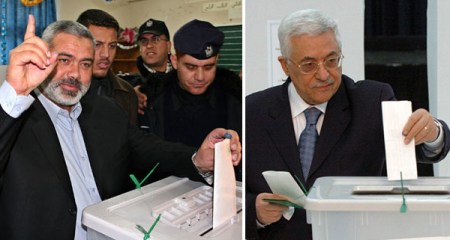
1682One man, one vote, one time? Hamas leader Ismail Haniyeh (left) and Fatah leader Mahmoud Abbas (also president of the Palestinian Authority) are pictured voting in the last election for the Palestinian Legislative Council, which took place in 2006.

Similarly, Fatah maintains that Hamas has been waging a campaign of intimidation and detention against Fatah supporters in the Gaza Strip — also in order to disrupt the upcoming election and undermine Fatah’s performance at the ballot boxes.

In the past two weeks, several Fatah activists in the Gaza Strip were rounded up by Hamas security forces, which have also banned Fatah from carrying out public election campaigns or holding rallies. Last week, as part of this crackdown, a Hamas court sentenced a former Palestinian Authority “general” to seven years in prison for “collaboration” with the PA security forces in the West Bank. Another three Fatah activists were sentenced to five years for the same crime.

In an effort to quell tensions between Hamas and Fatah, the Palestinian Central Election Commission decided to ask the two parties to sign a “Code of Conduct” document that requires all candidates and parties to avoid smear campaigns, slander, and fomenting sectarian or racist strife. The document also requires all those participating in the election to refrain from “exploiting religious or sectarian or tribal sentiments” in their campaign and also to avoid any form of intimidation, such as declaring one another traitors, apostates and infidels.

Although Fatah and Hamas have pledged to honor the terms of the “Code of Conduct,” known in Arabic as mithak sharaf, the two sides, which are not famous for honoring agreements, seem resolved to resort to all available methods to persuade voters to vote for each one of them.

For now, the two sides have taken to social media to present their electoral platforms and wage a smear campaign against each other.

Local elections are supposed to be about who can provide the people with the best municipal services and improve their living conditions. As such, one would expect candidates to run on a platform that promises new schools, roads, parks, sports centers and other municipal services. But in the case of the Palestinians, local and municipal elections seem to have assumed a new meaning and role. In fact, the upcoming election seems to be anything but a vote for a mayor or a member of a municipal or village council.

Hamas, whose leaders seem to be enthusiastic and optimistic about the upcoming vote, has seized the opportunity to wage a massive election campaign on Facebook and Twitter to promote its extremist ideology through intimidation and by accusing its rivals of infidelity, blasphemy and profanity. Hamas’s message to the Palestinian voters: Vote for us or else you will be considered infidels and you will end up in hell.

The first sign of Hamas’s frightening platform emerged when one of its top muftis, Yunis Al-Astal,issued a fatwa (Islamic religious decree) banning Palestinians from voting for any other party other than Hamas. “Any person, male or female, who votes for a party other than Hamas will be considered an infidel and apostate and his or her repentance will not be accepted even if they fasted or prayed or performed the hajj [pilgrimage] to Mecca,” the mufti ruled.

The Hamas fatwa sparked a wave of anger from many Palestinians, who were quick to accuse the Islamist movement and its leaders of waging a campaign of intimidation and terror against voters.

“This is the policy of the Muslim Brotherhood [of which Hamas is an offshoot],” commented Hisham Sawalhi, a Palestinian from the West Bank. “Those who support Muslim Brotherhood are believers, while those who oppose them are infidels.”

A Hamas-affiliated cartoonist from the Gaza Strip, Baha Yasin, published a cartoon that carries the same message as the fatwa. “A Palestinian Muslim does not vote for secular infidels,” he captioned a cartoon that depicts supporters of Fatah as unbelievers who smoke nargilas and cigarettes. The caption accompanying the cartoon also denounces the Fatah supporters for “insulting Allah” and Islam.

Rajai Al-Halabi, who is in charge of the “women’s portfolio” in Hamas, also stirred up controversy when she appeared on Al-Jazeera to declare that Islam surfaced for the first time in the Gaza Strip with the creation of Hamas.

Her declaration, which came in the context of Hamas’s election campaign, drew strong condemnations and sarcastic remarks from many Palestinians. “This means that all those who died before the establishment of Hamas were infidels, commented Hamzeh Abu Ajaleh, a Palestinian from the Gaza Strip. “In any case, my grandfather did not consume alcohol and my grandmother used to cover her head,” he wrote in reaction to the statement by the senior Hamas official.

“Hamas has launched its unofficial election campaign by issuing deeds of forgiveness and taking us back to the Middle Ages,” said Palestinian political analyst Mahmoud Sabri.

“They have turned mosques into podiums for political, and not religious, lecturing. Any citizen who does not vote for Hamas will be closer to entering hell and will be asked by Allah on Doomsday why he or she did not vote for the right people. Hamas wants us to believe that if we do not support them, then we are against Islam and that we are participating in the war against our religion.”

Some Palestinians in the Gaza Strip said this week that Hamas has formed a special team to manage its propaganda campaign in preparation for the local and municipal elections. This team has begun operating on two fronts: first, a public campaign to market Hamas’s “achievements” since its violent takeover of the Gaza Strip in the summer of 2007; and second, one to wage a campaign of defamation against its rivals in Fatah, depicting them as traitors and Israeli agents and infidels and enemies of Allah and Islam.

“A vote for Hamas is a vote for the resistance and a vote in support of Allah and Islam,” reads one of Hamas’s election banners. Other banners posted on social media highlight the fact that most of the Fatah representatives are not faithful Muslims and do not pray or practice any of the other pillars of Islam.

This Hamas tactic has worked in the past. In the previous parliamentary election, Hamas used the same propaganda to brainwash and scare Palestinian voters. Hamas has also resorted to the same rhetoric in campaigns during elections for university student councils and various professional unions in the West Bank and Gaza Strip. Some Palestinians, particularly Fatah loyalists, fear that Hamas will once again manage to persuade Palestinian voters to cast their ballots in favor of the Islamist movement by exploiting Islam to intimidate them.

However, there is no ignoring that there are other reasons why Palestinians may nevertheless prefer to vote for Hamas and not Fatah. Nearly two months before the election, tensions in Fatah seem to be on the rise. Many Fatah representatives are threatening to run in the election as independent candidates or as representatives of their clans. This already happened in the 2006 parliamentary election and resulted in Fatah’s defeat to Hamas. And this is why some Fatah officials already have second thoughts about the election and some of them have even openly called on the Palestinian Authority leadership to consider delaying them until further notice.

Last week, Mahmoud Abbas reportedly expelled four “rebellious” senior Fatah officials from the faction. The move came amid growing tensions among Fatah’s top brass over the upcoming election.

For Hamas, the upcoming election is an opportunity to consolidate its power and extend its control from the Gaza Strip to the West Bank. Hamas also views the local and municipal elections as a test for future parliamentary and even presidential elections. Without question, a Hamas victory in the upcoming elections would have an impact on any future elections and would send a message to the world that the Palestinian Authority is weak and has lost much of its credibility and standing among Palestinians. By calling the election and allowing Hamas to participate, Abbas is digging his own grave. Not to mention that he will be presiding over the burial of any so-called peace process with Israel.

Officials In Lebanese, Gazan Terror Organizations Confirm: Iran Funds Our Activity

August 11, 2016

Officials In Lebanese, Gazan Terror Organizations Confirm: Iran Funds Our Activity, MEMRI, August 11, 2016

Arab media have recently published statements by officials in the Lebanese Hizbullah and the Gazan Hamas and Islamic Jihad organizations, and by their supporters, confirming what has long been known – namely that these Lebanese and Gazan terror organizations receive substantial financial and military assistance from Iran. These statements join many reports, especially in the anti-Iranian media, regarding Iran’s funding of various terrorist organizations across the Arab world. According to these reports, the assistance comes mainly from the office of Iranian Supreme Leader Ali Khamenei and from the Islamic Revolutionary Guards Corps (IRGC).

The following are some examples of these statements and reports from the last two months:

Hizbullah Secretary-General Nasrallah: Hizbullah’s Entire Budget Is Provided By Iran

In a speech he delivered on June 24, 2016, marking 40 days after the killing of Mustafa Badr Al-Din, who was considered to be Hizbullah’s chief operations officer, and following the imposition of U.S. sanctions on Hizbullah that threaten its financial infrastructure and income, Hizbullah Secretary-General Hassan Nasrallah clarified: “Hizbullah’s budget – its salaries and expenditures, [the money that pays for] its food and drink, weapons and missiles – [all come from] Iran. Is that clear?… As long as Iran has money we have money. Do you require greater transparency than that[?] The funds earmarked for us do not reach us through the banks. We receive them the same way we receive our missiles, with which we threaten Israel.”[1]

Hamas Official Abu Marzouq: Iran’s Assistance To Hamas Is “Not Comparable” To Any Other Assistance

The deputy head of Hamas’s political bureau, Moussa Abu Marzouq, tweeted on June 15, 2016: “The aid extended by Iran to the Palestinian resistance, in provisions, training and funds, is not comparable [to any other aid], and most other countries cannot match it.”[2]

29502Abu Marzouq’s tweet

Former Lebanese Minister Wiam Wahhab: Iran Has Funded Resistance In Palestine

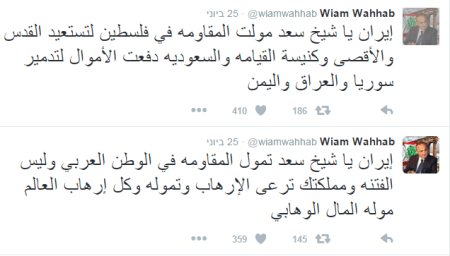
On June 25, 2016, in response to a remark by former Lebanese prime minister Sa’d Al-Hariri that Iran funds fitna(internecine strife) in the Arab world,[3] former Lebanese minister Wiam Wahhab, a known supporter of Hizbullah and the resistance axis, tweeted: “O Sheikh Sa’d [Al-Hariri], Iran has funded resistance in Palestine to restore Jerusalem, Al-Aqsa and the Church of the Sepulcher [to Palestinian hands, whereas] Saudi Arabia paid to destroy Syria, Iraq and Yemen.” In another tweet he wrote: ” O Sheikh Sa’d, Iran funded resistance in the Arab homeland rather than fitna, [whereas] your kingdom [Saudi Arabia, who supports Al-Hariri and his faction in Lebanon,] sponsors and funds terrorism. The funds of all the terrorist [organizations] in the world are Wahhabi [i.e., Saudi] funds.”[4]

29503Wiam Wahhab’s tweets

Saudi Daily Al-Sharq Al-Awsat: Hizbullah’s Weapons Come Directly From IRGC; Iran Has Renewed Regular Aid To Islamic Jihad Organization

The anti-Iranian press, such as the London-based Saudi daily Al-Sharq Al-Awsat, also reported on Iran’s funding of terrorist organizations in Lebanon and Gaza. On June 29, 2016, Al-Sharq Al-Awsat confirmed Nasrallah’s statements regarding the Iranian funding. The report stated that Hizbullah’s funds came from the office of Iranian Supreme Leader Ali Khamenei while its weapons are provided by the IRGC. It quoted the director of the Umam Research and Documentation center in Lebanon, Luqman Salim, a Shi’ite known for his opposition to Hizbullah, as saying that between 70% and 80% of Hizbullah’s funds come from Iran. According to Salim, Iran also invests about $400 million of the IRGC’s budget in the Islamic Radio and Television Union, a group of stations which includes the Iranian Al-Alam but also Hizbullah’s Al-Manar and Al-Mayadin and the Hamas-affiliated Al-Quds (all of which broadcast from Lebanon) and Hamas’s Al-Aqsa station, which broadcasts from Gaza.

The daily also cited a “knowledgeable source” as saying that until 2005 Iran transferred to Hizbullah between $200 million and $250 million annually, but since then the allocation has increased: After the 2006 Lebanon War it rose to $850 million, and since Hizbullah entered the Syria war its budget has become unlimited, because it has become part of Tehran’s war effort there.[5]

On May 25, 2016, the daily reported, citing sources close to the Islamic Jihad organization in Gaza, that Iran had renewed its regular financial aid to the organization after the two sides agreed to renew their mutual relations.[6] According to these sources, an Islamic Jihad delegation headed by the organization’s secretary-general Ramadan Shalah visited Iran in April 2016, and during this visit Tehran renewed its sponsorship of the organization after the latter accepted its terms. In meetings held by the delegation during this visit, including with IRGC commander Mohammad Ali Jafari and Qods Force commander Qassem Soleimani, Iran clarified its vision of Islamic Jihad’s course in the coming years. The sources claimed further that Soleimani decided, in coordination with the organization’s military and political bureaus, to grant $70 million a year out of the IRGC budget to Islamic Jihad’s military wing, Saraya Al-Quds, and to reorganize this body and appoint Khaled Mansour, who is close to Tehran, as its commander.[7]

Endnotes:

[1] Alahednews.com.lb, June 24, 2016.

[2] Twitter.com/mosa_abumarzook, June 15, 2016.

[3] Al-Mustaqbal (Lebanon), June 26, 2016; Al-Hariri’s remark was a response to Nasrallah’s  statement one day earlier that Hizbullah’s entire budget comes from Iran.

[4] Twitter.com/wiamwahhab, June 25, 2016.

[5] Al-Sharq Al-Awsat (Lebanon), June 29, 2016.

[6] Reports in the Arab media in the passing year indicated that Iran had suspended its assistance to Islamic Jihad following disagreements between them on the crisis in Yemen. According to these reports, the Islamic Jihad refused Iran’s demand to declare its opposition to the Arab Coalition’s activities in Yemen. See for example Aljazeera.net, May 26, 2016, Janoubia.com, April 3, 2016.

[7] Al-Sharq Al-Awsat (London), May 25, 2016.