Posted tagged ‘Golan’

Hizballah is creeping up on Israel’s Golan border, relying on Russian military cover

October 23, 2015

Hizballah is creeping up on Israel’s Golan border, relying on Russian military cover, DEBKAfile, October 23, 2015

nasrallah-putin_10.15Hassan Nasrallah believes he has Putin behind him.

Wholly preoccupied with the ferocious Palestinian terror campaign washing over their country, Israelis have scarcely noticed that Hizballah forces, believing they are protected by the Russian military presence in Syria, are creeping toward Israel’s northeastern Golan border. DEBKAfile reports: The Lebanese group thinks it is a step away from changing the military balance on the Golan to Israel’s detriment and gaining its first Syrian jumping-off base against the Jewish state – depending on the Syrian-Hizballah forces winning the fierce battle now raging around Quneitra opposite Israel’s military positions.

For two years, Hizballah, egged on intensely by Iran, has made every effort to plant its forces along the Syrian border with Israel. For Tehran, this objective remains important enough to bring Al Qods Brigades chief, Gen. Qassem Soleiman, on a visit last week to the Syrian army’s 90th Brigade Quneitra base, which is the command post of the battle waged against Syrian rebel forces.

Soleimani, who is commander-in-chief of Iran’s military operations across the Middle East, is acting as military liaison in Syria between Tehran and Moscow.

DEBKAfile’s military sources report that the Iranian general inspected the Quneitra battle lines no more than 1.5-2 km from the Israeli Golan border. He arrived a few days after Revolutionary Guards Col. Nader Hamid, commander of Iranian and Hizballah forces in the region, died there fighting against Syrian rebels.

His death betrayed the fact that not only are Hizballah forces gaining a foothold on the strategic Golan enclave, but with them are Iranian servicemen, officers and troops.

While in Quneitra, the Iranian general also sought to find out whether Col. Hamid really did die in battle or was targeted for assassination by Israel to distance Iranian commanders from its border.

Just 10 months ago, on Jan. 18, Israel drones struck a group of Iranian and Hizballah officers who were secretly scouting the Quneitra region for a new base. Iranian Gen. Ali Mohamad Ali Allah Dadi died in that attack.

But Tehran and Hizballah are again trying their luck. During his visit to Quneitra, Soleimani called up reinforcements to boost the 500 Hizballah fighters in the sector.

Seen from Israel, the Syrian conflict is again bringing enemy forces into dangerous proximity to its border.

The Iranian general and Russian Air Force commanders agree that the drawn-out battle for Quneitra will not be won without Russian air strikes against the rebels holding out there. A decision to extend Russia’s aerial campaign from northern and central Syria to the south would be momentous enough to require President Vladimir Putin’s personal approval.

This decision would, however, cross a strong red line Israel laid down when Binyamin Netanyahu met Putin on Sept. 21 in Moscow and when, last week, a delegation of Russian generals visited Tel Aviv to set up a hot line for coordinating Israeli and Russian air operations over Syria.

Israeli officials made it very clear that Iranian and Hizballah forces would not be permitted to establish a presence opposite the Israeli Golan border and that any Russian air activity over southern Syria and areas close to its borders was unacceptable.

The possibility of Israeli fighter jets being scrambled against Russian aerial intervention in the Quneitra battle was not ruled out.

This state of affairs was fully clarified to Gen. Joseph Dunford, Chairman of the Joint US Chiefs of Staff, when he was taken on a trip this week to the southern Golan under the escort of IDF Chief of Staff Gen. Gady Eisenkot and OC Northern Command Gen. Avivi Kochavi. He visited the command post of Brig. Yaniv Azor, commander of the Bashan Division, which will be called upon for action if the hazard to Israel’s security emanating the Quneitra standoff takes a dangerous turn.

I got Syria so wrong

October 15, 2015

I got Syria so wrong, Politico, October 15, 2015

Fully complicit in the Assad regime’s impressive portfolio of war crimes and crimes against humanity, Iran relies on its client to secure its overland reach into Lebanon. And Russia works to sustain Assad as a rebuke to Washington. All the while, the eastern part of Syria is run by the self-styled Islamic State, or ISIL, itself a criminal enterprise. For the most part, the two titans of crime — the Assad regime and the Islamic State — have been able to live and let live, concentrating their hideous repertoires of violence on civilians and on armed rebels offering a nationalistic alternative to both. The result is widespread and profound hopelessness. Many Syrians are giving up on their beloved Syria. They are voting with their feet.

*********************

I spent early 2011 trying to ease tensions between Syria and its neighbors. I never predicted the brutality that would come from inside.

Now and then I am asked if I had predicted, way back in March 2011 when violence in Syria began, that within a few years a quarter-million people would be dead, half the population homeless and hundreds of thousands of defenseless civilians terrorized, traumatized, tortured and starved. The companion question, more often than not, is if I had forecast the failure of the West to offer any protection at all to Syrian civilians subjected to a systematic campaign of mass homicide. Having first been exposed to Syria as a teenage exchange student, I was expected by questioners to know something about the place. And as a State Department officer, I was assumed to know something about my government.

But no. It took me the better part of eighteen months to comprehend fully the scope of an unfolding humanitarian and political catastrophe. By September 2012, when I resigned my State Department post as adviser on Syrian political transition to Secretary of State Hillary Clinton, I knew that Syria was plunging into an uncharted abyss — a humanitarian abomination of the first order. And I knew that the White House had little appetite for protecting civilians (beyond writing checks for refugee relief) and little interest in even devising a strategy to implement President Barack Obama’s stated desire that Syrian President Bashar Assad step aside. But at the beginning, nothing drawn from my many years of involvement in Syria inspired accurate prophesy.

That Russia’s recent military intervention in Syria has shocked the Obama administration is itself no surprise. For nearly two years, Washington had chased Moscow diplomatically in the belief that the Kremlin’s soothing words about supporting political transition in Syria were truthful. That which was obvious to many — Russia’s desire to perpetuate Assad in office — is now jarringly clear to the administration. That training and equipping anti-Assad rebels to fight anyone but Assad has been dropped like a bad habit by an administration warned not to proceed along these lines is hardly a bolt from the blue.But the White House is not alone in failing to accurately forecast the severity of the Syrian disaster.

The major reason for my lack of foresight: It didn’t have to turn out this way, and I remain mildly surprised that it did. It is not that Syrians were without grievances concerning the way they were being governed. Widespread unemployment, underemployment and opportunity deficits were already prompting those with means among the best and brightest to leave the country. Although the regime’s corruption, incompetence and brutal intolerance of dissent were hardly state secrets, Assad was not universally associated by Syrians with the system’s worst aspects: “If only the president knew” was a phrase one heard often. Some Syria watchers believed that the Arab Spring would visit the country in the form of political cyclone. I did not. I did not think it inevitable that Assad — a computer-savvy individual who knew mass murder could not remain hidden from view in the 21st century — would react to peaceful protest as violently as he did, with no accompanying political outreach. And as Syria began to descend into the hell to which Assad was leading it, I did not realize that the White House would see the problem as essentially a communications challenge: getting Obama on “the right side of history” in terms of his public pronouncements. What the United States would do to try to influence Syria’s direction never enjoyed the same policy priority as what the United States would say.

Back in early 2011, it seemed possible not only to avoid violent upheaval in Syria but to alter the country’s strategic orientation in a way that would counter Iran’s penetration of the Arab world and erase Tehran’s land link to its murderous Hezbollah militia in Lebanon. Much of my State Department time during the two years preceding Syria’s undoing was thus spent shuttling back and forth between Damascus and Jerusalem, trying to build a foundation for a treaty of peace that would separate Syria from Iran and Hezbollah on the issue of Israel.

There was a degree of idealism in my quest, born in the brain of an American teenager many years before. But there was another personal element as well. Long before Hezbollah murdered Mr. Lebanon — Prime Minister Rafik Hariri — in 2005, it had brutally and pathologically tortured to death a friend of mine serving as an unarmed United Nations observer, Marine Lt. Col. Rich Higgins. Peace between Israel and Syria would require Damascus to cut all military ties to Hezbollah. It would require Syria to stop facilitating Iran’s support to Hezbollah. It would set the stage for a Lebanon-Israel peace that would further marginalize Lebanon’s murder incorporated. Peace for its own sake is good. But the prospect of beating Hezbollah and its Iranian master was inspiring. This prospect, more than anything else, motivated the mediation I undertook as a deputy to Special Envoy George Mitchell in the State Department.

Assad, told me in late February 2011 that he would sever all anti-Israel relationships with Iran, Hezbollah and Hamas and abstain from all behavior posing threats to the State of Israel, provided all land lost by Syria to Israel in the 1967 war — all of it — was returned. My conversation with him was detailed in terms of the relationships to be broken and the behavior to be changed. He did not equivocate. He said he had told the Iranians that the recovery of lost territory — the Golan Heights and pieces of the Jordan River Valley — was a matter of paramount Syrian national interest. He knew the price that would have to be paid to retrieve the real estate. He implied that Iran was OK with it. He said very directly he would pay the price in return for a treaty recovering everything.

Israeli Prime Minister Benjamin Netanyahu was interested. He was not at all eager to return real estate to Syria, but he found the idea of prying Syria out of Iran’s grip fascinating. And the negative implications for Hezbollah of Lebanon following Syria’s peace accord with Israel were not lost on him in the least. Although there were still details to define about the meaning of “all” in the context of the real estate to be returned, Netanyahu, too, knew the price that would ultimately have to be paid to achieve what he wanted.

But by mid-April 2011 the emerging deal that had looked promising a month earlier was off the table. By firing on peaceful demonstrators protesting police brutality in the southern Syrian city of Deraa, gunmen of the Syrian security services shredded any claim Assad had to governing legitimately. Indeed, Assad himself — as president of the Syrian Arab Republic and commander in chief of the armed forces — was fully responsible for the shoot-to-kill atrocities. Even so, he told Barbara Walters in a December 2011 ABC TV interview, “They are not my forces, they are military forces belong[ing] to the government . . . I don’t own them, I am the president. I don’t own the country, so they are not my forces.”

Before the shooting began the United States and Israel were willing to assume Assad had sufficient standing within Syria to sign a peace treaty and — with American-Israeli safeguards in place — make good on his security commitments before taking title to demilitarized territories. But when he decided to try to shoot his way out of a challenge that he and his first lady could have resolved personally, peacefully and honorably, it was clear he could no longer speak for Syria on matters of war and peace.

Some of my U.S. government colleagues from bygone days tell me we dodged a bullet: that an uprising against the Assad regime’s arrogance, cluelessness and corruption in the middle of treaty implementation would have caused real trouble. Others believe we were too slow: that a treaty signing in early 2011 could have kept the gale force winds of the Arab Spring from unhinging Syria. I don’t know. I don’t know if Assad or Netanyahu would, in the end, have done a deal. What I do know is that I felt good about where things were in mid-March 2011. What I also know is that by mid-April hope of a treaty was gone, probably never to return in my lifetime.

Assad’s decision to apply lethal violence to something that could have been resolved peacefully was the essence of betrayal. He betrayed his country so thoroughly as to destroy it. Four years on, he reigns in Damascus as a satrap of Iran and a dependent of Moscow. In the end, he solidified Israel’s grip on land lost in 1967 by his defense minister father.

Fully complicit in the Assad regime’s impressive portfolio of war crimes and crimes against humanity, Iran relies on its client to secure its overland reach into Lebanon. And Russia works to sustain Assad as a rebuke to Washington. All the while, the eastern part of Syria is run by the self-styled Islamic State, or ISIL, itself a criminal enterprise. For the most part, the two titans of crime — the Assad regime and the Islamic State — have been able to live and let live, concentrating their hideous repertoires of violence on civilians and on armed rebels offering a nationalistic alternative to both. The result is widespread and profound hopelessness. Many Syrians are giving up on their beloved Syria. They are voting with their feet.

There is no end in sight to this vicious bloodletting. Iran and Russia could stop the gratuitous mass murder but opt not to do so. Moscow now facilitates it with military intervention. The United States could stop it or slow it down significantly without invading and occupying Syria — indeed, without stretching the parameters of military science. But it has adamantly refused to do so. Meanwhile, the minions of the Islamic State loot and destroy the world heritage site of Palmyra while subjecting much of eastern Syria to their own brand of violent rule and internal terror.

Both sides of this debased criminal-terrorist coin need to be addressed urgently. Assad’s barrel bombing of Deraa in the south — where peaceful protests against regime brutality first attracted international notice in March 2011 — along with his bombing of Aleppo and Idlib in the north must be stopped cold. These horrific devices kill the innocent and recruit for the Islamic State: precisely as they are intended to do. Means exist far short of invasion and occupation to make it difficult for Assad regime helicopters to deliver their deadly cargoes. What is required is a clear statement of intent by Obama, one communicated to the Department of Defense, so that options can be produced for presidential decision and execution.

With regard to ISIL, a professional ground combat component provided by regional powers is desperately needed to work with coalition aircraft to sweep this abomination from Syria and permit a governmental alternative to the Assad regime to take root inside Syria. With central and eastern Syria free of both the regime and ISIL, an all-Syrian national stabilization force can be built. Western desires for a negotiated end to the Syrian crisis would be based, under these circumstances, on more than a wish and a hope.

The United States should neither seek nor shy away from confrontation with Russian forces in Syria. Moscow will not like it if its client’s ability to perform mass murder is impeded. Russia will not be pleased if ISIL, its false pretext for military intervention in Syria, is swept from the table. Ideally, Russia will not elect to escort regime aircraft on their mass homicide missions. And it would be difficult for even Russian President Vladimir Putin to articulate outrage if ISIL is crushed militarily. But if Russia seeks out armed confrontation with the United States in Syria, it would be a mistake for Washington to back down. People like Putin will push until they hit steel. And he will not stop in Syria.

Having failed miserably as a prophet in 2011 does not deter me from predicting the following: Obama will bequeath to his successor a problem of gargantuan dimensions if he does not change policy course now. Left to the joint ministrations of Assad and the Islamic State, Syria will continue to hemorrhage terrified, hungry and hurt human beings in all directions while terrorists from around the globe feast on the carcass of an utterly ruined state. Western Europe now reaps a whirlwind of desperate and displaced humanity it thought would be limited to Syria’s immediate neighborhood.

My failure to predict the extent of Syria’s fall was, in large measure, a failure to understand the home team. In August 2011, Barack Obama said Assad should step aside. Believing the president’s words guaranteed decisive follow-up, I told a congressional committee in December 2011 that the regime was a dead man walking. When the president issued his red-line warning, I fearlessly predicted (as a newly private citizen) that crossing the line would bring the Assad regime a debilitating body blow. I still do not understand how such a gap between word and deed could have been permitted. It is an error that transcends Syria.

I want the president to change course, but I fear that Syrians — Syrians who want a civilized republic in which citizenship and consent of the governed dominate — are on their own. I’ve been so wrong so many times. One more time would be great. It would mean saving thousands of innocent lives. It would mean real support for courageous Syrian civil society activists who represent the essence of a revolution against brutality, corruption, sectarianism and unaccountability. It would mean the reclamation of American honor. It would mean preserving my near-perfect record of getting things wrong. It would be a godsend.

Iran’s Soleimani visits Syrian Golan as Tehran bolsters war effort

October 15, 2015

Iran’s Soleimani visits Syrian Golan as Tehran bolsters war effort Powerful head of Tehran’s Quds Force in Syria to oversee new push against anti-Assad rebels, visits near border to boost morale of troops after setbacks

By Avi Issacharoff, Times of Israel staff and AP

October 15, 2015, 8:57 am

Source: Iran’s Soleimani visits Syrian Golan as Tehran bolsters war effort | The Times of Israel

Iranian Revolutionary Guards al-Quds Force commander Maj. Gen. Qassem Soleimani. (YouTube/BBC Newsnight)

Iranian Revolutionary Guards al-Quds Force commander Maj. Gen. Qassem Soleimani. (YouTube/BBC Newsnight)

ranian general Qassem Soleimani, the commander of the country’s expeditionary al-Quds Force, visited the Syrian side of the Golan in recent days, The Times of Israel has learned.

Soleimani, a powerful figure thought to be at the forefront of Iranian fighting abroad, is in Syria to oversee a new offensive by Iranian and Assad regime troops meant to help the government retake large swaths of the country’s north.

His visit to the Golan, near the border with Israel, was apparently intended to boost morale of Syrian and Hezbollah forces – the latter loyal to Iran’s regime — after a series of setbacks against the “southern front” of rebel groups in the area.

By Wednesday, Soleimani was in the Latakia province, on the Mediterranean coast north of Lebanon, from which the northern operation is expected to launch, backed by the recent influx of Russian air power.

A regional official and Syrian activists said Wedneday that hundreds of Iranian troops were being deployed in northern and central Syria, dramatically escalating Tehran’s involvement in the civil war as they join allied Hezbollah fighters in an ambitious offensive to wrest key areas from rebels amid Russian airstrikes.

The official, who has deep knowledge of operational details in Syria, said the Iranian Revolutionary Guards — currently numbering around 1,500 — began arriving about two weeks ago, after the Russian airstrikes began, and have accelerated recently. The Iranian-backed group Hezbollah has also sent a fresh wave of fighters to Syria, he told The Associated Press.

Iranian and Syrian officials have long acknowledged Iran has advisers and military experts in Syria, but denied there were any ground troops. Wednesday’s statements were the first confirmation of Iranian fighters taking part in combat operations in Syria.

The main goal is to secure the strategic Hama-Aleppo highway and seize the key rebel-held town of Jisr al-Shughour in Idlib province, which Assad’s forces lost in April to insurgents that included al-Qaida’s Nusra Front.

The loss of Jisr al-Shughour, followed by the fall of the entire province, was a resounding defeat for Assad, opening the way for rebels to threaten his Alawite heartland in the coastal province of Latakia. The official suggested the Syrian army’s alarmingly tenacious position around that time is what persuaded the Russians to join the fray and begin airstrikes two weeks ago.

The Syrian government and Iran had been asking Russia to intervene for a year, the official said, speaking on condition of anonymity because he was not authorized to discuss military affairs. He said the Russian “tsunami wave” has given allies such as Iran the cover to operate more freely in Syria.

His account of Iranian troops arriving ties in with reports from Syrian opposition activists, who reported a troop buildup in the northern provinces of Idlib and Aleppo. The Syrian Observatory for Human Rights also reported Wednesday that Iranian troops were arriving and being transported to a military base in the coastal town of Latakia, in the town of Jableh outside the provincial capital.

At least two senior Iranian commanders were killed in Syria in recent days, including Gen. Hossein Hamedani, a senior Revolutionary Guard commander, who died Oct. 8 near Aleppo.

“Syria will witness big victories in coming days,” said Gen. Mohammad Ali Jafari, chief of Iran’s Revolutionary Guard, speaking Monday at Hamedani’s funeral.

The Quds Force is the de facto overseas operational arm of the of the Iranian Revolutionary Guards Corps, which is loyal to Iranian Supreme Leader Ayatollah Ali Khamenei and is separate from Iran’s national military force.

Israeli officials have accused the IRGC of trying to build an anti-Israel front on the Syrian Golan, alongside Hezbollah forces and local Druze opposed to Israel.

On January 18, a reported Israeli air strike on the Syrian Golan targeting a Hezbollah cell there killed six Hezbollah fighters and an IRGC brigadier general, Mohammed Ali Allahdadi. Allahdadi was said to be involved in helping to build up the operational capabilities of Hezbollah’s burgeoning Golan presence.

Soleimani himself traveled to Lebanon the following day to meeting with Hezbollah chief Hassan Nasrallah and visit the graves of the Hezbollah fighters killed in the strike.

Reports from late January claimed that a cross-border Hezbollah reprisal attack the following week, in which two IDF soldiers were killed and seven injured, was planned by two Quds Force officers appointed by Soleimani.

Israel is braced for Russian aerial intrusions over its Golan border

October 9, 2015

Israel is braced for Russian aerial intrusions over its Golan border, DEBKAfile, October 9, 2015

Su-25_Frogfoot_ground-attack_planes_B-Syria_10.15_1Russian Su-25 Frogfoot fighter-bombers in Syria

Uncertainty still hangs over Moscow’s precise intentions regarding its air force flights over the Golan close to Israel’s border – even after two days of discussions on coordination ended in Tel Aviv Thursday, Oct. 8 between the Russian Deputy Chief of Staff Gen. Nikolay Bogdanovsky and his Israeli counterpart Maj. Gen. Yair Golan. A coordination mechanism between the two air forces was left as unfinished business for further discussion, DEBKAfile’s military sources report. So it is still not clear to Israel what is supposed to happen if Russian fighters and bombers enter the Syrian-Israeli border district and slip over into Israeli air space.

The bilateral talks left Israel with the impression that this was a distinct possibility.

Israeli and Western aviation and intelligence experts don’t see how Israel can prevent Russia providing air cover for Syrian and Hizballah forces when the war moves close to the Israeli and Jordanian borders of southern Syria.

Last week, Russian SU-30 and Su-24 warplanes twice violated Turkish air space in the southern province of Hatay (called Alexandretta on Syrian maps). Although after the Russian defense ministry apologized for the first intrusion as accidental and lasting just a few seconds, our military sources are certain that the Russians were in fact deliberately testing Turkish air defenses.

This scenario may well repeat itself over the Golan in the very near future.

Gen. Bogdanovsky made no secret of Moscow’s intention to use its air power against rebel targets in battles taking place near the Israeli border. According to our exclusive military sources, Israel braced for this eventually Wednesday night, Oct. 7. Syrian, Hizballah and pro-Iranian Shiite forces then launched a ground offensive with Russian air cover against Syrian rebel forces in the Hama region. This was their first ground operation since the start of the Russian military buildup in late August. Intelligence was received that a second Syrian-Hizballah offensive, covered by Russian fighters and bombers, was scheduled to start at the same time in the Quneitra area, directly opposite the Israeli Golan.

For some reason, it was not launched when expected, but it is unlikely to be deferred for long. After firing Kalibr-NK-SS-27 Sizzler cruise missiles last week to soften rebel resistance to the Syrian government offensive in the Hama area, the Russians may well aim them at the Quneitra arena too in support of another Syrian operation.

Netanyahu: ‘You Rush to Embrace Iran, They Fire Rockets at Us’

August 21, 2015

Netanyahu: ‘You Rush to Embrace Iran, They Fire Rockets at Us’, Israel National News, August 21, 2015

The attack ordered by Iran comes after a report in April, when  Iranian officials reportedly told the Syrian regime to strike Israel and open a war front on the Golan Heights.

**************************

PM warns ‘we’ll harm those who try to harm us,’ slams world powers for nuclear deal after ‘Iranian commander ordered rocket strike.’

Prime Minister Binyamin Netanyahu released a statement on Friday, shortly after the IDF airstrike that took out the Islamic Jihad terror cell backed by Iran that launched four rockets into Israel from Syria the day before.

“I said this week that those who try to harm us – we will harm them. And that’s what we did,” said the prime minister.

“The IDF struck the cell that conducted the (rocket) fire, and the Syrian forces that enabled it. We don’t intend to escalate the incidents, but our policy remains as it was,” he said. At least 14 targets were hit by the IDF overnight, including a strike on an army post which Syria said killed one soldier.

Turning his attention to the IDF reports that Iranian military sources funded and directed the Islamic Jihad cell, Netanyahu condemned the world powers that sealed a nuclear deal with Iran just last month and are now advancing economic trade and diplomatic ties.

“The countries that rush to embrace Iran need to know that an Iranian commander is the one who gave the cover and direction to the cell that fired on Israel,” he said.

As noted by Netanyahu, the one who gave the order for the rocket strike was said to be the head of the Palestinian department in Iran’s Al-Quds force, the covert foreign operations unit of the Iranian Revolutionary Guards.

Netanyahu on Friday ordered the Foreign Ministry to send an official letter to Western governments, saying Israel has “reliable information that this attack was carried out by the Palestinian Islamic Jihad, ordered directly by the Iranian terrorist Said Izadhi of the Iranian Revolutionary Guards.”

“This is further clear indication of Iran’s increasing involvement in attacks against Israel in particular and against regional targets in general. The ink on the nuclear agreement has not yet dried, and this attack shows clearly how Iran plans to act the moment after the international sanctions are removed.”

The attack ordered by Iran comes after a report in April, when  Iranian officials reportedly told the Syrian regime to strike Israel and open a war front on the Golan Heights.

The four rockets fired on Galilee came from the new Iranian terror front on the Golan

August 20, 2015

The four rockets fired on Galilee came from the new Iranian terror front on the Golan, DEBKAfile, August 20, 2015

Netanyahu_northern_border_B_18.8.15Israel leaders at Northern Command HQ this week

According to our military sources, it is this Iranian-backed network which Thursday, Aug. 20, fired a salvo of four rockets from the Golan into upper Galilee and the Golan. The impact set off brush fires but caused no casualties. A red alert had sent most people running to shelters.

****************

Israel’s top government and military went on a high level of preparedness Tuesday, Aug. 18 in expectation of the first terrorist attack to be orchestrated by Iran from Syrian or Lebanese borders. That is what brought Prime Minister Binyamin Netanyahu, Defense Minister Moshe Ya’alon and Chief of Staff Lt. Gen. Gady Eisenkott on a tour of inspection to the Golan and Northern Command headquarters. Netanyahu said then that Israel is ready for any scenario and would “harm anyone trying to harm us.”

DEBKAfile’s military sources report that these events were sparked by the knowledge reaching Israeli intelligence that Iranian Al Qods and Hizballah officers were building a new terrorist network for mounting large-scale terrorist attacks on Israel from the Syrian border opposite the Golan.

The officers had handed out anti-tank and anti-air rockets to the terrorists, raising Israeli suspicions that one of their plans was to seize an Israeli location or part of one and try and hold out against an Israeli counter-offensive of tanks and assault helicopters.

Our counter-terrorism sources disclose that three radical terrorist movements staff the new network:

One is the hard-line rejectionist Popular Front for Liberation of Palestine – General Command (PFLP-GC).

Another is the Golan-based Syrian Druze group known as Liberators of the Golan. It is headed by the notorious Samir Kuntar, a Lebanese Druze who has set up a Golan terror ring based in the Druze village of Al-Khadar opposite the Israeli border fence.

Also harnessed to Iran’s new Golan terror organization is the Syrian Social Nationalist Party (SSNP) which is made up of radical Christian terrorists. This old timer violent group, which is run by Syrian intelligence, took part in the 1982-3 Hizballah bombing massacres at the US Embassy and Marine headquarters in Beirut.

The first SSNP activists have arrived in the Quneitra district of the Golan.

According to our military sources, it is this Iranian-backed network which Thursday, Aug. 20, fired a salvo of four rockets from the Golan into upper Galilee and the Golan. The impact set off brush fires but caused no casualties. A red alert had sent most people running to shelters.

This was an unusually long-range attack: Previous launches from within Syria, whether deliberate or stray fire from the civil war there, hit the Israeli-held Golan without reaching the Israeli interior. It is now up to Israel to decide how and when to respond to an act of war orchestrated by Tehran, after the prime minister’s warning Tuesday had no deterrent effect.

Hizballah presses elite Radwan Force for conquering Galilee into saving stalled Zabadani battle

August 1, 2015

Hizballah presses elite Radwan Force for conquering Galilee into saving stalled Zabadani battle, DEBKAfile, August 1,2015

New_ninja_uniforms_of_Hezbollahs_elite_forcesNew “ninja” uniforms for Hizballah’s Radwan Force

Hizballah’s elite Radwan Force was originally designed to push in from Lebanon and conquer the Israeli Galilee. DEBKAfile’s exclusive military sources report that on Thursday, July 30 Hassan Nasralla saw he had no option but to press this high-value contingent into service, to extricate the combined Hizballah-Syrian armies from their month-long failure to recapture the key town of Zabadani – or even breach the defenses set up by the Al-Qaeda affiliated rebel Nusra Front.

This standoff with heavy casualties over the key town, which commands the main Damascus-Beirut highway, has become a symbolic make-or-break duel between the Iran-backed Shiite Hizballah and Al Qaeda’s Sunni Nusra Front. Nasrallah loses it at the cost of his organization’s credibility as a formidable fighting force.

Defeat would make western Damascus and eastern Lebanon more vulnerable to attack. And for Iran’s Lebanese proxy, it would leave an embarrassing question hanging in the air: If Hizballah under Iranian command combined with Syrian troops and backed by heavy artillery fire and air strikes can’t win a relatively small battle against no more than 1,200 rebel fighters across a nine-km square battleground, how much are its leaders’ boasts worth when they claim unbeatable prowess for winning major battles, including a war on Israel?

To save face in this landmark showdown, Hizballah decided to press into battle its most prestigious unit, named for Al-Hajj Radwan, the nom de guerre of Hizballah’s renowned military chief Imad Mughniye, whom Israel took out in February 2008.

Eight months ago, the Radwan Force lost its senior commanders. An Israeli air strike on Jan. 18 targeted a group of high Iranian and Hizballah officers on a visit to Quneitra on the Syrian Golan. They were surveying the terrain before relocating this elite unit to confront IDF positions on the Israeli Golan border. Iranian Gen. Ali Reza al-Tabatabai and the Hizballah district commander Jihad Mughniye (son of Imad) lost their lives in the Israeli raid and the plan was provisionally set aside.

If the Radwan Force manages to haul Hizballah out of its impasse in Zabadani, it may next be assigned to take up battle positions on the Golan.

But for now, its mission in the battle for Zabadani has three dimensions:

1.  To disarm the enemy by commando raids, a tactic to be borrowed from the rebels defending the town. On the night of July 24, the rebels preemptively struck Hizballah and Syrian army positions around the town and captured some of them. The decision to deploy Radwan appears to have come in response to that painful setback.

2.  To pull off a quick battlefield success at Zabadani, in view of intelligence reports that the Nusra Front and the Islamic State of Iraq and the Levant in northern Syria were preparing together to open a second front in Lebanon, in order to relieve the rebel force pinned down in Zabadani.

The two groups plan to cross into Lebanon and start attacking pro-Hizballah Shiite populations in the Beqaa Valley and the North. They propose to cut through the Bequaa Valley and head up to the important northern Lebanese city of Tripoli on the Mediterranean coast.

3.  Syrian President Bashar Asad is under extreme pressure for a battlefield success after admitting in a public speech last week to the loss of strategic territory to rebel forces and shrinking military manpower. He has earmarked a Zabadani victory – both as a turning-point for his flagging fortunes and for holding back the constant draining of his army by desertions and defections.

Our military sources reveal that, after Assad leaned hard on the Lebanese government and army to round up Syrian troops who went AWOL, Lebanese security forces went into action. They are picking up Syrian army deserters and putting them on buses driving in armored convoys into Syria. It doesn’t take much imagination to conjure up the fate of these unwilling returnees.

Palestinians: Why Salam Fayyad Lacks Popular Support

July 1, 2015

Palestinians: Why Salam Fayyad Lacks Popular Support, The Gatestone InstituteKhaled Abu Toameh, June 30, 2015

  • It is no secret that several senior Palestinian officials see themselves as potential successors to Abbas. Like his predecessor, Yasser Arafat, Abbas has stubbornly refused to share power with anyone. And like Arafat, he continues to run the Palestinian Authority as if it were his private fiefdom.
  • In Palestinian culture, it is more important if one graduates from an Israeli prison than from the University of Texas in Austin. A Palestinian who carries out an attack on Israel has more credentials among his people than one who studied at Harvard or Oxford universities.
  • It took Salam Fayyad too long to realize that no matter how many good things he does for his people, in the end he will be judged on the basis of his contribution to the fight against Israel, and not how much humanitarian and financial aid he provides.

In a surprise move, the Palestinian Authority (PA) has frozen the bank account of a non-profit organization headed by former Prime Minister Salam Fayyad.

The decision is seen in the context of PA President Mahmoud Abbas’s effort to undermine and discredit Fayyad. Abbas believes that Fayyad, who resigned in 2013, is seeking to replace or succeed him as president.

Following his resignation, the US-educated Fayyad established a Ramallah-based group called Future For Palestine. According to Fayyad, the group’s mission is to “enhance the resilience of Palestinian citizens in their homeland, especially in marginalized and severely impacted areas, by providing the basic development requirements.”

Abbas and the Palestinian Authority leadership did not like the idea from the beginning. Ever since Future For Palestine was established in August 2013, they have been working toward undermining the group and its founder, Fayyad.

The PA leadership is convinced that Fayyad is using the group to advance his own political goals and establish bases of power in the West Bank and Gaza Strip.

During the military confrontation between Israel and Hamas last year, Fayyad’s group launched acampaign to aid the residents of the Gaza Strip. The campaign included the purchase of tens of thousands of bottles of mineral water that were supposed to be dispatched to the Gaza Strip. The Palestinian Authority thwarted the campaign.

To justify the crackdown on Fayyad back then, the PA said that the former prime minister was part of a “conspiracy” to overthrow the Abbas regime. Some reports even suggested that Abbas had ordered his security forces to detain Fayyad for interrogation, but backtracked after threats from the US and several European governments.

Later, Abbas sent security officers to raid the offices of Future For Palestine and conduct a thorough search of its files. Some of Fayyad’s top aides were taken into custody and questioned about the sources of the group’s funding.

Last week, the campaign against Fayyad reached its peak when the Palestinian Authority announced that it has seized the assets of Future For Palestine, and accused the former prime minister of “money laundering.”

PA officials claimed that Fayyad’s group had received $10 million from the United Arab Emirates, a Gulf country that supports Abbas’s political enemy, ousted Fatah leader Mohamed Dahlan. The officials accused Dahlan and Fayyad of working together to topple the Abbas regime. Dahlan fled the West Bank several years ago after falling out with Abbas, who accused him of attempting to stage a coup against the Palestinian Authority leadership.

1135Former Palestinian Authority Prime Minister Salam Fayyad, pictured on January 25, 2013 at the World Economic Forum in Davos, Switzerland. (Image source: World Economic Forum)

Fayyad said this week that he is planning to take legal measures to cancel the decision to freeze his group’s assets. Denying the charge of “money laundering,” Fayyad added that Future For Palestine was operating within the framework of the law and did not commit any offense.

The decision to freeze the bank account of Future For Palestine came in the wake of increased talk about a behind-the-scenes power struggle to succeed the 80-year-old Abbas. The name of Fayyad has repeatedly surfaced as a potential successor to Abbas — a suggestion that has clearly enraged the Palestinian leader and his senior officials in Ramallah.

It is no secret that several senior Palestinian officials see themselves as potential successors to Abbas. These include, besides Dahlan, the chief of the PA’s General Intelligence Security Force in the West Bank, Majed Faraj, Palestinian Football Association Chairman Jibril Rajoub and Chief PLO negotiator Saeb Erekat.

Abbas believes that he has thus far succeeded in sidelining and discrediting at least two candidates: Fayyad and Dahlan. The charges made by Abbas against the two men are designed to depict them as agents of foreign countries who are plotting against him and the entire Palestinian people.

Like his predecessor, Yasser Arafat, Abbas has stubbornly refused to share power with anyone. And like Arafat, he continues to run the Palestinian Authority as if it were his private fiefdom.

Fayyad’s chances of succeeding Abbas are, anyway, very slim, if not non-existent. Fayyad is an independent figure who does not belong to Fatah, Hamas or any other political group. When he ran in the January 2006 parliamentary election at the head of the Third Way list, his group received two seats out of 132.

The reason most Palestinians did not vote for Fayyad is because he had not played any role in the “revolution” against Israel. In this culture, it is more important if one graduates from an Israeli prison than from the University of Texas in Austin. Fayyad did not participate in any armed attack on Jews and never supported the armed struggle against Israel. Nor did he send his son to throw stones or firebombs at Israelis. That is the real reason why people like Fayyad lack popular support.

If and when Abbas steps down, the only candidate who has a good chance of replacing him is one who was part of the “revolution.” A Palestinian who carries out an attack on Israel has more credentials among his people than one who studied at Harvard or Oxford universities. It took Salam Fayyad too long to realize that no matter how many good things he does for his people, in the end he will be judged on the basis of his contribution to the fight against Israel, and not how much humanitarian and financial aid he provides.

Syria, Hizballah torpedo understanding between Druze and Syrian rebel Nusra Front near Israeli border

June 28, 2015

Syria, Hizballah torpedo understanding between Druze and Syrian rebel Nusra Front near Israeli border, DEBKAfile, June 28, 2015

Druze_village_of_Hadar_16.6.15The Druze village of Khader – another flashpoint

Already it looks as though Assad and Nasrallah have succeeded in sabotaging the hard-won armistice deal that the US, Jordan and Israel brokered between the Druze and Nusra Front, by forcing the half million Druze of Syria to choose sides between the belligerents. Whichever it is, they will be clobbered.

********************

Syrian ruler Bashar Assad and Hizballah leader Hassan Nasrallah have gone all out to stir up adversity between the Druze communitys of the Golan and Israel, and the Syrian rebel Al Qaeda-linked Nusra Front.

To torpedo the armistice deal brokered between them earlier this month by the US, Jordan and Israel, 200 Syrian and Hizballah troops were pumped into the Druze village of Khader on the Syrian Golan, 3 km from the Israeli border. Since Friday, June 26, these troops have been attacking Nusra and the other Syrian rebel groups fighting to capture the Golan town of Quneitra. This has stalled the rebel operation for taking control of the highway to Damascus. Rockets from this battle strayed over to the Israeli side of Golan Sunday.

DEBKAfile’s military sources reveal that Nusra hit back over the weekend. They warned Druze leaders that if they don’t stop cooperating with Assad and Nasrallah, “their blood will be on their heads.” Fighters of this Islamist group then surrounded another, smaller Druze village, Skaska, on the western slopes of Jabal Druze and threatened to go in and massacre its inhabitants.

The Nusra ultimatum, posted Saturday, June 28, made it clear that since Syrian and Hizballah are firing against them from a Druze village, the Druze are held responsible for getting it stopped. Otherwise, they will be deemed collaborators of the Assad regime and in violation of the non-belligerence deal struck between them earlier this month.

Our sources add that Syria and Hizballah accompanied the 200-man force which infiltrated Khader, with Iranian and Syrian television crews and a group of Lebanese Druze members. The footage they showed was intended to demonstrate to the world that Lebanese Druze strongly challenged the Syrian rebel takeover of southern Syria including the Golan, and sided with Bashar Assad.

The fighting is so far low key between the Syrian and Hizballah troops ocupying the Druze village of Khadar and the Nusra Front fighters. But it is estimated by Israeli watchers that an escalation is not far off and, when it happens, the rebel Islamic group will make good on its threat of retribution against the Druze villagers of Skaska.

And then, yet another sensitive corner of the Syrian conflict may go up in flames, possibly putting Israel on the spot again.

Already it looks as though Assad and Nasrallah have succeeded in sabotaging the hard-won armistice deal that the US, Jordan and Israel brokered between the Druze and Nusra Front, by forcing the half million Druze of Syria to choose sides between the belligerents. Whichever it is, they will be clobbered.

Establishing a Palestinian Islamist State

June 23, 2015

Establishing a Palestinian Islamist State, The Gatestone InstituteBassam Tawil, June 23, 2015

  • The United Nations’ verdict of guilty to Israel, in its “Schabas Report,” issued yesterday, was written even before the trial began.
  • Only the wide-eyed West still does not believe that Mahmoud Abbas is telling the truth when he assures the Palestinians of his intent to destroy Israel.
  • All public opinion polls in the Palestinian Authority (PA) indicate that if elections were held today, Hamas — whose only openly-stated reason for existing is to destroy Israel — would win in a landslide, as in 2006. Gaza has already been lost to Hamas and perhaps soon to ISIS. All evidence reveals that to establish a Palestinian state now would turn it into an Islamist terrorist entity.
  • Abbas thought that forming a Unity Government with Hamas would give the PA a unified front with which to harvest more money and diplomatic concessions from Europe. But last summer, Abbas was informed of a Hamas murder plot against him.

The Middle East is at it again. At the top of the list, no one, it seems, is even thinking of stopping Iran from acquiring nuclear weapons capability — and by extension at least several other countries in the region, including Saudi Arabia, Turkey and Egypt.

First, It is dangerous enough for any openly expansionist regime, theological or not, to have nuclear weapons; Iran has recently shown itself to be nothing if not expansionist. Second, and, if possible, worse, several of the countries around Iran — who correctly feel in its crosshairs, have already announced that they will be building or buying nuclear weapons as well; and have probably already started. The Islamic State (ISIS) is also rumored to be on the market for a nuclear warhead; you too can apparently buy one for around $400 million. So we shall all have uncontrolled and uncontrollable nuclear proliferation to look forward to.

On top of all that, the Americans and Europeans are rumored to be at it again, pressuring the Palestinian Authority (PA) to renew peace negotiations with Israel. The London-based newspaper, Al-Quds Al-Arabi, recently quoted a senior Palestinian who suggested that the PA Chairman, Mahmoud Abbas, meet with Israeli Prime Minister Binyamin Netanyahu to jump-start the stalled negotiations.

New signs of triggering antagonism between the Palestinians and Israel are also reflected in the Vatican’s recognition of the Palestinian Authority as the State of Palestine, despite the vandalizing of the Church of the Nativity in Bethlehem and other acts that led to the mass-exodus of persecuted Christians from the Palestinian territories, and despite the PA having joined with the terrorist group, Hamas, in the so-called Palestinian National Consensus Government [“Unity Government”]. This union enabled Israel to accuse it of responsibility for the war crimes that really only Hamas committed against Israeli civilians during the last war. At the same time, the tottering Palestinian Authority is trying to delegitimize Israel by accusing it of war crimes in the International Criminal Court (ICC). Neither of these attacks bodes well for either Israel or the PA.

The ICC in The Hague also recently announced that it would unilaterally investigate Israel for alleged war crimes committed in the last clash in the Gaza Strip. This project will not end well for the Palestinians, the Israelis or the politicized “Jim Crow” International Criminal Court. Meanwhile, the Unite Nations’ verdict of guilty, in its “Schabas Report,” issued this week, was written even before the trial began.

The Obama Administration has also increased its pressure on Israel with not-so-subtle threats. Susan Rice and other sources within the US administration openly claimed in early March that, in view of Israel’s “refusal” to make peace, and because of its interpretations of statements made by Netanyahu during this Israel’s elections this year, Washington would not veto unilateral European proposals to establish a Palestinian state.

President, Barack Obama, on May 22, tried to reassure the Jewish community to the contrary and said that he was “an honorary member of the [Jewish] tribe,” but his assurances are suspicious. Obama has earned a reputation for not telling the truth, from blaming the 2012 slaughter of Americans at Benghazi, Libya on a YouTube video (even two weeks after he knew the video was not the reason), to welching on his “red line” commitment when Syria’s government used chemical weapons on its own people.

The Israelis regard the American stance as an anti-Israeli vendetta based on Obama’s personal dislike of both Israel and Netanyahu. Although Netanyahu has said that now might not be the best time for a Palestinian state, he has, in fact, never changed his fundamental policy: that a Palestinian state could potentially be in Israel’s best interests.

What Netanyahu did say, with justification — as hard as it is to admit he was right — is that, given the current regional chaos, establishing a Palestinian state at this time would mean establishing a terrorist state in the West Bank. To do so now would simply lead to what is euphemistically called “further regional destabilization” — namely, war. Recognizing a Palestinian state at this time will also encourage terrorist activities by giving extremist Islamic elements — presently operating throughout North Africa, Yemen, Syria, Lebanon and Iraq — even more territory from which to expand their operations.

This new Islamic extremist land-and-power grab would be similar to that of Hamas after it took over the Gaza Strip, after when Israel unilaterally withdrew in 2005; or the ISIS takeover of Syria and Iraq when the US withdrew or failed to act. Currently, Hamas and ISIS in the Gaza Strip menace the security of both Israel and Egypt.

A new Islamic emirate in the West Bank at this time would also be dangerous for Jordan. Even without an Islamic emirate, Jordan has to cope with waves of refugees, among whom are Islamist terrorist operatives infiltrating the kingdom with the goal of overthrowing the Hashemites and turning Jordan into a territory ruled by ISIS or the Muslim Brotherhood. Given Iran’s efforts to exploit the weakness of Sunni Islam in Syria, Iraq, Yemen, Lebanon and Bahrain, there seems no need for another extremist Islamic arena in Jordan.

Considerable pressure is also now being directed at the Palestinian Authority to renew negotiations with Israel. Some of the pressure comes from former President Jimmy Carter’s possibly well-intentioned but totally counterproductive demand that the Palestinians hold elections.

All public opinion polls in the PA indicate that if elections were held today, Hamas, as in 2006, would win in a landslide.

Unfortunately, many decision-makers in both the United States and Europe view the situation through the lens of Western democracy and practices. The overwhelming Hamas victory in the student council elections at Bir Zeit University, near Ramallah, should have been a wake-up call. Unfortunately, it was ignored.
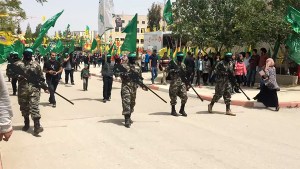
1042Hamas supporters march during a student council election rally at Bir Zeit University, near Ramallah, on April 20, 2015. The overwhelming Hamas victory in the student council elections should have been a wake-up call to the U.S. and Europe.

Mahmoud Abbas has a dilemma. If elections are held in the Palestinian Authority, and Hamas– whose only openly-stated reason for existing is to destroy Israel — wins, the PA will cease to exist and Israel will be able to avoid the peace process for all time.

If, however, elections are not held, Mahmoud Abbas will continue to rule without international or Palestinian legitimacy. Not only did his four-year term expire six years ago, but at this point, he barely represents the Palestinians in the West Bank.

The almost two million Palestinians on the other side of Israel, in Gaza, are represented almost exclusively by Hamas, with continuing attempted inroads by ISIS. Abbas is thus unable to represent “the Palestinian people” in any serious political process. The proposal for elections is therefore an embarrassment for Abbas, and is generally ignored.

Tragically, to shore up its status locally, the Palestinian Authority in the West Bank has taken a series of hasty, contradictory and dangerous steps. Since the PA’s chance at controlling the Gaza Strip has disappeared forever, the PA, to ensure its own continued survival, coordinates security with Israel to prevent further Hamas subversion in the West Bank.

In the meantime, senior figures in the PLO and the PA compete with Hamas in issuing strident, extremist messages to the Palestinian populace, which is consequently being radicalized — to the point now of supporting Hamas and ISIS.

Mahmoud Abbas and his high-ranking associates, nevertheless, continue to hold formal ceremonies to honor terrorists killed during attacks on Israeli targets.[1] Abbas also continues to commemorate “shaheeds” [those who die in the cause of Islam, often called “martyrs”] who killed dozens of Israeli civilians in suicide bombing attacks. Abbas erects monuments, names town squares after them, and holds sports and chess tournaments in their honor.

On this year’s Nakba Day — “the day of catastrophe,” which commemorated the 67th anniversary of the establishment of the State of Israel — during the May 15 ceremonies, Mahmoud Abbas promised the Palestinian masses that the occupied territories and the Palestinian diaspora would soon be restored to the independent state of Palestine. He also swore that the “resistance” — that is, armed violence and terrorism against Israel — would continue until the goal was achieved: destroying the State of Israel and establishing the Palestinian state on its ruins.

These intentions are not a secret to Israelis. They therefore do not trust his sincerity when he claims he wants “peace.” Only the wide-eyed West still does not believe that Mahmoud Abbas is telling the truth when he assures the Palestinians of his intent to destroy Israel.

The deliberate tension crafted by the Palestinian Authority has, as its only objective, bloodshed — both Palestinian and Israeli. This tactic can usually be seen when the level of violence falls below what the PA finds acceptable. It then trots out the old saw, first coined by the anti-Israeli Islamist sheikh Ra’ed Salah (whose right to free speech is protected by Israeli law), “Al-Aqsa mosque is in danger!”

At the beginning of May 2015, Sheikh Yusuf al-Dayis, the PA Minister of Religious Endowments [Waqf], made headlines in the Palestinian daily, Al-Quds, with the incendiary statement that the fate of the entire Muslim nation hung on the 35 acres of the Temple Mount. He even provided a list of what he claimed were Israeli “attacks” on Al-Aqsa mosque. Sadly for him, visitors to the Temple Mount can see every day the exorbitant security measures taken by the Israelis to protect the site. In point of fact, the record shows that every time the Palestinians want to provoke another pointless round of violence and slaughter, they say, “Al-Aqsa mosque is in danger!” It invariably causes hundreds of casualties on both sides and achieves absolutely nothing.

The last time a mosque actually was damaged was recently, in the Gaza Strip, when Hamas’s security forces removed the holy books, then used three bulldozers to raze a Salafist mosque. Hamas claimed it was in retaliation for an alleged Salafist attack on Hamas “jihad fighters” south of Khan Yunis. Sources in Gaza confirmed that seven Salafist-jihadi operatives were arrested in the mosque, and that Hamas had recently arrested 30 Salafist-jihadi Ansar Bayt al-Maqdis members. Having started terrorism in the Gaza Strip, Hamas is now reaping the result: terrorism there is “going viral.”

All evidence reveals that to establish a Palestinian state now would quickly turn it into an Islamist terrorist entity. Each time governments encourage Islamist movements, or ignore them in the hope that they will attack someone else, these movements have boomeranged into their own backyards and then moved on to their neighbors’. This will be the fate of Syria’s Bashar Assad, who let Hamas and other terrorist groups set up shop in Damascus. Former PA Chairman Yasser Arafat let Hamas into the neighborhood, and the Palestinian people are now being repaid by Hamas. Arafat wrongly assumed that letting Hamas in the door would serve him by forcing Israel to make concessions. Mahmoud Abbas thought that forming a Unity Government with Hamas would give the PA a unified front with which to harvest more money and diplomatic concessions from Europe. But last August, Abbas was informed of a Hamas murder plot against him. “We have a national unity government and you are thinking about a coup against me,” he said to Hamas’s leader, Khaled Mashaal.

The Islamist terrorist enclaves are wholly the fruit of the Muslim Brotherhood doctrine freely being spread around the Middle East and the democratic West. The so-far isolated incidents of bloodshed in Europe, Africa and the United States are just at the beginning stages of a long, bloody campaign to engulf the world.

Gaza has already been lost to Hamas and perhaps soon to ISIS. Libya and Lebanon may follow next. If the West pressures Palestinians and Israel to create a Palestinian state now, the West Bank and Jordan will be sure to follow. Enabling an expansionist Iran to have a nuclear threshold capability will also throw the region into war.

We, the Palestinians who live in the Palestinian Authority and within Israel, have not stopped dreaming of a Palestinian state, but we also witness the chaos around us and are relieved that so far the catastrophe has not harmed us or our families.

Some Palestinian politicians have turned to more extreme rhetoric to find favor with Israeli Arabs, but despite the tendency in Palestinian society towards extremism and terrorism, what is certain is that even if the establishment of the Palestinian state is postponed, most Palestinians hope the West will not make the mistake of permitting Iran to go nuclear. A nuclear Iran will create a nightmare that will make the Nakba look like a coming attraction.

____________________

[1] For recent examples, see: “Fatah glorifies arch-terrorist who planned killings of 125,” May 14, 2015; “PA honors 3 terrorists who lynched two Israeli reservists,” May 11, 2015; “PA sports presents terrorist murderers as role models,” May 4, 2015.