Posted tagged ‘Golan’

In new Syrian exodus, some 50,000 refugees head to Jordanian, Israeli borders

February 10, 2016

In new Syrian exodus, some 50,000 refugees head to Jordanian, Israeli borders, DEBKAfile, February 10, 2016

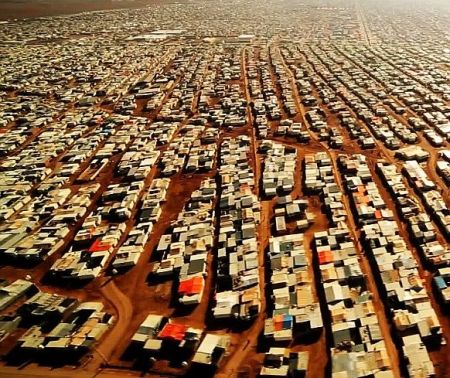
An aerial view shows the Zaatari refugee camp near the Jordanian city of Mafraq, some 8 kilometers from the Jordanian-Syrian border. 03/02/2016. BBC News

An aerial view shows the Zaatari refugee camp near the Jordanian city of Mafraq, some 8 kilometers from the Jordanian-Syrian border. 03/02/2016. BBC News

Syria’s refugee crisis in the north is now repeating itself in the south, with tens of thousands of destitute women, children and elderly people fleeing their homes – not this time from beleaguered Aleppo to the Turkish border, but from the southern region of Daraa towards the Jordanian and Israeli borders.

Unlike the broad coverage of the refugee crisis on the Syrian-Turkish border, the refugee exodus from the south has received scant media attention – even from Israeli correspondents.

With the intensification of attacks in southern Syria, about 50,000 refugees are now streaming toward Jordan and another 20,000 making tracks from Israel’s Golan border at Quneitra.

DEBKAfile’s military sources report that, since the weather has cleared and Russian air strikes resumed against the rebels holding the northern part of Daraa, tens of thousands of civilians are on the move from the South. About 15,000 to 20,000 have reached the Jordanian border, and more than 30,000 are believed heading that way; while another 20,000 refugees may be making for the Golan town of Quneitra on the Israeli border.

Jordan has taken in 650,000 Syrian refugees in previous exoduses from the five-year old war.

A desperate SOS appeared on social media Wednesday, Feb. 10, in which the rebel-controlled Daraa Provincial Council warned that tens of thousands of civilians were in flight from Russian air strikes and the barrel bombs dropped by the Syrian warplanes and helicopters.

There was no way to bring water, food or medicines to the fleeing refugees.

Military sources monitoring the situation report that the exodus was first touched off by the fall of Alaman, 3 km north of Daraa in the last few days to Syrian and Hizballah forces. They next cut off parts of Highway 5 from Daraa to Damascus. The rebels were left with only one remaining escape route, the road to the Jordanian border, but that too is under heavy fire, forcing the refugees to go round through rough country.

As in Aleppo, the Darnah district is held by hundreds of assorted rebel militias, ranging from the US-backed Free Syrian Army to groups which have sworn allegiance to ISIS. According to our intelligence sources, it is often hard to determine which groups are taking orders from whom.

Jordan has followed the Turkish policy towards the tens of thousands of refugees massing on its border  A single crossing is operating at Ramtha, but refugees are not allowed to pass through.

The Israeli government has not yet issued any statements of policy with regard to the Syrian refugees heading for the Golan.

IDF Preparing for Arrival of ISIS on Syrian Border

January 30, 2016

IDF Preparing for Arrival of ISIS on Syrian Border, Investigative Project on Terrorism, Yaakov Lappin, January 29, 2016

934

As conflict and mayhem continue to rage across Syria, the Israel Defense Forces (IDF) is preparing to encounter the threat of ISIS and al-Qaida forces right on its borders, and could encounter such threats in the coming months.

The preparations come as the Syrian civil war shows no sign of letting up. This is a conflict that has led to the violent deaths of 300,000 Syrians, and the displacement of more than 10 million others, 4.5 million of whom have fled the country.

Today, the IDF’s Military Intelligence Directorate views Syria as a former state that has broken apart into multiple ‘Syrias.’ The Assad regime controls barely 30 percent of Syria and is fully reliant on the foreign assistance of Russia, Hizballah, and Iran. Sunnis and Shi’ites wage daily war on one another.

It is worth examining the wider recent events in the multifaceted Syrian conflict, and place the IDF’s preparations in their broader regional perspective.

In Syria’s murderous kill-or-be-killed environment, Salafi-jihadist doctrines flourish, in the form of ISIS, which views Shi’ites (including the Assad regime and Hizballah) as infidels who must be destroyed.

ISIS cells have operated recently in Lebanon too, targeting Shi’ite Hizballah’s home turf of Dahiya in southern Beirut with two large bombings in November that claimed over 40 lives, while ISIS in Iraq continues to target Shi’ites.

Today, ISIS has between 30,000-50,000 members who are dedicated to expanding their caliphate and killing all those who disagree with their doctrine, including even fellow Sunni jihadi members of al-Qaida’s branch in Syria, the Al-Nusra Front, which has 8,000-12,000 members.

ISIS continues to use its territory in Syria and Iraq to plot major, mass-casualty terrorist attacks in Western cities. At the same time, its budgetary future looks uncertain, as oil funds have decreased significantly following allied air strikes on oil facilities. In the past year, 45 percent of ISIS’s $1.3 billion budget came from oil, far less than the oil revenue in 2014.

Unlike ISIS, al-Qaida believes in following a phased, slower plan in setting up a caliphate, and the two jihadist organizations have been at war with each other for more than two years in Syria.

Shi’ites led by Iran are fighting to stop the Salafi-jihadis’ spread. Under the command of Iranian Revolutionary Guard Corps (IRGC)-Quds Force unit commander, Qassem Suleimani, Iranian fighting forces and advisers moved into Syria. Iran has sustained more than 300 casualties there thus far.

Hizballah, too, is heavily involved in Syria’s battles, losing an estimated 1,300 fighters and sustaining 10,000 injuries – meaning more than half of its conscripted fighting force has been killed or wounded. Iran and its proxies are using the mayhem to try to spread their own influence in Syria.

Near Israel’s border with Syria, the Al-Yarmouk Martyrs Battalions, which is affiliated with ISIS, has set up many posts.

An estimated 600 members of the group control a population of around 40,000 Syrians. Al-Yarmouk is at war with al-Qaida’s Jabhat Al-Nusra, which maintains a few thousand members in the Syrian Golan near Israel.

Jabhat Al-Nusra’s membership is mostly derived of local Syrians, who tend to be more hesitant to start a war with Israel that would result in their areas, and relatives, being badly affected. Yet 10 to 15 percent of its membership comes from abroad, and have no commitment to the area. These foreign fighters have no qualms about precipitating attacks on Israel. At the moment, however, Jabhat Al-Nusra is bogged down by its fight with Al-Yarmouk.

ISIS has officially put Israel in its sights, and its leader, Abu Bakr Al-Baghdadi, declared his intention at the end of December to attack Israel.

The IDF is taking the threat seriously and is preparing for a range of possible attacks, including strategic terror attacks, cross-border raids, the sending of bomb-laden armored vehicles into Israel, and rocket, missile, small-arms, and mortar fire on the Israeli Golan Heights.

One possibility is that the heavily armed Al-Yarmouk group, which is facing the southern Golan Heights, might follow an Islamic State directive to attack Israel.

In 2014, Al-Yarmouk became an ISIS representative, swearing allegiance to it, though it is not fully subordinate to it.

Al-Yarmouk’s late leader, known as Al Khal (“the uncle”), was killed in November in an attack by Jabhat Al-Nusra. Before his violent end, Al Khal only partially committed himself to ISIS, and turned down ISIS requests to send fighters to Iraq.

Al-Yarmouk’s response to Jabhat Al-Nusra’s attacks came in December, when it assassinated a Jabhat Al-Nusra commander in his armored vehicle, just 400 meters from the Israeli border.

Al-Yarmouk subscribes to the Salafi jihadist ideology and has shoulder-held missiles, tanks, and other weapons looted during raids on the Assad regime military bases.

But Israel is also preparing for the possibility of encountering ISIS itself, not just an affiliate group.

ISIS proper is currently situated 40 kilometers from the Israeli border in southern Syria. One possibility is that Russian airstrikes will cause ISIS forces to ricochet southwards, towards Israel.

The IDF is gathering intelligence on all armed groups near its border, exhausting many resources to assess their capabilities, and intentions.

Israel watched as Shi’ite Hizballah came from Lebanon to block Sunni jihadist advances towards Lebanon in recent months, and as Russian airstrikes blocked the advance of the rebels northwards, to Damascus.

The IDF remains in a heightened state of alert along the Syrian border, though it is also working to avoid the creation of easy targets for the array of predatory forces on the other side.

As part of its preparations, the IDF’s Northern Command has given more autonomy to regional field commanders to enable faster responses to surprise attacks by reducing the initial chain of command during emergencies.

Inter-branch cooperation between intelligence, ground forces, and the air force has also been tightened.

Additionally, the IDF has fortified its border fence with Syria, adding electronic sensors to better be able to detect and respond to a potential attack in time.

The underlying assumption within military circles is that, sooner or later, ISIS will turn its guns on Israel, and the IDF does not intend to be caught off guard when that happens.

Russians let Hizballah into Daraa, breaking their promise to Israel

January 28, 2016

Russians let Hizballah into Daraa, breaking their promise to Israel, DEBKAfile, January 28, 2016

Syria_South

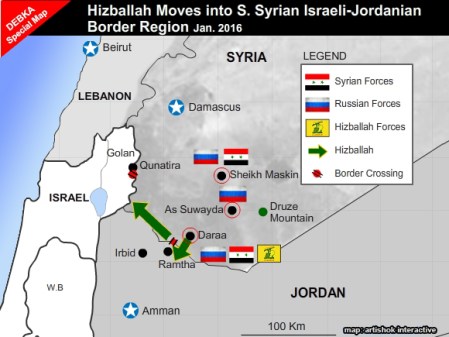
On Wednesday, Jan. 27 a large Hizballah force entered the southern Syrian town of Daraa, a critically dangerous event for Israel’s security. The way to the town, which lies near the Jordanian border and across from the Israeli Golan, was opened before Hizballah by none other than Russian forces. This was a blatant violation of President Vladimir Putin’s commitments to Prime Minister Binyamin Netanyahu and Jordanian King Abdullah not to permit Iranian and Iran-backed forces, such as Hizballah and Iraqi and Afghani Shiite militias, reach their borders in consequence of Russia’s military intervention in the Syria war.

Daraa is just 32 km from the southern Golan and 12 km from the Jordanian border. Hizballah forces in this town are therefore within easy striking distance from northern Israeli and Jordan.

What happened Wednesday was that a sizeable Hizballah contingent made it into Daraa, the day after a Syrian unit under the command of Russian officers captured the town of Sheikh Maskin, cutting off rebel forces east of Daraa from their comrades to the west.

Control of Sheikh Maskin is the key to the crossroads leading to Damascus in the north, the Druze Mountain town of es-Suwaida in the east, and Quneitra on Golan opposite Israel’s northern defenses.

The battle for Sheikh Maskin was the first in the Syrian conflict to be directly fought under Russian command. Its fall sparked accounts of Russian officers commanding Syrian troops in different parts of Syria.

So far, Israel has not reacted to the Hizballah force’s advance, notwithstanding public statements by Prime Minister Binyamin Netanyahu and Defense Minister Moshe Ya’alon that this would never be allowed to happen.

DEBKAfile’s military sources explain this reticence by a persistent misreading of the Syrian crisis in the higher ranks of the Israeli defense establishment. Military Intelligence chief Maj. Gen. Herzl Halevi, who has a good grasp of its complexities, is a lone voice against the defense minister and IDF chief of staff, Lt. Gen. Gady Eisenkot

In Amman, however, King Abdullah and his generals signified both alarm and fury. DEBKAfile’s sources report that Wednesday morning, the king shot off an urgent message to President Putin demanding an explanation for the Russian officers’ action in opening the door of Daraa to hostile Hizballah fighters.

Jordan has fought Hizballah and its conspiracies for three years, ever since its security forces seized an arms cache that Hizballah had smuggled into the kingdom for a terror cell to mount attacks in the northern province of Irbid. Amman is now concerned that Hizballah is close enough to make a grab for Al-Ramtha, the only border crossing between Syria and Jordan. That would be a feather in the cap of Iran’s Lebanese proxy, as the first Arab border crossing to fall to a Hizballah force outside Lebanon, and one, moreover, located athwart a main regional water source, the Yarmouk River.

As of Thursday morning, Jan. 28, Abdullah had not received a reply to his missive from Putin, but a message did come through to Amman from Syrian President Bashar Assad.

Using a back-door intelligence channel, he sent a notice in the name of Gen. Bahjat Suleiman, former Syrian ambassador to Jordan until he was expelled in May 2014, that King Abdullah must now face the consequences of his long support for the rebels of southern Syria.

The monarch was also advised to prepare for the influx of thousands of fleeing rebel fighters whom the combined Syrian and Hizballah forces were pushing towards the Jordanian border.

The next hours will be critical for the development of a similar crisis on the Israel-Syrian border in the Golan region.

Hizballah blows up “Mossad” patrol, sparks border clash with Israel

January 4, 2016

Hizballah blows up “Mossad” patrol, sparks border clash with Israel, DEBKAfile, January 4, 2016

Shortly after DEBKAfile’s forecast of a Hizballah revenge strike for the Samir Quntar assassination, a Hizballah roadside bomb blew up against an IDF patrol at the Shebaa Farms on the Hermon slopes Monday afternoon, Jan. 4.  No casualties were caused. The Israeli force responded with tank artillery fire on the southern Lebanese town of Al-Wazzani and was answered by rocket fire from Lebanon

Hizballah announced that it had targeted an Israeli patrol with a bomb on the ceasefire line at the Shebaa Farms targeting a civilian car carrying a “senior Mossad officer”.

The next Hizballah communiqué said: The Martyr al-Quntar Unit blew up a bomb against an Israeli patrol in the Shebaa Farms, destroying a military vehicle and causing casualties.

In a third communiqué, Hizballah said the car attacked carried a “senior Israeli army officer” – amending its previous claim of a Mossad officer.

The Israeli army has closed all northern roads to civilian traffic in case the Hizballah attack spreads into a major clash.

DEBKAfile reported earlier Monday that the rising tension between Tehran and Riyadh may serve Iran and its Lebanese proxy as an oportunity to attack Israel. The leader of that proxy, Hizballah’s Hassan Nasrallah, had repeatedly threatened to punish Israeli for the assassination of its high profile terrorist planner Samir Quntar in Damascus on Dec, 20. Quntar was freed by Israel as part of a prisoner swap in 2008, three decades after he was convicted of killing four Israelis. In September, the United States placed Quntar on its terror blacklist, saying he had “played an operational role, with the assistance of Iran and Syria, in building up Hizballah’s terrorist infrastructure in the Golan Heights.”

Concentrated Russian air strikes may open Syrian-Hizballah door to Israeli border

December 30, 2015

Concentrated Russian air strikes may open Syrian-Hizballah door to Israeli border, DEBKAfile, December 30, 2015

Sheikh_Maskin_29.12.15Sheikh Maskin-Syrian Army’s 82nd Brigade base

On the face of it, Moscow and Jerusalem make a show of their smooth air force collaboration in Syrian air space. But this picture is wide of the situation: The Russian air force omitted to notify Israel ahead of its massive bombardment close to its border Tuesday.

*****************************

Israel’s military and political leaders became intensely anxious Tuesday, Dec. 29, when they saw how concentrated Russian air strikes were swiftly dislodging anti-Assad rebels from southern Syria and beginning to open the door for the Syrian and Hizballah armies to come dangerously close to the Israeli border.

DEBKAfile’s military and intelligence sources report that Russian air strikes in other parts of the country have tapered off. Instead, heavy Russian bombardments are giving the combined Syrian-Hizballah force its first chance to recover Sheikh Maskin, the southern town housing the Syrian Army’s 82nd Brigade which has been passing from hand to hand for months. If the rebels lose that fierce battle, the way will be clear for the combined pro-Assad force to advance on the two key southern towns, Deraa and Quneitra on the Golan.

The rebel groups assaulted by the Russian air force Tuesday included moderate, pro-Western, pro-Israeli militias, such as the Southern Front and the First Column. Both suffered heavy casualties.

IDF unease as a result of Russia’s aerial intervention in the fighting in southern Syria is rising in proportion to the current military tensions with Hizballah. If the Lebanese Shiite terrorists manage to get the late Samir Quntar’s anti-Israel terror Front for the Liberation of Golan up and running, the Israeli air force would be severely hampered in launching its own strikes against this enemy by the dozens of Russian bombers using the same patch of sky without pause.

On the face of it, Moscow and Jerusalem make a show of their smooth air force collaboration in Syrian air space. But this picture is wide of the situation: The Russian air force omitted to notify Israel ahead of its massive bombardment close to its border Tuesday.

Some Israeli official circles suspect that Moscow is deliberately bringing Israel under pressure to accept a deal for southern Syria. One of President Vladimir Putin’s main objects from the outset of Russian’s military buildup in Syria was to eradicate the rebels in the South and the threat they posed to the Assad regime in Damascus.

More than once, Putin suggested to Prime Minister Binyamin Netanyahu that they work out a Russian-Israeli deal for that part of Syria. The Israeli leader was unresponsive, mainly because Israel is bound by prior understandings to coordination with the US, Jordan and moderate Syrian rebel groups. A deal with Moscow would counter those understandings.

However, The concentrated air strikes in the border region is intended by the Kremlin, according to some views, not just to push the rebels out, but to twist Israel’s arm for settling the issue with Moscow.

Tehran names Raafat Al-Bakkar as new Hizballah Golan terror ring chief

December 28, 2015

Tehran names Raafat Al-Bakkar as new Hizballah Golan terror ring chief, DEBKAfile, December 28, 2015

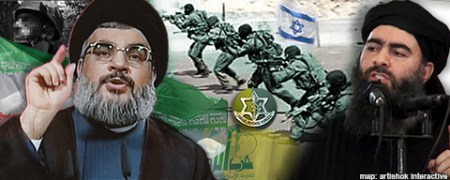
NasrallaBagdadi480

Tehran Monday, Dec. 28, further ramped up the tension between its Lebanese proxy Hizballah, whose leader Sunday threatened to avenge the death of Samir Quntar, and Israel, which is conducting a military exercise along its northern borders. Four days after Quntar was assassinated in Damascus, Tehran appointed a successor to carry on building a new terrorist network for striking Israel from the Golan.

This successor is revealed by DEBKAfile’s exclusive sources as a Lebanese called Raafat Al-Bakkar, about whom very little is known. According to our sources, the Iranians spotted Al-Bakkar as promising talent earlier this year, shortly after the Israeli air strike which on Jan. 18 killed Iranian Gen. Ali Dadi and the high-profile Hizballah leader Jihad Moughniyeh. They were caught touring the Golan around Quneitra in search of a site for a terrorist base. Al-Bakkar was sent to Tehran at that time for a course in building and running terrorist networks, and this week he was given charge of the new “National Resistance on the Golan” organization for deep strikes inside Israel.

When Nasrallah boasted Sunday that his jihadists were already on their way to punish Israel, he was looking forward to the arrival of Quntar’s successor.

See DEBKA files’ earlier report from Sunday, Dec. 27.

IDF Chief of Staff Lt. Gen. Gady Eisenkott explained why it was necessary to bring forward the launching of the new Commando Brigade by two months, when he addressed the formation ceremony on Sunday, Dec. 27, at the Ein Harod National Park: “The Commando Brigade is more necessary than ever in light of the threats from Hizballah and the Islamic State,” he said, in reference to the boasts heard in the last 48 hours from Hassan Nasrallah and Abu Bakr Al Baghdadi.

The Chief of Staff introduced Col. David Zini as the first commander of the new Brigade.

The ceremony took place shortly after the Hizballah chief Hassan Nasrallah said, “Revenge for the death of Samir Quntar is on the way… The orders have been given and execution is in the hands of resistance fighters on the ground… The Israelis are worried and rightly so – those on the borders [soldiers] and those inside the country…. We shall not let the blood of our Jihadi fighters and brothers to be spilled anywhere in the world,” he said.

DEBKAfile’s military sources report: Analysis of the kinds of threats posed by Hizballah (and ISIS) at this time, which are likely to focus more on terrorism than on tank or infantry border incursions, persuaded IDF leaders of the need for a new framework for bringing under one roof some of the top-notch, highly-trained, experienced, well-armed and determined fighting men who are willing to take on new challenges.

The self-styled Islamic State’s “caliph” Abu Bakr Al-Baghdadi, also devoted special attention to Israel, or rather “the Jews,” in his first audio speech in seven months Saturday, Dec. 26, the day before Nasrallah sounded off. His message was similar to that of his Shiite enemy, albeit in his own inimitable style:

The Islamic State would soon be in Palestine to establish an Islamic state there, he said, “Jews, soon you shall hear from us in Palestine which will become your grave… The Jews thought we had forgotten Palestinian… Not at all, Jews…The pioneers of the jihadist fighters are getting closer every day.”

If and when the Shiite Hizballah and Sunni ISIS make good on their similar but separate threats – or sooner – they will encounter Israel’s new Commando Brigade. Its fighting men are trained for combat in miscellaneous conditions of terrain, day or night, under deep cover. They are equipped with high-tech equipment, most of it classified, for gathering visual and electronic intelligence, communications, photography and targeting. They may either kill terrorists or take them captive.

In a word, these elite troops will hit the enemy in his back yard or at home, and blow the threats heard from Hizballah and ISIS leaders’ back on their own forces.

The 89th Commando Brigade is composed of four battalions:

Duvdevan specializes in operating amidst an Arab population under deep cover for locating and arresting terror suspects.

Egoz is a special kind of infantry battalion, whose commandos operate solo or in very small teams behind enemy lines, especially across the Syrian and Lebanese borders.

Maglan is skilled in the use of weaponry designed for precision operations against high quality enemy targets. These elite fighters go deep inside enemy territory to gather intelligence and use their specialized technology, exclusive for the use of this unit, for devastating assaults.

Rimon members are desert fighters who gained their experience in the terrain of the Gaza Strip and Egypt. Their experience as back-up for operations against drug smugglers is invaluable for urban combat in civilian environments.

Excluded from the new brigade are the separate IDF commando units: Sayeret Matkal, Shayetet 13 (Navy), the Oketz unit which trains dogs for anti-terror work, and Yahalom, of the Engineering Corps.

To Strike or Not to Strike, That is the Question

December 17, 2015

To Strike or Not to Strike, That is the Question, The Investigative Project on Terrorism, Paul Alster, December 16, 2015
1310 (1)

[C]ould there still be a window of opportunity, unpalatable as much of the international community might find it, of Israel launching a pre-emptive strike against what is widely perceived as a massive and increasing threat to its security?
**********************

Israeli estimates of the number of missiles terrorist powerhouse Hizballah has in Lebanon increased last summer from 100,000 to 150,000. The Shi’ite army continues to gain strength, unhindered by the token presence of United Nations troops in what was supposed to be a de-militarized zone following the 2006 Second Lebanon War.

Hizballah’s promises of capturing the Galilee – that have inspired a feature-length Lebanese movie on the subject – are oft-repeated. The imminent release (as a result of the P5+1 nuclear deal) of billions of dollars to its guardian angel and guiding hand, the Islamic Republic of Iran, promise more money and materiel will be placed at the disposal of an organization that has already fought two vicious wars against the Jewish state, a state whose existence it refuses to recognize.

Hizballah’s growing strength, and its acquisition of advanced weapons, (undoubtedly aided of late by Russian air strikes in support of the Syrian army), has Israeli leaders thinking hard about how long they can allow such a build-up to go unchecked, and whether there is a growing case for something more than sporadic cross-border interventions to temporarily stem Hizballah’s growing firepower.

“We operate in Syria from time to time to prevent it turning into another front against us,” Israeli Prime Minister Benjamin Netanyahu acknowledged Dec. 1 at the Galilee Conference in Acre. “We act, of course, to prevent the transfer of deadly weaponry from Syria to Lebanon.”

His surprise comments came on the back of two reported airstrikes on Syrian weapons convoys – attributed to the IAF – apparently destined for Hizballah.

Two days later, Defense Minister Moshe Ya’alon again highlighted the increasing danger posed by Iran’s overt support of the Hizballah, telling members of the U.S. Congress, “We are very worried about Iran’s presence in Syria… This regime generates terrorism and undermines many of the regimes in the Middle East, and this is not good news for the region, not only Israel.”

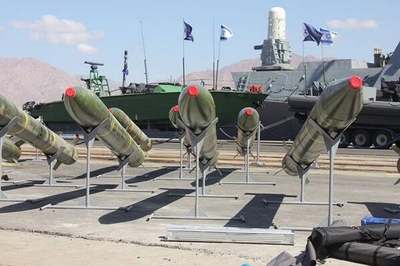
Reports last week of Iran completing a second medium-range ballistic missile test in contravention of U.N. Security Council resolutions did little to ease Israeli fears. On Dec. 10, in another indication of the urgency with which it views the Iran-Hizballah threat, Israel successfully tested its Arrow 3 missile defense system, an extra layer of defense on top of the Iron Dome, David’s Sling, and the Arrow 2 system that may well prove critical in defending against the Iranian-made Shihab 3 longer ranger missiles.

In an exclusive interview with the Investigative Project on Terrorism, a senior IDF official – who for security reason must remain anonymous – spelled out the likely scenario should Hizballah live up to its promises and attack Israel from the north. He did not discuss the likelihood of an Israeli pre-emptive strike against Hizballah, but painted a sometimes grim assessment of what the Israeli public can expect.

“The next war will be different. As an Israeli citizen, father to two boys in the army, I really hope we will find a solution to peace in the area… but we have to deal with this,” the IDF official explained. “I believe that in the next war we will see that Hizballah and Hamas will both launch missiles. They have the same interest here.”

Earlier this month, subsequent to this interview taking place, Israel’s Channel 2 news reported that Shadi el-Meni, the Islamic State leader in the Sinai Peninsula, met with Hamas leaders to discuss increased weapons supplies to the Gaza-based terrorists. The ideological differences between the two sides seemingly set aside in the pursuit of preparing an enhanced assault on Israel.

The IDF officer suggested that during the 2014 Gaza War more than 70 percent of the Israeli population was covered by the Iron Dome as it intercepted missiles coming from the Hamas-controlled enclave. But with rockets raining down from Israel’s north and south, Iron Dome’s use would be limited. There will be occasions when civilians will not be protected when defending strategic installations take priority.

“We understand that Iron Dome next time will not do the same work,” he said, “because you will not always put it on populations; you will put it in strategic locations that we need to defend like chemical factories, and gas [installations], of course.”

Israel’s third largest metropolitan area, Haifa, is home to a huge Mediterranean port and a major Israeli naval base. Defending such a massive target will be “very hard” he said. “We have Iron Dome, the Arrow and the Patriot as well, but when you have 150,000 missiles from Lebanon, you cannot assume that every missile they will launch will [be intercepted]. This is what we need to explain to the Israeli population. A lot of [apartment blocks], a lot of industrial zones, a lot of factories will be targeted, and at the same time Hamas will launch from Gaza. This is our understanding.”

He suggested there will be sustained bouts of simultaneous rocket attacks in the north, although there is no doubt that Hizballah’s arsenal offers the capability to reach as far as Tel Aviv and Jerusalem.

“I think the enemy has [learned] very well. Today we see Hizballah fighting in Syria. Hizballah a few years ago said they are just defensive, now we see they are an offensive force. After the [2014] operations near Israel’s Gaza border, we understand that kibbutzim near the [Lebanese] border may be ‘evacuated and moved back.’ We think it is possible [Haifa] will be without electricity for 72 hours,” he continued. “No phones. No talking to your family. We have practiced evacuations to shelters and built civilians rescue teams in the towns and villages.”

Civilian teams have trained to help get people into shelters and in emergency response in Jewish towns and Arab villages alike. Haifa, for example, is home to a wide variety of communities, including around 30,000 Israeli Arabs, (both Muslim and Christian), Druze, and followers of the Baha’i faith.

“We assume everything Hizballah sees in Syria they can try to bring into Lebanon, so I assume that they will try to bring missiles such as Scuds and try and launch them all over Israel. In [the Haifa] district what we will see is the 122mm – they have thousands of these Katyushas that have a range of up to 45 kms – and that would take them from the [Lebanese] border to Tirat HaCarmel [on the south side of Haifa]. This is the main problem for the first days of the war.”

“Hizballah has advanced weapons. You don’t need to be in uniform to know that if they take the C-802 that they launched at Eilat in 2006 they will try launching it [again]. They have very good, advanced weapons, anti-tank missiles – a huge stockpile.”

And, under the cover of missile fire, the senior IDF officer said he has little doubt Hizballah will attempt some degree of land invasion.

“I think that there are maps of this,” he said. “We understand this when [Hizballah leader Hassan] Nasrallah says he will be in the Galilee and will take it from Israel. I don’t think that he will [achieve] it. So, they will take Metula, or Shlomi, or Hanita for a few hours and they’ll raise a flag. Okay, so they will launch thousands of rockets. It will be hard, but Israel will continue to exist. With Hizballah fighting in Syria in offensive attacks with tanks, infantry, UAV’s, you understand they are building a very powerful military with much practical experience.”

During the long and bloody fight against ISIS, Al Nusra and others in Syria, Hizballah has picked up large amounts of weaponry from the battlefield, weapons manufactured around the globe, some likely from the U.S. who have armed the Free Syrian Army. Whatever they captured could be fired on Israel when the war everyone expects finally breaks out.

With the exception of its border with Jordan, Israel faces non-state actors at all points of the compass. Hizballah in south Lebanon, Hizballah, ISIS and the Al Nusra Front in Syria, Hamas and Islamic Jihad in Gaza, and ISIS and al-Qaida in Sinai. There are also signs that the Fatah-run Palestinian Authority is increasingly vulnerable to radical Islamists from Hamas or ISIS as the stabbing terror spree against Israelis continues into a third month.

Could the awful Paris attacks in November have finally brought Europeans around to understanding the Israeli predicament in facing terror organizations on virtually all sides?

“I think that all over the world we have problems with radical Muslims. What we see… is a common enemy. These radical terror organizations have similar tactics and I hope the world will understand what Israel has [faced] in the last decades. I think maybe we don’t know how to explain our story [very well]. I hope that maybe now they will understand what a threat the world has, facing non-state actors and terrorist organizations – and we know it is Iran that gives money to Hizballah and tries to give them missiles to hit every place in Israel.”

The best opportunity for Israel to intervene might have presented itself last summer, when Hizballah appeared to be on the ropes.

“One can conclude that Israel may see an auspicious opportunity to make a preemptive attack to destroy Hezbollah’s massive ordnance in southern Lebanon, stockpiled since the 33-day Israel-Hezbollah war in 2006,” Iranian-Canadian political analyst Shair Shahidsaless wrote at the Huffington Post in June.

That was before the game-changing Russian entry into the conflict that has seen the balance of power sway back towards Assad and Hizballah. But could there still be a window of opportunity, unpalatable as much of the international community might find it, of Israel launching a pre-emptive strike against what is widely perceived as a massive and increasing threat to its security?
Russia brings over heavy T-90 tanks to boost three Syrian warfronts

December 6, 2015

Russia brings over heavy T-90 tanks to boost three Syrian warfronts, DEBKAfile, December 6, 2015

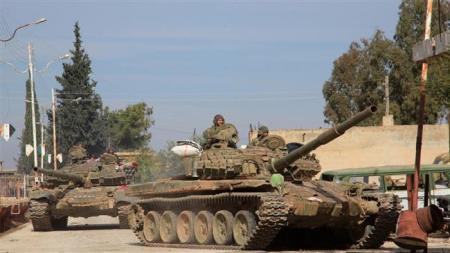
russian-tank-army-t-90-Syria_12.15

On Wednesday, Dec. 2, Russia started transferring dozens of advanced T-90 tanks to Syria, DEBKAfile’s military and intelligence sources report. They were moved immediately to two Syrian army fronts fighting rebel forces at the two most important cities, Aleppo and Damascus, and are expected to be sent to beef up the combined Syria, Iranian, Hizballah army poised to recover Palmyra from the Islamic State.

The shipment to the capital was delivered into the hands of the 4th armored division, Syria’s republican guard commanded by Gen. Ali Maher Assad, the younger brother of President Bashar Assad.

The attack on Palmyra in country infested by ISIS forces was scheduled to have begun two weeks ago but was delayed for the arrival of the heavy Russian tanks, among other reasons.

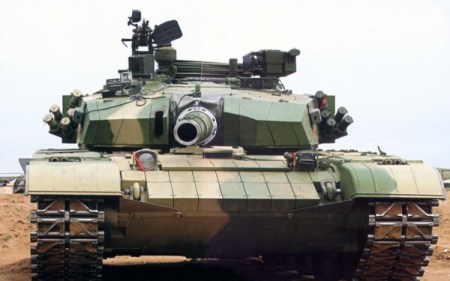
The T-90 weighs 46.5 tons and has a range of 375 kilometers, with an average speed of 45 km per hour under battle conditions or 65 km per hour on roads. It has three layers of defensive systems: composite armor plates on the turret; Kontact-5 third-generation explosive reactive armor on its front, sides, and turret that reduces penetration by kinetic energy bombs; and the “Shtora,” or curtain, an electro-optical active protection system that enables the tank to jam the systems of antitank missiles.

The T-90 also has 12 smoke mortars, a 125 mm cannon and AT-11 Sniper guided antitank missiles. The tank has proven itself in battle in recent years in Russia’s wars in Georgia and Chechnya against forces not unlike the Syrian rebels.

Until last week, Russia kept only a few T-90 tanks in Syria, mainly to protect its military bases around Latakia.

The new shipment, say Western military sources which are monitoring Russian movements, will eventually replace a large part of the Syrian army’s fleet of around 500 operational tanks, mostly T-72s – at least half of which are positioned to defend the capital.

But the pace of delivery will be dictated above all by the time needed for Russian instructors to retrain Syrian tank crews from scratch in the use of T-90s in battle conditions.

It should be noted meanwhile that, while the Syrian rebels have antitank missiles able to take out the T-72, they do not have advanced missiles capable of stopping the much heavier, reactively armed T-90. But  the Islamic State does, having captured US-made antitank missiles from the Iraqi armored divisions put to flight in June 2014. Some of those advanced missiles may be presumed to have been passed to ISIS forces in Syria.

For now, the Russian general staff shows no sign of preparing for a wide-scale operation against ISIS in Syria, so the newly-delivered T-90s are not immediately threatened from that quarter.

As far as Israel is concerned, the main worry is that Russian instructors will also be assigned to train Iranian and Hizballah tank crews in the use of the advanced T-90. Once they get hold of these tanks, they will be able to attain their objective of beefing up the Iranian-Hizballah front against Israeli defenses from southern Syria and the Syrian Golan.

Israeli finds cause for concern in the constant expansion of the Russian military presence and involvement in Syria. Preparations for a very long stay are signified by new developments every few days. A permanent Russian military presence in Syria would give Iran and Hizballah cover for a standing military buildup in Syria. This would confront Israel’s vital strategic interests with a major challenge.

Israel extremely nervous over Russian operations on its Golan border

December 2, 2015

Israel extremely nervous over Russian operations on its Golan border, DEBKAfile, December 2, 2015

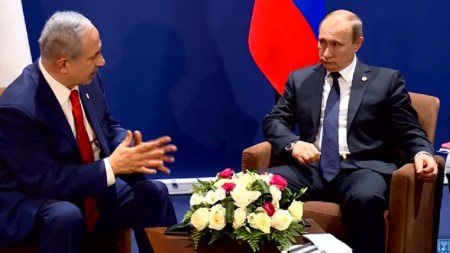
Netanyahu_speaks_with_Putin_Paris_30.11.15

Moscow may be giving Hizballah and Iran an umbrella for achieving their longstanding design to displace the Syrian rebels with Revolutionary Guards and Hizballah forces and deploy them along Israel’s Golan border.

**********************

On the outside, Israel is all smiles and full of praise for way the coordination with Moscow is working for averting clashes between its air force and Russian warplanes over Syria. This goodwill was conspicuous in the compliments Prime Minister Binyamin Netanyahu and President Vladimir Putin traded when they met on the sidelines of the Paris climate summit Monday, Nov. 30.

But the first disquieting sign appeared Tuesday, Dec. 1. Senior Russian and Israeli officers were due to meet in Tel Avid to discuss strengthening the cooperation between the two army commands. But no word from Moscow or Jerusalem indicated whether the meeting had taken place.

DEBKAfile’s military sources report that this week, the show of optimism is giving way to an uneasy sensation in the offices of the prime minister, Defense Minister Moshe Ya’alon and the IDF Chief of Staff Lt. Gen. Gady. They suspect an ulterior motive behind Russia’s military movements in southern Syria, especially its air strikes against Syrian rebels, just across from Israel’s Golan border.

In particular, Moscow may be giving Hizballah and Iran an umbrella for achieving their longstanding design to displace the Syrian rebels with Revolutionary Guards and Hizballah forces and deploy them along Israel’s Golan border.

This suspicion gained ground when Tuesday, Dec. 1, the day after the Putin-Netanyahu encounter, the combined Iranian-Syrian-Hizballah units expanded their thrust from the southern Syrian town of Deraa to the Golan town of Quneitra, within sight of Israel’s defense positions.

All that day, heavy battles raged over the rebel-held line of hills running from a point just south of Quneitra to the Israeli-Syrian-Jordanian border junction. The combined force was supported by Russian air strikes and heavy tanks and artillery, seen for the first time in this war arena.

When the fighting resumed Wednesday, the IDF placed its Golan units on high alert and an extra-vigilant eye was trained on this battle.

The Iranian-Syrian-Hizballah side is gaining a distinct advantage from the deep feud dividing rebel ranks. The Islamic State and the al-Qaeda-affiliated Syrian Nusra Front forces are tearing into each other with suicide bombers and explosive cars. Tuesday, an ISIS-rigged bomb car blew up at Nusra headquarters near Quneitra (see photo).

ISIS_car_bomb_in_Quneitra_nusra_1.12.15

But this also means that an Islamic State force has come dangerously close to the Israeli border.

However, even more perils are in store if Bashar Assad’s army backed by Iran, Hizballah and Russia manages to capture the hills opposite the Golan:

1. Two years of unrelenting Israeli military and intelligence efforts to keep Hizballah and Iranian forces away from its Golan border will have gone to naught.

2.  Hizballah will open the door for Iranian Revolutionary Guards officers to set up a command center right up to the Israeli border.

3.  Israel’s steadfast policy and military action to prevent advanced Iranian weapons reaching Hizballah in Lebanon via Syria will be superseded. On the Golan, Hizballah will have gained direct access to any weapons it wants directly from Syria and be able to deploy them at far shorter distances from Israeli targets than from their firing positions in Lebanon.

4.  Vladimir Putin attaches extreme importance to recovering southern Syria from the rebel forces backed by the US and Israel, because he regards the threat to the Assad regime as great from the south as it is from the north or the center.

5.  Israel faces a grave dilemma between keeping up its “honeymoon” with Moscow by giving way on its essential security interests, or taking the bull by the horns and keeping the enemy at bay, whatever the cost to the understanding reached with Putin.

Officials in Jerusalem point out that the threat to Golan peaked just hours after the Russian leader met the prime minister in Paris. Putin is conducting a hands-on policy on Syria and keeps close track of the slightest occurrence on the battlefield. He must have been perfectly aware of the state of play on the Golan when he met Netanyahu, but nonetheless kept it out of their conversation.

An Israeli Arab flies paraglider into Syria to join ISIS without being intercepted

October 25, 2015

An Israeli Arab flies paraglider into Syria to join ISIS without being intercepted, DEBKAfile, October 25, 2015

GlyderParchute

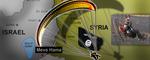
In a major security breach, an Israeli Arab, 23, was able to fly by paraglider across into Syria from the southwestern village of Mevo Hama Saturday, Oct. 24, southwestern Golan without being intercepted – although an IDF spotter had reported the event. The pilot came from the Israeli Arab town of Jaljuliya east of Kfar Saba near the West Bank. His defection, apparently to the Islamic State, was clearly organized in advance. His landing in Syria was secured by a party from the jihadist group who came to pick him up.

The massive air-and-ground search operation the Israeli military scrambled came too late.

“We believe he planned this move to the other side, and joined a group there,” Brig.-Gen. Moti Almoz told reporters during a conference call Sunday morning, after a gag order on the story was lifted. Another IDF statement said that Israeli forces are still trying to ascertain the person’s intentions

DEBKAfile’s military sources count this event as a particularly grave security lapse for the following reasons:

1. The Shin Bet was clearly taken unawares of a conspiracy for the Israeli Arab’s flight.

2.  No one discovered that a paraglider was being assembled in secret at Mevo Hama or had it brought there unnoticed. And who helped him launch it?

3. How did he set up communication with ISIS-Syria without being detected by Israeli security?

4. How did the preparations on the Syrian side to receive the pilot escape the attention of IDF military intelligence?

5. Why was no one on the spot authorized to shoot the paraglider shot down before it flew across the border? By the time the report went through channels, the bird had flown.

ISIS claims it has taken an “Israeli pilot” captive.

Our military sources add that the paraglider operation was set up by a hostile element to test Israel’s defenses in three areas:

  • The efficiency of IDF spotter posts across the Golan. The glider was indeed sighted and reported.
  • Israeli Air force operations in Golan – which were indeed found with holes that can be used for penetration.
  • Israel’s air defense on the Golan. This episode exposed the absence of a commander with authority to act with dispatch to foil an unforeseen event.

In other words, Israel’s defenses were wide open to attack Saturday.