Posted tagged ‘Gaza’

Gaza terrorists fire 3rd mortar at IDF troops

May 4, 2016

Gaza: Three mortar attacks in one day on IDF troops For third time Wednesday, terrorists attack IDF forces stationed along Gaza border; fourth such attack in two days.

By Ari Soffer

First Publish: 5/4/2016, 1:02 PM / Last Update: 5/4/2016, 3:13 PM

Source: Gaza terrorists fire 3rd mortar at IDF troops – Defense/Security – News – Arutz Sheva

Terrorists fire mortar shells (file) Flash 90

Terrorists in the Gaza Strip fired a two mortar shells at IDF engineers operating on the Israeli side of the border Wednesday, as tensions in the south continue to rise.

The mortar strikes – which came hours after a similar attack this morning – bring the total number of similar breaches of the ceasefire by Gazan terrorists in two days to four. IDF forces returned fire at a Hamas military post in response to the second attack.

No soldiers were injured in the first attack on Wednesday, which IDF forces responded to with tank fire.

Early Tuesday evening, terrorists opened fire on IDF forces just hours after Prime Minister Binyamin Netanyahu made an impromptu visit to troops stationed at the border with Hamas-ruled Gaza.

It is not yet known which of the many terrorist factions operating in Gaza is responsible for the latest attacks. Previous attacks have either been claimed by or attributed to jihadist terror cells linked to ISIS, or Hamas’s chief Islamist rivals Islamic Jihad, as part of efforts to challenge Hamas’s rule and provoke another round of fighting with Israel.

Israel Thwarted Attempted Smuggling of Ammonium Chloride to Gaza

May 3, 2016

Israel Thwarted Attempted Smuggling of Ammonium Chloride to Gaza, Israel DefenseOr Heller, May 3, 2016

Amonium chloridePhoto: Nitzana Customs

Before the Passover holiday, customs and ISA officials at the Nitzana Border Crossing used by Egypt, Israel and the Palestinian Authority seized four tons of ammonium chloride concealed within a shipment of salt. Ammonium chloride can be used in the production of long-range rockets and the quantity of material seized had the potential to yield hundreds of such weapons.

About a week before the Passover holiday, a shipment arrived at the Nitzana crossing, used for the passage of goods between Israel, Egypt and the Palestinian Authority. The shipment was intended for delivery to Gaza and was declared to contain 40 tons of salt. A thorough examination performed by Customs at Nitzana revealed that amidst the 40 tons of salt, 4 tons of ammonium chloride was concealed. Ammonium chloride is defined as dual-purpose and the transfer of such material to the Gaza Strip requires a license because it can be used by terrorist organizations, such as Hamas and Palestinian Islamic Jihad to manufacture long-range rockets. Recently, the ISA has grown increasingly concerned regarding the large amount of salt ordered to Gaza and that the shipments of salt are used for smuggling of chemicals designated for the production lines in the Gaza Strip, especially rocket production.

The ISA estimates that the importer of the latest smuggling attempt is a Gaza resident associated with Hamas. The importer was believed to have been urged by the terrorist group to bring the materials into the Strip for manufacturing use by Hamas. The ISA emphasized that this case illustrates that terrorist operatives in Gaza smuggle dual-use materials into the coastal Palestinian enclave for militant purposes under the guise of imports intended for the civilian population and construction of restoration projects.

ISA and the Customs Administration view this incident as severe and intend to continue to identify and thwart the smuggling of dual-use materials, while prosecuting those involved in smuggling attempts. The cooperation between the Customs Administration and ISA has already led to the thwarting of dozens of smuggling attempts of prohibited products and materials into Gaza, which were allegedly intended for terrorist organizations, including: sulfuric acid, diving Suits, polyurethane propellant for rockets, sulfur rods, fiberglass rolls, and a special coal used to fuel iron furnaces for processing metals.

UN official: Hamas doesn’t use cement for terror

May 3, 2016

Senior UN official denies Hamas uses cement for terror tunnels UN Assistant Secretary-General says ‘no proof’ Hamas uses construction material for ‘military purposes.’

By Matt Wanderman

First Publish: 5/3/2016, 1:45 PM

Source: UN official: Hamas doesn’t use cement for terror – Defense/Security – News – Arutz Sheva

Terror tunnel Flash90

UN Assistant Secretary-General Robert Piper claims that there is no proof that Hamas is taking advantage of UN-provided construction material for “military purposes,” the pro-Hamas Middle East Monitor reports.

He made his remark after Israel announced that it was blocking the transfer of cement into Gaza because Hamas uses it to build terror tunnels. Piper said that the United Nations has provided 1.2 million tons of construction materials to Gaza, though he did not explain why despite that very few reparations have been carried out since 2014’s Operation Protective Edge.

Recently, the Palestinian Authority claimed that the reconstruction is stymied by a lack of funds. Critics, including the Gaza-based think tank PalThink, say that the PA is trying to improve its own standing rather than Gaza. “Whenever the PA proposes development plans, it mixes between the reconstruction of Gaza and its own financial needs in order to get billions for its treasury,” says isntitute head Omar Sha’ban.

Despite Piper’s protestations, Hamas seems to make far more progress on building tunnels than on repairing residential neighborhoods and public services.

Robert Piper heads the UN Office for the Coordination of Humanitarian Affairs (UNOCHA), which handles natural disasters and complex emergencies.

UK: The Left’s Little Antisemitism Problem

May 1, 2016

UK: The Left’s Little Antisemitism Problem, Gatestone InstituteDouglas Murray, May 1, 2016

♦ Within a week, Britain’s Labour party leadership was forced to suspend one of its newest MPs and one of its oldest grandees — and both for the same reason.

♦ Labour party leader Jeremy Corbyn and Ken Livingstone both say that they condemn anti-Semitism. They always tend to add that they also condemn “Islamophobia and all other forms of racism,” a disclaimer that always seems a deliberate attempt to hide a hatred of Jews under the skirts of any and all criticism of Islam. What is most fascinating is that all the while they are saying this, they stoke the very thing they claim to condemn.

♦ They pretend that the Jewish state does such things for no reason. There is no mention of the thousands of rockets that Hamas and other Islamist groups rain down on Israel from the Gaza Strip. The comment turns a highly-targeted set of retaliatory strikes by Israel against Hamas in the Gaza Strip into a “brutal” attack “on the Palestinians” as a whole. While mentioning those death-tolls, Livingstone has no interest in explaining that the State of Israel builds bunkers for its citizens to shelter in, while Hamas uses Palestinians as human shields and useful dead bodies for the television cameras, to help Hamas appear as an aggrieved “victim.”

♦ It is the narrative of the “left” on Israel that is causing the resurgence of anti-Semitism. It is not coming from nowhere. It is coming from them. If the left wants to deal with it, they first have to deal with themselves.

Every time anyone thinks Britain’s Labour party has reached a new low of anti-Semitism, entirely new depths seems to open. In September, I wrote here about how the election of Jeremy Corbyn to the leadership of the Labour party constituted a “mainstreaming” of racism in the UK. Although Mr. Corbyn claims he does not have any tolerance for any hatred of anyone, he is a man who has spent his political life cosying up to anti-Semites and terrorist groups that express genocidal intent against the Jewish people. He has worked closely with Holocaust deniers, praised anti-Semitic extremists and described Hamas and Hezbollah as his friends.

During his leadership so far, it is clear that the lead he is given is being followed farther down the party hierarchy. In March, I described how the party appeared to be rotting from the head down, with the discovery that the Labour Club at Oxford University had become an entity rife with anti-Semitic insults. Yet anyone who thought that the party could fall no farther had not imagined its turns of the past week.

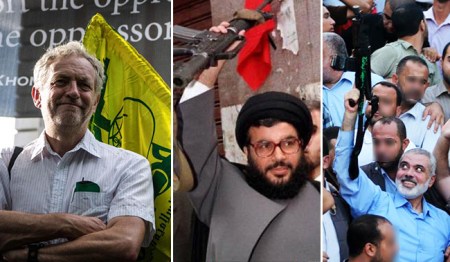
1267In 2009, Jeremy Corbyn (left, posing before a Hezbollah flag) said: “It will be my pleasure and my honour to host an event in Parliament where our friends from Hezbollah will be speaking. I also invited friends from Hamas to come and speak as well.” Pictured in the middle is Hezbollah leader Hassan Nasrallah. Pictured at right is Hamas leader Ismail Haniyeh.

At the start of the week, the MP for Bradford West, Naz Shah, was found to have posted on Facebook threads such ideas as the deportation of all the Jews from Israel over to America; the caption read, “problem solved.” Elsewhere she wrote on a discussion thread, “The Jews are rallying.” Ms. Shah happens to be a Muslim and represents a constituency which, until the last election, was represented by George Galloway. Other luminaries of the area include the former Liberal Democrat MP and David Ward.

So it is fair to say that among her peers, what Ms. Shah said was not unusual. The posts are from 2014, a year before she became an MP, and during the latest of Israel’s engagements in Gaza. In her apology, once she was found out, Ms. Shah talked of the fact that it was period in which “feelings were running high.” Of course, not everyone during a period of heightened feelings calls for the destruction of a UN member state, but Ms. Shah did, and within a day of the exposé of these messages, and an appropriate political outcry, she was suspended from the Labour party, pending a full investigation.

Labour’s week had barely begun. Within hours, another Labour MP, Rupa Huq, tried to come to Ms. Shah’s rescue. In a BBC interview, Ms. Huq tried to compare calls to eradicate the State of Israel with any other “amusing” thing one might find on Twitter. After a swift U-turn, Ms. Huq managed to restrain herself and remained in the party.

Next, from stage far-left, the former Mayor of London, Ken Livingstone, currently on Labour’s National Executive Committee, made his intervention. Mr. Livingstone has been in the Labour party for almost five decades and in the same trenches as the party’s current leader all of his political life. They have marched together for many a terrible cause and stood shoulder-to-shoulder on many a forsaken platform. But as Ken Livingstone went on several BBC programs, he probably did not expect that within hours, his own Labour party membership would be suspended, as was Ms. Shah’s. Livingstone had used his media opportunities to start talking about Hitler — specifically to claim, that Zionism was an early policy of Hitler’s. Perhaps sensing that he had got himself onto unfortunate ground, Livingstone then stressed that this was all before Hitler “went mad” and killed six million Jews.

So within a week, the Labour party leadership was forced to suspend one of its newest MPs and one of its oldest grandees — and both for the same reason. Presently, Jeremy Corbyn and his spinners are desperately trying to pretend that they have cut out the problem and are dealing with it appropriately. But there are reasons why they cannot do this with the problem that the Labour party — and the wider left in Europe and America — now has when it comes to Jews and the State of Israel.

Both Jeremy Corbyn and Ken Livingstone say that they condemn anti-Semitism. They always tend to add that they also condemn “Islamophobia and all other forms of racism,” a disclaimer that always seems a deliberate attempt to hide a hatred of Jews under the skirts of any and all criticism of Islam. But doubtless on one level they believe it. What is most fascinating is that all the while they are saying this, they stoke the very thing they claim to condemn.

There was much outcry to one answer Ken Livingstone gave this week when he tried to excuse Naz Shah’s original comments by saying that they were “over the top and rude.” But it was what he said earlier and has so far gone uncommented upon that was far more revealing and points to the left’s central problem here. In an earlier interview that morning with BBC London, Livingstone had said:

“The simple fact in all of this is that Naz made these comments at a time when there was another brutal Israeli attack on the Palestinians.

“And there’s one stark fact that virtually no one in the British media ever reports, in almost all these conflicts the death toll is usually between 60 and 100 Palestinians killed for every Israeli. Now, any other country doing that would be accused of war crimes but it’s like we have a double standard about the policies of the Israeli government.”

That right there is what is at the centre of Labour’s anti-Semitism problem. It pretends that the Jewish state does such things for no reason. There is no mention of the thousands of rockets that Hamas and other Islamist groups rain down on Israel from the Gaza Strip. The comment turns a highly-targeted set of retaliatory strikes by Israel against Hamas in the Gaza Strip into a “brutal” attack “on the Palestinians” as a whole. While mentioning those death-tolls, Livingstone has no interest in explaining that the State of Israel builds bunkers for its citizens to shelter in, while Hamas uses Palestinians as human shields and useful dead bodies for the television cameras, to help Hamas appear as an aggrieved “victim.”

In pretending that a state, Israel, in protecting itself from a rain of rockets, stabbings and car-rammings in the best way it possibly can, is, instead, committing war-crimes, not only is there a perpetuation of one lie; there is the subtle placing of a kernel of a thought. Why, a naïf might wonder, do these double-standards exist only in regard to Israel, and not to, say, Iran, China, Sudan, North Korea or Russia? Might it be because some people just hate Jews?

Such a comment is also the reason why even if the party pretends to “root it out,” it no longer can. What Livingstone said there passed without comment because it is the sort of thing which many MPs in the party and countless members of the party believe. Yet every time they say it, they are propagating a lie. Excusing Naz Shah’s comments by saying that they came “at a time when there was another brutal Israeli attack on the Palestinians” parcels a whole pack of lies into one.

That is the problem. It is the narrative of the “left” on Israel that is causing the resurgence of anti-Semitism. It is not coming from nowhere. It is coming from them. If the left wants to deal with it, they first have to deal with themselves.

US Sinai pullback payback for islands handover

April 27, 2016

US Sinai pullback payback for islands handover, DEBKAfile, April 27, 2016

RedSeaBab2

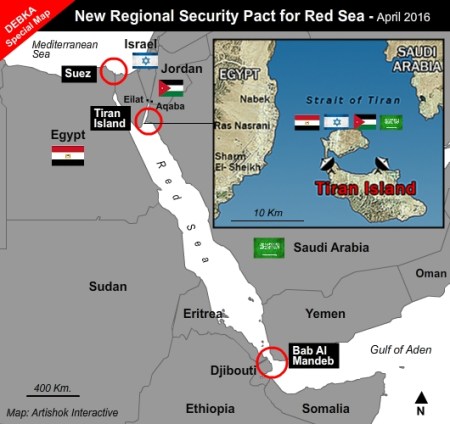
The US withdrew its forces from the Sinai Peninsula last weekend in retaliation for Egypt’s transfer of sovereignty over Tiran and Sanafir islands to Saudi Arabia, according to DEBKAfile’s military and intelligence sources. They also report that the move came after Washington protested to Egyptian President Abdel Fattah al-Sisi over its exclusion from the consultations and military coordination between Egypt, Saudi Arabia and Israel regarding the islands.

The US message was clear. Since Riyadh, Cairo and Jerusalem do not report their military steps in the Sinai Peninsula, the Gulf of Aqaba and the Red Sea to Washington, the US sees no need to inform them of its military steps in the Sinai.

That message was conveyed by the chairman of the US Joint Chiefs of Staff, Joseph F. Dunford, to the Egyptian president during their meeting on Saturday, April 23 in Cairo.

On Tuesday, DEBKAfile’s military sources reported that several days earlier the US military secretly withdrew about 100 of its officers and enlisted men from the multinational peacekeeping force in the northern part of the Sinai. As far as Riyadh, Cairo and Jerusalem are concerned, there is no doubt that it was a retaliatory measure.

US sources refused to specify the current location of the troops. The American force was withdrawn from El Gorah base, located next to the town of Sheikh Zuweid. Gen. Dunford told al-Sisi that the Obama administration is no longer willing to maintain forces in the northern Sinai following the recent shelling of the base by the ISIS affiliate in the restive area. The incident marked the terrorist organization’s first attack on US troops in the Sinai, but its second on an American force in the Middle East.

On March 19, ISIS shelled Fire Base Bell, a US marine base in Makhmur, northern Iraq, about 77 kilometers southeast of the terrorist organization’s de facto capital of Mosul. One marine was killed.

It was not by chance that shortly before he visited Cairo, Gen. Dunford made a visit lasting no more than 90 minutes to the US forward base to award purple hearts to four marines for their bravery during the ISIS shelling.

But while Washington is determined to maintain Fire Base Bell, where it has deployed HIMARS rocket launchers that can fire GPS-guided rockets known as GMLRS capable of reaching Mosul, and awards medals to soldiers serving at the base, it is not ready to treat its soldiers in the Sinai in the same manner because they have the status of multinational observers. Rather than giving out medals, it withdrew those soldiers immediately after the first ISIS attack.

At the same time, US sources launched an unprecedented personal attack on Egypt’s president over his decision to hand over the two islands to Riyadh. Articles attacking El-Sisi’s policy started to appear in the American media, with one saying “The decision to transfer the islands to Saudi Arabia may be the final nail in Sissi’s coffin.” It also described Egypt as being on the verge of a revolution against al-Sisi.

Two other Middle Eastern figures who were involved in Cairo’s decision regarding the islands were Saudi Deputy Crown Prince and Defense Minister Mohammad bin Salman and Israeli Defense Minister Moshe Ya’alon, who said recently that Cairo consulted Jerusalem regarding the transfer of the islands. However, his comment was not mentioned in US media reports, as if the development was not related to Saudi Arabia or Israel.

DEBKAfile’s military and intelligence sources report that one of the main reasons for Washington’s rage was the fact that Egypt, Saudi Arabia, Jordan and Israel decided to establish and coordinate by themselves a regional defense mechanism covering the Suez Canal, the gulfs of Suez and Aqaba, and the Red Sea.

The Obama administration prefers to ignore the fact that the US withdrawal of its naval and air forces from those areas over the last three years has enabled the Iranian fleet to start operating in those waters.

The “Two State Solution”: Irony and Truth

April 27, 2016

The “Two State Solution”: Irony and Truth

by Louis René Beres

April 27, 2016 at 5:00 am

Source: The “Two State Solution”: Irony and Truth

  • “The establishment of such a [Palestinian] state means the inflow of combat-ready Palestinian forces into Judea and Samaria … In time of war, the frontiers of the Palestinian state will constitute an excellent staging point for mobile forces to mount attacks on infrastructure installations vital for Israel’s existence…” — Shimon Peres, Nobel Laureate and Former Prime Minister of Israel, in 1978.
  • The Palestine Liberation Organization (PLO) was formed in 1964; three years before there were any “occupied territories.” Exactly what, then was the PLO planning to “liberate”?
  • Both Fatah and Hamas have always considered, and still consider, Israel as simply part of “Palestine.” On their current official maps, all of Israel is identified as “Occupied Palestine.”
  • “You understand that we plan to eliminate the State of Israel, and establish a purely Palestinian state. … I have no use for Jews; they are and remain, Jews.” — PLO Chairman Yasser Arafat, January 30, 1996 (2.5 years after signing the Oslo Peace Accords).
  • In view of these repeatedly intolerant Arab views on Israel’s existence, international law should not expect Palestinian compliance with any agreements, including those concerning use of armed force — even if these agreements were to include explicit U.S. security guarantees to Israel.

There is no lack of irony in the endless discussions of Israel and a Palestinian state.

One oddly neglected example is the complete turnaround of former Israeli prime minister Shimon Peres. Recognized today as perhaps the proudest Israeli champion of a “Two State Solution” — sometimes also referred to as a “Road Map to Peace in the Middle East” — Peres had originally considered Palestinian sovereignty to be an intolerable existential threat to Israel. More precisely, in his book, Tomorrow is Now (1978), Mr. Peres unambiguously warned:

“The establishment of such a (Palestinian) state means the inflow of combat-ready Palestinian forces into Judea and Samaria this force, together with the local youth, will double itself in a short time. It will not be short of weapons or other military equipment, and in a short space of time, an infrastructure for waging war will be set up in Judea, Samaria and the Gaza Strip. … In time of war, the frontiers of the Palestinian state will constitute an excellent staging point for mobile forces to mount attacks on infrastructure installations vital for Israel’s existence…”

Now, Prime Minister Benjamin Netanyahu, in apparent agreement with this original position of Peres on Palestine, is nonetheless willing to go along with some form or another of a Palestinian state, but only so long as its prospective leaders should first agree to “demilitarization.” Netanyahu, the “hawk,” is now in agreement with the early, original warning of Peres, the “dove.” Peres’s assessment has been Netanyahu’s firm quid pro quo.

For Israel, as Mr. Netanyahu understands, legal mistakes and misunderstandings could quickly give rise to potentially irreversible harms. With reference to the particular matter of “Palestine,” the underlying hazards are complex, longstanding, and possibly global. These hazards would also only be exacerbated by any newly mandated (by the U.S., Russia, and/or United Nations) Israeli return of the Golan Heights to Syria. Then, armed militants could once again start shooting down at the farmers below, laboring on the Israeli plain.

History can help us better to understand the real outcome of any “Two-State Solution.” From the beginnings of the state system, in 1648, following the Thirty Years’ War, and the Peace of Westphalia, states have routinely negotiated treaties to provide security. To the extent that they have been executed in good faith, these agreements are fashioned and tested according to international law. Often, of course, disputes arise when signatories have determined that continued compliance is no longer in their presumed national interest.

For Israel, its 1979 Peace Treaty with Egypt remains fundamental and important. Still, any oscillating regime change or Islamist ascendancy in Cairo could easily signal an abrogation of this agreement. These same risks of deliberate nullification could apply to an openly secular Egyptian government, should its leaders (today, this would mean President el-Sisi) decide, for absolutely any reason, that the historic treaty with Israel should now be terminated.

Any post-Sisi regime that would extend some governing authority to the Muslim Brotherhood, to its proxies, or to its jihadist successors (such as ISIS), could produce a sudden Egyptian abrogation. Although the cessation of treaty obligations by the Egyptian side would almost certainly represent a serious violation of the 1969 Vienna Convention on the Law of Treaties, the governing “treaty on treaties,” there is little if anything that Israel or the so-called “international community” could do in response. In the still-insightful words of seventeenth-century English philosopher, Thomas Hobbes: “Covenants, without the sword, are but words….” (Leviathan).

Back to Palestine. As recently as last Friday, Palestinian Authority (PA) television, not Hamas, threatened the Jews, not just Israelis, with genocide:

PA TV Preacher: “Allah, punish Your enemies, the enemies of religion, count their numbers and kill them to the last one, and bring them a black day. Allah, punish the wicked Jews, and those among the atheists who help them. Allah, we ask that You bestow upon us respect and honor by enabling us to repel them, and we ask You to save us from their evil.” [Official PA TV, April 22, 2016]

That is just part of a wider security problem. Under law, Israel has a “peremptory” (irrefutable, not open to challenge or appeal) right to remain “alive.” It was, therefore, entirely proper for Mr. Netanyahu to have previously opposed a Palestinian state in any form. After all, both Fatah and Hamas have always considered, and still consider, Israel as simply part of “Palestine.” On their current official maps, all of Israel — not just West Bank, Judea and Samaria — is prominently identified as “Occupied Palestine.” As for Jerusalem, an April 15, 2016, UNESCO resolution was expressly dismissive of “so-called” Jewish sites, including the Western Wall.

Palestine, while not yet a fully sovereign state, is still a “nonmember observer state” of the United Nations. In that more limited capacity, “Palestine” had already been admitted into UNESCO, and, unsurprisingly, joined enthusiastically in the April 15, 2016 resolution calling into question all “Jewish sites.”

In the strict Islamic view, and not merely in narrowly jihadi or Islamist perspectives, Israel is described as the individual Jew writ large. The Jewish State, in this doctrinal view, must be despised and uprooted on account of the allegedly innate and irremediable “evil” that purportedly lurks within each and every individual Jew. This insidiously murderous viewpoint is a far cry from the more fashionable idea that Israel is somehow despised in the region “only” for legitimate political reasons, that it is supposedly an “occupier.” In reality, the Israeli is routinely despised in the Islamic world because its people do not submit to Islam. This alleged Jewish infirmity can never hope to be “healed.”

A current Egyptian textbook of “Arab Islamic History,” used widely in teacher training colleges, expresses these basic and crudely determinative sentiments:

“The Jews are always the same, every time and everywhere. They will not live save in darkness. They contrive their evils clandestinely. They fight only when they are hidden; because they are cowards. … The Prophet enlightened us about the right way to treat them, and succeeded finally in crushing the plots they had planned. We today must follow this way, and purify Palestine from their filth.”[1]

In an earlier article in Al-Ahram by Dr. Lutfi Abd al-Azim, the famous commentator urged, with complete seriousness:

“The first thing that we have to make clear is that no distinction must be made between the Jew and the Israeli….The Jew is a Jew, through the millennia … in spurning all moral values, devouring the living, and drinking his blood for the sake of a few coins. The Jew, the Merchant of Venice, does not differ from the killer of Deir Yasin or the killer of the camps. They are equal examples of human degradation. Let us therefore put aside such distinctions, and talk only about Jews.”[2]

Writing also on the “Zionist Problem,” Dr. Yaha al-Rakhawi remarked openly in AlAhram

“We are all once again face to face with the Jewish Problem, not just the Zionist Problem; and we must reassess all those studies which make a distinction between “The Jew” and “The Israeli.” And we must redefine the meaning of the word “Jew” so that we do not imagine that we are speaking of a divinely revealed religion, or a minority persecuted by mankind … we cannot help but see before us the figure of the great man Hitler, may God have mercy on him, who was the wisest of those who confronted this problem … and who out of compassion for humanity tried to exterminate every Jew, but despaired of curing this cancerous growth on the body of mankind.”[3]

Finally, consider what Israel’s original Oslo Accords “peace partner,” Yasser Arafat, said on January 30, 1996, while addressing forty Arab diplomats at the Grand Hotel in Stockholm. Speaking under the title, “The Impending Total Collapse of Israel,” Arafat remarked unapologetically, and without any hesitation:

“We Palestinians will take over everything; including all of Jerusalem. … All the rich Jews who will get compensation will travel to America. … We of the PLO will now concentrate all our efforts on splitting Israel psychologically into two camps. Within five years, we will have six to seven million Arabs living in the West Bank, and in Jerusalem. … You understand that we plan to eliminate the State of Israel, and establish a purely Palestinian state. … I have no use for Jews; they are and remain, Jews.”

Israeli Prime Minister Yitzhak Rabin, U.S. President Bill Clinton, and PLO chairman Yasser Arafat at the Oslo Accords signing ceremony on September 13, 1993. In 1996, Arafat publicly stated: “We Palestinians will take over everything … You understand that we plan to eliminate the State of Israel, and establish a purely Palestinian state. … I have no use for Jews; they are and remain, Jews.” (Image source: Vince Musi / The White House)

In view of these repeatedly intolerant Arab views on Israel’s existence, international law should not expect Palestinian compliance with any pre-state agreements, including those concerning use of armed force. This is true even if these agreements were to include certain explicit U.S. security guarantees to Israel. Also, authentic treaties can be binding only upon states, therefore any inherently non-treaty agreement between a pre-state “Palestine” and Israel could quickly prove to be of little or no real standing or effectiveness.

What if the government of a new Palestinian state were somehow willing to consider itself bound by the pre-state, non-treaty agreement? Even in these very improbable circumstances, the functioning Palestinian government could still have ample pretext, and opportunity, to lawfully terminate the agreement. Palestine, for example, could withdraw from the “treaty” because of what it would regard as a “material breach” — a purported violation by Israel that had allegedly undermined the “object or purpose” of the agreement. It could also point toward what international law calls Rebus sic stantibus (“fundamental change of circumstances”).

Here, if Palestine might decide to declare itself vulnerable to previously unforeseen dangers — perhaps even not from Israel but from other Arab armies or their sub-state proxies — it could lawfully end its previous commitment to remain demilitarized.

There is another factor that explains why Prime Minister Netanyahu’s conditioned hope for Palestinian demilitarization remains misconceived, and why Prime Minister Peres’s earlier pessimism remains well-founded. After declaring independence, a new Palestinian government, one possibly displaying the same openly genocidal sentiments, could point to particular pre-independence “errors of fact,” or “duress,” as appropriate grounds to terminate the agreement. Significantly, the usual grounds that may be invoked under domestic law to invalidate contracts can apply equally under international law, both to actual treaties, and to less authoritative agreements.

Any treaty or treaty-like agreement is void if, at the time of entry, it is in conflict with a “peremptory” rule of international law, a rule accepted by the community of states as one from which no deviation is permitted. Because the right of sovereign states to maintain military forces for self-defense is always such a rule, “Palestine” could be well within its lawful rights to abrogate any agreement that had, before its independence, compelled demilitarization.

In short, Benjamin Netanyahu should take no comfort from any legal promises of Palestinian demilitarization. Should the government of a future Palestinian state choose to invite foreign armies or terrorists on to its territory, possibly after the original government had been overthrown by more militantly jihadist or other Islamic forces, it could do so not only without practical difficulties, but also without necessarily violating pertinent international rules.

The core danger to Israel of any presumed Palestinian demilitarization is always far more practical than legal. The “Road Map” to “Palestine” still favored by U.S. President Barack Obama and most European leaders, stems from a persistent misunderstanding of Palestinian history, and, simultaneously, of the long legal history of Jewish life and title to disputed areas in Judea and Samaria (the West Bank) and Jerusalem. At a minimum, President Obama and, even more importantly, his successor, should finally recognize that the Palestine Liberation Organization (PLO) was formed in 1964; three years before there were any “occupied territories.” Exactly what, then was the PLO planning to “liberate”? This is a primary question that still cries out for a reasonable response.

A Palestinian state, any Palestinian state, would represent a mortal danger to Israel. This danger could not be relieved, even by the stipulated requirements of Israel’s current prime minister, or by any pre-independence Palestinian commitments to “demilitarize.”

Ironically, if by chance, a new state of Palestine would actually choose to abide by such pre-state commitments, it could then become more susceptible to a takeover by a jihadist organization such as ISIS.

In a staggeringly complicated region, filled with ironies, there are legal truths that should assist Israeli leaders to choose a more promising remedy to war and terror than an illusory “Two-State Solution.” Shimon Peres’s early warnings about “Palestine” were on-the-mark and should be heeded today.

Louis René Beres is Emeritus Professor of International Law at Purdue University. He can be reached at: lberes@purdue.edu


New Palestinian pact-for-terror

April 25, 2016

New Palestinian pact-for-terror, DEBKAfile, April 25, 2016

TerrorTunnels480

Israel embarked on a P. R. campaign to play down the extent of the threat which surfaced in one day in the discovery of Hamas tunnel near Kibbutz Sufa, and the suicide bombing of Jerusalem bus No. 12 on April 18, with 20 people injured. The police initially claimed for example that the explosion was due to a technical problem with the engine. But the two developments actually represented a sharp and serious escalation of the Palestinian wave of terror against Israel.

Neither of the operations was carried out by “lone wolves” but rather by large terror networks. The secret tunnel discovered in the Gaza border area was built by the Hamas military wing, the Izaddin al-Qassam brigades, while the suicide bombing in Jerusalem was carried out by the Hamas infrastructure in Judea and Samaria, specifically its operatives in the Bethlehem area.

Each of these terror networks poses a different challenge to Israel.

In Gaza, the Hamas political leadership is no longer in contact with the heads of its military wing. Neither the top commanders nor the regional commanders of the brigades obey any Hamas political body. They only heed three sources:

1. The Hamas military command framework headed by Mohammad Deif and Marwan Issa.

2. Iranian or Hizballah intelligence services, which maintain contacts with them and often provide funds or weapons.

3. The ISIS affiliate in the Sinai, with which the Hamas military wing maintains operational ties.

There is an equally serious problem in Judea and Samaria. Over the past few weeks, the Hamas terror networks have started to make contact with sleeper cells from Fatah’s Tanzim paramilitary force that have the knowledge, ability, means and experience for major terrorist attacks against Israel, such as the Jerusalem bus bombing.

This dormant wing of Mohammad Abbas’s Fatah has began to show signs of life and willingness to return to the path of terror.

These contacts began immediately after publication of a letter from jailed Tanzim leader Marwan Barghouti to members of the force that called on them to start coordinating their operations against Israel with Hamas. Nobody has bothered to explain how a senior terrorist jailed in a high-security Israeli prison succeeded in smuggling such a letter out.

The link between part of the Tanzim and the Hamas terror networks is no less dangerous than the tunnel discovered near Kibbutz Sufa, and it presages an escalation of terror operations in the future.

The only way to prevent a major deterioration of the security situation is to strike targets of the Izzadin al-Qassam brigades. There is no need to launch a total war against Hamas or to occupy Gaza.

But instead of responding as needed, Israel’s government and security establishment have released pictures of digging equipment that has finally succeeded in locating a single Hamas infiltration tunnel out of the many that exist, and claimed that those responsible for the Jerusalem bombing have yet to be identified. At the same time, senior officials and IDF officers continue to assert that Hamas is not seeking escalation.

Unfortunately, this can only mean a resurgence of the wave of terror.

Senior Hamas tunnel network defector tried to flee to Israel by sea: sources

April 18, 2016

Senior Hamas tunnel network defector tried to flee to Israel by sea: sources, DEBKAfile, April 18, 2016

Alauwana_Hamas_18.4.16

Western intelligence sources monitoring events in Gaza confirmed Monday that a senior operative from the Hamas tunnel network defected to Israel last week. The sources identified the defector as Sami Atauna, a resident of the Jebalya refugee camp who came to the border fence by himself and surrendered to an IDF patrol. The sources added that the senior operative had also made an unsuccessful attempt to defect to Israel by sea during the past few weeks. It is not clear whether there is any connection between the defection and the discovery of a Hamas tunnel leading into Israel, which was announced by the IDF on Monday.

Israel, Turkey, Russia and Egypt

April 17, 2016

Israel, Turkey, Russia and Egypt, Gatestone InstituteShoshana Bryen, April 17, 2016

(A blast from the past:

— DM)

♦ In 2011, the UN Palmer Commission Report found the blockade of Gaza — jointly administered with Egypt — to be legal, and said Israel owed Turkey neither an apology nor compensation.

♦ Lifting the Israel/Egypt embargo on Gaza would empower Hamas, and thereby the Muslim Brotherhood, Iran and ISIS — which would seem an enormous risk for no gain.

Turkish sources assert that Turkish-Israeli governmental relations are about to come out of the deep freeze. But this is a reflection of Turkey’s regional unpopularity and glides over Turkish demands for Israel to end the blockade of Gaza. To meet Turkey’s condition, Israel would have to abandon the security arrangement it shares with Egypt — which has increased Israel’s security and has begun to pay regional dividends. To restore full relations between Israel and Turkey would irritate Russia, with which Israel has good trade and political relations, and a respectful series of understandings regarding Syria. Israel’s relations with the Kurds are also at issue here.

After the 2010 Mavi Marmara flotilla — in which Turkey supported the Hamas-related Turkish organization, the IHH, in its effort to break the blockade of Gaza — Turkey made three demands of Israel: an Israeli apology for the deaths of Turkish activists; a financial settlement; and lifting the Gaza blockade, which Turkey claimed was illegal. The last would provide IHH with the victory it was unable to achieve with the flotilla.

1080 (1)The Turkish-owned ship Mavi Marmara took part in a 2010 “Gaza flotilla” attempting to break Israel’s naval blockade of Gaza, which is in place to prevent the terrorist group Hamas from bringing arms into Gaza. (Image source: “Free Gaza movement”/Flickr)

In 2011, however, the UN Palmer Commission Report found the blockade of Gaza — jointly administered with Egypt — to be legal, and said Israel owed Turkey neither an apology nor compensation. In 2013, at the urging of President Obama and to move the conversation off the impasse, Prime Minister Netanyahu did apologize for the loss of life and agree to discuss compensation. While President Obama was pleased, Prime Minister Erdogan repaid the gesture by denigrating Israel on Turkish television and announcing he would force the end of the blockade. Israel’s condition — that the office of Hamas in Ankara be closed — was ignored.

Nevertheless, in February 2014, Turkish Foreign Minister Ahmet Davutoglu told Turkish television that Israel and Turkey were “closer than ever” to normalizing relations.” In December 2015, it was more of the same. And in February 2016, there was yet another announcement of imminent restoration of government-to-government ties. In March, Kurdish sources said Turkey was demanding weapons from Israel, but that Israel wanted to ensure that Turkey would not use them against Kurdish forces.

Israel finds itself in an odd position — choosing among those who want its cooperation.

Israel and Egypt have come to a deep understanding of the sources of instability and insecurity in Sinai, and the relationship between Hamas in Gaza and its primary sponsor, Iran, as well as ISIS. Former IDF Chief of Staff Benny Gantz told inFOCUS magazine recently:

Coordination between us is very high and very important because we have identical interests. Period. The way to achieve them might look different, but Egypt is a very important country. It is crucial to the world to ensure its stability – progress in the fight against ISIS that is present in Sinai, and protecting the Suez Canal, and other things… They are all good reasons for Egypt to take these responsibilities seriously and do something about the threats. I’m very happy to see what they’re doing. It is a good track.

This month, Egypt and Saudi Arabia upgraded relations with Egypt, ceding back to the Saudis two islands that Saudi Arabia had given Egypt in 1950 to help Egypt fight Israel in the Red Sea. According to a report in the Egyptian daily al-Ahram, as reported by the Jerusalem Post, the Egyptian government informed Israel of the parameters of the deal, noting that Riyadh would be obligated to honor all of Egypt’s commitments in the peace treaty with Israel, including the presence of international peacekeepers on the islands and freedom of maritime movement in the Gulf of Aqaba. Israel approved the deal “on condition that the Saudis fill in the Egyptians’ shoes in the military appendix of the peace agreement,” according to Defense Minister Moshe Yaalon.

This makes Saudi Arabia an active partner in the Camp David Accords. And it follows on the heels of the Gulf Cooperation Council (GCC) labeling Hezbollah “a terror organization” without the weasel words the Europeans used to condemn only the “military wing” of the organization.

In the face of these developments, it is hard to imagine a benefit that would accrue to Israel by negating the Israel-Egypt blockade of Gaza on behalf of Turkey.

Russia presents a similar series of circumstances. Relations between Russia and Turkey have taken a nosedive over the Syrian civil war, particularly after Turkey shot down a Russian plane. But even before that, Turkey’s support of Sunni jihadist organizations was a thorn in the side of Russia, which still fears Sunni jihad inside southern Russia.

Russia has goals in Syria and Israel also has requirements. In his inFOCUS interview, former Chief of Staff Gantz noted:

The [Israeli] Prime Minister and Chief of Staff [Gantz’s successor] flew to Russia and had some important of discussions of intentions, deconfliction, and we expressed our interests… stability, preventing terrorist activity… preventing armament that will go from Iran through Syria to Hezbollah, or from Russia to Syria and then to Hezbollah…. People can see what it is that Israel does once in a while when it has to protect itself.

Add to this Israel’s generally good economic and political relations with Russia and, again, it is hard to see the benefit that would accrue to Israel by forging closer relations with Turkey while Russia and Turkey are doing a slow burn.

Turkey is doing a faster burn on the Kurds. Having waged a fierce war against Kurdish separatists in southern Turkey, the Turkish government has taken military action against the Kurds of Iraq and Syria to prevent Kurdish forces from connecting two enclaves — one in Iraq and one in Syria — that could form the geographic beginning of an independent Kurdistan.

Even at the peak of Israeli-Turkish relations, Israel’s support of the Kurds has been a relatively open political secret. Although the Israeli government consistently denies providing weapons, reputable sources suggest, at a minimum, training for Kurdish forces. Most recently, Israel acknowledged buying oil from Kurdish sources in Northern Iraq, and IsraAid, an Israeli humanitarian organization, provided assistance to Kurdish refugees fleeing ISIS. Prime Minister Netanyahu has publicly supported the establishment of a Kurdish state.

For Israel to trade its increasingly important relations with Russia, with Egypt — and thereby with Saudi Arabia — and with the Kurds for Turkish political approval and a promise to buy Israeli natural gas would seem to be a bad deal. For Israel to accompany that with the lifting of the Israel/Egypt embargo on Gaza that would empower Hamas — and thereby the Muslim Brotherhood, Iran and ISIS — would seem an enormous risk for no gain.

Israeli hysteria magnifies Hamas rocket threat

April 15, 2016

Israeli hysteria magnifies Hamas rocket threat, DEBKAfile, April 15, 2016

epa01962019 A Palestinian Hamas masked militant stands near a Hamas flag as he takes part in protest and a military parade in central Gaza Strip, 11 December 2009. Israeli settlers vandalized a mosque in a northern West Bank village early 11 December, spray-painting hate slogans in Hebrew and setting ablaze bookshelves and a carpet, Palestinian police and the Israeli military said. Palestinian police spokesman Munir Jagoub told the German Press Agency dpa that the fire in the grand mosque in the village of Yasouf, south-west of the city of Nablus, in the northern West Bank, caused heavy damage to the library, where copies of the Holy Quran are kept, as well as to prayer rugs and the wall. EPA/MOHAMMED SABER I

A Palestinian Hamas masked militant stands near a Hamas flag as he takes part in protest and a military parade in central Gaza Strip, 11 December 2009.

Hamas Political Bureau Chairman Musa Abu Marzuk led an SOS delegation to Tehran last month in a desperate effort to persuade Iran to end its boycott and renew the flow of funds and weapons to the Gaza Strip. But on April 4, the delegation returned home empty-handed.

This was a last-ditch effort since the Palestinian fundamentalist Hamas which rules the Gaza Strip is flat broke.

Since March 1, it has been forced to slash by two-thirds the wages paid to members of its military wing, the Ezz-a-din Qassem Brigades: each fighter now takes home $200 instead of $600 per month, and officers used to earning $1,000 must be satisfied with $350.

Since March 1, it has been forced to slash by two-thirds the wages paid to members of its military wing, the Ezz-a-din Qassem Brigades: each fighter now takes home $200 instead of $600 per month, and officers used to earning $1,000 must be satisfied with $350.

DEBKA’s military and intelligence sources add: The terrorist group has moreover halted recruitment for lack of funds to pay, accommodate or train new fighters.

The cash crunch has also hit the Hamas government. Most of Gaza’s municipal services are suspended because city officials have not been paid.

Iran’s boycott on military and financial assistance to the Gaza Strip was clamped down in mid-2015 over Hamas’ refusal to line up behind Iran’s unqualified endorsement of its allies, Syrian President Bashar Assad and Yemen’s Houthi rebels.

Since then, Hamas has spared no effort to end the shutdown. Its leaders even tried asking their friend and ally, Hizballah’s Hassan Nasrallah, to intercede on their behalf with his masters in Tehran. Nasrallah pulled some strings, suggesting that his group would be allowed to renew military and intelligence operations in Gaza to make it worthwhile for Iran to restore its support.

But that proposition like all previous applications was thrown out.

This time, the Hamas visitors were initially received by high Iranian officials, including Ali Shamkhani, secretary of the Iranian Supreme National Security Council, and Ali Larijiani, chairman of the Shura Council. Abu Marzuk asked them to put the case for ending the boycott before Iran’s supreme leader Ayatollah Ali Khamenei.

After the Palestinian officials cooled their heels for two weeks, Gen. Qassem Soleimani, commander of the Revolutionary Guards’ Al Qods Brigades, finally gave them a hearing.

But, according to DEBKA’s Iranian sources report, he told them bluntly that no more largesse would be forthcoming from the Islamic Republic until Hamas publicly declared its support for Syrian President Assad and ordered its fighting assets in Lebanon to join Hizballah’s military campaign in support of the Syrian ruler.

This confrontation has broad ramifications over and above Iran’s relations with the Palestinian terrorists.

Hamas_480_Kotert

1. Tehran demonstrated that its support for Assad is absolute and brooks no opposition. This should dash any hopes underlying the US-Russian understanding for a political resolution of the Syrian conflict that Assad would at some point agree to hand over power to a broad coalition.

Iran is ruthless in bending all its allies and dependents into toeing its line in defense of the Syrian ruler

2. Gen. Soleimani has resurfaced after a five-month disappearance from public view. Rumors abounded that he had been seriously wounded in a Syrian battle, or else fallen into disfavor with Khamenei and cast aside. His reappearance in Tehran with the Hamas delegation means he has been reinstated to the command of Iran’s forces in Syria and the role of operations coordinator with the Russian military.

3. After Iran’s door was slammed in their faces, Hamas leaders reluctantly tried patching up their tattered ties with Egyptian President Abdel-Fatteh El-Sisi.

But a delegation to Cairo found Egyptian military and intelligence officials as tough-minded as the Iranians. Hamas terrorists were put on notice that, to mend relations, they would have to prove their good faith by cooperating with Cairo in the war against the Islamic State in Sinai. Specifically, the Palestinian terrorists must hand over to the Egyptian army all the intelligence data they had accumulated on the ISIS networks in Sinai with whom they were playing ball.

Though insolvent, Hamas decided it could not afford to comply with Egypt’s terms for assistance. As DEBKA’s sources explain, breaking up with the Islamic State affiliates in Sinai, would also snap Hamas’ last remaining conduit for the receipt of smuggled funds and weapons from Islamist sources in Libya.

Having burned their boats to Tehran and Cairo, the Palestinian terrorists have run themselves into a dead end.

Hysteria regarding the threat posed by Hamas resurfaced in Israel this week, even though the terrorist organization’s military strength is gradually disintegrating mainly amid a cash crunch that nobody in the Hamas  political or military leadership has been able to resolve.

It all started from a briefing given by the head of the IDF Southern Command, Maj. Gen. Eyal Zamir, to military correspondents following a defensive exercise in the Gaza border area.

Afterwards, the heads of the Israeli defense establishment commented on the threat posed by Hamas using clichés that have been familiar to the Israeli public for years. Perhaps the most common one is “Hamas is not interested in an escalation now… but.” Another one is “Israel and the IDF are not interested in an escalation now…but.”

One of the heads of the Israeli local councils in the Gaza border area added that he was not surprised by recent comments by senior IDF officers on the strengthening of the Hamas. “The statements that Hamas operatives are continuing terror operations can only surprise those who are detached from reality,” he said.

Amid the terrorist organization’s weakness, Israeli hysteria is helping Hamas conceal its true situation from the Palestinian public.