Posted tagged ‘Gaza’

Southern Command: Hamas is ready for the next war

September 21, 2016

Southern Command: Hamas is ready for the next war Southern Command chief, Eyal Zamir, at a conference for southern residents explained that Hamas is preparing for the next round of fighting.

Arutz Sheva Staff,
21/09/16 13:13

Source: Southern Command: Hamas is ready for the next war – Defense/Security – News –

Zamir and Eizenkot on the border

Gefen Reznik

General of the Southern Command, Eyal Zamir, at a conference for southern residents explained that Hamas is preparing for the next round of fighting.

Zamir emphasized that, “we have no intentions to make the situation worse but we will react to any shot fired with the appropriate level of force.”

Regarding Hamas he said, “unfortunately they are utilizing this quiet period to prepare for the next battle.”

In the conference, the Major-General said, “in the last decade, and since the withdrawal from Gush Katif and the IDF’s exit from the Gaza Strip, we have had three military operations.” He explained that the past two years have been the quietest, relatively, in the past decade, and they are being used to expand settlements around Gaza.

Zamir clarified that the “IDF won’t let terrorist organizations, led by Hamas, harm Israeli citizens. We have no intentions of escalating the situation, but we will react to every hit with the appropriate amount of force.”

“On the idea of trying to lengthen the period of quiet, we are continuing to address the threats below and above ground in order to protect Israel’s citizens and destroy the threats.”

Yesterday an Israeli Air Force fighter jet shot down an unmanned aircraft from the Gaza Strip an army spokesman said.

The unmanned craft, believed to be controlled by Hamas, was detected flying along the Gaza coastline.

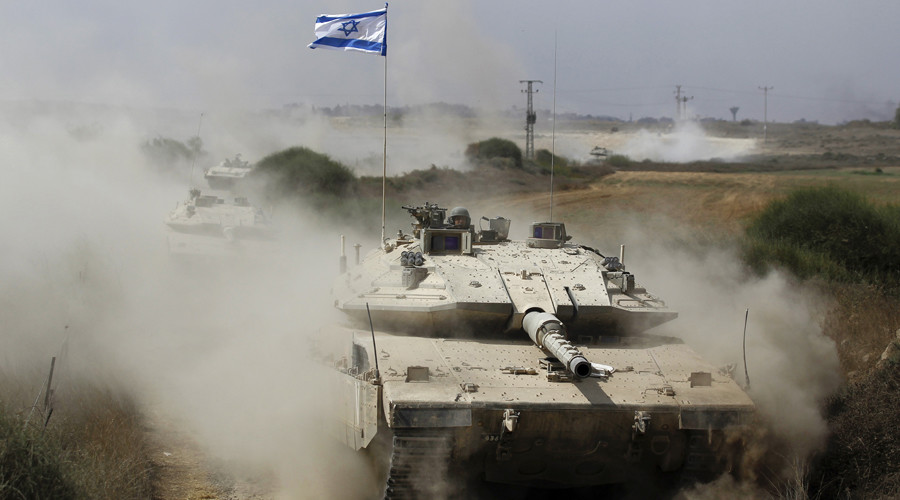
Israeli Air Force, tanks strike Hamas targets in Gaza after rocket hits Sderot

August 21, 2016

Israeli Air Force, tanks strike Hamas targets in Gaza after rocket hits Sderot

Published time: 21 Aug, 2016 12:37 Edited time: 21 Aug, 2016 13:20

Source: Israeli Air Force, tanks strike Hamas targets in Gaza after rocket hits Sderot — RT News

© Amir Cohen / Reuters

The Israeli military have launched strikes against two Hamas positions in the north of the Gaza Strip, the IDF reported on Twitter, saying the operation was a response to an earlier rocket attack from Gaza.

On Sunday afternoon, both the Israeli Air Force and armored corps on the ground targeted Hamas, who is considered a terrorist organization in Israel.

Earlier in the day, a rocket exploded in the southern Israeli city of Sderot, with the Israeli Defense Force (IDF) saying the missile had been launched from the Gaza Strip.

No injuries or damage have been reported in Sderot, which has a population of 19,000, while the police have called on members of the public to stay away from the scene.

In Gaza, Israeli artillery fire was reported, Haaretz said, citing Palestinian eyewitnesses. Rocket sirens have been sounded in Sderot and nearby communities on the Gaza border, the Israeli media reported.

There so far have been no reports of Palestinian casualties.

In July 2014, rockets from Gaza reportedly left two Sderot residential buildings in ruins. Some 15 people were said to be injured on the Palestinian side in Israel’s attack.

Gazan Rocket Hits Sderot

August 21, 2016

By: Jewish Press News Briefs

Published: August 21st, 2016

Source: The Jewish Press » » Gazan Rocket Hits Sderot

Rocket crossing!
Photo Credit: Asher Schwartz

Two rocket alerts went off in communities near the Gaza border and in Sderot at around 2:25PM on Sunday.

2:35 PM Residents near the Gaza border are reporting that they heard at least one explosion, possibly two.

2:43 PM Confirmed reports that one rocket from Gaza landed in Sderot between 2 houses. No one was injured.

The rocket was launched from Beit Hanoun.

Police are asking citizens to not go to the area where the rocket fell do the the danger.

3:00 PM Arab sources report that the IDF is striking Beit Hanoun area.

There are no reports on why Iron Dome did not take down he rocket.


Officials In Lebanese, Gazan Terror Organizations Confirm: Iran Funds Our Activity

August 11, 2016

Officials In Lebanese, Gazan Terror Organizations Confirm: Iran Funds Our Activity, MEMRI, August 11, 2016

Arab media have recently published statements by officials in the Lebanese Hizbullah and the Gazan Hamas and Islamic Jihad organizations, and by their supporters, confirming what has long been known – namely that these Lebanese and Gazan terror organizations receive substantial financial and military assistance from Iran. These statements join many reports, especially in the anti-Iranian media, regarding Iran’s funding of various terrorist organizations across the Arab world. According to these reports, the assistance comes mainly from the office of Iranian Supreme Leader Ali Khamenei and from the Islamic Revolutionary Guards Corps (IRGC).

The following are some examples of these statements and reports from the last two months:

Hizbullah Secretary-General Nasrallah: Hizbullah’s Entire Budget Is Provided By Iran

In a speech he delivered on June 24, 2016, marking 40 days after the killing of Mustafa Badr Al-Din, who was considered to be Hizbullah’s chief operations officer, and following the imposition of U.S. sanctions on Hizbullah that threaten its financial infrastructure and income, Hizbullah Secretary-General Hassan Nasrallah clarified: “Hizbullah’s budget – its salaries and expenditures, [the money that pays for] its food and drink, weapons and missiles – [all come from] Iran. Is that clear?… As long as Iran has money we have money. Do you require greater transparency than that[?] The funds earmarked for us do not reach us through the banks. We receive them the same way we receive our missiles, with which we threaten Israel.”[1]

Hamas Official Abu Marzouq: Iran’s Assistance To Hamas Is “Not Comparable” To Any Other Assistance

The deputy head of Hamas’s political bureau, Moussa Abu Marzouq, tweeted on June 15, 2016: “The aid extended by Iran to the Palestinian resistance, in provisions, training and funds, is not comparable [to any other aid], and most other countries cannot match it.”[2]

29502Abu Marzouq’s tweet

Former Lebanese Minister Wiam Wahhab: Iran Has Funded Resistance In Palestine

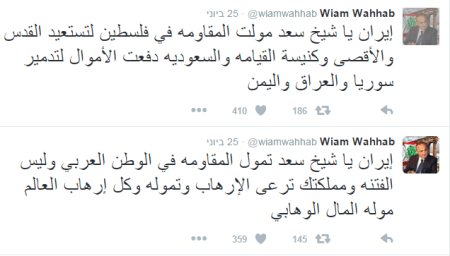
On June 25, 2016, in response to a remark by former Lebanese prime minister Sa’d Al-Hariri that Iran funds fitna(internecine strife) in the Arab world,[3] former Lebanese minister Wiam Wahhab, a known supporter of Hizbullah and the resistance axis, tweeted: “O Sheikh Sa’d [Al-Hariri], Iran has funded resistance in Palestine to restore Jerusalem, Al-Aqsa and the Church of the Sepulcher [to Palestinian hands, whereas] Saudi Arabia paid to destroy Syria, Iraq and Yemen.” In another tweet he wrote: ” O Sheikh Sa’d, Iran funded resistance in the Arab homeland rather than fitna, [whereas] your kingdom [Saudi Arabia, who supports Al-Hariri and his faction in Lebanon,] sponsors and funds terrorism. The funds of all the terrorist [organizations] in the world are Wahhabi [i.e., Saudi] funds.”[4]

29503Wiam Wahhab’s tweets

Saudi Daily Al-Sharq Al-Awsat: Hizbullah’s Weapons Come Directly From IRGC; Iran Has Renewed Regular Aid To Islamic Jihad Organization

The anti-Iranian press, such as the London-based Saudi daily Al-Sharq Al-Awsat, also reported on Iran’s funding of terrorist organizations in Lebanon and Gaza. On June 29, 2016, Al-Sharq Al-Awsat confirmed Nasrallah’s statements regarding the Iranian funding. The report stated that Hizbullah’s funds came from the office of Iranian Supreme Leader Ali Khamenei while its weapons are provided by the IRGC. It quoted the director of the Umam Research and Documentation center in Lebanon, Luqman Salim, a Shi’ite known for his opposition to Hizbullah, as saying that between 70% and 80% of Hizbullah’s funds come from Iran. According to Salim, Iran also invests about $400 million of the IRGC’s budget in the Islamic Radio and Television Union, a group of stations which includes the Iranian Al-Alam but also Hizbullah’s Al-Manar and Al-Mayadin and the Hamas-affiliated Al-Quds (all of which broadcast from Lebanon) and Hamas’s Al-Aqsa station, which broadcasts from Gaza.

The daily also cited a “knowledgeable source” as saying that until 2005 Iran transferred to Hizbullah between $200 million and $250 million annually, but since then the allocation has increased: After the 2006 Lebanon War it rose to $850 million, and since Hizbullah entered the Syria war its budget has become unlimited, because it has become part of Tehran’s war effort there.[5]

On May 25, 2016, the daily reported, citing sources close to the Islamic Jihad organization in Gaza, that Iran had renewed its regular financial aid to the organization after the two sides agreed to renew their mutual relations.[6] According to these sources, an Islamic Jihad delegation headed by the organization’s secretary-general Ramadan Shalah visited Iran in April 2016, and during this visit Tehran renewed its sponsorship of the organization after the latter accepted its terms. In meetings held by the delegation during this visit, including with IRGC commander Mohammad Ali Jafari and Qods Force commander Qassem Soleimani, Iran clarified its vision of Islamic Jihad’s course in the coming years. The sources claimed further that Soleimani decided, in coordination with the organization’s military and political bureaus, to grant $70 million a year out of the IRGC budget to Islamic Jihad’s military wing, Saraya Al-Quds, and to reorganize this body and appoint Khaled Mansour, who is close to Tehran, as its commander.[7]

Endnotes:

[1] Alahednews.com.lb, June 24, 2016.

[2] Twitter.com/mosa_abumarzook, June 15, 2016.

[3] Al-Mustaqbal (Lebanon), June 26, 2016; Al-Hariri’s remark was a response to Nasrallah’s  statement one day earlier that Hizbullah’s entire budget comes from Iran.

[4] Twitter.com/wiamwahhab, June 25, 2016.

[5] Al-Sharq Al-Awsat (Lebanon), June 29, 2016.

[6] Reports in the Arab media in the passing year indicated that Iran had suspended its assistance to Islamic Jihad following disagreements between them on the crisis in Yemen. According to these reports, the Islamic Jihad refused Iran’s demand to declare its opposition to the Arab Coalition’s activities in Yemen. See for example Aljazeera.net, May 26, 2016, Janoubia.com, April 3, 2016.

[7] Al-Sharq Al-Awsat (London), May 25, 2016.

UN aid worker in Gaza accused of helping Hamas

August 9, 2016

UN aid worker in Gaza accused of helping Hamas, Israel Hayom, Lilach Shoval and Daniel Siryoti, August 9, 2016

U.N. Development Program aid worker Wahid Abdullah Burash accused of using his position to help Hamas operatives hide weapons and tunnels, and preferring projects that benefit Hamas • Burash is second aid worker to be charged with assisting Hamas in span of a week.

helper

For the second time in one week, an international aid worker in the Gaza Strip has been accused of providing assistance to terrorist organization Hamas.

The Shin Bet security agency and Israel Police lifted a gag order Tuesday, revealing that a United Nations aid worker from Jabalia, 38-year-old Wahid Abdullah Burash, was arrested last month on suspicion that he was using his job at the U.N. Development Program to assist in Hamas operations. An indictment was filed against Burash at the Beersheba District Court, charging him with aiding the Gazan terrorist group.

The announcement comes less than a week after World Vision employee Mohammad Halabi was accused of funneling some $50 million in charity funds to Hamas.

The UNDP works to rehabilitate and develop infrastructure, including damaged homes, in the Gaza Strip to improve the lives of local residents. Burash has worked as an engineer at the program since 2003. As part of his work, he was responsible for demolishing homes damaged in military clashes and removing waste from the demolition sites.

The Shin Bet investigation revealed that in 2014, Burash was instructed by a senior Hamas official to carry out his work in a manner that would provide maximum benefit for Hamas. In 2015, he used UNDP resources to build a marine dock for the use of Hamas’ military wing in northern Gaza.

It was further revealed that throughout 2015, Burash, acting on Hamas orders, worked with his superiors to give preference to rehabilitation projects in areas where Hamas operatives live.

The investigation also found that Hamas deliberately exploited UNDP projects throughout 2015. Weapons and terror tunnel shafts were found in homes that had been rebuilt by the UNDP and taken over by Hamas. This violates U.N. protocol, according to which all explosives and weapons must be reported to the United Nations Mine Action Service.

Investigators learned that other Hamas operatives are embedded in a variety of humanitarian aid organizations in Gaza. Burash also revealed information about Hamas storehouses, outposts and tunnels that he had learned about in his work.

Hamas vehemently denied the charges brought against Burash. Hamas spokesman Sami Abu Zuhri said, “The accusations are baseless and false, and they are part of the Zionist occupation’s attempt to worsen the siege on Gaza by persecuting international aid organizations.”

The truth about humanitarian aid

August 7, 2016

The truth about humanitarian aid, Israel Hayom, Ariel Bolstein, August 7, 2016

The reports surrounding the arrest of Mohammad Halabi, director of the Gaza branch of the humanitarian organization World Vision, have sent shockwaves throughout the globe. This is a well-known, worldwide charity organization — one of the world’s largest in fact — that purports to help third world children.

As it turns out, when it comes to the Gaza Strip, the money donated by charitable individuals in Europe, Australia and the U.S. went mainly to help Hamas’ military wing. Among other things, the money was used toward purchasing weapons in Sinai, digging attack tunnels and paying the salaries of terrorists and their families.

The Hamas murderers did not stop there. They accepted thousands of food packages as well as other supplies intended for the poor. When devout Christian worshippers in churches across the U.S. donated a dollar or two to “those poor children,” the smiling faces on the receiving end were Hamas terrorists in Gaza.

More than half of the organization’s annual aid budget was funneled directly to Hamas. In total , the terror organization received between 40-50 million dollars and this may just be the tip of the iceberg, as there are other humanitarian groups that have poured tremendous amounts of money into these black holes referred to at times as “rehabilitation of Gaza” and “assistance to the Palestinians.”

For years, World Vision members, including senior officials, contributed to anti-Israel efforts. Time and again they have taken advantage of every possible forum to portray Israel as the culprit behind the suffering of Palestinian children. Never ones to be confused by the facts, they neglected to mention that they knew very well that Hamas was using the civilian population of Gaza as human shields, launching rockets at Israel from residential neighborhoods and storing weapons at schools.

Not a word of condemnation for Hamas was ever heard. But with respect to Israel, it has been a festival of lies and false accusations. In 2012, for example, the president of World Vision in the U.S. claimed that Israel had prohibited Christian from Judea and Samaria as well as Gaza from celebrating Easter in Jerusalem. The allegation was completely false (that year Israel granted more than 20,000 permits to travel to Jerusalem for Easter, far more than were requested). Still, the irreparable damage to Israel’s reputation in the eyes of the Christian world was done.

And if that wasn’t bad enough, World Vision has contributed extensively to other anti-Israel endeavors in the years since. For instance, the organization bankrolled a program called “Christ at the Checkpoint,” which aimed to portray Israel to American Christians as the embodiment of all evil. The program appealed to this audience’s most basic emotions: they were asked to imagine Jesus himself being harassed by Israeli soldiers at a border checkpoint. This was, in fact, anti-Semitism of the worst order, playing into the idea that the Jews abused the son of God and now they are abusing other poor souls.

In fact, a large portion of the funding that goes into the Boycott, Divestment and Sanctions movement actually comes from innocent donors, who are certain their donations are going toward saving lives in developing countries somewhere in Asia or Africa.

Sadly, World Vision is not the only charity organization that has been dragged into the anti-Israel efforts. Other organizations, such as Human Rights Watch and Amnesty International, have also fallen into the same trap.

All this is happening in a world where there are tens of millions of people who really need charitable assistance, with tens of millions of people in the West who are willing to donate generously to help worthy causes, or so they believe. These kind, naïve donors, are being taken advantage of every day in the most awful of ways.

Hamas ready to pounce on weak Fatah in local elections, experts say

July 28, 2016

Hamas ready to pounce on weak Fatah in local elections, experts say Gaza-ruling terror group now says it will take part in vote set for October; after all, it has won the only two major elections in which it ever competed

By Dov Lieber

July 28, 2016, 2:52 pm

Source: Hamas ready to pounce on weak Fatah in local elections, experts say | The Times of Israel

The Hamas terror group in control of the Gaza Strip is poised to make a power play using one of its most potent weapons — the ballot box.

In 2012, the hardline Islamist group boycotted municipal elections over allegations of intimidation and corruption in the West Bank by its political rival Fatah, which dominates the Palestinian Authority. Since then, the two major Palestinian parties have remained in a state of cold war.

 Despite these ongoing tensions, Hamas surprised many by agreeing recently to participate in municipal elections across the Palestinian territories slated for October 8.

Experts told The Times of Israel that Hamas likely ended its boycott of the vote because the group sees an opportunity to gain legitimacy by beating a weak opponent — the aging and unpopular Palestinian Authority President Mahmoud Abbas and his divided Fatah party.

Hamas is also in a state of political isolation after losing the support of its important Sunni state backers, Egypt, Jordan and Saudi Arabia, and to some extent Turkey after Ankara and Jerusalem recently mended relations. The ballot box, one Israeli expert argued, is a way the group can take control of its own destiny, while a well-known Palestinian scholar hypothesized secret and unprecedented coordination between the Islamists and Fatah.

Palestinian security officers wait to cast their early votes during local elections at a polling station in the West Bank town of Jenin on Thursday. Members of Palestinian security forces cast an early vote ahead of local elections, which are taking place Saturday, in the first such polls since 2006.(photo credit: AP Photo/Mohammed Ballas)

Palestinian security officers wait to cast their early votes during local elections at a polling station in the West Bank town of Jenin on Thursday. Members of Palestinian security forces cast an early vote ahead of local elections, which are taking place Saturday, in the first such polls since 2006. (AP Photo/Mohammed Ballas)

Hamas has won the only two elections it ever ran in — the 2005 municipal elections and the 2006 legislative elections, which resulted in a war between Hamas and Fatah. But since Hamas’s last democratic victory, 10 years have passed.

“It’s almost obvious why Hamas decided to participate in the upcoming elections,” Prof. Shaul Mishal, head of the Middle East program at the Interdisciplinary Center in Herzliya (IDC), told The Times of Israel.

“If you look back at what happened during the election in 2006, Hamas believes that’s the best way to gain status and strength within the Palestinian population of the West Bank. They want to extend their influence to where the heart of the Palestinian issue is,” he said.

In 2006, Hamas won nearly all the electoral districts in the West Bank and in Gaza.

Mishal believes Hamas sees an opportunity to take advantage of Abbas’s current weakness. The PA leader is 81-years-old and is reportedly not in good health. Polls show a majority of Palestinians want him to resign.

Prof. Shaul Mishal (Courtesy)

Prof. Shaul Mishal (Courtesy)

“This is Hamas’s opportunity to ensure they will be part and parcel of any future political process,” Mishal said.

He added that Hamas has reached such a point of political isolation that “the only way to strengthen their position with the public is to run in this election.” He argues Hamas’s success in the past and its likely success in the upcoming election has much to do with its nature as an Islamist movement.

“Hamas is a party of the people, putting its efforts into working with the communities on the ground… first and foremost, they are an Islamist social group: they focus on social services, social welfare and working with the needy, especially in places where the central government might not reach,” Mishal said.

In an indication of Hamas’s likely victory in the upcoming elections, the Islamist movement has for the past two years won the contest considered the best barometer of Palestinian public opinion — student elections at Birzeit University. Birzeit is the oldest Palestinian university, considered a liberal outpost and a historic stronghold for Fatah and the PA.

“The young generation is more pro-Hamas. From experience, the student elections tend to be quite accurate,” Mishal said.

Palestinian students who support the Hamas movement take part in an election campaign rally for the student council at Birzeit University, near the West Bank city of Ramallah on April 26, 2016 (AFP/Abbas Momani)

Palestinian students who support the Hamas movement take part in an election campaign rally for the student council at Birzeit University, near the West Bank city of Ramallah on April 26, 2016 (AFP/Abbas Momani)

With the odds stacked against it, the Israeli professor believes Fatah may try to wiggle out of having the elections.

“It all depends on one man: Abu Mazen (Abbas). He can find ways to bypass the declaration. He may substitute it with something more dramatic, such as negotiations over the Arab Peace Initiative,” he said, referring to the 2002 offer to the Jewish state for full diplomatic ties with 57 Arab and Muslim countries after cementing a peace accord with the Palestinians.

The Arab Peace Initiative has come to the forefront in the past few months, with both Arab and Israeli statesmen discussing the plan.

Khalil Shikaki, the Director of the Palestinian Center for Policy and Survey Research at his office in Ramallah, June 14, 2011 (photo credit: Yossi Zamir/Flash90)

Khalil Shikaki, the Director of the Palestinian Center for Policy and Survey Research at his office in Ramallah, June 14, 2011 (Yossi Zamir/Flash90)

“My guess,” said Dr. Khalil Shikaki, a Palestinian political scientist and well-regarded pollster, “is that Hamas has agreed [to the elections] because Abbas, without publicly admitting it, has agreed that local elections in the Gaza Strip can take place fully under Hamas’s security and administrative control.”

Shikaki called the possible coordination “the most visible PA acknowledgment of the legitimacy of Hamas’s control in the Gaza Strip since Hamas’s takeover in June 2007.”

“At this stage,” Shikaki continued, “Hamas seems to care more about maintaining control over the Strip than extending its influence into the West Bank.”

The Palestinian political scientist did, however, offer a second theory similar to Mishal’s.

“Hamas might think that given Fatah’s fragmentation, particularly in the Gaza Strip, the outcome of elections will demonstrate the Islamist group’s ascendance and popularity despite the blockade and siege imposed by Israel and Egypt, thus strengthening further its legitimacy,” Shikaki said.

Israel imposed a land and sea blockade on the Strip, designed to prevent the terror group from importing weapons, after Hamas seized power there in a bloody 2007 coup, which saw Abbas’s Fatah movement ousted from Gaza.

The upcoming elections are slated to be held in 416 townships and village councils; 25 are located in Gaza and the other 391 in the West Bank. If the election does take place, it will be the largest municipal elections held by the Palestinians in their history.

‘Hamas constantly trying to destabilize Jerusalem’

July 12, 2016

‘Hamas constantly trying to destabilize Jerusalem’ In report to Knesset Committee, Shin Bet head Nadav Argaman surveys number from recent terror wave as well as state of Fatah, Hamas.

Shai Landesman, 12/07/16 16:41

Source: ‘Hamas constantly trying to destabilize Jerusalem’ – Defense/Security – News –

Shin Bet head Nadav Argaman appeared at a meeting of the Knesset Foreign Affairs and Defense Committee headed by MK Avi Dichter (Likud) today (Tuesday), and delivered a report about the wave of Palestinian terror that started last October.

Here are the main findings Argaman presented in the report:

Since the beginning of the current escalation on the 10th of October, 2015, over 300 significant terror attacks have been carried out or attempted (this excludes stone or Molotov cocktail throwing). Of these 180 were stabbing attacks, 90 were shooting attacks, and 30 involved running over with cars, (all rounded figures). Though October 2015 saw a dramatic increase in the scale of these attacks, this can be seen as a continuation of a more slow increase of attacks in Judea and Samaria starting in 2012.

The majority of the attacks were “lone wolf” attacks, with only a few perpetrated by the established terror organizations.

Security forces and the Shin Bet have thwarted some 240 attacks since October, and in the first five months of 2016 alone they’ve prevented 11 suicide attack attempts, 10 kidnapping attempts, and over 60 shooting attempts, most planned by Hamas, who are constantly acting to destabilize Judea and Samaria.

There is a decrease in attacks over the past few months versus October of 2015, when some 600 attacks were perpetrated, of which 81 were significant. In June of this year 103 were perpetrated, of which 9 were significant.

The decrease is attributed to the large number of thwarted attacks, improvements in intelligence, and deterrence focused in the immediate surroundings of the terrorists. All of these measures have produced a widespread feeling among the Palestinian population of Judea and Samaria that there is little to be gained by continuing to escalate hostilities, a feeling reflected in opinion polls conducted by Palestinian institutions.

Though the actual number of attacks is decreasing, the situation remains highly volatile, with the threat still very real (as evidenced by the number of thwarted attacks). Thus any significant event may cause a renewed breakout of hostilities.

It is also important to note that there is a general feeling in PA and Fatah circles that the Mahmoud Abbas-era is nearing its end (as he has announced his intentions to retire several times). There is therefore much jostling for position among Fatah leaders, as is usual in transition periods, and many of them are using belligerent language to bolster their status as strong leaders.

The report also dealt with the Gaza Strip; the quiet reigning there is deceptive, it said. The economic situation is worsening, ISIS is gaining power, and Hamas are rebuilding their strength.

Approximately 80 terror attacks were perpetrated from the Gaza Strip since operation Protective Edge, making this the most quiet period in a decade. Fringe Salafist groups are behind most of the attacks. The quiet is mainly due to Hamas’ feeling of lack of readiness for war, and the stability of Israeli policy in dealing with the Gaza Strip.

Hamas is in strategic crisis due to diplomatic isolation as a result of its feuds with the Sunni states led by Egypt, difficulties in its relationship with the Iranian led Shi’ite camp, and internal divisions between the military wing in Gaza and the political leadership outside. In practice this has led to greater control by the military wing.

Hamas is rebuilding its arsenal and operational capabilities in preparation for the next round of fighting, from which it plans to extract strategic gains such as the removal of the IDF blockade of the Gaza coast.

As to public opinion in Gaza, the Shin Bet has found that there is rising resentment toward Hamas for its inability to improve the economic situation. Yet it is unlikely that any overthrow will be attempted, due to widespread fear of Hamas reprisals, economic dependency, and general distaste for the alternative, namely ISIS.

ISIS Comes to Gaza

July 11, 2016

ISIS Comes to Gaza

by Khaled Abu Toameh

July 11, 2016 at 5:00 am

Source: ISIS Comes to Gaza

  • Recent reports leave no doubt as to cooperation between Hamas and ISIS groups in Sinai. These reports, the Egyptians and Palestinian Authority argue, provide further evidence that the Gaza Strip remains a major base for various jihadi terror groups that pose a real threat.
  • The report said that terrorists wanted by the Egyptian authorities were admitted to the Gaza Strip hospital in return for weapons given to Hamas by the Islamic State in the Sinai.
  • Mahmoud Abbas and the leaders of the Palestinian Authority (PA) can continue to talk all they want about a Palestinian state that would be established in the West Bank, Gaza Strip and east Jerusalem. But when ISIS-inspired groups are active in Gaza and there are no signs that the Hamas regime is weakening, it is rather difficult to imagine a Palestinian state.
  • The jihadi groups clearly seek to create an Islamic emirate combining the Gaza Strip and Sinai. Abbas might thank Israel for its presence in the West Bank — a presence that allows him and his government to be something other than infidel cannon fodder for the jihadis.

Hamas denies it up and down. Nonetheless, there are growing signs that the Islamist movement, which is based in the Gaza Strip, is continuing to cooperate with other jihadi terror groups that are affiliated with Islamic State (ISIS), especially those that have been operating in the Egyptian peninsula of Sinai in recent years.

This cooperation, according to Palestinian Authority security sources, is the main reason behind the ongoing tensions between the Egyptian authorities and Hamas. These tensions have prompted the Egyptians to keep the Rafah border crossing mostly closed since 2013, trapping tens of thousands of Palestinians inside the Gaza Strip.

In 2015, the Egyptians opened the Rafah terminal for a total of twenty-one days to allow humanitarian cases and those holding foreign nationalities to leave or enter the Gaza Strip.

This year so far, Rafah has been open for a total of twenty-eight days. Sources in the Gaza Strip say there are about 30,000 humanitarian cases that need to leave immediately. They include dozens of university students who haven’t been able to go back to their universities abroad and some 4,000 patients in need of urgent medical treatment.

Surprisingly, last week the Egyptians opened the Rafah terminal for five days in a row, allowing more than 4,500 Palestinians to leave and enter the Gaza Strip. The unusual gesture came on the eve of the Muslim feast of Eid al-Fitr. However, the terminal was closed again at the beginning of the feast on July 6.

The renewed closure of the Rafah terminal coincided with reports that efforts to end the tensions between Hamas and Egypt hit a snag. According to the reports, the Egyptian authorities decided to cancel a planned visit to Cairo by senior Hamas officials. The decision to cancel the visit, the reports said, came in the wake of the dissatisfaction of the Egyptians with the way Hamas has been handling security along the border between the Gaza Strip and Egypt. The closure of the border crossing came as a blow to Hamas’s efforts to patch up its differences with Egypt and pave the way for easing severe travel restrictions imposed by Cairo on the Palestinians in the Gaza Strip.

In recent weeks, Hamas announced that it had deployed hundreds of its border guards along the shared border with Egypt in order to prevent infiltration both ways, especially of jihadi terrorists who have been targeting Egyptian security personnel and civilians in Sinai. However, the Egyptian authorities remain extremely skeptical about Hamas’s measures.

Egyptian security officials are convinced that Hamas is not serious about preventing jihadi terrorists from crossing the border in either direction. Moreover, the Egyptians suspect that Hamas maintains close relations with some of the ISIS-affiliated groups in Sinai, and is providing them with weapons and medical treatment.

Egyptian President Abdel Fattah el-Sisi has refused to conduct high-level contacts with Hamas since he came to power in 2013. His regime views Hamas as a threat to Egypt’s national security. The few meetings that did take place between the two sides were restricted to security issues; that was why Sisi entrusted his General Intelligence officials to conduct the discussions with the leaders of the Islamist movement who visited Cairo in the past months.

Apparently, the Egyptian skepticism towards Hamas is not unjustified.

In recent weeks, reports have surfaced that leave no doubt as to cooperation between Hamas and ISIS groups in Sinai. These reports, the Egyptians and Palestinian Authority argue, provide further evidence that the Gaza Strip remains a major base for various jihadi terror groups that pose a real threat not only to Egypt’s national security, but also to Israel and the Palestinian Authority in the West Bank, as well as neighboring countries such as Jordan and Lebanon.

Reports have also emerged that some of the jihadi terrorists in Sinai have been receiving medical treatment in hospitals in the Gaza Strip, with the approval of Hamas. The terrorists, who are wanted by the Egyptian authorities, are believed to have entered the Gaza Strip through smuggling tunnels along the border with Egypt.

According to one report, one of the terrorist leaders from Sinai, Abu Sweilem, was documented lying in bed at the Abu Yusef al-Najjar Hospital in the city of Rafah, in the southern Gaza Strip. The report said that Abu Sweilem was hospitalized under the heavy guard of members of Hamas’s armed wing, Ezaddin al-Qassam. It said that he, and other terrorists wanted by the Egyptian authorities, were admitted to the Gaza Strip hospital in return for weapons given to Hamas by the Islamic State in Sinai, which is known as Wilayat Sina’.

Another report by the same source claimed that Mohamed Abu Shawish, a senior member of Ezaddin al-Qassam in the Gaza Strip, has been helping train and organize the jihadi terrorists in Sinai. Hamas claimed that the man had fled the Gaza Strip to join ISIS and was wanted by its armed wing for defection. The report, however, noted that Abu Shawish was moving freely between the Gaza Strip and Sinai and was even using Hamas vehicles to commute between the two areas. It added that Abu Shawish has even set up a vast network of relations along the Palestinian side of the border with Egypt to facilitate the smuggling of weapons and terrorists in both directions.

The report goes on to reveal that the top Hamas operative is in touch with Eyad al-Khaldi, the owner of a clothing factory in the Gaza Strip, who has been supplying him with military uniforms and other equipment for the terrorists in Sinai. The report cites this as evidence of the growing activities of the Sinai-based jihadi terrorists inside the Gaza Strip, which is taking place with the blessing of top Hamas officials.

Hamas has in the past indeed cracked down on ISIS-affiliated groups and individuals in the Gaza Strip. But this happens only when they seem to pose some kind of a threat or challenge to Hamas’s rule over the Gaza Strip.

This crackdown, however, has clearly not stopped Hamas members, especially those belonging to Ezaddin al-Qassam, from collaborating with other groups that are linked to ISIS and that are engaged in terror attacks against the Egyptians in Sinai. Isolated and desperate for cash in the Gaza Strip, Hamas seems prepared to cooperate with anyone in order to retain its control and survive.

Some Palestinians in the Gaza Strip argue that the double standard Hamas employs in dealing with the jihadi terrorists is the result of a split between its political and military wing. While the top political leaders of Hamas appear to be keen to distance themselves from the jihadi terrorists, the commanders of Ezaddin al-Qassam are acting independently and working with anyone who hands them weapons.

These Palestinians also point out that an increasing number of Ezaddin al-Qassam members have in recent years fled the Gaza Strip to join ISIS in Sinai, Syria and Iraq — a development that continues to worry the political leadership of Hamas. Those who have not been able to flee the Gaza Strip are joining other jihadi groups that are operating inside the Gaza Strip.

Reports indicate that an increasing number of Hamas gunmen have in recent years fled the Gaza Strip to join ISIS in Sinai, Syria and Iraq. Pictured above: An August 2014 image of terrorists from the Islamic State in Sinai (then known as Ansar Bayt al-Maqdis), preparing to behead four Egyptians they accused of spying for Israel.

Last month, further evidence of this trend was provided by the death of Khaled al-Tarabin, a former Hamas operative killed while fighting alongside ISIS in Syria. He is the seventh Hamas-affiliated Palestinian to be killed while fighting alongside ISIS in Iraq and Syria in recent months, according to sources in the Gaza Strip.

Regardless of the level of cooperation between Hamas and jihadi terrorists in Sinai, the Palestinians living in the Gaza Strip will pay the price. Reports about this cooperation simply entrench in the minds of the Egyptians the need to close the borders, humanitarian needs be damned.

As for the Palestinian Authority, all it can do for now is watch the Gaza Strip — which it is hoping will become part of a future Palestinian state — descend into hell.

Mahmoud Abbas and the leaders of the Palestinian Authority can continue to talk all they want about a Palestinian state that would be established in the West Bank, Gaza Strip and east Jerusalem. But when ISIS-inspired groups are active in the Gaza Strip and there are no signs that the Hamas regime is weakening, it is rather difficult to imagine a Palestinian state. Abbas has not been able to set foot in the Gaza Strip since 2007. Even his private residence in Gaza City is off-limits to him. But Hamas is just the beginning of the story for Abbas. The jihadi groups clearly seek to create an Islamic emirate combining the Gaza Strip and Sinai. The Palestinian Authority president might thank Israel for its presence in the West Bank — a presence that allows him and his government to be something other than infidel cannon fodder for the jihadis.

Khaled Abu Toameh is an award-winning journalist based in Jerusalem.

Bennett: Kidnap Hamas officials to get soldiers’ bodies back

July 7, 2016

Bennett: Kidnap Hamas officials to get soldiers’ bodies back Jewish Home minister says Israel needs ‘leverage’ to secure return of soldiers’ remains held in Gaza Strip

By Times of Israel staff

July 7, 2016, 11:52 pm

Source: Bennett: Kidnap Hamas officials to get soldiers’ bodies back | The Times of Israel

Education Minister Naftali Bennett receives the Biton Committee report on July 7, 2016. (Flash90)

Education Minister Naftali Bennett on Thursday said Israel should start kidnapping senior Hamas members to gain leverage in its bit to secure the release of two Israeli civilians and two bodies of IDF soldiers held in the Gaza Strip.

The Jewish Home party leader has been strident in his criticism of the government’s failure to bring back the remains of Lt. Hadar Goldin and Sgt. Oron Shaul, and voted against a rapprochement deal with Turkey that was criticized for not guaranteeing pressure from Ankara on Hamas.

 “My policies are consistent over the years,” he said in a Radio Darom interview on Thursday, “complete opposition to disproportionate deals to free terrorists, and certainly in exchange for bodies.”

“Once, in a situation like this, we would go and kidnap from the other side,” Bennett, a former commando, said, apparently suggesting the kidnapping of senior Hamas officials.

In the past, he said, Israel would kidnap Syrian officers in order to gain diplomatic bargaining chips. Bennett said the military shouldn’t sit on its hands and “wait for the release of prisoners. We need to be aggressive and operate for ourselves.”

Bennett was an officer in the elite Sayeret Matkal commando unit, which abducted two senior Lebanese terrorists — Abdel Karim Obeid in 1989 and Mustafa Dirani in 1994 — in order to use as bargaining chips to trade for missing Israeli Air Force serviceman Ron Arad.

“We need to create leverage in order to free the bodies of our soldiers, and not release terrorists,” he said.

Former Hamas prime minister Ismail Haniyeh delivers a speech in front of portraits of late Iranian revolutionary founder Ayatollah Khomeini (left), and supreme leader Ayatollah Ali Khamenei (right), at a rally in Tehran, February 11, 2012. (AP/Vahid Salemi)

Former Hamas prime minister Ismail Haniyeh delivers a speech in front of portraits of late Iranian revolutionary founder Ayatollah Khomeini (left), and supreme leader Ayatollah Ali Khamenei (right), at a rally in Tehran, February 11, 2012. (AP/Vahid Salemi)

Bennett opposed the deal to reestablish diplomatic ties with Turkey, which stipulated Israel would pay $20 million in compensation to the families of 10 Turks killed in an IDF raid on a ship attempting to run the blockade on the Gaza Strip in 2010.

“Reconciliation with Turkey is important at this time and is in the interest of the State of Israel,” Bennett said before the cabinet voted on the deal at the end of June. “But at the same time paying compensation to the perpetrators of terrorist acts is a dangerous precedent that the State of Israel will regret in the future. Israel must not pay compensation to terrorists who tried to harm the IDF.”

The rapprochement agreement faced sharp criticism from the families of the Israeli soldiers whose remains are held by Hamas in Gaza, as well as the families of two Israeli citizens believed to be captive in the coastal enclave.

The parents of Shaul, killed in Israel’s 2014 war in the Strip and whose body is being held there, and family of Avraham Abera Mengistu, who disappeared into the Strip later in 2014 and who is believed to be still alive, had long petitioned for the agreement with Turkey to included a demand that their loved ones be returned to Israel. The parents of Goldin, also killed the 2014 war and whose body is also help by Hamas, have joined the protest against the deal.

The father of Hisham al-Sayed, the second Israeli held in Gaza, has called on the other families to cease their campaigns to pressure the government.

Bennett has recently called for aggressive measures to crack down on Palestinian terrorism in the wake of last week’s deadly terror attacks in the West Bank.

Suggestions included in his plan, he said, were the imprisonment or expulsion of terrorists’ families; the arrest of all Hamas operatives in the West Bank; the destruction of thousands of illegally built homes in the West Bank; the complete closure of the villages of assailants; resumption of full military activity in West Bank areas that are under the control of the Palestinian Authority; preventing Palestinian vehicles from traveling on Route 60 — the West Bank’s main north-to-south road; and disabling the internet in the entire Hebron region.