Posted tagged ‘Gaza’

Hamas Commander Deif to Hezbollah Leader Nasrallah: “Let’s fight Israel together”

January 22, 2015

Hamas Commander Deif to Hezbollah Leader Nasrallah: “Let’s fight Israel together”

The head of Hamas’ military wing signed a letter of condolence sent to Hezbollah’s Secretary General after the eliminations in Syria.

Jan 22, 2015, 04:00 PM | Gal Cohen

via Israel News – Hamas Commander Deif to Hezbollah Leader Nasrallah: “Let’s fight Israel together” – JerusalemOnline.


Photo Credit: Channel 2 News

Five months after the elimination attempt targeting the head of Hamas’ military wing, Mohammed Deif sent a message from hiding in Gaza and expressed his condolences regarding the attack that killed senior level Hezbollah officials, according to a report from Hezbollah’s television station.

Deif sent condolences to Hezbollah Secretary Genral Hassan Nasrallah following the elimination of senior level officials in his terror organization by Israel.  “We must unite our forces against the Zionist enemy and its allies,” Deif wrote to Nasrallah.

“Israel is the real enemy of the Islamic State and all guns should be pointed in its direction,” the Hamas terrorist added.  “We must carry out the next act together, so there will be crossfire throughout the occupied land.”

Sources close to Hezbollah said that earlier this week, the decision was made to respond to the attack in Syria that killed six senior level officials of the terror organization.  According to the report, the decision to respond was accepted by the joint resistance forces in Iran, Syria, and Hezbollah. 

Photo Credit: Channel 2 News/AP

According to the sources, the IDF’s attack did not weaken the terror organization in the Golan and did not disconnect the activities of Hezbollah from Rosh Ha-Nikra to Syria.  They claim Israel’s actions will not prevent the terror organization’s fighters from invading the Galilee in the next confrontation with the IDF.  

Iran, for its part, also addressed Israel’s actions.  Tehran admitted that one of their generals was killed in the incident and said they are committed to responding to the “Israeli aggression.”  An Iranian news site said “following the Zionist attack against the opposition in Syria, General Allahdadi, a former commander of the Iranian Revolutionary Guards, was killed along with Jihad Mughniyeh and three others, who were in the same car.”  An Iranian official added that “the resistance will respond forcefully at the right place and time to this terrorist attack.” 

Hamas announces jihad terror training camps for 15 year olds

January 13, 2015

Hamas announces jihad terror training camps for 15 year olds

via Hamas announces jihad terror training camps for 15 year olds | Pamela Geller, Atlas Shrugs.


All Hamas is devoted to is death and destruction. If Israel ceased to exist and all the Jews in Israel were murdered, Hamas would die — without anything to destroy and anyone to kill, it would have no reason to exist.

“Hamas announces military training camps for 15 year olds,” Elder of Ziyon, January 11, 2015 (thanks to The Religion of Peace):

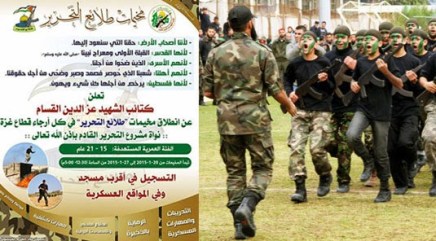
The Hamas al Qassam Brigades announced that it open up registration for military camps for children aged 15 and up throughout the Gaza strip on January 20.

The camps will be called “Vanguard of the Liberation.”

Hamas doesn’t try to hide that it is training children to be armed terrorists. The announcement states that “the camps will include military drills and skills, shooting live ammunition, scouting skills and sermons, as well as courses in civil defense and first aid.”

Kids can register for the camps “at the nearest mosque or the nearest Qassam Brigades military site.” Since the army sites are sprinkled liberally throughout residential areas, that makes it much easier to find a place to register.

Here’s the flyer announcing the camps:


This is the third year of the camps. Here are some photos from last year’s graduation ceremony (a full video is here.)….

Where did Gaza’s Concrete Go?

January 12, 2015

A leftwing organization is complaining that not enough building materials are being let into Gaza, but admits that what goes in is not being used to rebuild Gazan home.

By: Shalom Bear

Published: January 12th, 2015

via The Jewish Press » » Where did Gaza’s Concrete Go?.


A Hamas policeman walks past trucks loaded with cement which entered the Gaza Strip from Israel through the Kerem Shalom crossing.
Photo Credit: Abed Rahim Khatib / Flash90

It’s difficult to get a handle on the tone of a recent report by the radical left-wing organization Gisha.

In a recent article, they report on how much building materials such as concrete and cement have been brought into Gaza since the end of Operation Protective Edge in August 2014.

Trucks Tons of Material
Private use (Reconstruction) 722 34,570
Qatar projects 1,496 104,198
International Organization Projects 960 57,636
Totals: 3,178 196,404

Gisha complains that this amount isn’t nearly enough, making up only 3.9% of the amount of building material that Gaza needs to for reconstruction.

They claim that Gaza needs 5 million tons of building materials.

It would appear that Gisha is ignoring the estimated 3 millions tons of concrete rubble already in Gaza that can be recycled and reused for many projects — though that 3 million tons presumably includes the 800,000 tons of concrete originally used to build Gaza’s terror tunnel network that Hamas claims is already being rebuilt.

In the article, Gisha mentions that not a single home from the 20,000 destroyed homes hasbeen rebuilt since the construction material was first allowed back in.

But it is not clear who exactly Gisha is criticizing for that, or what they are implying.

So where did the concrete go?

An Israel Channel 2 reporter spoke with Gazans in December, and they said they haven’t seen any private reconstruction going on, only some main roads.

Based on the international mechanisms that were set up between the UN, Israel and the PA, every individual Gazan whose home was damaged need only fill out a form and they will receive the building materials they need to rebuild.

And yet the left-wing organization Gisha divulges that not a single new home has been rebuilt, despite nearly 35 tons and 722 trucks of construction material being brought in specifically for that purpose.

The Channel 2 reporter asked the Gazans about the construction material they were supposed to receive, and one Gazan in the construction business told him that the Gazans are reselling all their building materials on the black market to buy food and supplies – even though organizations like UNRWA supposedly supply them with the basics.

He claims that individual Gazans can’t afford to rebuild their homes, even after being given all the raw materials for free.

Which brings us back full circle, with one basic question.

Israel is allowing in building materials, more than enough for the Gazans to be rebuilding their homes.

There is enough recyclable construction material in Gaza to last them for years.

Individual Gazans are selling their construction material on the black market (to someone).

Despite the presence of international organizations who are supposed to be in Gaza helping them rebuild and ensuring that building materials do not go to Hamas, no one actually sees any help from them in rebuilding their homes, other than providing them raw material which they resell, presumably to Hamas.

Despite the multiplicity of NGOs supposedly concerned with Gaza, none of those NGOs seem to be helping the Gazans physically rebuild.

Despite having all the raw materials and the manpower, no one in Gaza is helping one another rebuild their homes, and certainly Hamas and the PA, their own government(s), isn’t helping either.

Which leaves us with one question: how many terror tunnels is Hamas currently rebuilding with all the redirected construction materials?

Can Charlie Hebdo’s Spirit Include Israel?

January 9, 2015

Can Charlie Hebdo’s Spirit Include Israel? Algemeiner, Noah Beck, January 9, 2015

parisians-300x167Grieving Parisians gathered to mourn the victims of the Charlie Hebdo shooting. Photo: Screenshot, Vice News.

[H]ad Palestinian gunmen similarly attacked Israel’s most important daily newspaper and then escaped, would the event inspire such constant coverage or international sympathy? Israel has suffered countless massacres followed by a suspenseful manhunt for the Islamist terrorists; in each of these incidents, the world hardly noticed until Israel forcefully responded and Palestinians died (prompting global condemnation of Israel).

The best response to the Charlie Hebdo attack is to redouble the free expression Islamists meant to stifle. Similarly, the best response to Islamist attacks on the only Mideast democracy, Israel, is to increase support for it.

****************

The Islamist massacre at Charlie Hebdo has understandably captured global attention because it was a barbaric attack on France and freedom of expression. In a moment of defiant moral clarity, “je suis Charlie” emerged as a popular phrase of solidarity with the victims. Hopefully such clarity persists and extends to those facing similar challenges every day in the Middle East.

Christians and other religious minorities have been beheaded by Islamists for years, but it wasn’t until US journalist James Foley was beheaded that the West cared. The Islamic State raped and slaughtered thousands of Yazidis — leaving the surviving refugees stranded on Mount Sinjar — before the West took notice. But one Islamist besieging a cafe in Sydney, killing two, dominated global coverage for the entire 16-hour incident.

Western leaders and media must realize that religious minorities in the Middle East are the canary in the coalmine for the West when it comes to Islamist threats. And Israel provides the clearest early warning of all, precisely because — despite Israel’s location in a region of Islamists and dictatorships — the Jewish state has free elections, freedom of speech, a vigorous political opposition and independent press, equal rights and protections for minorities and women (who are represented in all parts of civil, legal, political, artistic, and economic life), and a prosperous free market economy.

But had Palestinian gunmen similarly attacked Israel’s most important daily newspaper and then escaped, would the event inspire such constant coverage or international sympathy? Israel has suffered countless massacres followed by a suspenseful manhunt for the Islamist terrorists; in each of these incidents, the world hardly noticed until Israel forcefully responded and Palestinians died (prompting global condemnation of Israel).

However, when there is an attack in Europe, North America, or Australia, there is widespread grief, solidarity, and an acceptance of whatever policy reaction is chosen. But when Israel is targeted, there is almost always a call for “restraint,” as happened last November after fatal stabbings by Palestinian terrorists in Tel Aviv and the West Bank.

If two Palestinians entered a European or North American church and attacked worshipers with meat cleavers, killing five people, including priests, the outrage would be palpable in every politician and journalist’s voice. But when Israelis were victims of such an attack, Obama’s reaction was spineless and tone deaf. Did Obama condemn the Charlie Hebdo massacre by noting how many Muslims have died at the hands of French military forces operating in Africa and the Middle East? Of course not. Such moral equivocation would be unthinkable with any ally or Western country except Israel.

Similarly, would Secretary of State John Kerry ever suggest that the Islamic State is somehow motivated by French policies (whether banning Muslim headscarves at public schools or fighting Islamists in Mali)? Obviously not. Yet Kerry did just that sort of thing with Israel when he suggested that the Islamic State is driven by the Israeli-Palestinian conflict.

And the media’s anti-Israel bias is well known but became even more obvious when they couldn’t get a simple story about vehicular terrorism against Israelis correct. Compare how The Guardian writes accurate headlines when France or Canada suffers an Islamist car attack but not when Israel does.

Consider all of the justifiable news coverage and outrage over the 2013 Boston bombings, and imagine if one of those happened every week. Would anyone dare suggest that the US make peace with any Islamists demanding changes to US policy? And yet Israel had such bomb attacks almost every week of 2002 and was invariably asked to restrain itself and make concessions to the very people bombing them (as happened again last summer, when Hamas fired thousands of rockets at Israel).

As Israeli Prime Minister Netanyahu has ruefully observed, “There is a standard for dictatorships, there is a standard for democracies, and there is still a third standard for the democracy called Israel.”

Even when compared to Western democracies, what other country gives incredibly forgiving medical care to terrorists and agrees to treat the children of those working to destroy it? Israel is where a Hamas family member finds refuge when he is a gay convert to Christianity but this is yet another inconvenient fact for the mainstream media (as is the fact that some Israeli Arabs supported the IDF’s 2014 war against Hamas). Why report what contradicts the one-sided, anti-Israel narrative that the media and groups like Human Rights Watch have adopted? That narrative is only reinforced on college campuses (leftist college history professors openly supported Hamas last summer). Nevertheless, US funding of anti-Israel groups continues to aggravate the misinformation problem.

Israel is still the country that everyone loves to hate. So it’s the cheap way to please Muslim voters in Europe and oil producers in the Gulf. But what happens to Israel eventually comes to the West, because Israel is an extension of the West. And just as surrendering Czechoslovakia failed to appease the expansionist appetite and murderous rampage of Nazi totalitarianism, so too will feeding Israel to Islamist totalitarianism fail to appease that movement. In the end, there is no set of concessions — short of civilizational surrender — that the Islamists will accept.

Nevertheless, an EU court decided to remove Hamas from the European Union’s terror list, even though Hamas is responsible for scores of terrorist attacks that have murdered hundreds of Israelis, North Americans, and Europeans, and has a charter calling for the destruction of Israel. And Western European countries have voted for Palestinian statehood at the UN and in their parliaments, effectively rewarding Palestinian terrorism and intransigence. Europe supports the Palestinian Authority as if Hamas couldn’t overthrow it in the West Bank as easily as Hamas did in Gaza Strip in 2007. How can Europe not know that Hamas has designs on the West Bank and that any Israeli withdrawal from that territory will only facilitate such a takeover? And how can Europe believe that Israel could ever make peace with Hamas, which has launched three unprovoked wars on Israel in the last five years (in the decade since Israel withdrew from Gaza)?

Moreover, if lofty concerns about self-determination and human rights are the true motivation behind Europe’s vocal support for Palestinian independence (despite its undemocratic and violent record), why is Europe deafeningly quiet on Kurdish statehood? Given that six million Jews were annihilated by a genocide on European soil, Europe’s hypocrisy on Israel should embarrass the continent even more.

Worse still, Europe’s gestures of appeasement only encourage the Islamists. The best response to the Charlie Hebdo attack is to redouble the free expression Islamists meant to stifle. Similarly, the best response to Islamist attacks on the only Mideast democracy, Israel, is to increase support for it.

IDF pulls units from locations bordering Gaza, ignoring rising Egyptian military and al Qaeda activity

January 4, 2015

IDF pulls units from locations bordering Gaza, ignoring rising Egyptian military and al Qaeda activity, DEBKAfile, January 4, 2015

Egyptian_troops_SinaiEgyptian troops battling terrorists in Sinai

Israelis living in a string of villages and towns bordering on the Gaza Strip protested in vain against Defense Minister Moshe Ya’alon’s decision to withdraw the military presence keeping them safe, especially since the summer war on Gaza.

Four significant security events in the last 48 hours on both sides of the border added to their concerns:

Their government, at its weekly cabinet meeting in Jerusalem Sunday, Jan. 4, set up a committee to expedite the transfer of the bulk of IDF facilities from the center of the country to the south.

At the same time, Israelis living in the south within range of the Hamas-ruled Gaza Strip saw the soldiers heading out and were advised to put their trust in local paramilitary “preparedness squads” taking over from the army. The local population believes that they are not up to the job of safeguarding them from more terrorist aggression – by missile, tunnel or intrusion.

Also Sunday, Egypt began expanding the security buffer zone along the 14km of the Gaza-Sinai-Israel border, doubling its breadth from one half to a whole kilometer. The mostly Palestinian inhabitants of this zone were evacuated.

Saturday, Jan. 3, Egyptian troops raided three towns in northern Sinai: Rafah (which is part located in the Gaza Strip), El Arish and Sheikh Zuweid, killing 7 militants of Ansar Beit al-Maqdis, which last month pledged allegiance to the Islamic State of Iraq and the Levant, and jihad against Egypt and Israel.

A few hours later, an Egyptian army explosives expert was killed and several soldiers injured when a large bomb planted on a road in Sheikh Zuweid blew up when they tried to dismantle it.

Saturday night, the IDF commander of the Gaza Division, Brig. Gen. Itay Virov tried to calm dwellers across from the Gaza Strip, who were up in arms about the withdrawal of their military safety net. He addressed members of Kibbutz Nahal Oz with a rare burst of frankness. He spoke of military policy, but his words no doubt reflected the strategic thinking of Prime Minister Binyamin Netanyahu, Defense Minister Ya’alon, the outgoing Chief of Staff, Lt. Gen. Benny Gantz, and his successor next month Maj. Gen. Gadi Eisenkott.

The general may be commended for laying the truth about official policy on the table. However, instead of calming his audience, he bared evaluations that may give the rest of the country sleepless nights as well.

Here are the high points of his Nahal Oz lecture:

  • Israel can’t deter Gazan Palestinians from making war, because they have no other options. So deterrence in this case is an empty value.
  • Israel deliberately avoided going all the way to remove Hamas from power in Gaza in the summer war because salafist jihadists and al Qaeda would have moved in to replace them. It was deemed better to rely on Egypt to grapple with the terrorist threat, including al Qaeda, rather than the IDF.
  • Brig. Virov termed the last Gaza operation a campaign based on the doctrine of prevention rather than a war of aggression.
  • The political wing of Hamas looks after the population and wants peace and quiet, whereas the military wing lost no time in restoring the tunnels Israel blew up, conducting scores of test launches of rockets, and training hard for the next round of combat with Israel.
  • Israel therefore has no option but to prepare for a replay of Defense Edge with operations 2, 3 or even 4. Hamas must be degraded militarily each time – but not so far as to be rendered incapable of buttressing the Hamas regime.
  • The conclusion drawn from Gen. Virov’s lecture was that the Netanyahu government has provided Hamas-Gaza with a political and military guarantee of safety.

Like all policies, even those well thought out, this one too carries a price tag.

The general spoke of Hamas in terms of an independent entity whose operations and impact are confined to the Gaza Strip. He refrained from mentioning that, as recently as December, both of Hamas’ branches, the military and the political, jumped aboard the Iran-led Iraqi-Syrian-Hizballah alliance. This Palestinian group is now subject to Tehran’s policy decisions and directives. This omission from Israel’s policy calculations could be dangerous. Clearly, an undefeated Hamas remains a lasting menace.

Tehran’s decisions regarding Hamas may have an overarching effect, possibly touching on the moves directed by President Barack Obama. (See our Jan. 1 article on Obama’s New Year gift to Israel and the Middle East.).

Israel’s policy of relying on the Egyptian army to contain Al Qaeda’s Sinai network also comes at a price.

For now, Israel has quietly consented to large-scale Egyptian military strength entering Sinai: One and a half divisions, including fighter squadrons and tank battalions, have taken up positions, nullifying the key demilitarization clause of their 1979 peace treaty.

And that’s just for starters.

Egypt-Qatar rapprochement rattles Hamas

December 31, 2014

Egypt-Qatar rapprochement rattles Hamas, Al-MonitorAdnan Abu Amer, December 30, 2014

(These guys could form several pretty adequate stand-up comedy teams.

— DM)

Egyptian woman gestures during a protest against what they say is Qatar's backing of ousted Egyptian president Mohamed Mursi's government, outside the Qatari Embassy in CairoAn Egyptian woman gestures during a demonstration against what protesters call Qatar’s backing of ousted Egyptian President Mohammed Morsi’s government, outside the Qatari Embassy in Cairo, Nov. 30, 2013. (photo by REUTERS)

At a time when Hamas is mending its relationship with Iran, Egypt and Qatar are also in the process of rapprochement after more than a year of tension. Resumed ties between them will likely have an impact on Hamas, but questions remain as to whether the Palestinian Islamist movement stands to gain or lose from this important regional development.

Hamas waited several days to announce its final position on the return of positive relations between Doha and Cairo on Dec. 20, when President Abdel Fattah al-Sisi met the envoy of Qatar’s emir in Cairo, Sheikh Mohammed bin Abdulrahman bin Jassim Al-Thani, the minister’s assistant for International Cooperation Affairs.

On Dec. 28, senior Hamas leader Mahmoud al-Zahar welcomed the Egyptian-Qatari convergence and denied Qatar was pressuring the Hamas leadership to leave Doha. He also denied reports that Qatar was planning to suspend its support for Hamas over the warming of ties with Egypt, reiterating that Hamas supports the unity of Arab countries to serve the Palestinian cause.

Yousef Rizqa, the former minister of information and political adviser to former Gaza Prime Minister Ismail Haniyeh, said in an interview with Al-Monitor, “The Egyptian-Qatari rapprochement serves the interest of the Palestinian national project, and Hamas has no concerns about its relations with Doha being harmed after the Doha-Cairo rapprochement because the movement is not a party to the internal Arab conflict, and it is accepted by the Arab capitals.”

However, an anonymous Egyptian official said in Dec. 26 press statement that Doha informed Hamas leaders that it would temporarily suspend its support for the movement in a bid to pressure Hamas to change its policies against Cairo.

Husam Badran, spokesman for Hamas and a resident of Doha, told Al-Monitor, “There is no suspension of the Qatari financial support for the movement, since their relationship is ongoing.” But Palestinian Minister of Labor Maamoun Abu Shahla revealed Dec. 28 that Qatar had postponed the financial grant supposed to be sent to Gaza’s state workers.

Rizqa neither confirmed nor denied this report, but he told Al-Monitor that Qatar has not cut its support and relationship with Hamas over the rapprochement with Egypt, saying, “The Hamas-Doha relationship is stable and Qatar’s support for the movement is sustained and has never ceased. Moreover, Qatar’s position on Hamas is strategic.”

It is worth noting that Hamas’ fear of Qatar halting its financial support for the movement at Egypt’s request coincides with its renewed attempt to improve ties with Iran, as well as political head Khaled Meshaal’s recent visit to Turkey. Hamas may be reaching out to possible alternatives for regional support should Doha downgrade its ties with the movement in a “secret” deal with Cairo.

The Palestinian Authority did not express a position on the Egyptian-Qatari rapprochement, but on Dec. 25 Ambassador Hazem Abu Shanab, a member of the Revolutionary Council of Fatah, ruled out the consideration that the Egyptian-Qatari convergence would contribute to the improvement of relations between Hamas and Cairo, because this depends on how Cairo decides to deal with the Muslim Brotherhood and its affiliates, such as Hamas.

This prompted the Egyptian official to reveal Dec. 26, also on condition of anonymity, that Hamas demanded Doha mediate with Cairo to calm the atmosphere with Hamas, as the movement expressed its goodwill toward overcoming the tension with Cairo.

A senior Hamas official told Al-Monitor on condition of anonymity that Hamas is analyzing the extent of Doha’s ability to influence Cairo on reconciling with the movement. Should the rupture between Hamas and Egypt continue irrespective of the Doha-Cairo rapprochement, this would be interpreted by Hamas as being made a scapegoat.

A former member of the Qatari Shura Council, asking not to be named, revealed to Al-Monitor, “There have been contacts made between the Hamas leadership, represented by Meshaal, and Emir Tamim bin Hamad al-Thani, among other Qatari officials. They discussed the rapprochement with Egypt. Meshaal told the emir that he fully supports any Qatari effort to unify Arab positions.”

The Qatari official told Al-Monitor by phone from Doha, “Meshaal received a formal Qatari pledge not to attack the Hamas leadership or tighten the noose around its neck in Doha in exchange for rapprochement with Cairo. This is because Qatar never establishes relations based on bargaining between one party or another, and our relationship with Hamas will continue to exist.”

Interestingly, coinciding with the rapprochement, Egyptian media outlets reported that Cairo threatened to cut ties with Hamas on Dec. 26 unless 13 accused members of the movement were extradited to Egypt. The 13 were accused of involvement in armed operations in Egypt, and allegedly, Egyptian authorities have insisted that extradition proceedings must conclude before they consider improving relations with Hamas.

On Dec. 28, Zahar denied Egyptian media reports that Hamas interfered in Egypt’s domestic affairs.

A senior Hamas official in Gaza who spoke to Al-Monitor on condition of anonymity also denied the reports, saying, “Egypt made no formal request to extradite any Hamas member, and these accusations were featured across all media outlets, which only creates more tensions,” he said.

Ahmed Yousef, a senior Hamas official, told Al-Monitor that he hopes “the breakthrough in the Doha-Cairo relations will positively affect Hamas’ relations with Egypt and that Qatar would do its best to alleviate the tension between Gaza and Cairo,” adding, “The Hamas and Cairo dossier is likely to be opened after the meeting of Emir Tamim with Sisi.” He denied the existence of contacts between the movement and Egypt following the Doha-Cairo rapprochement.

The timing of the Egyptian-Qatari warming may have come as a surprise to Hamas, which took nearly a week to announce that it welcomes the move, making sure that it would not come at its expense. The atmosphere prevailing within Hamas is still ambiguous over whether the Qatari position toward the movement will be affected, despite promises made by Doha to the contrary. Hamas knows that the pressure exerted on Qatar may be stronger than its ability to resist.


Mahmoud Abbas: Failing the Palestinians and Peace

December 29, 2014

Mahmoud Abbas: Failing the Palestinians and Peace, Front Page Magazine, December 29, 2014

Mahmoud Abbas

[T]he increased authoritarianism of Abu Mazen is reflected in a recent survey by the Palestinian Center for Policy and Survey Research. It indicates that 66% of Palestinians are afraid to criticise Abu Mazen and the PA, and 80% consider the PA institutions to be corrupt and infected with nepotism.

***************

Mahmoud Abbas, (aka Abu Mazen) has been a failure as the Palestinian “Rais.” He failed to lead the Palestinian Authority (PA) toward peace with Israel, and he mismanaged the alleged goal to achieve statehood for the Palestinians. Instead of facing the tough issues and making compromises required in negotiating peace and statehood with the Israelis, Abbas chose an alliance with the Gaza controlled terrorist group Hamas. Following Abbas’ pact with Hamas last April, Israel broke off peace negotiations with the Palestinians, just days before the talks brokered by Secretary of State John Kerry were scheduled to expire.

Abbas isn’t only confusing Israelis, Americans, and is his Europeans patrons, he is perplexing his own Palestinian consituents. Following last summer’s Gaza War between Hamas and Israel, Abbas threatened to join the International Criminal Court (ICC) and saught to indict Israel on war crimes. PA Foreign Minister Riad al-Maliki met with the Chief Prosecutor of the ICC last August to explore ways of joining the court by PA President Abbas signing the Rome Statute.  When, however, the U.S. Congress threatened to cut off all funding to Palestine if Abbas filed war crimes charges against Israel, Abbas backed off. At the same time though, Israel’s Prime Minister threatened to counter-sue, alleging that the rockets fired by Hamas terrorists into Israeli civilian areas constituted “double war” crimes.

The Israeli Law Center called Shurat-HaDin, led by Nitsana Darshan-Leitner submitted a complaint against Mahmoud Abbas in the ICC for “war crimes.” The complaint claims that Abbas may be tried for his responsibility in the missile attacks targeting Israeli cities, executed by the Palestine Liberation Organization (PLO), which Abbas heads. It charges that Fatah, also led by Abbas, was responsible for several missile attacks on Israeli cities. Darshn-Leitner pointed out that Fatah leader Abbas may be tried by the ICC. Abbas is a citizen of Jordan and Jordan is a member-state of the ICC. The ICC has jurisdiction over crimes committed by a citizen of a member state. Darshan-Leitner added, the organization “will not allow Fatah to carry out rocket attacks on Israeli population centers, while hypocritically advocating Palestinian membership in the ICC. Abbas falsely believes that alleged crimes against Arabs are the only ones that should be prosecuted.”

A week ago, Abbas threatened again. This time he fingered the security co-ordination with Israel following the death of Ziad Abu Ein, 55, PA Minister without Portfolio. He promptly backtracked. On November 29, 2014, Abbas declared  that if the United Nations Security Council rejects the Palestinian statehood resolution, he will seek membership in the ICC. He said, “We will seek Palestinian membership in international organizations, including the International Criminal Court in the Hague. We will also reassess our ties with Israel, including ending the security cooperation between us.”

Abbas’ latest gambit is a UN Security Council (UNSC) resolution that would force Israel to withdraw from Judea and Samaria (West Bank) within two-years. According to press reports, U.S. Secretary of State John Kerry requested to postpone the Palestinian initiative at the UNSC until after the Israeli elections, (March 17, 2015) but the Palestinians refused. PA Foreign Minister Riad al-Maliki intimated to reporters that there was disagreement between the Americans and Palestinians on how the elections in Israel would or wouldn’t advance the PA UNSC resolution. Kerry believed that a UNSC vote before the elections would impact adversely on the winners. In other words, a vote before the elections would strengthen Netanyahu and the Right in Israel. Maliki argued that a vote before January, 2015 would be rather positive.

At a closed meeting last week with 28 EU ambassadors, John Kerry revealed that he was asked by former Israeli president Shimon Peres and Tzipi Livni to prevent the Palestinian initiative at the UNSC because it will help “Netanyahu and Bennett (Jewish Home Party chairman) in the upcoming elections.” Maliki posited that Kerry himself has not abided by his pledge not to intervene in the Israeli elections.

Also last week in London, Secretary of State Kerry met with Saeb Erekat, the chief Palestinian negotiator, and according to a PA senior official, Kerry posed a number of U.S. principles that should be included in the Palestinian UNSC resolution. Kerry supposedly refused the two year time period demand by the PA for Israeli withdrawal. The resolution as Kerry suggested should include recognition of Israel as a Jewish state, as well as U.S. opposition to declare Jerusalem as a joint capital for Palestine and Israel. Erekat rejected the U.S. proposals. Kerry declared afterward that the U.S. does not accept the Jordanian (presenting the Palestinian resolution)  and French resolutions. He warned that if the Palestinians insist on presenting the resolutions, the U.S. would use its veto power. Erekat rejected Kerry’s ideas, and insisted that the resolutions would be submitted. As of December 25, 2014, Abbas rejected an Arab League request to delay the submission of the Palestinian statehood until January when five new members who support the Palestinian cause will join the Security Council.

Abbas’ gambits notwithstanding, the increased authoritarianism of Abu Mazen is reflected in a recent survey by the Palestinian Center for Policy and Survey Research. It indicates that 66% of Palestinians are afraid to criticise Abu Mazen and the PA, and 80% consider the PA institutions to be corrupt and infected with nepotism. Last summer, according to the survey, support for Abbas (Abu Mazen) declined to 35% from 50%. “There is no doubt about the fact that outlawing freedoms and rights, especially of professional unions, is a factor in Abbas’ decline in popularity,” said Dr. Khalil Shikaki, one of the survey takers.

PA security agents inspect what is written in the social media, and threaten those who criticize Abbas. Abu Mazen critics point out that after a decade in power he is controlling all systems of government to such an extent as to minimize all resistance. Perceived political rivals such as Mohammad Dahlan, who once served as Abu Mazen’s assistant, and Salam Fayyad, the former Prime Minister of the PA, are vilified by Abbas. Following the Palestinian Unity government formation, headed by Rami Hamdallah last May, elections were to follow. But, once again, internal squabbling prevented it, and added to it was Abbas’ fear of a Hamas victory.

Abu Mazen’s strategy for the establishment of a Palestinian state has reached a cul-de-sac.  None of his gambits proved successful. His rivalry with Hamas is bitter and ongoing, despite the alliance he forged at the expense of negotiations with Israel. And, like his predecessor Yasser Arafat, he balks at the idea of ‘ending the conflict’ with Israel. He knows full well that this might be a death sentence for him, targeting him for assassination. It is for this reason that Abbas and the PA are unlikely to forgo the “right of return” of Palestinian refugees to Israel. Israel for its part, cannot accept such a demographic suicide. This is why Abbas would rather avoid negotiations with Israel and bypass it by going to the UNSC. It is also the ostensible reason why peace with Israel cannot be achieved, and as a result, the Palestinian people continue to suffer political and economic deprivation. Abbas has not been the solution to the Palestinian problems; rather, he has been responsible for failing them.

The Israelis who back UN hypocrisy

December 29, 2014

The Israelis who back UN hypocrisy, Israel Hayom, Dr. Limor Samimian-Darash, December 29, 2014

[T]he more one delves into the U.N.’s outrageous conduct, the harder it becomes to separate the actions of the international community from the tailwind provided by certain Israelis.

******************

The growing relationship between Iran and the Palestinian Authority, as well as Iran’s arms shipments and its involvement in terrorism, are, as always, not being condemned internationally. This is in addition to the world’s silence about the Palestinian terrorist attacks in recent months, which have included stabbings, vehicular rammings and firebombings. None of these produced a U.N. resolution against the Palestinians. And if the massacre at the synagogue in Jerusalem had not looked like a classic anti-Semitic attack in Europe, it is doubtful we would have heard any condemnation of it at all.

One can, of course, complain about the hypocrisy of the world, and particularly that of European nations, who have continued to ignore the growth of Islamic radicalism and terrorism in the world and have focused instead, in a biased manner, on the Israeli-Palestinian conflict. Alongside this, more and more nations are symbolically recognizing a Palestinian state and turning a blind eye to all Palestinian misdeeds. These moves are indeed symbolic, not just because they have no diplomatic meaning, but also, ironically, because Israel is once again being placed on the altar for sacrifice.

But the more one delves into the U.N.’s outrageous conduct, the harder it becomes to separate the actions of the international community from the tailwind provided by certain Israelis. Indeed, Tzipi Livni, Isaac Herzog and even Avigdor Lieberman have explained to us that this is all happening because of a lack of diplomatic initiative on the part of Prime Minister Benjamin Netanyahu. They do this, of course, without attributing any blame to Palestinian Authority President Mahmoud Abbas, who, despite all the concessions offered by Netanyahu, would not even agree to begin peace talks.

And there are now more false accusations being hurled around, such as the claim that the lack of negotiations following Operation Protective Edge is leading us toward a renewal of hostilities in the Gaza Strip. There is no mention of Hamas or its desire to expel us from the region. There is also no mention of the use of reconstruction funds by Hamas to re-arm itself ahead of the next round of fighting or the fact that the Palestinian Authority was kicked out of Gaza by the Palestinians themselves. No, they say, everything is the Israeli government’s fault for not initiating a diplomatic process.

And even more bluntly, Israeli politicians are directly appealing to the international community to apply pressure on the Israeli government. For example, Livni had the gall to implore U.S. Secretary of State John Kerry to not support the unilateral Palestinian move at the U.N., as this would have strengthened the Israeli Right. Herzog made a similar claim when he sought to dissuade the British parliament from recognizing a Palestinian state.

Former Labor MK Avraham Burg took a different tack, urging his British friends to recognize a Palestinian state and force a diplomatic solution on Israel. And if we look not too far back in history, this was the exact line taken by Livni when she was appointed foreign minister in 2006 by then-Prime Minister Ehud Olmert. Her first speech at the U.N. did not remind the nations of world about the historical right of the Jewish people to the land of Israel. Instead, her debut speech on the world stage was dedicated to presenting her vision of the establishment of a Palestinian state.

These are not some words uttered by one Palestinian government minister or another. And no, they are not a biased report by a BBC presenter. Rather, these are Israeli politicians who, whether they are just trying to butt heads with the government or if they truly believe in the righteousness of Abbas, are ultimately providing fuel for unilateral anti-Israel moves at the U.N. And when they do this, they are helping the lowlifes at the U.N.

Palestinian Authority Envoy to Tehran Says Israel will be Destroyed

December 28, 2014

Iran is aiding terrorism in Judea and Samaria, Netanyahu says.

By: Tzvi Ben-Gedalyahu

Published: December 28th, 2014

via The Jewish Press » » Palestinian Authority Envoy to Tehran Says Israel will be Destroyed.


A message from an ambassador of the Palestinian Authority, Israel's "peace partner."
A message from an ambassador of the Palestinian Authority, Israel’s “peace partner.”

The Palestinian Authority ambassador to Iran has said that Israel is a cancer” that “will be destroyed,” Prime Minister Binyamin Netanyahu told the Cabinet Sunday morning.

He also said, ‘We have seen increased Iranian efforts for terrorist activities in Judea and Samaria. ”The PA ambassador’s remarks, quoted by the Prime Minister, are a carbon copy of those of Hamas and exposes the Ramallah regime headed by Mahmoud Abbas as a terrorist organization in a shirt and tie.

Netanyahu said:

The ambassador said he is happy with orders from the ruler of Iran, [Ali Hosseini] Khamenei, to send weapons to the West Bank.He added, and I quote, ‘The Zionist regime is an aggressive cancerous regime that sooner or later will be eliminated.’

Netanyahu emphasized that the ambassador is not a Hamas official but one from the Palestinian Authority headed by “peace partner” Mahmoud Abbas.

He asked rhetorically what will be the reaction of the United Nations.

“They give Iran a place of honor instead of dealing with incitement like this, which leads to terrorism such as we have experienced lately,” referring to last week’s firebombing of an 11-year-old and her father by two Palestinian Authority terrorists.

Netanyahu said Israel will not allow the Palestinian Authority “to force a second Hamastan on us and endanger our security” by going to the U.N. Security Council to circumvent negotiations with Israel.

“This is the same United Nations whose Human Rights Council last year brought 20 decisions against Israel, one against Iran and one against Syria,” Netanyahu added.

The Prime Minister said he expects the international community to unite against the Palestinian Authority effort.

We also can expect  the Palestinian Authority  observer to the United Nations tell the international community how much Abbas  wants peace and that Israel refuses to make peace with a regime that publicly states that Israel is a “cancer that, sooner or later, will be eliminated.”

Israel, the Obsession

December 22, 2014

Israel, the Obsession, American ThinkerRichard Baehr, December 22, 2014

[T]here is no clear path back to sanity, nor is there a clear path to the end of the obsession with Israel.

*****************

It has been a pretty typical week on the hate Israel front.  A European Union Court has decided that Hamas is not a terrorist organization, and their previous designation as such had not been justified by real evidence that Europeans had developed, as opposed, say, to information supplied by the United States or Israel.  An international court in Geneva is hearing evidence of Israeli human rights violations.  The United Nations Security Council has been considering a resolution developed by the Palestinian Authority, as well as one by the French that would effectively lay out the terms for Israel’s capitulation over the next few years.  Israel’s peace camp has been working with U.S. Secretary of State John Kerry, encouraging a delay in consideration of the Security Council resolutions, since any action before the upcoming Israeli parliamentary elections could benefit the right-wing parties in Israel.  In other words, there is not even an attempt to hide anymore that the United States is putting its foot down for one particular side in the Israeli election.  Various European countries are endorsing Palestinian statehood on the terms demanded by the Palestinian Authority.  Academic groups, unions, and churches in Europe and the United States are endorsing the boycott, divestment, and sanctions (BDS) movement.  Certain European communities are now “Israeli-frei” – free of Israeli goods (or at least those they can identify and care to avoid).  The U.N. Human Rights Council and the General Assembly, as well as specific agencies whose only task is to bash Israel, are set to get back to work, creating more resolutions and condemnations of the Jewish state.

As Joshua Muravchik makes clear in his outstanding new book, Making David Into Goliath, this obsession with Israel by most nations of the world and the United Nations – or as they are collectively known, “the international community” – as well as by “the global left,” could not have been imagined a half-century back, prior to the Six-Day War.  At that time, Israel was championed by Socialist political parties, and viewed sympathetically as a beleaguered democracy fighting for its existence against a collection of larger anti-Western Arab tyrannies.  There was residual sympathy for Jewish survivors of the Holocaust, many of whom had moved to Israel.  There was no movement for Palestinian nationhood, though certainly violent actions by Arabs aimed at Israel and Jews in the region had been going on for decades.

Muravchik’s book attempts to explain what has happened during this period and why.  A lot changed after the 1967 war, when, instead of little Israel facing off with 21 Arab nations, the conflict was recast with Israel as the big dog, oppressing the Palestinians and occupying their land.  Since the left tends to root for the underdog, Israel no longer fit the bill.  The description of the conflict in the post-1967 telling is of course neither factual nor historical, since there had never been a unique nation of Palestinian Arabs, denied their nationhood – say, the way the Tibetans or the Kurds have been for sixty years, or forever.  The Palestinians became refugees because their leaders refused to accept half a loaf – a state on half of the mandate territory in 1947 – and instead chose to go to war to deny the Zionists their state.  The Arabs of Palestine, even with the support of armies from their Arab neighbor states, lost the war.

When you start a war and lose, there are consequences.

Since 1967, the Palestinians and their allies have been trying to reverse not just the war of 1967, but the 1948 war as well.  Refugees from the 1948 war (and there are not many of them left) are still in refugee camps, unlike any other refugees from any other conflicts then or in the years since, and the descendants of the original refugee population, now from three generations, demands a “right of return” to homes in Israel where they never lived and in fact to a country where they have never been.

The 1948 war produced a population exchange – a larger number of Jews were driven out of Egypt, Tunisia, Morocco, Algeria, Yemen, Iraq, Libya, and other countries than Arabs who left their homes in what became Israel.  Most of the Jewish refugees moved to Israel, where in relatively short order they were out of any temporary refugee camps and absorbed as regular citizens of the state.  That the Arabs have sacrificed generations of their own people to maintain their inflexible hatred of Israel is all one needs to know about why there has been no resolution of the conflict despite serious efforts over the years to accomplish this.

Muravchik, who was once a leftist himself, spends a fair amount of time in the book documenting the impact of Edward Said , who with his disciples has mentored the current U.S. president, Barack Obama.  Said, despite his faked personal history, has had enormous impact introducing moral relativism to studies of the regions, declaring that the West cannot understand “the Orient” and has no right to judge the regimes, the religions, the people.  What the West calls a terrorist group is instead viewed as a resistance fighting for freedom.  The combination of mosque and state is what those in the region know and prefer, not Western parliamentary systems.  Israel is not a beacon with much to offer those in the region, but an imperialist creation and a predator.  Muravchik outlines how in Israel itself, a part of the population is at war with Zionism and is in fact in league with Israel’s external enemies, assisting viperish non-governmental organizations (often funded by European nations) and bigoted journalists.  An increasing number of left-wing Jews in the United States behave as if Israel is an embarrassment, claiming that Israel’s behavior is “not in its name” and calling for an end to the “racist, apartheid“ state.

At one time, the United Nations consisted primarily of democracies who had fought the Axis powers.  With the decolonization of Africa and Asia after the war, dozens of new nations, since dubbed “the Third World,” became the dominant block at the U.N., particularly in the General Assembly and other international organizations.  These new nations included many Arab and Islamic countries, and their power in numbers shifted these organizations into full-blown assault forces directed at Israel.  Three quarters of all U.N. General Assembly resolutions that are directed at a single country are rebukes of Israel.  It is fairly obvious that the international community considers Israel the worst country in the world (or at least the closest thing to a piñata for the purposes of diplomatic assault) and has ignored the human rights disasters at play in Sudan, Somalia, Nigeria, Iran, North Korea, Pakistan, Bangladesh, Libya, Saudi Arabia, and dozens of other easy targets, since there is no real interest in fairness, and Israel is always held to a different standard.

The Palestinians and their allies have also scored with the terror weapon and the oil weapon.  One nation after another demonstrated that cowardice was the preferred policy for dealing with Palestinian terror groups, rather than risking confrontation with them, and many nations thought they could buy peace and security by becoming harsh critics of Israel and allies of the Palestinians.  In countries with large populations of Arab or Muslim immigrants, taking on Israel politically, and ignoring violence directed against Israel or threats against Jews, was seen as a safety valve to prevent terrorism and violence directed against such countries’ own citizens.  After the 1973 Yom Kippur War, OPEC, dominated by Arab oil producers, began a more systematic effort to use the threat of cutting off oil deliveries to force changes in policy by oil-importing nations, particularly in Europe.

Muravchik is an honest historian of the conflict, and he documents how Israel contributed to changing the narrative of the conflict.  Some of Israel’s leaders were poor spokespersons for the country.  The invasion of Lebanon in 1982, followed by the attacks carried out by Christian Phalangists in Sabra and Shatila to avenge the assassination of their leader by Palestinians, with Israeli forces seemingly looking the other way, were particularly damaging.  Many Israelis, not all on the hard left, have opposed the settlement enterprise in Judea and Samaria.  Muravchik makes clear, however, much as Caroline Glick has done in her book The Israel Solution, that to a large extent it is irrelevant what Israel has offered in any peace process to achieve a deal.  In essence, the country has entered a bidding war against itself.

Muravchik has laid out why Israel is now in the dock, facing more critics on more fronts all the time.  But what is most depressing is that there is no clear path back to sanity, nor is there a clear path to the end of the obsession with Israel.  In fact, the momentum is all with those ganging up on the Jewish state.  In the United States, Barack Obama is a president more comfortable with the thinking of the international community than any prior president since Israeli statehood in 1948, and he seems anxious to end America’s isolation on this issue (since it alone has stood in Israel’s corner for several decades) and move American policy so we are more in line with Sweden or Spain with regard to the conflict.

Muravchik calls for vigilance (Obama will be around only another two years and one month), but with America’s rapidly shifting demography, and the takeover of so many parts of the culture by the left – most of the media, the arts, the universities, Hollywood, many churches and synagogues – the struggle for those who stand with Israel will be uphill.