Posted tagged ‘Gaza’

Palestinian Summer Camps Preach Jihad and Train Youth to Become Terrorists

July 30, 2015

Palestinian Summer Camps Preach Jihad and Train Youth to Become Terrorists, Investigative Project on Terrorism, July 30, 2015

(In Gaza and at the Al-Aqsa Mosque in Jerusalem: raising a new generation of Palestinian children yearning to be free kill Jews for Allah, virgins, their parents and Palestine.  — DM)

Hamas hopes to provide 25,000 children and teenagers with military training to seed future terrorist operations against Israel. Similar to the Al-Aqsa camp, the Hamas camp heavily emphasizes religious indoctrination and radical jihadist brainwashing, according to a news report translated by MEMRI.

******************

Palestinian summer camps in Jerusalem and Gaza are actively indoctrinating young children with radical jihadist ideology and preparing them for martyrdom (suicide) operations, the Middle East Media Research Institute (MEMRI) reports.

In an Islamic summer camp at Al-Aqsa Mosque in Jerusalem, little children are subjected to a radical sheikh’s lecture on the virtues of martyrdom.


“The martyr is absolved with the first drop of his blood…the martyr also gets to vouch for seventy family members (on Judgment Day)… the martyr gets two virgins of Paradise, but the murabit [someone guarding Islam against the infidel] gets 70 – 35 times more than the martyr,” preached radical cleric Khaled Al-Maghrabi.

The children generally appear like most children their age – fidgeting, looking around, some playing with toys, seemingly disinterested in the lecture. Al-Magrabi still appears determined to impart jihadist indoctrination into the next generation of Palestinians at a very early age.

A Palestinian bystander even confronts Al-Maghrabi and tells him his message isn’t appropriate for children.

“Listen, sheik, they do not understand what you are saying. They are children…you are talking to them about ribat, martyrdom, and the virgins of Paradise. Shame on you. You can teach these lessons to (adults) like us, not to them,” said the Palestinian man.

Unfortunately, Palestinians standing up against radicalization is all too rare of an occurrence. Al-Maghrabi carried on after the distraction, leading the children in chanting, “We shall sacrifice our souls and our blood for you, Al-Aqsa!” the children chant.

In a second video illustrating Palestinian indoctrination of its young people with hate, viewers are taken inside a Hamas summer camp called “Vanguard of Liberation.” Hamas hopes to provide 25,000 children and teenagers with military training to seed future terrorist operations against Israel. Similar to the Al-Aqsa camp, the Hamas camp heavily emphasizes religious indoctrination and radical jihadist brainwashing, according to a news report translated by MEMRI.

“The goal of the camps is to instil the spirit of Jihad and of fighting in these cubs, these youth, so that they will become the next generation of liberation,” says a masked Hamas operative and camp counselor.


“Liberation” in this context means taking over all of Israel since Hamas is openly dedicated to the destruction of the Jewish state in any form.

The video features the youth running through military style courses, weapons training, and even shows a junior version of a Hamas naval commando unit dedicated to infiltrating Israel and conducting terrorist attacks.

ISIS infiltrates Egyptian special forces, joins with Hamas to occupy N. Sinai, liquidate Sisi

July 23, 2015

ISIS infiltrates Egyptian special forces, joins with Hamas to occupy N. Sinai, liquidate Sisi, DEBKAfile, July 23, 2015

islamic-State-Corvette-AttackThe ISIS Kornet missile attack on Egyptian Navy vessel

Islamic State affiliates in Sinai and Libya have banded together with the Palestinian Hamas rulers of the Gaza Strip for the shared goals of capturing northern Sinai from the Egyptian army and staging an assassination coup against President Abdel-Fatteh El-Sisi, DEBKAfile’s exclusive military and intelligence sources report.

They are in the throes of four steps for promoting their objectives:

1.  Monday, June 29, a rogue group of Egyptian Special Forces accessed the heavily-guarded upscale Cairo district of Heliopolis to plant a bomb car, which they remotely detonated as the convoy of their target, Egypt’s general prosecutor Hisham Barakat, went by. He was killed on the spot. The assassins were members of the Egyptian elite force which had defected to the Islamic State of Iraq and the Levant.

Three weeks later, on July 16, notwithstanding reinforced security in Heliopolis, ISIS killers reached inside the neighborhood once again and planted a roadside bomb. It was detonated as an Interior Ministry special forces security patrol moved past.

Because of the tight official blackout on the event, there are no reliable accounts on casualties. The authorities in Cairo reported that one Egyptian soldier was injured, but this is no doubt only part of the picture.

The following day, July 17, a violent clash erupted In the Talibiya neighborhood of Giza near the pyramids between Egyptian Special Forces and Muslim Brotherhood’s underground cells. Five MB adherents were reported killed, but again no word on military losses.

2. On July 1, ISIS forces launched their most ambitious offensive to date against Egyptian military and police facilities in northern Sinai. Still ongoing three weeks later, the losses the Egyptian military have sustained to date are estimated at 120 dead and hundreds injured. Though fighting fiercely, Egyptian troops have not been able to repel the continuous Islamist assault or contain its advance through the northeastern section of the peninsula.

Tuesday, July 21, Hamas terrorists arrived at ISIS positions in northern Sinai for a joint assault on the base of the Multinational Observer Force at El Gorah, not far from the embattled town of Sheik Zuwaid. It was the first major attack on the US-led force that was installed in Sinai to monitor the 1979 Egyptian-Israeli peace accord – and is still going on..

Here, too, the MFO command and Cairo have combined to impose a blackout on the situation in the camp and the extent of casualties..

3. On July 17, the Islamic state of Sinai sank an Egyptian coast guard vessel with a sophisticated guided Kornet anti-tank missile. The ship was patrolling the Mediterranean shore of Rafah to prevent the smuggling of arms and fighters from Egypt proper and Libya into northern Sinai. This was a landmark incident in that it was the first time ISIS is known to have sunk an adversary’s vessel at sea.

Cairo reported at first that a fire broke out on the ship and there were no casualties.

4.  On July 22, an audio message began making the rounds in Cairo and other Egyptian cities claiming to be the voice of Hisham al-Ashmawy, an Egyptian Special Forces officer who defected to ISIS. He said the country had been “overpowered by the new pharaoh” and called on all Egyptians “to come together to confront the enemy.” The message concluded with the words: “Do not fear them, but fear Allah if you are true believers.”

Western and Middle East counter-terror experts have concluded that it was Hisham al-Ashmawy who orchestrated the assassination of the general prosecutor last month. They tag him as the leader of the group of Egyptian officers and men who defected to ISIS. Egypt’s elite military units would appear therefore to be heavily penetrated by the Islamic State.

For Egyptian rulers this is a recurring menace. Thirty-years ago in October 1981, President Anwar Sadat was assassinated by a senior Egyptian intelligence officer who had secretly joined the radical Egyptian Islamic Jihad, one of Al Qaeda’s two parent groups, and went AWOL a short time earlier.

Suspected ISIS Jihadists Blow Up Six Hamas Vehicles in Gaza

July 19, 2015

Only two people were wounded, indicating that it might have bee Fatah and not ISIS who attacked.

By: Tzvi Ben-Gedalyahu

Published: July 19th, 2015

via The Jewish Press » » Suspected ISIS Jihadists Blow Up Six Hamas Vehicles in Gaza.


Gaza ambulance at scene of one of six attacks on Gaza ans Islamic Jihad vehicles Sunday morning.

Gaza ambulance at scene of one of six attacks on Gaza ans Islamic Jihad vehicles Sunday morning.
Photo Credit: Hamza-Twitter

Salafists linked with the Islamic State (ISIS) blew up six Hamas and Islamic Jihad vehicles in simultaneous attacks in Gaza City Sunday morning.

At least two people were wounded.

The ability to stage a coordinated attack in the Hamas stronghold reflects both the capabilities of the jihadists as well as the growing vulnerability of Hamas, whose regime has brought misery, depression and war to the local population.

An ISIS poster was found near one of the vehicles that as exploded.

Israel’s Reshet Bet (Voice of Israel) suggested that terrorists may have used the ISIS poster to frame the Islamists for attacks, which could have been carried only with highly organized support.

The fact that there were not many injuries offers a hint that it might have been Palestinian Authority Fatah terrorists who staged the rare attack with the intent of scaring Hamas but without causing an immediate upheaval.

So much for the “unity” that the Obama so highly applauded earlier this year.

Hamas, which recently has fallen back into Iran’s good graces, is in a serious crisis and has been outlawed in Gaza.

Senior Hamas leader Khaled Mashaal won a rare audience last week with Saudi Arabia ling Salman, the first time in four years a Saudi king has publicly confirmed discussions with the Gaza regime.

Nasrallah: Iran only hope to liberate Jerusalem

July 10, 2015

Nasrallah: Iran only hope to liberate Jerusalem

Hezbollah leader delivers annual speech via massive screen in Beirut; Pro-Palestinian rallies spread across Iran as a new deadline is set for negotiations on Iran’s nuclear program.

Roi Kais, Associated Press

Latest Update: 07.10.15, 19:21 / Israel

via Nasrallah: Iran only hope to liberate Jerusalem – Israel News, Ynetnews.

Hezbollah leader Hassan Nasrallah gave his annual speech Friday to mark “Al-Quds Day,” calling Iran “The only hope left for liberating Palestine and Jerusalem.”

Nasrallah’s speech was televised and filmed in a hidden bunker and screened in a event in the Dahiya quarter of Beirut. He also said that Iran would be “perverting her own religion” if Tehran agreed to Prime Minister Benjamin Netanyahu’s demands that Israel be recognized as a Jewish State.


Nasrallah on the big screen.


He also addressed fighting in Syria during the speech saying that “If Syria goes to Hell, Palestine will go to Hell.”

Meanwhile, tens of thousands of Iranians chanted “Down with America” and “Death to Israel” during pro-Palestinian rallies nationwide on Friday, as a deadline on talks to reach a deal on Iran’s nuclear program was postponed until Monday – the third postponment in two weeks.

The “Al-Quds Day” rallies took place as Iran and six world powers were meeting in Vienna to work out a deal to limit Iran’s nuclear program in exchange for easing tens of billions of dollars in economic penalties on the Islamic Republic.


Photo: AFP
Photo: AFP

 Iranian President Hassan Rouhani made a brief appearance at the rally in the capital, Tehran, but did not mention the nuclear talks that have blown past two extensions and entered the 14th day of the current round on Friday. US Secretary of State John Kerry warned on Thursday that the Americans were ready to leave.


Photo: AP
Photo: AP

However, a top leader said Friday the US would be making a “strategic mistake” if it pulled out of ongoing negotiations on Tehran’s nuclear program.


Photo: EPA
Photo: EPA

 “If you drive the talks into a dead end then it will be you who will be committing a strategic mistake,” Iran’s parliament speaker Ali Larijani said at Friday prayers following the rally in Tehran, addressing the US “And its outcome will not benefit you since Iran’s nuclear staff are ready to accelerate nuclear technology at a higher speed than before.”


Photo: EPA
Photo: EPA

 At the rally, the hard-line protesters wrapped America, British, Israeli and Saudi flags around pillars and set them ablaze.


Photo: EPA
Photo: EPA

 Since the 1979 Islamic Revolution, Iran has observed “Al-Quds Day” during the Islamic holy month of Ramadan. Tehran says the occasion is meant to express support for Palestinians and emphasize the importance of Jerusalem for Muslims.

Iran does not recognize Israel and supports anti-Israeli militant groups like Hamas in Palestine and Hezbollah in Lebanon.

Reuters contributed to this report.


First Published: 07.10.15, 18:27

US-Israeli-Egyptian mobile sensor-fence projects to block further ISIS Mid East expansion

July 10, 2015

US-Israeli-Egyptian mobile sensor-fence projects to block further ISIS Mid East expansion, DEBKAfile, July 10, 2015

mobile_surveillance_sensor_towers7.15A US mobile surveillance sensor tower

US counter-terror experts are overseeing a lightning operation for setting up mobile sensor towers and electronic fences in Tunisia, Egypt, Jordan and Israel in a desperate bid to seal their borders off against the fast-moving impetus of the Islamic State of Iraq and the Levant – ISIS, or at least slow it down. This reign of terror is spreading out from Iraq and Syria and creeping into southern Jordan, the Israeli Negev, and Egyptian Sinai, then on to Libya and over to Tunisia and Algeria, covering a distance of 4,000 km.

When President Abdel-Fatteh El-Sisi saw his army had not repelled the ISIS Sinai affiliate’s offensive in North Sinai as it went into its second week – controlling only the main highway from El Arish to Cairo via Bardawil Lake – he turned to Washington with an urgent request to ship over mobile surveillance sensor towers and American crews to operate them. His plan is to string them across the Sinai Peninsula and along Egypt’s borders with Libya and Sudan in a last-chance bid to block the constant influx of reinforcements and weapons to ISIS fighters reaching Sinai from Libya, through the Egyptian borde,r and from Iraq, through southern Jordan and the Israeli Negev.

The State Department acceded to the Egyptian request and has submitted the application worth $100 million for congressional approval.

The application states: “This procurement is intended for Egyptian Border Guard Forces, which currently lack any remote detection capability along unpatrolled areas of Egypt’s borders.” Libya, Sudan and Sinai are specified. The application goes on to explain: “The system would provide an early warning capability to allow for faster response times to mitigate threats to the border guards and the civilian population.”

DEBKAfile’s counter-terror and intelligence sources disclose that Egypt already has one set of American mobile sensor towers. They were installed on the 193 km long banks of the Suez Canal more than a year ago and have kept ISIS terrorists from reaching those banks and firing missiles at passing ships to block the waterway, like the RPG attack of Sept. 5, 2013.

The sensor towers have proved effective so long as the various terrorist groups, such as ISIS, were deterred from directly attacking American facilities by tactical considerations of their own, such as a preference for those systems rather than a large-scale army forces to police the Suez zone, which would physically impede the convoys carrying men and arms from Libya into Egypt.

The drivers of these convoys stop over at Suez and Port Suez to rest up before carrying on with the long drive to their destinations in Sinai. Scattering the mobile sensor towers in areas unpatrolled by Egyptian troops would expose the American operators to ISIS attacks and abductions. So while solving one problem, they may well generate another. In any case they won’t make the ISIS threat go away.

Whereas Egypt asked for mobile sensors, Tunisia is to have a new, permanent fence with electronic warning stations along its route. Our counter-terror experts point out that, however effective this system is, it can’t promise Tunisia hermetic protection against terrorist encroachment.

ISIS has at least two ways of getting around the fence barrier:

1. Landing by sea. The gunman who massacred 39 tourists on the Soussa beach on June 26 landed from the Mediterranean by speedboat.

2. Circumventing the fence through the meeting point of the Tunisian-Libyan-Algerian borders. That point will not be enclosed. Tunisia may be reached through western Algeria where the border is wide open.

The second electronic fence the United States is providing will run down 30 km of the border between Israel and Jordan from Timna to Eilat. It is a joint project, which has become necessary to curb ISIS movements from southern Jordan through the Israeli Negev and onto Egyptian Sinai and the Gaza Strip.

The Iran Delusion: A Primer for the Perplexed

July 8, 2015

The Iran Delusion: A Primer for the Perplexed, World AffairsMichael J. Totten, Summer 2015

Totten_Iran

US foreign policy in the Middle East is focused on two things right now: containing ISIS and preventing Iran from acquiring nuclear weapons. These are both worthy goals, but if sanctions are lifted on Iran as part of a nuclear deal, whether or not it gets the bomb, Tehran will certainly have more money and resources to funnel to Hezbollah, the Assad regime, Iraq’s Shia militias, the Houthis in Yemen, and—perhaps—to Saudi Arabia’s disaffected Shia minority. The region will become even less stable than it already is. ISIS and al-Qaeda will likely grow stronger than they already are.

**************************

The chattering class has spent months bickering about whether or not the United States should sign on to a nuclear deal with Iran, and everyone from the French and the Israelis to the Saudis has weighed in with “no” votes. Hardly anyone aside from the Saudis, however, seems to recognize that the Iranian government’s ultimate goal is regional hegemony and that its nuclear weapons program is simply a means to that end.

What do these shatter zones have in common? The Iranian government backs militias and terrorist armies in all of them. As Kaplan writes, “The instability Iran will cause will not come from its implosion, but from a strong, internally coherent nation that explodes outward from a natural geographic platform to shatter the region around it.”

That’s why Iran is a problem for American foreign policy makers in the first place; and that’s why trading sanctions relief for an international weapons inspection regime will have no effect on any of it whatsoever.

Iran has been a regional power since the time of the Persian Empire, and its Islamic leaders have played an entirely pernicious role in the Middle East since they seized power from Mohammad Shah Reza Pahlavi in 1979, stormed the US Embassy in Tehran, and held 66 American diplomats hostage for 444 days.

In 1982, they went international. When the Israelis invaded Lebanon to dislodge Yasir Arafat’s Palestine Liberation Army, Iranian Revolutionary Guard Corps commanders forged a network of terrorist and guerrilla cells among their coreligionists in Lebanon’s Shia population.

Hezbollah, the poisoned fruit of these efforts, initially had no name. It was a hidden force that struck from the shadows. It left a hell of a mark, though, for an organization of anonymous nobodies when it blew up the American Embassy in Beirut and hit French and American peacekeeping troops—who were there at the invitation of the Lebanese government—with suicide truck bombers in 1983 that killed 368 people.

When Hezbollah’s leaders finally sent out a birth announcement in their 1985 Open Letter, they weren’t the least bit shy about telling the world who they worked for. “We are,” they wrote, “the Party of God (Hizb Allah), the vanguard of which was made victorious by God in Iran . . . We obey the orders of one leader, wise and just, that of our tutor and faqih [jurist] who fulfills all the necessary conditions: Ruhollah Musawi Khomeini. God save him!”

The Israelis fought a grinding counterinsurgency against Hezbollah for 18 years in southern Lebanon before withdrawing in 2000, and they fought a devastating war in 2006 along the border that killed thousands and produced more than a million refugees in both countries. Hezbollah was better armed and equipped than the Lebanese government even then, but today its missiles can reach Tel Aviv, Jerusalem, and even the Dimona nuclear power plant all the way down in the southern part of the country. 

Until September 11, 2001, no terrorist organization in the world had killed more Americans than Hezbollah. Hamas in Gaza isn’t even qualified as a batboy in the league Hezbollah plays in.

Hezbollah is more than just an anti-Western and anti-Jewish terrorist organization. It is also a ruthless sectarian Shia militia that imposes its will at gunpoint on Lebanon’s Sunnis, Christians, and Druze. It has toppled elected governments, invaded and occupied parts of Beirut, and, according to a United Nations indictment, assassinated former Lebanese Prime Minister Rafik Hariri.

Hezbollah is, for all intents and purposes, the foreign legion of Iran’s Revolutionary Guard Corps. The parts of the country it occupies—the northern Bekaa Valley, the Israeli border region, and the suburbs south of Beirut—constitute a de facto Iranian-controlled state-within-a-state inside Lebanon. 

After the United States demolished Saddam Hussein’s Sunni-dominated regime in 2003, Iran’s rulers duplicated their Lebanon strategy in Iraq by sponsoring a smorgasbord of sectarian Shia militias and death squads that waged war against the Iraqi government, the American military, Sunni civilians, and politically moderate Shias. 

Unlike Lebanon—which is more or less evenly divided between Christians, Sunnis, and Shias—Iraq has an outright Shia majority that feels a gravitational pull toward their fellow Shias in Iran and a revulsion for the Sunni minority that backed Hussein’s brutal totalitarianism and today tolerates the even more deranged occupation by the Islamic State, also known as ISIS. 

The central government, then, is firmly aligned with Tehran. Iran’s clients don’t run a Hezbollah-style state-within-a-state in Iraq. They don’t have to. Now that Hussein is out of the way, Iraq’s Shias can dominate Baghdad with the weight of sheer demographics alone. But Iran isn’t content with merely having strong diplomatic relations with its neighbor. It still sponsors sectarian Shia militias in the center and south of the country that outperform the American-trained national army. They may one day even supplant Iraq’s national army as the Iranian Revolutionary Guard Corps has more or less supplanted the Iranian national army. Iraq’s Shia militias are already the most powerful armed force outside the Kurdish autonomous region and ISIS-held territory.

When ISIS took complete control of the city of Ramadi, the capital of Anbar Province, in May of 2015, the Iraqi soldiers tasked with protecting it dropped their weapons and ran as they had earlier in Mosul, Tikrit, and Fallujah. So Iraq’s central government tasked its Iranian-backed Shia militias with taking it back. 

On the one hand, we can hardly fault Baghdad for sending in whatever competent fighting force is available when it needs to liberate a city from a psychopathic terrorist army, but the only reason ISIS gained a foothold among Iraq’s Sunnis in the first place is because the Baghdad government spent years acting like the sectarian dictatorship that it is, by treating the Sunni minority like second-class citizens, and by trumping up bogus charges against Sunni officials in the capital. When ISIS promised to protect Iraq’s Sunnis from the Iranian-backed Shia rulers in Baghdad, the narrative seemed almost plausible. So ISIS, after being vomited out of Anbar Province in 2007, was allowed to come back.

Most of Iraq’s Sunnis fear and loathe ISIS. They previously fought ISIS under its former name, al-Qaeda in Iraq. But they fear and loathe the central government and its Shiite militias even more. They’d rather be oppressed by “their own” than by “the other” if they had to choose. But they have to choose because Iran has made Iraq its second national project after Lebanon.

It doesn’t have to be this way. At least some of the tribal Sunni militias would gladly fight ISIS as they did in the past with American backing. If they did, residents of Ramadi, Fallujah, and Mosul would view them as liberators and protectors rather than potential oppressors, but Tehran and Baghdad will have none of it.

“All attempts to send arms and ammunition must be through the central government,” Adnan al-Assadi, a member of Parliament, told CNN back in May. “That is why we refused the American proposal to arm the tribes in Anbar. We want to make sure that the weapons would not end up in the wrong hands, especially ISIS.”

That may appear reasonable on the surface, but ISIS can seize weapons from Shia militias just as easily as it can seize weapons from Sunni militias. The real reason for the government’s reluctance ought to be obvious: Iraq’s Shias do not want to arm Iraq’s Sunnis. They’d rather have ISIS controlling huge swaths of the country than a genuinely popular Sunni movement with staying power that’s implacably hostile to the Iranian-backed project in Mesopotamia.

The catastrophe in Iraq is bad enough, but the Iranian handiwork in Syria is looking even more apocalyptic nowadays. ISIS wouldn’t even exist, of course, if it weren’t for the predatory regime of Bashar al-Assad, and the close alliance that has existed between Damascus and Tehran since the 1979 revolution that brought the ayatollahs to power.

Syria’s government is dominated by the Alawites, who make up just 15 percent of the population. Their religion is a heterodox blend of Christianity, Gnosticism, and Shia Islam. They aren’t Shias. They aren’t even Muslims. Their Arab Socialist Baath Party is and has always been as secular as the Communist Party was in the Soviet Union (and it was in fact a client of the Soviet Union). A marriage between an aggressively secular Alawite regime and Iran’s clerical Islamic Republic was hardly inevitable, but it’s certainly logical. The two nations had a common enemy wedged between them in Saddam Hussein’s Iraq, and both have been threatened by the region’s Sunni Arab majority since their inception. 

Hezbollah is their first child, and the three of them together make up the core of what analyst Lee Smith calls the Resistance Bloc in his book, The Strong Horse. The Party of God, as it calls itself, wouldn’t exist without Iranian money and weapons, nor would it exist without Damascus as the logistics hub that connects them. And it would have expired decades ago if Syria hadn’t conquered and effectively annexed Lebanon at the end of the Lebanese civil war in 1990.

Every armed faction in Lebanon, including Hezbollah, signed on to the Syrian-brokered Taif Agreement, which required the disarmament of every militia in the country. But the Assads governed Lebanon with the same crooked and cynical dishonesty they perfected at home, and as the occupying power they not only allowed Hezbollah to hold onto its arsenal, but also allowed Hezbollah to import rockets and even missiles from Iran.

“For Syria,” historian William Harris wrote in The New Face of Lebanon, “Hezbollah could persist as both a check on the Lebanese regime and as a means to bother Israel when convenient.”

The Party of God is now a powerful force unto itself, but it rightly views the potential downfall of the Assad regime as the beginning of its own end. The fact that Assad might be replaced by the anti-Shia genocidaires of ISIS compelled its fighters to invade Syria without an exit strategy—with the help of Iranian commanders, of course—to either prop up their co-patron or die.

Rather than going all-in, the Iranians could have cut their losses in Syria and pressured Assad into leaving the country. ISIS would be hiding under rocks right now had that happened. Hardly any Sunnis in Syria would tolerate such a deranged revolution if they had no one to revolt against. But the Resistance Bloc will only back down if it’s forced to back down. If ISIS devours Syria and Iraq as a result, then so be it.

And while the Resistance Bloc is fighting for its survival in the Levant, it’s expanding into the Arabian Peninsula.

The Shia-dominated Houthi movement took control of Yemen’s capital, Sanaa, earlier this year following the revolution that toppled former President Ali Abdullah Saleh, and its fighters are well on their way to taking the port city of Aden, in the Sunni part of the country.

The Houthis, of course, are backed by Iran.

They’re no more likely to conquer every inch of that country than Iran’s other regional proxies are to conquer every inch of anywhere else. Shias make up slightly less than half of Yemen’s population, and their natural “territory” is restricted to the northwestern region in and around the capital. Taking and holding it all is likely impossible. No government—Sunni, Shia, or otherwise—has managed to control all of Yemen for long. 

And the Saudis are doing their damnedest to make sure it stays that way. Their fighter jets have been pounding Houthi positions throughout the country since March.

Saudi Arabia is more alarmed at Iranian expansion in the region than anyone else, and for good reason. It’s the only Arab country with a substantial Shia minority that hasn’t yet been hit by Iranian-backed revolution, upheaval, or sectarian strife, although events in Yemen could quickly change that.

In the city and province of Najran, in the southwestern corner just over the Yemeni border, Shias are the largest religious group, and they’re linked by sect, tribe, and custom to the Houthis.

Not only is the border there porous and poorly defined, but that part of Saudi Arabia once belonged to Yemen. The Saudis conquered and annexed it in 1934. Najran is almost identical architecturally to the Yemeni capital, and you can walk from Najran to Yemen is a little over an hour. 

Will the Houthis be content to let Najran remain in Saudi hands now that they have Iranian guns, money, power, and wind at their back? Maybe. But the Saudis won’t bet their sovereignty on a maybe.

Roughly 15 percent of Saudi Arabia’s citizens are Shias. They’re not a large minority, but Syria’s Alawites are no larger and they’ve been ruling the entire country since 1971. And Shias make up the absolute majority in the Eastern Province, the country’s largest, where most of the oil is concentrated. 

Support among Yemen’s Sunnis for al-Qaeda in the Arabian Peninsula—the most dangerous branch of al-Qaeda on earth—is rising for purely sectarian reasons just as it has in Syria and Iraq. Iran can’t intervene anywhere in the region right now without provoking a psychotic backlash that’s as dangerous to Tehran and its interests as it is to America’s.

If Iranian adventurism spreads to Saudi Arabia, watch out. Everywhere in the entire Middle East where Sunnis and Shias live adjacent to one another will have turned into a shatter zone.

The entire world’s oil patch will have turned into a shatter zone.

US foreign policy in the Middle East is focused on two things right now: containing ISIS and preventing Iran from acquiring nuclear weapons. These are both worthy goals, but if sanctions are lifted on Iran as part of a nuclear deal, whether or not it gets the bomb, Tehran will certainly have more money and resources to funnel to Hezbollah, the Assad regime, Iraq’s Shia militias, the Houthis in Yemen, and—perhaps—to Saudi Arabia’s disaffected Shia minority. The region will become even less stable than it already is. ISIS and al-Qaeda will likely grow stronger than they already are.

We’re kidding ourselves if we think that won’t affect us. It’s not just about the oil, although until every car in the world is powered by green energy we can’t pretend the global economy won’t crash if gasoline becomes scarce. We also have security concerns in the region. What happens in the Middle East hasn’t stayed in the Middle East now for decades. 

The head-choppers of ISIS are problematic for obvious reasons. Their leader, Abu Bakr al-Baghdadi, said, “I’ll see you in New York,” to American military personnel when they (foolishly) released him from Iraq’s Camp Bucca prison in 2004. But the Iranian-led Resistance Bloc has behaved just as atrociously since 1979 and will continue to do so with or without nuclear weapons.

US involvement in Syria and Iraq is minimal now, but even the little we are doing makes little sense. We’re against ISIS in both countries, which is entirely fine and appropriate, but in Iraq we’re using air power to cover advances by Shia militias and therefore furthering Iranian interests, and in Syria we’re working against Iranian interests by undermining Assad and Hezbollah. Meanwhile, the nuclear deal Washington is negotiating with Tehran places a grand total of zero requirements on Iran’s rulers to roll back in their necklace of shatter zones.

We don’t have to choose between ISIS and Iran’s revolutionary regime. They’re both murderous Islamist powers with global ambitions, and they’re both implacably hostile to us and our interests. Resisting both simultaneously wouldn’t make our foreign policy even a whit more complicated. It would, however, make our foreign policy much more coherent.

Israel’s ISIS Option

July 7, 2015

Israel’s ISIS Option

Why an ISIS Gaza might help end terrorism.

July 7, 2015

Daniel Greenfield

via Israel’s ISIS Option | Frontpage Mag.

Daniel Greenfield, a Shillman Journalism Fellow at the Freedom Center, is a New York writer focusing on radical Islam.

Long after the PLO had outlived its role as an even halfway plausible peace partner; Israel was forced to keep the terrorist group on life support as a bulwark against Hamas.

PLO leaders posture about having the UN declare a state, but not only would that state instantly be more bankrupt than ten Greek economies piled on top of each other, but its collection of terrorists who are great at running drugs and shaking down West Bank storekeepers for protection money would last all of 5 seconds in a grudge match with Hamas.

We know that last one is true because that was how it went when the PLO tried to take on Hamas in Gaza. The PLO had American weapons, training and support. Its illegal military slash police force had been nurtured by the United States and the European Union. They still lost fast and they lost hard.

The PLO’s crack troops, who were experts at sniper attacks on Jewish babies or drive-by attacks on Israeli families headed home from weddings, ran away faster than an Iraqi army division.

The billion dollars in security assistance lavished on the Palestinian Authority forces bought nothing except panicking PLO terrorists fleeing Gaza; some of whom had to be evacuated by Israel. That year, the US had promised around $50 million in security assistance to PLO boss Abbas’ 4,700 member elite “presidential guard”. $3 million was to be sent to terror boss Mohammed Dahlan who has been accused of trying to undermine Hamas by funding Al Qaeda groups in Gaza. Those groups are now turning to ISIS.

By trying to find moderate Islamic terrorists to fight extreme Islamic terrorists, the US helped create ISIS in Gaza. The second best way to stop Islamic terrorism is to stop supporting moderate terrorists.

The PLO pretended to run the first Palestinian state in the West Bank while disavowing such legal niceties as elections and Hamas ran its second Palestinian state in Gaza. Despite all the PLO’s rants about Israel, if Israel ever stepped aside, Hamas could take the West Bank with a few hundred gunmen. The PLO has gambled all along that Israel would never actually let Hamas win.

The PLO was the only alternative to Hamas. And Hamas’ terrorists were the real “extremists”.

Now with the rise of ISIS, Hamas is being passed off as the bulwark against the Islamic State and Iran. The old extremists are the new moderates. The Saudis and Egypt want to polish up Hamas, put it on a shelf and offer it a lot of goodies in exchange for cutting its ties with Iran. Israel is supposed to go along.

Hamas is committed to wiping out the Jews and taking over Egypt, but for the moment it’s a cheap way to keep ISIS out of Gaza. Just like the PLO was supposed to keep Hamas out of Gaza.

And even those who know better will mumble, ”What’s the alternative?” No one wants ISIS taking over Gaza do they? Just think, if ISIS controlled Gaza, it might fire rockets into major Israeli cities and drag opponents around main streets face down tethered to motorcycles.

You know, the sorts of things that Hamas does.

If Hamas, a genocidal terrorist group that is part of the Muslim Brotherhood’s world terror network bent on global conquest, is a reasonable moderate alternative to ISIS, then can’t ISIS one day come to seem like a reasonable alternative to some even more horrifying Islamic terror group?

ISIS is a chip of the old block of the Al Qaeda network and Al Qaeda is a splinter group of the Muslim Brotherhood.

A splinter group of ISIS that will be even more dementedly vicious than it is an almost certain development. One day we’ll look back on its beheadings, drowning and auto-da-fés as relics of a simpler time before terrorists from SuperDuperJihad or IslamAwayAllInfidels weren’t engaging in ritual cannibalism and child rape on camera. And that ISIS state in the Sinai will be considered moderate.

 When it comes to terrorists, “moderate” and “extreme” are mostly meaningless terms. When the moderates are mass murderers, they don’t look any better just because the extremists are worse.

It’s not clear that the Islamic State taking over Gaza would be any worse for Israel. It might even be a good deal better if Gaza were run by an Islamic terrorist group that couldn’t count on weapons from Iran and support from the Democratic Party’s Code Pink donors. Even they might actually draw the line at ISIS, if only because the Free Gaza activists would be beheaded as soon as their boat landed.

Protecting the PLO from Hamas has improved Israel’s security situation in the short term, while worsening its overall situation in the long term as the PLO and Hamas trade off diplomatic and terrorist attacks. Protecting Hamas from ISIS would be an even bigger disaster. If this madness goes on, Israel will have to protect ISIS from SuperDuperJihad while absorbing terrorist attacks from the greater and lesser evils.

The Israeli strategy after the collapse of Oslo was to prove that the PLO does not want peace. That strategy has failed for the same reason that politicians won’t stop calling Islam the religion of peace or insisting that ISIS is un-Islamic. It’s easier to simplify and ‘niceify’ problems than to deal with reality.

Believing that you can prove a point to anyone using reason and logic is a notorious Jewish weakness. In the Talmud any issue can be resolved using a complex set of proofs. In real life most issues are resolved with fait accomplis. In one of the first diplomatic exchanges, the biblical judge Jephthah dispatched a missive to the King of Ammon laying out a claim to the land based on history, religion and logic tying reason and emotion together into an irrefutable argument. The King of Ammon invaded anyway.

If American liberals have a weakness for wishful thinking, Netanyahu has a weakness for reasoned argument. These arguments will fail because they lack the seductiveness of Obama’s promises.

The current efforts at drawing Hamas into some sort of anti-ISIS and anti-Iran coalition may be in the interests of the Saudis and Egypt, but they are not in Israel’s interests. And despite the unbridled enthusiasm among some in the pro-Israel camp over these new ties, both countries continue to consider Israel a useful enemy. This is the same old attitude that they have had before.

Israelis should know by now better than anyone else that Islamic terrorists cannot be defanged.

The Islamic State is a threat to Israel, but less so than Hamas or the PLO. ISIS is an opportunity because it is undisguised Islamic terrorism. ISIS not only refuses to deal with Israel, but with any of the enablers of Hamas and PLO terrorism in Europe and America. Whatever strengths it has, it is incapable of exploiting the greatest strategic weakness of its enemies for appeasement.

If ISIS were to take over Gaza, Israel would have no choice except to fight it. And no one in the world would be able to offer any other options. There would be no last minute diplomatic rescues for ISIS, the way that there were for Hamas and the PLO. Israel would not be forced to tolerate the bombing of its cities due to worthless accords rammed through by Washington D.C. and Cairo.

The destabilization of the Middle East threatens the rest of the region far more than it does Israel. The unweaving of tribal and religious ties among Muslims can’t take down Israel the way that it could Egypt, Syria and Jordan. While having terrorists on every border would be a serious threat, every one of Israel’s neighbors has already been providing sanctuary to terrorists targeting Israel.

If they want Israel’s help keeping ISIS away, then instead of letting them aid Hamas, Israel should make ending their support for terrorism into the price for its aid.

If they want secure borders, Israel should be able to expect secure borders in return.

Israel has spent too long protecting the PLO and Jordan from their neighbors. Expecting it to protect Hamas from ISIS is simply insane. It might be time for Israel to step back and let the natural course of terrorism have its way. The end result will be ugly, but it will end Israel’s obligation to nurture its foes.

The Jewish State has tried its best to find a middle ground that works. It’s time to let the “moderate” terrorists and their foreign appeasers live with the consequences of their terrorism.

When reason can’t win the argument, reality eventually wins the debate.

Israel merges IDF elite units to form the new Commando Brigade tailored to combat ISIS

July 7, 2015

Israel merges IDF elite units to form the new Commando Brigade tailored to combat ISIS, DEBKAfile, July 7, 2015

Israeli_Special_ForcesIsrael Special Operations Forces

The new Commando Brigade is designed for quiet, bold, covert and effective action against terrorist groups posing a threat from the Sinai Desert to Egyptian sovereignty and Israel’s southern border. Such action would be coordinated closely between Israeli and Egyptian military and intelligence arms.

*******************

While US president Barack Obama coined his approach to the struggle against the Islamic State with the words: “Ideologies are not defeated by guns. They’re defeated with better ideas.” – Israel and its military leaders are taking no chances against a declared enemy.

Last Friday, July 3, the Islamic State of Iraq and the Levant’s Sinai branch fired three Grad missiles across the border into the Israeli Eshkol district, while it was in mid-offensive against the Egyptian army in North Sinai. Large parts of southern Israel next door had already been declared closed military areas in consequence of that offensive.

ISIS and its affiliates, while currently preoccupied with snatching up territory from countries neighboring Israel, make no secret of their intention, confirmed by military intelligence, to reach Israel’s northern, eastern and southern borders before long.

Monday, July 6, IDF Chief of Staff Lt. Gen. Gady Eisenkott unveiled Israel’s answer to the coming challenge. It is a unique, multi-purpose commando ground force, especially tailored to fight ISIS and provide the “boots on the ground” which the US-led coalition has kept back from the Islamists’ constantly expanding warfront.

It will be trained and armed for extraordinary missions outside routine military tasks.

The revelation was something of a wake-up call for the general Israeli population. The new force’s short term tasks are to guard southern and northern Israel against hostile rocket fire and attempts by Islamist groups riding captured armored carriers to storm the border. This happened once before on Aug. 6, 2012, when Ansar Beit Al-Maqdis Islamists (who later joined ISIS) broke through the Egyptian-Israeli Kerem Shalom border crossing from Sinai. Their APCs had driven almost up to a military base before they were wiped out by Israeli warplanes.

The new Commando Brigade is designed for quiet, bold, covert and effective action against terrorist groups posing a threat from the Sinai Desert to Egyptian sovereignty and Israel’s southern border. Such action would be coordinated closely between Israeli and Egyptian military and intelligence arms.

Similar operations would also be staged if necessary from Israel’s northern border – against Hizballah or any threat from Syria.

The new outfit brings together the different skills and the high, focused fire power rendered by the four elite units’ assorted weaponry. In this sense, these units, all highly adept in different aspects of covert and stealth operations deep behind enemy lines, complement one another. This amalgam that may be loosely likened to a unique combination of US Delta, Seals, Rangers, and airborne commandoes all rolled in one.

The elite units merged into the new commando brigade are:

1. Meglan, which specializes in destroying enemy systems with the accent on armored units. Its members are equipped with intelligence technology for gathering data and its transmission in real time.

2.  Duvdevan‘s tasks are to liquidate targeted terrorists and round up suspects. Its members operate under cover by blending into a hostile population in disguise. They are trained for single combat in the heart of enemy terrain.

3. Egoz commandos employ guerilla tactics borrowed from the books of terrorist organizations.

4. Rimon commandos also blend into a hostile population disguised as locals for the purpose of spotting and foiling terrorist operations in difficult and complex areas.

The commander of the new combined brigade is Col. David Zinni who defers to the 98th (Esh) Division.

Gen. Eisenkott has brought the four elite units together from the Paratroops, Golani and Givati brigades, among which they were formerly distributed. His action capped the reassessment of the IDF’s war doctrine which he found essential for dealing with the new volatile and constantly moving enemy.

The four elite units in combination offer a synergetic combination. They will train together in air, sea and tactics for missions to meet unorthodox intelligence demands. They will also be set apart from the conventional military by their special weapons, secret high-tech equipment, and separate guidelines and logistics.

The swiftness of ISIS’s climb to highest ranks of Israel’s foes caused Gen. Eisenkott to override the most recent innovation of his predecessor, Lt. Gen. Benny Gantz: the Depth Command. The Commando Brigade has made the Depth Command redundant.

When Palestinians Die in Jail

July 6, 2015

When Palestinians Die in Jail, The Gatestone InstituteKhaled Abu Toameh, July 6, 2015

  • Like the mainstream media in the West, the UN chooses to look the other way when Palestinians torture or kill fellow Palestinians.
  • The Palestinian Authority and Hamas claim that the three men committed suicide.
  • When three detainees die in less than a week, this should sound an alarm. But pro-Palestinian groups and human rights activists do not care about the human rights of Palestinians if Israel cannot be held responsible. Their obsession with Israel has made them blind to the plight of Palestinians living under the Palestinian Authority.

Three Palestinian men were found dead in their jail cells in the West Bank and Gaza Strip this past week.

But their stories did not attract the attention of the international media or human rights organizations in the U.S. and Europe. Nor was their case brought to the attention of the United Nations or the International Criminal Court (ICC).

By contrast, the case of 17-year-old Mohamed Kasba, who was shot dead north of Jerusalem by an Israeli army officer as he attacked the officer’s car with stones, received widespread coverage in the Western media.

The UN even rushed to condemn the killing of Kasba, and called for an “immediate end” to violence and for everyone to keep calm. “This reaffirms the need for a political process aiming to establish two states living beside each other safely and peacefully,” said UN Special Coordinator for the Middle East Peace Process, Nickolay Maldenov.

The UN official, needless to say, made no reference to the deaths that occurred in the Palestinian Authority (PA) and Hamas jails. He did not even see a need to express concern over the deaths or call for an investigation. Like the mainstream media in the West, the UN chooses to look the other way when Palestinians torture or kill fellow Palestinians.

The reason the case of the three detainees will not interest anyone in the international community is because the men did not die in an Israeli jail. Instead, the three men died while being held in Palestinian-controlled jails.

Had the three men died in Israeli detention, their names would have most likely appeared on the front pages of most leading Western newspapers. The families of the three men would have also been busy talking to Western journalists about Israeli “atrocities” and “human rights violations.”

But no respected Western journalist is going to visit any of the families of the three detainees: they did not die in an Israeli jail.

The same week that the three Palestinian men were found dead in jail, the UN Human Rights Council decided to adopt a resolution condemning Israel over the UN report into last year’s Operation Protective Edge in the Gaza Strip. Again, the UN Human Rights Council chose to ignore human rights violations by Hamas and the Palestinian Authority, who deny detainees basic rights and proper medical treatment.

Two of them died in PA security installations in Bethlehem, while the third was found dead in a Hamas-controlled jail in the Gaza Strip.

The two detainees who were found dead in their jail cells in Bethlehem are Shadi Mohamed Obeidallah and Hazem Yassin Udwan. The man who died in the Gaza Strip jail was identified as Khaled Hammad al-Balbisi.

The Palestinian Authority and Hamas claim that the three men committed suicide.

In the case of Obeidallah, the Palestinian Authority police said he hanged himself with a piece of cloth inside the jail restrooms. He was taken into custody on suspicion of committing a murder three years ago.

The second man, Udwan, died a few days later in another Bethlehem police facility. According to police officials, he too committed suicide.

The detainee in the Gaza Strip, al-Balbisi, was being held by Hamas authorities for allegedly assaulting his wife.

But al-Balbisi, 43, apparently did not commit suicide. He was very ill when he was arrested by the Hamas security forces, and did not receive proper medical care while in detention.

The Palestinian Center for Human Rights (PCHR), a Gaza-based non-profit group dedicated to protecting human rights, promoting the rule of law and upholding democratic principles in the Palestinian territories, called for an investigation into the circumstances surrounding the deaths of the detainees.

“PCHR stresses that the Palestinian Authority is responsible for the lives of prisoners and detainees under its control and is thus responsible for treating them with dignity, including offering them medical care,” the group said in a statement.

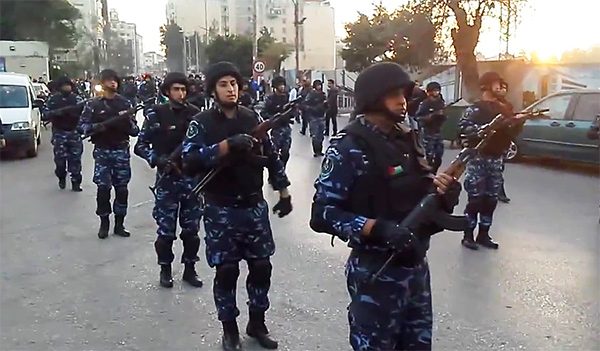
1143The Palestinian Authority police on parade, January 2015.

When three detainees die in less than a week in Palestinian detention, this should sound an alarm bell, especially among so-called pro-Palestinian groups and human rights activists in different parts of the world.

But these folks, like the UN and mainstream media, do not care about the human rights of the Palestinians if Israel cannot be held responsible. Their obsession with Israel has made them blind to the plight of Palestinians living under the Palestinian Authority and Hamas, as well as to the horrific crimes committed every day by Muslim terrorists in the Middle East and elsewhere.

The story of the three men who died in Palestinian jails is yet another example of the double standards that the international community and media employ when it comes to the Israeli-Palestinian conflict

Egyptian army backed by Apaches kills 63 Islamists in broad area between Sheikh Zuwaid and Rafah

July 6, 2015

Egyptian army backed by Apaches kills 63 Islamists in broad area between Sheikh Zuwaid and Rafah, DEBKAfile, July 6, 2015

(Please see also, The U.S. Must Help Egyptian President Sisi. — DM)

SinaiEgyptENG

An immense stretch of Sinai desert populated by half a million people is under siege, as the Egyptian army fights off a major offensive by the Islamic State’s Egyptian affiliate, the Sinai Province, against its positions in northern Sinai. The battle, which Monday, July 6, went into its sixth day, is being fought in an area bounded by the northern town of Sheikh Zuwaid, Rafah on the Gaza border, and up to Kerem Shalom and Nitzana on the Israeli border to the south. DEBKAfile’s military sources report a news blackout on the ongoing warfare except for Egyptian army handouts.

Egyptian security sources reported Monday that the latest round of helicopter strikes and ground operations had killed 63 Islamists in villages between Sheikh Zuwaid and Rafah, where four of their hideouts had been located. Our sources add that these air strikes are directed against civilian dwellings, especially in farming districts, where ISIS fighters are suspected of hiding out. No figures have been released by Cairo on civilian or Egyptian army casualties.

DEBKAfile describes the contest as an asymmetrical one between an army that depends heavily on aerial operations and ISIS terrorists, who have resorted mainly to guerilla warfare. By night, they flit swiftly on foot between the dunes to strike Egyptian army positions. By day, their foot soldiers trap Egyptian soldiers by setting up ambushes around those positions and on the roads of Sinai to keep Egyptian troops pinned down. Terrorist operations are a constant on their agenda.

The Egyptians respond with blanket air strikes which swoop on any moving object in the embattled area – whether by car or on foot

The hide-and-seek tactics employed by ISIS are sustainable in the long term, especially when the Islamists can rely on a constant influx of reinforcements, weapons and ordnance, the sources of which DEBKAfile disclosed in an exclusive report Sunday, July 5.

The Islamic State is rushing reinforcements to Egypt from Libya and Iraq for its battle with Egyptian forces in northern Sinai, which went into its fifth day Sunday, July 5, and other offensives, DEBKAfile’s intelligence and counter-terror sources report. After sustaining hundreds of casualties, both sides claim to have won the upper hand but the tenacious struggle is not over.

An Islamist manpower pool is provided by Egyptian extremists who crossed into Libya in the past and settled in bases around Benghazi.  Last week, ISIS summoned them to take up positions in Cairo and the Suez Canal and wait for orders to go into action. They crossed back with the help of smugglers. Those rings, dominated by the Muslim Brotherhood underground, with branches controlled by Hamas and Hizballah, bring illicit weapons and ammunition supplies to Sinai from Libya via Egypt.

President Abdel Fatteh El-Sisi is therefore obliged to earmark substantial military and intelligence resources for defending the Suez Canal and Cairo – more even than the Sinai front.

The other source of jihadi reinforcements is Iraq, They use another branch of the smuggling network which carries them through southern Jordan to the Gulf of Aqaba where they are picked up by smugglers’ boats and ferried across to the eastern coast of the Sinai Peninsula.

The IDF had more than one reason for its decision last Wednesday to close to traffic Rte 12, Israel’s main southern highway, which runs parallel to the Egyptian border up to Eilat: It was a necessary precaution lest ISIS turned its terrorists and guns against Israel from next-door northern Sinai. The other reason was to deter the Islamists coming from Iraq from trying to transit Israel and reach Sinai with the help of Bedouin smugglers operating on both sides of the Israeli-Egyptian border.

Our military sources estimate that some 1,000 jihadists are directly engaged in the North Sinai battle with the Egyptian army, but add that they could quickly recruit supplementary fighting manpower from Bedouin tribes near the warfront who already play ball with the terrorists.

Egyptian tacticians have strictly limited the army action on this front to air and helicopter strikes and local ground and armored forces. They are focusing on defending three Sinai enclaves, the northern district around Sheikh Zuweid, El Arish port and Rafah, and Sharm el-Sheikh in the south, to pin ISIS forces down in those places and prevent them from fanning out into areas controlled by the big Bedouin tribes.

When President El-Sisi visited the troops in northern Sinai Saturday, July 5, he disclosed that only one percent of the Egyptian army of 300,000 men was assigned to Sinai. He indicated that his army was perfectly capable of wiping out the Sinai terrorist threat in no time if all its might were to be thrown into the fray.

This strategy leaves ISIS with free rein in central Sinai. However, El-Sisis, like his predecessor Hosni Mubarak, is not prepared to go all out against ISIS in its “dens” any time in the near future, because he needs all his military resources and assets he can muster to defend the capital Cairo and the Suez Canal.
Neither the Islamic Army nor the Muslim Brotherhood or any other radical Islamists make any secrets of their next plans. ISIS has announced that it is setting its sights on Egypt’s pyramids, the Sphinx of Giza, and the country’s unique historic monuments in general, after its savage vandalism and looting of other precious world heritage sites.

In a new message released Friday, July 3, a number of radical Islamist leaders, including the ISIS “caliph” Abu Bakr al-Baghdadi, told their followers that the destruction of Egypt’s national monuments, such as the pyramids and the sphinx, was a “religious duty” that must be carried out by those who worship Islam, as “idolatry is strictly banned in the religion.”

This message has sharply ratcheted up the jihadist element of ISIS military confrontation with Egypt to a higher, more inflammatory level.