Posted tagged ‘Foreign Policy’

Russia warns that Syria war could become a ‘proxy war’

November 1, 2015

Russia warns that Syria war could become a ‘proxy war’ BreitbartJohn J. Xenakis, November 1, 2015

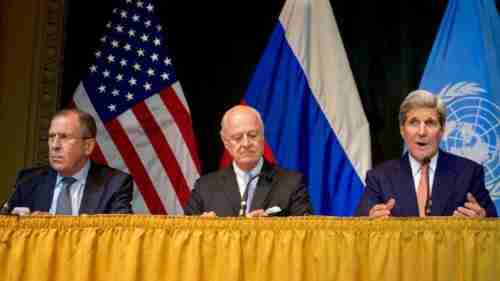
g151031bL-R: Sergei Lavrov, United Nations Special Envoy for Syria Staffan de Mistura, and John Kerry in Vienna on Friday (state.gov)

Russia has poured millions of dollars of heavy weapons into Syria, and is now sending in Russian troops to establish bases there. Recently, Russia launched 27 cruise missiles from the Caspian Sea to targets in Syria. Iran is pouring new troops into Syria. Iran has also given Lebanon’s Hezbollah terrorist group a great deal of money, and Hezbollah has sent thousands of troops into Syria to support Syria’s president Bashar al-Assad.

Al-Assad’s genocidal attacks on innocent Syrian Sunnis, killing hundreds of thousands and forcing millions from their homes, has caused Sunni jihadists from all of the world to fight against al-Assad, Russia, Hezbollah, and Iran in Syria. Along the way, these jihadists formed the so-called Islamic State (IS or ISIS or ISIL or Daesh).

And now, on Friday, Russia’s Foreign Minister Sergei Lavrov made a pronouncement that Barack Obama was going to trigger a “proxy war” in Syria by sending in 50 special operations forces, as we reported yesterday.

You can’t make this stuff up.

Thanks to Iran, Russia, al-Assad and Hezbollah, there are now tens of thousands of foreign troops fighting each other in Syria, with al-Assad in particular supported by massive amounts of foreign weapons.

But somehow, those tens of thousands of foreign fighters don’t make it a “proxy war,” but America’s 50 special forces troops do.

You can’t trust any garbage that comes out of Lavrov’s mouth, or out of al-Assad’s mouth, or out of Vladimir Putin’s mouth, but I listen to BBC, al-Jazeera, FOX, CNN, and other media sources all the time, and I see these news anchors report this crap with a straight face all the time. I don’t know whether it is more sickening to watch those fatuous news anchors, or to watch the fawning Secretary of State John Kerry suck up to Lavrov and Putin, which has happened in issues involving Ukraine, Iran’s nuclear development, and Syria.

All this verbiage is coming out of a meeting in Vienna whose purpose is to find a “political solution” to the Syria problem. With hundreds of thousands of Syrian migrants pouring into Europe, and with hundreds of ISIS militants returning to Russia to fight Putin, there is a lot of pressure to find a “political solution.” But this week’s announcement that Iran will fully enter the war in Syria on the side of the Syrian regime makes any “political solution” farther away than ever. On the contrary, Saudi Arabia and other Gulf countries will never agree to anything like the emerging situation. Actions by Russia and Iran, intervening militarily in Syria, is an emerging disaster, likely triggering a sectarian Sunni versus Shia war throughout the region. BBC and International Business Times and Reuters

Syria’s civil war and Generational Dynamics

In the 12 years that I’ve been doing this, I’ve posted about 4,000 articles with hundreds of Generational Dynamics predictions.

In 2011, when the Syrian civil war began, I said that the war should fizzle within a year or two. Of all the hundreds of Generational Dynamics predictions, this is the one where I’ve clearly been (depending on how you look at it) either wrong or poorly described.

Syria’s last generational crisis war was civil war that climaxed in 1982 with the massacre at Hama. There was a massive uprising of the 400,000 mostly Sunni citizens of Hama against Syria’s president Hafez Assad, the current president’s father. In February, 1982, Assad turned the town to rubble, 40,000 deaths and 100,000 expelled. Hama stands as a defining moment in the Middle East. It is regarded as perhaps the single deadliest act by any Arab government against its own people in the modern Middle East, a shadow that haunts the Assad regime to this day.

(As a related matter, the civil war in Lebanon also climaxed that year, with the bloody massacre at Sabra and Shatila occurring in September 1982. And it occurred as the Iran/Iraq war was ongoing, three years after Iran’s bloody Great Islamic Revolution in 1979. At that time, much of the Mideast was re-fighting World War I and the collapse of the Ottoman Empire, 60 years earlier.)

So, in 2011, I said that the civil war in Syria would fizzle, and could not turn into a crisis civil war. And that’s both wrong and true. There are too many survivors who remember the 1982 slaughter, and do not want to see it repeated. And so there’s been no massive anti-government uprising, as there was in 1982, and Bashar al-Assad’s Shia/Alawite troops have been fighting half-heartedly, with many soldiers defecting or deserting.

But the war did not fizzle.

It should have fizzled in 2011 or 2012, but Hezbollah and Iran starting pouring troops in to support al-Assad. And foreign fighters from around the world arrived to fight al-Assad and to form ISIS. That’s not something that Generational Dynamics could have predicted.

Earlier this year, it looked like al-Assad’s army was near collapse. In July, a desperate al-Assad gave a national speech in which he admitted he was losing. The war should have fizzled this year. But now, Russia and Iran are pouring tens of thousands more troops into Iran to bolster al-Assad. And that also is not something that Generational Dynamics could have predicted.

So the problem for me is: How should I have characterized the situation in 2011? The prediction that it wouldn’t turn into a crisis civil war was correct, but the war did not fizzle, because it turned into a proxy war.

Well, I don’t think there’ll be a next time, but if there is, I’ll try to characterize the situation differently, without simply using the word “fizzle.” NPR (1-Feb-2012)

Generational Dynamics and crisis civil wars

I write about a number of civil wars going on in the world today, so this is a good time to discuss civil wars from the point of view of Generational Dynamics.

Among generational crisis wars, an external war is fundamentally different than a civil war between two ethnic groups. If two ethnic groups have lived together in peace for decades, have intermarried and worked together, and then there is a civil war where one of these ethnic groups tortures, massacres and slaughters their next-door neighbors in the other ethnic group, then the outcome will be fundamentally different than if the same torture and slaughter is rendered by an external group. In either case, the country will spend the Recovery Era setting up rules and institutions designed to prevent any such war from occurring again. But in one case, the country will enter the Awakening era unified, except for generational political differences, and in the other case, the country will be increasingly torn along the same ethnic fault line.

The period following the climax of a crisis war is called the “Recovery Era.” One path that the Recovery Era can take is that the leader of one ethnic group decides that the only way to prevent a new civil war is for him to stay in power, and to respond to peaceful anti-government demonstrations by conducting massive bloody genocide, torture and slaughter of the other ethnic group, in order to maintain the peace. (Dear Reader, I assume you’ve grasped the irony of the last sentence.)

For example, in a July article about Burundi, I described how Burundi’s Hutu president Pierre Nkurunziza was using such violence to quell Tutsi protests, supposedly to avoid a repeat of the 1994 Rwandi-Burundi genocidal war between Hutus and Tutsis.

As another example, in a June article about Zimbabwe, I described how Zimbabwe’s president Robert Mugabe was even worse. His 1984 pacification campaign was known as “Operation Gukurahundi” (The rain that washes away the chaff before the spring rain). During that campaign, accomplished with the help of Mugabe’s 5th Brigade, trained by North Korea, tens of thousands of people, mostly from the Ndebele tribe, were tortured and slaughtered. Later, Mugabe single-handedly destroyed the country’s economy by driving all the white farmers off the farms, resulting in one of the biggest hyperinflation episodes in world history.

That is what Bashar al-Assad is doing in Syria. Fearing a Sunni uprising, like the one in 1982, al-Assad is conducting a massive “peace campaign” by slaughtering and displacing millions of innocent Sunnis. As I wrote above, this should have fizzled in 2011 or 2012, but it’s turned into a proxy war, and it’s a disaster for the Mideast and the world.

But none of the above three examples is a crisis civil war. A crisis war has to come from the people, not from the politicians. So, for example, there’s a massive crisis civil war going on today in Central African Republic (CAR), between the Muslim ex-Seleka militias fighting Christian anti-Balaka militias.

Unlike the previous examples, CAR is in a generational Crisis era. CAR’s last generational crisis war was the 1928-1931 Kongo-Wara Rebellion (“War of the Hoe Handle”), which was a very long time ago, putting CAR today deep into a generational Crisis era, where a new crisis war is increasingly likely. That’s why the CAR is a genuine crisis civil war, and won’t fizzle out. In fact, it won’t end until it has reached some kind of explosive conclusion — of the kind we described in Hama or Sabra and Shatila. ( “2-Oct-15 World View — Violence resurges in Central African Republic crisis war”)

Generational Dynamics and war between Palestinians and Israelis

I’ll discuss one more example — not a civil war, but very similar to a civil war, with the same kinds of issues.

In the last few years, there have been three non-crisis wars between Israelis and Palestinians in Gaza. In each case, the Israelis destroyed Hamas’s infrastructure, ending the war. The war began again each time when Hamas’s infrastructure was rebuilt.

But the point I want to make is that these three non-crisis wars were all directed by politicians. Palestinians attacked when the leadership told them to, and stopped attacking when the leadership told them to stop.

What I have been describing in numerous articles recently is that there is emerging a major, fundamental, historic change.

In the emerging situation, young people today are no longer willing to listen to these leaders. According to the CIA World Fact Book, 20% of Gaza’s population are in the 15-24 age range, and so are 21% of the West Bank — about 200,000 males in each territory, or 400,000 young males total.

On the Israeli side, there are over 600,000 young males in the same age range. There have been unconfirmed reports of young Israelis also disgusted with the leadership. It is possible that, like the young Palestinians, they are willing to take matters into their own hands.

So in this environment, what could happen next? The last three Gaza wars were non-crisis wars, but the next one could be a crisis war between Israelis and Palestinians.

How can a crisis war begin? How about if those 200,000 young male Gazans blow holes in the walls, pour across into Israel and start killing Israeli citizens en masse in their homes and villages? And how about if they are joined by those 200,000 young male Palestinians on the West Bank, who start with the Jewish settlers and continue with the Jews in Jerusalem. And how about if the young Israeli males strike back and start killing Palestinians in their homes and villages?

Israel’s tanks and bombers would not be of much use. You can’t bomb Jerusalem, and you can’t bomb Israeli villages and settlements to kill Palestinians.

That is the difference. That is what a generational crisis war is like. It is not two tanks shooting at each other. It is hand to hand combat in homes, neighborhoods and streets by people armed with sticks and knives. It is what happened in Central African Republic last year, it is what happened in Rwanda in 1994, in Bosnia in 1994, and in Palestine in 1947.

And by the way, that assumes that the bloody mess stays confined to Israel and the Palestinian territories. The Palestinians are likely to be joined by tens or hundreds of thousands from Jordan, Lebanon and Egypt.

The recent widely reported changes in the attitudes and behaviors of young Palestinians is a sign that this kind generational crisis war is coming.
Putin has no long term strategy, says administration w/no long term strategy

October 31, 2015

Putin has no long term strategy, says administration w/no long term strategy, Front Page Magazine, Daniel Greenfield, October 31, 2015

hqdefault

This is an administration that believes you win wars with word games

Obama claimed that Putin is acting in Syria out of weakness and is being all reactive. Then he reacted by shipping weapons to Sunni rebels, a move he had originally rejected, and sending American soldiers into combat as boots on the ground.

Now DNI James Clapper is claiming that Putin is being impulsive and has no long term strategy. This comes from an administration that changed its mind several times about intervening in the Syrian Civil War and keeps saying it still doesn’t have a plan for defeating ISIS.

Clapper said Putin was “very impulsive and opportunistic” as he increased Russian support for close ally President Bashar al-Assad in Syria’s roiling civil war.

“I personally question whether he has some long-term strategy or whether he is being very opportunistic on a day-to-day basis,” Clapper told CNN’s Jim Sciutto. “And I think his intervention into Syria is another manifestation of that.”

Being “opportunistic” is actually how real life battles are fought. You have a strategy, but you seize advantages based on the evolving situation on the ground.

So far Putin’s long term strategy has been to expand Russian influence in the region. It’s working really well. Russia is back to being the regional alternative to the US. It’s securing strategic territories and its allies are expanding their sphere of influence.

On top of that, Putin managed to avert US air strikes on Assad with his fake WMD deal. Then he helped Iran secure its nuclear weapons program with the Iran deal. (I’ll grant that he had a lot of help from Obama and Kerry there.) Now he’s angling to get Obama on board a peace deal that keeps Assad in power and ends US support for the rebellion. Considering this administration’s foreign policy track record, he’ll probably get his way. While the administration clown car taunts him as weak and opportunistic and reactive and impulsive.

In the Cold War, the Soviets trash talked while the US got things done. Under Obama, the US talks trash and Russia gets things done. But this is an administration that believes you win wars with word games.

How is that working out for them?

ISIS Threatens Obama With ‘New Lesson’ in Beheading Video

October 31, 2015

ISIS Threatens Obama With ‘New Lesson’ in Beheading Video, Newsmax, Sandy Fitzgerald, October 31, 2015

(Video at the link. Has Obama recently decided that the Islamic State is a greater threat than climate change?– DM)

A horrifying new 15-minute video appears to show Islamic State (ISIS) terrorists beheading four captured Kurdish Peshmerga fighters — and delivering a bold warning to President Barack Obama.

The video claims to be the ISIS response to a Delta Force-Kurdish raid in northern Iraq last week that cost American Master Sgt. Joshua Wheeler his life.

“Obama, you have learned a new lesson,” a masked terrorist warns Obama in what sounds like an American accent. “Six of the soldiers of the caliphate faced 400 of your children; they killed and injured them by Allah’s grace.”

The warning was delivered before the man executes one of the prisoners, reports CNN, and the other three prisoners are also beheaded by the video’s end. Arabic text also appears onscreen, translating as “Peshmerga soldiers that Americans came to rescue.”

The video was released online Friday, and earlier in the clip, ISIS claims to show the aftermath of the raid, in which Kurdish, U.S., and Iraqi forces rescue 70 hostages from an ISIS prison in Hawija, located in Kirkuk, a province located in northern Iraq.

CNN reports that those who were set free included 20 of the Iraqi Security Forces, local residents and several ISIS fighters accused of spying. None of the hostages were Kurds.

As of Saturday morning, there had not been an official response issued from the White House on the video or the threat. But in Kurdistan, regional government spokesman Dindar Zebari told CNN that “ISIS respects no form of human rights. Our message to them is that we will finish them.”

But Kurdistan will not kill ISIS prisoners in response, Zebari said.

“We hold 215 ISIS prisoners and we treat them according to international human rights laws,” he said. “We have also freed 85 prisoners who had been suspected of association with ISIS. We do not kill our prisoners.”

The Kurdistan regional government said that more than 20 ISIS fighters were killed in last week’s raid, and six more were captured.

The Kurdish Peshmerga, which protects an autonomous region in northern Iraq, has been fighting against ISIS and its push to take Iraq and Syria and create a caliphate.

ISIS earlier this week said the Delta Force-Kurdish raid, called for by the Kurds to rescue Peshmerga fighters, was a failure.

The man who issued the threat does not appear to be the infamous “Jihadi John,” the English-speaking jihadist who has appeared in several other ISIS beheading videos.

The terrorist, whose real name is believed to be Mohammed Emwazi, is considered to be a priority target after killing American, Western, and Japanese hostages.

Meanwhile, two Syrian activists have also been killed in recent days in the Turkish town of Urfa, and their deaths are being blamed on ISIS.

According to the groups Raqqa is Being Slaughtered Silently and Eye on Homeland, activists Ibrahim Abdul Qadir and Faris Humadi the men who were shot and beheaded. ISIS has not yet claimed responsibility for their deaths.

Qadir and Humadi worked for Eye on Homeland, a Syrian media group that reports on the civil war, and Qadar also was a founding member of the Raqqa group, which posts photos, video, and other information online from the Raqqa province in Syria.

World powers agree to more talks on Syria crisis

October 31, 2015

World powers agree to more talks on Syria crisis, Al Jazeera, October 31, 2015

(But please see, Iran-US Talks Limited to Nuclear Issue: MPs — DM)

Friday’s talks included an Iranian delegation for the first time.

***********************

Major powers meeting in Vienna for talks on Syria have found enough “common ground” to meet for a new round of talks in two weeks, even as the conflict enters a new phase with the deployment of US special forces in the country.

President Barack Obama has ordered the deployment of fewer than 50 commandos to help coalition forces coordinate with local troops, Josh Earnest, the White House spokesperson, said on Friday.

The troop announcement came as diplomats in the Austrian capital representing 17 countries and the EU agreed to launch a broad new peace attempt to gradually end Syria’s long civil war – a declaration that avoided any decision on when President Bashar al-Assad might leave.

A Syrian member of parliament said the decision is an aggression because it does not involve the government’s agreement.

Sharif Shehadeh told AP news agency on Saturday that the troops will have no effect on the ground, but Washington wants to say that it is present in Syria.

It is not clear how many rebel groups would agree to a plan that does not result in Assad’s immediate departure.

Sergey Lavrov, Russia’s foreign minister, said on Friday a US decision to deploy special forces in Syria would make cooperation between the armed forces of the two countries more important.

“I am sure that neither the United States nor Russia want [the conflict] to become a so-called proxy war,” Lavrov said after the talks in Vienna.

“But it is obvious for me that the situation makes the task of cooperation between the militaries more relevant.”

Friday’s talks included an Iranian delegation for the first time.

Representatives from Britain, Egypt, France, Germany, Italy, Lebanon, the EU and other Arab states also attended.

The participation by Russia and Iran in the attempt could mark a new and promising phase in the diplomacy since those countries have staunchly backed Assad.

‘Tough conversations’

Any ceasefire agreement that may come as a result of the peace effort would not include the Islamic State of Iraq and the Levant (ISIL) group, which controls large parts of northern Syria and has its capital there.

“There were tough conversations today,” John Kerry, US secretary of state, said on Friday. “This is the beginning of a new diplomatic process.”

Kerry acknowledged that those present have major differences regarding the Assad government.

“But we cannot allow the differences to get in the way of diplomacy to end the killing.”

Federica Mogherini, the European Union foreign policy chief, said there is “hope” for a political process to advance, saying that those involved in the talks “found common ground” for further discussion.

“It was a very long and very substantial meeting. This was not an easy one, but for sure a historical one,” she said while praising “those who took difficult decisions” in joining the talks.

Lavrov said those present in the meeting spent a “long time” pushing for an inclusive Syrian-led peace process.

Among the points agreed upon during the talks was that ISIL cannot be allowed to reign in Syria, he said.

In a rare hint of diplomatic progress, Iran indicated it would back a six-month political transition period in Syria followed by elections to decide Assad’s fate, although his opponents rejected the proposal as a trick to keep him in power.

In addition to Assad’s fate, on which delegates said no breakthrough had been expected, sticking points have long included the question of which rebel groups should be considered “terrorists” and who should be involved in the political process.

Al Jazeera’s Mohammed Jamjoom, reporting from Vienna on Friday, said that there was a “mood of optimism” following the talks.

“There is a sense of hopefulness, which has been absent in these talks for quite a long time now,” he said.

The talks came as Syrian government air strikes continued in rebel-held territories, killing at least 61 people and wounding over 100 others in the Damascus suburb of Douma on Friday.

A further 80 people were killed in government and Russian air strikes in Aleppo province.

Bipartisan consensus: Stop Iran and its missile attacks on Iranian dissidents

October 31, 2015

Bipartisan consensus: Stop Iran and its missile attacks on Iranian dissidents, The Hill, Raymond Tanter, October 31, 2015

Fox News reports a missile attack occurred on Camp Liberty Iraq on October 29; residents include 2,400 members of the Mujahedeen-e-Khalq (MEK). About 80 missiles made holes as deep as 7 feet and wide as 8 feet—including 122 mm Katyushas and those Tehran produced—the NB24 Russian missiles. 

Why is Iran targeting its opposition? Dissidents block the goal of Tehran—to control Baghdad and Damascus where we are fighting the Islamic State of Iraq and Syria (ISIS). Washington’s evolving strategy is DOA on the Hill unless the administration reaches out to the opposition and sees Iran as a threat across the porous border.

How to counter the threat from Iran? Align with others opposing Tehran and the bipartisan congressional coalition sharing that view.

Saudi Arabia’s alignment against Iran includes Israel as a silent partner. Saudis view Tehran and Damascus unfavorably. A potential partner for Riyadh and Washington is the Iranian Resistance that rejects clerical rule in Tehran. All define the threat as Islamist.

Saudi Foreign Minister Adel al-Jubeir asked, Is Iran a “state or a revolution?” If it wants to export its 1979 revolution and revive the Persian Empire “we cannot deal with it.” Israeli Prime Minister Benjamin Netanyahu said in his UN speech on October 1 that shifting alliances in the Middle East drew Arab countries like Saudi Arabia closer to Israel in confronting Iran and ISIL. His speech before the Congress stated that, “Iran’s regime poses a grave threat…to the peace.”

On April 29, the House Foreign Affairs Committee held a hearing, “ISIS: Defining the Enemy.” Maryam Rajavi is President-Elect of the National Council of Resistance of Iran (NCRI), the coalition of which the MEK is the largest unit; she testified from Paris. Her written testimony showed how Tehran is an Islamist epicenter of terrorism to establish an Empire without borders and called for empowering the democratic tolerant Islam she represented.

The Joint Comprehensive Plan of Action (JCPOA), garnered bipartisan criticism on the Hill. At a May 5, 2014 press conference, Senate Committee on Armed Services (SCAC) Chairman John McCain (R-Ariz.) announced completion of markup of National Defense Authorization Act for Fiscal Year 2016. That Act had language to counter Iran’s influence in Iraq and protect the MEK, now in Camp Liberty. An SCAC hearing on Iranian Influence in Iraq and the Case of Camp Liberty focused on resettlement of the MEK from Camp Liberty outside Iraq.

Bipartisan statements by over a dozen senators indicated Secretary Kerry should protect the MEK in Iraq and waive regulations to permit MEK members to enter the USA and contribute to the economy in alignment with our humanitarian values, as stated by several senators and General James Jones, USMC (Ret.), first National Security Advisor to President Barack Obama.

“The U.S. government and military made a commitment to protect thousands of people [MEK] who surrendered their weapons and came under our protection as a result,” McCain said. “Clearly, this commitment has not been sustained.”

Ranking member, Sen. Jack Reed (D-R.I.), expressed a desire to help these oppositionists. “The Iranian dissidents at Camp Liberty are in an increasingly perilous situation, having repeatedly come under attack. These horrific attacks, which have killed more than 100 MEK members since 2009, clearly indicate the threat to this group from Iran and Iranian-backed militia seeking to eliminate and silence these dissidents.” Add about 30 others from the attack on Oct 29, 2015.

McCain described the MEK as a group that received “protected persons” status in 2004 under the Fourth Geneva Convention. Col Wes Martin, former Commander, Forward Operating Base Ashraf until 2006, testified that the United States provided ID cards for each Protected Person under the authority of the American military on behalf of the U.S. Government.

Former Sen. Joe Lieberman (I-Conn.), invited by former colleagues to attend as witness, testified that America would be “disloyal to our…national values if we did not find better ways–overt and covert–to support the democratic opposition to the dictatorial regime in Iran.”

Senators backed the moderate pro-democracy tolerant Islam of the MEK instead of allowing the Islamist regime in Tehran to suppress that organization. With such bipartisan backing, there is enhanced likelihood the MEK can expand the NCRI coalition for regime change from within and broaden its base in Iran given that expectations will be higher in a post-nuclear-agreement Iran.

The way forward: Alignment with those opposing Tehran, congressional allies sharing that view, and prevention of attacks like the missiles on Camp Liberty.

US, Russia edge close to military collaboration in Syria and Iraq

October 27, 2015

US, Russia edge close to military collaboration in Syria and Iraq, DEBKAfile, October 27, 2015

ForcesIaqSyria480

Washington and Moscow appear close to agreeing to their armed forces teaming up for war operations in Syria and Iraq. Nothing definite has so far emerged about this potential collaboration, or even if it is to be conducted covertly and experimentally ad hoc or seriously and out in the open.

A comment suggesting that the Obama administration was ready for a new direction on Syria came from US Defense Secretary Ashton Carter Tuesday, Oct. 27. In testimony before the Senate Armed Services Committee, he said, “we won’t hold back from supporting capable partners in opportunistic attacks against ISIL…or conducting such mission directly, whether by strikes from the air or direct action on the ground.”

According to Pentagon sources, the US intends to deploy small units of Special Operations forces in Syria and “special advisers” in Iraq, which too are believed to be special operations units under another name.

However, DEBKAfile’s military sources point out that small-scale military ventures in open-ended war situations tend to extend beyond the scale originally intended. Therefore, it is more than likely that both the US and Russia will find themselves committing increasing numbers of air and ground troops if the conflicts in the two countries continue.

The way matters are going now, the plan for Iraq is for US forces to join Iraqi and Iranian units in launching an offensive to recover Ramadi, capital of the Western province of Anbar, 110 km West of Baghdad, which ISIS captured in May.

In Syria, American troops plan to work with the northeastern Kurdish PYD-YPG militia for marching on Raqqa, the Islamic State’s headquarters in that country.

At the Senate hearing, Carter pointed to last week’s rescue operation in northern Syria. US Delta commandos and Syrian Kurdish special forces stormed a prison held by the Islamic State and freed dozens of Kurdish prisoners.

This operation was outside the bounds of normal US involvement in the Syrian conflict. After it was over, the US Defense Secretary said the military expects “more raids of this kind.”

This joint US-Kurdish raid brought forth a furious response from Turkey.The Turkish military twice directed machine gun fire at the Syrian Kurdish PYD force in the Syrian town of Tal Abyad Sunday, Oct. 25.

DEBKAfile’s military sources note that Tel Abyad is the closest point to Raqqa to have been reached by America’s Kurdish allies.

Ankara is vehemently opposed to the US partnership with the Kurds of Syria and Iraq, and puts its campaign against their separatist trends ahead of its commitment to the anti-ISIS coalition.

However, the Obama administration appears to have finally come down in favor of a combined operation with the Kurdish forces, even at the expense of its ties with Ankara, another pointer to the up-and-coming US ground operations in Syria.

Neither Washington nor Moscow has commented on their possible military cooperation for the fight to vanquish ISIS. But straws in the wind point in that direction.

Russian President Vladimir Putin has repeated: “I have no plans to put ground troops in Syria,” indicating that Moscow would confine itself to air strikes.

The US Defense Minister Tuesday explicitly mentioned “…direct action on the ground” as well as, ”supporting capable partners in opportunistic attacks against ISIL.”

DEBKAfile’s military sources find common elements in the American and Russian modes of action. Whereas the Americans plan to deploy ground troops for fighting with Kurdish forces, the Russians will stick to aerial attacks in conjunction with certain Syrian rebel groups.

Moscow’s plan unfolded on Monday, Oct. 26, when a delegation of the Free Syrian Army, which is backed by the US, Israel and Saudi Arabia, turned up in Moscow seeking to coordinate its military operations with the Russians.

It is hard to tell if US-Russian military cooperation in the Syrian and Iraqi wars actually ripens into a productive effort or proves ephemeral. Israel’s concerns and its responses to the fast-moving, explosive situation on its northern borders are scheduled to be thrashed out in the talks Defense Minister Moshe Ya’alon is holding this week in Washington with Defense Secretary Carter.

Escalation of child execution in Iran

October 26, 2015

Escalation of child execution in Iran, Front Page MagazineDr. Majid Rafizadeh, October 26, 2015

(Please see also, Iranian Supreme Leader Khamenei’s Letter Of Guidelines To President Rohani On JCPOA Sets Nine Conditions Nullifying Original Agreement Announced July 14, 2015. According to Supreme Leader Khamenei,

Any sanctions against Iran “at every level and on every pretext,” including terrorism and human rights violations, by any one of the countries participating in the negotiations will “constitute a violation of the JCPOA,” and a reason for Iran to stop executing the agreement. 

He probably need not be concerned.– DM)

photo-by-seysd-shahaboddin-vajedi-wikimedia-commons-iranian-supreme-leader-ayatollah-ali-khamenei-releases-video-propaganda

While Iranian ruling clerics enjoy reaping the economic benefits from the nuclear deal, they also feel triumphant when it comes to the Obama administration’s total disregard of the increasing human rights violations in Iran.

To sustain his nuclear deal, President Obama appears to have made a Faustian bargain with the Iranian leaders: He turns a blind eye to Iran’s sponsorship of terrorism, repressive methods to crack down on social and political freedoms, egregious human rights abuses, while Iran verbally and on the surface, binds itself to the nuclear deal.

This week, Iran’s parliament passed a bill supporting the nuclear deal which was primarily reached between President Obama and the Islamic Republic. Some policy makers were surprised that Iran passed the bill. But why would Iranian leaders not sign a deal that would bring them financial rewards and allow them to be as repressive as they please both domestically and regionally? As I mentioned several weeks ago, it was easy to predict that the Iranian parliament (Majlis) would pass the deal to receive further rewards.

Simultaneously, Iran’s judiciary system has become more emboldened and empowered. This can be seen when they are issuing death sentences at unprecedented levels, particularly for children.  Last week, Iran’s Islamic court executed a juvenile offender on October 13, 2015 in Adelabad Prison, Shiraz. Fatemeh Salbehi, was arrested at the age of 16 because her husband was found dead at home.

She was 16 years old when she was forced into marriage to a man who was thirty. She had never met the man before their marriage.  According to a recent release by the UN Special Rapporteur on the situation of human rights in Iran, Ahmed Shaheed, “These executions are disturbing examples of surging execution rates and questionable fair trial standards in the Islamic Republic of Iran….The Iranian authorities must comply with its international law obligations and put an end to the execution of juvenile offenders once and for all.”

What is intriguing is that Iranian leaders used to take notice when there was an international outcry regarding a human rights or political prisoner case. They used to postpone the case, the execution, or do something to let the global pressure fade away.   But not anymore. In this case, Amnesty International, Amnesty USA, International human rights organizations, and the United Nations’ Office of the High Commissioner for Human Rights pressured the Islamic Republic to refrain from executing Ms. Salbehi and another young man.  But Iran’s answer was implicitly clear: We will execute anyone we like and no one can stop us now.

One must wonder how much the nuclear deal, President Obama’s unwillingness to criticize the Islamic Republic, and President Obama’s actions in legitimizing the Islamic Republic on the global stage have played a role in emboldening and empowering the ruling mullahs and the hardliners rather than influencing them to be more rational and civilized figures.

A week before the execution of Ms. Salbehi, another juvenile was executed. No notice was given to his family or even his attorney. The UN Special Rapporteur on summary executions, Christof Heyns, pointed out, “Let us be clear – these are unlawful killings committed by the State, the equivalent of murders performed by individuals…. These are profound tragedies that demean the value of human life and sully the reputation of the country,” He added “Iran must immediately stop killing children,”

More than 1,000 people will be executed in the year 2015. There has been a surprising rise in the number of executions since Iran scored a victory by signing the nuclear deal. Ms. Salbehi was one of the hundreds of women being executed on a regular basis based on Iran’s Shiite Islamist laws and on gender discrimination. These women are not allowed due process or adequate access to a lawyer. As the Office of the High Commissioner for Human Rights (OHCHR) warned when Ms. Salbehi was hanged on Tuesday, the execution was “in breach of international law banning juvenile executions, and despite reported flaws in her trial and appeal process.”

Finally, It is crucial to point put that we are only hearing about a few cases of human rights violations; only a few of these shocking human rights abuses make their way to the international spotlight. As an Iranian human rights activist and lawyer, Shadi, told me on a phone call from Tehran, “Just step in the Islamic courts and you will see that there are tens of thousands of these cases, particularly regarding innocent women, which the media never hear about.”

Achieving his dream of signing a nuclear deal with Iran should not make President Obama silent about human rights violations, the ever increasing rate of child executions, and ongoing crimes against humanity.

Russia overrides Middle East cyber waves

October 26, 2015

Russia overrides Middle East cyber waves, DEBKAfile, October 26, 2015

Latakia_Habaniya480

Aloft over Syria, the IL-20 can supply Russian forces and commanders with a complete, detailed picture of the situation on the ground. Its close proximity to Israel, moreover, enables this wonder plane to scoop up a wealth of data from across the border – not just on IDF military movements on the Golan, but also to eavesdrop on electronic activity and conversations in Jerusalem, Military Staff Headquarters in Tel Aviv, Air Force bases in southern Israel and even the nuclear complex in Dimona in the Negev.

******************

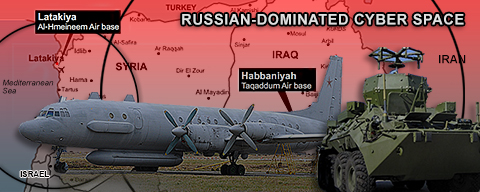
The distance as the crow flies between Russia’s Syrian air base Al-Hmeineem near Latakia and its Iraqi host facility at Al Taqaddum Air base is 824 km (445 nautical miles). From the Latakia base to Israel, the distance is just 288 km or 155 nautical miles, a hop and a skip in aerial terms. Syria’s ruler Bashar Assad first let Moscow in with the use of a base where 30 fighter and bombing jets are now parked. Iraqi Prime Minister Haider al-Abadi followed suit Saturday, Oct. 24 by granting the Russian Air force the use of a facility 74 km from Baghdad.

Their presence in the two bases draws a strong arc of Russian aerial control at the heart of Middle East. By boosting its two extremities with state-of-the-art electronic warfare systems, Moscow has imposed a new reality whereby it will soon be almost impossible for any air or ground force, American or Israeli, to go into military action above or inside Syria or Iraq without prior coordination with the Russians.

The bricks of Russian domination are now almost all in place.

In the last week of September, two Ilyushin-20 (IL-20 Coot) super-surveillance planes stole into Syrian airspace, to provide a major upgrade for the Russian air fleet of Sukhoi-30 fighter jets, cargo planes and attack helicopters gathering for combat in Syria.

This was first revealed by DEBKA Weekly’s military and intelligence sources on Oct. 2.

The IL-20s, the Russian Air Force’s top-line intelligence-gathering aircraft, brought over from the Baltic Sea, have exceptional features as an intelligence platform. Their four turboprop engines enable it to stay airborne for over 12 hours, using its thermal and infrared sensors, antennas, still and video cameras, and side-looking airborne (SLAR) radar to collect a wide range of data from long distances, day or night, in almost any kind of weather.

The Coot-20 collates the data gathered and transmits it to intelligence or operational command centers in Moscow or its Latakia air base by powerful jam-resistant communications systems, satellites and other methods.

Aloft over Syria, the IL-20 can supply Russian forces and commanders with a complete, detailed picture of the situation on the ground. Its close proximity to Israel, moreover, enables this wonder plane to scoop up a wealth of data from across the border – not just on IDF military movements on the Golan, but also to eavesdrop on electronic activity and conversations in Jerusalem, Military Staff Headquarters in Tel Aviv, Air Force bases in southern Israel and even the nuclear complex in Dimona in the Negev.

DEBKAfile’s military sources add that an Il-20 Coot has been sighted in the last few days at the Iraqi Al Taqaddum Air base near Baghdad.

Then, on Oct. 4, our sources reveal, another Russian super-weapon was brought to Syria by Russian cargo ships: Nine MT-LB armored personnel carriers fitted with the Borisoglebsk 2 electronic warfare systems, which are among the most sophisticated of their kind in the world.

These APCs were secretly driven aboard tank carriers to Nabi Yunis, which is the highest peak of the Alawite Mountains along the coastal plain of northwest Syria, and stands 1,562 meters (5,125 feet) above sea level. To render the highly complicated Borisoglebsk 2 device system impermeable to attack, our electronic warfare experts describe it as fitted into the interior and walls of the nine APCS, along with receivers that can pick up transmissions on a wide range of frequencies on the electromagnetic spectrum.

From their mountain aerie, its antennas and powerful transmitters are designed to intercept and jam almost any radio signal carried by the electromagnetic waves in military or civilian use.

Russian strategists posted this top-of-the-line system in Syria to enable the Russian air force to operate unhindered in Middle Eastern skies and, just as importantly, to neutralize US-led coalition special forces operating deep within Syrian territory, and block or disrupt the operations of rebel groups and Islamic State forces.

The Borisoglebsk 2 system has only just started rolling off top secret Russian assembly lines. It took five years to plan and manufacture the system, which went into service for the first time at the beginning of this year on the Ukraine battlefield.

From its vantage point in Syria, the Russian electronic warfare system could seriously impair the performance of Israeli intelligence and communication networks arrayed across the Golan and along the northern border in the upper and western Galilee. It could run interference against the IDF’s use of unmanned aerial vehicles (unless they were autonomous), the field operations of Israeli Special Operations forces and air and naval networks, which depend on communications networks in their defense of the country’s northern borders.

Madam Hillary is on the right side of herstory

October 25, 2015

Madam Hillary is on the right side of herstory, Dan Miller’s Blog, October 25, 2015

(The views expressed in this article are mine, and do not necessarily reflect those of Warsclerotic or its other editors.– DM)


Lies are good and truth is bad because truth would damage Madam Hillary’s and even Imam Obama’s sterling images. Both, bravely and proudly, try to feed us what is “good.” Their people love it, so what difference does it make? 

1025151 (1)

According to John Hinderaker at Power Line, Madam Hillary

lies…it’s not exactly a news flash. On the contrary, based on the liberal media’s reaction to her Benghazi testimony, her willingness to lie, brazenly, is a positive virtue.

There’s always an excuse for having “misspoke.” It need not be a credible excuse, because an incredible excuse works just fine. Anyway, whatever happened was in the past and therefore doesn’t matter now:

What has Imam Obama lied about? Plenty. Here’s an incomplete list: Islam, the nuke “deal” with Iran, Libya, His strength and Putin’s weakness in the Middle East, Israel, Immigration, Crime, Obamacare, race relations and on and on and on. As with Madam Hillary’s spewings, the “legitimate media” generally love it.

Madam Hillary blamed the video repeatedly

According to an article titled “I didn’t blame the video,” Madam Hillary did just that while also managing to lie about substantially more than that.

Hillary simply adores arguing and lawyering.

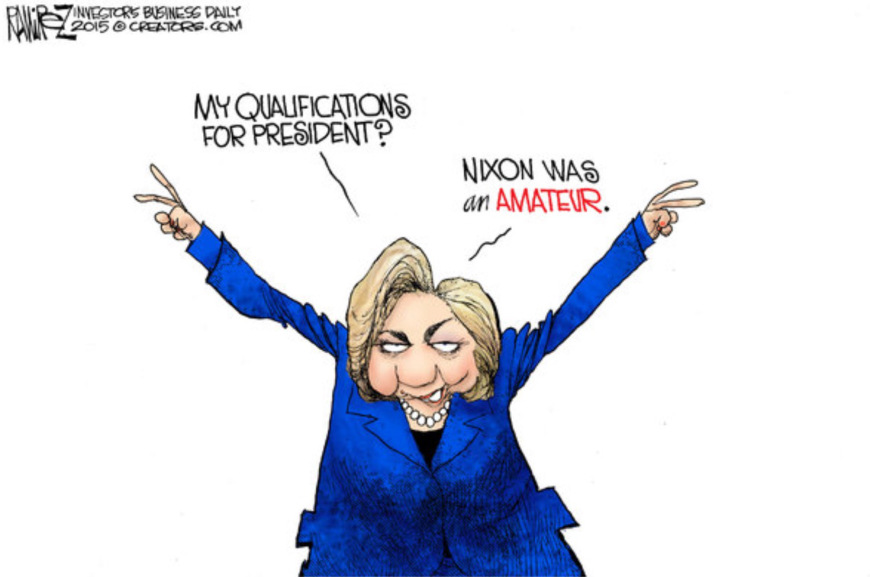
She lives for it and has at least since she was fired from the House Judiciary Committee during its investigation of the Watergate scandal that eventually brought down President Richard M. Nixon in 1974. Hillary’s then-supervisor, lifelong Democrat Jerry Zeifman, said he canned the 27-year-old attorney “because she was a liar … an unethical, dishonest lawyer. She conspired to violate the Constitution, the rules of the House, the rules of the committee and the rules of confidentiality.” [Emphasis added.]

No lie is too big or too small for Hillary, whether it’s a concocted tale of being under enemy fire at an airport in Bosnia, the existence of a “vast right-wing conspiracy” to undermine her husband’s presidency, that she was named after Mt. Everest climber Sir Edmund Hillary even though he rocketed to fame by accomplishing the feat when she was a six-year-old, or that the Clintons were “dead broke” when they exited the White House.

Meanwhile, at the Thursday hearing, Rep. Jim Jordan (R-Ohio) demolished Clinton’s apparently fresh assertion at the hearing that she didn’t actually claim an obscure anti-Islam movie trailer posted on YouTube prompted the terrorist assault in Benghazi on the eleventh anniversary of the 9/11 attacks. She now takes a more nuanced, twisted-like-a-pretzel position in which maybe some non-terrorist Muslims were suddenly stirred to violence in Libya by the video, but really at the same time it was a terrorist attack, something she testified Thursday has been her position the whole time. She talked about the video publicly not to point fingers but as a warning, she testified, to those who might attack U.S. interests in the region. In other words, like a good defense lawyer, Hillary was trying to confuse the issues and muddy the waters. [Emphasis added.]

. . . .

While she was informing the American public that the anti-Islam video was what caused the attack, at the same time she emailed her daughter Chelsea and the governments of Libya and Egypt to pin the blame on Muslim militants, Jordan explained. Around the same time the White House, in the closing weeks of a heated presidential election campaign, was pushing the line that what transpired in Benghazi was a spontaneous demonstration turned violent, but terrorism was not a factor.

“We know that the attack in Libya had nothing to do with the film,” Clinton wrote Egypt’s prime minister the night of the attack. “It was a planned attack, not a protest.” But in public Clinton continued to blame the “offensive” video. The U.S. government acquired $80,000 worth of commercial airtime in Pakistan to apologize for the YouTube clip. [Emphasis added]

Jordan pointed out that there was no video-inspired protest over in Benghazi on Sept. 11, 2012, but there was one in Cairo, Egypt. The same day State Department spokeswoman Victoria Nuland said “Benghazi has been attacked by militants. In Cairo, police have removed demonstrators.”

You want to talk about Madam Hillary’s lies? She didn’t lie, of course, but let’s change the subject to something more important. Right now.

hillary-Nixon-copy


Conclusions

“Her people” not only don’t care, they are delighted with Madam Hillary’s numerous lies. Again, “what difference does it make?” Plenty.

Please think about Madam Hillary’s and Imam Obama’s impunity — and readiness —  to lie, violate laws and do pretty much whatever they please. We have become a nation without law enforcement where we need it most and very much where enforcement of Obama’s executive decrees harms us greatly (climate change and immigration for example). Do we want a nation the governance of which is increasingly based on, and perpetuated through, lies to “We the people?” Do we want Madam Hillary or another Obama clone as the next Commander in Chief?

Here’s what “Commander in Chief” Obama has done with his our military:

Do you approve of those and the other things He has done to our military? Want more of the same? Or even worse? If not, what can we do about it? Supporting Donald Trump may or may not be what we should do, but I think the songs in the video are superb. Back in September, I wrote an article titled To bring America back we need to break some stuff. We still do, and if someone other than Trump is ready, willing and able he (or, of course, she) should also be considered, very seriously.;

The Holocaust is OVER

October 25, 2015

The Holocaust is OVER, The Gatestone InstituteShoshana Bryen, October 25, 2015

  • This minute, the UN is labeling one of the oldest existing symbols of Jewish patrimony in the Land of Israel — the Tomb of Rachel, wife of the biblical patriarch Jacob — as a Muslim holy site.
  • The UN had not a word, however, about the Muslims who burned the Jewish holy site at Joseph’s Tomb last week. This omission raises a different question: the same Joseph is also a prophet in Islam; why are they firebombing his tomb?
  • Abbas has been lying about threats to the status quo on the Temple Mount, and proposing his own change: The Jews, he said, have no right to “desecrate” the mosque with their “filthy feet.”
  • Watch a beautiful little girl with a large knife tell her approving father, “I want to stab a Jew.”
  • In 2000, the New York Times wrote about Arafat’s summer “war-game camps” in Gaza, teaching Palestinian children how to prepare for battle. That is fifteen years of learning to kill Jews and creating child soldiers: a violation of the UN Convention on Child Soldiers, and one reason so many young Palestinians are primed for violence.
  • In the summer of 2015, tens of thousands of teenagers in Gaza participated in these “summer camps” to learn from their Hamas teachers to kill Jews.
  • If what happened in the 1930s and 1940s, however, is allowed to turn our attention from the current threats to the Jewish State, we will have granted Hitler and the Grand Mufti of Jerusalem a belated victory they do not deserve.

Israel’s Prime Minister, Benjamin Netanyahu, set off a firestorm on October 21 by saying that the Mufti of Jerusalem had actually planted the idea of exterminating the Jews in Hitler’s mind; that Hitler would have simply ousted them from Europe.

Scholars, academicians, politicians, friends and enemies of Jews, Israel, and Netanyahu leapt to the barricades. The Washington Post had the story on the front page. Twitter and blogs have overflowed with it. The Chancellor of Germany found it oddly necessary to say, “Germany is responsible for the Holocaust.”

But enough about who, between two long-dead anti-Semites, was the worst. It is a distraction and provides cover for today’s racists and those who would destroy Israel.

Palestinian agitator Saeb Erekat used the tumult to weigh in. In the latest Palestinian effort to rewrite history, he said, “Palestine’s efforts against Nazis, are deep-rooted part of our history.”

Palestinian Authority (PA) strongman Mahmoud Abbas, a Holocaust denier at least since his PhD days (and now in the 10th year of his four-year term, so he cannot be called “President”) did not say anything on that subject. He does, however continue to incite Palestinians to kill Jews. Right now, today, this minute.

Abbas has been lying about threats to the status quo on the Temple Mount, and proposing his own change: The Jews, he said, have no right to “desecrate” the mosque with their “filthy feet.” He then assures those Palestinians who go out to kill Jews — because they understood the recommendation to be officially sanctioned — that, “Every drop of blood spilled in Jerusalem is pure, every shahid [martyr] will reach paradise, and every injured person will be rewarded by God.”

Also, right now, today, this minute, the United Nations is labeling one of the oldest existing symbols of Jewish patrimony in the Land of Israel — the Tomb of Rachel, wife of the biblical patriarch Jacob — as a Muslim holy site. The U.S., U.K., Germany, Netherlands, Czech Republic, and Estonia voted against this surreal piracy. But 26 other countries voted in favor of a resolution, totally fraudulent, that condemned Israel for aggression and illegal measures taken against the “freedom of worship and access” of Muslims to Al-Aqsa mosque and Israel’s “attempts to break the status quo since 1967.”

The UN had not a word, however, about the Muslims who burned the Jewish holy site at Joseph’s Tomb last week. This omission raises a different question: the same Joseph is also a prophet in Islam; what are they doing firebombing his tomb?

In addition, right now, today, this minute, the State of Israel is under physical and political attack, and its best ally, the United States, is largely absent. Secretary of State John Kerry admonished, “We continue to urge everybody to exercise restraint and restrain [sic] from any kind of self-help in terms of the violence, and Israel has every right in the world to protect its citizens, as it has been, from random acts of violence.”

No self-help? Kerry specifically said it; he meant that if the government shows up and kills the terrorist before he kills, fine, but he does not want Israelis to take their defense into their own hands. That is not the way defense is done in America, and it is not the way it is done in Israel. The United States is abandoning a core American value in pursuit of the chimera of Israeli-Palestinian “peace.”

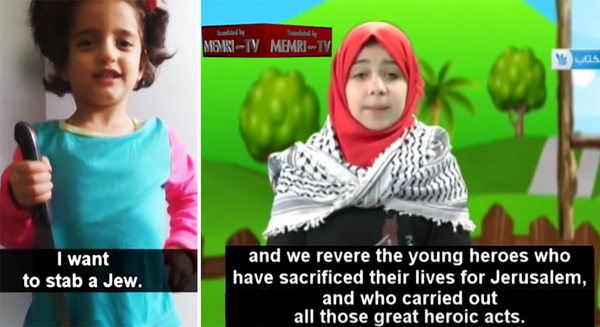
Right now, this minute, young Palestinian children are being marinated in Jew-hatred by their parents and by their society. Watch a beautiful little girl with a large knife tell her approving father, “I want to stab a Jew.” Watch a Palestinian children’s TV program in which a girl of about 10, her hair covered, draped in a Palestinian shawl, tell other children that the “martyrs” are “grown up kids.” She compares their number to the number of dead Israelis. “It’s almost like a game,” she says.

1313(Image source: MEMRI)

In 2000, before the so-called “second intifada,” the New York Times wrote about Yasser Arafat’s summer “war-game camps” in Gaza, teaching young Palestinian children how to prepare for the battle they would fight. That is fifteen years of learning to kill Jews — and fifteen years of creating child soldiers: a violation of the UN Convention on Child Soldiers, and one reason so many young Palestinians are primed for violence. Any Palestinian now under the age of, say, 23 could have had that “training.” In the summer of 2015, tens of thousands of teenagers in Gaza participated in these “summer camps” to learn from their Hamas teachers to kill Jews.

Even before that — since the Palestinians created their own school curriculum 21 years ago, in 1994, under the Oslo Accords — Palestinian children have been exposed to lies, incitement to violence and raw anti-Semitism, in the schools of the Palestinian Authority and UNRWA. Palestinians under the age of 30 spend most of their formative years in schools that deny the legitimacy of the State of Israel and that deny any connection of the Jews to the land.

We are currently seeing the results of the long-term abuse of Palestinian children by their parents and teachers — abetted by the United Nations.

There have been many calls for the U.S. to defund the Palestinian Authority, either completely or in part. This week Congress, in rare bipartisan agreement, took up part of the challenge, stripping $80 million from $370 million of U.S. economic aid to the Palestinian Authority.

History provides a framework for understanding today’s politics. The Mufti of Jerusalem was not only a kindred spirit of Hitler; he spent much of the war in Berlin as the guest of like-minded practitioners of Jew-hatred. If what happened in the 1930s and 1940s, however, is allowed to turn our attention from the current threats to the Jewish State, we will have granted them a belated victory they do not deserve.