Posted tagged ‘Fatah’

Gaza Salafists look to ISIS for inspiration

May 12, 2016

Gaza Salafists look to ISIS for inspiration, Israel National News, Adel Zaanoun, May 12, 2016
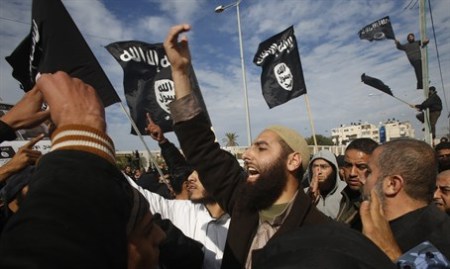
Isl State in GazaISIS supporters in Gaza Reuters

(AFP) Terrrorists inspired by the Islamic State (ISIS) jihadist group’s ideology are seeking to benefit from the desperation of young Palestinians to strengthen their foothold in the Gaza Strip.

But the Salafists in the enclave tread a fine line to avoid conflict with Hamas, the Islamist terrorist group which has ruled the strip for a decade but does not share all of ISIS’s world view.

Leaders of the Salafists, who are adherents of a strict Sunni interpretation of Islam, claim to have 3,000 fighters in Gaza.

While the figure is impossible to verify, experts see an increasing use of ISIS-style rhetoric to attract support.

“Some groups use the Islamic State label and claim to have adopted jihadist ideology to attract teenagers who have lost all hope,” said Assaad Abu Charakh, a professor at Al-Azhar University in Gaza.

Last week saw the heaviest cross-border clashes between Israeli forces and Hamas and other terrorist groups since 2014, raising fears of a return to hostilities, though calm has since returned.

Israel has maintained a blockade on Gaza since 2006 aimed at containing Hamas, which is sworn to the destruction of Jewish state and whose charter calls for the annihilation of the Jewish people.

At almost 45 percent, the unemployment rate in the Gaza Strip is among the world’s highest.

Hamas won the 2006 Palestinian parliamentary elections, and then one year later staged a violent purge of its Fatah rivals, killing scores and ousting the Palestinian Authority from Gaza entirely.

Qassam Brigades defectors

But some members of the Ezzedine al-Qassam Brigades, Hamas’ armed wing, argued elections were un-Islamic and defected to form Salafist groups.

Abu al-Ansari al-Ina, a leader of the “Young Salafist Fighters,” one of the major jihadist groups in Gaza, is one such defector.

The priority, he argues, is the “fight against the Jews in Palestine, even if the strategic goal is the introduction of Islamic law in the world.”

He says he is under surveillance and took precautions before meeting anAFP journalist.

Two hundred Gazans, including some of his movement, have crossed into Egypt to join the ranks of the Islamic State “despite Hamas’ attempts to stop them,” he says.

Most used the tunnels that once linked Gaza to Egypt, while others took advantage of the occasional openings of the Rafah border crossing, the only of Gaza’s borders crossings not controlled by Israel, and which is the subject of a total blockade by Egypt.

The vast Sinai desert is gripped by an insurgency that Egypt regularly accuses Hamas of supporting.

Egypt’s air force has destroyed a large number of the tunnels and established a buffer zone along the Gazan border.

Abu Sayyaf, military commander of another Salafi movement, insists Israel is the primary enemy.

“Our priority now is to strengthen the military capabilities of our fighters to kill the Jews, the enemies of God,” he said.

“We do not want confrontation with Hamas,” but “we will not hesitate to fight the infidels or anyone who stands in the way of our fighters.”

Escalation fears

Hamas security services reached an agreement last year with the jihadists after arresting about 100 of them: in exchange for their release, the groups committed to respect the truce with Israel and not to attack Palestinian or foreign institutions in Gaza.

Though limited, Salafi attacks endanger the ceasefire which Hamas is tactically keen to uphold.

Gazan groups have been firing rockets into Israel for years, with Israel retaliating by striking Hamas positions – holding the terrorist group responsible for all attacks emanating from territory it governs.

Many fear the tensions could escalate into clashes between Hamas and jihadi groups if rocket attacks occur.

Salafi jihadists have occasionally threatened Hamas in online videos, with some claiming the shelling of Qassam bases. “We met our commitments but Hamas did not, they again arrested some of our fighters,” says Abu al-Ina.

Mahmoud Zahar, a top Hamas official, says the authorities “discuss and are trying to reason” with the imprisoned Salafists, but have no choice but to use force against aggressors.

A Salafist was killed last year by Hamas forces who had come to arrest him.

Some jihadists “were planning to kill their neighbors and relatives,” Zahar said, provoking Hamas to step in to prevent “a huge explosion.”

Asked about the ISIS links, Abu al-Ina al-Ansari says they merely consist of “an exchange of ideas but are not organizational.”

“We agree with the clear message sent by the Islamic State to the miscreant West: ‘Stop your attacks, we will stop our attacks’.”

New Palestinian pact-for-terror

April 25, 2016

New Palestinian pact-for-terror, DEBKAfile, April 25, 2016

TerrorTunnels480

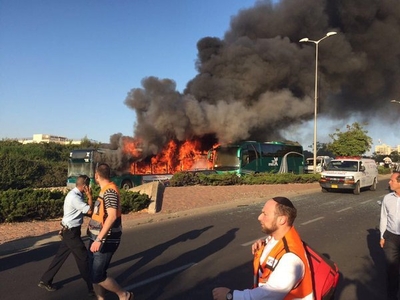
Israel embarked on a P. R. campaign to play down the extent of the threat which surfaced in one day in the discovery of Hamas tunnel near Kibbutz Sufa, and the suicide bombing of Jerusalem bus No. 12 on April 18, with 20 people injured. The police initially claimed for example that the explosion was due to a technical problem with the engine. But the two developments actually represented a sharp and serious escalation of the Palestinian wave of terror against Israel.

Neither of the operations was carried out by “lone wolves” but rather by large terror networks. The secret tunnel discovered in the Gaza border area was built by the Hamas military wing, the Izaddin al-Qassam brigades, while the suicide bombing in Jerusalem was carried out by the Hamas infrastructure in Judea and Samaria, specifically its operatives in the Bethlehem area.

Each of these terror networks poses a different challenge to Israel.

In Gaza, the Hamas political leadership is no longer in contact with the heads of its military wing. Neither the top commanders nor the regional commanders of the brigades obey any Hamas political body. They only heed three sources:

1. The Hamas military command framework headed by Mohammad Deif and Marwan Issa.

2. Iranian or Hizballah intelligence services, which maintain contacts with them and often provide funds or weapons.

3. The ISIS affiliate in the Sinai, with which the Hamas military wing maintains operational ties.

There is an equally serious problem in Judea and Samaria. Over the past few weeks, the Hamas terror networks have started to make contact with sleeper cells from Fatah’s Tanzim paramilitary force that have the knowledge, ability, means and experience for major terrorist attacks against Israel, such as the Jerusalem bus bombing.

This dormant wing of Mohammad Abbas’s Fatah has began to show signs of life and willingness to return to the path of terror.

These contacts began immediately after publication of a letter from jailed Tanzim leader Marwan Barghouti to members of the force that called on them to start coordinating their operations against Israel with Hamas. Nobody has bothered to explain how a senior terrorist jailed in a high-security Israeli prison succeeded in smuggling such a letter out.

The link between part of the Tanzim and the Hamas terror networks is no less dangerous than the tunnel discovered near Kibbutz Sufa, and it presages an escalation of terror operations in the future.

The only way to prevent a major deterioration of the security situation is to strike targets of the Izzadin al-Qassam brigades. There is no need to launch a total war against Hamas or to occupy Gaza.

But instead of responding as needed, Israel’s government and security establishment have released pictures of digging equipment that has finally succeeded in locating a single Hamas infiltration tunnel out of the many that exist, and claimed that those responsible for the Jerusalem bombing have yet to be identified. At the same time, senior officials and IDF officers continue to assert that Hamas is not seeking escalation.

Unfortunately, this can only mean a resurgence of the wave of terror.

Make or Break Moment for Palestinian Violence

April 21, 2016

Make or Break Moment for Palestinian Violence, Investigative Project on Terrorism, Yaakov Lappin, April 21, 2016

1502 (1)

The coming Passover holiday represents a make-or-break moment that could decide whether Palestinian violence and terrorism fizzles out, or escalates into a new and more dangerous phase.

Israel’s defense establishment is on alert to the possibility that tensions surrounding Jerusalem’s Temple Mount (known to Palestinians as the Al-Aqsa holy site) could resurface and trigger a new outburst of terrorism, just as a seven-month wave of largely unorganized terrorist attacks begins to draw down.

The tensions could well appear again during Passover, when the number of visits by religious Jews to the Temple Mount rises. There is no shortage of elements in the Palestinian arena – from Hamas media outlets to social media users – who will eagerly present such visits as part of an imagined Israeli conspiracy to take over the site.

As a result, Israel’s defense establishment has advised the government to prohibit any politicians, from any political party, to further inflame tensions by visiting the site.

Against this background, the Shin Bet domestic intelligence agency has quietly thwarted a steady flow of mass-casualty, organized terror plots, planned and orchestrated by Hamas. Any one of these plots could have changed the strategic picture and led to an escalation on multiple fronts had they materialized.

Hamas has been deeply disappointed by the recent decrease in terrorism and by its failure to bypass Shin Bet’s intelligence networks.

On April 18, a Palestinian bomb blew up on board a bus in Jerusalem and injured 21 civilians, including, possibly, the bomber himself. A media ban is in place that prevents publication of further details on the investigation.

Israelis watched TV news broadcasts of scenes of a bus in flames and emergency vehicles attending the site with much concern. They had hoped such bombings, which tore through Israeli cities in the dark days of the second Palestinian Intifada 15 years ago, were long behind them.

Unlike 15 years ago, Israel’s security forces operate all across the West Bank on a nightly basis to thwart attacks. Yet it only takes one plot to slip through the cracks for the terrorists to achieve their goal.

The bus bombing goes to show the inherently unstable nature of the security situation. On one hand, the number of terror stabbings, shootings, and car ramming attacks – all part of the unorganized violence – have plummeted in the past two months. On the other, such incidents could soon resurge and be joined by organized, more lethal events.

Fatah’s official Facebook account praised the bus attack, but this is only part of the real picture.

Away from the rhetoric, on the ground, the Fatah-ruled Palestinian Authority has actually improved its security coordination with Israel, and has stopped 20 percent of organized terrorism plots brewing in the West Bank, according to figures cited recently by Defense Minister Moshe Ya’alon.

A senior Israeli military source said in April that “tensions in Jerusalem, particularly in the context of Al-Aqsa, are there. It characterizes the holiday period. We are going with the working assumption that we will encounter this.”

The source described seeing “a lot of orchestrated terror attempts by [the large Palestinian] organizations. We can see many attempts being made on a continuous basis.” In West Bank raids, security forces discovered ready-made explosive devices and high-quality assault rifles, like M-16s and Kalashnikovs in the possession of would-be terror cells.

“The numbers [of such attempts] are high,” the source said. “But we are very effective. “The Shin Bet is a very significant aspect of this. Although there are attempts, and there is very high motivation [to carry out attacks], we succeed in thwarting them, and they have not been able to reach a situation in which they can really launch a quality attack.”

Ten would-be kidnapping terror plots were thwarted since October, the source added.

Israel’s defense establishment also is improving in an area that it has, until now, really struggled to deliver results – the ability to pick up warning signs of a lone-wolf attack and stop it in time.

Improved social media analysis, using new big data algorithms, are part of this improvement, defense sources say.

1503

Meanwhile, to the south, the IDF announced this week the detection of a new Hamas cross-border attack tunnel, stretching from the Gaza Strip into southern Israel.

It is the first tunnel discovered since the cessation of hostilities in August 2014 between Hamas and Israel and represents the renewed effort by Hamas’s military wing to prepare attack options for when war breaks out again.

Hamas views the current ceasefire as a tactical regrouping break. It has no intention of stopping its multi-generational jihad against Israel’s very existence, and it views Gaza as its base of operations for this “holy war.”

The Hamas military wing, the Izzadin Al-Qassam Brigades, is readying itself for future conflict. It is manufacturing rockets, mortar shells, and digging tunnels for Hamas’s elite Nuhba force of 5,000 heavily armed guerilla-terrorists who make up one quarter of all of Hamas’s armed members.

The plan was to inject these murder and kidnap squads into southern Israel through tunnels. But Hamas’s tunnel tactics are now in trouble. Israel used new technological and intelligence capabilities to detect the new tunnel, and has invested hundreds of millions of shekels in the research and development of new detection systems.

If the IDF’s Southern Command can begin to systematically detect tunnels as Hamas digs them, and destroy them, Hamas would find itself wasting treasure and blood (many workers die in tunnel collapses during the construction stage) for very little return. Hamas would lose one of its main investments in its future offensive capabilities.

That frustration could spur Hamas to try even harder to set up cells remotely that sow death and destruction in Israeli cities. Israel’s intelligence personnel will continue to work around the clock, away from the headlines and spotlights, to prevent that from happening.

Fatah Spokesman Osama Qawasmeh: The West Sponsors Islamic Extremism; 9/11 Was No Coincidence

April 12, 2016

Fatah Spokesman Osama Qawasmeh: The West Sponsors Islamic Extremism; 9/11 Was No Coincidence, MEMRI-TV via You Tube, April 11, 2016

The blurb following the video states,

In an interview, broadcast by the Palestinian Authority’s official TV channel, Fatah spokesman Osama Qawasmeh talked about the situation in Syria, and said that “it was the [Americans] who worked to create Islamic extremism,” adding that “they are indoctrinated with certain notions, and leaders created in the West and in Israel are planted in their midst.” Qawasmeh further said that the timing of 9/11 was “no coincidence”: it pushed the Palestinian cause to the sidelines in the international media. The interview aired on April 5, 2016.


Palestinians: Presidents for Life, No Elections

April 1, 2016

Palestinians: Presidents for Life, No Elections, Gatestone InstituteKhaled Abu Toameh, April 1, 2016

♦ We hear often that Mahmoud Abbas is keen on having Palestinians vote in a democratic election. Yet Abbas turned 81 last week and appears ready to remain at the helm until his last day — free elections for Palestinians be damned. That makes sense: Hamas could easily best Abbas in such an election.

♦ Hamas and Abbas’s Fatah are still far from achieving any form of reconciliation. This, despite all the talk about “progress” that has been reportedly achieved in talks between the two parties taking place in Doha, Qatar.

♦ Hamas is also cracking down on journalists, academics, unionists and even lawyers in the Gaza Strip.

♦ Yet Abbas’s West Bank rivals Hamas in Gaza, in terms of a lack of human rights and freedom of speech. The idea of free and democratic elections there is a joke. Abbas will leave a legacy of chaos.

Best birthday wishes to Palestinian Authority (PA) President Mahmoud Abbas, who turned 81 last week. The octogenarian appears ready to remain at the helm until his last day — free elections for Palestinians be damned.

Abbas has inherited a tradition of tyranny. His predecessor, Yasser Arafat, was also president for life. Both have plenty of company, joining a long list of African presidents who earned the notorious title of “President for Life” – in Uganda, Equatorial Guinea, Angola, Zimbabwe, Sudan, Chad, Eritrea and Gambia. And let us not forget the Arab dictators in these ranks.

One might hope for at least a deputy — someone to fill the impending and inevitable power vacuum in the PA. Not likely.

Abbas has fiercely resisted demands from leaders of his ruling Fatah faction to name a deputy president or a successor. His reasoning: the time is not “appropriate” for such a move. Palestinians should instead concentrate their energies on rallying international support for a Palestinian state.

The PA president acquired his “private fiefdom,” as it is called by his detractors, in a January 2005 election, when Abbas was given a four-year mandate.

Such mandate seems to have been rewritten by the standing president. January 2016 marked the beginning of the eleventh year of Abbas’s four-year term in office. But it is business as usual in Ramallah.

We hear on a monthly basis that Abbas is keen on having Palestinians cast their ballots in a free and democratic vote. Yet we have seen no evidence to this effect. That make sense: Hamas could easily best Abbas in such an election. Despite his advancing age, Abbas still has clear memories of January 2006, when Hamas was permitted to run in the parliamentary election and won.

Abbas is also acutely aware that Hamas, which holds hostage nearly two million Palestinians in the Gaza Strip, would never allow a free vote there — especially for Abbas loyalists who have been seeking to undermine its rule.

Just a few days ago, a Hamas “military” court in the Gaza Strip sentenced two senior Palestinian Authority security officers, Sami Nisman and Naim Abu Ful, to 15 and 12 years in prison respectively, on charges of spying for the Palestinian Authority and plotting terror attacks against Hamas targets.

The verdicts are yet another sign that Hamas and Abbas’s Fatah are still far from achieving any form of reconciliation. This, despite all the talk about “progress” that has been reportedly achieved in talks between the two parties. Unconfirmed reports earlier this week leaked details of sticking points between Hamas and Fatah negotiators, have been meeting in Doha, Qatar, under the auspices of the Gulf state, towards forming a new unity government and holding new presidential and parliamentary elections. Qatar is the largest source of funds for the Muslim Brotherhood and its offshoot, Hamas.

Abbas’s fear of holding elections in the Gaza Strip is not without justification. In addition to the crackdown on his loyalists and security officers there, Hamas is also cracking down on journalists, academics, unionists and even lawyers.

Last week, Hamas security forces raided the offices of the Palestinian Bar Association in Gaza City and confiscated computers. The raid came as a result of the controversy surrounding the Bar Association not submitting lawyers’ financial and administrative records, in addition to complaints filed by some lawyers against the Bar Association, according to a statement released by the Palestinian Center for Human Rights (PCHR). The raid, some Palestinians claim, is in the context of Hamas’s effort to crack down on lawyers who are affiliated with the rival Fatah faction.

Yet Abbas’s West Bank rivals Hamas in Gaza, in terms of a lack of human rights and freedom of speech. The president’s security forces are in the midst of a massive and ongoing crackdown on political opponents of all stripes, making the idea of free and democratic elections there a joke. Abbas cannot tolerate the idea of having a deputy: how would he consider the establishment of a new party or the emergence of a potential candidate for the presidency.

Senior figures who have dared to challenge Abbas’s autocratic rule have already found themselves targeted by the president and his men. Ask former Prime Minister Salam Fayyad, who had his organization’s bank accounts seized by Abbas, or Mohamed Dahlan, the former Fatah commander and minister who was forced to flee the Palestinian territories after falling out with Abbas and his sons. Perhaps deposed PLO Secretary-General Yasser Abed Rabbo, who overnight was stripped of his powers and thrown to the dogs for speaking out against the president, would have a word to say. In Ramallah, they call them the “Abbas victims.”

909Palestinian Authority President Mahmoud Abbas (left), who turned 81 last week, has fiercely resisted demands from leaders of his ruling Fatah faction to name a deputy president or a successor. Senior figures who have dared to challenge Abbas’s autocratic rule have been targeted by the president — such as Mohamed Dahlan (right), the former Fatah commander and minister who was forced to flee the Palestinian territories after falling out with Abbas and his sons. (Image sources: U.S. State Dept., M. Dahlan Office)

We would need a crystal ball to know what will happen the day after Abbas disappears from the scene. Perhaps, say some, we shall witness a scene reminiscent of the old days of the Soviet Union “Politburo,” with the next president chosen by a group of Fatah and PLO leaders who will meet in Ramallah. This seems the most likely scenario, in the absence of any chance of free and democratic elections, and in light of the continued split between the two Palestinian entities in the West Bank and Gaza Strip.

We do not need a crystal ball, however, to know that Abbas will leave a legacy of chaos. His adamant refusal to name a deputy or even discuss the issue of succession in public has already created tensions among the top brass of the PLO and Fatah. The Palestinian public, for its part, has precious little confidence in its leaders.

The behind-the-scenes power struggle that has been quietly raging in Ramallah for the past few months is likely to lead to a state of paralysis in the Palestinian arena and leave the Palestinians without an acceptable leader. Or, as senior Fatah official Tawfik Tirawi put it, Abbas will be the last president for the Palestinians.

Palestinians are plagued with leaders who desire one thing: personal power. The Palestinians are marching away from achieving a state, partly because they seem incapable of the fundamental political principle of free and democratic elections. The day after does not look promising.

Fatah Official Jamal Muhaisen: The U.S. Is No. 1 Enemy of the Palestinians and Arab-Islamic Nation

March 31, 2016

Fatah Official Jamal Muhaisen: The U.S. Is No. 1 Enemy of the Palestinians and Arab-Islamic Nation, MEMRI TV via You Tube, March 31, 2016

‘State of Palestine’ Becomes Member of Permanent Court of Arbitration in The Hague

March 17, 2016

State of Palestine’ Becomes Member of Permanent Court of Arbitration in The Hague

by Breitbart Jerusalem

16 Mar 2016

Source: ‘State of Palestine’ Becomes Member of Permanent Court of Arbitration in The Hague – Breitbart

The Associated Press

The Jerusalem Post reports:

The Permanent Court of Arbitration in The Hague announced on Tuesday that the State of Palestine has joined it, becoming its 118th member state.

It is unclear how significant an achievement joining the PCA is with the Palestinians likely to brandish it as supporting their joining the International Criminal Court and Israel likely to underplay it.

At press time, the Palestinian Authority had not responded to inquiries and the Foreign Ministry responded, “this is a legal body which is not among the more important ones. What a waste that the Palestinians continue to invest efforts to be accepted into these kinds of bodies instead of returning to the negotiating table.”

Israel opposes any recognition of Palestine as a state outside of bilateral negotiations.

The ICC Prosecution in January 2015 accepted Palestine as a state for purposes of opening an examination of the 2014 Gaza war crimes allegations and of the settlements enterprise, but Israel has been trying to convince it to back away from this position.

Tuesday’s news only complicates Israel’s efforts, even as the PCA is much less prominent now than the ICC.

Read the full story.

Palestinians: Laughing Their Heads Off

March 14, 2016

Palestinians: Laughing Their Heads Off

by Khaled Abu Toameh

March 14, 2016 at 5:00 am

Source: Palestinians: Laughing Their Heads Off

  • As in any comedy, there is a clown, and Biden was played for a fool by a Palestinian Authority leadership that finds that it pays to point its finger at Israel.
  • Here is a dirty little secret: the Palestinian attackers were not driven to murder Jews because of “settlements” and “checkpoints.”
  • Check their Facebook accounts: what fueled their hatred were the lies they had been fed for the past few years by President Abbas and other Palestinian leaders. Palestinian media outlets and spokesmen vomit poison against Israel.
  • And so the curtain rises on another act of the ceremonial, make-believe theater of the Middle East. In Abbas’s sneaky script, it is about settlements. In reality, it is about the refusal of the Americans to read, speak or even translate Arabic.

U.S. Vice President Joe Biden visited Ramallah last week, and Palestinian Authority (PA) President Mahmoud Abbas and his top officials are laughing their heads off.

Why not laugh? Biden arrived in the region hoping to persuade the Palestinian leaders to issue a “condemnation” of the reign of terror, which they continue to describe as a “popular and peaceful uprising.” This in itself reeks of gallows humor.

But what Biden got was even funnier, from the point of view of Abbas and his friends.

The Palestinian president offered “condolences” over the killing of a U.S. citizen in Jaffa the previous day: “The President [Abbas] offered his condolences over the killing of the US citizen, while stressing at the same time that the occupation authorities have killed 200 Palestinians over the past five months,” according to a statement released by the PA leadership in Ramallah.

Abbas’s crocodile tears were shed for Taylor Force, a West Point graduate from Texas who was stabbed to death by a Palestinian during a rampage on the Jaffa beachfront promenade. Abbas is doubtless also upset because Israel has killed Palestinian stabbers and shooters.

Just before Biden arrived in Ramallah, Abbas’s Fatah faction praised the murderer of Force, calling him a “martyr.” But Fatah was quick to delete the posts to avoid embarrassing the Palestinian leadership during Biden’s visit.

It seems that the murder of an American visitor is condemnable, but the murder of some 34 Israelis since last October, including a pregnant woman and civilians, is somewhat less so.

Where was the condemnation of the wounding of nine Israelis in the attack that killed Taylor Force? Where was the condemnation of the attacks the took place on that very day in Jerusalem and Petah Tikva?

But Abbas explained everything to Biden: Israel was in fact fully responsible for the “violence and bloodshed” because of the “occupation” and “settlements.”

Here is a dirty little secret: the Palestinian attackers were not driven to murder Jews because of “settlements” and “checkpoints.”

Check their Facebook accounts: what fueled their hatred were the lies they had been fed for the past few years by President Abbas and other Palestinian leaders, concerning Jews “desecrating” Islamic holy sites and plotting to destroy them. No checkpoint snags, no settlement issues, no protests against construction of new apartments in Jerusalem for Jewish families.

Many of these Palestinians went for Israeli blood because they have been taught — by Mahmoud Abbas, the Palestinian Authority, Hamas and other Palestinian groups — to hate Israel. And they do not give a damn whether that Jew lives in Jaffa or in the West Bank. They also do not give a damn if some of their victims are Arabs.

Yet the comedy continues. Biden is reported to have urged Abbas and the Palestinian leadership to stop the anti-Israel incitement in their official media and on social media. Abbas vehemently denied that this incitement was taking place, and indeed, explained that the US leader had gotten things mixed up entirely: it was Israel that was guilty of incitement against the Palestinians.

While Abbas was busy offering his condolences for the killing of the U.S. citizen, his ruling Fatah faction was busy glorifying Palestinian assailants who killed Israelis.

In one instance, Fatah published an announcement inviting Palestinians to mark the 38th anniversary of the “martyrdom” of Dalal Al-Mughrabi.

Al-Mughrabi was a Fatah member who participated in the 1978 Coastal Road massacre in Israel, in which 38 civilians were killed, including 13 children.


U.S. Vice President Joe Biden visited Palestinian Authority President Mahmoud Abbas in Ramallah on March 10, hoping to persuade Abbas to issue a “condemnation” of the wave of terror attacks against Israelis. The next day, Abbas’s Fatah party invited Palestinians to commemorate the 38th anniversary of the “martyrdom” of Dalal Al-Mughrabi. Al-Mughrabi was a Fatah member who participated in the 1978 Coastal Road massacre in Israel, in which 38 civilians were killed, including 13 children.

The condolence message was also long enough for Fatah to praise Palestinian assailants, including Abdel Malek Abu Kharoub, who carried out a recent shooting attack in Jerusalem. In a post on its official Facebook account, Fatah hailed Abu Kharoub as a “hero and martyr.”

Of course neither Biden nor any of his advisors and aides saw these posts. They prefer to continue burying their heads in the sand and pretending that once the “peace process” is revived, everything will be fine.

So it is business as usual for Abbas and crew. As in any comedy, there is a clown, and Biden was played for a fool by a PA leadership that finds that it pays to point its finger at Israel.

In Arabic, a language in which Western leaders are perhaps not fluent, Palestinian media outlets and spokesmen vomit poison against Israel. Condemnation of attacks on Israelis would be rather unlikely in such a drama.

And so the curtain rises on another act of the ceremonial, make-believe theater of the Middle East. In Abbas’s sneaky script, it is about settlements. In reality, it is about the refusal of the Americans to read, speak or even translate Arabic.

Khaled Abu Toameh, an award-winning journalist, is based in Jerusalem.

  • Follow Khaled Abu Toameh on Twitter


WATCH: ‘Do we have to hijack your planes again?’ Fatah official asks

February 8, 2016

Do we have to hijack your planes again?’ Fatah official asks Former negotiator Nabil Shaath slams Western indifference to Mideast suffering, says US ‘has never been an honest broker’ in peace talks

By Times of Israel staff February 8, 2016, 4:43 am

Source: WATCH: ‘Do we have to hijack your planes again?’ Fatah official asks | The Times of Israel

Former Palestinian negotiator Nabil Shaath in a February 1 interview with the Palestinian Authority's Awdha TV. (Screen capture/YouTube/MEMRI)

Former Palestinian negotiator Nabil Shaath in a February 1 interview with the Palestinian Authority’s Awdha TV. (Screen capture/YouTube/MEMRI)

ormer Palestinian peace negotiator Nabil Shaath said in an interview earlier this month that he often asks Westerners whether Arabs have to “hijack your planes and destroy your airports again” to make the world take notice of the Palestinian cause.

In a February 1 interview with the Palestinian Authority’s Awdha TV, translated by MEMRI, Shaath slammed American efforts at Israeli-Palestinian peacemaking.

 Asked about a French proposal for an international peace conference, Shaath replied, “Well, anything is better than American control of the negotiations. Anything. The US has never been a reliable honest broker. Never. It is the strategic ally of Israel. Period. Therefore any discussion of a different formula is a positive thing.”

But, he added, “an international conference is not what is needed. What is needed is a smaller framework. Today, at the African Union summit, President [Mahmoud] Abbas reiterated that we want something similar to the 5+1 framework” of six world powers who negotiated the nuclear deal with Iran.

“Like it or not, the US will be part of it. But we want France, Germany, Britain, the EU, Russia, China, Brazil, India. From the Arab countries we want Egypt at least. We want a small international framework.”

Shaath then turned to what he described as Western apathy toward suffering in the Middle East.

“If the Syrian problem had not been exported to Europe through the refugees on the one hand and terrorism on the other, the Europeans would not have cared even if the entire Syrian people had died,” he charged.

“But when all of a sudden there were four million Syrian refugees in Europe, 1.2 million of them in Germany alone, and when this was accompanied by Islamic State operations in France and elsewhere, all these countries began to fear that IS might have infiltrated through the refugees. And this started a debate about racial transformation in Europe with the entrance of non-white, non-European, non-Anglo-Saxon races, like the Syrian refugees, the Africans and others. This is what made the Syrian problem the most pressing from their perspective.”

He added: “I always say to these people, after I tell them about Syria and IS: ‘Do we have to hijack your planes and destroy your airports again to make you care about our cause? Are you waiting for us to cut off your oil supply? You always wait for things to reach boiling point and explode, causing you harm, before you intervene to end the crimes and violations.’”

Shaath served as the PA’s first foreign minister, and has served as a top peace negotiator and an influential member of the Fatah Central Committee.

Iran’s long arm

January 21, 2016

Iran’s long arm, The Jerusalem Post, JPost Editorial, January 21, 2016

(Please see also, New Iranian-Backed Terror Group Makes Inroads in West Bank, Gaza. — DM)

ShowImage (20)Thousand of Basij soldiers stage mock seige of Temple Mount in Iran. (photo credit:FARS)

If anyone needed proof how the lifting of sanctions on Iran will hurt Israel’s security, this week provided two examples.

Just days after implementation of the Joint Comprehensive Plan of Action nuclear agreement, we received a reminder that Iran and its proxies remain dangerous enemies of Israel.

Five Palestinians from the Tulkarm area were arrested for planning to carry out terrorist attacks under instructions from Hezbollah, the Shin Bet (Israel Security Agency) said on Wednesday.

The head of the cell, Mahmoud Za’alul, had been recruited through social media networks. Using encrypted messages, he enlisted five more men from the Tulkarm area; they were ordered to gather intel and plan terrorist attacks, including preparing explosive vests for suicide bombings.

Hezbollah funded their operation by sending them $5,000 through money changers.

Now that the “crippling” economic sanctions on Iran have been removed, the resources at its disposal – and as an extension at Hezbollah’s – will be significantly greater.

In Lebanon, meanwhile, Hezbollah is consolidating its political power. On Monday, in a development that is nothing short of earth shattering, Samir Geagea, leader of the Christian Lebanese Forces party, publicly endorsed his rival, the formal general Michel Aoun, for president of Lebanon.

In so doing, Geagea abandoned his loyalty to Saad Hariri, head of the anti-Syrian Future (Al-Mustaqbal) Movement, for an alliance with the enemy camp headed by Hezbollah, which supports Aoun for president.

This opens the way to the appointment of a pro-Iranian president in Lebanon.

Hezbollah and Iran are undoubtedly pleased with the development. If Aoun is elected president, Hariri’s influence – and the influence of Hariri’s main patron, Saudi Arabia – will be greatly diminished.

Finally, in the Gaza Strip, Iran has over the past few months been providing funding to a new terrorist group called Al-Sabireen Movement for Supporting Palestine. Al-Sabireen, which means “the patient ones” in Arabic, was formed in the wake of a break between Tehran and the two largest terrorist organizations operating in Gaza – Hamas and Islamic Jihad.

Neither organization has acquiesced to Iran’s demand to support President Bashar Assad in Syria.

Both have incensed the Iranians by remaining silent on Saudi attacks in Yemen against the Iranian-backed Houthis. Both face their worst financial crisis in two decades after Iran’s decision to cut off support.

Al-Sabireen’s emblem – a gun sprouting from the center of its name in Arabic – is nearly identical to Hezbollah’s.

So far, the organization has about 400 followers in the Gaza Strip, each one receiving a monthly salary of $250-$300, while the senior officials get at least $700, according to The Jerusalem Post’s Palestinian Affairs correspondent Khaled Abu Toameh. Iran has been supplying Al-Sabireen with weapons used to attack Israel.

The Iranians are believed to have supplied their new terrorist group in the Gaza Strip with Grad and Fajr missiles that are capable of reaching Tel Aviv. Also, Iranian funds channeled through Al-Sabireen are said to be used to support the families of killed or arrested terrorists living on the West Bank.

The Iranian-backed organization is also wooing Fatah members. Scores of militiamen once belonging to Palestinian Authority President Mahmoud Abbas’s Fatah faction in the Gaza Strip have allied themselves with Al-Sabireen. Most were attracted by the money.

The rise of an unshackled Iran’s influence in the region is bad for Israel. But it is also bad for many of the US’s Sunni allies in the region such as Saudi Arabia and the Palestinian Authority. A shared enemy has created a shared interest – the curtailing of Iranian influence.

Implementation of the JCPOA might delay Tehran’s nuclear weapon program. The removal of sanctions, however, has set the stage for the Islamic Republic to increase its destabilizing influence. Iran and its proxies must be stopped.
