Posted tagged ‘Fatah’

Abbas Calls on Arab States to Attack Hamas

March 28, 2015

Abbas Calls on Arab States to Attack Hamas, Israel National News,  Ari Yashar, March 28, 2015

(Unlikely, but what would Obama say? — DM)

574415Mahmoud Abbas Reuters

Abbas urges ‘same policy’ of Yemen airstrikes to be used by Arab League in ‘Palestine,’ after his adviser calls for ‘iron’ blow to Hamas.

Palestinian Authority (PA) Chairman Mahmoud Abbas used the platform of the Arab League summit in Sharm el-Shekh, Egypt, this Saturday to attack his “unity partner” Hamas, making a subtle call for the Arab states to take military action against the Gaza-based Muslim Brotherhood offshoot.

Speaking at the 26th summit in the southern Sinai peninsula, Abbas made reference to the campaign of airstrikes launched last Thursday by Saudi Arabia and other Arab countries against Iran-backed Shi’ite Houthi rebelsin Yemen – the Houthis have overthrown the government while rapidly expanding their control.

“I hope that the Arab countries will take the same policy they employed in Yemen for all Arab countries suffering from internal conflict – like Palestine, Syria, Libya and Iraq,” Abbas said according to Yedioth Aharonot, in an open jab at Hamas in Gaza.

Making Abbas’s comments calling for military intervention in “Palestine” all the more pointed is the fact that just two days earlier, Abbas’s adviser on Religious and Islamic Affairs Mahmoud Al-Habbash, who also serves as PA Supreme Sharia (Islamic law) Judge, made similar remarks.

Al-Habbash urged the Arab countries to take action and strike Hamas with an “iron fist,” in an open call for military intervention.

Hamas and the PA signed a unity deal last April, which has done little to damper the enmity raging between the rivals ever since Hamas violently seized control of Gaza in 2007 – the most obvious example of the how the deal has not changed tensions was when Hamas tried to stage a coup against the PA in Judea and Samaria last year.

Responding to Al-Habbash, Hamas said the comment is “a dangerous and not nationalist call.”

Abbas’s call for Arab intervention comes after Arab foreign ministers meeting in Egypt last Thursday declared the establishment of a joint Arab military force, reportedly meant to rapidly respond to security threats to Arab nations.

Arab League secretary-general Nabil al-Arabi was assigned with coordinating the details with the chiefs of staff of the various Arab armies within one month, so as to work out the logistics of establishing the new force.

Pres Obama Dismisses Questions About Netanyahu’s Election Win – Cavuto

March 20, 2015

Pres Obama Dismisses Questions About Netanyahu’s Election Win – Cavuto, via You Tube, March 19. 2015


Israelis prepare to vote; Palestinians prepare to fight

March 17, 2015

Israelis prepare to vote; Palestinians prepare to fight, The Gatestone InstituteKhaled Abu Toameh, March 16, 2015

For some Palestinians, the election is not about removing Netanyahu from power. Rather, it is about removing Israel from the face of the earth and replacing it with an Islamist empire.

Kerry’s statement about the revival of the peace process shows that he remains oblivious to the reality in the Middle East, particularly with regards to the Palestinians.

Kerry is ignoring the fact that the Palestinians are today divided into two camps; one that wants to destroy Israel through terrorism and jihad and another that is working hard to delegitimize and isolate Israel with the hope of forcing it to its knees.

As Kerry was talking about the revival of the peace process, Hamas announced that it has completed preparations for the next confrontation with Israel.

Abbas will come to the talks with the same demands he and his predecessor have made over the past two decades, namely a full Israeli withdrawal to the pre-1967 lines. And when Israel does not accept all his demands, he will again walk out and demand international intervention to impose a solution on Israel.

Talk about the resumption of the peace process is nothing but a silly joke.

As Israeli voters head to the ballot boxes to elect their new representatives, Palestinians say they are preparing for another war with Israel.

The preparations came even as US Secretary of State John Kerry and some Israeli candidates, especially Zionist Camp leaders Isaac Herzog and Tzipi Livni, continue to talk about the need to revive the Israeli-Palestinian peace process after the election.

For some Palestinians, the election is not about removing Likud leader Binyamin Netanyahu from power. Rather, it is about removing Israel from the face of the earth and replacing it with an Islamist empire.

The next Israeli government will face a two-pronged attack on the Palestinian front — one from the Gaza Strip, where Hamas and Islamic Jihad say they have just completed preparations for the next conflict with Israel, and another from the West Bank, where the Palestinian Authority (PA) says it is determined to pursue its “diplomatic war” against Israel in the international arena.

On the eve of the election, Kerry expressed hope that Israelis will elect a government that “meets the hope for peace.”

Kerry’s statement about the revival of the peace process shows that he remains oblivious to the reality in the Middle East, particularly with regards to the Palestinians.

Kerry is ignoring the fact that the Palestinians are today divided into two camps; one that wants to destroy Israel through terrorism and jihad, and another that is working hard to delegitimize and isolate Israel in the international community with the hope of forcing it to its knees.

Hamas and Islamic Jihad continue to scoff at Kerry’s talk about the resumption of the peace process. The two groups, which control the 1.7 million Palestinians of the Gaza Strip, actually have other plans for the post-election era. Their main plans center around preparing for the next war with Israel.

983Israel’s Prime Minister Binyamin Netanyahu (left) and Hamas leader Ismail Haniyeh (right, in blue shirt).

As Kerry was talking about the revival of the peace process, Hamas’ armed wing, Izaddin al-Qassam, announced that it has completed preparations for the next confrontation with Israel.

These preparations, according to the group, include the reconstruction of Hamas military bases and training centers that were destroyed during the last war, known as Operation Protective Edge. The group says that it has not only rebuilt the destroyed sites, but has also set up new military posts, especially along the border with Israel.

Of course, when Hamas talks about “military bases,” it is also referring to the underground tunnels that it is hoping to use in the next conflict to infiltrate Israel.

Some of the bases are located only a few hundred meters away from the border with Israel, such as the Yarmouk and Palestine posts. Hamas says that the decision to build the military bases so close to the Israeli border is aimed at sending a message of defiance to Israel.

Islamic Jihad also does not seem to be impressed with the recent talk about the resumption of the peace process between Palestinians and Israelis.

Earlier this month, Islamic Jihad too unveiled its preparations for war, by inviting journalists on a tour of its tunnels inside the Gaza Strip.

“We’re on our highest level of alert to counter any attack. We’re used to the occupation breaking its ceasefires,” senior Islamic Jihad commander Abu al-Bara told Agence France Press. “It’s a war that never ends. We’re ready to go to another level against the Zionist occupation and carry out actions we’ve never done before.”

Meanwhile, the Palestinian Authority is also preparing for a confrontation with Israel, albeit one of a different nature.

The PA says it is determined to pursue its effort to seek worldwide support for imposing a solution on Israel. It is hoping to do so with the help of the United Nations, the European Union, the Obama Administration and some Arab countries.

In order to achieve its goal, the Palestinian Authority is currently waging a massive campaign in the international arena whose goal is to delegitimize, isolate and weaken Israel to a point where it would be forced to succumb and make far-reaching concessions, such as a full withdrawal to the pre-1967 lines.

PA President Mahmoud Abbas will find it almost impossible to return to the negotiating table with Israel now that he has told his people that the Palestinians’ next step is to file “war crime” charges against Israel with the International Criminal Court (ICC). Abbas’s aides have even set a date for the filing of the first anti-Israel case with the ICC: April 1.

Even if Abbas does return to the negotiating table — under heavy pressure from the Americans and Europeans — he would be doing so not in order to achieve an agreement with Israel, but to try to show the world that Israel does not want peace.

Abbas will come to the talks with the same demands he and his predecessor have made over the past two decades, namely a full Israeli withdrawal to the pre-1967 lines. When Israel does not accept all his demands, he will again walk out and demand international intervention to impose a solution on Israel. And while he would be waging his diplomatic campaign, Hamas and Islamic Jihad would resume their terror attacks against Israel from the Gaza Strip.

Under the current circumstances, where some Palestinians continue to seek the destruction of Israel and others are unable to make any concessions for peace, any talk about the resumption of the peace process is nothing but a silly joke.

Palestinian forces detain 500 Hamas West Bankers, to thwart coup and Abbas assassination plot

March 10, 2015

Palestinian forces detain 500 Hamas West Bankers, to thwart coup and Abbas assassination plot, DEBKAfile, March 10, 2015

security_forces_in_the_West_Bank_Hamas__10.3.15Palestinian security forces detain Hamas activists

[O]ur sources also reveal that the PA chairman has asked Netanyahu through back-channels for a secret rendezvous somewhere in Europe. He proposed avoiding prominent capitals like London, Paris or Berlin, but meeting at a smaller venue for the sake of confidentiality.

Abbas also insisted that this meeting must be concealed from Washington, especially from Secretary of State John Kerry.

The Israeli prime minister has turned him down – and not just because the Palestinian request finds him in the middle of a tough race for re-election.

*********************

Acting on direct orders from Palestinian Authority Chairman Mahmoud Abbas, Palestinian special forces raided the nine PA-ruled towns of the West Bank in the past 48 hours and detained 500 Hamas suspects, DEBKAfile’s military sources report. Abbas ordered the operation after discovering that Hamas had been hatching a plot for some weeks to stage an armed insurrection against the Palestinian Authority, starting in one of the Palestinian towns – possibly even the PA capital of Ramallah. They would assassinate him in the process of the coup.

Of late, Abbas has kept his distance from Ramallah and his seat of government and spends most of his time traveling in foreign countries, especially Arab capitals, where he feels safer under the protection of foreign security services than he does at home.

The wave of detentions from Sunday to Tuesday (March 9-10) is the most extensive the Palestinian Authority has ever conducted against Hamas’ West Bank cells. Not only prominent figures and known terror activists were taken into custody but also new figures.

Abbas ordered the operation amid a serious dilemma over his personal security.

Before him were reports presented by Palestinian Intelligence chief Maj. Gen. Majed Faraj revealing the preparations in train for his assassination, an event that would signal mass riots orchestrated by Hamas and Jihad Islami, leading up to the seizure of government from the Palestinian Authority – much as they did in the Gaza Strip.

At the same time, Abbas does not entirely trust Palestinian security services or their ability to safeguard him and his regime in Ramallah.

He therefore turned to Israel, touching off an IDF response that had nothing to do with Israel’s forthcoming general election on March 17 – as government opponents have claimed.

The 3,000 IDF soldiers plus 10,000 reservists called up this week were not posted on the West Bank to practice anti-riot tactics for putting down Palestinians disturbances against Jewish settlements – as reported. They were placed on the ready in case it was necessary to go into Palestinian towns and save them from being overrun by the radical Hamas and Jihad Islami.

The Israeli troops also rehearsed a possible scenario that might ensue from the murder of Mahmoud Abbas.

In view of the highly sensitive security situation on the West Bank, Prime Minister Binyamin Netanyahu accompanied by Defense Minister Moshe Ya’alon, paid a rare visit to the IDF’s Judea-Samaria command headquarters Tuesday, March 10, to inspect these preparations.

It was the Hamas conspiracy to seize power in Ramallah that prompted Ya’alon’s enigmatic remark that were it not for preemptive military operations, central Israel might now be under missile and mortar attack.

DEBKAfile’s military sources add that way the Palestinian issue has become a football for kicking around Israel’s election campaign, making it hard to penetrate the fog of anti-government propaganda and establish what is really going on.

For example, Netanyahu is being presented by his rivals as having agreed at a former stage in US-brokered peace negotiations with the Palestinians to withdraw to behind the 1967 lines. They have picked out one of the many papers drawn up by the Americans and discarded in the course of the negotiations – this one was written by a Shiite Iraqi academic in Oxford University and was never approved either by Israel or the Palestinians.

Turning to the real events afoot today, our sources also reveal that the PA chairman has asked Netanyahu through back-channels for a secret rendezvous somewhere in Europe. He proposed avoiding prominent capitals like London, Paris or Berlin, but meeting at a smaller venue for the sake of confidentiality.

Abbas also insisted that this meeting must be concealed from Washington, especially from Secretary of State John Kerry.

The Israeli prime minister has turned him down – and not just because the Palestinian request finds him in the middle of a tough race for re-election.

Islamic State Deepens Grip in Future Palestine

January 23, 2015

Islamic State Deepens Grip in Future Palestine, The Gatestone InstituteKhaled Abu Toameh, January 23, 2015

According to Israeli security forces, dozens of Hamas and Islamic Jihad members in the West Bank have defected to the Islamic State in recent months. Their main goal, according to sources, is to topple the Palestinian Authority and launch terror attacks on Israel.

Some 200 supporters of the Islamic State, who held up Islamic State flags, took to the streets of Gaza City to protest the latest cartoons published by the French satirical magazine, Charlie Hebdo. They also chanted slogans that called for slaughtering French nationals, and burned French flags. Attempts by Hamas to impose a news blackout on the protest failed, as photos and videos found their way to social media.

The glorification of terrorists and jihadists by the Palestinian Authority, and the ongoing anti-Israel incitement by both Hamas and the Palestinian Authority, is driving many Palestinians into the open arms of the Islamic State.

Hamas and other Palestinian groups are continuing to deny the obvious, namely that the Islamic State terror group has managed to set up bases of power in the West Bank and Gaza Strip.

The Palestinians do not feel comfortable talking about the fact that Islamic State is working hard to recruit Palestinians to its ranks.

The presence of Islamic State in the West Bank and Gaza Strip is an embarrassing development for both Hamas and the Palestinian Authority.

For Hamas, the fact that Islamic State has long been operating in the Gaza Strip is something that it does not want the world to know about.

Hamas cannot afford a situation where another Islamist terror group poses a challenge to its exclusive control over the Gaza Strip. Since it seized control over the Gaza Strip in 2007, Hamas has successfully suppressed the emergence of rival forces, first and foremost the secular Fatah faction headed by Mahmoud Abbas.

But if until recently it was Fatah that posed a challenge and threat to Hamas’s rule, now it is the Islamic State and its supporters in the Gaza Strip are openly defying the Islamist movement’s regime.

When the first reports about Islamic State’s presence in the Gaza Strip emerged last year, Hamas and other Palestinians were quick to dismiss them as “false.”

Salah Bardaweel, a senior Hamas official, said in February 2014 that the Islamic State “does not exist” in the Gaza Strip.

This week, however, it became evident that Hamas was lying when it denied the presence of Islamic State in the Gaza Strip.

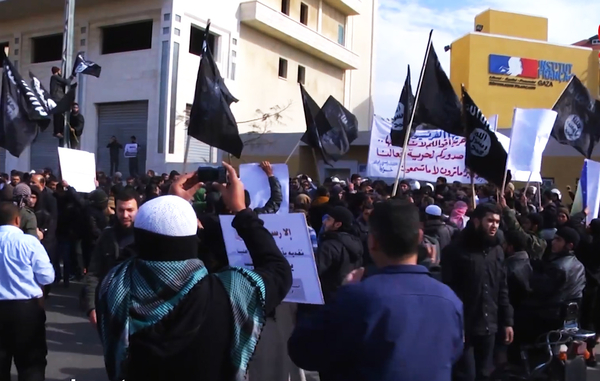
Some 200 supporters of the Islamic State, who held up Islamic State flags, took to the streets of Gaza City to protest the latest cartoons published by the French satirical magazine, Charlie Hebdo.

The protesters tried to storm the offices of the French Cultural Center in Gaza City. They also chanted slogans that called for slaughtering French nationals, and burned the French flag.

899Palestinians waving Islamic State flags attempt to storm the French Cultural Center in Gaza City. Some in the crowd carried posters glorifying the terrorists who carried out this month’s attacks in Paris. (Image source: ehna tv YouTube screenshot)

The protest apparently caught Hamas by surprise. Hamas security forces that were rushed to the scene dispersed the protesters and arrested seven Islamic State supporters.

Attempts by Hamas to impose a news blackout on the Islamic State protest failed, as photos and videos of the demonstration found their way to social media. Needless to say, Hamas-affiliated media outlets ignored the protest. They were hoping that the world would also not see the Islamic State demonstrators on the streets of Gaza City.

Hamas’s biggest fear is that scenes of Islamic State supporters marching in the heart of Gaza City will scare international donors and dissuade them from providing badly needed funds for the reconstruction of the Gaza Strip. Hamas is also afraid that Western officials working with the United Nations and relief agencies will stop visiting the Gaza Strip after watching the footage of Islamic State supporters.

In recent weeks, it has also become evident that Islamic State has some kind of a presence in the West Bank — a fact that poses a serious threat to Abbas’s Palestinian Authority [PA].

Just last week, Israel announced arrests of members of an Islamic State terror cell in the West Bank city of Hebron. The three Palestinian members of the cell confessed during interrogation that had planned to launch a series of terror attacks against Israel. The three suspects were identified as Waddah Shehadeh, 22, Fayyad al-Zaru, 21 and Qusai Maswaddeh, 23.

Until recently, Hamas was considered the number one threat to the Palestinian Authority in the West Bank. Now, however, it has become evident that Islamic State is also trying to set up bases of power in the West Bank. According to Israeli security sources, dozens of Hamas and Islamic Jihad members in the West Bank have defected to Islamic State in recent months. Their main goal, the sources, said, is to topple the PA and launch terror attacks on Israel.

Abbas is lucky that the Israeli security forces are still operating in the West Bank, including inside cities and towns controlled by the Palestinian Authority. Were it not for the IDF and various branches of the Israeli security establishment, Hamas, Islamic Jihad and Islamic State would have toppled the Palestinian Authority and beheaded Abbas and his officials a long time ago.

Still, Abbas does not feel comfortable acknowledging the fact that a growing number of Palestinians in the West Bank are joining Islamic State. Abbas fears is that if he admits that Islamic State is already operating in the West Bank, this could dissuade many Western countries from supporting his effort to persuade the world to support the creation of an independent Palestinian state. Like Hamas, Abbas also fears that Westerners would stop visiting Ramallah and other West Bank Palestinian cities once they learn about Islamic State’s presence in these areas.

Although Hamas and the Palestinian Authority are continuing to bury their heads in the sand and deny what is there, they cannot avoid responsibility for the emergence of Islamic State in the Gaza Strip and West Bank. The glorification of terrorists and jihadists by the PA and the ongoing anti-Israel incitement by both the PA and Hamas, are driving many Palestinians into the open arms of the Islamic State.

This is something that the UN Security Council members will have to consider the next time they are asked to vote in favor of the establishment of a Palestinian state. Otherwise, they will be voting for the creation of an Islamic, and not a Palestinian, state.

The West Bank Army of the “State of Palestine,” Thanks to the United States

January 21, 2015

The West Bank Army of the “State of Palestine,” Thanks to the United States, The Gatestone InstituteShoshana Bryen, January 21, 2015

(????????????? — DM)

The U.S. Consulate’s determination to provide the trappings of Palestinian statehood to the Palestinian Authority outside the negotiating process should come under scrutiny.

What plan do we have if the Palestinian army attacks the IDF in the future — instead of its presumed enemy, Hamas?

It is revealing that the U.S. appears determined to provide the Palestinian Authority with an army while it is still at war with our ally, Israel.

Last week, officials from the U.S. Consulate in East Jerusalem attended a Palestinian protest over Israel’s removal of olive trees illegally planted in the West Bank. Coordinated with the Palestinian Authority [PA] but not Israel, the Consulate personnel ended up clashing with Israelis living nearby. It was, perhaps, the quietest international almost-incident you never heard of.

This week, with the focus off Paris, the Middle East Quartet (the U.S., EU, Russia & the UN) plans to meet. The U.S. Consulate’s determination to provide the trappings of Palestinian statehood to the PA outside the negotiating process should come under scrutiny.

The olive tree incident prompted an article in the Israeli press about the Consulate, including the use of Palestinian security, rather than IDF combat veterans as required by a 2011 agreement. Some IDF guards were fired, according to the article. Others resigned, blaming the appointment of a new consulate security officer, who they said, established a Palestinian armed militia. “He is training them with weapons, combat and tactical exercises. There is a lack of responsibility here – who ensures that such weapons, once given over to Palestinian guards, won’t make their way to terror groups?”

The change in personnel from IDF veterans to a Palestinian Security Force [PSF] is part of a long series of steps to transform the Palestinian body politic into a state. If the U.S. Consulate becomes the U.S. Embassy to Palestine — a function it already observes — it is understandable that the PA would not want “occupying Israeli soldiers” to guard the symbol of America from Palestinian citizens in “its capital, Jerusalem.” The Consulate, with its mission to the PA, would agree.

Palestinian security forces have been in existence since 1994 and have steadily changed mandates. They have gone from a “police force” under the Oslo formulation of “dismantling the terrorist infrastructure” so Israel could have confidence in security after withdrawing from territory, to a protection force for Mahmoud Abbas so he would continue negotiations under U.S. auspices — but now to an army for the nascent state.

The Clinton Administration signed on to the police phase, but asked how Arafat could be expected to defeat “terrorists” without weapons. Unmentioned were a) Arafat was the prime funder and organizer of the terrorist organizations in question, and b) the PLO had already proven perfectly capable of killing its enemies.

The first funds for equipment and training came in 1994 from international donors including the U.S. Arafat, having a reasonable sized arsenal of his own, wanted arms, but settled for nonlethal items.

In 1996, Western trained Palestinian “police” attacked IDF personnel with weapons, killing 15 soldiers and border guards, after the opening of an exit from an ancient Hasmonean tunnel in Jerusalem, near the Western Wall in the Old City.

Despite these attacks, according to Jeffrey Boutwell, Director
 of the Pugwash Conferences on Science and World Affairs, the 1997 Hebron Protocol “provided for a Palestinian police force of some 30,000 personnel, equipped with 15,000 automatic rifles and pistols, 240 heavy machine guns, 45 armored vehicles, lightly armed shore patrol vessels, and associated communications and transportation equipment.” An Israeli-Palestinian Joint Security Coordination and Cooperation Committee [JSC] was formed to oversee “arrangements for entry of the Palestinian Police and the introduction of police arms, ammunition, and equipment.”

Between the onset of Western arms deliveries and a thriving black market, the PA “police” had all the lethal equipment they could handle.

Training stopped during the 2001-2004 so-called “second intifada” with the (unsurprising) revelation that the PA “police” found their Western assets invaluable in attacking Israelis. In 2005, however, history began again and the U.S. decided that the Palestinians should have a new security service. LTG William Ward USA (Deputy Commanding General, U.S. Army Europe, and Chief of Staff, U.S. Seventh Army) was the point man. In the words of then-Secretary of State Condoleezza Rice, his mission was:

  • “To make sure the parties understand each other and we understand what the parties are doing, so we can raise it at the appropriate level” if action is required.
  • “To provide a focal point for training, equipping, helping the Palestinians to build their security forces and also for monitoring, and if necessary, to help the parties on security matters.”

The missions were incompatible and inappropriate. The first involved “translating for the parties” with an eye toward U.S. intervention, a political job that should not have been done by a military officer. Further, having part of the mission directed toward a Palestinian force gave the General a stake in the success of the Palestinians over the concerns of Israel.

And so it happened. The Ward mission, the sole conduit for U.S. aid to the new Palestinian Security Force, resulted only in better-trained terrorists.

LTG Keith Dayton (Director of Strategy, Plans and Policy, Office of the Deputy Chief of Staff, G-3, U.S. Army), well respected and liked by Israel and the IDF, succeeded LTG Ward. His job, however, was complicated by the deterioration relations Hamas-Fatah in Gaza. According to acontemporaneous Ha’aretz story, Dayton was to arm and train “the Presidential Guard of PA Chairman Mahmoud Abbas to prepare it for a potential violent confrontation with Hamas forces in Gaza. Palestinian sources say the training of 400 Force 17 troops… started [in November 2006] in Jericho under the guidance of an American military instructor.” Force 17 had been Arafat’s Praetorian Guard, attacking recalcitrant Palestinians as well as Israelis. Abbas had inherited it.

Throwing American support to one Palestinian faction over another was a political decision to side with what our government assumed was “better” or more “moderate” Palestinians, hoping it would use our help to put down Hamas rather than using it to kill ever more Israelis.

What it did was legitimize the creeping movement of the Palestinians toward a full-fledged army.

This new mission needed IDF participation — which Israel approved in part because of its relations with LTG Dayton, and because it allowed Israel to operate in West Bank territory with a relatively free hand to arrest both Hamas operatives and Fatah bad guys. It also made Abbas beholden to Israel for his personal security and that of his kleptocracy. That part worked, and even now, PA figures have admitted publicly that without IDF cooperation, the PA would fall.

Dayton’s successors, LTG Michael Moeller, USAF and ADM Paul Bushong, USN, have quietly continued and upgraded both training and weapons.

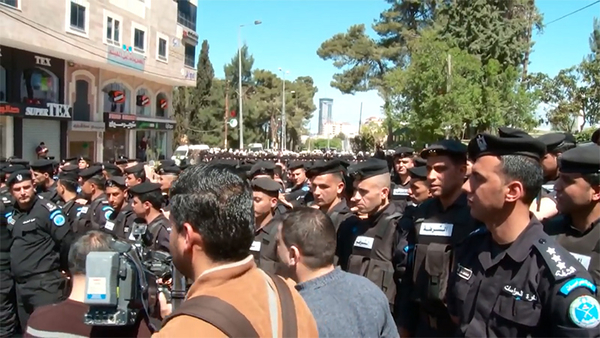
893Hundreds of troops from the Palestinian Security Force line a street in Ramallah, in order to block anti-American protestors, during President Obama’s 2013 visit to the city.

The question always was twofold: What constitutes “appropriate” weapons for the PSF, and how does the U.S. justify training security forces the ultimate loyalty of whom will be a government that we cannot foresee and may become something — or already is something — we don’t like? The corollary is: What plan do we have if the Palestinian Army attacks IDF forces in the future — instead of its presumed enemy, Hamas?

To raise the questions is to understand that there are no sound answers from either the Consulate or the State Department. In their absence, concern over the choice of security guards by the U.S. Consulate in Jerusalem is appropriate, but insufficient. It is revealing that the U.S. appears determined to provide the PA with an army while it is still at war with our ally, Israel.

Don’t ignore the writing on the wall

January 16, 2015

Don’t ignore the writing on the wall, Israel Hayom, Yoram Ettinger, January 16, 2015

(It’s much easier and much less stressful to look forward to hope and change. Briefly. –DM)

Since the 1993 Oslo Accord, Western democracies have refrained from reading the writing on the Palestinian (Mahmoud Abbas and Hamas) wall: hate education in grades K-12; unprecedented terrorism; systematic noncompliance with agreements; naming squares, streets and tournaments after terrorists; monthly allowances for families of terrorists; responding to Israeli withdrawals with intensified terror.

Hitler’s master plan was outlined in 1925-26 in the two volumes of the supremacist, anti-Jewish “Mein Kampf” (“My Struggle”), which is currently a best-seller in the Muslim world, particularly in Iran and the Palestinian Authority.

***************

In 539 B.C.E., Babylonian King Belshazzar ignored the writing on the wall — as interpreted by the Prophet Daniel — and was, therefore, annihilated by the Persians (Daniel 5).

In 2015, Western civilizations must read the writing on the wall, desist from ambiguity, denial and political correctness and embrace clarity, realism and political incorrectness, in order to survive and overcome the clear and present lethal threat of Islamic takeover, which is gathering momentum via demographic, political and terroristic means.

History proves that Western ambiguity and the refusal to identify enemies — due to ignorance, gullibility, oversimplification, appeasement, delusion and wishful thinking — have taken root, yielding major strategic setbacks and painful economic and human losses. When it comes to reading the writing on the wall, Western eyesight has been far from 20:20, dominated by modern day Belshazzars, ignoring modern day Daniels.

For example, during the 1930s, the writing was on the wall in glaring letters: Germany abrogated the Treaty of Versailles, which called for German disarmament, reparations and territorial concessions; German military spending skyrocketed, military conscription was reintroduced and the Rhineland was remilitarized; Germany withdrew from the League of Nations and annexed Austria. Still, on September 30, 1938, British Prime Minister Neville Chamberlain signed the Munich Pact, declaring “peace for our time.” He refused to recognize Hitler’s strategic, global, supremacist goal, assuming that Hitler’s appetite could be satisfied with a tactical, limited gain in Czechoslovakia’s Sudetenland, signing a “peace accord” that triggered the “war of all wars.”

Hitler’s master plan was outlined in 1925-26 in the two volumes of the supremacist, anti-Jewish “Mein Kampf” (“My Struggle”), which is currently a best-seller in the Muslim world, particularly in Iran and the Palestinian Authority.

During 1977-79, U.S. President Jimmy Carter did not read the writing on the wall, supporting the Ayatollah Ruhollah Khomeini’s battle against the Shah of Iran, who was, in fact, the U.S.’s policeman in the Persian Gulf. Overwhelmed by denial and wishful thinking, and heavily influenced by the U.S. foreign policy establishment, Carter ignored the litany of sermons delivered by Khomeini, which exposed the Iranian cleric as an enemy of Western civilization and civil liberties. He despised the U.S. and aligned himself with the enemies of the U.S., while protected by a Palestinian PLO praetorian guard. Thus, the U.S. betrayal of the Shah eliminated a most effective and loyal strategic partner of the U.S., gave rise to the most lethal, conventional and nonconventional threat to vital U.S. interests in the Persian Gulf, the Middle East and beyond and generated a robust tailwind to Islamic terrorism.

In 1990, on the eve of Saddam Hussein’s invasion of Kuwait, the U.S. stated that an Iraq-Kuwait military clash would be an intra-Arab, rather than a U.S., concern. The Bush/Baker administration assumed that “the enemy of my enemy [Iran] is my friend [Iraq],” supplying Saddam with dual-use sensitive systems, providing him with $5 billion loan guarantees and concluding a U.S.-Iraq intelligence sharing agreement. The 1990 policy of denial triggered a conventional conflict, a $1.25 trillion cost to the U.S. taxpayer, 4,500 U.S. military fatalities, a surge of anti-U.S. Islamic terrorism and a dramatic destabilization of the Persian Gulf.

Since the 1993 Oslo Accord, Western democracies have refrained from reading the writing on the Palestinian (Mahmoud Abbas and Hamas) wall: hate education in grades K-12; unprecedented terrorism; systematic noncompliance with agreements; naming squares, streets and tournaments after terrorists; monthly allowances for families of terrorists; responding to Israeli withdrawals with intensified terror.

In 2011, Western democracies denied the eruption of an Arab tsunami, welcoming the violence on the Arab Street as an Arab Spring that would transition the Arabs toward democracy. The Obama administration embraced the Muslim Brotherhood (while giving a cold shoulder to Gen. Abdel-Fattah el-Sissi), refusing to recognize its well-documented intra-Arab terrorism, the offshoot of its motto: “Allah is our objective; the Quran is the constitution; the prophet is our leader; jihad is our way; death for the sake of Allah is our wish.”

The 2015 failure to carefully read the Iranian writing on the wall could produce a nuclear conflict that would cost the U.S. taxpayer trillions of dollars, incur an unprecedented level of fatalities, spark a tidal wave of Islamic terrorism throughout the globe, including in the U.S., decimate the pro-U.S. Arab regimes in the Persian Gulf and Jordan, create an unprecedented disruption of the supply of Persian Gulf oil, further radicalization of the anti-U.S. regime in Venezuela with ripple effects in Latin America, including Mexico, and additional tectonic eruptions of insanity throughout the globe.

At stake is not only freedom of expression and the safety of European Jewry, but the survival of Western democracies.

Solidarity demonstrations and eloquent speeches will not spare Western democracies the wrath of Islamic terrorism and domination, unless accompanied by clarity, realism and the willingness to take military, legislative and political action to thwart the writing on the walls of the mosques: submission of humanity to the Prophet Muhammad; submission of the Christian, Hindu, Buddhist, Sikh and Jewish kuffar (“infidel”) to Muslims and to Shariah laws; jihad — holy war on behalf of Islam — is the duty of Muslims; waqf — Muslim land — is ordained by Allah; Dar al-Islam (the residence of Islam) must take over Dar al-Harb (the residence of war); and Islam-sanctioned taqiyya (dissimulation, deception and concealment of inconvenient data) aimed at shielding Islam and “believers” from “disbelievers.”

A Sad State of Affairs: The Kerry Record

January 2, 2015

A Sad State of Affairs: The Kerry Record, World Affairs JournalJoshua Muravchik, November/December, 2014

(Kerry likely agrees with Obama as to his quite foreign foreign policies and, equally likely, we are stuck with both at least until Obama leaves the White House.

Kerry I'm an idiot

The most bothersome current aspects of Obama-Kerry foreign policies are the extent to which they trust Iran and how they deal with it and the P5+1 negotiating group. — DM)

John_Kerry_and_Benjamin_Netanyahu_July_2014 (1)

Although Kerry’s anti-American ideology has moderated to some degree from his fiery days as an antiwar leader, he has misrepresented but never repudiated his past. Especially consistent has been his inclination to see the best in America’s enemies, from Madame Binh to Comandante Ortega to Bashar Assad. Israelis were shocked this summer that Kerry came up with a plan molded by Turkey and Qatar to fit the interests of Hamas at their own expense. Had they known him and his record better, they might not have been.
***************

The Gaza war of July and August 2014 occasioned the sharpest frictions in memory between the United States and Israel, highlighted by a cease-fire proposal offered by Secretary of State John Kerry that Israel’s security cabinet rejected unanimously. Kerry’s plan envisioned a seven-day cease-fire, during which the parties would negotiate “arrangements” to meet each of Hamas’s demands about the free flow of people and goods into Gaza and the payment of salaries of Hamas’s tens of thousands of employees. As for Israel’s demands about destruction of tunnels and rockets and the demilitarization of Gaza, these were not mentioned at all, except in the add-on phrase that the talks would also “address all security issues.”

The document cited the important role to be played by “the United Nations, the Arab League, the European Union, the United States, Turkey, [and] Qatar.” Conspicuous by their absence from this list were Israel, Egypt, and the Palestinian Authority. These three had also not been invited to the Paris meetings where Kerry worked on his ideas with leaders of the countries and bodies mentioned.

Barak Ravid, diplomatic correspondent for the liberal Israeli newspaper Haaretz, wrote that the proposal “might as well have been penned by Khaled Meshal [head of Hamas]. It was everything Hamas could have hoped for.” The centrist Times of Israel’s characteristically circumspect editor, David Horovitz, branded Kerry’s initiative “a betrayal.” And left-leaning author Ari Shavit commented that “Kerry ruined everything. [He] put wind in the sails of Hamas’ political leader Khaled Meshal, allowed the Hamas extremists to overcome the Hamas moderates, and gave renewed life to the weakened regional alliance of the Muslim Brotherhood.”

Turkey and Qatar are the mainstays of that alliance and were chosen by Kerry as his principal interlocutors because they are Hamas’s main backers. This brought protests from the Palestinian Authority, led by President Mahmoud Abbas’s movement, Fatah, the secularist rival to Hamas. That group declared that “whoever wants Qatar and Turkey to represent them can emigrate and go live there. Our only legitimate representative is the PLO.”

The shock of Palestinian and Israeli leaders would have been less, however, if they had been more familiar with the record of John Kerry. Spurning America’s friends in pursuit of deals with their nemeses was perfectly in character for the secretary of state. The hallmark of his career has been to denigrate America itself, while supporting the claims of its enemies.

That career began in 1969, when, months after returning from a tour of duty in Vietnam, Kerry sought and received a military discharge so that he might run for Congress. His campaign as a peace candidate sputtered, but his authenticity as a Vietnam vet established him as a presence in the burgeoning antiwar movement. In May 1970, he traveled to Paris for an unpublicized meeting with Viet Cong representatives, and, perhaps at their suggestion, he joined up upon his return with Vietnam Veterans Against the War. VVAW was headed by Al Hubbard, a former Black Panther. Kerry was instantly given a top role, twinning with Hubbard as the public face of the organization.

At a VVAW protest in Washington, DC, in April 1971, Kerry joined other veterans in throwing away their military medals in front of news cameras. The entire demonstration was punctuated by Kerry’s appearance before the Senate Foreign Relations Committee, where he offered dramatic testimony about American atrocities in Vietnam based on accounts heard at a VVAW inquest a few months earlier. He spoke of veterans who said:

They had personally raped, cut off ears, cut off heads, taped wires from portable telephones to human genitals and turned up the power, cut off limbs, blown up bodies, randomly shot at civilians, razed villages . . . poisoned food stocks, and generally ravaged the countryside.

These acts, Kerry emphasized, “were not isolated incidents but crimes committed on a day-to-day basis with the full awareness of officers at all levels of command.”

When, at the behest of aghast senators, the Naval Criminal Investigative Service conducted a formal inquiry into the stories presented at the VVAW inquest, it reported that many of the VVAW witnesses cited by Kerry refused to cooperate, although promised immunity. Others were clearly crackpots, and several swore, and provided witness corroboration, that they had not participated at the inquest at all and had no idea who had appeared in their names. The entire exercise had been inspired and largely engineered by Mark Lane, whose book on the same subject earlier that year had been panned by New York Times columnist James Reston Jr. as “a hodgepodge of hearsay,” while that paper’s book reviewer, Neil Sheehan, who had reported from Vietnam and would soon break the Pentagon Papers, revealed that some of Lane’s “witnesses” had not served in Vietnam. (The political scientist Guenter Lewy documents these events in his 1978 book America in Vietnam.)

In August 1971, four months after his Senate appearance, Kerry made another trip to Paris, to meet with Madame Nguyen Thi Binh, foreign minister of the Viet Cong, this time in full view, for his first exercise in international diplomacy. He returned touting the “peace plan” of the Viet Cong, explaining: “If the United States were to set a date for withdrawal, the prisoners of war would be returned.” Although he frequently accused American leaders of lying, he took the Communist leaders’ statements at face value, asserting that their peace plan “negates very clearly the argument of the president [Nixon] that we have to maintain a presence in Vietnam to use as a negotiating [chip] for the return of those prisoners.”

Kerry’s dismissal of the statements of US leaders as lies and his credulity toward those of the Vietnamese Communists reflected a broader difference in attitude toward the two sides to the conflict. Ho Chi Minh, who had spent long years as a henchman of Stalin’s, serving the Comintern in several countries, was in Kerry’s admiring eyes “the George Washington of Vietnam” who aimed only “to install the same provisions into the government of Vietnam” that appeared in the American Constitution. America, in contrast, had itself strayed so far from those principles that it needed a “revolution” to restore them.

Kerry’s colleagues in VVAW undoubtedly shared this sentiment, and in November 1971, at a conference of its leadership in Kansas, the group considered just how far down the path of revolution it was willing to go. It debated, although ultimately rejected, a proposal to commence a campaign of terrorist violence and assassination of pro-war US senators. When he ran for president in 2004, Kerry denied he had been present at this conclave, but when FBI files secured by the Los Angeles Times under the Freedom of Information Act placed him there, he retracted that denial in favor of the statement that he had “no personal recollection” of it.

Is this plausible? Gerald Nicosia, author of a highly sympathetic history of the antiwar movement, reported, in May 2004, that “several people at the Kansas City meeting recently said to me or to mutual friends that they had been told by the Kerry campaign not to speak about those events without permission.” Why the urgency to cover up? And how would the campaign know who was there, that is, whose silence to seek, if Kerry had no recollection of the meeting? One of Nicosia’s interviewees, John Musgrave, said “he was asked by Kerry’s veterans coordinator to ‘refresh his memory’ after he told the press Kerry was in Kansas City. Not only is Musgrave outraged that ‘they were trying to make me look like a liar,’ but he also says ‘there’s no way Kerry could have forgotten that meeting—there was too much going on.’”

This puts it mildly: the event was memorably raucous, with debates over the proposals for violence and for napalming the national Christmas tree, furious factional fighting, the discovery of eavesdropping bugs in the building leading to a quick move to another location, and above all an angry showdown between Kerry and Hubbard over revelations that the latter had never been in Vietnam. This particular contretemps was punctuated by Hubbard’s dramatically pulling down his pants to show scars he claimed he sustained in Vietnam. The mayhem culminated in Kerry’s announcing his resignation from the group’s executive. And Kerry had “no personal recollection” of being there?

Although Kerry appeared as a speaker for VVAW for about a year following this resignation, he then faded from national view for a decade, climbing the ladder of local and state politics in Massachusetts before winning election to the US Senate in 1984. The Senate, he later said, “was the right place for me in terms of . . . my passions. The issue of war and peace was on the table again.” What put it on the table were the anti-communist policies of President Ronald Reagan, which Kerry deeply opposed. A year earlier, Reagan had ordered the invasion of Grenada, which Kerry scorned as “a bully’s show of force [that] only served to heighten world tensions and further strain brittle US-Soviet and North-South relations.”

In contrast, Kerry ran on a platform of the Nuclear Freeze, a popular movement opposing US plans to counterbalance a large Soviet nuclear buildup over the previous decade. Kerry made sure to score one hundred percent on a test of candidates’ positions presented by a group called Freeze Voter ’84, and he proposed to cut the defense budget by nearly twenty percent, including “cancellation of twenty-seven weapons systems” and “reductions in eighteen other[s],” according to the Boston Globe. He cited his own work with VVAW as a counterpoint: “We were criticized when we stood up on Vietnam. . . . But we’ve been borne out. We were correct. Sometimes you just have to stand and hold your ground.”

In the Senate, he secured a coveted seat on the Foreign Affairs Committee and turned his attention to the fraught issue of policy toward Central America, a small region that had assumed inordinate geopolitical importance by becoming one of the front lines in the Cold War. A Marxist-Leninist party, the Sandinista National Liberation Front, had seized power in Nicaragua and was aiding likeminded movements in El Salvador and other nearby states while the Reagan administration supported anti-Communist guerrillas inside Nicaragua, the so-called “Contras.”

Kerry lent his name to Medical Aid for El Salvador, which gave non-lethal aid to the Communist side in that civil war. On February 16, 1982, an Associated Press story quoted actor Ed Asner, leader of a Hollywood group that raised much of the funding for this project, as explaining that “medical supplies are to be purchased in Mexico and shipped clandestinely to the Democratic Revolutionary Front in El Salvador.” However, the issue of US aid to El Salvador’s anti-Communist government became overshadowed by debate about aid to the Nicaraguan “Contras.”

As the Senate neared a decisive vote, Kerry and Senator Tom Harkin undertook a dramatic maneuver to try to head off approval of the Reagan administration’s request for Contra funding. They flew to Managua, the Nicaraguan capital, for their own summit meeting with the country’s strongman, “Comandante” Daniel Ortega. The results resembled those of his 1971 meeting with Madame Binh. Ortega handed Kerry a “peace plan” according to which the US would first end all aid to the Contras, and the Sandinistas would then initiate a cease-fire and restore civil liberties. Kerry justified undercutting the US government in this way by faulting Reagan’s failure “to create a climate of trust” with the Sandinistas. He, in contrast, offered them trust in abundance, calling Ortega’s plan “a wonderful opening.” He took to the Senate floor to say, “Here, in writing, is a guarantee of the security interest of the United States.”

A year later, in 1986, in another Senate debate on Contra aid, Kerry voiced one of the odder claims about his Vietnam experience. Warning against the slippery slope of military involvement and against the duplicity of our own government, Kerry delivered a floor speech containing this assertion:

I remember Christmas of 1968, sitting on a gunboat in Cambodia. I remember what it was like to be shot at by Vietnamese and Khmer Rouge and Cambodians, and have the president of the United States telling the American people that I was not there; the troops were not in Cambodia. I have that memory which is seared—seared—in me.

The “seared” part was a nice touch, especially in view of the fact that the whole thing had not happened (although Kerry had been repeating the story since as early as 1979). In the course of Kerry’s 2004 presidential campaign, the Swift Boat Veterans for Truth, former crewmen on the type of vessel on which Kerry served who were angered by his antiwar activities, attacked this claim among other aspects of Kerry’s military history. In this case, however, unlike in response to some points raised by Kerry’s detractors, no shipmate of Kerry’s could be found to corroborate his version. Soon, his spokesmen began to hedge. One aide explained that Kerry’s boat had been “between” Vietnam and Cambodia. But the two countries are contiguous: there is no “between,” so another spokesman backed down further, explaining that Kerry had merely been “near” Cambodia.

Then, Douglas Brinkley, who authored a laudatory history of Kerry’s military service, issued another explanation, apparently at the behest of the campaign. On Christmas 1968, the moment of Kerry’s “seared” memory, he was fifty miles from Cambodia, said Brinkley, but his boat “went into Cambodia waters three or four times in January and February 1969.” Oddly, however, Brinkley’s book, which covered those two months in painstaking detail at a length of nearly one hundred pages, even to the extent of locating the sites of battles, made no mention of Kerry’s having crossed into Cambodia. And the campaign soon pulled the rug from under Brinkley by issuing a new claim, namely, that Kerry’s boat had “on one occasion crossed into Cambodia.” Three of Kerry’s shipmates, two of whom were supporting his campaign, categorically denied even this minimized claim.

In that, they are supported by no less a source than Kerry himself, in the form of a journal he kept while on duty. Substantial passages of it are reproduced in Brinkley’s book, and one of them reads:

The banks of the [Rach Giang Thanh River] whistled by as we churned out mile after mile at full speed. On my left were occasional open fields that allowed us a clear view into Cambodia. At some points, the border was only fifty yards away and it then would meander out to several hundred or even as much as a thousand yards away, always making one wonder what lay on the other side.

He was never to learn the answer because this diary entry was from his final mission.

Kerry was of course right to link Central America to Southeast Asia. They were both nodes in the Cold War, the epic struggle that defined international politics for forty years, including the first two decades of Kerry’s political engagement, from the time he returned from Vietnam in 1969 until the Berlin Wall came down in 1989. Whatever the rights and wrongs of America’s entry into Vietnam, or its actions in Central America or elsewhere, Kerry perverted the basic issue of the Cold War, always viewing America’s actions as bellicose and malign, while casting those of the Communists, like “George Washington” Ho Chi Minh, in the most favorable light.

To many, the Cold War’s benign denouement—the fall of the Wall and the USSR’s disappearance into the ash bin of history—vindicated Reagan’s approach, but Kerry appears to have entertained no second thoughts despite these outcomes. When it came to addressing post–Cold War issues, he remained reflexively averse to the exercise of American power. Kerry had lamented as “not proportional” Reagan’s 1986 bombing of Libyan dictator Muammar el-Qaddafi’s residence in response to a Libyan terror attack on US servicemen in Germany. The Middle East was also the scene of the first military showdown after the Cold War, when Saddam Hussein’s Iraq swallowed whole the neighboring state of Kuwait, in 1990. At the time, Kerry opposed the Bush administration’s request for authorization of military action, saying that those “of the Vietnam generation . . . come to this debate with a measure of distrust [and] a resolve . . . not [to be] misled again.” He concluded his Senate speech by reading a passage from an antiwar novel by the American Communist Dalton Trumbo.

With the Cold War’s end, and America’s demonstration of will and strength in driving Hussein’s forces from Kuwait, the defining issue of the 1990s became the wars of Yugoslavia’s dissolution. Here, the prime issue was whether or not to lift an international arms embargo that rendered Bosnia’s Muslims naked before their predators, the well-armed Serbs. As public opinion reacted to news accounts of the grisly results of this imbalance, the Senate voted to lift the embargo, over the objections of Kerry, who helped to lead the opposition.

With the terrorist attacks of September 11, 2001, the American public was awakened from its post–Cold War indifference toward foreign affairs. A fierce patriotism burst forth, and with it a determination to take down those who had attacked us. Thus, preparing for a 2004 presidential bid, Kerry moved to reconfigure his image. The antiwar veteran was suddenly replaced by the military hero, and the Democratic nominating convention was replete with uniforms and military gestures, highlighted by Kerry’s sharp salute to the assemblage while uttering the words, “reporting for duty.” Already, his rejected service medals had miraculously reappeared mounted and framed on his Senate office wall. Asked how that was possible, as he had been photographed throwing them away, Kerry explained that the medals he tossed were not his own but actually belonged to another veteran.

The dramatic reincarnation did not quite come off, as Kerry was dogged by Vietnam veterans, led by fellow Swift Boat crewmen, still furious at how he had blackened their names. And the awkwardness of his transformation was symbolized by his much-ridiculed explanation of his stance on funding the 2003 US invasion of Iraq: “I actually did vote for the $87 billion before I voted against it.”

In his later years in the Senate, Kerry made the issue of Syria his own. He took several trips to Damascus where, according to a June 2011 account in the Wall Street Journal, he “established something approaching a friendship with [Syrian dictator Bashar] Assad.” When Barack Obama came to office, he made Kerry his point man in efforts to improve US-Syrian relations. Kerry put his endorsement on diplomatic proposals he received in Damascus, including an offer by Assad to engineer a Palestinian unity government embracing Fatah and Hamas. The benefits to the US, not to mention Israel, of such unity were not self-evident, but in any event, talks between the two Palestinian factions were already under way, mediated by Egypt, which was closer to Fatah. Why it would be advantageous to switch the sponsorship to Syria, the ally of Hamas, was hard to grasp. Nonetheless, Kerry saw in Assad’s proposal the prospect of “a major step forward in terms of how you reignite discussions for the two-state solution . . . . Syria indicated to me a willingness to be helpful in that respect.” In all, as the Journal put it, “Kerry . . . became . . . Assad’s champion in the US, urging lawmakers and policymakers to embrace the Syrian leader as a partner in stabilizing the Mideast.”

In sum, although Kerry’s anti-American ideology has moderated to some degree from his fiery days as an antiwar leader, he has misrepresented but never repudiated his past. Especially consistent has been his inclination to see the best in America’s enemies, from Madame Binh to Comandante Ortega to Bashar Assad. Israelis were shocked this summer that Kerry came up with a plan molded by Turkey and Qatar to fit the interests of Hamas at their own expense. Had they known him and his record better, they might not have been.

Egypt-Qatar rapprochement rattles Hamas

December 31, 2014

Egypt-Qatar rapprochement rattles Hamas, Al-MonitorAdnan Abu Amer, December 30, 2014

(These guys could form several pretty adequate stand-up comedy teams.

— DM)

Egyptian woman gestures during a protest against what they say is Qatar's backing of ousted Egyptian president Mohamed Mursi's government, outside the Qatari Embassy in CairoAn Egyptian woman gestures during a demonstration against what protesters call Qatar’s backing of ousted Egyptian President Mohammed Morsi’s government, outside the Qatari Embassy in Cairo, Nov. 30, 2013. (photo by REUTERS)

At a time when Hamas is mending its relationship with Iran, Egypt and Qatar are also in the process of rapprochement after more than a year of tension. Resumed ties between them will likely have an impact on Hamas, but questions remain as to whether the Palestinian Islamist movement stands to gain or lose from this important regional development.

Hamas waited several days to announce its final position on the return of positive relations between Doha and Cairo on Dec. 20, when President Abdel Fattah al-Sisi met the envoy of Qatar’s emir in Cairo, Sheikh Mohammed bin Abdulrahman bin Jassim Al-Thani, the minister’s assistant for International Cooperation Affairs.

On Dec. 28, senior Hamas leader Mahmoud al-Zahar welcomed the Egyptian-Qatari convergence and denied Qatar was pressuring the Hamas leadership to leave Doha. He also denied reports that Qatar was planning to suspend its support for Hamas over the warming of ties with Egypt, reiterating that Hamas supports the unity of Arab countries to serve the Palestinian cause.

Yousef Rizqa, the former minister of information and political adviser to former Gaza Prime Minister Ismail Haniyeh, said in an interview with Al-Monitor, “The Egyptian-Qatari rapprochement serves the interest of the Palestinian national project, and Hamas has no concerns about its relations with Doha being harmed after the Doha-Cairo rapprochement because the movement is not a party to the internal Arab conflict, and it is accepted by the Arab capitals.”

However, an anonymous Egyptian official said in Dec. 26 press statement that Doha informed Hamas leaders that it would temporarily suspend its support for the movement in a bid to pressure Hamas to change its policies against Cairo.

Husam Badran, spokesman for Hamas and a resident of Doha, told Al-Monitor, “There is no suspension of the Qatari financial support for the movement, since their relationship is ongoing.” But Palestinian Minister of Labor Maamoun Abu Shahla revealed Dec. 28 that Qatar had postponed the financial grant supposed to be sent to Gaza’s state workers.

Rizqa neither confirmed nor denied this report, but he told Al-Monitor that Qatar has not cut its support and relationship with Hamas over the rapprochement with Egypt, saying, “The Hamas-Doha relationship is stable and Qatar’s support for the movement is sustained and has never ceased. Moreover, Qatar’s position on Hamas is strategic.”

It is worth noting that Hamas’ fear of Qatar halting its financial support for the movement at Egypt’s request coincides with its renewed attempt to improve ties with Iran, as well as political head Khaled Meshaal’s recent visit to Turkey. Hamas may be reaching out to possible alternatives for regional support should Doha downgrade its ties with the movement in a “secret” deal with Cairo.

The Palestinian Authority did not express a position on the Egyptian-Qatari rapprochement, but on Dec. 25 Ambassador Hazem Abu Shanab, a member of the Revolutionary Council of Fatah, ruled out the consideration that the Egyptian-Qatari convergence would contribute to the improvement of relations between Hamas and Cairo, because this depends on how Cairo decides to deal with the Muslim Brotherhood and its affiliates, such as Hamas.

This prompted the Egyptian official to reveal Dec. 26, also on condition of anonymity, that Hamas demanded Doha mediate with Cairo to calm the atmosphere with Hamas, as the movement expressed its goodwill toward overcoming the tension with Cairo.

A senior Hamas official told Al-Monitor on condition of anonymity that Hamas is analyzing the extent of Doha’s ability to influence Cairo on reconciling with the movement. Should the rupture between Hamas and Egypt continue irrespective of the Doha-Cairo rapprochement, this would be interpreted by Hamas as being made a scapegoat.

A former member of the Qatari Shura Council, asking not to be named, revealed to Al-Monitor, “There have been contacts made between the Hamas leadership, represented by Meshaal, and Emir Tamim bin Hamad al-Thani, among other Qatari officials. They discussed the rapprochement with Egypt. Meshaal told the emir that he fully supports any Qatari effort to unify Arab positions.”

The Qatari official told Al-Monitor by phone from Doha, “Meshaal received a formal Qatari pledge not to attack the Hamas leadership or tighten the noose around its neck in Doha in exchange for rapprochement with Cairo. This is because Qatar never establishes relations based on bargaining between one party or another, and our relationship with Hamas will continue to exist.”

Interestingly, coinciding with the rapprochement, Egyptian media outlets reported that Cairo threatened to cut ties with Hamas on Dec. 26 unless 13 accused members of the movement were extradited to Egypt. The 13 were accused of involvement in armed operations in Egypt, and allegedly, Egyptian authorities have insisted that extradition proceedings must conclude before they consider improving relations with Hamas.

On Dec. 28, Zahar denied Egyptian media reports that Hamas interfered in Egypt’s domestic affairs.

A senior Hamas official in Gaza who spoke to Al-Monitor on condition of anonymity also denied the reports, saying, “Egypt made no formal request to extradite any Hamas member, and these accusations were featured across all media outlets, which only creates more tensions,” he said.

Ahmed Yousef, a senior Hamas official, told Al-Monitor that he hopes “the breakthrough in the Doha-Cairo relations will positively affect Hamas’ relations with Egypt and that Qatar would do its best to alleviate the tension between Gaza and Cairo,” adding, “The Hamas and Cairo dossier is likely to be opened after the meeting of Emir Tamim with Sisi.” He denied the existence of contacts between the movement and Egypt following the Doha-Cairo rapprochement.

The timing of the Egyptian-Qatari warming may have come as a surprise to Hamas, which took nearly a week to announce that it welcomes the move, making sure that it would not come at its expense. The atmosphere prevailing within Hamas is still ambiguous over whether the Qatari position toward the movement will be affected, despite promises made by Doha to the contrary. Hamas knows that the pressure exerted on Qatar may be stronger than its ability to resist.


Mahmoud Abbas: Failing the Palestinians and Peace

December 29, 2014

Mahmoud Abbas: Failing the Palestinians and Peace, Front Page Magazine, December 29, 2014

Mahmoud Abbas

[T]he increased authoritarianism of Abu Mazen is reflected in a recent survey by the Palestinian Center for Policy and Survey Research. It indicates that 66% of Palestinians are afraid to criticise Abu Mazen and the PA, and 80% consider the PA institutions to be corrupt and infected with nepotism.

***************

Mahmoud Abbas, (aka Abu Mazen) has been a failure as the Palestinian “Rais.” He failed to lead the Palestinian Authority (PA) toward peace with Israel, and he mismanaged the alleged goal to achieve statehood for the Palestinians. Instead of facing the tough issues and making compromises required in negotiating peace and statehood with the Israelis, Abbas chose an alliance with the Gaza controlled terrorist group Hamas. Following Abbas’ pact with Hamas last April, Israel broke off peace negotiations with the Palestinians, just days before the talks brokered by Secretary of State John Kerry were scheduled to expire.

Abbas isn’t only confusing Israelis, Americans, and is his Europeans patrons, he is perplexing his own Palestinian consituents. Following last summer’s Gaza War between Hamas and Israel, Abbas threatened to join the International Criminal Court (ICC) and saught to indict Israel on war crimes. PA Foreign Minister Riad al-Maliki met with the Chief Prosecutor of the ICC last August to explore ways of joining the court by PA President Abbas signing the Rome Statute.  When, however, the U.S. Congress threatened to cut off all funding to Palestine if Abbas filed war crimes charges against Israel, Abbas backed off. At the same time though, Israel’s Prime Minister threatened to counter-sue, alleging that the rockets fired by Hamas terrorists into Israeli civilian areas constituted “double war” crimes.

The Israeli Law Center called Shurat-HaDin, led by Nitsana Darshan-Leitner submitted a complaint against Mahmoud Abbas in the ICC for “war crimes.” The complaint claims that Abbas may be tried for his responsibility in the missile attacks targeting Israeli cities, executed by the Palestine Liberation Organization (PLO), which Abbas heads. It charges that Fatah, also led by Abbas, was responsible for several missile attacks on Israeli cities. Darshn-Leitner pointed out that Fatah leader Abbas may be tried by the ICC. Abbas is a citizen of Jordan and Jordan is a member-state of the ICC. The ICC has jurisdiction over crimes committed by a citizen of a member state. Darshan-Leitner added, the organization “will not allow Fatah to carry out rocket attacks on Israeli population centers, while hypocritically advocating Palestinian membership in the ICC. Abbas falsely believes that alleged crimes against Arabs are the only ones that should be prosecuted.”

A week ago, Abbas threatened again. This time he fingered the security co-ordination with Israel following the death of Ziad Abu Ein, 55, PA Minister without Portfolio. He promptly backtracked. On November 29, 2014, Abbas declared  that if the United Nations Security Council rejects the Palestinian statehood resolution, he will seek membership in the ICC. He said, “We will seek Palestinian membership in international organizations, including the International Criminal Court in the Hague. We will also reassess our ties with Israel, including ending the security cooperation between us.”

Abbas’ latest gambit is a UN Security Council (UNSC) resolution that would force Israel to withdraw from Judea and Samaria (West Bank) within two-years. According to press reports, U.S. Secretary of State John Kerry requested to postpone the Palestinian initiative at the UNSC until after the Israeli elections, (March 17, 2015) but the Palestinians refused. PA Foreign Minister Riad al-Maliki intimated to reporters that there was disagreement between the Americans and Palestinians on how the elections in Israel would or wouldn’t advance the PA UNSC resolution. Kerry believed that a UNSC vote before the elections would impact adversely on the winners. In other words, a vote before the elections would strengthen Netanyahu and the Right in Israel. Maliki argued that a vote before January, 2015 would be rather positive.

At a closed meeting last week with 28 EU ambassadors, John Kerry revealed that he was asked by former Israeli president Shimon Peres and Tzipi Livni to prevent the Palestinian initiative at the UNSC because it will help “Netanyahu and Bennett (Jewish Home Party chairman) in the upcoming elections.” Maliki posited that Kerry himself has not abided by his pledge not to intervene in the Israeli elections.

Also last week in London, Secretary of State Kerry met with Saeb Erekat, the chief Palestinian negotiator, and according to a PA senior official, Kerry posed a number of U.S. principles that should be included in the Palestinian UNSC resolution. Kerry supposedly refused the two year time period demand by the PA for Israeli withdrawal. The resolution as Kerry suggested should include recognition of Israel as a Jewish state, as well as U.S. opposition to declare Jerusalem as a joint capital for Palestine and Israel. Erekat rejected the U.S. proposals. Kerry declared afterward that the U.S. does not accept the Jordanian (presenting the Palestinian resolution)  and French resolutions. He warned that if the Palestinians insist on presenting the resolutions, the U.S. would use its veto power. Erekat rejected Kerry’s ideas, and insisted that the resolutions would be submitted. As of December 25, 2014, Abbas rejected an Arab League request to delay the submission of the Palestinian statehood until January when five new members who support the Palestinian cause will join the Security Council.

Abbas’ gambits notwithstanding, the increased authoritarianism of Abu Mazen is reflected in a recent survey by the Palestinian Center for Policy and Survey Research. It indicates that 66% of Palestinians are afraid to criticise Abu Mazen and the PA, and 80% consider the PA institutions to be corrupt and infected with nepotism. Last summer, according to the survey, support for Abbas (Abu Mazen) declined to 35% from 50%. “There is no doubt about the fact that outlawing freedoms and rights, especially of professional unions, is a factor in Abbas’ decline in popularity,” said Dr. Khalil Shikaki, one of the survey takers.

PA security agents inspect what is written in the social media, and threaten those who criticize Abbas. Abu Mazen critics point out that after a decade in power he is controlling all systems of government to such an extent as to minimize all resistance. Perceived political rivals such as Mohammad Dahlan, who once served as Abu Mazen’s assistant, and Salam Fayyad, the former Prime Minister of the PA, are vilified by Abbas. Following the Palestinian Unity government formation, headed by Rami Hamdallah last May, elections were to follow. But, once again, internal squabbling prevented it, and added to it was Abbas’ fear of a Hamas victory.

Abu Mazen’s strategy for the establishment of a Palestinian state has reached a cul-de-sac.  None of his gambits proved successful. His rivalry with Hamas is bitter and ongoing, despite the alliance he forged at the expense of negotiations with Israel. And, like his predecessor Yasser Arafat, he balks at the idea of ‘ending the conflict’ with Israel. He knows full well that this might be a death sentence for him, targeting him for assassination. It is for this reason that Abbas and the PA are unlikely to forgo the “right of return” of Palestinian refugees to Israel. Israel for its part, cannot accept such a demographic suicide. This is why Abbas would rather avoid negotiations with Israel and bypass it by going to the UNSC. It is also the ostensible reason why peace with Israel cannot be achieved, and as a result, the Palestinian people continue to suffer political and economic deprivation. Abbas has not been the solution to the Palestinian problems; rather, he has been responsible for failing them.