RIGHT ANGLE: Is Italy Next Out of the E.U.?, Bill Whittle Channel via YouTube, December 6, 2016
The Death of the Leftist Project (at Least for Now), PJ Media, Michael Walsh, November 25, 2016
 Welcome to Death Valley. You may be here a while (Shutterstock)
The real “leftist ideal” was the European superstate known as the EU, a more benign form of the Union of Soviet Socialist Republics that collapsed in 1989 with the fall of the Berlin Wall. Although the Washington Post quoted here doesn’t see it that way, everything since then has been a gradual dissolution, as the Americans — and now, the somnambulist Europeans — have awakened to find a void at the center of their existence.
**************************
Goodbye, so long, auf wiedersehen, farewell —
When Donald Trump shocked the world with an upset victory in the U.S. presidential election this month, much of Europe was aghast. But in at least one critical sense, the result couldn’t have been more European: Across the continent, parties of the center-left that have dominated politics for decades — and that have given Europe its reputation for generous social welfare systems — now find themselves beaten, divided and directionless. Hillary Clinton and the Democrats are just the latest members of a beleaguered club.In Germany and Britain, once-mighty center-left parties have been badly diminished, locked out of their nations’ top jobs for the foreseeable future. In Spain and Greece, they have been usurped by newer, more radical alternatives. And in France and Italy, they’re still governing — but their days in power may be numbered. The rout of the center-left has even extended deep into Scandinavia, perhaps the world’s premier bastion of social democracy.
Overall, the total vote share for the continent’s traditional center-left parties is now at its lowest level since at least World War II. Like the Democrats, these parties have been marginalized, with little influence over policy as the right prepares to place its stamp on the Western world in a way that could endure for decades.
“If the left and the center-left don’t get their act together, then we’re looking at a period of very unstable right-wing hegemony,” said Alex Callinicos, a European studies professor at King’s College London.
Good. The cultural Marxist threat I outlined in my recent bestseller, The Devil’s Pleasure Palace — on sale at the link this Black Friday weekend! — has at last begun to recede; now the challenge is to restore Western civilization’s cultural confidence again in the primacy if its message: political freedom, artistic creation, technological advancement, radiant spirituality for all who welcome it. The culture of death and decay — quintessentially satanic — is being roundly rejected around the precincts of goodness.
As recently as a decade ago, the picture was very different. Britain’s Tony Blair was at the vanguard of a generation of European center-left leaders who had emulated Bill Clinton’s pragmatic Third Way politics and seemed poised to ride their marriage of social democracy with market liberalization to an unlimited future of electoral success.But the Great Recession — and the bumpy, deeply unequal recovery that followed — fundamentally changed that.
“With the economic crisis, and the negative effects of globalization, the socialists couldn’t convince the populations in their respective countries that the future lies in a liberal Europe,” said Gérard Grunberg, a historian of socialism at Sciences Po in Paris. “This is the end of the European utopia.”
Even better. The “European utopia” was always a daemonic fantasy, born of bloodshed, guilt, mass murder, and displacement, and protected by the American nuclear umbrella.
That “utopia” emerged in the aftermath of 1945, when politicians across war-torn Europe banded together to build a new continent that would never repeat the grave mistakes of the recent past. This was the genesis of the European Union: an economic union that was meant to become, at least in theory,committed to the common cause of social justice, largely a leftist ideal.
The real “leftist ideal” was the European superstate known as the EU, a more benign form of the Union of Soviet Socialist Republics that collapsed in 1989 with the fall of the Berlin Wall. Although the Washington Post quoted here doesn’t see it that way, everything since then has been a gradual dissolution, as the Americans — and now, the somnambulist Europeans — have awakened to find a void at the center of their existence.
Let’s just hope it’s not too late.
Europe Begins to Take Immigration Seriously, Counter Jihad, November 22, 2016

The victory of Donald Trump cements the fear among European elites that was first stoked by Brexit. Can they change quickly enough for their voters?
The Prime Minister of France says that both his nation and Germany are in danger, and the European Union may fall apart. The hazard? Governments refusing to listen to their people’s concerns about immigration and Islamist terror.
Immigration was one of the main drivers of Britons’ vote to leave the EU, and Valls said the bloc, which more than a million migrants entered last year, had to regain control of its borders.
He said the Brexit vote and Donald Trump’s election victory showed how important it was to listen to angry citizens, and that politicians scared of making decisions were opening the door to populists and demagogues.
Valls is worried chiefly about France’s National Front party, which has a number of similarities to the forces that recently won stunning come-from-behind victories in the United Kingdom and the United States. In the United States, the election of Donald Trump came in large part because of his frequently repeated promises to get tough on immigration. In the United Kingdom, the so-called “Brexit” campaign struck a blow for Merry England. Though there are significant security challenges associated with Brexit, in all the results have so far been reassuring to those who backed the Leave campaign. Voters in that nation reasserted control over their national destiny and character, with the result that in the wake of this election concerns about immigration fell to a recent low among English citizens. Though immigration concerns remain the single largest issue for Britons, it has in the wake of Brexit fallen to the level of an ordinary political concern — only a few more citizens are very worried about it than are very worried about poverty, for example.
In Germany, however, concerns about immigration are still sky high.
On the other side of the scale are nations like Germany, where a grand total of 15 per cent of residents are immigrants and 38 per cent express concern, and Sweden where 14 per cent are immigrants and 36 per cent are worried.
Also high among German concerns is worries about crime and extremism. Thirty-five per cent of Germans told interviewers they were worried about terror, 28 per cent about extremism, and 36 per cent about crime and violence.
The result has been the repeated success of political movements in Germany at the local levels. Even Angela Merkel has begun to take notice. During her recent trip to Niger, the German leader cautioned refugees not to come to Germany. Ostensibly she is worried about the rate of drownings associated with refugee ships crossing the Mediterranean sea. However, like Valls, she has to be feeling the pressure of the electoral wave.
Merkel’s shift puts her in good company. Self-described “liberal” politicians in Germany are also now demanding a new crackdown on immigrants, especially those who — as these politicians phrase it — “reject our state and act against our social order.” It is pretty clear to what that coded language intends to refer. However, if anyone doubts that the issue is radical Islam, they need only look to the proposed policy solution: “an expansion of faith-led Islamic classes, which they say should be taught under state supervision in German, by teachers with full training.” (Emphasis added.)
That move to take direct government control of how Islam is taught represents a solution far too radical for Americans, whose First Amendment protects the church from any such government intervention. Nevertheless, that such solutions are even under discussion should go a long way to demonstrating that the public’s patience with governing elites is largely gone. A political community is not just a market, as Aristotle said, but a group bound by shared values and common beliefs. That basic idea, as old as ancient Greece, is being restored to its central role in public life by another Greek idea: democracy.
‘Defeating Jihad’ author: EU’s time is done, Fox Business News via YouTube, August 1, 2016
(Preposterous! Frau Merkel is a woman, just like Hillary! — DM)
Brexit Disrupts Nonchalant European Union Meddling, Gatestone Institute, Malcolm Lowe, July 13, 2016
♦ In respect of the Palestinian problem, the European political elites have only the means to destabilize the status quo without installing an alternative. But Israel’s leaders can take heart. Any declarations made at French President François Hollande’s conference will be unenforceable, because the EU on its own lacks the means and because its energies must now focus on stopping its own disintegration.
♦ The underlying reasons for Brexit and for EU disintegration in general have still not been widely understood. Brexit was not merely a vote of no confidence in the EU but also in the UK establishment. Similar gaps between establishment and electorate now exist in several other major European states. In some cases, however, governments are united with their electorates in detesting the EU dictatorship in Brussels.
The June 23 vote by the United Kingdom electorate to leave the European Union should be seen in the context of two other recent European events. Three days earlier, on June 20, the EU’s Foreign Ministers Council decided to solve the Palestinian problem by Christmas with its endorsement of French President François Hollande’s “peace initiative.” Three days after the vote, on June 26, the second election in Spain within a few months failed once again to produce a viable majority for any government. Worse still, the steadily rising popularity of nationalist parties in France, Germany, Austria and the Netherlands suggests that political paralysis in other EU countries is on the way.
In short, the ambitions of the ruling political cliques of Europe to solve the problems of the world are being undermined by their own neglected electorates, which are increasingly furious at the failure of those cliques to solve the problems of Europe itself. Four years ago, we wrote about Europe’s Imminent Revolution. Two years ago, about the attempt and failure of those cliques to turn the EU into a make-believe copy of the United States. Today, that revolution is creeping ahead month by month.
Before threatening Israel’s security and local supremacy, the EU foreign ministers could have recalled the results of their previous nonchalant meddling in the area. We were all rightly horrified by the threat of Muammar Gaddafi to hunt down his enemies “street by street, house by house,” as he began by shooting hundreds in his capital, in February 2011. Hollande’s predecessor, Nicolas Sarkozy, rallied European leaders — first and foremost the UK’s David Cameron — to do something about it. President Obama turned up to give a speech, something that he is good at. More importantly, Obama supplied warplanes from the NATO base in Naples. The idea was to enable victory for the Libyan rebel forces by paralyzing Gaddafi’s own air force and bombing his land forces.
Victory was achieved. But the rebels were united only in their hatred of Gaddafi. So Libya has descended into a chaos that could have been prevented only by a massive long-term presence of European land forces, which Europe — after repeated cuts in army strength — does not have. Now it is the local franchise of the Islamic State, among others, that is hunting down enemies house by house.
Europe was incapable of achieving anything in Libya without the United States, and incapable of replacing a detestable regime with a superior alternative. The lesson could have been learned from Iraq. Here, a massive American military presence accompanied a constitutional revolution and the beginnings of parliamentary rule. But the whole costly achievement collapsed when Obama decided to remove even the residual military presence needed to perpetuate it.
In respect of the Palestinian problem, too, the European political elites have only the means to destabilize the status quo without installing an alternative. But Israel’s leaders can take heart. At Hollande’s conference in December, the UK will be half in and half out, if present at all. Neither Obama nor his by then elected successor will turn up to make a speech. Any declarations made at Hollande’s conference will be unenforceable because the EU on its own lacks the means and because its energies must now focus on stopping its own disintegration.
Of the authors of the Libyan adventure, David Cameron resigned after the vote for Brexit. Obama will shortly leave after what may charitably be called a mixed record in foreign affairs. Sarkozy’s aspiration to be reelected and succeed the unpopular Hollande, whose approval rate is now just 12%, has been challenge by a recent French court decision.
Sarkozy was trying to sue Mediapart, a French investigative agency, for publishing a letter of 2007 from Gaddafi’s intelligence chief about an “agreement in principle to support the campaign for the candidate for the presidential elections, Nicolas Sarkozy, for a sum equivalent to Euro 50 million.” (The maximum individual contribution permitted in French law is 1500 euros.) The judges investigating the corruption case against Sarkozy have ruled that the letter is genuine. The suspicion, then, is that Sarkozy’s campaign to eliminate Gaddafi was at least partly motivated by the need to eliminate the supplier of a bribe.
The underlying reasons for Brexit and for EU disintegration in general have still not been widely understood. Brexit was not merely a vote of no confidence in the EU but also in the UK establishment. Out of 650 members in the House of Commons, only around 150 — nearly all Conservatives — are estimated to have voted for Brexit. Against Brexit was also a clear majority of leading figures in commerce, academia and the churches. Similar gaps between establishment and electorate now exist in several other major European states. In some cases, however, governments are united with their electorates in detesting the EU dictatorship in Brussels.
That glaring discrepancy between the UK establishment and the electorate explains the establishment’s quick acceptance of Brexit, for fear of becoming totally discredited. A contributory reason was the broad consensus on both sides of the debate that the operative style of EU institutions is deeply flawed and often detrimental to UK interests. The concessions obtained by Cameron from the EU before the vote were widely regarded as derisory. Moreover, the President of the European Parliament, Martin Schulz, had loudly proclaimed that he could obtain a vote to cancel those concessions. The real issue, therefore, was whether a Remain vote could help to reform the EU, in cooperation with other member states, or whether the EU was fundamentally unreformable. The UK electorate decided for the latter view and the establishment is committed to implementing it.
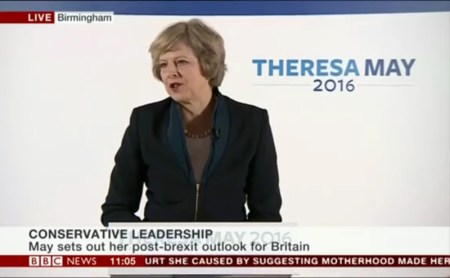 The glaring discrepancy between the UK establishment and the electorate explains the establishment’s quick acceptance of Brexit, for fear of becoming totally discredited. Pictured above: Theresa May launches her campaign for leader of the UK Conservative party on July 11, 2016, saying “Brexit means Brexit.”
The two earlier articles mentioned above first spotted the phenomenon of European disintegration and then explained it. Today, the intervening events have made the explanation all the simpler. Basically, the European political elites were correctly convinced, long ago, that considerable European integration was desirable, but their very successes in this area made them grossly overestimate what could and should be done further.
Up to a decade ago, it seemed that a similar pattern was becoming established in one EU country after another: the parliament was dominated by a large center-right party and a large center-left party that alternated in power from one election to another. The parallel to the United States seemed obvious, but the parallel was illusory, as we shall show.
Emboldened, the political parties concerned made the fatal mistake of trying to combine for the purpose of elections to the EU Parliament. Thus emerged a pan-European center-right pseudo-party, the “European People’s Party” (EPP), whose origins go back to a get-together of Christian Democrat parties in 1976. And a pan-European center-left pseudo-party, the “Party of European Socialists” (PES), founded in 1992 as an alliance between old-style Social Democrat parties and the former so-called Eurocommunist parties. The latter first emerged during the decline and discreditation of the Soviet Union in the 1970s and 1980s, then changed their names after its disappearance in December 1991. Thus, the core of Italy’s current Democratic Party derives from the Italian Communist Party (PCI), the major opposition party of post-war Italy.
Curiously but inevitably, the more those parties tried to unite, the more they lost support in their own countries of origin. Thus the Dutch Christian Democrats (CDA) are today a minor party of the right and the Panhellenic Socialist Movement (PASOK) barely crosses the threshold of 5% needed for entry into the Greek Parliament. (Incongruously, the last PASOK Prime Minister of Greece, George Papandreou, continues to be President of the Socialist International.) The reason for this development, however, is not far to seek.
Nationalism, it was forgotten, is an essential component of center-right sentiment. So a center-right party that prefers an international interest at the expense of the national interest of its own country loses credibility among its own core supporters; it becomes vulnerable to the rise of far-right upstart parties. Examples of this process in the EU are now so evident as not to need enumeration.
The attraction of socialism, it was forgotten, is that its core supporters expect increases in government social spending at the expense of financial stability. This becomes more difficult, the more a country is constrained by participation in a shared international framework. It becomes impossible to maintain once a country joins a common currency, since the usual remedy for socialist overspending is devaluation of the national currency. This is why PASOK has been eclipsed in Greece by the far-left SYRIZA, why the Spanish franchise of the PES (the PSOE) has lost severely to the upstart Podemos, and why support for its Dutch franchise (the PvdA) is now down to about the same as for each of two other left-wing parties.
It is also why in Britain, where the electoral system obstructs the rise of new parties, Jeremy Corbyn was voted leader by the Labour Party membership to the horror of the party establishment. Corbyn himself was a pronounced Euroskeptic until recently and only half-heartedly spoke in public for Remain, creating suspicions that he secretly voted for Leave.
A far-right party, like the Freedom Party (OFP) of Austria, has an easy sales pitch. Not so the far-left ones: after they come to power, it quickly and painfully becomes evident that they have no more ability than their derided Social Democrat predecessors to defy the constraints imposed by membership in the Eurozone.
Thus SYRIZA came to power in Greece and won a referendum to end austerity. The result was that all Greeks found that their bank accounts were virtually frozen: they were allowed to withdraw only sixty Euros a day. SYRIZA then split. The larger faction won the resulting general election and accepted the harsh conditions that the referendum had rejected. The paradoxical result in Greece is that the current government is a coalition of an upstart far-left party, SYRIZA, and an upstart nationalist party (the Independent Hellenes) that lies to the right of New Democracy (the Greek franchise of the EPP).
In other EU countries, however, the typical development has been the opposite: the erstwhile competing franchises of the EPP and the PES are in coalition against the motley upstart breakaway parties, since neither of the two gets an absolute majority in parliament any more. That is, their former raison d’être as competing alternatives has been abandoned in the need to survive in power at all. The paralysis in Spain comes from the fact that the two local franchises there are descended from the two sides in the murderous Civil War of 1936-1939. Joint government is still hardly imaginable especially for the losing socialists, who continued to suffer persecution long after the war.
Likewise, in the elections to the EU Parliament in May 2014, the EPP and the PES won only 221 and 191 seats respectively out of 751, each far short of a majority. So they clubbed together to make the top candidate of the EPP, Jean-Claude Juncker, President of the EU Commission and to retain the top candidate of the PES, Martin Schulz, as President of the Parliament. The incredible response of Juncker to Brexit has been to demand even tighter integration: he wants to force into the Eurozone the eight EU member states (other than the UK) that still have independent currencies. He also reiterated his proposal, originally made last March, to unite the armed forces of all states (with the UK gone) into a European army. For this he has the support of Schulz’s home party, the German SPD. That is, they want more and more of what the European electorates want less and less.
Especially in Eastern Europe, there are now also governments that resent the relentless centralizing urges of the EU establishment. In Hungary, for example, the government has rejected the demand of the EU Commission to absorb a quota of the immigrants currently streaming into Europe; it has scheduled a referendum on the matter for October 2. On the same day, Austria will hold a revote for the presidency, which the Freedom Party may narrowly win after narrowly losing the first time around.
These governments are among the new friends of Israel described in a recent Reuters article, titled “Diplomatic ties help Israel defang international criticism.” As it notes:
“Whereas a few years ago Israel mostly had to rely on Germany, Britain and the Czech Republic to defend its interests in the EU, now it can count Italy, Greece, Cyprus, Austria, Hungary and a handful of others among potential allies.”
These allies have no desire to penalize Israel on behalf of increasingly tedious Palestinians. On the contrary:
“Like Turkey, which last week agreed to restore diplomatic ties with Israel after a six-year hiatus, they see a future of expanding business, trade and energy ties.”
By “energy ties” is meant Israel’s recently discovered vast fields of natural gas, the phenomenon that we earlier dubbed “Israel as a Gulf State.” That is: just as governments care little for the human rights record of, say, Qatar in their eagerness to acquire its natural gas, so also the self-righteous moaning of the Palestinian Authority does not deter those governments from going for what Israel has to offer. As the Reuters article quotes a European ambassador: “There’s just no appetite to go toe-to-toe with Israel and deliver a really harsh indictment. No one sees the upside to it.”
Israel’s government is not, of course, gloating over the discontent spreading in the EU. But it surely appreciates some of the side effects.




 anneinpt
 artaxes
 danmillerinpanama
 davidking1530
 Peter Hofman
 Joseph Wouk
 Peter
Peter Louisiana Steve
 WarSclerotic
Recent Comments