Robert Spencer on Hannity, January 8, 2015, on Sharia No-Go Zones and the Charlie Hebdo jihadis, Jihad Watch Videos, January 9, 2015
Je Suis Jihad, Center for Security Policy, Frank Gaffney, Jr., January 9, 2015

It was an act of violence prescribed by shariah to punish what that code deems to be a capital offence: giving offense to Muslims by caricaturing, or even just portraying pictorially, the founder of their faith, Mohammed. Unfortunately, acknowledging this reality is a practice that continues to be eschewed by governments on both sides of the Atlantic and by many in the media – even as they decry the attacks.
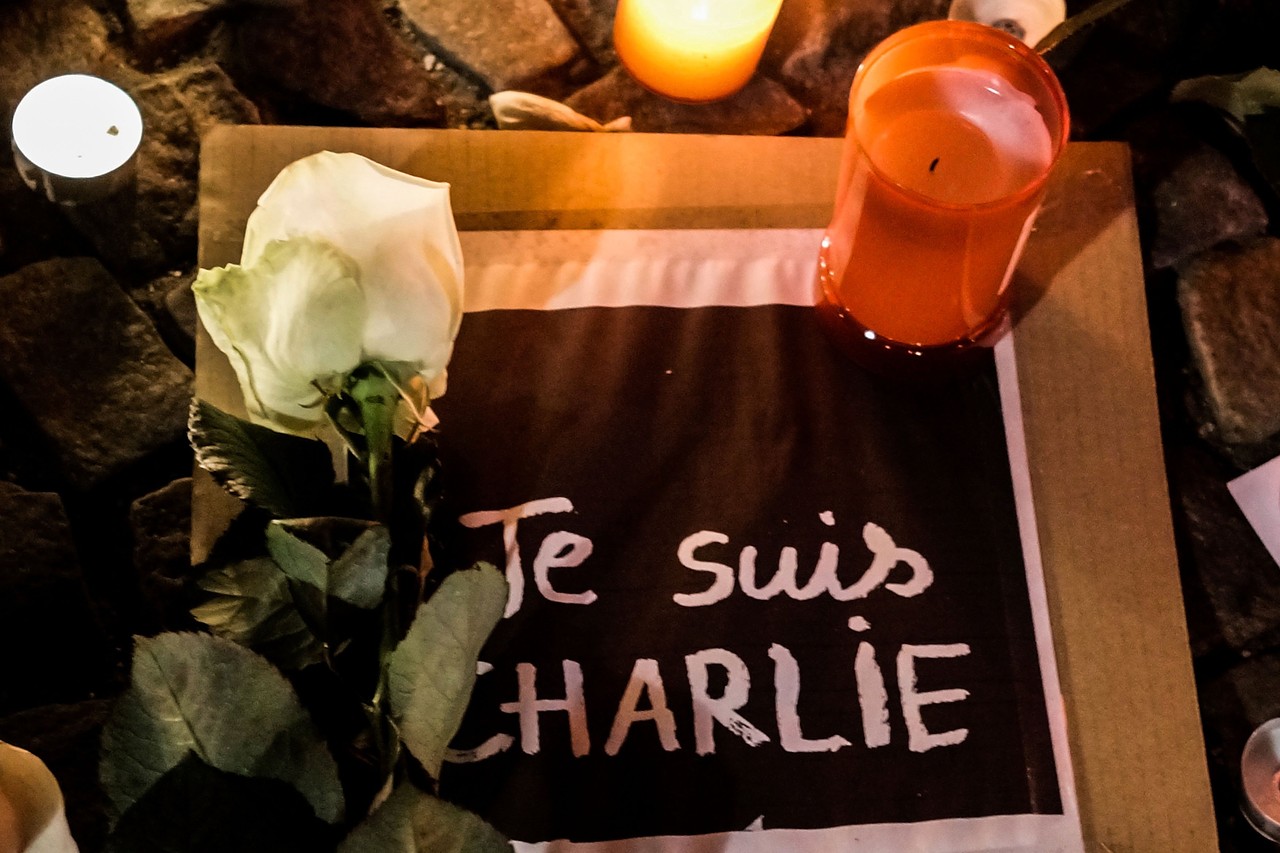
Therefore, it would be clarifying if, as those who profess solidarity with the fallen and their commitment to freedom of expression by declaring “Je suis Charlie” (I am Charlie) would also acknowledge the impetus behind the perpetrators: “Je suis jihad.”
*****************
In the aftermath of the murderous attack on the staff of Charlie Hebdo, the iconically irreverent French satirical journal, there is a widespread – and welcome – appreciation that the Islamic supremacist perpetrators sought not only to silence cartoonists who had lampooned Mohammed. They wanted to ensure that no one else violates the prohibitions on “blasphemy” imposed by the shariah doctrine that animates them.
In other words, the liquidation of twelve of the magazine’s cartoonists and staff – and a police officer (a Muslim, as it turns out) assigned to protect them after an earlier 2011 firebombing of its offices – was an act of jihad. Not “workplace violence.” Not antisceptic “terrorism” or the even more opaque “violent extremism.”
It was an act of violence prescribed by shariah to punish what that code deems to be a capital offence: giving offense to Muslims by caricaturing, or even just portraying pictorially, the founder of their faith, Mohammed. Unfortunately, acknowledging this reality is a practice that continues to be eschewed by governments on both sides of the Atlantic and by many in the media – even as they decry the attacks.
Therefore, it would be clarifying if, as those who profess solidarity with the fallen and their commitment to freedom of expression by declaring “Je suis Charlie” (I am Charlie) would also acknowledge the impetus behind the perpetrators: “Je suis jihad.”
Such a step could begin a long-overdue correction in both official circles and the Fourth Estate. Both have actually encouraged the jihadists by past failures to acknowledge the reality of jihad and shariah, and by serial accommodations made to their practitioners.
One of the most high-profile and egregious examples of this phenomenon was President Obama’s infamous statement before the United Nations General Assembly in September 2012 – two weeks after he first, and fraudulently, blamed the attack on U.S. missions in Benghazi, Libya on a online video that had offended Muslims: “The future must not belong to those who slander the prophet of Islam.”
This outrageous submission of the constitutional freedom of speech to shariah not only tracked with the sorts of statements one might have heard from global jihadists like al Qaeda’s Osama bin Laden, the Taliban’s Mullah Omar or the Supreme Guide of the Muslim Brotherhood. It was of a piece with an agenda the Obama administration had been pursuing since its inception: finding ways to satisfy the demands of another, less well known, but exceedingly dangerous jihadist group – the supranational Organization of Islamic Cooperation (OIC).
As documented in a superb film on the subject entitled Silent Conquest: The End of Freedom of Expression in the West (spoiler alert: I appear in this documentary, as do most of the preeminent international champions of freedom of expression), starting in March 2009, Team Obama began cooperating with the OIC in its efforts to use the UN Human Rights Council (UNHRC) to impose what amounted to shariah blasphemy laws worldwide. This collaboration ultimately gave rise to UNHRC Resolution 16/18 entitled, “Combating Intolerance, Negative Stereotyping and Stigmatization of, and Discrimination, Incitement to violence, and Violence against Persons based on Religion or Belief,” which was adopted with U.S. support in March 2011. Despite its pretense of protecting persons of any religion or belief, the motivation behind and purpose of Res. 16/18 was to give Islamic supremacists a new, international legal basis for trying to impose restrictions on expression they would find offensive.
Resolution 16/18 is, in other words, a form of what the Muslim Brotherhood calls “civilization jihad” – a stealthy, subversive means of accomplishing the same goals as the violent jihadists worldwide: the West’s submission, and that of the rest of the world, to shariah and a caliph to rule according to it.
It fell to then-Secretary of State Hillary Clinton to try to accommodate the Islamic supremacists’ demands. She launched something called the “Istanbul Process” which brought the United States, the European Union and the Organization of Islamic Cooperation together to find ways of giving force to Res. 16/18. On July 15, 2011, after paying lip service to the fact that, “for 235 years, freedom of expression has been a universal right at the core of our democracy,” Mrs. Clinton announced:
We are focused on promoting interfaith education and collaboration, enforcing anti-discrimination laws, protecting the rights of all people to worship as they choose, and to use some old-fashioned techniques of peer pressure and shaming, so that people don’t feel that they have the support to do what we abhor.
The Charlie Hebdo attack is a particularly vivid reminder of what comes of such appeasement and how it encourages jihadists – pursuant to their shariah ideology – to redouble their efforts, not just through stealth but through violence, to achieve our absolute submission. If are to have any hope of preventing more such incidents in the future, let alone far worse at the hands of shariah’s adherents, we must acknowledge the true nature of these enemies and adopt a comprehensive and effective counter-ideological strategy for defeating them.
Emerson on Fox’s Hannity: “No Go Zones and Sharia Courts…Europe is Finished.” Investigative Project, January 7, 2014
(Which is more deadly? The white flag of surrender flown in the name of multiculturalism throughout Europe and elsewhere, or the (non-Islamic, as we have repeatedly been told) Islamic State flag? The white flag flutters as it celebrates the killing of our souls, while the flag of Islam merely celebrates the killing of our bodies while “enriching” local culture with the “blessings” of multicultural diversity.– DM)
Sean Hannity: Welcome back to “Hannity.” So France is on high alert at this hour following today’s deadly terrorist attack that left 12 people dead. Investigators working around the clock to put the pieces together. So could a similar terrorist attack happen here at home? Joining me now terrorism expert Steve Emerson. Steve, I want to talk about the growth in population of people moving to France from Muslim countries. You have these no-go zones. You have sharia courts that they’ve allowed. I assume the French, they wanted to be accepting and accommodating and have not insisted on assimilation. Has that played a part in this and is that something we’ve got to be on alert for now?
Steve Emerson: Well certainly throughout Europe, Sean, you have “no-go zones.” When I was in Brussels a year ago when I asked the police to take me to the Islamic zone or the Islamic community area they refused. They said we don’t go there. This goes on in Belgium, this goes on in Sweden, in the Netherlands, in France, it goes on in Italy. It goes on throughout Europe. So there are no-go zones.
Sean Hannity: Hang on. “No-go zone” means no non-Muslims, no police, no fire, their own court system. So basically these countries have allowed Muslims to take over parts of their country, entire portions, towns.
Steve Emerson: These are semiautonomous countries within countries in which the federal governments there have basically given up, surrendered their autonomy, surrendered their authority and goes against the entire grain of what social democracy was after World War II, was to integrate everybody into a socialist democracy, which is really a pluralistic experiment which worked. And everybody was supposed to be egalitarian; at least everyone was supposed to be equal in a pluralist society. What has happened however with migration of Muslims – and [although the problem] not all Muslims, the problem is the domination of Muslims [communities] within European countries, particularly in France…by radical Islamic groups. The mosques and Islamic centers… infuse the Islamic population with a militant strain of Islam that teaches them the infidel has to be killed and that the Crusaders like the French, Jews and Americans have to be killed or punished like [we saw] today. And this goes on and on and on. And the reaction unfortunately as we saw this morning from the President or from the President [Hollande]… of France or from [Prime Minister] Cameron of Britain is this has nothing to do with Islam, this is just a simple act of [non-religious] violence and that Islam is a religion of peace. And when they say those things they exonerate the leaders of Islamic communities throughout Europe and the militants themselves are given a free pass.
Sean Hannity: The next logical question then, Steve, is, okay, what about visas for people coming from Muslim countries? What about people that come to America that are Muslim? I’m sure the average American believes in freedom of religion, they don’t want to discriminate, they don’t want to be called Islamophobic, all of these things. How do you balance the two if people are coming from Muslim countries, how do you determine if they hold radical views, if they want sharia implemented in America like this guy Chaudary that I talked about?
Steve Emerson: Well you raise a very good question because that’s the role – you know there are DHS officers planted, placed overseas in US embassies in certain countries that have produced disproportionate numbers of terrorists like in Egypt or Saudi Arabia or elsewhere. Their role is to collect the intelligence on the visa applicants coming to the United States. The problem has been under this administration is that DHS has specifically instructed DHS agents overseas to basically not do their job, to not collect this intelligence. And when the intelligence has been collected, to show that the applicants coming to the United States with the visas in hand have radical backgrounds are either connected to the Muslim Brotherhood, connected to the Taliban, connected even [tangentially] to ISIS, they’ve been told to look away. I can tell you that personally. having had discussions with DHS officials and other agents from DHS who operate in an environment that’s Orwellian. And so you’re right, there’s a real problem here and our national security being violated.
Sean Hannity: Do you think France can get control of their country again and take over these no-go zones, stop sharia courts? I know prayer rugs are in just about every hotel if you go to Paris, according to a friend of mine who travels there quite often. Do they have the ability now to stop this, to say no you either assimilate or you have to go?
Steve Emerson: That’s a great question. I think they’ve reached critical mass, frankly. I’ve said this before, I think Europe is finished.
Sean Hannity: You think it’s finished? Well there’s a poll out there. One in six people in France actually support ISIS. Over 1,000 French have gone to join ISIS. So you’re saying you don’t think they can recover, that’s there’s too many radical Islamists that have taken over this portion of that country and it would be a war to take it back?
Steve Emerson: They [the European governments] wouldn’t take it back. They refuse to take it back. Sweden just engineered this artificial political coalition designed to stop any type of immigration prohibitions until the year 2022. So we’re talking about a situation throughout Europe where there’s a refusal to acknowledge the problem. And two, even if they did acknowledge the problem, what are they going to do if six to seven to eight to nine percent constitute a serious radical threat, not every single person but within that percentage, [there exist] no-go zones with sharia courts? Who are they hurting the most? They’re hurting Muslim women the most. They’re the ones who get subject to beatings, to death, to honor crimes.
Sean Hannity: So women who live in France are subject to sharia. They’re not subject to the laws of the country.
Steve Emerson: Not all Muslim women.
Sean Hannity: If they live in the no-go zone.
Steve Emerson: Absolutely. You’re 100% right. That’s the problem.
Sean Hannity: All right. That’s a big problem, and a warning I think.
How to Answer the Paris Terror Attack, Wall Street Journal, Ayaan Hirsi Ali, January 7, 2015
If there is a lesson to be drawn from such a grisly episode, it is that what we believe about Islam truly doesn’t matter. This type of violence, jihad, is what they, the Islamists, believe.
Those responsible for the slaughter in Paris, just like the man who killed the Dutch filmmaker Theo van Gogh in 2004, are seeking to impose terror. And every time we give in to their vision of justified religious violence, we are giving them exactly what they want.
We appease the Muslim heads of government who lobby us to censor our press, our universities, our history books, our school curricula. They appeal and we oblige. We appease leaders of Muslim organizations in our societies. They ask us not to link acts of violence to the religion of Islam because they tell us that theirs is a religion of peace, and we oblige.
We have to acknowledge that today’s Islamists are driven by a political ideology, an ideology embedded in the foundational texts of Islam. We can no longer pretend that it is possible to divorce actions from the ideals that inspire them.
****************
After the horrific massacre Wednesday at the French weekly satirical magazine Charlie Hebdo, perhaps the West will finally put away its legion of useless tropes trying to deny the relationship between violence and radical Islam.
This was not an attack by a mentally deranged, lone-wolf gunman. This was not an “un-Islamic” attack by a bunch of thugs—the perpetrators could be heard shouting that they were avenging the Prophet Muhammad. Nor was it spontaneous. It was planned to inflict maximum damage, during a staff meeting, with automatic weapons and a getaway plan. It was designed to sow terror, and in that it has worked.
The West is duly terrified. But it should not be surprised.
 GETTY IMAGE
If there is a lesson to be drawn from such a grisly episode, it is that what we believe about Islam truly doesn’t matter. This type of violence, jihad, is what they, the Islamists, believe.
There are numerous calls to violent jihad in the Quran. But the Quran is hardly alone. In too much of Islam, jihad is a thoroughly modern concept. The 20th-century jihad “bible,” and an animating work for many Islamist groups today, is “The Quranic Concept of War,” a book written in the mid-1970s by Pakistani Gen. S.K. Malik. He argues that because God, Allah, himself authored every word of the Quran, the rules of war contained in the Quran are of a higher caliber than the rules developed by mere mortals.
In Malik’s analysis of Quranic strategy, the human soul—and not any physical battlefield—is the center of conflict. The key to victory, taught by Allah through the military campaigns of the Prophet Muhammad, is to strike at the soul of your enemy. And the best way to strike at your enemy’s soul is through terror. Terror, Malik writes, is “the point where the means and the end meet.” Terror, he adds, “is not a means of imposing decision upon the enemy; it is the decision we wish to impose.”
Those responsible for the slaughter in Paris, just like the man who killed the Dutch filmmaker Theo van Gogh in 2004, are seeking to impose terror. And every time we give in to their vision of justified religious violence, we are giving them exactly what they want.
In Islam, it is a grave sin to visually depict or in any way slander the Prophet Muhammad. Muslims are free to believe this, but why should such a prohibition be forced on nonbelievers? In the U.S., Mormons didn’t seek to impose the death penalty on those who wrote and produced “The Book of Mormon,” a satirical Broadway sendup of their faith. Islam, with 1,400 years of history and some 1.6 billion adherents, should be able to withstand a few cartoons by a French satirical magazine. But of course deadly responses to cartoons depicting Muhammad are nothing new in the age of jihad.
Moreover, despite what the Quran may teach, not all sins can be considered equal. The West must insist that Muslims, particularly members of the Muslim diaspora, answer this question: What is more offensive to a believer—the murder, torture, enslavement and acts of war and terrorism being committed today in the name of Muhammad, or the production of drawings and films and books designed to mock the extremists and their vision of what Muhammad represents?
To answer the late Gen. Malik, our soul in the West lies in our belief in freedom of conscience and freedom of expression. The freedom to express our concerns, the freedom to worship who we want, or not to worship at all—such freedoms are the soul of our civilization. And that is precisely where the Islamists have attacked us. Again.
How we respond to this attack is of great consequence. If we take the position that we are dealing with a handful of murderous thugs with no connection to what they so vocally claim, then we are not answering them. We have to acknowledge that today’s Islamists are driven by a political ideology, an ideology embedded in the foundational texts of Islam. We can no longer pretend that it is possible to divorce actions from the ideals that inspire them.
This would be a departure for the West, which too often has responded to jihadist violence with appeasement. We appease the Muslim heads of government who lobby us to censor our press, our universities, our history books, our school curricula. They appeal and we oblige. We appease leaders of Muslim organizations in our societies. They ask us not to link acts of violence to the religion of Islam because they tell us that theirs is a religion of peace, and we oblige.
What do we get in return? Kalashnikovs in the heart of Paris. The more we oblige, the more we self-censor, the more we appease, the bolder the enemy gets.
There can only be one answer to this hideous act of jihad against the staff of Charlie Hebdo. It is the obligation of the Western media and Western leaders, religious and lay, to protect the most basic rights of freedom of expression, whether in satire on any other form. The West must not appease, it must not be silenced. We must send a united message to the terrorists: Your violence cannot destroy our soul.
We Are Charlie: Free Speech v. Self-Censorship, Gatestone Institute, Douglas Murray, January 8, 2015
(How many of our “allies” against the (non-Islamic, we are told) Islamic State, et al, take comparable measures under their laws against those who “insult” Islam or its prophet? Why does Obama persist in advancing, directly or indirectly, the notion that “the future must not belong to those who slander the prophet of Islam?” Does the future instead belong to Islam and its prophet? Unless and until the evil that is Islam is recognized as an existential evil that threatens our lives as well as our freedoms, rather than ignored and/or tolerated, the future may well belong to it. How will the appeasers of all things Islamic react when Iran gets “the bomb” and uses it, not only on the “evil” they perceive as Israel, but on them as well?– DM)
— DM)
It is easier to denigrate the people warning us about a danger . . . than it is to address the danger they are warning us about. The same holds true for Europe’s policy toward Israel: It is easier to bully an open, pluralistic democracy than to take on all those terrorists and the countries that support them, and it is to do what is necessary to get them to stop.
***********************
Will we keep on blaming the victims? Perhaps the media assume that it is easier to force good people to keep quiet, or keep their own media offices from being attacked, than to than to tackle the problem of Islamic extremism head-on. It is easier to blame Geert Wilders, Ayaan Hirsi Ali, Lars Hedegaard, Suzanne Winters, Salman Rushdie or Charlie Hebdo — and even put some of them on trial — than to attack the attackers, who might even attack back!
The press and the media seem to prefer coerced self-censorship: It is your own fault if you get hurt: none of this would be happening to you if you had only kept your mouth shut. It is easier to denigrate the people warning us about a danger than it is to address the danger they are warning us about.
Do you think a country should change its policies because segments of one community will run into newspaper offices and gun people down if you don’t?
If those in positions of influence do not deal with this problem now, we will not like those who deal with it later.
Wednesday’s massacre at the Paris offices of the magazine Charlie Hebdo was not just a barbaric act of jihadist violence. It was also a test for the West and for the freedom of speech in the West. It is a test that we all have been failing.
Those of us who have proposed that all Western — and in particular European — news outlets should multilaterally publish the Charlie Hebdo cartoons have been greeted in return with a terrified and terrifyingly self-conscious silence. The papers and broadcasters do not want to do it. Last time they refused to republish the cartoons, from Denmark’s Jyllands Posten, they said it was because the cartoons were from a “right wing” newspaper. This time they refuse to republish cartoons from a “left-wing” newspaper. It does not matter what the politics are — it is not about the politics, it is about the cartoons. The sooner the press at least has the guts to admit this, the better.
But there has been much worse than the cringing surrender that this refusal denotes. Consider just a couple of even worse examples from the mainstream media’s coverage of these barbaric events.
In the United Kingdom on Wednesday, the Daily Telegraph newspaper was straight out of the starting blocks. Within a couple of hours of the attack, as the bodies of the slain journalists had not even been identified, The Telegraph chose to run a report headlined, “France faces rising tide of Islamophobia“!
The press was already blaming the victims. Commentators on CNN opined that Charlie Hebdohad been “provoking Muslims” for some time. Perhaps they assum that it is easier to force good people to keep quiet, or keep their own media offices from being attacked, than to tackle to the problem of Islamic extremism head-on. It is easier blame Geert Wilders, Ayaan Hirsi Ali, Lars Hedegaard, Suzanne Winters, Salman Rushdie or Charlie Hebdo — and even put some of them on trial — than to attack the attackers, who might even attack back!
The press and the media seem to prefer a policy of coerced self-censorship: It is your own fault if you get hurt; none of this would be happening to you if you had only kept your mouth shut. It is easier to denigrate the people warning us about a danger on than it is to address the danger they are warning us about. The same holds true for Europe’s policy toward Israel: It is easier to bully an open, pluralistic democracy than to take on all those terrorists and the countries that support them, and it is to do what is necessary to get them to stop. That is also what Germany’s Chancellor Angela Merkel broadcast in her New Year’s message when she warned against the anti-Islamic “Pegida” marches in Germany: she said it was the marchers against Islamic extremism that have “coldness” in their hearts, not the propagators of Islamic extremism.
And so the Telegraph’s first response piece listed the terrible events of the rise of right-wing and other forces — as though the attack were the response to radical Islam, rather than even suggest that it might be radical Islam itself that was at fault. Once again, the “backlash” against Muslims took precedence over the actual murder of non-Muslims at the hands of Muslim fanatics.
Over in New York, The New York Daily News is not a newspaper that tends to pull its punches. But consider what it did while the dead were still lying in the magazine’s offices. It ran a story which showed images of a Parisian policeman at the moment that the terrorists — shouting “Allahu Akhbar” [“Allah is Greater!”] — gunned him down in cold blood. It also showed an image from 2011 of Charlie Hebdo editor and publisher Stéphane Charbonnier standing outside his firebombed offices, the last time the magazine was attacked, holding up an edition of the paper with an image of Mohammed on the front. But the image was pixelated. Yes — that’s right. The paper was willing to show a man who had been alive that morning in the process of being murdered. But they chose not to publish a cartoon of a historical figure who died 1400 years ago.
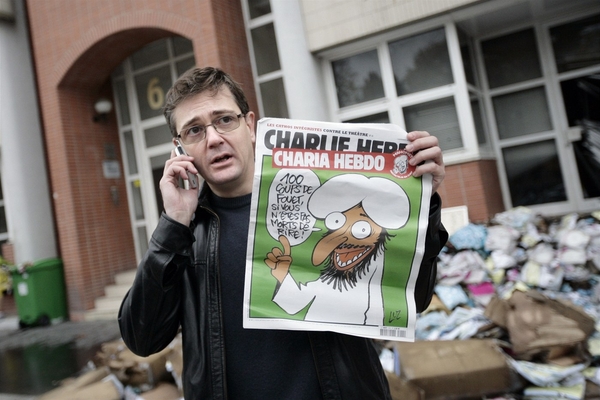 Stéphane Charbonnier, the editor and publisher of Charlie Hebdo, who was murdered yesterday along with many of his colleagues, is shown here in front of the magazine’s former offices, just after they were firebombed in November 2011.
This is the pass that the free press has come to, even in countries such as America, and even in places where there has been no attack on a newspaper’s offices for “insulting” somebody else’s prophet. And then again, in the tide-wave of bafflement, the same excuses have begun to get rolled out:
“Has this to do with France’s foreign policy?” interviewers and pundits have mused. In this particular instance, the answer to that question is “no more than usual.” But the follow-on bit of the answer should be even more easily said: “So what if it were?” Let us say that you do not like France’s foreign policy. Do you think that a country should change its policies because segments of one community will run into newspaper offices and gun people down if you don’t?
Another diversionary question has been, has been, “Does this have something to do with the situations in which many French Muslims find themselves – the banlieues (less-affluent French suburbs) and so forth?” The only answer I have so far managed to give to this question is that there are really people out there who may not like where they live but do not run into newspaper offices with Kalashnikov rifles and start firing off. Many people do not like their neighborhoods. It is not the point.
Other media have gone straight for the placatory option. Across in Britain, from left to right, the response was the same: “British Muslim leaders all come out in opposition to Paris magazine attack.” As though head-shaking constituted some great breakthrough. There seems to be a long-term pattern — no matter how often the attackers shout “Allahu Akbar!” or announce, as yesterday, that, “The Prophet [Mohammad] has been avenged” — of condemning terrorist attacks in general, accompanied by bewilderment at the thought that they that it could have anything do with “Islam.”
There are also great loud woolly condemnations of “terrorism,” but never accompanied by naming the men or groups involved. And will we keep on blaming the victims? This all bodes very ill.
Charlie Hebdo was — I hope I can still say “is” — a magazine that satirizes any and all ideas. Their targets have included not only Mohammed, but also Christians, Jews, the French novelist Michel Houellebecq and the Front National leader Marine le Pen. At this moment, mainstream media and politicians should be ensuring that they understand the concerns of their publics, rather than treating them as radioactive “racists” and “Islamophobes.” If those in positions of influence do not deal with this problem now, we will not like those who deal with it later.
Europe’s Year of the Jihadist, Investigative Project on Terrorism, Abigail R. Esman, December 29, 2014
(But the world is less violent than it has ever been. It is also more tolerant. Thus spake Obama.
— DM)

Among the trends of 2014 – “Gone, Girl,” Lena Dunham, and $55,000 potato salad – was another the list-makers seem to have missed: it was also a very good year for Islamic jihad. And while this was true on the battlefields of Syria and the cities and villages of Pakistan, it was true, too, in more subtle ways throughout the West – and especially in Europe. It was, for instance, the year of Mehdi Nemmouche’s slaughter of four Jews at the Jewish Museum in Brussels.
It was the year that Belgium itself was named a “terrorist recruiting hub” by the Wall Street Journal. And in Germany, France, England, and the Netherlands, pro-Islamic State demonstrations laid bare the growing support of terrorism and Islamic jihad among Europe’s expanding Muslim population – all while politicians either stood back or even contributed to the praise.
Throughout 2014, Europeans faced pro-IS, anti-Jew demonstrations in Paris, Hamburg, Amsterdam, London and The Hague, and the establishment of “sharia zones” in London, Wupperthal, and elsewhere. True, such zones do not necessarily delineate areas in which sharia law, rather than state law, applies. But the term helps them define those largely-Muslim neighborhoods whose residents tend to be radical and who often support jihadist movements both at home and abroad.
Combined, these events signal the increasing success of Islamists who are working to change Europe from within – sometimes through violence, but more often through strategies known as “stealth jihad” – a way of applying social and political pressures to transform the current culture.
Take, for instance, the response of Josias van Aartsen, mayor of The Hague, to radical Muslims who called for the death of Dutch non-Muslims and Jews during pro-IS rallies in August: then on holiday, Van Aartsen declined to return home, ignoring even the throwing of stones at non-Muslims and the police. Only when a counter demonstration against IS was planned in the same, Muslim-majority neighborhood did Van Aartsen take action: he forbade it. “Too provocative,” he said.
Or there are the recently-leaked intelligence briefs in France, as reported by the Gatestone Institute, that “Muslim students are effectively establishing an Islamic parallel society completely cut off from non-Muslim students,” while “more than 1000 French supermarkets, including major chains such as Carrefour, have been selling Islamic books that openly call for jihad and the killing of non-Muslims.”
In England, an “Operation Trojan Horse” outlined plans to Islamize schools in Muslim neighborhoods. According to the Guardian, a government investigation of the program last summer found a “‘sustained, coordinated agenda to impose segregationist attitudes and practices of a hardline, politicised strain of Sunni Islam’ on children in a number of Birmingham schools.” Among those responsible for the “Operation” were the Association of Muslim Schools – UK and the Muslim Council of Britain – the same organization that, in 2011, declared that women who do not veil their faces “could be guilty of rejecting Islam.”
Ironically, it seems to have been England’s own culture that allowed the rise of Islamist teachings in its schools to begin with. Even Britain’s education secretary Nicky Morgan admitted to the New York Times that much of the operation’s success could be attributed to public “fear of being accused of racism and anti-Islamic views.” Not for nothing did former Obama advisor Lawrence Krauss declare the British “too polite” and “scared of offending ‘vocal and aggressive Muslims.'”
The government’s discovery of “Operation Trojan Horse” and immediate efforts to dismantle it are commendable, but it is difficult to assess the damage already done to Muslim children in the British schools. By some accounts, as many as 2,000 Britons have joined the (Sunni-led) jihad in Syria and Iraq. That includes the man known as “Jihadi John,” who beheaded U.S. journalists James Foley and Steven Sotloff. And, experts warn, the number of so-called “junior jihadis” – children under 10 who have become radicalized – is on the rise.
Not that such warnings are likely to do much good: The UK has, until recently, spent tremendous resources on programs aimed at preventing Muslim youth from joining militant groups, which have for the most part failed. “Having undertaken the ‘most significant domestic program by any Western country to foster a moderate version of Islam and prevent radicalization, the UK has effectively given up trying to stop jihadists from being created,” James Brandon, the former research director at one such program, told Reuters.
Despite such developments, European lawmakers have had a hard time figuring out how to deal with Muslim radicals, especially with returnees from Syria and Iraq. England is hardly the only place where politicians fear “offending” the sensibilities of Muslim groups. Although an estimated 450 Germans have joined the jihad in Syria, German Green Party domestic policy expert Irene Mihalic told the magazine Der Spiegel in September that tougher counterterrorism laws were unnecessary because “there are already ‘sufficient levers available to impose bans and limitations’ on terrorists and their supporters.” Majority parties apparently disagreed. Later that month, Germany became the first country to fully outlaw IS, along with all expressions of support for the terrorist group, from banners and graffiti to public demonstrations and endorsements by local mosques.
Such has hardly been the case in Denmark, though, where unwillingness to “offend” or “provoke” the country’s Muslim community has translated into a program that seeks to rehabilitate returning jihadists, rather than imprison them. In the country that boasts the second-largest number (per capita) of Muslims to join jihadist groups, returnees receive generous handouts in the form of government assistance in finding homes and jobs, or tuition aid in order to continue their education. In addition, the rehab program “does not try to change the fundamentalist beliefs of the returning fighters – as long as they don’t advocate violence,” CNN reports.
Evidently pampering jihadists isn’t working very well: Danish intelligence recently warned that returnees from IS and Al Nusra camps now pose a “significant” threat to the country. One jihadist profiled by CNN said that he plans to return to Syria to rejoin the caliphate once he completes his Danish government-funded education.
Other European governments have been reluctant to prosecute those recruiting for ISIS and other terrorist groups – groups that are in effect encouraging people to commit murder. In December, Dutch courts declared a 20-year-old woman “not guilty” of recruiting women to join the jihad in Syria on the grounds that women in IS are not permitted to fight – and hence cannot be considered terrorists. In another case, 23-year-old “Imad al-O” was found guilty of helping a 16-year-old girl travel to Syria via Egypt. His sentence? Three months prison time and 240 hours of community service.
Through it all, “lone wolf” radicals continue their attacks in European cities, such as the Dec. 21 attack in Dijon by a man who drove a car into a crowd of pedestrians, claiming he was “acting for the children of Palestine.”
The attack “for the children of Palestine” occurred just as French officials determined to join Sweden in recognizing a Palestinian state – a kind of international version, you might say, of England’s decision to stop trying to keep Muslim youth from radicalizing and becoming warriors for Islam. Unlike Kickstarter potato salads, it’s a trend we can well leave behind as we move into the new year.
Is there a solution? Israel Hayom, Dror Eydar, December 26, 2014
(For European nations, America and others, abortive efforts to bring “peace” among Israel and warring Islamic factions provide welcome distractions from difficulties elsewhere which are even less tractable and more damaging to them. — DM)
[N]ot even a utopian-style peace treaty will end the fight against Israel that is being waged by Europe and the global left wing (and here as well, to some degree). The dozens of organizations that have been established to take away the Jews’ right to their own land (for some reason, these groups are known as “human-rights organizations”; after all, you know, we Jews have no human rights) will no longer show any interest in the cruel dictatorship that they helped set up next door. Instead, they will aim their heavy artillery against Israeli society, which they will accuse of racism for being an exclusive state for the Jewish ethnic group instead of a “state of all its citizens,” which is actually code for “a state of all its nationalities.”
*****************
1. The upcoming elections have plunged Israel into a wartime atmosphere, and a good deal of blame is being thrown about. Each side, instead of looking to its own misdeeds, is making accusations against the other. They are not saying, “We have sinned,” but rather, “You have sinned.”
Here, too, the accusations are meant to generate shallow headlines rather than addressing deep issues. This is a big mistake. Despite the piles of mud and refuse that are customarily dumped onto the average Israeli, the average Israeli is generally well aware of what is going on. They understand ideology and vision.
On the political plane, one gets the impression that the discourse, at least on the Left, is still stuck in the 1980s, before the great experiments that the Oslo Accords brought upon us — before Hamas, before Islamic State, before the Middle East fell to pieces. What can Tzipi Livni accomplish with the Palestinians that she hasn’t done over the past two years, when she was in charge of the talks with them? Did she bring any sort of agreement to the government that it turned down? If so, let her tell us.
But she knows that there is nobody to talk to on the other side. They never had the slightest desire to end the conflict with the Jews. I would be glad to hear any Arab leader name his final demands — the ones for which, if they were fulfilled, he would sign on the dotted line that the conflict was over and state that he had no further claims. Are there any volunteers?
We have not even mentioned Jerusalem or the refugees or recognition of Israel as a Jewish state. The demand that our neighbors recognize Israel as the national home of the Jewish people was not for us, but for them. That is the litmus test of the integrity of their intentions. Do they recognize the right of Jews to any part of the historical Land of Israel? We know that any Arab leader who grants such recognition can expect an uncomfortable death.
That is the reason for the effort to anchor the Jewish nature of the State of Israel in a Basic Law. It is because not even a utopian-style peace treaty will end the fight against Israel that is being waged by Europe and the global left wing (and here as well, to some degree). The dozens of organizations that have been established to take away the Jews’ right to their own land (for some reason, these groups are known as “human-rights organizations”; after all, you know, we Jews have no human rights) will no longer show any interest in the cruel dictatorship that they helped set up next door. Instead, they will aim their heavy artillery against Israeli society, which they will accuse of racism for being an exclusive state for the Jewish ethnic group instead of a “state of all its citizens,” which is actually code for “a state of all its nationalities.”
2. As we look on, Europe is falling like a ripe fruit at the feet of the radical Islam sweeping over it. The more terrorism conquers the streets of Europe, the greater the Europeans’ desire will be to pay the terrorists a ransom in exchange for being left in peace, unmolested. As history has taught us, the ransom will be the Jews. The ludicrous statements by the European parliaments about recognizing the Palestinian state show the blindness of a society in decline that lost its basic instincts long ago. The Europeans care nothing about the Palestinians, whom they have doomed to a life of misery and suffering under oppressive regimes that are among the worst in the world, where there is no such thing as basic human rights.
The Palestinians are the last thing that the Europeans care about, just as they care nothing about the atrocities being perpetrated in Syria, Iraq or Africa. The Europeans are recognizing the Palestinian state not because they have any desire to improve our neighbors’ situation, but because they have a problem with the Jews. They always did.
Ironically, the return to Zion made the Jewish problem worse because it gave the Jews an independent political living space — which the Europeans find completely unacceptable. That is also the reason why there are dozens of European organizations in this region, and why they funnel hundreds of millions of euros supposedly to help the Palestinians, but actually in efforts to undermine the legitimacy of the Jewish state. The “peace process” is just one more tool in that mechanism.
3. The talk of a “diplomatic agreement” is also a media ransom, lip-service paid by politicians who seek the sponsorship of the media party. Avigdor Lieberman is quite familiar with this work.
“We must reach a diplomatic agreement,” he said in a “closed-door conference,” and received flattering headlines right away. “What is going on today is that they are doing nothing; there is a status quo. The initiative must be a comprehensive regional agreement.”
Have we not heard those empty phrases a thousand times already? Have we not tried to reach a political agreement in all kinds of ways? Has Prime Minister Benjamin Netanyahu not gotten into trouble with his own camp over it? Did he not freeze construction in Judea and Samaria for ten months? And, before him, did Ehud Olmert not offer our neighbors what even Lieberman (I hope) would never dare offer?
And what about the two Yisrael Beytenu princes, Uzi Landau and Yair Shamir? Where are they? Why are they not responding to their party chairman’s heretical statements? After all, were they not the ones who gave Lieberman the stamp of approval to be a right-wing party? More evidence of Lieberman’s desertion to the Left is his use of the well-known leftist scare tactic terminology: “a political tsunami.” But what burst out this week was more of a police tsunami against the members of Yisrael Beytenu. Now that the leader has adopted the Orwellian language of peace and speaks the language of the media party, maybe they will cut him some slack.
4. In the end, the dispute between most of the Right and most of the Left boils down to one question: Do we believe the Palestinians or not? Palestinian Authority President Mahmoud Abbas has declared many times that he will never recognize Israel as a Jewish state, and he specifically named 6 million, with all its symbolism, as the number of Palestinians who expect their demand for the right of return to be fulfilled. Abbas is currently being kept alive by the Israeli army, which is protecting him as they would a delicate flower from attacks by the street, which supports Hamas. This does not stop the Palestinians from going all over the world, accusing us of every possible atrocity.
The purpose of their action is to gain the maximum amount of territory at the minimum price — actually, for no price at all — but not to establish a tiny statelet. The past hundred years have taught us that what unites Arab-Palestinians is not the desire to improve their own living conditions, but to destroy the Jews’ lives. What more has to happen for us to believe what they say? In the meantime, they are sticking close to us so that we will protect them against Islamic State.
5. So what is the solution? First, whoever said that there was a solution? Second, if we tried and did not succeed, maybe we ought to leave something for future generations to accomplish. You do not really believe the well-known chorus of lamentation that things are bad here and that the country is “stuck.”
We have succeeded quite well, thank God, considering the fact that only one of our hands is engaged in construction, development and cultural work, since the other is busy with self-defense. Where were we just 70 years ago, in 1944 — and where are we now? Let us put things in perspective.
The unlikely founding fathers of the Islamic State
By Missing Peace
via The unlikely founding fathers of the Islamic State | Missing Peace | missingpeace.eu | EN.

The rise of the Islamic State (sometimes called ISIL) is commonly seen in the West as something that emerged more or less out of the blue. US President Obama for instance has said the dramatic rise of IS was not anticipated by the intelligence services of the US.
That’s not true, however. At about the time that Obama made this claim, European diplomats stationed in Syria told a journalist working for an Asian newspaper that the CIA had repeatedly warned the US government of the danger posed to America by the IS. The CIA termed it the greatest threat to the US since the Second World War, according to the diplomats.
So it may be more accurate to say it was Obama himself who underestimated the danger of the Islamist movement, and who chose to ignore the CIA’s warnings.
Why? Because heeding those CIA warnings would have meant admitting that US policy in Syria and Iraq had failed, and that his disengagement policy in the Middle East needed significant adjusting.
Von Oppenheim’s Jihad strategy
As we will see,the Islamic State ‘s current campaign of Jihad is not only unsurprising but is in large measure the result of a strategy that has been known for more than a hundred and twenty years and was devised by a German diplomat of Jewish origin.
That diplomat was Max von Oppenheim, born in Cologne in 1860 to a Jewish banking family whose members converted to Catholicism after his birth.
Von Oppenheim traveled throughout the Middle East in the last years of the 19th century, visiting Syria, Mesopotamia (now called Iraq), the Persian Gulf, Morocco and Egypt. After his return to Germany, he published his observations in a two-volume book. He studied law and, later, Arabic in Egypt, and in 1896 was became an attaché at German’s embassy in Cairo, Egypt.
During that Egyptian stint, von Oppenheim authored 467 reports on the Middle East, including a lengthy report on the rise of the Pan-Islamic movement. These influenced and to an extent even determined German policies in the region. He eventually became a key adviser to the German emperor Wilhelm.
On the eve of Wilhelm’s visit to the Middle East in 1889, von Oppenheim recommended that Germany support the emerging Islamist movement. This, he argued, would benefit German interests in the region. On one hand, the Germans were without colonies in the Middle East. On the other, the area’s Muslims sought an end to the dominance of the Christian powers – Great Britain, France and Russia – in a region with a Muslim-majority population. There was therefore a shared interest. The Muslims alone were not able to bring an end to foreign domination. And German was anxious to expand its influence in the Middle East at the expense of the French and British.
In his report to the emperor on Pan-Islamism, Von Oppenheim explained that the Muslims already had established a Caliphate, an overarching state, in the Middle East in the seventh century and that state had existed for centuries. The German diplomat argued that the Ottoman Turks had managed to breathe new life into this state and had succeeded in attracting Muslimloyalty to the Sultan/Caliph.
The Muslim masses increasingly viewed the Ottoman leader as the protector of Islam and its holy sites, Von Oppenheim wrote. He concluded that if the Sultan would issue a fatwa calling for Jihad, three hundred million Muslims could be counted upon to rise in revolt and put an end to Anglo-French dominance in the Middle East.
The mission, in his words, was therefore “to unleash Muslim fanaticism that would border on madness”.
Von Oppenheim’s plan led to a pact between Germany and the Ottoman Empire. However, the concept of a massive jihad that might have produced a German-Turkish victory over the Allies in the First World War failed completely.
Mainly, this was the result of fundamental errors in his analysis. Von Oppenheim ignored the internal divisions in the Muslim world, for instance. And he over-estimated the extent of Arab acceptance of the Turkish Caliph’s authority.
But along with a group of German Middle East experts, Von Oppenheim succeeded in establishing Islamist groups that did in fact begin to execute the planned Jihad in certain Muslim countries.
In November 1914, he dispatched a 136-page plan entitled “Revolutionizing the Islamic territories of our enemies” to his emperor. The plan was quickly approved and Von Oppenheim’s team was provided with the necessary funds. Shortly afterwards, Von Oppenheim’s terrorist groups began deploying suicide attacks as a means of achieving their goals. In India, for instance, a group of 25 Jihadists attacked British targets.
German experts
The German experts recognized that there was a risk the forces of jihad would eventually be out of control and turn into an offensive against the West. The unfolding of events after the defeat of Germany and Turkey in World War I and the emergence of Franco-British domination over the Middle East resulting in the Sykes Picot agreement proved them right.
Sykes-Picot, in particular, resulted in a redefined Middle East of states whose borders were drawn by the French and British. These borders however failed to take account of the tribal nature that had long characterized the Middle East. They also ignored the sharp divisions between Sunni and Shiite Muslims.
The so-called Arab Spring in 2010 represented a kind of turning point. Dictatorships in the area had prevented some of the states that emerged under British-French influence from falling apart. Their leaders had more or less succeeded in curbing sectarian violence within their borders.
But then came the fall of dictators like Iraq’s Saddam Hussein, Egypt’s Hosni Mubarak and Gaddafi of Libya. These changes, plus the uprising against Assad in Syria and the reduction in the United States’ Middle East influence finally offered Islamists the opportunity to establish a new order based on their interpretation of Islam.
Immediately after proclaiming the establishment of an Islamic State in Iraq and Syria, ISIL was able to triumphantly announce – with a certain degree of justification – that the Sykes-Picot era had finally come to an end.
Hitler and Husseini
Following the failure of Von Oppenheim’s plan in World War I, a second German attempt was made by Hitler through his alliance with the Islamist, Haj Amin al-Husseini.
Husseini originally harbored pan-Arab ambitions, aspiring to become the leader of the Arab world. He eventually settled for becoming the Grand Mufti of Palestine and the de facto leader of the Palestinian Arabs.
Husseini and Hitler shared a deep hatred of the Jews and other common interests. Hitler sought an Arab leader who would promote his agenda of world domination in the Middle East. Husseini in turn needed a Western ally who would prevent the creation of a Jewish state in Palestine and put an end to Western domination of Muslim countries.
Husseini’s collaboration with the Nazis is well known. It went well beyond preventing the emergence of a Jewish state in the Middle East. For example, Hitler took the decision to embrace the so-called ‘Entlosung ’, the strategy of systematically exterminating European Jewry, a few hours after a meeting with Husseini. During that meeting, Husseini had exerted pressure on Hitler to solve the “Jewish problem” once and for all.
In 1944, Husseini succeeded in preventing a deal between the Germans and the Allied forces in which 5,000 Jewish children would be exchanged for Allied prisoners of war, and frustrated the escape of 14,000 Jewish children from Hungary. Almost all of these children were later murdered in the Nazi death camps.
Husseini spent much of World War II living in Berlin, establishing his headquarters in a confiscated Jewish mansion. The Nazis provided him with funds to undertake a range of Islamic projects in Europe and beyond.
He developed a plan to establish death camps in Arab countries for the intended extermination of the Jews in the Middle East. This failed because of the 1942 defeat of the advancing German army at El Alamein, Egypt and the collapse of Hitler’s Africa Korps. Most of the Middle East’s Jews thus escaped the Holocaust.
Husseini escaped prosecution for war crimes after World War II, largely for political reasons. He was thus able to continue to lead the jihad against Israel and keep the Islamist movement alive. In May1946, carrying a false passport, he escaped from French custody and fled to Egypt. Once in Cairo, he founded a new army al-Jihad al-Muqaddas, under the leadership of another Nazi collaborator, al-Qawuqii. With a training camp near the Libyan border, its soldiers prepared for the ”struggle against the Zionists” and participated in the War of Independence in 1948.
Following the Arab defeat in the 1948 war, Husseini united the Islamists under his leadership in a new organization called the Islamic World Congress (IWC). Among its other prominent members: Sayyid Qutb, the ideologue of the Muslim Brotherhood; and the Iranian Islamic spiritual leader Abd al-Qasim al-Kashani. One of Kashani students was Ruhollah Khomeini who went on in 1979 to lead Iran’s Islamic revolution.
Husseini moved the headquarters of the Islamic World Congress (IWC) to Karachi, Pakistan,in 1949. He appointed Dr. Inamullah Khan as its Secretary General. Khan, known for his hatred of Jews, nevertheless became the recipient of the prestigious 1988 Templeton Prize for Progress in. This prize had been awarded in previous years to Mother Teresa and Aleksandr Solzhenitsyn.
Syrian Islamist Maaruf al-Dawalibi, who had also collaborated with the Nazis, was Husseini’s successor. In 1984, he declared at a United Nations seminar that Hitler had been right when he wanted to exterminate the Jews because of their belief that they were God’s chosen people. In the same speech, he repeated the classic anti-Semitic blood libel that the Talmud commands the Jews to drink the blood of non-Jews at Passover.
Jihad in Europe
Said Ramadan, the son-in-law of the founder of the Muslim Brotherhood, Hassan al-Banna, was asked by Husseini to spread the Islamist ideology in Europe. In 1958, Ramadan fled to Geneva due to the repression of the Muslim Brotherhood in Egypt and Syria. In 1959, Ramadan wrote a dissertation on Islamic Sharia law called “Islamic Law: Its Scope and Equity” for the University of Cologne in which he called upon European Muslims to fight against Western secular culture in Europe.
Ramadan, aided by money from al-Husseini’s Nazi funds and later with the financial help of Saudi Arabia, began a process whereby local Muslim communities in Europe came under the control of the IWC and the Muslim Brotherhood. By 2000, many Muslim communities in Europe had adopted the Islamist ideology of the Muslim Brotherhood and were led by members of the organization.
After Ramadan’s death, Ali GhalebHimmat, one of his lieutenants, became the leader of one of Europe’s most important beachheads of radicalIslam – a mosque in the German city of Munich. The mosque had beenestablished by Muslims who had fought for the Nazis.
Together with the Syrian Islamist Yusuf Mustafa Nada Ibada, Himmat built a global financial network for the Muslim Brotherhood. In 1988, they founded the al-Taqwa bank that was involved in financing the Al Qaeda attack on the United States on 11 September 2011. The main architect of the attack on the US was Aiman al-Zawahiri, the current leader of Al Qaeda. He is the grandson of Abd al-WahhabAzzam, who was the spiritual leader of Hajj Amin al-Husseini. Al-Wahhab was the brother of Abd al-Rahman Azzam , the first Secretary General of the Arab League. During World War II, Abd al-Rahman Azzam worked as a secret agent for the Nazis under al-Husseini.
From Hassan al-Banna to ISIL
Prior to his membership of Al-Qaeda, the Egyptian Al-Zawahiri was the leader of Tanzim al-Jihad, the group responsible for the assassination of President Anwar Sadat. He was strongly influenced by Sayyid Qutb, the ideologue of the Muslim Brotherhood.
In one of his writings, he wrote that Qutb started the Islamic revolution against the enemies of Islam in the Middle East and beyond. This bloody revolution continues up to this day, wrote Al-Zawahiri. He fully endorsed Qutb’s view that the establishment of the kingdom of Allah on earth cannot be achieved through prayer and preaching alone. In order to reach this goal, it was necessary that those who did not recognize Allah’s authority should be killed.
According to Qutb and al-Zawahiri, Islam permits killing people in Jihad for Allah.
Al-Zawahiri also explained the importance of the mobilization for Jihad against the enemies of Islam. Since the end of the Anglo-French domination in the Middle East, these enemies had been replaced by the United States and Israel.
This Jihad is not – like the Sufi version of Islam says – a spiritual struggle of the Muslim, but is the ultimate battle between Islam and the infidels and their societies. This is the main theme that connects all Islamist groups and that is practiced by Al Qaeda, Hamas, Hezbollah, Islamic State, Boko Haram (whose name means Western education is forbidden) and many other Islamist movements.
In this view, Jihad against the Jews (and other infidels) becomes a primary religious duty. In this respect, there is no difference between the ideas of Khomeini, Khamenei, Al Qutb, Bin Laden, Al-Zawahiri, al-Husseini, IS leader al-Baghdadi, the current Brotherhood ideologue Yusuf al-Qaradawi and Hamas leaders.
All have said publicly that the Jews control the world and that they are the enemies of Allah and must be expelled from Muslim land (meaning Palestine) or they are to be killed. They also stated that Jihad should continue until Islam rules the world.
So the ideology of the Islamic State is not new. It is rooted in the ideology of Islamists who previously, not coincidentally, collaborated with the Nazis.
The similarities between the methods of IS and those of the Nazis are striking as well as the ideology that underlies those methods. For Islamic State, the ‘ubermensch’ is a Muslim who has abandoned the state of barbaric negligence (Jahaliyah) which in IS view also prevails in Arab countries and that is typical of the West. Jahaliyah existed before the advent of Muhammad and the goal of Islamists is to bring the Umma, the Islamic world community, back to the early days of Islam and the path of the upright Caliphs who led the Islamic empire at the time.
Muslim Brotherhood founder Hassan al-Banna, who was an admirer of Hitler and Mussolini, had the model of the SS in mind when he founded the so-called shock battalions. These battalions intended to do what ISIL is now doing in Iraq and Syria. So it comes as no surprise that a variation on al-Banna’s slogan can now be seen on the black flags of Islamic State: ‘Allah is our objective, the Koran is our constitution, the Prophet our leader; struggle is our way and death for Allah is our highest aspiration. ‘
This article is partly based on research by Middle East expert professor Barry Rubin
Israel, the Obsession, American Thinker, Richard Baehr, December 22, 2014
[T]here is no clear path back to sanity, nor is there a clear path to the end of the obsession with Israel.
*****************
It has been a pretty typical week on the hate Israel front. A European Union Court has decided that Hamas is not a terrorist organization, and their previous designation as such had not been justified by real evidence that Europeans had developed, as opposed, say, to information supplied by the United States or Israel. An international court in Geneva is hearing evidence of Israeli human rights violations. The United Nations Security Council has been considering a resolution developed by the Palestinian Authority, as well as one by the French that would effectively lay out the terms for Israel’s capitulation over the next few years. Israel’s peace camp has been working with U.S. Secretary of State John Kerry, encouraging a delay in consideration of the Security Council resolutions, since any action before the upcoming Israeli parliamentary elections could benefit the right-wing parties in Israel. In other words, there is not even an attempt to hide anymore that the United States is putting its foot down for one particular side in the Israeli election. Various European countries are endorsing Palestinian statehood on the terms demanded by the Palestinian Authority. Academic groups, unions, and churches in Europe and the United States are endorsing the boycott, divestment, and sanctions (BDS) movement. Certain European communities are now “Israeli-frei” – free of Israeli goods (or at least those they can identify and care to avoid). The U.N. Human Rights Council and the General Assembly, as well as specific agencies whose only task is to bash Israel, are set to get back to work, creating more resolutions and condemnations of the Jewish state.
As Joshua Muravchik makes clear in his outstanding new book, Making David Into Goliath, this obsession with Israel by most nations of the world and the United Nations – or as they are collectively known, “the international community” – as well as by “the global left,” could not have been imagined a half-century back, prior to the Six-Day War. At that time, Israel was championed by Socialist political parties, and viewed sympathetically as a beleaguered democracy fighting for its existence against a collection of larger anti-Western Arab tyrannies. There was residual sympathy for Jewish survivors of the Holocaust, many of whom had moved to Israel. There was no movement for Palestinian nationhood, though certainly violent actions by Arabs aimed at Israel and Jews in the region had been going on for decades.
Muravchik’s book attempts to explain what has happened during this period and why. A lot changed after the 1967 war, when, instead of little Israel facing off with 21 Arab nations, the conflict was recast with Israel as the big dog, oppressing the Palestinians and occupying their land. Since the left tends to root for the underdog, Israel no longer fit the bill. The description of the conflict in the post-1967 telling is of course neither factual nor historical, since there had never been a unique nation of Palestinian Arabs, denied their nationhood – say, the way the Tibetans or the Kurds have been for sixty years, or forever. The Palestinians became refugees because their leaders refused to accept half a loaf – a state on half of the mandate territory in 1947 – and instead chose to go to war to deny the Zionists their state. The Arabs of Palestine, even with the support of armies from their Arab neighbor states, lost the war.
When you start a war and lose, there are consequences.
Since 1967, the Palestinians and their allies have been trying to reverse not just the war of 1967, but the 1948 war as well. Refugees from the 1948 war (and there are not many of them left) are still in refugee camps, unlike any other refugees from any other conflicts then or in the years since, and the descendants of the original refugee population, now from three generations, demands a “right of return” to homes in Israel where they never lived and in fact to a country where they have never been.
The 1948 war produced a population exchange – a larger number of Jews were driven out of Egypt, Tunisia, Morocco, Algeria, Yemen, Iraq, Libya, and other countries than Arabs who left their homes in what became Israel. Most of the Jewish refugees moved to Israel, where in relatively short order they were out of any temporary refugee camps and absorbed as regular citizens of the state. That the Arabs have sacrificed generations of their own people to maintain their inflexible hatred of Israel is all one needs to know about why there has been no resolution of the conflict despite serious efforts over the years to accomplish this.
Muravchik, who was once a leftist himself, spends a fair amount of time in the book documenting the impact of Edward Said , who with his disciples has mentored the current U.S. president, Barack Obama. Said, despite his faked personal history, has had enormous impact introducing moral relativism to studies of the regions, declaring that the West cannot understand “the Orient” and has no right to judge the regimes, the religions, the people. What the West calls a terrorist group is instead viewed as a resistance fighting for freedom. The combination of mosque and state is what those in the region know and prefer, not Western parliamentary systems. Israel is not a beacon with much to offer those in the region, but an imperialist creation and a predator. Muravchik outlines how in Israel itself, a part of the population is at war with Zionism and is in fact in league with Israel’s external enemies, assisting viperish non-governmental organizations (often funded by European nations) and bigoted journalists. An increasing number of left-wing Jews in the United States behave as if Israel is an embarrassment, claiming that Israel’s behavior is “not in its name” and calling for an end to the “racist, apartheid“ state.
At one time, the United Nations consisted primarily of democracies who had fought the Axis powers. With the decolonization of Africa and Asia after the war, dozens of new nations, since dubbed “the Third World,” became the dominant block at the U.N., particularly in the General Assembly and other international organizations. These new nations included many Arab and Islamic countries, and their power in numbers shifted these organizations into full-blown assault forces directed at Israel. Three quarters of all U.N. General Assembly resolutions that are directed at a single country are rebukes of Israel. It is fairly obvious that the international community considers Israel the worst country in the world (or at least the closest thing to a piñata for the purposes of diplomatic assault) and has ignored the human rights disasters at play in Sudan, Somalia, Nigeria, Iran, North Korea, Pakistan, Bangladesh, Libya, Saudi Arabia, and dozens of other easy targets, since there is no real interest in fairness, and Israel is always held to a different standard.
The Palestinians and their allies have also scored with the terror weapon and the oil weapon. One nation after another demonstrated that cowardice was the preferred policy for dealing with Palestinian terror groups, rather than risking confrontation with them, and many nations thought they could buy peace and security by becoming harsh critics of Israel and allies of the Palestinians. In countries with large populations of Arab or Muslim immigrants, taking on Israel politically, and ignoring violence directed against Israel or threats against Jews, was seen as a safety valve to prevent terrorism and violence directed against such countries’ own citizens. After the 1973 Yom Kippur War, OPEC, dominated by Arab oil producers, began a more systematic effort to use the threat of cutting off oil deliveries to force changes in policy by oil-importing nations, particularly in Europe.
Muravchik is an honest historian of the conflict, and he documents how Israel contributed to changing the narrative of the conflict. Some of Israel’s leaders were poor spokespersons for the country. The invasion of Lebanon in 1982, followed by the attacks carried out by Christian Phalangists in Sabra and Shatila to avenge the assassination of their leader by Palestinians, with Israeli forces seemingly looking the other way, were particularly damaging. Many Israelis, not all on the hard left, have opposed the settlement enterprise in Judea and Samaria. Muravchik makes clear, however, much as Caroline Glick has done in her book The Israel Solution, that to a large extent it is irrelevant what Israel has offered in any peace process to achieve a deal. In essence, the country has entered a bidding war against itself.
Muravchik has laid out why Israel is now in the dock, facing more critics on more fronts all the time. But what is most depressing is that there is no clear path back to sanity, nor is there a clear path to the end of the obsession with Israel. In fact, the momentum is all with those ganging up on the Jewish state. In the United States, Barack Obama is a president more comfortable with the thinking of the international community than any prior president since Israeli statehood in 1948, and he seems anxious to end America’s isolation on this issue (since it alone has stood in Israel’s corner for several decades) and move American policy so we are more in line with Sweden or Spain with regard to the conflict.
Muravchik calls for vigilance (Obama will be around only another two years and one month), but with America’s rapidly shifting demography, and the takeover of so many parts of the culture by the left – most of the media, the arts, the universities, Hollywood, many churches and synagogues – the struggle for those who stand with Israel will be uphill.
How Western Media Enable Islamic Terrorism, Front Page Magazine,
(Please see also Sharyl Attkisson’s Stonewalled for explanations of what happens in the legitimate “news” media and why. — DM)

If the West is experiencing a rise in the sort of terror attacks that are endemic to the Islamic world—church attacks, sex-slavery and beheadings—it was only natural that the same mainstream media that habitually conceals such atrocities, especially against Christians and other minorities under Islam, would also conceal the reality of jihadi aspirations on Western soil.
As The Commentator reports:
[T]he level of the [media] grovelling after the tragic and deadly saga in Sydney Australia over the last 24 hours has been astounding.
At the time of writing, the lead story on the BBC website is of course about that very tragedy, in which an Islamist fanatic took a random group hostage in a cafe, ultimately killing two of them.
He did this in the name of Islam. But you wouldn’t get that impression if you started to read the BBC’s lead story, which astoundingly managed to avoid mentioning the words Islam, Islamic, Islamist, Muslim, or any derivations thereof for a full 16 paragraphs. The New York Times, which led by calling the terrorist, Man Haron Monis an “armed man”, waited until paragraph 11.
In the Guardian’s main story – whose lead paragraph simply referred to a “gunman” — you had to wait until paragraph 24.
If you’d have blinked, you’d have missed it.
….
In the wider media, reports about Muslim fears of a “backlash” have been all but ubiquitous.
If these are the lengths that Western mainstream media go to dissemble about the Islamic-inspired slaughter of Western peoples, it should now be clear why the ubiquitous Muslim persecution of those unfashionable Christian minorities is also practically unknown by those who follow Western mainstream media.
As with the Sydney attack, media headlines say it all. The 2011 New Year’s Eve Coptic church attack that left 28 dead appeared under vague headlines: “Clashes grow as Egyptians remain angry after attack,”was the New York Times’ headline; and “Christians clash with police in Egypt after attack on churchgoers kills 21” was the Washington Post’s—as if frustrated and harried Christians lashing out against their oppressors is the “big news,” not the unprovoked atrocity itself; as if their angry reaction “evens” everything up.
Similarly, the Los Angeles Times partially told the story of an Egyptian off-duty police officer who, after identifying Copts by their crosses on a train, opened fire on them, killing one, while screaming “Allahu Akbar”—but to exonerate the persecution, as caught by the report’s headline: “Eyewitness claims train attacker did not target Copts, state media say.”
A February 2012 NPR report titled “In Egypt, Christian-Muslim Tension is on the Rise,” while meant to familiarize readers with the situation of Egypt’s Christians, prompts more questions than answers them: “In Egypt, growing tensions between Muslims and Christians have led to sporadic violence [initiated by whom?]. Many Egyptians blame the interreligious strife on hooligans [who?] taking advantage of absent or weak security forces. Others believe it’s because of a deep-seated mistrust between Muslims and the minority Christian community [what are the sources of this “mistrust”?].”
The photo accompanying the story is of angry Christians holding a cross aloft—not Muslims destroying crosses, which is what prompted the former to this display of Christian solidarity.
Blurring the line between victim and oppressor—recall the fear of “anti-Muslim backlashes” whenever a Muslim terrorizes “infidels” in the West—also applies to the media’s reporting on Muslim persecution of Christians.
A February 2012 BBC report on a church attack in Nigeria that left three Christians dead, including a toddler, objectively states the bare bone facts in one sentence. Then it jumps to apparently the really big news: that “the bombing sparked a riot by Christian youths, with reports that at least two Muslims were killed in the violence. The two men were dragged off their bikes after being stopped at a roadblock set up by the rioters, police said. A row of Muslim-owned shops was also burned…”
The report goes on and on, with an entire section about “very angry” Christians till one confuses victims with persecutors, forgetting what the Christians are “very angry” about in the first place: nonstop terror attacks on their churches and the slaughter of their women and children.
A New York Times report that appeared on December 25, 2011—the day after Boko Haram bombed several churches during Christmas Eve services, leaving some 40 dead—said that such church bombings threaten “to exploit the already frayed relations between Nigeria’s nearly evenly split populations of Christians and Muslims…” Such an assertion suggests that both Christians and Muslims are equally motivated by religious hostility—even as one seeks in vain for Christian terror organizations that bomb mosques in Nigeria to screams of “Christ is Great!”
Indeed, Boko Haram has torched 185 churches—to say nothing of the countless Christians beheaded—in just the last few months alone.
Continuing to grasp for straws, the same NYT report suggests that the Nigerian government’s “heavy-handed” response to Boko Haram is responsible for its terror, and even manages to invoke another mainstream media favorite: the poverty-causes-terrorism myth.
Whether Muslim mayhem is taking place in the Islamic or Western worlds, the mainstream media shows remarkable consistency in employing an arsenal of semantic games, key phrases, convenient omissions, and moral relativism to portray such violence as a product of anything and everything—political and historical grievances, “Islamophobia,” individual insanity, poverty and ignorance, territorial disputes—not Islam.
As such, Western mainstream media keep Western majorities in the dark about the Islamic threat, here and abroad. Thus the “MSM” protects and enables the Islamic agenda—irrespective of whether its distortions are a product of intent, political correctness, or sheer stupidity.




 anneinpt
 artaxes
 danmillerinpanama
 davidking1530
 Peter Hofman
 Joseph Wouk
 Peter
Peter Louisiana Steve
 WarSclerotic
Recent Comments