Posted tagged ‘EU’

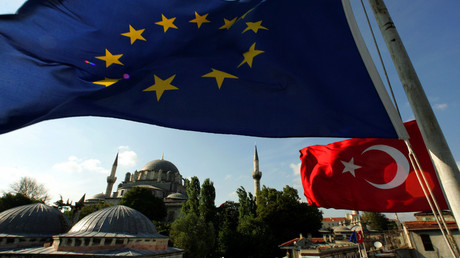
Turkish EU bid ‘unrealistic’ while Erdogan in power – European commissioner

August 30, 2016

Turkish EU bid ‘unrealistic’ while Erdogan in power – European commissioner

Published time: 30 Aug, 2016 13:28 Edited time: 30 Aug, 2016 17:20

Source: Turkish EU bid ‘unrealistic’ while Erdogan in power – European commissioner — RT News


Turkey is unlikely to join the European Union as long as its president remains in office, a top official from the bloc has said, adding that Ankara’s bid will be an issue for negotiations “for the time after Erdogan.”

In the current circumstances Turkey’s EU accession “is not realistic all through the next decade,” Guenther Oettinger, the European Commissioner for Digital Economy and Society, told Bild newspaper on Tuesday.

“This will surely be an issue [for discussion] for the time after [President Recep Tayyip] Erdogan,” he said. The official added, however, that Ankara is an important geostrategic and economic partner for the EU, and keeping good bilateral ties is critical.

German Vice Chancellor and Economy Minister Sigmar Gabriel has also previously dismissed the Turkish accession bid, which started in 2005. Speaking to reporters in early June, he said Europe was not in a position to admit “even a small state” to its 28-nation ranks, according to the broadcaster Deutsche Welle (DW).

“The illusion … here comes someone to soon become a full member in the EU … that’s complete nonsense … that will not eventuate,” he was quoted as saying by DW.

Talks between Ankara and Brussels on Turkey’s EU membership have not been smooth, with Turkey linking the progress in discussions on granting visa-free travel for its nationals to its contribution to a controversial refugee deal.

In turn, the EU cites 72 conditions on issues such as the rule of law and human rights to be implemented by Turkey for lifting the visa requirements. A number of prominent European officials have accused Turkey of “blackmailing” Brussels or even behaving “like at a bazaar” by trying to raising the stakes.

European officials say that although Turkey has fulfilled most of the 72 conditions, it has failed to comply with the most important one, which is to relax its strict anti-terrorism laws, said to have been used to silence Erdogan’s critics.

Ankara maintains that it is Brussels which has not stuck to the initial arrangements and has failed to meet its own obligations.

In a July interview with the German broadcaster ARD, President Erdogan said that Turkey had so far received only €2 billion (US$2.23 billion) of the promised €3 billion as part of the refugee deal. “European leaders are dishonest,” he said. “We have stood by our promise. But have the Europeans kept theirs?”

Last month, top Turkish officials also threatened to withdraw from the controversial refugee deal which Brussels hopes will help stem the huge flow of migrants into the EU.

“If visa liberalization does not follow, we will be forced to back away from the deal on taking back [refugees] and the agreement of March 18,” Mevlut Cavusoglu, the Turkish foreign minister, told Frankfurter Allgemeine Zeitung in an interview.

“It can be early or mid-October, but we are waiting for an exact date,” he said.

EU President: “Borders Are The Worst Invention Ever Made By Politicians”

August 24, 2016

EU President: “Borders Are The Worst Invention Ever Made By Politicians”

Source: EU President: “Borders Are The Worst Invention Ever Made By Politicians” | Zero Hedge

If The British needed any more confirmation of their decision to leave The EU, Jean-Claude Juncker, president of the European Commission, just gave them a big one. The often incoherent “when it’s important, you have to lie” politician spewed more United States Of Europe tripe this morning when he called for European nations to drop border controls, claiming that borders were “the worst invention ever.” Britain’s new PM, Theresa May, was not amused…

Speaking at the European Forum Alpbach in Austria’s Tyrol, Mr Juncker said: “Borders are the worst invention ever made by politicians” and said solidarity must be given to refugees and their children… (Border bullshit starts at 10:15 – note the mindless applause from the audience when Juncker drops his line)

As The Express reports,

Mr Juncker’s comments were taken as a sign that he intends to block attempts to tighten border checks to deal with the migrant crisis overwhelming Europe.


It is also a challenge to France and Belgium who have pushed for an end to the Schengen free-movement zone across the EU to stop terrorists crossing the Continent without checks after Europe was rocked by a series of atrocities.


The intervention from Mr Juncker came as Germany’s chancellor Angela Merkel, French president Francois Hollande and Italian prime minister Matteo Renzi met on the Italian island of Ventotene where the concept of the EU was first dreamt up, to discuss the impact of Brexit.


The latest views of Mr Juncker, who also said the EU needs to “block popular nationalism” in response to Brexit, were immediately disagreed with by Theresa May.

Britain’s new prime minister Theresa May was not impressed by Juncker’s de-sovereignisation rhetoric… (via The Telegraph)

 “This is not something that the Prime Minister would agree with and, indeed, you have heard the Prime Minister talk about the views that the British people expressed in the referendum.


“The British people think that borders are important, having more control over our borders is important, and that is an issue we need to address.”

And, unsurprisingly, UKIP spokesman Peter Whittle said that Juncker’s comments were “beyond parody”…

This was another reason “why we must exit the EU as quickly as possible, otherwise our security could be left exposed by Juncker’s anti-borders policy.


“Safe and secure borders help to define a nation, you only have to look at Germany to see what happens when you when you effectively discard them.


“Mr Juncker is also well behind the curve to think he, or his colleagues amongst the European political elite, can stop popular democracy from flourishing across Europe following the historic Brexit vote.


“I’m happy to predict that Britain will not be the only country to leave the EU and become a free and sovereign nation again,” added Ukip’s national culture spokesman.

The big question is – of course – what will George Soros demand of Juncker next?

EU Proposal to Monitor “Intolerant” Citizens

August 2, 2016

EU Proposal to Monitor “Intolerant” Citizens

by Soeren Kern

October 28, 2013 at 5:00 am

Source: EU Proposal to Monitor “Intolerant” Citizens

  • There is no need to be tolerant to the intolerant” — European Framework National Statute for the Promotion of Tolerance, Article 4
  • “The supra-national surveillance that it would imply would certainly be a dark day for European democracy.” — European Dignity Watch

While European leaders are busy expressing public indignation over reports of American espionage operations in the European Union, the European Parliament is quietly considering a proposal that calls for the direct surveillance of any EU citizen suspected of being “intolerant.”

Critics say the measure — which seeks to force the national governments of all 28 EU member states to establish “special administrative units” to monitor any individual or group expressing views that the self-appointed guardians of European multiculturalism deem to be “intolerant” — represents an unparalleled threat to free speech in a Europe where citizens are already regularly punished for expressing the “wrong” opinions, especially about Islam.

The proposed European Framework National Statute for the Promotion of Tolerance was recently presented to members of the Civil Liberties, Justice and Home Affairs Committee of the European Parliament, the only directly-elected body of the European Union.

The policy proposal was drafted by the European Council on Tolerance and Reconciliation (ECTR), a non-governmental organization established in Paris in 2008 by the former president of Poland, Aleksander Kwasniewski, and the president of the European Jewish Congress, Moshe Kantor.

Lars Hedegaard was acquitted by the Danish Supreme Court in 2012 on charges of “hate speech” for critical comments he made about Islam.

The ECTR — which describes itself as a “tolerance watchdog” that “prepares practical recommendations to governments and international organizations on improving interreligious and interethnic relations on the continent” — includes on its board more than a dozen prominent European politicians, including former Spanish Prime Minister José María Aznar.

The ECTR first presented its proposal for a Europe-wide Law on Tolerance to the European Parliament in November 2008 as part of the European Week of Tolerance that marked the 70th anniversary of the Kristallnacht, a night of anti-Semitic violence that began the Jewish Holocaust in Germany.

After five years of lobbying in Europe’s halls of power, the ECTR proposal appears to be making headway, as evidenced by the European Parliament’s recent decision to give the group a prominent 45-minute time slot to present its proposal to the Civil Liberties committee on September 17.

Also known as the “Model Statute for Tolerance,” the ECTR’s proposal was presented as part of the EU’s ongoing work towards a new “Equal Treatment Directive” (ETD) that would vastly expand the scope of discrimination to all sectors of life in both the public and private spheres.

Critics of the ETD, currently being negotiated within the Council of the European Union, say the directive seeks to establish an ill-conceived concept of “equal treatment” as a horizontal principle governing the relationships between all and everyone, thus interfering with the right of self-determination of all citizens.

According to European Dignity Watch, a civil rights watchdog based in Brussels,

The principles of freedom of contract and the freedom to live according to one’s personal moral views are in danger of being superseded by a newly developed concept of ‘equality.’ It would undermine freedom and self-determination for all Europeans and subject the private life of citizens to legal uncertainty and the control of bureaucrats. It is about governmental control of social behavior of citizens. These tendencies begin to give the impression of long-passed totalitarian ideas and constitute an unprecedented attack on citizens’ rights.

When viewed in the broader context of the ETD, the ECTR document is so audacious in scope, while at the same time so vague in defining its terminology, that critics say the proposal, if implemented, would open a Pandora’s Box of abuse, thereby effectively shutting down the right to free speech in Europe.

According to Section 1 (d), for example, the term “tolerance” is broadly defined as “respect for and acceptance of the expression, preservation and development of the distinct identity of a group.” Section 2 (d) states that the purpose of the statute is to “condemn all manifestations of intolerance based on bias, bigotry and prejudice.”

An explanatory note to Section 2 states: “Religious intolerance is understood to cover Islamophobia” but it provides no definition at all of “Islamophobia,” a term invented by the Muslim Brotherhood in the 1990s. If taken to its logical conclusion, Section 2 would presumably ban all critical scrutiny of Islam and Islamic Sharia law, a key objective of Muslim activist groups for more than two decades.

The document also declares that “tolerance must be practiced not only by governmental bodies but equally by individuals.” Section 3 (iv) elaborates on this: “Guarantee of tolerance must be understood not only as a vertical relationship (government-to-individuals) but also as a horizontal relationship (group-to-group and person-to-person). It is the obligation of the government to ensure that intolerance is not practiced either in vertical or in horizontal relationships.”

According to Section 4 (f) (i) of the document: “There is no need to be tolerant to the intolerant. This is especially important as far as freedom of expression is concerned.” Section 5 (a) states: “Tolerance (as defined in Section 1(d)) must be guaranteed to any group, whether it has long-standing societal roots or it is recently formed, especially as a result of migration from abroad.”

Section 6 states: “It goes without saying that enactment of a Statute for the Promotion of Tolerance does not suffice by itself. There must be a mechanism in place ensuring that the Statute does not remain on paper and is actually implemented in the world of reality.”

An explanatory note to Section 6 (a) states: “Members of vulnerable and disadvantaged groups are entitled to a special protection, additional to the general protection that has to be provided by the Government to every person within the State.” Another note adds: “The special protection afforded to members of vulnerable and disadvantaged groups may imply a preferential treatment. Strictly speaking, this preferential treatment goes beyond mere respect and acceptance lying at the root of tolerance.”

Section 6 (b) demands that every one of the 28 member states of the EU “set up a special administrative unit in order to supervise the implementation of this Statute.” An explanatory note adds: “The special administrative unit should preferably operate within the Ministry of Justice (although the Ministry of the Interior is another reasonable possibility).”

Section 6 (c) calls for the establishment of a “National Tolerance Monitoring Commission as an independent body — composed of eminent persons from outside the civil service — vested with the authority to promote tolerance.” An explanatory note adds: “The independent Commission will be empowered to express its views regarding implementation of the Statute by all concerned. Implementation in this context includes (but is not limited to) the imposition of penal sanctions.”

Section 7 (a) states: “The following acts will be regarded as criminal offences punishable as aggravated crimes: Incitement to violence against a group and group libel. “Group libel” is broadly defined as: “defamatory comments made in public and aimed against a group or members thereof with a view to inciting to violence, slandering the group, holding it to ridicule or subjecting it to false charges.”

Section 7 (b) states that “Juveniles convicted of committing crimes listed in paragraph (a) will be required to undergo a rehabilitation program designed to instill in them a culture of tolerance.” Paragraph 7 (e) states that “victims of crimes listed in paragraph (a) will have a legal standing to bring a case against the perpetrators, as well as a right to redress.” Paragraph 7 (f) states that “free legal aid will be offered to victims of crimes listed in paragraph (a), irrespective of qualification in terms of impecuniosity.”

Section 8 states that “the government shall ensure that (a) Schools, from the primary level upwards, will introduce courses encouraging students to accept diversity and promoting a climate of tolerance as regards the qualities and cultures of others.” An explanatory note adds: “It is very important to start such courses as early as possible in the educational program, i.e. in elementary school. Yet, these courses must be offered also at higher levels of education, up to and including universities.”

Section 9 (a) states: “The government shall ensure that public broadcasting (television and radio) stations will devote a prescribed percentage of their program to promoting a climate of tolerance.” Section 9 (b) adds: “The government shall encourage all privately owned mass media (including the printed press) to promote a climate of tolerance.” Section 9 (c) states: “The government shall encourage all the mass media (public as well as private) to adopt an ethical code of conduct, which will prevent the spreading of intolerance and will be supervised by a mass media complaints commission.”

The document, if adopted by the European Parliament in its current form, would — among other problems — establish a right to a freedom from hurt feelings at the expense of the freedom of speech and expression. In practical terms, critics say, the highly subjective definition of terms and concepts such as “tolerance,” “discrimination,” “vulnerable,” and “disadvantaged,” amounts to a legal straitjacket that would encourage frivolous litigation aimed at silencing individuals and groups, or at finding circumlocutions that appear to avoid violating these principles.

“Faith-based groups and schools, adherents of a particular religion or even just parents who want to teach their children certain moral values would all be put under general suspicion of being intolerant,” according to European Dignity Watch.

“Even worse, if enshrined as EU policy, such language also could lead to the possibility that charges are brought on unclear or even without legal grounds. The chilling result of this would be the dramatic diminution (and possible disappearance) of the fundamental freedom of expression — individuals and groups would censor themselves, afraid that they might be prosecuted for expressing their own personal moral views,” the NGO argues in a statement.

“The authors of this proposed statute — under the aegis of an international NGO for tolerance and reconciliation — have invited the Civil Liberties, Justice and Home Affairs Committee to endorse it as a legal project. But not only would an adoption of this statute at the national level of the European states be a significant step backward,” the statement concludes, “but the supra-national surveillance that it would imply would certainly be a dark day for European democracy.”

If you had doubts about the islamisation of Europe

July 2, 2016

Islam, Islamism and Islamophobia in Europe

\http://www.assembly.coe.int/nw/xml/XRef/Xref-XML2HTML-en.asp?fileid=17880&lang=en

If you had doubts about the islamisation of Europe

Resolution 1743 (2010) Final version

Author(s): Parliamentary Assembly

Origin – Assembly debate on 23 June 2010 (23rd Sitting) (see Doc. 12266, report of the Committee on Culture, Science and Education, rapporteur: Mr Mogens Jensen; Doc. 12303, opinion of the Political Affairs Committee, rapporteur: Mr Hancock; Doc. 12305, opinion of the Committee on Legal Affairs and Human Rights, rapporteur: Mr Rafael Huseynov; and Doc. 12304, opinion of the Committee on Equal Opportunities for Women and Men, rapporteur: Mrs Memecan). Text adopted unanimously by the Assembly on 23 June 2010 (23rd Sitting). See also Recommendation 1927 (2010).

1. The Parliamentary Assembly notes that Islamic radicalism and manipulation of religious beliefs for political reasons oppose human rights and democratic values. At the same time, in many Council of Europe member states, Muslims feel socially excluded, stigmatised and discriminated against; they become victims of stereotypes, social marginalisation and political extremism. The Assembly is deeply concerned about Islamic extremism as well as about extremism against Muslim communities in Europe. Both phenomena reinforce each other.
2. The Assembly recalls that Islamism is the view that Islam is not only a religion but also a social, legal and political code of conduct. Islamism can be violent or mainstream and peaceful, but in both cases it does not accept the separation between religion and state, which is a fundamental principle of democratic and pluralistic societies. The Assembly also recalls that discrimination against Muslims is unacceptable and must be combated. A great majority of European Muslims share the principles at the basis of our societies and it is essential to fight against Islamophobia, which stems mainly from lack of awareness and from negative perceptions associating Islam with violence. Failing to address these issues, many European governments pave the way to the rise of extremism.
3. Muslims are at home in Europe where they have been present for many centuries, as the Assembly noted in its Recommendation 1162 (1991) on the contribution of the Islamic civilisation to European culture. Islam, Judaism and Christianity – the three monotheist religions – share the same historic and cultural roots and recognise the same fundamental values, in particular the paramount value of human life and dignity, the ability and freedom to express thoughts, the respect for others and their property, and the importance of social welfare. Those values have been reflected by European philosophies and have been included in the European Convention on Human Rights (“the Convention”; ETS No. 5).
4. Article 9 of the Convention guarantees freedom of thought, conscience and religion, including the right to manifest one’s religion or belief, either alone or in community with others, in public or in private, in worship, teaching, practice and observance. Article 10 of the Convention enshrines freedom of expression, including the right to express religious or philosophical views or oppose and criticise them. Both freedoms constitute the necessary requirements for a democratic society. However, they are not absolute and may be subject to limits imposed under strict control. Moreover, in accordance with Article 17 of the Convention, they must not be abused for the destruction or undue limitation of any of the rights and freedoms set forth in the Convention.
5. The Assembly has already stressed the importance of reconciling these two freedoms in its Resolution 1510 (2006) on freedom of expression and respect for religious beliefs, as well as its Recommendation 1805 (2007) on blasphemy, religious insults and hate speech against persons on grounds of their religion. The Assembly firmly condemns death decrees and threats against people who criticise Islam or political views linked to Islam. It regrets, however, the initiatives taken by a number of United Nations member states that have resulted in the Human Rights Council adopting resolutions on action against defamation of religions, and in particular Islam, as this strategy constitutes a threat to freedom of expression.
6. Recalling its Recommendation 1804 (2007) on state, religion, secularity and human rights, the Assembly emphasises that democratic standards require a separation of the state and its organs from religions and religious organisations. Governments, parliaments and public administrations that democratically reflect and serve their society as a whole must be neutral towards all religious, agnostic or atheist beliefs. Nevertheless, religion and democracy are not incompatible, in particular as religions may play a beneficial social role. Member states should therefore encourage religious organisations to support actively peace, tolerance, solidarity and intercultural dialogue.
7. The Assembly notes with concern, however, that some Islamic organisations active in member states have been initiated by governments abroad and receive financial support and political guidance from those governments. The objectives of such organisations are hence not religious. National political expansion into other states under the disguise of Islam should be brought to light. In keeping with Article 11 of the Convention, member states can limit the activities of such organisations on condition that such limitations satisfy the requirements set forth in paragraph 2 of Article 11. Therefore, member states should require transparency and accountability of Islamic as well as other religious associations, for instance by requiring transparency of their statutory objectives, leadership, membership and financial resources.
8. As the Assembly indicated in its Recommendation 1774 (2006) on the Turkish presence in Europe: migrant workers and new European citizens, member governments and parliaments as well as the Council of Europe must give priority to fostering the social inclusion of Muslims and other religious minorities. The many efforts undertaken by member states to better integrate migrants are to be commended, but this integration is often still far from reality, in particular with regard to Muslim migrants. Thus, the Assembly invites member states to be proactive in dealing with social, economic and political inequalities.
9. The Assembly calls on member states to effectively address the social and economic exclusion of Muslims and other minorities in Europe – including through the adoption, implementation and regular monitoring of comprehensive anti-discrimination legislation, policies and practices to protect them from the day-to-day discrimination they face and to ensure better access to legal remedies when their rights have been violated.
10. While organisational structures of Muslim communities in member states are desirable in order to facilitate contacts with governmental and administrative bodies, member governments and parliaments should also seek to establish direct political contacts with Muslims as equal citizens. Such direct contacts could be facilitated, for example, through public hearings at local and regional levels as well as through regional and national discussion platforms on the Internet. Referring to Recommendation 170 (2005) of the Congress of Local and Regional Authorities of the Council of Europe on intercultural and inter-faith dialogue: initiatives and responsibilities of local authorities, the Assembly calls on national parliaments to ensure that local authorities in their countries have the necessary legal, administrative and financial frameworks for local activities intended to foster social inclusion and intercultural dialogue.
11. It is necessary that persons belonging to a minority culture in their country do not isolate themselves and do not attempt to develop a parallel society. Thus the Assembly calls on the representatives of the Muslim communities to encourage intercultural dialogue and fight against divisions which would otherwise lead to societal frictions and conflicts. Recalling its Resolution 1605 (2008) and Recommendation 1831 (2008) on European Muslim communities confronted with extremism, the Assembly invites Muslims, their religious communities and their religious leaders to combat any form of extremism under the cover of Islam. Islam is a religion which upholds peace. Muslims should be the first to react with dismay and opposition when terrorists or political extremists use Islam for their own power struggle and thus disrespect the fundamental value of human life and other values enshrined in Islam.
12. The Assembly deplores that a growing number of political parties in Europe exploit and encourage fear of Islam and organise political campaigns which promote simplistic and negative stereotypes concerning Muslims in Europe and often equate Islam with extremism. It is inadmissible to incite intolerance and sometimes even hatred against Muslims. The Assembly calls on member states to pursue political action in accordance with General Policy Recommendation No. 5 (2000) of the European Commission against Racism and Intolerance (ECRI) on combating intolerance and discrimination against Muslims. It reiterates that it is for the member states to reject political statements that stir up fear and hatred of Muslims and Islam, while complying with the stipulations of the Convention, in particular Article 10.2.
13. The Assembly also remains concerned at policies and practices – by both national as well as regional and local authorities – that discriminate against Muslims and at the danger of the abuse of popular votes, initiatives and referenda to legitimise restrictions on the rights to freedom of religion and expression which are unacceptable under Articles 9 and 10 of the Convention. In this context, the Assembly is particularly concerned about the recent referendum in Switzerland and urges the Swiss authorities to enact a moratorium on and repeal as soon as possible, the general prohibition on the construction of minarets for mosques.
14. Recalling its Resolution 1464 (2005) on women and religion in Europe, the Assembly calls on all Muslim communities to abandon any traditional interpretations of Islam which deny gender equality and limit women’s rights, both within the family and in public life. This interpretation is not compatible with human dignity and democratic standards; women are equal to men in all respects and must be treated accordingly, with no exceptions. Discrimination against women, whether based on religious traditions or not, goes against Articles 8, 9 and 14 of the Convention, Article 5 of its Protocol No. 7 and its Protocol No. 12. No religious or cultural relativism may be invoked to justify violations of personal integrity. The Parliamentary Assembly therefore urges member states to take all necessary measures to stamp out radical Islamism and Islamophobia, of which women are the prime victims.
15. In this respect, the veiling of women, especially full veiling through the burqa or the niqab, is often perceived as a symbol of the subjugation of women to men, restricting the role of women within society, limiting their professional life and impeding their social and economic activities. Neither the full veiling of women, nor even the headscarf, are recognised by all Muslims as a religious obligation of Islam, but they are seen by many as a social and cultural tradition. The Assembly considers that this tradition could be a threat to women’s dignity and freedom. No woman should be compelled to wear religious apparel by her community or family. Any act of oppression, sequestration or violence constitutes a crime that must be punished by law. Women victims of these crimes, whatever their status, must be protected by member states and benefit from support and rehabilitation measures.
16. For this reason, the possibility of prohibiting the wearing of the burqa and the niqab is being considered by parliaments in several European countries. Article 9 of the Convention includes the right of individuals to choose freely to wear or not to wear religious clothing in private or in public. Legal restrictions to this freedom may be justified where necessary in a democratic society, in particular for security purposes or where public or professional functions of individuals require their religious neutrality or that their face can be seen. However, a general prohibition of wearing the burqa and the niqab would deny women who freely desire to do so their right to cover their face.
17. In addition, a general prohibition might have the adverse effect of generating family and community pressure on Muslim women to stay at home and confine themselves to contacts with other women. Muslim women could be further excluded if they were to leave educational institutions, stay away from public places and abandon work outside their communities, in order not to break with their family tradition. Therefore, the Assembly calls on member states to develop targeted policies intended to raise Muslim women’s awareness of their rights, help them to take part in public life and offer them equal opportunities to pursue a professional life and gain social and economic independence. In this respect, the education of young Muslim women as well as of their parents and families is crucial. It is especially necessary to remove all forms of discrimination against girls and to develop education on gender equality, without stereotypes and at all levels of the education system.
18. Female genital mutilation under the pretext of Islamic or other customs should be considered as a crime as it violates the right to physical and moral integrity of all individuals and especially of girls. Member states must do their utmost to put an end to this crime and provide practical help to children and their parents, including in particular through education. The Assembly recalls in this context its Resolution 1247 (2001) on female genital mutilation.
19. The Assembly accordingly urges member states to take every step to prevent and combat all forms of oppression or violence undergone by women and, in particular, as part of the negotiations for the future Council of Europe convention on preventing and combating violence against women and domestic violence, to support the provisions enabling women irrespective of their origin or status to have access to protection, prevention and rehabilitation facilities.
20. Stereotypes, misunderstandings and fears with regard to Islam are typical symptoms of a widespread lack of adequate knowledge among non-Muslims in Europe. Similarly, many Muslims in Europe lack adequate knowledge of Islam let alone other religions, which can make them vulnerable to “Islamism” as a religiously disguised form of political extremism. In this context, the Assembly recalls its Recommendation 1720 (2005) on education and religion and calls on member states to ensure that knowledge about Islam, Judaism and Christianity is taught at school and through lifelong education.
21. Teaching about religions should be supported by member states, to raise public awareness of the common origin and values of Judaism, Christianity and Islam and their impact on modern European humanism. Institutions of higher education and research in Europe should provide Islamic studies in order to educate religious scholars, teachers and leaders and distinguish Islam from Islamism. The Assembly is confident that most European Muslims accept a common approach reconciling Islam with democratic values, human rights and the rule of law; indeed, many have done so for a long time.
22. The Assembly also welcomes the White Paper on Intercultural Dialogue prepared by the Council of Europe during the European Year of Intercultural Dialogue in 2008 as well as other activities by the Committee of Ministers in this field. Member governments should use the White Paper in their related national action, including in schools and educational institutions.
23. It is important to create synergies with other international organisations in this respect. Therefore, the Assembly invites the United Nations Alliance of Civilizations to co-operate more closely with the Council of Europe, in particular by setting up joint programmes of action. In this context, the Assembly invites the Secretary General of the Council of Europe to seek additional funding for such activities through member states and facilitate reciprocal secondment of staff between the two organisations.
24. The Assembly invites the Islamic Educational, Scientific and Cultural Organization (ISESCO) and the Arab League Educational, Cultural and Scientific Organization (ALECSO) to work with the Council of Europe on combating Islamism and Islamophobia or other religious discrimination as well as on promoting the respect for universal human rights. ISESCO and ALESCO can be particularly important in ensuring that their members respect the International Covenant on Civil and Political Rights (ICCPR) and the International Covenant on Economic, Social and Cultural Rights (ICESCR) of the United Nations.
25. In this context, the Assembly regrets that some member governments of ISESCO and ALECSO have adopted national legislation based on an interpretation of Sharia law or have pursued national policies which are in conflict with the ICCPR and the ICESCR: imposing severe penalties or even the death penalty on persons wishing to adopt a religion other than Islam is incompatible with Article 18 (2) ICCPR; imposing severe sanctions on, or passing public death decrees against, persons who have criticised Islam is incompatible with Article 19 of the ICCPR; calling for a “holy war” or violence against other countries or their citizens and glorifying terrorists as “holy martyrs” is incompatible with Article 20 (2) of the ICCPR; educating children to hate or fight persons of faiths other than Islam is incompatible with Article 13 (1) of the ICESCR.
26. Contacts between Muslim and non-Muslim Europeans and Muslims in North Africa, the Middle East and Asia should be facilitated, in particular among young people, students and teachers. The Assembly invites, therefore, the European Youth Forum to expand its activities in this field. Co-operation between educational and cultural institutions as well as cities around the Mediterranean Basin should be supported, for instance in the framework of the Convention on the Recognition of Qualifications concerning Higher Education in the European Region (ETS No. 165) and the European Outline Convention on Transfrontier Co-operation between Territorial Communities or Authorities (CETS No. 106).
H/T  E.J.Bron


Israeli control of West Bank fostering global terror, Abbas tells EU

June 23, 2016

Israeli control of West Bank fostering global terror, Abbas tells EU Addressing parliament in Brussels, PA leader backs peace bids, accuses Israel of turning territories into an ‘open-air prison,’ repeats hoax story of rabbi calling for poisoning Palestinian wells

By Tamar Pileggi

June 23, 2016, 2:45 pm

Source: Israeli control of West Bank fostering global terror, Abbas tells EU | The Times of Israel

President of the Palestinian Authority Mahmoud Abbas delivers a speech at the European Union Parliament in Brussels on June 23, 2016. (AFP / JOHN THYS)

In an appeal to the European Union on reaching a two-state solution to the conflict with Israel, Palestinian Authority President Mahmoud Abbas on Thursday said an end to Israeli presence in the West Bank and East Jerusalem would eradicate terrorism across the globe.

Speaking to European Parliament lawmakers, Abbas also underscored Ramallah’s support for a two-state solution as outlined in the current French peace plan and the 2002 Arab Peace Initiative, and pleaded with EU lawmakers to save Palestinians from Israeli “provocations,” including what he said were calls by rabbis to poison Palestinians’ water — repeating a hoax story.

 “We are against terrorism, in whatever form it may take, and whoever carries it out,” Abbas told members of the European Parliament to a resounding applause.

“Once the occupation ends, terrorism will disappear, there will be no more terrorism in the Middle East, or anywhere else in the world,” he said.

Speaking a day after his Israeli counterpart Reuven Rivlin spoke in the same venue and rejected the French multilateral peace push, Abbas rebuffed the possibility of reaching an interim peace agreement with Israel as an exercise in pointlessness.

“We reject any suggestion of temporary borders or an interim agreement because it’s a waste of time and does not lead anywhere,” he said.

“We favor a two-state solution based on the 1967 borders with East Jerusalem as the capital, and the solution will be based on the Arab Peace Initiative that was approved in 2002 with no changes to it,” Abbas said. “Our hands are extended with a desire for peace, we have the political will to achieve peace.”

An international conference aimed at resurrecting the stalled peace talks, to be held later as part of the French plan, must include a “set schedule for negotiations and the implementation of decisions, and constitute a mechanism for the implementation and monitoring of the decisions, as happened in the negotiations with Iran,” he said.

The Palestinian leader went on to condemn Israel’s “never-ending provocations” and “fascist policies,” and pointed as proof to sharp criticism of Israel’s current leadership made recently by former prime minister Ehud Barak and former defense minister Moshe Ya’alon.

Israel, Abbas charged, has started three wars in Gaza and killed thousands of people in the process. Since 1967, the PA leader continued, Israel has imprisoned over 1 million Palestinians.

“Israel has “turned our country into an open-air prison,” Abbas told EU lawmakers. “You are our friends, help us.”

In his address, Abbas also touched on the persistent Israeli accusations of Palestinian incitement, saying he was willing to re-start the Tripartite Committee on Incitement watchdog group to monitor calls for violence on either side, a move Israel has consistently rejected.

He called for the EU to join the joint US- Israeli-Palestinian commission.

While Israel typically accuses Palestinian officials of encouraging violence against Israelis, Abbas claimed that rabbis in Israel had recently called for the poisoning of Palestinian water supplies to murder Palestinians.

“The Israelis are doing this as well… certain rabbis in Israel have said very clearly to their government that our water should be poisoned in order to have Palestinians killed,” he said, repeating an anti-Semitic canard.

A story reported in the Turkish press earlier in June claimed a rabbi had made such a call, leading to denunciations by the Palestine Liberation Organization, though the story was quickly debunked.

Abbas went on to press EU lawmakers on why Israel was “free to act with impunity” and was not held accountable under international law.

“Why is international law not being applied in the case of Israel?” he asked to applause by MEP lawmakers.

The European Union has been pressing hard to get the stalled Middle East peace process back on track based on a two-state solution.

EU foreign ministers on Monday backed a French initiative to call an international conference on the Middle East aimed at restarting Israeli-Palestinian talks, which have been deadlocked since 2014.

On Wednesday Rivlin addressed the EU parliament, saying the French plan was doomed to fail and suffered from “very fundamental faults.

Like other international initiatives to reach a peace agreement, the president said the plan’s inflexible “all or nothing” approach to the implementation of a two-state solution ignores the total lack of trust between Israelis and Palestinians.

Rivlin urged EU nations to instead show patience and facilitate trust-building measures between Israel and the Palestinians.

Later Thursday, President Reuven Rivlin was set to meet with EU Commission President Jean-Claude Juncker and foreign affairs chief Federica Mogherini.

Abbas met with Mogherini earlier in the day, and told a press conference he had doubts about Israel’s commitment to peace

“If Israel wanted peace with its Arab neighbors, it must end its control over our people and home country first by withdrawing from our lands and acknowledging the rights of our people, which also has a significant interest for Israel as it would be possible then to apply the Arab Peace Initiative in accordance with the Beirut conference of 2002,” Abbas said.

Earlier in the day, Rivlin’s office said Abbas had spurned an attempt to broker a sit-down between the two while in Brussels.

Leave while you can, your vote will never again make a difference in Brussels

June 19, 2016

Leave while you can, your vote will never again make a difference in Brussels

Jun 18 Posted by Peter Reedijk

Source: Leave while you can, your vote will never again make a difference in Brussels | Peter Reedijk

Last April, the Dutch had a referendum on the EU association treaty with Ukraine. The outcome is frustratingly predictable, but it is still worth offering some details of the proceedings, especially in light of the upcoming Brexit referendum on June 23rd. The EU is proving once more that it is not just undemocratic, but even anti-democratic – and that is a lesson the British should take to heart.

After the vote

After a majority voted against the ratification of the Ukraine association treaty, the Dutch government could withdraw its ratification (which would be the democratic thing to do), or it could ignore the will of the people (which would at least still be within the definition of the referendum law). But instead, the government is doing nothing at all. Dutch Prime Minister Mark Rutte has been surprisingly open about the reasons for our government not following its own law: Brussels won’t allow it.

During a parliamentary debate one week after the referendum Rutte declared negotiations about the Ukraine treaty could take place in the open only after the Brexit referendum. There are several interesting things about that single statement. Firstly, as mentioned, the EU is telling the Dutch government not to adhere to its own law. Secondly, the Dutch government itself is not following its own law by entering into negotiations for which the referendum law offers no basis, likely because the result of the referendum is displeasing to the pro-EU establishment. Thirdly, there will be talks behind closed doors in the coming months, precisely while the referendum was intended to help restore democracy and bring the process out into the open. Lastly, the EU’s leadership does not want the Dutch referendum “to interfere” with the Brexit referendum – there is only one logical explanation for this: the EU and the Dutch government intend to ignore (once again) the will of the people, but they are afraid to show that the EU does’t care about democratic votes because that would fuel the Leave campaign.

The campaign

The Netherlands has a (quite young) referendum law which allows the people to organize an consultative referendum on newly passed laws, provided they can collect 300,000 signatures in 6 weeks. Then there is another obstacle, which is a minimum required voter turnout of 30% for the result to be valid. The turnout on referendum day (April 6th) was 32.2% and the treaty was rejected by no less than 61.1% of the voters. A clear success, and although our government is not bound by law to follow the people’s vote, a parliament majority had promised beforehand to do so anyway.

It was a campaign between the elite, consisting of most major political parties together with establishment news outlets, and the people, represented by a coalition of citizen groups and a popular right-leaning blog (and supported by Nigel Farage for their campaign climax). Representatives of the ruling parties (who were officially not going to campaign) were given communication guidelines, with tips like “no fearmongering”. But it is tradition to meet challengers of EU expansion with threats of chaos and catastrophe, so obviously Jean-Claude Juncker warned that a No-vote would lead to a “continental crisis” and Herman Van Rompuy insisted a No would be an embarrassment for the Dutch, adding that it would mean that the Ukrainians who have lost their lives on Maidan Square would have died in vain.

So much for that plan. Luckily the Yes-camp still had character assassination up its sleeve. The initiators of the referendum were painted as liars, clowns, senseless troublemakers, even racists (because “if all else fails”, apparently…). But the No-camp had better arguments (with an added dose of healthy anti-EU sentiment) and their clowns went on to win several televised debates.

History in the making

The Netherlands does not have much of a history with referendums, in that we have only had one before and the result was blatantly ignored when we rejected the European Constitution and got it anyway under a different name. Most of us who voted to reject the Ukraine association treaty knew what was coming, and as much as the establishment are looking for excuses to reduce the value of this result – and referendums in general – the facts are clear.

This referendum was a rebellion of the people against the elite, and the elite is demonstrating precisely why it needs to be challenged. The EU’s architects were unabashed about their disregard for democracy, but they have overplayed their hand. The EU has turned into an anti-democratic behemoth, and one of the biggest symbols of elitism in the world. What they are doing now can only be understood as an effort by the EU to avoid showing British voters how little it cares about democracy so shortly before the Brexit referendum. And that is why voting to leave the EU is the only reasonable choice: whether Britain stays or leaves, June 23rd will be the last time your vote will make any difference to Brussels.

The UNO, the EU and Daesh schizophrenia

June 7, 2016

The UNO, the EU and Daesh schizophrenia by Thierry Meyssan Intergovernmental organisations are supposed to unite the efforts of member-states in order to achieve results that they could not manage alone. We might therefore conclude that the UNO and the EU are coordinating the fight against Daesh. Instead of which, these two organisations are hindering the forces on the ground and masking state support for international terrorism.

Voltaire Network | Damascus (Syria) | 6 June 2016

Source: The UNO, the EU and Daesh schizophrenia, by Thierry Meyssan

Jeffrey Feltman, the Director of Political Affairs for the UNO, and Federica Mogherini, the High Representative of the EU for Foreign Affairs and Security Policy. Are these senior civil servants working for peace or are they lying for the cause of US imperialism?

If, during the Cold War, research credits for social and political studies were oriented towards the study of «totalitarism» – in other words, the assimilation of Nazism and Stalinism – they were reoriented towards «terrorism» just after the attacks of the 11 September 2001. Suddenly, thousands of experts appeared, all financed in order to justify, a posteriori, the official version of the attacks, the wars in Afghanistan and Iraq, and the proclamation of the Patriot Act.

Thirteen years later, the phenomen repeated itself on the occasion of the proclamation of the Caliphate by Daesh. It was now less a question of fighting a vague terrorist threat than engaging in a war against a genuine though unrecognised state, and anticipating the transfer of arms, money and combatants that it generates.

Two intergovernmental organisations, the UNO and the European Union, have accomplished a colossal job of work defining a strategy for the «prevention of violent extremism» and the fight against Daesh. The General Assembly of the United Nations will examine this work on the 30 June and the 1 July. Obviously, one may fear that the «prevention of violent extremism» may be no more than a justification for the repression of any form of opposition.

When we read the available documents — those (1) of the Secretary General of the UNO [1], (2) the UN Counter-Terrorism Committee (Resolution 1373), (3) the Analytical Support and Sanctions Monitoring Team [2], and (4) the European Union External Action Service [3] — we are overcome with vertigo at what looks less like a battle plan than an elaboration of politically correct rhetoric.

The UNO and the EU base their work exclusively on Western sources which are far removed from the terrain – not only do they never make a single mention of the information transmitted by Iraq, Syria and Russia, but seem to ignore the very existence of such information. And yet it was handed to the Security Council by ambassadors Mohamed Ali Alhakim, Bachar Ja’afari and Vitali Tchourkine. The documents are freely available.

Syria, and to a far lesser degree, Iraq, furnished information concerning the transfer of money, arms and jihadists on a day-to-day basis, while Russia distributed five thematic reports concerning
- 1. the illegal commerce of hydrocarbons [4];
- 2. the recruiting of foreign terrorist combatants [5];
- 3. the trafficking of antiques [6];
- 4. the deliveries of arms and ammunition [7];
- 5. the components intended for the fabrication of improvised explosive devices [8].

All these documents directly implicate Saudi Arabia, Qatar and Turkey. These three states – allies of Washington – have all responded with generalised denials without ever discussing the slightest element of the charges.

Daesh is functional on the four strategic objectives of the United States, namely the fomenting of a civil war between the Sunnis and the Shia in Iraq, the project for the partition of Iraq into three federalised parts, the project for cutting the road linking Iran and Lebanon, and the project for the overthrow of the Syrian Arab Republic. To the point where we might ask ourselves – if Daesh didn’t exist, would Washington have had to invent it?

It would be a mistake to believe that the occulting of the documents mentioned above is the result of anti-Iraqi, anti-Syrian or anti-Russian prejudice. Indeed, the Western sources, both public and private, which support their evidence are also ignored. For example, declassified documents from the U.S. Defense Intelligence Agency [9], or the articles in Jane’s, the favourite magazine of NATO officers [10]. No, the UNO and the EU approach the question of Daesh with one clear and simple a priori – this state popped up quite spontaneously, without any help whatsoever.

The UNO’s blindness is such that its Secretary General, Ban Ki-moon, attributes to the International Coalition led by Washington the victories obtained through the sacrifices made by the Iraqi and Syrian Arab armies, the Lebanese Resistance, as well as the massive engagement of the Russian army.

The «result» of fifteen years of the «war against terror», we are assured, is to have killed more than a million and a half civilians in order to eliminate 65,000 to 90,000 presumed terrorists, and to have moved from an obscure terrorist threat (Al-Qaïda) directly to a terrorist state (Daesh)! After having explained that fifteen member-states of the UNO have «failed» (Failed States) despite years of international aid, we are supposed to believe that within a few months a group of illiterate conscripts has managed, on its own, to create a state and threaten world peace.

Al-Qaïda has moved quietly from the status of «threat» to that of «ally», depending on the situation. It was able to finance the AKP in Turkey [11], help NATO overthrow Mouamar el-Kadhafi in Libya and do a «good job» in Syria, while still being listed by the UNO as a terrorist organisation. No-one has judged it constructive to explain this evolution and this contradiction. In any case, it doesn’t matter any more, since the status of «enemy» is now occupied by Daesh.

Over the last fifteen years, we have watched the Western camp develop its theory about 9/11 and the threat of Al-Qaïda. After the publication of my critisism of this cock and bull fable [12], and despite the fact that terrorist attacks have multiplied, we have seen public opinion begin to doubt the sincerity of their governments, then move gradually away from their official declarations to the point of not believing them at all any more. All this while certain heads of state – in Cuba, Iran [13], and Venezuela – have publicly declared that they are not falling for it.

Given that this time, the opposition point of view is defended from the beginning by numerous states, including two permanent members of the Security Council – Russia and China – are we going to spend the next fifteen years becoming schizophrenic about the «danger of Daesh»?

Translation
Pete Kimberley

[1] “First UN report on ISIL”, “Second UN report on ISIL”, Voltaire Network, 9 February and 31 May 2016.

[2] “Report of the Analytical Support and Sanctions Monitoring Team pursuant to Security Council resolutions 1526 (2004) and 2253 (2015) concerning Islamic State in Iraq and the Levant (ISIL) (Da’esh), Al-Qaida and the Taliban and associated individuals and entities”, March 4th, 2016.

[3] “Towards a comprehensive EU approach to the Syrian crisis”, Voltaire Network, 24 June 2013. “Elements for an EU regional strategy for Syria and Iraq as well as the Da’esh threat” (Confidential leaked document), Voltaire Network, 6 February 2015. “Council conclusions on the EU Regional Strategy for Syria and Iraq as well as the ISIL/Da’esh threat”, Voltaire Network, 16 March 2015. “One year after: the impact of the EU Regional Strategy for Syria, Iraq and against Da’esh” (European External Action Service. Mena Directorate. Working document), Voltaire Network, 10 May 2016. “EU Council conclusions on the EU Regional Strategy for Syria and Iraq as well as the Da’esh threat”, Voltaire Network, 23 May 2016.

[4] “Illegal trading in hydrocarbons by ISIL”, Voltaire Network, 29 January 2016.

[5] “Russian intelligence report on Turkey’s current assistance to Daesh”, Voltaire Network, 18 February 2016.

[6] “Russian Intelligence report on Daesh’s smuggling of antiquities”, Voltaire Network, 8 March 2016.

[7] “Second Russian intelligence report on Turkey’s current assistance to Daesh”, Voltaire Network, 18 March 2016.

[8] “Russian intelligence report on Turkey’s current assistance to Daesh”, Voltaire Network, 17 May 2016.

[9] “The DIA report on jihadists in the Levant” (FOIA document), August 12th, 2012. Download.

[10] « Les États-Unis violent le cessez-le-feu en Syrie et arment Al-Qaïda », Réseau Voltaire, 25 avril 2016. « Qui arme les jihadistes durant le cessez-le-feu ? » (vidéo), par Thierry Meyssan, Télévision nationale syrienne , Réseau Voltaire, 30 avril 2016.

[11] “Erdoğan received Al-Qaeda’s banker in secret”, Translation Alizée Ville; “Al-Qaeda, NATO’s Timeless Tool”, by Thierry Meyssan, Translation Roger Lagassé, Al-Watan (Syria) , Voltaire Network, 6 January 2014.

[12] 9/11, The big lie, Thierry Meyssan, Carnot Publishing, March 2002.

[13] “Statement by Mahmoud Ahmadinejad at 67th UN General Assembly”; “Al-Qaeda blasts Ahmadinejad for his stance on 9/11”, Voltaire Network, 26 September and 2 October 2011.

Brexit The Movie

May 13, 2016
Published on May 12, 2016

Full version of Brexit: The Movie – the crowdfunded film making the case for Britain to LEAVE the EU on June 23rd.

https://www.youtube.com/watch?v=eYqzcqDtL3k

H/T E.J. Bron
(www.ejbron.wordpress.com)

Putin: Russia will consider tackling NATO missile defense threat

May 13, 2016

Putin: Russia will consider tackling NATO missile defense threat

Published time: 13 May, 2016 12:50 Edited time: 13 May, 2016 13:41

Source: Putin: Russia will consider tackling NATO missile defense threat — RT News

A Tomahawk missile being launched from the Mark 41 Vertical Launching System aboard United States Navy destroyer USS Farragut. File photo. © the United States Navy / Wikipedia

Russia is being forced to look for ways to neutralize threats to its national security due to deployment of the NATO anti-missile shield in Europe, Russian President Vladimir Putin said after the alliance launched a missile defense site in Romania.

“Now, after the deployment of those anti-missile system elements, we’ll be forced to think about neutralizing developing threats to Russia’s security,” Putin said.

Read more

NATO Secretary General Jens Stoltenberg (C) reviews an honour guard during an inauguration ceremony of the US anti-missile station Aegis Ashore Romania (in the background) at the military base in Deveselu, Romania on May 12, 2016. © Daniel Mihailescu

The US missile shield in Europe is a clear violation of Russian-American arms treaties, Putin said at a meeting with Russian military officials, adding that the anti-missile facilities can be easily repurposed for firing short and midrange missiles.

The US anti-missile shield in Europe is yet another step in increasing international tensions and launching a new arms race, he stressed.

“We’re not going to be dragged into this race. We’ll go our own way. We’ll work very accurately without exceeding the plans to finance the re-equipment of our Army and Navy, which have already been laid out for the next several years,” Putin said.

“Recent developments indicate that the situation isn’t getting better. Unfortunately, it’s deteriorating. I’m talking about the launch of the radar station in Romania as one of the elements of the up-and-coming US anti-missile defense program,” Putin said.

Russia is making every effort to maintain the strategic balance of power, in order to avoid the outbreak of large-scale conflicts, the president said.

Read more

NATO Secretary General Jens Stoltenberg (L), Romanian Prime Minister Dacian Ciolos and U.S. Deputy Secretary of Defense Robert Work (R) take part in an official inauguration ceremony at Deveselu air base, Romania, May 12, 2016. © Inquam Photos

NATO formally declared its missile defense base in Deveselu, Romania, operational on Thursday, bringing to fruition a plan to construct a shield in Eastern Europe first announced by George W. Bush in 2007.

Earlier, Moscow said that not only was the US missile defense aimed at neutralizing Russia’s offensive capability – an accusation the Pentagon has repeatedly rejected – but that the Deveselu’s MK 41 launching systems it uses could be re-equipped with offensive cruise missiles.

Russia also stated that US actions are a violation of the Intermediate-Range Nuclear Forces Treaty (INF), and warned that it may pull out from the deal if Washington continues with its anti-missile plans.

The missile shield uses a network of radars that track potential threats in the atmosphere, before launching an interceptor missile from a stationary base, or a fleet.

Simultaneously with Romania coming online, NATO is beginning construction on another base in Poland, which will complete the Eastern European segment of the shield in 2018.

Russia Hints At Nuclear War After US Deploys Ballistic Missile Shield

May 13, 2016

Russia Hints At Nuclear War After US Deploys Ballistic Missile Shield

by Tyler Durden on 05/12/2016 19:02 -0400

Source: Russia Hints At Nuclear War After US Deploys Ballistic Missile Shield | Zero Hedge

In a dramatic development for the global nuclear balance of power, yesterday we reported that starting today, the United States would launch its European missile defense system dubbed Aegis Ashore at a remote airbase in the town of Deveselu, Romania, almost a decade after Washington proposed protecting NATO from Iranian rockets and despite repeated Russian warnings that the West is threatening the peace in central Europe.

As Robert Bell, a NATO-based envoy of U.S. Defense Secretary Ash Carter explained “we now have the capability to protect NATO in Europe. The Iranians are increasing their capabilities and we have to be ahead of that. The system is not aimed against Russia,” he told reporters, adding that the system will soon be handed over to NATO command.

We also noted that the Kremlin, which for years has warned that it would have no choice than to escalate proportionally, was “incensed at such of show of force by its Cold War rival in formerly communist-ruled eastern Europe where it once held sway.” Moscow said that the U.S.-led alliance is trying to encircle it close to the strategically important Black Sea, home to a Russian naval fleet and where NATO is also considering increasing patrols. Russia has good reason to be worried: the US move is a clear defection from the carefully established Game Theory equilibrium in the aftermath of the nuclear arms race, one which potentially removes a Russian first strike threat, thereby pressuring Russia.

We added that “the precarious nuclear balance of power in Europe has suddenly shifted, and quite dramatically: despite U.S. assurances, the Kremlin says the missile shield’s real aim is to neutralize Moscow’s nuclear arsenal long enough for the United States to make a first strike on Russia in the event of war.”

In conclusion we said that “what makes this step particularly dangerous is that Russia will now be forced to retaliate and since it does not have a comparable defensive technology, Putin will have no choice but to deploy more ICBMs on Russia’s borders, which in turn will exponentially escalate the threat of an “inadvertent” launch. Although considering how the “market” responds to newsflow these past few years, this may also be seen as a bullish catalyst for stocks.”

Fast forward to today when as American and allied officials celebrated the opening of a long-awaited missile defense system in Europe with a ribbon cutting and a band…

. the reaction in Moscow on Thursday was darker: a public discussion of how nuclear war might play out in Europe and the prospect that Romania, the host nation for the United States-built system, might be reduced to “smoking ruins.

As expected, Russia was furious. The NYT cites Kremlin spokesman Dmitri Peskov who told reporters in a conference call that “we have been saying right from when this story started that our experts are convinced that the deployment of the ABM system poses a certain threat to the Russian Federation.”

Of course, the US and NATO are well aware of this, which is why they have proceeded with this latest provocation, one which however has far more profound implications to the peace in Europe than the occasional barrel-roll in a fighter plane fly by.

“Measures are being taken to ensure the necessary level of security for Russia,” he said. “The president himself, let me remind you, has repeatedly asked who the system will work against.”

Russian Foreign Ministry spokeswoman, Maria Zakharova, said Russian defense experts consider the site a threat. “We still view the destructive actions of the United States and its allies in the area of missile defense as a direct threat to global and regional security.” She said that the Aegis Ashore launchpad was “practically identical” to a system used aboard Aegis warships that is capable of launching Tomahawk cruise missiles.

As the NYT adds, while the United States says it has no Tomahawk missiles at the site in Romania, the launchpad violates a 1987 treaty intended to take the superpowers off their hair-trigger nuclear alert, the Intermediate-Range Nuclear Forces Treaty, by banning land-based cruise and medium-range missiles with a range from 300 to 3,400 miles.

The problem, as we wrote yesterday, is that the short flight time of these missiles diminished to mere minutes the window Soviet leaders would have had after a warning to decide whether to launch a second strike, raising the risks of mishaps. Any redeployment of nuclear-capable missiles in Central Europe, the NYT writes, would roll the clock back to this nerve-racking 1980s status quo.

And now the ball is in Russia’s court.

“We have to announce this openly, without any additional diplomatic formulations,” Zakharova said of the Russian assertion the site violates the intermediate-range missile ban. “We are talking about violation of this treaty.” Previously Putin has warned that an American antimissile deployment in Eastern Europe could prompt Russia to withdraw from the treaty. The United States last year accused Russia of violating the treaty by failing to declare the true range of two missile types.

One potential response Russia will implement, is a nuclear-armed drone submarine. Last fall, Russian security officials appeared to drop hints of this military response to the missile defense system hinting through the leak that Russia has options. The drone, according to easily decipherable text accompanying the design drawing, would be capable of carrying a large nuclear device into coastal waters and detonating it, touching off a radioactive tsunami to flood and contaminate seaside cities.

In short, the kind of stuff that unleashes new all time highs in stock markets when it all goes wrong.

The submarine would “defeat important economic objects of an enemy in coastal zones, bringing guaranteed and unacceptable losses on the country’s territory by forming a wide area of radioactive contamination incompatible with conducting military, economic or any other activities there for a long period of time,” it said.

As the NYT adds, a Russian commentator, Konstantin Bogdanov, wrote on Lenta.ru, a news portal, that the antimissile sites in Eastern Europe might even accelerate the slippery slope to nuclear war in a crisis.

This is precisely what we said yesterday as well.

Bogdanov added that the missile sites would inevitably become priority targets in the event of nuclear war, possibly even targets for preventive strikes. Countries like Romania that host American antimissile systems might be the only casualties, he wrote, whereas the United States would then reconcile with Russia “over the smoking ruins of the East European elements of the missile defense system.”

* * *

There is, of course, a far simpler response. Recall that in November 2008, then Russian president Dmitry Medvedev made a stark warning to NATO: “Russia will deploy Iskander missile systems in its enclave in Kaliningrad to neutralize, if necessary, the anti-ballistic missile system in Europe.” We also reported in 2013 that in a seeming escalation as the ballistic shield appeared on its way to completion, there were unconfirmed reports that Russia had deployed a “double-digit” amount of SS-26 mobile units within Kaliningrad.

This time, we are absolutely certain, another nuclear ICBM deployment in the proximity of central Europe is imminent as Russia has no choice but to respond and this time it will be very much confirmed.


