Posted tagged ‘EMP attack’

The Iran scam worsens — Part II, North Korea – China connection

June 17, 2015

The Iran scam worsens — Part II, North Korea – China connection, Dan Miller’s Blog, June 17, 2015

(The views expressed in this article are mine and do not necessarily reflect those of Warsclerotic or its other editors. — DM)

It is likely that the P5+1 nuke “deal” with Iran will be approved soon. Military and other nuke sites which Iran has not “disclosed” will not be inspected. Nor will Iran’s nuke ties with North Korea — which P5+1 member China seems to be helping, Iran’s massive support for terrorism and abysmal human rights record be considered because they are also deemed unnecessary for “deal” approval. Sanctions against Iran are moribund and will not be revived regardless of whether there is a “deal.” However, a bronze bust of Obama may soon be displayed prominently in Supreme Leader Khamenei’s office and one of Khamenei may soon be displayed proudly in Dear Leader Obama’s office.

Iran fenced in

Part II — The North Korea – China connection

The North – Korea connection is a “natural,” and its basis should be obvious: Iran has been receiving funds through sanctions relief and will get substantially more when the P5+1 “deal” is made. North Korea needs money, not to help its starving and depressed masses, but to keep the Kim regime in power and for its favorites to continue their opulent lifestyles.

As I have written here, here and elsewhere, North Korea has been making substantial progress on nuclear weapons and means to deliver them, which it shares with Iran. Now, China appears to be intimately involved in their transfers of nuclear and missile technology as well as equipment.

As noted in an April 15, 2015 article titled Obama Hid North Korea Rocket Component Transfer to Iran,

US intelligence officials revealed that during the ongoing Iran nuclear negotiations, North Korea has provided several shipments of advanced missile components to the Islamic regime in violation of UN sanctions – and the US hid the violations from the UN. [Emphasis added.]

The officials, who spoke to the Washington Free Beacon on Wednesday on condition of anonymity, said more than two shipments of missile parts since last September have been monitored by the US going from North Korea to Iran.[Emphasis added.]

One official detailed that the components included large diameter engines, which could be used to build a long-range missile system, potentially capable of bearing a nuclear warhead. [Emphasis added.]

The information is particularly damaging given that Admiral Bill Gortney, Commander of North American Aerospace Defense Command (NORAD) and US Northern Command (USNORTHCOM), admitted this month that the Pentagon fears that North Korea and possibly Iran can target the US with a nuclear EMP strike.

Critics have pointed out that the nuclear framework deal reached with Iran earlier this month completely avoids this question of Iran’s intercontinental ballistic missile (ICBM) program, which would allow it to conduct nuclear strikes. [Emphasis added.]

US President Barack Obama was given details of the shipments in his daily intelligence briefings, but the officials say the information was hidden from the UN by the White House so that it would not take action on the sanctions violations. [Emphasis added.]

On June 17th, Secretary Kerry stated, just before leaving to participate in P5+1 negotiations, that the

“US and its negotiating partners are not fixated on the issue of so-called possible military dimensions [of the Iranian nuclear program] because they already have a complete picture of Iran’s past activities.”

This comment was a compendium of contradictions and untruths.

Sure, John. A June 17th article at Power Line on the same subject is titled Kerry’s absolute idiocy.

Here are the highlights from a March 29, 2015 article at The Daily Beast titled Does Iran Have Secret Nukes in North Korea?

As can be seen from the North Korean base housing Tehran’s weapons specialists, Iran is only one part of a nuclear weapons effort spanning the Asian continent. North Korea, now the world’s proliferation superstar, is a participant. China, once the mastermind, may still be a co-conspirator. Inspections inside the borders of Iran, therefore, will not give the international community the assurance it needs. [Emphasis added.]

Inspections? We don’t need and won’t get no stinkin inspections since His Omniscience Kerry knows everything and is not troubled by it.

The cross-border nuclear trade is substantial enough to be called a “program.” Larry Niksch of the Center for Strategic and International Studies in Washington, D.C., estimates that the North’s proceeds from this trade with Iran are “between $1.5 billion and $2.0 billion annually.” A portion of this amount is related to missiles and miscellaneous items, the rest derived from building Tehran’s nuclear capabilities.

Iran has bought a lot with its money. Mohsen Fakhrizadeh, thought to be Tehran’s chief nuclear scientist, was almost certainly in North Korea at Punggye-ri in February 2013 to witness Pyongyang’s third atomic test. Reports put Iranian technicians on hand at the site for the first two detonations as well.

. . . .

The North Koreans have also sold Iran material for bomb cores, perhaps even weapons-grade uranium. The Telegraph reported that in 2002 a barrel of North Korean uranium cracked open and contaminated the tarmac of the new Tehran airport.

The relationship between the two regimes has been long-lasting. Hundreds of North Koreans have worked at about 10 nuclear and missile facilities in Iran. There were so many nuclear and missile scientists, specialists, and technicians that they took over their own coastal resort there, according to Henry Sokolski,  the proliferation maven, writing in 2003.

As noted in a January 31, 2014 Daily Beast article titled Iran and North Korea: The Nuclear ‘Axis of Resistance,’

Last September, at the same time Iran was secretly meeting with U.S. officials to set up the current nuclear talks, North Korea leaders visited Tehran and signed a science and technology agreement that is widely seen as a public sign the two countries are ramping up their nuclear cooperation.

“Iran declared Sept. 1, 2012 North Korea was part of their ‘Axis of Resistance,’ which only includes Iran, Syria, and Hezbollah. They’ve announced to the world they are essentially allies with North Korea,” said David Asher, the State Department’s coordinator for North Korea from 2001 to 2005. [Emphasis added.]

On February 13, 2013, DEBKAfile reported that North Korea —  Iran nuclear connection is substantial.

There is full awareness in Washington and Jerusalem that the North Korean nuclear test conducted Tuesday, Feb. 12, brings Iran that much closer to conducting a test of its own. A completed bomb or warhead are not necessary for an underground nuclear test; a device which an aircraft or missile can carry is enough. [Emphasis added.]

Mahmoud Ahmadinejad’s boast this week that Iran will soon place a satellite in orbit at an altitude of 36,000 kilometers – and Tehran’s claim on Feb. 4 to have sent a monkey into space – highlight Iran’s role in the division of labor Pyongyang and Tehran have achieved in years of collaboration: the former focusing on a nuclear armament and the latter on long-range missile technology to deliver it. [Emphasis added.]

Their advances are pooled. Pyongyang maintains a permanent mission of nuclear and missile scientists in Tehran, whereas Iranian experts are in regular attendance at North Korea’s nuclear and missile tests.[Emphasis added.]

Since the detonation of the “miniature atomic bomb” reported by Pyongyang Tuesday – which US President Barack Obama called “a threat to US National security”- Iran must be presumed to have acquired the same “miniature atomic bomb” capabilities – or even assisted in the detonation. [Emphasis added.]

On the same day, an article at Fox News observed,

In an exclusive interview with Fox News, Ambassador Thomas Graham, Jr, who has advised five U.S. presidents as a world renowned authority on arms control and nuclear non-proliferation, noted “If the assessments are correct as to his (Fakhrizadeh’s) role in the Iranian nuclear program, if China knowingly permitted him transfer from Iran across China to witness the North Korea test … then it would appear that China or at least some element in China are cooperating with nuclear programs in North Korea and Iran.” [Emphasis added.]

The Feb. 11 test has been described by experts as a miniaturized atomic bomb test of a relatively small yield of 6-7 kilotons, mounted on a Nodong missile.

. . . .

Ambassador Graham added: “The objective of this test has said to be the development of a compact highly explosive nuclear warhead mated with a North Korean missile. Iranian missiles were developed from North Korean prototypes. It could appear that North Korea is building nuclear weapons for transfer to Iran.” [Emphasis added.]

A June 11, 2015 Gatestone Institute article titled North Korea’s Serious New Nuclear Missile Threat, noted that North Korea already has upwards of twenty nukes and that

if North Korea’s technical advances are substantive, its missiles, armed with small nuclear weapons, might soon be able to reach the continental United States — not just Hawaii and Alaska. Further, if such missile threats were to come from submarines near the U.S., North Korea would be able to launch a surprise nuclear-armed missile attack on an American city. In this view, time is not on the side of the U.S. Submarine-launched missiles come without a “return address” to indicate what country or terrorist organization fired the missile.

The implications for American security do not stop there. As North Korea is Iran’s primary missile-development partner, whatever North Korea can do with its missiles and nuclear warheads, Iran will presumably be able to do as well. One can assume the arrangement is reciprocal.

Although attempts have been made to debunk recent photoshopped images of North Korea firing of a missile from a submerged platform, the immediately linked Gatestone article offers substantial reasons to think that it was indeed fired and that it is troubling.

The linked Gatestone article continues, despite hopes that China may force or talk North Korea into halting its missile development program and sharing with Iran, such hopes are

painfully at odds with China’s established and documented track record in supporting and carrying out nuclear proliferation with such collapsed or rogue states as Iran, Syria, Pakistan, North Korea and Libya, as detailed by the 2009 book The Nuclear Express, by Tom C. Reed (former Secretary of the Air Force under President Gerald Ford and Special Assistant to the President of National Security Affairs during the Ronald Reagan administration) and Daniel Stillman (former Director of the Lawrence Livermore National Laboratory).(Emphasis added.]

Far from being a potential partner in seeking a non-nuclear Korean peninsula, China, say the authors, has been and is actually actively pushing the spread of nuclear weapons to rogue states, as a means of asserting Chinese hegemony, complicating American security policy and undermining American influence. [Emphasis added.]

The problem is not that China has little influence with North Korea, as China’s leadership repeatedly claims. The problem is that China has no interest in pushing North Korea away from its nuclear weapons path because the North Korean nuclear program serves China’s geostrategic purposes. [Emphasis added.]

As Reed and Stillman write, “China has been using North Korea as the re-transfer point for the sale of nuclear and missile technology to Iran, Syria, Pakistan, Libya and Yemen”. They explain, “Chinese and North Korean military officers were in close communication prior to North Korea’s missile tests of 1998 and 2006.″ [Emphasis added.]

Thus, if China takes action to curtail North Korea’s nuclear program, China will likely be under pressure from the United States and its allies to take similar action against Iran and vice versa. China, however, seems to want to curry favor with Iran because of its vast oil and gas supplies, as well as to use North Korea to sell and transfer nuclear technology to both North Korea and Iran, as well as other states such as Pakistan. As Reed again explains, “China has catered to the nuclear ambitions of the Iranian ayatollahs in a blatant attempt to secure an ongoing supply of oil.” [Emphasis added.]

What about Russia which, like China, is a P5+1 member? Russia announced in late May of this year that it would build an Iranian nuclear reactor for “peaceful” generation of electricity. It announced in April that it would provide accurate, long range S-300 missiles to Iran.

Iranian news sources are reporting that negotiations with Russia to buy the S-300 surface-to-air missile systems were “successful.”

Western officials say delivery of the system would essentially eliminate the military option to stop Iran from obtaining nuclear weapons.

During a press conference Monday, Iran’s Deputy Foreign Minister for Arab and African Affairs Hossein Amir-Abdollahian said that the missiles will be delivered as soon as possible.

On September 23, 2014, the Iranian FARS News Agency announced that Iran was completing its own version of the S-330 missile.

Last month, senior Iranian military officials announced that their home-grown version of the Russian S-300 missile defense system, called Bavar (Belief)-373, has already been put into test-run operation and has once shot at a target successfully.

Commander of Khatam ol-Anbia Air Defense Base Brigadier General Farzad Esmayeeli told the Iranian state-run TV that “Bavar-373 has fired a first successful shot”.

Might Russia have given Iran the plans needed to build its own version of the Russian missile? Why not?

Conclusions

We have to guess far more than we actually know about the North Korea – China – Iran nuclear connection. That is unfortunate. It is absurd that the P5+1 joint plan of action and the White House summary focus on Iran’s uranium enrichment to the exclusion of its militarization of nukes. Since nuke militarization, among other substantial matters, is deemed irrelevant to whether there is a “deal,” so is the connection with North Korea, China and possibly Russia.

Obama wants a “deal” with Iran, regardless of what it may say or — more importantly — what it may not say.

NK and Iran

A powerful totalitarian theocracy can bring peace. Of sorts.

May 2, 2015

A powerful totalitarian theocracy can bring peace. Of sorts. Dan Miller’s Blog, May 2, 2015

(The views expressed in this article are mine, and do not necessarily reflect those of Warsclerotic or its other editors. — DM)

a1  Obama and Kahameni -building a toaster

Iran, an already powerful theocratic totalitarian state with extensive hegemonic ambitions, is about to become (if it is not already) a nuclear power. So equipped, it can extend its rule over the Middle East and beyond, bringing the “peace” of submission to Islam. Obama may favor this outcome and in any event appears to be at best indifferent.

Iran is ruled by Ayatollah Khamenei, its supreme political and religious power. He has the ultimate authority to approve or reject any P5+1 agreement, should there be one — which seems increasingly likely due to Obama’s ludicrous efforts to concede every possible matter of substance. Obama wants a foreign policy legacy and needs a “deal;” Iran does not need a “deal.” It has already benefited greatly from sanctions relief. Other nations have also benefited economically to the point that even were the U.S. to try to reimpose sanction such trade would continue and expand. Moreover, it is highly likely that Iran has done all of the necessary technical research on nukes and on delivery devices to the extent that, regardless of whether there is a “deal,” Iran can have deliverable nukes within a few months if not sooner. As I pointed out here, the insanity of the 2013 framework, adhered to except when arguably in America’s favor, led inexorably to this result.

The North Korea – Iran linkage makes the problem worse. Chinese nuclear experts recently revised their estimation of North Korea’s current possession of nukes:.

China’s top nuclear experts have increased their estimates of North Korea’s nuclear weapons production well beyond most previous U.S. figures, suggesting Pyongyang can make enough warheads to threaten regional security for the U.S. and its allies.

The latest Chinese estimates, relayed in a closed-door meeting with U.S. nuclear specialists, showed that North Korea may already have 20 warheads, as well as the capability of producing enough weapons-grade uranium to double its arsenal by next year, according to people briefed on the matter. [Emphasis added.]

Iran and North Korea have a long history of nuclear cooperation. Delivering North Korean technology, materials and nukes to Iran would not be very difficult. I addressed the problem here, herehere and elsewhere.

Consequences of a nuclear Iranian theocracy

The Iranian Shiite theocracy is totalitarian in every sense of the word; it has not moderated under “moderate” President Rouhani. To the contrary, it seems to have worsened. To the extent that credible figures are available, sexually transmitted disease has risen and the birth rate in Iran has fallen, considerably in recent years. Despite sanctions relief, poverty has increased. Where has the money gone? Iran pursues its hegemonic ambitions, most recently to help the Houthi in Yemen, while continuing to provide economic, logistical and weapons support to its other proxy terrorist organizations such as Hamas, Hezbollah, the Muslim Brotherhood and others. Iran is very likely motivated by its own desire eventually to control the Middle East and beyond.

The recent Iranian hijacking of a cargo ship under “U.S. protection” may well have been an Iranian warning to Saudi Arabia, an American ally and leading opponent of the Iranian proxy war by Houthi in Yemen, that it can and might close the Strait of Hormuz to Saudi oil exports.

Strait-of-Hormuz

Although obligated under treaty to come to the defense of the Marshall Islands-registered cargo ship, the Obama Nation did not. Instead, it simply watched as the Iranian Navy fired shots across her bow and took her to an Iranian port to the North at Bandar Abbas. The ship and her crew remain there. Caroline Glick, in an article titled The Marshall Islands’ cautionary tale pointed out that

The Maersk Tigris is flagged to the Marshall Islands. The South Pacific archipelago gained its independence from the US in 1986 after signing a treaty conceding its right to self-defense in exchange for US protection. According to the treaty, the US has “full authority and responsibility for security and defense of the Marshall Islands.” [Emphasis added.]

Given the US’s formal, binding obligation to the Marshall Islands, the Iranian seizure of the ship was in effect an act of war against America.

. . . .

If the US allows Iran to get away with unlawfully seizing a Marshall Islands flagged ship it is treaty bound to protect, it will reinforce the growing assessment of its Middle Eastern allies that its security guarantees are worthless.

As the Israel Project’s Omri Ceren put it in an email briefing to journalists, “the US would be using security assurances not to shield allies from Iran but to shield Iran from allies.” [Emphasis added.]

What can other nations, with which America has treaties calling upon us to come to their defense, expect from the Obama administration if attacked by Iran? Precious little.

Under credible threat from nuclear attack by Iran and lacking actual (as distinguished from verbal) support from the Obama administration, Middle East Arab nations cannot be expected to resist very effectively, even as they seek to obtain their own nuclear arsenals.

Israel, the “Little Satan?” She would fight fiercely to the end, but might be overcome. Perhaps she will take the initiative and destroy Iran’s nuclear facilities before they become too extensive and better protected, perhaps by missiles provided by Russia. I suggested here that she can and should do so. Here is a link to a far more detailed analyses of what she can and should do, soon.

America, the “Great Satan,” is not immune to an Iranian nuclear attack. As I suggested here, a nuclear armed Iran could launch an EMP attack to drive the U.S. back to the stone age. Such an attack would increase Iran’s hegemonic potentials, and hence ambitions, by foreclosing the possibility of American help to nations with which we have protection treaties. However, even without an EMP attack, Obama would not provide much help. Therefore, I wonder whether — despite all of the continuing Iranian “death to America” bluster — Iran would be foolish enough to do it before Obama leaves office. He does His best to help Iran get nukes and pursue its hegemonic ambitions. Why try to kill a staunch friend like Obama’s America?

The Obama administration — and many voters — view global warming, climate change, climate disruption and whatever new phrases as may be developed as the most severe threat to humanity. An interesting article titled Progressives at the Poker Table compares “Progressive” attitudes toward “the threat of climate warming and that of a nuclear-armed Iran.” Predictably, the Obama Administration and most of the “legitimate news media” are far more concerned about the former than the latter, even though there is little if anything that we can do, even at great expense, about climate change (mostly natural in origin). If so disposed, there is quite a lot that we could do about the far greater, and in any event more immediate, threat from a nuclear Iran. Perhaps it’s simply easier to stage pious shows about costly but ineffective ways to “save the Earth” than to make useful efforts to save humanity from Islamic ravages.

Church of climatology

Conclusions

Andrew Klavan ridicules Obama’s P5+1 “deal” here:

The Congress probably won’t do anything to stop it, so Iran will very likely have nukes and the missiles with which to deliver them soon — if it does not already have them.

Hitler made a “deal” with Prime Minister Chamberlain years ago and returned from Munich to display a piece of paper signed by Hitler. Crowds cheered. Hitler laughed and continued his hegemonic pursuits throughout Europe. Hitler could have been stopped with relative ease long before World War II erupted but wasn’t. The “Peace in our time” meme was too powerful. Then we fought WWII.

Is that how the current mess with Iran will turn out?

code pink on Iran

Progressives at the Poker Table

April 24, 2015

Progressives at the Poker Table, Mishpacha Magazine, Jonathan Rosenblum, via Jewish Media Resources, April 24, 2015

A comparison of the progressive approach to the threat of climate warming and that of a nuclear-armed Iran offers interesting insights into the progressive mind.

Let’s start with climate warming, which according to the best measures, inconveniently stopped about 18 years ago. First, what is the magnitude of the threat? The most alarmist predictions of future catastrophe are based on computer-generated climate models that have been consistently refuted by events of the real world. According to the alarmists, there would be fifty million refugees from global warming by 2010. Never happened.

Those models are based on a variety of assumptions about “feedback mechanisms” generated by increased CO2 in the atmosphere trapping more heat. NASA satellite date from 2000-2011 showed far more heat escaping the earth’s atmosphere than predicted by the computer models, according to study in the peer-reviewed journal Remote Sensing.

Nor is clear to what extent the global warming of the 20th century was generated by anthropogenic forces – i.e., increased CO2 emissions. Many leading climate scientists now think that solar activity — about which we can do nothing — may be a larger contributor to temperature variation than carbon emissions. That would be consistent with the wide fluctuations between warm and cold periods over the last millennium, even prior to the onset of the Industrial Resolution.

Scientists at CERN, the European Organization of Nuclear Research, which involves 600 universities and national labs and 8,000 scientists, have shown that cosmic rays promote the formation of molecules that grow and seed clouds. And clouds trap heat in the atmosphere. The magnitude of cosmic rays emitted by the sun depends on variations in the sun’s magnetic field.

Finally, that which the alarmists consider an unmitigated disaster — higher levels of CO2in the atmosphere may have many beneficial effects. A 2012 statement signed by 16 distinguished scientists from universities like Harvard, Princeton, MIT, and the Hebrew University, pointed out that CO2 is “not a pollutant,” but rather a “key component of the biosphere’s life cycle.” Higher concentrations of CO2 spur plant growth.

In sum, the threat, if any, is one for the indeterminate future, of unknown magnitude and causation, and may not even be subject to ameliorative action. Yet climate alarmists propose a Global Green Carbon Treaty of such cost and intrusiveness that Yale’s Walter Russell Mead compares it to the 1928 Kellogg-Brand Pact outlawing war for sheer folly. He describes GGCT as less a treaty and more a constitution for world government regulating all economic production in every country on earth. That constitution would be for a “global welfare state with trillions of dollars ultimately sent by the taxpayers of rich countries to governments (however feckless, inept, corrupt or tyrannical) to poor ones.”

These proposals are put forward seemingly oblivious to the economic cost or loss of liberty involved. In his 2001 book The Skeptical Environmentalist, Danish statistician Bjorn Lonborg calculated that enforcement alone of the Kyoto Treaty would cost $150,000 billion a year, money which could save tens of thousands of lives annually.

The above-mentioned statement of the 16 scientists cited the work of Yale economist William Nordhaus, whos showed that the highest benefit-to-cost ratio would be achieved via a policy of fifty years of economic growth unimpeded by greenhouse gas controls. The least developed countries would benefit most by being able to share some of the advantages of material well-being — i.e., health and life expectancy — with the more developed world.

NOW TO THE OTHER SIDE of the comparison. Even President Obama admits that under the unsigned understanding reached at Lausanne, Iran will have zero breakout time to a nuclear weapon thirteen years from now. (Today, he puts the breakout time at three months.)

That fact alone creates a world with as many tripwires leading to war as Europe on the eve of the assassination of Archduke Ferdinand in August 1914. Only this time the weapons of choice will be nuclear.

The proposed agreement with Iran means the end of nuclear non-proliferation. If the world’s leading rogue state and sponsor of terrorism can have its nuclear weapons program effectively endorsed by the members of the U.N. Security Council, every other nation that was dissuaded in the past by international pressure from expanding its civilian nuclear program to include enrichment to weapons level – e.g., South Korea, Brazil – will reconsider.

The most rapid nuclear proliferation will take place in the world’s most volatile region, the Middle East, in which the millennial hatred of Sunnis and Shiites still burns hot. Saudis have made it clear that they will purchase nuclear weapons off-the-shelf from Pakistan, as per a prior agreement, to counter Iran’s ability to obtain nuclear weapons. Egypt and Turkey will almost certainly follow suit.

An already aggressive Iran would become vastly more so with the hundreds of billions of dollars in revenues from the lifting of sanctions and the ability to provide a nuclear umbrella for its regional proxies. As a consequence, the Middle East would become all the more volatile.

The nations most likely to acquire nuclear arms and unstable, which increases the possibility of terrorist groups acquiring nuclear weapons. Iran has long eyed the “holy cities” of Mecca and Medina, and is already stirring up the Shiite population in Saudi Arabia’s eastern, oil-producing provinces and in Yemen on its southern border. Egypt cannot feed its population.

And Iran might find it useful to supply some of its non-state allies, like Hezbollah or Hamas, with dirty nuclear weapons that do not require missiles to deliver. Non-state actors are far harder to deter or hold accountable.

A nuclear Iran should terrify not only Israel, which it has repeatedly threatened to obliterate. Iranian leaders have publicly speculated for years about the grim calculus of a nuclear exchange with Israel: one bomb wipes out Israel; Israeli retaliation still leaves us with tens of millions survivors. Former CIA Director James Woolsey and Peter Fry, a member of the congressional EMP (electro-magnetic pulse) Commission, stress the vulnerability of the United States. The recent “understanding” (the terms of which are unknown and perhaps unknowable given the wide divergence between American and Iranian descriptions of what has been concluded) makes no reference to any limitations on Iran’s ballistic missile program, on which it works closely with North Korea.

Iran may soon possess long-range missiles capable of reaching the United States or the capacity to launch a nuclear-armed satellite above the United States. Even one nuclear weapon detonated above the United States could potentially knock out much of the national power grid. The congressional EMP Commission estimated that a nationwide blackout lasting one year from such an EMP attack could result in the deaths of nine out of ten Americans, with ISIS-like gangs ruling the streets.

Nor are traditional doctrines of nuclear deterrence relevant to the Middle East, in general, and Shiite Iran, in particular. Former secretaries of state Henry Kissinger and George Schultz ask in their devastating critique of the recent agreement how will traditional doctrines of deterrence based on stable state actors “translate into a region where sponsorship of non-state proxies is common, the state structure is under assault, and death on behalf of jihad is a kind of fulfillment?”

As the dean of Middle East scholars Bernard Lewis has pointed out, for Shiite fanatics awaiting the return of the “hidden Imam,” after a cataclysmic event, the destruction of nuclear war might be an inducement rather than a deterrent.

WHAT DOES PRESIDENT OBAMA offer as the response to this description of a nuclear tinderbox waiting to be lit? Pure fantasy.

He and Secretary of State Kerry have made repeated references to a fatwa of the Supreme Leader Ayatollah Khameini against the use of nuclear weapons, which does not exist and certainly is credited by none of Iran’s enemies.

And he speaks hopefully of a newly mellowed Iran after the conclusion of an agreement. What is it about the Supreme Leader’s repeated chants of “Death to America” and insistence that current negotiations have nothing to do with reconciliation that the President can’t hear?

One option that the President has completely excluded is an air campaign to destroy Iran’s nuclear infrastructure and cut of the “head of snake,” as Woolsey once described the Revolutionary Guard to me. Obama has repeatedly accused the opponents of the Lausanne understanding as being advocates of war.

Clearly, then, all the tough talk about “all options are on the table,” “a bad deal is worse than no deal [followed by military attack],” “I will never allow Iran to acquire nuclear weapons,” had the same truth content as “If you like your plan, you can keep your plan.”

Yet no one doubts that the United States has the capability to destroy Iran’s enrichment infrastructure. (If Russia goes through with the delivery of advanced anti-aircraft batteries, as a consequence of the Lausanne understanding, the task will be complicated.) And there will be consequences that cannot be fully known in advance. Iran has terrorist sleeper cells around the world. But it also has lots of assets, besides its nuclear infrastructure, which would be subject to further attacks if it unleashes those cells.

Whatever the Iranian response, the price to be paid will certainly be less than consigning all humanity to live in a world perpetually poised on the cusp of nuclear war.

SO WHY in the case of global warming are progressives willing to incur unbearable costs to combat a future threat of unknown magnitude and immediacy, and against which their solutions may well prove futile, while with respect to the easily identified and imminent danger of a nuclear-armed Iran, they write off from the start a clear and known remedy?

For progressives the solution of worldwide government, run by the executive decree of “the best and the brightest,” is not a cost too great to be contemplated, but rather the fulfillment of the progressive dream. But they will never countenance military action, even to save millions of lives down the road. Churchill’s dictum, “If you want peace, prepare for war,” remains foreign to them.

An EMP attack on America seems likely

April 19, 2015

An EMP attack on America seems likely, Dan Miller’s Blog, April 19, 2015

(The views expressed in this article are mine and do not necessarily reflect those of Warsclerotic or any of its other editors. — DM)

Some consider North Korea to be the rogue nation most likely to use an electromagnetic pulse (EMP) to attack America; Iran is also seen as quite likely to do it. It matters little which succeeds.

Here is a lengthy 2013 video about an EMP attack, what would happen and why:

The possibilities and consequences of an EMP attack on America are too horrific to contemplate; the “legitimate news media” generally ignore them. We therefore tend to relegate them to the realm of remote “tin foil hat conspiracy theories” and to focus instead on more congenial stuff — the latest sex scandal, Hillary Clinton’s campaign van parking in a disabled-only space and other matters unlikely to impact America to an extent even approaching that of an EMP attack. Meanwhile, most of “our” Congress Critters, who should know better, focus on opinion polls, filling their campaign coffers and getting richer personally while neglecting our atrophying missile defense systems and other potential means of avoiding or recovering from an EMP attack.

Here is a 2013 video about the likelihood of an Iranian EMP attack on America that would paralyze the country for a very long time.

North Korea and the Islamic Republic of Iran have long cooperated in the development of nukes and means to deliver them. I wrote about their cooperation here, herehere and elsewhere. It now appears that Iran intends to use them for an EMP attack on America.

The issue of a nuclear EMP attack was raised in the final hours of this week’s elections in Israel when U.S. authority Peter Vincent Pry penned a column for Arutz Sheva warning of Iran’s threat to free nations.

“Iranian military documents describe such a scenario — including a recently translated Iranian military textbook that endorses nuclear EMP attack against the United States,” he wrote. [Emphasis added.]

Here is a March 7, 2015 video about the impact of the P5+1 “negotiations” on Iran getting (or keeping) nukes and the likelihood of an Iranian EMP attack on America:

In April of this year, John Bolton had this to say about the Iran – North Korea connection, how much we don’t know and the ongoing P5+1 “negotiations.”

Perhaps Israel can take out Iran’s nuke capabilities.

Here is a February 2015 video about what’s (not) being done to harden our domestic power grid:

As of February of this year, Govtrack US opined that the chances of passage of the SHIELD act were zero percent. Be that as it may, simply hardening the power grid would not solve communications or transport problems — most modern communications devices, as well as vehicles built after 1987, depend on computer chips and, when the chips are fried, will not function. Even if food and water could be processed, getting them to consumers in sufficient quantities to keep them alive would be an enormous if not impossible task.

Problems of a human nature would also arise and remaining alive would be difficult. If one’s family were about to starve, how many would try to steal food and water from those who still have even enough for a few days? How many roving gangs of armed criminals, quite willing to kill, would do the same? The police would likely have no communications ability and might well be otherwise occupied, tending to their own families. Military forces not confined to base would likely have the same problems and be doing the same.

That suggests another problem in restoring infrastructure seriously damaged or destroyed by the EMP attack. It would not only require the availability of transport, communications and undamaged equipment. It would also require the availability of personnel, not otherwise occupied in scrounging for food, water, medical supplies and other resources to care for their own families, while protecting them from those lacking such resources, as well as from armed gangs.

Now, the U.S. military is taking steps to protect itself by reopening a cold war bunker at Cheyenne Mountain, abandoned in 2006.

Cheyene Mt. Complex

Cheyene Mt. Complex

The Pentagon last week [early April 2015] announced a $700 million contract with Raytheon Corporation to oversee the work for North American Aerospace Command (NORAD) and US Northern Command.

Admiral William Gortney, head of NORAD and Northern Command, said that ‘because of the very nature of the way that Cheyenne Mountain’s built, it’s EMP-hardened.’

. . . .

‘And so, there’s a lot of movement to put capability into Cheyenne Mountain and to be able to communicate in there,’ Gortney told reporters.

‘My primary concern was… are we going to have the space inside the mountain for everybody who wants to move in there, and I’m not at liberty to discuss who’s moving in there,‘ he said.  [Emphasis added.]

The Cheyenne mountain bunker is a half-acre cavern carved into a mountain in the 1960s that was designed to withstand a Soviet nuclear attack. From inside the massive complex, airmen were poised to send warnings that could trigger the launch of nuclear missiles.

But in 2006, officials decided to move the headquarters of NORAD and US Northern Command from Cheyenne to Petersen Air Force base in Colorado Springs. The Cheyenne bunker was designated as an alternative command center if needed.

Now the Pentagon is looking at shifting communications gear to the Cheyenne bunker, officials said.

‘A lot of the back office communications is being moved there,’ said one defense official.

Officials said the military’s dependence on computer networks and digital communications makes it much more vulnerable to an electromagnetic pulse, which can occur naturally or result from a high-altitude nuclear explosion.

Under the 10-year contract, Raytheon is supposed to deliver ‘sustainment’ services to help the military perform ‘accurate, timely and unambiguous warning and attack assessment of air, missile and space threats’ at the Cheyenne and Petersen bases.

Raytheon’s contract also involves unspecified work at Vandenberg Air Force Base in California and Offutt Air Force Base in Nebraska.

When will the site be fully operational, for what and who will be allowed to go there?

Some other military bases are probably being hardened, at least to an extent that might (or might not) preserve their electrical grids. If it works, they may serve as refugee centers for adjacent civilian populations. However, the military installations would likely run out of food and potable water before very long and, with food and water processing centers no longer operational, there would be substantial difficulties in getting — as well as transporting — large quantities of food and water. Were the processing centers to become operational, transportaion difficulties would remain. Communications between the military installations and the outside world? Likely zilch, at least initially, because radios, telephones and other modern communications devices (as most now are) depend on computer chips and would be fried by an EMP attack. Some might eventually be restored at some military bases, but that is not likely to be the case with those not on those bases.

Conclusions

What would you do in the event of an EMP attack? In a major metropolitan area, you would probably be SOL very quickly. In a small town? Marginally but not much better off. An isolated small farm, close to a mountain spring and adequately stocked with food, medical supplies, firearms and ammunition, could provide reason to hope that you might eventually be able to grow or slaughter sufficient food and have access to enough potable water to survive; at least until roving armed gangs arrive and overpower you.

This video is about a massive world-wide pandemic. In the event of a pandemic, electricity, automobiles and communications would still function, at least for a while. Following an EMP attack, the consequences would likely be substantially worse and last far longer.

Here is a link to a novel about one family in a small city and its efforts to survive an EMP attack on America. It does a reasonable job of summarizing the potential consequences.

Obama Hid North Korea Rocket Component Transfer to Iran

April 15, 2015

Obama Hid North Korea Rocket Component Transfer to Iran, Israel National News, Ari Yashar, April 15, 2015

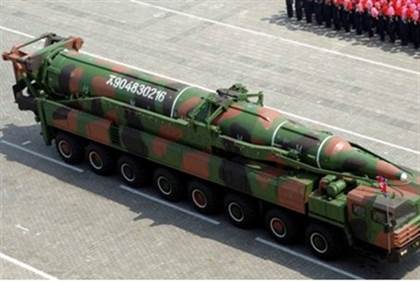
NK missileA North Korean rocket in a military parade (file)Reuters

The information is particularly damaging given that Admiral Bill Gortney, Commander of North American Aerospace Defense Command (NORAD) and US Northern Command (USNORTHCOM), admitted this month that the Pentagon fears that North Korea and possibly Iran can target the US with a nuclear EMP strike.

********************

US intelligence officials revealed that during the ongoing Iran nuclear negotiations, North Korea has provided several shipments of advanced missile components to the Islamic regime in violation of UN sanctions – and the US hid the violations from the UN.

The officials, who spoke to the Washington Free Beacon on Wednesday on condition of anonymity, said more than two shipments of missile parts since last September have been monitored by the US going from North Korea to Iran.

One official detailed that the components included large diameter engines, which could be used to build a long-range missile system, potentially capable of bearing a nuclear warhead.

The information is particularly damaging given that Admiral Bill Gortney, Commander of North American Aerospace Defense Command (NORAD) and US Northern Command (USNORTHCOM), admitted this month that the Pentagon fears that North Korea and possibly Iran can target the US with a nuclear EMP strike.

Critics have pointed out that the nuclear framework deal reached with Iran earlier this month completely avoids this question of Iran’s intercontinental ballistic missile (ICBM) program, which would allow it to conduct nuclear strikes.

US President Barack Obama was given details of the shipments in his daily intelligence briefings, but the officials say the information was hiddenfrom the UN by the White House so that it would not take action on the sanctions violations.

Back in 2010, the UN Security Council put sanctions on Iran’s illegal uranium enrichment program. Those sanctions prohibit Iran from buying ballistic missile parts, and any “technology related to ballistic missiles capable of delivering nuclear weapons.”

The US officials said the recent transfers fall within the scope of the sanctions.

In confirmation, a spokesperson for Spain’s mission to the UN, now in charge of the UN’s sanctions committee, said the committee has not been told about the incidents by the US since Spain took over in January.

White House and State Department spokespersons contacted by the paper refused to comment on the report.

Hiding transfers from the UN – “typical” Obama

A wave of experts came out with criticism against Obama’s administration for hiding the missile part transfer from the UN.

Former UN Ambassador John Bolton said the shipments violate UN sanctions on Iran, as well as those imposed on North Korea back in 2009.

“If the violation was suppressed within the U.S. government, it would be only too typical of decades of practice,” Bolton said. “Sadly, it would also foreshadow how hard it would be to get honest reports made public once Iran starts violating any deal.”

Former CIA analyst Fred Fleitz shared his assessment, saying “while it may seem outrageous that the Obama administration would look the other way on missile shipments from North Korea to Iran during the Iran nuclear talks, it doesn’t surprise me at all.”

“Iran’s ballistic missile program has been deliberately left out of the talks even though these missiles are being developed as nuclear weapon delivery systems,” noted Fleitz. “Since the administration has overlooked this long list of belligerent and illegal Iranian behavior during the Iran talks, it’s no surprise it ignored missile shipments to Iran from North Korea.”

The mounting criticism was added to by Thomas Moore, a former Senate Foreign Relations Committee arms control specialist, who told Washington Free Beacon that the transfer “certainly points out the glaring omission present in the Iran deal: the total lack of anything on its missile threat.”

“If true, allowing proliferation with no response other than to lead from behind or reward it, let alone bury information about it, is to defeat the object and purpose of the global nonproliferation regime – the only regime Obama may end up changing in favor of those in Tehran, Havana and Pyongyang,” Moore said.

And Henry Sokolski, head of the Nonproliferation Policy Education Center, said the missile transfer “more than suggests why the administration had to back away from securing any ballistic missile limits in its negotiations” with Iran.

Exposing the Iran-North Korea missile partnership

The Washington Free Beacon went into detail about the relationship between North Korea and Iran in building the latter’s advanced missile program, which is poised to construct ICBMs capable of delivering a strike with a nuclear warhead at astounding distances.

A classified State Department cable from October 2009 that was exposed by Wikileaks details that Iran is the leading missile customer of North Korean.

It stated how since the 1980s North Korea has been handing Scud missiles and technology for developing Nodong missiles with a 620-mile range to Iran.

“Pyongyang’s assistance to Iran’s [space launch vehicle] program suggests that North Korea and Iran may also be cooperating on the development of long-range ballistic missiles,” read the cable.

Another cable from September 2009 posited that the steering engines in Iran’s Safir rocket likely come from North Korea, and are based on Soviet-era SS-N-6 submarine launched ballistic missiles.

Importantly, that transfer of technology let Iran develop a self-igniting missile propellant that “could significantly enhance Tehran’s ability to develop a new generation of more-advanced ballistic missiles.”

“All of these technologies, demonstrated in the Safir [space launch vehicle] are critical to the development of long-range ballistic missiles and highlight the possibility of Iran using the Safir as a platform to further its ballistic missile development,” read the cable.

The assessments of the classified cables were confirmed by Joseph DeTrani, former director of the US intelligence agency National Counterproliferation Center, who said North Korea has kept “close and long term” relations with Iran in transferring missiles and related technology.

“U.N. Security Council resolutions prohibit this type of activity, and continued missile-related transfers from North Korea to Iran would be in violation of these Security Council resolutions,” added DeTrani, a former CIA officer and special envoy to North Korea nuclear talks.

Dr Andrew Bostom on Lisa Benson show 12.5.2015

April 13, 2015

Dr Andrew Bostom on Lisa Benson show 12.5.2015, You Tube, April 13, 2015

(Dr. Bostom relates Islamic doctrine to Iran’s negotiating tactics. Please see also, Lt. Col Ralph Peters: “The Iranians Negotiate, We BEG!” — DM)

US Admits N. Korea, Maybe Iran, Can Now Target it with EMP-Nukes

April 12, 2015

US Admits N. Korea, Maybe Iran, Can Now Target it with EMP-Nukes, Israel National News,Mark Langfan April 12, 2015

(Please see also, Why IS the US military moving back into ‘Stargate’ base deep under the Rocky Mountains a decade after it was abandoned? — DM)

Adm. Gortney revealed that America’s anti-missile missile shield is not only configured to repulse a North Korean missile, but an Iranian ICBM as well. The Admiral explained that the current assessment is that the threat of an ICBM EMP strike comes from North Korea and not from Iran, but that the system could handle both scenarios. “Our system is designed for North Korea, and if we get our assessment wrong, for Iran. Its [the US homeland missile shield] is designed to defend the nation [the homeland] against both those particular threats today,” he said.

US President Barack Obama is currently negotiating a deal with Iran that he himself has admitted would enable it to manufacture its own nuclear weapons, 12-13 years after it is signed.

*********************

In a blockbuster admission, Admiral Bill Gortney, Commander of North American Aerospace Defense Command (NORAD) and US Northern Command (USNORTHCOM) disclosed that the Pentagon now believes North Korea has mastered the ability to miniaturize its nuclear bombs so they can be fitted onto their latest mobile KN-08 intercontinental ballistic missiles (ICBMs), which are capable of reaching the continental United States.

At the news conference, Adm. Gortney flatly stated, Pyongyang has “the ability to put a nuclear weapon on a KN-08 and shoot it at the homeland [the continental United States].” He expressed confidence that the US could knock down such a missile if launched by North Korea or its ally, Iran.

He also admitted, however, that it is “very difficult” for the US to counter the threat, because its intelligence is unable to follow the mobile ICBMs and give an efficient warning before they are launched.


The admission was accompanied by the announcement that NORAD is reopening its nuclear-EMP-proof Cheyenne Mountain bunker,

The KN-08 is a road-capable, highly mobile ICBM, which can be hidden anywhere throughout the North Korea and could be fired on a short-countdown virtually undetectable by American intelligence. As Adm. Gortney further explained about the North’s KN-08 ICBM, “It’s the relocatable [highly-mobile, can go anywhere – ML] target set that really impedes our ability to find, fix, and finish the [KN-08] threat. And as the [KN-08] targets move around and if we don’t have a persistent stare [i.e., the ability to monitor its location at all times – ML] and persistent [intelligence, surveillance, and reconnaissance] that we do not have over North Korea at this time, that relocatable nature makes it very difficult for us to be able to counter it.”

Despite Adm. Gortney’s concerns, he still believes that if a KN-08 was fired at the US homeland, in the Admiral’s words – “Should one get airborne and come at us [the US homeland], I’m confident we would be able to knock it down.”

Even if this is true, it is not clear if the US ballistic defense could knock down an incoming North Korean ICBM in time, if the nuke is intended as an EMP weapon, which explodes soon after re-entering the atmosphere.

System can defend against Iran strike, too 

In another dramatic revelation, Adm. Gortney revealed that America’s anti-missile missile shield is not only configured to repulse a North Korean missile, but an Iranian ICBM as well. The Admiral explained that the current assessment is that the threat of an ICBM EMP strike comes from North Korea and not from Iran, but that the system could handle both scenarios. “Our system is designed for North Korea, and if we get our assessment wrong, for Iran. Its [the US homeland missile shield] is designed to defend the nation [the homeland] against both those particular threats today,” he said.

Experts have estimated that the KN-08 has a range of 5,600 miles and would be capable of hitting the US’s west coast if launched from North Korea. Experts also believe the missile is not accurate.

However, Adm. Gortney’s statement about North Korea’s nuke-capable KN-08 ICBM must be taken in the context of his simultaneous announcement of the Pentagon’s concern about an EMP-missile strikeon the United States homeland.

South Korean intelligence has long believed that North Korea has been developing an EMP-nuclear device. As early as June 2009, Kim Myong Chol, who was an “unofficial” spokesperson of the then-Supreme Leader Kim Jong-il, openly threatened use of a “high-altitude detonation of hydrogen bombs that would create a powerful electromagnetic pulse” bomb.” And, in November of 2013, South Korea’s intelligence service (NIS) issued a report to the South Korean parliament that North Korea had “purchased Russian electromagnetic pulse (EMP) weaponry to develop its own version” of a nuclear EMP device.

EMP strike on South Korea?

In 2005, then-USAF Major Colin Miller posited, in a public-domain US Air Force University thesis, that the North Koreans could tactically use a nuclear-EMP weapon on the Korean Peninsula to “level-the playing field” against the electronic dependent forces of the United States and South Korea.

The tactical North Korean EMP “decapitation” attack would likely bag as POWs the 40,000 living US marines now guarding South Koreabecause an EMP doesn’t kill human beings, only electronics.

A tactical nuclear-EMP aimed at South Korea would not need an ICBM to reach the 30-50 km level above the earth to explode. Rather, it would only need a much smaller short-range missile to achieve its suitable EMP-location above the Korean peninsula for an effective EMP detonation.

Given the degree of cooperation between the Islamic Republic of Iran and North Korea, it is highly likely that any nuclear-EMP-technology mastered by North Korea has already been shared with Iran. Therefore, the EMP-proliferation danger from North Korea to Iran is a catastrophic danger.

North Korea has been threatening a pre-emptive nuclear strike on the US for two years, as explained in this ABC News report from 2013. At the time of the report, North Korea was said to be “years away” from a developing a missile that could hit the US: These “years” have apparently passed.

And yet, inexplicably, US President Barack Obama is currently negotiating a deal with Iran that he himself has admitted would enable it to manufacture its own nuclear weapons, 12-13 years after it is signed.