Posted tagged ‘Egypt’

US mull hitting ISIS for EgyptAir bombing

May 22, 2016

US mull hitting ISIS for EgyptAir bombing, DEBKAfile, May 22, 2016

Triangle480_Koteret

A special team set up by ISIS in its Syrian capital Raqqa planned the downing of EgyptAir Flight 804 from Paris to Cairo, which took the lives of 66 passengers and crew, DEBKAfile’s intelligence and counterterrorism sources say in an exclusive report.

The information that an ISIS team ploting terrorist attacks has been operating in Raqqa for several weeks was known to American intelligence and counterterrorism services even before the downing of the Egyptian airliner, and warnings containing the information were sent to several Western European capitals, including Paris.

The warnings said ISIS is prepare a series of large-scale attacks in main European cities and airports with the start of the summer travel season.

That is the main reason why both Paris and Cairo said the plane was downed by an act of terror on May 19 as soon as it became clear that the airliner had crashed into the Mediterranean 288 kilometers north of Alexandria, even before the debris was found.

Our sources report that the US has decided to maintain its original plan, prepared  before the downing of Flight 804, to impose a siege on Raqqa in an attempt to prevent terror cells from leaving the city and carrying out attacks.

On Saturday, May 21, US Army Gen. Joseph Votel, the commander of American forces in the Middle East, made a secret visit to Syria, the first of its kind by a senior US officer since the Syrian civil war began in 2011. Votel, who recently assumed command, visited Kurdish YPG militia forces and the US special forces troops at Rmelan airbase located 288 kilometers northeast of Raqqa. The American force is equipped with AH-64 Apache attack helicopters capable of attacking Raqqa within a relatively short period of time.

The purpose of Gen. Votel’s visit was to look into the viability of a US-Kurdish strike in retaliation for the downing of the Egyptian plane. It should be assumed that US President Barack Obama will need to make a decision on the operation in the coming hours.

Over the weekend, ISIS, which is aware of the American plans, enabled citizens to leave Raqqa if they wished to do so. ISIS does not want to have to worry about the civilian population if there is a US-Kurdish attack or siege.

In the meantime, Washington and Cairo are stalling for time while considering their options.

That is the reason why US and Egyptian officials, and even Egyptian President Abdel Fattah al-Sisi, continued to claim on May 22 that more time is needed to determine the cause of the crash.

It was also the reason why, soon after the air disaster, it was claimed that there was no distress call or any other message regarding a problem with the plane.

But two days after the crash, on May 21, following the recovery of debris and parts of the bodies of the passengers, there were suddenly reports that they signals from the plane of smoke in two places in the aircraft.

Investigators say it is still not clear what caused the smoke, whether a fire or fires broke out on the plane, or whether the fire eventually caused the crash, but al the signs point to an internal explosion.

DEBKAfile sources report that both Paris and Cairo believe that the crash was caused by a new type of small time bomb, or several of them, that were smuggled into the plane and planted by Charles de Gaulle airport workers loyal to ISIS.

The sources point out that ISIS explosives experts specialize in building very small devices that can be smuggled onto planes. A device within a Coca-Cola can downed a Russian Airbus A321 over the Sinai Peninsula on October 31, killing all 224 passengers and crew.

Our sources also report that investigators of the latest crash believe that just as ISIS blew up the Russian plane in retaliation for Moscow’s intervention in Syria, the downing of the Egyptian plane is linked to the entry by Egyptian special forces into Libya during the last few weeks to take action against ISIS forces.

DEBKAfile’s military sources report that an Egyptian special force is operating with a  US elite units against ISIS targets in eastern Libya near the port city of Tobruk.

Sisi and Mideast Peace

May 21, 2016

Sisi and Mideast Peace, American ThinkerC. Hart, May 21, 2016

Egyptian President Abdel Fatah al-Sisi’s speech on Tuesday, May 18, set ripples through Israel’s political establishment. Speaking in the southern city of Assiut, Sisi signaled to the Arab world, the Palestinians, and Israel that it is time for an historic breakthrough in peace negotiations.

Responding immediately to Sisi’s comments, Israeli Prime Minister Benjamin Netanyahu stated that he is open to working with Egypt and Arab states towards advancing the peace process, not only with the Palestinians but with the peoples of the Middle East region.

Netanyahu’s comments come on the heels of a visit to Israel by French Foreign Minister Jean-Mark Ayrault. The two men met but disagreed on how to advance peace.

France insists on hosting an international parley to force Israel and the Palestinians to come to the peace table. Israel is against the French initiative.

Netanyahu would like to go beyond the Israeli-Palestinian conflict and work directly with moderate Arab states on a comprehensive peace deal. Sisi could be instrumental in building an Arab coalition for peace which would dismiss or weaken the divisive French initiative, releasing Israel from conceding to European demands.

Former Israeli ambassador to Egypt, Zvi Mazel, is currently working as a Research Fellow at the Jerusalem Center for Public Affairs (JCPA). He is a Middle East expert who has represented Israel’s Ministry of Foreign Affairs as former Ambassador to Sweden and Romania, as well. This writer asked Mazel if Sisi’s comments were spontaneous or were released at this time for political reasons because he wants to strengthen Egypt’s position in the region by helping Israel.

“I don’t think there is a big design… I think that Sisi understands what is going on in the Middle East and he is identifying according to his view — a kind of possibility of advancing the peace process.”

Egypt, Saudi Arabia, the Gulf countries, and Israel have common enemies: Iran and Islamic State. Already there have been discreet diplomatic and business ties between Israel and these nations

According to Mazel, Sisi is also emerging as a strong respected leader among Egyptians despite the Western media’s portrayal of him as a dictator similar to former Egyptian President Hosni Mubarak.

“Sisi sees himself as a president quite stable among his people. I know that this is not the way they think in the Western media — New York Times and company. They see him as a kind of military dictator; absolutely not! He’s a good man. He’s not Mubarak. He’s Sisi.”

Mazel explains that Egypt is on the way to economic sustainable development. This is what Sisi has been focused on over the past two years and he is seeing success. Unemployment has gone down, despite the fact that almost 90 million people live in Egypt and the country is poor.

“He has started something quite positive, and Sisi thinks that the time has come for Egypt to be in the international arena.”

What that means, according to Mazel, is that Egypt’s current role is still minor. Sisi is asking Israelis and Palestinians to go forward, yet he, himself, does not have a plan. But, in the future, Egypt could emerge as a larger player in the region.

Mazel is pragmatic about the short-term. “It’s a positive step for Egypt, but it is not going to change the world.”

Current peace advances that are being prepared for release are not a positive development for Israel: (a) the French Initiative; (b) a document showing the obstacles to Israeli-Palestinian peace efforts soon to be reported by the Quartet; (c) the 2002 Arab Peace Initiative that, despite being outdated, is still considered a serious option by the Arab world.

In the coming days, the Arab League plans to meet and discuss the Israeli-Palestinian conflict. Mazel thinks that Sisi’s statement was good timing for that meeting, but otherwise, was not connected to a bigger scheme.

However, on Wednesday, May 18, American Secretary of State John Kerry arrived in Egypt one day after Sisi gave his emotional speech. Some analysts believe that the U.S. is behind Sisi’s bold words, in an effort to circumvent the French from becoming a new power broker in the Middle East.

The question is whether Sisi’s encouragement will lead to Israel courting the Arab nations and the Arab nations courting Israel, while by-passing the Palestinians. Mazel thinks that kind of change is slow in coming, because the Arabs continue to entrench themselves in old positions that favor Palestinian demands.

Refusing to sit down and negotiate with Israel, the Palestinians have insisted on preconditions which the Arab League has accepted. They demand that Israel agree on the right of return for so-called Palestinian “refugees” to Israeli land; that Israel withdraw to the 1967 borders; and, that Israel stop building in West Bank settlements (Judea and Samaria). Palestinian President Mahmoud Abbas also expects Israel to release hundreds of Palestinian prisoners, who have blood on their hands, serving time in Israeli jails because of terrorist attacks against the Israeli population.

So far, these unresolved issues have kept Abbas away from face-to-face negotiations with Netanyahu. However, his real diplomatic scheme is to get the international community to affirm the Palestinian position and force Israel to concede to Palestinian demands. Right now, Abbas sees the best venue to accomplish his goal as a French-sponsored future peace conference, followed by a stinging UN anti-Israel resolution.

Meanwhile, the future pressure on Israel will be to immediately stop settlement construction in order to get the peace process going. Mazel declares, “Absolutely not… we have to go on! Half a million people live there. And, they are the shield of Israel. We continue to build until there is peace.”

Mazel has a real problem with the demands of the Arab League, as well. “The Arab Peace Initiative is more or less the same as the Palestinian attitude. The ‘right of return’ is still there. It should be taken completely out. Most importantly, the Palestinians and the Arabs should recognize a Jewish State in Israel.”

Mazel is also not sure that Netanyahu’s insistence on widening his government, to provide greater stability, is a wise idea. Reportedly, Yisrael Beytenu Chairman Avigdor Liberman will soon become Israel’s new Defense Minister as Netanyahu brings several more ministers into his coalition. Mazel thinks this will not provide a wider diplomatic envelope; nor, will it help change European or Arab attitudes towards Israel; nor will it end the Boycott-Divestment-Sanctions (BDS) movement against Israel.

Then there is U.S. President Barack Obama’s failed Middle East policy, which includes his lackluster support of American allies in the region. Mazel says this policy cannot continue.

“It cannot be like that, because America is the most important power in the world… And, whoever will win the presidency, whether it will be Mrs. Clinton or Trump, both of them are in a certain way connected to the Middle East.”

Mazel believes that with 22 countries and more than 300 million people living in the region, the next U.S. president will be more engaged in leading the nations into greater stability.

In the meantime, currently 80% of the Egyptian people support Egyptian President Sisi. His nation has already made peace with Israel (along with Jordan). Helping Israel to extend an olive branch to other Arab countries will encourage Egypt to take up an important leadership role in a region that continues to be embroiled in major upheaval and violence.


EgyptAir flight blown up by ISIS time bomb

May 19, 2016

EgyptAir flight blown up by ISIS time Bomb, DEBKAfile,  May 19, 2016

EgyptAir804_480

EgyptAir flight MS804, which took off at 11:09 p.m. on Thursday May 19 from Charles de Gaulle airport in Paris, was supposed to land at 3:55 a.m. in Cairo. However, it dropped off the radar screens of Greek and Egyptian flight controllers at 2:45 a.m. and crashed into the Mediterranean about 10 miles inside Egypt’s territorial waters.

The Airbus A320-232 had 66 people aboard including seven crew members, three security guards, 30 Egyptian citizens, 17 French nationals as well as citizens of Iraq, Saudi Arabia and other countries. The plane, which was built in 2003, was flown by two pilots who each had thousands of hours of cockpit experience. Reports by Egypt’s airport authority said the cargo did not contain dangerous materials or anything else out of the ordinary.

Egyptian Prime Minister Sherif Ismail said terrorism could not be ruled out, emphasizing that there were no distress calls made from the cockpit and that there were no reports showing deviation from the flight path or altitude before the plane disappeared. The spokesman of the Egyptian military, Brig. Gen. Mohammed Samir, confirmed in a posting on the military’s Facebook page that the pilots did not send out a distress signal.

Following the disappearance, French President Francois Hollande convened an emergency meeting Thursday morning at the Elysee Palace.

Reports on social media said that witnesses in Greece saw a large ball of fire in the sky, which may strengthen the assumption that flight MS804 carried a time bomb that was set to explode when the plane was in Egyptian airspace.

DEBKAfile’s counterterrorism sources say that if the plane was downed by an act of terror, it would be the latest major blow by ISIS to international civilian aviation, Egyptian tourism, and the security, counterterror and intelligence services of France and Egypt.

  • It is the second time in less than a year that ISIS has succeeded in using a time bomb to down a passenger plane linked to Egypt. The first one was a Russian Airbus A321 that took off from Sharm al-Sheikh and blew up over the Sinai Peninsula on October 31. All 224 passengers and crew were killed.
  • One of the main questions in the investigation of the latest air disaster will be whether the explosive device was planted in Cairo or Paris. If it did happen in Paris, it would raise the question of whether an ISIS cell penetrated the ground crews at Charles de Gaulle airport. If confirmed, it would be a serious escalation by ISIS following the terrorist organization’s November 2015 attacks in Paris in which 130 people were killed and hundreds were wounded.
  • A sign of an escalation was that it was the second terrorist attack within three months on a civilian aviation target in a Western European capital, following the bombing of Brussels international airport in March in which 31 people were killed and about 200 were wounded.
  • But if the investigation finds that the bomb was planted on the plane in Cairo before it departed for Paris, it would mark a serious and dangerous escalation of the infiltration and operational abilities of ISIS in the Egyptian capital, and a major threat to the stability of the regime of President Abel Fattah al-Sisi.

French intelligence warned of ISIS attacks before missing Egypt Air Flight MS804

May 19, 2016

French intelligence warned the country was ‘clearly being targeted by ISIS’ and was at risk of ‘a new form of attack’ a week before Paris flight to Egypt.

Patrick Calvar, head of DGSI, warned of ‘new attacks’ on May

10 His warning to French MPs came a week before Flight MS804 went missing

Mr Calvar said ISIS and Al-Qaeda wanted to create a ‘climate of panic’

France will be hosting the Euro 2016 football tournament next month

By Chris Summers For Mailonline

Published: 02:51 EST, 19 May 2016 | Updated: 04:15 EST, 19 May 2016

Source: French intelligence warned of ISIS attacks before missing EgyptAir Flight MS804 | Daily Mail Online

The head of France’s internal intelligence agency had warned the country was being ‘clearly targeted’ by ISIS a week before the Paris to Cairo flight took off.

Egypt Air Flight MS804 has gone missing over the Mediterranean with 66 people on board amid reports of a merchant ship captain having seen a ‘flame in the sky’.

An Egyptian civil aviation authority spokesman has said the plane, with 15 French passengers and one Briton on board – most likely crashed into the sea.

Patrick Calvar (pictured), the head of French internal intelligence, warned last week that ISIS was planning new attacks and France was still their number one target

The cause of the disaster remains unknown but it comes seven months after a bomb blew up a Russian airliner over the Sinai desert, killing all 224 people on board.

ISIS later revealed images of a soda can bomb which they claimed to have used to bring the Metrojet plane down.

It has now emerged that Patrick Calvar, the head of France’s DGSI agency, told a parliamentary committee on national defence in Paris on May 10 that ISIS was planning ‘a new form of attack’.

France’s security forces have remained on high alert since the Paris attacks (pictured) in November, which killed 130 people

The DGSI (General Directorate for Internal Security) is France's equivalent of the MI5 and is responsible for guarding against internal threats

The DGSI (General Directorate for Internal Security) is France’s equivalent of the MI5 and is responsible for guarding against internal threats

France was targeted twice last year – with the Charlie Hebdo attack in January and the Paris attacks in November – and the French security forces are on a state of high alert.

Mr Calvar was quoted in The Local as saying: ‘We risk being confronted with a new form of attack: a terrorist campaign characterised by leaving explosive devices in places where big crowds gather, multiplying this type of action to create a climate of panic.’

He made no mention of attacks on aircraft but said he believed France was ‘the country most threatened’ by ISIS, which is often known as Daesh, and also warned that Al-Qaeda remained a threat and was champing at the bit to ‘restore its image’ as a major player, especially in the Maghreb and the Arabian peninsula.

Mr Calvar said while last November’s attacks in Paris that killed 130 people were conducted by suicide bombers and jihadists armed with Kalashnikovs, a new form of attack was possible.

We know that Daesh is planning new attacks…and that France is clearly targeted
Patrick Calvar

It may be several weeks or even months before it is known what brought down Flight MS804 but Mr Calvar’s comments will increase fears of spectators with less than a month to go before the start of the Euro 2016 football tournament in France.

Mr Calvar said: ‘We know that Daesh is planning new attacks using fighters in the area, taking routes which facilitate access to our territory and that France is clearly targeted.’

He said ISIS had suffered military setbacks in Syria and Iraq and wanted to take revenge on members of the coalition, including France, which were behind the air strikes on ISIS targets.

Mr Calvar said while last November’s attacks in Paris that killed 130 people were conducted by suicide bombers and jihadists armed with Kalashnikovs, a new form of attack was possible.

This is a so-called soda can bomb, published in the ISIS magazine, which they claimed to have used to destroy the Russian airliner in October, killing 224 people

ISIS to Israel: “We’re coming very soon”

May 8, 2016

ISIS to Israel: “We’re coming very soon” DEBKAfile, May 8, 2016

65 Killed in Egypt's Sinai, ISIS Claims Responsibility

65 Killed in Egypt’s Sinai, ISIS Claims Responsibility

The last 48 hours (May 7-8) have seen a major escalation of the ISIS threats against Israel, DEBKAfile’s intelligence and counterterrorism sources report. In a coordinated maneuver by all of the ISIS commands in the Middle East, the terrorist organization simultaneously released at least 10 videos that it said showed ISIS forces on their way to attack targets in Israel.

All of the videos refer to the Palestinian issue, Jerusalem and the timing of the attacks. In each one, the narrator claims the terror organization did not forget the Palestinians, and will not neglect them any more; describes Jerusalem as “a bridge to Islam”; and threatens an impending attack, saying “We’re coming, and coming very soon” accompanied by images of fighters from the ISIS affiliate in the Sinai are shown.

It was not the first time for the ISIS propaganda machine to threaten hostilities against Israel, but it was the first time for the threat to be issued simultaneously from every province or city where ISIS is located in the Middle East. The videos included ones from Raqqa, the ISIS capital in Syria; Mosul, the terrorist organization’s capital in Iraq; the Sinai Peninsula and Egypt; Derna in eastern Libya; and central Libya, where according to DEBKAfile’s counterterrorism sources ISIS controls a huge 300-kilometer area including the Mediterranean coast on the Gulf of Sidra.

Our sources report that every video contains the following sentences: “We know that the Egyptian army is being helped by Israeli intelligence and the Israeli Air Force in its war against us”; “We also know that Israel set up intelligence networks within the population of the Bedouin tribes in the Sinai”; and “From now on we will take action against Egyptian and Israeli targets as one.”

DEBKAfile’s intelligence sources report that these comments are intended to counter efforts by the Egyptian military to establish anti-ISIS militias among the Bedouin tribes. This came after American counterterrorism experts advised the Egyptian military to operate the same way that the US operates among the Sunni tribes in western Iraq’s Anbar province, where US military instructors are setting up local militias to prevent ISIS fighters from entering or passing through areas under the tribes’ control.

Our sources report that three Bedouin anti-ISIS militias have been established in the Sinai so far: the “Sons of Sinai”, “Unit 103”; and the “Death Squad”.

Meanwhile, the ISIS affiliate in the Sinai carried out one of its boldest terrorist attacks on Sunday, May 8, killing eight Egyptian policemen including an officer, in the Cairo suburb of Helwan. Four masked terrorists with automatic weapons jumped out of a commercial vehicle that had blocked a minibus transporting the policemen, fired hundreds of bullets at the minibus, killing everyone inside, and then fled the scene.

Western counterterrorism experts monitoring ISIS-Sinai estimate that it not only has the ability to carry out terrorist attacks in major Egyptian cities, but also against Israel.

Muslim Countries Slam Israel—For Protecting them

April 28, 2016

Muslim Countries Slam Israel—For Protecting them, Front Page MagazineP. David Hornik, April 28, 2016

OIC

On Tuesday the Organization of Islamic Cooperation held an “emergency,” “extraordinary” meeting in Jeddah, Saudi Arabia.

The OIC includes violence-wracked countries and failed states like Syria, Iraq, Yemen, Libya, Afghanistan, Nigeria, and others, as well as severely poor and dysfunctional countries like Burkina Faso, Somalia, Bangladesh, and others. Not a single one of the organization’s 57 countries is a frontrunner in terms of freedom and prosperity, and most are far below that level.

But the topic of Tuesday’s “emergency meeting” was that on April 17 Israeli prime minister Benjamin Netanyahu said that: “Israel will never withdraw from the Golan Heights.”

The meeting’s final communiquéCondemns strongly Israel, the occupying power, and its macabre acts to change the legal status, demographic composition, and institutional structure of the occupied Syrian Golan.” It also “expresses unconditional support for the legitimate right of the Syrian people to restore their full sovereignty on the occupied Syrian Golan.”

The Arab League—whose 22 member states make up a sizable chunk of the OIC—had already weighed in on Netanyahu’s words on April 21, calling for a special criminal court to be set up and put Israel on trial for the transgression.

The Golan was controlled by Syria from 1948 to 1967, during which time Syrian gunners often fired at the Israeli communities below and forced their residents to sleep in bomb shelters. Israel captured the Golan from Syria in the 1967 Six Day War—and fortunately, since then, has kept it and developed it.

Today, with Syria devolved into Hobbesian war and fragmentation, the Heights are all the more strategically vital to Israel, and the idea of trading them for “peace” has—at least in the Israeli discourse—died a well-deserved death. The Golan, by the way, constitutes less than 1 percent of Syrian territory, and Syria’s loss of it almost 50 years ago is the least of its problems.

But there is further irony in the Arab League’s and the OIC’s reactions to Netanyahu’s words.

At present, Israel is engaged in tight strategic cooperation with two of its neighbors—Egypt and Jordan—against ISIS, one of the two most dangerous of the entities now fighting it out in Syria. More broadly, according to numerous reports, as well as hints dropped by Israeli and some Arab leaders, Israel and Sunni Arab states—led by Saudi Arabia—are also working together against the Iranian axis, the second of the two most threatening forces now operating in Syria.

Not only, then, do the Arab and Muslim countries as corporate bodies denounce Israel as a “macabre” criminal even as it acts as a crucial ally of not a few of these countries. They also react with outrage to the very Israeli policy—retaining the Golan—that keeps Israel strong in the face of the threats emanating from Syrian territory.

The signers of Tuesday’s communiqué in Jeddah know that there no longer exists a “Syrian people” to which sovereignty on the Golan could be restored. Some of the signers also know that a strong Israel is now one of the guarantors of their survival; and more specifically, that Israel’s presence on the Golan helps shield Jordan from imminent peril.

That Netanyahu’s words about keeping the Golan continue to spark fierce denunciations, then, reflects something deeper: an ongoing, profound antipathy to Israeli—that is, Jewish—control of any land in what is seen as, by rights, a Muslim domain. From that standpoint, even for Israel to hold onto a sliver of what used to be Syria, won in a defensive war almost half a century ago, is intolerable.

That same antipathy was on display earlier this month when seven Arab countries—including Egypt—got UNESCO to pass a particularly vicious resolution negating any Jewish connection to Judaism’s most sacred sites in Jerusalem, declaring them exclusively Muslim sites, and going so far as to accuse Israel of “planting Jewish fake graves in…Muslim cemeteries.” (Among the “yea” votes: France, Spain, and Sweden.)

These rhetorical eruptions suggest that, despite the growing behind-the-scenes collaborations, Israel remains very far from being accepted and legitimized in the region. Its best bet is to keep building its power, which gets some of its neighbors to deal with it pragmatically and rationally.

As for the Arab and Muslim countries, their continuing hang-up with the geographically tiny Jewish state, and repeated displays of ganging up on it in righteous fury, are unedifying and linked to their inability to tackle their real problems.

US Sinai pullback payback for islands handover

April 27, 2016

US Sinai pullback payback for islands handover, DEBKAfile, April 27, 2016

RedSeaBab2

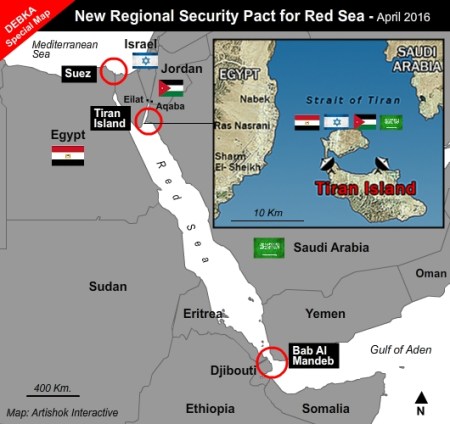
The US withdrew its forces from the Sinai Peninsula last weekend in retaliation for Egypt’s transfer of sovereignty over Tiran and Sanafir islands to Saudi Arabia, according to DEBKAfile’s military and intelligence sources. They also report that the move came after Washington protested to Egyptian President Abdel Fattah al-Sisi over its exclusion from the consultations and military coordination between Egypt, Saudi Arabia and Israel regarding the islands.

The US message was clear. Since Riyadh, Cairo and Jerusalem do not report their military steps in the Sinai Peninsula, the Gulf of Aqaba and the Red Sea to Washington, the US sees no need to inform them of its military steps in the Sinai.

That message was conveyed by the chairman of the US Joint Chiefs of Staff, Joseph F. Dunford, to the Egyptian president during their meeting on Saturday, April 23 in Cairo.

On Tuesday, DEBKAfile’s military sources reported that several days earlier the US military secretly withdrew about 100 of its officers and enlisted men from the multinational peacekeeping force in the northern part of the Sinai. As far as Riyadh, Cairo and Jerusalem are concerned, there is no doubt that it was a retaliatory measure.

US sources refused to specify the current location of the troops. The American force was withdrawn from El Gorah base, located next to the town of Sheikh Zuweid. Gen. Dunford told al-Sisi that the Obama administration is no longer willing to maintain forces in the northern Sinai following the recent shelling of the base by the ISIS affiliate in the restive area. The incident marked the terrorist organization’s first attack on US troops in the Sinai, but its second on an American force in the Middle East.

On March 19, ISIS shelled Fire Base Bell, a US marine base in Makhmur, northern Iraq, about 77 kilometers southeast of the terrorist organization’s de facto capital of Mosul. One marine was killed.

It was not by chance that shortly before he visited Cairo, Gen. Dunford made a visit lasting no more than 90 minutes to the US forward base to award purple hearts to four marines for their bravery during the ISIS shelling.

But while Washington is determined to maintain Fire Base Bell, where it has deployed HIMARS rocket launchers that can fire GPS-guided rockets known as GMLRS capable of reaching Mosul, and awards medals to soldiers serving at the base, it is not ready to treat its soldiers in the Sinai in the same manner because they have the status of multinational observers. Rather than giving out medals, it withdrew those soldiers immediately after the first ISIS attack.

At the same time, US sources launched an unprecedented personal attack on Egypt’s president over his decision to hand over the two islands to Riyadh. Articles attacking El-Sisi’s policy started to appear in the American media, with one saying “The decision to transfer the islands to Saudi Arabia may be the final nail in Sissi’s coffin.” It also described Egypt as being on the verge of a revolution against al-Sisi.

Two other Middle Eastern figures who were involved in Cairo’s decision regarding the islands were Saudi Deputy Crown Prince and Defense Minister Mohammad bin Salman and Israeli Defense Minister Moshe Ya’alon, who said recently that Cairo consulted Jerusalem regarding the transfer of the islands. However, his comment was not mentioned in US media reports, as if the development was not related to Saudi Arabia or Israel.

DEBKAfile’s military and intelligence sources report that one of the main reasons for Washington’s rage was the fact that Egypt, Saudi Arabia, Jordan and Israel decided to establish and coordinate by themselves a regional defense mechanism covering the Suez Canal, the gulfs of Suez and Aqaba, and the Red Sea.

The Obama administration prefers to ignore the fact that the US withdrawal of its naval and air forces from those areas over the last three years has enabled the Iranian fleet to start operating in those waters.

A policy of hypocrisy

April 25, 2016

A policy of hypocrisy, Israel Hayom, Dr. Haim Shine, April 25, 2016

Judging by his approach to complex national and international issues, U.S. President Barack Obama is very frustrated. The frustration is natural for someone who made big promises, almost messianic ones, and is now leaving behind nothing more than a trail of shattered dreams. During his eight years in office, the United States has gone from being a leading superpower, a pillar of Western civilization, to a state that is hesitant, indecisive and alarmingly slow to respond. Its domestic economy is faltering, sowing uncertainty and insecurity among the large middle class.

Needless to say, the success enjoyed by Republican presidential candidate Donald Trump is an expression of a great number of Americans who grew up hearing about how their flag was raised on Japan’s Mount Suribachi on the island of Iwo Jima toward the end of World War II, and who are now watching with heartache as their beloved flag is being lowered to half-mast before being taken down altogether.

In an effort to gather up the pieces of his crumbling legacy, Obama set out on his final trip to the Middle East and Europe. America’s long-time allies feel betrayed. Their resentment is clear. Relationships between countries are not disposable. The Obama administration’s deference to Iran has had major implications on its ties with Saudi Arabia and the Gulf States. A divided Egypt is still paying the price for Obama’s support for the Muslim Brotherhood.

The state of Israel, which has led the struggle against a nuclear Iran for a long time, has by now come to terms with the fact that the United States was duped by the fake smiles of Iranian Foreign Minister Mohammad Javad Zarif and his friends in Tehran. Singing Passover songs in Hebrew won’t change the fact that Obama has not changed, after having sided entirely with the mendacious Palestinian narrative of victimhood.

Leaders in the Middle East cannot decide whether Obama is a naive president or one who is willing to sacrifice his fundamental values and his credibility just so he can leave behind what he sees as a positive sentence in the books of history — a sentence that will be erased with record speed.

Europe is also discouraged by the United States. Obama’s indecisiveness regarding the madness in Syria has allowed Russia to take significant steps in the Middle East and Europe. The failed efforts to confront the Syrian problem have contributed to the tsunami of migrants flooding Europe and all the resulting consequences for European society and its security. Add to this, of course, the financial crisis currently threatening to destroy the European Union, the seeds of which were sown in 1992 with the signing of the Maastricht Treaty in 1992.

It is against this backdrop that the British are expected to decide via referendum whether or not to remain a part of the European Union. During his recent visit to England, Obama spoke out strongly against Britain’s potential separation from the EU. This was a crude and disproportionate effort to meddle in another state’s affairs — an expression of his desire to evade blame for the collapse of the European Union. In his mind, British citizens are expected to forgo their opinions and best interests in favor of his legacy.

It is therefore unclear why Obama unleashed his fury at Prime Minister Benjamin Netanyahu when the latter made tireless efforts to convince Congress and the American public not be deceived by the dangerous nuclear deal. How much hypocrisy does it take to allow yourself to do things that you reprimand others for doing? Immanuel Kant saw this kind of behavior as a basic moral failure. Luckily for Britain’s citizens, Obama cannot veto their decision.

GCC leaders reject Obama’s Middle East policy

April 23, 2016

GCC leaders reject Obama’s Middle East policy, DEBKAfile, April 23, 2016

Big Bomber


DEBKAfile’s intelligence sources and its sources in the Gulf report exclusively that US President Barack Obama failed to convince the leaders of the six Gulf Cooperation Council member states, during their April 22 summit in Riyadh, to support his Middle East policy and cooperate with Washington.

Our sources also report that Saudi Arabia, with Turkey’s help, and the US carried out separate military operations several hours before the start of the summit that showed the extent of their differences.

The US on Thursday started to use its giant B-52 bombers against ISIS in an attempt to show Gulf leaders that it is determined to quash the terrorist organization’s threat to Gulf states. The bombers deployed at Qatar’s Al Udeid airbase attacked targets around Mosul in northern Iraq, but the targets were not identified.

Meanwhile, Saudi Arabia and Turkey, which recently established a bloc along with Egypt and Jordan to oppose Obama’s Middle East policy, started to infiltrate a force of 3,500 rebels back into Syria.

The force has been trained and financed by the Saudis at special camps in Turkey and Jordan. Members of the force are now fighting alongside other rebels north of Aleppo, but they are being bombed heavily by the Russian and Syrian air forces.

Riyadh sent the rebels into Syria to demonstrate to Obama that the Saudi royal family opposes the policy of diplomatic and military cooperation between the US and Russia regarding Syria that enables President Bashar Assad to remain in power in Damascus.

Since the war in Syria began in 2011, Obama has promised countless times that Washington would train and arm Syrian rebel forces outside the country, and then deploy them in Syria in order to strengthen rebel forces.

However, it has not done so except for one instance in 2015. The US infiltrated a small force consisting of no more than several dozen fighters, but it was destroyed by the Nusra Front, an affiliate of Al Qaeda, shortly after it crossed the border. The terrorist group had apparently been tipped off about the arrival of the pro-American force.

All of Washington’s efforts to recruit and train Syrian fighters, which have cost close to $1 billion, have failed.

DEBKAfile’s sources report exclusively that the leaders of the six GCC member states put their previous differences aside and presented Obama with four requests aimed at building a new joint policy regarding the region. According to our sources, these requests were:

1. Action by Washington to strengthen the Sunni majority in Iraq and facilitate representation of the Sunnis in the central government in Baghdad. The Gulf rulers told Obama that his policy of trying to win the support of Iraqi Prime MinisterHaider al-Abadi is mistaken.

They also pointed out reports by their intelligence services that al-Abadi is likely to be deposed and be replaced by a pro-Iranian prIme minister in the near future.

Obama rejected the request and said he refuses to change his Iraq policy.

2. Imposition of new US sanctions on Iran over its continuing ballistic missile tests.

On April 19, several hours before Obama’s departure for Riyadh, Iran carried out its latest act of defiance by attempting to launch a satellite into orbit using one of its “Simorgh” intercontinental ballistic missiles. The missile failed to leave the Earth’s atmosphere, fell to earth and crashed along with the satellite.

Obama turned down the Gulf leaders on new sanctions as well.

3. Provision of US-made F-35 fighter-bombers to Saudi Arabia and the UAE so they can take action against the Iranian missile threat. The US president declined the request.

4. Abandonment of Washington’s cooperation with Russia and the UN for political solution in Syria, and instead cooperate with Gulf states and Turkey to end the war and depose President Bashar Assad. Obama refused.

In other words, the summit in Riyadh, Obama’s final meeting with GCC leaders before he leaves the White House next January, ended without a single agreement.

Israel, Turkey, Russia and Egypt

April 17, 2016

Israel, Turkey, Russia and Egypt, Gatestone InstituteShoshana Bryen, April 17, 2016

(A blast from the past:

— DM)

♦ In 2011, the UN Palmer Commission Report found the blockade of Gaza — jointly administered with Egypt — to be legal, and said Israel owed Turkey neither an apology nor compensation.

♦ Lifting the Israel/Egypt embargo on Gaza would empower Hamas, and thereby the Muslim Brotherhood, Iran and ISIS — which would seem an enormous risk for no gain.

Turkish sources assert that Turkish-Israeli governmental relations are about to come out of the deep freeze. But this is a reflection of Turkey’s regional unpopularity and glides over Turkish demands for Israel to end the blockade of Gaza. To meet Turkey’s condition, Israel would have to abandon the security arrangement it shares with Egypt — which has increased Israel’s security and has begun to pay regional dividends. To restore full relations between Israel and Turkey would irritate Russia, with which Israel has good trade and political relations, and a respectful series of understandings regarding Syria. Israel’s relations with the Kurds are also at issue here.

After the 2010 Mavi Marmara flotilla — in which Turkey supported the Hamas-related Turkish organization, the IHH, in its effort to break the blockade of Gaza — Turkey made three demands of Israel: an Israeli apology for the deaths of Turkish activists; a financial settlement; and lifting the Gaza blockade, which Turkey claimed was illegal. The last would provide IHH with the victory it was unable to achieve with the flotilla.

1080 (1)The Turkish-owned ship Mavi Marmara took part in a 2010 “Gaza flotilla” attempting to break Israel’s naval blockade of Gaza, which is in place to prevent the terrorist group Hamas from bringing arms into Gaza. (Image source: “Free Gaza movement”/Flickr)

In 2011, however, the UN Palmer Commission Report found the blockade of Gaza — jointly administered with Egypt — to be legal, and said Israel owed Turkey neither an apology nor compensation. In 2013, at the urging of President Obama and to move the conversation off the impasse, Prime Minister Netanyahu did apologize for the loss of life and agree to discuss compensation. While President Obama was pleased, Prime Minister Erdogan repaid the gesture by denigrating Israel on Turkish television and announcing he would force the end of the blockade. Israel’s condition — that the office of Hamas in Ankara be closed — was ignored.

Nevertheless, in February 2014, Turkish Foreign Minister Ahmet Davutoglu told Turkish television that Israel and Turkey were “closer than ever” to normalizing relations.” In December 2015, it was more of the same. And in February 2016, there was yet another announcement of imminent restoration of government-to-government ties. In March, Kurdish sources said Turkey was demanding weapons from Israel, but that Israel wanted to ensure that Turkey would not use them against Kurdish forces.

Israel finds itself in an odd position — choosing among those who want its cooperation.

Israel and Egypt have come to a deep understanding of the sources of instability and insecurity in Sinai, and the relationship between Hamas in Gaza and its primary sponsor, Iran, as well as ISIS. Former IDF Chief of Staff Benny Gantz told inFOCUS magazine recently:

Coordination between us is very high and very important because we have identical interests. Period. The way to achieve them might look different, but Egypt is a very important country. It is crucial to the world to ensure its stability – progress in the fight against ISIS that is present in Sinai, and protecting the Suez Canal, and other things… They are all good reasons for Egypt to take these responsibilities seriously and do something about the threats. I’m very happy to see what they’re doing. It is a good track.

This month, Egypt and Saudi Arabia upgraded relations with Egypt, ceding back to the Saudis two islands that Saudi Arabia had given Egypt in 1950 to help Egypt fight Israel in the Red Sea. According to a report in the Egyptian daily al-Ahram, as reported by the Jerusalem Post, the Egyptian government informed Israel of the parameters of the deal, noting that Riyadh would be obligated to honor all of Egypt’s commitments in the peace treaty with Israel, including the presence of international peacekeepers on the islands and freedom of maritime movement in the Gulf of Aqaba. Israel approved the deal “on condition that the Saudis fill in the Egyptians’ shoes in the military appendix of the peace agreement,” according to Defense Minister Moshe Yaalon.

This makes Saudi Arabia an active partner in the Camp David Accords. And it follows on the heels of the Gulf Cooperation Council (GCC) labeling Hezbollah “a terror organization” without the weasel words the Europeans used to condemn only the “military wing” of the organization.

In the face of these developments, it is hard to imagine a benefit that would accrue to Israel by negating the Israel-Egypt blockade of Gaza on behalf of Turkey.

Russia presents a similar series of circumstances. Relations between Russia and Turkey have taken a nosedive over the Syrian civil war, particularly after Turkey shot down a Russian plane. But even before that, Turkey’s support of Sunni jihadist organizations was a thorn in the side of Russia, which still fears Sunni jihad inside southern Russia.

Russia has goals in Syria and Israel also has requirements. In his inFOCUS interview, former Chief of Staff Gantz noted:

The [Israeli] Prime Minister and Chief of Staff [Gantz’s successor] flew to Russia and had some important of discussions of intentions, deconfliction, and we expressed our interests… stability, preventing terrorist activity… preventing armament that will go from Iran through Syria to Hezbollah, or from Russia to Syria and then to Hezbollah…. People can see what it is that Israel does once in a while when it has to protect itself.

Add to this Israel’s generally good economic and political relations with Russia and, again, it is hard to see the benefit that would accrue to Israel by forging closer relations with Turkey while Russia and Turkey are doing a slow burn.

Turkey is doing a faster burn on the Kurds. Having waged a fierce war against Kurdish separatists in southern Turkey, the Turkish government has taken military action against the Kurds of Iraq and Syria to prevent Kurdish forces from connecting two enclaves — one in Iraq and one in Syria — that could form the geographic beginning of an independent Kurdistan.

Even at the peak of Israeli-Turkish relations, Israel’s support of the Kurds has been a relatively open political secret. Although the Israeli government consistently denies providing weapons, reputable sources suggest, at a minimum, training for Kurdish forces. Most recently, Israel acknowledged buying oil from Kurdish sources in Northern Iraq, and IsraAid, an Israeli humanitarian organization, provided assistance to Kurdish refugees fleeing ISIS. Prime Minister Netanyahu has publicly supported the establishment of a Kurdish state.

For Israel to trade its increasingly important relations with Russia, with Egypt — and thereby with Saudi Arabia — and with the Kurds for Turkish political approval and a promise to buy Israeli natural gas would seem to be a bad deal. For Israel to accompany that with the lifting of the Israel/Egypt embargo on Gaza that would empower Hamas — and thereby the Muslim Brotherhood, Iran and ISIS — would seem an enormous risk for no gain.