Posted tagged ‘Egypt’

Rift widens between Egyptian president, Al-Azhar

February 27, 2017

Rift widens between Egyptian president, Al-Azhar, Al Monitor

(A debate/discussion between President Sisi and Muslim reformer Zuhdi Jasser about the reformation of Islam would be interesting. Perhaps something can be arranged when President Sisi visits President Trump in Washington.– DM)
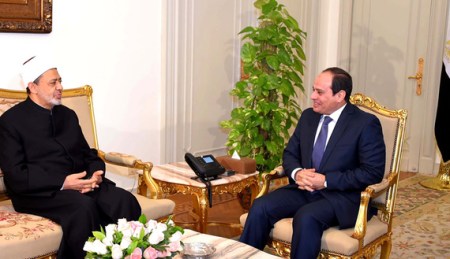
al-sisi-and-islamistEgyptian President Abdel Fattah al-Sisi (R) meets with Al-Azhar’s Grand Imam Ahmed el-Tayeb at the Ittihadiya presidential palace in Cairo, Feb. 26, 2017. (photo by Reuters/Egyptian Presidency)

Al-Azhar’s rejection of Sisi’s proposal places the religious institution on a direct collision course with the head of state, signaling a marked shift in the relationship and possibly the beginning of a tug of war for greater autonomy for the institution — perceived as “politicized” by some analysts. In the meantime, Sisi’s push for religious reforms hangs in the balance. 

**************************

When Field Marshal Abdel Fattah al-Sisi, then defense minister, gave a televised speech on July 3, 2013, announcing that President Mohammed Morsi had just been overthrown, he was flanked by Egypt’s top religious leaders, Pope Tawadros, the head of Egypt’s Coptic Orthodox Church, and Sheikh Ahmed el-Tayeb, the grand imam of Al-Azhar. Tayeb, who had earlier called on Morsi  — the country’s first democratically elected president — to step down to end the bloodshed, threw his weight behind the military man who helped rid Egypt of the Muslim Brotherhood, since designated by the country as a “terrorist group.”

Now, nearly four years later, cracks have appeared in the alliance between Sisi (himself a devout Muslim), who became president in 2014, and Al-Azhar, Sunni Islam’s oldest seat of learning. Al-Azhar has resisted repeated appeals by Sisi to “renew Islamic discourse” and “modernize the faith.” Any doubts skeptics might have had about Tayeb and Sisi not seeing eye to eye in regard to “modernizing Islam” vanished when the president publicly took a jab at the grand imam last month, telling him, “You wear me out.” While the remark was made jokingly, it signaled underlying tensions in their relationship, suggesting Sisi’s patience with Al-Azhar’s intransigence on reforms may be wearing thin.

Sisi first made his impassioned plea for what he called a “religious revolution” two years ago during a New Year’s Day speech at Al-Azhar, lamenting that ”radicalized thinking is antagonizing the entire world and tearing the umma [Islamic nation] apart.” His bold comments earned him praise from Western supporters who noted that Sisi had done something that no Western leader had had the courage to do. Skeptics, however, cautioned that Sisi was an unlikely reformer as “he champions the application of Islamic law [Sharia].” Furthermore, Sisi had given no specifics regarding the revolution he seeks, argued Daniel Pipes in an article published by the Middle East Forum think tank he heads.

At home, Al-Azhar scholars took Sisi’s exhortations for religious reforms with a grain of salt. “Any change must come from scholars of Islam, not from the government,” an Al-Azhar official, who declined to be named because he was not authorized to speak to the press, told Al-Monitor. Hinting that Al-Azhar preachers resent state interference in their religious affairs, he criticized the decision by the Ministry of Religious Endowments to unify sermons at Friday congregational prayers in mosques across the country.

“The Ministry of Religious Endowments decides on the topics the imams will be preaching on each week, but often the sermons prepared by the ministry are insensitive to the circumstances of the place where they are being delivered,” he complained. “A sermon on cleanliness may be well received by mosque-goers in Cairo but would be unsuitable when preached in mosques in the northern Sinai town of el-Arish, a hotspot for violence in recent months.”

He also rejected claims by some critics that Al-Azhar’s curriculum promotes fundamentalism and violence. “Tens of thousands of students — local and foreign — study at Al-Azhar. How many of them have become terrorists?” he asked. The grand imam, too, has rebutted the allegation that the centuries-old Islamic institution was spreading radical ideas, insisting that “Al-Azhar is the pulpit of moderate, centrist and tolerant Islam.”

A special committee of educational experts, created in 2015 at the behest of Sisi, has been reviewing and updating Al-Azhar’s educational curriculum, weeding out content perceived to be inciting violence. Meanwhile, a YouTube channel launched two years ago and overseen by Al-Azhar scholars has the declared aim of “countering Islamic State propaganda.” Plans are also underway to launch a new Al-Azhar TV channel in the coming months ”to promote moderate thought.” While these are all steps in the right direction, they fall well short of Sisi’s aspiration of “revolutionizing Islam.” Much more needs to be done if Al-Azhar wants to show it is serious about combating the surge in terrorist attacks and curbing the spread of extremism, alongside the government, which is battling IS-affiliated groups in the Sinai Peninsula.

Al-Azhar‘s senior scholars have thus far refused to accuse IS of heresy, arguing that “Islam prohibits accusations of heresy as only God knows what is in someone’s heart.” They claim that IS cannot be considered heretical as long as its members have uttered the shahada (the Muslim declaration that there is no God but Allah and that Muhammad is his prophet.) The institution’s clerics have also failed to back calls by rights activists to annul the country’s controversial blasphemy laws that allow citizens to be prosecuted for “insulting religion” despite Sisi’s giving a nod to such calls.

Islamic thinker and TV talk show host Islam El-Beheiry spent the most part of 2016 behind bars on the charge of contempt of religion for questioning the authenticity of various religious texts interpreting the Quran and calling for their revision on his show on the privately owned Al-Kahira Wal Nas Channel. A legal complaint was filed against him by a private citizen after Al-Azhar demanded the suspension of his show for “defaming Islam.” Beheiry was originally handed down a five-year sentence that was reduced to one year by an appeals court in December 2015. He was released in November after Sisi granted him amnesty and has since vowed to continue to speak out against “radical thought.” In his first television appearance on the privately owned Al-Mehwar channel days after his release, he denied having committed a crime and paid tribute to Al-Azhar. However, he said that “the problem lies with the Salafists within the institution who continue to defend problematic religious texts upon which IS practices are based. Al-Azhar condemns the actions of IS, saying IS members are misinterpreting the texts. They are not; the texts tell them to kill and it is these texts that should be condemned.”

Beheiry told Al-Monitor that Sisi is serious about reforming Islamic discourse, but unifying the sermons in mosques will not change anything. “To counter the threat of terrorism, Al-Azhar needs to acknowledge that the problem lies in outdated Islamic heritage books that were written in the medieval period or earlier. These books promote jihad [holy war] and intolerance. Terrorist attacks will continue as long as these books are available, poisoning people’s minds,” he said.

Eslam Abdel Raouf, an assistant professor of journalism at Al-Azhar, acknowledged that there are internal divisions within the institution. “Like any other institution in the country, Al-Azhar has reformists and ultraconservatives. The former group supports Sisi’s calls for reform while the latter is against it,” he told Al-Monitor. “The dominant view among Al-Azhar clerics is that change is welcome as long as it does not touch the fundamentals of the religion. While it is fine to modernize religious discourse to make it more appealing to the youth, state interference in religious edicts [fatwas] is considered a red line that must not be crossed.”

Sisi was perceived by the clerics as having crossed that line when he recently called for a law banning verbal divorce in Egypt in an attempt to reduce the country’s burgeoning divorce rate, which in 2015 went up by 10.8%, according to Egypt’s Central Agency for Public Mobilization and Statistics. Sisi had lamented in a speech he gave at the Police Academy on the eve of National Police Day on Jan. 25 that 40% of all marriages in Egypt end within the first five years. He urged the grand imam, who was present in the audience, to lend his support to the proposed legislation.

In a rare show of defiance, however, Al-Azhar rejected the plan, drawing a clear line between religion and politics. A statement released by Al-Azhar’s Council of Senior Clerics stated, “Verbal divorce, when meeting all the conditions — the husband has to be fully conscious and of sound mind when uttering the words ‘I divorce you’ — has been an undisputed practice since the days of the Prophet Muhammad.“

Al-Azhar’s rejection of Sisi’s proposal places the religious institution on a direct collision course with the head of state, signaling a marked shift in the relationship and possibly the beginning of a tug of war for greater autonomy for the institution — perceived as “politicized” by some analysts. In the meantime, Sisi’s push for religious reforms hangs in the balance.


Egypt: Thousands screaming “Allahu akbar” mourn Blind Sheikh, mastermind of 1993 WTC jihad bombing

February 24, 2017

Egypt: Thousands screaming “Allahu akbar” mourn Blind Sheikh, mastermind of 1993 WTC jihad bombing, Jihad Watch

(Please see also, Blind Sheikh Dead But His Network Lives On in America and ‘We’re Totally Not Terrorists’ Muslim Brotherhood Mourns Terror Leader Who OK’d NYC Bombings. — DM)

Those who favor jihad and Sharia are just a tiny minority of extremists, right?

“If he were a bad man, people from all over the country wouldn’t have came to attend his funeral.”

Exactly so.

egypt-prayers-before-blind-sheikh-funeral

“Thousands mourn ‘blind sheikh’ convicted in 1993 World Trade Center bombing,” by Amina Ismail and Arwa Gaballa, Reuters, February 22, 2017:

Thousands of mourners gathered in a small Egyptian town on Wednesday for the funeral of the Muslim cleric known as “the blind sheikh” who was convicted of conspiracy in the 1993 World Trade Center bombing in New York.

Omar Abdel-Rahman, who was also convicted of planning a broader “war of urban terrorism” in the United States, died on Saturday in a North Carolina prison aged 78.

Movements across the Islamist spectrum from the Muslim Brotherhood to al Qaeda issued statements mourning him, and several leaders from Egypt’s Islamic Group, which views the sheikh as a spiritual leader and renounced violence in 1997, attended.

Carrying signs that read “we will meet in heaven” and chanting “we will defend you with blood and soul, Islam,” hundreds of mourners gathered at Al-Gamaliya, his hometown in Egypt’s Nile Delta province of Dakahlia, to wait for Abdel-Rahman’s body as it made its way back from the U.S. via Cairo.

The Egyptian-born Abdel-Rahman, who lost his eyesight due to childhood diabetes and grew up studying a Braille version of the Koran, remained a spiritual leader for radical Muslims even after more than 20 years in prison.

As an adult he became associated with the fundamentalist Islamic Group and was imprisoned and accused of issuing a fatwa leading to the 1981 assassination of Egyptian President Anwar al-Sadat, against whom he had railed for years.

Abdel-Rahman was still an important figure in radical Islam even after years in prison. A year before his al Qaeda followers pulled off the most destructive assault on U.S. soil, the Sept. 11, 2001, attacks, Osama bin Laden had pledged a jihad to free Abdel-Rahman from prison.

When Mohammed Mursi, a leader of the Muslim Brotherhood, began his short-lived presidency of Egypt in 2012, he said winning the sheikh’s freedom would be a priority. The jihadists who attacked an Algerian oilfield and took hostages in 2013 also demanded his release.

Yet supporters paint him as a revered scholar who faced injustice and torture at the hands of the Egyptian and U.S. governments for sticking by his principles.

Mourners chanted “God is great” and cheered as his body, draped in a brown blanket inside a wooden coffin, was brought out to be washed at his brother’s house before the burial.

“If he were a bad man, people from all over the country wouldn’t have came to attend his funeral,” said Mostafa al-Wakeel, a 40-year-old lawyer who traveled around 175 kilometers (110 miles) from Cairo….

Egypt: Muslims shoot Christian teacher in the head as attacks on Christians escalate

February 18, 2017

Egypt: Muslims shoot Christian teacher in the head as attacks on Christians escalate, Jihad Watch,

The Economist reported in December that “a massacre of Coptic Christians” in Egypt is underway, and identified “disgruntled Islamists” who are out to revenge Egyptian President Abdel-Fattah al-Sisi’s crackdown of the Muslim Brotherhood. Coptic Christians strongly supported el-Sisi’s ouster of his MB predecessor, Mohammed Morsi.

Former Unit 777 (an Egyptian military counter-terrorism and special operations unit) chief-of-staff Hatem Saber, who is also visiting professor at the Egyptian Military Academy and an expert in international terrorism movements, states that he considers “the Brotherhood the source of all current extremist militant groups” in Egypt.

Most Westerners are familiar with the stealth operations of the Muslim Brotherhood, but the Brotherhood also can and does resort to armed jihad depending on political climate.

Regrettably, the Brookings Institution boosts the Muslim Brotherhood. A Brookings Institution report declared that  the MB “was left with no other option but to protest in a climate characterized by exclusion and McCarthyism” after Egypt’s military coup in 2013 that outlawed it and declared it a terrorist organization. The very nature of the MB from its founding is conquest and supremacicm; there is no way to appease it save to concede to its leadership, which el-Sisi has demonstrated that he is unwilling to do. El-Sisi said:

Vicious terrorism is being waged against the country’s Copts and Muslims. Egypt will emerge stronger and more united from this situation.

The Brookings Institution, which “bills itself as “the most influential, most quoted and most trusted think tank in the world,” was bought off by the Qatari government in 2013, when it received 14.8 million dollars, casting “a dark cloud” over its “lofty claim to credibility.”

Meanwhile, President Trump affirmed support for Egypt’s fight against terror in a phone call with el-Sisi three days after Trump’s inauguration.

christian-copts

“Coptic Teacher Shot in the Head by Radical Islamists as Attacks on Christians in Egypt Escalate”, by Stoyan Zaimov, Christian Post, February 17, 2017:

A 50-year-old Coptic Christian teacher was shot in the head by two Islamic militants in Egypt while on his way home from school Thursday, as attacks on Christians continues to rise at an alarming rate in the Muslim-majority country.

The Associated Press reported that the killing of Gamal Tawfiq took place in the coastal city of el-Arish when the teacher was attacked by two militants on a motorbike on his way home from El-Samran School.

Tawfiq’s death was confirmed by a school official, but no further details of the crime have yet been provided.

It’s the second murder of a Christian in less than a week in the same northern Sinai region, after suspected militants gunned down Bahgat Zakher, a local vet, on Sunday. Wale Milad, a merchant and Coptic Christian, was killed in late January after militants stormed his shop.

Copts make up only 10 percent of the nation’s 92 million population, and have often been victims of Islamic militants who have vandalized churches, Christian bookshops, orphanages, and other buildings.

As many as five Copts were murdered over a two-week timespan in January, with persecution watchdog groups criticizing the government for not doing enough to help protect Christians from such attacks.

“My brother had no enemies; he was a very simple man, and peaceful,” said a family member of one of the victims. “He left his wife and children to work in Cairo to support them. His family will now face difficulties as he was the primary bread-winner.

In December, Cairo’s largest Coptic cathedral was bombed by Islamic State terror group supporters, killing 25 people, including women and children, in what was one of the deadliest attack against Christians in Egypt in years.

President Abdul Fattah al-Sisi declared a three-day period of national mourning over the attack, insisting that the country stands against such violence.

“Vicious terrorism is being waged against the country’s Copts and Muslims. Egypt will emerge stronger and more united from this situation,” al-Sisi said at the time.

International Christian Concern, which monitors attacks on Christian communities worldwide, said that the bombing must serve as a “wakeup call to the Egyptian government and the international community that the Christian population in Egypt is in grave danger from religious attacks.”

“Entire Christian communities have been assaulted by mobs of Muslim radicals on four separate occasions in 2016 because there was a rumor that a church was being constructed. Now, we have witnessed one of the worst assaults on Egypt’s Christian community in years. More must be done to protect Christians and their places of worship in Egypt,” said William Stark, ICC’s regional manager….

Sisi’s church donation stirs religious controversy

January 27, 2017

Sisi’s church donation stirs religious controversy, Al-Monitor

Egyptian President Abdel Fattah al-Sisi attends a meeting with Egyptian Coptic Pope Tawadros II, head of the Egyptian Coptic Orthodox Church, with some members of the Holy Synod of the Coptic Orthodox Church at the Ittihadiya presidential palace in Cairo, Egypt July 28, 2016 in this handout picture courtesy of the Egyptian Presidency. The Egyptian Presidency/Handout via REUTERS ATTENTION EDITORS - THIS IMAGE WAS PROVIDED BY A THIRD PARTY. EDITORIAL USE ONLY. - RTSK39U

Egyptian President Abdel Fattah al-Sisi attends a meeting with Egyptian Coptic Pope Tawadros II, head of the Egyptian Coptic Orthodox Church, with some members of the Holy Synod of the Coptic Orthodox Church at the Ittihadiya presidential palace in Cairo, Egypt July 28, 2016 in this handout picture courtesy of the Egyptian Presidency.

“In addition to making a donation for the building of a church, [Sisi] also donated his money to establish a mosque, thus putting both communities [Christian and Muslim] on the same pedestal.”

**************************

CAIRO — Egypt’s Coptic Christians have become used to visits by President Abdel Fattah al-Sisi. On Jan. 6, for the third year in a row, Sisi celebrated Coptic Christmas at the Abbasiya Cathedral in Cairo, extending Christmas wishes to the country’s Copts and Tawadros II, the pope of Alexandria and patriarch of the See of St. Mark.

This year, the celebration was different. The cathedral where Sisi addressed the congregation and delivered Christmas wishes stands just meters from St. Peter and St. Paul Coptic Orthodox Church, where an explosion during a service on Dec. 11 claimed the lives of 27 people and wounded 48, mostly women and children.

Sisi responded to the attack not just by visiting the church, but by announcing a 100,000 Egyptian pound (roughly $5,200) personal donation toward building a church and mosque in the new administrative capital of New Cairo.

Hamdi Rizq, the host of the show “Al-Nazra” (“The View”) on satellite TV channel Sada al-Balad, reacted by announcing during his show Jan. 6 that donations were being collected for the building of a mosque and a church in the new capital.

Amina Naseer, a professor of religion at Al-Azhar University and a member of parliament, who also serves on the parliamentary education committee, said in a Jan. 7 phone call on “Al-Nazra” that she had also donated 100,000 pounds to be split equally between the mosque and the church.

During the same show, other donors came forward: Farag Amer, the chair of the parliamentary committee for youth and sport; member of parliament Mustafa Bakry; and businessman Mohammed Abul-Enein, the owner of the Sada al-Balad network.

“The president’s call for donations for a mosque and a church should be an example to all,” Alaa Wali, head of the parliament’s housing committee, told Al-Monitor. “I suggested setting up a fund to receive donations for places of worship in general, including for renovating churches damaged because of terrorist attacks, but the priority will be a mosque and a church in the administrative capital so they can be as beautiful as possible.”

Naseer told Al-Monitor she had urged all members of parliament to donate to the fund. “Those donations are for all Egyptians, not just for the Copts,” she said. “It is true that they will go toward building a church, but that is a reaction by all Egyptians against everyone who tries to impose a foreign mandate on us, as the US Congress tried to do.”

Naseer was referring to a bill debated in Congress on Dec. 28 that would require Egypt to report annually to the US State Department on its work to restore churches vandalized by members of the Muslim Brotherhood, which was toppled from power in July 2013. Egyptian Foreign Ministry spokesman Ahmed Abu Zeed rejected in a press statement issued on the same day the bill and the debate, calling it flagrant intervention in Egypt’s affairs.

While Sisi’s donation was welcomed by some, the suggestion that Egyptians should donate to the fund was slammed by his opponents. Lawyer Tarek Elawady wrote on Facebook Jan. 6: “Sir, Egypt does not need mosques and churches; it needs schools, factories and workplaces.”

Magda Ghonem, a professor of economics and rural development at Ain Shams University in Cairo, tweeted on Jan. 7: “We have a surplus of places of worship, no smaller than the surplus in outbidding and hypocrisy. What about building the biggest home for street children, or the biggest university, or the biggest training center?”

In a lengthy post on Facebook Jan. 7, Cairo University political science professor Hazem Hosny said that the state may not have allocated the necessary funds for a church or a mosque, rather intending to rely on donations made by the citizens. “The president made the first donation, but the whole thing is an attempt to get Egyptians to pay for the new capital under the pretext of building a mosque or a church,” Hosny wrote.

Political activist Mamdouh Hamza satirized Sisi’s donation, tweeting Jan. 7: “Donate for the building of a mosque or a church, because the faithful are lining up outside thousands of mosques and churches; there’s a critical shortage of places for prayer.”

While some critics played down the importance of building mosques and churches at the present time, other bloggers and anonymous activists condemned the idea of donating for church building on religious grounds, saying it violates Sharia.

“The Christian faith is in opposition with Sharia and Islamic doctrine on many issues,” a Salafist scholar who asked not to be named told Al-Monitor. “It is haram for Muslims to donate to the building of any institution that will be a base for discussion and promotion of anything that contradicts Sharia and Islamic doctrine.”

For his part, Abdel Fattah Idriss, a professor of comparative jurisprudence at Al-Azhar University, told Al-Monitor, “There is no jurisprudence proof or any sunna in the holy Quran that prohibits a head of state from donating funds for the building of a church or any other house of worship for the monotheistic religions. Islamic Sharia had approved of this as per Prophet Muhammad who gave the right for Jews of Medina to build their temples.”

Idriss said, “The donation made by a head of state is widely welcomed, as he is considered the [protector] of all communities residing in Egypt and has the complete authority to build houses of worship. Such donations strengthen people’s patriotism and make them feel part of the nation, qualities that Islam has always sought to instill.”

He added, “In addition to making a donation for the building of a church, [Sisi] also donated his money to establish a mosque, thus putting both communities [Christian and Muslim] on the same pedestal.”

A similar controversy broke out in 2009 regarding Sharia rulings on Muslim donations for the building of churches. The sheikh of Al-Azhar at the time, Mohammed Sayed Tantawi, met a delegation from the Egyptian Union for Human Rights, headed by Naguib Gibrael, an adviser to the Orthodox Church. The media reported he had ruled that Muslims donating for church building was permitted by Islamic law. His office denied the reports after a wave of opposition from scholars at Al-Azhar.

Egypt’s Dar al-Iftaa, a government body that advises on Islamic religious affairs, ruled on Jan. 7, 2016, “Christians in Egypt may, according to Islamic law, build churches if they need that for their worship, and Islam demands they be allowed to remain, according to the laws laid down by the Egyptian state. There is nothing in any reliable text on Islamic law to prohibit that.”

Sisi’s attempt to rein in the anger of the Copts after the bombing attack of St. Peter and St. Paul Coptic Orthodox Church thus prompted a range of criticism. But it appears that the opposition comes from a pre-existing state of antagonism between him and his critics who bemoan the lack of social, economic and educational progress in Egypt.

Revealed yesterday: The Muslim Brotherhood lost a good friend when Obama left office and gained a formidable opponent with Trump

January 24, 2017

Revealed yesterday: The Muslim Brotherhood lost a good friend when Obama left office and gained a formidable opponent with Trump, American ThinkerThomas Lifson, January 24, 2017

Yesterday saw a stunning contrast as it was revealed that the outgoing Barack Obama funded Palestinians as almost his last act in office, while Donald Trump’s first full workday saw him call Egypt’s President Al-Sisi to offer support in his battle against the Muslim Brotherhood, the Ikhwan, which seeks his overthrow.

It’s all about the Muslim Brotherhood, that octopus of Islamic supremacist jihad that seeks to use all methods — legal, violent, or deceptive – to advance the goal of a world ruled by Islam.

Former President Obama’s last few hours in office saw him override a Congressional “hold” placed on $221 million funding for the Palestinians, whose goal remains the destruction of Israel in line with the Muslim Brotherhood’s strategy. Matthew Lee and Rick Lardner broke the story for the AP:

A State Department official and several congressional aides said the outgoing administration formally notified Congress it would spend the money Friday morning. The official said former Secretary of State John Kerry had informed some lawmakers of the move shortly before he left the State Department for the last time Thursday. The aides said written notification dated Jan. 20 was sent to Congress just hours before Donald Trump took the oath of office. (snip)

Congress had initially approved the Palestinian funding in budget years 2015 and 2016, but at least two GOP lawmakers — Ed Royce of California, the chairman of the House Foreign Affairs Committee, and Kay Granger of Texas, who sits on the House Appropriations Committee — had placed holds on it over moves the Palestinian Authority had taken to seek membership in international organizations. Congressional holds are generally respected by the executive branch but are not legally binding after funds have been allocated.

That this move was a single digit salute to his opponents is evident in the other last minute beneficiaries of Obama’s granting of boons: the United Nations and climate change funding:

In addition to the $221 million for the Palestinians, the Obama administration also told Congress on Friday it was going ahead with the release of another $6 million in foreign affairs spending, including $4 million for climate change programs and $1.25 million for U.N. organizations

President Trump has come under fire for allegedly being anti-Muslim, when in fact his opposition is to violent jihad and those who promote world domination for Islam and the imposition of sharia law on every human being on the planet.  Oddly enough, the women marchers on Saturday were led by a fan of sharia, Linda Sarsour.

Actually, President Trump sees good relations with Muslims who oppose violent jihad and the Ikhwan, and acted dramatically on that yesterday, as Reuters reports:

 Egyptian President Abdel Fattah al-Sisi and U.S. President Donald Trump discussed ways to boost the fight against terrorism and extremism on Monday and the new American leader underscored his commitment to bilateral ties, the two countries said.

Trump told Sisi in a telephone call he appreciated the difficulties faced by Egypt in its “war on terror” and affirmed his administration’s commitment to supporting the country, Sisi’s spokesman Alaa Youssef said in a statement.

“The U.S. president also expressed during the call his looking forward to the president’s awaited visit to Washington which is being prepared for through diplomatic channels,” the statement said.

“The U.S. president also expressed during the call his looking forward to the president’s awaited visit to Washington which is being prepared for through diplomatic channels,” the statement said.

The people who want to inflict terror attacks on us support the Palestinians funded by Obama, while they want to force Sisi out of office. For the moment, I will leave it to historians to explain why Obama chose to align himself with the former group, and I thank God that president Obama [sic] is supporting President Al-Sisi, who has openly called for reform of Islam.


Trump stressed bilateral commitment when he talked to Egypt’s El-Sisi

January 24, 2017

Trump stressed bilateral commitment when he talked to Egypt’s El-Sisi , DEBKAfile. January 23, 2017

President Donald Trump assured Egypt’s Abdel El-Sisi that the US remains committed to bilateral relations with Cairo and is ready to offer Egypt economic assistance in the phone conversation they held Monday on economic issues and terrorism.

DEBKAfile: This was Trump’s second phone conversation with a Middle East leader after he talked to Israel’s Binyamin Netanyahu Sunday.

Why Trump’s bid to amplify Muslim reformers will keep Americans safer

December 30, 2016

Why Trump’s bid to amplify Muslim reformers will keep Americans safer, The Hill, Cynthis Farahat, December 29, 2016

sisi_egypt_president_458617936© Getty Images

Sisi’s supporters say the Obama administration’s tolerance of Islamism and harsh criticism of Egypt’s counter-terrorism efforts have been an enormous obstacle. In contrast, Trump’s campaign expressed “strong support for Egypt’s war on terrorism” and pledged that “under a Trump Administration, the United States of America will be a loyal friend, not simply an ally, that Egypt can count on in the days and years ahead.”

**********************************

The recent terror attacks in Berlin and Zurich highlight once again the danger that radical Islamism poses to the West. While many are searching for ways to improve security and defeat the threat on the ground, few appear to appreciate that the decisive blow against Islamism can only be administered by leaders in the Middle East.

President-elect Donald Trump pledged during his last major foreign policy speech before the election to “be a friend to all moderate Muslim reformers in the Middle East” “amplify their voices.”

President Abdel Fattah el-Sisi and most of the political and media establishment in Egypt warmly embraced this policy. After meeting with the Republican nominee on the sidelines of the UN General Assembly in September, Sisi told CNN he had “no doubt” Trump would make a strong leader. Sisi was also the first Arab leader to telephone Trump after his election win.

Egyptian affections for Trump are partly fueled by distaste for former Secretary of State Hillary Clinton, who many Egyptians believe conspired with the Muslim Brotherhood to help elect Islamist Muhammad Morsi as president in 2012 (after which she was greeted in Egypt with protestors hurling tomatoes).

However, the main attraction of Trump in the eyes of many Egyptians is his staunch anti-Islamism.

Since coming to power in 2013, Sisi has spoken passionately about the need for an Islamic reformation. For Sisi, Islamism isn’t merely a ruinously bad blueprint for modern governance and a chronic source of security threats, it is also a wedge fueling outside hostility to Muslims, both Islamists and non-Islamists alike. In a 2015 New Year’s Day speech at al-Azhar University, the world’s most prestigious seat of Sunni Islamic learning, Sisi warned that the “corpus of [Islamic] texts and ideas that we have sacralized over the years” are “antagonizing the entire world” and “caus[ing] the entire umma [Muslim world] to be a source of anxiety, danger, killing and destruction.”

Not surprisingly, Sisi has faced opposition in the region, especially from Turkey, Qatar, and powerful figures in the Saudi royal family, who have opened their media to Brotherhood operatives to attack Sisi and even call for his assassination. One of the only Arab governments openly backing Sisi’s uncompromising stance on Islamists is the United Arab Emirates (UAE), which in 2014 designated the Muslim Brotherhood as a terrorist organization (along with two of its U.S.-based affiliates, the Council on American-Islamic Relations and the Muslim American Society).

Within Egypt, Sisi’s calls for a religious revolution have made him extremely popular, but he has faced fierce resistance from Islamists, who still dominate many sectors of Egyptian civil society and exert influence in government, particularly the judiciary.

Sisi’s supporters say the Obama administration’s tolerance of Islamism and harsh criticism of Egypt’s counter-terrorism efforts have been an enormous obstacle. In contrast, Trump’s campaign expressed “strong support for Egypt’s war on terrorism” and pledged that “under a Trump Administration, the United States of America will be a loyal friend, not simply an ally, that Egypt can count on in the days and years ahead.” Walid Phares, a foreign policy advisor for the president-elect, stated in an interview that Trump will work to pass legislation designating the Muslim Brotherhood as a terrorist organization.

Trump’s election appears to have emboldened Sisi to step up his Islamic reformation campaign. Just days later, Sisi pardoned 82 prisoners, among them Islam Behery, a former TV host and prominent leader of a growing neo-Mu’tazilah-style movement that claims Islamic scriptures are man-made and should not overrule reason and critical thinking.

Behery’s movement has gained sweeping popularity as horrors committed by Al-Qaeda, Islamic State, and other Sunni jihadist groups have mounted in recent years.

Many across the Arab world, and Egyptians in particular, are hopeful that the election of Donald Trump will open a new page of cooperation between the United States and those who are seeking to challenge Islamic extremism in the war of ideas. Only together can we defeat the Islamists wreaking carnage on the streets in the West.

Cynthia Farahat is a fellow at the Middle East Forum and a columnist for the Egyptian daily Al-Maqal.

The views expressed by authors are their own and not the views of The Hill.;

Trump and Sisi discuss Middle East peace

December 23, 2016

Trump and Sisi discuss Middle East peace, Israel National News, Elad Benari, December 23, 2016

trumpandsisiTrump and Sisi meet in New YorkReuters

“The presidents agreed on the importance of affording the new U.S. administration the full chance to deal with all dimensions of the Palestinian case with a view of achieving a full and final settlement,” he added.

Sisi recently praised Trump and said he expected greater engagement in the Middle East from his administration.

******************************

Egyptian President Abdel Fattah al-Sisi on Thursday night spoke with U.S. President-Elect Donald Trump, Sisi’s office said, according to Reuters.

The call came hours after the UN Security Council postponed indefinitely a vote on Egypt’s draft resolution denouncing Israeli “settlements”.

“During the call they discussed regional affairs and developments in the Middle East and in that context the draft resolution in front of the Security Council on Israeli settlement,” said Sisi’s spokesman, Alaa Yousef.

“The presidents agreed on the importance of affording the new U.S. administration the full chance to deal with all dimensions of the Palestinian case with a view of achieving a full and final settlement,” he added.

Thursday’s vote on the UN Security Council resolution was reportedly postponed after Sisi instructed his nation’s delegation to push for a delay in the vote.

Trump had earlier called for the United States to veto the resolution, as it has traditionally done with similar proposals. American officials indicated that the Obama administration was planning to abstain from voting or even to vote yes.

Sisi recently praised Trump and said he expected greater engagement in the Middle East from his administration.

The Egyptian President has also been at the forefront of the effort to resume talks between Israel and the Palestinian Authority, having several months ago urged Israelis and Palestinian Arabs to seize what he said was a “real opportunity” for peace and hailed his own country’s peace deal with Israel.

The comments were welcomed by Prime Minister Binyamin Netanyahu, who stressed that “Israel is ready to participate with Egypt and other Arab states in advancing both the diplomatic process and stability in the region.”

Palestinian Authority (PA) chairman welcomed Sisi’s call as well, saying he welcomed the Egyptian president’s efforts to achieve peace and establish a Palestinian state.

Egyptian pilots flying Russian choppers in Syria

November 26, 2016

Egyptian pilots flying Russian choppers in Syria, DEBKAfile, November 26, 2016

attack_ka-52_alligators

Egyptian President Abdel-Fatteh El-Sisi’s secret decision to intervene militarily in the Syrian war on the side of the Syrian President Bashar Assad is revealed here by DEBKAfile’s military and intelligence sources. The precise details of that intervention vary from source to source.

1. According to one version, a group of Egyptian helicopter pilots – 18, according to one estimate – landed secretly a few days ago at the Syrian Air Force base in Hama and were pressed at once into service for strikes against Syrian rebel forces.

Some sources describe the Egyptian flight crews as taking over the cockpits of Russian attack/reconnaissance Kamov Ka-52 helicopters, with which they were familiar, having trained on them since the end of 2015.

2. Others say that the Egyptian airmen flew those helicopters from Egypt to Syria over the eastern Mediterranean.

3. There is also a claim that their arrival was preceded by a preliminary inspection of the Syrian front lines by two major generals from the Egyptian general staff operations division, who later submitted their recommendations to the Egyptian president. It is not clear if they met the Russian commanders in Syria during that trip.

4. Others say the Egyptian generals headed a military delegation, which has set up a permanent mission in Damascus.

But every one of those sources agrees that, one way or another, Egypt has secretly entered the Syrian war in support of the Bashar regime – a development which has raised a firestorm in Arab capitals.

Saudi Arabia is particularly incensed over El-Sisi’s move. For years, Riyadh granted Cairo billions of dollars in aid, hoping this was an investment for procuring the Egyptian army as the stalwart protector of the kingdom and the Gulf emirates against Iran.

But towards the end of last year, Riyadh was affronted when the Egyptian ruler turned down an appeal for ground troops to support the Yemen campaign against Iranian-backed Houthi rebels. An eye-opener came when Egypt showed sympathy for Assad’s fight against extremist Islamist groups in the rebel movement, especially those associated with the Muslim Brotherhood, which El-Sisi has outlawed in Egypt as the sworn foe of his regime. Then, when Cairo supported Russian pro-Assad diplomacy at the United Nations, Saudi Arabia abruptly cut off financial assistance to Egypt and discontinued its oil shipments.

Donald Trump’s election this month as the next US president has already become the catalyst of a major reshuffling of Middle East alliances and stakes.

Some of its rulers, including El-Sisi, see the landscape changing and may be gambling on Trump reaching a deal with Russian President Vladimir Putin for joint military operations in Syria against the Islamic State and other Islamic terror groups, including the Al-Qaeda affiliate, the Nusra Front. The new bandwagon about to roll appears to favor Bashar Assad and his army.

The US president elect’s take on the Syrian ruler is expected to be markedly different to that of outgoing President Barack Obama, who castigated Assad, but held back from fighting him on the battlefield.

DEBKAfile reported exclusively on Nov. 21 that clandestine talks between Jerusalem, Amman and Damascus were afoot for the restoration of the demilitarized zone on the Golan and steps to stabilize their common borders in southern Syria.

Those talks are taking place with the knowledge of the Trump transition team and the Kremlin. They have already produced results in the return of UNDOF observers to their former posts on the Syrian Golan.

There are grounds to speculate now that the deployment of Egyptian aviators to Syria may be one more product of the secret inter-power diplomacy swirling in recent weeks over Syria’s bloody and intractable five-year war.

Egypt’s parliament responds to UK Commons’ ‘defence of political Islam’

November 23, 2016

Egypt’s parliament responds to UK Commons’ ‘defence of political Islam’, Ahram on LineGamal Essam El-Din, November 21, 2016

The Egyptian parliament’s foreign affairs committee said its report aims to expose Europe and the UK’s false views on “political Islam”

egyptparliament

“The UK parliament report ignores – either on purpose or due to a lack of knowledge about historical facts – that since it was established in the first third of the previous century the Muslim Brotherhood has been responsible for spreading the radical Islamic ideology upon which all terrorist organizations such as Al-Qaida, ISIS, Hamas, Ezzeddin Al-Qassam, Al-Nusra Front and Ansar Beit Al-Maqdis were based,” said the report, adding that “most of the leaders of these terrorist organizations such as Al-Qaida’s current leader Ayman Al-Zawahri were once members of Muslim Brotherhood.”

“This group is the godfather of all jihadist and Salafist ideologies which dream of resurrecting the state of the caliphate against the infidel West,” said the report.

***************************

A 10-page report issued by the Egyptian parliament’s foreign affairs committee on Sunday launched a scathing attack on EU and UK politicians and MPs who defend “political Islam.”

The report, issued in response to a 7 November UK House of Commons’ foreign affairs committee’s report on the Muslim Brotherhood and political Islam, said it does not aim to defend the Egyptian government’s security and legal measures against the Brotherhood group and its affiliated militant and terrorist organizations.

“Our report reflects our responsibility as elected MPs to stand against a group which seized its one year in power to turn Egypt into a religious state and show the world the true meaning of “political Islam,” said the report.

It added that the “Muslim Brotherhood tried to steal history and turn the Arab world’s first civilian state into a theocratic state that is hostile to human civilization and the values of freedom, equality and citizenship.”

The report said “if Europe and the West are really keen to stem the tide of religious terrorism and the political hijacking of Islam, they should correct their understanding of all political Islam movements which claim they have a licence from God to implement his laws on earth and impose the state of the caliphate on the world .”

Ahmed Said, head of the Egyptian foreign affairs committee, told reporters Sunday that Egypt’s parliament deplores the UK report’s inclusion of a number of horrible lies.

“Our committee’s report aims to expose these lies. We intend to send it to the Egyptian ambassadors in England and Germany to stand against  the attempts of several politicians and MPs in these two countries to polish the image of political Islam ,” the report said.

Said said “we know from history that Europe was able to move ahead and achieve progress only after it made a separation between religion and politics.”

“So we are surprised by the new generation of European radical liberals and progressives who defend political Islam and thereby give cover for Islamist movements which claim victimhood to spread across Europe and create a fertile ground for Islamist radicals there,” said Said.

The report said the UK parliament’s report offered a very artificial interpretation of “political Islam.”

“We wonder how a parliament that was based on separating religion from politics  approves that a country like Egypt be governed by a theocratic state,” said the report, adding that “this is a setback from all the democratic and liberal ideals which formed the foundation of European civilization.”

The report said that “the UK parliament made a very artificial and marginal differentiation between Islamist movements that exploit democracy to reach power on the one hand, and Islamist movements that seek the path of violence and armed jihad to impose their radical ideology on societies, on the other.”

“All studies that have been conducted on political Islam movements show that there are no essential differences among them and that they all seek one objective – that is trying to impose a strict code of Islam and Islamic Sharia law on the world, and to launch an armed Jihad against ‘infidel rulers’ everywhere,” argued the report.

“In other words,” the report added, “these groups want to Islamise the entire world and they only differ on when and how these objectives should be implemented,” said the report.

“While a group like the Muslim Brotherhood shows the face of artificial Islamic moderation to gain ground in the West and infiltrate societies there, other groups seek the road of violence. Each complements the other,” said the report.

The report described the Muslim Brotherhood “as the mother of all jihadist and Salafist movements.”

“The UK parliament report ignores – either on purpose or due to a lack of knowledge about historical facts – that since it was established in the first third of the previous century the Muslim Brotherhood has been responsible for spreading the radical Islamic ideology upon which all terrorist organizations such as Al-Qaida, ISIS, Hamas, Ezzeddin Al-Qassam, Al-Nusra Front and Ansar Beit Al-Maqdis were based,” said the report, adding that “most of the leaders of these terrorist organizations such as Al-Qaida’s current leader Ayman Al-Zawahri were once members of Muslim Brotherhood.”

“This group is the godfather of all jihadist and Salafist ideologies which dream of resurrecting the state of the caliphate against the infidel West,” said the report.

“We doubt that UK politicians or MPs have any books about the ideological basis of this group, which is highly hostile to the West and what they describe as its “liberal and infidel culture,” said the report.

To press its case, the report reviews a number of political assassinations which the Muslim Brotherhood has carried out since it was established by its leader Hassan Al-Banna in 1928.

The second part of the response accuses the UK report of making “a big mistake” by drawing a comparison between the experience of Muslim Brotherhood in Egypt and Tunisia.

“The Media and politicians in the West always like to portray Tunisia as the democratic, inclusive model in the Middle East,” said the report, adding that “this is a big mistake because facts show that Tunisia has become a fertile ground for Islamist jihadists who spread extremism and terrorism in France and Europe and that more than 1,000 Tunisians — the greatest number from any Arab country — a have joined the IS group.”

“Doesn’t this show that the Muslim Brotherhood ideology was behind the transformation of Tunisia into a breeding ground for jihadists,” wondered the report, adding that “not to mention that Tunisia is a small country – with 11 million people – but Egypt is a country with 90 million and the birthplace of the Muslim Brotherhood, which exploited political tolerance over eight decades to create a wide network of businesses and secret armed militias.”

“The Muslim Brotherhood in Egypt owns banks, charity organizations and receives huge donations from wealthy sympathisers in the Arabian Gulf and throughout the Islamic world,” said the report.

The report also argued that the Muslim Brotherhood in Tunisia accepted democracy only for tactical reasons. “After they saw how millions in Egypt revolted against their mother group, they decided to backtrack only for tactical reasons,” said the report.

The report’s third section is devoted to explaining the Muslim Brotherhood’s ideology and internal structure “which is highly hostile to all democratic values.”

“Their ideology is based on strict obedience to the group’s supreme guide, not to mention that its main ideologues, such as Sayyid Qutb, were the ones who invented the jihadist ideology which states that “democracy goes against the rule of God and Islamic Sharia,” said the report.

The report also reviews in detail “the one year of the Muslim Brotherhood in power in Egypt.”

“They exploited the collapse of (former president) Hosni Mubarak’s ruling party to exclude all civilian political forces from power and impose their rule on the country. When millions revolted against them and expelled them from power on 30 June, 2013, they resorted to claims of victimhood again, only to find an ear in the UK and its parliament,” said the report, insisting that “Egyptians stand firm against the rule of ‘the supreme guide’ and will not allow their country to become a religious state.”

“Egyptians are in a battle of life and death against this group, which is the mother of all radical Islam movements,” said the report.

The report also said that many of those who implemented terrorist attacks against the US on 11 September, 2001 received training at the hands of old and veteran Muslim Brotherhood leaders.

The report spotlights what it calls the Muslim Brotherhood’s “empowerment ideology” which seeks to Islamise the entire world in a gradual way.

The report urges the UK parliament and politicians to review “the dark history of the Muslim Brotherhood” and to verify their information about it “instead of issuing distorted reports about political Islam.”

“While the world has become increasingly aware of the dangers of all radical Islam movements, we are surprised that the UK MPs and politicians still live in a coma, insistent not only on polishing the image of these movements, but also propagating the biggest lie: that it is a peaceful and moderate movement,” the report concludes.

The report includes a great number of details about the yearlong rule of former president Mohamed Morsi and how the Brotherhood exploited this year to isolate all political forces.

“For all those who believe in the West that Islamist movements can be integrated into the political process of Arab countries, we offer this bitter experience to put an end to this lie,” said the report.

The UK House of Commons’ foreign affairs committee released its report on 7 November, commenting on the findings and conclusions of a December 2015 review by the UK Foreign and Commonwealth Office (FCO) on the Muslim Brotherhood.

The 2015 FCO report concluded that the group has long maintained a dubious position vis-à-vis the use of violence and terrorism to achieve political change.

The UK parliament committee said that the FCO review “undermined confidence in the impartiality of the FCO’s work” due to the “misguided appointment” of Sir John Jenkins, the UK ambassador to Saudi Arabia, to head the review effort.