Posted tagged ‘Egypt’

Meshaal on point of relocating Hamas’ political headquarters from Doha to Tehran

December 27, 2014

Original posted by Dan Miller

Meshaal on point of relocating Hamas’ political headquarters from Doha to Tehran, DEBKAfile, December 27, 2014

Khaled_Mashaal_12.14Hamas’ Khaled Meshaal heads for new exile

Hamas’ political leader Khaled Meshaak, forced to quit his old headquarters in Damascus after abandoning his longtime host Bashar Assad and finding sanctuary in Doha – is again being hounded from pillar to post.

A deal struck this week between Egypt and Qatar could result in the Hamas leader settling in the Iranian capital. This would afford Tehran a foothold in the Gaza Strip, its second Mediterranean outpost after Lebanon on the Israeli border.

The Egyptian-Qatar deal, revealed here by DEBKAfile’s Middle East sources, covers the future of the Muslim Brotherhood, the nemesis of Egyptian President Abdel-Fatteh El-Sisis, and its offspring, the Palestinian Hamas, which rules the Gaza Strip. Their memorandum of understanding was concluded Wednesday, Dec. 24, in Cairo by a delegation of Qatari intelligence chiefs and the new Egyptian director of intelligence Gen. Khaled Fawzi. They spent most of the day hammering out its six points, which are listed here:

1.  Qatar withdraws its support from all Brotherhood operations against Egypt and Saudi Arabia;

2.  This point applies equally to any Hamas activity that may be interpreted as inimical to Egypt;

3.  Qatar’s assistance to Hamas will be limited to “civilian” projects (such as repairing war damage in Gaza), which too will be subject to President El-Sisi’s approval;

4. Given the close cooperation maintained at present between the Egyptian president and Israeli Prime Minister Binyamin Netanyahu on affairs relating to Gaza, Israel will implicitly have the right to disqualify certain Palestinian projects in the enclave;

5.  Qatar is to shut down the anti-Egyptian propaganda channel run by its Al Jazeera television station;

6.  The emirate is not required to sever all its ties with the Muslim Brotherhood and Hamas, just to keep them under control as its “strategic reserve.”

It is extremely hard to conceive of these two radical Islamist organizations bowing to the restrictions placed on their operations under the Egyptian-Qatari deal.

Brotherhood leaders have exited Doha and made arrangements to establish residence and a new center of operations in London, U.K.  Khaled Meshaal, after he was denied permission by Turkish President Tayyip Erdogan to set up shop in Istanbul, is on the point of a decision to relocate his offices in Tehran. Iran would thus gain a proxy foothold in the Gaza Strip, its second outpost on the Mediterranean after the first was provided by Hizballah in Lebanon. If Meshaal decided to settle in Tehran, Iran would acquire a handy springboard for action against Egypt and southern Israel.

The unlikely founding fathers of the Islamic State

December 24, 2014

The unlikely founding fathers of the Islamic State

 By Missing Peace

via The unlikely founding fathers of the Islamic State | Missing Peace | missingpeace.eu | EN.


Islamic State

The rise of the Islamic State (sometimes called ISIL) is commonly seen in the West as something that emerged more or less out of the blue. US President Obama for instance has said the dramatic rise of IS was not anticipated by the intelligence services of the US.

That’s not true, however. At about the time that Obama made this claim, European diplomats stationed in Syria told a journalist working for an Asian newspaper that the CIA had repeatedly warned the US government of the danger posed to America by the IS. The CIA termed it the greatest threat to the US since the Second World War, according to the diplomats.

So it may be more accurate to say it was Obama himself who underestimated the danger of the Islamist movement, and who chose to ignore the CIA’s warnings.

Why? Because heeding those CIA warnings would have meant admitting that US policy in Syria and Iraq had failed, and that his disengagement policy in the Middle East needed significant adjusting.

Von Oppenheim’s Jihad strategy

As we will see,the Islamic State ‘s current campaign of Jihad is not only unsurprising but is in large measure the result of a strategy that has been known for  more than a hundred and twenty years and was devised by a German diplomat of Jewish origin.

That diplomat was Max von Oppenheim, born in Cologne in 1860 to a Jewish banking family whose members converted to Catholicism after his birth.

Von Oppenheim traveled throughout the Middle East in the last years of the 19th century, visiting Syria, Mesopotamia (now called Iraq), the Persian Gulf, Morocco and Egypt. After his return to Germany, he published his observations in a two-volume book. He studied law and, later, Arabic in Egypt, and in 1896 was became an attaché at German’s embassy in Cairo, Egypt.

During that Egyptian stint, von Oppenheim authored 467 reports on the Middle East, including a lengthy report on the rise of the Pan-Islamic movement. These influenced and to an extent even determined German policies in the region. He eventually became a key adviser to the German emperor Wilhelm.

On the eve of Wilhelm’s visit to the Middle East in 1889, von Oppenheim recommended that Germany support the emerging Islamist movement. This, he argued, would benefit German interests in the region. On one hand, the Germans were without colonies in the Middle East. On the other, the area’s Muslims sought an end to the dominance of the Christian powers – Great Britain, France and Russia – in a region with a Muslim-majority population. There was therefore a shared interest. The Muslims alone were not able to bring an end to foreign domination. And German was anxious to expand its influence in the Middle East at the expense of the French and British.

In his report to the emperor on Pan-Islamism, Von Oppenheim explained that the Muslims already had established a Caliphate, an overarching state, in the Middle East in the seventh century and that state had existed for centuries. The German diplomat argued that the Ottoman Turks had managed to breathe new life into this state and had succeeded in attracting Muslimloyalty to the Sultan/Caliph.

The Muslim masses increasingly viewed the Ottoman leader as the protector of Islam and its holy sites, Von Oppenheim wrote. He concluded that if the Sultan would issue a fatwa calling for Jihad, three hundred million Muslims could be counted upon to rise in revolt and put an end to Anglo-French dominance in the Middle East.

The mission, in his words, was therefore “to unleash Muslim fanaticism that would border on madness”.

Von Oppenheim’s plan led to a pact between Germany and the Ottoman Empire.  However, the concept of a massive jihad that might have produced a German-Turkish victory over the Allies in the First World War failed completely.

Mainly, this was the result of fundamental errors in his analysis. Von Oppenheim ignored the internal divisions in the Muslim world, for instance. And he over-estimated the extent of Arab acceptance of the Turkish Caliph’s authority.

But along with a group of German Middle East experts, Von Oppenheim succeeded in establishing Islamist groups that did in fact begin to execute the planned Jihad in certain Muslim countries.

In November 1914, he dispatched a 136-page plan entitled “Revolutionizing the Islamic territories of our enemies” to his emperor. The plan was quickly approved and Von Oppenheim’s team was provided with the necessary funds. Shortly afterwards, Von Oppenheim’s terrorist groups began deploying suicide attacks as a means of achieving their goals. In India, for instance, a group of 25 Jihadists attacked British targets.

German experts

The German experts recognized that there was a risk the forces of jihad would eventually be out of control and turn into an offensive against the West. The unfolding of events after the defeat of Germany and Turkey in World War I and the emergence of Franco-British domination over the Middle East resulting in the Sykes Picot agreement proved them right.

Sykes-Picot, in particular, resulted in a redefined Middle East of states whose borders were drawn by the French and British. These borders however failed to take account of the tribal nature that had long characterized the Middle East. They also ignored the sharp divisions between Sunni and Shiite Muslims.

The so-called Arab Spring in 2010 represented a kind of turning point. Dictatorships in the area had prevented some of the states that emerged under British-French influence from falling apart. Their leaders had more or less succeeded in curbing sectarian violence within their borders.

But then came the fall of dictators like Iraq’s Saddam Hussein, Egypt’s Hosni Mubarak and Gaddafi of Libya. These changes, plus the uprising against Assad in Syria and the reduction in the United States’ Middle East influence finally offered Islamists the opportunity to establish a new order based on their interpretation of Islam.

Immediately after proclaiming the establishment of an Islamic State in Iraq and Syria, ISIL was able to triumphantly announce – with a certain degree of justification – that the Sykes-Picot era had finally come to an end.

Hitler and Husseini

Following the failure of Von Oppenheim’s plan in World War I, a second German attempt was made by Hitler through his alliance with the Islamist, Haj Amin al-Husseini.

Husseini originally harbored pan-Arab ambitions, aspiring to become the leader of the Arab world. He eventually settled for becoming the Grand Mufti of Palestine and the de facto leader of the Palestinian Arabs.

Husseini and Hitler shared a deep hatred of the Jews and other common interests. Hitler sought an Arab leader who would promote his agenda of world domination in the Middle East. Husseini in turn needed a Western ally who would prevent the creation of a Jewish state in Palestine and put an end to Western domination of Muslim countries.

Husseini’s collaboration with the Nazis is well known. It went well beyond preventing the emergence of a Jewish state in the Middle East. For example, Hitler took the decision to embrace the so-called ‘Entlosung ’, the strategy of systematically exterminating European Jewry, a few hours after a meeting with Husseini. During that meeting, Husseini had exerted pressure on Hitler to solve the “Jewish problem” once and for all.

In 1944, Husseini succeeded in preventing a deal between the Germans and the Allied forces in which 5,000 Jewish children would be exchanged for Allied prisoners of war, and frustrated the escape of 14,000 Jewish children from Hungary. Almost all of these children were later murdered in the Nazi death camps.

Husseini spent much of World War II living in Berlin, establishing his headquarters in a confiscated Jewish mansion. The Nazis provided him with funds to undertake a range of Islamic projects in Europe and beyond.

He developed a plan to establish death camps in Arab countries for the intended extermination of the Jews in the Middle East. This failed because of the 1942 defeat of the advancing German army at El Alamein, Egypt and the collapse of Hitler’s Africa Korps.    Most of the Middle East’s Jews thus escaped the Holocaust.

Husseini escaped prosecution for war crimes after World War II, largely for political reasons. He was thus able to continue to lead the jihad against Israel and keep the Islamist movement alive. In May1946, carrying a false passport, he escaped from French custody and fled to Egypt. Once in Cairo, he founded a new army al-Jihad al-Muqaddas, under the leadership of another Nazi collaborator, al-Qawuqii. With a training camp near the Libyan border, its soldiers prepared for the ”struggle against the Zionists” and participated in the War of Independence in 1948.

Following the Arab defeat in the 1948 war, Husseini united the Islamists under his leadership in a new organization called the Islamic World Congress (IWC). Among its other prominent members: Sayyid Qutb, the ideologue of the Muslim Brotherhood; and the Iranian Islamic spiritual leader Abd al-Qasim al-Kashani. One of Kashani students was Ruhollah Khomeini who went on in 1979 to lead Iran’s Islamic revolution.

Husseini moved the headquarters of the Islamic World Congress (IWC) to Karachi, Pakistan,in 1949. He appointed Dr. Inamullah Khan as its Secretary General. Khan, known for his hatred of Jews, nevertheless became the recipient of the prestigious 1988 Templeton Prize for Progress in. This prize had been awarded in previous years to Mother Teresa and Aleksandr Solzhenitsyn.

Syrian Islamist Maaruf al-Dawalibi, who had also collaborated with the Nazis, was Husseini’s successor. In 1984, he declared at a United Nations seminar that Hitler had been right when he wanted to exterminate the Jews because of their belief that they were God’s chosen people. In the same speech, he repeated the classic anti-Semitic blood libel that the Talmud commands the Jews to drink the blood of non-Jews at Passover.

Jihad in Europe

Said Ramadan, the son-in-law of the founder of the Muslim Brotherhood, Hassan al-Banna, was asked by Husseini to spread the Islamist ideology in Europe. In 1958, Ramadan fled to Geneva due to the repression of the Muslim Brotherhood in Egypt and Syria. In 1959, Ramadan wrote a dissertation on Islamic Sharia law called “Islamic Law: Its Scope and Equity” for the University of Cologne in which he called upon European Muslims to fight against Western secular culture in Europe.

Ramadan, aided by money from al-Husseini’s Nazi funds and later with the financial help of Saudi Arabia, began a process whereby local Muslim communities in Europe came under the control of the IWC and the Muslim Brotherhood. By 2000, many Muslim communities in Europe had adopted the Islamist ideology of the Muslim Brotherhood and were led by members of the organization.

After Ramadan’s death, Ali GhalebHimmat, one of his lieutenants, became the leader of one of Europe’s most important beachheads of radicalIslam – a mosque in the German city of Munich. The mosque had beenestablished by Muslims who had fought for the Nazis.

Together with the Syrian Islamist Yusuf Mustafa Nada Ibada, Himmat built a global financial network for the Muslim Brotherhood. In 1988, they founded the al-Taqwa bank that was involved in financing the Al Qaeda attack on the United States on 11 September 2011. The main architect of the attack on the US was Aiman al-Zawahiri, the current leader of Al Qaeda. He is the grandson of Abd al-WahhabAzzam, who was the spiritual leader of Hajj Amin al-Husseini. Al-Wahhab was the brother of Abd al-Rahman Azzam , the first Secretary General of the Arab League. During World War II, Abd al-Rahman Azzam worked as a secret agent for the Nazis under al-Husseini.

From Hassan al-Banna to ISIL

Prior to his membership of Al-Qaeda, the Egyptian Al-Zawahiri was the leader of Tanzim al-Jihad, the group responsible for the assassination of President Anwar Sadat. He was strongly influenced by Sayyid Qutb, the ideologue of the Muslim Brotherhood.

In one of his writings, he wrote that Qutb started the Islamic revolution against the enemies of Islam in the Middle East and beyond. This bloody revolution continues up to this day, wrote Al-Zawahiri. He fully endorsed Qutb’s view that the establishment of the kingdom of Allah on earth cannot be achieved through prayer and preaching alone. In order to reach this goal, it was necessary that those who did not recognize Allah’s authority should be killed.

According to Qutb and al-Zawahiri, Islam permits killing people in Jihad for Allah.

Al-Zawahiri also explained the importance of the mobilization for Jihad against the enemies of Islam. Since the end of the Anglo-French domination in the Middle East, these enemies had been replaced by the United States and Israel.

This Jihad is not – like the Sufi version of Islam says – a spiritual struggle of the Muslim, but is the ultimate battle between Islam and the infidels and their societies. This is the main theme that connects all Islamist groups and that is practiced by Al Qaeda, Hamas, Hezbollah, Islamic State, Boko Haram (whose name means Western education is forbidden) and many other Islamist movements.

In this view, Jihad against the Jews (and other infidels) becomes a primary religious duty. In this respect, there is no difference between the ideas of Khomeini, Khamenei, Al Qutb, Bin Laden, Al-Zawahiri, al-Husseini, IS leader al-Baghdadi, the current Brotherhood ideologue Yusuf al-Qaradawi and Hamas leaders.

All have said publicly that the Jews control the world and that they are the enemies of Allah and must be expelled from Muslim land (meaning Palestine) or they are to be killed. They also stated that Jihad should continue until Islam rules the world.

So the ideology of the Islamic State is not new. It is rooted in the ideology of Islamists who previously, not coincidentally, collaborated with the Nazis.

The similarities between the methods of IS and those of the Nazis are striking as well as the ideology that underlies those methods. For Islamic State, the ‘ubermensch’ is a Muslim who has abandoned the state of barbaric negligence (Jahaliyah) which in IS view also prevails in Arab countries and that is typical of the West. Jahaliyah existed before the advent of Muhammad and the goal of Islamists is to bring the Umma, the Islamic world community, back to the early days of Islam and the path of the upright Caliphs who led the Islamic empire at the time.

Muslim Brotherhood founder Hassan al-Banna, who was an admirer of Hitler and Mussolini, had the model of the SS in mind when he founded the so-called shock battalions. These battalions intended to do what ISIL is now doing in Iraq and Syria. So it comes as no surprise that a variation on al-Banna’s slogan can now be seen on the black flags of Islamic State: ‘Allah is our objective, the Koran is our constitution, the Prophet our leader; struggle is our way and death for Allah is our highest aspiration. ‘

This article is partly based on research by Middle East expert professor Barry Rubin

ISIS Closing in on Israel from the North and the South

December 24, 2014

SIS Closing in on Israel from the North and the South

The Fiscal Times

By Riyadh Mohammed December 23, 2014 6:30 AM

via ISIS Closing in on Israel from the North and the South – Yahoo Finance.


The war against ISIS is taking a dangerous, perhaps inevitable turn. The terror organization has been keen to expand to southern Syria and the Syrian capital of Damascus. Now it says it has recruited three Syrian rebel groups operating in the south of the country in an area bordering the Israeli occupied Golan Heights — that have switched their loyalties to ISIS.

This switch means that Israel, the U.S.’s closest ally in the Middle East, could be threatened from the southwest by the Egyptian ISIS group of Ansar Bait al-Maqdis in Sinai and by ISIS in southern Syria.

The ISIS war is not going well at all for the US-led alliance in Syria. ISIS and al-Nusra Front, al-Qaeda’s branch in Syria, are still the dominant rebel groups in the country. The U.S.-backed Free Syrian Army is still not a reliable fighting force.

Related: Reports of U.S. Ground Fighters Emerge as ISIS Gains in Iraq

The three rebel groups that just joined ISIS could make that situation even worse. Two of the groups are small in number, but the Yarmouk Martyrs Brigade has hundreds of fighters. The Yarmouk Brigades has been at odds with al-Nusra Front and switched now to join what leaders of all thrwee groups believe is the future of Islam.

“If Israel was attacked by ISIS, America would expect a proportionate response by Israel, which is militarily capable of defending itself,” said Geoffrey Levin, a professor at New York University. “America would counsel against sustained Israeli involvement because it could threaten the tacit alliance between America, Iran, Turkey, and several Arab states against ISIS.”

“More recent reports indicated a closer alliance with [the Islamic State] due to tensions with JN [al-Nusra Front],” said Jasmine Opperman, a researcher at Terrorism Research & Analysis Consortium (TRAC). She said al-Nusra attacked the headquarters of the Yarmouk Brigade in southern Syria in early December 2014 following clashes between the two groups.

Al-Yarmuk Martyrs Brigade controlled an area near the Jordan-Israel border in March 2013. That same month, the brigade took as hostages some of the United Nations peacekeeping mission soldiers. Even so, Israel reportedly allowed the brigade to have its wounded fighters treated in Israeli hospitals.

Related: Iraq’s ‘Bodyguards’ Subvert the War Against ISIS

ISIS has been known for launching surprise attacks and opening new battlefronts when it seems to be losing. ISIS also has been criticized by many Arabs and Muslims for not taking its fight to Israel and instead fighting fellow Arabs and Muslims. An attack aimed at Israel may boost ISIS’s popularity in the Arab world and refresh its recruitment and funding efforts.

On the other hand, some of ISIS’s top military commanders were former officers in Saddam Hussein’s army, and they may resort to what Saddam did in the 1991 Gulf War when he attacked Israel with mid-range rockets, hoping to drag the Israelis into a conflict that he was losing.

An Israeli retaliation in 1991 could have jeopardized the U.S-led coalition that then included Arab countries like Egypt, Syria and Saudi Arabia. The same is true now.

WHY THIS MATTERS

Despite some recent tensions between the countries, Israel remains America’s closest ally in the Middle East. Attacks on Israel by ISIS or affiliated groups could further escalate war in the region, or they could further strain ties between the Obama administration and the Israeli government.

Related: This Laser Could Take Out ISIS

“It would be more likely a sign of desperation, as were Saddam’s attempts to lure Israel into the 1991 war as a way of breaking the Arab coalition against him,” said NYU’s Levin. At that time, continuous pressure from the first Bush administration and the installation of the Patriot anti-rocket system convinced the Israelis to refrain from reacting to Saddam’s attack.

Israel could launch a preemptive attack to destroy or significantly damage these ISIS-affiliated units whether by air or by ground forces. Israel used its advanced air force to launch attacks in Syria several times since the beginning of Syrian civil war in 2011.

Meanwhile, Israel has recently boosted its defenses in the Golan Heights, saying its main concern was to prevent any major weapon transfer from Syria to Hezbollah, the Lebanese guerrilla organization that has engaged in several rounds of war with the Israelis since the 1980s.

This article was updated at 3 p.m. on Tuesday, Dec. 23.

EU Gives Hamas Green Light to Attack Israel

December 22, 2014

EU Gives Hamas Green Light to Attack Israel, Gatestone InstituteKhaled Abu Toameh, December 22, 2014

Although the EU court has said that its controversial decision was “technical” and was not a reassessment of Hamas’s classification as a terrorist group, leaders of the Islamist movement believe that the move will eventually earn them legitimacy in the international arena.

The EU court’s decision represents a “severe blow to the Palestinian Authority and Egypt,” according to Palestinian political analyst Raed Abu Dayer.

Any victory for Hamas, albeit a small and symbolic one, is a victory for the Islamic State, Al-Qaeda, Islamic Jihad, the Muslim Brotherhood and other fundamentalist groups, and causes tremendous damage to those Muslims who are opposed to radical Islam.

Hours before the EU court’s decision was made public, Hamas leader Mahmoud Zahar announced that his movement would never recognize Israel, and that Hamas seeks to overthrow the Palestinian Authority and seize control of the West Bank.

The EU court’s decision also coincided with a rapprochement between Hamas and Iran. Now, the Iranians and other countries, such as Turkey and Qatar, are likely to interpret the EU court’s decision as a green light to resume financial and military aid, including rockets and missiles, to Hamas — not only to Gaza but to the West Bank as well — to support those Palestinians whose aim it is to eliminate Israel.

Less than 48 hours after a top European Union court ruled that Hamas should be removed from the bloc’s list of terrorist groups, supporters of the Palestinian Islamist movement responded by firing a rocket at Israel. The attack, which did not cause any casualties or damage, did not come as a surprise.

Buoyed by the EU court’s ruling, Hamas leaders and spokesmen see it as a “political and legal achievement” and a “big victory” for the “armed struggle” against Israel.

Musa Abu Marzouk, a top Hamas leader, issued a statement thanking the EU court for its decision. He hailed the decision to remove his movement from the terrorist list as a “victory for all those who support the Palestinian right to resistance.”

When Hamas leaders talk about “resistance,” they are referring to terrorist attacks, such as the launching of rockets and suicide bombings against Israel. In other words, Hamas has interpreted the court’s decision as a green light to carry out fresh attacks as part of its ambition to destroy Israel.

The rocket that was fired from the Gaza Strip at Israel only days after the court decision is not likely to be the last.

Although the EU court has said that its controversial decision was “technical” and was not a reassessment of Hamas’s classification as a terrorist group, leaders of the Islamist movement believe that the move will eventually earn them legitimacy in the international arena.

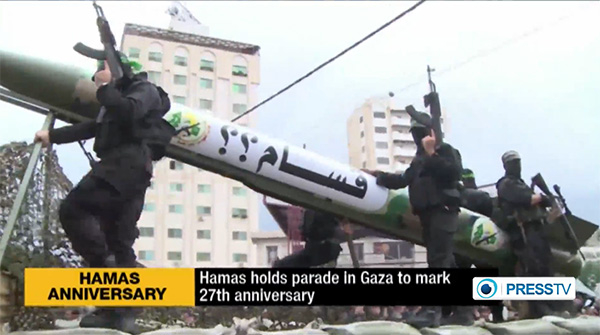
Ironically, the EU court’s decision coincided with Hamas celebrations marking the 27thanniversary of its founding. Once again, Hamas used the celebrations to remind everyone that its real goal is to destroy Israel. And, of course, Hamas used the event to display its arsenal of weapons that include various types of rockets and missiles, as well as drones.

845 (1)Thousands of armed Hamas troops showed off their military hardware at a Dec. 14, 2014 parade in Gaza, marking the organization’s 27th anniversary. (Image source: PressTV video screenshot)

Hours before the EU court decision was made public, Hamas leader Mahmoud Zahar announced that his movement would never recognize Israel. Zahar also made it clear that Hamas seeks to overthrow the Palestinian Authority [PA] regime and seize control over the West Bank.

The EU court’s decision also coincided with increased efforts to achieve rapprochement between Hamas and Iran. Recently, a senior Hamas leadership delegation visited Tehran as part of efforts to mend fences between the two sides. The main purpose of the visit was to persuade the Iranians to resume military and financial aid to Hamas. The visit, according to senior Hamas officials, appears to have been “successful.”

“There are many signs that our relations are back on the right track,” explained Hamas’s Musa Abu Marzouk. “Hamas and Iran have repaired their relations, which were strong before the Syrian crisis.” Relations between Hamas and Iran deteriorated due to the Islamist movement’s refusal to support the regime of Syrian President Bashar Assad.

Now the Iranians are likely to interpret the EU court decision to remove Hamas from the list of terrorist groups as a green light to resume financial and military aid to the movement.

Iran’s leaders recently announced that they intend to dispatch weapons not only to the Gaza Strip, but to the West Bank as well, as part of Tehran’s effort to support those Palestinians who are fighting to eliminate Israel.

Moreover, the EU court’s move will also embolden other countries that provide Hamas with political and financial aid, first and foremost Qatar and Turkey. Oil-rich Gulf countries such as Kuwait, Bahrain, Oman and Saudi Arabia will now face pressure from many Arabs and Muslims to join Qatar, Turkey and Iran in extending their support to Hamas.

The biggest losers, meanwhile, are Palestinian Authority President Mahmoud Abbas and Egypt’s President Abdel Fattah el-Sisi. Over the past few months, the two men have been doing their utmost to undermine Hamas and end its rule over the Gaza Strip.

Abbas has been fighting Hamas by blocking financial and humanitarian aid and arresting its supporters in the West Bank, while Sisi continues to tighten the blockade on the Gaza Strip and destroy dozens of smuggling tunnels along the border with Egypt.

The EU court’s decision represents a “severe blow to the Palestinian Authority and Egypt,” noted Palestinian political analyst Raed Abu Dayer. “As far is Abbas is concerned, the decision grants Hamas political legitimacy and challenges his claim to be the sole legitimate leader [of the Palestinians]. With regards to Egypt, the European court decision calls into question rulings by Egyptian courts that Hamas is a terrorist organization.”

Even if the EU court decision is reversed in the future, there’s no doubt that it has already caused tremendous damage, especially to those Muslims who are opposed to radical Islam.

Any victory for Hamas, albeit a small and symbolic one, is a victory for the Islamic State, Al-Qaeda, Islamic Jihad, the Muslim Brotherhood and other fundamentalist groups around the world.

The decision has left many Arabs and Muslims with the impression that Hamas, after all, is not a terrorist organization, especially if non-Muslims in Europe say so through one of their top courts. Even worse, the decision poses a real and immediate threat to Israel, as evident from the latest rocket attack.

If the Europeans have reached the conclusion that Hamas is not a terrorist organization, then why don’t their governments openly invite tens of thousands of Hamas members and supporters to move to London, Paris and Rome? And they should not forget to ask the Hamas members to bring along with them their arsenal of weapons.

How Western Media Enable Islamic Terrorism

December 19, 2014

How Western Media Enable Islamic Terrorism, Front Page Magazine, December 19, 2014

(Please see also Sharyl Attkisson’s Stonewalled for explanations of what happens in the legitimate “news” media and why. — DM)

la-epa-egypt-unrest2-jpg-20130819-450x300

If the West is experiencing a rise in the sort of terror attacks that are endemic to the Islamic world—church attacks, sex-slavery and beheadings—it was only natural that the same mainstream media that habitually conceals such atrocities, especially against Christians and other minorities under Islam, would also conceal the reality of jihadi aspirations on Western soil.

As The Commentator reports:

[T]he level of the [media] grovelling after the tragic and deadly saga in Sydney Australia over the last 24 hours has been astounding.

At the time of writing, the lead story on the BBC website is of course about that very tragedy, in which an Islamist fanatic took a random group hostage in a cafe, ultimately killing two of them.

He did this in the name of Islam. But you wouldn’t get that impression if you started to read the BBC’s lead story, which astoundingly managed to avoid mentioning the words Islam, Islamic, Islamist, Muslim, or any derivations thereof for a full 16 paragraphs. The New York Times, which led by calling the terrorist, Man Haron Monis an “armed man”, waited until paragraph 11.

In the Guardian’s main story – whose lead paragraph simply referred to a “gunman” — you had to wait until paragraph 24.

If you’d have blinked, you’d have missed it.

….

In the wider media, reports about Muslim fears of a “backlash” have been all but ubiquitous.

If these are the lengths that Western mainstream media go to dissemble about the Islamic-inspired slaughter of Western peoples, it should now be clear why the ubiquitous Muslim persecution of those unfashionable Christian minorities is also practically unknown by those who follow Western mainstream media.

As with the Sydney attack, media headlines say it all. The 2011 New Year’s Eve Coptic church attack that left 28 dead appeared under vague headlines: “Clashes grow as Egyptians remain angry after attack,”was the New York Times’ headline; and “Christians clash with police in Egypt after attack on churchgoers kills 21” was the Washington Post’s—as if frustrated and harried Christians lashing out against their oppressors is the “big news,” not the unprovoked atrocity itself; as if their angry reaction “evens” everything up.

Similarly, the Los Angeles Times partially told the story of an Egyptian off-duty police officer who, after identifying Copts by their crosses on a train, opened fire on them, killing one, while screaming “Allahu Akbar”—but to exonerate the persecution, as caught by the report’s headline: “Eyewitness claims train attacker did not target Copts, state media say.”

A February 2012 NPR report titled “In Egypt, Christian-Muslim Tension is on the Rise,” while meant to familiarize readers with the situation of Egypt’s Christians, prompts more questions than answers them: “In Egypt, growing tensions between Muslims and Christians have led to sporadic violence [initiated by whom?]. Many Egyptians blame the interreligious strife on hooligans [who?] taking advantage of absent or weak security forces. Others believe it’s because of a deep-seated mistrust between Muslims and the minority Christian community [what are the sources of this “mistrust”?].”

The photo accompanying the story is of angry Christians holding a cross aloft—not Muslims destroying crosses, which is what prompted the former to this display of Christian solidarity.

Blurring the line between victim and oppressor—recall the fear of “anti-Muslim backlashes” whenever a Muslim terrorizes “infidels” in the West—also applies to the media’s reporting on Muslim persecution of Christians.

A February 2012 BBC report on a church attack in Nigeria that left three Christians dead, including a toddler, objectively states the bare bone facts in one sentence.  Then it jumps to apparently the really big news: that “the bombing sparked a riot by Christian youths, with reports that at least two Muslims were killed in the violence. The two men were dragged off their bikes after being stopped at a roadblock set up by the rioters, police said. A row of Muslim-owned shops was also burned…”

The report goes on and on, with an entire section about “very angry” Christians till one confuses victims with persecutors, forgetting what the Christians are “very angry” about in the first place: nonstop terror attacks on their churches and the slaughter of their women and children.

A New York Times report that appeared on December 25, 2011—the day after Boko Haram bombed several churches during Christmas Eve services, leaving some 40 dead—said that such church bombings threaten “to exploit the already frayed relations between Nigeria’s nearly evenly split populations of Christians and Muslims…”  Such an assertion suggests that both Christians and Muslims are equally motivated by religious hostility—even as one seeks in vain for Christian terror organizations that bomb mosques in Nigeria to screams of “Christ is Great!”

Indeed, Boko Haram has torched 185 churches—to say nothing of the countless Christians beheaded—in just the last few months alone.

Continuing to grasp for straws, the same NYT report suggests that the Nigerian government’s “heavy-handed” response to Boko Haram is responsible for its terror, and even manages to invoke another mainstream media favorite: the poverty-causes-terrorism myth.

Whether Muslim mayhem is taking place in the Islamic or Western worlds, the mainstream media shows remarkable consistency in employing an arsenal of semantic games, key phrases, convenient omissions, and moral relativism to portray such violence as a product of anything and everything—political and historical grievances, “Islamophobia,” individual insanity, poverty and ignorance, territorial disputes—not Islam.

As such, Western mainstream media keep Western majorities in the dark about the Islamic threat, here and abroad.  Thus the “MSM” protects and enables the Islamic agenda—irrespective of whether its distortions are a product of intent, political correctness, or sheer stupidity.

The Countdown to the Next Gaza Conflict Has Begun

December 19, 2014

The Countdown to the Next Gaza Conflict Has Begun, Gatestone InstituteYaakov Lappin, December 19, 2014

(Please see also Hamas reconstructing terror tunnels using Israeli materials. — DM)

Hamas could, with a fair amount of ease, cause Israel to end its security blockade by accepting the terms of the international Quartet. These include recognizing the state of Israel, renouncing violence and abiding by past agreements.

Of course, those would contravene Hamas’s ideology of Islamist jihad and move it away from its current trajectory of organized violence and religious hatred, the foundations upon which it was established in the 1980s by the Muslim Brotherhood.

For now, it seems, Hamas will try, as it has been doing for months, to orchestrate terrorism in the West Bank, on the opposite side of Israel, while upholding its truce in Gaza.

The Israel Defense Forces, too, has spent recent months preparing to respond if there is a fresh round of hostilities.

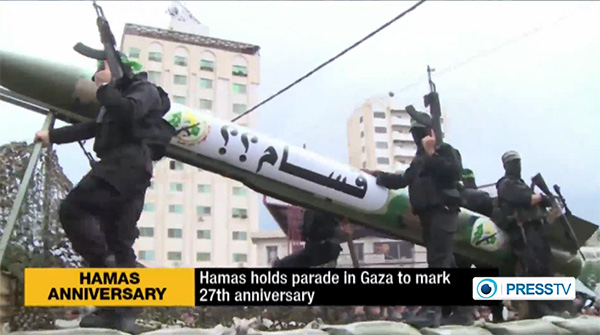
More than three months have passed since the end of the fifty-day conflict between Hamas in Gaza and Israel this past summer, yet all of the catalysts that helped spark that war remain in place and are pushing the sides into their next clash.

845Thousands of armed Hamas troops showed off their military hardware at a Dec. 14, 2014 parade in Gaza, marking the organization’s 27th anniversary. (Image source: PressTV video screenshot)

One of the reasons Hamas launched a war in July this year was to try to end its strategic isolation, which became severe after the downfall of the Muslim Brotherhood in next-door Egypt. Hamas also sought to improve its crumbling economic situation as the ruler of the Gaza Strip; its dire situation was illustrated by Hamas’s inability to pay 40,000 of its Gazan employees their monthly salaries.

Hamas could, with a fair amount of ease, cause Israel to end its security blockade by accepting the terms of the international Quartet. These would include recognizing the state of Israel, renouncing violence and abiding by previous diplomatic agreements. Of course, those would contravene Hamas’s ideology of Islamist jihad and move it away from its current trajectory of organized violence and religious hatred, the foundations upon which it was established in the 1980s by Palestinian members of the Muslim Brotherhood.

Today, however, the same problems that plagued Hamas prior to the summer war have become worse. Gaza is hemmed in to the south by a hostile Egypt under the rule of President Abdel Fattah El-Sisi. Egypt is systematically cutting off the smuggling tunnels that linked Sinai to the Gaza Strip. This means that Hamas is no longer easily able to smuggle either weapons or goods it can tax before they enter Gaza’s market.

Israel’s naval security blockade, designed to prevent the smuggling of arms or materiel that can be used to build weapons, remains in place, as does Israel’s tight security control of its border crossings with the Gaza Strip. Israel has in recent months begun permitting the entry of construction materials to encourage Gaza’s reconstruction efforts, and assisted in the export of Gazan agricultural goods to places such as the West Bank.

Most critically, however, Hamas’s hopes for $5.4 billion of international aid money, pledged by donor states for Gaza’s post-war recovery, remain unrealized. The money has barely begun to trickle in, due to an ongoing crisis with the Fatah-run Palestinian Authority [PA] in Ramallah.

Under the terms set by the international community, the money must enter Gaza through a joint PA-Hamas mechanism. Due to ongoing Fatah-Hamas divisions, such a mechanism appears far from being built.

The latest illustration of these intra-Palestinian tensions can be found in the coordinated, multiple bomb attacks in November on the homes of Fatah officials in Gaza — attacks carried out by Hamas’s military wing.

Meanwhile, the approximately 100,000 Gazans whose homes were destroyed by the fighting in the summer remain without a fixed roof over their heads in the winter, creating another source of pressure on Hamas.

These factors have led Hamas’s military wing to warn publicly that a new explosion of violence against Israel is imminent. “We are saying to all sides — if the siege on Gaza and the obstacles for reconstruction remain, there will be a new explosion,” stated Abu Obeida, the spokesman of Hamas’s military wing, the Ezzedine al-Qassam Brigades.

The warning was answered this week by Israel’s Defense Minister, Moshe Ya’alon, who said, “We now base the quiet in the Gaza Strip on deterrence. At this stage they are deterred, but we must be ready at any given time for the possibility that we will have to again act with full force.”

While it would not be in Hamas’s interests to spark a new destructive conflict so soon after a bruising one, if faced with the possibility that its regime in Gaza might collapse, it may decide to do so.

Hamas has, since the moment that hostilities ended in August, resumed rocket production in Gazan plants, albeit at a slower rate than before the conflict. Hamas has also most likely restarted work to dig more tunnels from Gaza into Israel, which are designed to inject guerrilla squads into Israel to commit terrorist kidnappings and murders.

The Israel Defense Forces, too, has spent recent months preparing to respond if there is a fresh round of hostilities. It assesses that Israeli deterrence has been fully replenished; it is also reluctantly prepared should the volatile situation in Gaza push deterrence aside.

For now, it seems, Hamas in Gaza will try, as it has been doing in recent months, to orchestrate terrorism in the West Bank, on the opposite side of Israel, while upholding its truce in Gaza. If Hamas’s standoff with Fatah continues, however, and the host of factors that pushed Hamas into the last war do not change, the countdown to the next war may be shorter than many think.

The Middle East realists: Old and new

December 14, 2014

The Middle East realists: Old and new, Israel Hayom, Richard Baehr, December 14, 2014

America, according to Friedman and the Israel Lobby professors ‎should also ignore Israeli concerns and push forward with a nuclear ‎deal with Iran. A successful negotiation, even one which leaves Iran ‎with nuclear breakout capability in a few months, is certain to ‎change Iran’s pattern of international behavior, as it becomes a ‎regular member of the “community of nations” and gets back to ‎enjoying more robust economic relations with many other nations. ‎Iranian aid to Hezbollah, Hamas, Assad in Syria, Yemeni Shiite ‎rebel groups, Iraqi Shiites, all of these aggressive efforts will soften ‎or go away once Iran becomes America’s latest and greatest strategic ‎partner.‎

Friedman has been one of the great lap dogs for the Obama ‎administration, and his loyalty cost the president very little.

A touch of realism would be welcome in the White House at this ‎point. But it won’t happen because the self-styled realists are ‎wearing the blinkers, and think they know all there is to know.

*********************

Professor Stephen Walt of Harvard University’s John F. Kennedy School of ‎Government and Professor John Mearsheimer of the University of Chicago like to ‎call themselves foreign policy realists. Realists are, in their minds, people who can ‎assess international situations without any ideological blinders or bias. Walt and ‎Mearsheimer co-authored “The Israel Lobby,” originally as a lengthy article in the ‎London Review of Books in 2006, and then as a much longer book version in 2007. In both ‎the article and book, the professors argued that America’s very tight relationship ‎with Israel was strategically unsound for the United States. The authors claimed ‎that the closeness between the two countries was a product of the behavior of the ‎Congress of the United States, which they believe had been unduly influenced by ‎the political power of the American Israel Public Affairs Committee and ‎other supporters of the Jewish state, such as evangelical Christians. ‎

In less academic, and blunter terms, New York Times columnist Tom Friedman ‎welcomed Israel’s Prime Minister Benjamin Netanyahu to his address to a joint session ‎of Congress in 2011, writing that the applause for Netanyahu reflected the fact that the ‎Congress was “bought and paid for by the Israel lobby.”‎

Of course, Friedman had been out ahead of Walt and Mearsheimer, with a similar ‎themed comment in a column in The New York Times in February 5, 2004:‎

‎”Israel’s prime minister has had George Bush under ‎house arrest in the Oval Office. Mr. Sharon has Mr. ‎Arafat surrounded by tanks, and Mr. Bush surrounded ‎by Jewish and Christian pro-Israel lobbyists, by a vice ‎president, Dick Cheney, who’s ready to do whatever Mr. ‎Sharon dictates, and by political handlers telling the ‎president not to put any pressure on Israel in an election ‎year all conspiring to make sure the president does ‎nothing.”

Friedman styles himself as an “eminence grise,” sitting high up in ‎New York Times land, a platform from where he can speak as an ‎equal with the likes of academic intellectuals such as Mearsheimer ‎and Walt, but also foreign leaders too numerous to name, and ‎American presidents, all of whom understand the significance of ‎receiving a favorable column from Tom Friedman. As a presumably ‎great strategic thinker and realist like Walt and Mearsheimer, ‎Friedman has come to the same conclusions as the professors on ‎where America’s strategic interests lie in the Middle East. America ‎must challenge Israel and force a two-state solution with the ‎Palestinians. This is in Israel’s interests as well, of course, since the ‎absence of peace creates so much ill will for both Israel and its ally ‎America among other nations in the region and around the world. ‎Friedman always claims he has Israel’s real interests at heart, while ‎their elected government digs deeper holes. Clearly, if Israel were ‎only to be more forthcoming, the deal with the Palestinians could ‎finally get done this time (next time, some time, whenever…). ‎

America, according to Friedman and the Israel Lobby professors ‎should also ignore Israeli concerns and push forward with a nuclear ‎deal with Iran. A successful negotiation, even one which leaves Iran ‎with nuclear breakout capability in a few months, is certain to ‎change Iran’s pattern of international behavior, as it becomes a ‎regular member of the “community of nations” and gets back to ‎enjoying more robust economic relations with many other nations. ‎Iranian aid to Hezbollah, Hamas, Assad in Syria, Yemeni Shiite ‎rebel groups, Iraqi Shiites, all of these aggressive efforts will soften ‎or go away once Iran becomes America’s latest and greatest strategic ‎partner.‎

Friedman has been one of the great lap dogs for the Obama ‎administration, and his loyalty cost the president very little. In his ‎case, the president revealed that he reads Friedman’s columns, and ‎then followed it up by inviting Friedman into the Oval Office to ‎offer up his invaluable insights. With all that respect and notoriety, ‎nothing could possibly stop the love coming from the Times ‎columnist for everything Obama. Friedman’s latest service to President Barack ‎Obama was to trash the critics of the president’s Iran policy:‎

‎ ‎‎”Never have I seen Israel and America’s core Arab allies ‎working more in concert to stymie a major foreign policy ‎initiative of a sitting U.S. president, and never have I seen ‎more lawmakers — Democrats and Republicans — more ‎willing to take Israel’s side against their own president’s. ‎I’m certain this comes less from any careful consideration ‎of the facts and more from a growing tendency by many ‎American lawmakers to do whatever the Israel lobby asks ‎them to do in order to garner Jewish votes and campaign ‎donations. “‎

Friedman and Walt and Mearsheimer are locked into an old and ‎predictable thesis that America’s real strategic interest in the region ‎is securing its oil supplies, and cozying up with the oil-rich nations ‎of the Gulf and Saudi Arabia. Improving relations with Iran fosters ‎a new climate where American is not so isolated as a result of its ‎support for Israel. And if Israel and the Palestinians make peace, ‎there will be a warm glow everywhere, improving the atmospherics ‎to address other regional issues.‎

There is however a new realism which has overtaken some of those ‎countries who have been patronized by the American realists for ‎decades. For years, many oil rich nations subsidized the efforts of ‎Islamists in schools, universities, mosques, and in politics. They ‎believed they had bought them off to a large extent in their own ‎countries, but could tip the scales against Israel by aiding Hamas ‎and could satisfy the aggressive demands for Islamist expansion in ‎other places. ‎

The new realism, demonstrated most prominently by Egypt, but ‎also by Saudi Arabia and the United Arab Emirates, all Sunni Arab states, is that ‎Iran, in particular a nuclear Iran, will become more assertive, not ‎less, and represents the biggest threat to their own regimes. Sunni ‎Islamists are also a threat to stability — witness Iraq, Libya, Syria, the ‎Sinai in Egypt. Increasingly, Turkey and Qatar are now grouped ‎with Iran as advancing an agenda that is unhelpful to the Saudis, ‎Egypt, and the UAE. Saudi Arabia and Egypt will not vote with ‎Israel at the United Nations, and they will continue to sign onto the ‎usual collection of resolutions condemning Israeli human rights ‎violations against the Palestinians. But it is Egypt that has gone to ‎war with jihadists in Sinai, and effectively shut its border with ‎Gaza. Egyptian soldiers and civilians are being murdered by Hamas ‎and other allies of the Muslim Brotherhood. Defeating this threat is ‎as important to Egypt, as defeating Hamas is for Israel.‎

Caroline Glick makes the argument this way:‎

‎”But the alliance that emerged this summer between Israel and ‎Egypt, with the participation of Saudi Arabia and the UAE, is ‎also a highly significant strategic development. For the first time, ‎a major regional power is basing its strategic posture on its ‎understanding that the threats against itself and against Israel ‎stem from the same sources and as a consequence, that the ‎war against Israel is a war against it.‎

“Israelis have argued this case for years to their Arab neighbors ‎as well as to the Americans and other Western states. But for ‎multiple reasons, no one has ever been willing to accept this ‎basic, obvious reality.‎

“As a consequence, everyone from the Americans to the ‎Europeans to the Saudis long supported policies that empower ‎jihadist forces against Israel.‎

‎‎ ‎“[Egyptian President Abdel-Fattah] Sissi is the first major leader to break with this consensus, as a ‎result of actions Hamas took before and since his rise to power. ‎He has brought Saudi Arabia and the UAE along on his ‎intellectual journey.‎

‎ ‎“Sissi’s reassessment of the relationship between the war against ‎Israel and the war against Egypt has had a profound impact on ‎regional realities generally and on Israel’s strategic posture ‎specifically.‎

‎”From Israel’s perspective, this is a watershed event.‎

‎ ‎“The government must take every possible action, in economic ‎and military spheres, to ensure that Sissi benefits from his ‎actions.”‎

Of course, the Obama administration seemed enthralled with the ‎Muslim Brotherhood government in Egypt, and both threatened ‎and for a time carried out an aid suspension when Sissi and his supporters engineered the ‎overthrow. There have been rumors, denied of course, that the White House has entertained similar notions for Israel due to its ‎‎”unconstructive” policy on settlement construction. More likely, ‎the administration may be trying to intervene in a none too ‎subtle fashion with the upcoming Israeli elections, to signal how ‎much better relations would be between Israel and America if ‎only Netanyahu were gone. If that is the White House strategy, it is not, ‎to use a word, realistic. Most Israelis expect nothing but the ‎back of the hand from Obama at this point, and Obama’s ‎blessing will not enhance the candidates of the Left in the ‎election.

A touch of realism would be welcome in the White House at this ‎point. But it won’t happen because the self-styled realists are ‎wearing the blinkers, and think they know all there is to know.‎

Arab Culture & the Arab-Israeli Conflict

December 10, 2014

Arab Culture & the Arab-Israeli Conflict, Front Page Magazine, December 10, 2014

ac-450x337

For the Arabs, the Israelis are the ‘others’, suspected of manipulation and treachery, and a permanent adversary and enemy, as taught in the Arabic Koran.

It is essential to unlock the Arab culture code, and cease viewing the Middle East through a Western prism that leads only to delusion, disdain, and a host of ill-consequences and dashed hopes.

****************

The multi-faceted essence of the Arab-Israeli conflict and Israeli-Palestinian war is territorialpolitical, ideological, and religious – a convulsive confrontation between the mutually exclusive claims of Judaism and Islam.

But a fifth dimension of the conflict is culture – popular culture – embodied in a code of identity that differentiates one human community from another.

Culture is not negotiable or alterable: it is the texture of the life people live, and the local rhythm of things they know from their earliest memories. It is an inbred code of behavior and, as for all peoples, precedes and precludes morality, thought, and judgment.

The reason why the cultural component of the conflict is ignored stems from the fact that in order to appreciate a culture, you basically have to know it from the inside; and outsiders, non-Arabs, are ignorant of Arab culture, and haughtily assume that it has no value.

Add to this obstacle the fact that a native always behaves differently when he is with a foreigner than with a fellow-native. Surface-like conversations between people from different cultures can reveal very little. To call the Arabs rhetorically flexible is a kind way to infer their masterful command of deception.

It is Arab culture in particular, atavistic and organic, encased in the old binding from its historical origin, which must be addressed in order to better explore the intractability of the long Arab-Israeli rivalry

1

Arab culture is a family-clan-national social reality. An Arab owes absolute and blind loyalty to the group of his birth. He belongs to family and village, as a Bedouin belongs to his tribe. You can’t change your tribe, and you don’t change your family; and no other social framework demands more adhesion than blood relations. It follows from this premise that the Arab mistrusts outsiders. For the Arabs, the Israelis are the ‘others’, suspected of manipulation and treachery, and a permanent adversary and enemy, as taught in the Arabic Koran.

2

For the Arabs, language reflects culture in a way that prevents it being a vehicle for direct and clear communication. Words are used to impress, deflect intentions, disarm interlocutors, confuse listeners, and offer promises never to be fulfilled. The cultural subtext in discussions and negotiations with Arabs is often garnished in polite commitments and even written agreements. But there is little conviction to adhere to the summary accord because the culture code calls for gingerly saying what the other wants to hear; then agreeing to an appointment never to be kept, or promising a phone call that will never come. The Israelis were enthused that the Palestinians moved toward peace in the Oslo Accord, but it was followed by blood and murder, not reconciliation and brotherhood.

3

For the Arabs, the past defines the present because history is the anchor for all aspects of identity and aspirations. There is a mythological fascination with ancestors – as for the contemporary Salifiyyamovement – combined with an axiomatic belief that sees the future as necessarily emerging from and even repeating the glorious Arab past. This contributes to an iron-will and patience until victory is assured. For the Arabs – Israel beware forget any perceived ill act against them. The early Islamic days of conquest and caliphate will be renewed, even if the shift in power takes forever.

4

Arab self-consciousness, spared any identity crisis, provides a psychological foundation for imposing the collective will upon others. To be a Muslim and an Arab, as Allah’s chosen people, launches the Arab on a path of self-justification, whose flip-side is to blame the non-Arabs for all Arab misfortunes and failures. Israel is always excoriated for crimes of aggression and violence. The composed Arab never doubts that justice is on his side: he can do no wrong. Thus, all the Arab-Israeli wars since 1948 are blamed on Israel. Considering that self-criticism is an ancient Jewish practice, Arab self-justification creates an imbalanced ethical equation that demoralizes the Jews while radicalizing the Arabs. In short, the Arabs seek victory, not peace.

5

Islamic truth claims, as in Koranic deviations from Biblical narratives, do not require proof or evidence, or even common sense validity. The Arabs are not perturbed by the lack of facts; their discourse is internal and self-enclosed, as reality is in their mind and not in the external objective world. The Arab mind-set inhabits a world of entrenched fantasy or diabolical conspiracy theories. Note the revelatory comment by Anwar Sadat that ‘all life is play-acting’. He was one to know. In 1993 Arafat demonstrated his theatrical adeptness at the Oslo signing ceremony at the White House.

*

It is essential to unlock the Arab culture code, and cease viewing the Middle East through a Western prism that leads only to delusion, disdain, and a host of ill-consequences and dashed hopes.

ISIS posts a new forward command group to Egyptian Sinai – at Israel’s back door

December 10, 2014

ISIS posts a new forward command group to Egyptian Sinai – at Israel’s back door, DEBKAfile, December 10, 2014

Abu_Bakr_al-Baghdadi_speaks_at_a_mosque_in_Mosul_2014Abu Bakr al-Baghdadi speaking at a mosque in Mosul

On arrival in Sinai, Islamic State commanders announced their movement’s mission had been overhauled and redirected from Egypt alone to the “Egyptian-Zionist alliance.”

******************

A group of at least ten ISIS operations and intelligence officers, led by a senior commander, has arrived in Sinai and taken charge of the local Ansar Beit al-Maqdas jihadis, thereby opening up a dangerous new front against Egypt and Israel, in proximity to the Suez Canal, the Gaza Strip and the West Bank, DEBKAfile’s exclusive counter-terror sources report.

Their identities are not known, but their relocation from Iraq to the Egyptian peninsula was carefully arranged. They came posing as tourists coming for a holiday at the Sinai resort of Sharm el-Sheikh, arriving on charter flights from Middle East and European locations on fake passports. This enabled them to evade the strict security checks at Cairo international airport.

By assuming command of the local Ansar Beit al-Maqdas terrorist group, which last month pledged allegiance to the Islamic State, Abu Bakr al-Baghdadi has moved to add Sinai as a new province to the caliphate he established in parts of Iraq and Syria.

In recent weeks, our counter-terror sources reveal, Islamic State tacticians have provided the Sinai outfit in with a strategic reserve by posting 300 combatants from Iraq to eastern Libya. This group also supplies the Egyptian contingent with arms.

Egypt therefore finds itself encircled by IS forces on its western border from Libya and deeply threatened from the northeast in Sinai; whereas Israel faces the same jihadi menace in the southwest from Sinai and in the north from Syria.

On arrival in Sinai, Islamic State commanders announced their movement’s mission had been overhauled and redirected from Egypt alone to the “Egyptian-Zionist alliance.”

One of their first tasks will be to counteract recent Egyptian military successes in broadening their penetration of the peninsula’s Bedouin tribes and so inflicting heavy losses on Ansar Beit al Maqdas.

Israel finds itself outflanked by the new IS deployment in Sinai. The IDF heavily built up its northern strength to meet any Al Qaeda menace from Syria to the Golan, creating the Bashan Division to fight off jihadist incursions. In the event, the IS’s Syrian units have given the Israeli border a wide berth and are focusing on fighting in northern and eastern Syria.

And so, while preparing to tackle Islamist encroachment from the north, Israel finds them cropping up along its southern border, where no comparable military buildup is in place.

Abu Bakr’s Sinai move contradicts the claims of senior US commanders that IS is on the run in Iraq after being badly hurt by US and coalition air strikes. (Last week there were no more than 31 air raids over Iraq and 15 in Syria.) All that the light US-led air campaign has achieved so far is to induce the Islamic State’s leaders to shift ground tactically from territorial expansion to defense and entrenchment.

Netanyahu’s epic understandings with Egyptian, Saudi and UAE rulers – a potential campaign weapon

December 6, 2014

Netanyahu’s epic understandings with Egyptian, Saudi and UAE rulers – a potential campaign weapon, DEBKAfile, December 6, 2014

Abdullah-al_sisiEgyptian and Saudi rulers take charge of Arab affairs

Netanyahu may or may not opt to brandish Israel’s diplomatic breakthrough to the Arab world as campaign fodder to boost his run for re-election.  Whatever he decides, the rulers of Saudi Arabia, the Arab emirates and Egypt are turning out to have acquired an interest in maintaining him in office as head of the Israeli government, in direct opposition to President Obama’s ambition to unseat him.

******************

The six Gulf Cooperation Council (GCC) rulers meet in the Qatari capital of Doha next week amid high suspense across the Arab world. Its agenda is topped by moves to finally unravel the 2010 Arab Spring policy championed by US President Barack Obama, moves that also bear the imprint of extensive cooperation maintained on the quiet between Israel and key Arab rulers.

DEBKAfile reports that the Doha parley is designed to restore Egypt under the rule of President Abdel Fatteh El-Sisi to the lead role it occupied before the decline of Hosni Mubarak. Another is to root out the Muslim Brotherhood by inducing their champion, the young Qatari ruler, Emir Tamim bin Hamad Al Thani, to drop his government’s support.

At talks taking place in Riyadh ahead of the summit, Qatari officials appeared ready to discontinue the flow of weapons, funds and intelligence maintained since 2011 to the Brothers and their affiliates across the Arab world (Libya, Egypt, Syria, Jordan and Hamas-ruled Gaza), as well shutting down the El Jazeera TV network – or at least stopping the channel’s use as the Brotherhood’s main propaganda platform.

The Doha summit is designed to crown a historic effort led by Saudi King Abdullah, UAE ruler Sheikh Mohammed bin Zayed and President El-Sisi to undo the effects of the Obama administration’s support for elements dedicated to the removal of conservative Arab rulers, such as the Brotherhood.

They have found a key ally in this drive in Israel’s Prime Minister Binyamin Netanyahu, who took advantage of the chance of an epic breakthrough in relations with the leading bloc of Arab nations, with immediate and far-reaching effect on Israeli security and its standing in the region.

Yet at the same time, Netanyahu has kept this feat under his hat – even while smarting under a vicious assault by his detractors – ex-finance minister Yair Lapid and opposition leader Yakov Herzog of Labor – on his personal authority and leadership credibility (“everything is stuck,” “he’s out of touch.”) and obliged to cut short the life of his government for a general election on March 17.

He faces the voter with the secret still in his pocket of having achieved close coordination with the most important Arab leaders – not just on the Iranian nuclear issue and the Syrian conflict, but also the Palestinian question, which has throughout Israel’s history bedeviled its ties with the Arab world.

When Yair Lapid, whom Netanyahu sacked this week, boasted, “I am talking to the Americans” while accusing the prime minister of messing up ties with Washington, he meant he was talking to the Americans close to Barack Obama, whom Egypt, Saudi Arabia and Abu Dhabi, hand in hand with Netanyahu, have judged adverse to their regimes.

This Arab-Israeli collaboration encompasses too many areas to keep completely hidden. Its fruits have begun breaking surface in a string of events.

This week, Israel apparently out of the blue, quietly agreed to Egypt deploying 13 army battalions in Sinai (demilitarized under their 1979 peace treaty), including tanks, and flying fighter jets over terrorist targets.

A joint Saudi-Israeli diplomatic operation was instrumental in obstructing a US-Iran deal on Tehran’s nuclear program.

Another key arena of cooperation is Jerusalem.

Friday, Dec. 5, Jordan announced the appointment of 75 new guards for the Al Aqsa Mosque compound on Temple Mount. The director of the mosque, Sheikh Omar al-Kiswani, said they will begin work in the coming days.

This was the outcome of Jordanian King Abdullah’s talks with the Egyptian president in Cairo Sunday, Nov. 30, in which they agreed that the Muslim Waqf Authority on Temple Mount must change its mode of conduct and replace with new staff the violent elements from Hamas, the Al Tahrir movement and Israeli Arab Islamists, which had taken charge of “security.”.

The Moslem attacks from the Mount on Jewish worshippers praying at the Western Wall below and Israeli police have accordingly ceased in the two weeks since Israel lifted its age restrictions on Muslim worshippers attending Friday prayers at Al Aqsa. Israel groups advocating the right to Jewish prayer on Temple Mount were discreetly advised to cool their public campaign.

The Palestinian riots plaguing Jerusalem for months have died down, except for isolated instances, since, as DEBKAfile revealed, Saudi and Gulf funds were funneled to pacify the city’s restive Palestinian neighborhoods.

Cairo and the Gulf emirates have used their influence with Palestinian Authority Chairman Mahmoud Abbas to get him to moderate his invective against Israel and its prime minister, and slow his applications for Palestinian membership of international bodies as platforms for campaigning against the Jewish state.

Concerned by the way the mainstream Arab world was marginalizing the Palestinian question, Hamas leader Khaled Meshaal chose his moment Friday – ahead of the White House meeting between the Jordanian monarch and President Obama – to try and re-ignite the flames of violence in Jerusalem. He went unheeded.

Netanyahu may or may not opt to brandish Israel’s diplomatic breakthrough to the Arab world as campaign fodder to boost his run for re-election.  Whatever he decides, the rulers of Saudi Arabia, the Arab emirates and Egypt are turning out to have acquired an interest in maintaining him in office as head of the Israeli government, in direct opposition to President Obama’s ambition to unseat him.