Posted tagged ‘Egypt’

Amplifying Details on the Sinai Plane Bombing and the Egypt-Libya Nexus

November 7, 2015

Amplifying Details on the Sinai Plane Bombing and the Egypt-Libya Nexus, Independent Strategy and Intelligence Study Group, November 7, 2015

The last few days have been filled with a flurry of information regarding the downing of Flight 7K9268. Within the last 18 hrs we’ve received amplifying information from our sources in the country. Our sources within the Egyptian Directorate of Military Intelligence (DMI) confirmed that Russian investigators found the remnants of the explosive device we were talking about in our 03 NOV “Sinai Plane Crash Update.” Furthermore, the running theory of those investigators is that depressurization caused by an internal explosion tore off the tail section, causing the plane to flip over and send it to the ground. When we asked one of our sources if 500 grams of C4 could cause that, he answered back that it wouldn’t take much to bring a plane down, especially if the device was placed near the fuel line – which is what DMI assesses to be the case. Another source working with Russia’s Health Ministry Center for Forensic Medical Expertise confirmed that parts of an explosive device was uncovered.

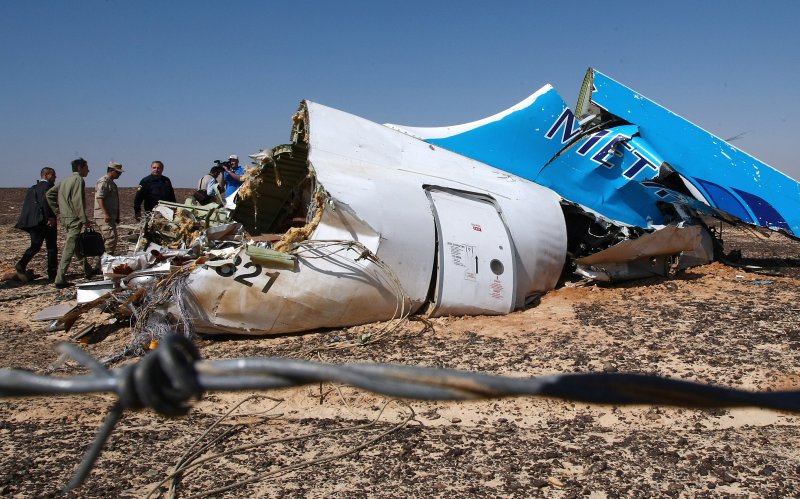
sinai-crash-300x168Source: Associated Free Press/Getty Images (Maxim Grigoryev)

As for the operative who emplaced the device on the plane, we’ve confirmed that the individual did not receive any assistance from a member of the security forces – because he’s a member of the security forces himself. The individual in question used his position to circumvent the 8 explosive detection systems and security checkpoints located at the airport in order to get to his target. DMI knew how this went down fairly quickly, although our sources couldn’t answer how this fell through the cracks, although they did imply that the security forces are plagued with serious internal issues due to the rising insider threat. However, Sharm al-Sheik Airport Chief Abdel-Wahab Ali was removed from his position due to these major security lapses. The fact that the British government aired these very same concerns LAST YEAR made the decision to remove him much easier.

The Latest: Sharm El-Sheikh Airport Chief Has Been Replaced
http://www.nytimes.com/aponline/2015/11/04/world/middleeast/ap-egypt-russian-plane-crash-the-latest.html?_r=0

UK had concerns about Sharm el-Sheikh airport security almost a year ago
http://www.theguardian.com/politics/2015/nov/05/uk-had-concerns-sharm-el-sheikh-airport-security-year-ago-egyptian-beach-resort

Sinai Plane Crash Update
http://isisstudygroup.com/?p=9184
IS-Sinai-300x135Islamic State-Sinai (IS-Sinai) aka “Wilayat Sinai (WS)”: Just entered the next stage of Operations. Source: The ISIS Study Group

Adding further weight to what we’ve been saying is that the Black Box reveals that the crash was not an accident. More importantly, the media (and some Western governments) are saying what we first mentioned in our “Sinai Plane Crash Update.” Excerpt:

European investigators who analyzed the two flight recorders from the Metrojet plane that went down last weekend in Egypt are categorically saying the crash is not an accident, CNN affiliate France 2 reported Friday.

The investigators said the cockpit voice recorder of Metrojet Flight 9268 shows an explosion and the flight data recorder confirms the explosion is not accidental — there is no sign of mechanical malfunction during the initial part of the flight, France 2 reported.

Everything is fine during the first 24 minutes, then in a fraction of a second there is a blackout and no more cockpit conversation, convincing investigators there was a bomb on board, according to France 2.

CNN Aviation Analyst Richard Quest said there would have been different data on the black boxes if there was a catastrophic failure than if there was an explosion. The key is what happened just before the data suddenly stops, he said.

“It’s this split second, and it’s a millisecond, where you hear an explosion of some description,” he said. “And you see all the parameters (on the recorders) go haywire before the power is completely lost. If this report is accurate, (investigators) have now analyzed that … heard it and they can identify it.”

If the plane had broken apart due to structural failure, there would have been more noise — and for a longer time, he said.

France’s air accident investigation agency, the BEA, told CNN that Egyptian officials will make an announcement about the crash investigation within the next 24 hours.

Report: Black boxes show bomb brought down Russian jet
http://www.cnn.com/2015/11/06/middleeast/russian-plane-crash-egypt-sinai/

Screen-Shot-2015-11-06-at-6.50.48-PM-300x167

Media now talking about the bomb being placed in the cargo hold among the luggage near the fuel line
Source: CNN

This wasn’t the first time WS gained access to an Egyptian airport either. Last year they recruited an employee at Cairo International Airport who provided Team Baghdadi with schematics of the facility, locations of guard postings and security procedures. Fortunately, DMI found out and arrested him before the attack plan was set into motion – which was the same plan carried out in Sharm al-Sheik. This was one of a long list of incidents – many of which were never reported by the country’s media outlets – that led to GEN Sisi authorizing the DMI to lead the crackdown on the insider threat within the security forces. From MAY 15 – JUL 15 several junior and mid-level officers within the Army were detained for either being sympathizers or full-fledged members of WS. There’s also been an increase in military personnel refusing to carry out missions against WS – not because they’re “scared” – because they “didn’t want to kill their Muslim Brothers” (which is a red flag since most Muslims would never consider IS as their “Muslim Brothers”). For the most part the military has been the main advocate for moderate Islam and secularism. Unfortunately, that all changed when the Muslim Brotherhood’s Muhammad Morsi rose to power, where he quickly began to sack “problematic” (read-those of moderate Islam or secular leanings) officers. Then he began to fill the ranks with those he reflected his values – in other words, guys with extremist views. The result was a new breed of officers in the junior and mid-level ranks who were very sympathetic to the ideologies of al-Qaida (of which the MB is closely-aligned) and IS. WS’ increase in capability is a good indicator of the success they’ve had in recruiting personnel with formal military experience (Check out “ISIS-Sinai Beheads Croatian Hostage – Just the Beginning” for additional info).

ISIS-Sinai Beheads Croatian Hostage – Just the Beginning
http://isisstudygroup.com/?p=8195
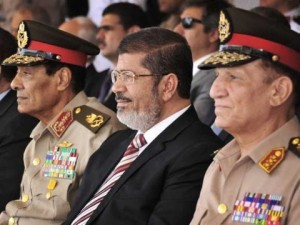
mohamed-morsi-300x225Egypt’s insider threat: Morsi’s legacy. Source: Sharif Abdel Minoem (Associated Press)

The bombing of that Russian airliner is the beginning of WS and IS’ Libya affiliate entering into a new phase of Team Baghdadi’s overall global campaign of conducting high-profile attacks outside of Syria and Iraq. WS followed up the plane bombing with another attack targeting an officer’s club that killed three policemen. But that’s just the start – WS fully intends to expand their operations to targeting Russians and Western tourists to both cripple Egypt’s tourism industry (which would result in significant economic damage) and retaliating for Russia’s Syria intervention. The indicators were all there with the sharp increase in the frequency and scale of attacks carried out by WS in Sinai throughout the year and this past summer in particular (Reference – “Sinai Under Siege Rising capabilities of Wilayat Sinai”). That said, the first real indicators of WS’ increased capabilities was seen as early as JAN 14 when they shot down an Egyptian military helicopter in the Sinai with a MANPAD that was traced back to one of the Qaddafi regime weapons depots that was raided by so-called “moderates” during the early days of the “Arab Spring.” In AUG 15 another attempt was made by WS to bring down an aircraft – this time a Thomson Airways airliner – as it was heading to Sharm al-Sheik Airport. Fortunately the pilot was able to perform evasive maneuvers and avoid being brought down (See the Guardian’s article titled, “Sharm el-Sheikh flight from Stansted dodged missile in August” and our initial piece on the Sinai crash, “Islamic State Claims to Have Shot-Down Russian Plane in Sinai – But Did They?”).

Egypt: 3 police officers killed in North Sinai bombing
http://www.cnn.com/2015/11/04/africa/egypt-north-sinai-bombing/

Militants Down Egyptian Helicopter, Killing 5 Soldiers

Sharm el-Sheikh flight from Stansted dodged missile in August
http://www.theguardian.com/uk-news/2015/nov/06/missed-by-a-1000-feet-how-british-holidaymakers-came-close-to-being-hit-by-a-missile-in-august?CMP=twt_gu

Sinai Under Siege Rising capabilities of Wilayat Sinai (WS)
http://isisstudygroup.com/?p=7587

Islamic State Claims to Have Shot-Down Russian Plane in Sinai – But Did They?
http://isisstudygroup.com/?p=9157
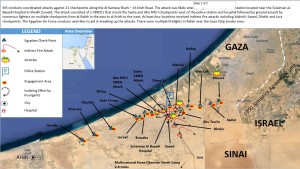
WS-July-2015-attack-Sinai-300x169

This is just a quick snapshot of attacks that occurred in JUL 15
Source: The ISIS Study Group

WS also wanted to show Baghdadi that they’re an effective force capable of achieving the objectives of his external operations campaign, but also to justify that their request for additional funding. This was also a bid for obtaining heavier weaponry from IS’ Libya affiliate, who sends weapons and supplies to Syria – some of which goes through Sinai (Check out “The Strategic Importance of Egypt to ISIS,” “2015: The Year of ISIS Expansion From Gaza to North Africa” and “The ISIS Expansion Into North Africa” for more details). We don’t think Libyan IS Emir Abu Nail will satisfy that request until after he seizes Darnah – which IS was driven out of back in JUN 15. As of this writing, IS-Libya has been busy consolidating its forces in the al-Fatayeh-area located Southeast of the city. That area is the likely staging-area from which the offensive to retake the town will be launched. The Libyan affiliate is facing a tough fight as they’re forced to take on several other opposition groups of varying jihadist flavors as well as the forces of the Egypt-back Libyan GEN Khalifa Haftar.

For the third time, Haftar’s forces fail to control Derna
https://www.middleeastmonitor.com/news/africa/20744-for-the-third-time-haftars-forces-fail-to-control-derna

Isis in Libya: Islamic State driven out of Derna stronghold by al-Qaeda-linked militia
http://www.ibtimes.co.uk/isis-libya-islamic-state-driven-out-derna-stronghold-by-al-qaeda-linked-militia-1506241

ISIS responsible for most Libya killings: ICC prosecutor
https://www.dailystar.com.lb/News/Middle-East/2015/Nov-06/321833-isis-responsible-for-most-libya-killings-icc-prosecutor.ashx

ISIS In Libya? Gadhafi Sirte Residence Searched By Islamic State For Hidden Money: Report
http://www.ibtimes.com/isis-libya-gadhafi-sirte-residence-searched-islamic-state-hidden-money-report-2139456

Warplanes bomb Libya’s Sirte, target Islamic State: witness
http://www.reuters.com/article/2015/10/29/us-libya-security-idUSKCN0SN2JM20151029

The Strategic Importance of Egypt to ISIS
http://isisstudygroup.com/?p=1392

2015: The Year of ISIS Expansion From Gaza to North Africa
http://isisstudygroup.com/?p=5248

The ISIS Expansion Into North Africa…
http://isisstudygroup.com/?p=3257

IS’ Libya affiliate is the terror organization’s most-developed branch and has become a critical part of Baghdadi’s vision of being able to project power outside of Syria/Iraq. Its worth noting that the Libya affiliate has been tasked with providing material support to other affiliates in North Africa in addition to WS and the main effort in Syria. WS actually receives a great deal of their financial support from the Libya affiliate. In fact so much influence has been placed on bolstering the Libya affiliate that some foreign fighters have actually been diverted there. Our sources report the presence of fighters from France, Germany, Egypt, Algeria, Sudan, Saudi Arabia, Canada and one unconfirmed report of Americans serving among the ranks. Recent reporting also suggests that a group of Indonesian jihadists are projected to be entering the country for this same purpose – other sources imply that they may have already arrived. Not only is Libya an alternative for foreign fighters who aspire to wage jihad but can’t make the trip to Syria, its a training ground for select personnel who get sent back to their countries of origin to establish their own attack networks and conduct the cell-based external operations that the IS leadership has been transitioning to over the last few months (For more info on this transition to cell-based external OPs, check out “Neil Prakash and Friends – an Update” and “Nail in the Coffin: ISIS’ Anwar al-Awlaqi BN Sends Fighters to Europe”). Think of it as IS’ way of “diversifying their terror portfolio” for their goal of launching such attacks in the West.

Neil Prakash and Friends – an Update
http://isisstudygroup.com/?p=8862

The Loss of Key ISIS External OPs Figures and the Anwar al-Awlaqi Battalion
http://isisstudygroup.com/?p=8467

Nail in the Coffin: ISIS’ Anwar al-Awlaqi BN Sends Fighters to Europe
http://isisstudygroup.com/?p=8562

With all this happening, what’s next for Vlad? Make no mistake, he’s going to respond – and when he does, people are either going to die or “disappear.” The big mistake the IS mothership in Syria and the Sinai affiliate made is thinking that Vlad is as soft and flaccid as President Obama. They’re going to find out real quick just how big of a mistake they made once he expands his intervention in Syria (although there will be challenges-more on that in another article) followed by enhanced collaboration with the Sisi regime – which has been steadily moving away from America and getting closer to Russia for well over a year (Check out “Egypt Atmospherics” for more details). On the flip side we assess that IS’ Caucasus affiliate (made up mostly of remnants of Imarat Kavkaz or “IK”) are going to become very active in launching attacks inside Russia itself. Although the media seized on the fact that Syria is one of Vlad’s client states, what didn’t get any real coverage are the 2,500-3,000 Russian nationals currently fighting under the IS banner in Syria – many of which are of Chechen/Dagestani/Tajik ethnicity (Reference the following for additional info – “Russia Poised to Increase Military Presence in Middle East in Response to Islamic State’s Strength,” “Islamic State’s Expansion into the Caucasus Region,” “Gulmurod Khalimov Update – His Militant Views May Not Be a Recent Development” and “Introducing Tajik Special Police COL Gulmurod Khalimov: Islamic State Defector”). At some point those foreign fighters are going to return to Mother Russia. A few already have. So if you thought this high-profile attack was an “isolated incident” that only affects Egypt, you thought wrong.

Egypt Atmospherics…
http://isisstudygroup.com/?p=614

Russia Poised to Increase Military Presence in Middle East in Response to Islamic State’s Strength
http://isisstudygroup.com/?p=8416

Islamic State’s Expansion into the Caucasus Region
http://isisstudygroup.com/?p=6880

Gulmurod Khalimov Update – His Militant Views May Not Be a Recent Development
http://isisstudygroup.com/?p=7760

Introducing Tajik Special Police COL Gulmurod Khalimov: Islamic State Defector
http://isisstudygroup.com/?p=7027
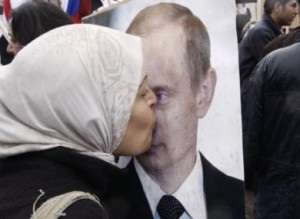
vlad2-300x219

Egyptian locals are increasingly “Pro-Vlad” – but aren’t big fans of President Obama
Source: The ISIS Study Group

Other Related Articles:

Haftar-Sisi Alliance: The Roadblock to ISIS Bridge Into the Maghreb
http://isisstudygroup.com/?p=5033

Egypt Strikes ISIS Positions in Libya: Moderate Muslims Rise Up Against Terror
http://isisstudygroup.com/?p=4889

Egypt and UAE Launch Airstrikes in Libya – US Kept in the Dark
http://isisstudygroup.com/?p=1302

Is Egypt Planning Military Intervention in Libya?
http://isisstudygroup.com/?p=584

Jordan Steps Up Airstrikes Against ISIS, Egypt Launches New Sinai Offensive
http://isisstudygroup.com/?p=4669

Egyptian Army and IDF Take On ISIS Supporters in Sinai
http://isisstudygroup.com/?p=1500

Egyptian Army Hits Back At ISIS In Sinai
http://isisstudygroup.com/?p=2410

ISIS Plots to Bring the “Flames of War” to US, UK and Australia
http://isisstudygroup.com/?p=6431&
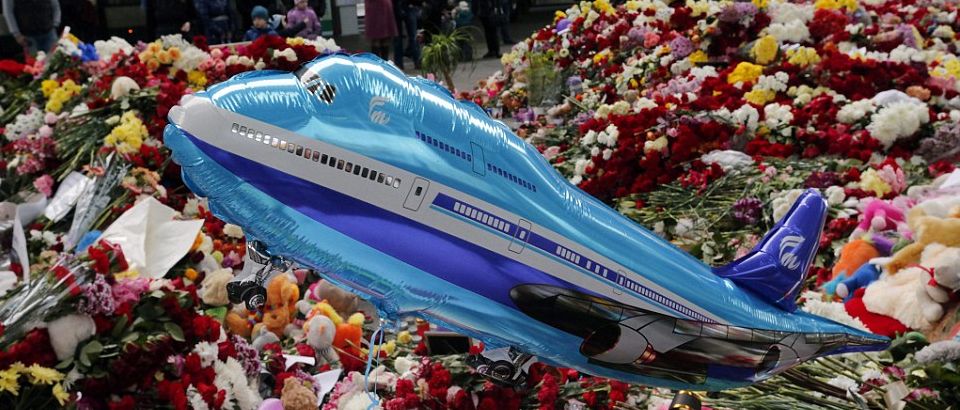
Putin halts flights to Egypt until “true causes” known for Metrojet crash

November 6, 2015

Putin halts flights to Egypt until “true causes” known for Metrojet crash, DEBKAfile, November 6, 2015

(Please see also, Russia to suspend flights to Egypt until causes of Sinai crash are clear. — DM)

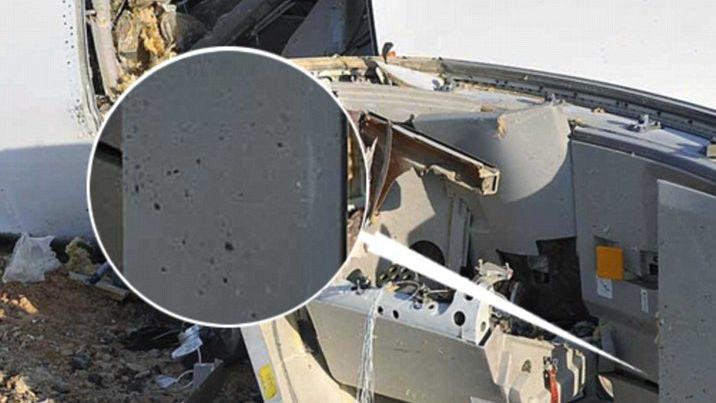
Bomb_evidence_B_5.11.15

They discovered holes made by iron balls planted inside a bomb and scattered through all parts of the plane (see attached photos), as well as large tears in the outer walls that were caused by a powerful explosion.

****************************

President Vladi­mir Putin halted all Russian flights to Egypt Friday, Nov. 6, “until we know the true causes of the incident” .i.e. the cause of the Russian Metrojet flight crash over Sinai Saturday which killed all 224 people aboard. Several European and Gulf Arab governments suspended flights to Sharm el-Sheikh, but Russia was the first to halt all outbound flights to Egypt. Kremlin spokesman Dmitry Peskov said that Putin acted on the recommendation of the Russian security service chief Alexander Bortnikov.

The language of the statement – “true causes of the incident” – indicates that the Russians have lost patience with President Abdel-Fatteh El-Sisi and don’t trust the Egyptian investigation into the causes of the disaster. For most of the week, the Russians played along with Egypt’s obstinate resistance to any suggestion of terrorism and insisted on waiting for the official investigations before making any determinations. Thursday, Moscow sharply criticized British prime minister for presuming on the strength of intelligence that the plane was most likely downed by a bomb.

Putin abruptly changed course Friday following four developments:

1. Russian investigators collecting samples at the crash scene in Sinai found residue and other evidence of an explosion emanating from inside the plane or externally from a missile. They discovered holes made by iron balls planted inside a bomb and scattered through all parts of the plane (see attached photos), as well as large tears in the outer walls that were caused by a powerful explosion. Samples from the airplane’s wreckage were collected and presented to a meeting of the National Anti-Terrorist Committee Thursday.

Mourners_memory_5.11.15

2.  Forensic examination of victims’ remains left no doubt that they died as a result of an explosive blast.

These findings spread like wildfire in Moscow and in St. Petersburg among the grieving families. The Russian leader saw he could no longer afford to line up with Cairo’s playdown of the terrorist factor.

3. Moscow received intelligence that the Islamic State plans to follow up on its first “success” with further terrorist attacks on Russian and European passenger jets.

By downing the Russian airliner over Sinai, the Islamist terror group delivered a huge blow to Egypt’s tourism industry. Russia tops Egypt’s tourist market. Last year, 3.1 million Russians visited Egypt, yielding $2.5bn out of the total national tourism income of $7.3bn in 2014.

Sharm el-Sheikh was the scene of havoc Friday, as Russian and British tourists mobbed the airport in an attempt to fly home after the Egyptian authorities limited the number of outbound flights.

Russia to suspend flights to Egypt until causes of Sinai crash are clear

November 6, 2015

Russia to suspend flights to Egypt until causes of Sinai crash are clear

Published time: 6 Nov, 2015 13:32 Edited time: 6 Nov, 2015 15:04

Source: Russia to suspend flights to Egypt until causes of Sinai crash are clear — RT News

© Maksim Blinov
President Vladimir Putin has agreed with the Federal Security Service to halt all Russian flights to Egypt following an October 31 passenger plane crash in Sinai that killed all 224 people on board.

FOLLOW RT’S LIVE UPDATES

As long as we haven’t established the causes of the incident, I consider it appropriate to suspend the flights of Russian aircraft to Egypt. This primarily applies to the tourist flow,” FSB director Aleksandr Bortnikov told a meeting of the Russian Anti-Terror Committee on Friday.

Egypt has provided Russian investigators with access to all the fragments of the crashed plane as well as the baggage, he said. There is need for “absolute objectivity” and “confirmed data” to establish the causes of the disaster, he added.

Kremlin spokesman Dmitry Peskov said that Putin agreed with the recommendations of the Federal Security Service (FSB). He added that Putin had instructed the government to ensure the safe return of Russian citizens from Egypt and to cooperate with the Egyptian authorities on establishing air traffic security.

Peskov said that the decision to suspend flights was “solely connected with security” reasons, and doesn’t suggest that Moscow considers the A321 crash to be a terrorist attack.

Russia’s civil aviation regulator has started drawing up plans to suspend flights between Russia and Egypt, the agency’s chief, Alexander Neradko, said Friday.

Around 45,000 Russians are currently on holiday in Egypt, TASS cited figures provided by Russia’s tourism agency.

Swabs and scrapings from all fragments of the [crashed] plane, baggage and soil have been taken by Russian experts,” said the head of the Russian Emergencies Service, Vladimir Puchkov, during the meeting.

I underline once more that the necessary samples have been taken from all the elements that can contain traces of explosives,” he added. “If there were explosives on the plane, we will be able to determine it.”

READ MORE: Cherry-picking facts may lead Sinai crash probe down MH17 lane – Russian aviation agency chief

The Airbus A321 belonging to Russian Kogalymavia, which uses the brand name Metrojet, crashed in Egypt 20 minutes after takeoff from Sharm el-Sheikh airport on October 31. All 217 passengers and seven crewmembers on board died in the disaster, making it the deadliest incident of this kind in Russian aviation history. There was no distress call prior to the crash.

Following the disaster, the head of Russian aviation agency Rosaviatsia, Aleksandr Neradko, said that all the signs suggested that the destruction of the plane occurred “in the air and at a great altitude.” The evidence for that was the remains of the plane and the bodies, which have been scattered over an area measuring about 8 km by 4 km, he said.

The airline of the ill-fated passenger jet said on Monday that the plane must have been damaged by a force in flight and couldn’t have just broken apart.

On Tuesday, US media cited sources in the intelligence community saying that that a US infrared satellite had detected a heat flash in the same vicinity, indicating that an explosion may have occurred on board.

On Thursday, UK Prime Minister David Cameron announced that it was “more likely than not” that a bomb caused the crash. His comments were met with doubts from Moscow. During a telephone conversation between Cameron and Putin on Thursday, the PM was accused of “acting before he knows the facts,” according to tabloid paper the Sun.

On Wednesday, Britain halted flights from and to the resort city of Sharm el-Sheikh over concerns that the Russian passenger jet was downed by a bomb on board.

Earlier in the week, a militant group associated with Islamic State (IS, formerly ISIS) claimed to have shot down the Russian plane, but this claim has been deemed unreliable.

Anti-air missiles in ISIS hands also imperil Saudi, Jordanian and Israeli skies

November 5, 2015

Anti-air missiles in ISIS hands also imperil Saudi, Jordanian and Israeli skies, DEBKAfile, November 5, 2015

Shut_up

The Ansar al Sharia terrorist organization in Libya, which attacked the US consulate in Benghazi and murdered the American ambassador in 2012, has the very missiles capable of shooting down large airliners flying at high altitudes: Russian-made ground-to-air Buk missiles, which have a range of between three and 42 kilometers. This ultra-violent Islamist terror group has very close operational ties with ISIS-Sinai, and very possibly smuggled the missile system into Sinai from Libya.

****************************

The British Cobra (emergency cabinet) decision of Wednesday, Nov. 4, not to send airliners to or from Sharm El-Sheikh, where 20,000 British tourists are stranded, further strengthens the assumption that the Russian Metrojet Flight 9268 was downed over Sinai Saturday by a terrorist missile. It confirms that air traffic over Sinai and landings at Sharm are under threat from the ground – else why leave a large group of Britons under virtual siege in the Egyptian Red Sea resort? London said that the suspension of flights to Sharm was “indefinite.”

Moscow early Thursday accused London of being moved to this action out of hostility to Russia rather than security concerns.

Downing Street released a statement Wednesday saying: “As more information has come to light, we have become concerned that the plane may well have been brought down by an explosive device.” This statement was criticized by Egypt as “premature” – not a good omen for the conversation Prime Minister David Cameron is due to hold with his visitor, Egyptian president Abdel-Fatteh El-Sisi, later Thursday.

The British government has therefore stubbed toes in Moscow and Cairo without coming up with an emergency plan for evacuating its citizens from Egypt, whether overland to Cairo by bus or by sea aboard ships picking them up at the Red Sea resort and sailing through the Suez Canal.

This lack of initiative is a sign of confusion and uncertainty.

So far, the drawn-out deliberations and prevarications by officials in several countries regarding the crash of the Russian plane are meant for one purpose: to gain time for doing nothing about ISIS in Sinai. Neither the US, Russia or Britain is ready to send forces to the peninsula to confront the terrorists head-on.

The Ansar al Sharia terrorist organization in Libya, which attacked the US consulate in Benghazi and murdered the American ambassador in 2012, has the very missiles capable of shooting down large airliners flying at high altitudes: Russian-made ground-to-air Buk missiles, which have a range of between three and 42 kilometers. This ultra-violent Islamist terror group has very close operational ties with ISIS-Sinai, and very possibly smuggled the missile system into Sinai from Libya.

A number of intelligence agencies are aware of this and so a flock of leading European and Persian Gulf airlines lost no time in rerouting their flights to avoid Sinai straight after the Russian air disaster.

By causing this disaster, the Islamist terrorists coolly aimed for four goals:

1.  Retaliation for Russian intervention in Syria

2.  An attempt to destabilize the regime of Egyptian President Fattah Al-Sisi

3.  To show up the inadequacies of the 63-member coalition that the US formed in its effort to fight ISIS

4. To parade before the world the Islamic State’s operational prowess, its ability to shoot down the large passenger planes of the world’s biggest powers.

For five days, intelligence and flight safety experts dismissed the claim of responsibility that ISIS issued on the evening of October 31, maintaining that it was not to be taken seriously because no proof had been provided to support the claim – as if the charred fragments of the plane spread across tens of kilometers of desert were deniable.

In the second of its three messages, ISIS repeated its claim Wednesday, Nov. 4, promising details of how it downed the plane at a later date.

While more and more Western governments are coming around to accepting that the Russian airliner’s crash was caused by an explosive device, DEBKAfile’s counterterrorism sources repeat that they cannot rule out the possibility of a missile. The argument made on Wednesday in Washington and London that terrorist organizations do not have missiles capable of downing such planes is are simply incorrect.

ISIS-Sinai’s possession of an advanced ground-air missile system does not only endanger planes in the peninsula’s airspace, but also those aircraft flying over the Suez Canal as well as parts of Saudi Arabia, Jordan and Israel. One of the Egyptian president’s main purposes in his London visit was to try and persuade Prime Minister Cameron to join an Egyptian military operation against Ansar al Sharia in Libya and so eliminate a major prop and arms supplier for ISIS-Sinai. He does not hold out much hope of success.

Russian-made cargo plane crash in S. Sudan kills dozens. Second Mid East air disaster

November 4, 2015

Russian-made cargo plane crash in S. Sudan kills dozens. Second Mid East air disaster, DEBKAfile, November 4, 2015

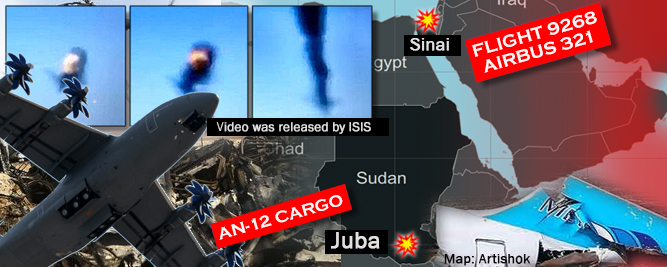
RussianPlaneSinai_Sudan2nd Russian-linked air crash kills dozens in Sudan. The missile or bomb which blew up the Russian airliner over Sinai Saturday is reported by DEBKAfile’s sources to have been likely smuggled in from Libya. Nov 4, 2015, 12:29 PM (IDT)

While neither the Egyptians or the Russians are willing to admit this, it is highly likely that the missile or explosives which brought down the Russian airliner Saturday came from Libya.

*********************

No cause has yet been established for the Russian-made Antonov Ant-12’s crash-landing on the east bank of the Nile River 800 m short of Juba international airport in South Sudan Wednesday, Nov. 4. Its five-man crew were Russians. According to first reports some 40 people were killed both on board and on the ground, although there appear to be two survivors.

But none of the 224 passengers and crew aboard the Metrojet Flight 9268 Airbus 321 survived the airliner’s crash in central Sinai Saturday, Oct. 31, en route from their holiday in Sharm El Sheikh to St. Petersburg.

Russian sources following the forensic examination of the bodies and partial remains of the victims flown to St. Petersburg report that they show evidence of an explosion in the plane before it plummeted to the ground. Further testing is required to establish the cause of the explosion.

A US infrared satellite detected a heat flash at the same time and same vicinity over Sinai where the Russian plane went down. A US defense official added that the same satellite would have been able to track the tell-tale heat trail of a missile from the ground.  “The speculation that this plane was brought down by a missile is off the table,” the official said.

Another official said, “the plane disintegrated at a very high altitude.”

The general consensus ahead of the Egyptian and Russian probes is that a sudden, catastrophic explosion caused the crash – whether from a bomb inside, “external impact” – as the Metrjet company claims – or from faulty fuel. Russian fuel experts found nothing wrong with the fuel.

An Egyptian physician who inspected the scene of the disaster found that one out of every five bodies he saw had been incinerated to death from a fire that may have started in the passenger’s cabin and spread to the rest of the plane.

Egyptian experts reported that “the large number of separate body fragments” could indicate that a strong explosion occurred onboard before the aircraft hit the ground. They were scattered across a radius of 8-10 square kilometers from the wreckage.

Russian and Egyptian sources tracking the examination of the two black boxes found evidence that the calamity occurred too rapidly for the pilots or crew to send an SOS or even say a few words.

As the probe of the air catastrophe began Tuesday and Wednesday, Moscow and Cairo were increasingly at odds on their findings. The Russians asserted that the plane must have broken up into two parts as a result of a strong explosion, whereas Egyptian officials remained intent on playing down the claim of responsibility for the crash published Saturday by the Sinai wing of the Islamic State. They criticize the Russians as rushing to conclusions ahead of the probe.

Egyptian President Abdel-Fatteh El-Sisi arrived in London Wednesday for talks with British Prime Minister David Cameron. In interviews prior to his arrival, the Egyptian president said that he will demand that David Cameron “complete his mission in Libya to prevent the country being dominated by Islamists.”

By “mission,” El-Sisi was referring to the UK’s role in the coalition which toppled Muammar Qaddafi in 2011.

DEBKAfile’s counterterrorism sources report that Egypt faces an acute problem from Libya’s transformation in the last two years into the main supply source of smuggled arms and fighters for the Islamist terrorists operating in Egypt and Sinai.

While neither the Egyptians or the Russians are willing to admit this, it is highly likely that the missile or explosives which brought down the Russian airliner Saturday came from Libya.

Doomed Russian jet did not issue a distress call: report

November 1, 2015

Doomed Russian jet did not issue a distress call: report, DEBKAfile, November 1, 2015

The Russian passenger plane that crashed in the Sinai Peninsula on Saturday did not send out any distress call, reports said Sunday, meaning that the plane suddenly blew up. A number of Israeli commentators continue to claim, like Egypt, that the pilots reported a technical problem to the Egyptian control tower, and that the plane broke in half during the flight. However, there is no basis to those reports.

Egypt’s War on Terror

October 20, 2015

Egypt’s War on Terror, Israel DefenseDr. Shaul Shay, October 20, 2015

AP_568967571149An Egyptian armored vehicle patrols on the Egyptian side of the border, Thursday, July 2, 2015 (Photo: AP)

The Egyptian army has launched operation “Martyr’s Right” – the largest and most comprehensive operation aimed at rooting out and killing militants in North Sinai. The operation is just one campaign of many launched by the government in response to the wave of terrorist attacks.

The Second Field Army units, the Commandos and anti-terrorism units with the support of air force attacked the terrorist hotbeds in North Sinai. The Egyptian Navy participates in the operation to tighten the grip on the terrorists and prevent them from escaping via sea as well as to cut the supplies provided to the terrorists.

North Sinai, which borders Israel and the Palestinian Gaza Strip, is a stronghold of Islamist militant group Ansar Beit Al-Maqdis, (known today as Wilayat Sinai) which pledged its allegiance to ISIS in 2014.

The Egyptian army has been battling a decade-long militant insurgency in North Sinai, which has spiked in the last two years following the ouster of Islamist president Mohamed Morsi in July 2013.

Ansar Beit Al-Maqdis has claimed responsibility for some of the deadliest attacks in Egypt. In October 2014, Ansar Beit Al-Maqdis claimed responsibility for an attack that killed as many as 30 soldiers and in July 2015 the group mounted its largest attack on Egypt’s security forces in North Sinai.

Days before operation “Martyr’s Right”, Ansar Beit Al-Maqdis released a video showing attacks it had carried out on military forces.

Operation “Martyr’s Right” – Phase 1

The operation against Islamist militants, was launched on September 8, 2015, at dawn, in the towns of Rafah, Arish, and Sheikh Zuweid in the northern part of Sinai peninsula.

The operation included the following steps:

The army said it has beefed up security around major government institutions and private buildings in the region as well as roads.

Army troops along with anti-terror police units attacked hideouts of Islamist militants, killing many terrorists and destroying vehicles and equipment used by the terrorists.

The military has stopped and arrested many of the North Sinai-based militant leaders and organizers of terrorist operations.

The Air force launched massive air strikes to repel the militants, killing tens of insurgents.

The security forces exercised the utmost care to save lives, public and private property in Sinai.

The army hailed efforts exerted by the citizens in Sinai in the anti-terror fight, saying, health, social and daily life services are guaranteed. The statement lauded unprecedented harmony of the military forces, police and the residents of Sinai to restore stability and security in the peninsula.

The border with Gaza strip – a tunnel was destroyed under a house in Rafah. Military costumes, telescopes, advanced guns, ammunition, a bipod for a sniper rifle and satellite communication devices were found inside the tunnel. The Egyptian authorities have also begun flooding its buffer zone along borders with Gaza to destroy remaining tunnels and prevent future digging.

The Egyptian army announced the end of the first stage of the operation on September 22, 2015, after the “achievement of its primary objectives,” which reportedly included the killing of over 500 militants and destroying various “terrorist” hideouts and artillery storage facilities in North Sinai.

The operation also extended to the Bahariya Oasis in western Egypt, where the army killed 10 militants who were planning to execute terrorist and criminal acts against vital targets and foreign interests during the Eid vacation, scheduled to take place from 23 to 27 September 2015.

Operation “Martyr’s Right” – Phase 2

The Egyptian armed forces announced on October 8, 2015, the commencement of the second phase of operation “Martyr’s Right” in North Sinai in the cities of Sheikh Zuweid, Rafah, and Arish. Phase two of the operation, according to a statement released by the army after the conclusion of the first phase, will “pave the road for creating suitable conditions to start development projects in Sinai.”

The second phase includes:

The commencement of numerous development projects and planned execution of reconstructions in North Sinai in the cities of Sheikh Zuweid, Arish, and Rafah.

The armed forces announced the dispatch of a convoy loaded with medical supplies and construction materials, as well as food for the people of North Sinai.

The armed forces are preparing for the construction of the new town of Rafah, which will include 1200 housing units as well as a hospital and schools.

The second stage of “Martyr’s Right” includes plans to build 27 water desalination plants as well as water tanks and new roads.

Summary

Egypt’s army latest campaign in North Sinai, operation “Martyr’s Right” is the largest and most comprehensive operation aimed at rooting out and killing terrorists.

During the first phase of the operation  according to the Egyptian military spokesman (stated on its official Facebook page) the military was able to combat and seize weapons and ammunition storage places and take over main roads in the area in addition to destroying large numbers of vehicles including 4WD, motor bikes and communication devices.

In ten different statements issued daily during the operation, the military alleged that the forces were able to kill 535 terrorists and 578 others were arrested. In an official statement by the military it alleged that it took precautions to take care of civilians and protect them.

President Abdel Fattah El-Sisi has greeted the armed forces over the advent of Eid Al-Adha. In a statement by the Presidency, Sisi said “this Eid provides a sublime value of sacrifice that all of us should cherish while serving our nation to realize security and stability for a better future for our kids.”

He lauded the efforts exerted by army and police personnel to eradicate terror in Sinai. He said they sacrifice their souls to defend their nation and confront terrorism and extremism.

He hailed the achievements realized during the first stage of the operation “Martyr’s Right” in Sinai that have largely contributed to curbing terror in Egypt. President El-Sisi underlined the importance of proceeding with the second phase with the same resolve and determination of the first stage.

The operation was billed to the Egyptian public as the decisive battle in the state’s ongoing campaign to tackle the country’s terrorist group.  In the press, the operation has been declared a sweeping success, and commentators have predicted that domestic terrorism will be “completely eradicated” by the 6 October, to coincide with the anniversary of what is perceived to be Egypt’s great 1973 military triumph against Israel.

In spite of the optimistic reports in the Egyptian media the war against the Islamic terror in Sinai is not over yet and Egypt will have to deal with Islamic insurgency for long time.

Egypt will begin construction of church dedicated to ISIS martyrs

October 10, 2015

Egypt will begin construction of church dedicated to ISIS martyrs, BreitbartThomad D. Williams, PH.D., October 10, 2015

(The church will be dedicated to those murdered by the Islamic State. In what other Muslim nation would that happen? — DM)

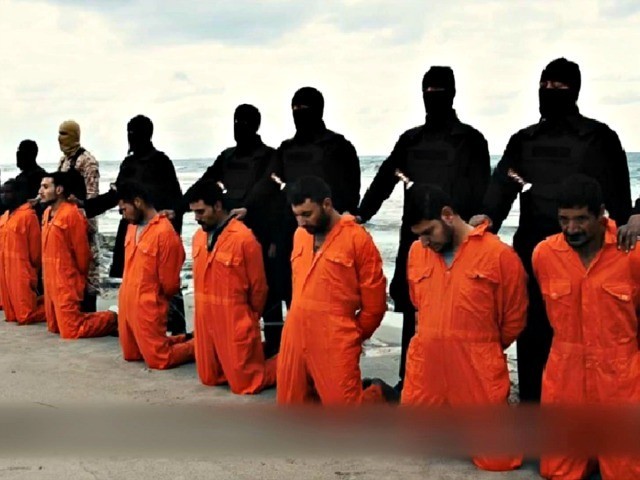
ISIS-21-Christians-YouTube-via-NBC-640x480YouTube via NBC News

President al-Sisi has asked Christians for a greater commitment in politics, urging them to vote and to run for office, to ensure a Christian presence in Parliament.

***********************

In the coming days, construction will commence on a new church in Egypt dedicated to the martyred Coptic Christians beheaded by the Islamic State in Libya in February.

The new church, bearing the name “Church of the Libyan Martyrs,” will be built in the Minya Governorate, south of the capital, Cairo. The church will cost $1.3 million, half of which has already been raised.

Egyptian President Abdel Fattah al-Sisi granted permission for the construction of the church last February after Islamic State militants murdered 21 Coptic Christians on a Libyan beach.

According to Father Rafic Greiche, spokesman for the Catholic Church in Egypt, the construction is indicative of a slow but noticeable shift taking place in Egyptian culture as well as among state officials. The change comprises improving attitudes toward Christians, but also resistance to Islamic extremism.

Until now, Fr. Greiche said, the procedure involved in getting a church building permit was extremely complex, involving a series of authorizations and approvals, which have been streamlined in this case. The decision also indicates that the government wished to send a strong message against religious discrimination, he said.

Greiche says that there have also been timid attempts at exegesis of the Koran and Islamic texts, accompanied by a ban on women teachers wearing a burka in the classroom and struggles against fundamentalism and extremist sermons in mosques.

Last week, the president of the University of Cairo, Dr. Hossam Kamel, prohibited teachers from wearing the burka in the classroom. They may continue to wear it, if they choose, at home or on the street, but not during teaching time.

Egypt’s top Islamic school, Al-Azhar, followed suit by banning women from wearing the burka in all its affiliate schools after a leading cleric said the burka was only a “tradition” and not necessary in Islam.

With general elections in late October and a possible reform of the Constitution, some expect a greater presence and visibility of Christians in society and in national politics as a result. While a transformation of the mentality naturally takes time, Greiche said, the fact remains that Christians are far more accepted in Egyptian society now than in the past.

President al-Sisi has asked Christians for a greater commitment in politics, urging them to vote and to run for office, to ensure a Christian presence in Parliament.

The High Electoral Commission also decided that at the first stage of the elections on October 17, women wearing the full veil must show their faces if they want to cast their vote.

For some time, there has been a greater determination to limit fundamentalism and extremism in mosques. The priest spoke of a “greater secularism without renouncing the religious element.”

Fast-roping toward war in the Middle East

October 10, 2015

Fast-roping toward war in the Middle East, Washington Times, Ken Allard, October 8, 2015

(Oh well,


Not on our side

— DM)


Home to the Arab world’s largest population and the region’s geopolitical crossroads, Egypt had been a key American strategic ally ever since Anwar Sadat. But Mr. Obama backed the Islamist dictatorship of Mohammed Morsi, even after 30 million Egyptians took to the streets in July, 2013 to force his overthrow. When Mr. Obama cut off military ties with the new Egyptian regime of President Abdel Fattah al-Sisi, the Russians swiftly stepped in to reverse a generation of American statecraft. Unlike the amateurs in the West Wing, Russian strategists and diplomats have no difficulty connecting dots or reading maps.

Neither do our few remaining allies in the Middle East, who can be forgiven for drawing their own conclusions, given the Egyptian reversal, those Syrian red-lines, the recent Iranian arms control deal and the steady expansion of Iranian influence throughout the region.

*****************************

The Russians are rapidly reinforcing their bridgehead in Syria, adding ground troops to their air, marine and naval forces. It is a classic air, land and sea intervention by a military establishment that understands how combined arms build synergies and broaden capabilities. As Jed Babbin pointed out in these pages on Wednesday, the broad-shouldered Russian intervention is the direct counterpoint to the “inaction, indecision and dithering” that have long characterized President Barack Obama’s foreign policy.

Russian President Vladimir Putin has called Mr. Obama’s bluff. He has also deployed a Russian expeditionary force bristling with robust anti-aircraft and ground-attack weapons, even firing cruise missiles from warships in the Caspian Sea. Such a deployment is precisely what Mr. Putin believes necessary to insure that Russian jets and helicopters dominate the skies over Syria. Fox News reports that Russian jets have already shadowed U.S. Predator drones on three occasions, a quiet but unsubtle message that the unmanned aircraft are flying only because of Russian forbearance.

Depending solely on Mr. Putin’s strategic objectives, that prevailing restraint can vanish in an instant. Union and Confederate commanders, for example, routinely practiced counter-reconnaissance throughout the Shenandoah Valley campaign of 1864. When planning a surprise attack or defending a vulnerable position, their first objective was to prevent enemy cavalry from having an unobstructed view of one’s own dispositions. What cavalry did back then, air forces and satellites do today.

Updating an ancient principle for the digital age, Norman Schwarzkopf destroyed Saddam Hussein’s radars, reconnaissance systems and intelligence assets before American airpower launched the opening salvos of Operation Desert Storm. Today’s Russian generals grew up practicing the basic principles of Soviet electronic warfare: Intercept the enemy’s communications, jam him or destroy him. Above all: Use the electromagnetic spectrum and state-of-the-art Russian air defenses to offset hi-tech American airpower. In Syria, that campaign has already begun.

Pandering to an American public that is militarily and strategically illiterate, some presidential candidates have reflexively called for “no-fly zones” to be set up in Syria. Predictably, Donald Trump has even expressed enthusiasm for Mr. Putin’s alleged intent to combat ISIS. But seriously, folks, why would Vladimir Putin go to the considerable trouble of staging the largest foreign deployment of Russian forces since the Cold War only to cater to western conceits about no-fly zones? Even if he did, who would set up and enforce them? Having made a power play to control Syria (and therefore a major chunk of the Middle East) why on earth would Mr. Putin content himself solely with attacking ISIS? (If you are having trouble following this logic, then you probably are a member of the White House staff “perplexed” by Russian objectives.

As a highly trained KGB apparatchik, Syria is not Mr. Putin’s first rodeo. While it has become obligatory in Washington policy salons to deplore Crimea and eastern Ukraine, Egypt’s recent history offers a better clue to Russia’s long-range goals.

Home to the Arab world’s largest population and the region’s geopolitical crossroads, Egypt had been a key American strategic ally ever since Anwar Sadat. But Mr. Obama backed the Islamist dictatorship of Mohammed Morsi, even after 30 million Egyptians took to the streets in July, 2013 to force his overthrow. When Mr. Obama cut off military ties with the new Egyptian regime of President Abdel Fattah al-Sisi, the Russians swiftly stepped in to reverse a generation of American statecraft. Unlike the amateurs in the West Wing, Russian strategists and diplomats have no difficulty connecting dots or reading maps.

Neither do our few remaining allies in the Middle East, who can be forgiven for drawing their own conclusions, given the Egyptian reversal, those Syrian red-lines, the recent Iranian arms control deal and the steady expansion of Iranian influence throughout the region. Because it is a tough and unforgiving neighborhood, where would you place your bets if you lived there? Do you ally yourself with the rising regional power or the one seemingly intent only on defeat and retreat? As a friend points out, “Obama only attacks oilmen, Wall Street, the police, pro-lifers, the NRA, Christians, conservative Republicans, and traditional U.S. allies. Remember when they were the good guys?”

In this confusing world, it is important to remember that things can get worse, particularly given the fog of war with lots of heavily armed aircraft moving at high speeds over surprisingly small operating areas. War is justly famed for confounding the best intentions, for proving that the only assumption which holds true is the one you were certain could never happen.

How ironic that the place where three of the world’s great religions were born might yet spark a global confrontation where no holds are barred.

Why hasn’t Sisi visited Washington yet?

October 9, 2015

Why hasn’t Sisi visited Washington yet? Al-MonitorMohamed Saied, October 8, 2014

(Obama thinks highly of the Islamist Muslim Brotherhood and rejects President Sisi because he supported the Egyptian masses who sought the overthrow of an increasingly dictatorial President Morsi. Obama’s rejection of Sisi’s Egypt pushed it into an alliance with Russia. Now Obama, et al, claim that alliance as a basis for the continuing hostility toward Sisi. Perhaps it is. Obama, et al, have also complained about Egyptian human rights violations in repressing the Muslim Brotherhood; few similar complaints have been made about far greater Saudi and Iranian human rights violations. Sisi is the only president of a Muslim nation who seeks to promote a more secular and hence moderate Islam, to which the Muslim Brotherhood is hostile. Please see also, Egypt’s secular culture minister ruffles Salafi feathers. — DM)

One of the most important issues that may hinder the return of US-Egyptian relations to their previous state is the strong relationship between Cairo and Moscow; Sisi has met his Russian counterpart Vladimir Putin four times so far, and Egypt is currently considered the most important ally of Moscow in the Middle East.

**********************

CAIRO — Ever since Egyptian President Abdel Fattah al-Sisi took office on June 8, 2014, US-Egyptian relations have been deteriorating. This has been further confirmed by the fact that Sisi has not visited Washington yet despite the shuttle visits he has made abroad.

Differences and conflicts plagued the US-Egyptian relationship during the era of President Gamal Abdel Nasser. These conflicts culminated in the 1967 Six-Day War, when diplomatic relations between the two countries were severed because of the economic and military support by the United States to Israel.

However, these relations started to take a positive turn based on the strengthening of the strategic interests shared between the two countries in the wake of the signing of the Camp David Accords with Israel — the US’ permanent ally — on Sept. 17, 1978, between Egyptian President Anwar Sadat and Israeli Prime Minister Menachem Begin, as per the State Information Service affiliated with the Presidency of the Republic.

Only one meeting was held between Presidents Sisi and Barack Obama on the sidelines of the 69th Session of the UN General Assembly in September 2014 in New York, but other than this the two presidents have been settling for phone calls to discuss the latest developments in the region.

According to The Washington Times, Obama refused to meet with Sisi on the sidelines of the 70th session of the UN General Assembly. Egyptian Foreign Minister Sameh Shoukry attributed this in a press statement on Sept. 24 to the mismatching agendas and schedules of the two presidents, which prevented them from holding individual talks.

According to the US Embassy in Egypt’s reports on the situation in the country following the revolution of June 30, 2013, Washington started a “comprehensive review” of its relations with Egypt on the background of the ouster of former Egyptian President Mohammed Morsi.

On Aug. 15, 2013, following the killing of hundreds of Muslim Brotherhood demonstrators in Al-Nahda Square and Rabia al-Adawiya Square, Obama announced the cancellation of the Bright Star maneuvers, which were launched in 1980 following the signing of the peace treaty between Egypt and Israel and consisted of a joint military exercise between the two countries.

By October 2013, the review of relations put a halt to the deal consisting of delivering arms to Egypt. Also in October 2013, the US administration suspended $260 million that was going to be directly transferred to the Egyptian government along with another $300 million in US loan guarantees.

However, in a telephone call on March 13, Obama told Sisi that the military aid amounting to $1.3 billion would continue.

Meanwhile, Dina Badawi, spokeswoman for the US State Department for the Middle East, expressed concerns in a live interview on the ONtv channel April 2 over the state of rights and freedoms in Egypt, and pointed out that aid is aimed at continuing the democratic track and the political reforms in the country.

Abdel Moneim Said, director of the Regional Centre for Strategic Studies, and Shai Feldman, the Judith and Sidney Swartz director at the Crown Center for Middle East Studies, said in a research paper titled “Resetting US-Egyptian relations,” which was published in March 2014 on the center’s website, that at the root of the downturn in the US-Egyptian relations is the huge gap between the two sides’ narratives regarding the events of June 30, 2013.

One of the most important issues that may hinder the return of US-Egyptian relations to their previous state is the strong relationship between Cairo and Moscow; Sisi has met his Russian counterpart Vladimir Putin four times so far, and Egypt is currently considered the most important ally of Moscow in the Middle East.

The dispute between Russia and the United States is in regard to several issues. Chief among these is the Syrian issue; Moscow launched airstrikes on Sept. 30, sparking criticism on the part of Obama during a press conference Oct. 2. Obama said that Moscow is acting “not out of strength, but out of weakness” in support of the losing party. The president was referring to Syrian President Bashar al-Assad, and he pointed out that Russia should help in reaching a political settlement.

Meanwhile, the Egyptian Foreign Ministry did not issue any statements condemning or supporting such strikes.

In January, spokeswoman for the US State Department Jennifer Psaki said during the daily press brief that a meeting she described as “routine” was held with a delegation of members of the former Egyptian parliament from the dissolved Muslim Brotherhood-affiliated Freedom and Justice Party, on the sidelines of their visit to Washington, which was organized and financed by Georgetown University in Washington.

This meeting raised the ire of the Egyptian political leadership, as well-informed sources told Reuters in June that the Egyptian government summoned the US ambassador in Cairo to express displeasure over visits to Washington by figures of the Muslim Brotherhood, which is banned in Egypt.

Concerning the fact that Egypt did not extend an official invitation to Obama to meet with Sisi, or vice versa, Atef el-Ghomri, former director of the office of the Egyptian Al-Ahram newspaper in Washington and a member of the Egyptian Council for Foreign Affairs, said, “There is an ongoing split within the US decision-making circles over the revolution of June 30, 2013, and the toppling of former President Mohammed Morsi, who belongs to the Muslim Brotherhood.”

Ghomri told Al-Monitor that over the past years, Egypt’s relations have been confined to its foreign relations with Washington as it only took into account its regional and international interests. This deprived Egypt of any international initiatives or insights about various issues. Also, Egypt had to give up its pivotal role in the Middle East as far as the African and Arab countries are concerned. This negatively affected Egypt over time.

“The Egyptian leadership is trying to diversify its foreign relations. It resorted to the Eastern bloc led by Russia, as well as East Asia represented by China and Singapore.” Ghomri added.

Washington is concerned about several files managed by the Egyptian leadership, mainly the human rights and political reforms issues. The United States has been expressing those concerns since the June 30 Revolution, when the Muslim Brotherhood was toppled and replaced by a military president.

Under such circumstances, Cairo had to resort to other countries, while the US-Egyptian relations are expected to witness further tension, especially with the differences in views concerning several international issues, namely Syria, Iran and Libya.