In a priceless demonstration of the Arabs’ 600-year long failure to appreciate new realities, Riyad Mansour, the Palestinian Authority’s UN Ambassador, on Friday warned President-elect Donald Trump that if he dared move the US embassy to Jerusalem, he and his ilk would “make life miserable” for the United States at the United Nations.
“If people attack us by moving the embassy to Jerusalem, which is a violation of Security Council resolutions, it is a violation of resolution 181 of the UN general assembly that was drafted by the US … it means they are showing belligerency towards us … If they do that nobody should blame us for unleashing all of the weapons that we have in the UN to defend ourselves and we have a lot of weapons in the UN,” Mansour said.
Mansour did demonstrate that he was still living on Planet Earth by conceding that the Security Council would not vote to condemn such a move by the US, because, well, the US is a veto wielding member of the Security Council. But that did not hold the PA rep back from warning the incoming president. “Maybe I can’t have resolutions in the Security Council but I can make their lives miserable everyday with precipitating a veto on my admission as a member state.”
Mansour, who served as the Deputy Permanent Observer of the PLO to the United Nations from 1983 to 1994, succeeded Nasser al-Qudwa as Permanent Observer for Palestine to the UN in 2005. On November 29, 2012, 65 years to the day after the Arabs forever ruined their chance for a legitimate state in the UN Partition vote, the Permanent Observer Mission of Palestine to the United Nations was upgraded to “non-Member Observer State.” Now, it appears, Ambassador Mansour made sure no further upgrades may be coming. Especially when he promised Trump he would drag him to the International Criminal Court of Justice in the Hague.
Taking Trump to court — now, that’ll scare him.
Mansour warned that “it is illegal to defy Security Council resolutions that the US is party to it that the unilateral action by Israel annexing East Jerusalem is illegal and it is null and void. If the US administration wants to defy international law they are doing something illegal.”
Trump’s plan to move the US embassy from Tel Aviv to Jerusalem sounds radically different coming from his key advisor Jason Greenblatt than from his other key advisor, Walid Phares. The former has spread enthusiastic promises regarding the move before the election, the latter has told the BBC that the move depended on there being a favorable “consensus.”
On Saturday night’s satirical show Back of the Nation, comic Rotem Abuhav said moving the embassy would be a nightmare, seeing as it would permanently clog the already jammed city traffic, making it impossible for Israelis to receive consular services. Abuhav suggested that from now on, instead of taking a trip to see America, she and her family would just take a trip to the US embassy to take the Visa Application ride.
Vice President-elect Mike Pence is heading up President-elect Donald Trump’s transition team, assembling a new administration after Trump’s victory earlier this week.
New Jersey Gov. Chris Christie had been in charge of Trump’s transition, but Pence is taking over and will be advised by members of Congress.
Pence will serve as Chairman of the Presidential Transition Team, according to a press release on Friday. It adds:
Dr. Ben Carson, New Jersey Governor Chris Christie, Former Speaker of the U.S. House of Representatives Newt Gingrich, Lieutenant General Michael Flynn, USA (Ret.), Former New York City Mayor Rudy Giuliani and U.S. Senator Jeff Sessions will join the team’s Executive Committee as Vice Chairs.
According to the press release, the following individuals will serve as leaders on the Presidential Transition Team Executive Committee:
Congressman Lou Barletta
Congresswoman Marsha Blackburn
Florida Attorney General Pam Bondi
Congressman Chris Collins
Jared Kushner
Congressman Tom Marino
Rebekah Mercer
Steven Mnuchin
Congressman Devin Nunes
Anthony Scaramucci
Peter Thiel
Donald Trump Jr.
Eric Trump
Ivanka Trump
RNC Chairman Reince Priebus
Trump Campaign CEO Stephen K. Bannon
“Together this outstanding group of advisors, led by Vice President-elect Mike Pence, will build on the initial work done under the leadership of New Jersey Gov. Chris Christie to help prepare a transformative government ready to lead from day one,” stated President-elect Donald Trump, adding:
The mission of our team will be clear: put together the most highly qualified group of successful leaders who will be able to implement our change agenda in Washington. Together, we will begin the urgent task of rebuilding this nation – specifically jobs, security and opportunity. This team is going to get to work immediately to Make America Great Again.
Rick Dearborn will serve as the team’s executive director. Dearborn previously served as Sen. Jeff Sessions (R-AL) chief of staff.
Others joining Dearborn on the team are:
Kellyanne Conway, Senior Advisor
David Bossie, Deputy Executive Director
Stephen Miller, National Policy Director
Jason Miller, Communications Director
Hope Hicks, National Press Secretary
Dan Scavino, Director of Social Media
Don McGahn, General Counsel
Katie Walsh, Senior Advisor
Pence will continue to have his top senior advisers, Nick Ayers, Josh Pitcock, and Marc Short, work with him on this process.
“President-elect Trump will bring about fundamental change in Washington, and these are the right people to make that happen,” stated Vice President-elect Pence. “This team of experienced leaders will form the building blocks of our Presidential Transition Team staff leadership roster, and will work with elected officials and tireless volunteers to prepare our government for the transfer of power on January 20th.”
Trump’s Israel advisor: “Trump doesn’t view settlement building as an obstacle for peace” Jason Greenblatt, one of Trump’s senior level advisors who will likely be appointed as Trump’s Middle East envoy, described the President-elect’s emerging policy: “It’s certainly not Mr. Trump’s view that settlement activity should be condemned.”
Jason Greenblatt, one of President-elect Donald Trump’s senior level advisors, will most likely be appointed as the US envoy to the Middle East and will rewrite a foreign policy differing from that of US President Obama and Secretary of State John Kerry. This morning (Thursday), Greenblatt was interviewed by Israel’s Army Radio explaining Trump’s stances and stressed: “He is not going to impose any solution on Israel.”
“It is certainly not Mr. Trump’s view that settlement activity should be condemned,” Greenblatt said during Israel’s Army Radio broadcast this morning. “Building over the Green Line is not an obstacle for peace.”
Trump giving a speech following his victory Photo Credit: CNN/Channel 2 News
“He believes that Israel is in a very tough situation needs to defend itself,” Greenblatt added mere hours after Israeli Prime Minister Benjamin Netanyahu congratulated Trump regarding his victory during a phone conversation between the two.
Greenblatt also indicated that Trump’s stance against returning land to the Palestinians derives from Israel’s 2005 Gaza disengagement: “He does not view the settlements as an obstacle for peace. I think he would use the expulsion of Jewish communities from the Gaza Strip as proof of that.”
Contrary to the Obama administration which attempted utilizing various measures in order to renew peace talks, Greenblatt feels that Trump will act differently regarding the Israeli-Palestinian conflict: “Peace has to come from both sides and he does not plan on intervening in the matter.”
Germany’s Angela Merkel sent out a blunt statement to Donald Trump Wednesday morning, telling the president-elect that if he wanted to work well with his overseas’ partners – specifically, her – he would recognize the “dignity of man,” regardless of Muslim roots.
The warning came just hours after Trump, who’s vowed to crack down on borders in the United States and make sure those coming in the country aren’t carrying any Islamic-tied terror threat with them, won the White House.
“Angela Merkel has issued a carefully-worded response to Donald Trump’s election as US President, taking aim at the divisive rhetoric he used during the campaign.
“While Theresa May simply congratulated Trump on his victory, Merkel said she would only offer ‘close cooperation’ dependent on his commitment to equal rights.
“The German Chancellor, who has been the driving force behind the EU’s acceptance of hundreds of thousands of refugees, said her relationship with Trump would only succeed if he upheld “the dignity of man, independent of origin”.
“She said: ‘Germany and America are connected by values of democracy, freedom, and respect for the law and the dignity of man, independent of origin, skin colour, religion, gender, sexual orientation, or political views.
“‘I offer the next President of the United States close cooperation on the basis of these values.
“‘The partnership with the United States is and remains a foundation of German foreign policy.’”
Merkel also said she had watched the election results as they unfolded in America with “trepidation,” the news outlet reported.
Merkel made the conditional remarks even while Germany’s been fighting off a massive inflow of Muslim refugees, some of whom in recent days have been disciplined, albeit lightly, for sexually assaulting young girls at community swimming pools.
Jason Greenblatt Co-Chairman of Israel Advisory Committee for Donald Trump Photo Credit: Facebook
The following is a Nov. 2 joint statement from Jason Dov Greenblatt and David Friedman, Co-Chairmen of the Israel Advisory Committee to Donald J. Trump:
“Approximately seven months ago, we were blessed to have been tapped by Donald J. Trump to be his top advisors with respect to the State of Israel. … Each of these positions has been discussed with Mr. Trump and the Trump campaign, and most have been stated, in one form or another, by Mr. Trump in various interviews or speeches given by him or on his social media accounts.
“For those of you who are true friends of the State of Israel, and for those of you who believe that the State of Israel and the United States of America have an unbreakable friendship, we urge you to read the [list] below.”
1. The unbreakable bond between the United States and Israel is based upon shared values of democracy, freedom of speech, respect for minorities, cherishing life, and the opportunity for all citizens to pursue their dreams.
2. Israel is the state of the Jewish people, who have lived in that land for 3,500 years. The State of Israel was founded with courage and determination by great men and women against enormous odds and is an inspiration to people everywhere who value freedom and human dignity.
3. Israel is a staunch ally of the U.S. and a key partner in the global war against Islamic jihadism. Military cooperation and coordination between Israel and the U.S. must continue to grow.
4. The American people value our close friendship and alliance with Israel — culturally, religiously, and politically. While other nations have required U.S. troops to defend them, Israelis have always defended their own country by themselves and only ask for military equipment assistance and diplomatic support to do so. The U.S. does not need to nation-build in Israel or send troops to defend Israel.
5. The Memorandum of Understanding signed by the American and Israeli Governments is a good first step, but there is much more to be done. A Trump Administration will ensure that Israel receives maximum military, strategic and tactical cooperation from the United States, and the MOU will not limit the support that we give. Further, Congress will not be limited to give support greater than that provided by the MOU if it chooses to do so. Israel and the United States benefit tremendously from what each country brings to the table — the relationship is a two way street.
6. The U.S. should veto any United Nations votes that unfairly single out Israel and will work in international institutions and forums, including in our relations with the European Union, to oppose efforts to delegitimize Israel, impose discriminatory double standards against Israel, or to impose special labeling requirements on Israeli products or boycotts on Israeli goods.
7. The U.S. should cut off funds for the UN Human Rights Council, a body dominated by countries presently run by dictatorships that seems solely devoted to slandering the Jewish State. UNESCO’s attempt to disconnect the State of Israel from Jerusalem is a one-sided attempt to ignore Israel’s 3,000-year bond to its capital city, and is further evidence of the enormous anti-Israel bias of the United Nations.
8. The U.S. should view the effort to boycott, divest from, and sanction (BDS) Israel as inherently anti-Semitic and take strong measures, both diplomatic and legislative, to thwart actions that are intended to limit commercial relations with Israel, or persons or entities doing business in Israeli areas, in a discriminatory manner. The BDS movement is just another attempt by the Palestinians to avoid having to commit to a peaceful co-existence with Israel. The false notion that Israel is an occupier should be rejected.
9. The Trump administration will ask the Justice Department to investigate coordinated attempts on college campuses to intimidate students who support Israel.
10. A two-state solution between Israel and the Palestinians appears impossible as long as the Palestinians are unwilling to renounce violence against Israel or recognize Israel’s right to exist as a Jewish state. Additionally, the Palestinians are divided between PA rule in the West Bank and Hamas rule in Gaza so there is not a united Palestinian people who could control a second state. Hamas is a US-designated terrorist organization that actively seeks Israel’s destruction. We will seek to assist the Israelis and the Palestinians in reaching a comprehensive and lasting peace, to be freely and fairly negotiated between those living in the region.
11. The Palestinian leadership, including the PA, has undermined any chance for peace with Israel by raising generations of Palestinian children on an educational program of hatred of Israel and Jews. The larger Palestinian society is regularly taught such hatred on Palestinian television, in the Palestinian press, in entertainment media, and in political and religious communications. The two major Palestinian political parties — Hamas and Fatah — regularly promote anti-Semitism and jihad.
13. The U.S. cannot support the creation of a new state where terrorism is financially incentivized, terrorists are celebrated by political parties and government institutions, and the corrupt diversion of foreign aid is rampant. The U.S. should not support the creation of a state that forbids the presence of Christian or Jewish citizens, or that discriminates against people on the basis of religion.
14. The U.S. should support direct negotiations between Israel and the Palestinians without preconditions, and will oppose all Palestinian, European and other efforts to bypass direct negotiations between parties in favor of an imposed settlement. Any solutions imposed on Israel by outside parties including by the United Nations Security Council, should be opposed. We support Israel’s right and obligation to defend itself against terror attacks upon its people and against alternative forms of warfare being waged upon it legally, economically, culturally, and otherwise.
15. Israel’s maintenance of defensible borders that preserve peace and promote stability in the region is a necessity. Pressure should not be put on Israel to withdraw to borders that make attacks and conflict more likely.
16. The U.S. will recognize Jerusalem as the eternal and indivisible capital of the Jewish state and Mr. Trump’s Administration will move the U.S. embassy to Jerusalem.
17. Despite the Iran Nuclear deal in 2015, the U.S. State Department recently designated Iran, yet again, as the leading state sponsor of terrorism — putting the Middle East particularly, but the whole world at risk by financing, arming, and training terrorist groups operating around the world including Hamas, Hezbollah, and forces loyal to Syrian President Bashar al-Assad. The U.S. must counteract Iran’s ongoing violations of the Joint Comprehensive Plan of Action regarding Iran’s quest for nuclear weapons and their noncompliance with past and present sanctions, as well as the agreements they signed, and implement tough, new sanctions when needed to protect the world and Iran’s neighbors from its continuing nuclear and non-nuclear threats.
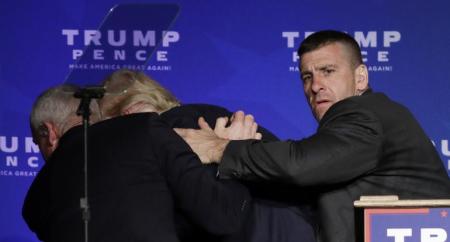
Secret Service agents rush Republican presidential candidate Donald Trump off the stage during a campaign rally in Reno, Nev., on Saturday, Nov. 5, 2016. (AP Photo/John Locher)
The biggest worry about Donald Trump has always revolved around the question of temperament. Isn’t he just too thin-skinned? Too irritable? Too likely to strike out wildly when on the receiving end of a slight, real or imagined? Would you want to entrust someone whose temperament is on a hair-trigger, as Trump’s was said to be, with the awesome power of the U.S. military, including our nuclear codes?
That’s the rap, endlessly repeated by the (irony alert!) calm and even-keeled Hillary Clinton, echoed faithfully by battalions of Democratic operatives with bylines at CNN, MSNBC, The New York Times, The Washington Post, and elsewhere.
But is it true? I happened to be watching Trump’s rally in Reno last night when Secret Service agents rushed on stage — “Go, go!” — to grab him and, protecting his body with theirs, scurry him backstage after a protestor made what seemed to be a threatening move towards the stage.
A few minutes later, after the fellow had been removed from the arena, Trump strolled calmly back on stage. “Nobody ever said this was going to be easy for us, but we will never be stopped,” he observed. He then gave effusive thanks to the Secret Service and proceeded with his campaign talk. He was cool, calm, collected, almost nonchalant. Ten minutes later he was boarding his plane to fly to Denver to preside over his final rally of the day.
Trump’s appearance at Reno, by the way, was his third that day. Today he is scheduled to appear at five rallies, from Sioux City, Iowa, to Leesburg, Virginia. Tomorrow is even more demanding: he makes six stops, from Sarasota, Florida, to Manchester, New Hampshire, and Grand Rapids, Michigan. Voters will determine whether his sole scheduled appearance on November 8 proceeds as billed at the New York Hilton: “Donald J. Trump Victory Party.”
I suspect it will. And I suspect that Hillary was wise to describe her November 8 colloquy as an “election night event” rather than a “victory party.”
“Oh, that’s just like Trump,” you say. “Typical braggadocio,” etc.
Yes, it is. It may also be sound psychology.
So let’s talk about temperament a bit. According to The American Heritage Dictionary, the primary meaning of “temperament” is “the manner of thinking, behaving, or reacting characteristic of a specific individual.” It is interesting that “temperament,” in addition to being a neutral vessel waiting to be colored by a particular quality — we speak of someone having a nervous temperament, serene temperament, melancholy temperament, and so on — it can also, all by itself, suggest “excessive irritability or sensitiveness”: so-and-so, we caution, suffers from an abundance of temperament.
My sense, having observed Donald Trump since July 2015, is that his temperament has mellowed and matured these past fifteen months. Partly, perhaps, it is because he is following the direction of his aides and advisors, who have, we are told, urged him to “stay on message.”
But people tend to become the characters they emulate, which is one reason that habit is so important. “In a word,” as Aristotle observed, “our moral dispositions are formed as the result of the corresponding activities.” Accordingly, he notes, “we become just by doing just acts, temperate by doing temperate acts, brave by doing brave acts.” To some extent, then, people are responsible for their characters, their temperament: “they acquire a particular quality,” said the philosopher, “by constantly acting in a particular way.”
With increasing diligence over the last several months, Donald Trump has added dollops of deliberateness to his drive, discipline, ambition, and sobriety. And by degrees (though not without some slippage) he has become more deliberate, more focused. His grueling campaign schedule tells us something about his temperament, his “characteristic manner of behaving.” It tells us that he is willing to work very hard and put himself out to deliver his message and achieve his goals.
And I believe that his behavior throughout the Secret Service eruption last night reveals something else about his temperament. It gave us a little window on how he behaves in an emergency. He didn’t fly off the handle. He issued no recriminations. He didn’t bluster. He did not cancel the event or skulk off fearfully. He took charge, calmly, proceeded with business, and delivered his message.
We do not know how Hillary Clinton would have behaved in an analogous situation. We know how she behaved when fabricating a story about coming under sniper fire in Bosnia, but that is different. We also know how she behaved as secretary of State when she deliberately circumvented security protocols by installing a private email server in her house from which she conducted the nation’s business. We know how she behaved after leaving office when she lied about whether there were classified documents on the server — there were — and when she destroyed documents and had her server professionally wiped afterreceiving a congressional subpoena. (Andy McCarthy lays out the whole sordid story here.)
In fact, we know quite a lot about Hillary Clinton’s temperament. We know, for example, that when our consulate in Benghazi came under attack and four Americans, including our ambassador to Libya, were killed by jihadists, she acknowledged to her daughter that the atrocity was an act of terrorism but stood next to the coffins of the fallen Americans and told their parents that the episode was sparked by a crude internet video. We also know that she was involved in having the maker of that video rounded up at midnight by brown-shirted agents and held without bail. We know, too, how Hillary and Bill Clinton used the Clinton Foundation as a sort financial entrepôt: money from supplicants seeking favors would flow into its coffers in exchange for face time with the Clintons which led to lucrative business deals or government contracts.
In short, I agree with those who say that temperament is a key issue in this election. Ten years ago, Donald Trump privately indulged (at least, he thought it was private) in lewd, locker-room banter with a pal. That privacy was violated by the Clinton campaign in an effort to smear their opponent. A few days ago, Hillary Clinton, unable to attract many people to her rallies by herself, offered free tickets to hear the filth-emitting rapper Jay Z and Beyoncé at a Pennsylvania event. Which is worse? Follow the link and read about the event. Ponder Jay Z’s “lyrics.” Think about the pictures of him with a smiling if slightly shell-shocked Hillary Clinton. What does it all say about her temperament?
It will be interesting to see how the Clinton campaign spinmeisters deal with last night’s episode in Reno. They should hope it does not receive wide coverage. For what it shows is a man acting with grace under pressure — acting, in a word, presidential. It was Trump’s third event of the day. It was already late by New York time. But then being president of the United States is a demanding job. The sudden eruption must have been scary. It turns out that the pro-Hillary protestor did not — contrary to the shouts of some audience members — have a gun. But neither the Secret Service nor Donald Trump knew that at the time. Trump responded to the crisis with aplomb. Would Hillary have given as good account of herself in a similar situation? I suppose there is room for disagreement about that. But when I cast my mind over Hillary Clinton’s legacy of mendacity, blame-shifting, and cover-ups, I conclude that to ask the question is to answer it. “Only an utterly senseless person,” said Aristotle, “can fail to recognize that our characters are the result of our conduct.” Take a look a Hillary Clinton’s conduct. Temperament will tell.
In the lead-up to the U.S. presidential election, it appears that the Egyptian regime under President ‘Abd Al-Fattah Al-Sisi prefers Donald Trump to Hillary Clinton as the next president of the U.S. After Al-Sisi met with both presidential candidates in September 2016, his spokesman, ‘Alaa Youssef, said that Egypt regarded both of them equally and that “the [last] word in the U.S. presidential election will be said by the American voters, and we have nothing to do with it.”[1] However, despite this statement, there are clear indications that the Egyptian administration favors Trump over Clinton, especially in light of what is perceived in Egypt as the latter’s support for the Muslim Brotherhood (MB) and her disapproval of Al-Sisi’s ouster of the Muhammad Mursi regime on June 30, 2013. This preference of the Egyptian regime is reflected in statements by Al-Sisi and his associates, as well as in reports and op-eds published in the Egyptian government press.
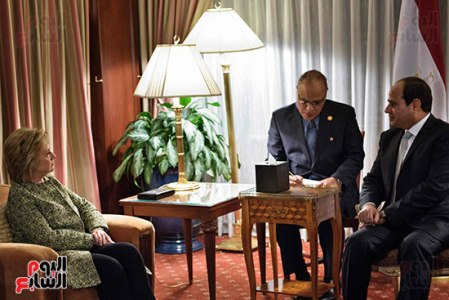
During his visit to the U.S. to attend the September 20, 2016 UN General Assembly, Al-Sisi met with both Hillary and Trump. However, the mood in his meeting with Clinton seemed formal and restrained; moreover, the Egyptians limited the media’s access to it (reporters were allowed to attend for only a few minutes and were forbidden to take pictures). Conversely, the mood of Al-Sisi’s meeting with Trump seemed open and friendly.
Reports on the meetings in the Egyptian and the global media stressed Trump’s positive stance towards the Egyptian regime versus Clinton’s more critical stance. For example, they emphasized that, during the brief part of the meeting attended by the media, Clinton had praised Egypt, but also implicitly criticized the state of human rights there, and said that she looked forward to talking about “the path we are taking in order to build up a new civil society, a new modern country that upholds the rule of law, that respects human rights and liberties.” Trump, on the other hand, did not bring up these issues in his meeting with the Egyptian president, but lavished praise on Egypt for its tough stance against terror and promised that, under a Trump administration, the U.S. would be “a loyal friend to Egypt,” not simply an ally.[2] Trump’s foreign policy advisor Walid Phares described the meeting between Al-Sisi and Trump as “historic” and noted that Trump was committed to “restoring the warmth to U.S.-Egypt relations, which are presently in a very difficult phase.” [3] Phares also claimed that in the meeting Trump had promised Al-Sisi to promote legislation in the U.S. to designate the MB a terrorist organization.[4]
Indications of Al-Sisi’s preference for Trump can be seen in his September 22, 2016 interview with CNN. In the interview, he said that Trump would no doubt make a strong leader, but when asked whether Clinton would make a good president, he replied evasively that “political parties in the United States would not allow candidates to reach that level unless they are qualified to lead a country the size of the United States of America.”[5]
As stated, the Egyptian regimes’ support for Trump and reservations about Clinton were also reflected in many op-eds published in the Egyptian press. The majority of articles in the government press expressed distaste for Clinton and warned that, in the case of a Clinton victory, Egypt and the entire region would face years of chaos and mounting terror. Some even predicted that a Clinton win would herald further deterioration in Egypt-U.S. relations, due to her insistence on interfering in Egypt’s affairs, such as human rights issues. These articles cited her support for the ouster of Hosni Mubarak and what they described as her positive stance towards the MB. It should be mentioned that, as early as 18 months ago, reports and op-eds in the government daily Al-Ahram have been claiming that Clinton’s personal aide, Huma Abedin, is a member of the MB and serves as Clinton’s liaison with the organization.[6] Conversely, only a minority of articles in the Egyptian press spoke negatively of Trump and/or expressed support for Clinton. Most of the ones that did were penned by senior MB official Gamal Heshmat and by journalists in the independent daily Al-Shurouq, which occasionally criticizes the regime.
This report will review the media discourse in Egypt for and against Trump and Clinton as president.
Pro-Regime Journalists: Clinton Is Bad For Egypt, Trump Is Better
In the days following Al-Sisi’s meetings with the two presidential candidates, the Egyptian government press published many articles and views by opinion-leaders and politicians expressing distaste for Clinton and hope for a Trump victory. For example, MP ‘Imad Gad, deputy-director of the Al-Ahram Center for Political and Strategic Studies, said that Clinton had performed poorly as secretary of state and had caused problems for Egypt, and even called her a liar. Conversely, about Trump he said that “if elected president, he will uproot the MB spirit from the White House and purge the [U.S.] state department of it… Trump will never support the MB. A Trump victory will be best for the interest of the Middle East and of Egypt as a civil state.”[7] Pro-regime journalist Wael Al-Abrashi said on his show on Dream TV that Egyptians tend to support Trump as the next U.S. president despite his racism, because they hate his rival Clinton, who, he said, is known for her support for the MB.[8] On his show on Sada Al-Balad TV, Journalist Ahmed Moussa, likewise a regime supporter, complained that the U.S. media supports Clinton and ignores “that poor guy” Trump, and accused Clinton and U.S. President Obama of “rigging the election.”
After Al-Sisi returned from his U.S. visit, the editor of the government daily Al-Ahram, Muhammad ‘Abd Al-Hadi ‘Allam, published a detailed article about the president’s meetings with world leaders and the messages he had delivered at the UN General Assembly. Addressing Al-Sisi’s meetings with Trump, whom he described as “a strong candidate who has proved his eligibility to [be president] throughout the campaign,” he stressed the importance of the meeting and devoted two paragraphs to enumerating the terrorism-related issues on which the two men had agreed. He also claimed that Trump had told Al-Sisi that “the June 30 revolution [i.e., Al-Sisi’s ouster of Mursi] had saved not only Egypt but the entire world.” As for Al-Sisi’s meeting with Clinton, ‘Allam mentioned it but did not describe its content or say anything positive about the Democratic candidate.[9]
Editor for Al-Yawm Al-Sabi’ Daily: A Clinton Victory Will Be A Catastrophe For The Region And The World
Op-eds in the Egyptian media leveled harsh criticism at Hillary Clinton. Karim ‘Abd Al-Salam, the acting editor of the daily Al-Yawm Al-Sabi’, wrote in a September 21, 2016 article that if Clinton won she would continue the policy of the Obama administration, whose relations with Egypt have been marked by tension and disagreements, whereas Al-Sisi’s meeting with Trump indicated that the latter would focus on cooperation with Egypt in combating terror and extremism. He wrote: “President Al-Sisi met with the two U.S. presidential candidates, Hillary Clinton and Donald Trump. At first glance, and judging from news agency and press reports, the meeting with Hillary was restrained… Hillary Clinton made no clear statement regarding what her policy [towards Egypt] would be were she to be elected U.S. president. During the meeting, she settled for underlining the importance of strengthening bilateral relations… and other such diplomatic statements made for the record, which conceal more than they reveal.
“The president’s meeting with Republican candidate Trump was totally different. During the meeting, Trump largely agreed with the president’s plan for combating terrorism and for economic growth, and at its conclusion he issued statements of explicit future support for Egypt and its president. The Republican candidate stated that he would be a powerful friend and ally of Egypt in all areas, while reiterating his full support for Egypt’s efforts to combat terrorism and for economic and military cooperation…
“Trump focused on the one topic that unites Cairo and Washington: the struggle against the shared enemy of extremism and terrorism. [Trump] explicitly committed to work together with the Egyptian leadership in order to overcome this danger, while Clinton did not address [this issue at all], even though terrorist attacks have reached New York.
“What does this mean? It means that Clinton’s election as president would entail a continuation of the confusion, disagreement, and chaos of the Obama years. Her administration will also focus on the issue of creative chaos, and on the forging of new societies in the Middle East, and will work pressure Egypt by raising the issues of human, minority, and gay rights. [A Clinton administration will also strive] to prevent Cairo from protecting its regional surroundings and security depth in Libya, Sudan, and Syria – not to mention the support that her administration will provide to violent and extremist organizations, chiefly the Muslim Brotherhood and Jabhat Al-Nusra [sic, now Jabhat Fath Al-Sham].
“Therefore, we must be well prepared for the possibility that Hillary Clinton will take the reins of power, despite my personal assessment that Trump will win the presidency, because a Clinton victory would bring four more catastrophic years for the Arab region, Europe, and the U.S. as well!”[10]
Al-Sisi’s meeting with Trump in New York (image: Al-Ahram, Egypt, September 21, 2016)
Al-Ahram Editor: Clinton’s Interference In Egypt’s Affairs Is A Red Line
In a September 25, 2016 article in Al-Ahram, Muhammad Sabreen, a columnist for the daily and a member of its editorial board, reviewed the two candidates’ positions on Egypt, claiming that Trump focuses on the common ground with Egypt – namely the war on terror – whereas Clinton interferes in Egypt’s internal affairs, which Egyptians regard as a “red line”. He wrote: “I believe that Hillary Clinton and her Democratic camp are trying to bring back warmer [relations with Egypt] than existed under Obama, while attempting to blackmail [the Egyptian regime] into bringing the political Islam organizations into Egypt’s political arena. On the other hand, Trump and his campaign are making grand promises about the importance and necessity of [U.S.] cooperation with Egypt. In an important and meticulously planned message, he says that under his presidency, the U.S. would be a friend on which Egypt could rely…
“Trump [seeks] to develop relations to the point of partnership, and later alliance, with Egypt, and the question is why. The answer was provided by Dr. Walid Phares, Trump’s foreign policy advisor, who explained that ‘the challenge of terrorism and ideological extremism is common to both countries’… Phares goes even further and says that Trump would work to place the Muslim Brotherhood on the list of designated terrorist organizations, and furthermore that Trump and his people see ‘Egypt as the first line of defense against terrorism.’ Conversely, Clinton has reverted to talking about her aspiration ‘to build up a new civil society, a new modern country that upholds the rule of law, that respects human rights and liberties.’
“I believe that most Egyptians agree in principle with [the values of] ‘a modern and democratic civil state,’ but strongly oppose Washington’s interference in Egypt’s internal affairs, or [Washington’s] linking [U.S. military] aid or partnership [between the two countries] to any ‘engineering’ of Egypt’s domestic political arena [by the U.S.]. This is and has always been a red line for the Egyptians…”[11]
Al-Ahram Columnist: A Clinton Victory Will Strengthen MB, ISIS
Rania Hefny devoted her October 7 column in Al-Ahram to a diatribe against Clinton, whom she believes is likely to win the election, saying that her victory would strengthen the MB and ISIS. She wrote under the title “The Implications of a Clinton Presidential Victory”: “The foreign policy of the candidate with the highest chance of winning the presidential election, Hillary Clinton, will be far more inflexible than Obama’s. She believes that the world’s problems will be solved more quickly if the U.S. is involved in the solution. [If she is elected,] Libya and Iraq are expected to return to square one. Clinton’s leadership of the American political arena will arouse the Muslim Brotherhood terrorist organization and the statelet Qatar, as well as ISIS – in whose creation she participated – and the focus will be on exporting the conflict to many kingdoms such as Saudi Arabia, Jordan, and Morocco. Beware, beware, beware…
“You would do well to remember that Hillary Clinton supported the escalation of the war in Afghanistan and pushed for the ongoing U.S. military presence in Iraq. She helped plan the attack on Libya, and encouraged Obama to bomb Syria without obtaining the support of the [UN] Security Council… It is known that every American president sees to Israel’s interest, and she has already stated that Israel’s security is non-negotiable. Do not be overly optimistic. Beware.”[12]
Al-Watan Columnist: Clinton Is Concerned About Human Rights Situation In Egypt While Ignoring Assad’s Crimes
In a September 28 column, Al-Watan columnist ‘Imad Al-Din Adib accused Clinton of employing a double standard because she demanded the ouster of former Egyptian president Hosni Mubarak but took a feeble stance vis-à-vis Syrian President Bashar Al-Assad, whose actions against his people are far worse than Mubarak’s were. He wrote: “The position of Ms. Hillary Clinton, the Democratic candidate for U.S. president, on Egypt’s domestic affairs is suspect and odd. Without getting into the dissemination of the well-known conspiracy theory regarding the ‘perpetual American wish to topple any national regime’ in Egypt, let us discuss our actual experience between January 25 and February 11, 2011.
“During the January 2011 revolution [against the Mubarak regime], Ms. Clinton was U.S. secretary of state, and it was she who advised the White House to pressure president Hosni Mubarak to immediately relinquish power, [saying] that it was unavoidable… Thus pressure was applied to president Mubarak… This sent a reassuring message to the rebels, the Muslim Brotherhood, and the military that Washington is withdrawing support for its old friend Hosni Mubarak and his regime… The astonishing thing is that the Americans did all this with Mubarak, yet since March 2011, that is, since the start of the popular rebellion in Syrian Deraa, they have not stated unequivocally that ‘Assad must leave now, and now means today!!!’
“They have not demanded [this] of Assad, who has murdered nearly 400,000 of his own people, wounded two million civilians, and expelled 11 million openly, in broad daylight! Washington has not demanded that Bashar Al-Assad of the barrel bombs, who uses missiles against civilians and chemical weapons against women, children, and the elderly, leave at once. The most it demanded in this matter was expressed in Obama’s recent UN statement, that it is unthinkable that Assad will play any role during the transitional period. Mubarak was warned to leave – but Bashar Al-Assad never was!
“What sort of standards is Washington adopting, and what [sort of standards] were implemented by Ms. Hillary when she was secretary of state? Washington bemoans the human rights situation in Egypt, but not the crushing human destruction in Syria! What standards does Ms. Hillary have?!”[13]
Al-Sisi’s meeting with Clinton in New York (image: Al-Yawm Al-Sabi’, Egypt, September 20, 2016)
MB Official, Independent Journalists: Clinton Is Better Than The Racist Trump
Conversely, an MB official, as well as journalists for the independent daily Al-Shurouq, which tends to be critical of the regime, expressed distaste for Trump and support for Clinton.
In response to the claim by Trump’s advisor that, if elected, he would promote legislation in the U.S. to designate the MB a terrorist organization, MB official Gamal Heshmat said that there was a great deal of similarity between Trump and Al-Sisi, because both of them “rely… on spreading fear among their people in order to justify the actions of violence, exclusion and takeover in which they believe and which they employ with [great] confidence under the pretext of fighting terror and promoting stability!”[14]
Dr. Osama Rushdi, an official in the Construction and Development party, the political branch of Al-Gama’a Al-Islamiyya, said that “it will be a great disaster if Trump becomes the U.S. president,” adding that he is “a racist and fascist” and threatens all Muslims, whereas Clinton is more rational. [15]
Al-Shurouq Editor: Trump Is An Enemy Of Mankind; Clinton Is A True Head of State
The independent daily Al-Shurouq published two articles against supporting Trump. The daily’s editor, ‘Imad Al-Din Hussein, wrote in a September 26 article that Trump was an “extremist and racist” and even “an enemy of most of mankind,” and that Clinton was the better candidate due to her experience. He wrote: “Which of the two would be better for Egypt as U.S. president, Hillary Clinton or Donald Trump?… Among many in Egypt, there is a widespread belief that a Trump victory would be better for us, since he promised to include the Muslim Brotherhood on the list of designated terrorist [organizations], while the Democratic Clinton opposes the June 30 revolution [i.e., Mursi’s ouster]. This impression might be partially true, but people forget that Trump is also an enemy of most of mankind, as he is an extremist and a racist, and repeatedly says that if elected, he would expel the Arabs and Muslims from the U.S. [These] extremist statements have not stopped since the beginning of his election campaign. Likewise, his victory would be the greatest of gifts for ISIS and for all the extremists in the region and in the world, because it would give them the best excuse of all for their extremism.
“It is true that Clinton was not enthusiastic about the June 30 revolution, but she is a true head of state. She is not a demagogue or a racist, and carefully weighs every word she says, as she spent eight years in the White House alongside her husband, president Bill Clinton, and for years was secretary of state during Obama’s first term. Conversely, Trump is rash, a radical extremist, and lacks any political experience.
“So which of the two is better for Egypt, Trump or Clinton? If Trump wins, we will temporarily gain a few nice slogans, but in the long run we will lose much, as Arabs and Muslims, if he implements his slogans. If Clinton wins, she may be somewhat reserved towards us, but not as much as Obama, and our relationship might stabilize in the long term…
“Therefore, those who think a Trump victory means a total reversal [of the U.S. position on Egypt] are deluding themselves. We must remember, for example, that every presidential candidate courts the Jewish lobby and promises to transfer their country’s embassy to Jerusalem, but that [when the time comes] they don’t, because of their interests vis-à-vis the Arab world.”[16]
Former Egyptian MP: Trump “Will Contribute To The World Becoming A Hell”; Hillary Is The Lesser Evil
The second Al-Shurouq article, also published on September 29, was by former Egyptian MP Mustafa Al-Naggar. He contended that Trump was no less dangerous for the world than Nazism and fascism, and condemned those who express support for him in Egypt, calling them extremist right-wing elements that pose a danger to Egypt itself. He wrote: “Under the influence of Ikhwanophobia [fear of the Muslim Brotherhood], the U.S. elections have become a new arena of schism in Egypt, for accusations of treason, and for classification by position on the candidates.
“It is no exaggeration to say that in recent days, and especially after the first televised debate, there is a sense [among Egyptians] that this election is not about the U.S., but about Egypt. There has been a resurgence of the tumultuous debate that is characterized by illogic, to the point where Hillary Clinton is described as a member and supporter of the Muslim Brotherhood. One of the lies [going around] is that Clinton is grooming an American woman who is of Pakistani descent and a Pakistani Muslim Brotherhood member [referring to Huma Abedin] to become secretary of state!…
“In general, it is odd that some in Egypt support Trump, the man who undoubtedly represents the worst of modern American extremism. He repeatedly spews racism in its ugliest form, and most of his positions clash with humanism and the values of tolerance and coexistence with which the world has come very far and from which there is no retreat…
“It is therefore foolish to argue that this despicable racist will combat extremism and terrorism. On the contrary, he will greatly contribute to the world becoming a hell. Therefore, his existence will justify the rise of terrorism, deepen the concept of the clash of civilizations, and inflame religious animosity among the peoples…
“Trump threatens not only the U.S., but the entire world. The rise of Trumpism on the global level effectively recreates messages of hate and the rise of the extreme right, evoking the era of Nazism and Fascism in Germany and Italy that led the world to bloody wars that claimed millions of lives. Who wants that again?
“In effect, the U.S. is not run by a single person, but by enormous institutions of decision-makers. However, the election of an extremist and racist president, who will appoint an administration that shares his mentality, will cause many problems for America and for the world.
“This does not mean that Hillary Clinton is an angel who will do good for the world and Arab countries. But a choice between two bad things does not mean choosing the better one, but choosing the lesser evil. We have no voice in the U.S. presidential race. But we hope that the Americans will throw out the preachers of hatred and the racists, and send a message to the world that they oppose the insane campaign on which Trump and his ilk are leading them…
“[In order to cure] the delusions of the Trump supporters in Egypt, there is first a need for psychological treatment, and [only] then rational and ideological refutation. This group of extremists in Egypt that reflects the rise of a secular right wing is no less dangerous than the religious right. We must deal with it by disproving and dismantling the terminology of this message, and by making the public aware of its risks and consequences for Egypt…”[17]
Other Articles: Trump And Clinton Are Equally Bad
Also published in the Egyptian press were some articles claiming that Trump and Clinton would be equally bad for Egypt. Tarek Fahmy, a professor of political science at the American University in Cairo, told the Al-Yawm Al-Sabi’ daily that America is choosing between bad and worse and that there was essentially no difference between the two candidates in terms of foreign policy.[18]
Mursi ‘Atallah, the former board chairman of the Al-Ahram Foundation, wrote on September 21 that the debate about which is better, Clinton or Trump, was boring since both of them hate Arabs more or less to the same degree. He wrote: “As happens every four years, the Arab analysts and intellectuals are preoccupied with finding an answer to the traditional question: Which is better, an American president from the Democratic party or from the Republican party? The public has wearied of the recurring scenes of this boring play that repeats every four years. Even if the protagonists of this play are different, nothing in the discourse is, not even one single line.
“There is no difference between Reagan and Carter or Hillary Clinton and Donald Trump. The Republicans and the Democrats are two sides of the same coin.
“If the Republican candidate Donald Trump presents himself as an openly hostile enemy of the Arabs and Muslims, there are those who forget that Hillary Clinton harbors no less hostility and hatred [towards them] than Trump, but only softens it outwardly…”[19]
* Y. Graff is a research fellow at MEMRI; H. Varulkar is Director of Research at MEMRI.
(The article seems principally directed to Never Trumpers. –DM)
The election next week of Clinton, who is firmly committed, indeed virtually compelled, to continue with Obama policies is more than likely to make that course irretrievable, and the US—much like several luckless EU countries—will be set on an inevitable downward spiral toward third-world status…from which a growing portion of its population hoped to extricate itself
Given the stakes, this seems almost inconceivable. Trump should be elected not because of what may occur if he is, but because of what will almost certainly occur if he is not. He should not be judged on what his incumbency might achieve, but what his incumbency must prevent.
So in weighing the grim alternatives, the US electorate would do well to bear in mind that these elections are for the Presidency not the Papacy. They must choose who is best suited (or the least unsuited) to be President – not the Pope.
*********************
You knooow…C’mon Who do you think is out of touch?– Barack Obama, commenting derisively on Hillary Clinton, 2008
“Hillary Clinton, she’ll say anything and change nothing” – I am Barack Obama…and I approve this message – From a 2008 Obama election campaign ad.
The fate of the republic rests on your shoulders. The fate of the world is teetering and you…are going to have to make sure that we push it in the right direction.– Barack Obama, urging voters to support Hillary Clinton, November 3, 2016
It would, indeed, be in no way an exaggeration to describe next week’s US elections as perhaps the most significant in recent history, a real “fork in the road” for the future of the over 200-hundred year Union.
Waning adherence to founding principles?
This Union proved to be a remarkable socio-political creation. Largely because of its founding values, as articulated in its founding documents and later amendment’s, it developed into the most influential, prosperous powerful country on the planet.
Indeed, in great measure, by holding fast to those values, it managed to maintain its position of primacy since the early decades of the last century.
But in the last decade this began to change perceptibly. Adherence to the underlying fundamentals–its Anglo-Saxon cultural roots and its Judeo-Christian (indeed Judeo-Protestant) ethical foundations—has begun to wane. Identification with, and belief in, what made America, America began to erode and fray—and with it, the coherence of the identity that made it exceptional.
Clearly, it was not America’s natural resources and mineral wealth that generated its unparalleled success. After all, numerous other countries have been endowed by nature with vast riches but none of them were able to harness the enormous creativity and productive energy of their population on a similar scale/intensity as America did.
What set America apart was the manner in which it managed to mobilize its human resources and facilitate opportunity for talent, ingenuity and industry to flower.
There is no way to decouple this remarkable accomplishment from the original organizing principles set out for the nation at its founding. Similarly, there is no way to decouple these organizing principles from the civilizational foundations from which they were drawn.
Clearly then, as America of today diverges increasingly from identification with those principles and civilizational foundations, and the spirit that they were imbued with, it will increasingly jeopardize the key to its own exceptionalism—and the exceptional achievement that accompanied it.
Diversity is strength, but diffusion is weakness
Of course I can already hear the howls of outraged indignation that this kind of talk borders on bigotry, and reflects gross ignorance as to sources of American strength and success. They will, no doubt, point to the enormous contributions made by immigrants, who hailed from civilizational backgrounds far removed from any traces of Judeo-Protestant influence—from East Asia to Latin America. They will of course recite the worn-out mantra that “diversity is strength” and underscore how Americans of Buddhist, Hindu, Catholic and other origins have all been part of the American success story.
This is all entirely true—and equally irrelevant to the point being made. For it was only in the environment created by the unique societal foundations of America, and the opportunities it afforded, that allowed the immigrants, drawn to its shores from other socio-cultural settings, to blossom. After all, if this was not the case, why would they leave their countries of origin?
So, as long as these foundations remained the dominant determinant of societal realities in America, the country could continue to absorb productive forces from other societal backgrounds, without jeopardizing the sustainability of its past success.
This, however, is not the case when large bodies of immigrants flow into the country and wish to establish communities which retain—indeed, actively sustain—much of what they left behind in their countries of origin, and which, presumably, comprised much of the motivation for them to leave.
It is then that dynamic diversity begins its decline into dysfunctional diffusion. Tolerance vs self-abnegation
To illustrate the point somewhat simplistically: It is one thing if a Mexican immigrant arrives in the US, integrates into American society and becomes a productive American. It is quite another, if waves of Mexican immigrants arrive in America and transform significant parts of it into Mexico.
Thus, when immigrants from diverse socio-ethnic backgrounds blend into the dominant culture, the result might well be a synergetic outcome beneficial to both. But this is unlikely when largely discordant immigrant cultures begin to impose themselves on the dominant host culture, which begins to forego important parts of its identity for fear of “offending” new comers, who were attracted to it precisely because of what that dominant culture offered them.
Accordingly, while tolerance of diverse minorities is clearly enlightened self-interest, self-abnegation to accommodate discordant minority predilections is, no less clearly, a detrimental denial of self-worth.
What has all this to do with the upcoming elections on Tuesday?
Well, a great deal! Indeed, in many ways it lies at the heart of the decision for whom to cast one’s ballot. It not only separates out sharply between the two candidates’ declared platforms and campaign pronouncements, but more profoundly–-far more profoundly—it separates out between their prospective constituencies and the long-term vested interests of the respective political Establishments that support them.
Real “fork in the road”
Accordingly, one does not require advanced degrees in political science to grasp just how the relevant political landscape lies as the crucial ballot approaches.
It is beyond dispute that, because of the demographic composition of its support base, any Democratic Party candidate, Hillary Clinton included, will be exceedingly loath to curtail significant influxes of largely unregulated and un-vetted immigrants from the Mid-East, Latin America and elsewhere. For this reluctance will clearly find favor with many of her current constituents and prospective new ones – particularly in light of the astounding electoral practice in the US which requires no photo ID to allow one to choose who will have access to the nation’s nuclear codes—while such identification is obligatory for a myriad of other far less significant purposes.
By contrast, whether or not one lends credence to Donald Trump’s strident declarations on severe restrictions he plans to impose on immigration across the county’s southern border and from Muslim countries, it is clearly very much in his political interest to act along such lines—since this will deny his adversaries the potential expansion of their political base.
So those, then, are the real stakes in these elections – the real “fork in the road”: A choice between a candidate, whose vested political interests induce her to permit changes that will permanently alter the character and composition of America, or one whose political interests compel him to resist this.
The elections as “damage control”
In many ways—most of them, regrettable—these are elections that are significantly different from virtually all previous ones.
Indeed, there is unprecedented dissatisfaction with—even, disapproval of—both candidates.
Thus, Clinton is hardly an ideal candidate—even for Clinton supporters; and Trump far from an ideal candidate—even for Clinton opponents.
Accordingly, far more than a choice of whom to vote for, these elections will be dominantly a choice of whom not to vote for. They will be far less a process that determines whom the voters want to ensconce in the White House, and far more about whom they want prevented from being ensconced in it.
Thus, rather than what they hope their preferred candidate can do for the country, their ballot will be determined by what they fear the other candidate will do to the country.
In this sense, these elections are largely an exercise in damage control.
Or at least that is what it should be: A choice, foisted on a largely dismayed electorate, to install the candidate least likely to be able to inflict irreparable damage on the Republic, until American democracy can somehow recover and offer the voter a more appealing selection of candidates in the future.
A relatively simple choice
In this respect, the choice ought to be relatively simple. For regardless of what one might believe as to what either candidate has in his/ her heart, it is clearly Trump who has a greater interest in keeping America American; while Clinton has a vested interest in endorsing the burgeoning inflow of immigrants, who, rather than embrace the founding values of America, are liable to exploit them to change the face of US society beyond recognition.
Indeed, one should be bear in mind that there is nothing “universal” about the noble values on which America was founded and evolved. Quite the opposite. After all, the spirit of liberty and tolerance they reflect are not the hallmarks of many—perhaps even most—of the countries around the globe. So, unless these values are diligently preserved, they could well be mortally undermined.
It is difficult to think of anything that could undermine the values of a society more fundamentally than the massive influx of largely unregulated un-vetted newcomers, for whom those values are not only foreign, but often antithetical, to those of the countries of origin—something countries like Sweden and Germany have sadly discovered to their great detriment.
But that, of course, is precisely what should be expected if Clinton wins. It would require hefty doses of unbounded, and largely unfounded, optimism to expect any outcome other than increasingly severe erosion of societal values that have defined America in the past.
Specter of irretrievable change
But it is not only the structural bias of Clinton’s political interests that makes her potentially the more permanently damaging incumbent to the character of the American Republic, but also her ability to do so. For, as a seasoned politician, well-versed in the corridors of governmental power and machinations of the political Establishment, she has far greater capacity and reach to ensure that her ill-conceived and detrimental policies are implemented and durably entrenched, than the inexperienced maverick novice Trump. After all, he would undoubtedly require many months “learning the ropes”, before he manages to implement and entrench any allegedly injurious policies that perturb his detractors.
As I wrote in last week’s column, the 2009 Obama administration set a course for America substantially different from those set by his predecessors, and in important ways highly discordant with them. Obama’s 2012 reelection helped solidify the anomalous (the less charitable might say “perverse”) change in direction along which he took the nation.
The election next week of Clinton, who is firmly committed, indeed virtually compelled, to continue with Obama policies is more than likely to make that course irretrievable, and the US—much like several luckless EU countries—will be set on an inevitable downward spiral toward third-world status…from which a growing portion of its population hoped to extricate itself
Obama is right—but Obama is wrong
So President Obama was right when he declared at a North Carolina rally (November 3, 2016): “The fate of the republic rests on your [the voters] shoulders…The fate of the world is teetering…” For these elections will indeed have momentous consequences both for the US and across the world. He is, however entirely mistaken as to the direction in which he urges them “to make sure…we push it” (See introductory excerpt)
Sadly, however, despite the fact that these are likely to be the most consequential elections in modern history, it appears (if the conduct of the campaign is to be any guideline) that they may well be decided because of the most inconsequential reasons. For it seems, it will not be the strategic direction in which the country will be taken that will determine the outcome, but rumors and innuendo as to the character defects of Trump and his alleged crude indiscretions with women.
Given the stakes, this seems almost inconceivable. Trump should be elected not because of what may occur if he is, but because of what will almost certainly occur if he is not. He should not be judged on what his incumbency might achieve, but what his incumbency must prevent.
So in weighing the grim alternatives, the US electorate would do well to bear in mind that these elections are for the Presidency not the Papacy. They must choose who is best suited (or the least unsuited) to be President – not the Pope.







 anneinpt
 artaxes
 danmillerinpanama
 davidking1530
 Peter Hofman
 Joseph Wouk
 Peter
Peter Louisiana Steve
 WarSclerotic
Recent Comments