Posted tagged ‘Donald Trump’

How Trump Rebranded the GOP

March 18, 2016

How Trump Rebranded the GOP He’s the greatest brander of his time, but he can’t take all the credit for this one: The party had to destroy its old brand first.

By Michael Hirsh March 17, 2016

Source: How Trump Rebranded the GOP – POLITICO Magazine

AP Images

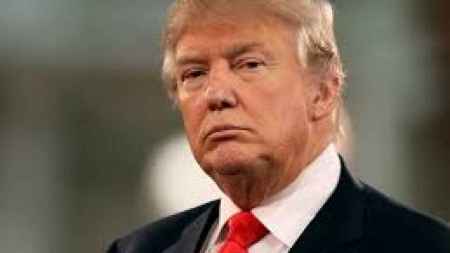
Whatever else you might say about him, Donald Trump is one of the great branders of our age. And what he’s accomplished over the past 10 months since he took that now-notorious ride down the Trump Tower escalator is plainly his life’s masterwork: his rebranding of the GOP in his own image.

The Trump Organization is a global trademarking factory; among the 515 corporations, trusts, limited liability companies and other entities listed on Trump’s Federal Election Commission disclosure are scores of buildings, golf courses, product and other things from Baku to Dubai listed as “Trump Marks” (as in trademarks) entities. For example: Trump Ice LLC; Trump Marks Mattress LLC; Trump Pageants, Inc. And my favorite: The Trump Follies LLC.

After Tuesday’s primaries, it’s looking like we can add one more entity to the Trump Marks list: the Trumpublican Party, LLC.

Trump accomplished this rebranding so fast that Republicans still don’t seem to understand what happened to them. We’ve heard him say it many times in recent months—he’s defined the race, whether the issue is immigration or trade or corporate tax inversions, which even Hillary Clinton has taken up as a cause. Trump’s favorite locution: “If it weren’t for me, you wouldn’t even be talking about [fill in the blank].” Or as his daughter Ivanka put it recently to Breitbart: “From Day One, my father set the agenda for what the whole party is talking about.”

But in truth the Trump takeover of the GOP occurred, to quote an old line from Hemingway, “Two ways. Gradually, then suddenly.” What had to happen first, before Donald could step in and slap on his own brand in a short period of time, was the gradual “de-branding” of the party at the hands of its own leaders, especially over the past 7½ years since Barack Obama entered the White House. That’s when the party decided to abandon any ideas about governing in favor of one singular idea: “No to Obama.”

The events of this week supply an apt illustration. You might think there wasn’t much connection between the Republicans’ insistence on Wednesday that they wouldn’t even talk to Supreme Court nominee Merrick Garland and Trump’s humiliation of his Republican rivals the night before. In fact, both events help explain why this strange outsider from New York now basically owns one of America’s political parties. Trump could succeed only because the GOP rendered itself so incoherent that no one knew what the party really stood for anymore, except for something negative—the party of No. No, we won’t talk to him. No, we won’t listen to you. No, we can’t even agree on what we disagree about. No. No. NO.

Trump was the perfect candidate to come along, kick in what was left of the party’s empty ideological husk and then rebrand it as only he, the master, can do. First, of course, Trump earned his bona fides with the Obama-hating base by being the most negative Obama candidate of all—the loudest voice in the “birther” movement. But then he quickly won over the base by forming some positive, if rather crude, platform ideas that were welcomed, perhaps, largely because no one else had any ideas other than the old tax-cutting, trickle-down bromides. Those had been the lingering core of the Republican brand, but had lost much of their political traction as the party’s base of angry, undereducated whites watched their fortunes dim as the rich enjoyed their tax relief. The same Republican leaders and pundits who have been complaining that Trump’s simplistic notions about immigration (“build a wall”) or trade (“start winning again”) are unworkable and unRepublican haven’t had the courage to spell out any clear new ideas of their own.

Think about it: Before Trump came along, and the party’s neocons and quasi-isolationists squabbled endlessly about U.S. involvement in Syria or Ukraine; and various conservative think tanks and pundits put forward 10 different plans for changing the tax code; and no one could agree on education reform or immigration reform (recall the many incomprehensible exchanges between Ted Cruz and Marco Rubio at the debates over this issue), was there anything identifiable any longer as a party platform?

And clarity is key. Rob Frankel, who has been called “the best branding expert on the planet” by StrikingItRich.com, says Trump took his tactics “right out of my playbook, and I’m really proud of the way he did it. I wish my clients could execute that well. He did exactly what everybody else should be doing for their brand. To be effective you have clear, credible, authoritative. And then there’s my prime directive: for a brand to work it has to be perceived as the only solution. If I can create the perception of being the only game in town, you’re going to stop shopping. That’s what he did.”

***

Republican voters have stopped shopping, perhaps, because there isn’t much else on offer. This process of GOP brand destruction has been going on at least since the era of George W. Bush, who many conservatives feel betrayed them with his runaway spending habits and neocon war, but it’s especially true since Obama was elected and the party was, well, driven basically mad with Obama enmity. Beginning with Mitch McConnell’s blunt declaration in 2010—“The single most important thing we want to achieve is for President Obama to be a one-term president “—the GOP simply became identified as the anti-Obama party and little else.

What ensued was so ugly and neck-wrenching that Republicans kept having to remind themselves they were still the party of Lincoln and Reagan, because there was no obvious way to track where they were going, much less what positive ideas they stood for any longer. House tea party members kept hijacking fairly routine congressional votes and threatening to send the United States into first-time default to fight a proxy war over their singular agenda (though no one quite knew what that was either; was it libertarian or redistributive?). An actual government shutdown occurred, and another almost did. What began as an outlandish threat—sequester—became policy through more party paralysis. Every Republican from Rubio to John Boehner who tried to make a deal with Obama and the Democrats and stand for something, anything, other than “no” was humiliated and declared a traitor to the cause. What cause? Good question.

Thus the reaction to Garland, a perfectly credible and even outstanding prospect for the Supreme Court, is all of a piece with what’s been going on for the past seven years. Now, with the exception of a few Republican senators like Kelly Ayotte and Mark Kirk who face tough reelection challenges in purplish states, a flat “no” is the order of the day once again. On Wednesday, we heard even a formerly reasonable conservative like Orrin Hatch declare nonsensically that the Garland nomination—that is, a person to fill a meaningful vacancy on the nation’s highest court—“shouldn’t be brought up when people are screaming and shouting.”

What Hatch said, of course, was gibberish, not least because it’s almost entirely the Republicans who have been doing the screaming and shouting all this time. Even Trump makes more sense than that—which is exactly the point. Trump fortuitously entered the fray and began repeating his nationalist-populist mantra at a time when no one else had a mantra, and when the party’s greatest need was for leadership, which in turn requires clarity, which in turn requires a brand. What could be a more perfect and poetic piece of justice than a fatally incomprehensible party, one whose brand no longer stood for an identifiable set of ideas other than to thwart the president, leaving itself open to a takeover by the greatest brand-maker of the age?

Hence the spectacle of John Kasich—who moved from being a firebrand House conservative in the ’90s to a more practical governor of Ohio—looking like a stranger in a strange land upon his return to national politics. On the state and local level, thankfully, ideology still swiftly gives way to the necessity to govern, which is one reason why so many Republicans such as Kasich are still successful at those levels. But Kasich has found he might as well be speaking another language with his endless stump speech about such accomplishments as turning Ohio’s deficit into a surplus and adding 400,000 jobs. What’s his mantra? What’s his brand?

This was also the subtext, perhaps, of Rubio’s sad withdrawal speech on Tuesday night, when he appeared to blame both the GOP establishment and the tea party for his faded career. “That we find ourselves at this point is not surprising, for the warning signs have been here for close to a decade,” Rubio said. “In 2010, the tea party wave carried me and others into office because not enough was happening, and that tea party wave gave Republicans a majority in the House, but nothing changed. In 2014, those same voters gave Republicans a majority in the Senate and, still, nothing changed. And I blame some of that on the conservative movement, a movement that is supposed to be about our principles and our ideas. But I blame most of it on our political establishment.”

Blame it instead on the failure of your brand, Marco.
Not Satire | Anti-Trump protesters are patriots

March 17, 2016

Anti-Trump protesters are patriots, Boston Globe, Renée Graham, March 17, 2016

(Please see also, US democracy at stake amid campaign violence, major Jewish group warns.

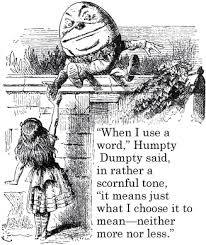
Humpty Dumpty words

— DM)

Aniti trump protestors
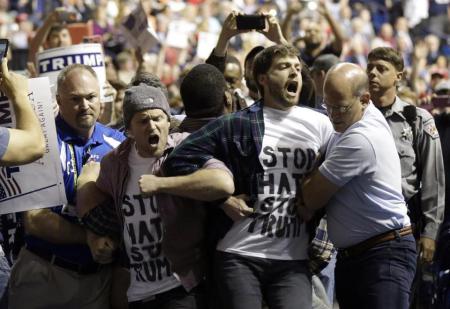
Protesters are removed as Republican presidential candidate Donald Trump speaks during a campaign rally in Fayetteville, N.C., on March 9, 2016.

Donald Trump slams protesters at his rallies as “thugs” but, as usual, the unhinged GOP presidential front-runner is dead wrong:

They’re patriots.

By now, any protester at a Trump rally knows what they will face. The lucky ones will only be ridiculed by the candidate, have their anti-Trump signs yanked away and torn to pieces, and be hustled out of the arena. At worst — at least so far — they’ll be peppered with racist or anti-Semitic invective, manhandled by security guards, spat on, or sucker-punched by some moron sorry only that he couldn’t have inflicted more lethal damage.

With Trump nearly sweeping this week’s primaries, those rallies will become more hostile toward anyone pushing against his hideous rhetoric. Yet those patriots will still come, not just because they oppose Trump but for the love of their country which is being shoved toward the abyss. As poet Adrienne Rich wrote in “An Atlas of the Difficult World”:

A patriot is one who wrestles/ for the soul of her country/ as she wrestles for her own being.

Odds are these aren’t the people who fueled an all-time spike in Google searches on moving to Canada after Trump won multiple states on Super Tuesday. They weren’t checking real estate prices in Toronto or job openings in Vancouver. Patriots don’t surrender their nation to a preening narcissist or to his supporters, who, like goats unable to discern between what they should chew up or spit out, swallow whole all the nonsense they’re fed.

Armed with nothing more than the unshakeable certainty that their nation will collapse under the weight of Trump’s insatiable ego, they walk into arenas where they will be met with scorn, even physical retaliation. This stunningly frightful time demands more than hash tags, and these protestors have placed themselves on the front line.

That’s a lot more than Trump’s fellow GOP candidates have done. On “Meet the Press” last Sunday, Governor John Kasich of Ohio said, when asked if he would support Trump as the presidential nominee, “It’s tough.” Actually, Governor Kasich, it’s not. Likewise, Senator Ted Cruz of Texas condemns the bombastic billionaire’s bruising style, but in his next breath says he will back the party’s nominee — even if it’s the troubling GOP front-runner. Kasich and Cruz would rather save their floundering party than the nation they claim to love.

For his part, Trump told CNN that if he doesn’t get the nomination, “I think you’d have riots. I think you’d have problems like you’ve never seen before. I think bad things would happen.” That veiled threat is nothing more than a dog whistle for Trump’s rowdiest supporters.

Still, even under the risk of mayhem from those supporters, rally protesters are determined to keep that craven man with his dark dreams from running this nation into the ground. That is the essence of patriotism.

Especially after 9/11, patriotism was remade into something regressive and divisive, not unlike what extremists have done to various religions. It became flag pins and “freedom fries,” while dissent became tantamount to treason. Too many were left sputtering in enraged silence. Perhaps spurred by the success of the Black Lives Matter movement, many have found again the lasting power of voices joined in a common cause.

And that cause is to stop Donald Trump. Those who oppose him — and they will grow in number as he racks up primary and caucus wins — will not relinquish their country to the kind of made-for-television tyranny that Trump spews as easily as he breathes. A true patriot knows that for America to be great, it must be wrested away from this vain, empty man who believes in nothing but himself.

US democracy at stake amid campaign violence, major Jewish group warns

March 17, 2016

US democracy at stake amid campaign violence, major Jewish group warns American Jewish Committee appears to take on Trump a day after the Republican front-runner threatened riots at convention

By Rebecca Shimoni Stoil March 17, 2016, 8:53 pm

Source: US democracy at stake amid campaign violence, major Jewish group warns | The Times of Israel

Jews jumping on the bashing Trump band wagon also , with lies and half truths .

ASHINGTON — Threats of political violence threaten the viability of American democracy, the American Jewish Committee warned Thursday, a day after Republican frontrunner Donald Trump said that there would be “riots” if his party tried to edge him out through a brokered convention.

“I think you’d have riots. I think you’d have riots,” Trump said Wednesday in an interview with CNN. “I’m representing a tremendous many, many millions of people.”

 Although the AJC’s statement did not mention any candidates by name, its dire warnings seemed to reflect directly on Trump’s comments.

“Violence and threats of violence have no place in American politics. There should be no threats to disrupt political rallies and no threats to disrupt a convention if a candidate is denied the nomination by his party’s convention,” the organization admonished. “Too many democracies have failed, to be replaced by autocratic governments, when violence became a sanctioned political tool, especially by those who feel disenfranchised and choose not to await ordinary change at the ballot box.”

Warning that “nothing less than the survival of American democracy is at stake,” the AJC emphasized that “we hope that the violence seen so far is an aberration which stops now,” and called on “those who have resorted to, or sanctioned, violence” to “repudiate it now.”

Trump’s comments regarding a scenario in which the Republican establishment would seek to nominate someone else as the GOP candidate for president were far from the first time on the campaign trail that the brash businessman was seen as giving a nod to violence.

During a Fayetteville, NC rally, a non-violent protester was sucker-punched by a Trump supporter. As protesters were removed from the event, Trump himself told backers that “in the good old days this didn’t use to happen, because they used to treat them very rough. We’ve become very weak.”

Last week, a major campaign event in Chicago teetered on the brink of becoming an all-out melee when fistfights erupted between protesters and supporters.

Journalists and protesters alike have complained on a number of occasions that they have been victims of physical violence from Trump’s supporters and even senior staff members.

On multiple occasions, Trump suggested that the violence was due to agents provocateur in the crowds.

The AJC warned that such incidents could be a slippery slope.

“We do not draw analogies to the rise of communism and fascism lightly, but both of those tyrannical movements rose to power replacing democratically elected governments, by virtue of threats of, or actual, violence against their opponents,” the organization said.

The statement emphasized that the AJC is “strictly non-partisan” and “abstains from taking stands on candidates and is content to let the electoral processes play out. “But when the process is infected with threats of violence and disruption, it is not a candidate at issue; it is the viability of democracy itself.”

Prime Minister Benjamin Netanyahu and AJC Executive Director David Harris (right) during a meeting Monday in Israel (photo credit: Olivier Fitoussi/AJC)

AJC Executive Director David Harris (Olivier Fitoussi/AJC)

As a non-partisan advocacy organization with a 501c3 tax status, the AJC does not – and in fact cannot – endorse or oppose candidates for elected office.

“Would AJC meet with Donald Trump? Yes, we would,” the group’s head, David Harris, answered in response to a Times of Israel query. “He is a leading candidate for the highest office in the land and, as an agency deeply involved in public policy issues, we would be absolutely remiss if we didn’t avail ourselves of such an opportunity to meet.”

Still, Harris continued, “while we are strictly non-partisan, it doesn’t render us mute in an election.

“We speak out on policies, not parties, and on issues, not individuals. For example, we stand for a healthy, respectful American pluralism, a robust US-Israel relationship, and strong American global leadership,” he added. “If those core principles are challenged by any of the candidates, then we won’t hesitate to reaffirm our views in favor of these principles, as we have in the past.”

The AJC’s statement came amid an impassioned debate in the American Jewish community around Trump’s plans to address an audience of over 18,000 next Monday at the American Israel Public Affairs Committee’s annual policy conference.

To defend our democracy against Trump, the GOP must aim for a brokered convention

March 17, 2016

To defend our democracy against Trump, the GOP must aim for a brokered convention

March 16 at 4:41 PM

Source: To defend our democracy against Trump, the GOP must aim for a brokered convention – The Washington Post

There is no end on DEMONIZING Trump !

Defending democracy by killing the democracy, the new norm.

View Photos
The Republican candidate continues to dominate the presidential contest.

DONALD TRUMP’S primary victories Tuesday present the Republican Party with a stark choice. Should leaders unite behind Mr. Trump, who has collected the most delegates but may reach the convention in July without a nominating majority? Or should they do everything they can to deny him the nomination? On a political level, this may be a dilemma. As a moral question, it is straightforward. The mission of any responsible Republican should be to block a Trump nomination and election.

We do not take this position because we believe Mr. Trump is perilously wrong on the issues, although he is. His proposed tariff on Chinese imports could spark a trade war and global depression. His proposed tax plan would bankrupt the government while enriching his fellow multimillionaires. But policy proposals, however ill-formed and destructive, are not the crux of the danger.

No, Mr. Trump must be stopped because he presents a threat to American democracy. Mr. Trump resembles other strongmen throughout history who have achieved power by manipulating democratic processes. Their playbook includes a casual embrace of violence; a willingness to wield government powers against personal enemies; contempt for a free press; demonization of anyone who is not white and Christian; intimations of dark conspiracies; and the propagation of sweeping, ugly lies. Mr. Trump has championed torture and the murder of innocent relatives of suspected terrorists. He has flirted with the Ku Klux Klan and other white supremacists. He has libeled and stereotyped wide swaths of humanity, including Mexicans and Muslims. He considers himself exempt from the norms of democratic contests, such as the release of tax returns, policy papers, lists of advisers and other information that voters have a right to expect.

Does a respect for democracy require the Republican Party to anoint its leading vote-getter? Hardly. We are not advocating that rules be broken but that they be employed to maximum effect — to force a brokered convention and nominate a conservative candidate who respects the Constitution, or to defeat Mr. Trump in some other way. If Mr. Trump is attracting 40 percent of Republicans, who in turn represent about one-quarter of the country, that is a 10 percent slice of the population — hardly a mantle of legitimacy.

Trump: ‘We’re going to win, win, win and we’re not stopping’

   There are some Americans, Democrats in particular, who are happy to watch the Republican Party self-destruct with Mr. Trump at the helm. We cannot share in their equanimity. For one thing, though Hillary Clinton, the likely Democratic nominee, would be heavily favored, a Trump defeat is far from sure. For another, the country needs two healthy parties and, ideally, a contest of ideas and ideology — not a slugfest of insults and bigotry. Mr. Trump’s emergence already has done grave damage to American civility at home and prestige abroad. The cost of a Trump nomination would be far higher.

On Wednesday, Mr. Trump offered what was meant as an argument for his nomination. If he reaches the convention with a lead short of an outright majority, and then fails to win, “I think you’d have riots,” Mr. Trump said. “I think you’d have problems like you’ve never seen before. I think bad things would happen.”

A democrat disavows violence; a demagogue wields it as a threat. The Republican Party should recognize the difference and act on it before it is too late.

Trump Campaign Releases New Details About Sessions’ Role As Foreign Policy Adviser

March 17, 2016

Trump Campaign Releases New Details About Sessions’ Role As Foreign Policy Adviser

by Julia Hahn

17 Mar 2016WASHINGTON D.C.

Source: Trump Campaign Releases New Details About Sessions’ Role As Foreign Policy Adviser – Breitbart

The best of the best gathering around Trump .
And we will see more coming out the coming weeks / months !

Julia Hahn

Donald Trump’s senior policy adviser Stephen Miller is explaining the detailed role

Sen. Jeff Sessions (R-AL)80%

will play as chairman of Trump’s Foreign Policy Advisory Committee.

“The news that I’m here to tell you about tonight,” Miller said on The Kelly File, “is that Senator Sessions is the Chairman of his Foreign Policy Committee. And that’s a major piece of news, I mean, who’s

Sen. Ted Cruz (R-TX)97%’s guy? Who’s John Kasich’s guy?”

For first time, Miller detailed the effort Sessions has poured into this new role. “Jeff Sessions has been meeting for hours now putting together a team of foreign policy advisers, military experts, [and] intelligence experts,” Miller said. “I had a chance to speak to Sen. Sessions today and his military advisers for about half an hour before coming here and we discussed some robust foreign policy ideas.”

Miller informed viewers that Trump has “sat down with Senator Jeff Sessions and has spoken about these [foreign policy] issues at length.”

Miller also discussed the expertise Sessions would be bringing to the role: “Sessions has been for twenty years on the Armed Services Committee” and “is one of the most respected members of the Senate,” Miller said. “Anyone who knows Jeff Sessions will tell you that he is the most straight-shooting, sincere, honest, [and] frankly apolitical person that you will ever meet in Washington.”

During the interview, Miller also criticized Ted Cruz for being “reflexively interventionist.”

“If you look at the last 15 years, he [Trump] has been prescient on the major foreign policy issues that we’re facing,” Miller said. “As a businessman, he managed to see what all the people in Washington couldn’t see. He saw it with the threat of Osama bin Laden, [and] he saw it with the war in Iraq—to cite two very big examples.”

When Kelly tried to push back on this point, Miller said: “the public record shows that he was critical of it [the Iraq war] when there was support of it. And that’s a very big distinction between him and, say, Senator Cruz, who’s reflexively interventionist. And that’s a huge difference in this race.”

Kelly concluded by asking Miller about Trump’s new ad attacking Hillary Clinton. The ad features video footage from a Clinton campaign event in which she was heard barking like a dog. Kelly prefaced the ad by saying that one of the things that people “love about Donald Trump is that he’s tough.” Miller agreed and said:

Donald Trump is brilliant when it comes to getting to the weak spot, and, of course, we’ve seen it throughout this campaign… You had some very might and powerful politicians who have crumbled to nothing trying to go up against Donald Trump… so I might say that tonight he is previewing just a sampling of how he might go after Hillary Clinton in a general election.

Allen West on the state of the Republican Party

March 17, 2016

Allen West on Kilmeade and Friends (3/16/2016)

(West for Secretary of State? — DM)


Should Trump and Cruz unite with we the people against the establishment uni-party?

March 16, 2016

Should Trump and Cruz unite with we the people against the establishment uni-party? Free Republic, Jim Robinson, March 16, 2016

(I would prefer Trump as president, but a Trump – Cruz ticket would be great. I hope it happens. — DM)

The biggest plus is a Trump/Cruz ticket would immediately secure the nomination for us (the majority of the right-leaning grassroots voters), end any possibility of a GOPe betrayal at the convention, and would ensure the Republican party is finally with we the grassroots people (tea party, conservatives, religious people, economic conservatives, business people, middle class, blue collar, national security patriots, etc, ie, a rebirth of the Reagan Coalition) and against the globalist GOP big government establishment. It’d be a yuuuge middle finger to the elite ruling classes of both parties.

And it would have coattails guaranteeing a pro-America landslide against the America-hating Marxists and a strengthening of the Republican majority in the congress and in local and state governments. And finally begin a return to constitutional, pro-America, pro-free-market government and a reversal of the slide into godless socialism and globalism.

A mandate from we the people to secure the borders, enforce the law, deport the illegals, end sanctuary cities, end the war on Christianity, cut the taxes, cut the government, cut the regulations, end the war on American industry, end the war on coal gas & oil, bring back a growing economy, bring back manufacturing and jobs, and rebuild the military.

Unlike the GOPe, this is what real Americans want and what both candidates propose doing.

So let’s quit bickering, join forces, and make it happen.

Trump and the Left’s Accusations of Fascism

March 16, 2016

Trump and the Left’s Accusations of Fascism, Front Page MagazineBruce Thornton, March 16, 2016

trump

Donald Trump’s success in the primaries and his rhetoric have sparked troubled meditations about an awakening of fascist impulses among his supporters. Bret Stephens has drawn an analogy with the Thirties, “the last dark age of Western politics,” and compared Trump to Benito Mussolini. On the left, Dana Milbank, in a column titled “Trump Flirts with Fascism,” wrote about a campaign rally at which Trump was “leading supporters in what looked very much like a fascist salute,” a scene New York Times house-conservative David Brooks linked to the Nuremberg party rallies.

Much of the rhetoric that links Trump to fascism or Nazism is merely the stale ad Hitlerum fallacy used by progressives to demonize the candidate. They did the same thing when they called George W. Bush “Bushitler.” This slur reflects the hoary leftist dogma that conservatives at heart are repressed xenophobes and knuckle-dragging racists lusting for a messianic leader to restore their lost “white privilege” and punish their minority, immigrant, and feminist enemies. As such, the attack on Trump is nothing new or unexpected from a progressive ideology whose totalitarian inclinations have always had much more in common with fascism than conservatism does.

What Auden called the “low dishonest decade” of the Thirties, however, is indeed instructive for our predicament today, but not because of any danger of a fascist party taking root in modern America. Communism was (and in some ways still is) vastly more successful at infiltrating and shaping American political, cultural, and educational institutions than fascism ever was. But the same cultural pathologies that enabled both fascist and Nazi aggression still afflict us today. These pathologies and their malign effects are more important than the reasons for Trump’s popularity–– anger at elites, economic stagnation, and anti-immigrant passions–– that supposedly echo the “waves of fear and anger” of Auden’s Thirties.

The most important delusion of the Thirties still active today is the idealistic internationalism that had developed over the previous century. A world shrunk by new communication and transportation technologies and linked by global trade, internationalists argued, meant nations and peoples were becoming more alike. Thus they desired the same prosperity, political freedom, human rights, and peace that the West enjoyed. Interstate relations now should be based on this “harmony of interests,” and managed by non-lethal transnational organizations rather than by force. Covenants and treaties like the Hague and Geneva Conventions, and institutions like the League of Nations and the International Court of Arbitration, could peacefully resolve conflicts among nations through diplomatic engagement, negotiation, and appeasement.

The Preamble to the First Hague Convention (1899) captures the idealism that would compromise foreign policy in the Thirties. The Convention’s aims were “the maintenance of the general peace” and “the friendly settlement of international disputes.” This goal was based on the “solidarity which unites the member of the society of civilized nations” and their shared desire for “extending the empire of law and of strengthening the appreciation of international justice.” Two decades later, the monstrous death and destruction of World War I should have shattered the delusion of such “solidarity” existing even among the “civilized nations.” Despite that gruesome lesson, Europe doubled down and created the League of Nations, which failed to stop the serial aggression that culminated in World War II.

But the League wasn’t the only manifestation of naïve internationalism. The Locarno Treaty of 1925 welcomed Germany back into the community of nations with a seat on the League of Nations council. Nobel Peace prizes, and wish-fulfilling headlines like the New York Times’ “France and Germany Bar War Forever,” were all that resulted. The Kellogg-Briand pact of 1928 “condemn[ed] recourse to war for the solution of international controversies, and renounce[d] it as an instrument of national policy” in interstate relations. The signing powers asserted that “the settlement or solution of all disputes or conflicts . . . shall never be sought except by pacific means.”

All the future Axis Powers signed the treaty, and they all soon shredded these “parchment barriers.” In the next few years, Japan invaded Manchuria, Hitler remilitarized the Rhineland in gross violation of the Versailles Treaty, and Italy invaded Ethiopia. By the time Germany annexed Austria, and Neville Chamberlain’s faith in negotiation and appeasement handed Czechoslovakia to Hitler, all these treaties and conventions and conferences were dead letters, and the League of Nations was exposed as a “cockpit in the tower of Babel,” as Churchill suggested after the First World War.

However, such graphic and costly evidence showing the folly of “covenants without the sword,” as Hobbes put it, did not discredit this dangerous idealism over the following decades. Indeed, it lies behind the disasters of Obama’s foreign policy. Just consider his “outreach” to our enemies, his acknowledgement of our own “imperfections,” his reliance on toothless U.N. Security Council Resolutions, his preference for non-lethal economic sanctions to pressure adversaries, and his belief that negotiated settlements and agreements can achieve peace and good relations even with our fiercest enemies. All reflect the same failure to recognize that our adversaries in fact do not sincerely want to reach an agreement, for the simple reason they are not in fact “just like us,” and so they do not want peace and prosperity and good relations with their neighbors and the “world community.”

The catalogue of Obama’s failures is long and depressing. The “reset” with Russia and promise of “flexibility,” the empty “red line” threats against Bashar al Assad, the arrogant dismissal of a metastasizing ISIS as a “jayvee” outfit, the alienation of allies like Egypt, Saudi Arabia, and Israel, the cultivation of the jihadist Muslim Brotherhood, the ill-conceived overthrow of Muammar Ghaddafi, and the rhetoric of guilt and self-abasement are just the most noteworthy failures. The nuclear deal with Iran, of course, is the premier monument to this folly. Yet despite the increasing evidence of its futility­­––Iran’s saber-rattling in the Gulf, capture of U.S. military personnel, genocidal rhetoric, and testing of missiles in blatant violation of a U.N. Security Council resolution–– Obama still clings to this internationalist delusion.

A recent article in The Atlantic on Obama’s foreign policy shows, despite his protestations of hardheaded “realism,” that he has not learned from his failures. Thus he still thinks that the vigorous use of force is usually an unnecessary and dangerous mistake, and that verbal persuasion and diplomatic engagement are more effective. He also still believes that “multilateralism regulates [U.S.] hubris” of the sort that George W. Bush showed when he recklessly invaded Iraq, and that American foreign policy has frequently displayed.

Obama’s delusional faith in rhetoric, especially his own, comes through in his rationale for the infamous 2009 Cairo speech: “I was hoping that my speech could trigger a discussion, could create space for Muslims to address the real problems they are confronting—problems of governance, and the fact that some currents of Islam have not gone through a reformation that would help people adapt their religious doctrines to modernity.” The idea that Obama’s mere words could start a “discussion” that would transform 14-century-old religious doctrines fundamentally inimical to liberal democracy, human rights, and all the other Western goods we live by, is a fantasy. Obama’s self-regard recalls Neville Chamberlain’s boast after his meeting with Hitler at Bad Godesberg that he “had established some degree of personal influence with Herr Hitler.”

Or consider Obama’s take on Vladimir Putin:

He understands that Russia’s overall position in the world is significantly diminished. And the fact that he invades Crimea or is trying to prop up Assad doesn’t suddenly make him a player. You don’t see him in any of these meetings out here helping to shape the agenda. For that matter, there’s not a G20 meeting where the Russians set the agenda around any of the issues that are important.

A “player,” in Obama’s foreign policy universe, is a leader who uses “smart power” like diplomacy and negotiated deals, and recognizes that the use of force will backfire and lead to costly “quagmires.” As Secretary of State John Kerry suggested, Putin is using outdated “19th century” instruments of foreign policy like military force in a world that presumably has evolved beyond it.

In contrast, a genuine “player,” as Obama fancies himself, attends summits and conferences, such as the useless climate change conference in Paris, and “sets the agenda.” And like his rationale for the Cairo speech, as the leader of the world’s greatest power, his rhetoric alone can be a force for change. Thus just saying that Syria’s “Assad must go,” while doing nothing to achieve that end, is still useful, and refusing to honestly identify the traditional Islamic foundations of modern jihadism will build good will among Muslims and turn them against the “extremists.”

Meanwhile, Putin and Iran fight and bomb and kill in Syria and Iraq, and now they are the big “players” in a region that the U.S. once dominated, but that now serves the interests of Russia and Iran. I’m reminded of Demosthenes’ scolding of the Athenians for refusing to confront Phillip II of Macedon: “Where either side devotes its time and energy, there it succeeds the better––Phillip in action, but you in argument.”

In other words, for Obama as for Chamberlain, appeasing words rather than forceful deeds are the key to foreign policy––precisely the belief that led England to disastrously underestimate Hitler until it was too late. And that same belief has turned the Middle East into a Darwinian jungle of clashing tribes, sects, and nations.

Obama wraps his foreign policy of retreat in claims to “realist” calculations of America’s security and genuine interests, and buttresses his claim by citing his strategically inconsequential drone killings. But such rhetoric hides an unwillingness to risk consequential action and pay its political costs. And it reflects a commitment to the internationalist idealism that gives diplomatic verbal processes an almost magical power to transform inveterate enemies into helpful partners. Europe tried that in the Thirties, and it led to disaster. That’s a much more important lesson from that sorry decade’s history than the lurid fantasies about fascism coming to America on the wings of Trump’s rhetoric.

Trump on Possibility of Being Denied GOP Nod at Convention: ‘I Think You’d Have Riots’

March 16, 2016

Trump on Possibility of Being Denied GOP Nod at Convention: ‘I Think You’d Have Riots’

by Jeff Poor

16 Mar 2016

Source: Trump on Possibility of Being Denied GOP Nod at Convention: ‘I Think You’d Have Riots’ – Breitbart

Wednesday on CNN’s “New Day,” Republican presidential front-runner Donald Trump was asked by show co-host Chris Cuomo about the possibility he could be denied the Republican presidential nomination at the party’s convention in Cleveland later this summer.

Trump said he expected to have enough delegates before heading into the convention, but added that if he were just shy of the 1,237 requited to clinch the nomination and was ultimately denied it, there could be the possibility of “riots.”

“Once the battle is over, once the war is over, I think there really is a natural healing process and I’ve gotten along with people all my life,” Trump said. “This is actually a little bit unusual. I’ve gotten along very well with people and I think it’ll happen again and I believe it will. Now, if it doesn’t, it doesn’t. I’ll go along the same path, which has obviously been an effective path. I think we’ll win before getting to the convention, but I can tell you, if we didn’t and if we’re 20 votes short or if we’re 100 short and we’re at 1,100 and somebody else is at 500 or 400, because we’re way ahead of everybody, I don’t think you can say that we don’t get it automatically. I think it would be — I think you’d have riots. I think you’d have riots.”

“I’m representing a tremendous, many, many millions of people. In many cases, first time voters,” he continued. “These are people that haven’t voted because they never believed in the system, they didn’t like candidates, etc., that are 40 and 50 and 60 years old and they’ve never voted before. Many of those people, many Democrats, many independents coming in. That’s what the big story is really, Chris. I mean, the really big story is how many people are voting in these primaries. The numbers are astronomical. Now, if you disenfranchise those people and you say, well I’m sorry but you’re 100 votes short, even though the next one is 500 votes short, I think you would have problems like you’ve never seen before. I think bad things would happen, I really do. I believe that. I wouldn’t lead it but I think bad things would happen.

Follow Jeff Poor on Twitter @jeff_poor

Left-Wing Groups Claim Victory, Fundraise Off Trump Protests

March 15, 2016

Left-Wing Groups Claim Victory, Fundraise Off Trump Protests, Washington Free Beacon, March 15, 2016

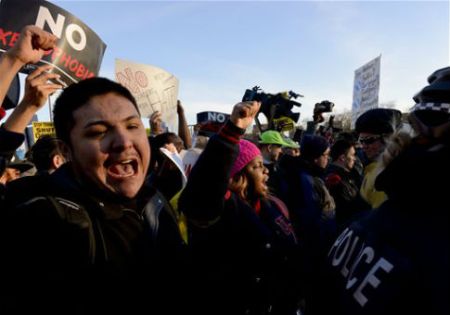
protest1Protestors march in Chicago before a rally with Republican presidential candidate Donald Trump / AP

Left-wing groups that have received money from the federal government and the MacArthur Foundation celebrated the disruption of Donald Trump’s rally in Chicago and are using the clashes to raise more money.

The progressive organizing group MoveOn.org, which boasts more than 8 million members nationwide, took partial credit for protests hours after a Trump rally was canceled in Chicago due to security concerns. Republicans who support Trump “should be on notice,” according to one MoveOn.org Political Action official.

“Mr. Trump and the Republican leaders who support him and his hate-filled rhetoric should be on notice after tonight’s events,” Ilya Sheyman, executive director of MoveOn.org Political Action, said in a statement hours after the clashes. “These protests are a direct result of the violence that has occurred at Trump rallies and that has been encouraged by Trump himself from the stage. Our country is better than the shameful, dangerous, and bigoted rhetoric that has been the hallmark of the Trump campaign.”

“To all of those who took to the streets of Chicago, we say thank you for standing up and saying enough is enough,” Sheyman said. “To Donald Trump, and the GOP, we say, welcome to the general election. Trump and those who peddle hate and incite violence have no place in our politics and most certainly do not belong in the White House.”

One day after this statement, Sheyman said it was “dishonest” to “scapegoat” progressive activists for the violence at the canceled Trump rally.

MoveOn.org, which was initially formed in 1998 to organize liberal opposition to the impeachment of President Bill Clinton, receives financial support from liberal billionaire George Soros. Soros gave $1.46 million to MoveOn’s Voter Fund in 2004.

MoveOn has also taken money from a wide range of left-wing funds and foundations, including the Compton Foundation, the Shefa Fund, the Steven and Michelle Kirsch Foundation, and the Stern Family Fund.

The group raised nearly $20 million in 2012, $10 million in 2014, and has pulled in nearly $5 million for the 2016 elections to date, according to its most recent filings. MoveOn used the recent Trump protests in Chicago as another avenue of fundraising.

The group’s members voted overwhelmingly to back Bernie Sanders this election cycle. According to a release, 78.6 percent of MoveOn.org members voted to endorse Sanders, “shattering MoveOn records with most votes cast and largest margin of victory.”

The ANSWER (Act Now To Stop War and End Racism) Coalition, which has offices in 11 cities, including Chicago, also declared “victory” after the disruptions and called for protesters to “keep the fires going.”

“Large numbers of Latinos, Muslims, Black people, Asians, Arabs and whites stood together, out of necessity, to confront and defeat a great threat to the people. The threat is very real,” the group said in a press release following the events.

The group launched three days after September 11, 2001 with the intent of opposing military intervention following the terrorist attacks committed that day. It has since become involved in other political issues, including the conflict between Israel and the Palestinians, and has come under fire from numerous groups, including other anti-war groups, for its radical and anti-Zionist views.

ANSWER, which operates as a 501(c)3, has received funding from the Progress Unity Fund (PUF), a group founded in 2001 to “break down the barriers of divisiveness and discrimination that exist in the world, and replace them with a sense of solidarity.”

The Progress Unity Fund has provided hundreds of thousands in donations to ANSWER since its inception.

The Illinois Coalition of Immigrant and Refugee Rights is another organization involved in the Chicago protests. The group describes itself as “dedicated to promoting the rights of immigrants and refugees to full and equal participation in the civic, cultural, social, and political life of our diverse society.”

The group received a $450,000 grant from the Marguerite Casey Foundation in January 2016 for leadership development and network development, according to the foundation’s website.

The Chicago-based MacArthur Foundation, one of the nation’s largest independent foundations, giving hundreds of millions in donations to liberal organizations and causes every year, provided a $575,000 grant in 2014 to the organization to be used over the course of two years, according to its website.

The National Council of La Raza, the largest Latino activist organization in the United States, was also involved in the Trump protests.

La Raza gets two thirds of its funding from individuals and corporations such as the Bill and Melinda Gates Foundation, the American Express Foundation, and the Rockefeller Foundation. La Raza also receives funds from the United States government.

Cecilia Muñoz, the director of the White House Domestic Policy Council, previously served as La Raza’s senior vice president for the office of research, advocacy, and legislation.

Muñoz, who sat on the board of directors at Soros’s Open Society Institute before joining the White House, is married to human rights attorney Amit Pandya, a former counselor to the Open Society Institute.

After Muñoz joined President Obama’s team, funding from the government to La Raza nearly tripled, rising from $4.1 million to $11 million.

None of the groups returned a request for comment by press time.