Posted tagged ‘Combat troops’

“This caliphate will take over the entire world and behead every last person that rebels against Allah”

August 1, 2015

“This caliphate will take over the entire world and behead every last person that rebels against Allah,”  Front Page Magazine, Daniel Greenfield, August 1, 2015

(But of course, as all good little Obamabots know, the Islamic State it not Islamic. Please see also, Despite Bombing Campaign, Islamic State No Weaker Than a Year Ago. — DM)

isis_map


The Un-Islamic JayVee team that Obama is trying to fight has a big plan. Behead all non-Muslims. Rule the world.

The undated document, titled “A Brief History of the Islamic State Caliphate (ISC), The Caliphate According to the Prophet,” seeks to unite dozens of factions of the Pakistani and Afghan Taliban into a single army of terror.  It includes a never-before-seen history of the Islamic State, details chilling future battle plans, urges al-Qaeda to join the group and says the Islamic State’s leader should be recognized as the sole ruler of the world’s 1 billion Muslims under a religious empire called a “caliphate.”

“Accept the fact that this caliphate will survive and prosper until it takes over the entire world and beheads every last person that rebels against Allah,” it proclaims. “This is the bitter truth, swallow it.”

Unlike al-Qaeda, which has targeted terror attacks on the United States and other western nations, the document said Islamic State leaders believe that’s the wrong strategic goal. “Instead of wasting energy in a direct confrontation with the U.S., we should focus on an armed uprising in the Arab world for the establishment of the caliphate,” the document said.

First the Muslim world. Then the world. It’s a straightforward strategy, one that Osama bin Laden flirted with but never truly committed to. Though he celebrated the Arab Spring, ISIS would reap its rewards.

Retired Defense Intelligence Agency Director Lt. Gen. Michael Flynn, who also reviewed the document, said it “represents the Islamic State’s campaign plan and is something, as an intelligence officer, I would not only want to capture, but fully exploit. It lays out their intent, their goals and objectives, a red flag to which we must pay attention.”

The failure to target the radical Islamic ideas behind the group has given its fighters the opportunity to spread, Flynn said. “If I were in their shoes, I would say,’We are winning, we are achieving our objectives,’” Flynn said. “They have demonstrated an incredible level of resiliency and they will not be defeated by military means alone.”

We have yet to try defeating them by military means.

To gratify Tehran and Moscow, new US-Turkish anti-ISIS war campaign in Syria skirts Assad’s forces

July 26, 2015

To gratify Tehran and Moscow, new US-Turkish anti-ISIS war campaign in Syria skirts Assad’s forces, DEBKAfile, July 25, 2015

Tanks_face_IS_at_Syria_25.7.15

Not exactly by chance, the security zone bisects Kurdish territory and holds back Kurdish forces in their assaults on ISIS.

DEBKAfile’s military sources report that a glance at the map betrays an all-out US-Turkish effort not put up backs in Tehran by interfering with Syrian, Hizballah and pro-Iranian militia operations in critical northern Syrian war zones such as Aleppo or give the Syrian rebels a helping hand in the Idlib province.

*********************

After the second successive night of Turkish cross-border bombing attacks on the Islamic State in northern Syria, Ankara and Washington agreed Saturday, July 25, to name the “security zone” covered by a “partial no fly zone” they had declared in northern Syria the “Islamic State free zone.” Click HERE for full-size map!

This name represents a significant US-Turkish concession to Iran of immunity for its allies, Syrian President Bashar Assad and Hizballah, in order to gain Tehran’s cooperation in the campaign Turkey launched against ISIS Friday. Integral to the deal is also a promise to abstain from using the campaign to grant anti-Assad rebel groups any advantages.

This immunity did not extend to the Kurdish Workers Movement (PKK), which were targeted in the course of Turkish air and ground action in and over the new “security zone.” Those warplanes also flew missions Friday night over the PKK bases and logistical facilities in the Qandil Mountains of northern Iraq. The PKK responded Saturday with an announcement that their armistice with Ankara was over. Turkey may consequently expect a recurrence of Kurdish terrorist violence in its cities,DEBKAfile notes.

High-placed sources in Ankara disclosed details of the US-Turkish deal with Iran. US warplanes will have the use of Turkish air bases, and not just the big Incirlik facility, for staging air strikes against ISIS, so long as Syrian targets are avoided. Washington agreed to Ankara using its air and ground operations against ISIS in Syria to drive into the new “security zone” and push toward the east to continue those attacks – eve if they run up against Kurdish forces which are also fighting ISIS.

The security zone’s area covered by a no-fly zone is 90 km wide and 40km deep, running between Mere, a small town 25  km north o Aleppo in the west, to the northwestern town of Jarabulus, which is situated on the west bank of the Euphrates.

Not exactly by chance, the security zone bisects Kurdish territory and holds back Kurdish forces in their assaults on ISIS.

DEBKAfile’s military sources report that a glance at the map betrays an all-out US-Turkish effort not put up backs in Tehran by interfering with Syrian, Hizballah and pro-Iranian militia operations in critical northern Syrian war zones such as Aleppo or give the Syrian rebels a helping hand in the Idlib province.

The combined US-Turkish action moreover greatly supports the Assad-Hizballah war against ISIS gains in Syria and enhances Iranian and Russian influence in Damascus.

US Secretary of Defense Ashton Carter, in Irbil Friday, July 24, assured leaders of the semiautonomous Kurdish Republic of Iraq. “We are trying to build a force through the territory of Iraq, and someday in Syria, that can do what the peshmerga have achieved.”

At the same time, in Syria, the Kurds and their national aspirations look like losing out dramatically in the fallout from the complex US-Turkish partnership for beating ISIS back.

Turkey Uses ISIS as Excuse to Attack Kurds

July 26, 2015

Turkey Uses ISIS as Excuse to Attack Kurds, Gatestone Institute, Uzay Bulut, July 26, 2015

(Please see also, Will Anyone Help the Kurds? — DM)

  • It appears as if the Turkish government is using ISIS as a pretext to attack the PKK (Kurdistan Workers’ Party).
  • Turkey just announced that its air base at Incirlik will soon be open to coalition forces, presumably to fight ISIS. But the moment Turkey started bombing, it targeted Kurdish positions in Iraq, in addition to targeting ISIS positions in Syria.
  • In Turkey, millions of indigenous Kurds are continually terrorized and murdered, but ISIS terrorists can freely travel and use official border crossings to go to Syria and return to Turkey; they are even treated at Turkish hospitals.
  • If this is how the states that rule over Kurds treat them, why is there even any question as to whether the Kurds should have their own self-government?

Turkey’s government seems to be waging a new war against the Kurds, now struggling to get an internationally recognized political status in Syrian Kurdistan.

On July 24, Turkish media sources reported that Turkish jet fighters bombed Kurdish PKK (Kurdistan Workers’ Party) bases in Qandil, in Iraqi Kurdistan, as well as the Islamic State (ISIS) in Syria.

Turkey is evidently unsettled by the rapprochement the PKK seems to be establishing with the U.S. and Europe. Possibly alarmed by the PKK’s victories against ISIS, as well as its strengthening international standing, Ankara, in addition to targeting ISIS positions in Syria, has been bombing the PKK positions in the Qandil mountains of Iraqi Kurdistan, where the PKK headquarters are located.

There is no ISIS in Qandil.

As expected, many Turkish media outlets were more enthusiastic about the Turkish air force’s bombing the Kurdish militia than about bombing ISIS. “The camps of the PKK,” they excitedly reported, “have been covered with fire.”

It appears as if Turkey’s ruling Justice and Development Party (AKP) is using ISIS as a pretext to attack the PKK. Ankara just announced that its air base at Incirlik will soon be open to coalition forces, presumably to fight ISIS, but the moment Turkey started bombing, it targeted Kurdish positions. Those attacks not only open a new era of death and destruction, but also bring an end to all possibilities of resolving Turkey’s Kurdish issue non-violently.

Prime Minister Ahmet Davutoglu announced that

“a second wave operation against Daesh [ISIS] in Syria was started. Just after that, a very comprehensive operation was carried out against the camps of the terrorist organization PKK in northern Iraq. I am glad that the targets were hit with great success. We have given instructions to start a third wave operation in Syria and a second wave operation in Iraq.”

The “great success” of the Turkish military has brought much damage and injury to even Kurdish civilians — including children. The Kurdish newspaper Rudaw reported that two Kurdish villagers in Duhok’s Berwari region were carried to hospital in the aftermath of a Turkish artillery bombardment in the Amediye region. One of the victims was 12 years old. The second victim lost a leg in an airstrike. Four members of the PKK were killed and several others were injured.

Shortly after military operations against the PKK started, access to the websites of pro-Kurdish newspapers and news agencies was denied “by decree of court.” These websites — including Fırat News Agency (ANF), Dicle News Agency (DIHA), Hawar News Agency (ANHA), Ozgur Gundem newspaper, Yuksekova News, Rudaw and BasNews — are still blocked in Turkey.

ISIS, meanwhile, has not so far made any statement regarding Turkey’s so-called bombings of ISIS in any of its media outlets.

Had Turkish military attacked the PKK alone, and not in addition to attacking ISIS, it would probably have received widespread international condemnation. So to add “legitimacy” to its attacks against the Kurdish PKK — whose affiliate Democratic Union Party (PYD) in Syria and its armed wing, the Kurdish People’s Defense Units (YPG) have been resisting ISIS and other Islamist terrorist groups since 2013 — Turkey declared that it will also attack ISIS. This would give it cover for its attacks against Kurdish fighters.

In 2014, Turkey’s President Recep Tayyip Erdogan described the plan he wanted to carry out in Syria and Iraq: “The problem in Syria should be taken into account. Iraq too should be considered similarly. Moreover, there needs to be a solution that will also deal with the Syrian wing [PYD] of the separatist terrorist organization [PKK].”

The AKP government, dissatisfied with the results of last month’s parliamentary elections, also seems to want to hold new elections, to push the mainly Kurdish HDP Party below the required 10% threshold, and thus force them out of parliament. Perhaps the government thinks that bombing the PKK will generate Turkish nationalist enthusiasm that will work in the AKP’s favor to help it regain a majority in early elections.

Apparently, Turkey does not need Kurdish deputies in its parliament. Apparently, the state prefers to slaughter or arrest the Kurds — as it has done for decades. Why hold talks and reach a democratic resolution when you have the power to murder people wholesale?[1]

Sadly, Turkey has preferred not to form a “Turkish-Kurdish alliance” to destroy ISIS. First, Turkey has opened its borders to ISIS, enabling the growth of the terrorist group. And now, at the first opportunity, it is bombing the Kurds again. According to this strategy, “peace” will be possible only when Kurds submit to Turkish supremacism and abandon their goal of being an equal nation.

In the meantime, Mevlut Cavusoglu, Turkish minister of foreign affairs, said that the Incirlik air base in Turkey has not yet been opened for use by the U.S. and other coalition forces, but that it will be opened in the upcoming period.

Kurdish forces, therefore, are the only forces that are truly resisting the Islamic State.

They have been repressed by Baghdad and murdered by Turkey and Iran.

If this is how the states that rule over Kurds treat them, why is there even any question as to whether the Kurds should have their own self-government?

As a result of the ISIS attacks in the region, the Kurdish PKK — as well as its Syrian Kurdish affiliate, Democratic Union Party (PYD) and its armed wing, Kurdish People’s Defense Units (YPG) — have emerged as the America’s most effective battlefield partners against ISIS. Ever since ISIS became a major force in Syria, the U.S. has apparently relied heavily on YPG to stop ISIS from advancing. According to Henri Barkey, a former State Department specialist on Turkey, “The U.S. has become the YPG’s air force and the YPG has become the U.S.’s ground force in Syria.”

* * *

Attacks on the Kurds were already under way last week. On July 20, a bomb attack in the Kurdish town of Suruc (Pirsus) in Turkey killed 32 people during a meeting of young humanitarian activists, who were discussing the reconstruction of the neighboring Kurdish town of Kobane.

1171The scene of the suicide bombing in Suruc, Turkey. An ISIS suicide bomber murdered 32 people and wounded more than 100 others in a July 20 attack on Kurdish humanitarian activists. (Image source: VOA video screenshot)

The blast took place while the activists were making a statement to the press in the garden of a cultural center. At least 100 others, mostly university students, were wounded. (Graphic video of the explosion)

The suicide bomber was identified through DNA testing, according to reports in the Turkish news media. Seyh Abdurrahman Alagoz was reportedly a 20-year-old Turkish university student, recently returned from Syria, and believed to have had ties to ISIS.

Alagoz targeted a meeting 300 secular activists, members of the Federation of Socialist Youth Associations (SGDF), who gathered at a cultural center in the province of Urfa, opposite the Kurdish town of Kobane in Syrian Kurdistan. As part of an effort to rebuild Kobane, they were preparing to provide aid, give toys to the children there and build a hospital, school, nursery, children’s park, library and a memorial forest for those who had lost their lives in Kobane.

“Work on the building of hospitals and schools needs to be done,” Oguz Yuzgec, the co-president of the federation, said before the explosion. “One of the things we will do is to build a children’s park in Kobane. We will name it after Emre Aslan, who died fighting in Kobane. We are collecting toys. We will participate in the construction of the nursery that the canton of Kobane is planning to build. We have the responsibility of helping the nursery function. We need everybody who knows how to draw and can teach children.”

Mazlum Demirtas, a survivor of the attack, said: “The main one responsible for this incident is the state of Turkey, the AKP fascism, the AKP dictatorship. … It attacked us with its gunmen and gangs. Since yesterday, parents have been collecting the dismembered body parts of their children. They are trying to identify the dismembered bodies. This is called fascism, inhumanity and barbarity.”

Pinar Gayip, another survivor of the attack, said in a telephone interview on the pro-government Haberturk TV that, “Instead of helping the wounded, the murderer-police of the murderer-AKP threw tear gas at the vehicles with which we carried the wounded.” She was taken off the air.

All across Turkish Kurdistan, there were protests condemning the massacre and the government’s alleged involvement in it. Police in Istanbul used plastic bullets and water cannonsagainst people who gathered to remember those murdered in Suruc.

The Turkish authorities briefly blocked access to Twitter last Wednesday to prevent the people from viewing photos of the bombing in Suruc. Officials admitted that Turkey had asked Twitter to remove 107 URLs (web addresses) with images related to the bombing; before the ban, Twitter had already removed 50.

Selahattin Demirtas, the co-chair of the pro-Kurdish Peoples’ Party (HDP), said that state surveillance activities were intensive in Suruc, and that the intelligence service was recording the identity of everyone traveling to and from Suruc.

As Demirtas’s own convoy had recently not been permitted to enter Suruc, he emphasized the extent of state surveillance in the town, and said that nobody could argue that someone could have managed to infiltrate the crowd and carry out the suicide attack without state support.

“Today, we have witnessed in Suruc yet again what an army of barbarity and rape, an army that has lost human dignity, can do,” Demirtas said. “Those who have been silent in the face of ISIS, who have not dared even raise their voice to it, as well as the officials in Ankara who threaten even the HDP every day but caress the head of ISIS, are the accomplices of this barbarity.”

In the meantime, Mehmet Gormez, the head of the Turkish Presidency of Religious Affairs (Diyanet), announced on its Twitter account that the perpetrators of the Suruc attack do not have religion.

However, three days before the massacre in Suruc, about 100 Islamists — alleged to be ISIS sympathizers — had performed mass Islamic Eid prayers in Istanbul. They demanded Islamic sharia law instead of democracy. ISIS sympathizers had performed the same Eid prayers at the same place the year before, as well.

Over the border in Syrian Kurdistan, shortly after the blast in Suruc, a suicide bomber detonated a car bomb at a checkpoint in Kobane. Two Kurdish fighters were killed in the explosion, according to Rami Abdel Rahman, director of the Syrian Observatory for Human Rights.

Last month, a deadly blast hit the Kurdish province of Diyarbakir in Turkey, during an election rally of the pro-Kurdish HDP that was attended by tens of thousands of people. Just before the HDP co-chair Selahattin Demirtas was going to speak, two bombs exploded at different places. Four people were killed, and more than 100 people are estimated to have been wounded. One of the wounded, Lisa Calan, 28, a Kurdish art director from Diyarbakir, lost both legs in the explosion.

As the wounded were being carried to hospitals, police used tear gas against people trying to run from the area in panic

The bomber was reported to be a member of ISIS.

* * *

In Turkey, millions of indigenous Kurds are continually terrorized and murdered, while ISIS terrorists can freely travel and use official border crossings to go to Syria and return to Turkey; they are even treated at Turkish hospitals. Emrah Cakan, for instance, a Turkish-born ISIS commander wounded in Syria, got medical treatment at the university hospital in Turkey’s Denizli province in March.

The Denizli governor’s office issued a written statement on 5 March:

“The treatment of Emrah C. at the Denizli hospital was started upon his own application. The procedural acts concerning his injury were conducted by our border city during his entry to our country and they still continue. And his treatment procedures continue as a part of his right to benefit from health services just like all our other citizens have.”

The “compassion” and hospitality that many Turkish institutions have for ISIS members is not even hidden. The silence of the West is mystifying and disappointing.

The U.S. government cooperates with oppressive regimes — including the terrorist regime of Iran, under which Kurds are forced to live — to the detriment of the Kurds, to the detriment other persecuted peoples, and to the detriment of the future of the West.

Many Middle Eastern regimes are ruled by Islamist, often genocidal governments — so there is not much to expect from them in terms of human rights and liberties.

The Kurds need real support, real arms and real recognition. Otherwise, there does not seem to be much difference between the dictatorial, genocidal Middle Eastern regimes and the West, which used to represent democracy and freedom.
_____________________________

[1] The so-called “peace process” was reportedly started in 2012 and through it, Kurds and the Turkish government were to resolve the Kurdish issue through negotiations.)

Israel merges IDF elite units to form the new Commando Brigade tailored to combat ISIS

July 7, 2015

Israel merges IDF elite units to form the new Commando Brigade tailored to combat ISIS, DEBKAfile, July 7, 2015

Israeli_Special_ForcesIsrael Special Operations Forces

The new Commando Brigade is designed for quiet, bold, covert and effective action against terrorist groups posing a threat from the Sinai Desert to Egyptian sovereignty and Israel’s southern border. Such action would be coordinated closely between Israeli and Egyptian military and intelligence arms.

*******************

While US president Barack Obama coined his approach to the struggle against the Islamic State with the words: “Ideologies are not defeated by guns. They’re defeated with better ideas.” – Israel and its military leaders are taking no chances against a declared enemy.

Last Friday, July 3, the Islamic State of Iraq and the Levant’s Sinai branch fired three Grad missiles across the border into the Israeli Eshkol district, while it was in mid-offensive against the Egyptian army in North Sinai. Large parts of southern Israel next door had already been declared closed military areas in consequence of that offensive.

ISIS and its affiliates, while currently preoccupied with snatching up territory from countries neighboring Israel, make no secret of their intention, confirmed by military intelligence, to reach Israel’s northern, eastern and southern borders before long.

Monday, July 6, IDF Chief of Staff Lt. Gen. Gady Eisenkott unveiled Israel’s answer to the coming challenge. It is a unique, multi-purpose commando ground force, especially tailored to fight ISIS and provide the “boots on the ground” which the US-led coalition has kept back from the Islamists’ constantly expanding warfront.

It will be trained and armed for extraordinary missions outside routine military tasks.

The revelation was something of a wake-up call for the general Israeli population. The new force’s short term tasks are to guard southern and northern Israel against hostile rocket fire and attempts by Islamist groups riding captured armored carriers to storm the border. This happened once before on Aug. 6, 2012, when Ansar Beit Al-Maqdis Islamists (who later joined ISIS) broke through the Egyptian-Israeli Kerem Shalom border crossing from Sinai. Their APCs had driven almost up to a military base before they were wiped out by Israeli warplanes.

The new Commando Brigade is designed for quiet, bold, covert and effective action against terrorist groups posing a threat from the Sinai Desert to Egyptian sovereignty and Israel’s southern border. Such action would be coordinated closely between Israeli and Egyptian military and intelligence arms.

Similar operations would also be staged if necessary from Israel’s northern border – against Hizballah or any threat from Syria.

The new outfit brings together the different skills and the high, focused fire power rendered by the four elite units’ assorted weaponry. In this sense, these units, all highly adept in different aspects of covert and stealth operations deep behind enemy lines, complement one another. This amalgam that may be loosely likened to a unique combination of US Delta, Seals, Rangers, and airborne commandoes all rolled in one.

The elite units merged into the new commando brigade are:

1. Meglan, which specializes in destroying enemy systems with the accent on armored units. Its members are equipped with intelligence technology for gathering data and its transmission in real time.

2.  Duvdevan‘s tasks are to liquidate targeted terrorists and round up suspects. Its members operate under cover by blending into a hostile population in disguise. They are trained for single combat in the heart of enemy terrain.

3. Egoz commandos employ guerilla tactics borrowed from the books of terrorist organizations.

4. Rimon commandos also blend into a hostile population disguised as locals for the purpose of spotting and foiling terrorist operations in difficult and complex areas.

The commander of the new combined brigade is Col. David Zinni who defers to the 98th (Esh) Division.

Gen. Eisenkott has brought the four elite units together from the Paratroops, Golani and Givati brigades, among which they were formerly distributed. His action capped the reassessment of the IDF’s war doctrine which he found essential for dealing with the new volatile and constantly moving enemy.

The four elite units in combination offer a synergetic combination. They will train together in air, sea and tactics for missions to meet unorthodox intelligence demands. They will also be set apart from the conventional military by their special weapons, secret high-tech equipment, and separate guidelines and logistics.

The swiftness of ISIS’s climb to highest ranks of Israel’s foes caused Gen. Eisenkott to override the most recent innovation of his predecessor, Lt. Gen. Benny Gantz: the Depth Command. The Commando Brigade has made the Depth Command redundant.

Soup Sandwich: Obama and His National Security Team Has no Plan to Combat ISIS

June 9, 2015

Soup Sandwich: Obama and His National Security Team Has no Plan to Combat ISIS, ISIS Study Group, June 9, 2015

(This appeared in an e-mail this morning from Foreign Policy Strategy Report:

Wait, where is everybody? Several hundred U.S. soldiers and Marines at al Asad air base in Iraq are standing by, ready to train some Iraq soldiers. But those Iraqi troops have stopped showing up, leaving the Americans all alone at the sprawling base. FP’s John Hudson, Lara Jakes and Paul McLeary report that across Iraq, there seem to be more U.S. trainers than recruits, with only 2,600 Iraqi soldiers currently receiving training from about 3,000 U.S. military personnel.

While the training has dried up, at the G-7 summit in Germany, President Barack Obama maintained that the United States and its allies must speed up the training of the Iraqi security forces….even, presumably, if they aren’t showing up.

— DM)

President Obama did some talking about the Islamic State (IS) after the G-7. Of note is that he admitted to not having an actual strategy in combatting IS and the threat it poses to the free world. In typical fashion he fails to hold himself accountable for his actions and points the finger at everybody but himself. He’s known about the threat of IS for since 2010 when Baghdadi’s guys initiated the “Breaking the Walls Campaign” in Iraq (which the Long War Journal did a great job of covering btw). This quote from our illustrious President was quite telling:

“I don’t want to put the cart before the horse. We don’t have a strategy yet,”

Obama: No ‘complete strategy’ yet on training Iraqis
http://www.cnn.com/2015/06/08/politics/obama-abadi-iraq-germany-g7/

And here’s President Obama’s press conference after the G-7 (we recommend fast-forwarding to the 18:00 mark to get to the good stuff):


The President comes off as well-versed in “saying the right things” when it comes to things like Greece, healthcare or raising minimum wage. However, he starts stumbling the minute someone asks about IS. At around the 19:00 mark of the aforementioned video he said that we’re making “progress” in pushing IS back, but then goes on to say that as we “secure” an area they move into other areas the Iraq Security Forces/Popular Mobilization Committee (ISF/PMC) left. This is the President’s definition of “winning” the fight against IS. We’re sorry if this offends his supporters (not really), but what’s happening on the ground in Syria, Iraq, Lebanon and Yemen isn’t the US “winning” this fight against IS, Iran or al-Qaida (AQ).

His “solution” to the problem being an acceleration of training up the ISF is smoke and mirrors, really. You can train the ISF up all you want and it won’t make any difference because at its core both the IA and Iraqi Police (IP) have been purged of their most capable commanders and replaced by incompetent officers. The fact that the IA is now 80% Shia further alienates itself from the Sunni Arab and Kurd communities. Even Secretary of Defense Ash Carter stated all the training in the world can’t help the IA due to the cowardice that’s endemic throughout the force. As much as the Iranian regime denied this and pushed back against Carter’s assessment, IRGC-Qods Force commander GEN Suleimani shares many his beliefs in the poor state of the IA – and that’s a big reason why Suleimani has been influencing the establishment of the Iraqi National Guard by working to ensure that the ranks are filled with Shia militia personnel. Oh, and btw, a lot of those “fresh troops” the President was referring to are already being put through the meat grinder in places like Bayji and Ramadi – and the results aren’t pretty.

Iranian Regime, GOI Take Issue With US SECDEF’s Assessment that IA are Cowards
http://isisstudygroup.com/?p=6707

ash-carter-300x169

SECDEF Ash Carter is the only guy in the Obama administration who seems to “get it” – too bad the powers that be forced him to walk back his accurate assessment on the cowardice seen throughout the IA
Source: Wall Street Journal

Again, none of this is surprising to our readers who’ve been with us since the beginning of our site. President Obama had a quasi-strategy of sorts that we covered in last summer’s “Obama’s ISIS Strategy: Failed Before it Started” that was followed up by “Another Reason Obama’s ISIS Strategy Has Already Failed.” To the uninitiated, the Obama strategy called for trainers and the arming of so-called “moderates” in Syria while supporting an Iraqi Army (IA) that has taken on sectarian characteristics. He’s banking on doing the bare minimum to basically run out the clock so that he can say he “didn’t deploy combat troops to Iraq.” In other words, he has a plan alrighHe’s been very untruthful because he’s dramatically increased the US military footprint in Iraq since last summer. Their situation is also much more dangerous now than it ever was during the OIF-era thanks to the restrictive ROE he slapped our brethren with prior to authorizing their deployment. Additionally, his term “no boots on the ground” is misleading because those “advisors/trainers” we’ve deployed are all ground troops – many of which are located in bases currently under siege such as al-Asad Airbase or Habbaniyah. If these aren’t American “combat troops,” then what are they, aid workers? Bystanders? The Obama administration may give the “trainer” label on our guys being deployed to Iraq, but the inconvenient truth of the matter is that they all have either “US ARMY” or “US MARINES” tags on their uniforms.

Obama’s ISIS Strategy: Failed Before it Started
http://isisstudygroup.com/?p=1730

Another Reason Obama’s ISIS Strategy Has Already Failed
http://isisstudygroup.com/?p=1757

US-Backed Syrian Group Disbands – But Were They Ever Truly “Moderate” to Begin With?
http://isisstudygroup.com/?p=5286

It was painful to watch President Obama – the alleged “leader” of the free world – have a hard time answering some pretty easy questions asked about US policy to combat IS. President Obama and his national security team had more than a few years to develop a strategy – but didn’t. Why is that? Its because President Obama doesn’t want his domestic agenda to get sidetracked by things like the foreign-policy arena. He just points the finger at everybody else saying “its their fault” while not formulating any real solution. He’s on his 7th year in office and still blames his predecessor for everything. Coming from military backgrounds ourselves, we were taught that a leader doesn’t make excuses. He makes things happen. A leader doesn’t keep rolling with a plan if it clearly isn’t working. A leader will adjust accordingly and inspire his subordinates to press on. That’s what a leader does. We’re not seeing that from this President. As we’ve stated earlier in this article, he’s just trying to “run out the clock” of his second term so that this will become the “next guy’s problem.” Unfortunately for him, it doesn’t work that way. His inaction and arrogance has directly led to the rise of IS, and his current policies have allowed the terror organization to expand into other locales such as Yemen, Libya, Egypt, Tunisia, Iraq, Afghanistan, Pakistan and the North Caucasus region. History won’t look so kindly on him as the current American media. The public will see this manifest itself in the next administration, when our country gets attacked on our home soil – again. Of course there’s the hope that the American people will finally realize this is what a “hope and change” foreign policy is all about before its too late. But we doubt it.

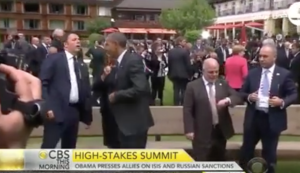
Screen-Shot-2015-06-08-at-2.21.59-PM-300x173

Oh yeah, President Obama knew PM Abadi was next to him and acted as if he wasn’t there – kinda like his approach to foreign policy
Source: CBS News

If you want additional details on the lead up to the rise of IS, then check out the history lesson we put together for President Obama’s counterpart Rand Paul, who is just as naive on foreign policy as he is:

Rand Paul Needs a History Lesson..
http://isisstudygroup.com/?p=6782

Links to Other Related Articles:

Defeating The Islamic State
http://isisstudygroup.com/?p=1708

Egypt Atmospherics
http://isisstudygroup.com/?p=614

No army in Mid East is challenging ISIS. Iran regroups to defend S. Iraqi Shiites, Assad to save Damascus

May 25, 2015

No army in Mid East is challenging ISIS. Iran regroups to defend S. Iraqi Shiites, Assad to save Damascus, DEBKAfile, May 25, 2015

Baiji_22.5.15Iranian troops in fight to evict ISIS from Baiji refinery

Hassan Nasrallah Saturday, May 23, called his Lebanese Shiite Hizballah movement to the flag, because “we are faced with an existential crisis” from the rising belligerence of the Islamist State of Iraq and the Levant. His deputy, Sheik Naim Qssem, sounded even more desperate: “The Middle East is at the risk of partition” in a war with no end in sight, he said. “Solutions for Syria are suspended. We must now see what happens in Iraq.”

The price Iran’s Lebanese proxy has paid for fighting alongside Bashar Assad’s army for four years is cruel: some 1,000 dead and many times that number of wounded. Its leaders now understood that their sacrifice was in vain. ISIS has brought the Syrian civil war to a new dead end.

This week, a 15-year old boy was eulogized by Hizballah’s leaders for performing his “jihadist duty” in Syria.

Clearly, for their last throw in Syria, the group, having run out of adult combatants, is calling up young boys to reinforce the 7,000 fighting there.

The Syrian president Bashar Assad is in no better shape. He too has run dangerously short of fresh fighting manpower. Even his own Alawite community has let him down. Scarcely one-tenth of the 1.8 million Alawites have remained in Syria. Their birthrate is low, and those who stayed behind are hiding their young sons to keep them from being sent to the front lines.

Assad also failed to enlist the Syrian Druze minority to fight for his regime, just as Hizballah’s Nasrallah was rebuffed when he sought to mobilize the Lebanese army to their cause. This has left Hizballah and the Syrian ruler alone in the battlefield with dwindling strength against two rival foes:  ISIS and the radical Syrian opposition coalition calling itself Jaish al-Fatah – the Army of Conquest – which is spearheaded by Al Qaeda’s Nusra Front and backed to topple Assad by Saudi Arabia, Qatar and Turkey.

Nasrallah tried to paint a brave picture of full mobilization to expand the war to all parts of Syria. However, Sunday, May 24, a key adviser to Assad admitted that his regime and its allies were being forced to regroup.

Their forces were withdrawing from the effort to shift the Islamists from the land they have conquered – about three-quarters of Syrian territory – and concentrating on defending the cities, Damascus, Homs and Latakia, home to the bulk of the population, as well as the strategic Damascus highway to the coast and Beirut. Hizballah needed to build up the Lebanese border againest hostile access.

But Syrian cities, the Lebanese border and the highway are still under threat – from Syrian rebel forces.

The Iraqi army, for its part, has been virtually wiped out, along with the many billions of dollars the US spent on training and weapons. There is no longer any military force in Iraq, whether Sunni or Shiite, able to take on ISIS and loosen its grip on the central and western regions.

The Kurdish peshmerga army, to whom President Barack refused to provide armaments for combating the Islamists, has run out of steam. An new offensive would expose the two main towns of the semi-autonomous Kurdish Republic – the capital Irbil and the oil city of Kirkuk – to the depredations of the Islamist belligerents.

A quick scan of Shiite resources reveals that in the space between the Jordan River and the Euphrates and Tigris, Iran commands the only force still intact in Iraq – namely, the Iraqi, Afghan and Pakistani Shiite militias, who are trained and armed by the Revolutionary Guards.

This last remaining fighting force faces its acid test in the battle ongoing to recover Baiji, Iraq’s main oil refinery town. For the first time, Iranian troops are fighting in Iraq, not just their surrogates, but in the Baiji campaign they have made little headway in three weeks of combat. All they have managed to do is break through to the 100 Iraqi troops stranded in the town, but ISIS fighting strength is still not dislodged from the refinery.

The Obama administration can no longer pretend that the pro-Iranian Shiite militias are the panacea for the ISIS peril. Like Assad, Tehran too is being forced to regroup. It is abandoning the effort to uproot the Islamists from central and western Iraq and mustering all its Shiite military assets, such as the Badr Brigade, to defend the Shiite south – the shrine towns of Najef and Karbala, Babil (ancient Babylon) and Qadisiya – as well as planting an obstacle in the path of the Islamists to Iraq’s biggest oil fields and only port of Basra.

The Shiite militias flown in by Tehran from Pakistan and Afghanistan have demonstrated in Syria and Iraq alike that they are neither capable nor willing to jump into any battlefields.

The upshot of this cursory scan is that not a single competent army capable of launching all-out war on ISIS is to be found in the Middle East heartland – in the space between the 1,000km long Jordan and the Euphrates and Tigris to the east, or between Ramadi and the Saudi capital of Riyadh to the south.

By Sunday, May 24, this perception had seeped through to the West. US Defense Secretary Ashton Carter, remarked: “What apparently happened was that the Iraqi forces just showed no will to fight.” The former British army chief Lord Dannatt was more down to earth. Since the coalition air force campaign had failed to stop ISIS’s advance, he said “it was time to think the previously unthinkable” and send 5,000 ground troops to fight the Islamists in Syria and Iraq.

The next day, Monday, Tehran pointed the finger of blame for the latest debacles in Iraq at Washington. Al Qods Brigades chief Gen. Qassem Soleimani was quoted by the English language Revolutionary Guards mouthpiece Javan as commenting: “The US didn’t do a damn thing to stop the extremists’ advance on Ramadi.”

Ash Carter: Iraqis Need to Be The Ones Fighting Islamic State But Don’t Have The Will to Do So

May 24, 2015

Ash Carter: Iraqis Need to Be The Ones Fighting Islamic State But Don’t Have The Will to Do So, Washington Free Beacon via You Tube, May 24, 2015

(We can give them equipment and training. But how can we give them time — and training requires time as well as motivation on the part of the trainees — when the Islamic State gives them neither? — DM)

Ramadi’s fall opens ISIS road to Baghdad. Jordan warns US air strikes won’t stop the terrorists’ advance

May 18, 2015

Ramadi’s fall opens ISIS road to Baghdad. Jordan warns US air strikes won’t stop the terrorists’ advance, DEBKAfile, May 18, 2015


Jordan’s King Abdullah has warned the Obama administration in an urgent message that US air strikes alone won’t stop the Islamic State’s advances in Iraq and Syria and, what is more, they leave his kingdom next door exposed to the Islamist peril. ISIS would at present have no difficulty in invading southern Jordan, where the army is thin on the ground, and seizing local towns and villages whose inhabitants are already sympathetic to the extremist group. The bulk of the Jordanian army is concentrated in the north on the Syrian border. Even a limited Islamist incursion in the south would also pose a threat to northern Saudi Arabia, the king pointed out.

Abdullah offered the view that the US Delta Special Forces operation in eastern Syria Saturday was designed less to be an effective assault on ISIS’s core strength and more as a pallliative to minimize the Islamist peril facing Saudi Arabia, Jordan and the Gulf emirates.

DEBKAfile’s Washington sources report that US officials refused to heed Abdullah’s warning and tried to play it down, in the same way as Secretary John Kerry tried Monday, May 18, to de-emphasize to the ISIS conquest of Ramadi, the capital of Iraq’s largest province.

At a news conference in Seoul, Kerry dismissed the Islamists’ feat as a “target of opportunity” and expressed confidence that, in the coming days, the loss “can be reversed.”

The Secretary of State’s words were unlikely to scare the Islamists, who had caused more than 500 deaths in the battle for the town and witnessed panicky Iraqi soldiers fleeing Ramadi in Humvees and tanks.

Baghdad, only 110 km southeast of Ramadi, has more reason to be frightened, in the absence of any sizeable Iraqi military strength in the area for standing in the enemy’s path to the capital.

The Baghdad government tried announcing that substantial military reinforcements had been ordered to set out and halt the Islamists’ advance. This was just whistling in the dark. In the last two days, the remnants of the Iraqi army have gone to pieces – just like in the early days of the ISIS offensive, when the troops fled Mosul and Falujah. They are running away from any possible engagement with the Islamist enemy.

The Baghdad-sourced reports that Shiite paramilitaries were preparing to deploy to Iraq’s western province of Anbar after Islamic State militants overran Ramadi were likewise no more than an attempt to boost morale. Sending armed Shiites into the Ramadi area of Anbar would make no sense, because its overwhelmingly Sunni population would line up behind fellow-Sunni Islamist State conquerors rather than help the Shiite militias to fight them.

Iran’s Defense Minister Hossein Dehghan, who arrived precipitately in Baghdad Monday, shortly after Ramadi’s fall, faces this difficulty. Our military sources expect him to focus on a desperate effort to deploy Shiite militias as an obstacle in ISIS’s path to Baghdad, now that the road is clear of defenders all the way from Ramadi.

In Amman, King Abdullah Sunday made a clean sweep of senior security officials, firing the Minister of Interior, the head of internal security (Muhabarat) and a number of high police officers. They were accused officially of using excessive violence to disperse demonstrations in the southern town of Maan.

The real reason for their dismissal, DEBKAfile’s counter-terror sources disclose, is the decline of these officials’ authority in the Maan district,  in the face of the rising influence of extremist groups identified with Al Qaeda and ISIS, in particular.

Book review: The Islamic War

March 16, 2015

The Islamic War: Book review, Dan Miller’s Blog, March 16, 2015

(The views expressed in this article are mine and do not necessarily reflect those of Warsclerotic or its other editors. — DM)

The Islamic War, Martin Archer, 2014

The novel begins with a terror attack on a residential area in Israel, resulting in multiple causalities. It may, or may not, have involved members of the Iranian Revolutionary Guard. Menachem Begin is the Israeli Prime Minister and Ariel Sharon is the Defense Minister. The story begins immediately after the (postponed?) end of the Iran – Iraq war in 1988.

A massive armor, infantry, artillery and air attack on Israeli positions in the Golan follows the terrorist attack. The Israelis are outnumbered and suffer many thousands of casualties.

Israel had anticipated a simultaneous attack via Jordan, so most Israeli tank, infantry and air resources are deployed there, rather than in the Golan, to conceal themselves and await the arrival of Iranian, Iraqi and Syrian forces. They come and are defeated, most killed or fleeing. The Israeli forces then move into Syria and have similar successes there as well.

As the story evolves, it becomes evident that Israel must have known that the Iran – Iraq war had been allowed to fester to permit Iran, Iraq and Syria to develop a well coordinated plan to dispose of Israel, in hopes that a surprise attack could be made as soon as the Iran – Iraq war ended. Other events also suggest that Israel had prior notice:

Nuclear facilities of several hostile nations explode mysteriously.

The Israeli Navy had managed to infiltrate Iranian oil ports — apparently before the attack on the Golan — without being noticed. Then, at a propitious moment near the end of the fighting elsewhere, they destroyed all oil tankers in, entering or leaving port, along with all Iranian oil storage facilities.

The Israel Navy, which had suffered no losses, then moved to Saudi Arabia to protect her oil ports and ships coming to buy her oil and leaving.

As these events unfold, Israel, Egypt, Jordan, Saudi Arabia and Turkey* are negotiating a united front against Iran, Iraq and Syria, much to the displeasure of the U.S. Secretary of State, who wants a cease fire and return to the status quo ante. Fortunately, the U.S. President favors Israel and her coalition and generally ignores his SecState.

I won’t spoil the story by relating what happens at the end, but it’s very good for Israel, Egypt, Jordan, Saudi Arabia, Turkey and the Kurds, and very bad for Iran, Iraq and Syria. The novel is well worth reading, perhaps twice.

_____________

*Historical note: Turkey in 1988 was reasonably secular and also in other ways quite different from now. Egypt under President Al-Sisi is, in some but not all respects, similar to Egypt in 1988 under President Mubarak. Beyond a good relationship with Israel, Al-Sisi is working to modernize and reform Islam by turning it away from the violent jihad which drives both the Islamic State (Sunni) and the Islamic Republic of Iran (Shiite). Egypt remains under fire from the Obama administration due to the “coup” which ousted President Morsi, who had made Egypt essentially an arm of the Muslim Brotherhood. Egypt now helps to protect Israel with her military presence in the Sinai to oppose Hamas and Muslim Brotherhood activities there. Saudi Arabia and Jordan, like most countries in the Middle East, look out for the interests of their rulers first and are quite concerned about both the Islamic State and Iran.

Analysis: Iran is no partner in the fight against the Islamic State

March 11, 2015

Analysis: Iran is no partner in the fight against the Islamic State, Long War Journal and , March 11, 2015

B_vsofcXEAAtDRvQassem Soleimani (center) with his bodyguards near the frontlines of Tikrit.

Iran benefits from the threat of an Islamic State, and if the US continues its courtship of Tehran, it may find the Islamic State replaced by an Islamic Republic.

****************

Testifying on Capitol Hill on March 3, Joint Chiefs Chairman General Martin Dempsey characterized the joint attempts of the Iraqi military, Iraqi Shia militias, and Iran’s Islamic Revolutionary Guards Corps (IRGC) at taking back control of Tikrit, Saddam Hussein’s hometown, from the Islamic State, as “a positive thing.” “Frankly,” General Dempsey said, “it will only be a problem if it results in sectarianism.”

General Dempsey’s caveat is an interesting one, since there is every reason to believe that Shia control of Tikrit will result in further sectarianism. While the US administration says in its most recent National Security Strategy that it desires to “degrade and ultimately defeat ISIL [Islamic State]” in an attempt to “support Iraq … free itself from sectarian conflict and the scourge of extremists,” Tehran is actively perpetuating the sectarian crisis in Iraq.

The threat of the Islamic State, coupled with American “strategic patience,” not only makes the Iraqi Shia more dependent on Tehran and legitimizes Iran’s military presence in Iraq, it also provides the regime in Tehran with another bargaining chip in nuclear negotiations with the P5+1 Group.

In the past, the Iraqi Shia have demonstrated little interest in reducing themselves to puppets of Tehran. During the war with Iraq from 1980-1988, Iraqi nationalism trumped sectarian identity: the Shia constituted the rank and file of the Iraqi military, and Shia leaders in Iraq kept their distance from the regime in Tehran. After the collapse of Saddam Hussein’s regime in 2003, Iraq became a sanctuary to Iranian clerics critical of the regime in Tehran, including Hossein Khomeini, grandson of the founder of the Islamic Republic.

But Iraq did not remain a refuge for long. The civil war in Iraq, followed by the rise of Islamic State, forced moderate Iraqi Shia, who otherwise would have pursued a line independent of Iran, to become dependencies of Tehran. After being rebuffed by the US following the Islamic State’s takeover of Mosul in 2014, General Qassem Atta, head of the Iraqi National Intelligence Service, asked Tehran for help and received assistance within 48 hours. Iraqi Prime Minister Haider al Abadi continues to press Washington for more support in his fight against the Islamic State and uses US hesitancy to justify reliance on Iran, which according to Vice President Iyad Allawi,only increases Iran’s influence in Iraq and could lead to dismantlement of the Iraqi state.

The Obama administration may desire to help secure the survival of the Iraqi state, but the small contingent of US advisers in Iraq is relying on a heavily Iranian-influenced Iraqi sectarian intelligence and security apparatus. The Iraqi security forces are predominantly Shia, and in addition, Shia militias and “advisers” from the IRGC Quds Force are now fighting as legitimate Iraqi forces. 

This creates an environment in which targeting operations developed by Iranian forces and the militias have primacy over those developed by the US, leading to the possibility that  Washington could be portrayed by Islamic State as complicit in the indiscriminate targeting of Sunnis. Such operations will be perceived the same way by the very Sunnis we need to fight Islamic State, thus undermining the US strategy to “support Iraq … free itself from sectarian conflict and the scourge of extremists.”

Any US reliance on Iranian support in the fight against the Islamic State is also likely to strengthen Tehran’s bargaining position in the nuclear negotiations.

Although both US and Iranian negotiators maintain that nothing but the nuclear issue is being discussed, this of course is fiction. On Sept. 22, Fars News, quoting an anonymous American source, reported that Secretary of State John Kerry and Mohammad Javad Zarif, Iran’s foreign minister, discussed the nuclear issue as well as the fight against the Islamic State. And Admiral Ali Shamkhani, Iran’s Supreme National Security Council Secretary, has also connected both issues. Clearly, Tehran’s cooperation with Washington in the fight against the Islamic State comes at a price, which Washington must pay at the negotiating table in Geneva.

Iran has Washington where it wants it. Iran wants a favorable deal, and the Obama administration is signaling that such a deal is forthcoming. US “strategic patience” is allowing Iran to increase its influence and presence in Iraq and Syria. Assad is waiting out the Americans and the international community, and Shia militias are now viewed as legitimate forces in Iraq, Syria, and Yemen. But most importantly, US “strategic patience” signals to Iran an unwillingness to jeopardize the talks by linking them to Iran’s role in Iraq, Syria, and Yemen. 

Iran benefits from the threat of an Islamic State, and if the US continues its courtship of Tehran, it may find the Islamic State replaced by an Islamic Republic.