Posted tagged ‘Assad’

Iran and Russia in first major falling-out over Syrian war and Assad

February 5, 2016

Iran and Russia in first major falling-out over Syrian war and Assad, DEBKAfile, February 5, 2016

P.V

While diplomats from 70 countries talked in London about how to raise $9 bn for projects to rehabilitate Syria’s refugees and rebuild their war-ravaged country, its future was further clouded this week by an argument that flared between the main arbiters, Russia and Iran.

Ali Akbar Velayati, Iranian supreme leader Ayatollah Ali Khamenei’s foreign affairs advisor, spent three days in Moscow Feb. 1-4 haranguing Russian leaders, including President Vladimir Putin, whom he saw twice, on the differences that had cropped up in their long political and military cooperation for propping up the Assad regime.

The Iranian official went home without resolving those differences, DEBKAfile’s sources report exclusively. Left pending were not just the next stage of the war but also the fate of President Bashar Assad.

Velayati told Iranian reporters on his plane: “We are against stopping the war,” and “The war must be continued until all (Syrian) terror cells are eradicated.”

He did not elaborate, but DEBKAfile’s Iranian and Moscow sources point out that he was underlining Tehran’s concerns about Moscow’s reported plans for the Assad regime, in which Iran is heavily invested, and the slowdown of Russia’s air campaign against every last rebel group.

Most of all, Iran’s leaders were troubled to find that Russia, by dint of its proactive military intervention, had maneuvered itself into position for calling the shots for Syria.

They are particularly distrustful, according to our sources, over Moscow’s complicated deals with Washington on the Syrian question and the dialogue Russia is holding with the Persian Gulf states, led by Saudi Arabia. The Iranians fear that Putin is calibrating his offensive against rebel groups according to the pace of these interchanges and may therefore scale back strikes on pro-American or “moderate” rebels, or even refrain from subduing them.

Tehran also looks askance at the improved relations Moscow is fostering with its rivals in the region, Riyadh and Abu Dhabi. Last week, Russian Foreign Minister Sergei Lavrov visited the two Arab capitals to allay their concerns for the Syrian rebel groups they support. He promised the Saudis not to harm them, so long as they did not get in the way of the joint Russian-Syrian steps in their country.

Given the Russian moves, the Syrian war looks increasingly to Tehran as unlikely to end in President Assad’s favor.

Lavrov seemed to confirm this Iranian concern on Feb. 2 when, during his visit to Oman he said, “Russian air strikes will not cease until we truly defeat the terrorist organizations ISIL and Jabhat al-Nusra, And I don’t see why these air strikes should stop.”

The Iranians immediately jumped on his omission of all other rebel groups but the two Islamists as the enemy, confirming their suspicions that Moscow was now acting in Syria on its own account. This was the cause of raised tempers in Velayati’s second meeting with the Russian president in Moscow.

The Iranian official demanded the expansion of Russian military operations to cover more inclusive rebel targets. Putin shot back that if Iran wants to ramp up war operations, it should send its own troops into the fray – and not just generals.

He touched on a sore point:  Iran’s Revolutionary Guards Corps don’t have troops available for fighting in Syria. And so, Velayati’s mission to Moscow ended on an acrimonious note.
IDF Preparing for Arrival of ISIS on Syrian Border

January 30, 2016

IDF Preparing for Arrival of ISIS on Syrian Border, Investigative Project on Terrorism, Yaakov Lappin, January 29, 2016

934

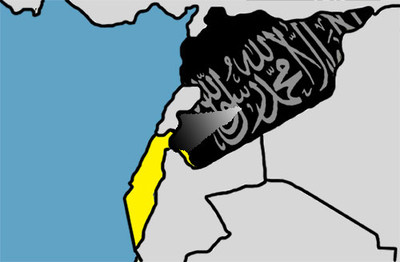
As conflict and mayhem continue to rage across Syria, the Israel Defense Forces (IDF) is preparing to encounter the threat of ISIS and al-Qaida forces right on its borders, and could encounter such threats in the coming months.

The preparations come as the Syrian civil war shows no sign of letting up. This is a conflict that has led to the violent deaths of 300,000 Syrians, and the displacement of more than 10 million others, 4.5 million of whom have fled the country.

Today, the IDF’s Military Intelligence Directorate views Syria as a former state that has broken apart into multiple ‘Syrias.’ The Assad regime controls barely 30 percent of Syria and is fully reliant on the foreign assistance of Russia, Hizballah, and Iran. Sunnis and Shi’ites wage daily war on one another.

It is worth examining the wider recent events in the multifaceted Syrian conflict, and place the IDF’s preparations in their broader regional perspective.

In Syria’s murderous kill-or-be-killed environment, Salafi-jihadist doctrines flourish, in the form of ISIS, which views Shi’ites (including the Assad regime and Hizballah) as infidels who must be destroyed.

ISIS cells have operated recently in Lebanon too, targeting Shi’ite Hizballah’s home turf of Dahiya in southern Beirut with two large bombings in November that claimed over 40 lives, while ISIS in Iraq continues to target Shi’ites.

Today, ISIS has between 30,000-50,000 members who are dedicated to expanding their caliphate and killing all those who disagree with their doctrine, including even fellow Sunni jihadi members of al-Qaida’s branch in Syria, the Al-Nusra Front, which has 8,000-12,000 members.

ISIS continues to use its territory in Syria and Iraq to plot major, mass-casualty terrorist attacks in Western cities. At the same time, its budgetary future looks uncertain, as oil funds have decreased significantly following allied air strikes on oil facilities. In the past year, 45 percent of ISIS’s $1.3 billion budget came from oil, far less than the oil revenue in 2014.

Unlike ISIS, al-Qaida believes in following a phased, slower plan in setting up a caliphate, and the two jihadist organizations have been at war with each other for more than two years in Syria.

Shi’ites led by Iran are fighting to stop the Salafi-jihadis’ spread. Under the command of Iranian Revolutionary Guard Corps (IRGC)-Quds Force unit commander, Qassem Suleimani, Iranian fighting forces and advisers moved into Syria. Iran has sustained more than 300 casualties there thus far.

Hizballah, too, is heavily involved in Syria’s battles, losing an estimated 1,300 fighters and sustaining 10,000 injuries – meaning more than half of its conscripted fighting force has been killed or wounded. Iran and its proxies are using the mayhem to try to spread their own influence in Syria.

Near Israel’s border with Syria, the Al-Yarmouk Martyrs Battalions, which is affiliated with ISIS, has set up many posts.

An estimated 600 members of the group control a population of around 40,000 Syrians. Al-Yarmouk is at war with al-Qaida’s Jabhat Al-Nusra, which maintains a few thousand members in the Syrian Golan near Israel.

Jabhat Al-Nusra’s membership is mostly derived of local Syrians, who tend to be more hesitant to start a war with Israel that would result in their areas, and relatives, being badly affected. Yet 10 to 15 percent of its membership comes from abroad, and have no commitment to the area. These foreign fighters have no qualms about precipitating attacks on Israel. At the moment, however, Jabhat Al-Nusra is bogged down by its fight with Al-Yarmouk.

ISIS has officially put Israel in its sights, and its leader, Abu Bakr Al-Baghdadi, declared his intention at the end of December to attack Israel.

The IDF is taking the threat seriously and is preparing for a range of possible attacks, including strategic terror attacks, cross-border raids, the sending of bomb-laden armored vehicles into Israel, and rocket, missile, small-arms, and mortar fire on the Israeli Golan Heights.

One possibility is that the heavily armed Al-Yarmouk group, which is facing the southern Golan Heights, might follow an Islamic State directive to attack Israel.

In 2014, Al-Yarmouk became an ISIS representative, swearing allegiance to it, though it is not fully subordinate to it.

Al-Yarmouk’s late leader, known as Al Khal (“the uncle”), was killed in November in an attack by Jabhat Al-Nusra. Before his violent end, Al Khal only partially committed himself to ISIS, and turned down ISIS requests to send fighters to Iraq.

Al-Yarmouk’s response to Jabhat Al-Nusra’s attacks came in December, when it assassinated a Jabhat Al-Nusra commander in his armored vehicle, just 400 meters from the Israeli border.

Al-Yarmouk subscribes to the Salafi jihadist ideology and has shoulder-held missiles, tanks, and other weapons looted during raids on the Assad regime military bases.

But Israel is also preparing for the possibility of encountering ISIS itself, not just an affiliate group.

ISIS proper is currently situated 40 kilometers from the Israeli border in southern Syria. One possibility is that Russian airstrikes will cause ISIS forces to ricochet southwards, towards Israel.

The IDF is gathering intelligence on all armed groups near its border, exhausting many resources to assess their capabilities, and intentions.

Israel watched as Shi’ite Hizballah came from Lebanon to block Sunni jihadist advances towards Lebanon in recent months, and as Russian airstrikes blocked the advance of the rebels northwards, to Damascus.

The IDF remains in a heightened state of alert along the Syrian border, though it is also working to avoid the creation of easy targets for the array of predatory forces on the other side.

As part of its preparations, the IDF’s Northern Command has given more autonomy to regional field commanders to enable faster responses to surprise attacks by reducing the initial chain of command during emergencies.

Inter-branch cooperation between intelligence, ground forces, and the air force has also been tightened.

Additionally, the IDF has fortified its border fence with Syria, adding electronic sensors to better be able to detect and respond to a potential attack in time.

The underlying assumption within military circles is that, sooner or later, ISIS will turn its guns on Israel, and the IDF does not intend to be caught off guard when that happens.

Obama’s Fake Syrian Peace Talks Falling Apart

January 29, 2016

Obama’s Fake Syrian Peace Talks Falling Apart, Front Page Magazine, Daniel Greenfield, January 29, 2016

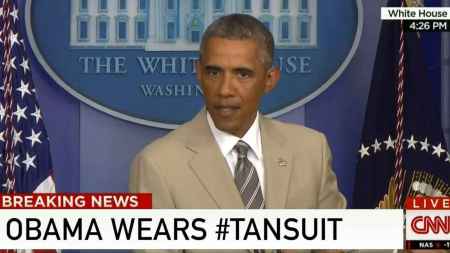
obama-wears-tan-suit-149481242256_6

The peace talks strategy for Syria comes out of Iran and Russia, two countries determined to keep Assad in power. Obama wanted the peace talks in order to rig a fake settlement that would come apart once he was out of office. But the only people fooled by this were stupid enough to get their news from CNN and their talking points from Think Progress. The Sunni side only participated to the extent that they could wreck the talks and extract some demands. They have no intention in signing on to Assad staying in power or to letting Obama get away with a fake solution that does just that.

And, oh yes, no one actually thinks Obama has any credibility.

As the Obama administration pushes for peace in Syria, its credibility is crumbling among Syrian opposition leaders, many of whom increasingly doubt the U.S. is serious about ending the rule of dictator Bashar Assad.

Because he isn’t.

If the talks peter out or collapse, that will further undermine President Barack Obama’s foreign policy legacy, which already has been tarnished by the endless bloodshed in Syria

It’s okay. Obama will blame Tom Cotton or Bush or Israel. Or someone. And the media will go along with it.

“A number of the opposition has expressed the feeling that the U.S. is not acting as an honest broker and that they’ve lost both trust and faith in the ability of the United States to deliver on a political settlement in Syria,” said Andrew Bowen, a senior fellow at the Center for the National Interest who has contacts among Syrian opposition groups.

Obama signed on with Iran. So he’s about as much of an honest broker as any other foreign agent.

“Kerry did not make any promises, nor did he put forward any initiatives,” said Khaled Khoja, president of the opposition Syrian National Coalition, in onestatement questioning U.S. intentions. “He has long been delivering messages similar to those drafted by Iran and Russia, which call for the establishment of a ‘national government’ and allowing Bashar al-Assad to stay in power and stand for re-election.”

Well yes. What else do you expect Kerry to do? This is the only thing he’s been doing since he got to the Senate and even beforehand with the Viet Cong. Traitors gotta traitor.

Among the numerous reports floating around — some of them highly speculative — are those that allege Kerry warned opposition leaders they could lose international support if they didn’t attend Friday’s talks. The reports come as the U.S. has appeared to be backing away from its demand that Assad must leave office by signaling its support for the notion of a transitional period.

And that period will come to an end once Obama is out of office.

But all this is theater anyway as the groups with the most fighters on the ground, including Al Qaeda and ISIS, are not represented. Most of the Islamists aren’t either. So this is just the Muslim Brotherhood, whose actual strength is weak, throwing a tantrum. Even if the Sunni groups signed some sort of deal it would be as worthless as the fake elections Hillary still talks up in Libya

Russians let Hizballah into Daraa, breaking their promise to Israel

January 28, 2016

Russians let Hizballah into Daraa, breaking their promise to Israel, DEBKAfile, January 28, 2016

Syria_South

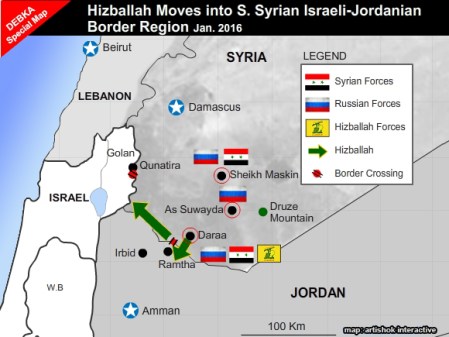
On Wednesday, Jan. 27 a large Hizballah force entered the southern Syrian town of Daraa, a critically dangerous event for Israel’s security. The way to the town, which lies near the Jordanian border and across from the Israeli Golan, was opened before Hizballah by none other than Russian forces. This was a blatant violation of President Vladimir Putin’s commitments to Prime Minister Binyamin Netanyahu and Jordanian King Abdullah not to permit Iranian and Iran-backed forces, such as Hizballah and Iraqi and Afghani Shiite militias, reach their borders in consequence of Russia’s military intervention in the Syria war.

Daraa is just 32 km from the southern Golan and 12 km from the Jordanian border. Hizballah forces in this town are therefore within easy striking distance from northern Israeli and Jordan.

What happened Wednesday was that a sizeable Hizballah contingent made it into Daraa, the day after a Syrian unit under the command of Russian officers captured the town of Sheikh Maskin, cutting off rebel forces east of Daraa from their comrades to the west.

Control of Sheikh Maskin is the key to the crossroads leading to Damascus in the north, the Druze Mountain town of es-Suwaida in the east, and Quneitra on Golan opposite Israel’s northern defenses.

The battle for Sheikh Maskin was the first in the Syrian conflict to be directly fought under Russian command. Its fall sparked accounts of Russian officers commanding Syrian troops in different parts of Syria.

So far, Israel has not reacted to the Hizballah force’s advance, notwithstanding public statements by Prime Minister Binyamin Netanyahu and Defense Minister Moshe Ya’alon that this would never be allowed to happen.

DEBKAfile’s military sources explain this reticence by a persistent misreading of the Syrian crisis in the higher ranks of the Israeli defense establishment. Military Intelligence chief Maj. Gen. Herzl Halevi, who has a good grasp of its complexities, is a lone voice against the defense minister and IDF chief of staff, Lt. Gen. Gady Eisenkot

In Amman, however, King Abdullah and his generals signified both alarm and fury. DEBKAfile’s sources report that Wednesday morning, the king shot off an urgent message to President Putin demanding an explanation for the Russian officers’ action in opening the door of Daraa to hostile Hizballah fighters.

Jordan has fought Hizballah and its conspiracies for three years, ever since its security forces seized an arms cache that Hizballah had smuggled into the kingdom for a terror cell to mount attacks in the northern province of Irbid. Amman is now concerned that Hizballah is close enough to make a grab for Al-Ramtha, the only border crossing between Syria and Jordan. That would be a feather in the cap of Iran’s Lebanese proxy, as the first Arab border crossing to fall to a Hizballah force outside Lebanon, and one, moreover, located athwart a main regional water source, the Yarmouk River.

As of Thursday morning, Jan. 28, Abdullah had not received a reply to his missive from Putin, but a message did come through to Amman from Syrian President Bashar Assad.

Using a back-door intelligence channel, he sent a notice in the name of Gen. Bahjat Suleiman, former Syrian ambassador to Jordan until he was expelled in May 2014, that King Abdullah must now face the consequences of his long support for the rebels of southern Syria.

The monarch was also advised to prepare for the influx of thousands of fleeing rebel fighters whom the combined Syrian and Hizballah forces were pushing towards the Jordanian border.

The next hours will be critical for the development of a similar crisis on the Israel-Syrian border in the Golan region.

Putin bypasses Israel, sets up joint war room for S. Syria with Jordan

January 14, 2016

Putin bypasses Israel, sets up joint war room for S. Syria with Jordan, DEBKAfile, January 14, 2016

Jordan_specail_forces

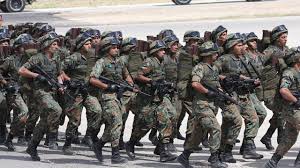
By teaming up with Jordan for a joint war room to cover operations in southern Syria, Putin has gone around Netanyahu’s back and acquired a helper for evicting Syrian rebels from southern Syria.

***************************

In a pivotal step reflecting the changeability of military and political deals in Israel’s neighborhood, Jordan has almost overnight agreed to establish a shared war room with Russia for the concerted conduct of their operations in Syria. This represents an extreme reversal of Amman’s policy. Until now, Jordan fought against Russia’s protégée Bashar Assad from a joint war room north of Amman called the US Central Command Forward-Jordan, as part of a lineup with the US, Saudi Arabia and Israel.

But this week Jordan shifted onto a new plane.

DEBKAfile’s military and intelligence sources say Jordanian King Abdullah’s decision to team up with Moscow starts a whole new ball game rolling on policy-making and intelligence-sharing. He doesn’t plan to shut down his shared command center with the US and Israel, but the center of gravity of Jordan’s military and intelligence efforts will be redirected to the new center with Russia, representing a major earthquake in those areas.

Amman is working hard to downplay the new partnership, presenting it as designed to foster better coordination between the American and Russian military efforts in Syria and the war on the Islamic State.

That picture is misleading.

With all due respect to the Jordanian monarch, his military and his intelligence services, they are not exactly qualified for the role of coordinator between the two world powers. The US and Russian presidents handle this in person. And in fact, the new Russian-Jordanian war room did come up, according to our Washington and Moscow sources, in the latest telephone conversation between the two presidents on Jan. 13.

Obama then held a quick meeting with King Abdullah at Andrews Air Force Base in Maryland and asked for an explanation.

For the various rebel militias holding out in large parts of southern Syria, including the Israeli border regions, the new Jordanian-Russian war room is bad news. Hitherto, Jordan provided the rebels with their main pipeline for fighters, weapons and funds from the US, Saudi Arabia and the UAE. The US even ran training camps in Jordan for Syrian rebel fighters.

This pipeline is now likely to be shut down or reduced to a minimum.

The Jordanians gloss over their shift, claiming it is designed to force the Syrian rebels of the South to accept a ceasefire and join peace talks with the US and Russia on Syria’s future. That is no more than diplomatic-speak for the real purpose, which is to compel them to give up the fight against Assad, and make way for Moscow to achieve its key objective, which is to restore the Assad regime’s control over the South.

Ever since his major intervention in Syria, Putin has tried to persuade Prime Minister Binyamin Netanyahu to pull the rug from under the Israeli-backed rebels in the South. They are deemed as a necessary buffer for securing Israel’s northern border and blocking the reimposition of Assad’s authority there.

The content of the exchanges between Putin and Netanyahu has only been shared with tight circles of confidants in Jerusalem and the Kremlin, so little is reliably known about their areas of agreement and dispute.

There is no doubt that the prime minister spoke firmly about Israel’s abiding concern that, once Assad regained control of the South, he would open the door up to the Israeli border and let in his allies and Israel’s arch enemies, Hizballah and the mostly-Iraqi Shiite militias fighting under the command of officers from Iran’s Revolutionary Guard Corps.

By teaming up with Jordan for a joint war room to cover operations in southern Syria, Putin has gone around Netanyahu’s back and acquired a helper for evicting Syrian rebels from southern Syria.

Assad again controls Damascus thanks to Russian air strikes and intelligence

December 26, 2015

Assad again controls Damascus thanks to Russian air strikes and intelligence, DEBKAfile, December 26, 2015

Allous_Killed_25.12.15

Less noticed, was the UN plan to remove at the same time several thousands ISIS fighters from the Syrian capital and transport them to their Syrian headquarters. The latter project has not been trumpeted for good reason: It implies UN recognition of ISIS as a party in the Syria war.

***************************

The Russian air strike that Friday, Dec. 25, killed Zahran Aloush, founder of the most powerful Syrian rebel group Jaysh al-Islam and his deputy, gave President Bashar Assad a big break in the Syrian war, thanks to his powerful backer, Vladimir Putin.

This grave loss will accelerate the breakup of Syrian rebel strongholds in and around Damascus. It will also hasten the evacuation under a UN-sponsored ceasefire of at least 2,000 rebels from the Damascus region. Less noticed, was the UN plan to remove at the same time several thousands ISIS fighters from the Syrian capital and transport them to their Syrian headquarters. The latter project has not been trumpeted for good reason: It implies UN recognition of ISIS as a party in the Syria war.

For nearly five years, the war seesawed back and forth, with neither the Syrian army nor the insurgents gaining the upper hand for long, even after Tehran threw its Lebanese proxy, Hizballah,  into the fray to bolster Assad’s army.

Interventions by the US, Saudi Arabia, Qatar, the UAE, Jordan and Israel were too trifling and hesitant to tilt the balance in favor of the anti-Assad insurgent militias. Weapons supplies were inferior and tardy and kept the rebels heavily outgunned by the Syrian army’s tanks, helicopters and fighter jets, and helpless against the Iranian-made barrel bombs dropped by the Syrian air force.

The Obama administration was the architect of this uneven support strategy, going so far as to constrain the rebels’ other foreign backers against giving them the resources for carrying the day, aside from local victories.

This strategy had the effect of prolonging the vicious conflict – until it was cut short by two events:

1. In the summer of 2014, the Islamic State of Iraq and the Levant arrived in full force to capture the northern Iraqi city of Mosul, scattering seven Iraqi armed divisions to the four winds, and grabbing  their sophisticated American weapons, along with their arsenals, that were crammed with good American tanks, armored personnel carriers, and an assortment of surface, antitank and antiair missiles.

Part of this booty was diverted to ISIS Syrian headquarters in Raqqa.

2.  A year later, in late September 2015, President Vladimir Putin embarked on a massive buildup of Russian military strength in Syria – notably, his air and missile forces – for direct intervention in the war.

In contrast to President Barack Obama, who sought to keep his hand on the conflict by a complicated system of dribbling arms to select Syrian rebel groups, Putin went all out with massive military and strategic backing to assure the Syrian ruler and his Iranian ally of victory.

The Russian strategy is now becoming evident:  It is to drive the rebels out of the areas they have captured around the main cities of Latakia, Aleppo, Idlib, Homs, Hama and the capital, Damascus, giving them two options: join the opposition front around the table for negotiating an end to the war, or total eradication – even though Moscow and Washington have yet to agree which of the rebel militias belong around that table.

According to Moscow’s scale of priorities, the fight against the Islamic State must wait its turn until after Bashar Assad’s authority as president is fully restored and his country returns to his army’s control.

But on the way to this objective, Putin has run up against a major impediment: the failure of Iranian, Shiite militia, Hizballah and Syrian army ground forces keep up with his pace. The plan was for Russian air strikes and missiles to clear rebels out of one area after another and for pro-Assad ground troops to storm in and take over.

But these troops are proving too slow to press the advantage given them by the Russians.

Last week, the Russians decided to use their intelligence assets to speed things up. They borrowed an Israeli counter-terror tactic to start targeting key rebel chiefs for liquidation.

The death of the Jaysh al-Islamc commander as the result of a Russian airborne rocket strike on Friday was an intelligence feat rather than a military one. Just as Israel last Sunday used its clandestine assets in Damascus to precisely target the Hizballah-Iranian arch terrorist Samir Quntar at his home in the Jaramana district, so the Russians directed their agents on the ground to mark the secret meeting of Jaysh al-Islam commanders at Marj al-Sultan at the precise moment for taking them down.

This blow to the rebel movement, plus the mass-evacuation of its fighters from the Syrian capital, are major steps towards bringing the Syrian capital back under the control of the Syrian dictator.

US bows to Russian demand to keep Assad in office. Israel follows suit

December 16, 2015

US bows to Russian demand to keep Assad in office. Israel follows suit, DEBKAfile, December 16, 2015

kerry-meets-putin-moscow_15.12.15

After two tries, US Secretary of State John Kerry finally turned President Barack Obama away from his four-year insistence that Bashar Assad must go, as a precondition for a settlement of the Syrian conflict. Tuesday, night, Dec. 15, the Secretary announced in Moscow: “The United States and our partners are not seeking so-called regime change.”

After Kerry’s first try, Obama still stuck to his guns. He said in Manilla on Nov.19 that he didn’t believe the civil war in Syria “will end while the dictator remains in power.”

Almost a month went by and then, Tuesday night, after a day of dickering with Foreign Minister Sergei Lavrov culminating in a joint conference with Putin at the Kremlin, Kerry confirmed this evolution in US policy. The focus now, he said, is “not on our differences about what can or cannot be done immediately about Assad.” Rather, it is on facilitating a peace process in which “Syrians will be making decisions for the future of Syria.”

Rather, it is on facilitating a peace process in which “Syrians will be making decisions for the future of Syria.”

This statement brought Washington in line with Moscow’s demand for the Syrian president’s future to be determined by his own people.

This statement brought Washington in line with Moscow’s demand for the Syrian president’s future to be determined by his own people.

On this demand, Iran’s Ayatollah Ali Khamenei is even more obdurate than Putin.

DEBKAfile’s Middle East sources wonder about the measure of freedom the Syrian people can expect while it is clamped firmly in a military vice by Russia, Iran and Hizballah. However, this was of no immediate concern to the big power players. Washington’s surrender to the Russian and Iranian line on Assad’s future was offered in the short-term hope of progress at the major international conference on the Syrian question taking place in New York Friday.

Another major US concession – this one to Tehran – was scarcely noticed.

Earlier Tuesday, the UN nuclear watchdog’s 35-nation board in Vienna closed its investigation into whether Iran sought atomic weapons, opting to back the international deal with Tehran rather than dwell on Iran’s past activities.

This motif of going forward toward the future rather than dwelling on the past was a repeat of the argument for keeping Assad in power. It provided an alibi for letting Tehran get away with the suspicion of testing a nuclear detonation at its Parchin military complex, without forfeiting sanctions relief, by the simple device of denying access to UN nuclear agency monitors to confirm those suspicions.

In a single day, the Obama administration handed out certificates of legitimacy to the Syrian dictator, who is responsible for more than a quarter of a million deaths, and to Iran’s advances toward a nuclear weapon.

These epic US policy reversals carried three major messages:

1. The Obama administration has lined up behind Putin’s Middle East objectives which hinge on keeping Bashar Assad in power.

2. Washington endorses Russia’s massive military intervention in Syria, although as recently as last month Obama condemned it as doomed to failure.

3. The US now stands behind Iran – not just on the Syrian question – but also on the existence of an Iranian-Syrian-Hizballah alliance, based on a solid land bridge from Iran and the Gulf up to the Mediterranean coast under Russian military and political protection and influence.

Even more surprising were the sentiments heard this week in Jerusalem.

Our military and intelligence sources cite officials urging the government to accept the American policy turnaround. In some military circles, senior voices were heard commenting favorably on Assad’s new prospects of survival in power, or advising Israel to jump aboard the evolving setup rather than obstructing it.

Those same “experts” long claimed that Assad’s days were numbered. They were wrong then and they are wrong now.

Israel was forced to yield on the Iranian nuclear program, but its acceptance of the permanence of Assad and the indefinite presence in Syria of his sponsors, Iran and Hizballah, will come at a high price for Israel in the next conflict.

Under secret Moscow-Cairo deal, first Egyptair passenger flights to Damascus, Aleppo

December 7, 2015

Under secret Moscow-Cairo deal, first Egyptair passenger flights to Damascus, Aleppo, DEBKAfile, December 7, 2015

Egyptair_resume_flights_toDamascus-and-Aleppo_2.12.15

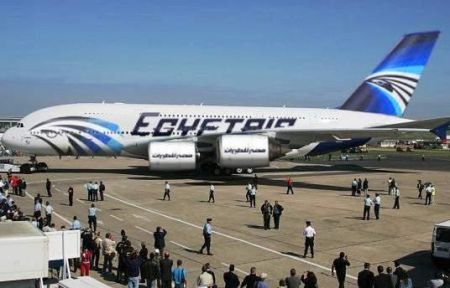
A new secret pact has taken shape in the Middle East. Last week, the offices of Russian Vladimir Putin and Egyptian President Abdel-Fatteh El-Sisi secretly formulated a tripartite accord for strengthening the ties between Moscow, Cairo and the Assad regime in Damascus, DEBKAfile’s exclusive military sources reveal. The pact had its first visible manifestation in the unannounced landings last Wednesday, Dec. 2, of the first Egyptair passenger flights at Damascus international airport and Aleppo in northern Syria.

The Egyptian national airline thus became the first of any Arab airline to renew flights to the war-torn Syrian capital since 2012. (see photo)

President El-Sisi’s gesture was tantamount to an eloquent vote of support for the Syrian ruler Bashar Assad in the face of his opponents in the Arab arena. It was also a demonstration of confidence in the Russian policy of preserving the Syrian ruler in power in the face of powerful voices in the West and the region calling for his ouster.

By sending a passenger plane to a Syrian airport, Egypt’ signaled its affirmation that Russian military intervention in Syria was making the embattled country a safer place where airliners could land without fear.

Moscow therefore attached supreme importance to the opening of the Egyptian-Syrian civilian air route, so much so that President Vladimir Putin pushed hard for it to take place ahead of the conference of Syrian rebel groups opening in Saudi Arabia Tuesday, Dec. 8.

In diplomatic communications with Riyadh, the Russians urged the Saudi hosts to prevail on the rebel groups whom they support with arms and cash to agree to enter into direct negotiations with Assad for ending the war.

Putin rewarded the Egyptian president for his gesture by ordering Russian airlines to resume their flights to Egypt. Those flights were suspended after the Russian Metrojet airliner was downed over Sinai by terrorists on Oct. 31 and 224 lives were lost in the crash. Their resumption will see Russian tourists again visiting Egypt, restoring a precious source of revenue to the strapped Egyptian economy, estimated at $5 bn per annum.

Our sources in Moscow declined to say whether the Russian passenger planes would again be calling at Sharm El-Sheikh like the ill-fated Metrojet. For the time being, they will most likely land at Cairo.

The Russian president is now trying to persuade El-Sisi to carry on making gestures for enhancing Assad’s standing.

Removing Assad ‘not necessary’ before political transition in Syria

December 6, 2015

Removing Assad ‘not necessary’ before political transition in Syria – French FM

Published time: 6 Dec, 2015 10:50

Source: Removing Assad ‘not necessary’ before political transition in Syria – French FM — RT News


A crack in the NATO wall ?

French Foreign Affairs Minister Laurent Fabius © Stephane Mahe
France has changed its hardline stance on the government in Damascus, with Foreign Minister Laurent Fabius saying he no longer believes that Syrian President Bashar Assad necessarily has to step down before a political transition takes place in the war-torn country.

“The fight against Daesh [Islamic State, or ISIS/ISIL] is crucial but it will only be totally effective if all the Syrian and regional forces are united,” Fabius told the French regional newspaper Le Progres.

This marks an apparent shift of priorities by France to tackling Islamic State, which staged a series of attacks on the French capital last month, killing 130 and injuring 352 others. Until recently, Paris echoed Washington in saying that Assad’s resignation is key to any political solution to the four-year Syrian conflict. Paris has repeatedly insisted on the removal of the Syrian president describing him as a “butcher” of his own people.

Paris now seems to accept that the Syrian army has to play a role in the fight against ISIS. “The operations must be led by local forces: moderate Syrian, Arab, Kurdish, and if necessary, in coordination with the Syrian army, which is impossible without a political transition,” Fabius told Le Progres, explaining that “the experience of the recent decades, whether it is in Iraq or in Afghanistan, shows that Western forces on the ground quickly appear like occupation forces.”

Read more

U.S. President Barack Obama © Benoit Tessier

Fabius did insist, however, that eventually Assad must go.

“A united Syria implies a political transition. That does not mean that Bashar al-Assad must leave even before the transition, but there must be assurances for the future,” he added.

Even so, the comments mark a sudden but clear softening of Paris’ position toward the Syrian president. Just earlier this week, French FM stated that working with the Syrian army to fight ISIS is not possible until Assad has been removed from power.

“If we achieve a political transition and it’s no longer Bashar in charge of the Syrian army, there could be joint actions against terrorism. But under Bashar it’s not possible,” Fabius told France Inter radio, speaking at the UN climate conference in Le Berget.

“It is obvious that it’s not under the leadership of Mr Assad that the army could be engaged alongside the moderate opposition,” he added on Monday.

On a trip to Washington last week, French President Francois Hollande said Assad “cannot be the future of Syria,” saying he must resign “as soon as possible” to halt civil war in the country.

Meanwhile US President Barack Obama told a news conference on Tuesday that ceasefires may soon be established in some parts of Syria, following the achievements in the Vienna negotiations by US Secretary of State John Kerry and Russian Foreign Minister Sergey Lavrov.

“What can happen is if the political process that John Kerry has so meticulously stitched together, in concert with Foreign Minister Lavrov of Russia, if that works in Vienna, then it’s possible given the existing accord that the parties have already agreed to, that we start seeing at least pockets of ceasefires in and around Syria,” Obama told reporters before leaving the global climate summit in Paris.

The US president also repeated his assertion that that Russia is welcome to join the US-led anti-ISIS coalition, on condition that it stops supporting the Syrian government.

But he added: “I don’t expect you’re going to see a 180 [degree] turn on [Russia’s] strategy over the next several weeks.”

Oh by the way, Turkey is trying to get into a war w/Iraq

December 6, 2015

Oh by the way, Turkey is trying to get into a war w/Iraq, Front Page Magazine, Daniel Greenfield, December 6, 2015

hqdefault_1

Open question: What does Turkey’s deranged Islamist leader have to do to be disavowed by NATO, Europe and the US?

Erdogan armed terrorists in Syria, but pretty much everyone is doing that. He nearly began a war with Russia. Now Iraq keeps ordering Turkish troops off its soil. But they’re there at the supposed request of Sunnis militias around Mosul. Possibly to fight ISIS. But considering Turkey’s track record and Baghdad’s protests, probably not.

It’s a given that Baghdad, which has become a puppet regime for Iran, would oppose arming Sunni militias. Its preferred means of operation is through Iranian trained Shiite militias.

Since Turkey is really in Syria to overthrow Assad, it looks like its version of the Sunni-Shiite conflict is spreading to Iraq. Essentially Turkey is advancing into a war with the Shiite axis of Iran-Syria and its Russian patron, not to mention all the various Shiite terror militias.

I won’t object if Sunni and Shiite terrorists and their state sponsors shoot and bomb each other. Especially if it’s Turkey and Iran, but as long as Turkey is in NATO, its lunatic tyrant trying to revive the Ottoman Empire has the ability to drag us into his wars.

And that’s an obvious problem.

Turkey should not be in NATO. And only a madman would consider it for EU membership.

But Erdogan’s migrant games have forced Germany to come crawling to him offering cash and EU membership acceleration.

Obama, who was once closest to Erdogan, is obviously not about to cut him off no matter what he does. But the United States is now in the strange position of having a ridiculously confused presence in a Muslim civil war.

Obama is backing Sunni Jihadists in Syria and Shiite Jihadists in Iraq. He refuses to arm Sunni militias in Iraq, but stands by while Turkey carries out what is effectively an illegal invasion of Iraq. (Remember that one the next time Kerry squeals about Jews living in Jerusalem.) He backs Kurdish militias that Turkey is bombing. He’s trying to appease Iran and Turkey at the same time and it can’t work.

The only thing Obama has managed to do is shove the United States in the middle of a Muslim civil war while making occasional noises about un-Islamic ISIS.