Posted tagged ‘Assad’

Syria Ceasefire Already Collapsing

March 8, 2016

Syria Ceasefire Already Collapsing, Front Page MagazineJoseph Klein, March 8, 2016

syria-bashar

The two week “cessation of hostilities” within Syria is about to run out. Negotiated by the United States and Russia, who were responsible for bringing the parties over which they have influence along, the lull was intended as a confidence building measure and as a way of getting critical humanitarian supplies to besieged and hard to reach areas of Syria. Talks between Syrian government and opposition representatives are supposed to resume in Geneva on March 9th.

Secretary of State John Kerry hailed the agreement to temporarily halt the violence in a conflict that has taken more than 250,000 lives as “a moment of promise.”  While there is evidence that the fighting has dropped noticeably overall since the cessation of hostilities went into effect on February 26, 2016, the violence never really stopped. On the second day alone of the lull, there were reportedly “35 breaches, 27 by violations by government forces, 8 by Russian forces,” according to the Syrian Network for Human Rights.

Airstrikes continued throughout Syria, some by Russia on the pretext that they were aimed at fighting ISIS and al Nusra. Rebel-held enclaves in and around Aleppo have come under particularly intense bombing attacks, said to be by Russian planes.

The Syrian Observatory for Human Rights said last Saturday that 135 people have lost their lives in areas where there was supposed to be a pause in hostilities. According to Israeli sources, the Syrian government has reportedly used chemical weapons against civilians since the cessation of hostilities were supposed to go into effect.

The United Nations has nevertheless been able to use the drop in hostilities to deliver some desperately needed humanitarian relief, although it has been stymied by bureaucratic obstacles put in the UN’s way by Syrian authorities. Sometimes, Syrian officials have gone so far as removing medical supplies from humanitarian convoys that had received permission to deliver their cargoes.

Perhaps the United States and Russia will push for an extension of the cessation of hostilities. Kerry and his Russian counterpart, Russian Foreign Minister Sergei Lavrov, have called for a prompt resumption of the peace talks in Syria, which would be hard to assemble if fighting resumes full throttle. They are evidently hoping that the partial success of the lull in fighting so far will provide momentum for successful talks. If so, they are dreaming. Kerry in particular is relying on the fatally flawed road map to a negotiated political solution in Syria that was laid out in last December’s UN Security Council Resolution 2258 (2015).  As I wrote last December when the resolution was adopted, the players were simply kicking the can down the road to no avail.

The Syrian regime, with Russia’s help, has made major military gains on the ground in recent months. Momentum is on its side. The opposition groups are losing negotiating leverage every day as a result of the regime’s advances and the opposition’s own internal divisions. Though the opposition is at least united on calling for Syrian President Bashar Al-Assad to step down immediately, they are whistling in the wind. Assad has no reason to go as long as Russia and Iran remain willing to stand behind him.

Russia has clearly changed the whole strategic situation in Syria by showing its willingness to engage militarily to the extent necessary to keep Assad in power as long as he serves their purposes. Just as President Obama foolishly dismissed the ISIS threat early on, his dismissal of Russia’s determination and capabilities was premature, to say the least.

The Obama administration’s vacillations in its Syrian policies, which left vacuums for both ISIS and Russia to fill, are now limiting its options going forward. Even in the unlikely case that President Obama now believes that the introduction of a large number of U.S. ground troops has become necessary to fight ISIS, give a nudge to Assad to abdicate and help stabilize what is left of Syria, the American people would not support the prospect of another protracted conflict in the Middle East.

Moreover, the Obama administration cannot even lead the way among its own allies, much less bridge the gap with Russia and Iran who remain committed to Assad. The administration’s efforts to assemble a real coalition of Arab nations willing to commit major ground troops to fight ISIS in tandem with our stepped up airstrikes have gone nowhere. Saudi Arabia and Qatar do not appear willing to cut off the flow of arms and money to the jihadists, whether or not they belong to ISIS or al Nusra. Saudi Arabia is even insisting on which opposition groups should officially represent the opposition in the Geneva talks, with little apparent pushback from the Obama administration.

Turkey is presenting its own headaches for the Obama administration. Its strongman president Recep Tayyip Erdogan accused the Obama administration of adopting a policy that has turned the Mideast into “a sea of blood.” He was particularly upset that the U.S. is relying on Kurdish fighters in Syria to help take on ISIS. The Kurds have been among the most effective ground forces we have to push back ISIS from territories it controls. Erdogan, however, regards the Kurds as terrorists who are more dangerous than ISIS. He blocked the Syrian Kurds from having any official representation in the Geneva peace talks, and is asking the U.S. to choose between Turkey and the Kurds as allies. The way Erdogan has been acting the last several years, we should tell him that unless he starts to fully cooperate and subordinate his parochial concerns to the global fight against ISIS, we will be prepared to support an independent Kurdistan right on his border. That should get his attention.

In short, the cessation of hostilities interlude, even if extended, will do nothing to change the underlying dynamics preventing a viable peace accord leading to the kind of inclusive Syrian government the Obama administration would like to see. However, to the extent lives have been saved and humanitarian relief has been allowed to get through for the first time, the pause in fighting has been a good thing in itself.

Turkey and Saudi Arabia hit back for the Obama-Putin Syrian pact

March 5, 2016

Turkey and Saudi Arabia hit back for the Obama-Putin Syrian pact, DEBKAfile, March 5, 2016

Zaman_4.3.16Headline of last issue of Turkey’s Zaman before government takeover

Turkey and Saudi Arabia have taken separate steps to break free from Washington’s dictates on the Syrian issue and show their resistance to Russia’s highhanded intervention in Syria. They are moving on separate tracks to signal their defiance and frustration with the exclusive pact between Presidents Barack Obama and Vladimir Putin which ostracizes Riyadh and Ankara on the Syrian question.

Turkey in particular, saddled with three million Syrian refugees (Jordan hosts another 1.4 million), resents Washington’s deaf ear to its demand for no-fly zones in northern and southern Syria as shelters against Russian and Syrian air raids.

Last year, President Reccep Erdogan tried in desperation to partially open the door for a mass exit of Syrian refugees to Europe. He was aghast when he found that most of the million asylum-seekers reaching Europe were not Syrians, but Muslims from Africa, Afghanistan and Pakistan, in search of a better life in the West. Most of the Syrians stayed put in the camps housing them in southern Turkey.

Even the Turkish intelligence agency MIT was hard put to explain this setback.  According to one partial explanation, organized crime gangs of Middle East dope and arms smugglers, in which ISIS is heavily represented, seized control of the refugee traffic heading to Europe from Libya, Iraq and Syria.
This human traffic netted the gangs an estimated $1 billion.

Turkey was left high and dry with millions of Syrian refugees on its hands and insufficient international aid to supply their needs. No less painful, Bashar Assad was still sitting pretty in Damascus.

Finding Assad firmly entrenched in Damascus is no less an affront for Saudi Arabia. Added to this, the Syrian rebel groups supported by Riyadh are melting away under continuing Russian-backed government assaults enabled by the Obama-Putin “ceasefire” deal’

The oil kingdom’s rulers find it particularly hard to stomach the sight of Iran and Hizballah going from strength to strength both in Syria and Lebanon.

The Turks threatened to strike back, but confined themselves to artillery shelling of Syrian areas close to the border. While appearing to be targeting the Kurdish YPD-YPG militia moving into these areas, the Turkish guns were in fact pounding open spaces with no Kurdish presence. Their purpose was to draw a line around the territory which they have marked out for a northern no-fly or security zone.

Saturday, March 5, President Erdogan proposed building a “new city” of 4,500 square kilometers on northern Syrian soil, to shelter the millions of war refugees. He again tried putting the idea to President Obama.

The Saudi Defense Minister, Deputy Crown Prince Mohammed bin Salman put together a more high-risk and comprehensive scheme. Its dual purpose is to hit pro-Iranian Hizballah from the rear and forcied [Sic] the two big powers to treat Riyadh seriously as a player for resolving the Syrian imbroglio.

The scheme hinged in the cancellation of a $4 billion Saudi pledge of military aid to the Lebanese army, thereby denying Hizballah, which is a state within the state and also dominates the government, access to Saudi funding. But it also pulled the rug from under Lebanon’s hopes for combating ISIS and Al Qaeda’s Nusra Front, which have grabbed a strip of Lebanese territory in the northern Beqaa Valley.

The Saudi action, by weakening the Lebanese military and its ability to shore up central government in Beirut, risks tipping Lebanon over into another civil war.

The London Economist commented that this Saudi step against Lebanon seems “amateurish.” Under the young prince (30), “Saudi Arabia sometimes acts with bombast and violence that makes it look like the Donald Trump of the Arab World,” in the view of the magazine.

But the Saudi step had a third less obvious motive, a poke in the eye for President Obama for espousing Iran’s claim to Middle East hegemony. Resentment on this score is common to the Saudi royal house and the Erdogan government.

As a crude provocation for Washington, the Turkish president ordered police Friday, March 4, to raid Turkey’s largest newspaper Zaman, after an Istanbul court ruling placed it under government control.

The newspaper released its final edition ahead of the raid declaring the takeover a “shameful day for free press” in the country. A group of protesters outside the building was dispersed with tear gas, rubber bullets and water cannons.

Zaman is owned by the exiled Muslim cleric Felhullah Gulen, who heads the powerful Hizmet movement, which strongly contests Erdogan government policies. A former ally of the president, the two fell out years ago. In 1999, after he was accused of conspiring to overthrow the government in Ankara, Gulen fled to the United States.

Today, the exiled cleric runs the Hizmet campaign against the Turkish president from his home in Pennsylvania, for which he has been declared a terrorist and many of his supporters arrested.

The takeover of Zaman was intended both as a blow by Ankara against Muslim circles opposed to the Erdogan regime and as an act of retaliation against the United States, for harboring its opponents and sidelining Turkey from Obama administration plans for Syria.

Oddly enough, the Turkish president finds himself in a position analogous to Egyptian President Abdel-Fatteh El-Sisi, who is at war with the Muslim Brotherhood, a movement which enjoys Obama’s support.

Israeli Prime Minister Binyamin Netanyahu has his own dilemmas. Struggling to keep his balance while walking a tight rope on the Syrian situation between Israel’s longstanding ties with Washington and handling the Russian tiger lurking next door, he is in no hurry to welcome Erdogan’s determined overtures for the resumption of normal relations.

Turkey is in trouble with both major world powers and, after living for five years under hostile abuse from Ankara, Israel does not owe Erdogan a helping had for pulling  him out of the mess.

Netanyahu phones Putin for clarifications on the South Syrian ceasefire

February 24, 2016

Netanyahu phones Putin for clarifications on the South Syrian ceasefire, DEBKAfile, February 24, 2016

PutinBibi2-480

Prime Minister Binyamin Netanyahu phoned President Vladimir Putin Wednesday Feb. 24, to find out how the partial Syrian ceasefire due to go into effect Saturday Feb. 27 will affect Israel’s northern border security. According to the Kremlin statement, “The two leaders discussed the Middle East and reached agreement to hold a number of high-level contact meetings.”

Agreement was also reached on “a range of contact [meetings] on the high and highest level, taking into consideration the 25tyh anniversary of the establishment of diplomatic relations between the two countries,” the communiqué went on to say.

The language and content of this communiqué struck DEBKAfile’s diplomatic sources as oddly off the point compared with statements that came after past conversations.

It is hard to believe that the Russian President, while deeply immersed in tense exchanges with President Barack Obama and Iran’s Hassan Rouhani for tying up the ends of the approaching Syrian ceasefire, would give his attention to the celebration of a historic event.

The words did however convey the impression that the Russian leader was making an effort to calm Israel’s apprehensions about the coming stage of the Syrian crisis.

According to our sources, Netanyahu put in the call to Putin when he learned that the Russian and American presidents had agreed to get the partial ceasefire started in southern Syria, namely on the front closest to the borders of Israel and Jordan.

Israeli and Jordanian military officials have been trying to get a picture of how these arrangements would work and affect their national security, but Washington and Moscow are similarly tightlipped on information. This is also the reaction the Israeli Foreign Ministry’s Director General Dore Gold found when he called on Russian Foreign Minister Sergei Lavrov in Moscow on Feb. 18. The minister was polite but avoided direct answers to questions.

Israel is most deeply troubled by the possibility that Syrian army, Iranian and Hizballah forces currently in offensive momentum in South Syria will exploit the cessation of hostilities to advance towards its Golan border with hostile intent.

With only three days to go before the truce goes into effect, Israel has still not received any clear answers about whether the Russian air force will continue to strike Syrian rebel elements deemed “terrorists” unabated in close proximity to its northern borders.

US officials have tried in the last 24 hours to assuage Israel’s concerns, but they are no more forthcoming with clear information than the Russians.

Netanyahu therefore picked up the phone to the Russian president, with whom he maintains a friendly dialogue, to find out what was ahead in the wake of the truce and to ask for guarantees that Syrian, Iranian and Hizballah forces would not permitted to take advantage of the lull to gain ground.

The prime minister also asked Putin about the huge $14bn arms deal in negotiation with Tehran.

He is most unlikely to have been appeased by the bone the Russian president threw him about a joint celebration of an anniversary. The record is not assuring. In early January, Putin promised Netanyahu that he would make sure that Hizballah forces would not be part of the Russian-backed Syrian army offensive in the South. But then, on Jan. 27, a large Hizballah force entered the southern town of Daraa and Russian air strikes drew ever closer to the Israeli border, until explosions could be heard in Israel from a distance of no more than a few hundred meters.

Shoigu in Tehran to rescue Putin’s plan from Assad’s Iranian-backed obstructionism

February 22, 2016

Shoigu in Tehran to rescue Putin’s plan from Assad’s Iranian-backed obstructionism, DEBKAfile, February 22, 2016

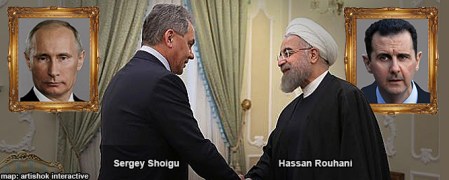
Shoigu_Ruhani

President Vladimir Putin this week mounted a rescue operation to unsnarl his blueprint for a solution of the Syrian crisis from the blockage placed in its path by none other than Bashar Assad. The Syrian ruler won’t hear of Moscow’s proposals for ending the war, or even the cessation of hostilities approved last week in Munich by the 17-member Syria Support Group.

DEBKAfile reports that the strains between Moscow and Damascus this week have blown back onto the working relations between the Russian, Syrian and Iranian military commands running the war in Syria.

US Secretary of State John Kerry, referring to the lack of progress toward a ceasefire during a visit to Amman Sunday, Feb. 21, pointed mainly at the Syrian opposition. Its High Negotiations Committee insists first on an end to the sieges, a halt on Russian bombardment and the inclusion of the jihadist Nusra Front in the ceasefire.

But, according to our sources, the main monkey wrench has been thrown into the mix by Assad.

When Putin discovered that the Syrian ruler had won the secret backing of Tehran in h is refusal, he decided to send the supreme commander of the Russian campaign in Syria, Defense Minister Gen. Sergei Shoigu, to Tehran Sunday, Feb. 21, with a personal message for President Hassan Rouhani.

Gen. Shoigu laid before Rouhani the extent to which Russian intervention had turned the tide of the Syrian war in favor of the regime, and the great advantages of a political resolution that would end the conflict in a way that enhanced Russian and Iranian influence in the region to the maximum.

The Russian general stressed that at the end of the proposed political process, Assad would be required to step down. This concurrence was incorporated in the Putin-Obama deal for working together to solve the Syrian crisis.

But Rouhani was unmoved, according to the statement he issued at the end of the interview.

“The crisis in Syria can only be solved through political negotiation and respect for the rights of the country’s government and people, who are those taking the final decision regarding its future,”  he said.

This was taken in Moscow as Iran’s rejection of at least one element of the Putin plan – imposing a solution on Assad – but not the plan in its entirety. This qualified response was meant to nudge Moscow closer to Teheran and Moscow and pull away from Washington.

The Shoigu mission therefore did not lessen the strains between Russia, Iran and Assad – at least for now, according to DEBKAfile’s sources.

Although all the parties concerned agree that the war must be ended by political means, those means are the subject of controversy between Moscow and its allies. The Russians are seeking a staged advance towards the final goal by first scaling down military operations, the while gradually refocusing their efforts on political and diplomatic arrangements.

But Syrian and Iranian leaders want to keep the focus on the military course.

Moscow wants the Assad regime to make concessions for paving the way to a cease-fire, and to accept a transitional government taking over in Damascus with representation for the opposition. The Syrian dictator would then gradually transfer his powers to the stand-ins as they assume responsibility for the various branches of government.

But both Assad and Tehran are adamantly opposed to a transitional government being installed – or any other political steps being pursued – before the rebel forces are totally defeated in non-stop military operations – first in the north and then in the south.

Neither the Syrian ruler nor Iran show any sign of relenting, or appreciating that the dramatic progress achieved in the past month by Syrian army, Iranian and Hizballah forces were down to Russian military support and especially its air campaign against their enemies. They feel safe in their intransigence because they assume that Putin can’t afford to abruptly pull his military support from under their feet to make them bow to his demands.

After five months in which Moscow and the Russian air force have provided the Iranian leadership and Assad with signal victories on the ground, President Putin has been brought up short by the same Iranian-Syrian negative obstructionism, that has defied every effort to end the brutal five-year war, which has cost 470,000 lives, left 1.9 million injured, displaced half the country’s population of 23 million and left a Syria ravaged beyond recognition.

Russia air strikes seal Jebel Druze against attack and refugees

February 21, 2016

Russia air strikes seal Jebel Druze against attack and refugees, DEBKAfile, February 22, 2016

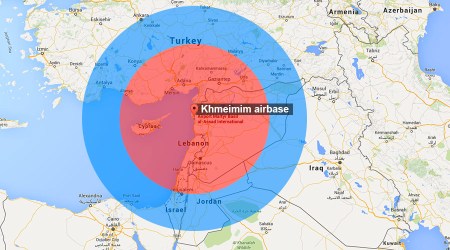
2717545 10/10/2015 Russian Su-25 attack aircraft take off from the Khmeimim airbase in Syria. Dmitriy Vinogradov/RIA Novosti

2717545 10/10/2015 Russian Su-25 attack aircraft take off from the Khmeimim airbase in Syria. Dmitriy Vinogradov/RIA Novosti

While Syrian war reporting focused over the weekend on the battles around Aleppo and along the Turkish border in the north, Russia since Saturday, Feb. 20 has ramped up its air bombardment of southern cities and towns, especially Daraa and Nawa. Thousands of fleeing rebels with their families and other civilians have meanwhile been turned away from the locked Jordanian border and are heading towards the Golan opposite the Israeli border.

The heaviest Russian air strikes seen hitherto in Syria have two strategic goals.

1. To retake the key southern town of Daraa from rebel hands and restore it to Syrian President Bashar Assad’s full control.

2. To crush rebel resistance in the South and force them to accept surrender, collapse or escape in the direction of the Jordanian or Israeli borders.

The intense Russian sorties are opening the door to Syrian, Iranian and Hizballah forces to move into the South and reach the Israeli borders. Prime Minister Binyamin Netanyahu sent Dr. Dore Gold to Moscow last week as his special emissary to explain how this affected Israel’s security. But he was unable to persuade the Russians to scale down their attacks in this sensitive border region.

Those attacks have a third goal, which is to encircle the Jebel Druze region with a “shield of fire” as protection for this ethnic minority of 750,000, most which inhabit mountain villages.

This unusual operation, the first of its kind in the Syrian war, has three objectives:

A. To shield the Druzes villages against ISIS attack from the east, namely Deir az-Zour.

B. To shut the door against fleeing rebels seeking sanctuary in the Druze enclave.

C. To show other Syrian minorities, especially the Kurds in the north, the great advantage of allying themselves with Moscow. Word of Russian protection of the Druzes has undoubtedly spread to Syria’s other minorities.

As for the rebels and refugees, Jordanian troops moved into the border crossings evacuated by Syrian rebels and closed the last crossing at Ramtha.

The exodus from southern Syria is now heading towards the Golan on Israel’s doorstep.

Israel has imposed a media blackout on this development. However, DEBKAfile’s sources warn that it will soon be impossible to keep it dark. Within a few days, many thousands of Syrian refugees will be massing at Israel’s Ein Zivan gate opposite Quneitra. Like Turkey and Jordan, Israel will have to supply large numbers of distressed Syrian refugees with tents, food, water and medicines.

Russian Magazine: Russia’s Air Force In Syria Is Winning The Battle For Assad

February 17, 2016

Russian Magazine: Russia’s Air Force In Syria Is Winning The Battle For Assad, MEMRI, February 17, 2016

(Please see also, Moscow on the Tigris: Russia Joins the Terror Nexus:

While an exhausted and burned out United States wishes international migraines like the Syrian civil war would just go away, Russia is energized by the prospect of filling the vacuum and thus once again playing a major role on the world stage. Aggressively intervening on behalf of his ally in Damascus, President Bashar al-Assad, and projecting force well beyond even the frontier states in his“near abroad,” Vladimir Putin audaciously aims to change political outcomes in a region that has been out of his country’s sphere of influence for a generation.

— DM)

Recently, the Russian campaign in Syria reached its 100th day. An article in Expert Online, the website of the influential Russian analytical magazine Expert, reviews the state of the Syria war, analyzing the activities on various fronts as well as the Russian involvement. The article, by journalist Pyetr Skorobogatyj, states that, with Russia’s help, the Syrian army is advancing slowly but surely. It stresses that the operation in Syria is not a substantial financial burden for Russia, and that it benefits Russia in many ways – including by allowing it to train pilots, test the performance of various weapons, and target Russian-speaking militants who are fighting in Syria. Most significantly, it allows Russia to establish a permanent presence in the Middle East that has an impact on all the region’s countries.

The article then reviews the military situation in Syria region by region. Focusing first on the north, it stresses that the Kurdish forces there are making headway against ISIS and are laying down the foundations for what may eventually become a Kurdish autonomy or even an independent Kurdish state. The main loser, says the article, is Turkey, who is powerless to stop these developments from unfolding.

The article states further that Russia, using its S-400 missiles, has effectively set up a no-fly-zone in the north of Syria, thus enabling the regime forces to make substantial achievements against the rebels, especially in the Latakia area. It adds that the U.S., too, is planning to establish a military base in northeast Syria, in the Malikia area.

Moving to the southern region, the article states that the stalemate between the sides there – namely the regime forces and rebel groups backed by Jordan – has ended, since Jordan has ordered these forces to stop attacking Assad’s troops. In Damascus, too, the regime is slowly flushing out the rebels, street by street and building by building. As for eastern Syria, the article concedes that ISIS still maintains a strong presence there and will be difficult to defeat.

The following are excerpts from the article.[1]

 “The Air Campaign Is Not Expensive For Moscow, And It Allows Russia To Train Pilots And Test Different Types Of Weapons”

“As the Russian campaign recently reached its 100th day,[2] [Russia’s] main goal appears to be the use of military power to force peace on the ‘rational’ [i.e., non-jihadist] rebel groups. There are a number of small [rebel] groups which have either joined Assad’s military or have stayed independent but coordinate their activities with the Syrian army. [Russia’s] largest partner [apart from the Syrian army] is the Syrian Democratic Army [SDA], a Sunni popular militia which is fighting in the north [of the country] alongside the Kurds and government troops. The Russian Ministry of Defense has confirmed that Russia supports the SDA with weapons, ammunition and airstrikes. ‘For its part, the patriotic opposition [i.e. the SDA] coordinates its military objectives with the Russian aviation group,’ noted Lt. General Sergei Rudskoy, Chief of Main Operations Management in the Russian Army General Staff…

“The joint military campaign of the Russian Air Force and Syrian troops seems to be [progressing] slowly but surely. [The slow pace] is due to the broad spectrum of military goals which must be met, including pressure on all ‘factions’ in order to separate [potential] ‘partners’ from ‘enemies,’ as well as the necessity to return as much territory as possible to the Syrian government’s control, in order to enable it to negotiate from a position of strength about the country’s future. In addition, all the battle fronts seem chaotic, with many parallel ‘seething cauldrons’… and with weather conditions are getting worse… All of these factors together make Russian air operations difficult, especially during the winter period. This week the ‘bad guys’ [i.e. ISIS] used the cover of a sandstorm [which hampered Russian air activity] to mount a major offensive on Deir Al-Zor, a Syrian enclave in the desert. This action resulted in a major defeat for the Syrian side. As prevailing weather conditions worsen, the… intensity of the military campaign will decrease…

“Notwithstanding, during the first 100 days of Russian Air Force and Navy operations, 217 villages and towns were retaken, and 1000 sq. km. of territory. The Russian-Syrian coalition has no need to hurry. The air campaign is not expensive for Moscow, and it allows Russia to train pilots and to test the battle performance of different types of weapons. These benefits are in addition to the political gains and to the main goal, which is to eliminate Russian-speaking fighters in theaters far away from Russia’s borders.

“In addition, thanks to the new Russian air force base in the [the Syrian city of] Latakia, Moscow has established a permanent presence in the region, controlling a very important logistic hub. This modern military base (equipped with Iskander[3] and S-400[4] missiles)… changes the military and political situation in Iraq, Iran, Israel, the U.S… and, of course, Turkey”…”

“Russia Has Set Up A No-Fly Zone Using Its S-400 Surface-To-Air Missile System”

“[Meanwhile] the goals of the main participants in the Syrian battle have become clear. In the north of Syria… the Kurds are winning. They are finally receiving extensive military support from the U.S. and covert support from Russia. They are carrying out offensive operations against ISIS and expanding their territory, which might become a future Kurdish state or an autonomous region within Syria, depending on the final agreement… The main loser is Turkey, who is unpredictable, irresponsible and unable to keep agreements. Currently, [Turkish President Recep Tayyip] Erdogan can only look on as the Kurdish enclave continually grows stronger. [The Turkish President] can initiate military operations only on his own territory…

“The geopolitical value of northern Syria is understood by all parties. Russia has set up a no-fly zone [there] using its S-400 surface-to-air missile system… [while] Syria is strengthening its Al-Bab air base with Russian military advisors and the S-300[5] missile system. The Americans are not napping either, and plan to set up a military base in Malikia in north-east Syria… This will allow the U.S to carry out an independent policy without having to depend on the Kurdish state which is being established…

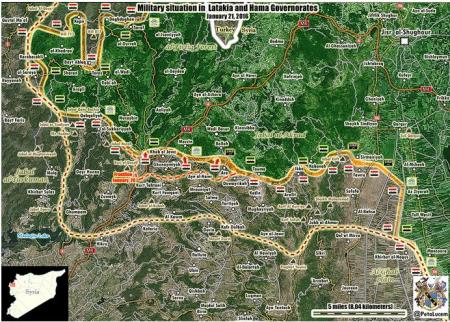
“The Syrian army, aided by Hizbullah’s brigades, is doing very well in the Latakia governorate. The map [below] clearly shows the movement of the fighting forces over the last few months. The dotted red line represents the front on October 7, 2015. In the first half of January 2016, government troops finally showed fighting ability against the Islamist stronghold of Salma… It was the first time that Russian military experts actively took part in the campaign, probably coordinating the attack on Salma. Support from Russian planes in the northern Latakia province allows the Syrian army to continue its advance at full speed…”

26798Military situation in Latakia and Hama areas, January 21, 2016

In The South, Jordan-Backed Rebels Have Been Ordered To Stop Attacking; In Damascus, The Government Is Flushing Out Islamists; In The East, ISIS Still Holds A Significant Area

“In the Dera province in the south, the opposing sides had [previously] agreed to maintain the status quo. Damascus was avoiding a conflict with Israel as well as with Jordan, which openly sponsored tribal forces and Islamist brigades… [Today, however,] the tactic of constant pressure [by Syrian regime troops on these forces and brigades] is producing results. The Military Operations Command [MOC] in Amman… which is coordinating rebel activities in southern Syria, has ordered [the forces it sponsors] to stop attacking [Syrian] government forces… Jordan’s logic is very simple… Syrian refugees in Jordan now total about 30% of the population, the same number as the Palestinians living in Jordan… so Jordan prefers to try to stabilize the situation in Syria rather than dream about cutting off Syria’s southern territories from the rest of the country. On the other hand, Damascus has begun to raise the issue of Israeli[-sponsored] rebels occupying the [Syrian] Golan Heights.

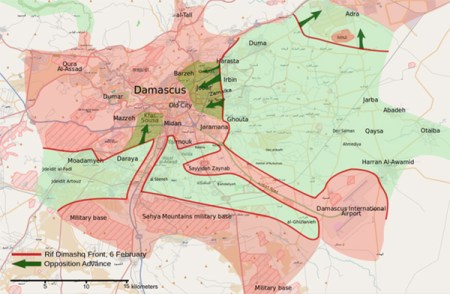
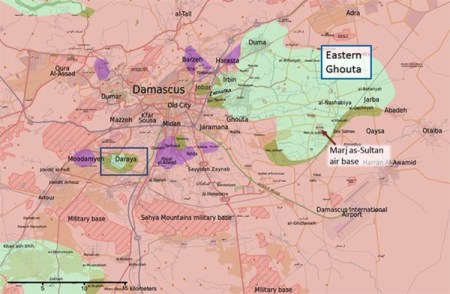
“In the Syrian capital, government troops are continuing to flush out Islamists and ‘bad guys’ from the city. The score is being kept not by counting streets retaken, but by counting buildings… The progress in the Damascus area is noticeable only when viewed over a long period of time. Below is a map showing the balance of forces in 2013, and beneath it a map showing the balance of forces in 2015.

26799Damascus area in 2013
26800Damascus’ area in 2015

“In addition, peace talks between the government and some rebel groups are now underway. Just recently, an agreement was made with a rebel brigade in the Al-Qadam suburb [in Damascus]. Some militants who were disarmed were moved to Raqqa and Idlib, while almost 1,500 others agreed to switch to Assad’s side…

“In spite of the relative success of government troops, ISIS still holds a significant area in the eastern part of Syria… The [ISIS] Caliphate is well-entrenched in the area it controls, with a strong force and command structure, and is not going to withdraw easily.”


Endnotes:

[1] Expert.ru, January, 22, 2016.

[2] The Russian campaign in Syria started on September 30, 2015.

[3] A Russia-manufactured portable short-range ballistic missile system; NATO designation name: SS-26 Stone.

[4] A Russia-manufactured anti-aircraft weapons system; NATO designation name: SA-21 Growler.

[5] A Russia-manufactured long range surface-to-air missile system;  NATO designation name: SA-10 Grumble.

‘Senior Official’ of Iran-Russia-Syria Alliance Brags About Subverting U.S. Diplomacy

February 17, 2016

‘Senior Official’ of Iran-Russia-Syria Alliance Brags About Subverting U.S. Diplomacy, Washington Free Beacon, Morgan Chalfant, February 17, 2016

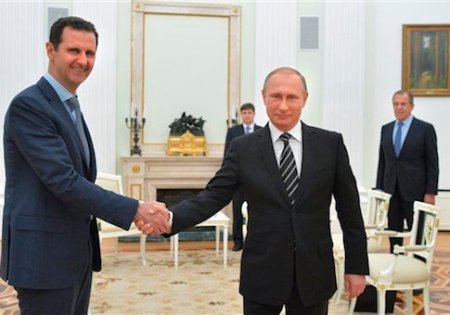
FILE - In this file photo taken on Tuesday, Oct. 20, 2015, Russian President Vladimir Putin, center, shakes hand with Syrian President Bashar Assad as Russian Foreign Minister Sergey Lavrov, right, looks on in the Kremlin in Moscow, Russia. When Russian Foreign Minister Sergey Lavrov said his country is ready to aid Syrian rebels fighting Islamic State militants on the ground, rebel commanders scoffed at the notion, pointing out that Russian aircraft were pounding rebel bases in central and northern Syria on daily basis. (Alexei Druzhinin, RIA-Novosti, Kremlin Pool Photo via AP, File)

FILE – In this file photo taken on Tuesday, Oct. 20, 2015, Russian President Vladimir Putin, center, shakes hand with Syrian President Bashar Assad as Russian Foreign Minister Sergey Lavrov, right, looks on in the Kremlin in Moscow, Russia. (Alexei Druzhinin, RIA-Novosti, Kremlin Pool Photo via AP, File)

A “senior official” of the military alliance between Iran, Russia, and Syria that is currently waging a ground offensive in Aleppo boasted about subverting U.S. diplomacy in a recent interview with an U.S. newspaper.

The official told the Wall Street Journal that military forces from Iran, Russia, and Syria would use a recent ceasefire deal brokered by world powers—including the United States—not to take steps towards a peaceful resolution of the Syrian war, but to consolidate their military gains.

The Journal reported:

“These allies are together in the same command center, working, planning and coordinating their operations in the battlefield,” said a senior official in the Iran-Russia-Syrian regime military alliance. “Retaking Aleppo will restore the regime’s strength and control over Syria; toppling the regime is now a thing of the past.” A cease-fire as proposed by world powers in Munich last week, he said, would simply be a pause for the Iran-led ground forces to consolidate recent territorial gains.

Thousands of fighters organized by Iran—including Hezbollah, the Islamic Revolutionary Guard Corps, and Shia fighters from Afghanistan, Iraq, and other countries—have launched the assault on Aleppo alongside Syrian army forces. Emboldened by Russian airstrikes, the fighters have been able to advance on Syria’s largest city.

There is some doubt regarding whether the ceasefire will be implemented at all. The deal was established by global powers on Friday, though neither Assad nor the Syrian opposition formally signed off on it. The deal was supposed to allow humanitarian aid to be sent to Syria and commence peace negotiations. The United States hoped that the ceasefire would be implemented in a week’s time.

Hours before the ceasefire was announced, Assad vowed to retake Syria in its entirety in an interview published by AFP.

Iran has put billions of dollars toward backing Assad, and Russia has launched a military intervention in Syria to back the Assad regime under the guise of fighting terrorist groups.

While the Obama administration has long said that Assad must be removed from power, the United States has softened that stance since 2011, when the Syrian civil war began. Secretary of State John Kerry said in December that the administration was not seeking a “regime change” in Syria following a meeting with Russian President Vladimir Putin.

“The United States and our partners are not seeking so-called regime change,” Kerry said then, indicating that world powers were focused on achieving a peace process in which “Syrians will be making decisions for the future of Syria.”

Both Russia and Iran have resisted any effort to oust Assad.

Russian-Turkish clash building up over Syria

February 14, 2016

Russian-Turkish clash building up over Syria, DEBKAfile, February 14, 2016

Turkish-self-propelled_howitzers_13.2.16

Turkish President Tayyip Erdogan clearly took a calculated risk when he ordered a two-our cross-border artillery bombardment Saturday, Feb. 13 of Syrian army forces positioned around the northern Syrian town of Azaz and the Kurdish YPG militia units which two days earlier took control of the former Syrian military air base of Minagh some six kilometers from the Turkish border.

Kurdish troops backed by the Russian air force seized that base last week from rebel militias as part of the operation for cutting the rebel groups under siege in Aleppo from their supply routes. The Turkish bombardment was therefore an indirect attack on the Russian forces backing pro-Assad forces against the rebels in the Syria war.

Erdogan knows that Moscow hasn’t finished settling accounts with Turkey for the shooting down of a Russian Su-24 on Nov. 24 and is spoiling for more punishment. After that incident, the Russians deployed top-of-line S-400 ground-to-air missile batteries and advanced Sukhoi Su-35 warplanes to their base in Latakia near the Turkish border. Ankara therefore limited its strike to a two-hour artillery bombardment from Turkish soil, reasoning that a Turkish warplane anywhere near the Syrian border would be shot down instantly.

Emboldened by the delay in the Russian response, the Turks took another step: Prime Minister Ahmet Davutoglu threatened the Kurdish YPG militia with more attacks if they failed to withdraw from the Menagh air base.

Although the Turkish prime minister had called on “allies and supporters” to back the operation against the Russian-backed  Syrian Kurds, Washington took the opposite line by urging Turkey, a fellow member of NATO, to desist from any further attacks.

Washington’s concern is obvious. An outright clash between Turkey and Russia would entitle Ankara to invoke the NATO charter and demand allied protection for a member state under attack.

The Obama administration would have had to spurn this appeal for three reasons:

1. To avoid getting mixed up in a military clash between two countries, just as the US kept its powder dry in the Russian-Ukraine confrontation after Moscow’s annexation of the Crimean Peninsula in February 2014.

2. To avoid upsetting the secret Obama-Putin deal on the allocation of spheres of influence in Syria: the Americans have taken the regions east of the Euphrates River, and the Russians, the west.

The Kurdish YPG militia forces near Aleppo and the city itself come under the Russian area of influence.

3. Regional tensions were tightened another notch Saturday by Russian comments: Russian Prime Minister Dmitry Medvedev said that his country and the West have “slid into a new Cold War period,” and Foreign Minister Sergei Lavrov said a third World War is actually underway -“I call this struggle a third World War by other means.,” he said.

Washington will avoid any action that risks further stoking this high state of international tension, but will act instead to de-escalate the cross-border Turkish-Russian confrontation over Syria.

All eyes are now on Moscow, Much depends on Russia’s response to the artillery bombardment of its Syrian and Kurdish allies. It is up to Putin to decide when and how to strike back – if at all.

Between Putin and Obama

February 7, 2016

Between Putin and Obama, Israel Hayom, Boaz Bismuth, February 7, 2016

The tide has turned in Syria: Aleppo, the rebel stronghold, is on the verge of falling to President Bashar Assad’s army. Hezbollah’s Shiite militias, the Iranian army and the massive Russian air strikes have been the difference.

In contrast to the rebels, Assad can count on his partners. On the Syrian dictator’s side, backed by Russia, action is being taken. On the rebel side, backed by the Americans, there has been a lot of talking. This perhaps explains why in January 2017 U.S. President Barack Obama will exit the White House, and Assad will still be in power. We can add this legacy to the American president’s splendid list of achievements.

And we haven’t even mentioned the millions of Syrian refuges, the terrible migrant crisis in Europe (leading to the rise of far-right parties across the continent), and the escalation of hostilities between Shiites and Sunnis. It’s not a short list.

Since last Monday, Aleppo has been under heavy attack from Assad’s forces. The gains on the ground have been considerable. Russia’s intervention has tipped the balance of power. No one can say this was unexpected. Washington, meanwhile, continues to grumble. U.S. Secretary of State John Kerry lambasted Moscow on Friday for the large number of dead Syrian women and children. Moscow isn’t exactly heeding his criticism. Washington still fails to understand that instead of talking, maybe it would be better to take action already. In August of 2013, however, after Assad had attacked his own people with chemical weapons for the 14th time, the Americans did nothing (red lines, remember?). Why should things be any different today?

Washington, you will say, has worked hard to find a diplomatic solution. This is a good time to remind everyone that the peace talks in Vienna have again hit a dead end. The talks aren’t likely to succeed for a number of reasons, namely that the two main players — Saudi Arabia and Iran — have reached a point of open hostilities, thanks to American foreign policy. Instead of cooperating to resolve the Syrian crisis, these two regional powers are closer than ever to a full-fledged military conflict. Riyadh is threatening to send ground forces into Syria to support the rebels. The commander of Iran’s Revolutionary Guard has already vowed that any such intervention would result in immense casualties for the Saudis. This is where things stand.

Over the weekend Turkey’s foreign minister discussed opening his country’s borders to the steady stream of refugees, but the crossings remain as shut as they were in September, 2014, when thousands of Kurds tried to flee the border town of Kobani. The European Union is trying to remind the Turks that they were given $3 billion for the expressed purpose of absorbing these 2 million refugees. But who expects agreements to be kept in today’s Middle East?

Who does have faith in agreements?

The refugee issue is becoming the hot button topic of the Syrian civil war. “The markets solved the economic crisis, the voters will solve the refugee crisis,” a French lawmaker said a few days ago. In the meantime, as Assad solidifies his power the far-right parties in Germany, Sweden, Denmark and Holland, and of course in France, are all growing in strength. It appears that everyone outside the Obama camp is thriving. And here is yet one more legacy to tell the grandchildren about.

Russian hands-off warning to US, Saudis, Turks amid crucial Aleppo battle

February 6, 2016

Russian hands-off warning to US, Saudis, Turks amid crucial Aleppo battle, DEBKAfile, February 6, 2016

S-400_range_map_25.11.15 (1)

The five-year Syrian civil war, faces its most critical moment. Saturday, Feb. 6, a combined force of Syrian army and Hizballah troops and an Iraqi Shiite militia under Iranian officers, were led by Russian air and Spetsnaz (special forces) officers into pressing forward to encircle 35,000 rebels trapped in Aleppo, the country’s largest city. As they tightened the siege, 400,000 Syrian civilians were also trapped and forced to bear heavy Russian air bombardment and savage artillery fire from the ground forces closing in on the city.

Rebel supply routes were cut off Thursday and Friday when Syrian and Hizballah forces captured the Azaz Corridor connecting Aleppo and all of the northern province of Idlib to the Turkish border.

Tens of thousands of refugees fleeing from the beleaguered town are massing at Bab al-Salama, the last Turkish border crossing to be closed against them. This is the largest Syrian refugee exodus since the start of the civil war.

The rebels under siege are painfully short of weaponry for fighting off the massive, combined offensive, DEBKAfile’s military sources report. Their only remaining recourse is to surrender or be ground into submission as the conquering force knocks over their positions and takes over street after street.

Once the combined forces fighting with Bashar Assad’s army take Aleppo and northern Syria, the opposition will have suffered its heaviest defeat since the war began. The rebels groups’ capacity to continue fighting the regime will be gravely diminished.

Their desperate plight – and the fresh surge of Syrian refugees in unmanageable numbers – cut short the conference in Geneva for a settlement of the Syrian conflict, before it got underway – and prompted reactions from sponsors of rebel groups.

In Riyadh, Brig, Gen. Ahmed Asiri, adviser to Saudi Defense Minister Muhammed Bin Salman, announced Friday that Saudi Arabia is ready “to participate in any ground operations that the international coalition launches against ISIS.” This offer was taken as a veiled response to the SOS from the rebel stronghold in Aleppo.

In Washington, State Department circles, in a briefing to US media, said the time had come to establish a no-fly security zone in northern Syria. They said: “Once a zone were established we do not believe Russia would challenge the stronger US and NATO forces, particularly if they were operating mainly from Turkey.”

The next day, Friday, Moscow came back with a sharp response: Russian Deputy Defense Minister Anatoly Antonov said: “Russian air defense systems enable early detection of threats to Russian aircraft flying combat missions over Syria and provide adequate measures to ensure flight safety.”

This was a reminder of the sophisticated air defense S-400 and S-300 missile systems Russia installed at its Syrian air base after the Turkish air force downed a Russian warplane in November.

Syrian Foreign Minister Walid al-Moallem put it more crudely: “Any foreign troops entering Syria would return home in wooden coffins.”

He advised armed opposition groups fighting the government offensive in the area to lay down their weapons because, he said, “government advances signal that the five-year-old Syria war is nearing its end.”

Saturday, US Secretary of State John Kerry urged Russia to implement a ceasefire in Syria, saying its bombing campaign was killing women and children in large numbers and “has to stop.” He told reporters on his return from a trip to Europe: “Russia has indicated to me very directly they are prepared to do a ceasefire,” adding “The Iranians confirmed in London just a day and a half ago they will support a ceasefire now.”

DEBKAfile’s military sources have seen no sign of any ceasefire or even a slowdown in the Russian-led Syrian-Iranian Aleppo offensive.