Posted tagged ‘Assad’

The Obama doctrine’s crushing denouement in Syria

December 16, 2016

The Obama doctrine’s crushing denouement in Syria, Washington Examiner, December 16, 2016

(Please see also, Russian role in Aleppo’s fall impacts US politics. — DM)

syriaandobamaPresident Obama’s fecklessness emboldened not just Russia, but also Iran, whose combat troops continue to bolster Assad’s forces across Syria, as well as jihadists around the world. (AP Photo/Carolyn Kaster)

President Obama said this week that the civil war in Syria “is one of those things that has kept me up at night a lot.” On a previous occasion he said that the situation there “haunts me constantly.”

But for all the worry and consternation it supposedly evokes in him, Obama still insists he wouldn’t do things differently if he could.

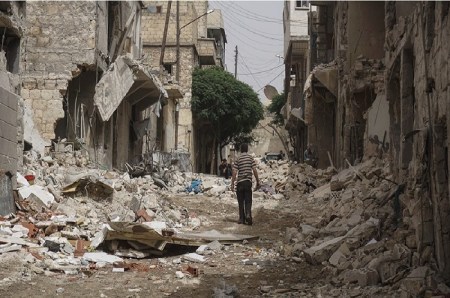
If in the story of Obama’s Middle East policy, the war in Syria represents the dramatic climax, then the imminent fall of rebel-held eastern Aleppo and the humanitarian crisis unfolding there is its crushing denouement.

The Obama administration’s determination to prevent the U.S. from being drawn into more wars — and to “lead from behind” when it felt it was forced to engage, as in Libya — allowed terrorist groups such as the Islamic State and geopolitical rivals such as Russia to fill the vacuum.

Obama’s first mistake in Syria was his 2012 failure to follow through on enforcing a “red line” over dictator Bashar Assad’s use of chemical weapons. Obama’s inaction taught Assad that there would be no repercussions for his regime’s crimes.

Obama’s decision in 2013 not to back moderate groups in the armed opposition only reinforced that lesson. When Russia moved in last year to help Assad, Obama again did nothing.

Obama’s fecklessness emboldened not just Russia, but also Iran, whose combat troops continue to bolster Assad’s forces across Syria, as well as jihadists around the world. All of them quickly learned that they had little to fear in Obama.

Obama repeatedly rejected recommendations from his generals for tougher military response against Assad. Obama seems to be willing to pay almost any cost to find a diplomatic solution to Syria. He believes peace talks will somehow lead to a transition in which Assad gives up power. Obama has focused instead on the Islamic State, but even there the U.S. response has been confined to bombing and the deployment of a few U.S. Special Forces.

Secretary of State John Kerry has been working for months to negotiate a ceasefire between the Assad regime and opposition forces. But Assad has refused to comply with previous agreements, continuing to bomb rebel-held areas of Aleppo.

Obama isn’t the only one who’s in denial about how the war can be resolved. The State Department on Wednesday refused to acknowledge that U.S. policy and strategy failed to bring peace to Syria. Russia, Iran and the Assad regime were to blame, a State Department spokesman told reporters, for trying to find a military solution instead of a political one.

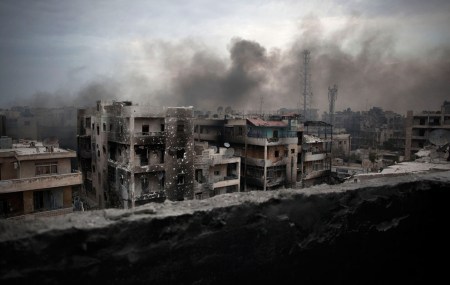
The war in Syria has taken the lives of 400,000 people and left another 11 million homeless. As many as 100,000 civilians remain trapped in Aleppo, potential victims of the regime’s revenge.

Obama’s failure to act decisively has left Syria devastated, much of the greater Middle East in chaos and Europe teeming with refugees. It has also left America less trusted and respected throughout the world. Obama’s dithering in Syria will be a black mark on his legacy.

Russian role in Aleppo’s fall impacts US politics

December 16, 2016

Russian role in Aleppo’s fall impacts US politics, DEBKAfile, December 16, 2016

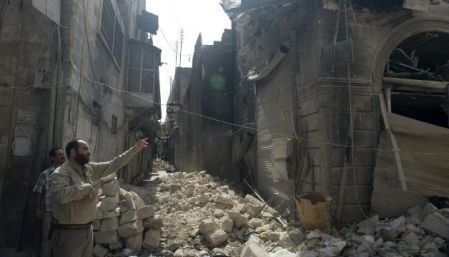
aleppo-damage_9-15

The Putin factor comes in handy for the latest tactic in a series pursued since the November 8 election, for delegitimizing Trump’s victory and negating his fitness to reach the White House.

This campaign may resonate strongly on America’s future policy and position as a world power, because it is designed to block Trump’s path to a deal with Putin for resolving the Syrian conflict. The Obama administration has no wish to see the new president succeed where it failed for nearly six years.

********************************

Aleppo’s fall to the Assad regime with the surrender Thursday, Dec. 15, of the Syrian rebel forces locked in a corner of the eastern districts was the most disastrous military and strategic setback to befall the Obama administration for two years. It started evolving in September 2015, when Russia stepped up its military intervention in the Syria war and rescued Bashar Assad.

When Aleppo succumbed to the Russian-backed government army and its allies, Iran, Hizballah and fellow Shite militias, it did not fall alone.  It brought down the entire architecture of US-backed positions in northern Syria. The US had invested in and trained local groups, such as the Syrian Kurdish militia and the rebel Free Syrian Army, as the bedrock for its policy and interests in the conflict. Those groups have melted away.

The acknowledged overlords of northern Syria today are Russian President Vladimir Putin and Turkish President Recep Tayyip Erdogan, who can claim the Aleppo victory. Bashar Assad and Iran are reduced to playing second fiddle. But whereas the Al Qods chief Iranian general Qassem Soleimani commands pro-Iranian forces in the region, America has been divested of all its military assets and has no real say in the next chapter of the horrific war.

Hence US Secretary of State John Kerry’s despairing appeal Thursday in a press briefing to bring the bloodshed and suffering to an end: “We can’t have another Srebrenica” – a reference to the Serbian slaughter of 8,000 Bosnian Serbs in 1985 – he said.

Kerry has toiled tirelessly for a diplomatic solution to the dreadful Syrian war, but his appeal falls on senses hardened by the many Srebrenicas perpetrated in more than five years of conflict. Hundreds of thousands of civilians and soldiers have been slaughtered – according to an unofficial estimate up to a million – and many subjected to chemical warfare. The secretary can’t count on the Kremlin to relent and so, even after the last Syrian rebels and their families are out of Aleppo, the killing will go on.

In Washington, 10,000 kilometers away, the Aleppo calamity is being dished up as a political tool. The claim was heard Thursday that the “same Vladimir Putin” who sponsored the atrocities in Aleppo, also interfered in the US presidential election by sending hackers to influence the results in favor of Donald Trump. The claim is touted by Obama administration spokesmen and the Democratic Party, whose candidate Hillary Clinton lost the election. It appears to be fodder for a Democratic party drive building up for the president-elect’s impeachment even before he is sworn in as president on Jan. 20.

The Putin factor comes in handy for the latest tactic in a series pursued since the November 8 election, for delegitimizing Trump’s victory and negating his fitness to reach the White House.

This campaign may resonate strongly on America’s future policy and position as a world power, because it is designed to block Trump’s path to a deal with Putin for resolving the Syrian conflict. The Obama administration has no wish to see the new president succeed where it failed for nearly six years.

Putin will have no qualms about capitalizing on Washington’s preoccupation with its internal power struggle and will build up as many gains in Syria as he can before Donald Trump takes over. Obama’s threat Friday, Dec. 12, to retaliate for Russia’s efforts to influence the presidential election will just provoke the Russian president to move faster and more determinedly in his grab for more assets in Syria.

Making Sense of the Mess in Syria

December 6, 2016

Making Sense of the Mess in Syria, Front Page MagazineAri Lieberman, December 6, 2016

syriamess

The vacillating and pusillanimous policies pursued by the Obama administration have enabled the Russians and Iranians to fill the void. Meanwhile, as Syria’s death toll nears 500,000 and its migrants – some with radical Islamic connections – continue to stream into Europe, it is clear that the nation state of Syria, Balkanized after five years of brutal conflict, is no more.

***********************

On July 30, 1970 a squadron of Israeli air force F-4E Phantoms and Mirages laden with bombs and missiles took off from their airbase in Sinai and flew westward toward Egypt. Their target was an Egyptian radar station.

The action occurred during the height of the War of Attrition between Israel and Egypt. The Egyptians were faring badly and their armed forces had suffered a series of public humiliations at the hands of the Israel Defense Forces. As a consequence, the Soviets stepped into the fray to save their client state and deployed 10,000 military personal and technical experts to the theater. The Soviets also assumed full control of Egypt’s air defenses. Surface-to-air missile batteries were manned by Soviet personnel and Soviet piloted MiG 21Js – the Soviet Union’s latest MiG-21 variant – patrolled Egyptian airspace. A direct clash between the Soviet Union and Israel was inevitable.

As the Israeli fighters zeroed in on their target, 16 Soviet MiGs moved in to intercept. In the melee that followed, five MiGs were shot down for no Israeli losses. The remaining 11 MiGs beat a hasty retreat. The Soviets were simply no match for the seasoned Israeli pilots.

The clash brought regional tensions – already heightened after one year of near constant border clashes – to a boiling point but neither side wanted an escalation. A ceasefire was eventually brokered by the superpowers and tensions deescalated.

Russia’s present military deployment in Syria is not dissimilar to its deployment in Egypt 46 years ago but the chances of an Israeli-Russian aerial clash today is virtually nil. There are some salient differences between the two circumstances. Israel and Russia are no longer bitter enemies and currently maintain cordial relations. Lines of communications between the two nations are good. Potential misunderstandings – to the extent that any exist – are channeled through liaisons to prevent accidental confrontations.

But war can best be summed up as organized chaos and given the clutter over the skies of Syria, with Russian, Israeli, Turkish and Coalition aircraft all operating within the confines of a limited space, mishaps are certainly possible. The Russians maintain formidable air defenses in Syria and Israel views them warily.

Underscoring this, last week IAF fighter jets launched two strikes in Syria, one targeting ISIS, in which four ISIS terrorists were killed and the second, targeting a Hezbollah weapons convoy and a Syrian military compound just outside Damascus. Though the Israelis have understandably remained moot on the specifics of the latter attack, according to published sources, Israeli fighters launched a number of Israeli made Popeye air-to-surface missiles from Lebanese airspace at a facility housing elements of Syria’s 4th Armored Division as well as a Hezbollah-bound weapons convoy traveling along the Beirut-Damascus highway.

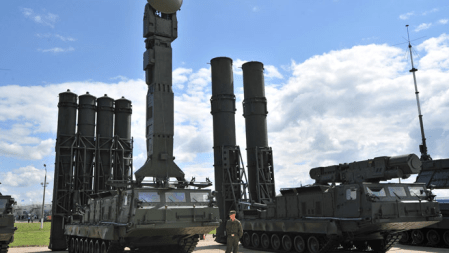
Israel cognizant of Russia’s S-400 and S-300 air defense platforms in Syria opted to circumvent the possibility of an accidental confrontation by launching its attack from Lebanese airspace. It should be noted that the S-400s were deployed by the Russians last year following the downing of a Russian Su-24 by a Turkish F-16. The move was meant to serve as a deterrent to Turkey and no hostile intent was directed at Israel. Additionally, the term “Lebanese airspace” is a rather generous term that implies that Lebanon is a fully sovereign nation. In reality, Lebanon is sovereign in name only, having been swallowed whole by Hezbollah, Iran’s genocidal Shia proxy.

Israel’s interest in Syria is limited to ensuring that game-changing weapons of strategic import don’t fall into the hands of Hezbollah. Thus, on several occasions, Israeli fighter jets have launched successful interdicting operations aimed at destroying sophisticated weaponry – including SA-22 anti-aircraft missiles, Scud D ballistic missiles and Yakhont cruise missiles – clandestinely shipped from Iran via Syria.

A secondary goal is to ensure that border areas remain free of Hezbollah, Iranian and ISIS influence. In January 2015, an Israeli airstrike liquidated 12 senior Hezbollah and Iranian Revolutionary Guard Corps operatives, including an IRGC general, who were reconnoitering the border near Israel’s Golan Heights for future operations against the Jewish State.

Russia, which has a much broader interest in Syria, understands Israel’s concerns and has no interest in needlessly antagonizing the Israelis. Syria has been under Soviet and now Russia’s sphere of influence since the early 1950s and Russia is intent on maintaining its air and naval bases in Syria. To that end, it is keen on maintaining Assad’s hold on power, or for that matter, any Assad replacement that commits to friendly relations with Moscow and continued Russian military presence.

Russia is also looking to project military power and reassert its role as a superpower. The high profile deployment of a sizable Russian fleet in the Eastern Mediterranean, which includes the Russian aircraft carrier and Cold War relic, Admiral Kuznetsov, represents part of this strategy. However, it appears that the Kuznetsov has been a bit of an embarrassment for Putin.

On November 14, a carrier-based MiG-29K crashed while attempting a failed landing on the Kuznetsov. The carrier was encountering problems with its arrestor cables and the MiG crashed while circling and waiting for repairs. Just three weeks later, a Russian Navy Su-33 encountered a similar fate while attempting a landing on the Kuznetsov. Recent Satellite imagery taken of the Russian air base at Khmeimim, near Latakia, shows rows of Su-33 and MiG-29K carrier-based aircraft parked alongside Russian land-based fighter jets indicating that the Russians have given up on the notion of launching strikes from the Kuznetsov.

While the Israelis and Russians maintain clear strategies and objectives for Syria, under Obama, the U.S. strategy in Syria can best be described as befuddled and lacking any clear direction. The U.S. had initially called for Assad’s unconditional departure but seems to have backed away from that position and now calls for an orderly transition of power, seemingly giving Assad some wiggle room.

Obama had threatened to use military force if Assad employed poison gas against his own people but back peddled on that position as well. In late 2015 it was revealed that the Obama administration spent an astonishing $500 million to train four or five Free Syrian Army rebels, clearly demonstrating that Obama’s policy on Syria represents nothing short of a farcical tragic comedy.

The Obama administration had initially ignored the ISIS menace and its current pinprick military campaign against the terror group is utilizing but a fraction of America’s military strength. Finally, while the Obama administration has publicly sought to end Syria’s civil war peacefully, its transfer of billions in cash to the Islamic Republic has only served to fuel the fire. There is no doubt that this cash has been utilized to pay the salaries of Iran’s mercenary forces in Syria, Lebanon, Yemen and Iraq.

The vacillating and pusillanimous policies pursued by the Obama administration have enabled the Russians and Iranians to fill the void. Meanwhile, as Syria’s death toll nears 500,000 and its migrants – some with radical Islamic connections – continue to stream into Europe, it is clear that the nation state of Syria, Balkanized after five years of brutal conflict, is no more.

Israel jets mark go-it-alone policy on Syria

November 30, 2016

Israel jets mark go-it-alone policy on Syria, DEBKAfile, November 30, 2016

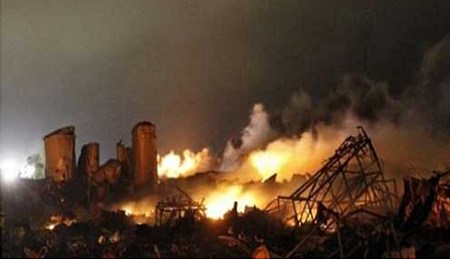
raidfire480Arab media show damage caused by air strikes to Syrian army compound in Damascus

Although Erdogan is notorious for his wildly unpredictable decision-making, it is more than likely that before going public on his radical change of heart on Assad, he was in touch with the new national security team taking shape in Washington. If that was the case, then Donald Trump was using Erdogan to notify Putin that the entire architecture of their understandings on Syria was now at risk.

If the Arab media reporting on Israeli air attacks on Syrian military and Hizballah targets in Damascus from Lebanese air space are confirmed, Jerusalem will be shown to have followed Ankara in backing away from those short-lived, understandings, opting instead for an independent policy in its own security interests with regard to Syria.

*****************************

Arab media carried conflicting reports wich described Israeli warplanes striking in and around Damascus overnight Tuesday, Nov. 29, with “four long-range Popeye” missiles fired from Lebanese air space on the government-held town of Al-Saboorah, a western suburb of Damascus, near the highway to Beirut.

A Lebanese newspaper reported that a Syrian army ammunition depot was destroyed in one of the raids, while other strikes hit and damaged a Hizballah arms convoy bound for Lebanon on the Damascus-Beirut Highway. There was also speculation, later denied, that one of the air strikes aimed at assassinating a senior Hizballah figure.

None of these reports were confirmed by Israel or any other official source.

Even so, Israel’s reported military action against enemy targets in Syria is bound to have repercussions in the next 24 hours, since, whatever took place, broke out of the secret overarching understandings on Syria reached provisionally this month between US President elect Donald Trump, Russian President Vladimir Putin and Turkey’s Recep Tayyip Erdogan.

Those understandings hinged strongly on joint US-Russian cooperation in the war on the Islamic State in Syria, supported by the coalition fighting for the Assad regime, namely, the Syrian army and its allies, the Lebanese Hizballah and foreign Shiite militias under the command of the Iranian Revolutionary Guards.

As the sub-text of the “big power” understandings, an outline was drafted between the next US administration, Moscow, Jerusalem, Amman and the UAE on arrangements for stabilizing Syria’s southern borders with Israel and Jordan.

Talks on these arrangements were first disclosed in an exclusive DEBKAfile report on Nov. 21, after they had already produced the unheralded return of the UN observers to the Golan demilitarized zone outside Quneitra.

But then, Sunday, Nov. 27, Russian warplanes staged a sudden series of airstrikes against Syrian rebel concentrations in the very region under discussion, southern Syria. After a three-month pause in these attacks, Moscow appeared to have waited for major Syrian government progress in Aleppo, to go against those understandings and send Russian jets into action over Jasim and Daraa in order to wipe out the rebel forces holding out in the South. Heavy casualties were sustained by those forces.

The Russian action was seen by the incoming Trump administration and Jerusalem as presaging the next danger-fraught step: To round out the raids, the Syrian army would come flooding into the South, along with Hizballah and other Shiite militias fighting under Iranian Revolutionary Guards command.

Tuesday saw two further ruptures in the trilateral understandings on Syria.

Assad announced he was gearing up for a decisive victory in Aleppo, notwithstanding a request from Trump’s advisers to Putin to hold back from the final step and refrain from retaking every last eastern district from rebel hands..

This was followed by an unforeseen statement by Erdogan: “The Turkish military launched its operations in Syria to end the rule of President Bashar al-Assad.”

This sentiment pivoted sharply away from the secret Trump-Putin understandings endorsed by the Turkish leader that was contingent on Assad remaining in power.

Although Erdogan is notorious for his wildly unpredictable decision-making, it is more than likely that before going public on his radical change of heart on Assad, he was in touch with the new national security team taking shape in Washington. If that was the case, then Donald Trump was using Erdogan to notify Putin that the entire architecture of their understandings on Syria was now at risk.

If the Arab media reporting on Israeli air attacks on Syrian military and Hizballah targets in Damascus from Lebanese air space are confirmed, Jerusalem will be shown to have followed Ankara in backing away from those short-lived, understandings, opting instead for an independent policy in its own security interests with regard to Syria.

Egyptian pilots flying Russian choppers in Syria

November 26, 2016

Egyptian pilots flying Russian choppers in Syria, DEBKAfile, November 26, 2016

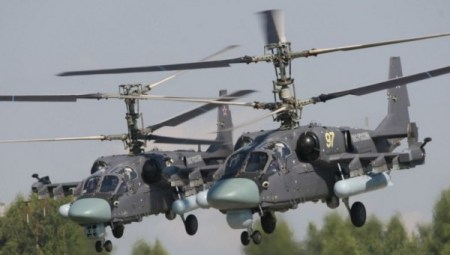
attack_ka-52_alligators

Egyptian President Abdel-Fatteh El-Sisi’s secret decision to intervene militarily in the Syrian war on the side of the Syrian President Bashar Assad is revealed here by DEBKAfile’s military and intelligence sources. The precise details of that intervention vary from source to source.

1. According to one version, a group of Egyptian helicopter pilots – 18, according to one estimate – landed secretly a few days ago at the Syrian Air Force base in Hama and were pressed at once into service for strikes against Syrian rebel forces.

Some sources describe the Egyptian flight crews as taking over the cockpits of Russian attack/reconnaissance Kamov Ka-52 helicopters, with which they were familiar, having trained on them since the end of 2015.

2. Others say that the Egyptian airmen flew those helicopters from Egypt to Syria over the eastern Mediterranean.

3. There is also a claim that their arrival was preceded by a preliminary inspection of the Syrian front lines by two major generals from the Egyptian general staff operations division, who later submitted their recommendations to the Egyptian president. It is not clear if they met the Russian commanders in Syria during that trip.

4. Others say the Egyptian generals headed a military delegation, which has set up a permanent mission in Damascus.

But every one of those sources agrees that, one way or another, Egypt has secretly entered the Syrian war in support of the Bashar regime – a development which has raised a firestorm in Arab capitals.

Saudi Arabia is particularly incensed over El-Sisi’s move. For years, Riyadh granted Cairo billions of dollars in aid, hoping this was an investment for procuring the Egyptian army as the stalwart protector of the kingdom and the Gulf emirates against Iran.

But towards the end of last year, Riyadh was affronted when the Egyptian ruler turned down an appeal for ground troops to support the Yemen campaign against Iranian-backed Houthi rebels. An eye-opener came when Egypt showed sympathy for Assad’s fight against extremist Islamist groups in the rebel movement, especially those associated with the Muslim Brotherhood, which El-Sisi has outlawed in Egypt as the sworn foe of his regime. Then, when Cairo supported Russian pro-Assad diplomacy at the United Nations, Saudi Arabia abruptly cut off financial assistance to Egypt and discontinued its oil shipments.

Donald Trump’s election this month as the next US president has already become the catalyst of a major reshuffling of Middle East alliances and stakes.

Some of its rulers, including El-Sisi, see the landscape changing and may be gambling on Trump reaching a deal with Russian President Vladimir Putin for joint military operations in Syria against the Islamic State and other Islamic terror groups, including the Al-Qaeda affiliate, the Nusra Front. The new bandwagon about to roll appears to favor Bashar Assad and his army.

The US president elect’s take on the Syrian ruler is expected to be markedly different to that of outgoing President Barack Obama, who castigated Assad, but held back from fighting him on the battlefield.

DEBKAfile reported exclusively on Nov. 21 that clandestine talks between Jerusalem, Amman and Damascus were afoot for the restoration of the demilitarized zone on the Golan and steps to stabilize their common borders in southern Syria.

Those talks are taking place with the knowledge of the Trump transition team and the Kremlin. They have already produced results in the return of UNDOF observers to their former posts on the Syrian Golan.

There are grounds to speculate now that the deployment of Egyptian aviators to Syria may be one more product of the secret inter-power diplomacy swirling in recent weeks over Syria’s bloody and intractable five-year war.

Iran’s Forces Outnumber Assad’s in Syria

November 24, 2016

Iran’s Forces Outnumber Assad’s in Syria, Gatestone Institute, Majid Rafizadeh, November 24, 2016

Pursuing a sectarian agenda, Iranian leaders have also fueled the conflict by sending religious leaders to Syria to depict the conflict as a religious war.

Iran’s military forces and operations in Syria are significantly more than what has been generally reported so far.

The Syrian war has led to the rise and export of terrorism abroad as well as to one of the worst humanitarian tragedies, in which more than 470,000 people have been killed.

Iran has played a crucial role in maintaining in power President Assad, who has repeatedly used chemical weapons on civilians. Iran has promoted continuing the conflict.

2070

While, according to reports by Iran’s Islamic Revolutionary Guard Corps (IRGC), the Syrian military has fewer than 50,000 men, Iran has deployed more than 70,000 Iranian and non-Iranian forces in Syria, and pays monthly salaries to over 250,000 militiamen and agents. According to a report entitled, “How Iran Fuels Syria War,” published by the National Council of Resistance of Iran (NCRI), non-Iranian mercenaries number around 55,000 men; Iraqi militias are around 20,000 men (from 10 groups), Afghan militias are approximately 15,000 to 20,000 men, Lebanese Hezbollah are around 7,000 to 10,000 men, and Pakistani, Palestinian and other militiamen number approximately 5,000 to 7,000.

In addition, the composition of Iranian IRGC forces are around 8,000 to 10,000 men, and 5,000 to 6,000 from the regular Iranian Army.

The major Iranian decision-makers in the Syrian conflict are Supreme Leader Ayatollah Ali Khamenei and the senior cadre of the Revolutionary Guards. Iran’s so-called moderate leaders — including President Hassan Rouhani and Foreign Minister Javad Zarif — are also in favor of Iran’s military, advisory, financial, and intelligence involvement in Syria. Rouhani repeatedly announced his support for Assad and pledged to “stand by [Syria].”

Khamenei insists on using more military power in Syria:

“[I]n December 2015, Khamenei ordered the IRGC to stand fast in the Aleppo region. He reiterated that if they retreated, their fate would be similar to the Iran-Iraq war and the regime would ultimately be defeated in Syria. Thus, in January 2016, the IRGC doubled the number of its forces in Syria to about 60,000 and launched extensive attacks in the region. However, despite tactical advances in some areas, these forces have been unable to even take control of southern Aleppo. IRGC faced a deadlock. In March 2016, Khamenei ordered the regular Army’s 65th Division (special operations) to be deployed around Aleppo, and increased the number of other forces as well. Plans for a major offensive to capture Aleppo were set in motion. During attacks by the IRGC and the Iranian army in April 2016, dozens of the regime’s forces, including IRGC commanders and staff, Iranian army personnel and foreign mercenaries from Iraq, Lebanon and Afghanistan, were killed. Although the IRGC and the Iranian regime’s regular army forces have failed to change the balance of military power in Syria, Khamenei insists on sending more IRGC and army forces into the Syrian quagmire. Seeing no way forward, and no way back.”

Iran has also played critical role in pushing Russia to intensify its military involvement in Syria by providing air support, so that the IRGC and its allies could help Iran’s military make quick territorial gains.

Iran has spent approximately USD $100 billion on the Syrian war. The sanctions relief given to Iran as a result of the “nuclear agreement” has significantly assisted the Iranian leaders’ ability to continue the war.

Iran also pays salaries to non-Iranian militias to participate in the war: “The Tehran regime spends one billion dollars annually in Syria solely on the salaries of the forces affiliated with the IRGC, including military forces, militias, and Shiite networks.”

Iran, for example, pays nearly USD $1,550 a month to the IRGC’s Iraqi mercenaries who are dispatched to Syria for a month-and-a-half, and approximately USD $100-200 a month to the Syrian militia fighters from the Syrian National Defense.

Pursuing a sectarian agenda, Iranian leaders have also fueled the conflict by sending religious leaders to Syria to depict the conflict as a religious war.

“Iran’s ruling regime has deployed a vast network of its mullahs to Syria, where their warmongering stirs up the fighters. And much like during the Iran/Iraq War, religious zealots are also sent to Syria to fuel the flames of religious fervor among the IRGC’s Basiij fighters and Afghan and Iraqi mercenaries.”

Iran has divided Syria into five divisions and haד over 13 military bases including the “Glass Building” (Maghar Shishe’i), which is the IRGC’s main command center in Syria, located close to the Damascus Airport. The IRGC placed its command center near the airport because,

“the airport would be the last location to fall. IRGC forces airlifted to Syria are dispatched to other areas from this location. One of the commanders stationed at the Glass Building is IRGC Brig. Gen. Seyyed Razi Mousavi, commander of IRGC Quds Force logistics in Syria. Between 500 and 1,000 Revolutionary Guards are stationed there.”

Other Iranian bases are scattered across Syria including in Allepo, Hama, and Latakia.

Since Brig. General Hossein Hamedani was killed in Syria, the current command of Iran’s forces in Syria lies with the Command Council, whose members include: IRGC Brig. Gen. Esmail Qaani (deputy of Qassem Soleimani who is the commander of the Quds Force) and IRGC Brig. Gen. Mohammad Jafaar Assadi (aka Seyyed Ahmad Madani).

The Syrian conflict has become the “root cause” of terrorism, which does not recognize borders and has spread to Europe and America. Since the Syrian war is the epicenter of terrorism, fighting terrorist groups such as ISIS without resolving the Syrian conflict is fruitless.

Terrorist groups such as ISIS are the symptoms, and the Syrian war is the disease. We need to address the disease and the symptoms simultaneously.

The best strategic and tactical approach is to cut off the role of a major player in the conflict: i.e. Iran. Without Iran, Assad would most likely not have survived the beginning phase of the uprising.

Iran kept Assad in power and gave birth to terrorist groups such as ISIS. In other words, Iran and Assad are the fathers of ISIS. Iran and Assad also played the West by claiming that they are fighting terrorism.

Considering the military forces and money invested in Syria, Iran is the single most important player in the Syrian war, and has tremendously increased radicalization of individuals, militarization and terrorism. Iran benefits from the rise of terrorism because it expands its military stranglehold across the region. Iran is top sponsor of terrorism, according to the latest report from U.S. State Department.

Iran will not agree to abandon Assad diplomatically.

In order to resolve this ripe environment of conflict for terrorism in Syria, Iran’s financial and military support to Assad should be strongly countered and cut off.

Together With Its Allies, The Syrian Regime Is Forcing Demographic Change In Areas Of The Country – For Self-Protection And Self-Preservation

November 15, 2016

Together With Its Allies, The Syrian Regime Is Forcing Demographic Change In Areas Of The Country – For Self-Protection And Self-Preservation, MEMRI, E. B. Picali* November 15, 2016

Introduction

Throughout the five and a half years of the war in Syria, and along with military action against the rebels, the regime of Syrian President Bashar Al-Assad, together with Iran, Hizbullah, and the pro-Assad militias, have implemented various measures to change the demographics of regions populated primarily by pro-rebel Sunnis, replacing them with pro-regime groups, primarily Alawites and Shi’ites.

These moves appear to be aimed at creating a homogenously pro-regime area with a Shi’ite and Alawite majority in a geographic region many refer to by the post-World War I term La Syrie Utile (“Useful Syria”). This is aimed at helping ensure the survival of the Syrian regime and of its strategic depth with Hizbullah in Lebanon and with Iran, in the event that Syria ends up being divided in any way as a solution to the crisis.

President Assad outlined this policy in a July 26, 2015 speech, saying: “The homeland does not belong to those who live there, nor to those who hold a passport or are citizens. The homeland belongs to those who protect and guard it.” Assad explained that circumstances on the ground require the Syrian army to withdraw from various areas “so that it can protect other, more important regions” and that the regime army “cannot fight on all fronts out of fear of losing control in certain areas, [and therefore] we relinquish [certain] regions in favor of important areas under our control.” These statements have been interpreted by Syrian opposition elements as proof that such a La Syrie Utile project is indeed underway.[1]

The Assad regime seems to be using a number of methods to carry out this project, including expelling its non-Shi’ite population that is not loyal to Assad and replacing it with an Assad-loyalist Shi’ite or Alawite population; agreements regarding the removal and replacement of local residents; killing and intimidating residents; demolishing homes and burning farmland; besieging towns and starving residents; offering besieged residents food if they sell their land to the regime; burning down land registration offices to destroy records; the buying up of land and homes by Iranian agents. In addition to these methods are the continued Shi’ization of the area, which has been underway for some time.[2]

Some of these measures, particularly the agreements for the removal and replacement of local residents, have been carried out under the auspices of the UN. Both the regime and the UN have been harshly criticized for them, by elements in the Syrian opposition as well as by anti-Syrian regime elements in Lebanon.

This report will review the purpose of this removal of local populations from areas of Syria, the means used to do so, and criticism of it and of the UN. The main sources cited in this report are anti-Syrian regime, anti-Iran, and anti-Hizbullah.

Creating A Homogenously Pro-Regime Geographic Region Stretching From Western Syria To Lebanon – To Ensure The Survival Of The Regime And Of Its Strategic Depth With Hizbullah And Iran

As stated, the army of the Syrian regime, along with Iran, Hizbullah, and the pro-regime militias, have been working to change the demographics of regions of Syria, using various means to remove their mostly Sunni pro-rebel residents, who include Palestinians, and replacing them with a pro-regime population. These measures are being carried out primarily in Damascus and its surroundings, in the west of the country along Lebanon’s northern and central Beqaa Valley, and along the Damascus-Beirut highway, with the aim of creating a contiguous region from Tartus to Latakia on the Mediterranean coast eastward to Homs and southward to Damascus – and perhaps even farther south to Quneitra – that will ultimately be populated solely by pro-Assad Shi’ites, Alawites, and others. Many refer to this region as La Syrie Utile, because it  will serve the Syrian regime and Iran if Syria ends up divided as part of a solution to the crisis.
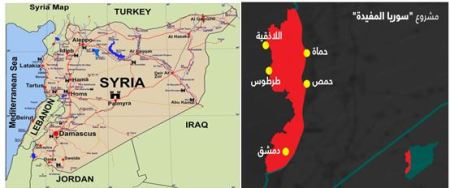
30686La Syrie Utile region (Alkhaleejonline.net, Istanbul-city-guide.com/map/Latakia-map)

Originally, the term La Syrie Utile, coined following World War I by the French Mandate for Syria and the Lebanon, referred to the borders of Greater Syria minus Jordan and Palestine. It defined the area of the Levant that at that time was considered economically and demographically more important and more central than other areas. The area the term refers to today covers nearly all of Syria’s most important economic, administrative, and demographic areas. Many Syrian oppositionists saw proof that the Assad regime had a plan to make this region demographically homogenous and pro-regime in Assad’s July 26, 2016 speech to union officials at the presidential palace in Damascus. In it, Assad explained that circumstances on the ground require the Syrian army to withdraw from various areas “so that it can protect other, more important regions” and that the regime army “cannot fight on all fronts out of fear of losing control in certain areas, [and therefore] we relinquish [certain] regions in favor of important areas under our control.”[3]

Today’s La Syrie Utile region borders on the regime’s strategic depth in Lebanon, that is, the areas controlled by Hizbullah and its allies. These include the northern Beqaa Valley, which has a decisive Shi’ite majority; parts of the central Beqaa Valley, whose border with Syria is controlled by the Popular Front for the Liberation of Palestine – General Command (PFLP-GC); and the Damascus-Beirut highway. Following extensive removal of the original residents by various means, the Syrian regime and its allies now control a large swath of Syria’s western regions and parts of eastern Lebanon in which the population is loyal to tem, rendering actual international borders nearly meaningless.

Syria’s creation of pro-regime demographic homogeneity within this region serves Iranian plans to control Syria and Lebanon, and serves the Iran-Hizbullah relationship. In January 2016, the anti-Iran Lebanese lawyer Nabil Al-Halabi, who heads the Lebanese Institute for Democracy and Human Rights (LIFE), told the Syrian oppositionist website Orient News: “Iran’s agenda in Syria is aimed at creating a large expanse… that will incorporate the entire [Syrian] border into Lebanon’s northern and eastern Beqaa and will connect them to the Baalbek-Hermel area [that is, Lebanon’s northern Beqaa], so as to transform it into an Iranian statelet subordinate to [Iran’s] Rule of the Jurisprudent.”[4] Similar statements were made by ‘Abdelilah Fahd, of the National Coalition for Syrian Revolutionary and Opposition Forces.[5]

In this context it should be mentioned that as early as three years ago, Lebanese newspapers that are known to support Hizbullah, Syria, and the resistance axis published articles about the importance of this geographic region in Syria and the need to connect it to the Lebanese depth so as to create a single area that will ensure the survival of the Syrian regime, Hizbullah’s strategic depth in Syria, and the geographic connection between them.[6]

Syrian oppositionists and anti-Assad Lebanese have warned about this plan. In August 2016, Syrian oppositionist Ahmad Abazid told the London-based Saudi daily Al-Sharq Al-Awsat: “The implementation of the plan [to bring about] a demographic shift in Syria began in the last quarter of 2012, with the regime using Shi’ite militias to change the composition of the population around Damascus and near the Lebanese border.”[7] Earlier, in February 2016, Lebanese Druze leader Walid Jumblatt, who was aware of the ramifications of this move for Lebanon, warned: “Lebanon could become a new province of La Syrie Utile, which the Syria-Iran axis is attempting to establish from Daraa to Tartus to Latakia.”[8]

Methods And Means Used By Regime And Its Allies To Create Pro-Regime Homogeneity In La Syrie Utile Region

For the past few years, Arab media, and particularly Syrian and Lebanese media hostile to the resistance axis, have been reporting on what is happening to the mostly Sunni anti-regime population in Damascus and its environs; in Homs, on the Damascus-Tartus road; in the towns of Al-Qusayr and Baniyas, between Homs and the northern Lebanese Beqaa Valley; in Al-Zabadani, north of the Damascus-Beirut highway; and recently also in the town of Madaya (on the Damascus-Beirut highway) and in Darayya (south of Damascus). The latter two locales have been in the news because of the regime’s systematic starvation and expulsion of their residents.[9] These reports reveal a wide range of violent methods used by the Syrian regime, Iran, and Hizbullah to shift the mostly Sunni population that they do not want there, including besieging towns and starving their residents;[10] transferring residents as part of ceasefire agreements; demolishing homes and burning farmland; setting up roadblocks to monitor and intimidate the population; forcing residents to sell their property; burning land registration offices in order to destroy records; and killing residents and intimidating the survivors. In addition to these methods are Shi’ization (on which see below) and, following the removal of Sunni and anti-regime residents, settling Shi’ite, ‘Alawite, and other pro-regime families in these areas.
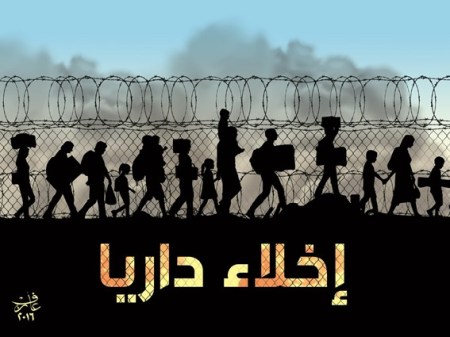
30687“The evacuation of Darayya” ( Al-Arab, Qatar, August 28, 2016)

 Following are examples of these methods, which Syrian regime opponents claim constitute “sectarian cleansing”:

Expelling Non-Shi’ite Residents From La Syrie Utile Region

One violent method used by the regime and its allies to create demographic homogeneity has been expelling non-Shi’ite anti-Assad residents and making it impossible for them to return. Sometimes this is done by intimidating residents and threatening them with death so that they will leave of their own accord.

Thus, for example, in August 2015, the Lebanese daily Al-Mustaqbal, which is known to oppose Hizbullah and the Syrian regime, cited General Authority of the Syrian Revolution (GASR) spokesman Ahmad Al-Qusayr as saying that since it occupied the town of Al-Qusayr in June 2013, Hizbullah has expelled most non-Shi’ite residents of the surrounding villages and is preventing them from returning to their homes.[11]

A November 2015 report in another Lebanese daily, Al-Safir, which supports the resistance axis, provided proof for the claim that Hizbullah and the Syrian regime are preventing residents of Al-Qusayr from returning to their homes. Reporting from the town, Al-Safir reporter Ali Duraij said that only former residents whose names are on a Syrian Army list may enter. The daily also quoted a Syrian soldier as saying that pro-rebel residents would only be returning to the town “over the soldiers’ dead bodies.”[12]

In March 2015, the Egyptian news portal Masr Al-Arabia quoted a young man residing in the old city of Damascus as saying that Shi’ite militias are threatening local young Sunnis with forced labor in order to drive them out of the city, and that as a result many families have abandoned their homes. It also reported that Damascenes are saying that Hizbullah is preventing families who have left from returning to their homes in neighborhoods that Hizbullah has taken over and made into strongholds.[13]

In January 2015, the Syrian oppositionist website Orient News reported that when Hizbullah and other Shi’ite militias occupied the town of Sayyidah Zaynab and others surrounding it, south of Damascus, they executed residents and left their bodies lying in the street to terrorize others and spur them to leave on their own. The remaining residents were forcefully expelled, and the area was transformed into a center for Shi’ite militiamen and their families. Abu Nasser Al-Shami, an opposition activist in southern Damascus, said that the expelled residents had repeatedly tried to return to their homes but that the Shi’ite militias had prevented them from doing so.[14]

The regime has also razed entire neighborhoods in Damascus and Homs as part of new infrastructure plans. Alsouria.net cited Syrian legal expert ‘Abd Al-‘Aziz as stating, in August 2015, that Assad’s Presidential Decree No. 66, of 2012, ordering  the demolition of thousands of homes and other buildings in the neighborhoods of Al-Mezzeh, Kafr Soussa, and others in southern Damascus, and the construction of new homes in their place, was aimed at expelling their original residents, since Al-Mezzeh and Kafr Sousa are strategic strongholds housing important security facilities of the Syrian regime.[15] Two months previously, in June 2015, the London-based Qatari daily Al-Quds Al-Arabi had cited an Al-Mezzeh resident as saying that the regime had ordered hundreds of families living east of the neighborhood and near the Iranian Embassy to leave their homes because they were going to be demolished to make way for “Iranian towers.”[16]

Following the regime’s approval of two new plans for infrastructure for Homs’ Baba Amr neighborhood,  local residents claimed that the plans as they were approved by the city council are aimed at expelling them from their homes as retribution for their support for the rebels.[17]

On March 20, 2016, Al-Quds Al-Arabi reported, citing Syrian activists and eyewitnesses, on the construction of a nonconventional military facility and on the excavation of tunnels, with help from Iranian experts, on the Syria-Lebanon border and near the Damascus-Beirut highway, and that local residents were being expelled, their homes were being razed, and trees were being uprooted.[18] The following day, the daily again reported that it was feared that the facilities were for the storage of chemical or other nonconventional weapons.[19]

On June 11, 2016, Al-Quds Al-Arabi correspondent ‘Omar Muhammad in the town of Madaya reported that Hizbullah fighters who control the southern approach to the town had forced 16 local families to immediately evacuate their homes. According to Muhammad, the fighters then looted the buildings, torched them, and took over the land, as part of the plan to change the demographics of the Damascus environs.[20]  

Pro-Rebel Residents Out, Shi’ite And Alawite Families In

Another method being used by the regime and its allies to change the demographics of the region is to settle Shi’ite and ‘Alawite families in areas from which non-Shi’ite residents have been removed. In many cases, ownership of the properties is transferred to the new residents without the original owners’ knowledge, and land registration offices have been burned down in order to remove all evidence of original ownership. Fields have also been burned, and homes razed.

In August 2015, the Lebanese daily Al-Mustaqbal reported that privately owned farmland surrounding the town of Al-Qusayr that belonged to Syrians who had been forced to leave their homes was being sold at attractive prices and on installment plans to “a specific sector” (likely pro-Hizbullah) of Lebanese citizens. Additionally, according to the report, Hizbullah had demolished the homes of residents “one after another.”[21] Previously, the newspaper reported that Hizbullah was settling its own fighters and their families in homes abandoned by the locals.[22]

Further evidence that Shi’ites were being moved into Al-Qusayr appeared in an August 2015 article discussing the population transfer methods being used by the regime and its allies, that was posted on the Syrian oppositionist website Alsouria.net. The article cited Samer Al-Homsi, a Syrian oppositionist in Homs, as stating that Hizbullah was settling the families of its fighters in Al-Qusayr.[23] Al-Homsi added that the Homs provincial council, which he said supported the regime, had posted notices on the doors of shops in the city’s old marketplace warning that if they did not open for business the property would be expropriated and turned over to new owners – while the regime was preventing the shop owners from returning to the city. He said that the regime is transfering these properties to newly arrived Alawite and Shi’ite families with security clearance.

The article also stated that the Syrian regime and Hizbullah had burned down the land registration office and other buildings in the city where real estate records were stored, so as to eliminate evidence of the ownership of thousands of properties.[24] The anti-Hizbullah Shi’ite-Lebanese website Janoubia.com also cited a source that said that the regime had transferred these properties to Iraqi and Lebanese Shi’ites, as well as to Alawites.[25]

The same thing happened in the old city of Damascus. A Masr Al-Arabia report quoted a young resident who said that homes abandoned by their original residents now house Lebanese, Iraqi, and Afghan militiamen whose families recently received Syrian citizenship, as well as displaced non-Sunni Syrians – all in accordance with a regime order giving itself the right to rent out these homes and to hold the rent received in escrow for the owners.[26] The report also quoted residents as saying that the regime had decreed that homes in Damascus may only be rented to people approved by the security authorities – and that only Iraqi, Iranian, Afghan, and Lebanese fighters are approved.[27]

The Syrian oppositionist website All4syria.info reported that in the town of Sayyidah Zaynab in the Rif Dimashq Governorate, Shi’ite militias were settling Shi’ite refugees from Basra, Iraq in homes whose owners had been removed. The report also quoted young resident Abu Radwan Al-Shami as saying said that a militia member had taken over his family home  and refused to leave despite his demands that he do so. Upon appealing to the police, Al-Shami was told that these militiamen are “guests who must be welcomed, and who cannot be removed.” The policemen cited Assad’s speech about  the land belonging to those who fight and defend it.[28]

An Al-Zabadani city councilmember told the London-based Al-Arabi Al-Jadid daily that the regime had demolished some 95% of the homes and commercial areas in the city, set fire to much of the farmland south and southwest of the city, near Madaya, and capped irrigation wells used by the farmers, all in an effort to force residents to leave. Media personality Faris Al-Arabi attested to the torching of orchards and buildings in these areas. According to Al-Zabadani residents, the town’s commerce and agriculturehad provided a livelihood for thousands, and the city is no longer worth living in because its economy and infrastructure have been completely destroyed.[29]

Hizbullah and the Syrian military have used the tactic of burning farmlands in the Madaya region as well, as reported on September 11,  2016  by the Syrian oppositionist website Enabbaladi.net.[30]

On September 6, 2016, Al-Sharq Al-Awsat cited a source close to the Iraqi militias in Syria as stating that the Iran-backed Al-Nujaba militia had begun settling some 300 Shi’ite families from southern Iraq in the towns of Darayya and Muadamiyat Al-Sham, southwest of Damascus. According to the report, the towns’ original residents had left as part of population transfer agreements (see following section).[31]

Siege, Starvation, And UN-Sponsored Population Transfer

The Syrian regime, along with Hizbullah and its other allies, are also besieging areas and starving the residents,[32] with the aim of wearing down the local population, causing it to turn against the rebels, and leveraging it to push rebel forces into signing local ceasefire agreements. The Assad regime calls these ceasefire agreements “national reconciliations” or “local reconciliations,” spinning them as a rebel surrender – while in actuality they involve the uprooting of pro-rebel residents and their transfer outside the La Syrie Utile region. This has been implemented in many places, particularly in Homs, the Al-Yarmouk refugee camp, Al-Zabadani, and Madaya and Darayya.

Some of the siege-lifting agreements have been sponsored by UN representatives, even though they were achieved by harsh sieges and by starving local residents, and involved removing residents from their homes and  the departure of the rebels and their families under population transfer agreements. From 2014 to 2016, the regime and the rebels arrived at a number of agreements under which the regime lifted the siege, stopped bombardment, and allowed humanitarian aid into the area, in return for the rebels’ and their families’ departure. Such UN-sponsored agreements have been signed for Homs’ old city[33] and parts of its Al-Waer neighborhood.[34] They were also signed for the majority-Turkmen towns of Kezhal and Umm Al-Qasab in western Rif Homs; rebel families from these towns were transferred to the northern Rif Homs.[35]
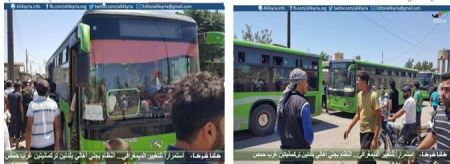
30688Residents of Turkmen towns west of Homs exiled north of Homs (All4syria.info, July 17, 2016)

Nabil Al-Halabi, the Lebanese lawyer and LIFE director, said that in Homs’ old city the regime had offered food to besieged residents who wanted to leave the city but only on the condition that they sold the regime their land and property.[36] On January 13, 2016, Al-Mustaqbal reported that Hizbullah fighters in Bloudan had threatened residents of the besieged Al-Zabadani and Madayya nearby who had managed to escape that they would be forced back into Madayya unless they sold their land and houses to them for pennies on the dollar. According to the daily, some of these residents agreed to this extortion in return for food or a handful of coins, while others were brought back into Madayya.[37] It was around this time that the ongoing siege on Madayya – which violated a previous agreement between the regime and rebels in the city – made headlines, after residents and rebels raised an outcry because the residents were reduced to eating weeds, eggshells, and cats, with some dying of starvation, and medical supplies had run out.[38] Earlier in January, Orient News quoted Madayya activists as saying that Hizbullah was allowing residents to leave if they sold them their homes, land, and property.[39]

In September 2015, Iranian representatives, with UN sponsorship and assistance, arrived at a ceasefire with the rebel group Ahrar Al-Sham, which controlled Al-Zabadani. The agreement covered the city and several surrounding towns, among them Madayya, besieged by Assad and Hizbullah, and the Shi’ite towns of Al-Fua and Kefraya in northern Syria, besieged by the rebels, and included a population transfer agreement. Under the latter, armed rebels and interested residents from Al-Zabadani would be transferred to the northern city of Idlib, which is under rebel control and outside of La Syrie Utile, while 10,000 women, children, and over-50 men from Al-Fua and Kefraya would be transferred to Al-Zabadani – thus effecting a demographic shift.[40]

One of the most prominent examples of the regime’s removal of anti-regime residents following extended siege, starvation, and bombardment occurred recently as part of a rebel-regime agreement in Darayya, south of Damascus. After four years of siege, Darayya has become a symbol of this regime policy. In November 2012, the Syrian army and its allies besieged Darayya, and only allowed in humanitarian aid three and half years later, in early 2016. Almost four years of siege, starvation, and carpet bombing of the city, and, according to the rebels, regime threats to burn down the city with all its residents, brought the rebels to surrender. On August 25, 2016, the sides reached an agreement under which the armed rebels and residents would leave the city and hand over their medium and heavy weapons to the regime army as it entered.[41] Thus, on August 27, 1,650 rebel fighters and anti-regime residents abandoned Darayya for the rebel-controlled Idlib in northern Syria.[42] The Assad regime said that Darayya had been rendered uninhabitable, and promised that after it was rebuilt, its residents would be allowed to return.[43] However, on August 27, 2016, the Kurdish website Ara News reported that mere hours after the expulsion of its residents, dozens of Iraqi families had already moved in.[44]

According to the opposition, in Darayya the regime had escalated its attempts to subdue the rebels and the residents, threatening to exterminate the population. Syrian oppositionist Bassma Kodmani, a member of the Syrian opposition’s High Negotiations Committee (HNC), said that regime forces changed tactics after failing to starve the residents in the besieged areas, and that “the threats of ‘surrender or starve’ that we have heard for four years have now become ‘surrender or we will destroy you.'”[45]

The UN was criticized for its role in the Darayya agreement. UN Special Envoy for Syria Staffan de Mistura denied that he had had any connection to it, and said he had not even known about it,[46] but city councilman Fahdi Muhammad said, “The council updates de Mistura on events and developments in the city immediately after they happen, and his denial is nothing but an attempt to shirk his responsibility to protect the residents who were expelled by the Assad regime.” He added: “UN officials and a Red Cross delegation knew about the negotiations, and even oversaw the expulsion operation.”[47]

Among the opponents of the Darayya agreement were Arab League secretary-general Ahmed Abu Al-Gheit, who in a statement called it “a worrisome development that could pave the way for similar arrangements that bring about demographic changes in Syrian cities, especially since they are with UN sponsorship.” He added: “Expelling residents under duress is a violation of international law.”[48]

Reports in recent months indicate that there will be a repeat of this ceasefire-agreement scenario in the town of Muadamiyat Al-Sham, also southwest of Damascus. On September 1, 2016, the Syrian daily Al-Watan, which is close to the Assad regime, reported that an agreement is set to be signed between the regime and representatives of the town residents, under which all rebels  and anti-regime residents will leave the town in order to “settle their status vis-a-vis the regime.”[49] The previous day, on August 31, Orient News had reported that the regime is aiming for an agreement like Darayya’s in Muadamiyat Al-Sham, and that in talks between the sides, the regime had warned the townspeople that it would burn the whole town along with its residents if the rebels did not hand over their medium and heavy weapons and depart with the anti-regime residents.[50]

Apparently, the Russians, in addition to the UN, are also involved in these so-called “reconciliation agreements” under which population transfers are conducted following siege and starvation. Thus, for example, Russian officials praised the Darayya agreement. On September 1, 2016, Russian Foreign Ministry spokeswoman Maria Zakharova, said that “the successful experience” of removing the rebels from Darayya “will help reduce the level of violence.” She assessed that further agreements were forthcoming, stating that the regime had “reached an agreement similar to” the Darayya agreement in Muadamiyat Al-Sham, and called for the international community to support these agreements and for the signing of similar ones on all Syrian battlefronts.[51] Orient News reported that Russian officers had participated in the talks between Muadamiyat Al-Sham representatives and the regime.[52]

In this context, it should be mentioned that the regime and its allies have also taken measures to get rid of Palestinians residing in Palestinian refugee camps who have expressed support for the rebels. Ayman Abu Hisham, director of the general Palestinian refugee authority in the temporary Syrian government of the National Coalition of Syrian Revolutionary and Opposition Forces, said that the regime is assassinating or expelling Palestinians who do not support it, without distinguishing opponents from neutral parties. He accused it of starving residents of the Al-Yarmouk refugee camp in southern Damascus, and of completely destroying other camps, such as Jaramana on the Damascus airport road and Handarat in northeastern Aleppo, to keep the residents, who had fled, from returning.[53]

On November 8, 2016, the website of the National Coalition of Syrian Revolutionary and Opposition Forces reported that the regime had bombarded Khan Al-Sheikh, a Palestinian refugee camp in the western Ghouta, in order to drive out its residents, after they did not heed the regime’s demand to evacuate the camp.[54]

Shi’ization And Iran’s Takeover Of Property In And Around Damascus

There have also been many reports on significant Iranian activity in Damascus and its environs,including direct and indirect purchase of land and homes, as well as extensive Shi’ite religious outreach and proselytizing, aimed particularly at young people, and the establishment of Shi’ite religious, cultural, and educational centers.
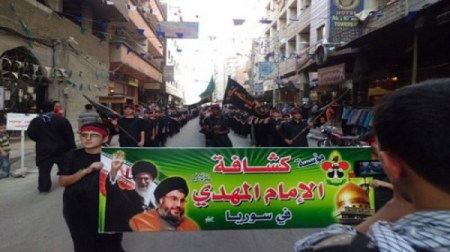
30693A march of the Al-Imam Al-Mahdi scouts movement in Syria (orientnews.net, January 19, 2015)

The Lebanese daily Al-Mustaqbal cited knowledgeable sources as stating that the Syrian regime was transferring ownership of state buildings and land in Damascus to Iran, as part of a repayment of regime debts.[55] Some three months previously, the Lebanese daily Al-Akhbar, which supports Hizbullah and the resistance axis, had reported that the Syrian regime had mortgaged state real estate to Iran in exchange for Iranian military and economic aid.[56]

A Damascus engineer identified as Suheil told Alsouria.net that he had sold his home to a Gulf businessman who later turned out to be an agent for Iranian firms, and that many other Syrians had done likewise. The website also reported that the number of Shi’ite residents in many Damascus neighborhoods was on the rise.[57]

The London daily Al-Sharq Al-Awsat also reported, citing numerous Syrian sources, that Iranian merchants and brokers had purchased property and land in various cities, with Iranian encouragement and support and with the cooperation of the Syrian regime. The daily quoted a report by the Electronic Group of the Syrian Rebellion as stating that Iran had established a network of real estate brokers and speculators for purchasing homes, hotels, and land from Syrian citizens who wish to leave Syria. According to the report, Iran had fraudulently transferred to itself ownership of various assets.[58]

Orient News reported that the Supreme Syrian-Iranian Council, headed by the Syrian Samer Al-As’ad, a representative of Iranian businessman and former IRGC general Rostam Qasemi, had appointed agents on the council’s behalf to pressure Damascus residents to sell their assets as part of an Iranian plan to create a demographically homogenous area stretching “from Darayya to the new building of the Iranian embassy in Damascus.”[59]

On June 22, 2015, Al-Quds Al-Arabi cited a resident of the Al-Mezzeh quarter in Damascus who said that Iranian Shi’ites fighting in Syria had been pressuring anti-regime owners of homes and land to sell them their assets by various means, including public humiliation, beatings, and even murder. According to the resident, the Kafr Soussa neighborhood is seeing much of this activity as well.[60]

On April 11, 2016, the Iranian news agency Fars reported that Iranian Majlis member Amir Khojasteh had presented a report to the Majlis after visiting Lebanon and Syria with a Majlis delegation. According to this report, Assad had agreed to grant residency visas to the 10,000 Iranian citizens already living in Syria, at no cost.[61]

In recent years, there has been increased Shi’ite and Iranian religious activity in both Damascus and in the town of Sayyidah Zaynab, south of Damascus. Sayyidah Zaynab is the site of the tomb of Zaynab, a descendent of the Prophet Muhammad, and it attracts many thousands of Shi’ite pilgrims annually. Entire areas of Damascus and other cities have turned Shi’ite, after families of foreign Shi’ite fighters immigrated to Syria and occupied homes abandoned because of the war. Further evidence of the rise of Shi’a in Syria was the unprecedented scale of the 2014 ‘Ashura ceremonies in Damascus, which were held even in areas of the capital that were not recognized as Shi’ite.[62]
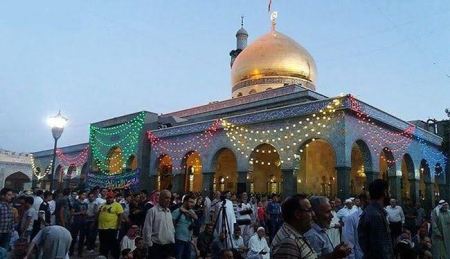
30690The tomb of Sayyidah Zaynab south of Damascus (All4syria.info, January 29, 2016)

Orient News reported that days after the residents of Darayya left it, as part of the agreement with the Assad regime, Shi’ite militiamen entered it to pray and conduct Shi’ite ceremonies at a tomb that has in recent years become a Shi’ite pilgrimage site. It is claimed to be the burial site of Sayyidah Sakinah, the daughter of Hussein and granddaughter of the Prophet Muhammad.[63]
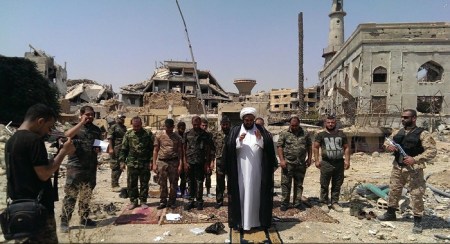
30692Amjad Al-Bahadli, leader of the Iraqi Al-Imam Al-Hussein Brigade militia praying at the ruins of the tomb of Sayyidah Sakinah in Darayya (Facebook.com/500674723445460, August 31, 2016)

The Syrian oppositionist website Enabbaladi.net reported that the Iraqi Abu Al-Fadl Al-Abbas militia has launched an advertising campaign, aimed at Iraqi Shi’ites, for an eight-day trip to the Shi’ite holy sites in Syria at a cost of $400 per person. The trip includes the tomb of Sayyidah Sakinah.[64]

Opponents Of Syrian Regime: These Forced Demographic Changes Are War Crimes, Carried Out With UN Complicity – That Serve Iran

The Syrian opposition and its supporters in Lebanon have been extremely critical of the La Syrie Utile project and the measures undertaken, by the regime and by its allies, to implement it.[65] Some said that the regime’s methods were worse than Israeli actions against the Palestinians, while others compared them to the Nazi racial policy that eventually become the Final Solution.

The head of the interim government of the National Coalition of Syrian Revolutionary and Opposition Forces, Ahmad Tu’mah, said that the regime was changing the demographics in Homs Governorate by forcing Sunnis out and bringing in Iranians to replace them.[66] George Sabra, head of the Syrian National Council and a member of the National Coalition, claimed that the La Syrie Utile project was aimed at dividing the country into sectarian statelets that served Iran; he added that the Syrian regime no longer cares about the Syrian homeland or people, but only about self-protection and self-preservation.[67]

HNC member Muhammad ‘Aloush called the removal of residents of Darayya and Muadamiyat Al-Sham “a war crime carried out by the Syrian regime, and forced expulsion.”[68] Orient News wrote about the siege and starvation of Madaya that Hizbullah and its secretary-general Hassan Nasrallah were using methods “that even Israel does not use.”[69]

Syrian opposition officials also harshly criticized the UN, saying that it was participating in these arrangements that are changing the country’s demographics. On August 29, 2016, HNC general coordinator Riyad Hijab sent a letter to the UN secretary-general warning the UN not to sponsor measures by the regime and its allies aimed at shifting demographics. Hijab argued that Aleppo, Homs, Rif Dimashq, and other areas are subject to such forced demographic changes, and that the Assad regime and its allies are carrying out these changes with UN sponsorship in the guise of local ceasefires. He asked rhetorically: “Do you believe that this will eliminate terrorism? Will it eliminate extremism? Will it end the spilling of Syrian blood and the killing of women and children? Will it make the world a safer place? Will it preserve the unity and territorial integrity of Syrian soil?” He added that since the start of the political process vis-à-vis Syria, “the regime, Iran, and the militias [supporting them] have killed over half a million Syrians and expelled millions,” and that therefore this political process is “backing the regime and its allies in implementing this demographic change.”[70]

In an article in the Kuwaiti daily Al-Qabas, National Coalition member Abdelilah Fahd alleged: “Officials in UN offices in Damascus have pressured the residents [of the Al-Waer neighborhood in Homs] in an attempt to reach a ceasefire that leads to a surrender [of the rebels]. The [UN] office in Damascus held talks with local residents to persuade them to accept a false ceasefire, which indicates it is a party to the expulsion plan… and that it has failed miserably to defend citizens according to international law.” Fahd also stated that the regime is implementing a policy of expulsion, killing, and destruction “in order to preserve the regime at all costs, in the belief that additional crimes will help it eliminate the rebelling Syrian people’s desire for freedom.” He called the methods being used by the regime “a scarlet letter in the history of the UN and international law.”[71]

The Lebanese daily Al-Mustaqbal  has published articles criticizing the demographic policies of the Syrian regime and its allies. In his July 7, 2015 column, ‘Ali Rabah wrote: “Hizbullah is attempting to change Syria’s demographics by expelling original residents to settle others in their place… This is the modus operandi of Hizbullah – which has for decades warned about a Zionist plan to divide the region – in an attempt to cancel the Sykes-Picot Accords.”[72] In another column, published August 12, 2015, Rabah wondered how Hizbullah leader Nasrallah could warn Shi’ites in Bahrain about demographic change that the Bahraini regime might implement against them while he was doing the same thing to Sunnis in Syria – and using the methods that Israel used against the Palestinians in 1948. He wrote: “The [Syrian] villages that Hizbullah wants to empty of their local residents could total a larger area than all of Palestine, or at least larger than all the [Israel-]occupied lands from 1948. Many haven’t noticed that the number of Syrian refugees in camps in Turkey and Jordan alone is three times greater than the number of Palestinians expelled by Israel.” Rabah added that Hizbullah was occupying Syria and establishing settlements and camps there.[73]

Lebanese poet and literary critic Paul Shaoul, who writes for Al-Mustaqbal, compared Hizbullah to Dracula, saying that it is sucking the blood of Syrians, and added that its policy in Syria was racist and sectarian and aimed at changing Syria’s demographics by eliminating Sunnis and expelling them from the country.[74] Mustafa ‘Aloush, a member of the Al-Mustaqbal faction’s Political Bureau and a columnist for the Al-Mustaqbal daily, compared the plan of Syria, Hizbullah, and Iran to the Nazi racial theory that developed into the Final Solution: “Their despair over the [failure of the] plan for the Rule of the Jurisprudent to control all Syria as its backyard has made the followers [of the Rule of the Jurisprudent] settle for the so-called La Syrie Utile. Today, it appears that Hizbullah’s entry into Syria is part of a ‘Final Solution’ supported by an Iranian fatwa aimed at ethnically cleansing areas bordering the central and northern Beqaa Valley [in Lebanon], possibly in preparation for the next stage, which will bring extensive changes to the political and demographic maps.”[75]

* E.B. Picali is a research fellow at MEMRI


Endnotes:


[1] Al-Watan (Syria), July 26, 2015.

[2] See MEMRI Inquiry & Analysis No. 1131, Shi’ization Of Syria: In Damascus, Unprecedentedly Extensive Observance Of The ‘Ashura, November 13, 2014.

[3] Al-Watan (Syria), July 26, 2016.

[4] Orient-news.net, January 6, 2016.

[5] Etilaf.org, September 21, 2016.

[6] Al-Akhbar (Lebanon), May 27-29, 2013. See MEMRI Inquiry & Analysis Series Report No. 980, Lebanon Openly Enters Fighting In Syria, June 13, 2013.

[7] Al-Sharq Al-Awsat (London), August 28, 2016.

[8] Al-Mustaqbal (Lebanon), February 4, 2016.

[9] See MEMRI Inquiry & Analysis Series Report No. 1226, Hizbullah Faces Criticism In Lebanon For Besieging Madaya: Its Starvation Of Syrians Recalls Past Crimes Of Mass Extermination In History, February 9, 2016.

[10] See MEMRI Inquiry & Analysis Series Report No. 1221, Local Ceasefire Agreements In Syria: Capitulation To Regime’s Siege-And-Starvation Strategy Under UN Sponsorship, January 26, 2016.

[11] Al-Mustaqbal (Lebanon), August 12, 2015.

[12] Al-Safir (Lebanon), November 4, 2015.

[13] Masralarabia.com, March 15, 2015.

[14] Orient-news.net, January 19, 2015.

[15] Alsouria.net, August 21, 2015.

[16] Al-Quds Al-Arabi (London), June 22, 2015.

[17] Alarabiya.net, August 27, 2015.

[18] Al-Quds Al-Arabi (London), March 20, 2016.

[19] Al-Quds Al-Arabi (London), March 21, 2016.

[20] Al-Quds Al-Arabi (London) June 11, 2016.

[21] Al-Mustaqbal (Lebanon), August 12, 2015.

[22] Al-Mustaqbal (Lebanon), July 30, 2015. Yasser Haidar, a member of the coordinating body in Al-Qusayr, told the Saudi daily ‘Okaz that he and other residents were expelled from the town, and that under the auspices of Hizbullah, it has become a center for bandits and gangs of smugglers and kidnappers. ‘Okaz (Saudi Arabia), February 7, 2015. According to the Lebanese daily Al-Mustaqbal, Hizbullah sent Shi’ite Lebanese criminals wanted in Lebanon to Syria, and particularly to the Al-Qusayr and Al-Qalamoun areas, chief among them the Shi’ite Lebanese fugitive Noah Zaiter, who posted images on his Facebook page of himself along with Hizbullah officers fighting in those areas in Syria. Al-Mustaqbal (Lebanon), September 15, 2015.

[23] Alsouria.net, August 21, 2015.

[24] Alsouria.net, August 21, 2015.

[25] Janoubia.com, December 11, 2015.

[26] Al-Ba’th (Syria), May 21, 2014.

[27] Masralarabia.com, March 15, 2015.

[28] All4syria.info, January 29, 2016.

[29] Al-Arabi Al-Jadid (London), October 20, 2015.

[30] Enabbaladi.net, September 11, 2016.

[31] Al-Sharq Al-Awsat (London), September 6, 2016.

[32] See MEMRI Inquiry & Analysis Series Report No. 1221, Local Ceasefire Agreements In Syria: Capitulation To Regime’s Siege-And-Starvation Strategy Under UN Sponsorship, January 26, 2016; and Inquiry & Analysis Series Report No. 1069, Syria Regime’s Tactic Against Opponents: ‘Surrender Or Starve’, February 13, 2014.

[33] Al-Quds Al-Arabi (London), May 3, 2015.

[34] Alarabiya.net, December 5, 2015.

[35] All4syria.info, July 17, 2016.

[36] Orient-news.net, January 6, 2016.

[37] Al-Mustaqbal (Lebanon), January 13, 2016.

[38] See MEMRI Inquiry & Analysis Series Report No. 1221, Local Ceasefire Agreements In Syria: Capitulation To Regime’s Siege-And-Starvation Strategy Under UN Sponsorship, January 26, 2016.

[39] Orient-news.net, January 6, 2016.

[40] Orient-news.net, September 19, 2015.

[41] Sana.sy, August 25, 2016.

[42] Al-Quds Al-Arabi (London), August 27, 2016; Sana.sy, August 27, 2016.

[43] Dp-news.com, August 29, 2016.

[44] Aranews.net, August 27, 2016.

[45] Aksalser.com, September 1, 2016.

[46] Orient-news.net, August 27, 2016.

[47] Etilaf.org, August 27, 2016.

[48] Alarabiya.net, August 28, 2016.

[49] Al-Watan (Syria), September 1, 2016.

[50] Orient-News.net, August 31, 2016.

[51] Aksalser.com, September 1, 2016.

[52] Orient-news.net, August 31, 2016.

[53] Al-Quds Al-Arabi (London), May 2, 2014.

[54] Etilaf.org, November 8, 2016.

[55] Al-Mustaqbal (Lebanon), August 12, 2015.

[56] Al-Akhbar (Lebanon), April 29, 2015.

[57] Alsouria.net, August 21, 2015.

[58] Al-Sharq Al-Awsat (London), March 26, 2016.

[59] Orient-news.net, November 6, 2016.

[60] Al-Quds Al-Arabi (London), June 22, 2015.

[61] Fars (Iran), April 11, 2016.

[62] See MEMRI Inquiry & Analysis No. 1131, Shi’ization Of Syria: In Damascus, Unprecedentedly Extensive Observance Of The ‘Ashura, November 13, 2014.

[63] Orient-news.net, September 1, 2016.

[64] Enabbaladi.net, September 17, 2016.

[65] See MEMRI Inquiry & Analysis Series Report No. 1226, Hizbullah Faces Criticism In Lebanon For Besieging Madaya: Its Starvation Of Syrians Recalls Past Crimes Of Mass Extermination In History, February 9, 2016.

[66] Dp-news.com, January 23, 2016.

[67] Aljazeera.net, September 29, 2015.

[68] Alarabiya.net, September 1, 2016.

[69] Orient-news.net, January 6, 2016.

[70] Aksalser.com, August 29, 2016.

[71] Al-Qabas (Kuwait), August 31, 2016.

[72] Al-Mustaqbal (Lebanon), July 7, 2015.

[73] Al-Mustaqbal (Lebanon), August 12, 2015.

[74] Al-Mustaqbal (Lebanon), August 12, 2016.

[75] Al-Mustaqbal (Lebanon), January 13, 2016.
Article On Syrian Opposition Website: The Political Solution Is Unfeasible; We Should Ignite All-Out War

October 19, 2016

Article On Syrian Opposition Website: The Political Solution Is Unfeasible; We Should Ignite All-Out War, MEMRI, October 19, 2016

‘Ali Hamidi, a Syrian journalist opposed to the regime, called on regime opponents to abandon the political solution and ignite an all-out war in Syrian order to force the world to step in and end it. Writing on a Syrian opposition website, he said that the brutal offensive waged in recent weeks by the Assad regime and by Russia against the rebel-held eastern neighborhoods of Aleppo is nothing less than a holocaust and slaughter for its own sake. He leveled harsh criticism at the international community, headed by the U.S., for the situation in the city, saying that their failure to intervene does not stem from helplessness or a lack of influence but rather from a lack of willingness to stop Assad and Russia.

The following are excerpts from his article:[1]

30329Devastation in Aleppo (image: Aljazeera.com)

“It would be absurd to write anything or make any comment about the all-out war of extermination currently being waged by Russia and the Assad regime against the ‘besieged neighborhoods’ of eastern Aleppo. This is [nothing less than] a holocaust; it is the ongoing indiscriminate killing of civilians without any military justification… Its objective was and is nothing but killing for its own sake. Many of us have made efforts to find definitions and reasons for this [military] action. We have heard, for example, that its objective is ethnic and sectarian cleansing; that it is an attempt to pressure the civilians in eastern Aleppo to leave or to disassociate themselves from the militants; that it is a holy war against the Sunnis, and many other analyses that are belied by the scenes of bombing and indiscriminate killing. At this point analyses and theories fail, and the main [insight] that emerges is that [it is nothing but] the killing of anyone opposed to the Assad regime…

“Can we really say today that the world is helpless? I think that would be the greatest and falsest compliment we could bestow upon this world – for the international community was not, is not and will never be helpless. It has ability and influence, if it only wanted [to use them]. But the simple [truth is] that nobody wants to stop Assad and Russia – neither the U.S. nor Europe nor anyone else…

“In the UN Security Council session on Aleppo [on September 25, 2016], UN envoy to Syria Staffan de Mistura expressed concern about the firing of ‘[gas] canisters’ from [rebel-held] eastern Aleppo into the [regime-held] western [parts of the city]. But he did not mention the kinds of missiles and mortars fired on the people [of the city], nor did he mention the over 300 victims [that are killed] every day as he delivered this miserable speech. Even more disturbing were the statements made by the representatives of the permanent Security Council members, who parrot hollow words of commiseration that are nothing but humiliating pleas [directed at] Russia, beseeching it to do its best to restrain Assad and restore the fragile ceasefire…

“Are we not being naïve when we wait for others to make their considerations, and hand them the keys to our cities [while we sit around,] waiting to be bombed? We wait for Barack Obama to [formulate] a policy [on Syria], when everyone is quite convinced that his departing administration will do nothing for those who are being killed in Aleppo and elsewhere, and that he and his team are not really doing anything to topple the Assad regime or to compete with Russia and Iran by supporting [the Syrian opposition]. If this is the position of the [world] leadership, there is no point in expecting anything from the countries it leads.

“Eastern Aleppo is in flames and its people are dying, and the entire world is party to this crime. Therefore, all the efforts that are currently being invested in renewing the dialogue with the Assad regime must be diverted to starting a war – an all-out war that will burn everyone. Then the world will hurry to stop it.

“The statements we hear, that only the political solution exists, are not realistic in the least. In fact, even the Assad regime does not accept them. Hence it would be folly to continue pinning our hopes on political [solutions] or on the ‘friendly’ countries. [Such suggestions] are tantamount to asking the people of Aleppo to surrender [just] in hope of being allowed to negotiating for the lives of those who still survive…

“To those who ask what alternative exists, [I say]: Why shouldn’t everyone who is dedicated to the cause [of saving syria] divert his efforts from the political channel to looking for weapons, even on the black market, so as to deliver them to the fighters in order to start an [all-out] war[?]”


Endnote:

[1] Orient-news.net, September 26, 2016.

Russia & Turkey carve anti-US enclaves in Syria

October 15, 2016

Russia & Turkey carve anti-US enclaves in Syria, DEBKAfile, October 15, 2016

rusturk

US President Barack Obama told Pentagon and military chiefs he met Friday, Oct. on Oct. 14, that instead of arming anti-Assad rebel groups in Syria, Washington was going back to negotiations with Moscow for cooperation in achieving a cessation of hostilities in the Syrian war.

US Secretary of State John Kerry therefore scheduled his umpteenth meeting with Russian Foreign Minister Sergey Lavrov for Saturday in Lausanne. This time, the foreign ministers of Turkey, Turkey, Iran, Saudi Arabia and possibly Qatar, tagged along.

Beyond the high words, recriminations and the unspeakable horrors attending the battle for Aleppo, Obama never seriously considered providing the anti-Syrian rebels holed up in Aleppo with the anti-air weapons they need to shoot down the Russian and Syrian warplanes blitzing them – any more than UK Foreign Secretary Boris Johnson’s statement that it was time for British military involvement in the Syrian war was for real

Above all, Britain is short of the military heft for backing up hypothetical intentions.

The options for serious Western intervention in the Syrian war are constantly diminishing for the reasons outlined here by DEBKAfile’s military sources:

1.  American missiles have no way of reaching Syrian rebel groups, certainly not those still fighting in eastern Aleppo. Neither Russia, nor Turkey, whose army now controls 5,000 sq. km of northern Syria, would let them through to that destination.

2. Had Turkish President Tayyip Erdogan chosen to do so, he could have simply ordered his army to open up a route for the supply of missiles to the rebels who are hemmed in in Aleppo by Russia, Syrian, Iranian and Hizballah forces. He is withholding that order because the military deals he concluded with President Vladimir Putin last week in Istanbul override any concerns he may have for the fate of those rebels or Aleppo’s population.

3. Those deals in a word sanctify the Turkish “security zone” in northern Syria which is covered by a no-fly zone for all but Russian and Turkish flights. They also provide for the Syrian rebels retreating from the various Syrian war zones, including Aleppo, to be taken in and absorbed in the Turkish enclave. Erdogan would thus become the senior patron of the Syrian opposition rebel movement, barring only the Al-Qaeda-affiliated Nusra Front and other Islamic extremist groups. This would enable him to steal from the United States, Saudi Arabia, Jordan and Qatar their sponsorship roles and their influence in the anti-Assad movement.

4. Ankara’s military alliance with Moscow is steadily eroding Turkey’s ties with the United States as well as NATO. Matters have gone so far that the two capitals or in advanced discussion of the supply of Russian air defense missiles to the Turkish army.

DEBKAfile’s intelligence sources reveal that under discussion is the installation in Turkey of a system of advanced Russian missiles linked to the Russian anti-air missile shield under construction in Syria.

Turkey would thus become the first member of NATO to arm itself with a Russian anti-air missile shield.

How was this allowed to happen?

According to our sources, Putin and Erdogan are moving fast to cash in on President Obama’s repugnance for military intervention in Syria and his waning powers at the tail end of his presidency.

Furthermore –

a) Neither is configuring Syrian President Bashar Assad into their calculations. They are going forward with their plans while ignoring him and his drastically diminished army as factors worth consideration.

b)  Their objectives are similar and interlocking:  Both are intent on developing their respective enclaves in northern Syria, Moscow for a long-term military presence in the country: likewise, Ankara.

Up until now, the Obama administration stood firm against the two goals, which is why Washington and Moscow were unable to achieve any real cooperation over a secession of hostilities in the war-torn country;  even when Kerry and Lavrov struck a truce accord on Sept 9, it never held up beyond a few hours.

Most recently, Putin and Erdogan tried signaling the US president that their sole ambitions with regard to Syria’s future lie in the two military enclaves now under construction.

Obama saw this as a sufficient basis to continue withholding advanced arms from Syrian rebel groups and to go for another round of diplomacy with Russia – with Turkey hitching a ride this time on the opposite side of the table..

Obama set for Mosul battle, leaves Aleppo to Putin

October 8, 2016

Obama set for Mosul battle, leaves Aleppo to Putin, DEBKAfile, October 8, 2016

(Please see also, The Obama administration is pushing Iraq into further chaos. — DM)

aleppo_destruction

Obama is brooking no distractions from his main objective, He hopes the Mosul operation will be over and done with by mid-December, so that when he exits the White House in January, he will have chalked up a major victory against the Islamic State as part of his legacy.

****************************

The warlike rhetoric heard from Washington over the plight of the stricken Syrian town of Aleppo does not represent any current Obama administration plan for military intervention to halt the ever-mounting carnage.

President Barack Obama’s mind is elsewhere.

This was discovered by his national security adviser Susan Rice every time she tried to arrange for Defense Secretary Ashton Carter and the Chairman of the Chiefs of Staff Gen. Joseph Dunford to be received by the president. After the collapse of diplomacy with Moscow for a cessation of hostilities, they had drawn up a plan for limited US military intervention in Syria that would enable essential humanitarian aid to reach the population.

Obama refused to hear what the trio had to say and the plan was shelved.

DEBKAfile’s Washington sources report that, for now, the US president’s mind is fixed exclusively on the preparations for the Oct. 19 offensive for the liberation of the Iraqi city of Mosul from ISIS occupation. US, Iraqi, Iraqi and Kurdish forces are aligned for the battle.

Obama is brooking no distractions from his main objective, He hopes the Mosul operation will be over and done with by mid-December, so that when he exits the White House in January, he will have chalked up a major victory against the Islamic State as part of his legacy.

In the process, the Democratic president intends to debunk the Republican candidate Donald Trump’s criticism of his administration as showing weakness in the face of ISIS.

Russian President Vladimir Putin is exploiting Obama’s preoccupation with the Mosul offensive to snatch a free hand for pushing the Aleppo battle to its barbaric limit. He is letting Bashar Assad and his allies conduct a scorched earth policy – even if this means reducing Syria’s second town to ruins.

Russian and Syrian jets are bombing the city, building by building, leaving the 8,000 rebels still fighting there with little hope of survival, since food, water, medicine or ammunition and anti-air missiles are out of their reach. The only form of resistance remaining to them is marksmen sniping from the rubble in an attempt to slow the advance of Syria, Iranian and Hizballah foot soldiers.

Obama, Putin and Assad are not alone in sentencing Aleppo to its doom: Turkish President Tayyip Erdogan, after grabbing 5,000 sq. km of northern Syria, is letting his army stand by idly as every attempt to bring life-saving assistance from Turkey to the beleaguered population is thrown back.

The Turkish leader is shielding himself with his secret deal with Putin, whereby his army is given a free hand in northern Syria without Russian interference, while the Aleppo arena becomes a Russian-Syrian precinct that is off-limits to Turkey.

This secret deal has also neutralized the US special operations forces deployed in northern Syria as well as the small Syrian rebel militias they trained and sponsor. Washington has therefore lost any leverage for swaying events in that part of the country. Since they are hemmed in on all sides, Obama refuses to hear of any military intervention in an area under Russian-Turkish control.

As he sees the larger picture, the northern Syrian devolution as a sphere of Turkish-Russian influence is balanced by US-Iraqi-Kurdish domination of northern Iraq

On paper, the US plans and preparations afoot for the liberation of Mosul are impressive.

Elite US troops are being pumped into the Mosul region – 600 just this week. Altogether an estimated 12,500 US servicemen are assigned for the offensive, which is due to be launched in 11 days, on Oct. 19.

This is the largest American military force to fight in Iraq since the battles against Al Qaeda during 2006-2007.

US military engineers are working overtime on the construction of bases around Mosul for the intake of US and Iraqi army units. The Kurdish Republic’s Peshmerga army is in position to the north.

Two new US facilities have just been completed. One is near the Mosul Dam, which regulates the flow of the Tigris River bisecting the targeted city. A second is located in the Bashiqa Mountains north of Mosul.

The two bases plus Kurdish army posts are designed as jumping-off points on the city from the south, east and Uninvited military forces are hovering nearby hoping to pick up a piece of the action. Among them are Turkish military units, local Iraqi militias, such as Turkmen, which the Turkish army is training for combat, and pro-Iranian Iraqi militias, such as the Badr Brigades and the Popular Mobilization Forces.

US commanders are intent on keeping these hangers-on out of the action, because their participation in the Mosul offensive would deepen the discord dividing Iraq’s Shiite, Sunni and Kurdish communities, and throw the city into chaos after the jihadists are driven out. US officers failed to check the sectarian violence that erupted in another Sunni-dominated town, Fallujah, in the wake of the battles for its recovery from ISIS in May and June.