Posted tagged ‘Arab nations’

Qatar’s neighbors issue steep list of demands to end crisis

June 23, 2017

Qatar’s neighbors issue steep list of demands to end crisis, Israel Hayom, Associated Press and Israel Hayom Staff, June 23, 2017

(Please see also, BREAKING: Gulf States Give Qatar List of Demands To Restore Diplomatic Relationships – All Demands Target The Muslim Brotherhood. — DM)

Emir of Qatar Tamim bin Hamad al-Thani | Photo credit: Reuters

Saudi Arabia and other Arab countries that have cut ties to Qatar issued a steep list of demands Thursday to end the crisis, insisting that their Persian Gulf neighbor shutter Al Jazeera, cut back diplomatic ties to Iran and close down a Turkish military base in Qatar.

In a 13-point list — presented to the Qataris by Kuwait, which is helping mediate the crisis — the countries also demand that Qatar sever all ties with the Muslim Brotherhood and with other groups including Hezbollah, al-Qaida and the Islamic State group.

Saudi Arabia, Egypt, the United Arab Emirates and Bahrain cut ties to Qatar this month over allegations the Persian Gulf country funds terrorism — an accusation that U.S. President Donald Trump has echoed. Those countries have now given Qatar 10 days to comply with all of the demands, which include paying an unspecified sum in compensation.

According to the list, Qatar must refuse to naturalize citizens from the four countries and expel those currently in Qatar, in what the countries describe as an effort to keep Qatar from meddling in their internal affairs.

They are also demanding that Qatar hand over all individuals who are wanted by those four countries for terrorism; stop funding any extremist entities that are designated as terrorist groups by the U.S.; and provide detailed information about opposition figures that Qatar has funded, ostensibly in Saudi Arabia and the other nations.

Qatar’s government did not have any immediate reaction to the list. Nor did the United States. Earlier this week, Secretary of State Rex Tillerson had insisted that Qatar’s neighbors provide a list of demands that was “reasonable and actionable.”

Though Qatar’s neighbors have focused their grievances on alleged Qatari support for extremism, they have also voiced loud concerns about Qatar’s relationship with Iran, the Shiite-led country that is a regional foe for Saudi Arabia and other Sunni-led nations.

The Iran provisions in the document say Qatar must shut down diplomatic posts in Iran, kick out from Qatar any members of the Iran’s elite Revolutionary Guard, and only conduct trade and commerce with Iran that complies with U.S. sanctions. Under the 2015 nuclear deal, nuclear-related sanctions on Iran were eased but other sanctions remain in place.

The demands regarding Al Jazeera, the Doha-based satellite broadcaster, state that Qatar must also shut down all affiliates. That presumably would mean Qatar would have to close down Al Jazeera’s English-language affiliate. Qatar’s neighbors accuse Al Jazeera of fomenting unrest in the region and supporting the Muslim Brotherhood.

If Qatar agrees to comply, the list asserts that it will be audited once a month for the first year, and then once per quarter in the second year after it takes effect. For the following 10 years, Qatar would be monitored annually for compliance.

U.S.: Strategic Objectives in the Middle East

June 22, 2017

U.S.: Strategic Objectives in the Middle East, Gatestone InstitutePeter Huessy, June 22, 2017

On relations with the Palestinian Authority, the administration has moved to improve matters but has not moved to advocate a two-state solution — for which there is no contemplated security framework sufficient to protect Israel.

****************************

The new “test” of our alliance will be whether the assembled nations will join in removing the hateful parts of such a doctrine from their communities.

What still has to be considered is the U.S. approach to stopping Iran from filling the vacuum created by ridding the region of the Islamic State (ISIS), as well as Iran’s push for extending its path straight through to the Mediterranean.

The tectonic plates in the Middle East have shifted markedly with President Trump’s trip to Saudi Arabia and Israel, and his announced new regional policy.

The trip represented the beginning of a major but necessary shift in US security policy.

For much of the last nearly half-century, American Middle East policy has been centered on the “peace process” and how to bring Israel and the Palestinians to agreement on a “two-state” solution for two peoples — a phrase that Palestinian Authority President Mahmoud Abbas refuses to say.

First was shuttle diplomacy during 1973-74 in the Nixon administration; then second, in 1978, the Camp David agreement and the recognition of Israel by Egypt, made palatable by $7 billion in new annual US assistance to the two nations; third, the anti-Hizballah doctrine, recently accurately described by National Security Advisor General H.R. McMaster, as Iran, since 1983, started spreading its terror to Lebanon and elsewhere in the region. This last effort was often excused by many American and European analysts as a result somehow, of supposed American bad faith. Fourth, came the birth, in 1992, of the “Oslo Accords” where some Israelis and Palestinians imagined that a two-state solution was just another round of negotiations away.

Ironically, during the decade after Oslo, little peace was achieved; instead, terror expanded dramatically. The Palestinians launched three wars, “Intifadas,” against Israel; Al Qaeda launched its terror attacks on U.S. Embassies in Africa; and Iran, Hizballah, and Al Qaeda together carried out the forerunner attacks against America of 9/11/2001.

Since 9/11, despite wars in Afghanistan and Iraq, terrorism has not only failed to recede; on the contrary, it has expanded. Iran has become the world’s biggest state sponsor of terrorism, and the Islamic State (ISIS) has tried to establish a transnational “Islamic caliphate.” Literally tens of thousands of terror attacks have been carried out since 9/11 by those claiming an Islamic duty to do so. These assaults on Western civilization have taken place on bridges, cafes, night clubs, offices, military recruitment centers, theaters, markets, and sporting events — not only across the West but also in countries where Muslims have often been the primary victims.

Particularly condemnable have been the improvised explosive device (IED) attacks against U.S. soldiers in Iraq and Afghanistan, perpetrated to a great extent by Iran, according to U.S. military testimony before Congress.

All the while, we in the West keep trying to convince ourselves that, as a former American president thought, if there were a peace deal between Israel and the Palestinian Authority, most of the terrorist attacks we see in Europe and the United States “would disappear.”

No matter how hard we may rhetorically push the “peace process”, there is no arc of history that bends naturally in that direction. Rather, nations such as the United States together with its allies must create those alliances best able to meet the challenges to peace and especially defeat the totalitarian elements at the core of Islamist ideology.

If anything, the so-called Middle East “peace process” has undercut chances of achieving a sound U.S. security policy. While the search for a solution to the Israel-Palestinian “problem” dominated American thinking about Middle East peace for so many decades, other far more serious threats materialized but were often ignored, not the least of which was the rise of Iran as the world’s most aggressive terrorist.

The United States has now moved in a markedly more promising and thoughtful direction.

The new American administration has put together an emerging coalition of nations led by the United States that seeks five objectives:

(1) the defeat of Islamic State;

(2) the formation of a coalition of the major Arab nations, especially Egypt and the Kingdom of Saudi Arabia, to clean up in their own back yards financing terrorism and providing terrorists with sanctuary. As Elliott Abrams, an adviser to former U.S. President George W. Bush, cautions us, however, this will not be an easy effort: “Partnerships with repressive regimes may in some cases exacerbate rather than solve the problem for us” but, Abrams says, “gradual reform is exactly the right approach…”;

3) “driving out” sharia-inspired violence and human rights abuses from the region’s mosques and madrassas;

(4) a joint partnership with Israel as part of an emerging anti-Iran coalition — without letting relations with the Palestinian authority derail United States and Israeli security interests; and

(5) the adoption of a strategy directly to challenge Iran’s quest for regional and Islamic hegemony, while ending its role in terrorism.

Defeating Islamic State

Defeating ISIS began with an accelerated military campaign and a new American-led strategy to destroy the organization rather than to seek its containment. According to the new U.S. Secretary of Defense, James Mattis, “Our intention is that the foreign fighters do not survive the fight to return home to North Africa, to Europe, to America, to Asia. We’re going to stop them there and take apart the caliphate.”
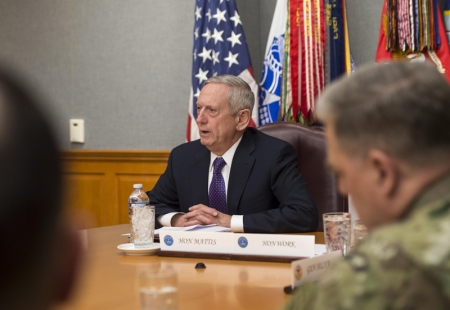
Secretary of Defense James Mattis. (Dept. of Defense/Brigitte N. Brantley)

So far, the United States coalition has driven ISIS from 55,000 square kilometers of territory in Iraq and Syria.

A New Coalition

Apart from a strategy to counter ISIS, the Trump administration also called on our allies in the Middle East to put together a new joint multi-state effort to stop financing terrorism. Leading the multi-state effort will be the Kingdom of Saudi Arabia and the United States, which together will supposedly open a new center dedicated to the elimination of terrorist financing. Positive results are not guaranteed, but it is a step in the right direction.

According to Abdul Hadi Habtoor, the center will exchange information about financing networks, adopt means to cut off funding from terrorist groups, and hopefully blacklist Iran’s jihadist army, the Islamic Revolutionary Guard Corps (IRGC). These measures in turn will help eliminate the sanctuaries from which terrorists plot and plan.

This move also places emphasis on the responsibility of states to eliminate terrorism. As President Trump said, each country — where it is sovereign — has to “carry the weight of their own self-defense“, be “pro-active” and responsible for “eradicating terrorism”, and “to deny all territory to the foot soldiers of evil”.

This determination was underscored by many Arab countries breaking diplomatic relations with Qatar for its support of Iran, the Muslim Brotherhood and ISIS. Most of Qatar’s Arab neighbors, including the Saudis, Egypt, and the UAE did so, while the US, although denouncing Qatar’s support of terrorism, continues to maintain access to, and use of, its critical military base there.

In short, the U.S. is playing good-cop, bad-cop in the region, while U.S. allies are putting together what Josh Rogin of the Washington Post described as “a regional security architecture encompassing countries on the periphery of Iran.”

Such an approach is not without risk: Turkey, allied with Iran and Qatar, has already has pledged to help Qatar defy the Gulf States’ trade cut-off. If Turkey, for example, seeks to move its promised aid shipments to Qatar through the Suez Canal, the ships could possibly be blocked by Egypt or attacked on the high seas. Does the U.S. then come to the assistance of a NATO member — Turkey — against an ally in the strategic coalition?

Drive Hateful Ideology Out

A companion challenge by the new American President underscored this new security effort. President Trump said to the assembled nations of the Islamic conference that they have to expel the ugly Islamist ideology from the mosques and madrassas that recruit terrorists and justify their actions.

Trump said: “Drive them out of your places of worship”. Such words had never been spoken so clearly by an American president, especially to the collection of nearly all the Islamic-majority countries (minus the Shi’ite bloc) gathered together.

The president’s audience doubtless understood that he was speaking of the doctrine of sharia (Islamic law). The new “test” of our alliance will be whether the assembled nations will join in removing the hateful parts of the doctrine from their communities. It was a sharp but critical departure from the previous American administration’s message in Cairo in 2009, and placed the Islamic doctrine that seeks to establish the sharia throughout the world in a contained context.

New Israeli Partnership

With Israel, the administration has cemented the next part of its strategy. Here the Trump administration successfully improved our political and military relations with Israel. Markedly so. One part of that effort was enhanced missile-defense cooperation called for in the FY18 United States defense budget, specifically to deal with Iranian and Iranian-allied missile threats.

On relations with the Palestinian Authority, the administration has moved to improve matters but has not moved to advocate a two-state solution — for which there is no contemplated security framework sufficient to protect Israel.

Challenge and Roll Back Iran

The final part of the administration’s strategy starts with a thorough review of our Iran strategy and the Joint Comprehensive Plan of Action (JCPOA), or “nuclear deal”, with Iran. As Max Singer recently wrote, even if we discount what secretive nuclear capability Iran may now have, the Iranian regime will at the very least be much closer to producing nuclear weapons down the road than when the JCPOA was agreed to.

As Ambassador John Bolton has warned the nuclear deal with Iran did nothing to restrain Iranian harmful behavior: “Defiant missile launches… support for the genocidal Assad regime… backing of then Houthi insurgency in Yemen… worldwide support for terrorism… and commitment to the annihilation of Israel” continue.

In addition, uranium enrichment, heavy water production, the concealed military dimensions of warhead development and joint missile and nuclear work with North Korea all lend a critical urgency to countering Iran’s lethal efforts. The United States did not make these counter-efforts any easier by providing to Tehran $100 billion in escrowed Iranian funds, equivalent to nearly one quarter of the Islamic Republic’s annual GDP.

The United States’ and Europe’s easing of sanctions on Iran has helped reintegrate Iran into global markets via mechanisms such as the electronic payment system run by the Society for Worldwide Interbank Financial Telecommunications (SWIFT). That, in turn, has helped Iran expand dramatically its military modernization budget by 33%, including deals worth tens of billions of dollars in military hardware with China and Russia.

Added to that is Iranian financial- and weapons-support for foreign fighters in Syria, Iraq, Yemen, Lebanon and Afghanistan. Iran’s significant support to the Houthi rebels in Yemen includes weaponry, financing and logistical support, including advanced offensive missiles. The Houthis regularly attempt to carry out missile attacks against Saudi oil facilities.

Such Iran activity is described by the Commander of U.S. Central Command, General Joseph Votel, as “the most significant threat to the Central Region and to our national interests and the interest of our partners and allies”.

As such, it can only be challenged through exactly the kind of military, political, and economic coalition the Trump administration is seeking to band together, which would include the Gulf Arab nations, especially Saudi Arabia, as well as Egypt, Jordan, and Israel.

The administration’s five-step strategy has a chance to work. It creates a policy to destroy ISIS; oppose Islamic terrorism and specifically the imposition of sharia; adopt measures to go after the financing of such terrorism; implement improvements in Gulf allies’ military capabilities — including missile defenses — parallel with pushing NATO members to meet their military spending obligations; put back into place a sound and cooperative relationship with Israel; and specifically contain and roll back Iranian hegemonic ambitions and its terror-master ways.

What still has to be considered, however, is the U.S. approach to stopping Iran from filling the vacuum created by ridding the region of ISIS, as well as Iran’s push for extending its path straight through to the Mediterranean.

If successful, some modicum of peace may be brought to the Middle East. And the arc of history will have finally been shaped toward America’s interests and those of its allies, rather than — however inadvertently — toward its mortal enemies.

Dr. Peter Huessy is President of GeoStrategic Analysis, a defense consulting firm he founded in 1981, and was the senior defense consultant at the National Defense University Foundation for more than 20 years.

Will Trump make a peace breakthrough in 2018?

June 15, 2017

Will Trump make a peace breakthrough in 2018? DEBKAfile, June 15, 2017

(Lots of speculation about future events, but an interesting piece nevertheless. — DM)

US President Donald Trump’s goal of generating a rapid improvement of Israel’s ties with the Arab world, including the Palestinians in 2018, is not just up to Prime Minister Binyamin Netanyahu and Palestinian Authority Chairman Mahmoud Abbas, but depends largely on how the Trump administration handles the continuing conflict between Qatar and its powerful Arab opponents, Egypt, Saudi Arabia and the UAE.

Up until the end of this week, Trump had turned down the efforts of Secretary of State Rex Tillerson and Secretary of Defense James Mattis to resolve the Gulf conflict by diplomacy. Instead of heeding them, the president took the advice of the Saudi defense minister, Prince Mohammed bin Salman, and Saudi Foreign Minister Adel Al-Jubeir, who visited Washington this week. Tillerson and Mattis tried to arrange a conference between Saudi Arabia and Qatar so as to gradually ease the tensions, but Trump torpedoed the initiative by adopting Riyadh’s tough line.

A complex situation has arisen in the last few days regarding the US diplomacy for bringing Israel and the Palestinians aboard a peace process. The signs of movement on this score fluctuate between crises and some progress:

1. The Gaza electricity row falls under the first heading. Some circles contend that the crisis is artificial, since the Palestinian enclave is receiving as much power now as before. What is different is the new, intensified pressure by Egypt on the one hand and the Palestinian Authority on the other in the hope of toppling Hamas rule in the Gaza Strip or squeezing its leaders into toeing their lines. Neither Egyptian President Abel Fatteh El-Sisi nor the Palestinian Authority chairman has made headway. Hamas stubbornly refuses Cairo’s demand to sever ties with Qatar, while launching a counteroffensive to draw Israel into the dispute by making an empty threat of an “explosion.”

Israel responded with a counter-threat on Thursday, June 15: a proposal to transfer one hour’s worth of power from West Bank Palestinian towns to boost the supply to Gaza.

This maneuver kept the entire electricity issue in the court from it was tossed, Ramallah.

2. A shower of Israeli concessions is landing on the Palestinians judging by almost daily reports. Some are true and others false. But in sum, they are designed to impress President Trump with the Netanyahu government’s good will towards his peace initiative and readiness to take steps in its support. In fact, the prime minister is preparing the ground for the forthcoming arrival of Jason Greenblatt, Trump’s envoy on the Israel-Palestinian issue.

3. US Secretary of State Tillerson this week informed the Senate that the Palestinian Authority had agreed to  halt its payments to the families of Palestinian terrorists who were killed while carrying out attacks against Israelis. Palestinian officials no doubt let this be understood to demonstrate their willingness to go along with Trump’s peace initiative, without, however, have any real intention of following through.

4. Media reports and the findings of Arab research institutes add up to the following predictions on the fate of the negotiations generated by the Trump administration between Israel and the Arab world:

A. Some time during 2018, a showcase summit will be staged for Trump, Netanyahu and leading Arab rulers like Saudi King Salman, Egyptian President El-Sisi and the UAE’s Crown Prince Mohammed bin Zayed al-Nahyan.

They will publish a joint declaration signaling the phased normalization of relations with Israel by such preliminary steps as the exchange of economic and business delegations, the opening of trade offices and of Arab skies to Israeli commecial flights. None of these researchers is clear about the Palestinian role in this event.

B. Meanwhile, Israel will make concessions towards improving the lives of ordinary Palestinians, such as removing checkpoints, issuing building permits for Palestinian towns and more jobs in Israel.

C. Israel and the Palestinian Authority will expand their security cooperation. The Palestinians will be persuaded to cease their incitement against the Jewish State and stop payouts to the families of convicted Palestinian terrorists and other security offenders.

D. Direct Israeli-Palestinian negotiations will ensue, without preconditions on either side, and expand. with Arab governments sitting in.

E. At the end of a period of some years, this process will mature into a discussion of the core issues of the dispute, Palestinian statehood, future borders, settlements, Jerusalem and refugees.

In other words, the year 2018 will see the building of normal relations between Israel and Arab countries to be followed at a later date by the Israeli-Palestinian peace process. President Trump has clearly seized on relations with Riyadh, Cairo and Abu Dhabi as a lever for pushing Israel and the Palestinians into peace talks.

The idea is simple. Israel’s improved ties with the Arab world will resonate positively on Israeli-Palestinian relations. That appears to be Trump’s formula for peace. But there is a catch. It depends heavily on the US President maintaining good relations with the Arab world in the long term.

Military crisis in Qatar may spark Gaza outbreak

June 13, 2017

Military crisis in Qatar may spark Gaza outbreak, DEBKAfile, June 13, 2017

A military crisis centering on Qatar would be a catalyst for an outbreak of violence from the Gaza Strip. And indeed, after the failed Sanwar mission to Cairo and the reduction of electric power to the Gaza Strip, Hamas spokesmen warned that an “explosion” was imminent.

*********************

The electricity cutback in the Gaza Strip, engineered by Palestinian leader Mahmoud Abbas to flex muscle against Hamas rule, was just one piece on the checkerboard created by the crackdown Egypt, Saudi Arabia Bahrain and the United Arab Emirates have imposed on Qatar for supporting terrorist groups like the Palestinian extremist Hamas. Therefore, Hamas leader Yahya Sanwar had little to expect from his mission to Cairo last weekend to persuade the El-Sisi government to ease its restrictions on the Gaza Strip.

He arrived at the head of a large mission, in which the group’s military arm, Ezz e-Din El-Qassam was heavily represented. Their appeals to Maj.-Gen Khaled Fawzy, director of Egyptian General Intelligence, met with a list of tough conditions. When the Palestinian delegation balked, Cairo acted to tighten its blockade on the Palestinian enclave.

The Hamas rulers of the Gaza Strip found themselves in the same boat as their old friend, Qatar, in the week that their internal rival, Mahmoud Abba, docked payment for the electricity Israeli supplies the Gaza Strip. The power supply was cut by 40 percent.

From 2015, the emir of Qatar remained the only Arab ruler backing the Palestinian extremist Hamas with occasional cash donations to Gaza City and permission for its top officials to set up shop in Doha.

This flow of aid was abruptly cut off by the land, sea and air blockade Saudi Arabia, the UAE, Bahrain and Egypt clamped down on Qatar last week over its support for terrorist groups and ties with Tehran. Sheikh Tamim bin-Hamad Al-Khalifa defied the ultimatum they presented him, and so Qatar’s banks and international assets have been losing dollars, its currency has plummeted and there is no money to spare for the Gaza Strip.

Qatar and Hamas are being pushed into the same corner.

The small Gulf island, which is the world’s largest supplier of natural gas, was been told by the four leading Arab governments to expel Muslim Brotherhood and Hamas officials from its soil, after years of providing them with hospitality plus pensions generous enough for them to live a life of ease and plenty, while also running their terrorist networks across the region and beyond.

Qatar was also told to discontinue its propaganda campaigns against Egypt, Saudi Arabia and the UAE, and shut down its main platform, the Al Jazeera TV channel; and hundreds of Egyptian and Saudi dissidents granted political asylum deported forthwith.

With nowhere else to go, these dissidents could potentially head for sanctuary in the Gaza Strip, making it a “little Qatar,” which is why Cairo further tightened the Palestinian enclave’s isolation by blocking all routes of access.

The Hamas delegation was likewise confronted in Cairo with tough demands by the Egyptian intelligence chief:

1. To turn in the Muslim Brotherhood fugitives they were sheltering in the Gaza Strip.

2.  Not just to sever cooperation between the Hamas military arm and the Islamic State networks in the Sinai Peninsula, but to surrender to Egypt all the intelligence they possessed about the jihadists and their activities.

3.  To discontinue weapons smuggling operations through Sinai.

After balking at the Egyptian demands, Yahya Sanwar was forced to leave Cairo empty-handed with regard to eased restrictions and humanitarian aid – only to find on his return home that the Egyptians had raised their biggest gun against the Gaza Strip: They had cut off power.

A humanitarian catastrophe now hangs over the two million inhabitants of the tiny Mediterranean enclave. Hospitals are cutting back operations, refrigerators are switched off, clean water supplies are dwindling because desalination plants are without power, raw sewage is dumped into the sea and sanitary conditions deteriorating.

Cairo asked the Palestinian Authority in Ramallah and the Israeli government not to relent, but to keep the pressure on the Hamas regime high. Ramallah must continue to hold back payment to cover Israel’s electricity bills, which suits Mahmoud Abbas’ campaign for bringing Hamas to heel.

But for Israel, there is a dilemma. Nonetheless, the Netanyahu government is extremely wary of breaking away from the anti-terror line taken by Arab governments, because this could put paid to the delicate ties established with them – especially in the military domain – through long and laborious effort.

In Jerusalem, it is therefore ardently hoped that the Qatar crisis is quickly resolved and Hamas and Cairo can reach terms exponentially for easing the humanitarian crisis in the Gaza Strip.

For the time being, there is no sign of this happening. On the contrary, there are indications of the crisis moving onto a military plane. Sources in the Middle East are not ruling out possible military action by Saudi Arabia, Egypt and the UAE against Qatar.

Read more about this looming potential in the coming DEBKA Weekly issue (for subscribers) out next Friday, June 16. 

A military crisis centering on Qatar would be a catalyst for an outbreak of violence from the Gaza Strip. And indeed, after the failed Sanwar mission to Cairo and the reduction of electric power to the Gaza Strip, Hamas spokesmen warned that an “explosion” was imminent.

Qatar – the end of the road?

June 9, 2017

Qatar – the end of the road? Israel National News, Dr. Mordechai Kedar, June 9, 2017

(Please see also, Qatar, Trump and Double Games. — DM)

The Emirate of Qatar is a peninsula that juts out from Saudi Arabia into the Persian Gulf. The only overland route out of Qatar is by way of Saudi Arabia and if that route is blocked, the only way to reach Qatar or leave it is by air or sea. However, flights to and from Qatar pass over Saudi air space part of the time and ships from or to Qatar have to pass through Saudi territorial waters. This means that Saudi Arabia can in effect declare a total blockade on Qatar if it so desires. It has never done so before, but it began the process on June 5th.

In addition to a blockade, the Saudis, joined by the United Emirates, Bahrain, Egypt, Libya, Mauritius, the Philippines and the Maldives, cut off diplomatic and consular relations with Qatar.  Egypt, Libya and the Emirates declared that they would ban Qatari plans and ships from their air space and territorial waters. In 2014, these countries took much milder steps in order to punish Qatar, cancelling them once Qatar agreed to accept the dictates of the Umma and signed the Riyadh agreement along with the rest of the Arab nations.

The reasons provided by the countries involved for the unprecedented severity of the current steps against Qatar included: “Qatar aids the Muslim Brotherhood and other terror organizations such as Hezbollah, Hamas, ISIS and Jebhat al-Nusrah” and “The Emir of  Qatar has declared that Iran is a good nation” as well as “Qatar destabilizes our regime,” as well  as ” Qatar provides hiding places and shelter to Muslim Brotherhood leaders who fled there from Egypt,” and “Qatar is giving aid to  the Houthi rebels (read Shiites) in Yemen.”

Another and most subtle reason, whose source is a Kuwaiti commentator, appears on al Jazeera‘s site: “Qatar refused to meet Trump’s financial demands.” This odd remark relates to a rumor on Facebook and other social network sites claiming that before Trump agreed to come to the Riyadh Arab League Conference, he demanded the Gulf Emirates purchase US arms in the legendary sum of one and a half trillion dollars, to be divided among Saudi Arabia, Qatar and the United Emirates. The three agreed, but Qatar pulled out at the last minute, causing the Emirates to follow suit, and leaving the Saudis holding the bill demanded by Trump.   The falling through of this deal, the largest in history, may have been the reason for Trump’s noticeably grim face in Riyadh.

Claiming that Qatar causes the destabilization of regimes is a veiled hint referring to al Jazeera which broadcasts from Qatar. Every since it began broadcasting in 1996 from the capital city of Qatar, Doha, al Jazeera has infuriated Arab rulers because it constantly carries out a media Jihad against them also aimed at others such as  Israel, the US, the West and Western culture. The channel also promotes and supports the Muslim Brotherhood and its offshoots such as Hamas, al Qaeda and the Northern Branch of the Islamic Movement in Israel headed by Sheikh Raad Salah. Al Jazeera‘s media strategy is determined by Qatar’s Emir and is carried out down to the last detail by its very professional leading broadcaster and editorial policy setter, Jamal Rian, a Palestinian born in Tul Karem in 1953, who moved to Jordan where he was active in the Muslim Brotherhood until expelled by King Hussein.

Every so often other Arab regimes, chief among them Egypt under Mubarak, attempted to close down al Jazeera‘s offices in their countries after overly harsh criticism was aimed at the ruling government, only to reopen them when al Jazeera simply stepped up its attacks

The general feeling is that any government official – or anyone at all – who opposes a ruling regime (and there is no shortage of these people in any Arab country) leaks embarrassing information to  al Jazeera all the time, so that the channel is always poised to expose the information when the time is ripe and especially if the now-cornered victim has been unfriendly to it and to Islamists. The thought of this happening is enough to paralyze every Arab leader who would like to clamp down on al Jazeera in his country.

Every time a conflict erupts between Israel and Hamas, al Jazeera comes out in favor of the terrorist organization because of Qatar’s support of it. Hamas leader Haled Mashaal, makes his home in Qatar and the Qatari Emir is the only Arab leader so far to visit Hamas-ruled Gaza. The Emir has give billions to Hamas, enabling the organization to develop its  terror infrastructure.

Qatar has budgeted half a billion dollars to “buy” organizations such as UNESCO (whose next head will, unsurprisingly, be from Qatar), as well as media, academic and government figures to advance the goal of removing Jerusalem from Israeli hands. Al Jazeera runs a well publicized and organized campaign in order to ensure this outcome. This is the face of media jihad.

Saudi Arabia has never allowed al Jazeera‘s reporters to work from within the country, but does allow them to cover special events once in a while, mainly the Hajj. The Saudis know exactly what the Emir had up his sleeve when he founded a media network that would rule over Arab monarchs by means of recording their slip-ups, taking advantage of the Arab obsession with avoiding public humiliation by broadcasting from a satellite that can reach every house in the Arab world with no way of blocking it.

The last reports are that the Saudis blocked access to the al Jazeera internet site from their territory.  It is harder to block al Jazeera‘s satellite channel reception legally and it can still be accessed throughout the monarchy. Arab media attribute the blockage to declarations supportive of Hamas and Hezbollah made by the Emir of Qatar after Trump’s speech in Riyadh in which the US president included Hamas and Hezbollah in his list of terror organization, equating them with al Qaeda and ISIS.

Sorry, but I do not buy that story. Declarations about third parties (Iran, Hamas, Hezbollah) are ordinarily not the reason a public dispute erupts between Iranian monarchs. In my opinion, the reason for blocking the al Jazeera site in Saudi Arabia is a photograph posted on the al Jazeera site while Trump was in Riyadh.

This photo shows King Suleiman of Saudi Arabia awarding the Gold Decoration, the highest honor of the Saudi monarchy, to Donald Trump, but that is not the reason it was posted on al Jazeera. The reason has to do with the woman appearing in it and standing between Suleiman and Trump. I do not know what her name is, but she accompanied Trump during his entire stay in Riyadh standing just behind him and carrying a briefcase. Perhaps she is an interpreter. She is carrying a briefcase filled with important documents that have to be with Trump all the time in one picture as he, of course, would not be seen carrying a briefcase and standing be[hind her].

What is interesting about this woman is that she spent the entire time in the royal palace with her hair uncovered, like Melania Trump, the First Lady, did, even though women with uncovered hair are not to be seen in Saudi Arabia. In the palace, women are also not allowed to b e seen in the company of men. Al Jazeera posted this photo intentionally, in order to embarrass the king who granted Trump an award even though he was accompanied by women who, like those in the picture, who do not cover their hair. That photo of the king was the last straw and the Saudis blocked al Jazeera.

Qatar is now under great pressure. The nations that broke off relations with Qatar have stopped recognizing the Qatari Rial as a viable currency and have confiscated all the Qatari Rials in their banks. As a result, Qatar cannot purchase goods with its own currency and must use its foreign currency reserves. The supermarket shelves in Qatar have been emptied by residents hoarding food for fear that the blockade will not allow food to be imported. Long lines of cars can be seen trying to leave for Saudi Arabia to escape being shut up in the besieged, wayward country.

Qatar is trying to get the US to help improve the situation. The largest American air force base in the Gulf is located in  Qatar and it is from there that the attacks on ISIS are generated. Qatar also hosts the US Navy Fifth Fleet as well as the Central Command and Control of US forces in that part of the world. Qatari media stress the US concern about the siege that the Saudis have put on Qatar.

As part of its efforts to enlist US aid, Qatar has begun a counterattack: Qatar media have publicized that the U.A.E. ambassador, Yousef Al Otaiba , said on US election eve: “What star could make Donald Trump the president?” This is intended to cause a rift between the US and the Gulf Emirates, but will certainly not improve Qatar’s own relations with the Emirates.

Meanwhile, the Saudis and the Emirates have ejected Qatar from the coalition fighting the Houthis in Yemen, and there are rumors that they will also remove Qatar from the Council for Cooperation in the Gulf. The Saudis could suspend Qatar’s membership in the Arab League and other organizations if this dispute continues, raising the pressure on the Emir’s al-Thani clan.

The next few days will decide Qatar’s future. There  is a distinct possibility that the foreign ministers of Qatar and the Arab nations taking part in the boycott against it will meet in some neutral spot, perhaps Kuwait, Qatar will give in and new rules will be set by Arab leaders, that is by King Suleiman, to keep Qatar in line. They would include: toning down al Jazeera and perhaps even switching its managerial staff, ending the support for the Muslim Brotherhood and other terror organizations, ending cooperation with Iran and above all, listening to what the Saudi “Big Brother” says about issues, especially those having to do with financial dealings with the US. Once the conditions for Qatari surrender are agreed upon, we can expect the ministers to meet the press, publicize a declaration on the end of the intra-family dispute, shake hands before the cameras and smile – until the next crisis.

There is, however, another scenario: Qatar does not give in, the Saudis and its allies invade, their armies eject the Emir and Mufti of Qatar, and also Jamal Rian, the guiding brain behind Al Jazeera’s  policies. They would then appoint a new Emir from the ruling family, one who knows how to behave, one who listens to the Saudis.  No one except for Iran, the Muslim Brotherhood and Hamas would oppose this solution, and the soft-spoken condemnations will not succeed in hiding the world’s joy and sighs of relief if the Saudis actually carry out that plan.

Time for a Terrorism Accord, Not a Climate Accord

June 4, 2017

Time for a Terrorism Accord, Not a Climate Accord, PJ MediaRoger L Simon, June 3, 2017

(Another pleasing idea that won’t likely be tried and, if tried, won’t work. “America First” can work and, if given a chance, should. The Supreme Court is about to consider President Trump’s “Muslim ban” executive order. Perhaps recent events in Europe and England will push enough justices to reinstate it.That will at least be a step in the right direction. Please see also, Supreme Court Expedites Trump’s Petition on Executive Order Case. — DM)

[T]he recent Paris climate accord is not only based on bad or “cooked” Climategate science, it is a deliberate conscious/unconscious deflection from the genuine “present danger” in front of us.  It is no more than obfuscation allowing moral narcissists to feel good about themselves, virtue signaling about an environmental armageddon that hasn’t happened and may never happen while, in real life, people are actually murdered on London bridges and in Cairo churches.

**************************

Yes, there’s a threat to civilization and it’s not global warming, manmade or otherwise.  And anyone who isn’t comatose should know what it is.

Islam, like cancer, needs a cure. And we all have to participate in the search for one before it’s too late.

Yes, this is about Islam, not “radical” Islam or some other off-shoot, real or imagined, because the tenets that have inspired the non-stop spate of terrorism across the world in recent years are spelled out clearly in sections of the Koran and the Hadith and other holy works of Islam. They provide justification for ISIS and a hundred other groups that may or may not replace them, now and in the future. This cannot continue — unless we really do want to destroy ourselves.

To be clear, this is not about bad people (many Muslims are fine human beings), but about a malignant ideology from the seventh century that must be expunged for the survival of all.

But the majority of Western leaders don’t want to know that.  In fact, I’d wager that most have not even bothered to educate themselves in any serious way about Islam nearly sixteen years after 9/11 and with all the constant carnage that has gone on since and has been increasing significantly, not just in London and Manchester but virtually everywhere.

These Westerners are not only willfully blind, they are suicidal.  But we cannot let them commit suicide for the rest of us.  They have to go.

Similarly, the recent Paris climate accord is not only based on bad or “cooked” Climategate science, it is a deliberate conscious/unconscious deflection from the genuine “present danger” in front of us.  It is no more than obfuscation allowing moral narcissists to feel good about themselves, virtue signaling about an environmental armageddon that hasn’t happened and may never happen while, in real life, people are actually murdered on London bridges and in Cairo churches.

What we need now is an international terrorism accord — and, unlike the climate accord, a binding one — that would commit the world, including the Muslim nations themselves, to the complete reformation of Islam that is the necessary basis for an end to this terrorism.

President Trump made a good start in Riyadh in his address to the Sunni leaders, but we must go much further.  It is correct that the Islamic world should be the ones to change their religion, but the rest of us on the planet are too affected by the results to stand by and wait.  From the horrifying (London this weekend) to the daily (the constant of indignity of being scanned at airports, concerts, museums, etc.), we are all victims of Islamic ideology.  We have a right, indeed an obligation, to participate in and demand its change. Otherwise, it will only get worse.

Since Trump had the courage to open the discussion in Saudi Arabia, he should attempt to expand the dialogue and create this global accord. Egypt’s el-Sisi would be a good partner because he already had the guts to criticize his own religion.  All should be invited, even those who would never come (like the mullahs).  All must confront the question of why Islam, unique among the world’s religions today, has so much violence committed in its name. What is it about Islam that attracts this?  What therefore has to be changed, both in behavior and ideology?

The event should be public, with Islam ultimately made to pledge itself to human rights as accepted by the West — equal rights for women and homosexuals, separation of church (mosque) and state, no discrimination based on race or religion (why no churches allowed in Saudi Arabia?), etc. — not the absurd Orwellian version of human rights promulgated the UN Human Rights Council.

This demand should be made to all quarters of the Islamic world with economic punishment applied if necessary.  The time for diplomatic politesse is long over. Islam must be forced to join modernity. Reactionary multiculturalists among us must be ignored, along with their hypocritical (and nonsensical) belief that all religions are equal.  To do otherwise would be to treat Muslim people like children.  And that is what the West has been doing for some time — with atrocious results for all.

Iran and Middle East Instability

June 3, 2017

Iran and Middle East Instability, American ThinkerShahriar Kia, June 3, 2017

During President Donald Trump’s trip to the region and beyond Iran was strongly condemned by the American leader and senior Saudi officials for its support for terrorism, destructive role across the Middle East, and meddling in Syria, Iraq, and Yemen. Tehran is most specifically concerned with world leaders denouncing Iran’s human rights violations and acknowledging how the Iranian people are the main victims of the mullahs’ atrocities.

The Arabs, as the flagbearers of implementing U.S. sanctions, have launched the domino of freezing Iran’s money abroad. Iranian bank accounts in countries such as Turkey, Oman, and the UAE, especially in Dubai and Abu Dhabi, are being blocked one after another. This can be considered the prelude to comprehensive sanctions on Iran’s banking network.

***********************

The end result of Iran’s presidential election has created further rifts and launched a more intense power struggle amongst the regime’s senior ranks. Supreme Leader Ali Khamenei, fearing a repeat of the 2009 scenario of nationwide uprisings, failed to “engineer” the election results with the aim of unifying his regime apparatus. Khamenei sought to prepare conservative cleric Ebrahim Raisi as his heir by first placing him in the presidency, similar to the process he himself went through.

The elections, however, failed to provide such a finale and in fact prompted all candidates to unveil corruption in the most senior ranks. This has prompted the general public to increase their demands. Protests and demonstrations are witnessed these days in more than 30 cities and towns across Iran, with sporadic reports of clashes, following the bankruptcy of two state-run financial firms, Caspian and Arman.

Iran is also facing major foreign dilemmas, with a new international coalition shaping and targeting Tehran’s interests. The Arab-Islamic-American alliance, with the presence of 55 States, and Iran’s absence, delivered a major blow to the mullahs’ objectives in the Middle East.

On the other hand, Iranian opposition People’s Mojahedin Organization of Iran (PMOI/MEK), transferring all its members from Iraq to a number of European countries, has become ever more powerful. Through a vast network of supporters inside Iran, the PMOI/MEK was able to significantly influence the recent elections and place the regime in a quagmire like never before.

A major rally is scheduled for July 1st by supporters of the National Council of Resistance of Iran (NCRI), the political umbrella group of Iranian dissidents, including the PMOI/MEK. Policymakers and influential figures from across the globe will be gathering to provide a concrete plan to evict the mullahs’ presence from the region, how to establish freedom and democracy in Iran, and thus result in peace and stability in the Middle East. Last year more than 100,000 people took part in this convention.

During President Donald Trump’s trip to the region and beyond Iran was strongly condemned by the American leader and senior Saudi officials for its support for terrorism, destructive role across the Middle East, and meddling in Syria, Iraq, and Yemen. Tehran is most specifically concerned with world leaders denouncing Iran’s human rights violations and acknowledging how the Iranian people are the main victims of the mullahs’ atrocities.

Despite the heavy blows and new sanctions against Tehran, Khamenei has chosen to remain completely silent. This is in complete contrast to the Obama era, where the mullahs’ leader resorted to harsh outbursts in response to even the slightest hint of threats by U.S. officials.

To this end, adopting a strong approach against Tehran has proven to be correct, parallel to the weakness seen in Tehran following the presidential election.

To add insult to injury for Iran, the Trump administration has imposed sanctions on dozens of Iran’s companies, sending a highly important message.

Sanctions have now expanded from ballistic missiles and reached the human rights perspective, and specifically targeting the Revolutionary Guards (IRGC) with the objective of designating this entity as a foreign terrorist organization

The IRGC-affiliated Fars news agency described a new U.S. Senate bill as an “effort to bring Europe aboard in nuclear sanctions.”

“Foreign investment in Iran during the past four years has halved during the past four years, lowering from $4.6 billion to $2.05 billion,” according to Naseem Online citing a UN report.

The Arabs, as the flagbearers of implementing U.S. sanctions, have launched the domino of freezing Iran’s money abroad. Iranian bank accounts in countries such as Turkey, Oman, and the UAE, especially in Dubai and Abu Dhabi, are being blocked one after another. This can be considered the prelude to comprehensive sanctions on Iran’s banking network.

Is Rouhani able, or even willing?

Rouhani is neither willing nor able to carry out any measures outside of Khamenei’s framework. The entire apparatus and power structure is controlled by the Supreme Leader. As long as Iran remains under the mullahs’ regime structure, one should set aside all expectations of change emanating from within Iran. A look at Mohammad Khatami’s tenure is president from 1997 to 2005, andRouhani’s first term, are undeniable proof to this reality.

“They want to change our behavior, but changing it means changing our regime,”Khamenei said recently, signaling his red line.

Rouhani defending Iran’s missiles

The regime’s president recently said that Tehran would continue its ballistic missile program.

“… US officials should know whenever we need to technically test a missile, we will do so and will not wait for their permission,” he said in a news conference.
The Iranian regime reported recently the construction of a third underground ballistic missile production factory and will keep developing its missile program.

This came in the same week when Trump in his foreign visit described Iran as a supporter of militia groups and a threat to all Middle East countries.

Rouhani is an “utterly ruthless operator,” who had presided since 2013 over a collapsing economy and what Amnesty International called “a staggering execution spree,” murdering and imprisoning so many dissidents that Iran has per capita the highest execution rate in the world, according to Christopher Booker in a recent Telegraph article.

Obama’s departure ended the period of appeasement and golden opportunities for Tehran’s mullahs. The road ahead promises to be very difficult, to say the least.

The past four decades have proven that only regime change will bring about what the Iranian people desire and deserve. This is something that is supported by the NCRI and Rajavi’s ten-point plan, calling for a free and democratic Iran where equal opportunities are provided to all citizens regardless of gender, ethnicity, and religion. During the short campaigning season, Iranians manifested their support for Rajavi’s plan by putting up posters reading “Maryam Rajavi is our president.”


The Limits of Israeli Power

June 2, 2017

The Limits of Israeli Power, Front Page MagazineCaroline Glick, June 2, 2017

(As to Jerusalem, please see Turkish takeover in Jerusalem. — DM)

Originally published by the Jerusalem Post

Washington and the rest of the governments of the world know that their refusal to recognize Israel’s capital does not endanger Israel or its control of Jerusalem. They are free to bow to Arab pressure, safe in the knowledge that Israel will continue to protect the unified city.

The time has come, at the outset of the second 50 years of Israeli control over Judea and Samaria, for Israel to take matters into its own hands. Our leaders must stop beating around the bush. They need to use the powers they have to secure Israel’s military and civilian interests in Judea and Samaria for the next 50 years as best they can. And they need to stop waiting for someone else to solve our problems for us.

*********************************

On Thursday, US President Donald Trump bowed to the foreign policy establishment and betrayed his voters. He signed a presidential waiver postponing the transfer of the US Embassy to Jerusalem for yet another six months.

Ahead of Trump’s move, Prime Minister Benjamin Netanyahu made a last-ditch bid to convince Trump to move the embassy to Jerusalem. But it was not to be.

Israel’s failure to convince Trump to do what he repeatedly promised US voters he would do during his presidential campaign shows the disparity in power between Israel and the US.

Israel lacks the power to convince foreign nations to recognize its capital – much less to locate their embassies there. The US, on the other hand, not only has the power to recognize Jerusalem and transfer its embassy to Israel’s capital whenever it wishes to do so, it also has the ability to convince dozens of other countries to immediately follow its lead.

The disparity between what the Americans can do and what Israel can do was on display on Monday evening in a glittering hall at the King David Hotel in Jerusalem. There, Bar-Ilan University conferred its Guardian of Zion award on former US ambassador to the UN John Bolton. In his acceptance speech, Bolton presented his vision for the resolution of the Palestinian conflict with Israel.

Bolton’s views are important not merely because his past work at the State Department and the UN brought the US some of its only diplomatic victories in recent decades. His views are important as well because of his close relationship with Trump.

Bolton began his discussion Monday evening by rejecting the “two-state solution.” The two-state model, he noted, has been tried and has failed repeatedly for the past 70 years. There is no reason to believe that it will succeed now. This is particularly true, he said, given the lack of Palestinian social cohesion.

Hamas controls Gaza. The PLO, which is supposed to be Israel’s peace partner, barely controls parts of Judea and Samaria. At a time when more cohesive Arab societies are unraveling, the notion that a Palestinian state would survive and advance regional peace and stability is laughable, Bolton argued.

Bolton then turned to his preferred policy for resolving the Palestinian conflict with Israel, which he dubbed “the three-state solution.” Under his plan, Egypt and Jordan would work with Israel to solve the Palestinian conflict. Egypt would take over the Gaza Strip and Jordan would negotiate the status of Judea and Samaria with Israel.

The crowd at the King David responded enthusiastically to Bolton’s proposal. This is not surprising.

Since 1967, Israelis have hoped for Jordan and Egypt to work with them to solve the problem of the Arabs of Judea, Samaria and Gaza who lived under Jordanian and Egyptian occupation from 1949-1967.

Unfortunately, Israel’s support for Bolton’s plan is irrelevant. Israel is powerless to advance it. Israel cannot convince Arab nations to help it resolve the Palestinian conflict any more than it can convince the PLO to cut a peace deal with it.

Like PLO leaders, the leaders of the Arab world know that they cannot help Israel with the Palestinians.

Doing so would involve disowning the Palestinian narrative.

The Palestinian narrative claims that the Jews of Israel are colonialist interlopers who stole the land from the Palestinians, its rightful owners. The narrative makes no distinction between Tel Aviv and Hebron. All of Israel is a crime against the Arab world. All of Israel is illegitimate.

The overwhelming majority of the Arab world believes the Palestinian narrative. For an Arab leader to walk away from it or even to signal an attenuation of his fealty to it in the interest of regional peace would be the riskiest of moves.

Israel has nothing to offer Arab leaders that could induce them to take that risk.

Although it is far from certain, the US may very well have the ability to convince Arab leaders to do so. If Trump decided that this is the way to advance peace in the Arab world, chances are he would make some headway. In other words, Bolton’s three-state plan is a plan that only America can adopt. It cannot be an Israeli plan no matter how enthusiastically the public supports involving Jordan and Egypt in solving the conflict.

Given Israel’s inability to offer the Arabs anything valuable enough for Arab leaders to risk life and limb to accept in exchange for helping to solve the Palestinian conflict, as Israel considers its own options in relation to the Palestinians, it needs to limit its goals to things that it can achieve without them. In other words, the only steps that Israel can take in relation to the Palestinians are unilateral steps.

For the past 50 years, hoping that the Arabs – and since 1993, the PLO – would finally make peace with it and so settle the permanent status of Judea and Samaria, Israel refused to take any unilateral actions in relation to its permanent interests in Judea and Samaria. Rather than apply its legal code to Judea and Samaria, it opted for the stop-gap measure of installing a military government to run the areas on the basis of Jordanian law.

Between 1994 and 1996, Israel canceled the military government in the Palestinian population centers in Judea and Samaria and Gaza. In 2005, when it withdrew, it canceled the residual military government in the rest of Gaza. Since then, the only area that remains under the Israeli military government is Area C in Judea and Samaria. Area C includes all of the Israeli communities in Judea and Samaria, and strategically critical areas including the Jordan Valley, the Samaria mountain range and the south Hebron Hills.

On Tuesday, Prime Minister Netanyahu gave an interview with Army Radio where he set out part of his vision for the permanent status of Judea and Samaria. He limited his statement to the military status of the areas. He said that under any possible future scenario, Israel must retain full security control of the areas. This, he said, is the lesson of Israel’s 2005 withdrawal from the Gaza Strip.

That pullout led to the transformation of Gaza into a Hamas-controlled hub of global jihad. Moreover, under Hamas, the Palestinians turned Gaza into one big, densely populated missile-launching pad against Israel.

While justified, Netanyahu’s position obscures more than it illuminates about his long-term vision for Judea and Samaria.

What does he mean by security control? Would the IDF remain in sole control over Israel’s eastern boundaries or would it serve as an overall coordinator of foreign forces operating along the border? Would IDF forces be confined to fortified positions while the Palestinians reign free in the open areas, as was the case in southern Lebanon in the years leading up to Israel’s disastrous withdrawal in 2000? Or would the IDF have freedom of action and maintain the initiative throughout Judea and Samaria? Moreover, does Netanyahu envision the IDF remaining the only military organization operating in Judea and Samaria in the long term? Beyond the security issues that require clarification, Netanyahu’s statements make no mention of the rights of Jews to live in Judea and Samaria.

Does he believe that Jews should be permitted to live permanently in the areas that Israel controls? If so, why are they subjected to the Jordanian legal code used by the military government and which proscribes their right to purchase land and register land sales? This brings us to the issue of governance. What does Netanyahu think about the military government in Area C? Does he believe that the 50-year reign of generals should continue until the Arabs choose to resolve the Palestinian conflict with Israel? What if this means that the generals will continue to rule over hundreds of thousands of Israeli citizens for another 50 or 100 or 150 years? Does he, on the other hand, prefer to transfer governance responsibility in Area C to the Palestinians and place the nearly 500,000 Israelis in the area under Palestinian control? In the course of his remarks, Bolton noted that if Jordan is responsible for the Palestinians of Judea and Samaria, the issue of Jerusalem will be removed from the equation. After all, if their capital is Amman, Israel has no reason to divide its capital city.

And this brings us back to Jerusalem, which Trump spurned on Thursday.

As is the case today, 50 years ago, Israel had no power to influence the positions of foreign governments regarding its capital city. But in contrast to its decision to establish a military government in Judea and Samaria, Israel didn’t wait for foreigners to give it permission to act where it had the power to act in order to change the status of the city and ensure its ability to govern and control its capital for generations to come.

In 1967, the government voted to expand the municipal boundaries of Jerusalem to include the eastern, northern and southern quarters that had been under Jordanian occupation since 1949.

Everyone benefited from the move – including the foreign powers that still refuse to recognize the simple fact that Jerusalem is Israel’s capital.

Washington and the rest of the governments of the world know that their refusal to recognize Israel’s capital does not endanger Israel or its control of Jerusalem. They are free to bow to Arab pressure, safe in the knowledge that Israel will continue to protect the unified city.

Trump’s decision to sign the waiver delaying the embassy move is a betrayal of his campaign promise, but it doesn’t change the situation in Jerusalem. Last week, Israel celebrated 50 years of sovereignty over its united capital. Jerusalem will be neither more nor less united if and when the US moves its embassy to the capital.

Perhaps Trump will eventually keep his word and move the embassy. Perhaps he will continue to breach his promise. And as far as the Palestinians are concerned, perhaps Trump adopts Bolton’s three-state plan in relation to Judea, Samaria and Gaza. Perhaps he will maintain his predecessors’ slavish devotion to the establishment of a PLO state.

Israel can’t control what Trump will do any more than it can influence what the Arabs will do. And so it needs to take a lesson not only from its bitter experience of withdrawing from Gaza, but from its positive experience of taking matters into its own hands in Jerusalem.

The time has come, at the outset of the second 50 years of Israeli control over Judea and Samaria, for Israel to take matters into its own hands. Our leaders must stop beating around the bush. They need to use the powers they have to secure Israel’s military and civilian interests in Judea and Samaria for the next 50 years as best they can. And they need to stop waiting for someone else to solve our problems for us.

The President Goes to Israel

May 18, 2017

The President Goes to Israel, American Thinker, Shoshana Bryen, May 18, 2017

It is worth getting out of the weeds of Washington on occasion and looking at the big picture. This is one of those occasions.

President Trump is going to Israel, visiting the one stable, prosperous, multiethnic, multicultural, democratic ally the United States has in a region marked by war, repression, and corruption. When he visits the Western Wall, he will be the first sitting president to do so — Barack Obama came as a candidate, George W. Bush as governor of Texas, George H.W. Bush as vice president, and Bill Clinton both before and after his presidency.

The fact that he will visit during the week of the 50th anniversary of the reunification of Jerusalem is a potent symbol of American support for Israel’s determination to keep the city open to all religious faiths – and specifically open to Jewish worship. There is no forgetting that only for the past 50 years, only under Israeli control, have Jews been able to study, visit, and pray at Judaism’s holiest sites. During Jordanian occupation of the eastern side of the city, and for the 500 years of Ottoman rule before that, Jews were restricted or banned entirely from their heritage.

The President’s visit to the holiest site in the Jewish world — accessible to Jews for less than his lifetime – is an exclamation point.

The reunification of Jerusalem was, of course, accomplished in the context of the Six-Day War, and the presidential visit comes in that context as well. The war was waged by Arab States unreconciled to Jewish sovereignty in any part of the historic Jewish homeland. Visiting on the eve of the commemoration of Israel’s defense of its place and defense of its rights, Mr. Trump has chosen a time ripe with symbolism to assert America’s longstanding — and newly recovered — shoulder-to-shoulder defense of Israel’s legitimacy and right to sovereign security.

But the visit is not only about symbols; certainly security is never only about symbols.

Mr. Trump was preceded in Israel by Defense Secretary James Mattis and Chairman of the Joint Chiefs of Staff Joseph Dunford. Their visits were aimed at deepening U.S.-Israeli security cooperation and reversing the previous administration’s plan to enhance the role of Iran in the region and decrease American influence. Mr. Trump can be expected to praise the first and find additional ways to work with Israel to constrain Iran’s freedom of action in both missile and nuclear development, and in military activity in Syria, Yemen and the Persian Gulf.

The President will visit with Arab leadership in the Gulf before arriving in Israel. The Sunni Arab world knows Iranian aggression and radical Islam are its fundamental security problems, not Israel. They are thrilled with the administration’s harder line on Iran, and the understanding that American influence and American presence matters. They want to be on Mr. Trump’s “good side,” and that’s helpful. Responding to his interest in Israeli-Palestinian talks, a new incarnation of an “Arab Peace Plan” has been floated. Trying to appear reasonable, the Arabs say Israel has only to “stop building settlements in the West Bank and ease trade restrictions in the Gaza Strip.” In exchange, they will allow Israel access to Gulf State airspace and enable direct communications with Israel.

The good news is that the plan doesn’t appear to try to settle the whole problem in a grand gesture. It does get closer to reality — the prior “Arab Peace Plan” in 2002 required that Israel withdraw from all the territory acquired in the 1967 war, including Jerusalem, before the Arab States would consider — consider, mind you — ending their state of war with Israel. As things go, this is an improvement and an affirmation of the points made by Mr. Trump and Prime Minister Netanyahu made in their joint press conference in February that progress on Palestinian-Israeli accommodation might be accomplished in a regional context.

The Palestinians, it appears, took the possibility that they will be sidelined to heart and went one better than the Arab States, dropping their eight-year insistence on an Israeli building freeze as a precondition to negotiations. U.S. Ambassador to Israel David Friedman put a nail in the coffin of “settlement freezes,” saying, “The U.S. won’t dictate how you should live together, that is something you will have to decide on your own.” Having lost the battle on that issue, the Palestinians will have to be content with the President’s visit to the Church of the Nativity in Bethlehem.

Are there glitches? Yes. There is a long way to go before the Arab States meet their UN-mandated obligation to provide Israel with “termination of all states of belligerency and respect for the sovereignty, territorial integrity and political independence of all States in the region.” The Palestinians aren’t likely to do it before their political and financial masters do.  And Americans David Berns and Jonathan Schrier, working in the U.S. Consulate in Jerusalem — which sees itself as an embassy to the fictitious State of Palestine — tried to create a firestorm over an issue of sovereignty. It was more like a paper fire in a wastebasket, embarrassing the President, but doing no damage.

But those are points that can be left for later.

When the President of the United States arrives in Israel as Israel prepares to commemorate 50 years of the Six-Day War and the reunification of Jerusalem, Americans should be pleased and proud that President Trump chose this time and this place to cement relations with Israel — our ally and friend.


US-Israel security interests converge

April 28, 2017

US-Israel security interests converge, Israel Hayom, Yoram Ettinger, April 28, 2017

In 2017, the national security interests of the U.S. and Israel have converged in ‎an unprecedented manner in response to anti-U.S. ‎Islamic terrorism; declining European posture of deterrence; drastic cuts in ‎the U.S. defense budget; an increasingly unpredictable, dangerous globe; ‎Israel’s surge of military and commercial capabilities and U.S.-Israel shared ‎values. ‎

Contrary to conventional wisdom — and traditional State Department policy — ‎U.S.-Israel and U.S.-Arab relations are not a zero-sum game. This is ‎currently demonstrated by enhanced U.S.-Israel strategic cooperation, ‎concurrently with expanded security cooperation between Israel and Egypt, ‎Jordan, Saudi Arabia and other pro-U.S. Arab countries, as well as stronger ‎cooperation between the U.S. and those same Arab countries. Unlike the ‎simplistic view of the Middle East, Arab policymakers are well aware of their ‎priorities, especially when the radical Islamic machete is at their throats. They ‎are consumed by internal and external intra-Muslim, intra-Arab violence, which ‎have dominated the Arab agenda, prior to — and irrespective of — the ‎Palestinian issue, which has never been a core cause of regional turbulence, a ‎crown-jewel of Arab policymaking or the crux of the Arab-Israeli conflict. ‎

Israel’s posture as a unique ally of the U.S. — in the Middle East and beyond — ‎has surged since the demise of the USSR, which transformed the bipolar ‎globe into a multipolar arena of conflicts, replete with highly unpredictable, ‎less controllable and more dangerous tactical threats. Israel possesses proven ‎tactical capabilities in face of such threats. Thus, Israel provides a tailwind to the ‎U.S. in the pursuit of three critical challenges that impact U.S. national security, significantly transcending the scope of the Arab-‎Israeli conflict and the Palestinian issue: ‎

‎1. To constrain/neutralize the ayatollahs of Iran, who relentlessly aspire to ‎achieve nuclear capability in order to remove the ‎U.S. from the Persian Gulf, dominate the Muslim world, and subordinate the American “modern-day Crusaders.”‎

‎2. To defeat global Islamic terrorism, which aims to topple all pro-U.S. Arab ‎regimes, expand the abode of Muslim believers and crash the abode of non-Muslim “‎infidels” in the Middle East and beyond.‎

‎3. To bolster the stability of pro-U.S. Arab regimes, which are lethally ‎threatened by the ayatollahs and other sources of Islamic terrorism.

Moreover, Israel has been the only effective regional power to check the North ‎Korean incursion into the Middle East. For instance, on Sept. 6, 2007, the ‎Israeli Air Force destroyed Syria’s nuclear site, built mostly with the support of ‎Iran and North Korea, sparing the U.S. and the globe the wrath of a ruthless, ‎nuclear Assad regime. ‎

While Israel is generally portrayed as a supplicant expecting the U.S. to extend a ‎helping hand, Adm. (ret.) James G. Stavridis, a former NATO supreme commander, ‎currently the dean of the Fletcher School of Law and Diplomacy at Tufts ‎University, says otherwise. He maintains that Israel is not a supplicant but ‎rather a unique geostrategic partner, extending the strategic hand of the U.S. ‎through a mutually beneficial, highly productive ‎relationship with the U.S.

On Jan. 5, 2017, Stavridis wrote: “Our ‎best military partner in the region, by far, is Israel … as we stand together ‎facing the challenges of the Middle East. … Israeli intelligence gathering is ‎superb. … A second zone of potentially enhanced cooperation is in technology ‎and innovation. … In addition to missile defense, doing more together in ‎advanced avionics (as we did with the F-15), miniaturization (like Israel’s small ‎airborne-warning aircraft) and the production of low-cost battlefield unmanned ‎vehicles (both air and surface) would yield strong results. … We should up our ‎game in terms of intelligence cooperation. [The Israeli intelligence ‎services] of our more segregated sectors on a wide range of trends, including the disintegration of Syria, the events in Egypt and the military and nuclear ‎capability of Iran. … Setting up a joint special-forces training and innovation ‎center for special operations in Israel would be powerful. … It truly is a case ‎of two nations that are inarguably stronger together.” ‎

Unlike other major U.S. allies in Europe, the Far East, Africa and the Middle East, ‎Israel does not require U.S. military personnel and bases in order to produce an ‎exceptionally high added value to the annual U.S. investment in — and not ‎‎”foreign aid” to — Israel’s military posture.

For example, the plant manager of Lockheed Martin, the manufacturer of the ‎F-16 and F-35 fighter planes, told me during a visit to the plant in Fort Worth, Texas: “The ‎value of the flow of lessons derived from Israel’s operation, maintenance and ‎repairs of the F-16 has yielded hundreds of upgrades, producing a mega-‎billion-dollar bonanza for Lockheed-Martin, improving research and ‎development, increasing exports and expanding employment.”

A similar ‎added value has benefitted McDonnell Douglas, the manufacturer of the F-15 fighter plane ‎in Berkeley, Missouri, as well as hundreds of U.S. defense manufacturers, ‎whose products are operated by Israel. The Jewish state — the most ‎predictable, stable, effective, reliable and unconditional ally of the U.S. — has ‎become the most cost-effective, battle-tested laboratory of the U.S. defense ‎industry. ‎

According to a former U.S. Air Force intelligence chief, Gen. George Keegan: ‎‎”I could not have procured the intelligence [provided by Israel on Soviet Air ‎Force capabilities, new Soviet weapons, electronics and jamming devices] with ‎five CIAs. … The ability of the U.S. Air Force in particular, and the Army in ‎general, to defend NATO owes more to the Israeli intelligence input than it ‎does to any other single source of intelligence.” The former chairman of the ‎Senate Appropriations Committee, Sen. Daniel Inouye, revealed that “Israel ‎provided the U.S. [operational lessons and intelligence on advanced Soviet ‎ground-to-air missiles] that would have cost the U.S. billions of dollars to find ‎out.”

On Oct. 28, 1991, in the aftermath of the First Gulf War, then-Defense ‎Secretary Dick Cheney stated: “There were many times during the course of ‎the buildup in the Gulf, and subsequent conflict, that I gave thanks for the ‎bold and dramatic action that had been taken some 10 years before [when ‎Israel destroyed Iraq’s nuclear reactor at Osirak].” The destruction of Iraq’s ‎nuclear capabilities in 1981 spared the U.S. a nuclear confrontation in 1991.

An Israel-like ally in the Persian Gulf would have dramatically minimized U.S. ‎military involvement in Persian Gulf conflicts, and drastically reduced the ‎monthly, mega-billion dollar cost of U.S. military units and bases in the ‎Gulf and Indian Ocean, as is the current Israel-effect in the eastern flank of ‎the Mediterranean.‎

Yoram Ettinger is a former ambassador and head of Second Thought: A U.S.-Israel Initiative.