Published on Sep 11, 2016
One, state, two state – it doesn’t matter as long as there is no Jewish or Zionist state.
One, state, two state – it doesn’t matter as long as there is no Jewish or Zionist state.
Speech at the 71st General Assembly in New York, Sept. 22, 2016
Palestinian Author Yousef Jad Al-Haq
Palestinian researcher and author Yousef Jad Al-Haq recently rejected the two-state solution and called to conduct organized resistance in order to liberate Palestine “from the [Jordan] River to the [Mediterranean] Sea.” Extrapolating the percentages from the birthrate of the Arab nation, he said: “If a million of us die, but we get to liberate Palestine… Well, that’s fine by me.” Al-Haq was speaking on Syria News TV on August 16.
Added by J.K
Jerusalem Online did not approved my comment existing out of this video !
Iran is again threatening Israel, saying it will “turn Tel Aviv and Haifa to dust” pending mistakes by the “Zionist regime.”
By: Hana Levi Julian
Published: September 21st, 2016
Source: The Jewish Press » » Iran Threatens to Turn Tel Aviv, Haifa to ‘Dust’

Missile Strike’ — a new anti-Israel game launched by Iran.
Photo Credit: FNA
Tehran is back to threatening Israel, this time during a parade marking the anniversary of the 1980 Iraqi invasion of Iran, a war that lasted eight years.
A wide variety of military hardware was on display Wednesday during the parade, which made its way down the main drag in the nation’s capital. Included was the Qadr H missile, which allegedly has a range of 2,000 kilometers.
Long-range ballistic missiles, tanks and the Russian-produced S-300 surface-to-air missile defense system were all in full view as the gala parade was broadcast on state television.
One military truck displayed a banner shown prominently on the broadcast that read:
“If the leaders of the Zionist regime make a mistake, then the Islamic Republic will turn Tel Aviv and Haifa to dust.”
The Iranian Navy showed off 500 vessels, along with submarines and helicopters, at the port of Bandar Abbas on the Persian Gulf.
Iran has tested American mettle more than 30 times so far this year with close encounters in the Gulf between its vessels and those of the United States Navy, according to U.S. officials quoted by Reuters.
Palestinians: “The Mafia of Destruction”
by Khaled Abu Toameh
September 21, 2016 at 5:00 am
Source: Palestinians: “The Mafia of Destruction”
Question: How do Palestinian patients obtain permits to receive medical treatment in Israeli and other hospitals around the world? Answer: By paying bribes to senior Palestinian officials in the West Bank and Gaza Strip. Those who cannot afford to pay the bribes are left to die in under-equipped and understaffed hospitals, especially in the Gaza Strip.
Yet, apparently some Palestinians are more equal than others: Palestinians whose lives are not in danger, but who pretend that they are. These include businessmen, merchants, university students and relatives of senior Palestinian Authority (PA) and Hamas officials, who receive permits to travel to Israel and other countries under the pretext of medical emergency.
Many Palestinians point a finger at the PA’s Ministry of Health in the West Bank. They argue that senior ministry officials have been abusing their powers, in order to collect bribes both from genuine patients and from other Palestinians who only want medical permits in order to leave the Gaza Strip or the West Bank. Thanks to the corruption, many real patients have been denied the opportunity to receive proper medical care in Israel and other countries.
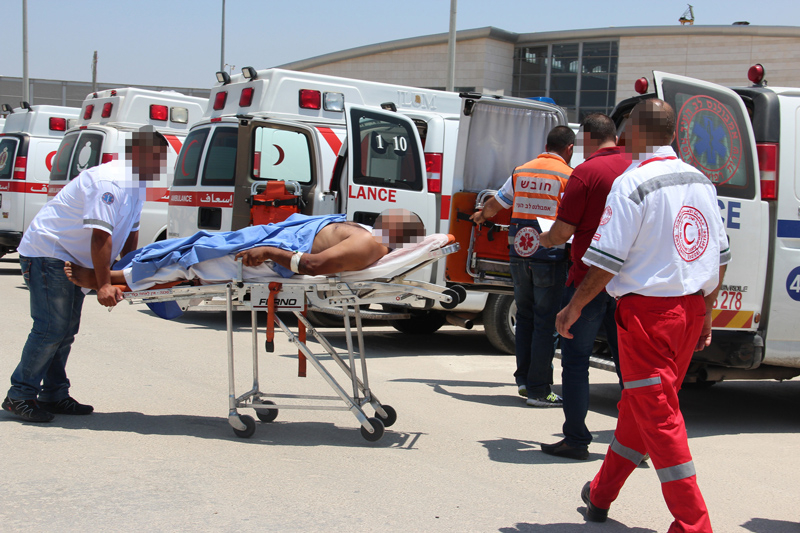 A Palestinian man is transferred to an Israeli ambulance at the Erez crossing between the Gaza Strip and Israel, on his way to an Israeli hospital, July 29, 2014. (Image source: Israeli Foreign Ministry) A Palestinian man is transferred to an Israeli ambulance at the Erez crossing between the Gaza Strip and Israel, on his way to an Israeli hospital, July 29, 2014. (Image source: Israeli Foreign Ministry) |
This, of course, does not apply to senior Palestinian officials and their family members, who continue to make ample use of Israeli hospitals and other medical centers in Jordan, Egypt, the Gulf and Europe.
Even top Hamas officials enjoy access to Israeli hospitals. In 2013, Amal Haniyeh, the granddaughter of Hamas leader Ismail Haniyeh, was transferred to an Israeli hospital for urgent medical treatment. A year earlier, Haniyeh’s sister, Suheilah, was also brought to an Israeli hospital for urgent heart surgery.
Haniyeh, however, did not need to offer cash to get his daughter and sister medical treatment in Israel. Indeed, some Palestinians are evidently very much more equal than others.
The corruption in the Palestinian health system, both in the West Bank and Gaza Strip, has long been a well-known secret. Palestinians without the right connections and without money to hand over to a senior official or physician are fully aware that they would never be allowed to receive what is called “medical referrals abroad.” The signature of a physician or a senior health official is the most precious merchandise in the West Bank and Gaza Strip. This signature allows patients to receive free medical treatment in Israel and various countries.
The absence of clear regulations to define who is entitled to this privilege have facilitated widespread corruption in the Palestinian health system. Nepotism plays a major role in this form of corruption. The relative of a senior Palestinian official can easily be transferred for treatment in an Israeli, Jordanian or Egyptian hospital, while poor patients from the Gaza Strip can wait months and years before obtaining such permits.
Hamas and PA officials are trading with the lives of Palestinian patients. They have turned medical care into a business that earns them hundreds of thousands of dollars per year. This corruption, in the absence of transparency and accountability, has also enabled top officials in the West Bank and Gaza Strip to embezzle millions of shekels from the PA budget.
Although both the Palestinian Authority and Hamas have vowed to combat this exploitation of Palestinian patients, the Palestinians themselves report no improvement. They say that more than 70% of the cases of medical referrals to Israeli hospitals and abroad have never been documented, and it remains unclear how and where the money was spent.
In 2013, for instance, the PA spent more than half a billion shekels covering medical bills of Palestinians who were referred to hospitals outside the Palestinian territories. However, no one seems to know exactly how the money was spent and whether all those who received the referrals were indeed in need of medical treatment.
The PA maintains that in 2014, more than 54,000 Palestinians from Gaza received medical referrals for treatment outside the Strip. Health officials in the Gaza Strip, however, say they are aware of only 16,382 documented cases of real patients who received such permits.
Between 1994 and 2013, the Palestinian Authority did not ask Israeli hospitals for detailed bills of the medical treatment provided to Palestinian patients. The money is deducted on a monthly basis from tax revenues collected by Israel and later paid to the PA.
The Coalition for Accountability and Integrity (AMAN), a Palestinian group working in the fields of democracy, human rights and good government, to combat corruption and enhance integrity, principles of transparency and systems of accountability in Palestinian society, is one of the few bodies sounding an alarm bell about this abuse.
Last year, AMAN released a report in which it warned against corruption in the Department of Medical Referrals Abroad, which belongs to the PA Ministry of Health. The report pointed out discrepancies in the costs of medical treatment in Israeli and other hospitals, and the actual bills. For example, in one case it appeared that 113 Palestinian patients had been admitted to Israeli hospitals at the cost of 3 million shekels, while there is no documentation of any of these cases. Even the identities of the patients remain unknown.
The AMAN report stated that measures taken by Palestinian health officials to limit nepotism and bribes, and prevent the squandering of public funds, have been insufficient. Physicians, it said, faced pressure from Palestinian Authority officials to issue medical referrals to Israeli hospitals and other hospitals around the world, even to those not in need of them. Some of the cases, the report notes, could have been treated in Palestinian hospitals, and there was no need to transfer them to other hospitals at very high costs.
The PA says that it has asked its Anti-Corruption Commission to investigate the scandal. To date, it remains unclear whether substantive measures have been taken against those responsible for the corruption.
Hamas, for its part, continues to hold the PA responsible for the misery of patients in the Gaza Strip. The Islamist movement claims that the PA government is withholding the issuance of medical permits as a means to punish Palestinians for their support of Hamas.
The truth, however, is somewhat different: health officials in the Gaza Strip who are linked to Hamas have also been exploiting the plight of patients. Hamas is uninterested in this coming to light.
Hajer Harb, a courageous Palestinian journalist from the Gaza Strip, recently prepared an investigative report about the corruption of health officials in the West Bank and Gaza Strip. She has been repeatedly interrogated by Hamas.
Harb says she is now facing charges of “slander” for exposing the corruption. She was told by her interrogators that the decision to summon her for investigation came after a physician in the Gaza Strip filed a complaint against her for “defamation.”
Hamas interrogators demanded that Harb reveal her sources and the identity of those involved in the corruption scandal. “I told them that I am a journalist and I cannot provide them with the identities of my sources without a court order,” she said.
“The prosecution told me that I was facing the following charges: impersonation of another person (they claim I did not reveal my real identity during the investigative report); slandering the Ministry of Health, publishing inaccurate and incorrect information and working with ‘foreign parties’ (by preparing a report for a London-based television station under the pretext that the media organization is not registered with the Press Office in the Gaza Strip).”
In her report, Harb wrote about the middlemen who obtain medical referrals to Israeli and foreign hospitals in return for bribes. She approached one of the middlemen and claimed she wanted to travel from the Gaza Strip to the West Bank to marry a man living there. She wrote that she received a permit to leave the Gaza Strip and receive medical treatment in East Jerusalem’s Al-Makassed Hospital after she paid a bribe to a local physician. She also found several forged medical referrals in the name of the son of a senior Palestinian official in the Gaza Strip, who obtained them in order to complete his studies in the West Bank. Harb further located a man who claimed that he works for the PA’s Preventative Security Service and who boasted that he could get a permit for medical treatment outside the Gaza Strip in return for $200. Another Palestinian bought a medical permit to leave the Gaza Strip and work in a restaurant in Ramallah.
Hamas claims to be combating the corruption of officials who are tampering with the lives of Palestinian patients. In reality, it is busy harassing journalists who speak the truth. The Palestinian Authority regime, for its part, is not too happy with exposure about the scandal.
The Palestinian Journalists Syndicate (PJS), based in the West Bank, condemned Hamas for harassing Harb. But this critique should be seen more in the context of the power struggle between the PA and Hamas, rather than as stemming from a concern for public freedoms.
In a statement, the PJS criticized Hamas for interrogating Harb as a “grave breach of media work and freedom of expression” in the Palestinian territories. The syndicate emphasized the right of journalists not to reveal the identity of their sources, adding that Harb had abided by all moral, legal and professional standards.
Najat Abu Baker, a member of the Palestinian Legislative Council who belongs to PA President Mahmoud Abbas’s Fatah faction, was one of the few politicians in the West Bank who dared to come out against the corruption scandal.
In her words, the corruption in the PA’s Department of Medical Referrals has transformed it into a “real mafia headed by influential figures.” Abu Baker accused the ministry of exploiting the impoverished residents of the Gaza Strip and wasting public funds:
“The issue of medical permits has become a business and the only ones who are paying the price are the patients from the Gaza Strip. Hundreds of these patients who have died are the victims of the ministry’s measures.”
She called for a commission of inquiry into the corruption scandal. She noted that many patients from the Gaza Strip have died while waiting for medical referrals while others, who were not ill, were given the permits thanks to nepotism and bribery.
“The merchants of death are tampering with the fate of our patients. It is time to tell the truth so that we can get rid of the mafia of destruction and end their trade in the lives of our patients.”
The medical permit scandal is yet further proof that Hamas and the Palestinian Authority shamelessly exploit their people for political and financial purposes. The PA leverages its power to issue medical permits in order to pressure Palestinians in the Gaza Strip to turn against Hamas. Its officials sell the permits for cold hard cash. Hamas, which continues to hold the entire Gaza Strip hostage, has its own ideas about how money is well spent. Gaza’s hospitals would be rather better equipped if Hamas used the money it has to build medical centers instead of tunnels for smuggling weapons from Egypt to attack Israel. While medical permits are sold to the highest Palestinian bidder, we ask: What is the going rate for a permit for clarity concerning the behavior of Palestinian leaders?
Khaled Abu Toameh, an award-winning journalist, is based in Jerusalem.
Southern Command: Hamas is ready for the next war Southern Command chief, Eyal Zamir, at a conference for southern residents explained that Hamas is preparing for the next round of fighting.
Source: Southern Command: Hamas is ready for the next war – Defense/Security – News –

Zamir and Eizenkot on the border
General of the Southern Command, Eyal Zamir, at a conference for southern residents explained that Hamas is preparing for the next round of fighting.
Zamir emphasized that, “we have no intentions to make the situation worse but we will react to any shot fired with the appropriate level of force.”
Regarding Hamas he said, “unfortunately they are utilizing this quiet period to prepare for the next battle.”
In the conference, the Major-General said, “in the last decade, and since the withdrawal from Gush Katif and the IDF’s exit from the Gaza Strip, we have had three military operations.” He explained that the past two years have been the quietest, relatively, in the past decade, and they are being used to expand settlements around Gaza.
Zamir clarified that the “IDF won’t let terrorist organizations, led by Hamas, harm Israeli citizens. We have no intentions of escalating the situation, but we will react to every hit with the appropriate amount of force.”
“On the idea of trying to lengthen the period of quiet, we are continuing to address the threats below and above ground in order to protect Israel’s citizens and destroy the threats.”
Yesterday an Israeli Air Force fighter jet shot down an unmanned aircraft from the Gaza Strip an army spokesman said.
The unmanned craft, believed to be controlled by Hamas, was detected flying along the Gaza coastline.
Iran’s Rouhani: Tactical Shift at the UN
by Majid Rafizadeh September 19, 2016 at 4:00 am
Source: Iran’s Rouhani: Tactical Shift at the UN
Iran’s President Hassan Rouhani and Foreign Minister Mohammad Javad Zarif will be attending the 71st session of the UN General Assembly in New York this week.
Based on the latest developments, all signs point to a tactical shift by Rouhani, in which his messages and tone will be quite different this year.
In the previous sessions of the UN General Assembly, Rouhani and his team adopted a diplomatic tone in order to have the UN Security Council lift sanctions against Iran. He praised the success of the nuclear agreement, its contribution to peace and its prevention of more tension and potential conflagration in the region. Iran’s objective was achieved: a few months later, when all four rounds of the Security Council sanctions were removed, billions of dollars and billions of cover-up stories arrived, all cost-free gifts from the U.S.
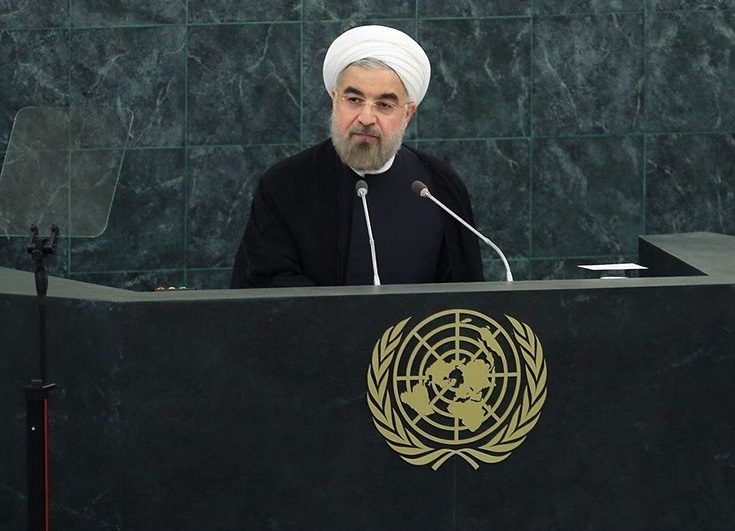 Iranian President Hassan Rouhani speaks at the UN General Assembly, September 26, 2013. (Image source: president.ir) Iranian President Hassan Rouhani speaks at the UN General Assembly, September 26, 2013. (Image source: president.ir) |
After achieving these goals for Iran’s ruling politicians, Rouhani’s message this year will switch to blaming the U.S. for all sorts of injurious shortcomings in the nuclear agreement, which Iran, incidentally, still has not signed.
U.S. President Barack Obama’s administration has sent hundreds of billions of dollars to Iran, and has hidden Iran’s supposed non-compliance with the nuclear deal to which it never officially agreed in the first place. The deal, in fact, seems only to have existed in the overheated imaginations of the US and other gullible members of the Joint Comprehensive Plan of Action (JCPOA). Nevertheless, the U.S. has ignored what Iran’s violations could be, and has assisted Tehran in evading any terms of the nuclear agreement it wished.
In addition, now that Iran has seen that the U.S. had lost all political leverage to pressure Tehran through the Security Council sanctions, and that, as critics of the deal had repeatedly and urgently warned, sanctions could not be “snapped back,” partly due to the veto power of Russia and China, Rouhani will be openly delivering the hardline messages of Iran’s Supreme Leader, Ayatollah Ali Khamenei, and the generals of Iran’s Islamic Revolutionary Guard Corps (IRGC), who enjoy power over Iran’s economic and political systems.
Khamenei and the senior cadre of the IRGC draw their legitimacy and power from the revolutionary principle of opposing the U.S., the “Great Satan.”
After the billions of dollars from the nuclear deal were delivered, the regime’s anti-American remarks and behavior only increased. For Rouhani, any expectation of rapprochement with the U.S. must be prevented, and also any domestic political liberalization prevented from occurring.
Reasons for Rouhani’s tactical shift in more publicly adhering to Iran’s revolutionary principle of anti-Americanism also include Iran’s leaders’ awareness that President Obama is tightly and desperately clutching the nuclear agreement until he leaves office: he considers the deal his crowning foreign policy accomplishment and legacy. By criticizing and blaming the U.S. for not honoring the terms, Rouhani plans to exploit President Obama’s weak point, as the negotiating team has been doing all along, by invoking Obama’s fear that Tehran might pull out of the nuclear deal — a move that would highlight the failure of the accord. This tactic will, as usual, successfully pressure the administration to give Tehran even more geopolitical and economic “carrots,” and pursue a policy with Iran of agreeing to even more concessions. Rouhani and Zarif will, as usual, conduct bilateral talks with American diplomats behind the closed doors to make sure they are achieved.
Rouhani’s public shift to Iran’s hard-line political spectrum is also partially pitched to Iran’s upcoming presidential elections. He needs the firm support of the hard-line leaders — fundamentally that of Supreme Leader Khamenei, who enjoys the final say in Iran’s domestic and foreign policy, and that of the IRGC leaders — in order to assure his election to a second term.
By more publicly delivering Khamenei’s message — that the US is not adhering to the terms of the nuclear deal and that it is supposedly the U.S. that has been “breaking oaths and not acting on their commitments and creating obstacles” —
Rouhani is most likely hoping further to endear himself to Khamenei and the IRGC and prove his loyalty.
A recent poll by the Center for International and Security Studies at the University of Maryland revealed that the moderate camp’s popularity has not only decreased, but that Iran’s former president, Mahmoud Ahmadinejad,
“now represents the single largest threat to Rouhani’s re-election, and trails the once-popular incumbent by only eight points. Suddenly, the ex-president [Ahmadinejad] seems once again to be a real political contender.”
Rouhani had also promised the Iranian people that the nuclear deal would improve their economic life. Since the implementation of the nuclear deal, however, the Iranian people have (unsurprisingly) not seen the fruits of the deal and the billions of dollars that the government has received. Rouhani will undoubtedly be trying to distract people’s attention from blaming the Iranian government by pointing to the U.S. as the culprit.
In one of his latest speeches, Khamenei pointed out that the U.S. is attempting to “destroy Iran’s economic relationships with other countries.” He added:
“Was it not supposed to be so that the unjust sanctions would be removed and it would have an effect on people’s lives? After six months, is there any tangible effect on the lives of the people? If not for America violating its oaths, would the administration not be able to do many things during this time? … Of course it has been some years that I have been repeating this about the lack of trust with America, but for some it was hard to accept this reality.”
Another issue on Rouhani’s agenda will be to promote, at the governmental level, business deals and trade, which will further financially benefit the IRGC and Khamenei, not Iran’s private sector.
Rouhani will more likely attempt to justify Iran’s military adventurism in the region by playing the anti-terrorism card, even though Iran is still the leading sponsor of terrorism.
Rouhani’s government will most likely focus on spreading the narrative of Khamenei and the IRGC, that Iran is an indispensable force in fighting the Islamic State and other extremist groups; that regional and global powers need to join Iran in this battle, and that Iran is the victim of terrorism in the region. In addition, Rouhani will presumably attempt to buttress the argument that the international community needs to support the Syrian President Bashar al-Assad in order to defeat terrorism.
Rouhani’s tactical shift is intended to reinforce Iran’s entrenched revolutionary ideal of anti-Americanism, appease Khamenei and the IRGC, and ensure his second term presidency.
Dr. Majid Rafizadeh, political scientists and Harvard University scholar is president of the International American Council on the Middle East. He can be reached at Dr.rafizadeh@post.harvard.edu.
What will Israel’s next war look like? Could Israel be facing multi-front war with hundreds of thousands of rockets targeting Israeli cities? IDF presents war scenario to cabinet.
Source: What will Israel’s next war look like? – Defense/Security – News –

Patriot Missile Battery IDF/Flash 90
Hundreds of thousands of rockets and missiles targeting Israel. More than 10,000 direct hits by rockets on buildings in Israeli towns. Three hundred and fifty people dead.
That is the scenario presented recently by the IDF to the Security Cabinet, highlighting the potential threats by Israel – and the army’s preparations to confront them.
According to IDF estimates, such a conflict could include attacks by Islamic terror groups from the Gaza Strip, Hezbollah in Lebanon, and the Syrian and Iranian militaries. In such a scenario, most of Israel – and most of Israel’s population – would be under direct threat from rocket and missile fire, though the majority of such weapons would likely hit open spaces.
In the scenario laid out in the IDF report, more than 230,000 rockets and missiles would be directed towards Israel, covering the country from the Haifa district in the north to the southern coast, leaving most of the population vulnerable.
While only 1% of rockets and missiles fired would be expected to cause damage in populated areas, given the large volume of projectiles, hundreds of casualties could result from the conflict.
Next week, Home Front Command will hold its annual emergency exercises. Beginning Sunday and continuing through Wednesday, this year’s exercises, code-names “Standing Firm”, will include emergency sirens in populated areas, to be sounded twice on Tuesday.
Residents are advised to plan a path to the nearest safe-room or bomb shelter as part of the exercises mock emergency sirens.
Washington calls Netanyahu’s ethnic cleansing video ‘inappropriate’ State Department in ‘direct conversations’ with Israeli government over prime minister’s clip released Friday
By Times of Israel staff and AP September 10, 2016, 4:06 am
Source: WATCH: Washington calls Netanyahu’s ethnic cleansing video ‘inappropriate’ | The Times of Israel
Video added by JK
Washington on Friday fumed at comments made by Prime Minister Benjamin Netanyahu in a video released online in which he accused the Palestinians of advocating ethnic cleansing of the Jewish population in the West Bank.
Get The Times of Israel’s Daily Edition by email
and never miss our top stories Free Sign up!
US State Department spokeswoman Elizabeth Trudeau told reporters the administration is “engaging in direct conversations with the Israeli government” about the video.
“We obviously strongly disagree with the characterization that those who oppose settlement activity or view it as an obstacle to peace are somehow calling for ethnic cleansing of Jews from the West Bank. We believe that using that type of terminology is inappropriate and unhelpful,” Trudeau said.
She said Israel expansion of settlements raises “real questions about Israel’s long-term intentions in the West Bank.”

Prime Minister Benjamin Netanyahu in a clip posted on Facebook on Friday, September 9 2016 (Screen capture Facebook)
Netanyahu on Friday decried what he said was the world’s silence on the issue.
Speaking in English in a video message posted on his Facebook page, Netanyahu asked whether people in other parts of the world would accept such demands in their own countries.
It’s “outrageous that the world doesn’t find it outrageous,” Netanyahu said, urging viewers to ask themselves whether they would accept “a territory without Jews, without Hispanics, without blacks” in their nation.
“Since when is bigotry a foundation for peace?” he asked.
He said he envisioned a Middle East “where young Arabs and young Jews learn together, work together, live together side by side in peace.”

Defense Minister Avigdor Liberman visits Israeli students in the Israeli settlement of Susya, on their first day of school. September 1, 2016. (Ariel Hermoni/Ministry of Defense)
Israel began building settlements in the West Bank after it captured the territory, previously controlled by Jordan, in the 1967 Six Day War. Today, over 250,000 Israelis live in West Bank settlements and outposts.
The settlements are seen as an impediment by proponents of the two-state solution, which would see a Palestinian state alongside Israel in most of the West Bank and all of Gaza. Israel withdrew from Gaza in 2005, dismantling all its settlements there, while some of the West Bank settlements would potentially remain under Israel control as part of a territorial exchange under a final peace agreement.
Netanyahu’s video garnered 45,000 views and more than 4,300 “likes” within the first three hours of publication. It is the latest in a series of viral attempts in which the prime minister talks directly to the camera, speaking, usually in English, about a current affairs issue. The prime minister is known for his fluent, almost unaccented English, which he perfected during his years of study in the US.
In the first such video, which came after June’s deadly nightclub shooting in Orlando, Netanyahu called on the international community to stand together with the LGBT community, saying that the attack was not an isolated incident and slamming homophobic practices carried out by Islamic terrorist groups and countries across the Middle East.
Since then, the prime minister has made videos about a terrorist attack in the West Bank town of Kiryat Arba in which 13-year-old Hallel Yaffa Ariel was stabbed to death, Jerusalem’s gay pride rally, steps for peace for Abbas, a new government program to fund development in the Arab community, and a Palestinian father telling Israeli soldiers to shoot his own son. Last month, he released a video in which he claimed Israel cares more about the Palestinian people than their own leaders.
Netanyahu and Abbas agree ‘in principle’ to meet, Russia says No confirmation from Jerusalem or Ramallah after latest report of possible face-to-face summit between leaders in Moscow
By Times of Israel staff and AP
September 8, 2016, 1:48 pm
Source: Netanyahu and Abbas agree ‘in principle’ to meet, Russia says | The Times of Israel

Polish President Andrzej Duda (C-R) and Palestinian Authority President Mahmoud Abbas (C-L) inspect an honour guard during an official welcoming ceremony in the courtyard of the presidential palace in Warsaw on September 6, 2016. (AFP PHOTO/JANEK SKARZYNSKI)
The Russian foreign ministry on Thursday said Prime Minister Benjamin Netanyahu and PA President Mahmoud Abbas had agreed “in principle” to meet in Moscow.
According to Russian media reports, the two leaders were willing to sit down for a face-to-face meeting in a bid to revive peace talks.
“Russian foreign ministry confirms willingness to host Netanyahu-Abbas meeting in Moscow, preparations continue,” the Interfax news agency reported. “Israeli, Palestinian leaders agree in principle to meet in Moscow.”
According to ministry spokeswoman Maria Zakharova, Moscow has heard from the offices of Abbas and Netanyahu that the two agreed to meet in the Russian capital, though it’s not clear when that will happen.
“The most important thing is to pick the right timing,” Zakharova told reporters. “Intensive contacts on this are ongoing.”
“We are convinced that there is a need to resume the negotiations, which would be a factor serving the interests in normalizing the situation,” she added, according to the TASS news agency.
There was no immediate response from the Prime Minister’s Office in Israel or officials in the PA. But a source close to the prime minister told the Walla news website that Netanyahu was willing to meet Abbas “anytime, anywhere, on the condition that there are no preconditions.”
The report came days after efforts to broker a meeting between the two became bogged down in mutual accusations that the other side was unwilling to sit down in Moscow.
The two leaders have not met in person since 2010, and peace efforts have continued to falter. Abbas has demanded Israel release Palestinians prisoners and freeze settlement building before meeting, while Netanyahu has said he is willing to meet without preconditions.
The efforts became further complicated Wednesday following an Israeli report on Soviet documents suggesting Abbas was a KGB spy in Damascus in the 1980s, during the time that Mikhail Bogdanov, today Vladimir Putin’s envoy to the Middle East, was stationed there.
The PA leader’s top political adviser said Wednesday Abbas had forgone his long-held preconditions and was planning in earnest to meet Netanyahu in Moscow this Friday, but the summit was spiked by Israel.
“There were no preconditions. That was very clear. When President [Vladimir] Putin invited the two sides, he said, ‘No preconditions.’ President Abbas approved that, and he said so very clearly yesterday when he was in Warsaw,” Majdi al-Khalidi told The Times of Israel in a phone interview.

Prime Minister Benjamin Netanyahu shakes hands with Palestinian Authority President Mahmoud Abbas in Jerusalem, September 15, 2010. (Kobi Gideon/Flash90)
While in Poland on Tuesday, Abbas declared he was willing to meet Netanyahu in Moscow, though he did not explicitly mention the preconditions in his statement.
However, the Palestinian leader added, Netanyahu’s representative sought to delay the Moscow meeting, which would have taken place September 9, to a later date.
An Interfax report Monday claiming the two had agreed to meet was initially denied by Palestinian officials, who indicated the preconditions were still in place.
On Tuesday, Netanyahu referred to confusion over the Palestinian stance during a press conference alongside Dutch Prime Minister Mark Rutte in The Hague.

Prime Minister Benjamin Netanyahu, left, and Dutch Prime Minister Mark Rutte give a press conference in The Hague, September 6, 2016. (AFP/ANP)
Ifthe Palestinians had forgone their preconditions to the Moscow meeting, the Israeli prime minister seemed unaware.
“Is Abbas prepared to meet without preconditions? We hear contradictory versions on that,” said Netanyahu.
“Just yesterday Palestinian spokespeople clarified that they are prepared to meet but that they have conditions — the release of prisoners and they also want to know beforehand what will be the end result of the talks, and such like,” Netanyahu said.
Khalidi, Abbas’s adviser, said he didn’t know why the Israeli prime minister believed there were preconditions to the Moscow meeting.
“No one said there were preconditions. Many people in Israel and Palestine speak in general. But after what the president said, why do we have to listen to people from this side or that side. We have only one agency that is official, Wafa. We have one official spokesperson, Nabil Abu Rudeineh,” Khalidi said.

Nabil Abu Rudeineh (L), spokesman of Palestinian Authority president Mahmoud Abbas, welcomes Israeli opposition head Isaac Herzog (C) at the Palestinian Authority headquarters in the West Bank city of Ramallah, August 18, 2015. (AFP Photo/Abbas Momani)
The Prime Minister’s Office voiced skepticism of the statements.
“If the Palestinian leadership can say with one voice that they are willing to meet without preconditions, then Prime Minister Netanyahu will meet President Abbas,” Netanyahu’s spokesperson David Keyes told The Times of Israel Wednesday.
On Tuesday night, Abu Rudeineh, the official Abbas spokesperson, said Netanyahu “had once again shown a lack of seriousness in searching for a just peace based on the two-state solution.”
The idea of direct talks in Moscow was first floated by Egyptian President Abdel-Fattah el-Sissi in August, when he said that Russian President Vladimir Putin was willing to play host.
Peace efforts have been at a standstill since a US-led initiative collapsed in April 2014.
The last substantial public meeting between Abbas and Netanyahu is thought to have been held in 2010, at the tail end of a 10-month settlement building moratorium, though there have been unconfirmed reports of secret meetings since then.
Raphael Ahren and Dov Lieber contributed to this report.




 anneinpt
 artaxes
 danmillerinpanama
 davidking1530
 Peter Hofman
 Joseph Wouk
 Peter
Peter Louisiana Steve
 WarSclerotic
Recent Comments