Posted tagged ‘Aleppo Syria’

Between Putin and Obama

February 7, 2016

Between Putin and Obama, Israel Hayom, Boaz Bismuth, February 7, 2016

The tide has turned in Syria: Aleppo, the rebel stronghold, is on the verge of falling to President Bashar Assad’s army. Hezbollah’s Shiite militias, the Iranian army and the massive Russian air strikes have been the difference.

In contrast to the rebels, Assad can count on his partners. On the Syrian dictator’s side, backed by Russia, action is being taken. On the rebel side, backed by the Americans, there has been a lot of talking. This perhaps explains why in January 2017 U.S. President Barack Obama will exit the White House, and Assad will still be in power. We can add this legacy to the American president’s splendid list of achievements.

And we haven’t even mentioned the millions of Syrian refuges, the terrible migrant crisis in Europe (leading to the rise of far-right parties across the continent), and the escalation of hostilities between Shiites and Sunnis. It’s not a short list.

Since last Monday, Aleppo has been under heavy attack from Assad’s forces. The gains on the ground have been considerable. Russia’s intervention has tipped the balance of power. No one can say this was unexpected. Washington, meanwhile, continues to grumble. U.S. Secretary of State John Kerry lambasted Moscow on Friday for the large number of dead Syrian women and children. Moscow isn’t exactly heeding his criticism. Washington still fails to understand that instead of talking, maybe it would be better to take action already. In August of 2013, however, after Assad had attacked his own people with chemical weapons for the 14th time, the Americans did nothing (red lines, remember?). Why should things be any different today?

Washington, you will say, has worked hard to find a diplomatic solution. This is a good time to remind everyone that the peace talks in Vienna have again hit a dead end. The talks aren’t likely to succeed for a number of reasons, namely that the two main players — Saudi Arabia and Iran — have reached a point of open hostilities, thanks to American foreign policy. Instead of cooperating to resolve the Syrian crisis, these two regional powers are closer than ever to a full-fledged military conflict. Riyadh is threatening to send ground forces into Syria to support the rebels. The commander of Iran’s Revolutionary Guard has already vowed that any such intervention would result in immense casualties for the Saudis. This is where things stand.

Over the weekend Turkey’s foreign minister discussed opening his country’s borders to the steady stream of refugees, but the crossings remain as shut as they were in September, 2014, when thousands of Kurds tried to flee the border town of Kobani. The European Union is trying to remind the Turks that they were given $3 billion for the expressed purpose of absorbing these 2 million refugees. But who expects agreements to be kept in today’s Middle East?

Who does have faith in agreements?

The refugee issue is becoming the hot button topic of the Syrian civil war. “The markets solved the economic crisis, the voters will solve the refugee crisis,” a French lawmaker said a few days ago. In the meantime, as Assad solidifies his power the far-right parties in Germany, Sweden, Denmark and Holland, and of course in France, are all growing in strength. It appears that everyone outside the Obama camp is thriving. And here is yet one more legacy to tell the grandchildren about.

Jihadists reinforce other rebels during key battle in Aleppo province

February 7, 2016

Jihadists reinforce other rebels during key battle in Aleppo province, Long War Journal, February 6, 2016

Screen-Shot-2016-02-06-at-11.57.16-AM-768x433

An Al Nusrah Front convoy streams into Aleppo province in late January.

Al Nusrah Front, al Qaeda’s official branch in Syria, sent a massive convoy of fighters to the Aleppo province in late January. The jihadists’ redeployment was promoted in a short video posted on Twitter. More than 100 vehicles filled with fighters streamed into the province.

It was a harbinger of the heavy fighting to come.

Bashar al Assad’s regime, backed by Russian airstrikes, Iranian-sponsored Shiite militias and Hezbollah, launched a major offensive in Aleppo earlier this month. The fight for the province is likely the most important battle in Syria since early last year, when the Jaysh al Fateh coalition, led by Al Nusrah and Ahrar al Sham (an al Qaeda-linked jihadist group) swept through the neighboring Idlib province.

If Assad and his allies are successful it will not only allow them to lay siege to the city of Aleppo, parts of which have been controlled by the insurgents since 2012, but also to cut off Idlib. Assad wants to secure the northern part of the province, which borders Turkey and houses vital supply routes for the insurgency.

The Syrian government claims to have made gains in pursuit of this objective in recent days.

The Syrian Army, “in cooperation with” paramilitary groups, “restored security and stability to Rityan and Mair towns in the northern countryside of Aleppo province,” Assad’s propaganda arm, SANA, claimed on Feb. 5.

The purported gains came two days after SANA reported that the Syrian Army and its allies “broke the siege imposed on Nubbul and al-Zahra towns by terrorist organizations.” SANA claimed that “[s]cores of terrorists were killed, most of them from [Al Nusrah Front] during the operations.” Nubbul and al-Zahra are both Shiite-majority towns in the northern part of Aleppo.

There is an ebb and flow to the fighting in Aleppo, as elsewhere, making it difficult to tell if the government’s gains are lasting, or just temporary. For example, although SANA says Rityan has been retaken from the insurgents, Al Nusrah continues to post images from the fighting there.

And although SANA says all of the opposition to the government in Aleppo comes from “terrorist organizations,” the reality is more complex. Jihadist groups such as Al Nusrah are partnering with other rebel organizations, including Free Syrian Army (FSA) and Islamist factions, in an attempt to thwart the Syrian government’s advances.

The opposition in Aleppo

One of the strongest rebel groups in Aleppo is the Nur al-Din al-Zanki Movement. Members of Zanki and Al Nusrah clashed at a checkpoint in late September and early October of last year. Zanki’s “political bureau” then denounced Al Nusrah in tweets that were published in both English and Arabic. However, the infighting did not lead to a permanent rift between the two. Instead, Zanki complied with Al Nusrah’s demands and quickly apologized.

In a statement written in Arabic and released on social media, Zanki said its criticism of Al Nusrah did “not represent the [Zanki] movement’s official position…and we owe [an] exoneration of our brothers from what was attributed to them – accusations, insinuations, and slander [libel] – to God Almighty, and we only think properly of them.”

The “relationship between us and our [Nusrah] brothers is proceeding on even better terms than what it was in the past, and this incident which occurred between us and our [Nusrah] brothers will not deter us from vigorously continuing to strengthen the bond of Islamic brotherhood between us and them, and which obligates us – religiously – to cooperate and combine efforts and fight off the aggressor enemy,” Zanki’s apology continued.

The statement ended with a call for both Zanki and Al Nusrah “to [ensure] that the only judgment in any dispute between us should be based on religious law.”

Zanki is not al Qaeda. But as the skirmish with Al Nusrah demonstrated, Zanki does not want to offend al Qaeda’s men, cooperates with them on the battlefield and believes in a version of “religious law” (sharia) that is at least similar to Al Nusrah’s.

Despite its adherence to an Islamist ideology and alliance with Al Nusrah, Zanki has received American-made TOW missiles, which it has used against both the Assad regime and the Islamic State.

Another Islamist organization in Aleppo is Faylaq al Sham (Sham Legion), which fought as part of the Jaysh al Fateh coalition in Idlib. In early January, however, Faylaq al Sham announced that it was leaving Jaysh al Fateh to concentrate on the fighting in Aleppo. The group subsequently merged with others to form the “North Brigade” in Aleppo.

In late December, Sheikh Umar Huzaifa, a senior Faylaq al Sham official, was one of 38 ideologues who signed a statement proclaiming that jihad is an “individual obligation” for all Muslims “in situations like this.” The statement’s signatories, who belong to the “Association of Scholars in Sham,” portrayed the war in Syria as one pitting a “Crusader-Zionist-Safawi [Shiites and Iranians]” alliance against Sunni Muslims.

The association’s scholars claimed it “is no longer hidden from our Beloved Ummah [community of worldwide Muslims] what has reached the land of Sham with the rushing forward of the entire nations of Kufr [disbelief] against it,” because it “has become manifest in the Crusader-Zionist-Safawi coalition rushing to eliminate the revolution of the people of Sham and their blessed jihad.” The “battle of Sham has become a decisive battle against the nations of Kufr,” the statement continued, as the rebels’ enemies “gather to establish the Rafidhi [rejectionist] Shia to fulfill their drawn up plans for their (Shia) crescent (on the map) and to eliminate” Sunni belief in Syria and elsewhere.

Other signatories on the statement issued by the “Association of Scholars in Sham” included Sheikh Abdallah Muhammad al Muhaysini (an al Qaeda-affiliated cleric and “judge” in Jaysh al Fateh), members of Al Nusrah Front and Ahrar al Sham, Sheikh Sirajuddin Zurayqat (emir of the al Qaeda-linked and Lebanon-based Abdullah Azzam Brigades), as well as a number of other officials.

The battle for Aleppo is a complex, multi-sided affair. The organizations discussed above are just some of those fighting on the ground. The Islamic State, the Kurds, and the Western-backed Syrian Democratic Forces all have a presence.

Another group is Liwa Suqour al Jabal, which has reportedly received assistance from the CIA. Liwa Suqour al Jabal fights in Aleppo and has been targeted in Russian airstrikes.

“The Russian (air) cover continues night and day, there were more than 250 air strikes on this area in one day,” Hassan Haj Ali, the leader of Liwa Suqour al Jabal, told Reuters in an interview. “The regime is now trying to expand the area it has taken control of,” Ali explained. “Now the northern countryside (of Aleppo) is totally encircled, and the humanitarian situation is very difficult.”

The fight for Aleppo may very well shape the course of the war. And as the battle has raged on, jihadists have called for even more reinforcements. Sheikh Muhaysini, a popular jihadist cleric, has repeatedly urged Muslims to join the rebel’s ranks and for the existing insurgent organizations to unite under a common banner.

It remains to be seen if the jihadists, Islamists and other rebels can thwart the Assad regime’s advances.

Russian hands-off warning to US, Saudis, Turks amid crucial Aleppo battle

February 6, 2016

Russian hands-off warning to US, Saudis, Turks amid crucial Aleppo battle, DEBKAfile, February 6, 2016

S-400_range_map_25.11.15 (1)

The five-year Syrian civil war, faces its most critical moment. Saturday, Feb. 6, a combined force of Syrian army and Hizballah troops and an Iraqi Shiite militia under Iranian officers, were led by Russian air and Spetsnaz (special forces) officers into pressing forward to encircle 35,000 rebels trapped in Aleppo, the country’s largest city. As they tightened the siege, 400,000 Syrian civilians were also trapped and forced to bear heavy Russian air bombardment and savage artillery fire from the ground forces closing in on the city.

Rebel supply routes were cut off Thursday and Friday when Syrian and Hizballah forces captured the Azaz Corridor connecting Aleppo and all of the northern province of Idlib to the Turkish border.

Tens of thousands of refugees fleeing from the beleaguered town are massing at Bab al-Salama, the last Turkish border crossing to be closed against them. This is the largest Syrian refugee exodus since the start of the civil war.

The rebels under siege are painfully short of weaponry for fighting off the massive, combined offensive, DEBKAfile’s military sources report. Their only remaining recourse is to surrender or be ground into submission as the conquering force knocks over their positions and takes over street after street.

Once the combined forces fighting with Bashar Assad’s army take Aleppo and northern Syria, the opposition will have suffered its heaviest defeat since the war began. The rebels groups’ capacity to continue fighting the regime will be gravely diminished.

Their desperate plight – and the fresh surge of Syrian refugees in unmanageable numbers – cut short the conference in Geneva for a settlement of the Syrian conflict, before it got underway – and prompted reactions from sponsors of rebel groups.

In Riyadh, Brig, Gen. Ahmed Asiri, adviser to Saudi Defense Minister Muhammed Bin Salman, announced Friday that Saudi Arabia is ready “to participate in any ground operations that the international coalition launches against ISIS.” This offer was taken as a veiled response to the SOS from the rebel stronghold in Aleppo.

In Washington, State Department circles, in a briefing to US media, said the time had come to establish a no-fly security zone in northern Syria. They said: “Once a zone were established we do not believe Russia would challenge the stronger US and NATO forces, particularly if they were operating mainly from Turkey.”

The next day, Friday, Moscow came back with a sharp response: Russian Deputy Defense Minister Anatoly Antonov said: “Russian air defense systems enable early detection of threats to Russian aircraft flying combat missions over Syria and provide adequate measures to ensure flight safety.”

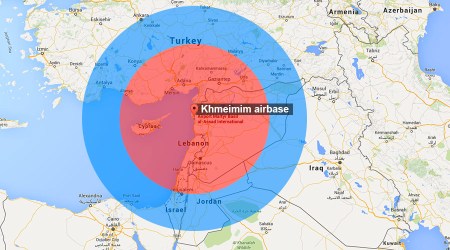
This was a reminder of the sophisticated air defense S-400 and S-300 missile systems Russia installed at its Syrian air base after the Turkish air force downed a Russian warplane in November.

Syrian Foreign Minister Walid al-Moallem put it more crudely: “Any foreign troops entering Syria would return home in wooden coffins.”

He advised armed opposition groups fighting the government offensive in the area to lay down their weapons because, he said, “government advances signal that the five-year-old Syria war is nearing its end.”

Saturday, US Secretary of State John Kerry urged Russia to implement a ceasefire in Syria, saying its bombing campaign was killing women and children in large numbers and “has to stop.” He told reporters on his return from a trip to Europe: “Russia has indicated to me very directly they are prepared to do a ceasefire,” adding “The Iranians confirmed in London just a day and a half ago they will support a ceasefire now.”

DEBKAfile’s military sources have seen no sign of any ceasefire or even a slowdown in the Russian-led Syrian-Iranian Aleppo offensive.