Before Arrival of Trump Envoy, PA Glorified Terrorist Who Murdered 38 Israelis 

Posted March 17, 2017 by Peter Hofman
Categories: Uncategorized

Tags: , , , , ,

When Jason Greenblatt, the Trump administration’s Special Representative for International Negotiati

BY:
March 16, 2017 2:49 pm

Source: Before Arrival of Trump Envoy, PA Glorified Terrorist Who Murdered 38 Israelis 

Mahmoud Abbas / Getty Images

When Jason Greenblatt, the Trump administration’s Special Representative for International Negotiations, met with Palestinian Authority President Mahmoud Abbas on Tuesday, Abbas “assured Mr. Greenblatt that he is fully committed to creating an atmosphere that is conducive to making peace.”

Just days earlier, Abbas, his Fatah Party, and the Palestinian Authority were celebrating a notorious terrorist on the anniversary of her attack in which 38 Israeli civilians, including 13 children, were shot and burned to death in a bus hijacking.

The Palestinian Authority’s annual celebration of the 1978 Coastal Road Massacre, the deadliest Palestinian terror attack in history, fell on March 11 and 12. Greenblatt arrived on March 13.

According to a report by the Middle East Media Research Institute, both Abbas’s Fatah Party and the Palestinian Authority glorified the terror attack in official media and in government celebrations.

On March 12, the Palestinian Authority opened a “youth training camp” named after the terrorist who carried out the attack, Dalal Mughrabi. The ceremony was attended by top Fatah Party officials.

The Palestinian Authority National Security Forces posted a picture of Mughrabi to Facebook with the caption, “The martyr Dalal Al-Mughrabi, the bride of Jaffa, on the 39th anniversary of her martyr’s death.”

Additionally, the governor of Ramallah and the Fatah Party in Bethlehem hosted ceremonies honoring Mughrabi and the attack, hailing her as a role model for Palestinians.

In a statement after his meeting with Greenblatt, the Palestinian Authority said “President Abbas committed to preventing inflammatory rhetoric and incitement.”

Donald Trump stuns the Middle East by sending an honest broker

Posted March 17, 2017 by Joseph Wouk
Categories: Uncategorized

Source: Donald Trump stuns the Middle East by sending an honest broker | The Times of Israel

Despite administration’s unprecedented pledge of allegiance to Netanyahu, Jason Greenblatt’s carefully calibrated visit shows US peace bid will take all sides into account

March 17, 2017, 12:52 pm
Palestinian Authority President Mahmoud Abbas (right) meets with Jason Greenblatt, the US president's assistant and special representative for international negotiations, at Abbas's office in the West Bank city of Ramallah, March 14, 2017. (WAFA)

Something unusual happened on the White House’s homepage the day after Prime Minister Benjamin Netanyahu met US President Donald Trump for the first time in the Oval Office.

Netanyahu was still in Washington on the evening of February 16 when, between 9:30 and 10 p.m., a new link appeared at the bottom of the site, under the category “Get Involved,” together with items in support of “empowering female leaders,” Trump’s plan to boost employment, and his nominee for the Supreme Court, Neil Gorsuch.

Entitled “President Trump Stands With Israel,” the new link led to a page on which the leader of the free world declares, with no further explanation, that he “stands in solidarity with Israel to reaffirm the unbreakable bond between our two nations and to promote security and prosperity for all.”

The page invites users to sign up with their names and email addresses to show that they stand “with President Trump and Prime Minister Netanyahu.”

While the president’s friendship with Netanyahu is no secret, having this item permanently placed on the White House homepage — it’s still there as of this writing, a month after Netanyahu’s visit — is exceedingly surprising. No other foreign country, let alone a single politician from a foreign country, has been given this honor.

And yet, after nearly a full week during which his special representative for international negotiations, Jason Dov Greenblatt, toured the region in a bid to revive the stalled Israeli-Palestinian peace process, one cannot help getting the impression that in the months ahead, Washington will not unconditionally side with Jerusalem on all matters relating to the conflict. Greenblatt’s schedule, interactions and comments plainly signal a genuine attempt to take Ramallah’s concerns into consideration as well.

Assistant to the President and Special Representative for International Negotiations, Jason Greenblatt meets Prime Minister Benjamin Netanyahu at the Prime Minister’s Office in Jerusalem, March 13, 2017. (Matty Stern/US Embassy Tel Aviv)

Assistant to the President and Special Representative for International Negotiations, Jason Greenblatt (left) meets Prime Minister Benjamin Netanyahu at the Prime Minister’s Office in Jerusalem, March 13, 2017. (Matty Stern/US Embassy Tel Aviv)

The envoy’s four-day visit, eight hours of which he spent in two sessions sitting in the Prime Minister’s Office, demonstrates quite clearly that Trump does not intend to be Netanyahu’s yes-man.

According to people who spoke with Greenblatt, his boss — who prides himself on having mastered the “art of the deal” — is determined to reach an Israeli-Palestinian peace agreement. Trump himself “expressed his strong desire to achieve a comprehensive, just, and lasting settlement to the Israeli-Palestinian conflict,” in a statement after he met Wednesday with Saudi Arabia’s Deputy Crown Prince Mohammed bin Salman. And Greenblatt worked exceedingly hard to be perceived by the players he met in Israel, the West Bank and Jordan as an honest broker.

The art of diplomacy

The lawyer-turned-diplomat did not only meet Netanyahu’s counterpart, Palestinian Authority President Mahmoud Abbas, but also Jordan’s King Abdullah, another important regional stakeholder whose views on the conflict are not exactly congruent with those of the Israeli leader.

While Greenblatt’s sessions with Abbas and Abdullah were much shorter than the two meetings with Netanyahu, officials in Ramallah were uncharacteristically optimistic after their contacts. Abbas, who Trump had last Friday invited to the White House, declared after his talks with Greenblatt that a “historic” peace deal was possible. “The mood is good,” one Palestinian official said with succinct enthusiasm in a private conversation.

In a unprecedented move for US officials, Greenblatt met Thursday with the heads of the Yesha Council, the settlement movement’s most important advocacy group. But he also spoke to young Palestinians in Bethlehem and at the Jalazoun refugee camp near Ramallah “to understand their daily experiences.” He met Palestinian high-tech entrepreneurs and a “cross section of folks from Gaza,” as he wrote on his busy Twitter account. The Gazans gave him “hope we can find solutions to humanitarian challenges while meeting Israel’s security needs,” he noted.

Greenblatt on Thursday also hosted a rare interfaith summit of the Council of Religious Institutions in the Holy Land, which was attended by both Israeli chief rabbis and the chief justice of the PA’s Sharia court.

Jason Greenblatt (center, in gray), the US administration’s special envoy for international negotiations, with members of the Council of Religious Institutions in the Holy Land at a gathering at the US Consulate-General in Jerusalem, March 16, 2017 (courtesy US Embassy Tel Aviv)

Jason Greenblatt (center, in gray), the US administration’s special envoy for international negotiations, with members of the Council of Religious Institutions in the Holy Land at a gathering at the US Consulate-General in Jerusalem, March 16, 2017 (courtesy US Embassy Tel Aviv)

On Wednesday night, Greenblatt, an observant Jew, visited the Old City’s Yeshivat Hakotel, a Talmudical seminary located in what the international community calls illegally occupied territory, and waxed on Twitter over the stunning “view of the heart of ancient Jerusalem.”

But if you thought that his Orthodoxy and his past as a student in a West Bank yeshiva had caught up with him, Greenblatt then tweeted that following his visit to the yeshiva he walked five minutes “to the home of a new Palestinian friend and saw the same sacred site, from a different angle.”

Some Israelis wondered why Greenblatt had chosen not to wear his customary big, black kippa during his diplomatic meetings. (He remained bareheaded even during the interfaith meeting, only putting on his kippa afterwards for the group photo.) He wanted to appear statesmanlike and not give the impression that he was biased in favor of Jewish Israelis, pundits surmised. But Greenblatt at no point hid his strong Jewish identity. At a stopover in Frankfurt before arriving, he tweeted a photo of his siddur, prayer shawl and phylacteries, indicating that he was about to “[p]ray for peace.”

On Thursday evening, as he wrapped up a visit he called “extremely positive,” he thanked Netanyahu and his staff for helping him make a minyan — the required forum of ten Jewish men — so he could say the Kaddish prayer in memory of his late mother.

Friendly, positive tweets

Like his boss, Greenblatt tweeted frequently. Very much unlike his boss, his tweets were well-crafted messages of peace — friendly, positive and balanced. “I was extremely fortunate to meet some incredible Israelis and Palestinians on my trip. Thank you all for your perspectives!” he wrote as he headed toward Ben Gurion Airport.

If Netanyahu thought Trump would easily give him green light to build wherever he wants, he has to think again.

People who spoke to Greenblatt said his mission was to listen and not necessarily to convey elaborate policy proposals. In contrast to the Obama administration — which had a very clear vision of how a solution to the conflict should look from day one — the Trump White House currently appears interested in fully understanding where everyone is at before formulating a coherent Middle East policy.

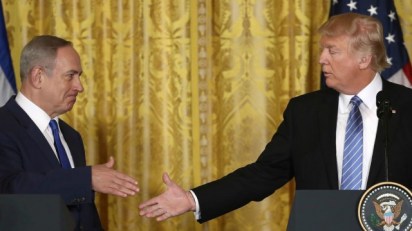
During his February 15 press conference with Netanyahu, the president said whatever solution both parties want would be fine with him, be it a one-state or a two-state solution. It seems a safe assessment that many of Greenblatt’s interlocutors here argued passionately for the need for a Palestinian state.
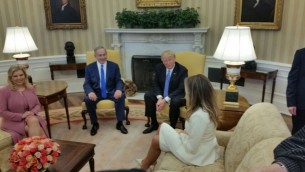
Benjamin Netanyahu, second left, and Donald Trump, second right, meeting in the Oval Office with their wives Sara Netanyahu, right and Melania Trump, left on February 15, 2017. (Raphael Ahren/ Times of Israel)

Benjamin Netanyahu, second left, and Donald Trump, second right, meeting in the Oval Office with their wives Sara Netanyahu, right and Melania Trump, left on February 15, 2017. (Raphael Ahren/ Times of Israel)

And it is in this context that the envoy’s unfinished negotiations with Netanyahu over settlement expansions should be seen. The White House has so far refrained from endorsing a two-state solution, but the fact that Netanyahu in two lengthy meetings did not manage to convince Greenblatt to give him free rein in the West Bank indicates that the Trump administration is determined to keep the prospect of Palestinian statehood alive.

Netanyahu publicly promised to build a new settlement for the recently evicted residents of the illegal Amona outpost, and vowed to reach an agreed-upon policy with the administration regarding settlement construction, but no such deal was done by the time the US envoy flew back to Washington. When this reporter tweeted on Thursday evening that Greenblatt’s second powwow with Netanyahu had ended without concrete results, the US envoy replied that “complex matters are not black and white and require significant time and attention to review and resolve.”

According to various sources, significant gaps remain between the two sides. If Netanyahu thought Trump would give him the green light to build wherever he wants, he has to think again.

Some Israeli politicians and pundits surmised on Friday that Netanyahu started missing Barack Obama this week. In the past, he could always blame the former president’s perceived anti-Israel attitude when pressured by his right-wing rivals over the slow pace of settlement constructions. With Trump, who etched his friendship to Netanyahu onto the White House website, this is no longer possible.

IAF ‘Arrow’ battery intercepts Syrian missile, in first reported use of the system

Posted March 17, 2017 by Joseph Wouk
Categories: Uncategorized

Source: IAF ‘Arrow’ battery intercepts Syrian missile, in first reported use of the system | The Times of Israel

Syria fires three anti-aircraft missiles at Israeli jets; one knocked down by defense system, reportedly over Jordan; other two land in Israel, cause no damage

March 17, 2017, 7:54 am
The Arrow 3 missile is launched from Palmachim air base in central Israel on December 10, 2015. (Defense Ministry)

The Arrow 3 missile is launched from Palmachim air base in central Israel on December 10, 2015. (Defense Ministry)

Israel shot down an incoming Syrian anti-aircraft missile with the Arrow defense battery early Friday morning, military officials said, in the first reported use of the advanced system.

At approximately 2:30 a.m., Israeli “aircrafts targeted several targets in Syria,” the Israel Defense Forces said, prompting a Syrian attempt to down the Israeli jets.

According to Arab media, the target of the IAF strikes was a Hezbollah weapons convoy.

“Several anti-aircraft missiles were launched from Syria following the mission and IDF aerial defense systems intercepted one of the missiles,” the army said in a statement.

The anti-aircraft missiles were fired from eastern Syria by Bashar Assad’s military, traveling over Jordan and toward the Jerusalem area. They were apparently SA-5 surface-to-air missiles (SAMs).

The Arrow is primarily designed to shoot down intercontinental ballistic missiles outside the atmosphere, intercepting the weapons and their conventional, nuclear, biological or chemical warheads close to their launch sites.

Surface-to-air missiles are designed to detonate at high altitudes to bring down aircraft or other missiles, and so do not pose much of a threat to people on the ground other than the possibility of being directly hit by falling shrapnel or the remains of the missile.

Therefore, it was not immediately clear why the IDF used the Arrow against a SAM, possibly indicating a misidentification of the type of weapon being fired from Syria.

The IDF said neither civilians on the ground nor Israeli Air Force pilots were in any danger at any point during the incident.

The most advanced version of the defense system is the Arrow 3, which Israel has been developing with the United States since 2008. Earlier versions of the Arrow system have been in place since the 1990s.

It is a major part of the multi-layered air defense array that Israel has designed to protect itself against a range of missile threats — from short-range rockets fired from the Gaza Strip and Lebanon to longer-range threats like a missile launch from Iran. The Iron Dome short-range interceptor is designed block projectiles heading for populated areas while allowing others to fall harmlessly in open areas.

The intercepted missile apparently fell in Jordan, while two more fell in Israel without causing any injury or damage.

Photos of what appear to be pieces of the Arrow missile in Jordan quickly began circulating on social media.

The launch of the IDF’s Arrow missile set off the country’s rocket alert system at 2:43 a.m.

At least two distinct explosions were heard as far west as Modiin and as far south as Jerusalem.

The sirens sounded near the Jordan Valley communities of Gitit, Mesoa, Yitav and Yafit in the Arvot Hayarden regional council, which straddles the Jordan River in the West Bank.

IDF ground forces in the area launched a search for fallen rockets and rocket fragments in the mountainous terrain.

The IDF statement was rare, if not unprecedented, as the Israeli military does not generally admit to carrying out specific actions in Syria other than retaliations to spillover fire from fighting near the border. However, Israel has acknowledged that it does, generally speaking, attack such convoys traveling from Syria to Hezbollah in Lebanon.

This was not the first time that the Syrian military fired SAMs at Israeli aircraft. In September 2016, Assad’s military launched two such missiles at Israeli jets carrying out a bombing run in response to mortar shells that struck the Golan Heights as a result of spillover from fighting nearby.

Then too, the Syrian military apparently launched the surface-to-air missiles after the Israeli raid, as the Israeli planes were on their way back to base.

The IDF said at the time that the missiles never posed a threat to the Israeli aircraft, though Syrian state television claimed the Syrian army had downed an Israeli fighter jet.

During that incident, Israel did not deploy any missile defense countermeasures.

Israeli air strikes in Syria. Reprisal threatened

Posted March 17, 2017 by Joseph Wouk
Categories: Uncategorized

Source: Israeli air strikes in Syria. Reprisal threatened

DEBKAfile Special Report March 17, 2017, 12:23 PM (IDT)

( SCARY SHIT if true… – JW )


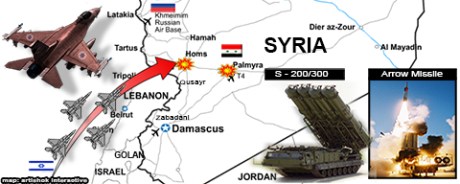
The Israeli military said its fighter jets had struck several targets in Syria early Friday, March 17, and were back in Israeli-controlled airspace, when Syria launched several anti-aircraft missiles toward the Israeli jets.

Israel’s Arrow air defense missile intercepted one of the missiles, the army said, but would not elaborate on whether any other hostile missiles had struck Israeli territory. The safety of Israeli civilians and the safety of the Israeli aircraft “were not compromised,” the IDF spokesman stressed.

debkafile’s military sources: The official IDF communiqué raises questions. It does not make sense for Israeli Arrow missiles to be aimed at Syrian ground-to-air rockets fired against the Israeli warplanes. The Arrow would only be used to intercept an incoming Syrian or Hizballah ground-to-ground missile heading for a target in Israel.

That too would explain the huge blast that resounded from the eastern Jordan Valley as far as Jerusalem, 150km away in the small hours of Friday.

This explanation gained credibility from the Syrian army account: “A total of four Israeli jets breached Syrian airspace on Friday morning. They hit a “military target” near Palmyra. In retaliation the jets were targeted by Syrian anti-aircraft missiles, which shot down on Israeli plane over “occupied ground.” Following the breach of the country’s airspace, the Syrian Army warned Israel of “direct” retaliation “with all means at its disposal,”

The Israeli Army stressed that none of the IAE planes was harmed. “At no point was the safety of Israeli civilians or the IAF [Israeli Air Force] aircraft compromised,” an Israeli military spokesman said.

debkafile’s military sources add: The big T4 Syrian air base is located near Palmyra. If that was indeed the target of the Israeli raid, it would have been the northernmost point in Syria ever attacked by Israeli warplanes.

The fact that fragments of the Arrow missile landed in the north Jordanian village of Anbata in the Irbid district, as revealed by social media, is added evidence that it was launched against a missile fired into Israel. Had the Arrow intercepted anti-air missiles in northern Syria, the fragments falling from the interception would not have reached Jordan or alerted rocket sirens close by in the Jordan Valley on the Israeli side of the border.

Furthermore, it is time to abandon the routine official attribution of any Israeli air strike over Syria as targeting an advanced weapons convoy heading for Hizballah in Lebanon. It is no longer credible. Following its intervention in the Syrian war, Hizballah maintains many military facilities, stationary and mobile, on Syria soil, geared ready for attacking Israel. The pro-Iranian Shiite group no longer needs to send convoys into Lebanon.  Its advanced weaponry is housed in permanent bases in the western Syrian towns of Zabadani and Quseir.

In recent weeks, in fact, Hizballah is busy digging deep underground storage pits to hold those advanced weapons systems outside those towns. According to some reports, they are also digging vast tunnels to funnel troops and hardware linking those pits to Lebanon.

The fog of battle still hangs over Friday’s episode. But it was serious enough to mark an escalation in Israel’s military involvement in Syria. This in turn exacerbates the risk for Israel of impending clashes with the Syrian army and Hizballah, under the direction of Iran.

State Dept: Israel will not see foreign aid cuts under Trump budget plan

Posted March 17, 2017 by Joseph Wouk
Categories: Uncategorized

Source: State Dept: Israel will not see foreign aid cuts under Trump budget plan | TheHill

State Dept: Israel will not see foreign aid cuts under Trump budget plan
© Getty Images

President Trump’s proposed budget plan would maintain current U.S. foreign aid to Israel, while assistance to other countries is being evaluated, the State Department said Friday.

“Our assistance to Israel is, if I could say, a cutout on the budget, and that’s guaranteed, and that reflects, obviously, our strong commitment to one of our strongest partners and allies,” State Department spokesman Mark Toner told reporters.

“With respect to other assistance levels, foreign military assistance levels, those are still being evaluated and decisions are going to be made going forward,” he added.

Toner said the U.S. would have to keep its treaty obligations in mind in its decision-making, though made no guarantee that the U.S. would continue providing assistance to countries, including Egypt, one of the largest recipients of U.S. foreign aid in the region.

“We’re still at the very beginning of the budget process, and in the coming months these are all going to be figures that we evaluate and look at hard, obviously bearing in mind … our treaty obligations going forward.”

Toner’s comments follow Trump’s unveiling of his first budget proposal, which calls for a massive increase in defense and security-related spending, while slashing the budgets of most other government agencies.

The State Department is among those that would have major cuts under the Trump proposal, with the blueprint calling for a 28 percent cut to the State Department’s budget, along with cuts to foreign aid.

The call the slash foreign aid falls in line with Trump’s campaign-trail rhetoric, in which blasted U.S. international assistance programs and called for an “America first” foreign policy.

The budget was released as guidance for Congress, though lawmakers typically craft their own budgets and members of both parties have already announced their opposition to key parts of Trump’s budget proposal.

Saudi Arabia offers to contribute troops to ISIS fight

Posted March 17, 2017 by Joseph Wouk
Categories: Uncategorized

Source: Saudi Arabia offers to contribute troops to ISIS fight | TheHill

Saudi Arabia offers to contribute troops to ISIS fight
© Getty Images

A top Saudi Arabia official said the country is considering contributing to the ISIS fight in Syria, following a Pentagon meeting with national security leaders.

Saudi Arabia’s Deputy Crown Prince and Minister of Defense Mohammed bin Salman told reporters Thursday his country would consider sending ground troops to fight inside Syria. Bin Salman made the remarks following a meeting with Defense Secretary Jim Mattis and other national security leaders.

“We are ready to do anything that will eradicate terrorism, anything without limits,” he said following a reporter’s question.

Saudi Arabia has regularly offered to send troops to Syria since at least 2016, although some experts have worried that a Saudi effort in Syria could make the fight into more of a proxy battle with regional rival Iran, which backs Syrian president Bashar al-Assad’s government. It’s also not clear how effective the Saudi military, which is already involved in a war with Iranian-tied rebels in Yemen, would be against ISIS.

During an opening statement, bin Salman also said Saudi Arabia must work and cooperate with its allies, including the U.S., as it faces extremists and terrorists in the region.”We in Saudi Arabia are on the front line in facing these challenges,” he said, adding that the country is “very optimistic under the leadership of President Trump and we believe these challenges will be easy to tackle under the leadership of the president.”

The United States recently deployed 400 Marines and Army Rangers on the ground in Syria to help prepare ahead of the fight to retake Raqqa from ISIS. There are also approximately 500 U.S. special operators already in Syria to train, advise and assist local forces.

The new troops are considered a temporary deployment and are not being counted against the 500-troop cap set by the Obama administration that has yet to be changed by the Trump administration.

Rep. Barbara Lee (D-Calif.) last week introduced a bill to block additional U.S. forces from being sent to Syria.

Her bill has 15 Democratic co-sponsors and one Republican, Rep. Walter Jones (N.C.).

The administration is also considering deploying as many as 1,000 American soldiers to Kuwait as a “reserve” force to support the U.S. offensive against ISIS in Syria and Iraq, according to a Reuters report last week.

Israeli aerial defense system intercepts Syrian missile fired at jets after bombing

Posted March 17, 2017 by Joseph Wouk
Categories: Uncategorized

Source: Israeli aerial defense system intercepts Syrian missile fired at jets after bombing | Fox News

Israel said its warplanes struck several targets in Syria and were back in Israeli-controlled airspace when several anti-aircraft missiles were launched.

Israel said its warplanes struck several targets in Syria and were back in Israeli-controlled airspace when several anti-aircraft missiles were launched.  (IDF)

Anti-aircraft missiles were launched from Syria into Israeli-controlled territory early Friday following a series of Israeli airstrikes in Syria, the Israeli military said.

The military said its warplanes struck several targets in Syria and were back in Israeli-controlled airspace when several anti-aircraft missiles were launched from Syria toward the Israeli jets.

Israeli aerial defense systems intercepted one of the missiles, the army said. It would not say whether any other missiles struck Israeli-held territory, but it said the safety of Israeli civilians and the safety of the Israeli aircraft “were not compromised.”

The army said the incident was the cause of sirens that wailed in Jewish settlement communities in the Jordan Valley area of the West Bank. The military would not immediately comment on media reports that explosions were heard in the area.

The Jordan Valley part of the West Bank borders Jordan. Israel captured it along with the rest of the West Bank in the 1967 Mideast war. Palestinians demand the areas for a future state.

Israel is widely believed to have carried out a number of airstrikes on advanced weapons systems in Syria — including Russian-made anti-aircraft missiles and Iranian-made missiles, as well as Hezbollah positions — but it rarely confirms them.

The firing of missiles from Syria toward Israeli aircraft is rare.

Israel has been largely unaffected by the Syrian civil war raging next door, suffering only sporadic incidents of spillover fire over the frontier that Israel has generally dismissed as tactical errors of the Assad regime. Israel has responded to these cases lightly, with limited reprisals on Syrian positions in response to the errant fire.

Opposing Trump Is The New Article Of Faith For Lawyers

Posted March 16, 2017 by danmillerinpanama
Categories: Lawyers, Trump agenda

Tags: ,

Opposing Trump Is The New Article Of Faith For Lawyers, Jonathan Turley’s Blog, Jonathan Turley, March 16, 2017

Attacking or obstructing Trump appears to be an accepted exemption from long-standing rules of legal practice and judgment. It is the legal version of the papal indulgences, which once forgave or reduced the punishment for sins. The legal indulgence appears to allow (and even celebrate) unprofessional acts, when taken in opposition to Trump or his administration. However, legal rules mean little if they become discretionary when they might support Trump. And if legal rules mean little, then lawyers will mean even less in this administration or any administration.

*****************************************

Below is my recent column about a type of new article of faith for lawyers in opposing President Donald Trump and his Administration.  Here is the column:

It seems these days like lawyers are proving Jeremy Bentham correct that “lawyers are the only persons in whom ignorance of the law is not punished.” Frankly, President Trump appears to bring out the worst in some lawyers. Indeed, opposing Trump appears to be a new article of faith for lawyers, including some who have been lionized for conduct that is facially unprofessional and arguably unethical.

Sally Yates and the obstruction of executive power

The strange influence that Trump has on lawyers was immediately apparent within days of his taking the oath of office. Acting Attorney General Sally Yates ordered the entire Justice Department to stand down and not to assist the president in the defense of his first executive order on immigration. In a letter to the president, Yates said she was not convinced that the law is just or right.

It was a curious position since the Justice Department argued for the last eight years, and as recently as 2016, that President Obama had sweeping authority over immigration. It is also the Justice Department that defended the alleged “torture program” under the Bush Administration without Yates or others taking such a stand. Yet, Yates effectively dared Trump to fire her over the immigration order and he did so.

Yates was immediately celebrated as a hero by many. Sen. Charles Schumer (D-N.Y.) called her firing another “Saturday Night Massacre,” referring to Nixon’s forcing the resignations of Attorney General Elliot Richardson and Deputy Attorney General William Ruckelshaus. Yates, however, was less a political massacre as it was a ritualistic suicide. Yates could have resigned like Richardson and Ruckelshaus.

Indeed, she only had a couple days left at Justice Department. But she sought to prevent an entire federal department from supporting a sitting president of the United States. It was a highly unprofessional act that raised serious ethical questions about the duties of a government lawyer. Among the bar rules controlling the conduct of lawyers in Washington, Rule 1.3 requires any withdrawal to be done without harming the client.

Yates did not conclude that the order was unlawful but was simply not convinced of its legality even though many (including lawyers at the Justice Department) argued that the president had this authority. She articulated a reason to resign from her position but not to obstruct a president. Under the same logic, Yates’ position would allow officials to obstruct a host of executive actions based on the failure of the president to convince them of their wisdom.

Monica Herranz and the shielding of illegal immigrants

Oregon Judge Monica Herranz allegedly was not satisfied with just ordering staff not to assist the Trump administration. Herranz held a hearing with Diddier Pacheco Salazar, 22, an illegal immigrant who pleaded guilty to a driving under the influence (DUI) case. Immigration officers were waiting outside of the courthouse to take Salazar into custody.  However, he never emerged. When they went into the courtroom, he was gone. U.S. Immigration and Customs Enforcement (ICE) officers accused Herranz of allowing Salazar to use her personal chamber door to evade the officers.

If true, it was an act of knowing obstruction. It further contravenes federal law which makes it a crime to conceal, harbor, or shield an illegal immigrant from detection. Nevertheless, the U.S. attorney declined to criminally investigate the judge who will instead be subject to possible judicial discipline. In the meantime, many are celebrating a judge who is accused of using her judicial office to obstruct the enforcement of federal law.

Preet Bharara and the refusal to resign from his post

Most recently, the U.S. Attorney for Manhattan, Preet Bharara, took a baffling position in refusing a presidential directive to resign. The most charitable thing to say about Bharara’s action is that it was more unhinged than unethical. After Attorney General Jeff Sessions asked for the resignations of all U.S. attorneys, a standard change of political appointees in a new administration. New administrations (particularly with a change of party) often demand such resignations. Bill Clintondemanded the resignation of all U.S. attorneys and no Democrats or liberals objected. George W. Bush had more of a transition but ultimately replaced all but one U.S. attorneys.

Ironically, presidents will sometimes ask for global resignations from political appointees only to decline to accept some on an individual basis. Bharara’s action guaranteed that he would not be one of them. U.S. Attorneys Dana Boente and Rod Rosenstein did submit their letters and the president reportedly declined to accept their resignations. We will never know if Bharara might have been on that short list because he placed himself on an even shorter list in refusing to resign.

Bharara said that he believed that Trump agreed to have him continue as U.S. attorney. Yet, even that is true, what professional standard is Bharara relying on for this obstructive position? Bharara is a rebel without a cause. He has no vested interest in this political position even if a promise were made. Yet, he is being again lionized for his highly unprofessional and frankly juvenile demand that he be fired. Harvard Law Professor Laurence Tribe tweeted Bahara “is a hero. His firing was no ordinary turnover.”

All U.S. attorneys serve at the pleasure of the president. Bharara insisted on being fired despite the fact that Trump was entirely within his right to ask for resignations and was following the course of other presidents. It is hard not to conclude that Bharara was using his office to try to embarrass the president of the United States. By doing so, he played to political passions rather than performing his professional duties.

Attacking or obstructing Trump appears to be an accepted exemption from long-standing rules of legal practice and judgment. It is the legal version of the papal indulgences, which once forgave or reduced the punishment for sins. The legal indulgence appears to allow (and even celebrate) unprofessional acts, when taken in opposition to Trump or his administration. However, legal rules mean little if they become discretionary when they might support Trump. And if legal rules mean little, then lawyers will mean even less in this administration or any administration.

The Real Hamas: Sorry, Folks!

Posted March 16, 2017 by Peter Hofman
Categories: Uncategorized

Tags: , , , , , , , , ,

What Hamas says, day and night, in Arabic, tells the real story. In fact, Hamas officials are very clear and straightforward when they address their people in Arabic. Yet some Western and Israeli analysts do not want to be bothered by the facts. Some

by Bassam Tawil

March 15, 2017 at 5:00 am

Source: The Real Hamas: Sorry, Folks!

  • What Hamas says, day and night, in Arabic, tells the real story. In fact, Hamas officials are very clear and straightforward when they address their people in Arabic. Yet some Western and Israeli analysts do not want to be bothered by the facts.
  • Some reports have suggested that Hamas leaders Khaled Mashaal and Ismail Haniyeh are the ones pushing for the changes in the movement’s charter. However, even if Mashaal and Haniyeh succeed in their mission, there is no guarantee that Hamas’s military wing would comply.
  • Hamas has also denied its intention to cut off its ties with the Muslim Brotherhood. “The reports are aimed at tarnishing the image of Hamas in the eyes of the world,” explained a top Hamas official. He also denied that Hamas was planning to abandon the armed struggle against Israel in favor of a peaceful popular “resistance.”

What does Hamas mean when it says that it “accepts” an independent Palestinian state in the West Bank, Gaza Strip and East Jerusalem without recognizing Israel’s right to exist?

Is this a sign of moderation and pragmatism on the part of the extremist Islamic terror movement? Or is it just another ploy intended to deceive everyone, especially gullible Westerners, into believing that Hamas has abandoned its strategy of destroying Israel in favor of a two-state solution?

Recent reports have suggested that Hamas is moving towards “declaring a Palestinian state over the 1967 borders.”

According to the reports, Hamas is also contemplating changing its charter so that it would no longer include anti-Semitic references. The charter, which was drafted in August 1988, contains anti-Semitic passages and characterizations of Israeli society as Nazi-like in its cruelty. The same reports also claimed that Hamas’s revised charter will also state that the terror movement is not part of the Muslim Brotherhood.

Some analysts in Israel and the West have interpreted these reports as a sign that Hamas is finally endorsing a policy of pragmatism toward Israel and Jews. They are particularly excited about Hamas’s purported intention to declare (in its revised charter) that its conflict is “only with Zionism and the occupation, and not with Jews around the world.”

Judging from the analyses published by some commentators and Palestinian affairs “experts” in the past few days, one might conclude that Hamas is on its way to making a dramatic change in its vicious ideology. Unfortunately, however, the facts suggest otherwise.

Changes or no changes, the movement has no intention whatsoever of abandoning its jihad to destroy Israel and kill Jews.

The purported shift in Hamas’s policy is illusory. What Hamas says, day and night, in Arabic, tells the real story. In fact, Hamas officials are very clear and straightforward when they address their people in Arabic. Yet some Western and Israeli analysts do not want to be bothered by the facts.

When Hamas talks about “accepting” a Palestinian state in the pre-1967 lines without recognizing Israel’s right to exist, it is actually saying, “Give us a state so that we can use it as a launching pad to destroy Israel.”

Indeed, senior Hamas official Ismail Radwan leaves no room for ambiguity when he explains this point. Hamas, he says, does not oppose the establishment of a Palestinian state on the 1967 “borders,” but this does not mean that “we will recognize the Zionist occupation and that the entire Palestinian land belongs to Palestinian and Islamic generations.” He also repeated Hamas’s opposition to any form of negotiations with Israel.

Hamas leader Mahmoud Zahar was also quick to refute claims that his movement was headed toward accepting the two-state solution. Calling for stepping up the “intifada” against Israel, Zahar said that Hamas’s goal was to “liberate all of Palestine.”

Hamas has also denied its intention to cut off its ties with the Muslim Brotherhood. “The reports are aimed at tarnishing the image of Hamas in the eyes of the world,” explained a top Hamas official. He also denied that Hamas was planning to abandon the armed struggle against Israel in favor of a peaceful popular “resistance.”

Some reports have suggested that Hamas leaders Khaled Mashaal and Ismail Haniyeh are the ones pushing for the changes in the movement’s charter. However, even if Mashaal and Haniyeh succeed in their mission, there is no guarantee that Hamas’s military wing would comply.

Hamas’s recent internal and secret election saw the rise of Yahya Sinwar as the top leader of the movement in the Gaza Strip. His election is seen as an indication of the growing influence of Hamas’s military wing. Sinwar, a convicted murderer, was released from Israeli prison a few years ago. The rise of Sinwar to power is also a sign that Hamas is headed toward more extremism and terrorism and preparing for the next war with Israel.

The Hamas military wing has a rather spotty history of following the directives of the movement’s political leaders. For example, recurring attempts by Mashaal and Haniyeh to end the dispute with Mahmoud Abbas’s Palestinian Authority (PA) have been repeatedly thwarted by the Hamas military wing and other leaders of the movement, first and foremost Zahar.

Let’s remember, for a moment, the annual rallies held by Hamas’s military wing in the Gaza Strip. At these rallies, masked Hamas terrorists remind the world that their true goal is to “liberate all of Palestine.”

Armed Hamas militiamen on parade with a vehicle-mounted rocket launcher in Gaza, in August 2016. (Image source: PressTV video screenshot)


At one such rally, Zahar announced that Hamas already has an army whose mission is to “liberate all of Palestine.” He continued: “By God’s will, this army will reach Jerusalem.”

Hamas continues to remain committed to all forms of terrorism against Israelis. There are no signs whatsoever that the movement is on its way to endorsing a peaceful and popular resistance against Israel. Quite the opposite is true: Hamas never misses an opportunity to clarify that it continues to encourage terrorism against Israel. The latest assertion from Hamas came this week when one of its spokesmen, Abdel Latif Al-Kanou, issued a statement praising a stabbing attack against two Israeli policemen in Jerusalem. Hailing the attack as a “heroic operation,” the spokesman stressed that the “intifada” against Israel would continue.

This is not the first time that Hamas has talked about “accepting” a Palestinian state on the pre-1967 lines.

In the past, some Hamas officials were quoted as saying that they do not rule out the possibility that their movement would one day accept such an idea. But these statements always came in the context of Hamas’s effort to rid itself of its growing isolation in the Gaza Strip.

The latest reports concerning floated changes in Hamas’s charter, too, ought to be seen in the context of the movement’s ongoing effort to end its isolation. But it is nothing but a smokescreen to mislead the international community into believing that it is on its way to toning down its murderous intentions.

So, what is prompting this disingenuous “change of heart”?

Reports that the Trump Administration is considering the possibility of designating the Muslim Brotherhood as a terrorist group. In all likelihood, Hamas is simply seeking to appear as if it is moving toward moderation. In other words, Hamas is prepared to lie — at least in English — about its independence from the Muslim Brotherhood.

Disturbingly, some Westerners are already marketing Hamas’s deception tactics as a “major shift” in the movement’s ideology and plans. Facts, however, are that Hamas remains a terrorist organization that has not and will not abandon its plans to eliminate Israel and kill as many Jews as possible. Here is a dose of deadly reality: Hamas seeks to extend its control to the West Bank as part of its plan to destroy Israel. It wants Israel to give the Palestinians more land so that it would be used as a launching pad to drive the Jews into the sea. This is Hamas, like it or not.

Bassam Tawil is a scholar based in the Middle East.

Zuhdi Jasser’s assistant attended Garland jihad shooters’ mosque in Phoenix

Posted March 16, 2017 by Peter Hofman
Categories: Uncategorized

Tags: , , , , , , ,

AIFD’s Community Outreach Coordinator is or was a member of the Islamic Community Center of Phoenix, the mosque attended by the jihad terrorists who attacked our American Freedom Defense Initiative free speech event in Garland, Texas on May 3, 2015.

By – on March 15, 2017

Source: Zuhdi Jasser’s assistant attended Garland jihad shooters’ mosque in Phoenix – Geller Report

Yesterday I called Zuhdi Jasser “the Grand Mufti of the Stealth Jihad.” This is more evidence of the correctness of the title. Courtney Lonergan is a “moderate” — she works for Jasser’s AIFD. But she was close friends with Garland jihadi Ibrahim Simpson. She knew all about him. The distinction between “moderates” and “extremists” is not as large as many non-Muslims imagine it to be — witness Jasser’s endorsement of Alija Izetbegovic, about which I also wrote yesterday.

“Zuhdi Jasser’s assistant attended Garland jihad shooters’ mosque in Phoenix,” by Robert Spencer, Jihad Watch, March 15, 2017:

Yesterday I cited professional moderate Muslim Zuhdi Jasser’s endorsement of pro-Sharia Islamic supremacist Alija Izetbegovic as an example of the problematic aspects of the entire moderate Muslim enterprise. Here is more. At Jasser’s American Islamic Forum for Democracy (AIFD) website, the “Our Team” page contains biographies of two people: Jasser himself and Courtney Lonergan, AIFD’s “Community Outreach Coordinator.” (Demonstrating yet again Jasser’s capacity for sonorous gobbledegook that he displayed in such abundance on his Blaze show denouncing me and others as “alt-jihadists,” we’re told that “Courtney is an enthusiastic and compelling participatory facilitator who engages the diverse perspectives of her stakeholders in meaningful dialogue to elicit inspired action and thoughtful working groups.” Good participatory facilitators are hard to come by these days, much less enthusiastic and compelling ones.)

AIFD’s Community Outreach Coordinator is or was a member of the Islamic Community Center of Phoenix, the mosque attended by the jihad terrorists who attacked our American Freedom Defense Initiative free speech event in Garland, Texas on May 3, 2015. And according to Lonergan herself, they were acting upon teachings they heard in the mosque. Pamela Geller wrote at Breitbart in July 2015: “And the jihadis who tried to commit mass murder last May at our free speech event in Garland, Texas, Ibrahim (formerly Elton) Simpson and Nadir Soofi, were members of the Islamic Community Center of Phoenix. Simpson’s friend Courtney Lonergan remembers, according to the Arizona Republic, that “Simpson would never waver from the teachings he picked up in the mosque and elsewhere.” Lonergan said: “He was one of those guys who would sleep at the mosque. The fact that he felt personally insulted by somebody drawing a picture had to come from the ideological rhetoric coming out of the mosque.”

That Arizona Republic article also notes that Lonergan “met Simpson at that mosque about 10 years ago.” Her bio at the AIFD site doesn’t say when she started working for Jasser. Nonetheless, I’ve been harshly criticized (and dubbed a “hate-group leader” by the hard-Left Southern Poverty Law Center) for saying that there was no distinction in Muslim communities between “moderates” and “extremists,” which has been represented as my saying that all Muslims were terrorists, when obviously I meant that “moderates” in mosques were not reporting or expelling the “extremists.” This is proof of that fact: Lonergan, who is a “moderate Muslim” herself and works for the “moderate” Jasser, was well acquainted with the “extremist” Simpson and the teachings of mosque. She didn’t say anything to the Arizona Republic about trying to get Simpson expelled from the mosque for his “extremism.” Wouldn’t it be a strong sign that Jasser’s “Islamic reform” had a real chance of succeeding if mosques were acting strongly against would-be jihad murderers such as Ibrahim Simpson, and if Islamic Community Center of Phoenix mosquegoers were rejecting the mosque teachings that led to the Garland jihad attack?